Introduction
Exposure to disasters results in mortality, morbidity, and disability among the affected populations. Reference Brilleman, Wolfe and Moreno-Betancur1 Mental disorders as a consequence of disasters have some impacts on mental, social, behavioral, and physical health, Reference Nepon, Belik, Bolton and Sareen2,Reference Bryant, Gallagher and Gibbs3 which can lead to the decrease of quality of life. Reference Li, Zweig and Brackbill4
A previous review showed that anxiety, depression, alcohol misuse, and posttraumatic stress disorder (PTSD) are associated with disasters. Reference Beaglehole, Mulder and Frampton5 Among these, PTSD is the most prevalent mental disorder after a disaster. Reference Neria, Nandi and Galea6 The main symptoms of PTSD are re-experiencing the trauma, emotional numbness, avoidance, and increased arousal. Reference Levin, Kleinman and Adler7
A meta-analysis showed a global prevalence of 23.66% for post-disaster PTSD. Reference Dai, Chen and Lai8 Several factors show that substantial discrepancies in prevalence rates of PTSD can be due to factors such as individual vulnerability (eg, age and sex), exposure factors (eg, damage to houses), and post-trauma (eg, the death of family members, friends, or neighbors). Reference Naeem, Ayub and Masood9
Time and method of PTSD assessment are other factors that can be responsible for the variation prevalence. The symptoms of the disease may be improved in a number of people over time. Reference Yoon, Kim and Hwang10 Hence, the time lag between the occurrence of the disaster and assessment of disorder is an important factor in estimating the PTSD prevalence. Moreover, there are some methods for PTSD assessment, including questionnaire and clinical interviews, which might lead to different results. Reference Galea, Nandi and Vlahov11
Some regions of the world are more disaster-prone, such as the Eastern Mediterranean region (EMR). This region is exposed to large-scale man-made and natural disasters that have affected more than 76 million people. 12 Among 21 countries located in the EMR, the natural disaster was more prevalent in 9 countries, including Iran, Pakistan, Afghanistan, Sudan, Somalia, Algeria, Morocco, Yemen, and Egypt. Reference Ghomian and Yousefian13 The common hazards causing natural disasters in this region include flood, drought, and earthquake. 14 Earthquakes are the second most prevalent disaster in the EMR Reference Ghomian and Yousefian13 ; for example, a drastic earthquake measuring 6.5 on the Richter scale hit the city of Bam in Iran in 2003, which was the worst natural disaster to occur in Iranian history. Reference Oliveira, Roca and Goula15 Also, a significant earthquake measuring 7.6 on the Richter scale struck Pakistan’s North–West province. The earthquake killed more than 73 000 people. Reference Naeem, Ayub and Masood9
Regarding the type of health consequences of the disasters, it has been reported that mental disorders have been responsible for 5.6% of the total disease burden in the EMR in 2013, which is higher than the global average primary. Reference Charara, Forouzanfar and Naghavi16 Therefore, we conducted a scoping review among countries in the EMR; some related studies have been conducted in Iran and Pakistan, and most studies were related to the earthquake. Also, depression, anxiety, and PTSD were the common post-disaster mental disorders. The prevalence of depression and anxiety among the 2 countries is the subject of a separate paper. Hence, the main aim of this study is to estimate the prevalence of PTSD after the earthquake in Iran and Pakistan.
Materials and Methods
Search Strategy
Literature Search
PubMed, Psych Info, Embase, Web of Science, Scopus, and Scholar Google databases were searched from inception to March 2019. To retrieve more articles, we searched for references cited in relevant and review articles. We searched the databases, using keywords: posttraumatic stress disorder, PTSD, psychiatric disorder, mental disease, mental disorder, mental health, disaster, catastrophe, earthquake, Iran, and Pakistan. We combined these terms with OR and AND operators.
Gray Literature Search
We searched dissertations, theses, and annual national and international reports conducted on the websites of the World Health Organization, governmental, and non-governmental organizations, such as the Ministry of Health and Red Crescent.
Inclusion and Exclusion Criteria of Studies
All studies on prevalence for PTSD after Iran and Pakistan earthquakes published in English and Persian were included in our meta-analysis and systematic review. We included the studies that applied any standardized diagnostic criteria on PTSD. The standardized questionnaires and clinical interviews are instruments for measuring mental disorders, including PTSD. They have been developed based on the International Classification of Diseases (ICD) or the Diagnostic and Statistical Manual of Mental Disorders (DSM) diagnostic criteria. Most of the instruments assess PTSD symptoms as defined in the DSM IV or DSM V version. Therefore, we included the studies in which the standardized questionnaires and clinical interviews were employed.
We included participants of any age, gender, ethnicity, and religion and excluded some subgroup, such as medically ill patients and qualitative studies. Also, we excluded editorial and commentary article and those articles whose full texts were not available.
We used 2 checklists for quality assessment, including The Joanna Briggs Institute checklist, Reference Munn, Lisy, Riitano, Tufanaru, Aromataris and Munn17 which is a critical appraisal instrument tool for cross-sectional and cohort studies and risk assessment checklist. Reference Hoy, Brooks and Woolf18 Each of these questionnaires had 10 items and their score range is between 0 and 10. The average scores from the 2 checklists were calculated, and studies with scores below 5 (based on the average score of both checklists) were excluded from the study.
Extracted Data
Extracted data included general information, such as the title of the study, Digital Object Identifier (DOI), first author’s name, year of study, the name of the journal, year of publication, and writer’s address. Specific information of the studies included the place of study, the lag between disaster and assessment, the design of the study, the sampling method, the sample size, the name of the tool, the method of assessment, ages and genders of the participants, the number of cases, and PTSD prevalence.
Analysis
Because the lowest reported prevalence in our studies was 20%, considering a power of 80% and conducting back calculation, the minimum sample size of 200 was needed; therefore, we excluded the studies with a sample size smaller than 200.
We used the statistical software STATA, version 14 (College Station, TX). Metaprop command was used to perform a meta-analysis for estimating the prevalence and standard error. Due to the heterogeneity in the studied data, the pooled prevalence was estimated using a random effects model. Furthermore, we also scrutinized the source of heterogeneity by examining the effect of the age group, sex, method of gathering data, and time lag between the occurrence of the disaster and study. The results showed that they did not change the heterogeneity. The only source of heterogeneity that remained statistically significant in the model was the place of study. Hence, the results of the meta-analysis were estimated based on 2 populations, that is, Iranian and Pakistani. Also, the forest plot depicted PTSD prevalence based on different studies.
As described above, we could not perform a meta-analysis on other subgroups, that is, age group, sex, method of gathering data, and time lag between the occurrence of the disaster and study. Therefore, we described the results based on these subgroups.
Results
Characteristics of Studies Included
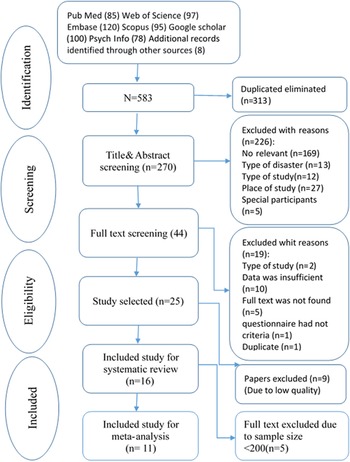
Figure 1 presents the results of the systematic review. The search yielded 583 studies, of which 313 were duplicates. Following the removal of duplicates, 270 titles and abstracts were identified for screening and among them 44 full texts were read in deep. Of 25 studies that were eligible for the study, 16 studies had the high quality, among them 5 studies were excluded because of a low sample size, and 11 studies remained in the study for meta-analysis.
Flow chart of study selection for review.

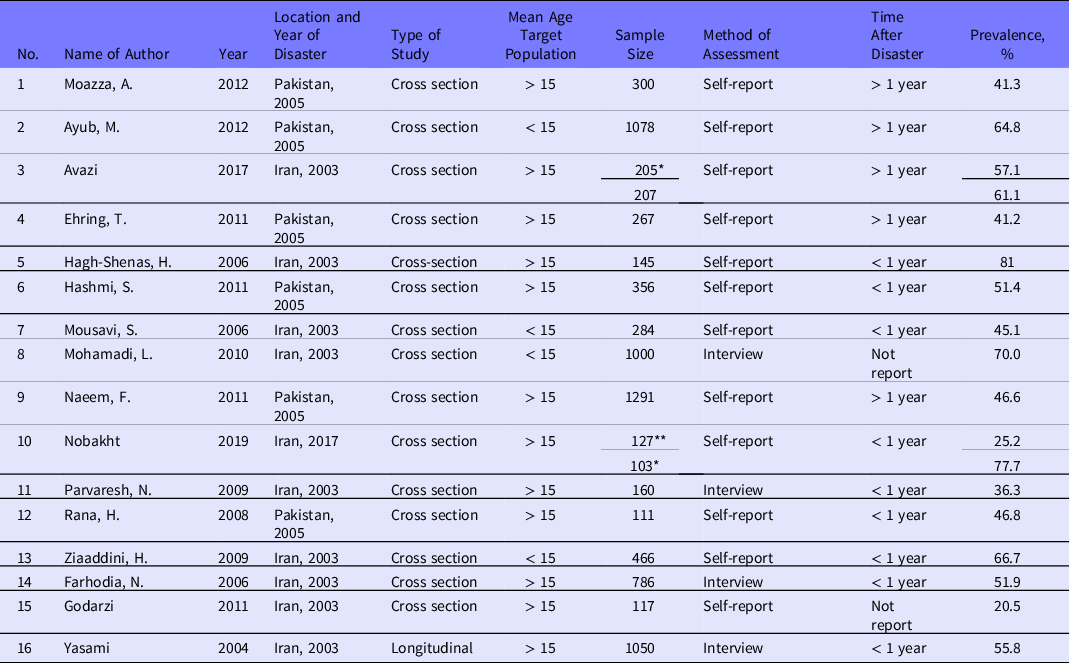
Sixteen studies met inclusion criteria, providing prevalence data for PTSD (Table 1) for a total sample of 8258 people. The majority of studies were cross-sectional studies, published between the years 2004 and 2019. Except for 1 article related to the Kermanshah earthquake in Iran, Reference Nobakht, Ojagh and Dale19 the rest of the studies were related to 2 earthquakes that struck Iran (in 2003) and Pakistan (in 2005). Most of them were from Iranian studies. Two different mean age groups (younger than 15 years and older than 15 years) were identified during the data extraction process. The mean age in 12 studies was older than 15 years, and 4 studies had a mean age younger than 15 years. Three studies presented the prevalence rates for men and women inclusively. Reference Naeem, Ayub and Masood9,Reference Gholampoor, Bina and Mahmoudi-Gharaei20,Reference Farhoudian, Rahimi Movaghar and Radgoudarzi21
Characteristics of 16 studies on the prevalence of PTSD after the Iran and Pakistan earthquakes

* Near the epicenter.
** Far from the epicenter.
A variety of the standardized instruments (self-report questionnaires and clinical interview) had been used to assess PTSD, including the Davidson Trauma Scale, The Children’s Revised Impact of Event Scale (CRIES-13), The Impact of Event Scale – Revised (IES-R), The PTSD Symptom Scale, The Traumatic Stress Symptom Checklist (TSSC), Posttraumatic Stress Diagnostic Scale (PDS), The PTSD Symptom Scale – Interview (PSS-I), Watson interview, and the Composite international diagnostic interview (CIDI). The majority of studies used the self-report method for data collection. Reference Naeem, Ayub and Masood9,Reference Gholampoor, Bina and Mahmoudi-Gharaei20,Reference Ali, Farooq, Bhatti and Kuroiwa22–Reference Ehring, Razik and Emmelkamp30
Most of the studies were conducted within shorter than 12 months after the occurrence of the disaster. Reference Gholampoor, Bina and Mahmoudi-Gharaei20,Reference Farhoudian, Rahimi Movaghar and Radgoudarzi21,Reference Hashmi, Petraro and Rizzo23,Reference Hagh-Shenas, Goodarzi, Farajpoor and Zamyad25–Reference Ziaaddini, Nakhaee and Behzadi27,Reference Yasamy, Farajpour, Gudarzi and Bahramnezhad31,Reference Parvaresh and Bahramnezhad32 As mentioned in the method section, we excluded 5 studies because the sample size was less than 20019,25,26,28,32 and performed a meta-analysis on 11 studies based on the location of the disaster (ie, Iran and Pakistan). Then, these studies were presented based on age group, sex, the method of assessment, and the time lag between the occurrence of the disaster and study, without performing a meta-analysis. Thus, in the following, the pooled prevalence is presented based on location, and then more details of prevalence based on other subgroups are presented.
Pooled Prevalence: Results of a Meta-Analysis
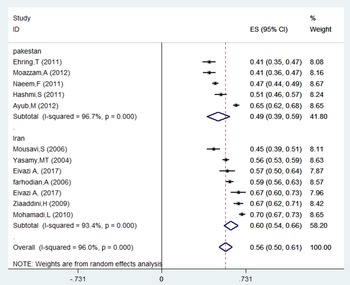
The results of the included studies show a varying picture of the prevalence of PTSD, ranging from 41% to 70% (Figure 2). The pooled prevalence was 56% (95% CI: 50–61). In the following, pooled prevalence is presented based on subgroup: the place of the study (ie, Iran and Pakistan).
Prevalence of PTSD after Iran and Pakistan earthquakes.

The Prevalence by Place of Disaster
Among the reviewed studies, 10 of them were related to the earthquake in Iran. Reference Nobakht, Ojagh and Dale19-Reference Farhoudian, Rahimi Movaghar and Radgoudarzi21,Reference Eivazi and Meysami24,Reference Hagh-Shenas, Goodarzi, Farajpoor and Zamyad25,Reference Ziaaddini, Nakhaee and Behzadi27,Reference Goodarzi and Tarikhi28,Reference Yasamy, Farajpour, Gudarzi and Bahramnezhad31-Reference Mohamadi, Mohamadkhani, Dolatshahi and Golzari33 We performed a meta-analysis on 6 studies. The pooled prevalence of PTSD was 60.2% (95% CI: 54.1–66.3). The highest and lowest prevalence of PTSD in Iran was 45% and 70%, respectively (see Figure 2). The lowest prevalence was among 284 adolescent survivors, 7–9 months after the earthquake. Data were collected using the PDS. The highest prevalence was related to 1000 students who survived in Iran. The PSS-I was used for data gathering. Reference Hoy, Brooks and Woolf18
Six studies were related to Pakistan. Reference Naeem, Ayub and Masood9,Reference Ali, Farooq, Bhatti and Kuroiwa22,Reference Hashmi, Petraro and Rizzo23,Reference Ayub, Poongan and Masood29,Reference Ehring, Razik and Emmelkamp30 We performed a meta-analysis on 5 of them. The pooled estimated prevalence of PTSD was 49.2% (95% CI: 39.4–59). PTSD prevalence ranged from 41% to 65% (see Figure 2). The lowest prevalence was identified in 2 studies. One of them, which was conducted 2 years after the disaster, was among 267 recovery workers. The IES-R questionnaire was used for data collection in this study. The other study was conducted 30 months after the disaster on 300 survivors, using the Davidson Trauma Scale.
The highest prevalence was related to a study that was conducted 18 months after the disaster of 1154 adolescents. Data were collected using the CRIES-13. Based on the obtained results, 92% of survivors had a family death.
Results of Prevalence Based on a Systematic Review
Age Categories (younger than 15 mean age years versus older than 15 mean age years)
Among survivors who were older than 15 mean age years, the range of PTSD was 20.5% to 81%. The highest prevalence was found among survivors of Bam (Iran), who lived in camp or temporary residence. The sample size was 145. This study was conducted 40 days after the Bam earthquake, using the PTSD Symptom Scale. Reference Bryant, Gallagher and Gibbs3 The lowest prevalence was among 117 survivors who were employed. Reference Goodarzi and Tarikhi28
Among survivors who were younger than 15 mean age years, PTSD prevalence was between 45.1% and 70%. The lowest prevalence was among 284 survivors, 7–9 months after the earthquake. These data were collected by the PDS. Most of them were students (79.2%), and 23.6% of them had lost at least 1 first-degree relative. Reference Gholampoor, Bina and Mahmoudi-Gharaei20 The highest prevalence was related to 1000 students who survived the Bam earthquake. The PSS-I was used for assessment. About 89% of them lost relatives and 33% were reported with a preexisting mental disorder. Reference Mohamadi, Mohamadkhani, Dolatshahi and Golzari33
Prevalence by Sex
Among these studies, 3 of them have reported distinct prevalence rates for men and women. Reference Naeem, Ayub and Masood9,Reference Ghomian and Yousefian13,Reference Farhoudian, Rahimi Movaghar and Radgoudarzi21 The lowest and highest prevalence of PTSD among men was 39.7% and 50.5%, respectively, and, for women, they were 53.4% and 60.3%, respectively. The low prevalence among men and women was reported in a study conducted in Pakistan, using the PTSD Symptom Scale questionnaire 18 months after the earthquake. Among the survivors, 47.1% of them reported a loss of a close family member. The highest prevalence among both sexes was reported in an Iranian study in which a clinical interview 8 months after the disaster was used for data collection. A significant number of survivors (89.3%) was reported with the loss of at least 1 of their close relatives.
Prevalence by Methods of Data Collection: Self-Report and Clinical Interview
The range of prevalence was reported between 20.5% and 81% by the self-report method. The lowest prevalence was related to the study among Iranian survivors using an Eshel questionnaire, Reference Goodarzi and Tarikhi28 whereas the highest prevalence was among Iranian survivors using the PTSD Symptom Scale. Reference Hagh-Shenas, Goodarzi, Farajpoor and Zamyad25
The prevalence by clinical interview method was between 36.3% and 70%. The lowest prevalence was found in a study conducted using the Watson interview method on 160 students, 4 months after the earthquake, Reference Parvaresh and Bahramnezhad32 whereas the highest prevalence used PSS-I on 1000 Iranian students. Reference Mohamadi, Mohamadkhani, Dolatshahi and Golzari33
Prevalence by Time Lag Less Than 12 Months Versus Greater Than 12 Months
The interval between the occurrence of disaster and assessment of PTSD in 9 articles was shorter than 12 months. Reference Nobakht, Ojagh and Dale19-Reference Farhoudian, Rahimi Movaghar and Radgoudarzi21,Reference Hashmi, Petraro and Rizzo23,Reference Hagh-Shenas, Goodarzi, Farajpoor and Zamyad25-Reference Ziaaddini, Nakhaee and Behzadi27,Reference Yasamy, Farajpour, Gudarzi and Bahramnezhad31,Reference Parvaresh and Bahramnezhad32 The lowest prevalence of PTSD was 36.3% among Iranian students, 4 months after the earthquake. The highest was 81% among Iranian people, 6 weeks after the disaster.
The time lag between the occurrence of the disaster and the assessment of PTSD in 5 articles was longer than 12 months. Reference Naeem, Ayub and Masood9,Reference Ali, Farooq, Bhatti and Kuroiwa22,Reference Eivazi and Meysami24,Reference Ayub, Poongan and Masood29,Reference Ehring, Razik and Emmelkamp30 The range of PTSD prevalence was between 41.3% and 66.7%. The time lag in the lowest and highest prevalence was 30 months and 18 months, respectively.
Discussion
We reported only a small part of the study as a meta-analysis. Due to methodological limitation, the majority of the results were reported as a systematic review. The results of meta-analysis showed that the pooled prevalence of PTSD was 60.2% and 49.2% among Iranian and Pakistani survivors, respectively. The results of the systematic review showed a high prevalence among both age groups younger than 15 years and older than 15 years. Women were more vulnerable than men. The variation of the prevalence based on the clinical interview method was less than the self-report method. The prevalence of PTSD decreased with the long time period between the occurrence of disaster and assessment of the disorder.
Our review revealed that post-disaster PTSD is a common disorder among the survivors after the earthquake. These results show that about half (48.8%) of the Pakistani survivors and more than half (60.6%) of the Iranian survivors suffer from PTSD after a disaster. A previous meta-analysis study showed that the global prevalence of PTSD after the earthquake was 23.66%, Reference Dai, Chen and Lai8 which is considerably lower than those of the current study. This discrepancy could be explained by several reasons. Our study was limited to Iran and Pakistan, and the cited comparison article included all relevant studies around the world. The majority of them were on related studies in other countries, which have many contextual differences with Iran and Pakistan. Theses contextual factors, such as higher prevalence of preexisting mental disorders in the study setting, may be responsible for the high prevalence of PTSD in our study in some ways. First, the lack of mental health preparedness might be a major cause of PTSD prevalence. Reference Roudini, Khankeh and Witruk34 The second might be the shortage of psychosocial support programs in developing countries, Reference Gilbert, Patel, Farmer and Lu35 including Iran and Pakistan. The next factor is the weakness of infrastructures and a shortage of resources to respond to a disaster, which might not be adequate to meet the needs of the affected population. In this case, countries seek international help; however, international aids in some circumstances might even lead to poor results. Reference Powell36 Finally, there are some barriers to seeking mental health care that make survivors reluctant to seek treatment and result in increased rates of mental disorders. Reference Kantor, Knefel and Lueger-Schuster37
The current study showed that the prevalence of PTSD among Iranian survivors is higher than that of Pakistani survivors. Some factors that can influence the prevalence of mental disorders are the characteristics of disaster, including severity of the disaster, the extent of trauma, proximity or distance from a disaster location, background factors, personality traits, and social support. Reference Neria, Nandi and Galea6 Although the severity of the Pakistan earthquake was higher than in the Iran earthquake and caused more mortality and morbidity, perhaps preexistence disorder is one of the factors that contributes to the high rate prevalence of PTSD in Iranian people. A study in 1999 showed that about one-fifth of the Iranian population suffered from mental disorders. Reference Noorbala, Yazdi, Yasamy and Mohammad38 Moreover, Pakistani people might be more resilient compared with the Iranian people.
In the present study, we grouped our results based on the 2 mean age groups: younger and older than 15 years. Although the difference between the prevalence of PTSD between the 2 age groups is not very obvious, in both developed and developing countries, PTSD is a predominant mental disorder among young people. Reference Kaminer, Seedat and Stein39 There are many reasons for the high rate of PTSD among young people. Mental health needs of young people are complex and diverse. Reference Jones40 Also, this age group does not have adequate experience, skills, and resources, and thus is vulnerable to the impact of the calamitous event. Reference Schonfeld and Demaria41
The range of PTSD among survivors older than 15 years was between 20.5% and 81%. This variation in the prevalence may be due to the difference between the target populations. There was a prevalence of 81% for Bam survivors who lived in a tent or temporary residence and a prevalence of 20.5% for survivors who were employed. It might be due to that people who lived in a tent or temporary residence were in a more unstable situation of living or job, or they might experience severe impacts of the disaster.
The range of PTSD among survivors younger than 15 years was 45.1% to 70%. A potential explanation for the variation in this age group could be explained through the different impact of the disaster; within the lowest reported prevalence (ie, 45.1%), only 23% of them lost a relative at the earthquake. In comparison, the corresponding figure for the highest prevalence of PTSD (ie, 70%) was 89%. Compared with the rates of PTSD in the Wenchuan earthquake, the rates of PTSD in our study were significantly higher. The prevalence of PTSD among adult and children after the Wenchuan earthquake was reported to be 15.57% Reference Zhou, Kang and Sun42 and 19.2%, Reference Chen, Xu and Li43 respectively. The reason for the lower rates in the Wenchuan earthquake might be that China is more experienced in managing the impact of earthquake, including mental disorders. Reference Neria, Nandi and Galea6 Of course, there may be other factors of this discrepancy, such as the method and time of assessment, and the prevalence of the disorder before disaster.
The results show that the prevalence of PTSD among woman is higher than that of men. This finding is consistent with many studies. Reference Dai, Chen and Lai8 The sociocultural and cognitive factors have a pivotal role in explaining gender difference. Reference Wade, Fletcher, Carty, Creamer, Castle and Abel44 The sociocultural element, especially in a developing country, has an important role in the vulnerability of a woman. The less access to power for decision making, as well as the values and traditions that are prominent in these societies, makes a woman more vulnerable to disaster impacts. Reference Baig and Sharif45
In our study, the time of assessment of PTSD was categorized into below and over 12 months. Although the difference between the prevalence of PTSD among the 2 categories is not very obvious, in both, the rates of PTSD decreased over time. A systematic review identified a decrease in PTSD from 28.8% at 1 month to 17.0% at 12 months. Reference Santiago, Ursano and Gray46 Considering the that PTSD is a curable disorder, a number of affected people can recover, leading to a declined prevalence over time and only a small percentage of people suffering from chronic PTSD in the aftermath of a disaster. Reference Self-Brown, Lai and Thompson47
The results about the method of measurement showed that PTSD prevalence is different according to the self-report and interview approaches. The results showed that the variation related to clinical interview is lower than the self-report method. This finding shows that clinical interview is probably more precise than the self-report method. However, the literature highlighted that both these methods might overestimate or underestimate the outcome. Reference Paykel, Norton, Sartorius and Ban48
This systematic review has a number of important limitations. First, despite the occurrence of natural disasters in Iran and Pakistan, we failed to find adequate articles on subgroups of populations. Second, we did our best to find the full texts of some articles but could not succeed as many systematic reviews. Third, we found a variety of instruments for PTSD assessment, which might affect the results of a meta-analysis. To overcome this problem, at least to some extent, we proceeded the analysis through consulting with a physiatrist who was expert in the systematic review. Then, to reach more accurate results, we categorized instruments into self-report and clinical interview methods.
Conclusion
Aftermath PTSD is a common disorder. The studies conducted in Iran and Pakistan presented different results. The results of meta-analysis identified that post-disaster PTSD in Iran is more prevalent than in Pakistan. The results of this systematic review showed that the rate of PTSD was high in both age groups (younger and older than 15 years). Also, the shorter the time lapses between the occurrence of disasters and time of the study, the higher the PTSD prevalence. Also, PTSD among woman was higher than among men. The clinical interview method showed less variation on the rate of PTSD than the self-report method.
Disaster managers should be aware of the high prevalence of PTSD to better address the needs of affected people. Appropriate planning and interventions can reduce the prevalence of the disorder. Because social problems after disasters can lead to mental disorders, future studies should aim at discovering a social problem in the wake of disasters.
Conflict(s) of Interest
The authors declared no potential conflicts of interest with respect to the research, authorship, and/or publication of this paper.
Acknowledgments
We would like to acknowledge and thanks the fanatical support provided by the Iran National Science Foundation of Vice-presidency for science and technology, the office of president.