Auch kleine Dinge können uns entzücken
Auch kleine Dinge können teuer sein
(Paul Heyse)In his literary autobiography, Le vent Paraclet, Michel Tournier records how during his time at the Lycée Pasteur in Neuilly he and his fellow classmates found a source of great hilarity in their favourite bêtisier, a volume called Pensées de Pascal, in which one learns that painting is a frivolous exercise that consists in imperfectly reproducing objects that are themselves quite worthless. Fairness to Pascal – far from Tournier's mind in those early days – demands that that offending pensée, which belongs in the sheaf of Vanités, be seen more as a summary of Saint Augustine's views than as a record of Pascal's own, and one that was rooted in a tradition stemming from Plato that deprecated all varieties of mimesis. Setting historical adjustment aside and reining back on the boys' sophisticated amusement, one may well wonder whether the view Pascal records does not contain a grain of truth. Are there not indeed kinds of painting that we prize, yet which are well chosen butts of this criticism? In particular, still life painting concerned to record the trivia of domestic life, pots and pans, fruits and meats, glasses and all sorts of everyday tableware looks to be sharply exposed to Pascalian scorn. If this Platonic or in Augustine's case, neo-Platonic, attack on painting is to be warded off in general then it had best be done here where it appears at its most pressing. And if it cannot be warded off here, then still life painting at least is moribund, probably lifeless, nature morte mort indeed.
Here I propose to explore a line of thought that stems from Schopenhauer's reflections about the nature and value of our experience of painting and ask whether there may not be something in his ideas fit to draw the sting of the contempt. What makes Schopenhauer a nice choice as still life's champion is that what he aims to do is not just to confute Platonic or neo-Platonic doctrine, but to show that in the finest painting we are given irreplaceable access to what the true Platonist esteems above all else, to Forms or Ideas. If some version of that thought can be made plausible in regard of still life painting, the neo-Platonist of Augustinian stamp will be shown to have closed his eyes there to the very thing that should keep them firmly open. As deft a rebuttal as one might wish for – if only it can be made out.
First a little crude exposition. Our world is the world as we represent it, and the perceived character it takes on is fundamentally a reflection of our needs, interests and desires. The urgencies of the moment, together with our long term goals and strivings, give our world its colour and its tone, but they distort our grasp of it as it is independently of those concerns. By contrast, in our more contemplative aesthetic engagement with the arts we are relieved from the treadmill of everyday life and its subservience to the imperious will, and there we can enjoy a far less distorted view of things. There, Schopenhauer thinks, we can be shown by the artist of genius the inner core and substrate of the world – Will – as it takes on perceptible shape and acquires immediate and adequate objectification unclouded by the clamouring of desire. In the arts we are offered a view of the world not as it usually apprehended, that is for us, für uns, but as it is in itself, an sich. The beautiful is just what manifests the Ding an sich (scilicet, Wille) as an object of knowledge and as such qualifies as Platonic Idea, something that is fully real, entirely generic in nature and immune to the vicissitudes of passing time.
In the aesthetic contemplation of things – be that in nature or in art (though primarily in art) – Schopenhauer holds that we find two things going on: first, we experience relief as we free ourselves, even if only briefly, from the pressures of will, the endless cycle of desire, its satisfaction and then the renewed onset of desire. Secondly, through our enjoyment of its beauty, art supplies us with pure knowledge. This cognitive satisfaction has its effect beyond the aesthetic moment in that it acts as what Schopenhauer called a Quietive, encouraging us to resign ourselves to our condition rather than pointlessly battling against it. Such is the lesson he took to lie at the heart of the Christian ethic and that of Eastern religions too. While this sense of relief is primarily what we gain from the beauties of nature and the minor arts, in the arts that concern themselves with human matters (especially history painting and poetry) the cognitive aspect of the story is to the fore and it is there that we are moved more surely beyond the momentary freedom that is provided by any restful quietive gain.
So much by way of bare summary. Clearly there is much here that is not particularly encouraging. But let me pick out the central matter to pursue. At the heart of the story – and what has to be preserved if anything worthwhile is to be made of it – is the idea that the best art provides a desirable correction or adjustment to our customary everyday way of seeing and thinking about things, in Schopenhauer's eyes the theoretical replacing the practical, pure knowledge standing over against end-directed representation. More specific is the idea that the crucial adjustment Schopenhauer had in mind was the exchange of the für uns representations of specific matters by an sich generic ones. So we should be able to ask whether in still life painting there are plausible cases that might serve to illustrate the point. Examples of a sort that look broadly supportive of the view come readily enough to mind.
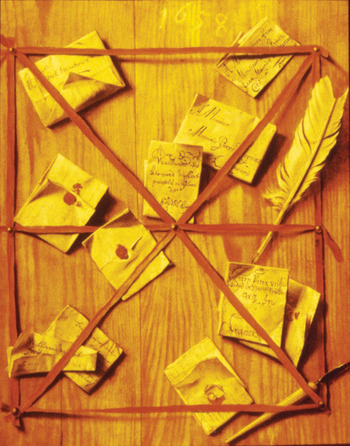
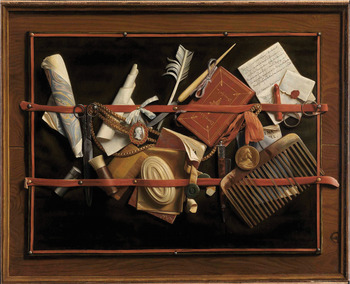
The first I offer is the sort of trompe l'oeil painting that detaches the things that collect around us or which we collect around ourselves and displays them in settings that set them off against ourselves. Such, for example, are Wallerant Vaillant's Letter-rack in Dresden (Figure 1) and Samuel van Hoogstraten's Steckbrett in Karlsruhe (Fig. 2). The trompe l'oeil aspect of these seventeenth century works has the effect of showing these objects – to put it tendentiously – as they really are, as opposed to the way in which they are usually seen, bound by the framework of our practical concerns – letters being read, written, sanded and sealed or, in the case of the Steckbrett, articles that serve the everyday practical activities of their owner. Here though, the person is quite absent and these objects take on an insignificance that displays them for what they are in themselves, not so much trinkets as junk (junk, just because they have no existence beyond the concerns of the persons they serve). These witty pictures do not strip those objects of their significance; they reveal them for what they are, insignificant.
Wallerant Vaillant, Letter-rack (1658) © Gemäldegalerie Alte Meister, Staatliche Kunstsammlungen Dresden.

Samuel van Hoogstraten, Still Life (1666–68), oil on canvas (63×79cm). © Vereingung der Freunde der Staatlichen Kunsthalle, Karlsruhe.

Given that, for Schopenhauer, these generic items must be counted as specimens of a low grade objectification of the Ding an Sich they would have been welcomed by him more for their provision of relief or detachment from the pressures of practical life – tiresome communication with others, say, in the case of the notes and letters, or the labours of toilette for social effect or work in the writer's studio in that of the Steckbrett – than for any far reaching insight into they might provide about the world. For that we need to turn elsewhere where more is at stake than pretty conceit.
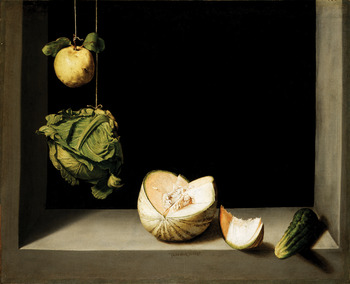
An example that looks better able to bear the burden is provided by Juan Sanchez Cotán's Quince, Cabbage, Melon with Cucumber in San Diego (Fig. 3). It is no longer a trompe l'oeil but a painting that offers to view items of the natural world displayed in a space from which onlookers feel themselves firmly excluded. It is a world in which those fruit and vegetables have almost only spatial relations to one another, and even there they are arranged in a carefully crafted but entirely mysterious way. It is as if their order emphasizes their ultimate independence of one another and, of course, of us, and so epitomizes the artist's prime concern for the an sich rather than the mere für uns.
Juan Sánchez Cotán, Still Life with Quince, Cabbage, Melon and Cucumber (c1602) © San Diego Museum of Art (http://www.TheSanDiegoMuseumofArt.org).

Without any reference to Schopenhauer the art historian Norman Bryson has commented on Cotán's work in terms that would have struck a chord. He writes: ‘Cotán's paintings aim to persuade vision to shed its worldly education, – its sloth, the blurs and entropies of vision that screen out everything in creation except what the world presents as spectacular. Against these vices of fallen vision, Cotán administers his antidote: hyper-reality.’Footnote 1
But hyper-reality or Ding an sich with a purpose, one should say: in its period and place, in deeply Catholic Spain of the late sixteenth century, Cotán's work was an invitation to spiritual exercise – meditation from a distance on the wonder of God's creation in its smaller parts and a reminder of our duty to adore Him through appreciation of that wonder. Even the geometrical disposition of those fruits intimates a divine order and in its mystery further emphasises our subservience to a higher power which we are called to worship. So at least in that case, unlike the two trompe l'oeil ones, the reward of the picture is in part an ethical one that extends well beyond the kind of pure cognition that Schopenhauer would have encouraged us to find there.
Indeed, for him the religious-cum-ethical teaching of Cotán's work could not sit at all well with the Platonic Idea he favoured, for the God that is posited there had no reality and was, as far as Schopenhauer could see, just a fable, whereas Platonic Ideas can only be of what is truly real. And it won't do for him to say that the true subject of the picture is the Will as objectified in fruit and vegetables (as he does in relation to the work of his favourite painters, Raphael and Correggio) for that then makes those works' ethical aspect incomprehensible, substituting resignation to our alienated situation for their more positive redirection of practical thought.
To make progress and to preserve a healthy sense of reality in our dealing with still life painting two adjustments recommend themselves. First, as even the hyper-reality of the Cotán makes clear, at the heart of such pictures is a thought about the relation between what is depicted and ourselves. Even though we feel ourselves to be excluded from the strange world of those familiar fruit, the idea to which we are led is nonetheless about our relation to the order they would reveal. Schopenhauer's idea that relief from pressures of the will demands that we abstract from all thought about the relation of depicted subjects either to each other or to ourselves cuts us off from what enables them to make most sense. Then, secondly, if we are to account for what lies at the heart of a picture like Cotán's, the idea of pure knowledge that comes with the reintroduction of Platonic Ideas must be enlarged to embrace such normative elements as come with making the first adjustment.
It may be that it would be less misleading to speak more modestly of reflective knowledge of how things are for us rather than of pure knowledge of Ideas while still preserving much of what is most interesting in Schopenhauer's thought. For instance, he insists that we are concerned with types or species rather than individuals – and about the Cotán it is right enough to say that at least there is no answer to the question: Which quince is there on display? Which melon? Just a melon; just a quince. (Interestingly, Schopenhauer pursues that theme even when it comes to portraits, insisting that each individual typifies a generic aspect of humanity – and maybe the appeal of portraiture itself lies less in capturing likenesses of individuals we care about than in its exploration of the extraordinary ways in which spirit takes on bodily form.) Then, secondly, and for Schopenhauer quite centrally, the vision that the artist offers us may well act as a corrective to or adjustment of the way our view of the world comes to be deformed and distorted under the pressures of practical exigency, egotistical velleity and the like.
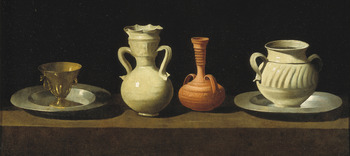
These points can be illustrated in the work of another Spanish still life painter of the early seventeenth century, Francisco de Zurbarán. His study of Metalware and Pottery in the Prado (Fig. 4) situates its objects in strict geometrical formation, somewhat like the fruit and vegetables of Cotán, but here the space is one that invites us in rather than excludes us, and the objects visibly bear on them the marks of the human hand in their making as well as the way they are adapted to the movement of the body in the ways they are fashioned to be lifted and moved about.Footnote 2 This picture too, like Cotán's, invites us to meditation, but, unlike it, exploits the thought that in human artefacts we also find scope for adoring God's work, for, a seventeenth century spectator might reflect, not only did He create the world for man, man too is His creation and in properly admiring human artefacts we give thanks for that generosity of God's in our regard.Footnote 3
Francisco de Zurbarán, Metalware and Pottery (1658–64) © Museo Nacional del Prado – Madrid (Spain).

In both these cases I think we are struck by the way in which the apparently trivial material – the humble objects of the bodega or the cantanero – is revealed as having a significance that we might not have expected. They work on us by removing those objects from their immersion in everyday activity that directs attention away from them and focuses it on the immediately given instead. Fruit and vegetables encountered in everyday life are on their way to the table and consumption; pots, glasses and other vessels, mere containers of future nourishment and thirst-quenching pleasure, but in the picture those aspects of their common presence recede. It would be misleading – as well as pretentious – to think of these objects as being invested with some metaphysical or transcendent significance, for what is actually going on is that they are being shown really to have that retrieved significance for us, one to which the picture teaches us to be alert in the life we lead beyond the picture's frame. That is, the view the picture offers us of its subject has its value not just in its purely aesthetic character but far more in the way in which it contributes to the rich and complex way in which such everyday things are incorporated in the conception of the world that we unconsciously build up through our interaction with its humbler contents and their surroundings. The connection between Schopenhauer's formulation in terms of pure knowledge of Ideas and what we have here is found at the point of what I call a reflective incorporation of such things in our internalized conception of the world.
Nevertheless, the examples I have mentioned could well be seen not so much as illustrative of Schopenhauerian theory as a warning against trying to carry it through. After all, the first of them seems to come closest to the an sich of their subjects, yet more as a conceit than as revelatory of their essence. And as we try to preserve something of that essence in the Cotán and the Zurbarán, what emerges quite plainly is that that is only achieved as we focus on the significance the depicted objects have in relation to ourselves and not as they stand quite independent of all humane considerations.
The ground is made muddier than it need be by Schopenhauer's insistence on the Platonic image, and his Augustinian adversary may think that to protect his own position it suffices to throw cold water over that aspect of his thought. So while Plato's Ideas are auto kath' auto, and must putatively surface in art as such if they are to do so at all, the recognition that we should be looking in the direction of the sense things are shown to have for us indicates that something is already giving way. Then too it could be observed that Plato's Ideas were of themselves necessarily inaccessible to sensible experience, yet what Schopenhauer offers us in their name is apparently sensibly recorded in the finest painting. Thirdly, and this is something that demands more than passing comment, the timeless validity and stability of Ideas does not look likely to be replicated in the shifting patterns exhibited by the arts in all their various guises, the painting of still life included.
So should we allow that the adversarial case is made and turn our backs on Schopenhauer in the supposition that there is nothing to take away here from his teaching in the aesthetic chapters of his volume? Certainly not for the reasons just mentioned. Maybe the appeal to Plato is florid and overdone, but the central message is that one leading value of painting – not the only one of course, but certainly a leading one – is to be found in its cognitive deliverances; and a message of subsequent but striking importance is that the arts supply a route to that goal, or good, which is otherwise often unavailable or available only with difficulty. It is only if these claims should fail that the verdict will finally turn out to be negative and it is primarily with them in mind that we should square up to his deflection of the attack recorded in Pascal's Pensées.
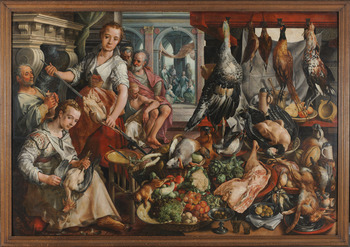
At the very outset, though, it might seem that the fundamentally cognitivist position that we are being offered is not one that can be safely occupied. Knowledge of how things are supposits truth in all its cases, yet are there not pictures to which the Schopenhauerian idea ought to extend but whose would-be cognitive claims involve opposites that cannot be plausibly combined. An instance of the sort I have in mind is provided by the so-called ‘inverted’ still life morality of Joachim Beuckelaer's Well-stocked Kitchen in the Amsterdam Rijksmuseum (Fig. 5), where the foreground images display tables of enjoyable plenty and abundance, while almost indiscernible in the background scenes from the gospel story play out. There in view, but easily overlooked, are the Flight into Egypt and Christ in the house of Mary and Martha, and their being visibly overlooked serves as a reminder of what we have forgotten or neglected, the repulsive side of that foregrounded surfeit. And if those two examples are contested as lying beyond the still life genre that concerns me or are just too far-fetched to illustrate the point convincingly, the Cotán supplies another case. The melon and the quince we see there come across at once as humble and majestic, both modest and grandiose, something that is central to any full appreciation of that marvellous work.
Joachim Beukelaer, Well-Stocked Kitchen (1566) Oil on panel, 171×250cm © Rijks Museum, Amsterdam.

At its heart the market stalls cannot be at once gloriously and replusively abundant; majesty and humility cannot both properly characterize the same fruit at the same time. And the peculiar image of reality that Schopenhauer wanted to exploit would get lost if one sought to respond to the difficulty by saying that such pictures display knowledge both of what is the case (hedonic abundance or majesty) and also of what ought to be sovereign, ascetic restraint or humility as preached by the Reformed Church, i.e., of what ideally is the case. For as Schopenhauer uses his image, what the artist achieves is always grasp of the real as opposed to the ideal and the challenge posed by such conflicts as these pictures face us with cannot be resolved by reifying the ideal alongside yet opposed to the actually real. And of course the challenge is not limited to a few pictures that show up both conflicting features. That is just a vivid illustration of the more general point that the supposed cognitive reward looks under threat as soon as we acknowledge that distinct pictures can claim our approval yet offer to our view what are dubiously combinable features of the same things.
What this hesitation about the cognitivist project should do is not make us abandon it, but be clear about the way the knowledge it has in view is identified. Talk of the essence of things, of Ideas, of Dinge an sich naturally encourages the thought that we have in mind knowledge and truth about the world as it is independently of us, where all truths can coexist and where there are no conflict-generating contraries. But once the move is made from the natural world to the Schopenhauerian ‘world as representation’ and which we have got used to speaking of as the Lebenswelt, or as what Kant had once called ‘second nature’,Footnote 4 that constraint no longer applies with any bite. The artist of talent can make it compelling that the world for us is structured one way and also in a way that is at odds with that first, as is achieved in the ‘inverted’ cases. Again, different artists, sensitive to potentially opposed features of things that engage us, can display their being thusly disposed in one case and in another to an equally powerful but opposed conception of those same things without there being any incoherence in our supposing that they both achieve cognitive insight.
Something that Schopenhauer could well draw on to outflank the criticism and to make his own point is his insistence that the artist is less concerned with the individual than with the generic, a point we have already met in noting that Cotán is not painting any particular melon and quince, but just a melon, just a quince. And while no melon or quince in the world of nature can possess incompatible properties, the way in which we respond to melons and quinces and their like in our Lebenswelt can and often does encompass strains to which individuals of the natural world are hardly subject. So the best response to the critically offered reflection is not to dismiss it, but to redirect it so that its base is given the proper weight, encouraging us to see that the phenomenon it highlights sits well within the cognitivist's field without being at odds with it.
In sum then, as long as we remember that we have to do with second nature, with ‘the world as representation’ in the best way of taking that famed phrase, the cognitivist need not be daunted. He will abjure any attempt to treat the world as we represent it as, at its best, the world as it is in itself and so free of inconsistency, but instead more modestly express an interest in capturing aspects of it that reflect our very mixed internalized attitudes towards that world – attitudes that may themselves be incommensurable and evidently at odds with one another. Within Schopenhauer's world as representation, taken as our Lebenswelt as we have it and as not a boring version of Berkeleyian or Kantian idealism there is ample room for conflicting opposites, and no bar to the painter seeking to exploit that fact. Witness the Cotán and the Beuckelaer.Footnote 5
A corollary – though one without any specific application to our thought about still life – is this. As long as the represented world is thought of as an approximation to the world of first nature then it is natural to think of artistic success, when the cognitivist programme is running, as adding knowledge to knowledge already acquired, and constrained by the usual logical demands of consistency and coherence. Then it will be found quite natural to think of the historical succession of great artists somewhat in the way we sometimes think, ideally and naively maybe, of the succession of great scientists – at their best cumulatively contributing to our progressive understanding of the world, one that approaches closer and closer to an ideal limit (realistically conceived). As we look back over the past in the grip of that picture, it hard for us not to think that the arts of the past are bound to be inferior to those of the present even as we foresee that what we achieve in the present is due to be surpassed and rendered obsolete by what the future will bring in its place.
Perhaps we can even see that the dismissive attitude that I have presented Schopenhauer as aiming to explode is itself a natural expression of that would-be ‘progressive’ conception of art. For in the end the cognitivist goal could only be perfectly achieved when there was a complete match between what the real world is like and the way it is mirrored in art – an idea of perfection that seemed to early thinkers to be already pointlessly achieved in the painting of Zeuxis and Apelles. The point would still stand even if later eyes, trained to detect mismatches between represented and representation even in the most convincing trompe l'oeil, will have had to wait for Luciano Ventrone or some other hyper-realist to attain that goal. As long as things are seen like that, the familiar jibe about the frivolity of making copies of what we already have is quite understandable and not easy to resist.
However, refocus the cognitivist's target as ‘the world as representation’, richer in its way than the world of nature, and neither of those points gains purchase. We can of course allow that there is progress in art: but only in the sense of movement from one rewarding point to another and not as movement towards some antecedently fixed end state. Once that is accepted, any judgment of superiority we are inclined to feel about the figurative work of our own day or its more or less recent past over that of earlier periods cannot be supported by an Augustinian or Pascalian conception of perfect reproduction. That is true even though we may think that what we prize in the still life painters' art is the way in which it can capture so accurately the way things are for us. Now the old jibe falls flat: the cognition that the artist arrives at and offers to the viewer is precisely of something that we do not already have, where we think of that ‘already’ as what is supplied by the world of nature. What is given to us beyond that is a display of how the world of nature enters into our lives in relation to our own place in it, where that place embraces the ‘what it is for us’ in as broad a sense as we like to give that phrase.
Trying to maintain his position, the Augustinian may think that he can concede the point, but that his criticism still holds good. After all, the Lebenswelt that the artist makes manifest is a world that is ours through and through and so is surely already in our possession. And in that case isn't it idle to attach ourselves to facsimiles of it?
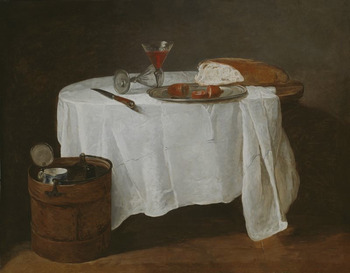
At this point we do well to remind ourselves here of the demand made by Schiller and Hegel that the artist be primarily concerned to find externalizations of what is internal, where the leading thought there is that we do not grasp what is actually internal until it is given adequate external expression. Of course our lived lives have the character they do, yet very often, they have that character without our being more than dimly aware of it. It takes distance to see what we are about, and in the practical urgency of getting things done that distance all too easily eludes us. Engagement with painting can provide the distance – so in the case of the ‘inverted’ pictures they can get us to see gluttonous surfeit as gluttonous or, to take another famous example of the genre, that of Chardin (Fig. 6), to find in our everyday domestic surroundings a delicacy and tenderness that we would otherwise quite miss.Footnote 6 The externalization of these attitudes and their like in still life makes us aware of the internal, the inner life that is ours in our immediate environment and to which in our day to day business we are are insensitive or even incapable of grasping before we find its expression in the artist's work. This, I suggest, is what we should make of Schopenhauer's thought that in our aesthetic life we find the intellect resisting the deforming pressures of unremitting will, yielding rare access to the elusive an sich of things. (When the world as representation is identified as the Lebenswelt his expression ‘an sich’ naturally rings alarm bells, but we should not suppose it stands for nothing; rather, it must pick out a rich and reflective ‘für uns’ that stands over against the depleted ‘für uns’ of habit and jaded familiarity and also of what we are no more than unconsciously aware.
Jean-Simeon Chardin, La Table d'Office (1757) courtesy of Le Musée de Beaux Arts, Carcassonne (who, generously, did not charge for their reproduction permission).

May there not be another intellectual mistake that in his a priori mode the Augustinian is trading on at this point beyond the misidentification already discussed? Perhaps. A view of mentality that comes with Descartes and which is explicitly endorsed by Spinoza is of what is transparent to the subject. Consciousness is necessarily for the subject and that transparency brings with it willy nilly consciousness of the subject's mental life (for Spinoza, iteratively so). So it could appear that the inner world of which the artist makes us aware is indeed already ours and hence its reproduction in art quite superfluous. But, of course, consciousness is indeed for a subject, yet only in the sense that consciousness belongs just to minded subjects. It is an entirely different matter to suggest that a subject is necessarily consciously aware of all his mental states. Of some he is, of others not. And the universal generalisation of that modest truth cannot be used to buttress the ‘already’ that is at the heart of the critic's complaint.
Maybe he will accept this too, and as a last a priori gasp hold out for the painter's externalized knowledge being frivolous and scarcely of value and, staking his colours to that mast, saying that along with much other knowledge about ourselves that we could acquire (How many hairs are there on my head? How long does my genome reveal I am likely to live?) what the still life painter shows us about the near to hand is hardly worth the effort of creating or the expense of acquiring. Nobody would be drawn to the crudest version of that reflection – one that comes in the version that the examined life is not worth living either – but one can again observe that there is a misleading philosophical assumption from which that thought may well spring: to wit, that the test of the less than frivolous can only be mounted on a base that is other than self-centred, in this case a base that is unbiased in our own peculiarly human direction. By contrast, once we recognize that any test for frivolity and its opposite can not but be geared to our own standards and preoccupations generated from within the sort of lives that are ours and what sort of persons we are and can decently aspire to be, that last plank of the negative and denigratory case also gives way.
All this does of course still leave open the question of my title - whether there is still life in Still Life. For even if still life at its best gives expression to the attitudes we have unconsciously or unself-consciously to our domesticity, its surroundings and decoration and so on, is there any reason to think that the art of the past has not already exhausted the field? (If not, and if the field is as it were constantly renewed, must we say that in the present we lose what the past once gave its own contemporaries?). Only the initial running together of the Lebenswelt with the world of first nature would give the rhetorically implied answer to that question any plausibility. True, the world of nature is basically stable and discoveries we make about its structure do tend to accumulate over time, while what in the main gets jettisoned are the mistaken beliefs that what had made up our conception of the world were in fact truths about it – believed in their day to have been discoveries, though not in fact being so. But the world of our imagination and understanding, ‘second nature’ is not like that. The character it has is constantly shifting in response to social, political, economic, philosophical and religious changes, and we must expect those changes to make themselves felt in the way in which we can best internalize our nearest surroundings (including our clothing, food, domestic furniture and so on) as they respond to those pressures on it. Seeing still life painting as of value for us on account of its ability to provide an externalization of the changing place these items have in our inner lives, recognizing the changing nature of that inner life, is at once to see that the insights acquired through the artistry of the past do not exhaust the field. So, as far as the cognitivist defence of the genre goes, there is indeed and indeed there will always still be room for still life – room that, once we acknowledge our need for it, we might reasonably expect to be fulfilled.
A word about the past. Is there an asymmetry here between real accumulating discoveries about the world of nature and replacement in the world of imagination (or representation) of established ways of thinking by the new, the cognitive gains delivered by paintings of the past being displaced by those of the present? If that were so to any marked degree then what spoke most clearly to its near contemporaries may strike us moderns as curiosities, and if the work of the past does still hold appeal for us it will do so for different reasons: as an antiquity; as an example of dazzling technique; as historical document and so on. What would be lost is the power that that art once had to anchor in the minds of its beholders the inner world it once displayed, just because and to the degree that that inner world is not any longer the world that once it was. For us nostalgia would have taken over from the vivid immediacy that our predecessors once enjoyed.
That is not how things stand. What seems more nearly true is that changing times make for adjustment of the inner life, make for changes of emphasis, so that the emergence of new ways of thinking and feeling that are added to the older ones alter the potency of the old without entirely reducing it to nothing. We are unlike the Catholic Spaniards of the sixteenth and seventeenth centuries, but their inner world still plays positively in our own, not just nostalgically so. Otherwise the Cotáns, the Zurbaráns and the Chardins could only move us under interpretations that do not really fit them. So in this respect we are all Whitmanesque; we are all large; we all contain multitudes.
So much for the past. What is still lacking is any sense that the bare painted externalization of the inner world I have spoken of plays back into any re-forming of that world, as it surely must. Clearly, just to be shown a flash photo or image of the inner can rightly be thought of as of little import if we do no more than simply acknowledge it and pass on to the next temporary focus of interest. It will only make its due effect through being easily available to be held before the eye. Now that might be supposed to be assured by the simple fact that the achieved still life image is fixed – the painter has captured what he is after, and once sealed by the varnish it does not move. But that is not all – it's not just that the image has to be stable, but access to it needs to be stable and undisturbed too if it is to have any truly forming and reforming effect. And this brings me to a further reason for thinking that still life still has a life.
As the power of particular fine work comes to be recognized, so pressure mounts for it to be made publicly available, and today that means to be conserved and presented in the museum, where it is the fate of most significant painting sooner or later to end up. Yet there, as Paul Valéry once remarked, it is that we become superficial.Footnote 7 Venus is transformed into document – and the last place where it is now possible to renew ourselves is in the confused and confusing assemblage of riches that the gallery prides itself on putting on show. What we need for intimate still lifes to make their effect is presence in the home where they can still be taken in at leisure and without distraction, and where what they rewardingly show becomes part of the fabric of life from day to day, and so can form and refresh that daily life. As it happens that is now something that can better be achieved by new work before the moment comes for it to serve out its days amid what Ruskin once called ‘the general lumber of the great pillage-reservoir galleries’.Footnote 8
Finally, among other things that the future life of still life depends on is the existence of intelligent patronage, the patronage of clear sighted individuals of fine taste, sensitive to the value that this genre of painting can offer. In the mid-1930s Valéry observed that ‘there is never any shortage of talented men of imagination born to artistic creation; but often what they need and is in short supply – indeed it is singularly lacking today – are those indispensable amateurs and connoisseurs whose pursuit of their very personal pleasure and the exercise of their very special intelligence is corrupted neither by the prospect of good business deals, nor by the success of their writing, nor by any ambition to be ahead, or on the crest, of fashion's wave’.Footnote 9 Perhaps the existence of such figures is even more precarious today than it was when Valéry wrote those lines, making still life's future less assured than it might otherwise be. One thing that could make both them and it rather less precarious is clarity about what is at stake.Footnote 10