INTRODUCTION
A stock can be defined as a group of individuals of a particular fish species whose genetic and life-history characteristics are more similar to each other, rather than to the other subpopulations (or stocks) (Waldman, Reference Waldman, Cadrin, Friedland and Waldman2005). The stock concept has been introduced to better understand the state of over-exploited fish subpopulations, and to highlight which areas within the species range are at higher risk of being over-fished. The correct identification of biological stocks, including the determination of their boundaries between adjacent conspecific subpopulations characterized by differences in abundance, growth, reproduction, spawning and genetic diversity, is a useful approach in the management of economically important fish species, since it is the unit of both management practices and conservation measures (Waples, Reference Waples1998).
Marine fish have been thought to have little genetic subdivision among geographically isolated populations (Ward et al. Reference Ward, Woodwark and Skibinski1994). Indeed the gene flow, through the passive transport of pelagic eggs and larvae, or by active adult migration over large distances, contributes to maintaining the genetic homogeneity of large and stable fish populations of the same species over large geographical scales. Recent data have partially modified this impression, highlighting geographic structure in many different fish species (Cowen and Sponaugle, Reference Cowen and Sponaugle2009). Although the use of genetic/molecular data has become a common basic method to identify fish population structure, allowing the evaluation of genetic differentiation and gene flow between subpopulations across the geographical distribution of a fish species, the assessment of fish stock is based nowadays on a holistic approach (Waldman, Reference Waldman1999). This includes the use of fish morphometrics, artificial tags, fish genetics and other biological tags to clarify stock structure. Among the biological tags, the parasite-based methodology (including parasite community structure of the fish species along its geographical distribution, parasitic infection levels and genetic/molecular characterization of parasite species) represents an important approach in defining a fish stock. Indeed, parasites can provide ecological information on the origin, migration, nursery ground and life history of the fish species (Thomas et al. Reference Thomas, Verneau, de Meeûs and Renaud1996).
The basic principle of the use of parasites as biological tags is that a fish becomes infected by a parasite species only when it is in the endemic area of that parasite. The endemic area of the parasite is the geographic region where the abiotic (temperature, salinity) and biotic (presence of suitable intermediate and definitive hosts) factors are suitable for the transmission and completion of its life cycle. Thus, we can assume that when a fish population is found infected by a parasite species, it means that the fish has spent part of its life history in the endemic area of the parasite, where fish behaviour and feeding habits could result in different infection levels by that parasite species. As a consequence, when the parasite fauna of two populations of the same fish species sampled from two different geographic areas is different, it means that the life history of those fish samples were different (MacKenzie et al. Reference MacKenzie, Campbell, Mattiucci, Ramos, Pinto and Abaunza2008).
Basically, a parasite can be used as a suitable biological tag for fish stock identification when its geographical distribution and life cycle are known, and when the parasite's residence time in the host is long enough compared with the lifespan of the fish host. In this sense, the parasite as biological marker reflects the geographic origin of the fish population on a spatial scale. This is the main reason why concordant and discordant results in the existence of different stocks of a fish species between the genetic/molecular datasets on the fish and the results from the use of some parasites as biological tags, may occur. Indeed, the genetic/molecular markers define the stock on the evolutionary temporal scale, while the parasite taxa characterize the stock on a spatial/geographical scale.
This paper is a review of the research carried out on the use of parasites as biological markers to assess the stock structure of some pelagic and demersal fish species in the Mediterranean Sea. Specifically, it focuses on the research carried out, in recent years, on the simultaneous use of population genetics analysis of the fish species and biological markers (parasites of the genus Anisakis) to assess sub-population structuring of some pelagic and demersal fish species in the Mediterranean Sea, in comparison with populations of the same fish species in the Atlantic Ocean.
THE MEDITERRANEAN SEA AND FISHERIES
The Mediterranean Sea is a semi-closed sea with a surface of about 3 million km2 (including the Black Sea) representing 0·8% of the total world marine surface area. Its range of latitude is from 30°N to 46°N, in a temperate zone of the northern hemisphere. It consists of two connected mid-latitude basins, the Western (WM) and the Eastern Mediterranean (EM) separated by the shallow (400 m) sill of the Sicily Channel, and is characterized by a limited water exchange with the Atlantic Ocean. The thermohaline circulation of the Mediterranean Sea is generally described as an open basin-wide cell, resulting in the transformation of surface water of Atlantic origin, on its eastward progress into Levantine Intermediate Water (LIW), and two closed secondary cells, one in the Western Mediterranean (WM) and the other in the EM, which involve the transformation of the surface and intermediate water into Eastern and Western deep waters (Gačić et al. Reference Gačić, Schroeder, Civitarese, Vetrano and Eusebi Borzelli2012). Water mass is stratified during the summer, however the temperature is around 13 °C in the deep water (below the 400 m) all year round. The absence of precipitation during the summer period is the main characteristic of the Mediterranean Sea. The loss of water through evaporation is partially balanced by the contribution of Atlantic water through the Strait of Gibraltar. In the Mediterranean Sea the evaporation exceeds precipitation and run-off: the salinity increase, due to evaporation over the Mediterranean surface, is compensated by an outflow of salty water into the Atlantic Ocean. Cooling in winter causes convection to intermediate depths forming the LIW. This salty intermediate water returns to the west underneath the AW and becomes the main component of the Mediterranean Outflow to the Atlantic. The LIW is a crucial component of the Mediterranean thermohaline, because it is the warmest and saltiest Mediterranean water mass formed in large amounts, and because it mainly flows westwards along the northern continental slopes of both basins, influencing the formation of North Atlantic Deep water (Gačić et al. Reference Gačić, Schroeder, Civitarese, Vetrano and Eusebi Borzelli2012).
The Mediterranean and Atlantic regions are long-recognized marine zoogeographic provinces. Forty-five per cent of the Mediterranean fish species that co-occur in the Atlantic are considered to have invaded the Mediterranean since the opening of the Gibraltar Strait in the early Pliocene (Quignard, Reference Quignard1978). Dramatic palaeogeographic and palaeoclimatic events have played a crucial role in the evolutionary history of many marine species in the Mediterranean region (Valsecchi et al. Reference Valsecchi, Pasolini, Bertozzi, Garoia, Ungaro, Vacchi, Sabelli and Tinti2005). The closure between the Atlantic Ocean and the Mediterranean Sea, which occurred between about 5·96 and 5·33 mya, determined the Messinian salinity crisis. The re-opening of the Strait of Gibraltar (about 5·33 mya) was characterized by the colonization events.
Mediterranean fisheries actually represent a small proportion of the total European production, only 20% of the total catch; the mean annual landings (mainly sold as fresh) have been around 1·5 million of tons in the last decade. The Mediterranean borders 21 countries (excluding the Black Sea); among them, the European countries (Spain, France, Greece and Italy) represent one third of the Mediterranean Sea coastline. From a socio-economic point of view, fishing activity is highly diverse and varies by geographic area and country. This is mainly related to different environmental conditions and is due to various socio-economic conditions in the countries whose fisheries are based in the Mediterranean Sea. The Mediterranean fisheries are characterized by fragmented fleets, usually composed of relatively small vessels, multi-species catches and a large number of landing sites. In general, the lack of connection between fish stock assessment and management is the main problem for the Mediterranean fisheries. This is because available historical data on landings are scarce and, given the complexity and diversity of the Mediterranean fisheries, insufficient data are available for the assessment of most fish species (Lleonart and Maynou, Reference Lleonart and Maynou2003). Ninety-five per cent of the fish stocks are overfished, which means that catches are higher than they should be in order to make the fish stocks grow to sustainable sizes. The management of the Mediterranean fisheries is based mainly on effort control. No Total Allowable Catches (TAC) are implemented (except for bluefin tuna and swordfish), nor any other type of adaptive management. Other technical measures, such as closed seasons and areas, minimum landing sizes and minimum mesh sizes, are also implemented, but they are fewer than in the Atlantic fisheries (Lleonart and Maynou, Reference Lleonart and Maynou2003).
Large pelagic, small pelagic and demersal fisheries are the three main different groups of fish resources in the Mediterranean Sea. The bluefin tuna (Thunnus thynnus) and the swordfish (Xiphias gladius) are the most important large pelagic species in the Mediterranean Sea; they represent around 4% of the total reported landings. The International Commission of Atlantic Tunas (ICCAT) recognizes the existence of a single stock of bluefin tuna for the North-Eastern Atlantic Ocean. Swordfish is the second large pelagic fish species, and ICCAT recognizes the existence so far of a single stock unit of swordfish in the Mediterranean Sea, distinct from those of the Atlantic Ocean (see paragraph devoted to X. gladius). Small (anchovies, sardine) and medium-size (mackerels, horse mackerel, bogue, etc.) pelagic fish are the main contributors (more than 50%) to the total landings in the Mediterranean. Demersal species in the Mediterranean Sea include more than 100 species; they have commercial value, despite the large number of species, according to the FAO, and they represent only 3% of the total catch (Lleonart and Maynou, Reference Lleonart and Maynou2003).
CURRENT METHODOLOGIES USED FOR THE IDENTIFICATION OF MEDITERRANEAN FISH STOCK UNITS
Definition of fish unit stocks has been largely absent or in some cases is still problematic in the Mediterranean fisheries (Caddy, Reference Caddy1995; Cacaud, Reference Cacaud2005; Palomera et al. Reference Palomera, Olivar, Salat, Sabates, Coll, Garcıa and Morales-Nin2007). The Scientific Advisory Committee of the GFCM (General Fisheries Commission for the Mediterranean) has established management areas based on political and statistical considerations, rather than on biological ones (FAO, 1999). The Mediterranean basin has been split into 27 Geographical Subareas (GSA) for statistical purposes and data on captures and production are reported accordingly (GFCM, 2012). The availability of appropriate data is considered one of the main shortcomings in the assessment of the Mediterranean fisheries. There is a large amount of reliable data but they are not often adequate to fit standard stock assessment methods. However, scientists have tried to assess the fisheries with several tools, using available data. Analytical methods based on population dynamics (long-term series of size/age relationships, growth, etc.) have been applied to different stocks of demersal, small pelagic and large pelagic fishes. However, approaches using a single method are now considered unsatisfactory in fish stock identification (Abaunza et al. Reference Abaunza, Murta, Campbell, Cimmaruta, Comesana, Dahle, Garcia Santamaria, Gordo, Iversen, MacKenzie, Magoulas, Mattiucci, Molloy, Nascetti, Pinto, Quinta, Ramos, Sanjuan, Santos, Stransky and Zimmermann2008a ).
On the other hand, the marine environment and the historical data from the Mediterranean Sea basin make stock assessment of pelagic and demersal fish species, with a wide geographic distribution, a challenging argument to be investigated using different approaches. Generally, marine fish stock identification has been challenging, due to the few physical barriers and strong ocean currents existing in the marine realm, which facilitate extensive gene flow between fish populations. Even in the absence of physical barriers and within small geographic distances, however, marine fish species can exhibit cryptic population structuring based on differences in their recruitment, spawning behaviour, and mechanisms of retention of larval stages and general life-history strategies and traits (Knutsen et al. Reference Knutsen, Jorde, André and Stenseth2003). However, the Mediterranean and Atlantic populations of marine organisms were isolated due to the sea level changes during the glacial maxima and then reconnected several times in the past. The genetic divergence of populations during isolation followed by secondary contacts after the re-opening of the Strait of Gibraltar, accompanied by a reduced gene flow between the geographically divergent populations, could therefore have led to the present occurrence of population substructuring observed in some fish species across the Mediterranean and Atlantic waters. Further, the Almeria-Oran oceanographic front and the occurrence of a well-defined hydrographic barrier have been suggested to be responsible for its position as the boundary between Mediterranean and Atlantic populations of several marine organisms (Quesada et al. Reference Quesada, Beynon and Skibinski1995; Pannacciulli et al. Reference Pannacciulli, Bishop and Hawkins1997). Thus, the Strait of Gibraltar is not regarded as the main barrier between the Mediterranean and the Atlantic marine populations. The transport of North Atlantic water through a discontinuous one-way surface current flow throughout the Strait of Gibraltar into the Alboran Sea is also documented (Tintore et al. Reference Tintore, La Violette, Blade and Cruzado1988; Patarnello et al. Reference Patarnello, Volckaert and Castilho2007).
Three main hypotheses may explain the subpopulation structuring in marine pelagic and demersal fish of the Mediterranean fish resources: (i) environmental factors, including past sea-level changes, past barriers and present oceanic barriers, responsible for the mixing or interrupted gene flow between populations; (ii) increasing of geographic distances; (iii) life-history traits, including potential for larval dispersal, differential homing and spawning area behaviour, and a possible abiotic factor such as oceanic currents responsible for larval retention in coastal zones.
Generally speaking, transition zones are expected to play an important role in limiting the gene flow among populations, thus promoting their genetic substructuring. The existence of the Atlantic Ocean–Mediterranean Sea transition has been shown for several fish species such as the swordfish, X. gladius (Kotoulas et al. Reference Kotoulas, Magoulas, Tsimenides and Zouros1995; Chow et al. Reference Chow, Okamoto, Uozumi, Takeuchi and Takeyama1997, Reference Chow, Clarke, Nakadate and Okazaki2007; Cimmaruta et al. Reference Cimmaruta, Iaconelli, Nascetti and Bullini1998; Alvarado-Bremer et al. Reference Alvarado Bremer, Mejutoc, Gómez-Márquezd, Boánd, Carpinterod, Rodríguez, Viñase, Greig and Elyg2005a , Reference Alvarado Bremer, Viñasa, Mejutoc, Elyd and Plae b ; Kasapidis et al. Reference Kasapidis, Mejuto, Tserpes, Antoniou, Garcia-Cortes, Peristeraki, Oikioonomaki, Kotoulas and Magoulas2007), common dentex, Dentex dentex (Bargelloni et al. Reference Bargelloni, Alarcon, Alvarez, Penzo, Magoulas, Reis and Patarnello2003), mullets Mugil cephalus (Crosetti et al. Reference Crosetti, Nelson and Avise1994), sand goby, Pomatoschistus minutus (Stefanni and Thorley, Reference Stefanni and Thorley2003), Mediterranean sea bass, Dicentrarchus labrax (Naciri et al. Reference Naciri, Lemaire, Borsa and Bonhomme1999; Bahri-Sfar et al. Reference Bahri-Sfar, Lemaire, Hassine and Bonhomme2000) and poor cod, Trisopterus minutus capelanus (Mattiangeli et al. Reference Mattiangeli, Ryan, Galvin, Mork and Cross2003). Moreover, an east-west fragmentation around the Siculo-Tunisian strait has been suggested in D. labrax (Barhi-Sfar et al. Reference Bahri-Sfar, Lemaire, Hassine and Bonhomme2000) and in X. gladius (Kasapidis et al. Reference Kasapidis, Mejuto, Tserpes, Antoniou, Garcia-Cortes, Peristeraki, Oikioonomaki, Kotoulas and Magoulas2007). Similarly, differences in specific hydrological, topographical and oceanographic features (depth, temperature, salinity) between the northern and southern part of the Adriatic Sea seem to be responsible for the genetic isolation of Adriatic sardine populations from the rest of the Mediterranean Sea (Alegria-Hernandez, Reference Alegria-Hernandez1986); these findings do not seem to be supported by the application of some genetic markers (Tinti et al. Reference Tinti, Di Nunno, Guarniero, Talenti, Tommasini, Fabbri and Piccinetti2002), despite a subpopulation structuring suggested recently based on the microsatellites loci analysis between Adriatic and Ionian Sea sardines (Ruggeri et al. Reference Ruggeri, Splendiani, Bonanomi, Arneri, Cingolani, Santojanni, Colella, Donato, Giovannotti, Caputo and Barucchi2013).
Most of the information regarding stock identification has been collected by applying morphological characteristics, morphometric traits, artificial tags, otolith shape and genetic methodologies. Indeed, in the last 15 years, genetic/molecular markers have become the most favoured method to assess fish population stock identity. Fishery scientists have applied many different types of genetic/molecular markers in the study of Mediterranean fish population structure, such as allozymes (Cimmaruta et al. Reference Cimmaruta, Iaconelli, Nascetti and Bullini1998, Reference Cimmaruta, Bondanelli and Nascetti2005, Reference Cimmaruta, Bondanelli, Ruggi and Nascetti2008), mitochondrial DNA loci (Tinti et al. Reference Tinti, Di Nunno, Guarniero, Talenti, Tommasini, Fabbri and Piccinetti2002) and, more recently, microsatellites loci (Ruggeri et al. Reference Ruggeri, Splendiani, Bonanomi, Arneri, Cingolani, Santojanni, Colella, Donato, Giovannotti, Caputo and Barucchi2013, and reference therein) and single nucleotide polymorphisms (SNPs) (Milano et al. Reference Milano, Babbucci, Cariani, Atanassova, Bekkevold, Carvalho, Espiñeira, Fiorentino, Garofalo, Geffen, Hansen, Helyar, Nielsen, Ogden, Patarnello, Stagioni, Tinti and Bargelloni2014, and references therein). These are the most favoured markers to establish fish stock structure, to assess their genetic differentiation and to estimate their genetic variability levels. Genetic combined with biological studies have so far been carried out for the stock definition and assessment of anchovy (Bembo et al. Reference Bembo, Carvalho, Snow, Cingolani and Pitcher1995, Reference Bembo, Carvalho, Cingolani, Arneri, Giannetti and Pitcher1996a , Reference Bembo, Carvalho, Cingolani and Pitcher b ; Pla et al. Reference Pla, Tudela, Garcia-Marin, Palomera and Rubies1996; Tudela et al. Reference Tudela, Garcia-Marin and Pla1999), swordfish (Kotoulas et al. Reference Kotoulas, Magoulas, Tsimenides and Zouros1995; Cimmaruta et al. Reference Cimmaruta, Iaconelli, Nascetti and Bullini1998; Kasapidis et al. Reference Kasapidis, Mejuto, Tserpes, Antoniou, Garcia-Cortes, Peristeraki, Oikioonomaki, Kotoulas and Magoulas2007), hake (Roldan et al. Reference Roldan, Garcia-Marin, Utter and Pla1998; Cimmaruta et al. Reference Cimmaruta, Bondanelli and Nascetti2005; Milano et al. Reference Milano, Babbucci, Cariani, Atanassova, Bekkevold, Carvalho, Espiñeira, Fiorentino, Garofalo, Geffen, Hansen, Helyar, Nielsen, Ogden, Patarnello, Stagioni, Tinti and Bargelloni2014); mackerel (Zardoya et al. Reference Zardoya, Castilho, Grande, Favre-Krey, Caetano, Marcato, Krey and Patarnello2004), sardines (Ruggeri et al. Reference Ruggeri, Splendiani, Bonanomi, Arneri, Cingolani, Santojanni, Colella, Donato, Giovannotti, Caputo and Barucchi2013) and mullets (Crosetti et al. Reference Crosetti, Nelson and Avise1994).
The literature concerning the use of parasites as biomarkers in the fish stock assessment of Mediterranean fish resources is not large. Among the methodologies applied in this field, the morphological identification of the parasite species, the use of genetic/molecular markers for the parasites’ detection, combined with the estimation of parasitic infection levels and multivariate analyses of the parasite community composition, are those mainly used so far (MacKenzie et al. Reference MacKenzie, Campbell, Mattiucci, Ramos, Pinto and Abaunza2008).
Power et al. (Reference Power, Balbuena and Raga2005) used parasite infracommunities as predictors of harvest location of bogue, Boops boops, in two fisheries off the Atlantic coast of Spain and one off the Spanish Mediterranean coast. Two parametric methods of classification were compared with other non-parametric methods to assign individual fish to their fishery ground. Five predictor parasite species, including the monogenean Microcotyle erythrini and the digeneans Aphanurus stossichii, Bacciger israelensis, Hemiurus communis and Lecithocladium excisum, present at high abundance in the whole host population, were considered as suitable biomarkers for the classification of bogues collected from different geographical areas of the Atlantic vs the western Mediterranean Sea (Spanish coast).
Similar studies have been carried out on parasite distribution in the striped red mullet, Mullus surmuletus, one of the most abundant and widely distributed fish in the coastal zone of the Mediterranean Sea and along the sublittoral zone of the North East Atlantic Ocean. Prevalence and abundance of three long-lived parasite taxa differed significantly among three localities off the Spanish Mediterranean coast (Ferrer-Castello et al. Reference Ferrer-Castelló, Raga and Aznar2007), indicating their potential as stock indicators of the striped red mullet. A cluster analysis based on prevalence and MANOVA on abundance datasets indicated strong inter-sample variability, even within the same locality, with poor spatial segregation among samples. A linear discriminant analysis (LDA) based on the abundance of 17 parasite taxa correctly assigned over 80% of fish to their capture locality, indicating good and stable predictive power based on the parasitological data (Ferrer-Castello et al. Reference Ferrer-Castelló, Raga and Aznar2007).
Klimpel et al. (Reference Klimpel, Kleinertz and Palm2008) found regional differences in the distribution of the parasite taxa identified in fish host populations of M. surmuletus sampled from the Mediterranean Sea and along the sublittoral zone of the North East Atlantic Ocean, suggesting the possible role of the history of the Mediterranean Sea as an hypothesis to explain the differential distribution of the parasite species detected.
Regional differences in infection levels by larval anisakids of the genus Anisakis from anchovies, Engraulis encrasicolus, fished in different fishing grounds of the Mediterranean Sea have been suggested to be related to the existence of different populations of this fish along its Mediterranean distribution (Rello et al. Reference Rello, Adroher, Benitez and Valero2009). The authors found the prevalence of the infection by Anisakis spp. in anchovies from the Ligurian Sea to be significantly higher than that in three other fishing areas of the southwestern Mediterranean Sea (Gulf of Lion, Catalonia coast and Alboran Sea) (Rello et al. Reference Rello, Adroher, Benitez and Valero2009). In similar studies, no infection by Anisakis was found in anchovies fished from off the Tarragona (NE Spain) (Serracca et al. Reference Serracca, Cencetti, Battistini, Rossini, Prearo, Pavoletti, Fioravanti, Righetti, Di Donfrancesco and Ercolini2013). On the other hand, anchovies caught in the Adriatic Sea off the Croatian coast showed moderately higher infection levels by Anisakis spp. larvae with respect to other Mediterranean and Atlantic waters which have shown strikingly lower prevalences (Mladineo et al. Reference Mladineo, Simat, Miletic, Beck and Poliack2012). However, when considering the host population dynamics as having a possible role in infection by larval Anisakis spp., the fish host size has not always been taken into account to explain regional differences observed in parasitic infection values from the same fish species.
When carrying out a multimethodological approach to fish stock identification, including morphological and biological traits (including parasites) and the genetic structure of the fish host, it is fundamental to include fish samples from the whole range of the species and to use the same fish samples for all the methodologies applied (Abaunza et al. Reference Abaunza, Murta, Campbell, Cimmaruta, Comesana, Dahle, Garcia Santamaria, Gordo, Iversen, MacKenzie, Magoulas, Mattiucci, Molloy, Nascetti, Pinto, Quinta, Ramos, Sanjuan, Santos, Stransky and Zimmermann2008a ). Furthermore, while fish size is not a confounding variable in detecting genetic population structure, it is in parasite studies, especially in long-lived species such as larval Anisakis, where it could have a confounding effect. This explains why, whenever possible, the sample size of the fish host should be as homogenous as possible and comparable for all the methodological approaches. However, it could also happen that when comparing fish population structure from different basin waters such as the Mediterranean Sea and the Atlantic Ocean, the size of the fish hosts, despite being the same age, may be different due to other environmental variables (abiotic factors, food availability and overfishing). This is for instance the case with the Mediterranean and Atlantic populations of swordfish (Ehrhardt, Reference Ehrhardt1992; Tserpes and Tsimenides, Reference Tserpes and Tsimenides1995).
Furthermore, when choosing a parasite as the best suitable biomarker, in addition to the ecological characteristics of the parasite it is also important to apply the most suitable method for its identification, especially when the parasite includes a complex of cryptic (or sibling) species. This is, for instance, the case for larval nematodes of the Anisakis simplex (sensu lato) complex, which comprises so far three biological species, named as Anisakis pegreffii, A. simplex (sensu stricto) and A. berlandi (see Mattiucci et al. Reference Mattiucci, Nascetti, Cianchi, Paggi, Arduino, Margolis, Brattey, Webb, D'Amelio, Orecchia and Bullini1997, Reference Mattiucci, Cipriani, Webb, Paoletti, Marcer, Bellisario, Gibson and Nascetti2014a ). The third-stage larvae of these three species, recovered from the fish hosts, show the morphotype indicated as Anisakis type I or Anisakis type II (Berland, Reference Berland1961), but they cannot be identified to their species level based on traditional morphological analysis. Among the genetic methodologies used for the species identification of Anisakis spp. larvae, the allozyme markers, as based on several diagnostic loci among the species of Anisakis so far genetically detected, are able to recognize the three species at any of their life-history stages. In addition, because of the temporal and geographic stability of the allozyme data, they are used in assessing the distribution of the different recognized species of Anisakis in the same fish host captured from several geographic areas. Finally, in order to have a comprehensive pattern of distribution of a parasite species in a fish species along its geographic range, a large number of parasites (up to several thousand) must be identified by molecular/genetic methodologies to their species level. This was, for instance, the case with the larval Anisakis spp. identified in samples of M. merluccius (Mattiucci et al. Reference Mattiucci, Abaunza, Ramadori and Nascetti2004), Trachurus trachurus (Mattiucci et al. Reference Mattiucci, Farina, Campbell, Mackenzie, Ramos, Pinto, Abaunza and Nascetti2008) and X. gladius (Mattiucci et al. Reference Mattiucci, Garcia, Cipriani, Santos, Nascetti and Cimmaruta2014b ). In addition, among the other molecular markers used for Anisakis detection (Mattiucci et al. Reference Mattiucci, Cipriani, Webb, Paoletti, Marcer, Bellisario, Gibson and Nascetti2014a ), the high substitution rate of the mtDNA cox2 sequences found so far in Anisakis spp. (Mattiucci et al. Reference Mattiucci, Cipriani, Webb, Paoletti, Marcer, Bellisario, Gibson and Nascetti2014a ) also allows the use of the phylogeography of Anisakis spp. to provide support to the subpopulation structure, as inferred for its fish host.
In the following paragraphs particular attention is focused on reviewing the use of some parasite species (i.e. larval nematode of the genus Anisakis) as biomarkers in three case studies of populations of large, small, pelagic and demersal fish species of the Mediterranean Sea within a multidisciplinary approach, including the use of genetic/molecular markers to detect fish host structure. The parasitological datasets concerning the occurrence of Anisakis spp. larvae are reviewed here in the context of the ‘fish stock identification’ as based on a ‘holistic approach’. Particular attention is then given to the results achieved by us, in recent years, on the population genetic structure of three fish species (European hake M. merluccius, horse mackerel T. trachurus and swordfish X. gladius) as inferred from allozyme markers, and on some parasite species (larval Anisakis spp.) which are the most suitable biological tags to characterize fish stocks.
Meta-analysis of parasites in their fish hosts was used to correlate the genetic datasets on the fish host and larval Anisakis as biological markers, as obtained on the same samples of the pelagic and demersal fish species collected in localities within the range of distribution of the three species in Mediterranean and Atlantic waters.
Congruence and incongruence in depicting the stocks of those fish species according to the two different datasets, i.e. fish genetics and Anisakis spp. larval distribution in fish populations, are analysed by a generalized Procrustes Rotation (PR) (also known as analysis of congruence) and discussed in the light of the biological features of the species. Indeed, Procrustes Analysis has proven to be a useful approach to test the congruence between two or more multivariate datasets, such as in the case of application of co-phylogenetic analysis of host-parasites associations (Balbuena et al. Reference Balbuena, Miguez-Lozano and Blasco-Costa2013), and genetic and morphological datasets achived on parasite species (Mattiucci et al. Reference Mattiucci, Cipriani, Webb, Paoletti, Marcer, Bellisario, Gibson and Nascetti2014a ).
In this paper, a generalized PR, performed by the Software R (R Development Core Team, 2012) was used to compare different ordinations of specimens of the three fish species, object of the review, based on combined genetic data of the fish host and Anisakis spp. larvae distribution and burden distance matrices. The latter was computed by considering the number of individual parasites (fourth-root transformed to improve normality and remove the mean/variance relationship) belonging to different species of Anisakis, genetically identified. A Procrustes test with n = 1000 bootstrap replicates was used to estimate the significance of the Procrustes statistics, assessing similarities between different ordinations, and the Procrustes correlation ‘r ’ was derived from the symmetric Procrustes residual (Peres-Neto and Jackson, Reference Peres-Neto and Jackson2001).
CASE STUDIES OF FISH STOCK IDENTIFICATION IN THE MEDITERRANEAN SEA
Demersal fish – the case of the European hake, Merluccius merluccius
The European hake is a demersal fish living in eastern Atlantic waters from the North Sea to the African coasts, including the Mediterranean and Black Sea. Hake fisheries are well developed throughout the whole species range and the available data suggest that at least the Mediterranean population could be overexploited (GFCM, 2012).
Here we present data acquired on the pattern of distribution and abundance of different species of Anisakis, supporting the existence of different stocks of M. merluccius sampled from several areas covering its whole geographic range. The data were acquired in the framework of a multidisciplinary international project GENHAKE (FAIR CT97-3494), which was aimed at clarifying the stock structure of M. merluccius in European waters. The project included the analysis of biological and morphometric characteristics of the fish host, and the use of different nuclear genetic/molecular markers to define the stock structure. The parasitological examination was carried out on the same individuals used for the genetic analyses and other biological studies.
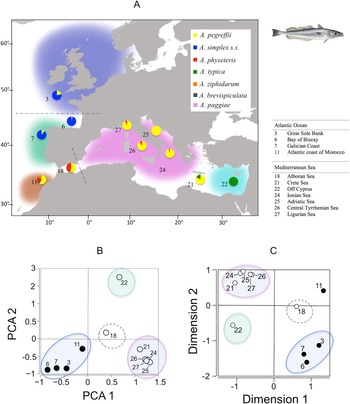
Among the wide range of parasite taxa found in M. merluccius across its range of distribution, attention was focused on some selected parasites proved to be of particular value in stock definition. These are the larval nematodes of the genus Anisakis: they are long-lived parasites, occurring at high frequency in this fish species throughout its geographic range and they are not pathogenic to the fish host. Therefore, they comply with the main characteristics defining a parasite as a good ‘biomarker’. The relative proportions of larvae of different species of Anisakis in different sampling localities of M. merluccius allowed the recognition of Mediterranean and Atlantic stocks of European hake (Mattiucci et al. Reference Mattiucci, Abaunza, Ramadori and Nascetti2004) (Fig. 1A). Anisakis pegreffii was identified in all the hakes sampled from the Mediterranean Sea, except in the Levantine Sea (off the Cyprus coast). In the western Mediterranean Sea, A. pegreffii was the most prevalent and abundant species in the Ligurian Sea; this finding seems to be related to the fact that this area is comprised in the Protected Marine Area the Pelagos Sanctuary of Mediterranean Cetaceans, a Mediterranean protected area inhabited by various dolphin species (Notarbartolo di Sciara et al. Reference Notarbartolo di Sciara, Agardy, Hyrenbach, Scovazzi and Van Klaveren2008), which are the main definitive hosts of A. pegreffii (Mattiucci and Nascetti, Reference Mattiucci and Nascetti2008; Mattiucci et al. Reference Mattiucci, Cipriani, Webb, Paoletti, Marcer, Bellisario, Gibson and Nascetti2014a ). This species also occurred at high prevalence and density in fish sampled from the eastern part of the Mediterranean Sea, such as in the Ionian, Aegean and Cretan Seas. Interestingly, hakes from Levantine Sea waters harboured only the species A. typica, a species parasitic in many cetacean species in warm temperatures and tropical waters (Mattiucci et al. Reference Mattiucci, Paggi, Nascetti, Portes Santos, Costa, Di Benedetto, Ramos, Argyrou, Cianchi and Bullini2002). Anisakis physeteris was the most prevalent species in hakes from the western Mediterranean Sea off the Balearic Islands, Alicante and Malaga (Mattiucci et al. Reference Mattiucci, Abaunza, Ramadori and Nascetti2004). The high proportion of this Anisakis species found in the fish from this deep area of the Mediterranean basin around the Balearic Islands could be related to the presence of the main migration routes for the sperm whale Physeter catodon, the definitive host of A. physeteris (Mattiucci and Nascetti, Reference Mattiucci and Nascetti2008). However, to date hakes from the western Mediterranean Sea were not found infected with A. simplex (s.s.) (Mattiucci et al. Reference Mattiucci, Abaunza, Ramadori and Nascetti2004), although this parasite species has been documented in some pelagic fish species, such as mackerel Scomber scombrus (Nascetti et al. Reference Nascetti, Paggi, Orecchia, Smith, Mattiucci and Bullini1986) and horse mackerel T. trachurus (Mattiucci et al. Reference Mattiucci, Farina, Campbell, Mackenzie, Ramos, Pinto, Abaunza and Nascetti2008; see next paragraph) from some of the collecting areas. This finding supports the hypothesis that there are no migrations of M. merluccius from and into Atlantic waters. Conversely, in the North-East Atlantic hake samples from north of the Strait of Gibraltar, A. simplex (s.s.) was the most prevalent species, while it occurred off the Spanish Atlantic coast in sympatry with A. pegreffii. Indeed, hakes that exhibited mixed infections of A. simplex (s.s.) and A. pegreffii represented >20% of the fish examined from the Atlantic coast of Galicia and 14% from the Bay of Biscay (Mattiucci et al. Reference Mattiucci, Abaunza, Ramadori and Nascetti2004). Moving south in the North-East Atlantic from the Strait of Gibraltar, mixed infections of different species of Anisakis in hakes caught along the Atlantic coast of Morocco were observed. More than 22% of the fish examined were found to be parasitized by five species of Anisakis: the major component species was A. pegreffii, followed by A. physeteris, A. ziphidarum, and, at a lower percentage, A. brevispiculata and A. paggiae (Fig. 1A). Thus, according to the pattern of distribution of larval Anisakis spp. and their abundance in the hake samples, different populations of M. merluccius in European waters (Mattiucci et al. Reference Mattiucci, Abaunza, Ramadori and Nascetti2004) were identified by PCA analysis (Fig. 1B). The larval distribution and abundance of the different species of Anisakis recognized in hakes from the different fishing grounds indicate that: (1) there are two stocks of M. merluccius, from Mediterranean and Atlantic waters respectively; (2) in the North Atlantic area, at least two distinct subpopulations are present, one north of the Strait of Gibraltar (samples 3, 6, 7 Fig. 1B) and another (no. 11, Fig. 1B) from off the Atlantic coast of Morocco; (3) some substructuring of the western and eastern parts of the Mediterranean hake populations seems to be recognized, with the population from Levantine Sea distinct from the other Mediterranean ones (Fig. 1B) (Mattiucci et al. Reference Mattiucci, Abaunza, Ramadori and Nascetti2004, Reference Mattiucci, Abaunza, Damiano, Garcia, Santos and Nascetti2007). Interestingly, in the PCA analysis, the sample from the Alboran Sea was more similar to Atlantic populations (Fig. 1B).
The case study of stock identification of a demersal fish species, the European hake Merluccius merluccius, from the Mediterranean Sea and Atlantic Ocean, as inferred from biological data, biomarkers (Anisakis spp. parasites) and the population genetics data (allozymes) of the fish populations (data from Nascetti et al. Reference Nascetti, Abaunza, Mattiucci, Magoulas, Cimmaruta and Bullini2000; Mattiucci et al. Reference Mattiucci, Abaunza, Ramadori and Nascetti2004; Cimmaruta et al. Reference Cimmaruta, Bondanelli and Nascetti2005). (A) Relative proportions of the Anisakis spp. larvae genetically identified (N parasites = 1950) in M. merluccius from the sampling localities from the Mediterranean Sea and the Atlantic Ocean (data from Mattiucci et al. Reference Mattiucci, Abaunza, Ramadori and Nascetti2004), plotted with the stock units as identified by the biological and morphometric analyses (data from Nascetti et al. Reference Nascetti, Abaunza, Mattiucci, Magoulas, Cimmaruta and Bullini2000). A different colour identifies a putative stock unit as defined by morphometric datasets of the fish host. Dotted lines identify the boundaries between hake stock units, as identified by genetic/molecular markers; (B) Principal Component Analysis (PCA) inferred from the larval Anisakis spp. bio-markers, identified genetically in the European hake specimens (M. merluccius sampled in the Mediterranean (white circles) and Atlantic (black circles) basins). The first axis of PCA explains about 60% of total ordination, and PCA 2 about 30%; (C) A generalized Procrustes Rotation (PR) performed with R (R Development Core Team, 2012) was used to compare different ordinations of the European hakes M. merluccius (N fish = 1306), based on combined molecular and parasite datasets. The latter was computed by considering the number (N parasites = 1950) of larval parasites belonging to A. pegreffii, A. simplex (s. s.), A. physeteris, A. typica, A. ziphidarum and A. brevispiculata. A Procrustes test (also known as analysis of congruence) with n = 1000 bootstrap replicates was used to estimate the significance of the Procrustes statistics, assessing similarities between different ordinations, and the Procrustes correlation r was derived from the symmetric Procrustes residual (Peres-Neto and Jackson, Reference Peres-Neto and Jackson2001). Analysis showed a significant correlation (Procrustes r = 0·59, P<0·01) between the Anisakis spp. burden and molecular traits, showing the clustering of sampled specimens in two well-defined clusters corresponding to the Mediterranean (white circles) and Atlantic stocks (black circles). Code numbers and coloured ellipses are related to the sampling localities, as appearing in Fig. 1A.

The parasitological findings are in agreement with the bulk of biological data, showing separate Mediterranean and Atlantic stocks of European hake since they are known to live in markedly different environments and to differ in many biological and demographic features such as growth rate, spawning season and recruitment (Froese and Pauly, Reference Froese and Pauly2014).
In addition, the parasitological data were largely in accordance with the genetic results obtained by using different molecular nuclear markers (allozymes, microsatellites, SNPs), showing a main subdivision between Atlantic and Mediterranean stocks (Roldan et al. Reference Roldan, Garcia-Marin, Utter and Pla1998; Lundy et al. Reference Lundy, Moran, Rico, Milner and Hewitt1999, Reference Lundy, Rico and Hewitt2000; Cimmaruta et al. Reference Cimmaruta, Bondanelli and Nascetti2005; Milano et al. Reference Milano, Babbucci, Cariani, Atanassova, Bekkevold, Carvalho, Espiñeira, Fiorentino, Garofalo, Geffen, Hansen, Helyar, Nielsen, Ogden, Patarnello, Stagioni, Tinti and Bargelloni2014). However, the molecular markers indicated that the boundary between the two stocks is located along the Almeria-Oran Front (AOF), instead of the Strait of Gibraltar. Within the Atlantic basin, the hake genetic structure is coincident with the Anisakis findings. However, the management areas of the International Council for the Exploration of the Sea (ICES) for European hake are not coincident with the parasitological analysis (Fig. 1C). The ICES distinguishes a northern and a southern stock of European hake with a boundary limit in the Cap Breton Canyon (Southeastern of the Bay of Biscay). This definition is based more on administrative reasons rather than on biological supporting, although the available data on morphometrics and biology seem to support a substructure in European hake from Atlantic waters to the North of the Strait of Gibraltar (Fig. 1A). The Moroccan area is out of the ICES area, and based on our parasitological data, the Northwest African waters could be a candidate for a southern stock of European hake, differentiated from the northern stock which inhabits European Atlantic waters (Fig. 1B and C).
Both allozymes and SNPs clearly identified a prominent role of selection in moulding the genetic stock structure between and within sea basins (Cimmaruta et al. Reference Cimmaruta, Bondanelli and Nascetti2005; Milano et al. Reference Milano, Babbucci, Cariani, Atanassova, Bekkevold, Carvalho, Espiñeira, Fiorentino, Garofalo, Geffen, Hansen, Helyar, Nielsen, Ogden, Patarnello, Stagioni, Tinti and Bargelloni2014), indicating the sea water temperature and salinity as the main driving factors shaping the genetic structure of a number of outlier loci. This finding suggests that the European hake represents a case study showing how marine environmental variables, such as temperature and salinity, are correlated to both the genetic structure of the fish host species, and to the pattern of distribution of the larval parasite Anisakis spp.
The high agreement among the different datasets in identifying the subpopulations of European hake was supplemented with a generalized Procrustes Rotation (Fig. 1C), which compared different ordinations of the European hake specimens as inferred from the combination of the genetic analysis (allozymes, data from Cimmaruta et al. Reference Cimmaruta, Bondanelli and Nascetti2005) with the larval distribution of the different Anisakis species, as detected in the same subpopulations. The analysis showed a significant correlation (Procrustes r = 0·59, P<0·01) between the distribution and abundance of the larval Anisakis and the pattern of fish-host genetic structure. The sampled specimens clustered in two well-defined groups corresponding to the Mediterranean (white circles) and Atlantic stocks (black circles) (Fig. 1C). Interestingly, in the PR analysis, the population from the Alboran Sea (no. 18, Fig. 1C) showed more similarity to the Atlantic samples than to those from the Mediterranean basin. In addition, the eastern population from the Levantine Sea (no. 22, Fig. 1C) resulted as being distinct from the western Mediterranean populations (Fig. 1C). Both datasets contributed strongly to the ordination recorded, with the molecular distance between samples accounting for about 93% of total ordination and the distance based on the parasitic burden of Anisakis spp. larvae for about 75%.
The results achieved in the case of European hake are evidence of how Anisakis spp. larvae are good biological markers in recognizing fish populations from different fishing grounds, given the assumption that these parasites are related to differences in life-history traits of their individual fish host. Indeed, the ecological differences of Anisakis spp., including their biogeography and life cycles, reflect the environmental conditions and feeding behaviour of adult fish related to each single fishing ground in the Atlantic and Mediterranean Sea waters.
Small pelagic fish – the case of the horse mackerel, Trachurus trachurus
The horse mackerel, T. trachurus is a small carangid fish living on the continental shelf of the North-Eastern Atlantic Ocean, from Norway to the Cape Verde Islands, and in the Mediterranean Sea. Horse mackerel catches have a high relevance in fisheries, with landings from the Atlantic area strongly decreasing after 2000 and now partially recovering (Abaunza et al. Reference Abaunza, Murta, Campbell, Cimmaruta, Comesana, Dahle, Garcia Santamaria, Gordo, Iversen, MacKenzie, Magoulas, Mattiucci, Molloy, Nascetti, Pinto, Quinta, Ramos, Sanjuan, Santos, Stransky and Zimmermann2008a ; Fernandes and Cook, Reference Fernandes and Cook2013; ICES, 2013). The horse mackerel is characterized by a high migratory ability and by a reproductive strategy with a rather extensive spawning season (4–8 months, according to latitude) and an asynchronous maturation of oocytes that mature and are spawned in a number of consecutive clutches (Abaunza et al. Reference Abaunza, Gordo, Karlou-Riga, Murta, Eltink, Garcia Santamaria, Zimmermann, Hammer, Lucio, Iversen, Molloy and Gallo2003; Murta et al. Reference Murta, Pinto and Abaunza2008). The combination of high vagility and multiple spawning makes the boundaries of horse mackerel stocks very difficult to define, while its economic relevance makes this issue a crucial one.
In recent years, the horse mackerel has been the target of a wide multi-methodological research, aimed at identifying the biological stocks of horse mackerel by simultaneously studying subpopulations by means of different genetic/molecular markers, morphometry, life-history traits and biological parameters, including parasites (Abaunza et al. Reference Abaunza, Murta, Campbell, Cimmaruta, Comesana, Dahle, Garcia Santamaria, Gordo, Iversen, MacKenzie, Magoulas, Mattiucci, Molloy, Nascetti, Pinto, Quinta, Ramos, Sanjuan, Santos, Stransky and Zimmermann2008a , Reference Abaunza, Murta, Campbell, Cimmaruta, Comesana, Dahle, Gallo, Garcia Santamaria, Gordo, Iversen, MacKenzie, Magoulas, Mattiucci, Molloy, Nascetti, Pinto, Quinta, Ramos, Ruggi, Sanjuan, Santos, Stransky and Zimmerman b ). All the genetic/molecular datasets were concordant in describing a low level of differentiation among the Mediterranean and Atlantic populations, whilst a high genetic variation was found at the intra-population level. Both nuclear (allozymes and DNA microsatellites loci) and mitochondrial (ND4L and ND2 sequences analysis of mtDNA) markers found the larger part of the variation to be distributed within the horse mackerel populations sampled from the different fishing grounds rather than between them (Cimmaruta et al. Reference Cimmaruta, Bondanelli, Ruggi and Nascetti2008; Comesaña et al. Reference Comesaña, Martinez-Areal and Sanjuan2008; Kasapidis and Magoulas, Reference Kasapidis and Magoulas2008).
The allozyme analysis suggested an association between the levels of genetic differentiation and the geographic distance in the Atlantic Ocean (Isolation By Distance, IBD), although it was impossible to distinguish discrete stocks on the basis of genetic data alone. These findings are in agreement with the biological features of the species, a vagile batch spawner, supporting the idea that the low genetic structuring of the fish species is related to a high gene flow due to the fish behaviour and mobility, rather than to the passive dispersion driven by marine gyres during the larval stage (Cimmaruta et al. Reference Cimmaruta, Bondanelli, Ruggi and Nascetti2008).
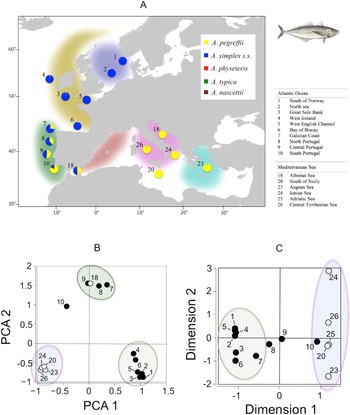
Despite the low resolution power of genetic/molecular markers to clearly distinguish the stocks of horse mackerel in European waters, several biological approaches (morphometrics, life-history traits, otoliths and parasites) were able to detect discrete populations (Abaunza et al. Reference Abaunza, Murta, Campbell, Cimmaruta, Comesana, Dahle, Garcia Santamaria, Gordo, Iversen, MacKenzie, Magoulas, Mattiucci, Molloy, Nascetti, Pinto, Quinta, Ramos, Sanjuan, Santos, Stransky and Zimmermann2008a ). Indeed, the above-mentioned techniques separated a Mediterranean stock from the Atlantic ones. A further subdivision in the NE Atlantic was observed: a ‘North Sea’, a ‘Western’ and a ‘Southern’ stock were identified. Also in the Mediterranean Sea, a western, a central and an eastern subpopulation were outlined (Fig. 2A). In addition, the biological data acquired indicated an influence of the Atlantic populations on the western extreme (Alboran Sea) of the Mediterranean Sea (Abaunza et al. Reference Abaunza, Murta, Campbell, Cimmaruta, Comesana, Dahle, Garcia Santamaria, Gordo, Iversen, MacKenzie, Magoulas, Mattiucci, Molloy, Nascetti, Pinto, Quinta, Ramos, Sanjuan, Santos, Stransky and Zimmermann2008a , Reference Abaunza, Gordo, García Santamaría, Iversen, Murta and Gallo c ; Gordo et al. Reference Gordo, Costa, Abaunza, Lucio, Eltink and Figueiredo2008; MacKenzie et al. Reference MacKenzie, Campbell, Mattiucci, Ramos, Pinto and Abaunza2008; Mattiucci et al. Reference Mattiucci, Farina, Campbell, Mackenzie, Ramos, Pinto, Abaunza and Nascetti2008; Murta et al. Reference Murta, Pinto and Abaunza2008; Stransky et al. Reference Stransky, Murta, Schlickeisen and Zimmermann2008).
The case study of stock assessment of a small pelagic fish species, the horse mackerel Trachurus trachurus, from the Mediterranean Sea and Atlantic Ocean waters, as inferred from biological data, biomarkers (parasites), and the population genetics dataset (allozymes) of the fish populations (data from Abaunza et al. Reference Abaunza, Murta, Campbell, Cimmaruta, Comesana, Dahle, Garcia Santamaria, Gordo, Iversen, MacKenzie, Magoulas, Mattiucci, Molloy, Nascetti, Pinto, Quinta, Ramos, Sanjuan, Santos, Stransky and Zimmermann2008a ; Cimmaruta et al. Reference Cimmaruta, Bondanelli, Ruggi and Nascetti2008; Mattiucci et al. Reference Mattiucci, Farina, Campbell, Mackenzie, Ramos, Pinto, Abaunza and Nascetti2008; Murta et al. Reference Murta, Pinto and Abaunza2008). (A) Relative proportions of the Anisakis spp. identified genetically (N parasites = 2200) in T. trachurus from the sampling localities from the Mediterranean Sea and the Atlantic Ocean (data from Mattiucci et al. Reference Mattiucci, Farina, Campbell, Mackenzie, Ramos, Pinto, Abaunza and Nascetti2008), plotted with the stock units identified by the biological and morphometric analyses (data from Murta et al. Reference Murta, Pinto and Abaunza2008). Different colours identify each putative stock unit as defined by morphometric datasets of the fish host; (B) Principal Component Analysis (PCA) inferred from larval Anisakis spp. as biomarkers, identified genetically in the horse-mackerel specimens (T. trachurus) sampled in the Mediterranean (white circles) and Atlantic (black circles). The first axis of PCA explains about 92% of total ordination, whilst PCA 2 about 7%; (C) A generalized Procrustes Rotation (PR), performed with R (R Development Core Team, 2012) used to compare different ordinations of the Atlantic horse mackerels (T. trachurus) analysed (N fish = 2241), based on combined molecular and Anisakis spp. burden distance matrices. The latter was computed by considering the number of individual parasites (N parasites = 2200) (fourth-root transformed to improve normality and remove the mean/variance relationship) belonging to A. pegreffii, A. simplex (s.s.), A. physeteris and A. typica. A Procrustes test (also known as analysis of congruence) with n = 1000 bootstrap replicates was used to estimate the significance of the Procrustes statistics, assessing similarities between different ordinations, and the Procrustes correlation r was derived from the symmetric Procrustes residual (Peres-Neto and Jackson, Reference Peres-Neto and Jackson2001). Analysis showed significant correlation (Procrustes r = 0·39, P = 0·05) between the parasitic burden and molecular traits, as shown by the clustering of sampled specimens corresponding to the Mediterranean (white circles) and Atlantic stocks (black circles). Molecular distance between specimens accounted for about 37% of total ordination, whilst the distance based on the parasitic burden with Anisakis for about 95%. Code numbers and coloured ellipses are related to the sampling localities, as appearing in Fig. 2A.

The use of Anisakis parasites as biological tags gave concordant results with otoliths and morphometric data analysis (Mattiucci et al. Reference Mattiucci, Farina, Campbell, Mackenzie, Ramos, Pinto, Abaunza and Nascetti2008), rather than with the genetic datasets.
Of the five species of Anisakis identified in horse mackerel, A. pegreffii and A. simplex (s.s.) were found to be the dominant species in all the fish sampled along its geographic distribution, whereas the other three species, i.e. A. physeteris, A. typica and A. nascettii (the last indicated as Anisakis sp. in Mattiucci et al. Reference Mattiucci, Farina, Campbell, Mackenzie, Ramos, Pinto, Abaunza and Nascetti2008), were identified at very low percentages in the central Tyrrhenian Sea, the Cretan Sea and in the NE Atlantic fish samples (Fig. 2A). Anisakis pegreffii and A. simplex (s.s.) showed statistically significant differences in their relative proportions in the horse mackerel samples throughout the NE Atlantic and the Mediterranean Sea. Indeed, A. pegreffii was identified as the main species parasitizing horse mackerel in the Mediterranean Sea; it was the only species found in the Adriatic and Ionian Seas samples, while in the horse mackerels from the Aegean Sea, A. pegreffii occurred in mixed infections with A. typica (1%). Similarly, in the western Mediterranean Sea, A. pegreffii was the dominant species, even though A. physeteris occurred in mixed infections in horse mackerel fished along the Tyrrhenian Sea coast (Fig. 2A). Mattiucci et al. (Reference Mattiucci, Farina, Campbell, Mackenzie, Ramos, Pinto, Abaunza and Nascetti2008) found that the samples of horse mackerel fished in the Alboran Sea showed mixed infections by both the sibling species, A. pegreffii and A. simplex (s.s.) in almost equal proportions (Fig. 2A). Moving to the NE Atlantic Sea, the occurrence of A. pegreffii progressively decreased from almost 87% off the Portuguese coast of Algarve, to 30% in the horse mackerels from off the Spanish Galician coast. Anisakis pegreffii was also rarely identified from horse mackerel from off the south coast of Ireland and from the Bay of Biscay (Fig. 2A). The opposite trend was found in the occurrence of A. simplex (s.s.), which showed increasing proportions in the horse mackerels fished from off the Portuguese coast (almost 13%) to the Spanish Atlantic coast of Galicia (71%). It became the only species present in the fish species in the Norwegian Sea and along the western English Channel (Mattiucci et al. Reference Mattiucci, Farina, Campbell, Mackenzie, Ramos, Pinto, Abaunza and Nascetti2008) (Fig. 2A).
In horse mackerel fished along the Portuguese and Spanish Atlantic coast, a contact zone between A. pegreffii and A. simplex (s.s.), the two parasite species occurred at high percentages in mixed infections, with the highest level in 43% of the fish captured from off the North Portuguese coast (Mattiucci et al. Reference Mattiucci, Farina, Campbell, Mackenzie, Ramos, Pinto, Abaunza and Nascetti2008). Similarly, in the Alboran Sea, the two species were found in syntopy in almost 60% of the infected fish, while most (35%) of the remaining fish examined from this basin were found infected only by the species A. pegreffii (Mattiucci et al. Reference Mattiucci, Farina, Campbell, Mackenzie, Ramos, Pinto, Abaunza and Nascetti2008). Further, few (N = 15 out of 2200 larvae analysed) F1 hybrid individuals between the two species A. pegreffii and A. simplex (s.s.) – i.e. showing a heterozygote genotype at all the diagnostic allozyme loci between the two species – were recognized in the sympatric areas of the two parasite species (Mattiucci et al. Reference Mattiucci, Farina, Campbell, Mackenzie, Ramos, Pinto, Abaunza and Nascetti2008 and unpublished data).
According to the genetically recognized species of Anisakis in the horse mackerel (Mattiucci et al. Reference Mattiucci, Farina, Campbell, Mackenzie, Ramos, Pinto, Abaunza and Nascetti2008) and from abundance levels of infection, different populations of the fish species can be distinguished, as shown in Fig 2B. Indeed, a discrete structuring of subpopulations of horse mackerel from the Mediterranean Sea (excluding the Alboran Sea) and those from the Atlantic can be recognized according to PCA analysis (Fig. 2B). Moreover, the same analysis seems to support the existence of a ‘southern’ stock of horse mackerel along the Spanish and Portuguese coasts (including the samples no. 7, 8, 9, 10), distinct from the ‘northern’ stock, as represented by the areas of the Northern North Sea and Southern Ireland coast (samples no. 1, 2, 3, 4, 5, 6) (Fig. 2A and B). Finally, it seems that the sample from the Alboran Sea (no. 18, Fig. 2A and B), according to its larval Anisakis spp. composition, clusters with the other Atlantic samples rather than with those from the Mediterranean Sea (Fig. 2B). This finding, and the presence of a low percentage of fish infected only by A. simplex (s.s.) in the Alboran Sea (Mattiucci et al. Reference Mattiucci, Farina, Campbell, Mackenzie, Ramos, Pinto, Abaunza and Nascetti2008), suggests that this population of horse mackerel could be the result of a migration of this small pelagic fish species from Atlantic waters into this extreme western area of the Mediterranean Sea, possibly mixing with the other Mediterranean Sea populations. The migrations of Atlantic horse mackerel into the western part of the Mediterranean Sea is also supported by the finding of the monogenean Heteraxinoides atlanticus in the same fish sample examined from the Alboran Sea (MacKenzie et al. Reference MacKenzie, Campbell, Mattiucci, Ramos, Pinto and Abaunza2008), a monogenean species recognized in the Atlantic horse mackerel. Thus, in turn, the finding that the fish samples from the Alboran Sea are more similar, in their parasite fauna, to the Atlantic populations rather than to the Mediterranean ones, is supported by the existence of the oceanographic front, a particular water circulation, called the AOF. This is an oceanographic front located from Almeria (Spain) to Oran (Morocco), consisting of inflowing Atlantic water which, entering at the surface through the Gibraltar Strait, describes in the Alboran Sea a quasi-permanent anticyclonic gyre in the west with less variation in the eastern part. This oceanographic front exhibits a pronounced step temperature (1·4 °C) and salinity gradient (2 ppt) over a distance of 2 km with an average current speed of 40 cm s−1 flowing southeastward from the Spanish coast to the coast of North Africa (Tintore et al. Reference Tintore, La Violette, Blade and Cruzado1988). This water circulation could explain the finding of A. simplex (s.s.), a parasite species widespread between 35°N and the Arctic Circle, in horse mackerel fished from the Alboran Sea. These horse mackerels could have been infected by preying upon infected invertebrates and/or smaller pelagic fish species in the Alboran basin.
Thus, horse mackerel shows a low level of genetic differentiation between the Mediterranean and Atlantic populations, a stable genetic structure and a high level of genetic variability without apparent geographic structuring (Cimmaruta et al. Reference Cimmaruta, Bondanelli, Ruggi and Nascetti2008; Comesaña et al. Reference Comesaña, Martinez-Areal and Sanjuan2008; Kasapidis and Magoulas, Reference Kasapidis and Magoulas2008). However, several other approaches (morphometrics and parasites) support the separation between the Mediterranean and Atlantic populations of horse mackerel whilst parasites, morphometrics and life-history traits support the existence of the ‘southern’ and ‘northern’ stocks in Atlantic waters (Murta et al. Reference Murta, Pinto and Abaunza2008), with the possible migration of adult fish following the west coast in the North-East Atlantic between the Celtic and Northern North Seas.
Finally, parasites and morphometric analyses were congruent in depicting the existence of sub-structured areas of horse mackerel in the Mediterranean Sea (western, central and eastern) (Abaunza et al. Reference Abaunza, Murta, Campbell, Cimmaruta, Comesana, Dahle, Garcia Santamaria, Gordo, Iversen, MacKenzie, Magoulas, Mattiucci, Molloy, Nascetti, Pinto, Quinta, Ramos, Sanjuan, Santos, Stransky and Zimmermann2008a , Reference Abaunza, Murta, Campbell, Cimmaruta, Comesana, Dahle, Gallo, Garcia Santamaria, Gordo, Iversen, MacKenzie, Magoulas, Mattiucci, Molloy, Nascetti, Pinto, Quinta, Ramos, Ruggi, Sanjuan, Santos, Stransky and Zimmerman b , Reference Abaunza, Gordo, García Santamaría, Iversen, Murta and Gallo c ; MacKenzie et al. Reference MacKenzie, Campbell, Mattiucci, Ramos, Pinto and Abaunza2008; Mattiucci et al. Reference Mattiucci, Farina, Campbell, Mackenzie, Ramos, Pinto, Abaunza and Nascetti2008; Murta et al. Reference Murta, Pinto and Abaunza2008) (Fig. 2C).
The Generalized PR comparing different ordinations of the horse mackerel populations based on combined molecular and parasitic burden datasets showed slightly significant correlation (Procrustes r = 0·39, P = 0·05) between the parasitic burden and molecular traits, as shown by the clustering of sampled specimens corresponding to the Mediterranean and Atlantic horse mackerel (Fig. 2C). Indeed, despite the fact that a trend similar to that shown by PCA of parasites (Fig. 2B) in depicting the existence of a stock structure of horse mackerel in European waters, fish populations genetic data accounted for only about 37% of total ordination at the PR analysis (Fig. 2C), whilst the differences in the parasitic burden by larval Anisakis spp. accounted for about 95%. This finding further supports the idea that parasites show structuring of their fish host populations at regional and temporal scales. Indeed, the latitudinal patterns of the larval Anisakis spp. distribution delineated the horse mackerel putative stocks in the Mediterranean and Atlantic waters according to the different regions of basin waters inhabited by different host meta-populations of the pelagic fish species.
Large pelagic fish – the case of the swordfish, Xiphias gladius
The correct identification of swordfish stocks is a ‘hot topic’ in fisheries science, being the rationale for the assessment and management of this important resource. As a consequence, different genetic/molecular techniques have been fruitfully used to study the stock structure of this cosmopolitan large pelagic fish that is characterized by a philopatric behaviour and a limited gene exchange between different parts of its range, in contrast to its remarkable migration ability. As a consequence of these characteristics, different stocks of swordfish corresponding to many reproductive areas are now recognized. In the Pacific Ocean, swordfish from north-eastern, north-central, south-eastern and south-western areas could be genetically differentiated (Alvarado-Bremer et al. Reference Alvarado Bremer, Hinton and Grieg2006). In the Atlantic Ocean, a ‘northern’ and a ‘southern’ Atlantic stock are now recognized, with their boundary still questioned based on genetic data: some markers confirm the 5°N position officially set by the International Commission for the Conservation of Atlantic Tunas (ICCAT) (Kasapidis et al. Reference Kasapidis, Mejuto, Tserpes, Antoniou, Garcia-Cortes, Peristeraki, Oikioonomaki, Kotoulas and Magoulas2007), while other data move it northward (Chow et al. Reference Chow, Clarke, Nakadate and Okazaki2007) or suggest an intergradation zone in the equatorial area (Smith and Alvarado-Bremer, Reference Smith and Alvarado-Bremer2010; Garcia et al. Reference Garcia, Mattiucci, Damiano, Santos and Nascetti2011) (Fig. 3A). As to the Mediterranean population, it is considered as a further stock, highly isolated and divergent from the Atlantic one and characterized by small population size and low genetic variability (Smith and Kotoulas et al. Reference Kotoulas, Magoulas, Tsimenides and Zouros1995; Chow et al. Reference Chow, Okamoto, Uozumi, Takeuchi and Takeyama1997; Cimmaruta et al. Reference Cimmaruta, Iaconelli, Nascetti and Bullini1998; Chow and Takeyama, Reference Chow and Takeyama2000; Vinas et al. Reference Viñas, Pérez-Serra, Vidal, Alvarado-Bremer and Pla2010). These features are explained by the history of this population, which was likely isolated and restricted in the eastern Mediterranean basin during the last two glacial periods and is still exchanging genes very little with the Atlantic populations (Alvarado-Bremer et al. Reference Alvarado Bremer, Viñasa, Mejutoc, Elyd and Plae2005b ). Indeed, Mediterranean swordfish are known to move to Atlantic waters via the Strait of Gibraltar for feeding, while Atlantic specimens may enter the Mediterranean Sea. However, the spawning grounds of the Mediterranean and Atlantic populations, and thus their gene pools, remain substantially separated due to the fish's philopatric behaviour (Magoulas et al. Reference Magoulas, Kotoulas, de la Serna, De Metrio, Tsimenides and Zouros1992; Chow et al. Reference Chow, Okamoto, Uozumi, Takeuchi and Takeyama1997). In the Mediterranean Sea, a genetic sub-structuring of swordfish has been revealed by phylogeographic analysis of mitochondrial control gene, supporting the existence of ‘eastern’ and ‘western’ subpopulation units (Viñas et al. Reference Viñas, Pérez-Serra, Vidal, Alvarado-Bremer and Pla2010).
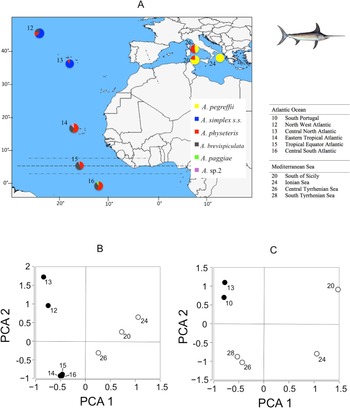
The case study of stock assessment of a large pelagic fish species, the swordfish Xiphias gladius from the Mediterranean Sea and Atlantic Ocean, as inferred from biological data, biomarkers (parasites) and the genetic datasets (allozymes) of the same fish populations (data from Garcia et al. Reference Garcia, Mattiucci, Damiano, Santos and Nascetti2011; Mattiucci et al. Reference Mattiucci, Garcia, Cipriani, Santos, Nascetti and Cimmaruta2014b ). (A) Relative proportions of the Anisakis spp. identified genetically (N parasites = 405) in X. gladius from the sampling localities from the Mediterranean Sea and the Atlantic Ocean (data from Garcia et al. Reference Garcia, Mattiucci, Damiano, Santos and Nascetti2011; Mattiucci et al. Reference Mattiucci, Garcia, Cipriani, Santos, Nascetti and Cimmaruta2014b ), plotted with the stock units as suggested by the genetic/molecular results (Kotoulas et al. Reference Kotoulas, Magoulas, Tsimenides and Zouros1995; Alvarado-Bremer et al. Reference Alvarado Bremer, Mejutoc, Gómez-Márquezd, Boánd, Carpinterod, Rodríguez, Viñase, Greig and Elyg2005a , Reference Alvarado Bremer, Viñasa, Mejutoc, Elyd and Plae b ; Chow et al. Reference Chow, Clarke, Nakadate and Okazaki2007). Dotted lines identify the boundaries between swordfish stock units; (B) Principal Component Analysis (PCA) inferred from the parasitic burden of the larval Anisakis spp. identified genetically and used as biomarkers, in the swordfish X. gladius specimens sampled in the Mediterranean (white circles) and Atlantic (black circles) basins. PCA analysis was computed by considering the number of individual parasites (fourth-root transformed to improve normality and remove the mean/variance relationship) belonging to A. pegreffii, A. simplex (s.s.), A. physeteris and A. brevispiculata. The first axis of PCA explains about 54% of total ordination, and PCA 2 about 22%; (C) Principal Component Analysis (PCA) inferred from Nei's distance matrix based on allozyme data (source: Cimmaruta et al. Reference Cimmaruta, Iaconelli, Nascetti and Bullini1998) performed on swordfish specimens analysed genetically (N fish = 323). The first and second axis accounted for 96 and 2% of total ordination, respectively.

The phylogeography and the behaviour of swordfish accounts for its well-defined pattern of genetic variation, making the distinct populations/stocks well identifiable by using genetic/molecular markers on the fish.
According to the results achieved on the different species of larval Anisakis recognized in swordfish from the Mediterranean Sea and Atlantic Ocean fishing grounds, different populations of swordfish have been distinguished from the two basin waters (Garcia et al. Reference Garcia, Mattiucci, Damiano, Santos and Nascetti2011; Mattiucci et al. Reference Mattiucci, Garcia, Cipriani, Santos, Nascetti and Cimmaruta2014b ). Indeed, among all the metazoan taxa of swordfish identified in several samples of the fish captured in Mediterranean Sea and Atlantic Ocean waters, the larval stages of Anisakis were among those mainly accounting for the differences detected between the Mediterranean and Atlantic populations (Mattiucci et al. Reference Mattiucci, Garcia, Cipriani, Santos, Nascetti and Cimmaruta2014b ). In fact, A. pegreffii was identified only in swordfish from the Mediterranean Sea fishing grounds, whereas the larvae of A. brevispiculata, A. paggiae, Anisakis sp. 2 and A. simplex (s.s.), were absent in X. gladius sampled from the same Mediterranean waters (Fig. 3A). Anisakis pegreffii was also found in co-infection with A. physeteris genetically identified in samples from the central and the southern Tyrrhenian Sea. However, the significantly different infection pattern with A. pegreffii and the absence of A. physeteris in the swordfish sampled from the Ionian Sea compared with the central and southern Tyrrhenian Sea (Fig. 3A) suggests a further investigation of swordfish from other parts of the eastern Mediterranean Sea to search for a possible accordance as suggested by genetic/molecular data (Viñas et al. Reference Viñas, Pérez-Serra, Vidal, Alvarado-Bremer and Pla2010). On the other hand, a high proportion of A. physeteris was found and showed higher infection levels in swordfish fished in east-tropical and tropical-equatorial Atlantic waters than in those observed in Mediterranean samples (Garcia et al. Reference Garcia, Mattiucci, Damiano, Santos and Nascetti2011; Mattiucci et al. Reference Mattiucci, Garcia, Cipriani, Santos, Nascetti and Cimmaruta2014b ). Indeed, in the Atlantic swordfish, A. physeteris, A. brevispiculata, A. paggiae and Anisakis sp. 2 are the dominant taxa. These findings are in accordance with the geographic distribution reported so far for those species (Fig. 3A and B). The PCA analysis based on the distribution pattern and infection levels with Anisakis spp. from swordfish showed the Mediterranean samples clustering separately from the Atlantic ones (Fig. 3B). In addition, in the Atlantic waters, a cluster formed by the ‘northern’ sample distinct from a cluster including the ‘southern’ sample was observed (Mattiucci et al. Reference Mattiucci, Garcia, Cipriani, Santos, Nascetti and Cimmaruta2014b ) (Fig. 3B).
The use of Anisakis spp. as biomarkers agrees with the genetic results gathered on the fish host when describing the existence of a Mediterranean Sea stock and two discrete Atlantic stocks, i.e. a ‘northern’ and a ‘southern’ Atlantic stock of the fish species (Fig. 3C). Indeed, a population genetic analysis based on allozyme loci of different swordfish populations from Mediterranean and Atlantic waters clearly distinguished the Mediterranean stock as distinct from the Atlantic one, as summarized by the PCA analysis (Fig. 3C, data from Cimmaruta et al. Reference Cimmaruta, Iaconelli, Nascetti and Bullini1998 and unpublished). The first axis of PCA alone explained 96% of total ordination (another 2% was explained by the second axis) illustrating that for this fish species even conservative markers, such as allozymes, have a high-resolution power.
However, when defining the boundary between the two Atlantic stocks, the results obtained by different genetic/molecular markers on X. gladius are discordant with each other, either confirming the 5°N position, moving it north of 5°N, or suggesting an intergradation zone in the equatorial area. According to the Anisakis spp. used as markers, the distinction between the NW swordfish stock from the remaining Atlantic populations is in agreement with the bulk of genetic data, while the boundary between the NW and the ‘southern’ stock seems to be less certain. This suggests a possible boundary between the northern and southern stocks, north of 5°N, or at least the existence of a mixing area in the tropical-equatorial Atlantic waters (Garcia et al. Reference Garcia, Mattiucci, Damiano, Santos and Nascetti2011; Mattiucci, personal communication) (Fig. 3A).
The North Atlantic swordfish recently benefited from the management actions that rebuilt its stock consistency (Neilson et al. Reference Neilson, Arocha, Cass-Calay, Mejuto, Ortiz, Scott, Smith, Travassos, Tserpes and Andrushchenko2013). On the contrary, the Mediterranean swordfish is still in need of effective management to counteract the loss of its spawning stock biomass and the ever-increasing percentage of juveniles in its landings, signalling a possible stock collapse into the next generation time of 7–10 years (Tserpes et al. Reference Tserpes, Tzanatos and Peristeraki2011).
DISCUSSION AND FUTURE PERSPECTIVES
A high genetic homogeneity of marine fish species has been postulated for years, based on the idea that in the marine environment there are few physical barriers limiting gene flow between fish populations (Palumbi, Reference Palumbi1994). However, in the last decade data have increasingly shown that marine species may be spatially structured even on a very small scale due to a number of factors ranging from local self-recruitment to historical vicariance (Cowen et al. Reference Cowen, Lwiza, Sponaugle, Paris and Olson2000, Reference Cowen, Paris and Srinivasan2006). Also, the marine environment proved to have geographic barriers, habitat discontinuities and transition zones which were able to exert different selective pressures on geographically discrete populations of marine species (Cimmaruta et al. Reference Cimmaruta, Bondanelli and Nascetti2005; Lemaire et al. Reference Lemaire, Versini and Bonhomme2005; Riginos et al. Reference Riginos, Douglas, Jin, Shanahan and Treml2011; Sà-Pinto et al. Reference Sà-Pinto, Branco, Alexandrino, Fontaine and Baird2012; Milano et al. Reference Milano, Babbucci, Cariani, Atanassova, Bekkevold, Carvalho, Espiñeira, Fiorentino, Garofalo, Geffen, Hansen, Helyar, Nielsen, Ogden, Patarnello, Stagioni, Tinti and Bargelloni2014). The historical and oceanographic characteristics of the Mediterranean–Atlantic transition are among the main factors in designating distinctive and geographically separated stocks of several fish species, as shown by an increasing number of investigations carried out at both large and fine geographic scales and providing phylogeographical scenarios for several fish species from these basins. Surveys of the genetic structure of fish populations over a large geographic range, spanning the North-East Atlantic Ocean, the Mediterranean Sea (west and east) and the Black Seas, included many fish species, among them Engraulis encrasicolus (Magoulas et al. Reference Magoulas, Tsimenides and Zouros1996), sparid species (Bargelloni et al. Reference Bargelloni, Alarcon, Alvarez, Penzo, Magoulas, Reis and Patarnello2003, Reference Bargelloni, Alarcon, Alvarez, Penzo, Magoulas, Reis and Patarnello2005), the anglerfish Lophius budegassa and Lophius piscatorius (Charrier et al. Reference Charrier, Chenel, Durand, Girard, Quiniou and Laroche2006), the Atherinidae Atherina spp. (Pujolar et al. Reference Pujolar, Zane and Congiu2012) and the mackerels Scomber scombrus and Scomber japonicus (Zardoya et al. Reference Zardoya, Castilho, Grande, Favre-Krey, Caetano, Marcato, Krey and Patarnello2004). In spite of the high number of studies, very few contributions report a multidisciplinary approach to fish stock assessment in Mediterranean vs Atlantic waters, which combines genetic data, biological (parasites) and morphological surveys of the fish host. To date, the only representative cases are those concerning fish stock assessment of horse mackerel and European hake, performed in the framework of the European projects HOMSIR (Abaunza et al. Reference Abaunza, Murta, Campbell, Cimmaruta, Comesana, Dahle, Garcia Santamaria, Gordo, Iversen, MacKenzie, Magoulas, Mattiucci, Molloy, Nascetti, Pinto, Quinta, Ramos, Sanjuan, Santos, Stransky and Zimmermann2008a ) and GENHAKE (Nascetti et al. Reference Nascetti, Abaunza, Mattiucci, Magoulas, Cimmaruta and Bullini2000) respectively. Some other authors have used a meta-analysis approach on biological (not including parasites) and genetic datasets acquired for various fish species to provide an integrated picture of Mediterranean–Atlantic population structure and phylogeography (Patarnello et al. Reference Patarnello, Volckaert and Castilho2007), also in the context of global patterns (Galarza et al. Reference Galarza, Carreras-Carbonell, Macpherson, Pascual, Roque, Turner and Rico2009; Riginos et al. Reference Riginos, Douglas, Jin, Shanahan and Treml2011). Their findings suggested an overall poor ability of biological factors as predictors of population/stock genetic structure (Galarza et al. Reference Galarza, Carreras-Carbonell, Macpherson, Pascual, Roque, Turner and Rico2009) or failed to show any particular association between biological traits and genetic variables (Patarnello et al. Reference Patarnello, Volckaert and Castilho2007), but all highlighted the role of biogegraphic-environmental factors in shaping the genetic structure of fish species.
In the present review we show that Anisakis parasites, used as biological tags, do provide a biological dataset able to identify fish stock structure generally in agreement with the findings of molecular approaches on the fish species. The meta-analysis approach performed by generalized Procrustes Rotation analysis on the genetic (allozyme markers) and biological (Anisakis spp. parasites) datasets acquired from the same fish populations of the Mediterranean Sea and Atlantic Ocean, in the framework of a multidisciplinary approach, produced a significant association between parasites as biomarkers, and the genetic variation detected at the allozyme level and agreed in delineating the stock structure of the demersal and pelagic fish studied (Figs 1C and 2C). The results obtained also suggest that the combined datasets produce stronger information on the population structure of a fish species rather than that indicated by a single dataset (Fig. 2C). This is due to the different features of the two kinds of data, where the parasites (biomarkers) provide knowledge of the movements of fish specimens for feeding purposes during their lifespan, while the fish population genetic data (molecular/genetic markers) provide those for gene flow averaged over many generations. Thus, genetic studies on fish host populations can detect changes over an evolutionary timescale. These differences may cause discordance in the results achieved by the two different methodological approaches, as shown for example in the case of T. trachurus stock assessment, where fish genetic data provided less structuring power than the parasites which, on the contrary, accounted for most of the differences found at the meta-population level. It is also appropriate to mention here that in stock identification studies, it may be a mistake to conclude that there is only one stock when differences are not observed, given the fact that failing to reject H0 (=Hypothesis ‘zero’, according to which, one single stock exists when differences are not observed) does not mean that the hypothesis has been proven to hold true (Gelman and Hill, Reference Gelman and Hill2007). On the other hand, parasites as biomarkers are generally more concordant with the biological and life-history traits of the fish host, as demonstrated in the case of T. trachurus (Abaunza et al. Reference Abaunza, Murta, Campbell, Cimmaruta, Comesana, Dahle, Garcia Santamaria, Gordo, Iversen, MacKenzie, Magoulas, Mattiucci, Molloy, Nascetti, Pinto, Quinta, Ramos, Sanjuan, Santos, Stransky and Zimmermann2008a ) and M. merluccius. The occurrence and composition of the parasite fauna in fish populations, as for other fish biological parameters, are very good and suitable biomarkers when considering a fish stock in a temporal (as related to the fish life-history) and spatial (as related to the geographic region) scale, because they reflect the environmental variables in which the fish species spends its life history. Thus, their potential application as biomarkers ranges from providing knowledge on fish migrations across different marine ecosystems to the identification of the marine grounds of origin for a given fish species.
This, in turn, means that the phenotypic markers (including parasites) of a fish species have greater application in studies on the short-term variation caused by the environment and other abiotic and biotic factors of a marine ecosystem (Begg and Waldman, Reference Begg and Waldman1999). Since the genetic characterization of stocks arises over evolutionary timescales, the comparison of incongruences between genetic and parasitological patterns provides information on both the mechanisms and the timescales involved in stock differentiation. This kind of information can be obtained only within the frame of a multidisciplinary approach to fish stock identification, demonstrating the high power of this approach.
Based on their features as biological tags, parasites can be used as good indicators of ecosystems in those regions inhabited by the fish species. Indeed, the parasites and their density in a region could reflect the temporal and spatial population dynamics of the fish species in a given geographical region. However, in turn, the demography and population dynamics of definitive and intermediate host populations could also influence the demography and density of a given host-specific parasite (Mattiucci and Nascetti, Reference Mattiucci and Nascetti2007, Reference Mattiucci and Nascetti2008). Thus, monitoring a fish subpopulation or stock at the regional scale level, including its specific parasite fauna and their abundance levels as biomarkers, could have implications for fisheries management and conservation measures.
In addition, future comparative co-phylogeographic studies between parasites and their hosts may be useful in determining fish host populations over different geographical areas. Indeed, parasite phylogeography could provide information to infer host population structure (Criscione and Blouin, Reference Criscione and Blouin2007). The relative mutation rates of homologous genes between parasite DNA and that of their hosts suggests that some parasites have a faster mutation rate than their hosts (Whiteman and Parker, Reference Whiteman and Parker2005). This could lead to a faster accumulation of genetic variation in the parasite genome allowing us to infer host population structure from the parasite population structure. In other words, the divergence time separating parasite populations could be shorter than that recorded in the host population. Different inferences could be made by the different genetic markers used, and this applies to both the fish hosts and their parasite species. In this contest, the Procrustes Approach to Co-Phylogeny (PACo) has been proposed as a statistical tool to test the congruence for co-phylogenetic aspects of host-parasite associations (Balbuena et al. Reference Balbuena, Miguez-Lozano and Blasco-Costa2013).
Mitochondrial DNA genes, due to the faster accumulation of base pairs substitution and maternal inheritance, are suitable genetic markers to infer population structure in both fish and parasite species. For instance, Criscione et al. (Reference Criscione, Cooper and Blouin2006) indicated that parasite trematode genotypes are more sensitive for indicating the natal stream of an individual of Oncorhynchus mykiss, rather than the host genotypes. Similarly, Baldwin et al. (Reference Baldwin, Rew, Johansson, Banks and Jacobson2011) used population genetic structure based on the cytochrome c oxidase 2 (cox2) mitochondrial DNA gene of larval nematodes of the genus Anisakis to infer the stock structure of Pacific sardine (Sardinops sagax) in the California current. Mitochondrial haplotypes distribution of larval Anisakis spp. obtained by those authors, from both parsimony networks and analyses of molecular variance, revealed a panmictic distribution of these parasites, which infect sardines throughout the California current ecosystem. Based on the results achieved, Baldwin et al. (Reference Baldwin, Rew, Johansson, Banks and Jacobson2011) hypothesized that the panmictic distribution of the larval Anisakis spp. populations may be a result of the presumed migratory pathways of the intermediate host (the Pacific sardine), moving into the northern portion of the California current in summer and returning to the southern portion to overwinter and spawn in spring. However, the wider geographic range of paratenic (large predatory fish), and final (cetaceans) hosts has also been postulated to explain the observed distribution pattern.
On the other hand, other mitochondrial markers, such as the mtDNA cox1 have been suggested as a suitable indicator of nematode population structure of A. simplex (s.s.), potentially providing knowledge about its fish host, the Atlantic herring Clupea harengus (Cross et al. Reference Cross, Collins, Campbell, Watts, Chubb, Cunningham, Hatfield and MacKenzie2007). This study indicated that mtDNA cox1 gene sequences of A. simplex (s.s.) analysed between and within spawning seasons of C. harengus, showed a high degree of temporal stability, highlighting the potential suitability of this molecular marker in this parasite species as a biological tag of herring stocks (Cross et al. Reference Cross, Collins, Campbell, Watts, Chubb, Cunningham, Hatfield and MacKenzie2007). Future studies on phylogeographic analysis, including population genetic structure of parasites as biomarkers and that of their host evolutionary units, inferred from highly polymorphic genes (such as DNA microsatellites, mitochondrial DNA genes, Single Nucleotide Polymorphisms (SNPs) markers) could represent a further tool to be included in an holistic approach to infer fine-scale genetic structuring of a fish species over its range of distribution.
ACKNOWLEDGEMENTS
We dedicate this review to the memory of our dear friend, Dr Alberto Murta. He left us, prematurely, during the preparation of this article. He was a passionate scientist; we have shared with him the challenge of using the multidisciplinary approach in the framework of fish stock identification, particularly during the HOMSIR Project. We dedicate this paper to his skill and expertise in fish population dynamics, to his work performed on the use of parasites as biological tags, to his enthusiasm for science and for life.
FINANCIAL SUPPORT
Parts of the studies reviewed in this paper were funded by the European Community: GENHAKE [FAIR CT97-3494]; HOMSIR [QLK5-CT99-01438], by the Italian Ministry for Aquaculture and Fisheries (MIPAF), and by the Italian Ministry for the Research and University (MIUR).