In December of 1946, with returning war veterans facing a national housing shortage, President Harry S. Truman released a much-anticipated statement of his housing plans for the following year. Although the nation was on the cusp of a boom in single-family, suburban homeownership, Truman wanted the federal government to support a different type of housing. He said that the “main point of emphasis” for his administration “is rental housing,” since it was essential that returning veterans “should not be compelled to buy in order to get shelter.” He said the administration’s goal was to “increase the proportion of rental units” being built through all possible methods, including “conversion and rehabilitation and re-use,” means most appropriate for older, urban areas. To implement these plans, Truman trumpeted the powers of the Federal Housing Administration (FHA). He promised to authorize the FHA to provide a billion dollars in mortgage insurance “to be used primarily for rental housing,” and urged it to focus its energy on this program, even while he asked Congress to extend rental housing assistance. In this vein, he celebrated the work of the “Mayors Emergency Housing Committees” for drawing attention to the needs of urban areas. Truman emphasized the importance of his program again in his State of the Union address the following month, where he called on Congress to focus on the demands of large cities, and to “establish positive incentives for the investment of billions of dollars in large-scale rental housing projects.”Footnote 1
Even before legislation was passed, Raymond Foley, recently installed as the commissioner of the FHA, responded to the president’s exhortations. He wrote Truman’s chief-of-staff, John Steelman, that “every phase of operations of the Federal Housing Administration is geared to production of veterans’ rental housing.” Foley claimed that he had already revamped the agency’s procedures to make multifamily and rental housing (the two were synonymous in the FHA’s literature) easier to produce, and he particularly mentioned the value of “conversion of existing structures—to produce the quickest, least expensive results.”Footnote 2 In a memo to all of the agency’s field offices nationwide, he stated that the “rental housing program upon which we are embarked is a MUST for all offices and all sections of every office.” The agency soon convened more than five hundred meetings with builders to encourage such housing, and at one of these the assistant commissioner explained that “most families in need of housing want apartments, rather than homes of their own.”Footnote 3
These statements, both from Truman and from the men who would lead the FHA for almost the entirety of Truman’s presidency, may seem surprising. The FHA, created in 1934 to revive the housing market by insuring mortgage loans against default in exchange for a small fee, is almost universally portrayed in the historical literature as the preeminent force behind modern suburbia, with a stark and steady bias for single-family, suburban, and white homeowners that denuded urban centers of middle-class populations and reshaped the nature of the modern American landscape.
Yet these traditional portrayals of the FHA misread its history for two related reasons. First, they treat the agency as having a largely internal and consistent compass toward development, one that operated independently of the larger political forces of its day. In fact, the FHA was consistently buffeted by political winds. The act authorizing the FHA was amended by Congress forty-seven times in just its first twenty years, and the agency was subject to relentless pressure by presidential administrations and their varying appointees.Footnote 4 As Truman’s statements and agency’s response shows, on the whole these political forces pushed the FHA to be more focused on the problems of cities. This article hopes to show that politicians and executive officers in this era had an interest in pleasing existing urban constituencies, rather than an incipient suburban minority, and that those most involved with housing issues in Congress and the executive branch tended to be from urban areas and push the FHA to support urban interests.
Another, related problem with the traditional portrayal of the FHA is that it treats the agency as either independent of the national housing market or as so omnipotent as to remake that market in its own image. This again examines the agency in a vacuum. When comparing the FHA’s policies and practices with those of the rest of the market, one can see how it differed, how it pressed or pulled the nonagency housing and mortgage markets in certain directions. When this comparison is performed, as hitherto it has not been on a nationwide basis, it reveals that urban political pressure had a profound effect. Relative to the rest of the market, the FHA was more likely to be involved in (1) multifamily and rental housing than single-family homes, (2) urban housing than suburban, and (3) to provide relative equality to white and minority borrowers, after significant political prodding. This article will examine each of these three claims in turn. I hope to show that, although the FHA did not always monolithically support urban priorities, its history demonstrates the power of urban politicians to demand and secure support for their constituents and their cities.
Levittown or Elevator Flats
The statement that the FHA favored the single-family housing market is today a widely accepted part of postwar American history. Kenneth Jackson, who wrote the first comprehensive analysis of the agency in his work Crabgrass Frontier, said that the FHA “favored the construction of single-family projects and discouraged construction of multi-family projects through unpopular terms.”Footnote 5 Lizabeth Cohen in her Consumers Republic also stated that the FHA and the federal government had a marked “preference” for homes “that were new and single-family.”Footnote 6 Contemporary college textbooks echo this interpretation. One states that modern suburbs emerged after the “federal government gave developers financial subsidies to build affordable single-family homes and offered Federal Housing Authority (FHA) loans” to homebuyers.Footnote 7 The discussion, or even mention, of FHA multifamily loans is absent here as from most works.Footnote 8 In fact, multifamily and rental housing projects were an essential part of the FHA vision from its origin.
During the congressional debate on the National Housing Act of 1934, the New York City delegation became concerned about two sections removed in committee from the bill that the Franklin Roosevelt administration had written. One allowed for the creation of “low-cost housing,” or rental buildings for urban workers, and the other for the chartering of National Mortgage Associations (NMAs), private companies with large capital that could bundle and sell mortgage securities, especially those on multifamily apartments. Representative John J. O’Connor believed both were essential to the health of the nation’s cities: “We in the cities cannot house our people in one-story bungalows. We must build multiple dwellings; we must go up 8 or 10 stories because of the limited space and the cost of the ground.” He pleaded with the House to “enact the legislation the administration wants, or no legislation at all.” Another New York representative, William Sirovich, a man fiercely proud of his Lower East Side district, denounced those “dreamers” who wanted “to build utopian communities outside these cities in their suburbs, in the outlying district from which to his place of employment it will take a man in his car from half to an hour and a half to reach his job.” What were needed instead were “5-story walk-ups or 10-story elevator apartments” and he demanded that the sections that would allow these be restored.Footnote 9
Urban congressmen succeeded in returning these sections to the bill, after which they vigorously supported it. The Senate soon passed a bill including these sections and even expanding the amount of rental housing insurance, and these provisions were contained in the final act. Thus the National Housing Act did not only allow the FHA to insure housing lenders against losses on single-family homes, as was made possible by its famous single-family program, Section 203 of the act, but also to provide insurance on large-scale rental projects for low-income individuals, as was embodied in its Section 207.Footnote 10
A desire to further large rental housing projects was again apparent in 1937, when President Roosevelt asked Congress to revise the act. In a public address, he told the nation that the “fact is not generally recognized that the majority of our urban families are not home-owners. In the larger cities, the proportion of rented dwellings” could be as high as 80 percent. Correspondingly, he asked for more liberalized terms for apartments and groups of houses for rent.Footnote 11 Stewart McDonald, the new commissioner of the FHA, came before Congress to plead for these reforms. A manufacturer and former Saint Louis police commissioner, he understood the dilemmas of cities already suffering loss of population, and in fact had already used his authority to push two large rental projects in his hometown despite questionable financial support.Footnote 12 In his testimony he focused on expanding Section 207 loans for rental projects, specifically for extending them to not just “low cost” units but middle-class families, “to care for people in average circumstances at reasonable rentals.”Footnote 13 McDonald, who claimed to be particularly interested in such housing, asked for even more funds to insure rental projects than was requested by the administration.Footnote 14
Miles Colean, head of the Rental Housing Division at the time, praised McDonald’s political skill in such situations, and noted specifically that his “forte was his way of handling Congress.”Footnote 15 In this case, it helped that McDonald knew his audience. Earlier that year, Senator Robert Wagner of New York, a vociferous defender of urban interests, had assumed the chairmanship of the banking committee, which dealt with housing issues, a position he would retain for a decade. McDonald’s skills and Wagner’s support paid dividends, and Congress granted the agency the higher dollar limits on multifamily projects, over and above the administration’s request.Footnote 16 Nonetheless, Roosevelt soon wrote to McDonald to say he wanted even more such housing, stating, “I hope you will continue the efforts I am sure you are making to stimulate rental housing.”Footnote 17
The FHA’s Section 207 mortgages were problematic, however, because large, amortizing (those where the borrower paid both the interest and the principle of the loan in regular installments) mortgages on multifamily projects were almost unknown at the time. Though many credit the creation of the long-term, single-family, amortizing mortgage to the FHA, such mortgages were already becoming common, a fact often noted by the FHA’s proponents. John Fahey, one of the authors of the act, claimed in a national radio address during the bill’s time in Congress, that “this new class of mortgage is not really new at all. It has been employed for over a century in most European nations and by American building-and-loan associations.”Footnote 18 By contrast, the section 207 mortgage had few precedents, and it represented a true innovation of the agency. McDonald, in an issue of the FHA’s official monthly magazine, Insured Mortgage Portfolio, admitted that “these mortgages . . . represent a relatively new type of investment.”Footnote 19 Another article, “Large-Scale Housing as an Investment,” admitted again that these “represent a relatively new field” for mortgages, one that was “unique in the field of real estate investment,” but urged banks to invest in them.Footnote 20
One way the FHA tried to encourage such investment was through creation of “Large Scale Housing Bonds.” These were bonds that had as their collateral, or the backing behind them, a single Section 207 housing project, and represented an important innovation in federal housing finance. One administrator even mentioned that the “FHA hopes to devise some scheme whereby debentures [bonds] can be sold against a pool of mortgages, rather than individual projects.” These were some of the first steps taken by the government toward collateralized mortgage-backed securities, and they were done to finance FHA rental programs.Footnote 21
Finding a resting place for these new mortgages and bonds was a perennial problem, and, despite FHA insurance and assurances, many investors shied away from embarking on untested waters. To assist banks, whom the FHA thought to be the mortgages’ largest potential customer, in purchasing them, the agency even helped pass an amendment to the banking laws. That amendment exempted Section 207 bonds from the prohibition on the holding of “investment securities” by commercial banks. This gave commercial banks their first relief from the recent strictures of the Glass-Steagall Act of 1933, which forbade their holding such long-term investment-type loans. McDonald later lamented that some banks were “not familiar with” this provision, and wrote and then received a letter from the Comptroller of the Currency, the national bank supervisor, who stated that the he was issuing regulations to further expand bank’s allowable holdings of the hitherto speculative investment.Footnote 22 For years the FHA worked successfully to secure money for these rental projects from banks, advertising in its magazines and printing glossy booklets like “Rental Housing as Investment,” for those institutions with savings to place in a new and original enterprise.Footnote 23
The perceived difficulty with finding money for these new mortgages was also the inspiration behind the chartering of the National Mortgage Associations (NMAs) in the original act. A memo by the Better Housing Division, which composed the first draft of the original act for Roosevelt, stated that NMAs’ purpose was “the provision of adequate financial facilities for limited dividend and similar low-cost housing projects,” also known as Section 207 projects.Footnote 24 On the House floor, Representative Frederick Sisson, another New Yorker, explained that “national mortgage associations are the only bodies which will have the resources to handle and service at low cost first mortgages for these projects in large individual amounts” and handle “the problem of providing better housing at low cost for the industrial workers in our large cities.”Footnote 25 The persistent dilemma of finding investors for these mortgages also explains why, when private groups failed to show much interest in investing in NMAs, the government created its own, the Federal National Mortgage Association (FNMA). It soon became better known by its nickname, Fannie Mae. According to Jesse Jones, its originator, Fannie Mae was “primarily intended to provide money for private enterprise which plans large-scale housing projects.” By the end of 1940, the federal NMAs (Jones also created another, the RFC Mortgage Company) had four times as much money in Section 207 mortgages as in Section 203 mortgages.Footnote 26 Thus, though the FHA, as other researchers point out, made amortizing single-family mortgages more popular, the agency’s real financial innovation was in creating easily tradable (or “liquid”) large-scale mortgages on multifamily rental properties.
Congress’s interest in multifamily housing also led them to create a multitude of other programs for insuring such loans, while there remained only one major program to insure single-family loans. In 1938, Congress created Section 210 for guaranteeing advances on the construction of multifamily units (as opposed to merely insuring the finished buildings). In 1948, Congress passed Title VII to guarantee the interest on mortgages of large-scale rental housing developments to investors. The FHA’s Section 608 plan, created in 1941, would become its largest multifamily program, extending insured loans for multifamily veterans housing. Under Section 803 of the National Housing Act, added in 1949, the FHA was tasked with insuring rental housing for active-duty military personnel.Footnote 27 Its Section 213 program, which financed cooperatively owned housing, was added in 1950, and was a vital part of the FHA’s operation for years, and an important boost to fledging co-ops.Footnote 28 In 1954, Section 220 Urban Renewal Housing and Section 221 Relocation Housing were added to provide rental housing for those in and around urban-renewal districts. The Housing Act of 1956 created a special program for FHA insurance of mortgages on housing for persons sixty years and older. As the 1958 Annual Report noted, “Activity under this authority has been chiefly in the field of rental housing.”Footnote 29 The creation of Section 239 in 1961, which financed condominium housing, was an early vote of support for a condominium industry that was almost nonexistent in the United States at the time. The FHA could be said to have initiated the subsequent condominium boom, though it limited its insurance to multifamily structures of five or more units.Footnote 30 The agency’s annual report mentioned that “this type of ownership, which has been used successfully in other countries and Puerto Rico, is a relatively new concept in the United States.”Footnote 31 Like the original section 207 mortgages, condominiums represented another important innovation by the FHA in the field of multifamily housing.
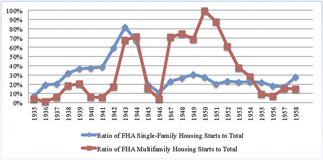
The end result of these myriad programs as well as the sustained FHA interest and support for them, was that loans backed by the FHA were more likely to be on multifamily housing than loans not supported by the agency. From 1934 until 1958, the FHA insured about 25.6 percent of all new single-family construction in the country and 39.7 percent of all multifamily construction. In the postwar years, often regarded as the height of government-led suburbanization, the agency insured well over 70 percent of the multifamily market, while never topping above 30 percent of the single-family.Footnote 32 These numbers indicate that in the absence of the FHA, there would have been more single-family homes relative to multifamily homes, and the American landscape would have had relatively more single-family housing.Footnote 33
FHA single-family and multifamily housing-unit starts to total single-family and multifamily-unit starts. Source: Historical Statistics of the United States, Chapter Dc -Construction Housing and Mortgages. (See Note 32 for details.)

The FHA’s focus on the rental and multifamily markets becomes clearer when one examines defaults and foreclosures on insured mortgages. One would suspect that if multifamily housing was being pushed for reasons of politics or agency preference, multifamily loans would have a higher default rate than the single-family loans, since the agency would be insuring more questionable or marginal mortgagors, and this is what one finds. From the creation of the agency until 1960, single-family homes had a total of 0.8 percent of the dollar volume of all homes insured go into default, while the comparable percentage for multifamily housing was 6.3 percent.Footnote 34
Another useful metric here is the level of reserves the FHA kept to provide for these defaults. Since its creation, the FHA has kept reserves against losses for its different insurance programs, such as those for single-family homes, multifamily homes, and war housing, in distinctive insurance reserve funds, of which there were eleven by 1960. These were funded solely by the fees assessed by the FHA on mortgagors in each of these programs, so they were engineered to be self-sustaining and provide for any losses. In 1960, the “Mutual Mortgage Insurance Fund,” which received money from and insured losses against single-family homes, held $603 million in reserves against an estimated need for $630 million in the case of a downturn, so it was approximately 95.7 percent funded. The “Housing Insurance Fund,” which insured Section 207 multifamily housing, however, held only $14.7 million in reserves against an estimated need for $56.6 million, so it was only 26.0 percent funded.Footnote 35 The high default ratio of multifamily homes and the very low fees required for FHA insurance meant that throughout the early years of its existence, the FHA’s multifamily program presented a significantly greater risk to the taxpayer, and thus a significantly greater “subsidy” to multifamily developers, than its single-family program. Earlier years and other multifamily funds display the same pattern.Footnote 36
The generosity and bias of the FHA toward multifamily apartments was widely recognized at the time. A writer for Architectural Forum was shocked by what he called the FHA’s “financial radicalism,” namely, its generous rates and low fees, in regard to multifamily apartments.Footnote 37 A 1955 survey of the New York City housing market by Leo Grebler, an influential housing economist, noted that “80 percent of the new rental housing that was produced” in the city since the war “was financed with FHA-insured loans involving only nominal, if any, investment of cash funds by the sponsors.”Footnote 38
Lending to Cities and Suburbs
The second accusation of bias that is most commonly lobbed against the FHA is that its insurance, whether single or multifamily, went largely to suburban construction and ignored the needs of central cities and urban communities. Here again, Kenneth Jackson provided the first and most comprehensive statement of this position. He claimed that “no agency of the United States government has had a more pervasive and powerful impact on the American people over the past half-century than the Federal Housing Administration,” since it “hastened the decay of inner-city neighborhoods by stripping them of much of their middle-class constituency.” He also stated that FHA “insurance went to new residential developments on the edges of metropolitan areas, to the neglect of core cities.”Footnote 39 Nell Irvin Painter likewise argued that FHA biases led “cities to decay for lack of credit.” This bias is of course often tied to the alleged bias against rental housing and apartments. The Cambridge Economic History of the United States claims that “with federal mortgage assistance, in some communities it was cheaper to buy in the suburbs than to rent in the city.”Footnote 40
The claim about suburban bias is occasionally based on a lack of knowledge about the FHA’s multifamily programs. Previous researchers have cited pro-suburban language in the FHA’s guide to single-family housing loans, the Underwriting Manual, to argue that the FHA as a whole was biased against cities.Footnote 41 Yet the Underwriting Manual referred to was far from the only manual the FHA distributed at this time, many of which dealt with the importance of building large multifamily dwellings in urban areas. For example, in 1940 the FHA printed a Rental Housing Manual, and it argued against “excessive distance from roads to entrance” and for more accessory buildings and stores. Highways were left unmentioned, but public transit was regarded as of vital importance. The manual said the “most significant feature of the transportation issue” is the transit “run time to the central city, frequency of service during the rush hour, and the fare.” It also explicitly advised that “care should be taken to mention any instance in which a project is in an extra-fare zone,” in other words, too far from downtown.Footnote 42 In its published regulations for 1937, the FHA noted that rental projects should be used as a way to reverse abandonment in central areas. It said it would consider the “size of the proposed project as a factor in influencing neighborhood development and stabilizing, modifying, or reversing discernible trends.” It also wanted rental projects that assisted in the “rehabilitation of blighted or slum areas.”Footnote 43
These multifamily developments thus tended to be built in large urban areas. A member of the Washington, D.C., planning commission even wrote Commissioner Stewart McDonald in the 1930s to complain that the number of apartment houses built in Washington had grown fourfold, “and as near I can make out, it is largely due to the financing by your organization.” He complained particularly about the density of some local projects, which at thirty-three families per acre, were “nearly three times the allowable limit in England, and half again as much as a row house development which we had come to think of as about the limit for Washington.” He asked the FHA to be wary about funding “this over-crowding” or “so intensive a development” again, but to no avail.Footnote 44 Instead, the agency focused its efforts on creating and operating these buildings in central cities. It commissioned studies such as A Survey of Apartment Dwelling Operating Experience in Large American Cities, which argued for stable financing of apartments and noted that “large buildings experienced greater profit than small buildings at comparable income levels.”Footnote 45
The FHA administrators were also not immune from the pervasive concern of the time with “decentralization” and urban decline, since they worried that any decline in city finances threatened their existing mortgage investments. They believed their FHA programs were means to limit this decentralization.Footnote 46 In 1941, the FHA published A Handbook on Urban Redevelopment for Cities in the United States, aimed at urban politicians and administrators. It noted that the agency “has long been conscious of the menace of urban blighted areas and the consequent uncertainty of . . . municipal financial conditions.” It stated that “this is a problem that must sooner or later be solved.” They advocated for cities “recapturing from the State all or a part of the revenues paid by local citizens. For example, refunds from gasoline taxes.” Federal aid to cities through the FHA and other agencies was justified due to the “importance of urban economic health and stability to the economic health of the nation.”Footnote 47
Partly in response to the pleas from some of Eisenhower’s housing officials, Congress in 1954 specifically allowed the FHA greater leeway for investment in central cities than in suburbs. The FHA commissioner was allowed to ignore some legal prohibitions “in an area where the Commissioner finds it is not practicable to obtain conformity with many of the requirements essential to the insurance of mortgages on housing in built-up urban areas.” Despite high and increasing default rates among rental housing mortgages, and national concern about generous multifamily insurance, they also further lowered the underwriting standards, allowing the commissioner to insure urban mortgages that were an “acceptable risk” to the FHA’s insurance funds. “Acceptable risk” was a much lower underwriting standard than that required for suburban mortgages, which the commissioner had to certify were “economically sound,” a standard that the FHA had already mentioned it would interpret “constructively” and generously when dealing with urban areas.Footnote 48
Most public discussion at the time also understood the connection between FHA apartments and central city success. A representative New York Times headline from 1962 exclaimed that “Apartment Boom Changes Atlanta: 700 Buildings in Five Years Spur Shift From Suburbs.” The article noted that “Federal Housing Administration insurance of up to 90 percent of mortgages has spurred the boom in multiple dwelling units.” Footnote 49 New York City’s local politicians, much like the city’s representatives in Congress, also trumpeted the value of the FHA. Robert McMurray, the city’s housing commissioner, told one congressional committee that the “FHA program, especially the multifamily rental-type sections, are of extreme importance in providing decent housing in New York City.”Footnote 50
The FHA’s single-family program was also directed toward major cities due to congressional and other pressures. The desire of Congress to make these single-family loans available to urban mortgagors became clear in the debate on the original act. In 1934, some senators worried that, in the vague bill the administration had handed them, “homes” in the single-family program might be construed to include only detached single-family homes in the suburbs, and in response they inserted several amendments. One said that property could be insured if it was used “in whole or in part for residential purposes” (emphasis added), which allowed homes with some retail or other uses to be insured as well. The committee also inserted directly in the bill a clause that said insurance was to be given “irrespective of whether such dwelling has a party wall or is otherwise physically connected with another dwelling,” which allowed the FHA to insure row houses as well. Finally, instead of the “owner-occupied” houses that the administration had suggested in its bill, the senators removed any owner or occupier requirement and allowed these supposedly “single-family” dwellings to be “not more than four families.” These all became part of the final act.Footnote 51
The FHA’s so-called “single-family” program, which actually could and did insure buildings of up to four-family units that could all be rented out, was thus not insulated from congressional pressures for a more urban focus, and the agency itself often worked to ensure loans in core cities, especially by focusing on mass transportation. The Underwriting Manual, although it did discuss old neighborhoods as a potential credit risk, also mentioned the importance of transit and “ready access to places of employment, main shopping districts, and other neighborhoods within a city.”Footnote 52 Likewise, The FHA Plan of Home Ownership pamphlet, given to prospective single-family borrowers, demanded “Adequate Transportation” to new homes the FHA was funding: “Transportation facilities can be as important to family comfort as modern heating, lighting, or plumbing. How is the home located in relation to the section of the city where members of the family are employed? Is it within walking distance or within reach of busses [sic] and street cars? . . . The attractions of a ‘pretty, new home’ sometimes tempt the inexperienced to purchase property without regard for such important considerations.”Footnote 53
The FHA’s pro-urban bias for single-family homes also emerged out of the location of their field offices and headquarters. In the postwar era, the FHA often required an in-person review of both the technical and legal documents created by a new mortgage, as well as an occasional in-person investigation of insured houses, and the benefits of proximity to insured loans were widely acknowledged. Commissioner Stewart MacDonald mentioned that the “desire to make Federal Housing Administration services available promptly” was paramount when opening up new offices. Significantly, almost all of those offices were in the downtowns of central cities.Footnote 54 When surveying field offices, a 1954 report said “locations in large centers of population have governed” their choices. Another said that in regards to the New Jersey field offices, “Both offices are located strategically to centers of the greatest density of non-farm population in the areas they serve.” Those two offices were in central Newark and central Camden. Most other FHA offices were also in very downtown locations, often only a few blocks from the center of the major city.Footnote 55 By the 1950s, suburban builders who lamented their lack of insurance were apprehensive that FHA agents were staying too close to these offices. One government report noted that while many other government employees were paid by fees for each approved project or permit, and were ready to travel anywhere to get those fees, it was difficult to convince FHA appraisers and inspectors on fixed salaries to “travel long distances” to approve loans for “outlying communities,” since they were in no way compensated for such extra work.Footnote 56 Thus urban locations and the structure of FHA salaries facilitated more urban loans.
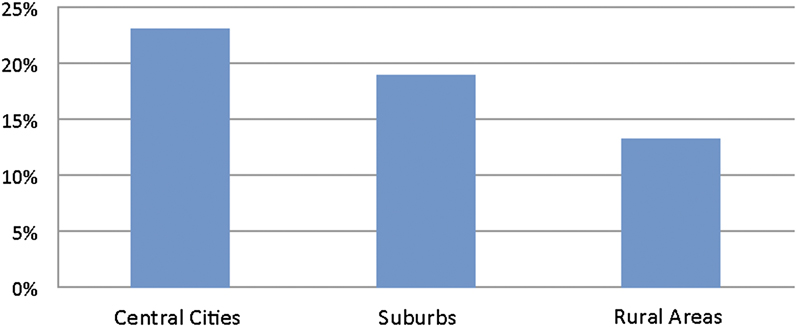
The combined congressional and agency concerns pushed the FHA to be relatively more involved in single-family homes in cities than in suburbs. The 1960 residential finance census show that the FHA insured 23 percent of all single-family mortgages in the central cities and 18.9 percent of such loans in the suburbs. If one moves out to the rural, or possibly “ex-urban,” areas the percentage of FHA loans drops to 13.2 percent.Footnote 57 So besides having a distinctive bias for multifamily homes, the FHA in its early years was more likely to insure homeowners in central cities than suburbs, and more likely to insure both relative to rural or ex-urban areas. Many cities that historians have argued were victims of FHA bias actually had a larger portion of their mortgages insured by the agency than their suburbs did. In Detroit, 31.9 percent of all mortgages inside the city were insured by the FHA, versus 25.3 percent in the suburbs. In Philadelphia, it was 20.3 percent inside the city compared to 19.2 percent in the suburbs. These proportions were found across the country and in many major cities. The bias is even starker if one takes the analysis through the next decade.Footnote 58
FHA single-family mortgages in central cities, suburbs, and rural areas as a percentage of total single-family mortgages. Source: Census Bureau, U.S. Census of Population and Housing, 1960, 8.

FHA’s sensitivity to the needs of urban communities is also demonstrated by an often-overlooked but essential FHA program, property improvement loans, known as Title I loans, significantly, the first section of the National Housing Act. The central importance of these loans was stated early in the discussion on the act’s passage. Marriner Eccles, one of the act’s authors, said that “the no. 1 point of our program [is] the program of modernization and repair.” Another witness, Harry Karr, of the Real Estate Board of Baltimore, in an astute analysis of urban problems, stated that rehabilitation loans were “a most necessary thing, because it goes to the very fundamentals of the city government and the economics of the city, because when you have deteriorated property you have less taxation, and you have a gradual movement out into the suburban districts and beyond the city limits.” He thought only Title I could remedy these ills. Title I was also by far the most generous portion of the act, requiring no fees for such insurance and covering almost all lenders’ losses.Footnote 59
Just as there were underwriting manuals for multifamily homes, the FHA also printed manuals for Title I, such as FHA Title I Lending Operations or Remodel, Repair, Repay with FHA, which suggested that one could use the loan “to convert a single-family home or a business building into apartments, or to modernize an older apartment building.”Footnote 60 Congress soon allowed loans for modernizing apartments or stores with a limit more than twenty times that for single-family loans, specifically to allow installation of equipment such as elevators.Footnote 61 Early in the program’s history, there was a monthly magazine, Better Housing, which urged groups to organize collectively to improve old housing and other properties on the model of the National Recovery Administration. An examination of early newspaper coverage of the National Housing Act also shows that the vast majority of stories dealt with its Title I repairs.Footnote 62
Many officers at the FHA thought Title I was the most important program at the agency. Guy Hollyday, the commissioner of the FHA in the early Eisenhower administration, was a strong proponent of the program. He was a former leader of the “Baltimore Plan” of improving substandard property in that city through rehabilitation, instead of bulldozing, and wanted to bring his experience onto a national stage. When taking over the office, he said too much attention was focused on new construction, and that the FHA should look “at our present supply of housing and determine how it can best be preserved and utilized.” He argued, as the Baltimore realtor during the hearings on the original act, that municipalities needed more support and more revenue, and that “not the least important result” of Title I operations would be increasing revenues of declining cities. Finally, he said that the “problem to which I have devoted the greatest amount of attention since I was appointed FHA Commissioner is the determination of how this agency can broaden its services by helping communities to rehabilitate. . . . I feel that participation in programming the restoration of neglected neighborhoods is the greatest opportunity ever offered to the FHA.”Footnote 63
By 1960, property improvement loans constituted 19.8 percent of all loans insured by dollar amount since the agency’s creation, a total of almost $13.4 billion dollars.Footnote 64 Even this figure vastly underestimates the influence of the FHA’s Title I program on American housing, since home-repair loans tended to have a much lower cost than complete home mortgages. When calculated by number of loans, more loans were made with the FHA Title I program than under all of the agency’s other mortgage insurance programs combined. As early as 1942, at a point when almost all housing was still from the pre-Depression era, an FHA report could boast that one out of every nine existing properties in the country was repaired using an FHA Title I loan.Footnote 65 From 1934 to 1960, the FHA insured 6.3 million housing units of all types, but it also insured a total of 24.3 million property improvement loans, many of which were used for commercial or multifamily properties.Footnote 66 The vast majority of Americans who experienced the FHA in the 1930s, ‘40s and ‘50s thus experienced it as an agency that financed old housing in need of repair and not new tract housing in the suburbs.
Race and Politics at the FHA
No discussion of the FHA’s effect on urban areas would be complete without a discussion of the FHA’s relationship to minorities and especially African Americans. The racial attitudes of the FHA and its effect on minority homebuyers are more complex than the other two issues discussed, and the agency’s bias against these groups cannot be dismissed. The literature on this bias is extensive. Robert Self, in his American Babylon, said that postwar state intervention in the housing market by the FHA and other federal agencies “made financing single-family homes more profitable to lenders, more accessible to white buyers, and virtually unobtainable for African Americans.”Footnote 67 David Freund’s work on the agency argues that the “architects of FHA policy believed that racial minorities were excluded from the new mortgage market . . . because minorities were incapable of engaging the market on its own terms.”Footnote 68 This argument has become so pervasive that in Barack Obama’s landmark speech on race and politics in 2008, he mentioned, among the aspects of “[l]egalized discrimination” in American history, the fact that “black homeowners could not access FHA mortgages.”Footnote 69
This section will show, however, that although the agency was slow to slough off racial biases, after significant political pressure the FHA moved far ahead of the prevailing real estate orthodoxies on race. The section will also demonstrate that when the FHA is compared to private real estate practices, the agency provided relatively more opportunity to minorities, and thus ameliorated some racial disparities, although they did so against an admittedly low bar.
The FHA’s sanctioning of racially restrictive covenants for homebuyers in its early years did constitute indisputable discrimination that hurt potential black homebuyers, though it is difficult to know how much the FHA mimicked prevailing real estate practices and how much it influenced them.Footnote 70 By 1947, however, after tireless and well-documented advocacy by civil rights groups, especially those based in northern cities, the FHA eliminated all references to race and the infiltration of “inharmonious groups” from its literature.Footnote 71 While the justifiable complaints of civil rights groups in the FHA’s sluggish changes have often been noted, few have mentioned that in this act the FHA was moving far ahead of the beliefs in the real estate industry. By comparison, a book sponsored by the National Association of Mortgage Brokers in 1953 still counseled that “the race and nationality of the individual families who live” in an area were of prime importance in determining neighborhood values, and advised that underwriters should be careful in giving loans “when there is fluidity of movement of racial and national groups within a neighborhood.”Footnote 72 The American Institute of Real Estate Appraisers, the private trade association associated with the National Association of Realtors, which produced handbooks similar to the FHA’s Underwriting Manual, continued in the late 1960s to claim that the influx of “people of [a] different race, color, nationality and culture” into a neighborhood led to “the destruction of value.”Footnote 73 Most private real estate associations did not remove all mentions of the supposed negative value associated with “inharmonious groups” from their literature until 1977, and then due only to Fair Housing Act lawsuits from the Department of Justice.Footnote 74 Though the FHA’s conversion to open-access housing was much delayed, as a political institution it was subject to pressure from civil rights groups, mainly based in urban centers, which succeeded in changing its focus, much more so than that of the private-sector groups that were beyond their reach.
After the FHA removed any mention of racial effects on property values from its manuals and forms, most activists of the era saw it as an agency that was more amenable to civil rights influence than the private sector. Robert C. Weaver’s famous The Negro Ghetto (1948) featured one of the first comprehensive criticisms of the FHA’s language about “inharmonious racial groups,” yet the FHA in Weaver’s story was largely a passive recipient of prevailing racist real estate practices. Weaver also argued, in his little-noted section “FHA Makes Amends—And Amendments,” that the policy of the FHA since 1945 under administrator Raymond Foley had been transformed, and that its current efforts were largely positive and pro-integrationist. Weaver explained that Foley issued a memorandum to all employees of the FHA “to encourage and inspire an active interest among FHA field personnel in the housing problems of minorities,” introduced new manuals and officers and provided “5,000 representatives of the building industry . . . with information on the scope of the minority groups’ housing market.”Footnote 75 Mary McLeod Bethune, the civil rights activist and former adviser to President Roosevelt, even wrote to Raymond Foley to explain “how deeply we appreciate the personal interest” he had shown in the minority programs at the FHA.Footnote 76 In a 1952 article in The Crisis, Weaver tempered his criticism further, claiming that “despite widely publicized encouragement of minority groups’ participation,” the FHA had only a “slightly better record” of housing African Americans than the private market.Footnote 77 Here the FHA was criticized for not going further, but its influence was still considered an improvement over complete federal noninterference in the housing market. Likewise, the 1961 United States Commission on Civil Rights report on housing described the “evolution of FHA policy from one actively encouraging discrimination to one advocating open occupancy.”Footnote 78 The civil rights consensus of the 1950s seemed to be that the agency, despite its myriad faults, was a definite improvement over federal noninvolvement.
With further prodding from people like Walter White, Weaver, and Bethune, the FHA did not just eliminate racial animus for its literature, it also worked to create numerous programs that assisted black homebuyers and renters. As Weaver noted, Raymond Foley in 1946 wrote to all FHA field offices “to encourage and inspire an active interest among our field personnel in the problems of minority groups.” Foley said that plans to remove “references to race, or minority groups, from a manual is only a negative approach to the need of the same groups for better housing. Our purpose is also to approach it positively.”Footnote 79 By the early 1950s, the FHA had established “minority group housing goals” for each of the agency’s regions and required them to report back on their progress toward these “quotas.” Far from being a ceiling, the agency advocated “maximum production of housing” in this field.Footnote 80 In 1952, the FHA told all field directors that in building housing for the Korean War, preference “will be given to those applications which propose the construction of open occupancy developments,” and the FHA publicly said that through favorable terms it would actively “encourage construction of privately developed housing projects which are open to all racial groups.”Footnote 81 Though the Executive Order banning discrimination in all government contracting would not be signed for another seven years, in 1955 the FHA inserted in its construction contracts and broker contracts “a clause on non-discrimination in employment” that “obligates the contractor . . . not to discriminate against any employee or applicant for employment because of race.”Footnote 82 Congress also became involved in extending FHA programs among nonwhites. Its 1954 Voluntary Home Mortgage Credit Program allowed special access to credit for some areas, but, as the program’s administrator explained, under the law, “If he is a member of a minority group, he can apply no matter where he lives.”Footnote 83 These were all relatively minor programs with modest goals, but again one has to compare it to the contemporary private sector, which lacked even these efforts.
Media discussions of the agency also demonstrated its attempts to serve the nonwhite market. A 1948 article in a real estate magazine bore the title “Harlem to Get $500,000 Apartment Project: Six-Story Structure Planned” and mentioned that, thanks to the FHA, this was the first large “housing project to be undertaken by a Negro in New York City” and one of the first with a black architect as well.Footnote 84 The Chicago Defender noted in 1950 that FHA approved the “largest mutually owned housing project to be owned and operated by Negroes in America.”Footnote 85 A 1950 Atlanta Journal and Constitution article argued that “Negro efforts, white enterprise and Federal credit are breaking Atlanta’s bottleneck in Negro housing.” (The FHA Commissioner had earlier written the Atlanta Urban League to say that he would “help in every possible way” on one of their proposed projects and assured them of his “fullest cooperation.”)Footnote 86 The FHA in its monthly periodical to banks also advertised extensively about the benefits of building housing for minorities. One FHA officer wrote in 1949 that “many institutions that have not hitherto extended their operations to the financing of homes for minority groups are looking for this field as a desirable outlet. The experience of others in lending on such security confirms its desirability.”Footnote 87
Though the FHA still retained some of the racist practices criticized both then and now, when evaluating their effect on the housing market one again has to compare its efforts to the private sector. The 1960 Census shows that the FHA insured 10.4 percent of all mortgages on nonwhite single-family homes and 18.8 percent of white mortgages. This is a significant and somewhat damning discrepancy, although a far cry from those who state that virtually no loans went to black homeowners. This difference, however, conceals the real disparities in the market since the minority mortgage market was so much smaller than the white one. In 1960, there were about 14 million mortgages on white homes and only 648,330 nonwhite mortgages, or only 4.5 percent of all mortgages, while nonwhites constituted approximately 11.4 percent of the population (over 92 percent of whom were black).Footnote 88 The small difference in total FHA loans for nonwhite relative to whites cannot account for the vast difference between black and white mortgage rates.Footnote 89 If the FHA gave an equal percentage of the market to black and white owners, only 54,459 more FHA-insured homes would go African Americans, which would mean less than 1 percent of nonwhite households would receive FHA insured homes in a state of equality between white and black FHA recipients.Footnote 90 Broader racial discrimination in the mortgage market, along with lower household income for nonwhites, was certainly more important in explaining this vast gulf.
Yet the federal government and the FHA assisted the nonwhite housing market in a different way. The 1960 Census also noted that “Federal and State Agencies,” which included Fannie Mae and other government agencies that purchased mortgages, held 6.7 percent of all nonwhite mortgages, as opposed to 5.0 percent of white mortgages, almost all guaranteed by the FHA. These institutions thus supported the nonwhite mortgage market in the face of existing banking intransigence.Footnote 91
One could note too that the difference between black and white mortgages at the FHA in 1960 was due to large numbers of mortgages remaining from the pre-1947 era, when FHA discrimination was undeniable, into the next decade, and that in the 1950s the FHA was more oriented toward black borrowers, as its literature indicates. By the time of the next census, in 1970, the FHA’s bias was clearer, and it was starkly in the other direction. The FHA in that year supported 35 percent of the black single-family market and only 20 percent of the white market, a tendency that would continue into the present.Footnote 92 The efforts of civil rights advocacy had born obvious fruits.
The facts seem to argue that after about 1950, the FHA, prodded by urban civil rights activists and politicians, made a sincere effort to grant black homeowners and renters a larger share in the market, especially when compared with a private sector that did not have racial relations officers, minority-group housing goals, or nondiscrimination contracts.
Conclusion
Historians have produced a vast literature on the Federal Housing Administration, one that lays the blame for much of the economic disparities prevalent in the American landscape at the feet of this single federal agency. Although this article argues against much of the consensual narrative, it cannot and does not hope to supplant it. Many of the arguments made by previous historians about the agency may be true in some areas and of some aspects its operations. This article also does not hope to contradict arguments that the FHA could have done much more to support cities and minorities, or that its operations squelched more radical reforms. The question presented here is not how FHA policy could have been improved, but how the agency changed the nature of American housing and cities, where its policies inevitably came into conflict with other factors and influences. Certainly other government policies, such as highway construction or zoning practices, had an important influence on pushing or pulling people outside the cities. Yet the evidence marshaled in this article suggests that, on the whole, the FHA was pushed by politicians and their appointees to ameliorate some of the problems of urban America in the mid-twentieth century. Despite claims that federal subsidies created the modern suburban landscape, the government’s most important instrument for reshaping the housing market pushed against it.