INTRODUCTION
As a graduate student attending the local university, all of my time was devoted toward researching gangs and I never saw myself becoming interested in officer involved shootings. Such a level of ignorance in the barrio did not last long. April 25, 2003 was a clear and sunny day. While cleaning my apartment bedroom, in a suburb a block north of Denver, I began to hear several popping noises that at first made me think of fireworks. I became aware that these were gunshots at the same time I realized my two children were playing outside. My wife followed me as we rushed outside to see what was happening. We noticed several police vehicles positioned near a minivan with its windows shot out. Police and ambulance sirens began to erupt in the background as emergency personnel began to crowd the scene. I made my children come inside the apartment as I grabbed my video camera and went back outside. For the last two years, I had been observing the police with a local community advocacy group. I realized this had become one of the most important times in my life to begin recording a police encounter and I began talking with witnesses. My interest in documenting this event was shrouded around the reluctance to capture a homicide victim on my video camera.
As I continued recording, an emergency response team took the young man away on an ambulance stretcher. He was alive but hurt. Signs of blood and pain covered his reality. A chopper began to hover in the sky and I recognized it as the local media. A White male police officer began taping off the crime scene and asked whether anyone saw anything. Many of my neighbors were outside but no one stepped forward. The police do not have rapport with the community. Many of us perceived the police as untrustworthy and dangerous. No one wanted to get involved. The working class residents were primarily Latino/a, White, Asian, and Black. When I watched the news that evening I learned the man’s name was Michael Grimaldo and he was listed as being alive. The police maintained a crime scene around the van as investigators sifted through the evidence. I felt a sense of relief the man didn’t die, especially because my neighbors claimed the shooting was unjustified.
The next morning I picked up the newspaper and learned the man died due to his gunshot wounds shortly after arriving to the hospital. The District Attorney Decision Letter stated how Michael was originally shot three times while fleeing from the police ( Lepley Reference Lepley>2003 ). The DA suspected Michael was preparing to use drugs when he became startled to encounter two police officers while parked in an abandoned bowling alley, a block south of my apartment. An officer of seven years believed his life was in danger when Michael attempted to get away in his vehicle and made threatening arm motions. The officer fired several shots, but Michael continued driving away. The two officers lost Michael when they notified dispatch that shots had been fired and the suspect was perceived to have been hit. Officer Karl Scherk, a twenty-year veteran, heard the call and drove to the vicinity where shots had been fired. An update was given that the suspect was in my apartment complex. When Officer Scherk came to a screeching halt in his patrol car, he hopped out of the vehicle and ordered the bloodied Michael to put his hands in the air. According to Officer Scherk, Michael was not responding and reaching into the center of his vehicle when Scherk fired two shots from his firearm. Michael, after being shot now a total of five times, continued to remain unresponsive to commands and Scherck fired a third shot. Afterwards, Officer Scherck reported thinking Michael was reaching for a gun. No such weapon existed. The autopsy found the twenty-three-year-old Michael was not under the influence of drugs or alcohol.
Michael was the same age as my younger brother, making me feel connected to the events that transpired. A few days later, several individuals came to the scene of the shooting and I walked over to see what they were doing. I learned they were Michael’s family members, including his pregnant wife and in-laws trying to figure out what happened. I told them what I observed and recorded. They thanked me for my help and invited me to attend Michael’s funeral viewing. As I sat near the back, I watched family members mourn as they approached the casket. I learned the impact of losing a family member to legitimized police violence. I wondered how can the police enter into my neighborhood and shoot an unarmed Latino man and face no legal consequences. Several additional shootings of Blacks and Latinos over the summer of 2003 made me want to learn more about who gets shot by the police and why. What determines whether a shooting is considered legally justifiable? Were there questionable shootings in Denver similar to Michael’s that were also considered legally justified and if so why?
Legalizing Deadly Force
The official decision-making regarding who deserves the punishment of death has a long history of controversy in the United States. In the early 1900s, W. E. B. Du Bois protested against the acts of lynching in the south, where Blacks were overrepresented as victims of these brutal attacks (Dray Reference Dray2002; Gabbidon Reference Gabbidon2001; Lewis Reference Lewis1993, 2000). In this form of punishment, community members, often with the help of or led by law enforcement officers enacted their own form of extrajudicial violence for individuals accused of criminal wrongdoing. With sustained struggle, lynchings were finally made illegal nationwide in 1968. After the increased production of firearms, a new form of death at the hands of law enforcement began to become justified: officer involved shootings (Takagi Reference Takagi1974). The increased production of firearms has increased since the 19th century allowing this deadly tool to be used for self defense, discretionary enforcement of laws, suicide, and participation in violence (Cook and Ludwig, Reference Cook and Ludwig2002; Cook et al., Reference Cook, Moore and Braga2000; Hemenway Reference Hemenway2004). The Small Arms Survey (2008) described armed violence as an epidemic that continues to impact communities around the globe. Most firearm research has focused on interpersonal violence yet agents of the state were a critical agent in the use of such a deadly object.
Although there was no central data collection system for tracking the number of deaths from law enforcement nationwide, a few studies provide some insight. According to the U.S. Bureau of Justice Statistics, from 2003 to 2009 there were 2931 people killed by law enforcement personnel, or an average of 419 individuals per year (Burch Reference Burch2011). From 1976 to 1998, 8578 residents were killed in officer involved shootings or an average of 373 individuals per year (Brown and Langan, Reference Brown and Langan2001). Most of the individuals killed were male, and Blacks were proportionately overrepresented compared to Whites.
A number of legal and research articles explain how law enforcement justification to use deadly force when apprehending a suspect was based on a common law ruling existing as far back as England in the 1200s (Binder and Scharf, Reference Binder and Scharf1982; Caplan Reference Caplan2000; Ravkind Reference Ravkind1959; Southwick Reference Southwick1999). During these times, breaking the law resulted in forfeiture of life. Accurate data on how often these crimes and deadly apprehensions occurred may be hard to assess. In the United States, most felonies and homicides do not result in the death penalty (Bright Reference Bright1994; Death Penalty Information Center 2016; FBI Uniform Crime Reports 2016).
For centuries, each state operated its own legal precedence and policies regarding the use of deadly force. Tennessee v. Garner (1985) formally established federal ground rules for law enforcement officers. In this case, a Memphis, Tennessee police officer shot and killed an unarmed fifteen-year-old Black youth (Garner) fleeing from a nighttime burglary. The eighth grader didn’t have a weapon as he attempted to jump a six foot fence. The officer reported thinking the suspect would get away and he shot Garner in the back of the head. A Tennessee statute and the police department policy allowed the officer to use deadly force in a burglary, despite Garner only stealing $10 and a purse. Garner’s father challenged this practice, but the lower courts agreed with the police department and state in finding no criminal wrongdoing in the officer’s decision. However, the United States Supreme Court argued the Fourth Amendment reasonableness requirement did not include a seizure of this type. The outdated common law practice of allowing the use of deadly force for any felony was no longer realistic. The Court ruled that police officers cannot shoot a non dangerous fleeing suspect unless probable cause exists that the suspect poses a significant threat of death or serious injury to the officer or other individuals. The Court did not favor the argument of Garner’s shooting as a violation of the Fourteenth Amendment, despite other deadly force cases in Memphis where the suspect was unarmed and non-assaultive involving primarily Black males (Sparger and Giacopassi, Reference Sparger and Giacopassi1992).
According to the literature, the overall impact of the Tennessee v. Garner (1985) decision on law enforcement use of deadly force was unclear. Although several researchers found police departments reporting decreased use of firearm discharges and increased policies and training (Culliver and Sigler, Reference Culliver and Sigler1995; Sparger and Giacopassi, Reference Sparger and Giacopassi1992; Tennenbaum Reference Tennenbaum1994), the chronological data provided by Brown and Langan (Reference Brown and Langan2001) highlight fluctuation in the number of shootings since 1985 in both total numbers and rates. Fyfe (Reference Fyfe1988) argued most major police departments had similar administrative policies at the time of the Garner decision, thus the ruling probably had more impact on smaller police jurisdictions. Justification seems all too common for a wide variety of circumstances, making the law a central point of frustration for family members and friends of individuals shot by the police (The Stolen Lives Project 1999). Russell-Brown (Reference Russell-Brown2004) commented how Blacks are often blamed for their own victimization or required to establish themselves as good victims (i.e. employed, graduate, no criminal record, held in high esteem, and appearing as non-threatening). Such a standard continues to place a burden on victims and/or families to prove the worthiness of loved ones.
Two complementary theories will be used to provide explanatory power as to why these shootings occur. First, Critical Race Theory (CRT) offers an opportunity to explain the unfolding circumstances by establishing that racism is foundational in the history, and common, every-day practices of the United States. As a method for uprooting racism, CRT through the voice of color thesis has utilized storytelling to provide an opportunity to give voice to experiences of oppression from the perspective of outgroups (Acosta 1973; Delgado Reference Delgado1989; Gouldner Reference Gouldner1968; Mirandé 2011). Second, explaining why officer-involved shootings remain mainstream requires an analysis of interest convergence, or in other words why change requires meeting the interests of White leaders. Derrick Bell (Reference Bell1980, p. 523) argues:
The interest of blacks in achieving racial equality will be accommodated only when it converges with the interest of whites. However, the Fourteenth Amendment, standing alone, will not authorize a judicial remedy providing effective racial equality for blacks where the remedy sought threatens the superior societal status of middle- and upper-class whites.
Matsuda (1989, p. 3) summarized the work of Derrick Bell best when she argued how his work described the law as “both a product and a promoter of racism.” Critical criminologists and researchers engaged in studying the impact of colonialism have shared a familiar framework when they argued that the law continues to serve the interests of the dominant classes (Mirandé 1987; Quinney 1977). In this context, attaining a remedy for unequal outcomes requires a shared experience between those in power and individuals who remain disenfranchised.
As an integrative theoretical framework, Social Dominance Theory (SDT) provides specific insights into why police violence was targeted against subordinate groups and why state violence was particularly targeted against males of color (Haley and Sidanius, Reference Haley and Sidanius2005; McDonald, et al., 2011; Sidanius and Pratto, Reference Sidanius and Pratto1999; Sidanius et al., Reference Sidanius, Pratto, van Laar and Levin2004). Rather than race being the absolute foundation as in CRT, SDT argues all human societies are structured in systems of group-based hierarchies. The small number of dominant groups influence the ideologies of what is socially valued, primarily through three stratification systems including (1) age; (2) gender; and (3) arbitrary sets which include caste, clan, ethnicity, race, religion, or other socially relevant group distinctions. These theorists argue that law enforcement was a hierarchy-enhancing occupation, with employees with primarily anti-egalitarian beliefs seeking to uphold (and receive privileges for upholding) dominant group interests. Both of these theories posit the difficulty yet importance of minimizing group based hierarchies. In responding to critics in regards to how SDT was more along the lines of Marxist and feminist scholarship than biological determinism, Sidanius et al., (Reference Sidanius, Pratto, van Laar and Levin2004, p. 862) stated “Rather than being an endorsement of oppression, social dominance theory can be seen as a prerequisite to morally driven intervention.”
In this paper, I provide an overview of the issues surrounding the legal decision-making involved in controversial officer involved shootings that occurred in the City and County of Denver from 1983 to 2012. Community members desired justice and accountability whereas public officials managed shifting notions of legality and policy shrouded by a terminology of justification. This selection and analysis of thirty-nine shootings is based on reviewing 218 officer involved shootings compiled from case files, decision letters, and videos. In addition, the author participated in more than a dozen police shooting protests, observed nearly one hundred police stops, and conducted semi-structured interviews with seven key stakeholders. Denver will be the location for this empirical discussion due to the number of shootings over several decades and availability of various sources of data.
METHODS AND SETTING
The research reported in this article is part of a larger, thirteen-year study of police shootings in Denver, Colorado. Archival and qualitative data were utilized in an attempt to build a comprehensive analysis of all shootings of and from law enforcement officers within the City and County of Denver, Colorado between January 1, 1983 and December 31, 2012. This research project combined 202 complete files held at the District Attorney’s (DA) office, 198 District Attorney Decision Letters, and thirty-seven videos involving officers, suspects, and witness interviews from immediately after the shooting occurred. Newspaper articles were collected on 172 shootings for a total of 913 articles in addition to more than 500 articles focusing on local police shootings in general and police officers. Footnote 1 Seven interviews were conducted with police critics and a prosecutor to provide insight into why police shootings were disputed or justified.
The study was first initiated by the author compiling a list of shootings available at the DA Office. The DA in Denver, Colorado reviews all police involved shootings to determine legal justification. Denver District Attorney Mitchell R. Morrissey (Reference Morrissey2011, p. 1) reported “For more than a quarter century, Denver has had the most open officer-involved shooting protocol in the country.” The police shooting files were open to the public for in-person review in the municipal office building. Included in these files were a Homicide Unit investigation conducted by the Denver Police Department, formal voluntary statements from witnesses and officers, autopsy reports, an overview of crime scene evidence collected, and a decision letter. The file boxes were obtained for me by the Assistant District Attorney and were semi-organized by year. I devoted several forty hour weeks, over a period of three years, reviewing the complete files at the DA office.
The 198 District Attorney police shooting decision letters included a brief summary of information contained in the complete file held at the DA’s office. They ranged in length from two to forty-seven pages. Copies of these letters were made available to me for further review and were valuable in developing a comprehensive database for each shooting. A small number of decision letters (n = 21) were not available in the case file or with the Assistant DA. The DA did not write letters in five cases where criminal charges were pursued or brought before the grand jury. It is important to note, these reports provided legal justification for shootings and were written in a format condemning the suspect and praising the officers. Similar to DA decision letters, Manager of Safety Public Statements provided additional background information for shootings since 2003 that resulted in death. These twenty-two reports were beneficial because they went beyond issues of legality to provide an administrative review involving whether the shooting met departmental policy and procedural standards. The key themes reviewed were the reasonableness of the officers’ tactics, reasonableness of the assessment of the threat, and reasonableness of the use of force option. These public statements were mostly supportive of officers, but two resulted in officers who were disciplined for their behavior.
In addition to reviewing files, the author watched thirty-seven police interview videos at the DA office that were recorded from 1988 to 2011. Handwritten notes of the accounts were written down on a notepad. Morrissey (Reference Morrissey2011, p. 2) stated how the use of the videotape interview room has included voluntary sworn statements from officer(s) and witnesses since 1983: “No other major city police department in the nation can make this statement.” Originally, forty-eight videos were randomly selected for review, but due to missing videos in several files a convenience sample was obtained. Footnote 2 Twenty-five percent (n = 12) of the original sample were included in the convenience sample. Time length in videos ranged from thirty minutes to over four hours. Police interviews were conducted individually with the officers involved or present when the shooting occurred, witnesses, and occasionally victims of the shooting. The interviews were conducted shortly after each shooting.
Since the Denver Police Department was the central agency that investigates law enforcement involved shootings in the City and County of Denver and was often accompanied by the DA’s office, the news media provided another investigative agency to pursue information. Although newspaper sales and controversy were of interest to reporters and readers, many of the shootings occurring in Denver were susceptible to criticism and these disputes were often ignored or discounted in the official decision letters. Lawyers challenged some of the shootings in court and the media shared these factual contradictions with the general public. To provide additional insight into police shootings, over 1000 newspaper articles were obtained and analyzed for supplemental information. The media complemented the shooting files by providing additional witness accounts and information pertaining to the shooting that was often more critical of police use of force. The local newspapers, such as the Denver Post, The Rocky Mountain News, and Westword often competed for who had the best access to in-depth versions of the shootings. Footnote 3 Some shootings received a lot of coverage, whereas others received very little to no coverage. For the most part, individual shooting coverage from the media was supportive of police and DA viewpoints, as captured by the research by Hirschfield and Simon (Reference Hirschfield and Simon2010), whereas some of the more general coverage was found to be more critical.
Finally, in an effort to develop a broader view of police shootings, I conducted semi-structured interviews with seven individuals regarding police shootings. Six of these individuals were police critics, often some of the most prominent community activists on behalf of family members. Another individual was one of the key prosecutors in the District Attorney’s office for three decades. In addition, I used participant observation at more than a dozen protests against police shootings from 2003 to 2006 to learn more about community grievances by talking with local residents, police critics, and family or friends of individuals shot by the police. A previous research project by the author resulted in nearly 100 field observations of the police in Denver from 2002 to 2006 (Durán Reference Durán2013).
The author entered all sources of data into SPSS, Microsoft Word, and QSR NVivo 10 for different forms of analyses. One hundred and fifteen variables were coded on SPSS. These included incident characteristics (when, where, why, etc.), suspect characteristics (age, background, gender, race), officer characteristics (years on the force, gender, accompanied by other officer, recognition for shooting), and additional details (criminal records, prison records, disputed shootings, consumption of drugs and alcohol). Qualitative coding of themes and constructing narratives for the 218 shootings benefitted from the use of Microsoft Word and QSR NVivo 10 software. In order to separate controversial shootings from the broader number of shootings, the author coded each file with a plus and minus ranking that ranged from -9 to +7, with an average of +1. The thirty-nine shootings coded by the author between -9 and -2 were selected to build the themes for this paper, whereas the other two categories of questionable (n = 99 or coded as -1 to +2), and more defendable (n = 80 or coded as +3 to +7) could be the focus of other reports. Twelve representative cases were then constructed to provide narratives, but any of the thirty-nine cases could have easily been situated into the outlined themes. The purpose of this coding scheme was not to essentialize each shooting but rather to provide a descriptive subset of shootings that could provide a qualitative overview of why some shootings were controversial.
Determining Shooting Legitimacy
The legal authority for law enforcement shootings can be found in the Colorado Revised Statutes 18-1-707. An officer was legally justified to shoot someone in cases where the officer reasonably believed it was necessary: (1) to defend self or third person and (2) effect arrest or prevent escape of an individual who has committed a felony or is fleeing with the use of a deadly weapon. From 1983 to 2012 there were a total of 218 officer involved shootings. Seven different District Attorneys considered almost all (99.5%) of the officer involved shootings legally justified. Of these shootings, 104 resulted in death. The DA brought three cases before a grand jury, where he determined there was not enough evidence to bring the case to trial due to the difficulty in proving the case beyond a reasonable doubt. Despite the legal stronghold of the District Attorney almost never filing criminal charges against an officer, shootings were often interwoven with questionable circumstances and competing arguments that often resulted in community members’ desiring a higher expectation of “truth” than what was provided by the law.
Two technical reports specifically focusing on law enforcement shootings and policy were conducted in the City and County of Denver. In June of 1996, the District Attorney Bill Ritter appointed an advisory team to review policies and procedures of the Denver Police Department and District Attorney as to whether deadly physical force decisions should result in criminal charges (Erickson Commission 1997). A retired Colorado Supreme Court Justice, William H. Erickson, led the team of former law enforcement officers, elected officials, and community leaders. The decision for such a commission was pushed by criticism for the DA not filing criminal charges on two off-duty officers involved in the Jeff Truax shooting: a young White man shot to death in his vehicle by two off-duty police officers working at a nightclub. The advisory team spent a year reviewing the procedures for shooting investigations and a total of eleven officer-involved shootings. In conclusion, the Erickson Commission (1997, p. 55) “…found no fundamental flaws in the procedures that are currently being followed.” They compared shootings in Denver to twenty-five other similar sized jurisdictions around the country and found the criminal law allowed great latitude and freedom for law enforcement officers. Thus, greater change or progress was suggested to result more from improved internal policies, procedures, and training.
In 2008, the City and County contracted with the Police Assessment Resource Center (PARC) to review twenty-four officer-involved shootings from 1999 to 2003 (Bobb et al., Reference Bobb, Melekian, Root, Barge and Naguib2008). They concluded that Denver met and even exceeded national standards in many areas, “making the DPD one of a handful of American police departments becoming a national leader,” yet most of this progress occurred after 2004 (Bobb et al., Reference Bobb, Melekian, Root, Barge and Naguib2008, p. 15). PARC encouraged the Denver Police Department to first hold officers accountable and second to learn from these incidents. They used the legal reasoning in Graham v. Connor (1989), arguing the discretion of whether to use force “must be judged from the perspective of a reasonable officer on the scene, rather than with the 20/20 vision of hindsight” (Bobb et al., Reference Bobb, Melekian, Root, Barge and Naguib2008, p. 19). The evaluators criticized the DPD for some of these cases, including contradictory crime scene investigations and lack of follow-up on some leads. They also encouraged better collection of physical evidence. Some interviews were found to be rushed and often including improper leading questions. Many of the interviews did not match the material evidence. The evaluators discouraged the granting of Medals of Honor or other awards for many of the law enforcement shootings because some of these incidents included tactical errors and thus the need for increased officer restraint. PARC discouraged officers from putting themselves in proximity of vehicles and endangering themselves (p. 138). Footnote 4 Overall, this report continued to replicate a number of assessments that were conducted over a period of thirty years regarding whether officers were objectively reasonable in light of the facts and circumstances.
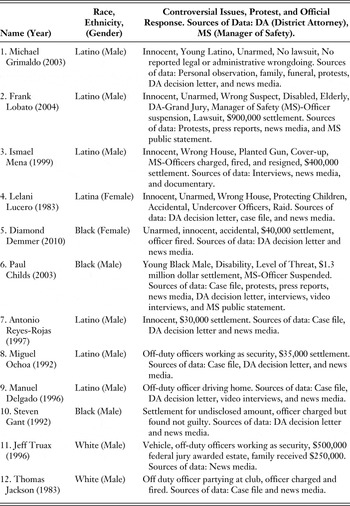
This research study draws upon a collection of shooting cases that were both larger in size (analysis of 218 shootings) and scope (thirty years) than previous reports. The individual coding of the 218 shootings resulted in thirty-nine cases that were determined to have a higher degree of controversy and led to the creation of three themes. Based on community claims and media coverage, there was not one single characteristic that led to protest over a police shooting. Instead, it was the intertwining of several key factors such as (1) lack of criminal participation by individual suspects; (2) violations of continuum of force standards; and (3) 24-7 deadly force discretion that encompassed off-duty officers. Twelve cases that are representative of the overall thirty-nine controversial shootings were expanded to develop a narrative of how District Attorneys and police departments attempted to mediate pressures from community members demanding justice in order to maintain an image of legitimacy. These narratives provide an overview of each of these shootings in a storytelling format used by Critical Race Theory (Delgado and Stefancic, Reference Delgado and Stefancic2005, Reference Delgado and Stefancic2012) (See Table 1). However, rather than create fictionalized characters responding to real issues, the author of this paper focuses on actual historical cases involving real victims and offenders. This type of storytelling matches more the vision of W. E. B. Du Bois (Reference Du Bois1996) and the encouraged importance described by Mirandé (2011).
Overview of Shooting Cases Reviewed

Innocent Individuals
In the United States, determining guilt was an outcome of an adversarial court system. However, a key feature of officer involved shootings was claiming suspect criminality (Russell-Brown Reference Russell-Brown2004; Stolen Lives Project 1999). Studies on law enforcement have found officers often justify the need to control suspects with force (Rojek et al., Reference Rojek, Alpert and Smith2010), and occasionally this takes the form of lying to ensure a higher chance of conviction or to validate the accounts made by fellow officers (Hunt and Manning, Reference Hunt and Manning1991). In a national study conducted on 925 randomly selected officers, Weisburd et al., (Reference Weisburd, Greenspan, Hamilton, Williams and Bryant2000) found that while most officers no longer report accepting the code of silence (remaining silent after observing officer misconduct), one-quarter (24.9%) believed it was not worth alerting authorities if wrongdoing was observed, and nearly two-thirds (67.4%) believed it would make their fellow officers treat them negatively. For these reasons, slightly more than half (52.4%) of officers reported not officially acknowledging wrongdoing when it was observed. In the City and County of Denver, District Attorneys and law enforcement officers regularly argued the shooting occurred not only due to illegal behavior, but also because the suspect caused a significant deadly threat to others. A number of shootings causing outrage and encountering dispute questioned whether the individual shot was involved in criminal activity and determining how the officer perceived this individual to be a threat. Community protests and media coverage often pushed public officials to admit officers may have reached the wrong conclusion regarding the perception of both criminality and whether the suspect posed a deadly threat. Depending on the degree of problematic information, District Attorneys, Mayors, and Managers of Safety were pushed to re-evaluate how to justify such situations.
Highlighting the lack of criminal involvement narratives was a statement occasionally reported by officers: “I thought he had a gun.” In popular media depictions, individuals shot by law enforcement officers were in possession of dangerous weapons and causing public harm. In Denver, slightly more than half (55%) of the 218 shooting victims possessed a firearm, but only five cases involved shootings that occurred after a suspect killed someone either prior to or in the presence of an officer. Footnote 5 One-fifth (19%, n = 42) of all shooting victims and 59% (n = 23) of the controversial cases in Denver were not holding a weapon. Psychologists have found from a number of virtual studies how Blacks and Whites were more likely to perceive Blacks to possess a firearm, followed by Latinos, even when such a weapon did not exist (Payne Reference Payne2001, Reference Payne2006). These outcomes were particularly more significant when the decision to shoot was made quickly.
Sixty-three-year-old Frank Lobato met both circumstances of not participating in criminal activity or possessing a weapon. On July 11, 2004, Frank was shot to death for holding possibly no more than a soda can. On Sunday evening around 7:00 p.m., officers received a 911 call from a woman stating she had been assaulted and held against her will by her forty-two-year-old boyfriend who was 5’11” and 290 lb. She snuck out of her apartment, while the boyfriend was passed out on the couch, and ran to the nearby McDonald’s to make a call for help. Denver Police officers gathered information about the suspect and they were notified an elderly uncle, Frank, also lived in the apartment. When officers arrived at the apartment at 8:07 p.m. and knocked on the front and back door there was no answer. A young boy told the officers the woman’s boyfriend jumped out the second floor window and left the scene. The officers didn’t think the boy’s story was logical since the man could have easily walked out either door. After obtaining a ladder from the fire department the officers entered the second floor of the apartment at 8:26 p.m. The officers began checking rooms with flashlights and guns drawn. When they opened a bedroom door, the lead officer (Ford) reported someone bolting up from bed holding a blanket and a shiny object in his right hand stating “What the Fuck.” Startled and reporting he perceived a gun, Officer Ford fired one shot hitting Frank in the chest. Dispatch was notified at 8:45 p.m. When examining the bedroom, investigators did not find a weapon only a soda can and some drug paraphernalia containing opium.
The case encountered community outrage and media attention. The District Attorney brought the case before a grand jury where nine people were not convinced the officer was criminally liable. For this reason, the DA did not believe he could establish guilt beyond a reasonable doubt before twelve jurors in a criminal trial. The Manager of Safety issued a ninety- day suspension for Officer Ford because he did not believe there was enough evidence for the officer to conclude an imminent threat was present, thus objectively unreasonable. The policy of comparative discipline prevented a more harsh punishment. In controversial cases, the media often pursued information regarding the lives of both the police officer and especially the individual shot. Frank was described as a heroin and cocaine addict who lived on a disability check. He grew up in East Denver, lived in California for some time, went to prison, had a lengthy criminal record, and often was homeless in the later years of his life. He was the father of four children who lived in California. A reporter described how Frank previously had violated his probation and was sentenced to three years of intensive supervision at the Salvation Army Adult Rehabilitation Center, and was not supposed to be in the home of his nephew (Olinger Reference Olinger2004). Despite these portrayals, community activists continued to emphasize the harmlessness of an elderly and disabled man lying in his bed without a weapon. Protests and vigils were held in Frank’s memory and during demonstrations against police brutality. Officer Ford’s life was also questioned. He joined the Jasper Police Department (Texas) in 1992 and moved up the ranks. In 2001, he became a member of the Denver Police Department. He was divorced and allegedly threatened his ex-wife’s boyfriend. A woman he dated claimed Officer Ford was violent, aggressive, trigger-happy, and obsessive (Osher Reference Osher2007). A settlement of $900,000 guaranteed the case did not go to trial in civil court and Officer Ford was subsequently suspended for fifty days. Many community members perceived this as a criminal case, yet the officer did not face legal consequences.
No knock search warrants were controversial when based on inaccurate information. Nine percent (n = 19) of the 218 cases involved an officer initiating either a search warrant or arrest warrant. On September 29, 1999, three officers shot and killed forty-five-year-old Ismael Mena for living in a duplex wrongfully accused as a location for where drugs were distributed. Ismael was working the night shift at the Coca-Cola factory and was more than likely asleep when the no-knock raid began. Ismael, a father of nine children, had been sending money to his family in Guadalajara, Mexico by working in various states over the years on a temporary worker visa. He had only lived in the Denver duplex for about a month when officers received a tip from a confidential informant that crack was being sold from the residence. As officers entered the duplex, they arrested a man downstairs and reportedly observed Ismael coming out from his upstairs room with a gun. Officers responded by shooting eight times. A news station later received a tip about officers attempting to cover up the fact that police officers raided the wrong house (Dominguez Reference Dominguez2007). Ismael did not have any drugs in his system and there were no drugs found in the home.
In response to this shooting, a community group named the Justice for Mena Committee was organized. The Mexican-Consulate General requested a federal investigation and the FBI initiated a criminal civil rights investigation. The American Civil Liberties Union challenged the reasoning behind the initial search warrant. Richard and Samantha, both middle-aged community activist and observers of the police since the late 1990s stated there were several problems with the Mena case that they often couldn’t get public officials to admit:
[Richard] They claim that Ismael Mena fired at them, but we don’t believe that really happened. [Why is that?] Well, the gun that they had was a World War II German 22 revolver and it wasn’t the firing pin that was broken but the pin that holds the revolver in place. When you pull the trigger the bullet advances and the revolver turns. When the hammer falls it strikes the bullet and fires it through the barrel. This gun you had to manually align the revolver with the barrel so the hammer would actually fire the gun correctly. If Mena had fired at the police three times before they opened [the door] and then fired twice more after they had shot him four times. I don’t believe he [Ismael] had the time. Like really, he had been shot very seriously when he sat up and must have returned fire when the police went into his bedroom and finished him off. And we don’t believe that he did that. We believe that gun was dropped. I think the police had that gun as a gun to drop. [Samantha continues] The original newspaper stories that reported the Mena killings, the stories published on September 30 of 1999, said that Mena was standing at the top of the stairs in a three point stance shooting. And actually it later came out that he had never left his bedroom. And they shot him through the door so from the very beginning the police used a story that would justify killing this man but none of that story was really true. [Richard] In fact, over and over again we were able to have stories that the police gave discredited.
A retired FBI agent who investigated the case supported the claim that officers used a “throw down gun” to make it look as if Ismael was at fault and that police had also considered planting drugs (Ensslin Reference Ensslin2003), but a federal judge dismissed the lawsuit. The officer responsible for the raid, Joe Bini, pled guilty to a reduced misdemeanor charge for official misconduct (Pankratz Reference Pankratz2000). A twenty-year veteran reported to internal affairs that senior officers had encouraged her to fabricate evidence (Vaughan Reference Vaughan2000). A community leader stated how the crime scene evidence concluded the police had moved the body. The Mayor of Denver wanted to overhaul the police department which he described as a “good old buddy system” and pursued finding a new police chief. The mayor asked the police chief to resign and the manager of safety to be replaced. The city paid $400,000 in damages in a settlement to the Mena family (Flynn Reference Flynn2000). Officer Bini, who later retired in 2008 from the police department during a time of criminal investigation, subsequently received a criminal arrest for child enticement and unlawful sexual contact (Pankratz Reference Pankratz2008). The Ismael Mena case was controversial, but most of the legal attention was focused on how the warrant was obtained and reports of trying to cover up a raid that occurred at the wrong address.
The shooting of twenty-five-year-old Lelani Lucero, a Latina, shared many similarities with the Ismael Mena case. On February 1, 1983 at approximately 9:15 p.m., plain clothes officers attempted to execute an immediate entry search warrant, based on a first time confidential informant, for the residence of a man named George Jones. Juan Lucero, the husband of Lelani, observed several men outside their home with guns drawn attempting to enter. Unknown to officers, but this was not the residence of George Jones. Juan didn’t know the plain clothes individuals outside were police officers as he attempted to prevent the armed men from entering his home. The DA seemed unclear who fired the first shot, but gunfire was exchanged. Glass hit one of the officers in the eye and fellow officers believed he had been shot. Juan took cover as bullets were fired into the home and his wife was struck in the buttocks while she took cover with the children. Juan fired three rounds from his .22 revolver and officers fired thirteen shots. The front entry team entered the residence in uniform and everyone seemed to realize the mistaken perceptions. Juan, seeing uniformed police officers, dropped the gun and was placed in handcuffs. The DA, Norman S. Early (Reference Early1983), stated:
After a complete and thorough review of the investigation of this case, I conclude that no criminal charges are fileable against Detective Marc Vasquez or Officer Kenneth Chavez for their conduct in this incident. Given all the facts and circumstances, the officers clearly had a right to return the fire. The fact that they were executing a search warrant that was based on the false information given them by the informant has no bearing on their right to return fire (p. 5).
Early outlined six reasons why Juan may have believed a robbery was in progress including (1) closeness in time between shots and police identification announcement; (2) officers in street clothes; (3) presence of wife and children to protect; (4) the fact Juan was not subject to a search warrant; (5) the fact Juan did not shoot at front entry officers; and (6) the statement of Juan’s nine-year old son reporting someone was attempting to rob them. Thus the DA did not file criminal charges against Juan and encouraged greater caution to law enforcement officers when initiating arrest or search warrants where intrusion into a residence was required. The Lucero family filed a lawsuit and it was unclear whether they obtained a settlement.
Officer perceptions at the time they fired their weapon did not always corroborate with the physical evidence or witness testimony. Antonio Reyes-Rojas, 17, was preparing to celebrate the New Year by watching his friends’ fire a rifle, a shotgun, and a handgun into the air. Upon hearing shots, Officer Ken Chavez responded to the scene and reported seeing an individual point a gun at him when he fired two shots. Antonio was hit once in the buttocks as he was walking back into the house. He reported never seeing or hearing the officer or firing a gun. Physical evidence and witness testimony conflicted with the officers’ claims. Bill Ritter, the District Attorney did not find corroborating evidence to support Officer Chavez. However, the DA concluded no criminal charges were going to be filed because the case couldn’t be proven beyond a reasonable doubt. The unarmed Antonio accepted a $30,000 settlement along with paid medical expenses for being shot in the buttocks with the bullet exiting near his groin. The officer, a twenty-year veteran, continued to have controversial shootings that occurred in 1977, 1980, 1983, and 2006.
Finally, guilt is difficult to uphold as an argument when the wrong person was hit by officer bullets. On July 2, 2010, Diamond Demmer, a twenty-nine-year-old Black female was leaving a club at 1:58 a.m. and attempting to walk to her vehicle when a fight broke out. She attempted to stay away from a confrontation and walked a different path. In the Arby’s drive-thru lane, a man began firing a handgun into the sky. Officers were already on the scene after breaking up an earlier fight when they observed a man in a 2003 GMC Yukon firing a gun. One officer began firing pepper balls that were ineffective and then fired three shots from his .45 caliber handgun. Another officer, Fitzgibbons, fired five shots from a .223 caliber AR-15 rifle. None of the bullets hit Shead who later reported he was firing shots in the air to scare off a potential assailant. However, as Diamond stepped from behind the Arby’s building she was struck in the left leg and lower torso by bullet fragments and then again in the right leg and lower torso. It was later determined Officer Fitzgibbons was using unauthorized military tracer bullets that had a greater chance of fragmenting and penetrating. Despite Diamond not being the intended target, the District Attorney Mitchell Morrissey (Reference Morrissey2010) stated the totality of facts gave the officers the right to shoot:
The fact that an uninvolved person was injured by bullet fragments from two of Officer Fitzgibbons’ rounds is an unintended and very unfortunate outcome, but does not change the officers’ justification for firing the shots at Shead. Therefore, no criminal charges are fileable against either officer for his conduct in this incident (p. 6).
Despite the DA not finding fault in the officer’s authority to use deadly force, the Manager of Safety terminated the officer for using non-department issued ammunition. Officer Fitzgibbons, forty-one, was an Iraq war veteran and sniper. He appealed the decision but it was upheld by the Denver Civil Service Commission (Harrison Reference Harrison2013). Diamond filed a $40,000 lawsuit (McGhee Reference McGhee2012; Meyer Reference Meyer2012). The police had shot at least six other individuals who were not the intended target but none of these incidents resulted in a separate District Attorney Decision letter. Footnote 6
Law enforcement and the DA were not always successful in convincing the public of suspect guilt. Community members challenged public official claims when the individuals were unarmed, mistakenly identified, or shot unintentionally. In these cases, there was not determined to be criminal wrongdoing in the shooting itself but rather a violation of department procedures. Officer Ford was suspended for fifty days, Bini received a misdemeanor charge, and Officer Fitzgibbons was fired. These decisions to impose such discipline occurred after months of protest and legal challenges from public defenders. Officer discipline and lawsuits acknowledged an error in outcomes, but did not revise the law in altering officer authority for making such decisions.
Violating Continuum of Force Standards
Similar to other criminal justice agencies, the Denver Police Department provides training and policies for the use of force. Section 4d (105.4) states “The level of force employed must be commensurate with the threat posed by the suspect and the seriousness of the immediate situation.” For young Black and Latino males, it often appeared as if a higher level of force was used for non-serious situations. Latino youth accounted for forty-two percent of the individuals shot by the police who were twenty-four years of age and younger (35 of 84), Black youth thirty-eight percent (32 of 84), whereas White youth seventeen percent (14 of 84). The smaller proportion of Black and Latino youth enhanced these disparities as Black youth were shot at a rate eleven times greater (11.06) than White youth and Latino youth almost five times greater (4.71 RRI) than White youth. Officer involved shootings of children under the age of eighteen, nineteen cases, departed from notions of justice as even the death penalty was not an option. Twenty-seven percent of individuals shot who were twenty-four years of age and younger were not in possession of weapons. Nineteen percent of juveniles were shooting at others and ten percent were attacking officers. The other one-half of cases were questioned by the community as to whether possession of a weapon justified deadly force and if officers could realistically predict youth intentions. Officers were more than likely to be unaware of the individuals’ exact age at the time they shot, but the community often considered this as a direct violation of human rights and of who should be a victim of deadly force.
One of the most protested officer involved shootings was of fifteen-year-old Paul Childs. Paul’s sister called 911 around 1:10 p.m. on Saturday July 5, 2003 reporting her brother following their mother around the house with a knife. Considered to be slightly mentally disabled, Paul was on several forms of medication. He regularly visited the hospital and his family often called the police to help with his behavior. When officers arrived outside of the home, they ordered everyone out. After everyone exited, the officers approached the front door. Paul came to the front door holding a knife. Paul allegedly took a step forward causing the lead Officer James Turney to fire four shots hitting Paul center mass. Officers were trained they could use deadly force when an armed suspect was within twenty-one feet. One year prior, Officer Turney participated in the shooting death of an eighteen-year-old Black youth who was advancing up a stairwell with a knife. Both shootings occurred in Northeast Denver: one of the highest concentrated neighborhoods in the entire city of Denver for Blacks (Geolytics 1980-2000).
Residents responded with protests involving marches and candlelight vigils. In October of 2003, the DA cleared the shooting as legally justified and the protests continued. Local groups such as the Greater Metro Denver Ministerial Alliance and Denver Copwatch came to aid in the struggle. A new mobilization effort was initiated called Operation Get Turney. The community demanded the Mayor and Manager of Safety do something. In February of 2004 the Childs family secured the legal counsel of the famous attorney Johnny Cochran and his legal team and the pressure for reprimanding the police officer and changing the police department continued. Two newspaper reporters discovered Turney had a history of abusing controlled substances including steroids and had allegedly threatened his former mother-in-law the day before the fatal shooting (Ensslin and Huntley, Reference Ensslin and Huntley2003). In April of 2004 Officer Turney was given a ten month suspension which was overturned by a hearing officer in 2005 and then reinstated in 2007 by the Denver Civil Service Commission. He also received a five day suspension for threatening his mother-in-law (Langbein Reference Langbien2006). The Childs family received a $1.3 million settlement and the case quieted down as a reason to initiate protest. However, the case continued to be mentioned with outrage by community members as another example of how young Black males could be shot by the police. The Mayor, John Hickenlooper, pursued increasing taser training. For a short period of time officer involved shootings decreased from ten in 2003 to only one in 2005, and then averaged six a year from 2006 to 2012. However, in 2013, the number of individuals shot by the police increased to nine, eight shootings occurred in 2014, and thirteen shootings in 2015.
Black males were proportionately four times (3.9) more likely to be shot in the City and County of Denver than Whites. Thus the shooting of an unarmed, young Black male, pleading with an officer sparked community outrage. On September 1, 1992, the shooting death of Steven Gant occurred in the primarily White, downtown centered, Capitol Hill neighborhood. Steven and his girlfriend of two months had a verbal argument which escalated into him kicking in the bathroom door. The police were called and Steven took off running and an officer gave pursuit. Officer Michael Blake, a White male officer who was 5’8” and 150 lbs cornered a 6’0” 200 lb Black male named Steven in a stairwell. The weight and height difference was mentioned as a factor for influencing the officer’s decision to shoot. Steven was only wearing his boxer shorts. At least five witnesses overheard Steven pleading for his life before Blake fired one bullet from his .45 caliber handgun to the center of Steven’s chest. The officer reported thinking Steven was armed and making threatening moves towards his gun. Officer Blake stated Steven was saying he was going to shoot him. One of the witnesses reported a man’s voice saying “Don’t shoot me! Don’t shoot me!” (Lipsher Reference Lipsher1992). Another witness heard “Oh God, I’ve been shot. I didn’t do anything.” Steven’s mother, a Denver Sheriff Deputy, reported to an officer that Officer Blake had previously told her son “If I ever see you in Capitol Hill again, I’ll shoot you.” Steven’s father was a sergeant with the Adams County Sheriff’s Department and he reported having hope that the system he worked for would reach an accurate decision. The autopsy found nicotine and THC in Steven’s system but no other drugs. The DA took the case before a grand jury because he reported the presence of a number of factual contradictions. The DA indicted Officer Blake on second-degree murder charges. The jury trial found Officer Blake not guilty of second-degree murder. The lesser charge of third degree criminally negligent homicide was blocked by one of the twelve jurors refusing to convict, resulting in a mistrial (Carnahan Reference Carnahan1993; Kerwin Reference Kerwin1993; Simpson Reference Simpson1993). The family filed a lawsuit against the City and County but agreed to a settlement for $55,000 in damages.
Based on the law, officer involved shootings of individuals twenty-four years of age and younger were not a reason for criminal wrongdoing. However, many of these cases sparked protest as death or injury drastically reduced the average life expectancy for these young Black and Latino males. Some of these cases resulted in lawsuits and occasional disciplinary action, but the authority for law enforcement officers to make these decisions was untouched.
Working 24-7 and the Problematic Decisions of Off-duty or “Moonlighting” Officers
At least 10% of shootings were impacted by officers encountering situations off-duty or while working at second jobs as private security. Fyfe (Reference Fyfe1980) questioned whether off-duty officers should be allowed to carry their firearms, as many situations individuals encounter may create violence where only potential violence existed. White’s (Reference White2000) study of officer involved shootings in Philadelphia from 1970-1978 and 1987-1992 found off-duty shootings were more likely to occur in bars or social clubs which mirrored Fyfe’s earlier findings that such cases were more likely than on-duty shootings to receive departmental discipline.
In Denver, police officers often worked additional jobs as security to supplement their incomes. On Sunday November 8, 1992 at 10:45 p.m. two uniformed officers were arriving at their off-duty job when they overheard the sound of gunshots. The officers hopped into their personal vehicle to see where the shots were coming from. They noticed two men with cowboy hats and another man walking suspiciously. The officers called dispatch at 10:55 p.m. saying shots had been fired and they were pursuing the suspect. Detective Dennis Chavez and Officer Vince Lombardi yelled “Hey you! Police!” and the man began to run and reach into his waistband. The officers began to chase him and they noticed a small handgun fall on the sidewalk. According to officers, rather than leave the gun there, the suspect picked it back up and started turning his right hand towards the officers. One officer fired five shots and the other officer two shots. The officers reported the shooting at 10:59 p.m. and requested an ambulance. Miguel Ochoa was pronounced dead at 5:18 a.m. He had been shot in the upper back right of the mid-line. The second shot hit Miguel in the lower back. His blood alcohol was .226. Investigators found four .25 caliber shell casings at the scene where they originally heard shots and one live round in the gun. One witness didn’t see anything in his hand, but the DA stated the reason for this was because the Raven .25 caliber semi-automatic pistol was a very small gun which allowed officers to have a better view of Ochoa’s hands. The DA, Norman S. Early (Reference Early1993), concluded:
Under the facts and circumstances of this case and all applicable Colorado law, Detective Chavez and Officer Lombardi were legally justified in using deadly physical force, to defend themselves, to protect others in the area of the incident, and to neutralize the clear risk to life presented by a man who had fired at least four rounds at targets unknown in the middle of the city, and subsequently, while attempting to elude police dropped and then intentionally picked up a loaded gun in the presence of officers who were ordering him to stop his actions…The fact that Ochoa was shot in the back is of no consequence under the circumstances of this encounter…Those who violate the law with guns and needlessly endanger our citizens and police officers need to know that police officers are not mind-readers and will act on the threat they perceive, whether or not that is what is in the suspects mind. In the real world of police work, delay can mean death (pp. 6-7).
Early claimed this was a violent conclusion to mixing guns with alcohol. The family sued the City and County of Denver. Miguel was a native of Chihuahua Mexico and had been working as a roofer in the United States for the last five years. A witness reported seeing a man running down a dark alley and the police officers telling him to stop. The witness then heard shots and observed a guy pulling his arms down behind his back as though he were putting a gun in his waistband, but the witness did not see a gun. Another witness reported seeing a truck chase a man. A final witness reported hearing three or four shots and then six shots. The physical evidence suggested Miguel’s hands were not bagged at the morgue and when a gunshot residue test was done there were no prints found on the .25 caliber gun. It was unclear whether the officers ever encountered any disciplinary action or if a settlement was reached for the lawsuit.
Another case on December 22, 1996 involved an off-duty officer who had barely finished his work shift. Thirty-year-old Manuel Moreno Delgado left a Christmas work party where he worked as a supervisor to drive home in his 1989 4-door Toyota. An immigrant from El Salvador, Manuel had moved to Colorado in 1995 searching for a better life. He worked two jobs while supporting his wife and two sons who were six years of age and eleven months. While driving, Manuel became involved in a dispute with another individual around 2:00 a.m. Unknown to Manuel was the vehicle was driven by an off-duty Denver Police Department officer, Michael Pace, who got off work from the Gang Unit and was driving home in his personal truck. Officer Pace stated Manuel cut him off by speeding up, and slowing down, to prevent his entry into the turning lane. Officer Pace rolled down his window and stated Manuel was holding a pistol in his hand threatening him. Officer Pace responded by firing his .45 caliber handgun six times. Manuel was killed in his vehicle and a .25 caliber Phoenix Arms Raven was found between his legs without any ammunition. His blood alcohol was .186. The DA, A. William Ritter (Reference Ritter1997), stated:
There is no evidence to indicate that Officer Pace’s account of the fatal shooting of Mr. Moreno-Delgado is inaccurate in any substantial way or to indicate that it could be proved beyond a reasonable doubt that his conduct was unreasonable, and therefore it would be inappropriate to file criminal charges against him with regard to this homicide. When aggressors have guns, unlike other types of weapons, there are very few options available to the officer or citizen who is confronted by them. Lesser degrees of force are generally not available. It is certainly reasonable for them to assume, absent specific evidence to the contrary, that the gun is loaded and operational. It would be a life and death gamble to assume otherwise…Citizens who are armed with firearms, and produce them in a confrontational, threatening or menacing manner, subject themselves to a lethal response…Police officers and citizens have the right to protect themselves…Finally, this situation demonstrates another negative byproduct of the massive presence of handguns in our community and the deadly consequences of the misuse of those weapons (pp. 4-5).
The Public Safety Review Commission heard testimony in 2001 that Pace may have lied (Crecente Reference Crecente2001). A forensic expert concluded in 2001 that Pace should be disciplined and that Delgado was not raising a gun as contended. Numerous problems at the crime scene were found, including where the gun was found, glass shards under the gun, and the position of Manuel’s head when he was shot (Lowe Reference Lowe2001). Bullets hit Manuel above his right ear, back of head, and left shoulder. The media captured how co-workers stated Manuel never lost his temper, handled stressful situations well, and was not known to have possessed a gun. His wife was unaware he owned a gun. Besides alcohol there were no traces of drugs in his system. The family sued the City and County and received a $75,000 settlement. Officer Pace never received any disciplinary action. The cases of Miguel and Manuel were similar in a number of ways. They were both immigrants. They both were shot under questionable circumstances and by allegedly pointing similar small caliber guns at officers when they were shot in the back. Both cases were considered legally justifiable and there were no records of departmental discipline for either officer.
Two final cases involving off-duty officers were the shooting of Jeff Truax, which resulted in the Erickson Commission, and the shooting of Thomas Jackson: the only case in which an officer was criminally charged. On March 20, 1996 around 1:45 a.m., Jeff Truax (25 years of age) and John Ferguson (22 years of age), two White males, were trying to leave a fight in downtown Denver when they encountered two off-duty officers who attempted to stop their vehicle. Jeff backed into one of the officers when attempting to leave and it was reported the officer fell into the back window which broke under the force of his weight. In response, the officers fired a total of twenty-five shots into the vehicle hitting Jeff seven times. Friends reported there was a bunch of guys throwing bottles at Jeff and they were simply trying to leave the conflict. Fifty individuals gathered at the scene to hold a candlelight vigil. Jeff’s family received $250,000 and John received $75,000. Only one shooting in thirty years was found unjustified. The incident involved a rookie off-duty officer in plain clothes. On June 8, 1983, Officer Gary Brooke and several other officers were hanging out at a bar in southeast Denver. The officers were attempting to escort several women home when they became involved in a fight with several men confronting the officer’s advances. Officer Brooke was jumped by several men, and he responded by firing seven to eight shots from his service pistol at the men who fled in a new BMW vehicle. Thomas Jackson was hit in the leg but survived his injury. Officer Brooke was brought in for questioning. He was not in uniform and intoxicated. He later pleaded guilty to felony assault. Based on the records, Thomas Jackson, a White male who was shot in one of the Whitest neighborhoods in Denver had a higher level of social capital than the plain clothes rookie officer.
CONCLUSION
After reviewing 218 officer-involved shootings occurring during a period of thirty years, the unfortunate outcome experienced by Michael Grimaldo and its subsequent legal justification were to be expected. As the data indicate, it was not atypical for the police to shoot an unarmed young Latino male and not receive criminal charges. District Attorneys lacked confidence in their ability to prove beyond a reasonable doubt that a police officer was intending to shoot an innocent individual, plant guns on suspects, or mistakenly assume an individual was a threat. Based on these patterns, the homicide stories of Frank, Jeff, Ismael, Manuel, Michael, Miguel, Paul, and Steven and the wounding of Diamond, John, and Leilani highlight the lack of social power for many residents in U.S. society when confronted with those who enforce the law.
In the early 1900s when Du Bois questioned the legitimacy of lynching it was an accepted extralegal event that often gathered hundreds of men, women, and children to watch such a spectacle (Dray Reference Dray2002; Lewis Reference Lewis1993). Du Bois demonstrated how data collection could inform an increased understanding of lynchings and help lead the opposition to these controversial actions. The collected data established how a higher proportion of Blacks were denied a finding of guilt in a court of law or a reasonable punishment for the alleged offense (Dray Reference Dray2002; Lewis Reference Lewis1993, 2000). In the post-civil rights era, officer-involved shootings and deaths at the hands of law enforcement have become common occurrences in communities across the country (Brown and Langan, Reference Brown and Langan2001). Despite overwhelming patterns of officer involved shootings having a disproportionate impact on racial and ethnic minority groups in the United States, the traditional response was to find no criminal wrongdoing (Russell-Brown Reference Russell-Brown2004; Stolen Lives Project 1999; Takagi Reference Takagi1979). District Attorneys appeared to feel constrained by the law which did not provide the opportunity to question law enforcement officer decision-making. The ability to prove an officer guilty beyond a reasonable doubt in front of twelve jurors was perceived to be impossible. Even the Steven Gant case, pleading for the officer not to shoot while being unarmed, could not accomplish the lower degree threshold of negligent homicide since one of the twelve jurors refused to convict.
The Erickson Commission (1997) suggested greater change or progress was able to result from improved internal policies, procedures, and training. Both Critical Race and Social Dominance Theorists often argue the law alone cannot change racism (Delgado and Stefancic, Reference Delgado and Stefancic2005, Reference Delgado and Stefancic2012; Sidanius and Pratto, Reference Sidanius and Pratto1999). Thus, by quoting the Fourteenth Amendment:
No State shall make or enforce any law which shall abridge the privileges or immunities of citizens of the United States; nor shall any State deprive any person of life, liberty, or property, without due process of law; nor deny to any person within its jurisdiction the equal protection of the laws.
Officer involved shootings, demonstrate that the law justifies the use of deadly force even in questionable circumstances. Although officers were able to make decisions entrusted with legal authority, it did not absolve them from public criticism or departmental discipline. A simple comparison of the Denver Police Department’s Use of Force Policy and Procedures from 1997 to 2014 indicates substantial revisions. The document grew from eighteen to thirty-one pages with increased language towards “respecting the value of all human life,” to state statutes, case law, types of resistance, use of force control options, and less lethal force and control options. However, the cases outlined in this paper and the numbers of shootings that have continued to occur since 2012 indicate that policies and procedures alone cannot stop the use of deadly physical force. Thus, individuals pursued justice by exerting pressure on authority figures to respond with departmental discipline or by filing civil lawsuits against the City and County of Denver. Since District Attorneys and Mayors were elected positions, it may have pushed these public officials to be more reflective and interested in making the community feel as if something was being done to change these deadly outcomes. Two of these public officials (former mayor and former district attorney) during the time of these shootings later became Governors of Colorado. More than often, the discipline that emerged was of individual officers and a loss of taxpayer money as a result of lawsuits.
The traditional framework of blaming “bad apples” was continued rather than finding fault in the law or limiting the authority for law enforcement officers to possess deadly force discretion. To help accommodate calls for justice, public officials often contracted for assessments regarding deadly force policies and practices. These reports continued to claim that the City and County of Denver often exceeded national standards (Bobb et al., Reference Bobb, Melekian, Root, Barge and Naguib2008; Erickson Commission 1997). Therefore, the law found shootings justified and the reviews of shootings continued to uphold the Denver Police Department performing duties according to national standards.
The Critical Race Theory concept of interest convergence was replicated in these shootings (Delgado and Stefancic, Reference Delgado and Stefancic2005, Reference Delgado and Stefancic2012). The pressure was to uphold the law which benefits groups in social power. When evidence supported the unreasonableness of officer decision-making, there were competing struggles that pushed public officials to pursue reprimanding individual officers. Never was the framework of the law or the authority entrusted to individual officers structurally altered. In order for the law to be changed, the elite of our society would need to encounter the differential brunt of being a victim to an officer shooting. However, in our structurally unequal and differentially stratified society by race and class, that outcome is not expected to occur. Moreover, these data follow the patterns outlined in Social Dominance Theory in that males of color were more likely to be victims of officer involved shootings. In addition, rather than District Attorneys’ ability to absolve themselves of responsibility through legal limitations, the institution of the DA office was a hierarchy- enhancing institution similar to the police departments, and lacked any desire or expectation to find officers at fault. For these reasons, officer involved shootings of young Black and Latino men will continue into the future. Hopefully, increased research can continue to shed light on how the individuals whom are shot are not necessarily the worst of the worst or unworthy of receiving democratic constitutional protection.