1. Introduction
This paper continues the rigorous study (initiated in Kuznetsov Reference Kuznetsov2011) of the coupled time-harmonic motion of a mechanical system that consists of water and a rigid body freely floating in it. The former is bounded from above by a free surface, whereas the latter is assumed to be an infinitely long cylinder which allows us to investigate two-dimensional modes orthogonal to its generators. The body is surface-piercing and unaffected by all external forces (for example due to constraints on its motion) except for gravity. The water domain is either infinitely deep or has a constant finite depth; the surface tension is neglected on the free surface of the water, whose motion is irrotational. The motion of the whole system is supposed to be of small amplitude near equilibrium, which allows us to use a linear model.
In the framework of the linear theory of water waves, the time-dependent problem describing the coupled motion of water and a freely floating surface-piercing rigid body was developed by John (Reference John1949). However, his formulation was rather cumbersome, and so during the second half of the 20th century the main effort was devoted to various problems involving fixed bodies instead of freely floating ones (see the summarising monograph by Kuznetsov, Maz’ya & Vainberg Reference Kuznetsov, Maz’ya and Vainberg2002). The cornerstone was laid by John (Reference John1950) himself, who proved the first result guaranteeing the absence of trapped modes at all frequencies. (We recall that a trapped-mode solution in two and three dimensions describes a free oscillation of water that has finite energy and is supported by a body or structure; see Linton & McIver (Reference Linton and McIver2001, p. 17). This should be distinguished from edge waves and waves trapped around an array of cylinders.) In John (Reference John1950), an immersed obstacle had a fixed position and was subject to a geometric restriction now usually referred to as John’s condition. In the two-dimensional case, this includes the following two requirements: (i) there is only one surface-piercing cylinder in the set of cylinders forming the obstacle; (ii) the whole obstacle is confined within the strip between two vertical lines through the points where the surface-piercing contour intersects the free surface of the water, whereas the bottom part (when the depth is finite) is horizontal outside of this strip.
Simon & Ursell (Reference Simon and Ursell1984) demonstrated that if condition (i) holds, then condition (ii) can be replaced by a weaker one. Namely, if the depth is infinite, then the whole obstacle must be confined to the angular domain between lines inclined at
 ${\rm\pi}/4$
to the vertical and going through the two points where the surface-piercing contour intersects the free surface. If the depth is finite, then it is required that the whole obstacle is confined to a smaller angular domain between the lines going through the same two points, but inclined at a certain angle to the vertical that is a little less than
 ${\rm\pi}/4$
. The results of Simon & Ursell (Reference Simon and Ursell1984) and John (Reference John1950) are illustrated in Kuznetsov et al. (Reference Kuznetsov, Maz’ya and Vainberg2002); see pp. 125, 126 and 137.
In Kuznetsov (Reference Kuznetsov2004), another geometric condition alternative to (ii) was found which together with (i) guarantees the absence of trapped modes at all frequencies for fixed bodies. This condition does not impose any restriction on the angle between the surface-piercing contour and the free surface (arbitrarily small angles are admissible), but this is achieved at the expense that the wetted contour is subject to a certain point-wise restriction (it must be transverse to curves (6.1) in a certain definite fashion).
On the other hand, condition (i) is essential for the absence of trapped modes. This became clear when McIver (Reference McIver1996) constructed an example of such a mode, for which purpose she applied the so-called semi-inverse method (see, for example, Kuznetsov & Motygin (Reference Kuznetsov and Motygin2012) for its brief description). Her example involves two fixed surface-piercing cylinders each of which satisfies the modified condition (ii) of Simon & Ursell (Reference Simon and Ursell1984), but they are separated by a non-zero spacing. Another example of a mode trapped by two fixed surface-piercing cylinders was found by Motygin & Kuznetsov (Reference Motygin and Kuznetsov1998). Subsequently, Kuznetsov (Reference Kuznetsov2011) proved that the latter cylinders can be considered as two immersed parts of a single body which freely floats in trapped waves, but remains motionless.
During the past decade, the problem of the coupled time-harmonic motion of water and a freely floating rigid body has attracted much attention. Along with the abovementioned paper by Kuznetsov (Reference Kuznetsov2011), rigorous results were obtained in Kuznetsov & Motygin (Reference Kuznetsov and Motygin2012), where a brief review of related papers was given. However, a substantial part of the research concerns the study of trapped modes and the corresponding trapping bodies with axisymmetric immersed parts, and only the paper by Kuznetsov & Motygin (Reference Kuznetsov and Motygin2011) has been focused on conditions eliminating trapped modes in the case when a surface-piercing or totally submerged body is present (for a surface-piercing body the original proof of John (Reference John1950) was essentially simplified).
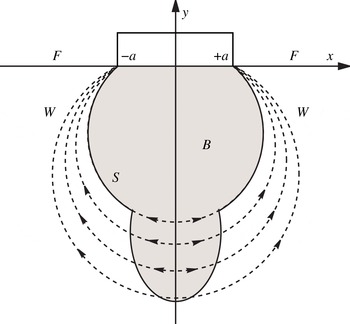
A definition sketch of the cylinder cross-section with a single immersed part denoted by
 $B$
;
 $W$
,
 $S$
and
 $F$
are cross-sections of the water domain, the wetted contour of the cylinder and the free surface of the water. The latter is located outside of the interval
 $|x|>a$
.

In the present paper, our aim is twofold. First, we are going to fill in, at least partially, the gap concerning conditions that guarantee the absence of trapped modes. In particular, we find conditions on the frequency so that they guarantee that no modes (or some specific modes) are trapped by a freely floating body provided that its geometry satisfies the assumptions used in Simon & Ursell (Reference Simon and Ursell1984) and Kuznetsov (Reference Kuznetsov2004) for establishing the absence of modes trapped by the same body being fixed.
Our second aim is to apply the so-called semi-inverse procedure for the construction of a family of two-dimensional bodies trapping the heave mode, that is, both the water and the body oscillate at the same frequency, the energy of the water motion is finite and the body executes a heave motion. Our construction is a modification of that used by Kuznetsov (Reference Kuznetsov2011) for obtaining two-dimensional trapping bodies that are motionless.
2. Statement of the problem
Let the Cartesian coordinate system
 $(x,y)$
in a plane orthogonal to the generators of a freely floating infinitely long cylinder be chosen so that the
 $y$
-axis is directed upwards, whereas the mean free surface of the water intersects this plane along the
 $x$
-axis, and so the cross-section
 $W$
of the water domain is a subset of
 $\mathbb{R}_{-}^{2}=\{x\in \mathbb{R},y<0\}$
. Let
 $\widehat{B}$
denote the bounded two-dimensional domain whose closure is the cross-section of a floating cylinder in its equilibrium position.
We suppose that
 $\widehat{B}\setminus \overline{\mathbb{R}_{-}^{2}}$
– the part of the body located above the water surface – is a non-empty domain, whereas the immersed part
 $B=\widehat{B}\cap \mathbb{R}_{-}^{2}$
is the union of a finite number of domains. Thus,
 $D=\widehat{B}\cap \partial \mathbb{R}_{-}^{2}$
consists of the same number of non-empty intervals of the
 $x$
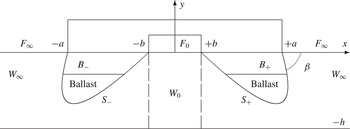
-axis; see figures 1 and 2 (the latter contains some extra notation used below), where
 $D=\{x\in (-a,a),y=0\}$
in the case of a single immersed part and
 $D=\{x\in (-a,-b)\cup (b,a),y=0\}$
in the case of two immersed parts. We suppose that
 $W$
is either
 $\mathbb{R}_{-}^{2}\setminus \overline{B}$
when the water has infinite depth (see figure 1) or
 $$\begin{eqnarray}\{x\in \mathbb{R},-h<y<0\}\setminus \overline{B},\quad \text{where}~h>b_{0}=\sup _{(x,y)\in B}|y|,\end{eqnarray}$$
when the water has the constant finite depth
 $h$
(see figure 2). The cross-section of the bottom is denoted by
 $H=\{x\in \mathbb{R},y=-h\}$
in the last case.
A definition sketch of the cylinder cross-section with two immersed parts denoted by
 $B_{-}$
and
 $B_{+}$
; their wetted boundaries are
 $S_{-}$
and
 $S_{+}$
respectively. The cross-section of the free surface of the water consists of three parts; two of them lying on the
 $x$
-axis outside
 $|x|>a$
are denoted by
 $F_{\infty }$
and the third one
 $F_{0}$
is between
 $x=-b$
and
 $x=+b$
;
 $W_{0}$
is the part of the water domain located in the vertical strip under
 $F_{0}$
and its complement is denoted by
 $W_{\infty }$
. The equation of the horizontal bottom is
 $y=-h$
.

Furthermore, we assume that
 $W$
is a Lipschitz domain, and so the unit normal
 $\boldsymbol{n}$
pointing to the exterior of
 $W$
is defined almost everywhere on
 $\partial W$
. Finally, we denote by
 $S=\partial \widehat{B}\cap \mathbb{R}_{-}^{2}$
the wetted curve (the number of its components is equal to the number of immersed domains), whereas
 $F=\partial \mathbb{R}_{-}^{2}\setminus \overline{D}$
is the free surface at rest.
To describe the small-amplitude coupled motion of the system it is standard to apply the linear setting, in which case two first-order unknowns are used. These are the velocity potential
 ${\it\Phi}(x,y;t)$
and the vector column
 $\boldsymbol{q}(t)$
describing the motion of the body, whose three components are as follows:
-
(i)
 $q_{1}$
and
$q_{2}$
are the displacements of the centre of mass in the horizontal and vertical directions respectively from its rest position
$(x^{(0)},y^{(0)})$
;
-
(ii)
$q_{3}$
is the angle of rotation about the axis that goes through the centre of mass orthogonally to the
$(x,y)$
-plane (the angle is measured from the
$x$
- to the
$y$
-axis).


We omit relations governing the time-dependent behaviour (see the details in Kuznetsov Reference Kuznetsov2011) and turn directly to the time-harmonic oscillations of the system, for which purpose we use the ansatz
 $$\begin{eqnarray}({\it\Phi}(\boldsymbol{x},y,t),\boldsymbol{q}(t))=\text{Re}\{\text{e}^{-\text{i}{\it\omega}t}({\it\varphi}(\boldsymbol{x},y),\text{i}{\bf\chi})\},\end{eqnarray}$$
where
 ${\it\omega}>0$
is the radian frequency,
 ${\it\varphi}\in H_{\mathit{loc}}^{1}(W)$
is a complex-valued function and
 ${\bf\chi}\in \mathbb{C}^{3}$
. To be specific, we first assume that
 $W$
is infinitely deep, in which case the problem for
 $({\it\varphi},{\bf\chi})$
is as follows:
 $$\begin{eqnarray}\displaystyle & \displaystyle {\rm\nabla}^{2}{\it\varphi}=0\quad \text{in}~W, & \displaystyle\end{eqnarray}$$
 $$\begin{eqnarray}\displaystyle & \displaystyle \partial _{y}{\it\varphi}-{\it\nu}{\it\varphi}=0\quad \text{on}~F,\quad \text{where}~{\it\nu}={\it\omega}^{2}/g, & \displaystyle\end{eqnarray}$$
 $$\begin{eqnarray}\displaystyle & \displaystyle \partial _{\boldsymbol{n}}{\it\varphi}={\it\omega}\unicode[STIX]{x1D649}^{\text{T}}{\bf\chi}\left(={\it\omega}\mathop{\sum }_{1}^{3}N_{j}{\it\chi}_{j}\right)\quad \text{on}~S, & \displaystyle\end{eqnarray}$$
 $$\begin{eqnarray}\displaystyle & \displaystyle \boldsymbol{{\rm\nabla}}{\it\varphi}\rightarrow 0\quad \text{as}~y\rightarrow -\infty , & \displaystyle\end{eqnarray}$$
 $$\begin{eqnarray}\displaystyle & \displaystyle \int _{W\cap \{|x|=b\}}|\partial _{|x|}{\it\varphi}-\text{i}{\it\nu}{\it\varphi}|^{2}\,\text{d}s=o(1)\quad \text{as}~b\rightarrow \infty , & \displaystyle\end{eqnarray}$$
 $$\begin{eqnarray}\displaystyle & \displaystyle {\it\omega}^{2}\unicode[STIX]{x1D640}{\bf\chi}=-{\it\omega}\int _{S}{\it\varphi}\unicode[STIX]{x1D649}\,\text{d}s+g\unicode[STIX]{x1D646}{\bf\chi}. & \displaystyle\end{eqnarray}$$
 $\boldsymbol{{\rm\nabla}}=(\partial _{x},\partial _{y})$
is the spatial gradient and
 $g>0$
is the acceleration due to gravity that acts in the direction opposite to the
 $y$
-axis;
 $\unicode[STIX]{x1D649}=(N_{1},N_{2},N_{3})^{\text{T}}$
(the operation
 $^{\text{T}}$
transforms a vector row into a vector column and vice versa), where
 $(N_{1},N_{2})^{\text{T}}=\boldsymbol{n}$
,
 $N_{3}=(x-x^{(0)},y-y^{(0)})^{\text{T}}\times \boldsymbol{n}$
and
 $\times$
stands for the vector product. In the equations of the body motion (2.8), the
 $3\times 3$
matrices are as follows:
 $$\begin{eqnarray}\unicode[STIX]{x1D640}=\left(\begin{array}{@{}ccc@{}}\unicode[STIX]{x1D610}^{M} & 0 & 0\\ 0 & \unicode[STIX]{x1D610}^{M} & 0\\ 0 & 0 & \unicode[STIX]{x1D610}_{2}^{M}\end{array}\right)\quad \text{and}\quad \unicode[STIX]{x1D646}=\left(\begin{array}{@{}ccc@{}}0 & 0 & 0\\ 0 & \unicode[STIX]{x1D610}^{D} & \unicode[STIX]{x1D610}_{x}^{D}\\ 0 & \unicode[STIX]{x1D610}_{x}^{D} & \unicode[STIX]{x1D610}_{xx}^{D}+I_{y}^{S}\end{array}\right).\end{eqnarray}$$
The positive elements of the mass/inertia matrix
 $\unicode[STIX]{x1D640}$
are
 $$\begin{eqnarray}\left.\begin{array}{@{}c@{}}\displaystyle \unicode[STIX]{x1D610}^{M}={\it\rho}_{0}^{-1}\int _{\widehat{B}}{\it\rho}(x,y)\,\text{d}x\,\text{d}y,\\ \displaystyle \unicode[STIX]{x1D610}_{2}^{M}={\it\rho}_{0}^{-1}\int _{\widehat{B}}{\it\rho}(x,y)[(x-x^{(0)})^{2}+(y-y^{(0)})^{2}]\,\text{d}x\,\text{d}y,\end{array}\right\}\end{eqnarray}$$
where
 ${\it\rho}(x,y)\geqslant 0$
is the density distribution within the body and
 ${\it\rho}_{0}>0$
is the constant density of water. On the right-hand side of relation (2.8), we have forces and their moments. In particular, the first term is due to the hydrodynamic pressure, whereas the second one is related to the buoyancy (see, for example, John Reference John1949). The non-zero elements of the matrix
 $\unicode[STIX]{x1D646}$
are
 $$\begin{eqnarray}\displaystyle & \left.\begin{array}{@{}c@{}}\displaystyle \unicode[STIX]{x1D610}^{D}=\int _{D}\,\text{d}x>0,\quad \unicode[STIX]{x1D610}_{x}^{D}=\int _{D}(x-x^{(0)})\,\text{d}x,\\ \displaystyle \unicode[STIX]{x1D610}_{xx}^{D}=\int _{D}(x-x^{(0)})^{2}\,\text{d}x>0,\quad I_{y}^{S}=\int _{S}(y-y^{(0)})\,\text{d}x\,\text{d}y.\end{array}\right\} & \displaystyle\end{eqnarray}$$
It should be noted that the matrix
 $\unicode[STIX]{x1D646}$
is symmetric.
In relations (2.4), (2.5) and (2.8),
 ${\it\omega}$
is a spectral parameter which is sought together with the eigenvector
 $({\it\varphi},{\bf\chi})$
. Since
 $W$
is a Lipschitz domain and
 ${\it\varphi}\in H_{\mathit{loc}}^{1}(W)$
, relations (2.3)–(2.5) are, as usual, understood in the sense of the following integral identity:
 $$\begin{eqnarray}\int _{W}\boldsymbol{{\rm\nabla}}{\it\varphi}\boldsymbol{{\rm\nabla}}{\it\psi}\,\text{d}x\,\text{d}y={\it\nu}\int _{F}{\it\varphi}{\it\psi}\,\text{d}x+{\it\omega}\int _{S}{\it\psi}\unicode[STIX]{x1D649}^{\text{T}}{\bf\chi}\,\text{d}s,\end{eqnarray}$$
which must hold for an arbitrary smooth
 ${\it\psi}$
having a compact support in
 $\overline{W}$
. Finally, relations (2.6) and (2.7) specify the behaviour of
 ${\it\varphi}$
at infinity. The first of these means that the velocity field decays with depth, whereas the second one yields that the potential given by formula (2.2) describes outgoing waves. This radiation condition is the same as in the water-wave problem for a fixed obstacle (see, for example, John Reference John1950).
The relations listed above must be augmented by the following subsidiary conditions concerning the equilibrium position:
-
(i) Archimedes’ law,
$\unicode[STIX]{x1D610}^{M}=\int _{B}\,\text{d}x\,\text{d}y$
(the mass of the displaced liquid is equal to that of the body); -
(ii)
$\int _{B}(x-x^{(0)})\,\text{d}x\,\text{d}y=0$
(the centre of buoyancy lies on the same vertical line as the centre of mass); -
(iii) the matrix
$\unicode[STIX]{x1D646}$
is positive semi-definite; moreover, the
$2\times 2$
matrix
$\unicode[STIX]{x1D646}^{\prime }$
that stands in the lower right corner of
$\unicode[STIX]{x1D646}$
is positive definite (see John Reference John1949).




The last of these requirements yields the stability of the body equilibrium position, which follows from the results formulated, for example, by John (Reference John1949, § 2.4). The stability is understood in the classical sense that an instantaneous infinitesimal disturbance causes the position changes which remain infinitesimal, except for purely horizontal drift, for all subsequent times.
In conclusion of this section, we note that relations (2.6) and (2.7) must be amended in the case when
 $W$
has finite depth. Namely, the no flow condition
 $$\begin{eqnarray}\partial _{y}{\it\varphi}=0\quad \text{on}~H\end{eqnarray}$$
replaces (2.6), whereas
 ${\it\nu}$
must be changed to
 $k_{0}$
in (2.7), where
 $k_{0}$
is the unique positive root of
 $k_{0}\tanh (k_{0}h)={\it\nu}$
.
3. Equipartition of energy
It is known (see, for example, Kuznetsov et al.
Reference Kuznetsov, Maz’ya and Vainberg2002, § 2.2.1), that a potential, satisfying relations (2.3), (2.4), (2.6) and (2.7), has an asymptotic representation at infinity of the same type as Green’s function. Namely, if
 $W$
has infinite depth, then
 $$\begin{eqnarray}\displaystyle \left.\begin{array}{@{}c@{}}\displaystyle {\it\varphi}(x,y)=A_{\pm }(y)\,\text{e}^{\text{i}{\it\nu}|x|}+r_{\pm }(x,y),\\ \displaystyle |r_{\pm }|^{2},|\boldsymbol{{\rm\nabla}}r_{\pm }|=O([x^{2}+y^{2}]^{-1})\quad \text{as}~x^{2}+y^{2}\rightarrow \infty ,\end{array}\right\} & & \displaystyle\end{eqnarray}$$
and the following equality holds:
 $$\begin{eqnarray}{\it\nu}\int _{-\infty }^{0}(|A_{+}(y)|^{2}+|A_{-}(y)|^{2})\,\text{d}y=-\text{Im}\int _{S}\overline{{\it\varphi}}\partial _{\boldsymbol{n}}{\it\varphi}\,\text{d}s.\end{eqnarray}$$
Assuming that
 $({\it\varphi},{\bf\chi})$
is a solution of the problem (2.3)–(2.8), we rearrange the last formula using the coupling conditions (2.5) and (2.8). First, transposing the complex conjugate of (2.8), we obtain
 $$\begin{eqnarray}{\it\omega}^{2}(\unicode[STIX]{x1D640}\,\overline{{\bf\chi}})^{\text{T}}=-{\it\omega}\int _{S}\overline{{\it\varphi}}\unicode[STIX]{x1D649}^{\text{T}}\,\text{d}s+g(\unicode[STIX]{x1D646}\overline{{\bf\chi}})^{\text{T}}.\end{eqnarray}$$
This relation and condition (2.5) yield that the inner product of both sides with
 ${\bf\chi}$
can be written in the form
 $$\begin{eqnarray}{\it\omega}^{2}\overline{{\bf\chi}}^{\text{T}}\unicode[STIX]{x1D640}{\bf\chi}-g\overline{{\bf\chi}}^{\text{T}}\unicode[STIX]{x1D646}{\bf\chi}=-\int _{S}\overline{{\it\varphi}}\partial _{\boldsymbol{n}}{\it\varphi}\,\text{d}s.\end{eqnarray}$$
Second, substituting this equality into (3.2), we obtain
 $$\begin{eqnarray}{\it\nu}\int _{-\infty }^{0}(|A_{+}(y)|^{2}+|A_{-}(y)|^{2})\,\text{d}y=\text{Im}\{{\it\omega}^{2}\overline{{\bf\chi}}^{\text{T}}\unicode[STIX]{x1D640}{\bf\chi}-g\overline{{\bf\chi}}^{\text{T}}\unicode[STIX]{x1D646}{\bf\chi}\}.\end{eqnarray}$$
In the same way as in Kuznetsov & Motygin (Reference Kuznetsov and Motygin2012), this yields the following assertion about the kinetic and potential energy of the water motion.
Proposition 3.1. Let
 $({\it\varphi},{\bf\chi})$
be a solution of the problem (2.3)–(2.8), then
 $$\begin{eqnarray}\int _{W}|\boldsymbol{{\rm\nabla}}{\it\varphi}|^{2}\,\text{d}x\,\text{d}y<\infty \quad \text{and}\quad {\it\nu}\int _{F}|{\it\varphi}|^{2}\,\text{d}x<\infty ;\end{eqnarray}$$
that is,
 ${\it\varphi}\in H^{1}(W)$
. Moreover, the following equality holds:
 $$\begin{eqnarray}\int _{W}|\boldsymbol{{\rm\nabla}}{\it\varphi}|^{2}\,\text{d}x\,\text{d}y+{\it\omega}^{2}\overline{{\bf\chi}}^{\text{T}}\unicode[STIX]{x1D640}{\bf\chi}={\it\nu}\int _{F}|{\it\varphi}|^{2}\,\text{d}x+g\overline{{\bf\chi}}^{\text{T}}\unicode[STIX]{x1D646}{\bf\chi}.\end{eqnarray}$$
Here, the kinetic energy of the water/body system stands on the left-hand side, whereas we have the potential energy of this coupled motion on the right-hand side. Thus, the last formula generalises the energy equipartition equality valid when a fixed body is immersed into water. Indeed,
 ${\bf\chi}=0$
for such a body, and (3.7) turns into the well-known equality (see, for example, formula (4.99) in Kuznetsov et al.
Reference Kuznetsov, Maz’ya and Vainberg2002).
Proposition 3.1 shows that if
 $({\it\varphi},{\bf\chi})$
is a solution of the problem (2.3)–(2.8) with complex-valued components, then its real and imaginary parts separately satisfy this problem. This allows us to consider
 $({\it\varphi},{\bf\chi})$
as an element of the real product space
 $H^{1}(W)\times \mathbb{R}^{3}$
in what follows (the sum of two quantities (3.6) defines an equivalent norm in
 $H^{1}(W)$
).
Definition 3.1. Let the subsidiary conditions concerning the equilibrium position (see § 2) hold for the freely floating body
 $\widehat{B}$
. A non-trivial real solution
 $({\it\varphi},{\bf\chi})\in H^{1}(W)\times \mathbb{R}^{3}$
of the problem (2.12) and (2.8) is called a mode trapped by this body, whereas the corresponding value of
 ${\it\omega}$
is referred to as a trapping frequency.
In the case of finite depth, the remainder in formula (3.1) has the following behaviour uniformly in
 $y\in [-h,0]$
:
 $$\begin{eqnarray}|r_{\pm }(x,y)|,\quad |\boldsymbol{{\rm\nabla}}r_{\pm }(x,y)|=O(|x|^{-1})\quad \text{as}~|x|\rightarrow \infty ,\end{eqnarray}$$
whereas formula (3.2) holds with
 ${\it\nu}$
changed to
 $k_{0}$
. Therefore, Proposition 3.1 is true for the problem (2.3)–(2.8) with condition (2.6) replaced by (2.13) and
 ${\it\nu}$
changed to
 $k_{0}$
in (2.7). Definition 3.1 remains unchanged for the finite depth case.
4. Two families of trapping bodies
In this section, we use a semi-inverse procedure for the construction of two-dimensional bodies that float freely in the infinitely deep water and trap one or another mode at the given frequency
 ${\it\omega}$
. The idea of the procedure is to seek trapping bodies for a prescribed mode corresponding to
 ${\it\omega}$
. There are several papers in which this idea was realised, and the first of these is Kuznetsov (Reference Kuznetsov2011), dealing with two-dimensional motionless trapping bodies (they are described in § 4.1 together with the corresponding trapped modes). Using the same method, Kuznetsov & Motygin (Reference Kuznetsov and Motygin2012) constructed various families of axisymmetric motionless trapping bodies. In Kuznetsov & Motygin (Reference Kuznetsov and Motygin2015), their results were extended in two directions: (i) axisymmetric structures consisting of
 $N\geqslant 2$
bodies were considered; (ii) some of the bodies (maybe none) are motionless, whereas the rest of the bodies (maybe none) are heaving. The method developed in the latter paper is simplified here in order to construct a family of bodies trapping a heave mode.
4.1. Motionless trapping bodies
In Kuznetsov (Reference Kuznetsov2011), the author considered the two-dimensional problem of trapped modes. For an arbitrarily fixed
 ${\it\omega}>0$
, he sought a family of bodies trapping the mode
 $({\it\varphi}_{0},(\mathbf{0},0)^{\text{T}})$
. Here,
 ${\it\varphi}_{0}(x,y)=g^{2}{\it\phi}_{0}({\it\nu}x,{\it\nu}y)/{\it\omega}^{3}$
and the non-dimensional velocity potential
 ${\it\phi}_{0}$
is as follows:
 $$\begin{eqnarray}{\it\phi}_{0}({\it\nu}x,{\it\nu}y)=\int _{0}^{\infty }\frac{k\,\text{e}^{k{\it\nu}y}}{k-1}[\sin k({\it\nu}x-{\rm\pi})-\sin k({\it\nu}x+{\rm\pi})]\,\text{d}k,\quad {\it\nu}={\it\omega}^{2}/g.\end{eqnarray}$$
Furthermore,
 $\mathbf{0}\in \mathbb{R}^{2}$
denotes the zero-displacement vector and 0 is the zero angle of rotation. Thus, motionless trapping bodies are sought. In (4.1), the integral is understood as a usual improper integral because its integrand is bounded since the singularity of the denominator coincides with the zero of the numerator.
It is easy to verify that
 $$\begin{eqnarray}{\it\phi}_{0}({\it\nu}x,{\it\nu}y)=(2{\it\nu})^{-1}[G_{x}(x,y;-{\rm\pi}/{\it\nu},0)-G_{x}(x,y;{\rm\pi}/{\it\nu},0)],\end{eqnarray}$$
where
 $G(x,y;{\it\xi},{\it\eta})$
is the Green’s function of the time-harmonic water-wave problem (see Kuznetsov et al. (Reference Kuznetsov, Maz’ya and Vainberg2002, § 1.2.1), where the properties of
 $G$
are described). Therefore, we have
 $$\begin{eqnarray}\partial _{y}{\it\phi}_{0}-{\it\nu}{\it\phi}_{0}=0\quad \text{for}~y=0~\text{and}~{\it\nu}x\neq \pm {\rm\pi},\end{eqnarray}$$
and for
 $({\it\nu}x)^{2}+({\it\nu}y)^{2}\rightarrow \infty$
we have
 $$\begin{eqnarray}\displaystyle \left.\begin{array}{@{}c@{}}\displaystyle {\it\phi}_{0}(x,y)=O([({\it\nu}x)^{2}+({\it\nu}y)^{2}]^{-1}),\\ \displaystyle {\it\nu}^{-1}|\boldsymbol{{\rm\nabla}}{\it\phi}_{0}(x,y)|=O([({\it\nu}x)^{2}+({\it\nu}y)^{2}]^{-3/2}).\end{array}\right\} & & \displaystyle\end{eqnarray}$$
These estimates yield that
 ${\it\phi}_{0}\in H^{1}(W)$
.
The next crucial point of the inverse procedure is to use streamlines corresponding to the velocity potential (4.1) in order to define two immersed contours of a freely floating trapping body that is symmetric about the
 $y$
-axis and has
 $x^{(0)}=0$
. To guarantee the last equality, one has to choose a proper density distribution which is always possible for a symmetric body. Moreover, by the choice of the density distribution one also obtains
 $y^{(0)}$
to be sufficiently close to the
 $y$
coordinate of the lowest points of the body, thus yielding that all of the subsidiary conditions hold for this body.
Taking a harmonic conjugate to
 ${\it\phi}_{0}$
in the form
 $$\begin{eqnarray}{\it\psi}_{0}({\it\nu}x,{\it\nu}y)=\int _{0}^{\infty }\frac{k\,\text{e}^{k{\it\nu}y}}{k-1}[\cos k({\it\nu}x-{\rm\pi})-\cos k({\it\nu}x+{\rm\pi})]\,\text{d}k,\end{eqnarray}$$
we see that this streamfunction decays at infinity. Let us list several properties of
 ${\it\psi}_{0}$
(see their proof in Kuznetsov et al. (Reference Kuznetsov, Maz’ya and Vainberg2002, pp. 178–179)) used for construction of a family of bodies trapping the mode
 $({\it\varphi}_{0},(\mathbf{0},0)^{\text{T}})$
. Since
 ${\it\psi}_{0}$
is an odd function of
 $x$
, we formulate these properties only for
 $x>0$
.
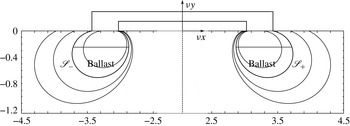
Level lines of the stream function
 ${\it\psi}_{0}$
plotted in non-dimensional coordinates. For an example of a motionless trapping body the wetted contours are denoted by
 ${\mathcal{S}}_{-}$
and
 ${\mathcal{S}}_{+}$
, whereas other pairs of symmetric streamlines can also be considered as bounding immersed parts of trapping bodies. In order to contract the width of the figure, a reduced horizontal scale is applied on the interval (
 $-2.5$
, 2.5).

The trace
 ${\it\psi}_{0}({\it\nu}x,0)$
has only one positive zero,
 ${\it\nu}x_{0}\in (2{\rm\pi}/3,{\rm\pi})$
. Moreover,
 ${\it\psi}_{0}({\it\nu}x,0)<0$
on
 $(0,{\it\nu}x_{0})$
; it increases monotonically from 0 to
 $+\infty$
on
 $[{\it\nu}x_{0},{\rm\pi})$
and decreases monotonically from
 $+\infty$
to 0 on
 $({\rm\pi},+\infty )$
. Therefore, for every non-dimensional
 $d>0$
the streamline
 $$\begin{eqnarray}\mathscr{S}_{+}=\{{\it\nu}(x,y)\in \overline{\mathbb{R}_{-}^{2}}:x>0,y<0,{\it\psi}_{0}({\it\nu}x,{\it\nu}y)=d\}\end{eqnarray}$$
(see the right part of figure 3) connects two points that lie on the positive
 ${\it\nu}x$
-axis on either side of the point
 $({\rm\pi},0)$
at which
 ${\it\psi}_{0}$
is infinite.
Thus, for the chosen
 ${\it\omega}$
and every
 $d>0$
the domain
 $B_{+}$
between
 $$\begin{eqnarray}S_{+}=\{(x,y)\in \overline{\mathbb{R}_{-}^{2}}:{\it\nu}(x,y)\in \mathscr{S}_{+}\}\end{eqnarray}$$
and the
 $x$
-axis serves as the right immersed part of a single motionless trapping body
 $\widehat{B}$
obtained by connecting
 $B_{+}$
with the symmetric domain
 $B_{-}$
, as shown in figure 3 for the corresponding domains in non-dimensional variables. Indeed, the Cauchy–Riemann equations imply that
 ${\it\varphi}_{0}$
satisfies the homogeneous Neumann condition on
 $S=S_{-}\cup S_{+}$
, and so the coupling condition (2.5) is fulfilled for the mode
 $({\it\varphi}_{0},(\mathbf{0},0)^{\text{T}})$
. The coupling condition (2.8) is also fulfilled for this mode because it reduces to the equality
 $$\begin{eqnarray}\int _{S_{-}\cup S_{+}}{\it\varphi}_{0}n_{y}\,\text{d}s=0.\end{eqnarray}$$
Indeed, the other two equalities are trivial by the symmetry of
 $S_{-}\cup S_{+}$
and the fact that the corresponding integrands are odd functions of
 $x$
. The proof that the last integral vanishes is based on the asymptotic formulae (4.4) (see the details in Kuznetsov (Reference Kuznetsov2011, p. 994)).
4.2. Bodies trapping a heave mode
Here, we modify the construction outlined in § 4.1. Our aim is to obtain a family of symmetric bodies trapping another mode, namely the heave one. For this purpose we consider the following odd function of
 ${\it\nu}x$
:
 $$\begin{eqnarray}{\it\psi}_{H}({\it\nu}x,{\it\nu}y)={\it\psi}_{0}({\it\nu}x,{\it\nu}y)+{\it\nu}x,\end{eqnarray}$$
where
 ${\it\psi}_{0}$
is defined by (4.5). If a pair of symmetric level lines of
 ${\it\psi}_{H}$
, say
 $\mathscr{S}_{-}^{(H)}\cup \mathscr{S}_{+}^{(H)}$
, has properties analogous to those of
 $\mathscr{S}_{-}\cup \mathscr{S}_{+}$
, then the Cauchy–Riemann equations yield that
 $$\begin{eqnarray}\partial _{\boldsymbol{n}}({\it\phi}_{0}-{\it\nu}y)=0\quad \text{on}~\mathscr{S}_{-}^{(H)}\cup \mathscr{S}_{+}^{(H)}.\end{eqnarray}$$
Let
 $B_{+}^{(H)}$
and
 $B_{-}^{(H)}$
be defined with the help of
 $\mathscr{S}_{-}^{(H)}$
and
 $\mathscr{S}_{+}^{(H)}$
in the same way as
 $B_{+}$
and
 $B_{-}$
with the help of
 $S_{-}$
and
 $S_{+}$
in § 4.1. Then, the last relation suggests that the symmetric body, whose immersed parts are
 $B_{+}^{(H)}$
and
 $B_{-}^{(H)}$
, traps the heave mode
 $({\it\varphi}_{0},(0,g/{\it\omega}^{2},0)^{\text{T}})$
, where the potential
 ${\it\varphi}_{0}$
is defined prior to formula (4.1).
To prove this assertion one has to demonstrate the following:
-
(a) there exist symmetric level lines
$\mathscr{S}_{\pm }^{(H)}$
separating the points
$(\pm {\rm\pi},0)$
from infinity; -
(b) the mode satisfies (2.8) on the wetted boundary
$S_{-}^{(H)}\cup S_{+}^{(H)}$
of
$B_{-}^{(H)}\cup B_{+}^{(H)}$
.


In order to prove
 $(a)$
it is sufficient to consider only level lines in
 $\{{\it\nu}x>0,{\it\nu}y<0\}$
. For
 ${\it\nu}x>0$
the graph of
 ${\it\psi}_{H}({\it\nu}x,0)$
is located strictly above that of
 ${\it\psi}_{0}({\it\nu}x,0)$
, and so a restriction must be imposed on those positive values for which level lines of
 ${\it\psi}_{H}$
have both ends on the
 ${\it\nu}x$
-axis located on either side of
 $({\rm\pi},0)$
. The results obtained in Kuznetsov et al. (Reference Kuznetsov, Maz’ya and Vainberg2002, § 4.2.2.3), yield the following properties of
 ${\it\psi}_{0}({\it\nu}x,0)$
:
-
(i) its single zero
${\it\nu}x_{H}$
belongs to
$(0,{\it\nu}x_{0})$
; -
(ii) it has only one positive minimum at a certain
${\it\nu}x_{\ast }\in ({\rm\pi},+\infty )$
; -
(iii) it asymptotes
${\it\nu}x$
as
${\it\nu}x\rightarrow +\infty$
.


Since
 ${\it\psi}_{H}({\it\nu}x,{\it\nu}y)\rightarrow +\infty$
as
 $({\it\nu}x,{\it\nu}y)\rightarrow ({\rm\pi},0)$
, for every non-dimensional
 $d\geqslant {\it\psi}_{H}({\it\nu}x_{\ast },0)$
the level line
 $$\begin{eqnarray}\mathscr{S}_{+}^{(H)}=\{{\it\nu}(x,y)\in \overline{\mathbb{R}_{-}^{2}}:x>0,y<0,{\it\psi}_{H}({\it\nu}x,{\it\nu}y)=d\}\end{eqnarray}$$
connects two points that lie on the positive
 ${\it\nu}x$
-axis on either side of the point
 $({\rm\pi},0)$
. A distinction between the family of level lines
 $\mathscr{S}_{+}^{(H)}$
and that defined by (4.6) is as follows. The family of lines of the form (4.11) is confined to the bounded region between the line
 $$\begin{eqnarray}\{{\it\nu}(x,y)\in \overline{\mathbb{R}_{-}^{2}}:x>0,y<0,{\it\psi}_{H}({\it\nu}x,{\it\nu}y)={\it\psi}_{H}({\it\nu}x_{\ast },0)\}\end{eqnarray}$$
and the
 ${\it\nu}x$
-axis, whereas the family (4.6) covers an unbounded region (see figure 3).
Let us turn to assertion (b). As in the case of the motionless trapping body considered in § 4.1, two equalities of the three comprising condition (2.8) are fulfilled automatically in view of symmetry. It remains to prove that
 $$\begin{eqnarray}{\it\nu}I^{M}=-\int _{S}{\it\phi}_{0}\partial _{\boldsymbol{n}}y\,\text{d}s+I^{D},\quad \text{where}~S=S_{-}^{(H)}\cup S_{+}^{(H)}.\end{eqnarray}$$
For this purpose we apply the second Green’s identity,
 $$\begin{eqnarray}0=\int _{\partial (W\cap R_{\ell ,r})}[{\it\phi}_{0}\partial _{\boldsymbol{n}}(y+{\it\nu}^{-1})-(y+{\it\nu}^{-1})\partial _{\boldsymbol{ n}}{\it\phi}_{0}]\,\text{d}s,\end{eqnarray}$$
to the harmonic functions
 ${\it\phi}_{0}$
and
 $y+{\it\nu}^{-1}$
; here,
 $R_{\ell ,r}=\{(\boldsymbol{x},y):|x|<\ell ,-r<y<0\}$
is a sufficiently large rectangle (such that
 $\overline{B}\subset R_{\ell ,r}$
). It should be noted that the boundary conditions (2.5) and (4.3) yield that
 $$\begin{eqnarray}-\int _{S}{\it\phi}_{0}\partial _{\boldsymbol{n}}y\,\text{d}s=-{\it\nu}\int _{S}(y+{\it\nu}^{-1})\partial _{\boldsymbol{ n}}y\,\text{d}s+\int _{(\partial R_{\ell ,r})\setminus \partial W}[{\it\phi}_{0}\partial _{\boldsymbol{n}}y-(y+{\it\nu}^{-1})\partial _{\boldsymbol{ n}}{\it\phi}_{0}]\,\text{d}s.\end{eqnarray}$$
The first term on the right-hand side is equal to
 $$\begin{eqnarray}{\it\nu}\int _{B}\,\text{d}x\,\text{d}y-I^{D},\end{eqnarray}$$
whereas the last one tends to zero by letting
 $r\rightarrow \infty$
first and then
 $\ell \rightarrow \infty$
. This is a consequence of the asymptotic formulae (4.4) applied to the integrand. Hence, (4.13) is true, being equivalent to Archimedes’ law. The latter holds along with other subsidiary conditions provided that the density distribution in
 $\widehat{B}$
is chosen properly.
5. Conditions guaranteeing the absence of trapped modes
In order to determine when
 $({\it\varphi},{\bf\chi})\in H^{1}(W)\times \mathbb{R}^{3}$
is not trapped by
 $\widehat{B}$
we write (3.7) as follows:
 $$\begin{eqnarray}{\bf\chi}^{\text{T}}({\it\omega}^{2}\unicode[STIX]{x1D640}-g\unicode[STIX]{x1D646}){\bf\chi}={\it\nu}\int _{F}|{\it\varphi}|^{2}\,\text{d}x-\int _{W}|\boldsymbol{{\rm\nabla}}{\it\varphi}|^{2}\,\text{d}x\,\text{d}y.\end{eqnarray}$$
It is clear that the left-hand side is non-negative provided that
 ${\it\omega}^{2}$
is sufficiently large, and so we arrive at the following.
Proposition 5.1. Let
 $\unicode[STIX]{x1D640}$
and
 $\unicode[STIX]{x1D646}$
be given by (2.9) and let
 ${\it\omega}^{2}$
be greater than or equal to the largest
 ${\it\lambda}$
satisfying
 $\det ({\it\lambda}\unicode[STIX]{x1D640}-g\unicode[STIX]{x1D646})=0$
. If the domain
 $W$
is such that the inequality
 $$\begin{eqnarray}{\it\nu}\int _{F}|{\it\varphi}|^{2}\,\text{d}x<\int _{W}|\boldsymbol{{\rm\nabla}}{\it\varphi}|^{2}\,\text{d}x\,\text{d}y\end{eqnarray}$$
holds for every non-trivial
 ${\it\varphi}\in H^{1}(W)$
, then
 ${\it\omega}$
is not a trapping frequency.
It should be noted that Proposition 5.1 is true no matter whether the domain
 $W$
has infinite or finite depth. Now we turn to examples of water domains or, which is the same, immersed bodies for which inequality (5.2) holds.
5.1. Bodies with a single immersed part
We begin with the case when
 $W$
has infinite depth. By
 $\ell _{d}$
and
 $\ell _{-d}$
we denote the rays emanating at the angle
 ${\rm\pi}/4$
to the vertical from the points
 $(d,0)$
and
 $(-d,0)$
respectively and going to the right and left respectively.
Let the whole rays
 $\ell _{d}$
and
 $\ell _{-d}$
belong to
 $W$
for all
 $d>a$
. Thus,
 $B$
is confined within the angular domain between the lines inclined at
 ${\rm\pi}/4$
to the vertical and going through the points
 $(a,0)$
and
 $(-a,0)$
to the right and left respectively. Under this assumption, Simon & Ursell (Reference Simon and Ursell1984) proved (see also Kuznetsov et al. (Reference Kuznetsov, Maz’ya and Vainberg2002), §§ 3.2.2.1 and 3.2.2.2) that the inequality
 $$\begin{eqnarray}{\it\nu}\int _{F}|{\it\varphi}|^{2}\,\text{d}x\leqslant \int _{W_{c}}|\boldsymbol{{\rm\nabla}}{\it\varphi}|^{2}\,\text{d}x\,\text{d}y\end{eqnarray}$$
holds provided that
 ${\it\varphi}$
satisfies the conditions (3.6) and relations (2.3) and (2.4). Here,
 $W_{c}$
is the subset of
 $W$
covered with rays
 $\{\ell _{d}:(d,0)\in F\}\cup \{\ell _{-d}:(-d,0)\in F\}$
. According to the last inequality, if
 ${\it\varphi}$
is non-trivial, then (5.2) holds. Therefore, Proposition 5.1 is applicable, thus giving a criterion for
 ${\it\omega}$
to be a non-trapping frequency for the freely floating
 $\widehat{B}$
whose immersed part
 $B$
is confined as described above.
In order to obtain inequality (5.2) in the case when
 $W$
has finite depth,
 $\ell _{d}$
and
 $\ell _{-d}$
must be replaced by similar segments connecting
 $F$
and
 $H$
and inclined at a certain angle to the vertical that is a little less than
 ${\rm\pi}/4$
. Numerical computations by Simon & Ursell (Reference Simon and Ursell1984) show that the same result as for deep water is true when
 $B$
is confined between the segments inclined at
 $44{\textstyle \frac{1}{3}}^{\circ }$
.
5.2. Bodies with two immersed parts
First, we assume that
 $W$
has finite depth. Let
 $\widehat{B}$
be symmetric about the
 $y$
-axis and such that
 $B_{+}$
is confined between the vertical segment through
 $(b,0)$
and the segment through
 $(a,0)$
forming the angle
 ${\it\beta}$
with the positive
 $x$
-axis (see figure 2). Again, inequality (5.3) with
 ${\it\nu}$
changed to
 $k_{0}$
and
 $F$
changed to
 $F_{\infty }$
holds for any non-trivial
 ${\it\varphi}$
when
 $W_{c}$
is the subset of
 $W$
covered with segments
 $\ell _{d}$
and
 $\ell _{-d}$
connecting
 $F$
and
 $H$
and forming the angle
 ${\it\beta}\geqslant 45\frac{2}{3}^{\circ }$
with the positive and negative
 $x$
-axis respectively.
Besides, the inequality
 $$\begin{eqnarray}k_{0}\int _{F_{0}}|{\it\varphi}^{(\pm )}|^{2}\,\text{d}x\leqslant \int _{W_{0}}|\boldsymbol{{\rm\nabla}}{\it\varphi}^{(\pm )}|^{2}\,\text{d}x\,\text{d}y,\end{eqnarray}$$
which together with the modified inequality (5.3) guarantees the absence of trapped modes, is proved only for symmetric (
 ${\it\varphi}^{(+)}(x,y)$
which is even in
 $x$
) and antisymmetric (
 ${\it\varphi}^{(-)}(x,y)$
which is odd in
 $x$
) modes. Moreover, the last inequality holds for
 ${\it\varphi}^{(\pm )}$
under the following restrictions on
 $k_{0}$
, and hence on
 ${\it\omega}$
(see Kuznetsov et al. (Reference Kuznetsov, Maz’ya and Vainberg2002, § 4.2.2.1) for the proof):
 $$\begin{eqnarray}{\rm\pi}\left(m+{\textstyle \frac{1}{4}}\pm {\textstyle \frac{1}{4}}\right)\leqslant k_{0}b\leqslant {\rm\pi}\left(m+{\textstyle \frac{3}{4}}\pm {\textstyle \frac{1}{4}}\right),\quad m=0,1,\ldots .\end{eqnarray}$$
We recall that
 $2b$
is the spacing between
 $B_{-}$
and
 $B_{+}$
.
Thus, the last inequalities guarantee the absence of symmetric and antisymmetric trapped modes provided that
 ${\it\omega}$
satisfies the restriction imposed in Proposition 5.1, whereas the geometry of the immersed parts of the body is subject to restrictions shown in figure 2.
If the water domain has infinite depth, then the inequalities
 $$\begin{eqnarray}{\rm\pi}\left(m+{\textstyle \frac{1}{4}}\pm {\textstyle \frac{1}{4}}\right)\leqslant {\it\nu}b\leqslant {\rm\pi}\left(m+{\textstyle \frac{3}{4}}\pm {\textstyle \frac{1}{4}}\right),\quad m=0,1,\ldots ,\end{eqnarray}$$
yield that the same result about the absence of symmetric and antisymmetric trapped modes is true. Again,
 ${\it\omega}$
must satisfy the restriction imposed in Proposition 5.1.
6. Another criterion eliminating some particular trapped modes
In this section, we turn to the case when
 $B$
does not satisfy the conditions of § 5.1. To be specific, we suppose that
 $W$
is bounded from below by the rigid bottom
 $H$
. Moreover, we assume that
 $\widehat{B}$
is symmetric about the
 $y$
-axis (see figure 1); this implies that
 $N_{1}=n_{x}$
 $(N_{2}=n_{y})$
attains the opposite (the same respectively) values at every pair of points on
 $B$
that are symmetric about the
 $y$
-axis. Let also
 ${\it\rho}(x,y)$
be an even function of
 $x$
, and so
 $x^{(0)}=0$
(the centre of mass lies on the
 $y$
-axis); this implies that
 $N_{3}=xn_{y}-n_{x}(y-y^{(0)})$
has the same behaviour as
 $N_{1}$
.
The last restriction on
 $\widehat{B}$
or, more precisely, on
 $B$
is expressed in terms of the curves
 $$\begin{eqnarray}x^{2}+(y-a\cot {\it\sigma})^{2}=a^{2}(\cot ^{2}{\it\sigma}+1),\quad \pm x>0,y<0,\end{eqnarray}$$
parametrised by
 ${\it\sigma}\in (-{\rm\pi},0)$
. On curves of these two families we define directions as shown in figure 1. It is clear that all curves (6.1) that intersect
 $H$
transversely enter into
 $W$
. Let this property also hold on
 $S$
; that is, all transverse intersections of curves (6.1) with
 $S$
are points of entry into
 $W$
(see figure 1). In what follows, a body satisfying the listed conditions is referred to as belonging to the class
 $\mathscr{B}$
provided that the conditions considered in § 3.2 are not fulfilled for it.
The following assertion generalises the criterion of Kuznetsov (Reference Kuznetsov2004) guaranteeing the absence of trapped modes for fixed surface-piercing bodies immersed in deep water and satisfying the above transversality condition with the family of curves (6.1). As in Proposition 5.1, the values of
 ${\it\omega}$
that are not trapping frequencies must be sufficiently large, but what is new is that some restrictions must be also imposed on the type of mode.
Proposition 6.1. Let
 $W$
have finite depth and let
 $\widehat{B}$
be a freely floating body belonging to the class
 $\mathscr{B}$
. If
 ${\it\omega}^{2}$
is strictly greater than the largest
 ${\it\lambda}$
such that
 $\det ({\it\lambda}\unicode[STIX]{x1D640}-g\unicode[STIX]{x1D646})=0$
with
 $\unicode[STIX]{x1D640}$
and
 $\unicode[STIX]{x1D646}$
given by (2.9), then
 ${\it\omega}$
is not a trapping frequency for modes of the following forms:
-
(a)
${\it\varphi}$
is an even function of
$x$
and
${\bf\chi}=(d_{1},0,d_{3})^{\text{T}}$
; -
(b)
${\it\varphi}$
is an odd function of
$x$
and
${\bf\chi}=(0,d_{2},0)^{\text{T}}$
.


Proof. Let us write relations (2.3)–(2.5) and (2.13) using the bipolar coordinates
 $(u,v)$
. The corresponding conformal mapping is usually defined as follows (see, for example, Morse & Feshbach (Reference Morse and Feshbach1953, § 10.1)):
 $$\begin{eqnarray}x=a\sinh u/(\cosh u-\cos v),\quad y=a\sin v/(\cosh u-\cos v).\end{eqnarray}$$
Therefore, (6.2) maps the strip
 $\{-\infty <u<+\infty ,-{\rm\pi}<v<0\}$
onto
 $\mathbb{R}_{-}^{2}$
so that for every
 ${\it\sigma}\in (-{\rm\pi},0)$
the image of the left (right) half-line
 $\{\pm u>0,v={\it\sigma}\}$
is the circular arc (6.1) that lies in the left (right) half-plane (see figure 1). Moreover,
 $$\begin{eqnarray}\{-\infty <u<+\infty ,v=-{\rm\pi}\}\quad \text{and}\quad \{\pm u>0,v=0\}\end{eqnarray}$$
are mapped onto
 $\{|x|<a,\,y=0\}$
and
 $\{\pm x>a,\,y=0\}$
respectively. Finally, we have
 $$\begin{eqnarray}|z^{\prime }({\it\zeta})|=a/(\cosh u-\cos v),\quad \text{where}~z=x+\text{i}y~\text{and}~{\it\zeta}=u+\text{i}v.\end{eqnarray}$$
The inverse mapping
 ${\it\zeta}(z)$
has the following properties: the points
 $a$
and
 $-a$
on the
 $x$
-axis go to infinity on the
 ${\it\zeta}$
-plane, whereas
 $z=\infty$
goes to
 ${\it\zeta}=0$
; thus,
 $F$
is mapped onto the whole
 $u$
-axis.
Denoting by
 $\mathscr{W}$
the image of
 $W$
, we see that apart from the
 $u$
-axis the boundary
 $\partial \mathscr{W}$
includes the images of
 $S$
and
 $H$
, say
 $\mathscr{S}$
and
 $\mathscr{H}$
respectively. According to the properties of (6.2), if
 $\widehat{B}$
belongs to the class
 $\mathscr{B}$
, then
 $\mathscr{S}$
is symmetric about the
 $v$
-axis, lies within the strip
 $\{-\infty <u<+\infty ,-{\rm\pi}<v<-{\it\alpha}\}$
and asymptotes the line
 $v=-{\it\alpha}$
as
 $u\rightarrow \pm \infty$
; here,
 ${\it\alpha}\in (0,{\rm\pi})$
is the angle between
 $S$
and
 $F$
at
 $(\pm a,0)$
. Moreover, the right half of
 $\mathscr{S}$
is the graph of a decreasing function of
 $u\in (0,+\infty )$
; its maximum value
 $v_{b}$
is the root of
 $\cos v-(a/b_{0})\sin v=1$
. Finally,
 $\mathscr{H}$
is a closed curve with the following properties. It is symmetric about the
 $v$
-axis, is tangent to the
 $u$
-axis at the origin and is the graph of a concave function of
 $v\in (v_{h},0)$
; here,
 $v_{h}\in (-{\rm\pi},0)$
is the root of
 $\cos v-(a/d)\sin v=1$
. It is clear that
 $-{\rm\pi}/4<-{\it\alpha}<v_{b}<v_{h}<0$
.
Let
 ${\it\phi}(u,v)={\it\varphi}(x(u,v),y(u,v))$
, then relations (2.3)–(2.5) yield that
 $$\begin{eqnarray}\left.\begin{array}{@{}c@{}}{\rm\nabla}^{2}{\it\phi}=0\quad \text{in}~\mathscr{W},\\ (\cosh u-1){\it\phi}_{v}={\it\nu}a{\it\phi}\quad \text{when}~v=0,\\ \displaystyle \boldsymbol{{\rm\nabla}}{\it\phi}\boldsymbol{\cdot }\boldsymbol{n}_{{\it\zeta}}=\frac{{\it\omega}a\unicode[STIX]{x1D649}_{{\it\zeta}}^{\text{T}}{\bf\chi}}{\cosh u-\cos v}\quad \text{on}~\mathscr{S}.\end{array}\right\}\end{eqnarray}$$
Here,
 $\boldsymbol{n}_{{\it\zeta}}$
is the unit normal to
 $\mathscr{S}\cup \mathscr{H}$
exterior with respect to
 $\mathscr{W}$
and
 $\unicode[STIX]{x1D649}_{{\it\zeta}}=\unicode[STIX]{x1D649}_{z({\it\zeta})}$
. Moreover, condition (2.13) implies that
 $$\begin{eqnarray}\boldsymbol{{\rm\nabla}}{\it\phi}\boldsymbol{\cdot }\boldsymbol{n}_{{\it\zeta}}=0\quad \text{on}~\mathscr{H},\end{eqnarray}$$
whereas condition (2.8) takes the form
 $$\begin{eqnarray}{\it\omega}^{2}\unicode[STIX]{x1D640}{\bf\chi}=-{\it\omega}\int _{\mathscr{ S}}\frac{{\it\phi}\unicode[STIX]{x1D649}_{{\it\zeta}}\,\text{d}s_{{\it\zeta}}}{\cosh u-\cos v}+g\unicode[STIX]{x1D646}{\bf\chi}.\end{eqnarray}$$
Furthermore, conditions (3.6) give that
 $$\begin{eqnarray}\int _{\mathscr{W}}|\boldsymbol{{\rm\nabla}}{\it\phi}|^{2}\,\text{d}u\,\text{d}v<\infty \quad \text{and}\quad \int _{-\infty }^{+\infty }\frac{{\it\phi}^{2}(u,0)}{\cosh u-1}\,\text{d}u<\infty ,\end{eqnarray}$$
whereas equality (5.1) turns into the following one:
 $$\begin{eqnarray}\int _{\mathscr{W}}|\boldsymbol{{\rm\nabla}}{\it\phi}|^{2}\,\text{d}u\,\text{d}v-{\it\nu}a\int _{-\infty }^{+\infty }\frac{{\it\phi}^{2}(u,0)}{\cosh u-1}\,\text{d}u=-{\bf\chi}^{\text{T}}({\it\omega}^{2}\unicode[STIX]{x1D640}-g\unicode[STIX]{x1D646}){\bf\chi}.\end{eqnarray}$$
Further considerations are based on the following identity (see Kuznetsov et al. (Reference Kuznetsov, Maz’ya and Vainberg2002, § 2.2.2)):
 $$\begin{eqnarray}(2u{\it\phi}_{u}+{\it\phi}){\rm\nabla}^{2}{\it\phi}=\boldsymbol{{\rm\nabla}}\boldsymbol{\cdot }(2u{\it\phi}_{u}+{\it\phi})\boldsymbol{{\rm\nabla}}{\it\phi}-2{\it\phi}_{u}^{2}-(u|\boldsymbol{{\rm\nabla}}{\it\phi}|^{2})_{u}.\end{eqnarray}$$
Here, the left-hand side vanishes due to the Laplace equation for
 ${\it\phi}$
. Let us integrate this identity over
 $\mathscr{W}^{\prime }=\mathscr{W}\cap \{|u|<b\}$
and
 $b$
is sufficiently large (in particular,
 $\mathscr{H}\subset \{|u|<b\}$
). Using the divergence theorem, we obtain
 $$\begin{eqnarray}\displaystyle & & \displaystyle 2\int _{\mathscr{W}^{\prime }}{\it\phi}_{u}^{2}\,\text{d}u\,\text{d}v+\int _{\mathscr{S}^{\prime }\cup \mathscr{H}}\boldsymbol{u}\boldsymbol{\cdot }\boldsymbol{n}|\boldsymbol{{\rm\nabla}}{\it\phi}|^{2}\,\text{d}S\nonumber\\ \displaystyle & & \displaystyle \quad =\int _{-b}^{+b}[2u{\it\phi}_{u}(u,0)+{\it\phi}(u,0)]{\it\varphi}_{v}(u,0)\,\text{d}u\nonumber\\ \displaystyle & & \displaystyle \qquad +\,\int _{\mathscr{S}^{\prime }}(2u{\it\phi}_{u}+{\it\phi})\,\boldsymbol{{\rm\nabla}}{\it\phi}\boldsymbol{\cdot }\boldsymbol{n}_{{\it\zeta}}\,\text{d}S+\mathop{\sum }_{\pm }\pm \int _{\mathscr{C}_{\pm }}(2u{\it\phi}_{u}+{\it\phi}){\it\phi}_{u}\,\text{d}v,\end{eqnarray}$$
where
 $\mathscr{S}^{\prime }=\mathscr{S}\cap \{|u|<b\}$
,
 $\boldsymbol{u}=(u,0)$
,
 $\sum _{\pm }$
denotes the summation of two terms corresponding to the upper and lower signs respectively and
 $\mathscr{C}_{\pm }=\mathscr{W}^{\prime }\cap \{u=\pm b\}$
. All integrals on the right-hand side arise from the first term on the right-hand side in (6.10), and one more integral of the same type vanishes in view of the boundary condition (6.6) on
 $\mathscr{H}$
.
Let us consider each integral standing on the right-hand side in (6.11). Using the free-surface boundary condition, we get that the first term is equal to
 $$\begin{eqnarray}\displaystyle & & \displaystyle {\it\nu}a\int _{-b}^{+b}[2u{\it\phi}_{u}(u,0)+{\it\phi}(u,0)]\frac{{\it\phi}(u,0)}{\cosh u-1}\,\text{d}u\nonumber\\ \displaystyle & & \displaystyle \quad ={\it\nu}a\int _{-b}^{+b}\frac{u\sinh u{\it\phi}^{2}(u,0)}{(\cosh u-1)^{2}}\,\text{d}u+{\it\nu}a\left[\frac{u{\it\phi}^{2}(u,0)}{\cosh u-1}\right]_{u=-b}^{u=+b},\end{eqnarray}$$
where the last expression is obtained by integration by parts. It follows from (3.6) that
 ${\it\varphi}(x,y)$
tends to a constant as
 $(x,y)\rightarrow (\pm a,0)$
, and so
 ${\it\phi}(u,v)$
has the same property as
 $u\rightarrow \pm \infty$
. Therefore, the integrated term in the last equality tends to zero as
 $b\rightarrow \infty$
, whereas the integral on the right-hand side converges in view of (6.8).
The second integral on the right-hand side in (6.11) is equal to
 $$\begin{eqnarray}{\it\omega}a\int _{\mathscr{S}^{\prime }}\frac{(2u{\it\phi}_{u}+{\it\phi})\,\unicode[STIX]{x1D649}_{{\it\zeta}}^{\text{T}}{\bf\chi}}{\cosh u-\cos v}\,\text{d}S.\end{eqnarray}$$
Since
 $S$
belongs to the class
 $\mathscr{B}$
, we have that
 ${\it\phi}$
and
 ${\it\varphi}$
are simultaneously even and odd functions of
 $x$
and
 $u$
respectively. Therefore, either of the assumptions (a) and (b) implies that this integral vanishes because the integrand attains opposite values at points of
 $\mathscr{S}^{\prime }$
that are symmetric about the
 $v$
-axis.
Finally, (6.8) implies that there exists a sequence
 $\{b_{k}\}_{k=1}^{\infty }$
tending to the positive infinity and such that the last sum in (6.11) tends to zero as
 $b_{k}\rightarrow \infty$
. Passing to the limit as
 $k\rightarrow \infty$
, we see that the transformed equation (6.11) with
 $b=b_{k}$
gives the following integral identity:
 $$\begin{eqnarray}2\int _{\mathscr{W}}{\it\phi}_{u}^{2}\,\text{d}u\,\text{d}v+\int _{\mathscr{ S}\cup \mathscr{H}}\boldsymbol{u}\boldsymbol{\cdot }\boldsymbol{n}|\boldsymbol{{\rm\nabla}}{\it\phi}|^{2}\,\text{d}S-{\it\nu}a\int _{-\infty }^{+\infty }\frac{u\sinh u}{(\cosh u-1)^{2}}{\it\phi}^{2}(u,0)\,\text{d}u=0,\end{eqnarray}$$
provided that either of the assumptions (a) and (b) holds.
Subtracting this from (6.9) multiplied by two, we obtain
 $$\begin{eqnarray}\displaystyle & & \displaystyle 2\int _{\mathscr{W}}{\it\phi}_{v}^{2}\,\text{d}u\,\text{d}v-\int _{\mathscr{S}\cup \mathscr{H}}\boldsymbol{u}\boldsymbol{\cdot }\boldsymbol{n}|\boldsymbol{{\rm\nabla}}{\it\phi}|^{2}\,\text{d}S\nonumber\\ \displaystyle & & \displaystyle \quad +\,{\it\nu}a\int _{-\infty }^{+\infty }\frac{u\sinh u-2(\cosh u-1)}{(\cosh u-1)^{2}}{\it\phi}^{2}(u,0)\,\text{d}u=-2{\bf\chi}^{\text{T}}({\it\omega}^{2}\unicode[STIX]{x1D640}-g\unicode[STIX]{x1D646}){\bf\chi}.\qquad\end{eqnarray}$$
If
 ${\it\omega}^{2}$
is strictly greater than the largest
 ${\it\lambda}$
such that
 $\det ({\it\lambda}\unicode[STIX]{x1D640}-g\unicode[STIX]{x1D646})=0$
, then (6.15) cannot hold unless
 ${\it\omega}$
is not a trapping frequency for modes of the form (a) and (b). Indeed, the right-hand side is negative for such a value of
 ${\it\omega}$
and a non-trivial
 ${\bf\chi}$
, whereas the left-hand side is non-negative because
 $S$
belongs to the class
 $\mathscr{B}$
and the fraction in the last integral is non-negative. The obtained contradiction proves the proposition.
7. Concluding remarks
First, it has been shown that for every frequency there exist two-dimensional bodies with a vertical axis of symmetry and two immersed parts that trap heave modes. Thus, there is a coupled oscillation of the body and the water that does not radiate waves to infinity, and so, in the absence of viscosity, this oscillation will persist forever. This extends previous work on motionless trapping bodies.
Second, the absence of trapped modes has been established under some restrictions; namely, the values of the frequency must exceed a bound depending on the properties of the body, and the geometry of the body must satisfy certain conditions. Moreover, in some cases, certain restrictions are imposed on the type of mode. This extends previous work on uniqueness in the water-wave problem for fixed obstacles.
Below, we discuss a couple of related results and list some topics for future work.
7.1. Discussion
It was recently demonstrated by McIver & McIver (Reference McIver and McIver2015) that for all frequencies the diagonal coefficients of the added mass matrix are positive for a two-dimensional body with a single immersed part that satisfies the John condition in water of infinite depth. It should be noted that this condition is a particular case of conditions on the body geometry considered in § 5.1. The second result of McIver & McIver (Reference McIver and McIver2015) concerns a two-dimensional body with two immersed parts each satisfying the John condition (again, this is a particular case of the conditions considered in § 5.2). In this case, the heave added mass coefficient is positive provided that the frequency belongs to the intervals characterised by inequalities (5.6). In both cases, the positivity of the added mass coefficients follows from conditions that guarantee the uniqueness in the water-wave problem for fixed obstacles. It would be interesting to investigate whether this property is always valid.
It is worth mentioning that a result similar to that in § 5.2 is valid for axisymmetric freely floating moonpools that satisfy the John condition (see Kuznetsov (Reference Kuznetsov2015), where the case of infinite depth is outlined and some its extensions are discussed).
It is reasonable to expect that there is no asymmetric motionless trapping body, but this is an open question so far. Another open question is whether there exists an asymmetric body trapping any kind of mode.
7.2. Conjecture
The first conjecture is as follows. Given the proof of a theorem guaranteeing the uniqueness of a solution to the linearised problem of time-harmonic water waves in the presence of a fixed obstacle, then this proof admits amendments transforming it into the proof of an analogous theorem for the same obstacle floating freely with additional restrictions on the non-trapping frequencies (they must be sufficiently large) and, in some cases, on the body geometry and the type of non-trapping modes.
Acknowledgement
The author would like to thank the anonymous referees for their helpful comments.