Introduction
High-entropy alloys (HEAs), which are composed of five or more metals in near-equiatomic proportions [Reference Yeh, Chen, Lin, Gan, Chin, Shun, Tsau and Chang1, Reference Cantor, Chang, Knight and Vincent2], have attracted growing attention due to fundamental scientific interest in phase stability and promising structural applications. While initial work focused on entropic stabilization of disordered solid solutions, it is now recognized that contributions other than configurational entropy must be considered to understand and predict the occurrence of single-phase solutions [Reference Santodonato, Zhang, Feygenson, Parish, Gao, Weber, Neuefeind, Tang and Liaw3, Reference Ma, Grabowski, Körmann, Neugebauer and Raabe4, Reference Melnick and Soolshenko5, Reference Miracle and Senkov6, Reference Widom7, Reference Zhang, Zuo, Tang, Gao, Dahmen, Liaw and Lu8, Reference Schön, Duong, Wang and Arróyave9, Reference Pickering and Jones10, Reference Otto, Dlouhý, Somsen, Bei, Eggeler and George11]. Configurational entropy is sensitive to short-range order that varies with temperature. Vibrational entropy also contributes to total entropy. This contribution can be predicted from density functional theory (DFT) [Reference Middleburgh, King and Lumpkin12] and hybrid Monte Carlo/molecular dynamics simulations, which were reviewed in a recent paper [Reference Gao, Zhang, Gao, Zhang, Ouyang, Widom and Hawk13]. This finding has given rise to terms such as multi-principal element alloys (MPEAs) [Reference Senkov, Miller, Miracle and Woodward14] or complex concentrated alloys [Reference Gorsse, Miracle and Senkov15] to describe alloys that are located away from the edges and vertices of multicomponent phase diagrams (ternary and higher). The common feature of these definitions is the alloying strategy using multiple major elements instead of the conventional vertex-and-edge approach of starting with a dominant base metal and adding one or more alloying elements. Most of the interest in these alloys is driven by structural properties [Reference Yeh, Chen, Lin, Gan, Chin, Shun, Tsau and Chang1, Reference Gludovatz, Hohenwarter, Catoor, Chang, George and Ritchie16, Reference Tang, Huang, He and Liaw17, Reference Chuang, Tsai, Wang, Lin and Yeh18, Reference Hemphill, Yuan, Wang, Yeh, Tsai, Chuang and Liaw19], although precious metal HEAs have particular applications in catalysis [Reference Yusenko, Riva, Carvalho, Yusenko, Arnaboldi, Sukhikh, Hanfland and Gromilov20]. The present work is motivated by an unusual application of HEAs—the immobilization of high-level nuclear waste.
Recently, Miracle and Senkov [Reference Miracle and Senkov6] performed a thorough assessment of the relatively unexplored central region of the multicomponent alloy phase diagram space. Of the 408 published alloys studied by these authors, 85% contained at least four of the following elements: Al, Co, Cr, Cu, Fe, Mn, Ni, Ti, and V. About 81% of the alloys studied contained Fe. These compositions can be considered extensions of widely studied austenitic stainless steels, austenitic Ni-based alloys, and Ni-based superalloys. Solid solutions constituted 48% of the reported microstructures, with single-phase solid solutions occurring in only 25% of the microstructures. The face-centered cubic (FCC), body-centered cubic (BCC), and hexagonal close-packed (HCP) phases occurred in the ratio 56:43:1. This proportion does not consider intermetallic compounds that are commonly found in HEAs. HCP phases and single-phase HCP solid solutions that are the subjects of this report are rare among HEAs [Reference Gao, Zhang, Guo, Qiao and Hawk21]. It is worth noting that experimental results show a stronger preference for solid solutions and single-phase microstructures compared to CALculated PHAse Diagram (CALPHAD) results. The CALPHAD also overestimates the occurrence of HCP phases [Reference Miracle and Senkov6]. These discrepancies stem from a number of reasons. Experimental microstructure reports by different groups for the same alloy differ because of differences in processing conditions. The reported microstructures may not be at equilibrium. Thermomechanical treatments following synthesis can cause new phases to form. Thermodynamics databases have limited data for most HEAs. The energetics of HCP phases are nearly the same as those of FCC phases due to similar arrangement of first neighbor atoms. Widom [Reference Widom7] has recently reviewed in detail the key issues in modeling the structure and thermodynamics of HEAs.
Hexagonal HEAs
Several groups have pursued the synthesis of HCP HEAs considering their rarity. Zhang et al. [Reference Zhang, Zuo, Tang, Gao, Dahmen, Liaw and Lu8] have pointed out the lack of reports on HCP HEAs but stated that the HCP phase can form in HEAs composed of rare earth elements with the HCP structure if they have similar atomic radii and form isomorphous binary solid solutions. Feuerbacher et al. [Reference Feuerbacher, Heidelmann and Thomas22] have synthesized an HCP alloy composed of YGdTbDyHo in equiatomic proportions by melting the pure elements in an Ar atmosphere and remelting the ingot four times for homogenization. The samples were homogenous and single phase with space group P63/mmc. The lattice constants were a = 0.363 nm and c = 0.566 nm. Based on thermodynamic considerations, atomic radii, and high mutual solubility in binary solutions, Feuerbacher et al. [Reference Feuerbacher, Heidelmann and Thomas22] have stated that hexagonal HEAs can be formed by including La, Er, Tm, Lu, Pr, Pm, and Nd. Other hexagonal HEA compositions have been predicted by calculations [Reference Gao and Alman23] but may be challenging to synthesize due to the drastic differences in melting points of constituents, such as Co and Re [Reference Feuerbacher, Heidelmann and Thomas22].
Takeuchi et al. [Reference Takeuchi, Amiya, Wada, Yubuta and Zhang24] have designed HCP HEAs by considering crystal structure and thermodynamic data from binary phase diagrams. They arc-melted alloys with equiatomic compositions of YGdTbDyLu or GdTbDyTmLu in an Ar atmosphere from elements with a purity of 99.9 wt%. In either case, the resulting microstructure consisted of an HCP phase with undetermined minor inclusions that could be due to stacking faults. The similar crystal structure of the elements and the small atomic size difference of about 5% between Y and the heavy lanthanides have been cited as the factors promoting the formation of a single-phase HCP alloy. Zhao et al. [Reference Zhao, Qiao, Ma, Gao, Yang, Chen and Zhang25] synthesized equiatomic YLaGdTbHo alloy by arc-melting 99.9 wt% pure metals in a Ti-gettered high-purity Ar atmosphere and homogenizing the ingot by remelting it four times. The microstructure consisted of single-phase HCP with undetermined inclusions enriched in Y and O.
Youssef et al. [Reference Youssef, Zaddach, Niu, Irving and Koch26] used ball milling of 99% pure metal powders in an Ar atmosphere initially at liquid-N2 temperature and then at room temperature to prepare a low-density HEA with atomic proportions, Li2MgAl2Sc2Ti3. The as-milled microstructure was nanocrystalline FCC with a grain size of 12 nm. Upon annealing at 500 °C for 1 h, the materials transformed to HCP. This transformation did not occur when N (0.4 at.%) and O (1.4 at.%) contamination was accidentally introduced. DFT calculations showed that the HCP phase had a lower energy than the FCC phase. The occurrence of a solid solution is surprising in view of factors mentioned previously, including small atomic size difference and low heat of mixing. Many of the binary systems in this HEA are immiscible or form intermetallic phases. It is worth exploring if the nanocrystalline grain size contributes to the stability of the solid solution in this case.
Recently, thermal decomposition of 5- and 6-component salts in a hydrogen flow has been used to synthesize single-phase HCP alloys containing precious metals [Reference Yusenko, Riva, Carvalho, Yusenko, Arnaboldi, Sukhikh, Hanfland and Gromilov20]. The alloy composition was Ru0.19Rh0.20Re0.21Os0.22Ir0.19. The space group was P63/mmc with lattice constants a = 0.273 nm and c = 0.434 nm. The material exhibited twins and planar defects. The HCP phase was found to be stable up to 1200 °C. It was also stable under hydrostatic compression to 45 GPa at room temperature. The alloy exhibited enhanced electrocatalytic activity for methanol oxidation.
Extreme processing has been shown to stabilize the HCP phase in the CrMnFeCoNi equiatomic alloy [Reference Tracy, Park, Rittman, Zinkle, Bei, Lang, Ewing and Mao27].Extreme processing conditions include high temperature, high pressure, severe plastic deformation, radiation fields, and high electric or magnetic fields. This alloy is known to exist in the single-phase FCC structure from experiments at room temperature [Reference Otto, Dlouhý, Somsen, Bei, Eggeler and George11] and cryogenic temperatures as low as 77 K [Reference Gludovatz, Hohenwarter, Catoor, Chang, George and Ritchie16]. However, ab initio calculations [Reference Ma, Grabowski, Körmann, Neugebauer and Raabe4] indicated that the HCP phase was stable at temperatures below 340 K. Tracy et al. [Reference Tracy, Park, Rittman, Zinkle, Bei, Lang, Ewing and Mao27] observed a martensitic transformation from FCC to HCP at a pressure of 14 GPa. Some of the HCP phase was retained after the release of pressure. Zhang et al. [Reference Zhang, Wu, Lou, Zeng, Prakapenka, Greenberg, Ren, Yan, Okasinski, Liu, Liu, Zeng and Lu28] observed the transformation from FCC to HCP to occur between 22 and 41 GPa, with the two-phase mixture existing over this broad pressure range. Upon return to ambient pressure, the HCP phase was stable up to a temperature of 633 K. The FCC to HCP phase transition was also observed recently by Moon et al. [Reference Moon, Qi, Tabachnikova, Estrin, Choi, Joo, Lee, Podolskiy, Tikhonovsky and Kim29] in Cr26Mn20Fe20Co20Ni14 alloy following high-pressure torsion at cryogenic temperatures. The crystal structure of this HCP phase was consistent with that of the HCP phase reported by Zhang et al. [Reference Zhang, Wu, Lou, Zeng, Prakapenka, Greenberg, Ren, Yan, Okasinski, Liu, Liu, Zeng and Lu28]. These results demonstrate that extreme processing conditions, such as high pressure and severe plastic deformation, can be used to stabilize HCP phases or create multiphase HEAs with desirable properties.
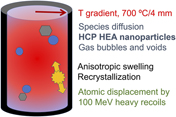
In addition to the extremes of pressure or shear stress in the above examples, one can consider the combination of radiation and elevated temperature as an extreme processing condition appropriate for the study of phase formation under external driving forces. One of the oldest known MPEAs (MoTcRuRhPd) forms in nuclear fuel as a single-phase HCP alloy under the extreme operating conditions of a nuclear reactor. Fission product metals, such as Mo, Tc, Ru, Rh, Pd, Ag, Cd, and Te, accumulate into HCP alloy particles, known as the epsilon (ε) phase. About 1.7 billion years ago, fission products from natural self-sustaining nuclear reactions in a uranium deposit at Oklo in Gabon formed what could be considered the oldest MPEA known to humanity [Reference Utsunomiya and Ewing30]. This phase has been the subject of several experimental studies long before HEAs came into vogue.
About 50 years ago, Bramman et al. [Reference Bramman, Sharpe, Thom and Yates31] established that spherical ε-phase fission product aggregates in fuel are composed of Mo, Tc, Ru, Rh, and Pd and determined the structure to be hexagonal with lattice constants a = 0.273 nm and c = 0.444 nm. These inclusions appeared white in ceramographs and were typically less than 20 μm in diameter. The authors proposed that metallic fission products close to the high temperature center of the fuel pellet may melt and coalesce but that most of the observed inclusions accumulated through solid state diffusion of individual elements. The authors also cast an ingot of Mo 43.5 wt%, Ru 35.5 wt%, Tc 17.7 wt%, and Rh 3.3 wt% to study this MPEA in detail. The structure was mainly HCP with a second phase of Mo5RuTc that constituted no more than 5%. This MPEA was tough, malleable, insoluble in common acids, and unaffected by exposure to normal etching reagents. Larger (700 μm) diameter particles with a similar structure but slightly different composition compared with that in the previously mentioned fission product study were extracted from irradiated fuel by O’Boyle et al. [Reference O’Boyle, Brown and Dwtght32], who proposed the formation of these particles by migration of fission products along grain boundaries.
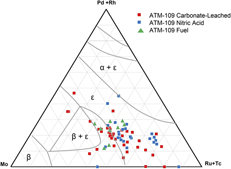
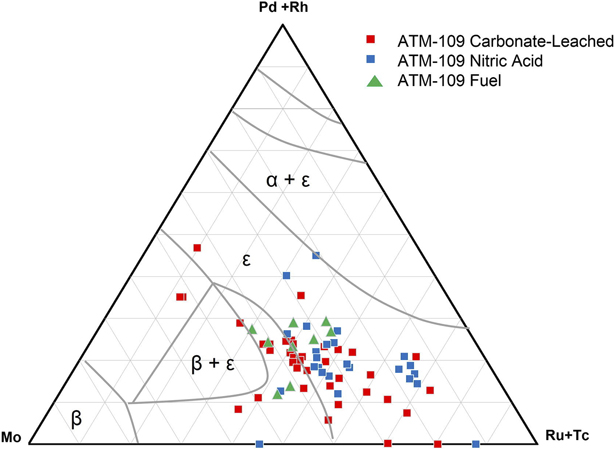
Kleykamp and coworkers [Reference Kleykamp33, Reference Kleykamp, Paschoal, Pejsa and Thümmler34, Reference Kleykamp35] systematically studied the composition, structure, and thermodynamics of MPEA precipitates in uranium oxide nuclear fuels using X-ray diffraction and microanalysis. The metallic phases they observed included the HCP ε-phase containing Mo, Tc, Rh, and Pd; the BCC β-phase containing Mo, Tc, and Ru; and the FCC α-phase enriched in Pd, Ru, and Rh. The α-phase formed at low Mo and high Pd content. At high oxygen potential, selective oxidation of Mo resulted in the ε-phase transforming into a two-phase mixture of ε and α [Reference Naito, Tsuji, Matsui and Date36]. Furthermore, they observed a σ-phase (Mo5Ru3), which formed at high Mo and low Pd content. Given the challenge of understanding the phase space as a function of temperature in a quinary diagram, Kleykamp et al. [Reference Kleykamp33] developed pseudo-ternary diagrams for this system. Figure 1 shows such a diagram that includes compositions of metallic particles extracted from nuclear fuel [Reference Buck, Mausolf, McNamara, Soderquist and Schwantes37], with different symbols representing different extraction processes. Not all phases, in particular, the ζ and σ phases, are labeled in this diagram for clarity.
Compositions of MPEA particles superimposed on the pseudo-ternary phase diagram proposed by Kleykamp et al. [Reference Kleykamp33]. Different symbols represent the particles in as-received nuclear fuel ATM-109 (green triangle), after nitric acid dissolution (blue square), and carbonate–peroxide dissolution processes (red square). Reprinted from Buck et al. [Reference Buck, Mausolf, McNamara, Soderquist and Schwantes37] with permission from Elsevier.
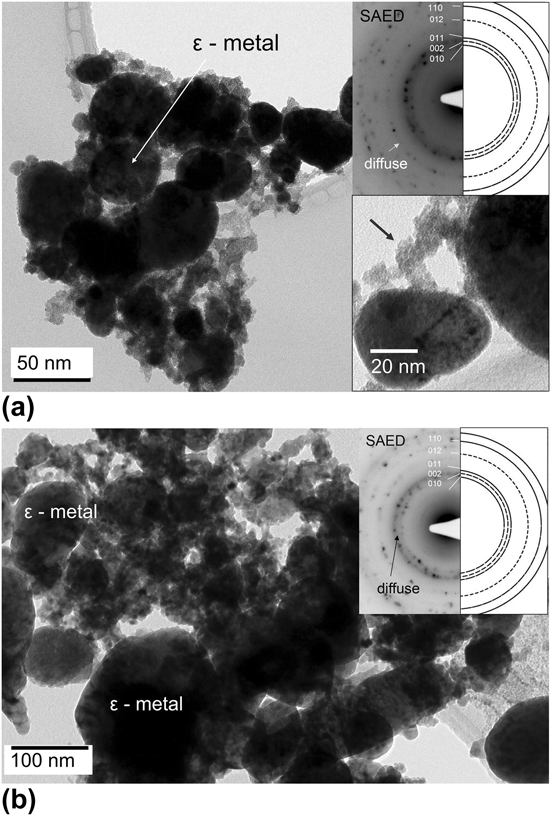
More recent studies have focused on the nanostructure of these alloy particles. Yang et al. [Reference Yang, Li, Zinkle, Zhao, Bei and Zhang38] have reviewed the radiation response and defect properties of HEAs. Cui et al. [Reference Cui, Rondinella, Fortner, Kropf, Eriksson, Wronkiewicz and Spahiu39] have characterized MPEA particles from low burn-up fuel to determine composition and lattice constants. The composition was rich in Mo, Ru, and Pd and had the HCP structure. Buck et al. [Reference Buck, Mausolf, McNamara, Soderquist and Schwantes37] have observed particles of 10–300 nm diameter with ε-phase (hexagonal) structure in used nuclear fuel. The particles exhibited a unique nanostructure with crystallites of 1–3 nm diameter and amorphous regions as seen in Fig. 2. Aggregates of the MPEA particles can be seen in the transmission electron microscopy image. The diffraction patterns show that the particles have the ε-phase HCP structure. Similar nanoparticles have also been found in specimens from the Oklo “natural reactor.” Lucuta et al. [Reference Lucuta, Verrall, Matzke and Palmer40] have reported the formation of spherical Mo–Ru–Rh–Pd MPEA precipitates in simulated nuclear fuel.
Bright field transmission electron microscopy image of metallic particle agglomerates from (a) carbonate–peroxide dissolved used fuel. The inset shows selected area electron diffraction (SAED) pattern and fit to ε-Ru HCP structure. The image in the bottom right-hand corner is a higher magnification image of the ε-metal particles clearly showing that some particles are isolated 1–2 nm particles and (b) nitric acid dissolved used fuel with inset SAED pattern and match to ε-Ru metal. Reprinted from Buck et al. [Reference Buck, Mausolf, McNamara, Soderquist and Schwantes37] with permission from Elsevier.

An interesting idea was to use the ε-phase particle as an aggregate form that could serve to isolate and immobilize nuclear waste by-products. To this end, Crum et al. [Reference Crum, Strachan, Rohatgi and Zumhoff41] have investigated spark plasma sintering, microwave sintering, and hot isostatic pressing to produce an ε-phase–based aggregate that could serve as a waste form to immobilize Tc and metals that are part of undissolved solids in nuclear fuel processing. The resulting fission product MPEA has been observed to be chemically durable and resistant to attack by acid solutions that dissolve UO2 fuel [Reference Bramman, Sharpe, Thom and Yates31, Reference Cui, Low, Sjoestedt and Spahiu42]. The study of the thermodynamics and formation process of MoTcRuRhPd HEA can help design a metallic waste form to immobilize the volatile 99Tc, which has a long half-life of ∼211,000 years and is usually present as soluble TcO4−.
Results and discussion
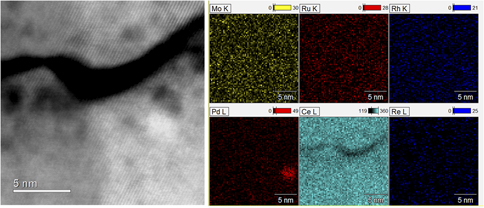
Figure 3 shows an HAADF-STEM micrograph of doped ceria irradiated with He+ ions at 673 K. The micrograph is from the peak damage region irradiated to 13 displacements per atom. This implies that the average atom has been knocked out of its site 13 times. In ceria, molecular dynamics simulations [Reference Yablinsky, Devanathan, Pakarinen, Gan, Severin, Trautmann and Allen43, Reference Devanathan44] show that most of the atoms displaced by energetic particles return to lattice sites, leaving behind a few vacancy clusters and interstitial clusters. Such defects can play an important role in enhancing atomic diffusion. The ceria remained crystalline rather than becoming amorphous. Small precipitates were evident in the HAADF-STEM images from atomic number (Z) contrast, and the EDS-STEM maps showed that these clusters are enriched in Pd. These enrichments/particles, with a diameter of 3 nm or less, formed after the irradiation and were not seen in the sample prior to irradiation. The clusters were found predominantly near grain boundaries and dislocations. These findings suggest that Pd is the most mobile species and it is likely to migrate along extended defects aided by point defects produced by radiation. Diffusion of metals along grain boundaries to form MPEA particles (ε-phase) in UO2 was proposed initially by O’Boyle et al. [Reference O’Boyle, Brown and Dwtght32].
HAADF-STEM images from CeO2 doped with Mo, Ru, Rh, Pd, and Re and irradiated with 90 keV He+ ions to a fluence of 4 × 10¹⁷ ions/cm2 at 673 K, with STEM-EDS maps of Mo, Ru, Rh, Pd, Ce, and Re showing Pd nanoclusters.
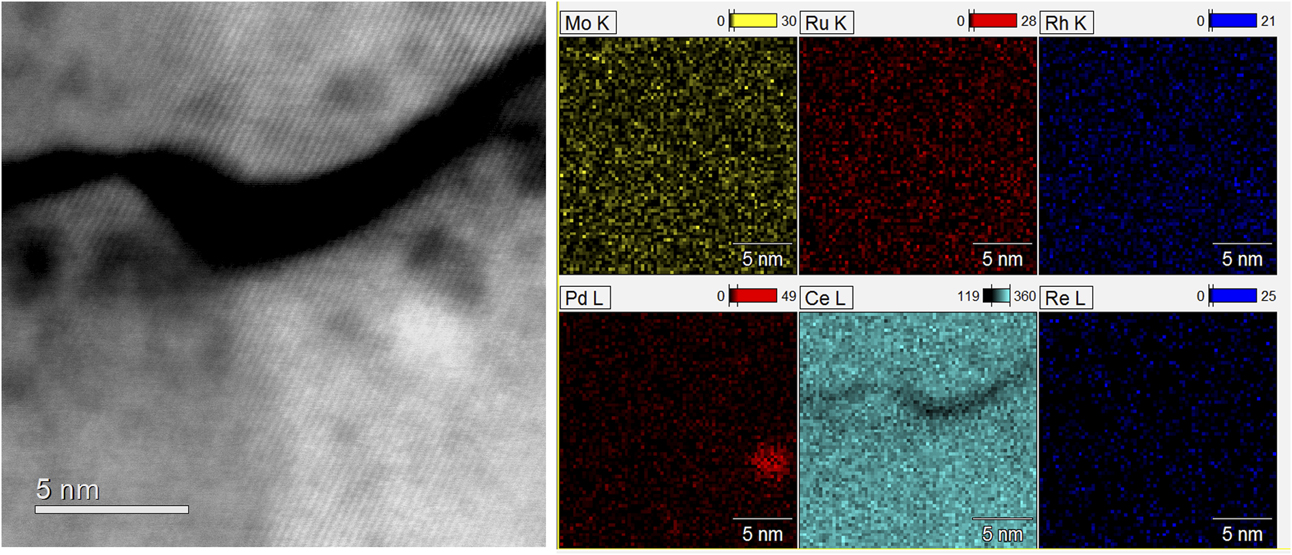
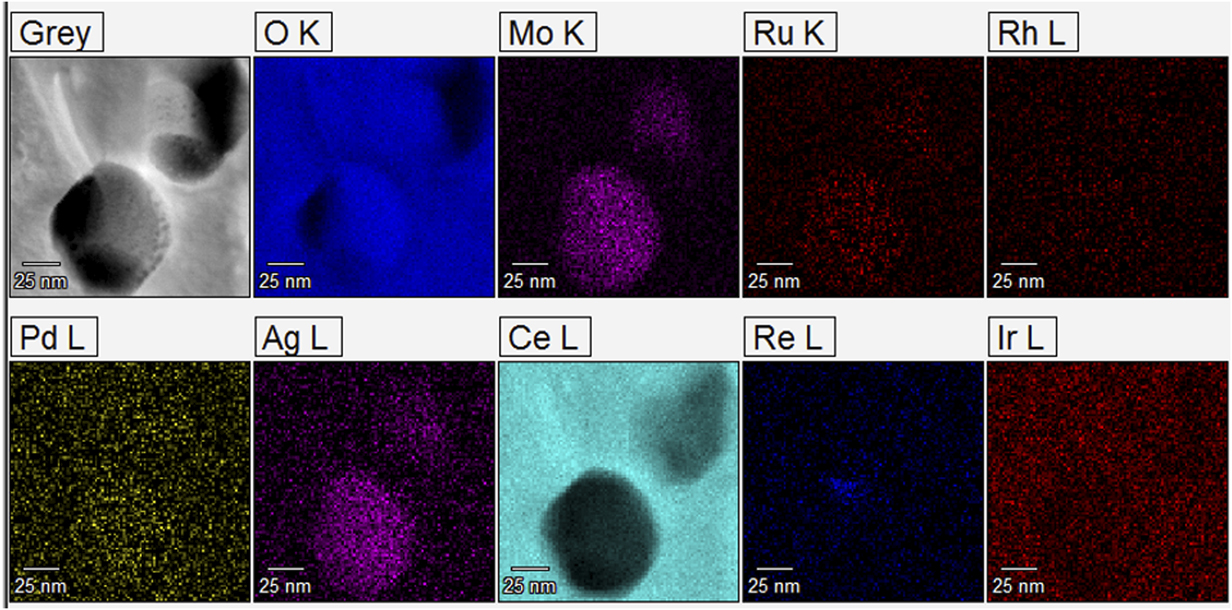
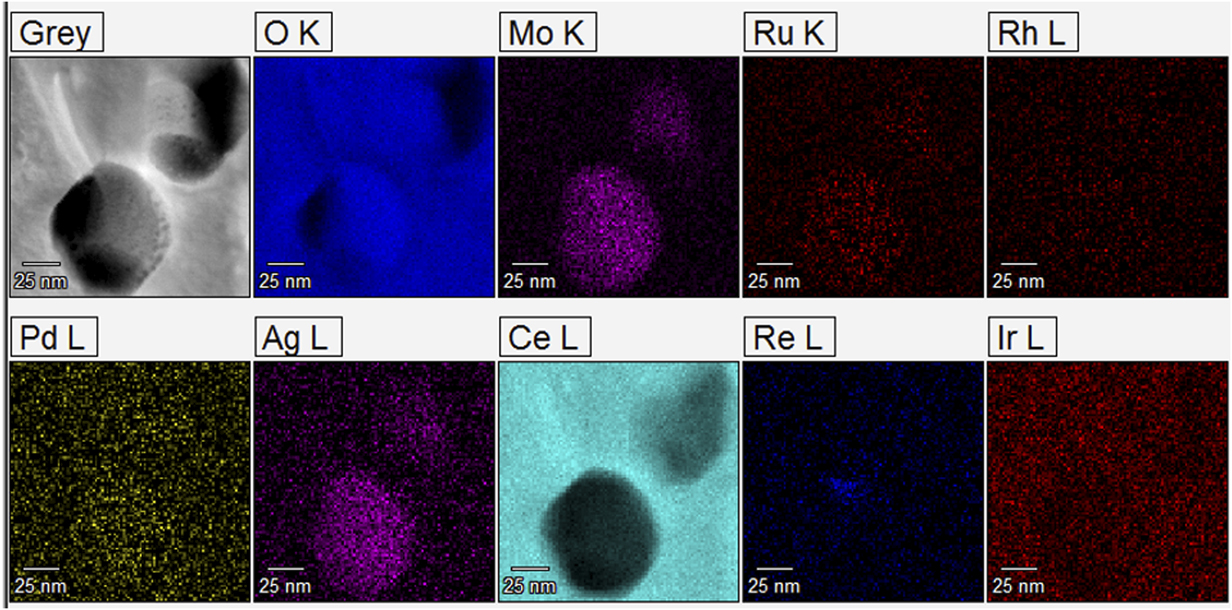
Figure 4 shows an HAADF-STEM micrograph in gray of the peak damage region of a metal-doped ceria sample that was annealed after irradiation. This sample was annealed at 1373 K for 10 h in air following 90 keV He+ irradiation at 673 K. The annealing temperature is typical of the centerline temperature of a nuclear fuel pellet in a reactor. The corresponding STEM-EDS maps are shown for O, Mo, Ru, Rh, Pd, Ag, Ce, Re, and Ir. The EDS maps include Ag, which is an impurity element that was most likely introduced unintentionally from silver paste used to mount samples for irradiation. The Ir signal could be an artifact. Following annealing, five other metals joined Pd to form areas of enrichment along defects and voids within the film. Large particles of 100 nm diameter were observed, and they were enriched in Mo, Ru, Ag, Pd, Re, and Rh. These precipitates formed throughout the ceria matrix and preferentially along grain boundaries, cracks, and dislocation lines. The extended defects could serve as rapid migration pathways for metals to join the initial Pd cluster and produce MPEA particles. These results show the effects of thermal and radiation-enhanced diffusion on the formation of MPEA nanoparticles from a uniform distribution of metal atoms under extreme processing conditions. Further details about the evolution of these particles, including results from atom probe tomography, can be found in the recent report of Jiang et al. [Reference Jiang, Conroy, Kruska, Overman, Droubay, Gigax, Shao and Devanathan45]. Previous reports on ε-phase particles had presented only the final microstructural state of MPEA particles in irradiated fuel. This work has revealed the early stages of MPEA formation. Due to the small size of the clusters and the fact that they are embedded in a ceramic matrix, we have not been able to unambiguously determine the crystal structure.
HAADF-STEM micrograph from a CeO2 sample doped with Mo, Ru, Rh, Pd, and Re that was annealed at 1373 K for 10 h in air after irradiation with 90 keV He+ ions to a fluence of 4 × 10¹⁷ ions/cm2 at 673 K (Grey, top left) with STEM-EDS maps of O, Mo, Ru, Rh, Pd, Ag, Ce, Re and Ir.
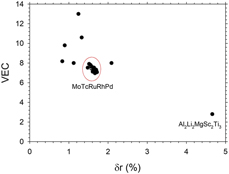
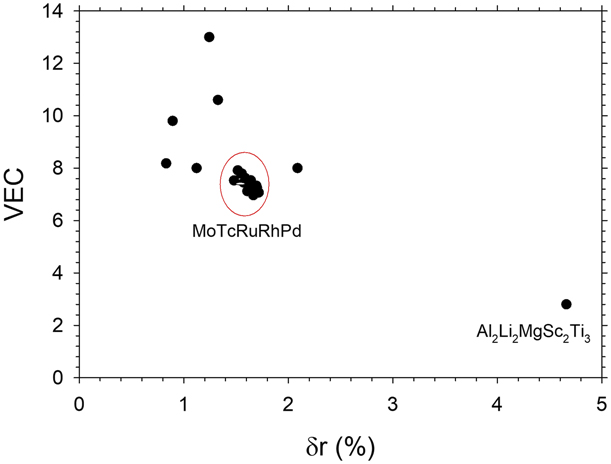
To understand and predict phase formation in this alloy system, we have used the ASAP tool of King and McGregor [Reference King and McGregor52] to calculate structure and electronic and thermodynamic properties of HCP HEAs. The compositions of experimentally reported and computationally predicted HCP HEAs and their properties are provided in Table S1 of the Supplementary material. Several of these compositions have been presented in the Supplementary material table of a recent work by Gao et al. [Reference Gao, Gao, Hawk, Ouyang, Alman and Widom46], but the values of properties differ. Figure 5 shows the valence electron concentration (VEC) of experimentally synthesized HCP HEAs as a function of the atomic size mismatch parameter δr. The alloys considered belong to the MoTcRuRhPd (ε-phase), AlLiMgScTi, YLaGdTbDyHoTmLu, IrOsReRhRu, AlLiMgScTi, and CoCrFeMnNi families. It has been proposed [Reference Zhang, Zuo, Tang, Gao, Dahmen, Liaw and Lu8, Reference Guo, Ng, Lu and Liu47] that BCC solid solutions form for VEC < 6.8 and FCC solid solutions for VEC > 8. In between these values, FCC and BCC phases were expected to coexist. Given the identical first neighbor atomic arrangements in FCC and HCP structures, it may be worthwhile to test the above criterion by substituting HCP for FCC. The ε-phase HCP HEAs have a VEC between 6.8 and 8. CoCrFeMnNi has a VEC of 8 and shows a stable phase at elevated temperature. The lanthanide HEAs and Ir0.19Os0.21Re0.21Rh0.20Ru0.19 have a VEC of 8 or higher. Al2Li2MgSc2Ti3 is an outlier in that it has a much lower VEC of 2.8 and a large atomic size mismatch δr of 4.66%. The other HCP HEAs have δr between 1 and 2.1%.
VEC of HCP HEAs as a function of atomic size mismatch.
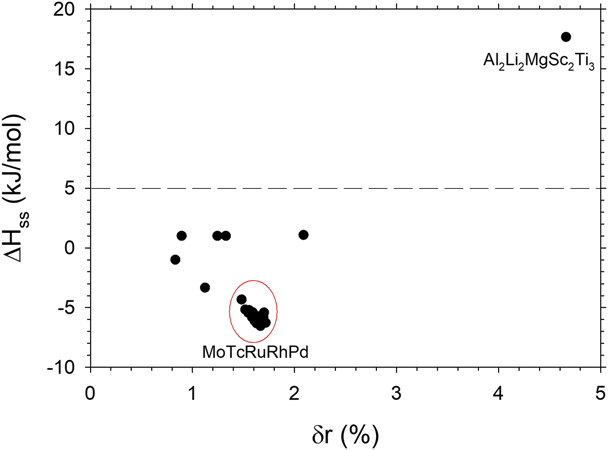
Senkov and Miracle [Reference Senkov and Miracle51] have reviewed the statistical analysis of experimental data that suggests that solid solution can exist if δr is <6.2% and the enthalpy of mixing ΔH SS is between −12 and 5 kJ/mol. Intermetallic phases can exist for δr > 3% and negative ΔH SS, while the material is likely to be amorphous for δr > 6.2% and ΔH SS between −40 and −12 kJ/mol. The value of ΔH SS is plotted against δr for HCP HEAs in Fig. 6. This criterion for solid solutions holds for MoTcRuRhPd, CoCrMnFeNi, lanthanides, and Ir0.19Os0.21Re0.21Rh0.20Ru0.19, and intermetallic compound formation is unlikely because the δr is <3%. The lanthanides have a small positive ΔH SS that still meets the criterion for solid solution formation. Al2Li2MgSc2Ti3 is an outlier in the upper right corner and does not meet any of these criteria because it has a large positive ΔH SS.
Enthalpy of mixing for HCP HEA solid solutions as a function of atomic size mismatch.
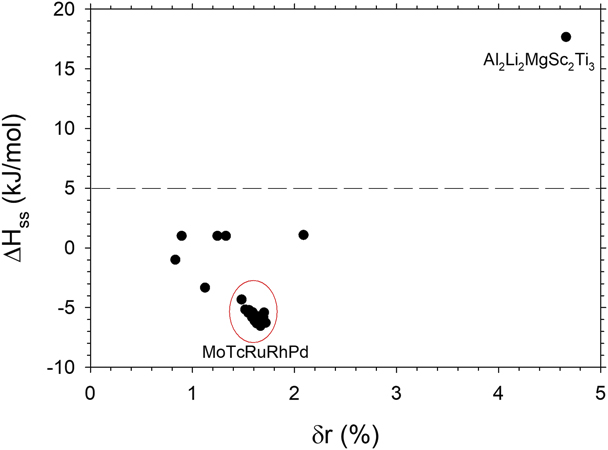
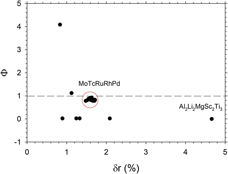
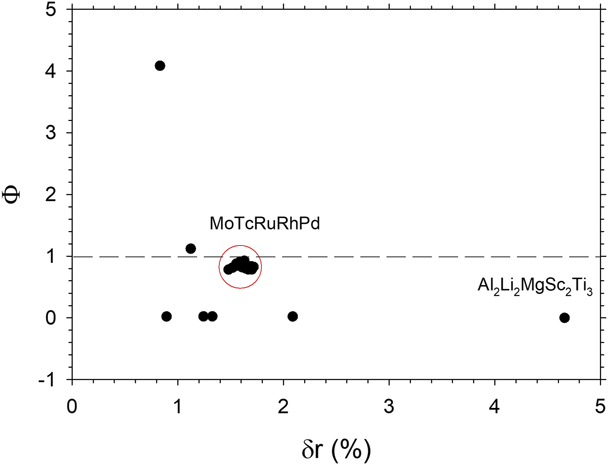
Figure 7 is a plot of the parameter Φ expressed as a ratio of Gibbs free energies of competing phases as a function of the atomic size mismatch parameter. Formation of single-phase random solutions of HEA is expected for Φ ≥ 1 and δr ≤ 6.6. Only equiatomic CoCrMnFeNi and Ir0.19Os0.21Re0.21Rh0.20Ru0.19 are predicted to be single-phase solid solutions. Both of these are predicted to form FCC solutions. This prediction has been experimentally confirmed for both these systems over a certain temperature and composition range. The ε-phase alloys (MoTcRuRhPd) come close to meeting this criterion because they have Φ values between 0.78 and 0.92 just below the threshold of 1. A recent DFT study has concluded that below about 2000 K the ε-phase may undergo partial ordering [Reference King, Burr, Obbard and Middleburgh48]. It is also worth considering that the ε-phase often occurs as a nanoparticle and nanosize effects due to the influence of surface free energy have been shown to stabilize the HCP phase of Rh [Reference Huang, Li, Duan, Cheng, Li, Zhu and Yu49]. The lanthanides and Li2MgAl2Sc2Ti3 have a Φ value close to 0. In the case of the lanthanides, the G max value in Eq. (8) is uncertain and the calculation assumes a large “worst-case scenario value” for this parameter. The Li2MgAl2Sc2Ti3 alloy had FCC structure as-milled but transformed into HCP after annealing at 500 °C for 1 h and the grain size was estimated to be 26 nm. This alloy was synthesized under nonequilibrium conditions. The annealing temperature is too low and annealing time too short to equilibrate this material. It is likely that the HCP phase is metastable and a multiphase microstructure could form upon prolonged annealing at elevated temperature. Calculations of phase stability are limited by gaps in thermodynamic data for the alloys of interest. The experimentally characterized phases may be metastable and influenced by size effects. More rigorous studies are needed to identify the stable phases and assess the reliability of the Φ parameter for the prediction of HCP HEAs.
Φ parameter, which is a ratio of Gibbs free energy of the solid solution to that of the competing phase, for HCP HEAs as a function of atomic size mismatch.
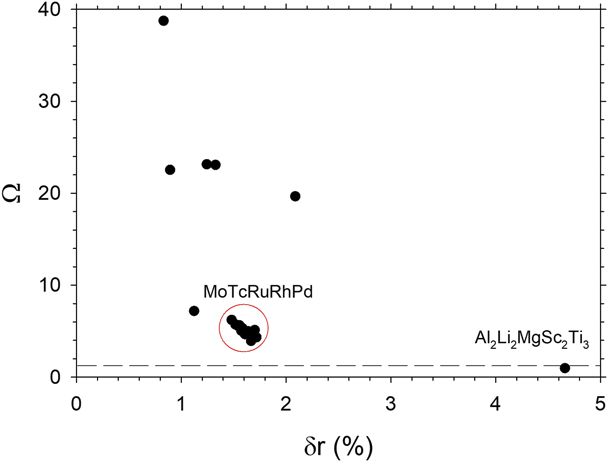
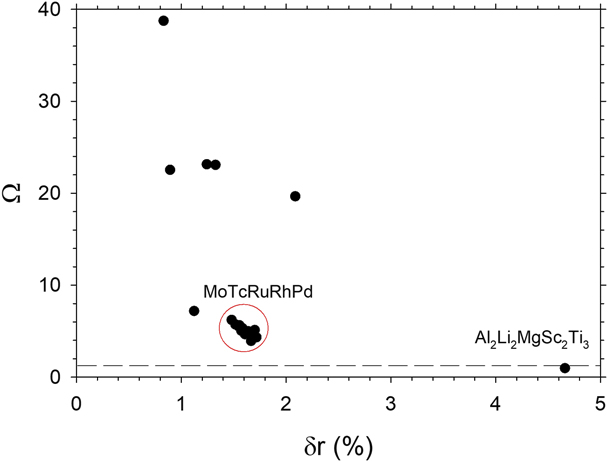
The Ω parameter that considers the ratio of the entropy of mixing and enthalpy of mixing has also been used to predict the occurrence of solid solutions. According to Yang and Zhang, solid solutions form in HEAs for values of Ω ≥ 1.1 and δr ≤ 6.6%. An intermetallic phase or amorphous material is expected to result for smaller Ω and larger δr. Figure 8 is a plot of Ω as a function of δr. Li2MgAl2Sc2Ti3 fails to meet this criterion with an Ω value of 0.96 but the δr value is within the specified range. All other HCP alloys plotted meet this criterion. However, Youssef et al. [Reference Youssef, Zaddach, Niu, Irving and Koch26] have calculated the Ω value to be 42.6, which meets this criterion. The discrepancy between the two values of Ω probably stems from differences in the estimates of ΔH SS and points to the need for obtaining reliable thermodynamic data and establishing data standards. As discussed above, the observed HCP structure of Li2MgAl2Sc2Ti3 may not be the stable phase, given that the alloy is an outlier compared to the other HCP HEAs studied here.
The ratio of entropic and enthalpic contributions to the free energy of mixing, Ω, as a function of atomic size mismatch for HCP HEAs.
One must exercise caution in using these thermodynamic parameters to predict single-phase solid solutions. The enthalpies calculated using Miedema’s model [Reference Takeuchi and Inoue53] correspond to liquid binary alloys. Moreover, the factor of 4 in Eq. (3) is appropriate for binary alloys. A different factor may be appropriate for MPEAs. Of the different criteria considered, the Ω parameter appears to be the most appropriate for predicting the stability of HCP HEAs and the Φ parameter is also promising. The above analysis has been extended to a list of HCP HEAs computationally predicted by Gao et al. [Reference Gao, Zhang, Guo, Qiao and Hawk21] using CALPHAD and phase diagram inspection, and the results are shown in Table S1 of the Supplementary material. Many of these alloys appear to be stable as solid solutions based on Ω and δr. Several of these alloys are predicted to form single-phase solid solution based on the Φ parameter. While these parameters provide a thermodynamic basis for alloy design, the cost of alloys listed in the Supplementary material is a practical consideration for alloy selection. The HCP alloy compositions listed are one to two orders of magnitude more expensive than Fe-based (FCC or BCC) HEAs, for instance, CoCrFeMnNi. The high cost makes these HCP HEAs better suited for applications such as catalysis or nuclear waste immobilization instead of structural applications.
Previous work has identified the HCP ε-phase as a promising waste form for the immobilization of Tc separated from nuclear waste streams or removed from off-gas [Reference Serne, Crum, Riley and Levitskaia50]. The advantages of this alloy are low overall volume of waste produced, the availability of data on the alloy stability for different compositions, and the durability of natural analogs [Reference Zhang, Wu, Lou, Zeng, Prakapenka, Greenberg, Ren, Yan, Okasinski, Liu, Liu, Zeng and Lu28]. In the case of nuclear fuel dissolved in a reprocessing plant, the ε-metal particles and other undissolved solids, including oxides, are left behind. These HEA particles and oxides can be consolidated as a waste form. Crum et al. [Reference Crum, Strachan, Rohatgi and Zumhoff41] have synthesized a model of such a waste form that contained 5 metals, Mo, Ru, Rh, Pd, and Re (surrogate for Tc), and ZrO2 to represent undissolved oxides. The ZrO2 concentration varied from 0 to 35 wt%. Spark plasma sintering or hot isostatic pressing was used to consolidate the samples into high-strength solids with up to 98–100% of theoretical density. The findings may change if Tc is introduced instead of Re. However, Tc melts at a much lower temperature than Re and may get incorporated into the waste form better. These results of Crum et al. [Reference Crum, Strachan, Rohatgi and Zumhoff41] show that HCP HEAs can be mixed with an oxide to produce a durable cermet waste form. The present work has provided insights into the early stages of ε-phase formation under extreme processing conditions and the stability of HCP HEAs.
Conclusions
We have extensively reviewed and summarized the current understanding of HCP HEAs. We have characterized the early stages of HCP HEA formation in a nuclear fuel surrogate, CeO2, doped with Mo, Ru, Rh, Pd, and Re, irradiated with energetic He+ ions at 673 K, and subsequently annealed at up to 1373 K for 10 h in air. Cracks and grain boundaries provide pathways for rapid diffusion of Pd initially and other metals subsequently to form alloy clusters that are likely precursors for HEA particles. Radiation-enhanced diffusion plays an important role at 673 K in the initial stages of nanoparticle formation from a uniform dispersion of the individual metals. Thermal diffusion contributes to alloying and particle coarsening. This extreme environment creates a set of conditions in nuclear fuel that drive the formation of stable alloy particles with HCP structure. We have examined the properties of different HCP compositions in the MoTcRuRhPd system reported in the literature and found that single-phase solid solutions are thermodynamically stable over a broad range of composition based on the Ω parameter that considers the ratio of entropic and enthalpic terms. This alloy system may be a viable waste form for the immobilization of long-lived 99Tc, considering the reported chemical durability of the alloy. The thermodynamic analysis was extended to all known HCP HEAs. These alloys satisfy solid solution stability criteria based on VEC, atomic size mismatch, enthalpy of mixing, and the Ω parameter, except for Al2Li2MgSc2Ti3, an outlier for which the HCP phase may be metastable.
Details of experiments and calculations
We irradiated and annealed ceria doped with Mo, Ru, Rh, Pd, and Re to examine the early stages of ε-phase MPEA formation under the extreme processing conditions of a nuclear reactor fuel without the radiological concerns associated with irradiating nuclear fuel in a reactor. CeO2 is a known surrogate for UO2 with the same cubic fluorite crystal structure. Re served as a substitute for Tc, and the individual dopant weight percents were based on typical metal inventory in the ε-phase found in irradiated fuel. We used pulsed laser deposition in 10−2 torr Ar atmosphere from a target with composition 95 wt% CeO2, 2 wt% Mo, 1.5 wt% Ru, 0.25 wt% Rh, 0.75 wt% Pd, and 0.5 wt% Re to grow the doped ceramic on polycrystalline yttria-stabilized zirconia substrates. The substrate temperature was held at 823 K during growth. The energy density of the pulsed KrF excimer laser operating at 5 Hz was 2.4 J/cm2. The average growth rate of the uniformly doped CeO2 film was 0.2 nm/s. We then irradiated the film with normally incident 90 keV He+ ions at 673 K to a fluence up to 4 × 10¹⁷ ions/cm2 and used beam rastering to cover a 10 × 10-mm area. At this fluence, the estimated peak displacement dose at a depth of 324 nm was 13 displacements per atom and the peak He concentration at a depth of 372 nm was 23 at.%. We annealed some of the irradiated samples and unirradiated samples in air at 1073 K or 1373 K for 10 h to study thermal effects in addition to radiation effects driving the MPEA particle formation.
We prepared cross-sectional transmission electron microscopy specimens using a beam-focused ion beam–integrated scanning electron microscope. We used high-angle annular dark field scanning transmission electron microscopy (HAADF-STEM) with an aberration-corrected JEM ARM 200CF (JEOL USA, Peabody, MA) microscope equipped with a cold field emitter and performed energy dispersive spectroscopy (EDS) using a Gatan Quantum 965 spectrometer (Gatan Inc., Pleasanton, CA) with a proprietary JEOL Centurio Si-drift EDS detector (JEOL USA, Peabody, MA). We performed STEM-EDS elemental mapping from selected areas with a voltage of 200 kV or 80 kV. These characterization techniques are well-suited to study nanoparticles dispersed in a ceramic matrix. As shown in Fig. S1 of the Supplementary material, phenomena occurring under extreme processing conditions of irradiation and high temperature drive the formation of sparsely distributed HCP particles, typically micrometer in size, in the UO2 matrix. The ceramic CeO2 used in this work serves as a nonradioactive surrogate for UO2.
We calculated the thermodynamic properties [Reference Senkov and Miracle51] of HCP HEAs reported in the literature and predicted by calculations using the Alloy Search and Predict (ASAP) tool developed by King and McGregor [Reference King and McGregor52]. The parameters calculated are listed below.
δr quantifies the atomic size difference of the HEA made of N metals i with atomic fraction c i and atomic radius r i as shown below.
 $$\delta r = 100 \times \sqrt {\sum\limits_{i = 1}^N {{c_i}{{\left( {1 - {{{r_i}} \over {\bar{r}}}} \right)}^2}} } \quad ,$$
 $$\bar{r} = \sum\limits_{i = 1}^N {{c_i}{r_i}} \quad .$$
The enthalpy of mixing of the solid solution is based on the enthalpy of mixing per mole H ij of pairs of metals i and j as follows:
 $$\Delta {H_{{\rm{SS}}}} = \sum\limits_{i = 1}^N {\sum\limits_{j > i} {4{H_{ij}}{c_i}{c_j}} } \quad ,$$
H ij was determined from Miedema’s model [Reference Takeuchi and Inoue53] applied to a liquid binary alloy. The configurational entropy of mixing of the solid solution is given by the following equation:
 $$\Delta {S_{{\rm{SS}}}} = - R\sum\limits_{i = 1}^N {{c_i}\ln \left( {{c_i}} \right)} \quad .$$
Here, R is the universal gas constant [8.314 J/(mol K)].
To understand phase stability, we must account for both enthalpy and entropy by considering the Gibbs free energy change ΔG.
 $$\Delta {G_{{\rm{SS}}}} = \Delta {H_{{\rm{SS}}}} - T\Delta {S_{{\rm{SS}}}}\quad ,$$
where ΔG SS is the change in Gibbs free energy for forming a disordered solid solution at temperature T starting with individual elements. Yang and Zhang [Reference Yang and Zhang54] have proposed a criterion based on an omega parameter for predicting solid solution formation in HEAs by comparing the relative importance of enthalpic and entropic contributions shown in Eqs. (3) and (4), respectively.
 $$\Omega = {{T_{\rm{m}}^{{\rm{HEA}}}\Delta {S_{{\rm{SS}}}}} \over {\left| {\Delta {H_{{\rm{SS}}}}} \right|}}\quad .$$
The HEA melting temperature  $\left( {T_{\rm{m}}^{{\rm{HEA}}}} \right)$ is obtained from the melting temperature of each element i
 $\left( {T_{\rm{m}}^i} \right)$ using the rule of mixtures.
 $$T_{\rm{m}}^{{\rm{HEA}}} = \sum\limits_{i = 1}^N {{c_i}T_{\rm{m}}^i} \quad .$$
Criteria for solid solution stability based on the relative values of Gibbs free energy change for competing solid solution and intermetallic phases have also been proposed in the literature [Reference Senkov and Miracle51]. King et al. [Reference King, Middleburgh, McGregor and Cortie55] have proposed a parameter Φ based on the ratio of these Gibbs free energy values:
 $$\Phi = {{ - \Delta {G_{{\rm{SS}}}}} \over {\left| {\Delta {G_{\max }}} \right|}}\quad ,$$
Here, ΔG max was defined as the lowest Gibbs free energy change on forming an intermetallic or the highest Gibbs free energy change for segregation when the individual elements are mixed. Troparevsky et al. [Reference Troparevsky, Morris, Kent, Lupini and Stocks56] have used high-throughput DFT calculations to develop a database of enthalpies of formation of binary intermetallic compounds and specified an optimal range of values at which a solid solution is likely to form. Finally, for the sake of completeness, we have also calculated the valence electron concentration (VEC) of alloys obtained as a weighted average of VEC of individual metals. Massalski [Reference Massalski57] has defined the VEC to include all the electrons in the valence band, including the d-electrons.
 $${\rm{VE}}{{\rm{C}}_{{\rm{HEA}}}} = \sum\limits_{i = 1}^N {{c_i}{\rm{VE}}{{\rm{C}}_i}} \quad .$$
Supplementary material
To view supplementary material for this article, please visit https://doi.org/10.1557/jmr.2018.438.
Acknowledgments
The authors thank D.J.M. King for thoughtful suggestions about the thermodynamics of MPEAs. This work was supported by the Nuclear Process Science Initiative (NPSI) under the Laboratory Directed Research and Development (LDRD) Program at the Pacific Northwest National Laboratory, a multiprogram national laboratory operated by Battelle for the U.S. Department of Energy under Contract DE-AC05-76RL01830. Ion irradiation was performed at Texas A&M University.