Vancomycin-resistant enterococci (VRE) are a good example of the emergence of multidrug-resistant bacteria and their ability to spread, particularly in hospitals.Reference Cattoir and Leclercq1 VRE belong to the designated 6 nosocomial pathogens that have evolved to escape the effects of antibiotics known as the ESKAPE bacteria: Enterococcus faecium, Staphylococcus aureus, Klebsiella pneumoniae, Acinetobacter baumannii, Pseudomonas aeruginosa, and Enterobacter spp.Reference Wolfensberger, Clack and Kuster2 The dissemination of these bacteria and the increased number of infections could create therapeutic impasses.Reference Cattoir and Leclercq1,Reference Wolfensberger, Clack and Kuster2 To limit their transmission, various infection prevention and control (IPC) measures can be implementedReference Siegel, Rhinehart, Jackson and Chiarello3,4 : standard precautions; additional contact precautions, which can be bundled with active surveillance cultures (ASCs); and regional cohorting with or without dedicated caregivers. However, the implementation of these IPC measures may represent a burden to patients, caregivers, and the hospital system.Reference Stelfox, Bates and Redelmeier5-Reference Reeme, Bowler and Buchan7 Therefore, it is interesting to evaluate VRE spread if one of these measures is implemented.
Assessing the effectiveness of IPC measures in real-life is difficult because it is difficult to control all parameters, such as caregiver behavior. In addition, in practice, the implementation of a bundle of IPC measures is recommended, so studying the effect of each measure separately is impractical, as is studying combinations of measures. To overcome these difficulties, it is possible to perform this assessment in silico. With the evolution of information technology tools, the use of agent-based models (ABM) has now grown substantially.Reference Keeling and Rohani8,Reference Railsback and Grimm9 ABMs facilitate the modeling of complex phenomena such as the dissemination of transmissible agents in healthcare services, and ABMs are well suited to assess IPC measures.Reference D’Agata, Magal, Olivier, Ruan and Webb10-Reference Barker, Alagoz and Safdar19 Furthermore, with regard to VRE, these measures have frequently been studied in intensive care units (ICUs) whereas VRE are also of interest in conventional units.Reference Hotchkiss, Strike, Simonson, Broccard and Crooke11-Reference Barnes, Morgan, Harris, Carling and Thom13 Thus, using an ABM, we simulated the transmission of VRE within and among 3 hospital conventional care and intensive care units, according to different IPC measures.
Methods
The ABM was constructed to accommodate the framework of short-stay medical wards, represented by 2 conventional units and 1 ICU, with single rooms. In one of the scenarios, an isolation unit devoted to VRE patients was added. This model consisted of a discrete event system. Each time step represented 15 minutes, and the simulations were carried out over 1 year.
The model was developed to simulate the patient-to-patient transmission of VRE, solely by the caregivers’ hands who become contaminated during contact with a contagious VRE carriers (ie, patients shedding VRE). Different categories of personnel were taken into account: registered nurses, nursing assistants, medical interns, and senior physicians.
The patient population was represented by inpatients (with or without antibiotics) and nonhospitalized patients. A hospitalized contagious VRE carrier was introduced into the model at time zero. Since patients with VRE can become noncontagious (mean shedding duration, 6.7 months), a second hospitalized contagious carrier was introduced into the model at 6 months to ensure that the model did not cease. These 2 introduced cases were counted in the number of carrier cases at the end of the simulations. In addition, at time zero, 4 nonhospitalized patients were chosen randomly to be contagious VRE carriers and could be hospitalized at any time. Over the simulated year, patients were admitted to and discharged from the hospital. Discharged patients (VRE carriers or not) could be readmitted.
The detailed description of the model and parameters are provided in Appendix A (online) and this model was conducted in accordance with the ODD (overview, design concepts, details) protocol.Reference Railsback and Grimm9,Reference Grimm, Berger and Bastiansen20,Reference Grimm, Berger, DeAngelis, Polhill, Giske and Railsback21
Experimental scenarios
The different simulated IPC measures consisted of the following elements:
-
Standard precautions (SP): Hand hygiene (HH) of caregivers before and after contact with a patient. Different experiments were carried out depending on the HH compliance rate. The notation used was SP: x% HH, where the HH compliance rate is equal to x% in the context of standard precautions.
-
Additional contact precautions (CP): Implemented only for known VRE patients (ie, a patient was detected or was considered to have known VRE only when the result of weekly screening was known) and represented by an increase in HH compliance by caregivers before and after contact with a VRE carrier. The notation used was SP: x% HH and CP: y% HH, that is, HH compliance at x% for noncarrier patients (ie, standard precautions) and at y% for VRE patients (contact precautions).
-
Cohorting: Known carriers shedding VRE (eligible patients) were grouped in the same unit (1 of the 2 conventional units). This conventional unit nonetheless continued to care for noncarriers, and staff could be shared between carrier and noncarrier patients. Eligible patients could still be treated in the ICU. Different thresholds of the number of patients eligible for the implementation and lifting of the cohorting were tested.
-
Isolation unit: Eligible patients were treated in a unit with dedicated medical and paramedical staff. Eligible patients could still be treated in the ICU. Different thresholds for the number of patients eligible for the establishment and closing of the isolation unit were tested.
The different scenarios are described in the Table 1. Each scenario underwent 50 simulations.
Simulated Scenarios

Note. HH, hand hygiene compliance rate; VRE, vancomycin-resistant enterococci (known contagious VRE-carrier); Threshold, threshold of implementation or lifting.
aGeographicalgrouping of VRE without dedicated staff.
bVRE care in an isolation unit with dedicated staff.
cCohorting or isolation unit were implemented but never stopping.
At each simulated care moment, contamination could occur if either the caregiver or the patient was contagious. The probability of VRE transmission was calculated as follows. (1) It was calculated on the basis of the probability of transmission from the patient to the caregiver, for a care moment with a contagious patient. The caregivers’ hands remained contaminated if he was not HH compliant after providing the care. The chance of a caregiver being compliant depended on the scenario (% HH) and the patient (VRE carrier or not). (2) The probability of VRE transmission was calculated for transmission from the caregiver to the patient, for a care provided by a caregiver with contaminated hands. The caregiver was contagious if he had not been HH compliant before the care. If the patient was receiving antibiotics, the transmission probability increased (multiplied by antibiotics odds ratio). These different parameters are defined in Appendix A (online).
Implementation and verification
The model was constructed using NetLogo software.Reference Wilensky22 At each step, the computer code implementing the model was tested with short simulations to detect programming errors and to ensure that the model functioned as indicated in the description.
Output data analyses
The primary end point was the cumulative number of VRE cases at the end of the simulations. The output data were imported into the R software.23 The results are represented in box plots.
Sensitivity analyses
Sensitivity analyses were carried out on parameters with values that were not homogeneous in the literature, namely the probability of VRE transmission from the caregiver to the patient and that of the patient to the caregiver. Different scenarios were carried out with probabilities at 6%Reference Austin, Bonten, Weinstein, Slaughter and Anderson24-Reference Wolkewitz, Dettenkofer, Bertz, Schumacher and Huebner26 and 20%,Reference Temime, Opatowski, Pannet, Brun-Buisson, Boëlle and Guillemot12 respectively. In addition, 4 scenarios were modelled by increasing the number of simulations to 1,000 to assess the stability of the results.
Results
Scenarios: Standard precautions for all patients
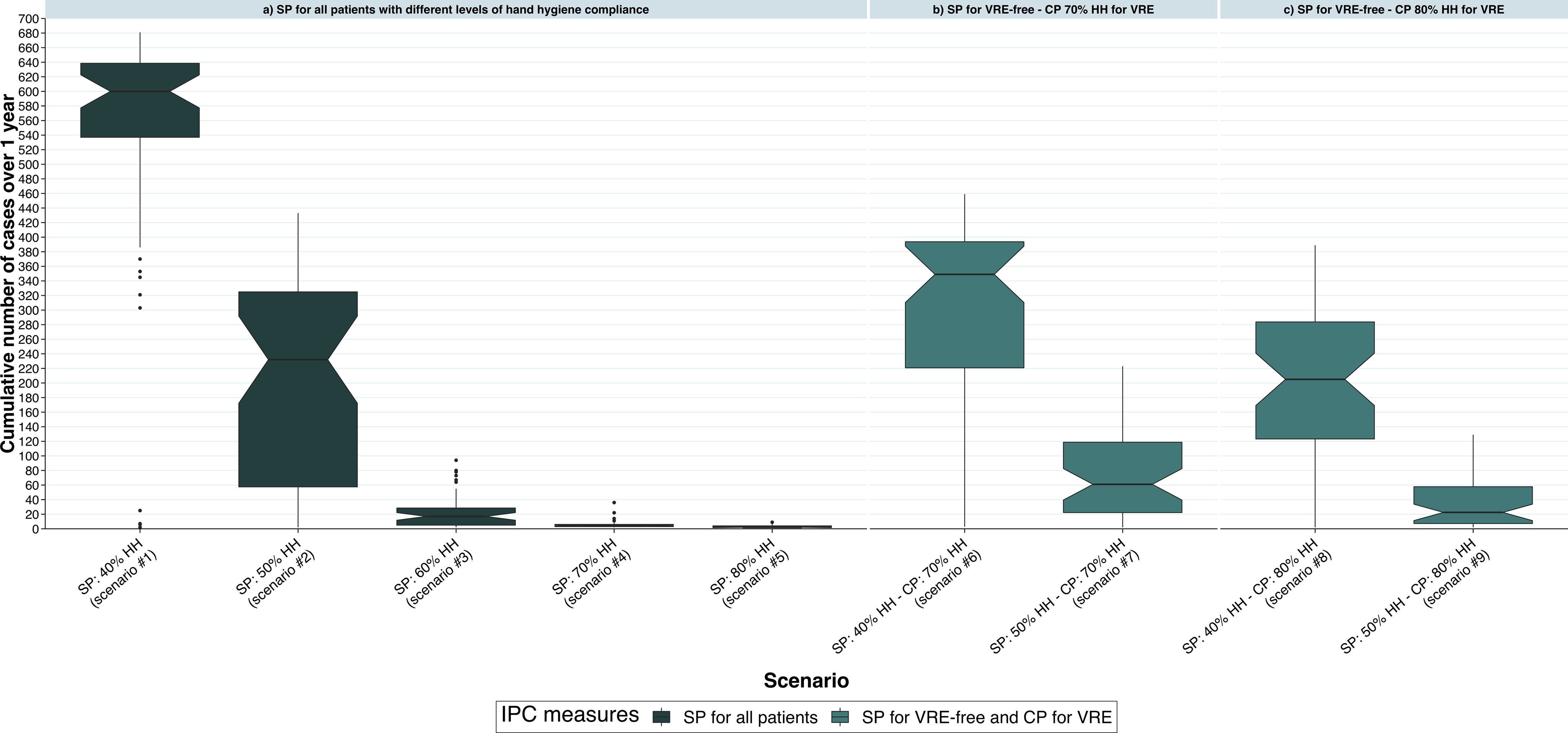
Figure 1a shows the impact of the HH compliance on the cumulative number of VRE carriers at the end of the 50 one-year simulations. A 10% increase in the compliance rate, between 40% (scenario 1) and 50% (scenario 2), was associated with a clinically significant decrease in the median number of cases: 600 (95% CI, 577–623) versus 232 (95% CI, 172–292). At 60% (scenario 3), the median number of new cases did not exceed 20: 17 new cases (95% CI, 12–22) at 60% and 4.5 new cases (95% CI, 4–5) at 70% (scenario 4). At 80% (scenario 5), in half of the simulations, there were no cases secondary to the 2 cases introduced into the model; the maximum number of cases was 9. A graph representing the results with scenarios 4 and 5 only is available in the appendices (Appendix B.1 online).
Comparison of the application of standard precautions for all patients, and the application of standard precautions for noncarrier patients and additional contact precautions for VRE patients, with different levels of hand hygiene compliance. This graph illustrates the cumulative number of VRE-carrier patients at the end of the 50 simulations, for each scenario. The central value of the box plots is the median and the edges are the first and third quartiles (Q1 and Q3). The ends correspond to a maximum of 1.5 times the interquartile range. The notch around the median gives a 95% confidence interval (CI) for comparing medians. Note. IPC, infection prevention and control; SP, standard precautions; CP, additional contact precautions; VRE, vancomycin-resistant enterococci (known contagious VRE carrier); %HH, hand hygiene compliance rate; Example: SP with 40% HH and CP with 70% HH means a 40% HH compliance rate for patients managed with SP and a 70% HH compliance rate for patients managed with CP.

Scenarios: Contact precautions for VRE carriers
Figures 1b and c show the impact of contact precautions on the cumulative number of VRE carriers. For the same basic HH compliance (ie, standard precautions), the addition of contact precautions for carriers reduced the total number of cases. Nevertheless, scenario 6 (standard precautions with 40% HH and contact precautions with 70% HH) and scenario 8 (standard precautions with 40% HH and contact precautions with 80% HH) did not show better results than scenario 2 (standard precautions with 50% HH for all; median, 232 cases; 95% CI, 172–292) versus scenario 6 (median 349 cases; 95% CI, 310–388). Similarly, scenario 3 (standard precautions with 60% HH) and scenario 9 (standard precautions with 50% HH and contact precautions with 80% HH) did not differ in their results.
Scenarios: Cohorting of VRE carriers
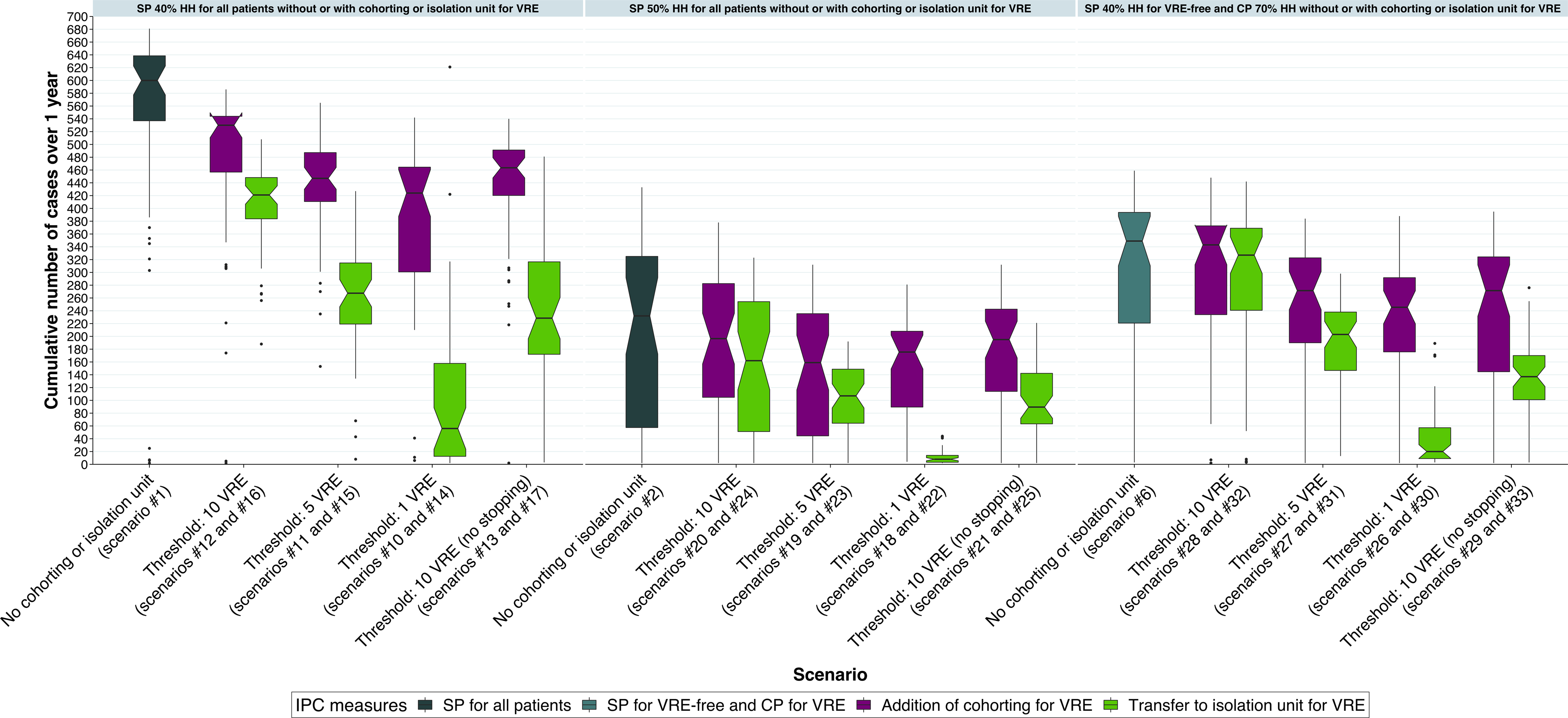
In Figure 2, we can observe the effect of cohorting according to the implementation and lifting thresholds. The effect of cohorting was greater when HH compliance was lower. At 40% HH compliance for all patients, the implementation of cohorting, irrespective of the threshold, reduced the total number of cases. A 10-case threshold (scenario 12) was less effective than the 5-case threshold (scenario 11) or the 1-case threshold (scenario 10), unless the cohorting was never discontinued (scenario 13). When the HH compliance rate was 50% for all patients, cohorting failed to show any effectiveness (scenarios 18–21).
Cumulative number of VRE carrier cases according to the different IPC measures. This graph illustrates the cumulative number of VRE carrier patients at the end of the 50 simulations, for each scenario. The central value of the box plots is the median and the edges are the first and third quartiles (Q1 and Q3). The ends correspond to a maximum of 1.5 times the interquartile range. The notch around the median gives a 95% confidence interval (CI) for comparing medians. Note. IPC, infection prevention and control; SP, standard precautions; VRE, vancomycin-resistant enterococci (known contagious VRE carrier); % HH, hand hygiene compliance rate; Thresholds: threshold for implementing and removal of VRE-patient cohorting or of the isolation unit according to the given scenario; No stopping: thresholds for implementing of VRE-patient cohorting or of the isolation unit according to the given scenario, without removal.

Scenarios: Management of VRE carriers in an isolation unit
Figure 2 shows the effect of admitting and transferring eligible patients to an isolation unit. The 10-case threshold appeared to be effective only in the context of 40% HH compliance for all (scenario 16). For the other thresholds and with equal HH compliance, the isolation unit was effective.
The establishment of an isolation unit when the first case occurred and the HH compliance rate was 50% for all care units (scenario 22) led to a lower number of cumulative cases than in the absence of an isolation unit and an HH compliance rate of 60% for all care units: median, 8 (95% CI, 6–10) versus median, 17 (95% CI, 12–22) (scenario 3 in Appendix B.2 online). On the other hand, scenario 22 did not show better results once the HH compliance rate for all patients exceeded 70% without an isolation unit (scenarios 4 and 5 in Appendix B.2 online).
Sensitivity analyses
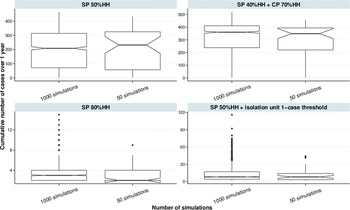
The sensitivity analyses revealed that the total number of cases was sensitive to the probabilities of transmission. The respective effect of the different IPC measures relative to each other was reduced, though it was identical regardless of the transmission probabilities. A graphic representation is available in the appendices (Appendix B.3 online). The increase in the number of simulations (1,000 simulations) for the same scenario did not modify the results (as shown in Figure 3 and Appendix B.4 online).
Comparison of the results of the four scenarios according to the number of simulations performed. The central value of the box plots is the median and the edges are the first and third quartiles (Q1 and Q3). The ends correspond to a maximum of 1.5 times the interquartile range. The notch around the median gives a 95% confidence interval (CI) for comparing medians. Note. SP, standard precautions; % HH, hand hygiene compliance rate; CP, additional contact precautions; VRE, vancomycin-resistant enterococci (known contagious VRE carrier); 1-case threshold = establishment and closing of the isolation unit for a 1-patient threshold of VRE.

Discussion
Our ABM confirmed the importance of HH compliance for all patients regardless of their infectious status (ie, standard precautions). This result is consistent with the literature.Reference Barnes, Morgan, Harris, Carling and Thom13,Reference Triola and Holzman15,Reference Austin, Bonten, Weinstein, Slaughter and Anderson24,Reference D’Agata, Horn and Webb25,Reference Cooper, Medley and Scott27,Reference D’Agata, Webb and Horn28 In our 50-repetition model, an 80% HH compliance rate prevented secondary cases in half of our simulations (44% of cases in the 1,000-simulation model). This scenario was the most effective of all our simulated experiments. However, our experience in the field tells us that this compliance is not currently achieved in most departments. A more realistic, albeit still elevated rate, namely that at 60%, showed interesting results, with a median cumulative number of cases at 1 year of 17 VRE patients for all 3 units (43 beds). This result is consistent with that of the ABM reported by Triola and Holzman,Reference Triola and Holzman15 who showed that this rate was sufficient to avoid an epidemic in an ICU. However, the compliance rates most often reported in the literature rarely exceed 50%.Reference Temime, Opatowski, Pannet, Brun-Buisson, Boëlle and Guillemot12,Reference Austin, Bonten, Weinstein, Slaughter and Anderson24,Reference D’Agata, Horn and Webb25,Reference D’Agata, Webb and Horn28-Reference Eveillard, Hitoto and Raymond34 In this setting, VRE dissemination does not appear to be under control according to our simulations, which are in agreement with the results of the deterministic model of Austin et al.Reference Austin, Bonten, Weinstein, Slaughter and Anderson24 A significant decrease in the number of VRE cases was highlighted between 40% HH compliance and 60% HH compliance, in keeping with the results reported in the literature.Reference Triola and Holzman15,Reference D’Agata, Horn and Webb25,Reference D’Agata, Webb and Horn28
In our calculations of HH compliance, we considered the performance of HH before and after a care intervention, while also taking into account its effectiveness. These 2 concepts were not differentiated given that the ultimate measure was contamination or not of the hands in a cross-transmission context.
The second simulated IPC bundle was contact precautions for the management of VRE carriers. With HH compliance rates of 40% or 50% for noncarriers, and higher rates of 70% and 80% for VRE patients, the number of cases decreased significantly in our simulations. Despite this decrease, an HH compliance rate of 70% for carriers and 50% for noncarriers remained less effective than the overall 60% compliance rate for all. Comparison with the reported literature data is nonetheless complex because contact precautions are often not differentiated from standard precautions or other IPC measures.Reference Austin, Bonten, Weinstein, Slaughter and Anderson24,Reference Yahdi, Abdelmageed, Lowden and Tannenbaum35
In the present study, we simulated contact precautions by simply increasing the rate of HH compliance for VRE carriers. This choice was made given that caregiver hands were the only vector of VRE transmission. However, this increasing rate of HH compliance (so a decrease risk of transmission) could simulated other precautions belong to contact precautions, such as clothing protection.
Another means to limit the spread of VRE is the cohorting of VRE patients within the same unit without a dedicated team and hospitalized with non-VRE patients. Notably, this measure can be applied when the establishment of a dedicated team or isolation unit is not possible, due to a lack of human and/or logistical resources. This measure allows providers to limit the number of VRE-exposed patients and caregivers. In 2005, Hotchkiss et alReference Hotchkiss, Strike, Simonson, Broccard and Crooke11 tested this scenario in ICUs and showed its effectiveness, although the approach had limits at high transmission rates and when all caregiver categories were not dedicated to the cohorted patients.Reference Hotchkiss, Strike, Simonson, Broccard and Crooke11 Our simulations also showed a moderate effect in this setting. The higher the HH compliance, the less the effect of cohorting. In addition, our results showed that the threshold above which the cohorting is implemented and lifted influenced its effectiveness. Waiting for the presence of 10 VRE carriers in a 43-bed department before implementing cohorting represented a threshold too high unless the cohorting remained in place in the long term.
Finally, we simulated the creation of an isolation unit dedicated to VRE carriers, supported by dedicated staff. This measure is rarely assessed in the modeling of VRE transmission, whereas this measure is recommended when an outbreak is not under control, particularly in France.4 In our model, this technique showed its effectiveness although did not systematically prevent the spread ofVRE, most likely due to the presence of contagious patients outside of the isolation unit that had not yet been detected or treated in the ICU. Again, the threshold above which the isolation unit is implemented and stopped is a key element. With 50% HH compliance for all patients, the implementation of an isolation unit as soon as 1 case is present enables controlling the VRE spread. With a threshold of 10 cases, this approach is less effective.
These results should be interpreted while keeping in mind the hypotheses of the model. To prevent further complication of our model and to facilitate its interpretation, we considered that rooms were single rooms and caregivers’ hands was the only vector of VRE transmission. However, the environment (surfaces or medical devices) is also a known transmission vector.Reference Wolfensberger, Clack and Kuster2-Reference Rutala and Weber37 Some researchers have attempted to take the latter into account in various ways, although showing incongruent results.Reference Barnes, Morgan, Harris, Carling and Thom13,Reference Wolkewitz, Dettenkofer, Bertz, Schumacher and Huebner26,Reference McBryde and McElwain38 Additional models are thus needed to better understand the importance of this vector.
Furthermore, we considered that the HH compliance rates were identical for all caregivers as well as before and after patient contact. Studies show that compliance is higher after an intervention with the patient than before the intervention, and that it can vary depending on the type of caregiver, the type of care, or the time of day.Reference Pittet, Mourouga and Perneger30,Reference Erasmus, Daha and Brug32,Reference Eveillard, Hitoto and Raymond34 Taking these parameters into account in future models would certainly be valuable.
The probabilities of VRE transmission during treatment care are difficult to estimate. Data reported in the literature are highly variableReference Wolfensberger, Clack and Kuster2,Reference Barnes, Morgan, Harris, Carling and Thom13,Reference Milazzo, Bown, Eberst, Phillips and Crawford16,Reference Austin, Bonten, Weinstein, Slaughter and Anderson24,Reference Pittet, Mourouga and Perneger30,Reference Perencevich, Fisman, Lipsitch, Harris, Morris and Smith39 ; hence, the reason we defined these probabilities as random variables following β distributions with large variances reflecting parameter uncertainty. These parameters are essential because they influence the number of cases generated, as shown by our sensitivity analyses. These analyses reflect the robustness of our model because the effectiveness of the IPC measures relative to each other was not influenced by the variation of these parameters.
In the present model, 50 simulations were performed for each scenario; however, we were unable to find a published reference indicating the number of required simulations. Our sensitivity analysis showed that increasing the number of simulations to 1,000, applied to certain scenarios, did not alter the results.
A strength of our model is our consideration of the delay between contamination and the detection of VRE carriage by screening (weekly screening in our simulations). During this delay, the patient is contagious but is not yet detected as a carrier; the patient is not eligible for contact precautions, cohorting, or an isolation unit, so VRE diffusion can easily occur if standard precautions are not properly applied. This further contributes to the importance of universal adherence to standard precautions. Hotchkiss et alReference Hotchkiss, Strike, Simonson, Broccard and Crooke11 showed the importance of this delay by studying the time between a patient becoming contaminated and the removal of that patient from the ICU by transfer to an isolation unit, discharge, or death. This delay plays a key role in the risk of transmission although, in reality, such risk is not readily reducible.
A key feature of ABMs is that they are spatially explicit. A meta-analysis conducted in 2019 highlighted the lack of publications regarding transmission models of multidrug-resistant infectious agents that include spatial diffusion.Reference Niewiadomska, Jayabalasingham and Seidman40 To reproduce real-life situations as closely as possible, we differentiated the categories of caregivers as well as caregiver–patient ratios according to time of day. We also simulated patient flows between units with different lengths of stay, all with the aim of assessing the effect of the measures with minimal bias.
Finally, VRE transmission simulations were not different between several different wards, whereas interward diffusion can be a cause of an outbreak that is difficult to manage. Studies often involve 1 ward type, mostly ICUs. However, ICUs are different from conventional units, particularly in terms of the number of beds and the caregiver–patient ratio.
In conclusion, our ABM simulating the VRE transmission in several care units showed that although contact precautions, cohorting, and an isolation unit likely represent good complements to standard precautions, these may not be necessary in theory if proper hand hygiene is adhered to with a high level of compliance (≥70%).
Supplementary material
To view supplementary material for this article, please visit https://doi.org/10.1017/ice.2020.1308
Acknowledgments
Thank you to the staff of the short-stay medical ward taken as a reference. This study received an approval opinion from the Ethics Committee of the hospital.
Financial support
No financial support was provided relevant to this article.
Conflicts of interest
All authors report no conflicts of interest relevant to this article.