Implications
Methane (CH4) is a potent greenhouse gas and it represents an energy loss to the animal. This study evaluated effects of the nitrogen fertilisation rate of grassland and stage of maturity of grass, when cut for silage making, on CH4 emission by lactating dairy cows. Increasing the N fertilisation rate was ineffective in reducing CH4 emissions. However, because of the higher digestibility and milk production, an earlier grass harvest resulted in less CH4 per unit of milk output and per unit of digestible organic matter intake, and a smaller proportion of ingested energy was lost to CH4.
Introduction
Methane (CH4) formation from ruminant livestock has received considerable attention in recent years due to its contribution to greenhouse gas emission (Intergovernmental Panel on Climate Change, 2008). Moreover, enteric CH4 formed from the fermentation of feed in the ruminant gastrointestinal tract implies a loss of digested energy (Johnson and Johnson, Reference Johnson and Johnson1995). It is known that rumen hydrogen balance and CH4 production is affected by diet degradability and diet chemical composition (for a recent review, see Hristov et al., Reference Hristov, Oh, Firkins, Dijkstra, Kebreab, Waghorn, Makkar, Adesogan, Yang, Lee, Gerber, Henderson and Tricarico2013). Grass silage is commonly fed in intensive dairy production and, hence, contributes to a main part of the CH4 emitted. However, quantitative in vivo information on the effect of a range of grass silage qualities on CH4 emissions is scarce.
Hammond et al. (Reference Hammond, Muetzel, Waghorn, Pinares-Patiño, Burke and Hoskin2009) showed that variation in the chemical composition of ryegrass explained only a minor part of the in vivo variation in CH4 production by dairy cows, and variation in digestibility particularly needs to be taken into account. Actual data on CH4 formation per unit of digestible feed intake for grass silage-fed dairy cows are limited. A recent study with lactating cows indicated a substantial reduction (−15%) in CH4 yield per unit of digestible organic matter intake (DOMI) for early-cut compared with late-cut (cut 3 weeks later) ryegrass-clover silage (Brask et al., Reference Brask, Lund, Hellwing, Poulsen and Weisbjerg2013). Similar findings were reported for beef and dairy cattle fed various grass hay qualities (Boadi and Wittenberg, Reference Boadi and Wittenberg2002).
As yet, a comprehensive in vivo study on the combined effect of N fertilisation rate of grassland and the maturity of the grass harvested for silage making on CH4 emission by dairy cows fed grass silage is lacking. The objective of this study was thus to evaluate the effects of N fertilisation rate and maturity of grass harvested for silage making on CH4 emission, feed intake, milk production, diet digestibility and energy balance of lactating cows. Our hypotheses were that an increasing N fertilisation rate increases the N content and digestibility of grass and that a decreasing grass maturity decreases fibre content and increases digestibility of grass, and CH4 emission intensity is thus reduced.
Material and methods
Experimental setup and dietary treatments
The experiment was conducted over 9 weeks from January to March 2013 at the animal research facilities ‘Carus’ of Wageningen University, Wageningen, the Netherlands, and was approved by the Institutional Animal Care and Use Committee of Wageningen University. In a completely randomised block design with six dietary treatments, 54 lactating Holstein–Friesian dairy cows (12 primiparous and 42 multiparous) were used.
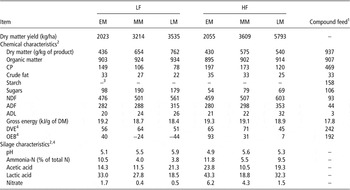
Treatments consisted of grass swards fertilised at a low rate (LF; 65 kg of N/ha) and a high rate (HF; 150 kg of N/ha), and harvested at three stages of grass maturity: early (EM; after 28 days of regrowth at a targeted yield of 2000 kg of DM/ha), mid (MM; after 41 days of regrowth) and late maturity (LM; after 62 days of regrowth; Table 1). Cows were assigned to nine blocks (six cows per block) based on parity, lactation stage (168±11 days in milk; mean±SE), expected milk yield, and whether cows were rumen cannulated or not. Twelve cows previously fitted with a permanent rumen cannula (10 cm i.d., Type 1C; Bar Diamond Inc., Parma, ID, USA) were used for rumen fluid collection. Within blocks cows were randomly assigned to one of six dietary treatments.
Chemical composition of grass silages harvested with a low and high nitrogen fertilisation (F) rate (65 kg/ha, LF; and 150 kg/ha, HF; respectively) at an early (EM; 28 days of regrowth), mid (MM; 41 days of regrowth) and late (LM; 62 days of regrowth) stage of grass maturity at cutting, and of compound feed

DVE=intestinal digestible protein; OEB=rumen-degraded protein balance.
1 Ingredients (per kg of DM): soybean meal (412 g), rumen-protected soybean meal (234 g; Rumi-S, Schouten Products, Rotterdam, the Netherlands), maize (218 g), beet molasses (60 g), urea (31 g), limestone (23 g), calcined magnesia (8.4 g), calcium biphosphate (7.3 g), rumen-inert palm fat (3.9 g; Hidropalm, Norel, Madrid, Spain), chromium oxide (3.3 g).
2 Values in g/kg of DM, unless specified otherwise.
3 Not determined.
4 Determined by NIRS for grass silages (BLGG AgroXpertus, Wageningen, the Netherlands); determined from Dutch feed table values for compound feed.
Grassland management
The grass originated from a mixed sward on sandy soil established in 2010 and composed of diploid perennial ryegrass (Lolium perenne) cultivars of intermediate- and late-heading type (36% each) and timothy (Phleum pratense; 28%; BG Superplus, Barenbrug, Oosterhout, the Netherlands). Grass swards were grown on three fields and treatments were randomly distributed across fields. Grass swards received an initial 80 kg of N/ha from cattle slurry, followed by either 45 or 115 kg of N/ha (LF and HF, respectively) from calcium ammonium nitrate (Rijnvallei, Wageningen, the Netherlands). The first cut did not result in satisfactory differences in N content of grass among treatments nor sufficient DM yields because of unfavourable weather conditions. Therefore, all fields were cut on 22 May 2012 and the fertilisation regimen for the regrowth swards was increased to 65 and 150 kg of N/ha (LF and HF, respectively) from calcium ammonium nitrate, which was applied a week after harvest. Grass was harvested either on 19 June 2012 (EM), 2 July 2012 (MM) or 23 July 2012 (LM) at approximately the same time (ca. 1500 h), wilted on field for ∼24 h and ensiled in bales (ca. 500 kg) using 12 layers of stretch plastic without addition of inoculants. Average daily temperature was 16.3°C (SD 2.9°C) and precipitation totalled 191 mm during the entire regrowth period from May to July 2012.
Feeding and housing
Cows were fed a diet consisting of 80% grass silage and 20% compound feed on DM basis (Table 1) in two equal daily portions at 0600 and 1600 h. The compound feed was provided separately as a meal to ensure its complete intake. The external marker Cr2O3 (2276 mg of chromium/kg of DM) was added to the compound feed (Research Diet Services, Wijk bij Duurstede, the Netherlands) for estimation of apparent total-tract feed digestibility. The grass silage was prepared twice weekly using a self-propelled mixer wagon (Strautmann Verti-Mix 500, Bad Laer, Germany) equipped with a cutter loader system and an electronic weighing scale and stored at 6°C. Water was offered ad libitum during the entire experiment.
Cows were individually housed in tie-stalls for 12 days to adapt to the corresponding experimental diet. Cows were fed ad libitum for the first 8 days. From day 9 onwards and before cows were moved to the climate respiration chambers (CRC), feed intake was restricted per block to 95% based on the ad libitum dry matter intake (DMI) of cows with the smallest DMI within a block. Feed restrictions were based on intake records from days 3 through 8 as described by van Zijderveld et al. (Reference van Zijderveld, Gerrits, Dijkstra, Newbold, Hulshof and Perdok2011) but at all times a minimum DMI of at least 80% of the ad libitum intake of cows with the greatest DMI within block was ensured. Because each block consisted of six cows but the four CRC units offered space for testing a maximum of four cows simultaneously, feed restriction was based on the smallest DMI of four cows per block.
On day 13 (1500 h), cows were moved individually to one of four identical CRC located in close vicinity of the tie-stall barn. Each block of six cows was completed within two consecutive periods; cows and treatments were randomly distributed to the CRC and periods. A detailed description of the CRC design and gas measurements was reported by van Gastelen et al. (Reference van Gastelen, Antunes-Fernandes, Hettinga, Klop, Alferink, Hendriks and Dijkstra2015). Briefly, in each CRC (volume 35 m3) relative humidity was maintained at 70% and temperature at 16°C. The ventilation rate in each compartment was 42 m3/h. Inlet and exhaust air of each compartment was sampled at 10-min intervals. Gas concentrations and ventilation rates were corrected for pressure, temperature and humidity to arrive at standard temperature pressure dew point volumes of inlet and exhaust air. Cows were exposed to 16 h of light per day. Cows stayed in the CRC until day 17 (0900 h). CH4 measurements were based on data recorded from day 14 (0800 h) through day 17 (0800 h); energy balance measurements were based on total manure collection from day 13 (1500 h) through day 17 (0900 h).
Sample collection and measurements
On day 10 and 11, rumen fluid samples (~350 ml) were collected in duplicates and proportionally from a cranial, middle and caudal direction from 12 rumen-cannulated cows, pertaining to blocks 1 and 9, at times t=0, 1, 2, 3, 4, 6, 8 and 10 h after morning feeding using a perforated plastic tube (2.5 cm i.d.). Rumen pH was measured immediately using a mobile electronic pH meter (pH electrode HI1230, Hanna Instruments, IJsselstein, the Netherlands). Subsamples of 50 ml were immediately stored at −20°C pending ammonia-N analysis, and subsamples of 750 µl were acidified with an equal volume of ortho-phosphoric acid and stored at −20°C pending volatile fatty acid (VFA) analyses.
Milk from cows in the CRC was collected twice daily at 0600 and 1600 h. A milk sample (10 ml) of each milking was collected in a tube containing 5 µl NaN3 for preservation for analyses of milk fat, protein and lactose. Milk composition reported was corrected for differences in milk yield between individual milking events. Additional milk samples (5 g/kg of milk) were taken at each milking, pooled per cow and stored −20°C for milk energy analyses. For energy balance determination, faeces and urine from the CRC were quantitatively collected as a mixture, homogenised and subsamples of ~500 ml from the mixture were stored at −20°C. For estimation of apparent total-tract feed digestibility, grab samples of faeces were collected twice daily during milking times at 0600 and 1600 h, pooled per cow and stored at −20°C. Feed residues were collected each morning, pooled per cow and stored at −20°C pending analyses. Samples were taken from feed portions offered to cows in the CRC and pooled per cow. Rumen degradation characteristics of the grass silages used in the present study were determined in a separate experiment using in situ nylon bag incubations, and results were reported by Heeren et al. (Reference Heeren, Podesta, Hatew, Klop, van Laar, Bannink, Warner, de Jonge and Dijkstra2014).
Chemical analyses
Samples of feed, feed residues, manure and faecal grab samples collected in the CRC from day 13 through 17 were oven-dried at 60°C, ground to pass a 1-mm sieve (Peppink 100 AN; Peppink, Olst, the Netherlands), and analysed by wet chemistry according to the methods described in detail by Abrahamse et al. (Reference Abrahamse, Dijkstra, Vlaeminck and Tamminga2008). Gross energy (GE) was determined by bomb calorimetry after ISO 9831 (International Organization for Standardization, 1998). Grass silage and compound feed samples were analysed for DM, ash, N, crude fat, starch (compound feed only), sugars, NDF, ADF, ADL and GE. Feed residues were analysed for DM and ash. Faecal grab samples and manure samples were analysed for DM, ash, crude fat, NDF and GE. Chromium was determined in compound feed and faecal grab samples by using an atomic absorption spectrophotometer (AA240FS; Varian, Palo Alto, CA, USA) after oxidation with wet destruction as described in detail by Pellikaan et al. (Reference Pellikaan, Verstegen, Tamminga, Dijkstra and Hendriks2013). The concentration of individual VFA was determined using gas chromatography (GC type Fisons HRGC MEGA2, Milan, Italy) as described by Warner et al. (Reference Warner, Dijkstra, Hendriks and Pellikaan2013a), the nonglucogenic-to-glucogenic VFA ratio (NGR; i.e. [acetate+2×butyrate+2×isobutyrate+valerate+isovalerate]/[propionate+valerate+isovalerate]) was calculated after Abrahamse et al. (Reference Abrahamse, Dijkstra, Vlaeminck and Tamminga2008). and that of ammonia-N using the indophenol reaction as described by Searle (Reference Searle1984). Milk composition was analysed by mid-infrared spectroscopy at VVB Milk Control Station (Nunspeet, the Netherlands) using the standard procedure ISO 9622 (International Organization for Standardization, 1999), and GE content in milk was analysed as described above.
Statistical analyses
Data on feed intake, milk production and composition were pooled per cow. Data were subjected to ANOVA in a randomised block design with a 2×3 factorial arrangement of treatments (2 N fertilisation rates×3 grass maturity stages) by mixed model procedures of SAS (version 9.3, SAS Institute, Cary, NC, USA). Treatments and their interactions were considered fixed effects and blocks were considered random effects. Each block of six cows each was completed within two consecutive periods because only four cows could be contemporaneously housed in the CRC units. Per block, cows and treatments were randomly assigned to one of two consecutive periods. Therefore, period effect was confounded with block effect. Covariance parameters were estimated using the REML method with variance component structure as the covariance structure, and denominator degrees of freedom were estimated using the Kenward–Roger approximation. Data from two cows (treatments HF–EM and HF–LM) were removed from statistical analyses on measurements taken in the CRC due to outlying values (considered here as more than 5×SE.) observed for DMI and milk production. Pairwise comparisons of means were tested with the Tukey–Kramer method. Rumen fluid measurements from two sampling days were pooled and data were subjected to repeated measures ANOVA to take repeated samples over time within the same cow into account. Because of unequal sampling time intervals, spatial power variance components were used as the covariance structure to account for within-cow variation. All results are reported as least square means with significance of effects declared at P⩽0.05 and trends at 0.05<P⩽0.10.
Results
Feed intake and milk yield
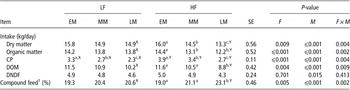
Compound feed was fed before the grass silage was offered and was generally completely consumed. Hence, differences in intake levels of DM, nutrients and the compound feed proportion presented in Table 2 were caused by differences in the intake of the respective grass silages. Occasional feed residues pertained to grass silage and were largest for cows receiving the HF–LM grass silage. Hence, these cows consumed a somewhat larger proportion of compound feed. Although DMI was restricted, DMI decreased by 4% with increasing N fertilisation rate and by 11% with advancing grass maturity. Fertilisation effects were particularly observed for LM cuts, and maturity effects were particularly observed for HF grass (significant treatment interaction). A similar pattern was observed for organic matter intake (OMI) intake, DOMI and a pattern in opposite direction for the compound feed proportion in the diet. Intake of DNDF decreased with advancing grass maturity but was not affected by N fertilisation rate.
Feed intake of dairy cows fed rations containing grass silage with a low and high nitrogen fertilisation (F) rate (65 kg/ha; LF and 150 kg/ha, HF; respectively) and harvested at an early (EM; 28 days of regrowth), mid (MM; 41 days of regrowth) and late (LM; 62 days of regrowth) stage of grass maturity (M) at cutting

DOM=digestible organic matter; DNDF=digestible NDF; SE=standard error of the means.
1 Proportion of compound feed in the ration (rest is grass silage).
a,b,cValues within a row with different lower-case superscript letters differ significantly at P⩽0.05 within F.
X,YValues within a row with different upper-case superscript letters differ significantly at P⩽0.05 within M.
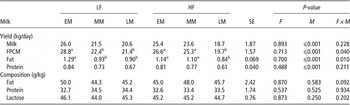
Yields of milk, FPCM, milk fat and milk protein decreased with advancing grass maturity but no N fertilisation effects occurred (Table 3). Yield of FPCM and yield of fat decreased with advancing grass maturity on average by 26% and 28%, respectively. For LF grass, maturity effects were observed between EM and MM cuts, whereas for HF grass, maturity effects were observed only between MM and LM cuts. This resulted in a significant treatment interaction for FPCM and milk fat yields. Milk composition was not influenced by dietary treatments.
Milk yield and composition of dairy cows fed rations containing grass silage with a low and high nitrogen fertilisation (F) rate (65 kg/ha, LF; and 150 kg/ha, HF; respectively) and harvested at an early (EM; 28 days of regrowth), mid (MM; 41 days of regrowth) and late (LM; 62 days of regrowth) stage of grass maturity (M) at cutting

FPCM=fat- and protein-corrected milk; SE=standard error of the means.
a,bValues within a row with different lower-case superscript letters differ significantly at P⩽0.05 within F.
Feed digestibility and rumen fermentation
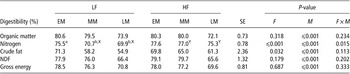
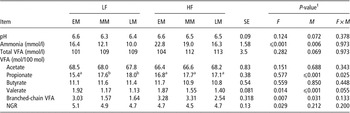
Apparent total-tract digestibility of all chemical fractions as well as GE decreased with advancing grass maturity and that of N and crude fat increased with N fertilisation rate (Table 4). Rumen ammonia-N concentrations were generally greater with HF compared with LF grass silage, and also were greater with decreased grass maturity (Table 5). Propionate molar proportion increased with advancing grass maturity but only when feeding LF grass. Valerate and branched-chain VFA molar proportions decreased with advancing grass maturity in line with a decreasing NGR and decreased with increasing N fertilisation rate. Acetate and butyrate molar proportions were not affected by dietary treatments. Sampling time had a significant effect on rumen fluid characteristics. Molar proportions of acetate decreased within the first 2 h after morning feeding, whereas those of propionate, butyrate, valerate and branched-chain VFA initially increased to approach baseline values again at 10 h after morning feeding (data not shown); ammonia-N concentrations were greatest at the first sampling (1 h) after morning feeding and decreased continuously thereafter (data not shown).
Apparent total-tract digestibility in dairy cows fed rations containing grass silage with a low and high nitrogen fertilisation (F) rate (65 kg/ha, LF; and 150 kg/ha, HF; respectively) and harvested at an early (EM; 28 days of regrowth), mid (MM; 41 days of regrowth) and late (LM; 62 days of regrowth) stage of grass maturity (M) at cutting

SE=standard error of the means.
a,bValues within a row with different lower-case superscript letters differ significantly at P⩽0.05 within F.
X,YValues within a row with different upper-case superscript letters differ significantly at P⩽0.05 within M.
Rumen fermentation characteristics of dairy cows fed rations containing grass silage with a low and high nitrogen fertilisation (F) rate (65 kg/ha, LF; and 150 kg/ha, HF; respectively) and harvested at an early (EM; 28 days of regrowth), mid (MM; 41 days of regrowth) and late (LM; 62 days of regrowth) stage of grass maturity (M) at cutting

VFA=volatile fatty acids; NGR=nonglucogenic-to-glucogenic VFA ratio; SE=standard error of the means.
1 Effect of sampling time (0, 1, 2, 3, 4, 6, 8 and 10 h after morning feeding) was significant (P⩽0.001) for all rumen fermentation parameters; interaction (sampling time×F×M) was not significant (P>0.05).
a,bValues within a row with different lower-case superscript letters differ significantly at P⩽0.05 within F.
CH4 production and energy balance
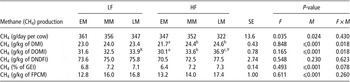
Daily CH4 production decreased by 4% with increasing N fertilisation rate and by 6% with advancing grass maturity (Table 6). Enteric CH4 emission intensity was not affected by N fertilisation rate but generally increased with advancing grass maturity irrespective of units used. CH4 emission expressed per unit of DMI increased by 7% with advancing grass maturity but a significant increase occurred only for HF grass as indicated by a significant interaction between N fertilisation rate and grass maturity. CH4 emission increased by 31% per unit of FPCM, by 15% per DOMI and by 9% per GEI with advancing grass maturity. No treatment effects were observed for CH4 emission per unit of digestible NDF intake (DNDFI).
Methane production from dairy cows fed rations containing grass silage with a low and high nitrogen fertilisation (F) rate (65 kg/ha, LF; and 150 kg/ha, HF; respectively) and harvested at an early (EM; 28 days of regrowth), mid (MM; 41 days of regrowth) and late (LM; 62 days of regrowth) stage of grass maturity (M) at cutting

DMI=dry matter intake; DOMI=digestible organic matter intake; DNDFI=digestible NDF intake; GEI=gross energy intake; FPCM=fat- and protein-corrected milk; SE=standard error of the means.
a,b,cValues within a row with different lower-case superscript letters differ significantly at P⩽0.05 within F.
X,YValues within a row with different upper-case superscript letters differ significantly at P⩽0.05 within M.
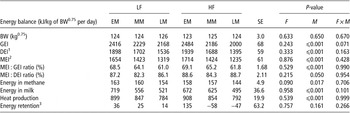
Levels of GEI, digestible energy intake and metabolisable energy intake decreased with advancing grass maturity but were comparable between N fertilisation rates (Table 7). A smaller amount of energy was lost to CH4, heat and milk, and diet metabolisability declined with advancing grass maturity. Energy lost to CH4 tended to be less for HF grass.
Energy balance in dairy cows fed rations containing grass silage with a low and high nitrogen fertilisation (F) rate (65 kg/ha, LF; and 150 kg/ha, HF; respectively) and harvested at an early (EM; 28 days of regrowth), mid (MM; 41 days of regrowth) and late (LM; 62 days of regrowth) stage of grass maturity (M) at cutting

GEI=gross energy intake; DEI=digestible energy intake; MEI=metabolisable energy intake; SE=standard error of the means.
1 Calculated as GEI×GE digestibility.
2 Calculated as GEI−energy in manure−energy in methane.
3 Calculated as MEI−heat production−energy in milk.
Discussion
The objective of this study was to assess CH4 emission by lactating dairy cows fed diets containing a large proportion of grass silage harvested under varying management conditions. As yet, in vivo data on combined effects of the rate of N fertilisation of grassland and the maturity of grass at harvest on enteric CH4 production of grass silage-fed dairy cows have not been reported in literature.
In line with expectations from a previous grass silage trial (Warner et al., Reference Warner, Dijkstra, Hendriks and Pellikaan2013b), the six grass silages tested varied in nutrient composition and digestibility, with HF grass silage containing more CP and less sugar than LF grass silage, and with advancing grass maturity resulting in decreased CP and increased sugar and fibre contents. Sugar content was greater for MM cuts, probably related to weather conditions at harvest and wilting. Silage characteristics were not always in line with expectations because of difficult harvesting and wilting conditions as shown by somewhat high silage pH values and low concentrations of lactic acid compared with those of acetic acid. In addition, LF–LM grass silage had a particular high DM content.
Grass silage quality influenced enteric CH4 emission depending on the unit in which CH4 emission is expressed. Daily CH4 production decreased with a higher N fertilisation rate and grass maturity by 4% and 6%, respectively. Although the amount of daily CH4 produced per cow was smaller with LM than with EM cuts, CH4 emissions per unit of FPCM and DOMI were larger as a result of lower feed digestibility and FPCM production with LM cuts. Such an increase in CH4 emission intensity is in line with results of Brask et al. (Reference Brask, Lund, Hellwing, Poulsen and Weisbjerg2013) obtained with late-cut relative early-cut (cut 3 weeks earlier) ryegrass-clover silage of primary growth.
A part of the N fertilisation effect on CH4 production was likely due to the relatively high nitrate content of the grass silages tested in the present study. The nitrate supply was particularly large for HF–EM and HF–MM grass silages (80 and 49 g of nitrate/day, respectively). This nitrate has likely served as a hydrogen sink in the rumen and resulted in reduced CH4 production (Navarro-Villa et al., Reference Navarro-Villa, O’Brien, López, Boland and O’Kiely2011). Assuming a stoichiometric CH4 reduction of 0.258 g with every gram nitrate in the diet (van Zijderveld et al., Reference van Zijderveld, Gerrits, Apajalahti, Newbold, Dijkstra, Leng and Perdok2010), nitrate intake alone was likely responsible for a reduction of up to 21 g CH4/day (6%) and 13 g CH4/day (4%) with the high-nitrate treatments (HF–EM and HF–MM, respectively), whereas CH4 reduction was minor for the low-nitrate LF grass silages (<6 g CH4/day). We can thus speculate that CH4 production was likely reduced by a greater nitrate supply with HF grass silage and that differences in CH4 production between HF and LF grass are negligible in a situation of equal nitrate supply.
CH4 formation in relation to milk output
Enteric CH4 emission per unit of FPCM increased considerably with advancing grass maturity (+31%), in line with a reduced FPCM production (−26%). A clear increase in CH4 emission intensity may be also calculated for a 3-week later cut ryegrass-clover silage (+15%; Brask et al., Reference Brask, Lund, Hellwing, Poulsen and Weisbjerg2013). Our findings are consistent with a model-simulation study by Bannink et al. (Reference Bannink, Smits, Kebreab, Mills, Ellis, Klop, France and Dijkstra2010) in which CH4 per unit of FPCM was predicted to be 10% higher for late-cut (4500 kg of DM/ha) relative to early-cut (3000 kg of DM/ha) ryegrass silage. The model-simulation study further predicted an effect of N fertilisation rate with a 13% reduction for a high (350 kg of N/ha per year) relative to a low (150 kg of N/ha per year) fertilisation regimen. The present in vivo study did not confirm this large fertilisation effect on CH4 emission intensity. However, it should be noted that the grass silages tested in the present study were harvested at a slightly greater DM yield, had a higher sugar content, a lower CP content and a lower rumen degradability (see Heeren et al., Reference Heeren, Podesta, Hatew, Klop, van Laar, Bannink, Warner, de Jonge and Dijkstra2014) than assumed by Bannink et al. (Reference Bannink, Smits, Kebreab, Mills, Ellis, Klop, France and Dijkstra2010). This may explain the relatively small amount of CH4 per unit of FPCM with LF grass silage and, thus, explain the similar CH4 emission levels between N fertilisation rates in the present study in contrast to the differences simulated by Bannink et al. (Reference Bannink, Smits, Kebreab, Mills, Ellis, Klop, France and Dijkstra2010).
Grass silage quality effects described in the present study were generally in line with those observed for dairy cows offered grass herbage under zero-grazing conditions (Warner et al., Reference Warner, Podesta, Hatew, Klop, van Laar, Bannink and Dijkstra2015). Increasing the grass maturity from 3 to 5 weeks of regrowth increased CH4 per unit of FPCM by 14%, whereas increasing the N fertilisation rate from 20 to 90 kg of N/ha did not affect CH4 emissions. The grass silages tested in the present study generated 8% more daily CH4 per cow than the grass herbage tested by Warner et al. (Reference Warner, Podesta, Hatew, Klop, van Laar, Bannink and Dijkstra2015). Nonetheless, emitted CH4 per unit of FPCM was slightly lower (−4%) in the present study due to a considerably larger milk production (+16%) realised with grass silage at comparable DMI levels.
CH4 formation in relation to feed intake and digestibility
In line with a reduction in DMI, enteric CH4 production per unit of DMI increased by 7% with advancing grass maturity. To a large extent, this was caused by a relatively small DMI with HF–LM grass because an increased feed intake level generally coincides with shorter retention times in the rumen and lesser amounts of CH4 per unit of feed (Hristov et al., Reference Hristov, Oh, Firkins, Dijkstra, Kebreab, Waghorn, Makkar, Adesogan, Yang, Lee, Gerber, Henderson and Tricarico2013). It should be, however, noted that the proportion of compound feed in the total diet was larger with HF–LM grass and this greater compound feed uptake may reduce CH4 emission in high-producing dairy cows through an increase in propionate (Boadi et al., Reference Boadi, Benchaar, Chiquette and Massé2004). However, for this treatment we observed no particular change in propionate molar proportions or in starch intake (data not shown), which may induce a shift in rumen VFA towards more propionate. Thus, the low daily CH4 production for low-digestible HF–LM grass was most likely related to a particular small DMI.
The increasing propionate molar proportions with advancing grass maturity for LF grass was not expected but may be explained by the relatively high sugar content. In contrast, no significant increase in propionate molar proportions with advancing grass maturity occurred with HF grass. Likely, the unexpected higher acetate : propionate ratio with the high-nitrate HF–EM and HF–MM grass was induced by nitrate reduction in the rumen, which decreased the amount of hydrogen in the rumen otherwise used for propionogenesis (Farra and Satter, Reference Farra and Satter1971) and methanogenesis (previously discussed).
Apparent total-tract digestibility decreased as expected with advancing grass maturity for all nutrients and for GE, in line with Brask et al. (Reference Brask, Lund, Hellwing, Poulsen and Weisbjerg2013), except for crude fat digestibility, which increased with advancing grass maturity in the latter study. A lower crude fat digestibility with advancing grass maturity may be explained by the lower crude fat content for LM cuts, as endogenous fat secretions have a relatively larger impact on apparent digestibility at low fat content. Total-tract digestibility was unaffected by N fertilisation rate, except for a higher N and crude fat digestibility with HF compared with LF grass. In line with observed in vivo digestibility, in situ rumen degradability of the same grass silages (Heeren et al., Reference Heeren, Podesta, Hatew, Klop, van Laar, Bannink, Warner, de Jonge and Dijkstra2014) was reduced with advancing grass maturity or reduced N fertilisation rate (except for OM in agreement with the absence of an effect of N fertilisation rate on in vivo OM digestibility). Whereas effects of N fertilisation rate on in situ rumen degradability generally depended on the grass maturity stage (Heeren et al., Reference Heeren, Podesta, Hatew, Klop, van Laar, Bannink, Warner, de Jonge and Dijkstra2014), such a treatment interaction effect did not occur for in vivo digestibility in the present study except for N digestibility.
When expressed per unit of digestible nutrient intake, CH4 production increased by 15% per unit of DOMI with advancing grass maturity but did not change per unit of DNDFI. A similar large increase of 18% was reported for a late-cut compared with early-cut ryegrass-clover silage (Brask et al., Reference Brask, Lund, Hellwing, Poulsen and Weisbjerg2013). No further in vivo data are available to support our findings on grass silage-fed dairy cows. However, the present results are in line with a study of Boadi and Wittenberg (Reference Boadi and Wittenberg2002) in which medium-quality grass hay (50.7% in vitro OM digestibility) generated 10% more CH4 per unit of DOMI than high-quality grass hay (61.5% in vitro OM digestibility) offered restrictedly to dairy and beef heifers, and in line with a study of Pinares-Patiño et al. (Reference Pinares-Patiño, Baumont and Martin2003) in which Charolais cows grazing timothy at heading stage (74.8% OM digestibility based on faecal N index method) produced 12% more CH4 per unit of DOMI than when grazing timothy at early-vegetative stage (77.6% OM digestibility). In contrast, when dairy cows were offered grass herbage under zero-grazing conditions (Warner et al., Reference Warner, Podesta, Hatew, Klop, van Laar, Bannink and Dijkstra2015), CH4 per unit of DOMI was not affected by either grass maturity or N fertilisation rate, whereas CH4 declined by 9% per unit of DNDFI with high- compared with low-fertilised grass (90 v. 20 kg of N/ha, respectively). Despite a clear reduction in NDF digestibility by 12% units with advancing grass maturity in the present study, grass silage quality did not affect DNDFI levels and CH4 per unit of DNDFI. Similar findings on CH4 per unit DNDFI were reported by Brask et al. (Reference Brask, Lund, Hellwing, Poulsen and Weisbjerg2013) for a ryegrass-clover silage.
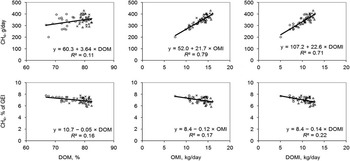
Total CH4 production (g/day) was well related to feed intake despite a restricted feeding regimen imposed on the experimental animals. In contrast, only a minor part of the variation in CH4 production could be explained by feed OM digestibility (Figure 1) despite the range in grass digestibility over three maturity stages. This was also confirmed by the fact that DOMI did not improve the relationship between CH4 production and OMI. These findings are in line with a study on timothy offered to Charolais cows at various stages of grass maturity (Pinares-Patiño et al., Reference Pinares-Patiño, Baumont and Martin2003) and agree with the concept that intake is the main explanatory variable of CH4 production (see e.g. meta-analysis of Ellis et al., Reference Ellis, Kebreab, Odongo, McBride, Okine and France2007). Digestibility and (digestible) intake of OM was negatively related to CH4 energy losses as % of GEI (Figure 1) or CH4 emission per unit of DMI (data not shown), but relationships were weak. Similar relationships were reported in other studies (e.g. Pinares-Patiño et al., Reference Pinares-Patiño, Baumont and Martin2003; Hart et al., Reference Hart, Martin, Foley, Kenny and Boland2009).
Linear relationships (P⩽0.05) between enteric methane (CH4) emission (in g/day and in % of gross energy intake (GEI)) and apparent total-tract organic matter digestibility (DOM; %), organic matter intake (OMI; kg/day) or digestible organic matter intake (DOMI; kg/day) from lactating dairy cows fed rations containing grass silages fertilised at 65 and 150 kg N/ha, and harvested at an early (28 days of regrowth; triangular symbols ∆), mid (41 days of regrowth; crossed symbols x) and late (62 days of regrowth; bullet symbols О) stage of grass maturity at cutting.

Implications
The present study indicates that CH4 emission intensity by lactating cows can be reduced by feeding less mature grass silage. Relationships between diet digestibility (mainly conditioned by grass maturity) and CH4 emissions were at the most moderate. However, effects were likely partly concealed by differences in feed intake and chemical composition, resulting from a different N fertilisation, stage of maturity at harvest and growing and harvesting conditions. On a whole-farm scale, these CH4 mitigating effects are most likely increased because OM fermentation and related CH4 emission during manure storage will be smaller with a higher digestible grass silage (Montes et al., Reference Montes, Meinen, Dell, Rotz, Hristov, Oh, Waghorn, Gerber, Henderson, Makkar and Dijkstra2013). Because an earlier grass harvest improves grass digestibility without the need of applying additional N fertilisers, potential sources of N2O or CO2 from application of artificial N fertilisers will not accrue and greenhouse gas emissions can be efficiently reduced with no additional N inputs. With an earlier grass harvest, care should be taken that rumen fermentation is not impaired by deficient fibre intake, and that a larger N excretion into the environment through increased grass CP intake may potentially offset any benefits from reduced CH4 emissions. The smaller herbage yields with an earlier grass harvest or shorter regrowth interval should be further taken into account. Over an entire growing season, Binnie et al. (Reference Binnie, Kilpatrick and Chestnutt1997) observed a 6% smaller ryegrass DM yield per hectare for a 4-week than 6-week regrowth regimen (comparable to EM and MM cuts in our study). Thus, CH4 production scaled to annual herbage DM yield per hectare may be slightly larger with EM cuts in our study. A holistic approach in form of a life-cycle assessment will provide a better assessment of the environmental impact and mitigation options for reducing greenhouse gas emissions from improved forage quality (Gerber et al., Reference Gerber, Vellinga, Opio, Henderson and Steinfeld2010). Van Middelaar et al. (Reference Van Middelaar, Dijkstra, Berentsen and De Boer2014) evaluated greenhouse gas emissions (emission of CO2, N2O and CH4) from dairy farming at the chain level (i.e., from production of farm inputs to the farm gate) of several feeding strategies based on a life-cycle assessment. In this integrated approach, they calculated reduced greenhouse gas emissions per kg of FPCM upon reducing the maturity stage of fresh and ensiled grass, and this strategy also was the most cost-effective.
Our results further suggest that increasing the N fertilisation rate was ineffective in reducing enteric CH4 emissions from dairy cows fed grass silage in the present range of fertilisation rates and growing conditions of grass. Although it was not measured in this study, our results imply that reducing the amount of N fertiliser within the range tested for the purpose of reducing N excretion into the environment does not necessarily increase CH4 emissions. Given the limited effect of N fertilisation on grass digestibility, despite application of the relatively low and high N fertilisation rate used in the present study, further work is needed to confirm the present results and to the effects of grass digestibility affected by variation in N fertilisation.
Conclusions
This study demonstrated that grass silage quality can affect CH4 emission depending on the unit it is expressed. Daily CH4 production per cow decreased with a higher N fertilisation rate and grass maturity. However, this drop in CH4 production was offset by a lower FPCM production and total-tract digestibility, which resulted in a considerably greater CH4 emission per unit of FPCM, DOMI and GEI with advancing grass maturity. Overall, these results suggest that a significant reduction of CH4 emission intensity can be achieved by harvesting grass at an earlier stage of maturity, whereas N fertilisation rate does not affect CH4 emission intensity.
Acknowledgements
This study was funded by the Ministry of Economic Affairs (The Hague, the Netherlands), the Product Board Animal Feed (Zoetermeer, the Netherlands) and the Dutch Dairy Board (Zoetermeer, the Netherlands). The authors thank the animal caretakers of the animal research facilities ‘Carus’ of Wageningen University, and the technical and laboratory staff of the Animal Nutrition Group of Wageningen University for assistance with sample collection and analyses.