Dancing around the Dikenga
We must reforest the imaginary.
—Nêgo Bispo (Bispo dos Santos 2023a) Footnote 1As long as we don’t combat the monoculture of thought, it won’t be possible to reforest our existence.
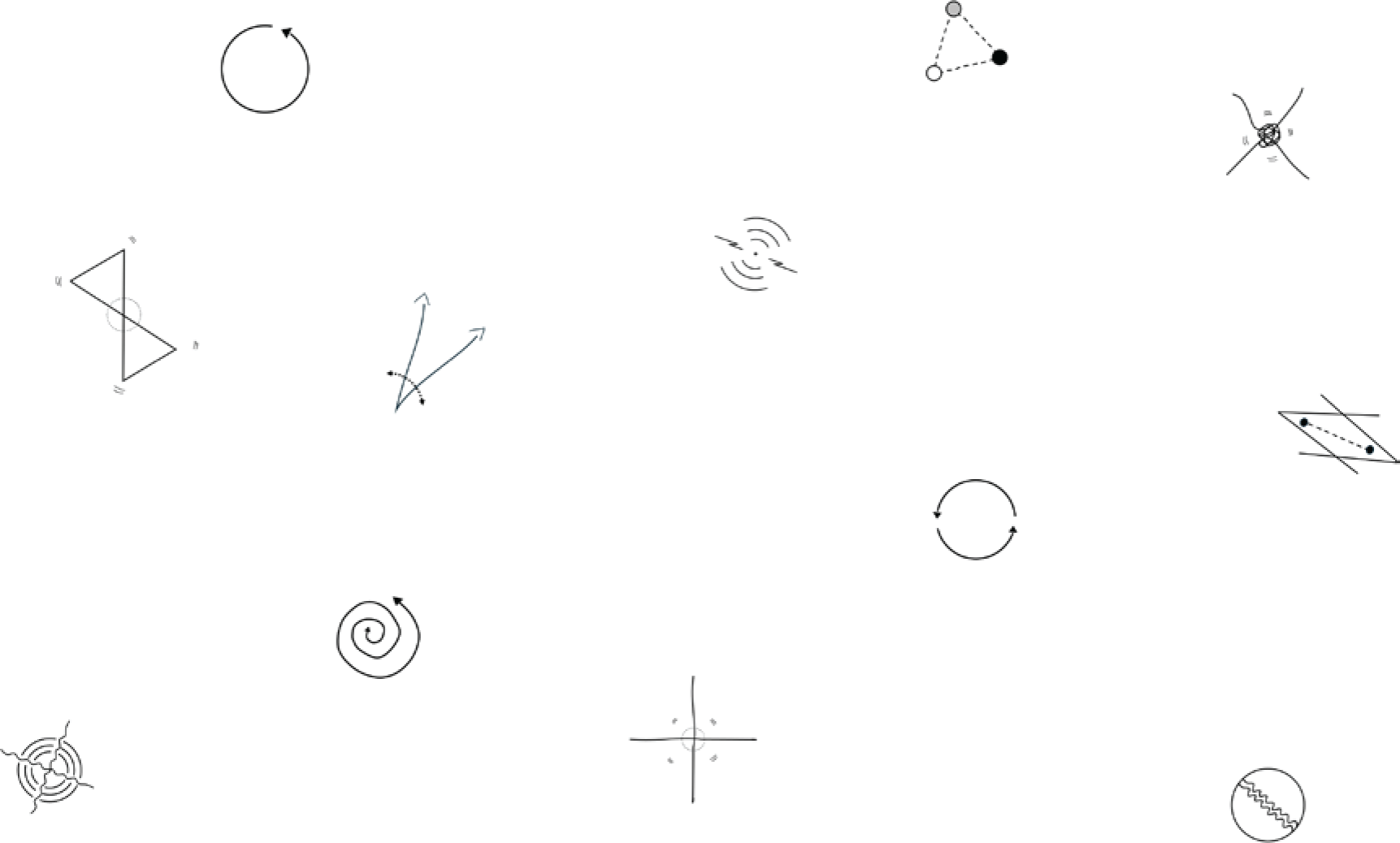
—Geni Núñez (2021)Imagine you are about to start a movement workshop on an unfamiliar approach. As you enter the working space, you notice a bunch of white chalk symbols sketched on the floor, randomly dispersed. After brief introductions, the facilitator invites everyone to wander, observe each drawing, and stand near one that captures their attention. See figure 2 to take your gaze on that cognitive journey.
Still from Musoni, a short film directed and performed by Cristina Fernandes Rosa, 2024. (Photo by Guilherme Fogaça; courtesy of CM archive)

Illustration of CM’s 12 line drawings. (Graphics by Cristina Fernandes Rosa; courtesy of CM archive)

Whether you choose a symbol because it reminds you of something you have seen before, or it seems uniquely strange, don’t worry about what it means just yet. Instead, take your time to carefully examine its formal elements, first with your eyes, then tracing it in the air with a finger. Play with these lines, curves, and shapes with your whole body, in different directions, or simply close your eyes and picture yourself doing so. As you move, focus on the sensations each gesture or step brings to mind. Experiment till you find a move that reverberates the feeling you get by looking at it. In the end, redraw that symbol on a piece of paper, and keep it next to you for the remainder of this article. Feel free to add other (verbal and nonverbal) marks around it to remind you how to move that way. We will circle back to these later.
Since 2021, I have been collaborating with other initiatives to better grasp the BantuFootnote 2 legacy across the Black Atlantic. Yet, these African indigenous worldviews are not our object of study, nor are weFootnote 3 primarily concerned with the preservation, dissemination, and/or visibility of their ecology of knowledge and practices in the diaspora. This is not a group project in the conventional sense. The research infrastructure is grounded in relational ontology, which rejects the Western model of individual authorship and the notion of a solitary researcher extracting knowledge from peoples, contexts, and inert matter. Knowledge here emerges from structured and unstructured practice-based collective investigations with other humans, animals, plants, rivers, and territories as living entities. Our PaR labs honor the ecological We and include creative endeavors like drawing, dancing, and making music together, and we have also drawn on oraliture and nonrational modes of inquiry, such as dreams and visions during ritualized practices. As a facilitator, my original contributions include devising the kinetic images, along with tactics, dynamics, and strategies; documenting these processes; and publishing them. I claim authorship of this text, not sole ownership of these ecologies of knowledge. I’m committed to practicing these ideas, informing and being formed by them, and acting as their guardian and disseminator.
This project has adopted its relational ontology as the underlying framework from which we think and act. In doing so, our decolonial and countercolonialFootnote 4 explorations with and through radical interconnectedness has reoriented us toward the sustainability of life on Earth.Footnote 5 This innovative initiative began as a hands-on series of residencies (or encounters) in Brazil, spearheaded by Mestre Cobra Mansa (Dr. Cinézio Feliciano Peçanha), an anthropologist and capoeira angola master-teacher, alongside Nêgo Bispo (Antônio Bispo dos Santos, 1959–2023), a key militant activist and leader within Brazil’s maroon community social movement—movimento quilombola.Footnote 6 Since January 2022, a diverse group of collaborators, from Afro-Brazilian and Indigenous religious figures to agroforestry engineers, political movement activists (e.g., Movimento Sem Terra, Teia dos Povos), and research artists such as myself have gathered at Cobra Mansa’s cultural and ecological center in Bahia’s countryside, the Kilombo Tenondé, to exchange information on sustainable pathways to inhabiting our planet. Above all, CosmoAngola explores how the crossroads of Afroreferenced ecologies of knowledge and practices can reorient us towards “involvement” with the plurality of Earth’s life forms, moving away from the capitalist brand of so-called sustainable development (Bispo dos Santos 2023:3). Activities at CosmoAngola range from bioconstruction, reforestation, and permaculture demonstrations; to music and dance workshops, capoeira training, and a somatic ritual centered on the Bakongo (or Bantu-Kongo) cosmogram, the Dikenga dia Kongo.
Briefly, the Dikenga (fig. 3) is an example of ancient graphic writing, widespread across Central Africa’s rupestrian paintings, ceramic vases, wooden sculptures, and textile patterns. The Congolese philosopher Kimbwandènde Kia Bunseki Fu-Kiau (1934–2013), a guiding reference at CosmoAngola, explains that the Dikenga is the foundation of Kongo society, namely the Bantu-Kongo or Bakongo.Footnote 7 As he puts it, “nothing exists that does not follow the steps of the cyclical Kongo cosmogram” (1994:26). And further, “people, animals, inventions, social systems” alike move in cycles, “in order to undergo change” (26). Across the diaspora, this ancestral technology continued to inform colonial and postcolonial arts and cultures, from African American Ring ShoutFootnote 8 performances to postmodern creative work such as Jean-Michel Basquiat’s painting Tuxedo (1983) and Tabita Rezaire’s performance Lubricate Coil Engine—Decolonial Supplication, offering (2019).Footnote 9 As an “Afrikan cosmological, philosophical, conceptual, and theoretical framework,” Obádélé Kambon concludes, the Dikenga maps the “patterned and cyclical nature of material, spatial, and temporal phenomena” (2017:1).
Varied illustrations of the Bakongo cosmogram or Dikenga dia Kongo, based on the available scholarship. (Graphics by Cristina Fernandes Rosa; courtesy of CM archive)

It is within the countercolonial context of CosmoAngola that I began exploring kinesthetic ways of engaging with Bakongo cosmology and its cosmogram, interweaving archival research with experiential enquiries anchored in somatic practices and theories in embodied cognition. Instead of lecturing on Bantu philosophy, my workshops invited participants to play with its key principles, correlating them to images and bodily actions. The exercise we did above is one of the first steps towards those playful explorations. Three years later, these practice-based experiments rooted in embodied intelligence and collective memory sprouted the Afroreferenced Practice as Research (PaR) methodology, which I termed Cognitive Motions in 2024, adopting the expression from Fu-Kiau ([1980] 2001). In a nutshell, this approach privileges somatic lived experiences (vivências somáticas) rooted in Bakongo cosmology and its cosmogram, largely explored through participatory improvisations of call-and-response and what I term “serious play” (Fernandes Rosa 2015).Footnote 10
In a recent CosmoAngola, for instance, my vivência followed a demonstrative session on local medicinal plants. So, we began with a guided somatic attunement to plant life cycles, first moving downward towards the ground, releasing muscular tension and preoccupying thoughts. I then invited everyone to roll to one side and pull their body into a fetal position, imagining they turned into the seed of a healing plant, sinking deeper into a humid and fertile soil. From that latent potentiality, I guided them through their life stages as a vegetable entity. This journey cross-pollinated their imaginary with the “four greatest ‘suns’ of change” (Fu-Kiau 2001:136) demarcated in the Dikenga (fig. 4): germination/conception (musoni), sprouting/birth (kala), flowering/maturity (tukula), and decay/death (luvemba)—after which new seeds drop and spread on the ground to restart the cycle. This improvisational exercise offers a visceral glimpse of the Bakongo’s spiraling process of continuous change (dingo-dingo kia luzingo). That is, life and living as a continuous “seedling process” in community (104), not an individualized linear progression.
Detailed illustration of the Dikenga dia Kongo, based on Fu-Kiau’s scholarship. (Graphics by Cristina Fernandes Rosa; courtesy of CM archive)

Cognitive Motions adopts the Dikenga dia Kongo as a guiding framework to unplug our corporeal episteme from the “Cognitive Empire” (Santos 2018). Embracing the Kilombo Tenondé ethos of deep ecology and Arturo Escobar’s strategies for thinking-feeling with the Earth (2016b), CM enables collaborative ways of cultivating Afroreferenced pluriverse futurities. As unpacked below, our collective body-centered explorations are grounded in a collection of tools with which to somatize—mentally visualize and corporeally experience—key principles of that cosmology. These tools assist in reforesting our imaginary and our existence (Núñez 2021; Krenak 2022; Bispo dos Santos 2026).
Moving nonlinearly but through Dikenga’s cyclical framework, I here mirror its core stages. Yet, following this ancestral technology, as we rotate clockwise, from left to right, our journey moves backwards. If disoriented, return to figure 4 to visually ground your thinking in the Bakongo worldview. We begin in luvemba, where I outline how CM choreographs a way out of the Western Cognitive Empire. We then return to the project’s apex in tukula, offering an overview of the infrastructure of these practice-based explorations with Bantu philosophical principles. In kala, we take another step back towards the birth of this approach, whose innovation lies in playfully intertwining ideas, images, and actions related to that African archive. We detail the function of our tool collection and its role in reforesting our imagination and existence. In musoni, we revisit CM’s conception within CosmoAngola, the foundational site of our involvement with sustainable ways of being-living. We conclude by returning, once again, to luvemba, completing one full cycle to begin another. Finally, we review the project’s scope and consider how its reforesting tactics reorient us toward the biopolitics of relationality and planetary survival. CM repurposes the Dikenga dia Kongo as an open container for various kinds of critical reflections, introspections, and creations.
Anchored in an African Indigenous knowledge system, CM disentangles training and creative processes from the colonial monoculture of thought, giving it broad relevance in contemporaneity. By sharing this countercolonial approach to reforesting the imaginary and existence cultivated in Brazil with an Anglophone readership, CM initiates a new cycle—echoing Nêgo Bispo’s motto: it is all beginning, middle, and beginning.Footnote 11
Luvemba
Choreographing a Way Out of Bifurcated Cosmology
The project sprouted during my residency as a visiting professor in the graduate dance program at the Universidade Federal da Bahia (UFBA; 2021–2023), both within and beyond CosmoAngola, alongside collaborations with Dr. Ciane Fernandes’s Performing Arts Research Laboratory and the performance collective A-Feto, also at UFBA. Since 2022, CM has facilitated somatic workshops and research-creation labs with artists’ collectives, dance and capoeira groups, and Bantu religious organizations in Brazil, fostering a dynamic interplay between thinking and making. We have also facilitated site-specific performances and video works, sharing the methodology within higher education—through graduate studio courses and seminars—and at national and international residencies, symposiums, and conferences in performing arts and physical education.Footnote 12 Early findings on how to embody ontological relationality and unplug from bifurcated cosmology through creative practice appear in the proceedings of Brazil’s National Association in Dance Studies (ANDA), within its Practice as Research and Somatics Working Group (Fernandes Rosa 2022, 2024, 2025).
First, our project sheds new light on the significance of Bantu cultural heritage in Brazil. Scholars estimate that around 70% of the enslaved Africans trafficked into Brazil between 1580 and 1850 had Bantu heritage (Silva et al. 2023). However, Brazilian researchers such as Nina Rodrigues have historically neglected and ostracized this group, labeling its culture “rudimentary” (see Rodrigues [1896–1897] 2006:10).Footnote 13 Consequently, Bantu contributions to Brazilian culture, especially the Bantu-Kongo legacy, have been overshadowed by Sudanese/Yoruba-focused studies.
CM’s archival research anchors on Bunseki Fu-Kiau, a Congolese philosopher inducted into three “initiation power societies” (ngoma, in Kikongo),Footnote 14 including Lemba, which has informed Afrodiasporic cultural manifestations in Cuba, Haiti, and Brazil. After migrating to the US in the 1970s, Fu-Kiau gained recognition as the founding scholar of the field of modern Bakongo philosophy.
In Brazil, however, Fu-Kiau’s scholarship remained unacknowledged until the turn of the 21st century, when a new wave of translators and interlocutors pulled his writings from obscurity in Brazil. Building on these publications, Tiganá Santana’s artistic works and his scholarship—which he published as Tiganá Santana Neves Santos—have cemented Fu-Kiau’s importance to Bantu-Brazilian studies. Most notable is Santos’s doctoral translation of Fu-Kiau’s African Cosmology of the Bantu-Kongo (Santos 2019) to Portuguese, later published as a book (Fu-Kiau 2024). Its Portuguese title, O livro africano sem título: Cosmologia dos Bantu-Kongo, rescues the earlier version of Fu-Kiau´s text, The African Book Without a Title (1980).
CM turns to African archives to address Earth’s ecosystem fragility. This search fuels the battle to dismantle the modern/colonial world-system and its ontological dualisms (e.g., body/mind, culture/nature). Moving away from that “bifurcated cosmology” (Mbembe 2024), CM follows contracolonial investments in Indigenous knowledge systems anchored on radical interdependence. Bantu-Kongo cosmology, for instance, recognizes that all life forms (animal, vegetable, and mineral) are created as part of symbiotic relationships. That is, we are a single life form, including many others. Fu-Kiau tells us that Earth is a living “bundle of healing essences” tied by an immanent-transcendent creation God-like entity or Vital Force (Kalunga, in Kikongo), with the intention of life (1991:111–17).
As “the principle-god-of-change,” he notes, Kalunga is a “force in motion, and because of that our earth and everything in it is in perpetual motion” (21–22).Footnote 15
Similar to Mbembe (2022), Bas’Ilele Malomalo has argued that our current climate crisis is in fact an ontological crisis stemming from the West’s “racist logic of indolent reason” (2022:23). In advocating for biocosmic, or nature’s rights, this Congolese scholar has also turned our attention to philosophical principles structuring Bantu languages and cultures (see also Mbembe 2022). Building on Kagame (1956) and Ramose (2011), Malomalo argues the root ntu denotes a Vital Force or Be-ing that created the cosmos, analogous to Kalunga (21–23). Ntu informs four categories of existence in various Bantu languages (see Kavusa 2022 for prefix variants). They are: 1) mu-ntu for self-aware beings, from living humans to ancestors; 2) ki-ntu for all other living entities, from mammals to mountains; 3) ha-ntu for space-time or environmental/contextual dimensions; and 4) ku-ntu for aesthetic/ethic means of expression, the frameworks for the relationships between the first three.Footnote 16
Kavusa adds that, African, especially the Bantu, indigenous knowledge, views every existence as a living being and as having a living soul […] The root ntu in the word kuntu implies that even the way humans (plural: Bantu) interact with other beings (kintu, hantu) must be informed by a vision of nature not as an “object” but as fellows. (2022:152)
We measured against these four categories comprising Bantu hermeneutics of sustainability with discourses on deep ecology, ecosophy (Guattari 2008; Manning et al. 2022), and ecologies of knowledge (Santos 2018). From this, CM cultivates a notion of sustainability as a dynamic balance across four intertwined ecological spheres of care: the personal (muntu), the social (kintu), the environmental (hantu), and the epistemic (kuntu) ecologies. Above all, we maintain that without epistemic justice, there can be neither environmental nor social justice.
In addition to these, the principle ubuntu (and variants) has been recognized as a fifth category. While -ntu implies an all-encompassing energy field, ubuntu denotes the mobilization of that Vital Force towards radical interdependence. Often translated as shared humanity or ecological-We (Ntumba 2014), ubuntu vibrates and mobilizes the manifestation of a relational ontology in the living world. Echoing Fu-Kiau’s “set of concrete social relations” (2001:60), Desmond Tutu explains:
A person with Ubuntu is open and available to others, affirming of others, does not feel threatened that others are able and good, based on a proper self-assurance that comes from knowing that he or she belongs in a greater whole and is diminished when others are humiliated or diminished, when others are tortured or oppressed. (1999:28)
Cross-referencing these assertions with Édouard Glissant’s treatise on the poetics of relation ([1990] 1997), we define ubuntu within the CM framework as “be-ing, in motion, open to others” (in Portuguese, ser-sendo, em movimento, aberto para o outro).
Meanwhile, our collaborative experiences have sought to choreograph a denaturalization of colonial ways of thinking about corporeality and mobility. Our attempts to make sense of the Bantu-diasporic cosmology at the bodily level, for instance, are supported by broad theoretical discussions on decolonizing embodiment and practice-based research. CM labs and workshops depart from Erin Manning’s “laboratory for thought in motion” (2008) to promote strategies of participatory improvisation (improvised actions guided by call-and-response) and serious play (performative practices combining ritual/commitment and signifyin(g)/playfulness) (see Drewal 2003; Fernandes Rosa 2015, 2025). It also benefits from Somatics as Research (SaR), which Fernandes, Pizarro, and Scialom define as somatic methods, techniques, and approaches that “honor different pathways towards much broader forms of knowledge, including more-than-human […] integrated modes of interacting, learning and growing with/in an ever-changing environment” (Fernandes et al. 2024:65). Our improvisational tasks dialog further with various body-centered approaches, including Soma therapy, Biodanza, Body-Mind Centering®, and La Pocha Nostra’s radical pedagogy. These crossroads are structured by a guiding question: How can we make somatics and other body-centered approaches not only useful for all people—across gender, race, class, ability, nationality, religion, etc.—but also with all their epistemic, ontological, and cognitive legacies, including the plurality of the Global South’s understandings of subjects, communities, and their ways of being-living?
In answering this framing question, CM adopts the countercolonial call for reforesting our imaginary and existence. Contrary to rewilding, reforesting requires one to first understand that ecosystems such as the Amazon forest didn’t arise passively in the wild, but result from a careful tending to the diversity of life forms, as Indigenous peoples of Brazil have done over the centuries through respectful attunement to coexisting ecological forces. Their acts of reforestation produce a fertile, symbolic territory of colonial resistance, within which “lies a map to navigate our contemporary challenges—a compass pointing toward another possible futurity” (Lehnen 2024:64).
Furthermore, we second Firmino-Castillo’s call for “enacting or dancing the pluriverse” (2016:70). Her framing of Indigenous dances as forms of political ontology and as means to embody alternative ways of being and relating to the world points to solutions to resist universalism’s impoverishment. Firmino-Castillo’s argument supports our understanding of Afroreferenced practices such as capoeira angola and CM research-creation labs as interdisciplinary reality-making, a fusion of theory and practice that makes room for diverse, coexisting worlds through embodiment and storytelling. Together, these calls to reforest the imaginary and existence, and to dance the pluriverse, enable the perception and experience of interdependence as essential for (re)creating “a world where many worlds fit,” as the Zapatistas (1996) propose.Footnote 17
Tukula
The Realization of the Cognitive Motions Methodology
In a nutshell, CM combines countercolonial approaches to practice-based research with somatic explorations of African archives, aiming for the “political activation of relationality” (Escobar 2016a:13) at the bodily level. At the heart of CM methodology is a collection of Bantu philosophical principles (n’kîngu), extracted from sentences in proverbial language (kingana), which themselves serve as “portals to access the ancient Bantu-Kongo worldview” (Santos 2019:207). So far, we have been playing with 12 key principles, among which ubuntu and kalunga are possibly the most widely known. Together, they assist us in better grasping the specificity of this cosmology’s relational ontology. Fu-Kiau cautions, however, that these principles’ complexity can only be fully accessed through their original spelling and pronunciation or reverberation in time and space. That is, through hantu and kuntu. The understanding of Bantu cosmologies, he adds, “is only possible if one can experience and feel the beauty of the radiation [n’niènzi a minienie] of the language that generates the culture in question” ([1980] 2001:11). Therefore, whenever possible, we voice and write these principles in their Bantu languages (Kikongo and Kimbundu). We seek metaphors and functional approximations in colonial languages (e.g., Portuguese, English, French) only when necessary to qualify their significations or guide others in understanding the principles, as I do later in this article.
Fu-Kiau also affirms that graphic illustrations and mental visualizations of the Bakongo cosmogram enhance our understanding of that worldview. Following his visual mapping of the cosmos’s parts and functions ([1980] 2001:17–21, 113–22) and the extensive scholarship on Bantu graphic writing and correlated bodily language (Thompson and Cornet 1981; Thompson 1983, 1991; Martínez-Ruiz 2007, 2009, 2013; Gaskins 2016, 2020), we have “translated” these Bantu principles into a collection of imagetic-philosophical symbols, or ideograms. Distilled from the Dikenga, CM’s ideograms function as visual cues with which to guide our perception and embodiment of these principles, thereby somatically unlocking the portals of access to the Bakongo cosmology. Here, I suggest you return to your drawing from figure 2 for a second look, perhaps noting how it relates to the Dikenga (figs. 3 and 4).
As you hopefully explored earlier, these ideograms are easily “translatable” into bodily actions in time-space. Their kinetic elements (e.g., arrows, dotted lines, and motion marks) invariably pull us into that universe-in-motion. For some of you, they might evoke particular gestures, steps, or figures. They may even suggest blueprint patterns for musical rhythms, special configurations, partner work, or group improvisation. As visual tools, they bridge body-mind interactions andguide the somatic re-cognition of those philosophical patterns across creative processes and artforms, from visual culture to dance, music, and performance art. Above all, we recognize them as a heterogeneous collection of imagetic seeds for performing fertile acts of reforestation within our own system of bodily organization and knowledge production; with which to reforest how we organize our thinking and moving in the world.
Together, the energetically charged sound and spelling of these philosophical terms, their figuration as ideograms, and the movement patterns these audiovisual tools might evoke allow us to piece together (or fabulate) the look and feel of that relational cosmology, so to speak. Over time, our somatic experiences with this collection of principles/ideograms have led to the resurfacing of deep-seated cultural knowledges ingrained in muscle memory or cellular code, or carried over from varied Afrodiasporic practices, customs, and belief systems. These principles can resurface ancestral wisdom that reorients us toward sustainable ways of living-being.
Foundational considerations of the Bakongo worldview are necessary to understanding each CM principle. First, Fu-Kiau’s writing emphasizes that the Bantu-Kongo cosmology is a system of thought and organization, whereby system (kimpa/fu) is closely connected to the form and the experience of living in the physical world (ku nseke). The translator Tiganá Santana Neves Santos clarifies:
The concept of kimpa is linked […] to a possible “image” of the system, while fu is more concerned with its internal functioning, that is, with the “living tissue” of the system. We have, then, something that is its image and its functioning, it seems, in interdependence. […] A system, within that plurality of meanings, depends on the necessary combination between experiencing and seeing it. In this way, kimpa reconfigures itself from fu. This, in turn, is evoked by kimpa. (2019:121)
The Bakongo cosmogram helps us visualize the dynamics of relationality structuring this system (kimpa) and, subsequently, how this cosmos works in practice (fu), informing and being formed by those living within that system. Santos explains further that the Dikenga, “a notable grammar of the Bakongo world” (2019:124), is tied to the position occupied by the Bakongo person (muntu) as the image and functioning of a system (kimpa ye fu). Fu-Kiau qualifies that:
the human being is a system of systems [Mûntu i kimpa kia bimpa]. He is also variably called “n’kîngu a n’kîngu”—a principle of principles, i.e., the pattern of patterns. Because “mûntu,” the human being, is the key system of systems, he is able as such to produce materially and technologically other mechanical systems. ([1980] 2001:70)
While the Dikenga “is of an inexhaustible textual complexity, including its plurilocular-interpretative, its hermeneutic and its endless possibilities” (Santos 2020), a general grasp of it will further support picturing this system in one’s mind as well as its functional embodiment.
The Dikenga’s outer circle represents the cyclical process of change (dingo-dingo), set in motion by their creation entity referred to as the Vital Force or Be-ing (Ntu/Kalunga). The circle is the first geometric image given to a human being as a second sun that vibrates and radiates energy in endless motion. As illustrated in figure 4, the disks where the circle intersects the crossed lines are color-coded and mark four key moments of a journey, or “dams of time” (Fu-Kiau 1994:33), in a counterclockwise direction. Santos describes them as “ontological stages” (2022:156): the unseen (musoni, in yellow), bottom; that which emerges (kala, in black), on the right; that which reaches the summit of a realization (tukula, in red), above; and that which disintegrates from a visible physicality (luvemba, in white), on the left (156). Expressing the endless continuity of past, present, and future, Fu-Kiau writes in the opening of his African Cosmology of the Bântu-Kôngo: “Here is what the Kongolese Cosmology taught me: I am going-and-coming-back-being around the center of vital forces. I am because I was and re-was before, and that I will be and re-be” ([1980] 2001:5).
Meanwhile, the Dikenga’s cross or intersecting pathways (mpambu a nzila) delineate a reciprocal universe with two mirroring and interconnected realms, “like two mountains of opposing bases separated by the ocean” (MacGaffey 1986:43). The horizontal line, or kalunga line, represents the liquid threshold between the world of the living (ku nseke) in the upper half and the spiritual world of ancestors (ku mpemba) below. It distinguishes the journey of a Bakongo person, from birth (kala) to death (luvemba), and the mirroring journey through the depth of the spiritual world, from death to rebirth. As a pliable membrane, however, it transforms every manifested experience into a balancing act—like standing on a small boat in high seas—between these two “planes of consciousness” (Rufino, Peçanha, and Oliveira 2018:76). By contrast, as fruit is to its seeds, the telama line traces a vertical link between one’s ancestry, in the unfathomable musoni, and the apex of a lifetime attainment in tukula, when one becomes a master of oneself or an expert (nganga), ready to serve his or her community.
Secondly, Fu-Kiau emphasizes the radical interdependence within this universe-in-motion, whereby reciprocity mobilizes the exchange of information across material (animal, vegetal, and mineral) and immaterial entities:
Life is fundamentally a process of perpetual and mutual communication; and to communicate is to emit and to receive waves and radiations [minika ye minienie]. This process of receiving and releasing or passing on [tambula ye tambikisa] is the key of human being’s game of survival. ([1980] 2001:113–14)
The relational ontology of the Bantu-Kongo implies, thus, a tendency toward otherification (Santos 2022:159), i.e., becoming or moving towards difference or an Other. Contrary to Western culture’s value of individuality and distinction—a drive to segregate everything into neat boxes—Makota Valdina (Valdina de Oliveira Pinto) summarizes in an interview with Tiganá Santana (Neves Santos) that for the Bantu “everything is connected” (in Fu-Kiau 2024:193–94).Footnote 18 Santos quotes the Congolese poet Zamenga Batukezanga to convey how the vibrational interactivity among relational singularities replaces subject-object distinctions:
The whole body is both emitter and receiver. What we are, our gestures, our vibration, affects our environment and acts like waves in the water, in the ocean. The shocks of our vibrations, that is, our gestures, speeches, are transmitted over long distances, even more so because they are equipped with an energetic power. Modern techniques and energies only serve to increase the natural ones arranged in our body. (Batukezanga 1996:19; in Santos 2019:75)
Elsewhere, Santos concludes that, within our complex and ongoing game of survival, what seems to matter the most is “the relationship between a collectivity and a singularity” (2020).
Moreover, in this interconnected system no entity (neither human nor nonhuman) pre-exists the relations that constitute them; there are no individualized distinctions a priori that might engage in relations. As the ubuntu principle indicates, each manifestation of the Be-ing is always already in motion, leaning toward otherness (or difference). All that exists are oscillating singularities and embodied vibrations that the Relation (Glissant [1990] 1997) and its biointeractions (Bispo dos Santos 2023:14) may manifest across spheres of care. As such, whoever is willing to incorporate this call-and-response game of survival must bypass or overcome the Western autopilot habitus of making abyssal distinctions (e.g., natural and cultural, physical and metaphysical, theory and practice). Yet, this relational system both distances from dualisms and also dialogs with them, for its pluriverse design comports both sameness and difference. In other words, “nothing is lost” (Santos 2020). This ethos of coexistence—both this and that—is pervasive throughout the infrastructure of this system (kimpa/fu) and CM’s core principles, their hyphenated descriptions, and, subsequently, the participatory research activities in this project.
Thirdly, Fu-Kiau clarifies that a person is a “soul-mind-object [ma kia mwela ye nitu]” ([1980] 2001:90), or rather “a living-energy-being (spiritual being) and a physical being (matter)” (133). Santos qualifies further that, “to have a body is to make present the action of living in a certain way. Morphology, in this sense, is a way of presenting what lives and, therefore, exists” (Santos 2022:159). And further, each body (nitu) is a tangible manifestation of relational being-living, occurring in continuous transformation (dingo-dingo), or a “pluriontological sameness” (159).
Similarly, in our research, body and corporeal indicate a knot of lived information/codes in-the-making, rather than ready-made matter that is distinct from that which thinks and the spirit or energy that animates it. In that sense, our emphasis on somatics has enabled our research labs to position physicality not only as a privileged place where knowledge is archived, transmitted, and resignified, but also as the catalyzing agent of those changes and exchanges—the system of systems. For the sake of simplification, however, at CM we often refer to human beings’ matter-mind-energy continuum as their corporeality.
This understanding of subjectivity as a vibrating knot or entanglement leads to an expanded notion of cognition, our fourth point. Within CM, cognition means the ability both to formulate information in sounds or vibration patterns, images, and gestures, as well as to decipher them—to unpack their coded knots into something that makes sense in practice. It thus exceeds intellectual or abstract work. We argue that knowing depends on the pliable embodiment of the be-ing; in motion, manifested in diverse-yet-interconnected forms; and their aforementioned “process of receiving and releasing, or transmitting [tâmbula ye tambikisa],” information. For the Bantu, “The metaphysical, imaginary, intuitive and rational phenomena are not segregated by mechanistic reason; reason is intrinsically holistic or integral. Bantu rationality is equivalent to a cosmoconsciousness” (Conceição 2009:123). That is, cognition is always already a process that happens in, with, and through these living-and-vibrating knots, in formation and transformation. Meanwhile, cognition informs, and is formed by, the moving resonances abstracted from these images/experiences, all of which are coded in scrolls of life and living (luzingu). As such, this methodology is not set, but is always in a continuous process of coding, decoding, and recoding. The exchange of verbal and nonverbal information in our SaR experiences privileges the Bakongo notion of knowledge and science (kindoki), which, according to Batukezanga, “is nothing other than the set of INTERACTIONS” (1996:11).
Most importantly, we borrow the expression “cognitive motion” from Fu-Kiau’s discussion of human beings’ exploratory processes within a system (Fu-Kiau [1980] 2001:133–35). For the Bantu-Kongo, he notes, thinking/reasoning/pondering is connected to our ability to stand vertically. Unlike four-legged animals who act (mostly) instinctively, humans can stand and reflect on their actions. Meanwhile, knowledge is “outside of us” and its acquisition “is especially a cognitive process/motion (dingo-dingo dianzâyila)” in six outer directions (133). We learn about the world of the living by walking on the horizontal axis (from kala to luvemba), to the right, left, front, and back. On the vertical axis, we acquire knowledge of our ancestry (below, towards musoni) and our potential to be achieved (above, towards tukula). In other words, it is necessary to “go and learn from the environment, the circle” (Santos 2019:99).
Meanwhile, journeys towards the center or inward, the seventh direction, seek to maintain or reestablish the power of (self) knowledge and (self) healing, or homeostasis. Fu-Kiau concludes that, without this cognitive process/movement, dingo-dingo dianzâyila, in these seven directions, “the human being [mû-ntu] becomes powerless in his own environments, the internal and the external” ([1980] 2001:133). Elsewhere, Fu-Kiau qualifies that health (kinenga) should be understood as a dynamic balance of the vital energy of the human being (ngolo) in their community (kanda) (1991:45–50). Thus, collective activities such as singing, dancing, and drumming, and even giving and receiving a simple “good morning,” can restore our self-healing power.
CM initially was aimed at examining the presence of the Bakongo worldview across traditional Afro-diasporic practices (e.g., capoeira angola) and contemporary contracolonial mobilizations (e.g., CosmoAngola). CM has now expanded into broader artistic and academic initiatives with which to reforest our imaginary/existence, towards relationality.
In sum, CM has articulated a balancing act across sound bites of the Bakongo system in the diaspora as well as their approximate transliterations into visual and kinetic patterns. Moreover, it offers opportunities to emit-and-receive waves of information about that relational system by playing with its forms/images (kimpa) and functions/know-how (fu) kinesthetically, through embodied cognition. In this somatic-informed approach, each cognitive motion aims to intertwine sensorial input from proprioception and kinesthesia (along with sight, hearing, smell, sense of balance, sense of orientation, and various interoceptive signals) with mental imagery and abstract thinking, ensuring the reforesting takes place at the physical as well as mental/energetic levels. Somatics as Research enhances the awareness of embodied choices and the fluid variations that each manifestation of be-ing (in motion, open to others) makes when sensing and picturing these Afroreferenced principles as well as grasping and experiencing them in relation to other multiple and mixed corporealities.
Through serious play—drawing, moving, and voicing ideas—participant-collaborators are also encouraged to access information about these principles that might be buried beneath internalized habits and social expectation in modern society, oriented by individualism, distinction, and linear progress. Meanwhile, we have developed a range of verbal and nonverbal strategies through which participants may contribute to expanding and qualifying, but also questioning and reconfiguring our ongoing attempts to untie the knots of the principles with functional approximations.
Still, all possible explorations with these audio, visual, and kinetic codes/knots give us only a shorthand glimpse of their complex meaning and function, without ever losing their “right to opacity” (Glissant [1990] 1997:189). We humbly recognize that these principles resist full understanding within Western modernity and do not conform to their demands for transparency and legibility at all costs. In that sense, CM’s ideograms work as (opaque) knots of information for navigating Bantu cosmology, which might be continuously untied through collaborative practices. Before moving to the next session, where I offer a short description of each principle/ideogram, I invite you to return to figure 2 and your drawings/marks once again. How would you employ the creative actions you distilled from your chosen ideogram to engage in participatory improvisations?
Kala
On the Birth and Growth of the CM Toolbox
CM’s toolbox evolved gradually through various gatherings of participatory research and knowledge exchange. We sought to emulate the Bakongo proverb Mu kanda, babo longa ye longa, which means “within the community everyone has the right to teach and to be taught. Education is a matter of reciprocity. True knowledge is acquired through sharing” (Fu-Kiau [1980] 2001:99–100). During the first two years, we remained especially open and attuned to all kinds of new, overlapping information. This included oral histories and movement repertoires that participants recalled, drawing from their historical positionalities and exposure to African archives and/or diasporic “afrographies” (Martins 1997).Footnote 19 We recognized early on that the significance of these Bakongo principles resides in the kinetic images and movement patterns they evoke, which solicit a full engagement of our corporealities.
Similar to ritualized drawings in traditional Bantu-diasporic religions—such as pontos riscados (Brazil), firmas (Cuba), and vèvès (Haiti)—CM ideograms channel and reverberate waves of information about these religions’ underlying cosmology. Graphic writing tactics have been especially useful in our research-creation labs, particularly when the Bantu terms could not be adequately spoken, recognized, or deeply understood. Meanwhile, they also resonate with glyphs found in modern rituals such as Underscore, Contact Improvisation’s jam sessions devised by Nancy Stark Smith (USA) in 1990. Likewise, CM’s ideograms act as visual guides for collective improvised explorations within contemporaneity. Thus, these tactics bridge abstract ideas, energetic frequencies, and embodied figurations within and beyond Afroreferenced contexts of exploration.
Meanwhile, the representation of these philosophical principles as synthetic drawings orients (re)cognitions beyond verbal language, overlapping seeing/perceiving and acting/doing with sensing/feeling and remembering/fabulating. Thus, our playful body-centered explorations offer open-ended opportunities to experiment with these tools of cognitive motion “beyond reason,” combining muscle memory and gut instincts with a wide range of oneiric visions and digressive pathways. They orient participants in picturing abstract concepts associated with that cosmology—with and through corporeal movements, dynamics, and relationships. In doing so, the ideograms bridge physical and metaphysical experiences, at different ecological spheres of care.
Cognitive Motions
A Collection of Tools to Reforest our Creative Imaginary and Existence
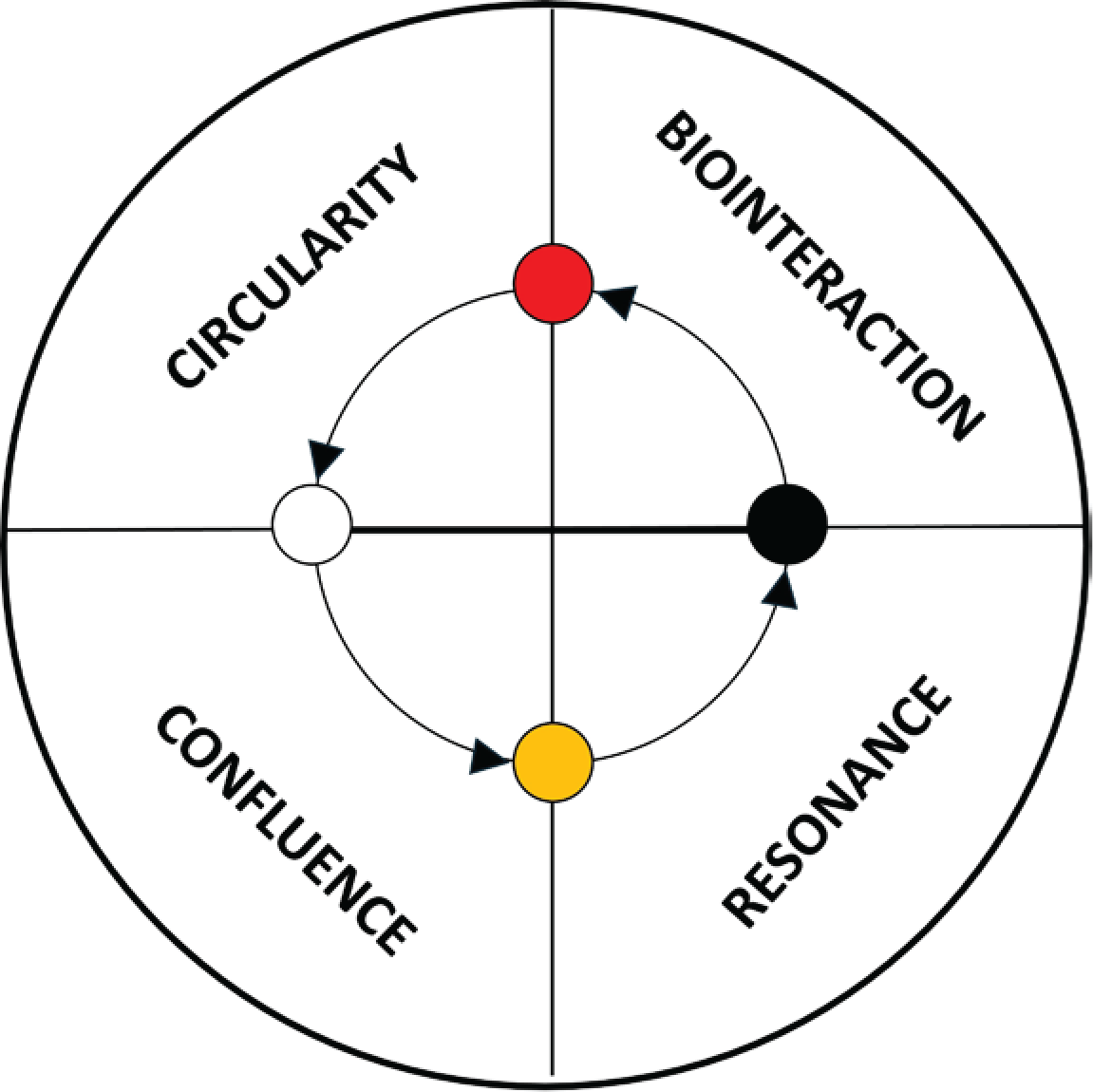
The relational ontology that structures the 12 Bantu principles and their ideograms shapes not only CM’s research practices and discourses but also the very notion of reality and presence we cultivate. To make this ontology accessible, we have organized these kinetic tools into four dynamics, each highlighting a different aspect of relationality (fig. 9). They are biointeraction and confluence, after Bispo dos Santos’s understanding of these terms (2015; 2023); circularity, a concept widespread across Bantu-diasporic literature (Martins 2021; Petit 2015; Ferreira 2021); and resonance, as deployed by Santos (2022), regarding the attunement to the forces and energies of that moving cosmos. Designed to assist those unfamiliar with Bakongo cosmology, these categories usher their engagement with a radically interdependent system of thought and organization, framing the incorporation of these seed-like principles into body-centered practices of contracolonial reforestation.
Closing circle after 6:00 a.m. capoeira Angola training during CosmoAngola, at Kilombo Tenondé, 2024. (Courtesy of CM archive)

Conversation with Mestre Cobra Mansa and Dr. Eduardo Oliveira after the ritualized somatic experience across the Dikenga at CosmoAngola, 2024. (Courtesy of CM archive)

Cognitive Motion´s workshop at Balaio Escola de Capoeira Angola (BECA), in Brasilia, 2024. (Courtesy of CM archive)

Mestre Cobra Mansa (Dr. Cinézio Feliciano Peçanha) standing at tukula, the dam of time representing the zenith of a cycle or a lifetime. January 2022, during a talk on the Dikenga dia Kongo at the first CosmoAngola. (Courtesy of CM archive)

Circular diagram of CM’s four dynamics of relationality around the Dikenga dia Kongo. (Graphics by Cristina Fernandes Rosa; courtesy of CM archive)

CM’s spherical diagram (fig. 9) represents these four categories around the Dikenga, and not inside it, for they are not part of Bakongo tradition. We also recognize that these four dynamics point to movement factors (e.g., flow, weight, time, and space) addressed in other methods first developed in the Global North, such as the Laban/Bartenieff Movement System. However, their understandings do not always coincide and are part of our ongoing discussions about their similarities or discrepancies. At last, since CM labs and workshops often reference capoeira angola, these correlations are included below.
The dynamic of resonance, or the poetics of energetic engagement, attune us to the interplay of cosmic forces and their reverberations. The Bakongo understands the cosmos as an energy field or vibrational reality that flows across the physical/material (ku nseke) and the spiritual/immaterial (ku mpemba) realms, connected by the fluid threshold of the kalunga line. Fu-Kiau explains that we live and move in an informational “ocean of waves/radiations”—not all of them perceptible—that affect us differently (positively or negatively) and at varying intensities, according to our degree of sensitivity ([1980] 2001:114). He further notes the communicative power of the frequencies people emit and receive, stating that “waves and radiations can be converted into forms and images that can speak” (2001:97). In addition, our ability to feel/absorb and radiate/propagate waves/vibrations, individually or collectively, allows us to attune to the Vital Force of the cosmos, without losing our singularity. As Santos summarizes, “to live is to be in variation, in a fabric of variations, to be in complexity” (2020) and for that which exists (existent) to fulfill one’s “vocation for transmutation (nsoba), it is necessary to vibrate (tatala)” (2019:155). Santos concludes, at the launch of his Portuguese translation of Fu-Kiau’s African Cosmology of the Bantu-Kongo:
To exist is not an experience of stillness, but of transmutation […] which happens through vibratory action. Things are like that, always dancing. You don’t dance because you exist; you exist because you dance. (2024)
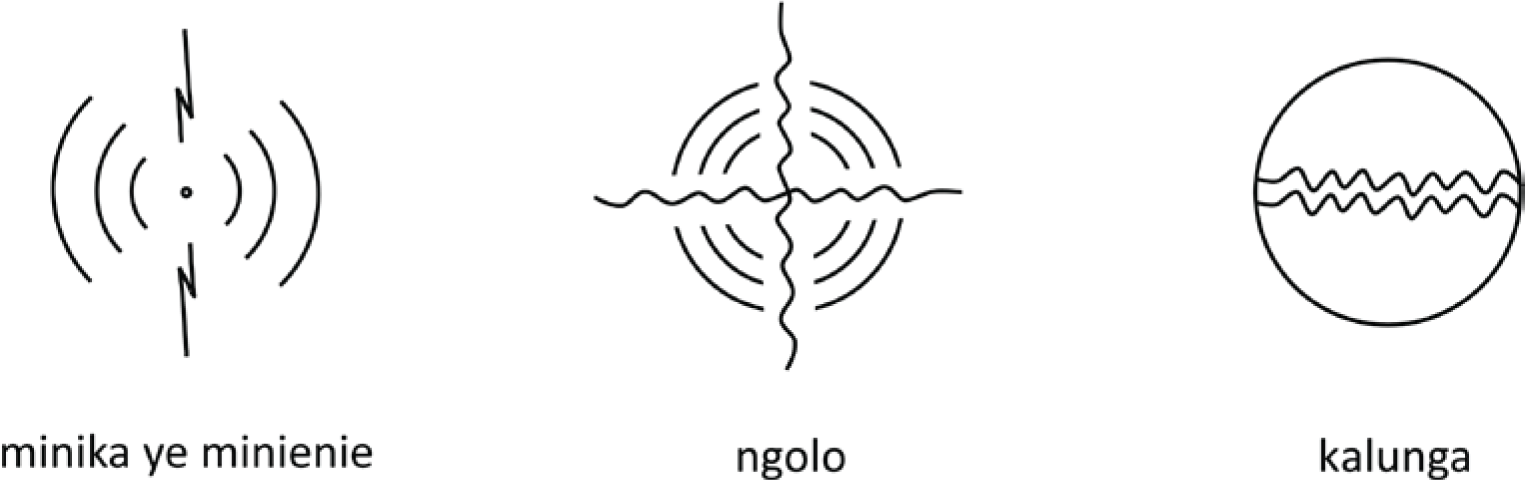
In contrast to the Western understanding of “harmonic unison,” Afrocentric resonances evoke a dynamic interplay of pluriverse patterns and multifaceted elements, often manifested in multimeter soundscapes. In practices like capoeira angola, for instance, syncopated rhythms from percussive instruments, singing, or clapping model the interaction of multiple vibratory energies. They provoke kinesthetic resonances in the players’ corporealities that overlap, without erasing, their singular ways of swaying or ginga. While resonance underpins all principles in this system, the following tools anchor this dynamic (fig. 10).
CM Ideograms for the principles grouped under the dynamic of resonance, from left: minika ye minienie; ngolo; and kalunga. (Graphics by Cristina Fernandes Rosa; courtesy of CM archive)

In Figure 10 at left is an ideogram referring to minika ye minienie, a generic expression for “waves/vibrations and radiations” permeating the material and immaterial infrastructure of the cosmos. Most discussions of this principle evoke analogies with other spheres of knowledge, from the “positive vibrations” of reggae culture to the subatomic universe of quantum physics. In capoeira angola, this principle illuminates the energy mobilizing the polycentric and polyrhythmic body and the circle’s axé, the energy to make-things-happen. Ngolo, meaning the energy and strength of living human beings (center), evokes vitality and power of realization in the ku nseke. Capoeira angola’s strategies of serious play mobilizes this vital energy in each player, strengthening the community. The ideogram for kalunga (right) seeks to capture a polysemic term referencing, amongst others: a) the “completely complete higher living energy [Nzambi]” (Fu-Kiau [1980] 2001:36) or omnipresent (hot-turned-cool) vital force of the universe that moves with an ocean-like sense of flow; b) the idea of immensity or “endless water within the cosmic space” (22); and c) the horizontal threshold between the two worlds or the Kalunga line (see also Fernandes Rosa forthcoming). The fluid mobility of capoeira angola’s swayed actions and syncopated rhythms, what I have termed the aesthetics of ginga (Fernandes Rosa 2012; 2015), seem to reverberate with (and draw us closer to) this pliable, hot-turned-cool, cosmic force. Like the ocean, the kalunga principle energizes, involves, dissolves, propels, and inundates everything.
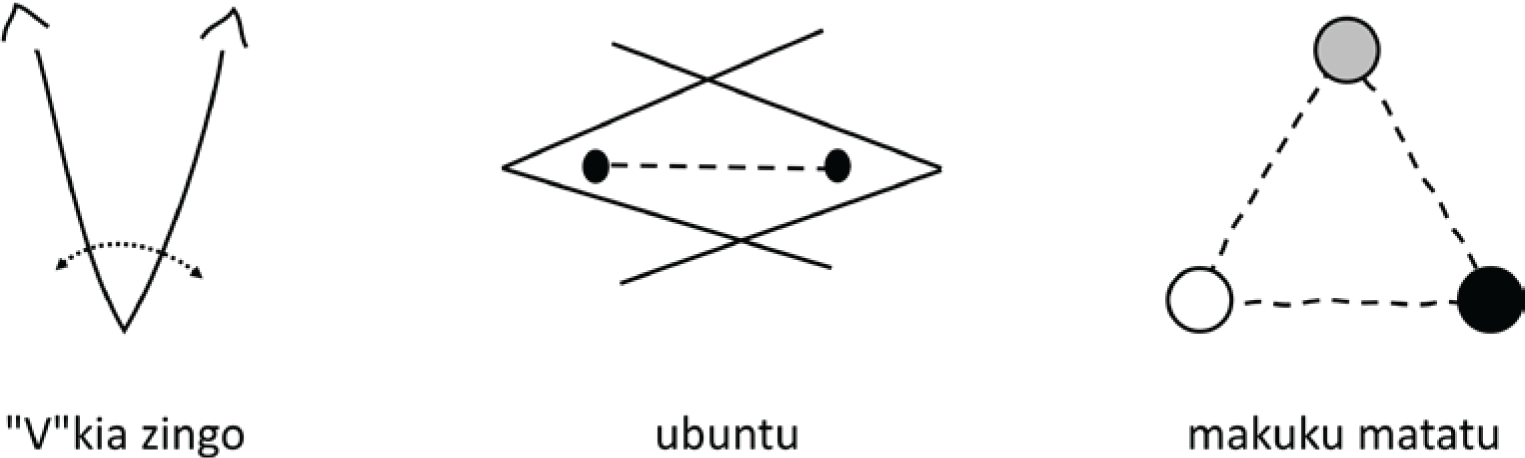
The dynamic of biointeraction, or the poetics of otherification, includes principles associated with the symbiotic nature of life and living. This dynamic focuses on the biopolitical activation of radical interdependence. Contrary to the objectification of difference in bifurcated cosmologies or processes of othering, otherification evokes gravitational pulls toward alterity and/or outer-ness. It thus recognizes the ecological connections across all entities, both their material and subtle bodies (spirit-energy). Biointeraction shapes the consciousness of be-ing as relational outcomes across spheres of care (personal, social, environmental, and epistemic). This dynamic includes the principles and ideograms in figure 11.
CM ideograms for the principles grouped under the dynamic of biointeraction, from left: “V” kia zingo; ubuntu; and makuku matatu. (Graphics by Cristina Fernandes Rosa; courtesy of CM archive)

Fu-Kiau devotes an entire chapter to the principle “V” (or “Vee”) kia zingo, meaning the “V” of life (fig. 11, left):
“Vee” is the basis of all inspirational realities […] We seek for ideas and images through “the open beam of the Vee” inside our mind and on the contrary we focus on details and specificities under reverse beam of the “Vee.” ([1980] 2001:130–31)
This principle organizes relational ontology as a moving spectrum that may open/expand/ramify or close/focus-on/funnel-in, as in the formation of roots and branches as well as blood vessels, rivers, flying birds, etc. In capoeira, players are constantly inviting interactive play by opening-and-closing their bodies, personal space, fields of vision, emotions/energies, setting participatory improvisations in an adjustable spectrum.
Figure 11, center: Ideogram for ubuntu, visually imagined as the meeting of two Vs of life, forming a diamond pattern (< >), common in Bantu textiles, or two sets of arms extending outward into a hug. “It is also under these ‘meeting Vees’ that friendships, partnerships and all kinds of relationships are created among people, communities, institutions and nations as well” (141). Capoeira’s call-and-response improvisations across dance-fighting, singing, and playing music embody and vivify this be-ing, in motion, open to others (fig. 12).
These two principles, “V” kia zingo and ubuntu, are often explored in tandem. First, we might invite participants to trace the V shape in the air, then physically manifest it by opening and closing their arms to frame a personal field of action, “opening-and-closing your body” as we say it in capoeira. This exploration culminates in a powerful, concrete metaphor: as two participants face each other, the intersecting arms form the diamond pattern, and we invite them to transition into an embrace. Once they hug, we explain that this is an embodied instantiation of ubuntu as “be-ing, in motion, open to others.” We often propose this somatic experiment at the end of a session and every single time participants respond with an “ah-ha!” as if it was suddenly clear what we mean by employing cognitive motions to shift from separation to connection. As we have come to understand, this collective “ah-ha!” voices the embodied reforesting happening in real-time. Exercises such as this offer a concrete way of demonstrating the relational ontology at the bodily level, bringing meaning into motion. Beyond serving as a somatic bridge that connects abstract philosophy, visual design, and mental imagery, hugs are especially disarming in specific Western scenarios of performing arts, in which competition and egocentrism prevail.
Demonstration of the meeting of two Vs of Life, moving into ubuntu’s pattern, and leading into a hug. Porto da Barra beach, 2026. (Courtesy of CM archive)

Lastly, the ideogram for makuku matatu (fig. 11, right) evokes the “three firestones” under a cooking pot, sustaining Kongo society. But they could also be read as three moving Vees forming a community. Across the upper-world of the living, the triadic disks—again, Fu-Kiau’s “dams of time” (kala, tukula, luvemba)—counterpose the spiritual world below, at musoni/ku mpemba. As a corporeal pattern of organization, triangulation pushes us to transcend the duality of the human condition (bilateral anatomy). In capoeira, this triangular pattern informs both the footwork patterns (ginga steps) and the syncopated dialogs across its improvised rhythms, especially across the three berimbaus—capoeira’s resonating bow musical instrument.
The dynamic of circularity, or the poetics of change, encompasses principles related to the never-ending nature of life and living, expressed through cyclical patterns and formations (roda, in Portuguese). This dynamic concerns the ongoing transformations of every living entity as well as their underlying processes and pathways. Contrary to the linear time of Cartesian-Enlightenment thought, Fu-Kiau asserts: “A human being’s life is a continuous process of transformation, a going around and around […] The human being is kala-zima-kala, a living-dying-living-being” ([1908] 2001:35). This un/winding of the cycles of life and their experiences qualify temporality as recurrent and infinite—what Martins terms spiral time (2021). Circularity also informs the circulation of knowledges and practices, evident within performative cyphers of capoeira and breakdancing alike as well as the wider circle of community life. Curvilinear pathways recycle information, update the past (Ferreira 2021), and integrate parts into the whole (Petit 2015).
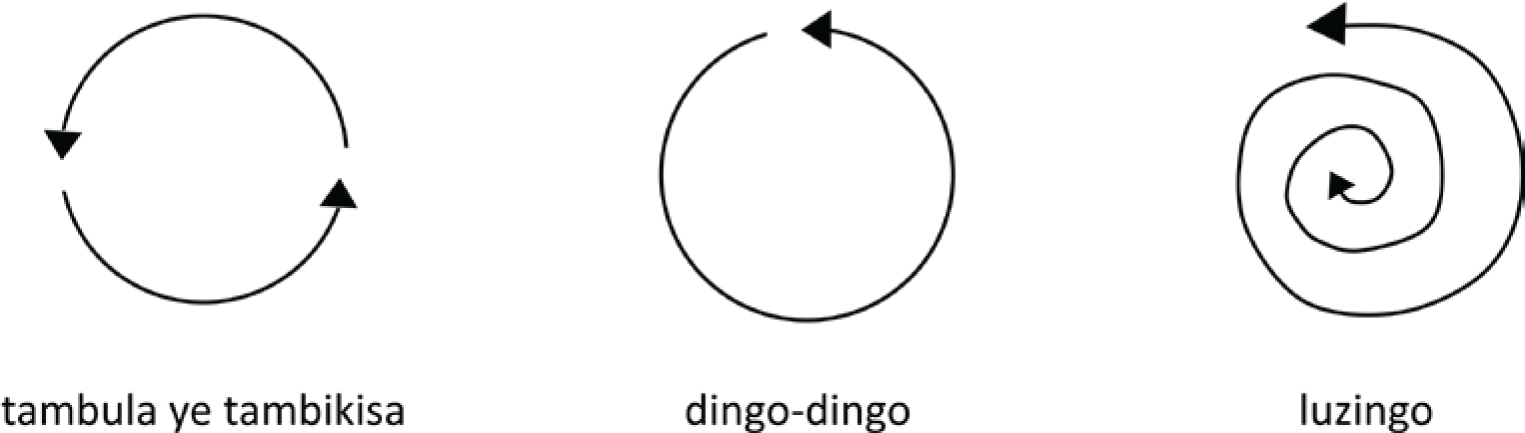
The ideogram for tambula ye tambikisa (fig. 13, right) represents mutualism, or the process of receiving and releasing/transmitting/passing on, which is central to community life (Fu-Kiau [1980] 2001:104). Besides the reciprocity between the world of the living and the world of ancestors/spirits, it evokes reversible processes (e.g., breathing) and back-and-forth oscillations traced across body parts (e.g., capoeira’s swayed gait). This give-and-take evokes oscillatory variations between polar oppositions, e.g., entering-exiting or closing-opening, instrumental to capoeira’s fluid feints and blows. Closely related, fig. 15, center, offers an ideogram for dingo-dingo, the “perpetual going-and-coming-back of life” (71) and the recycling “flow of energy of change” (88). Santos qualifies dingo-dingo as “the eternal, revolving and renewed/recombined/re-dimensioned process of things and events” (2019:114), noting that “dingo-dingo says dingo twice, suggesting that processes repeat themselves, do not end, they circulate” (131). Capoeira’s process-oriented games, its patterns of tonal syncopation, and the infrastructure of the roda keep this principle alive. Our ideogram for luzingu (fig. 15, right) draws on the image of life as a spiraled parchment. These “rolls of life [luzingu] in the form of tapes” un/fold and de/codify all human deeds (Fu-Kiau [1980] 2001:31); they evoke serpentine pathways and spiral processes or semiotic patterns in time/space (Luyalika 2017), in capoeira or in life.
CM ideograms for the principles grouped under the dynamic of circularity, from left: tambula ye tambikisa; dingo-dingo; and luzingo. (Graphics by Cristina Fernandes Rosa; courtesy of CM archive)

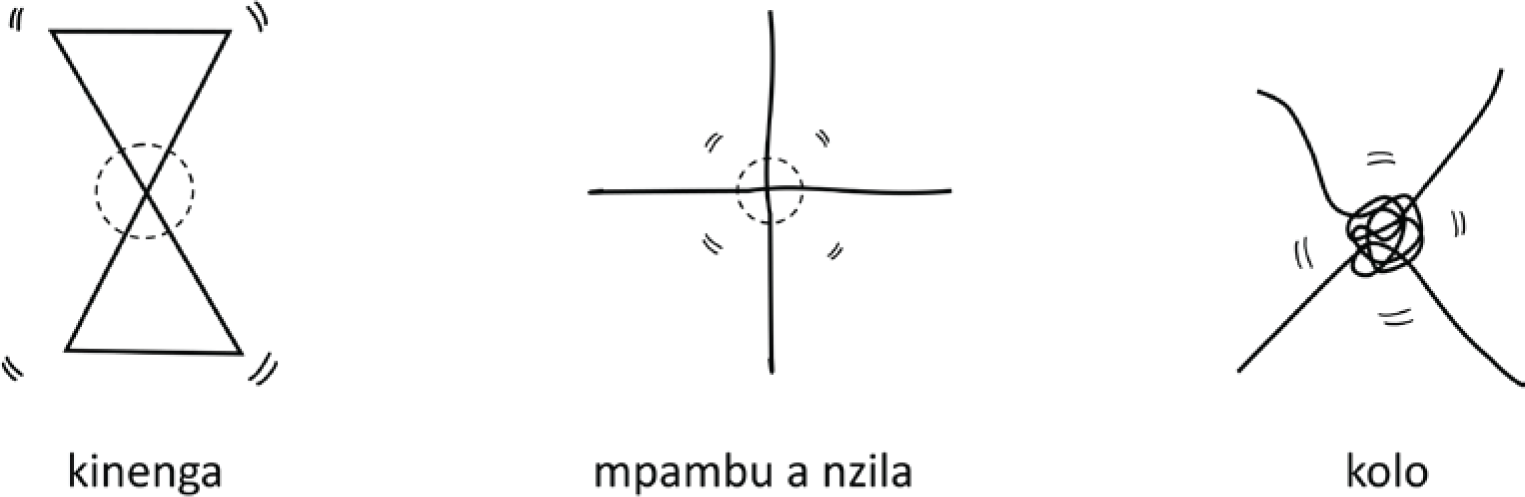
CM ideograms for the principles grouped under the dynamic of circularity, from left: kinenga; mpambu a nzila (a horizontal and a vertical line forming a cross, with a small dotted circle at its crossing intersection and little double-line motion marks around it); and kolo. (Graphics by Cristina Fernandes Rosa; courtesy of MC archive)

Circular “toolbox” with 12 Bakongo principles and their respective ideograms, arranged around CM’s 4 dynamics of relationality with the Dikenga at its core. (Graphics by Cristina Fernandes Rosa; courtesy of CM archive)

The dynamic of confluence, or the poetics of the crossroads, concerns the converging or entangling tendencies of life and living. The spatiality of confluence involves “trans-bordering”—a process that affects all that vibrates in three dimensions, from physical bodies to sound information (Santos 2019). It also evokes balancing out discrete forces and their overflows within a field of action. Like river confluences, crossed pathways drive exchanges and recognitions emblematic of pluriverse cosmologies. However, confluence also implies an effort that multiplies and expands, without losing its essence.
Figure 14, left, offers an ideogram for kinenga, which Fu-Kiau defines as balance or equilibrium required for community life (kinenga kia kimvuka; [1980] 2001:36) or the power to balance opposing forces (kala ye zima; on and off), outside of which “there is no health, no peace, no happiness, no love, no understanding, no life” (1991:70). This notion of health not as a state of the body or something static, but as a dynamic balance, is expressed as kinenga mu kala, “the balance of being,” (Fu-Kiau 1991:68) and kinenga kianzîla, “the balance of life” (70). Kinenga connects the self-healing power of homeostasis to the aesthetics of coolness, neither too cold nor too hot (Thompson 1983), and the cognitive swagger in capoeira (jogo-de-cintura; Fernandes Rosa 2015). The center ideogram of figure 14 illustrates mpambu a nzila, the principle for crossed pathways or dimensions (Cobe 2010:107, 241). Contrary to yowa, meaning cross, mpambu a nzila references, across the African diaspora, the act of crossing or trans-bordering, highlighting the mobility of traversing space and/or the semiotic potency of marking “sacred doorways” (Martins 2021:49–54). The center of a capoeira roda (and other Afrodiasporic cyphers) evokes a vortex of visible/invisible or material/immaterial forces, paths, and experiences. Finally, kolo (fig. 14, right) may be translated as knot or code. Fu-Kiau affirms that a person represents “the most vibrating ‘kolo’ (knot) of relationships” ([1980] 2001:113) within a shared web or field. These knots are “the access to the cultural, natural, and even ontological system (kimpa/fu) that contains them” (Santos 2019:176). In capoeira, the singularity of each person’s way of playing in the collective roda is an entanglement of (coded) waves/vibrations, resulting from concrete and symbiotic exchanges over time (fig. 15).
The sketched lines, curves, arrows, and motion marks that form the 12 ideograms facilitate access to historical and ancestral patterns of action and information, while also triggering cognitive acts of transfer, metaphors, and fabulations. They guide us in seeing/recognizing and feeling/experiencing these imagetic-philosophical principles in creative and open-ended ways. As seeds, they may also stimulate inventive associations across our matter-mind-energy continuum. By intertwining human sensoria (sight, hearing, touch, proprioception, kinesthesia) with neurological faculties (reason, intuition, sensitivity, memory, imagination) and energetic exchanges, these playful strategies surface information as well as free-flowing associations, oneiric creations, and transcending experiences.
In practice, our SaR approach employs this collection of tools in two intertwined, mutually affecting explorations. The first improvises cognitive motions in the six external directions through audiovisual, kinetic, and discursive play. These are often interactive and observable. The second articulates cognitive motions inward (the seventh direction), which are somatically sensed and felt internally but may not be perceptible to others. The inward motion cultivates a somatic attunement (Nagamoto 1992) to one’s ecological subjectivity. Meanwhile, the outward motion embodies radical interdependence, extending a comprehensive intelligence of self-regulation, in-motion, toward otherification (Fernandes 2014).Footnote 20
These embodied experiences invite sensorially engaged participant-researchers to explore multiple, visceral paths to understanding Bakongo cosmology’s material evidence within their own set of limits and possibilities. Tasks centered on makuku matatu, for instance, invite participants to corporeally explore the value of triangular patterns of negotiation and decision-making. A movement task may call them to explore multiple ways of moving beyond bifurcated logic, either this or that. Rather than choosing a side, so to speak, juggling acts across three (or more) moving positionalities allow us to stand back and reconsider a challenge from a different angle. This and other tasks open up new fields of possibilities for neuromuscular experiences and imaginative perception (fig. 16).
Extended CM diagram surrounding our circular “toolbox” with English approximations of each Kikongo principle and its ideogram. (Graphics by Cristina Fernandes Rosa; courtesy of CM archive)

Close-up of Cristina Fernandes Rosa embodying Luvemba during the performance Interstice or What Needs to Exist with the collective A-FETO at UFBA, 2023. (Courtesy of CM archive)

Cristina Fernandes Rosa demonstrates a variation of the exercise “the floor is my friend” on the beach, moving and being moved by Kalunga’s waters, 2024. (Courtesy of CM archive)

CM’s tactics and strategies are useful not only for tracing Bantu principles in diasporic practices like capoeira angola but also for reforesting academic and artistic propositions. Recently, CM has expanded into ecosomatic investigations near natural water sources. Dialoging with Fernandes’s Merger as Research approach (2024), we have developed an aquatic version of our research-creation labs. This has led us to rethink “ways of perceiving, moving, relating, and creating” (Fernandes 2022:308) as pluriverse, more-than-human manifestations of the cosmic Force (Kalunga/Ntu). These manifestations both move and are moved by flows of information through water waves. Submerged somatic processes help to further dissolve limiting patterns, attuning participants to problematize (or at least recognize) the psychosomatic nature of Western thinking ingrained in our neuromotor system, which still affects us in rigid and abyssal ways. Among all that we are learning, the inherited pliability of the kalunga principle mobilizing these living environments has offered us a deep awareness that—to paraphrase Báyò Akómoláfé—we will have to become water (2025). To move and be moved through the hardships of coloniality with a sense of coolness, i.e., to ginga or sway through life, allows us to reconnect to, or be flooded by, the enveloping-and-dissolving energy of the cosmos and our sense of “we-ness.” As Santos concludes when translating Fu-Kiau’s work into Portuguese: “It is necessary to be contaminated by the flavors of knowledge to verify, to some extent, what the latter are or can be to those who taste them and embody an experience” (2019:5).
Musoni
Germinating an Afrocentric Countercolonial Perspective of Somatics as Research
When Fu-Kiau first came to Brazil in 1997 for a series of lectures organized by Mestre Cobra Mansa, he teased possible correlations between capoeira angola and Bantu culture. Decades later, my practice-based investigations at CosmoAngola aimed to demonstrate how the practice of capoeira angola—especially its movement qualities and patterns of interactions—kept that Bantu worldview alive at the bodily level. In particular, I set out to investigate how the repeated doings-and-knowings of its “oraliture” (Martins 2003, 2021)Footnote 21 simultaneously recuperate and invent an Afroreferenced corporeal episteme—one that would counter colonization while also finding ways of living through it (see Mukutu 2018).
CosmoAngola, the fertile soil from which this initial collection of seeds germinated, builds on Permangola (2006–2019), Cobra Mansa’s prior initiative at Kilombo Tenondé, which combined capoeira angola with a sustainable farming system known as permaculture. Jorge Conceição, who collaborated on these earlier events, presented Permangola as a teaching-learning opportunity that traverses Afro-Brazilian culture and Afroreferenced tools for physical education and social and environmental transformations (see Conceição 2009). Meanwhile, from 2010 to 2014 Cobra Mansa (Cinézio Feliciano Peçanha) joined Richard Pakleppa and Matthias Röhrig Assunção in an ethnographic project between Brazil and Angola, which resulted in the documentary Jogo de Corpo: Capoeira e Ancestralidade (Body-Games: Capoeira and Ancestry; 2014). Subsequently, that experience led Mestre Cobra Mansa to pursue doctoral research on the Bakongo roots of capoeira angola (Peçanha 2019). At his PhD defense, Nêgo Bispo challenged him to rename Permangola as CosmoAngola. Through this switch, Cobra Mansa and Nêgo Bispo sought to expand the environmental initiatives that germinated within the previous series, redirecting these encounters towards contracolonial practices grounded in traditional Afro-Indigenous knowledge systems.
Departing from Cobra Mansa’s ritualization of the Dikenga (Fernandes Rosa 2022),Footnote 22 my workshops at CosmoAngola began as a somatic playground for familiarizing ourselves with those ancestral knowledges, and later attuning our body-mind-spirits to specific principles through movement patterns and visualization, in preparation for the walking meditation through the Dikenga. At the first event, I combined exercises of somatic attunement with choreographed phrases, guiding participants into capoeira angola’s underlying qualities of movement, including sensorial connections to the ground and each other, spiral pathways in time-space, and the continuous oscillations of the ginga. However, rather than focusing on executing traditional games of capoeira, my guided exercises invited participants to play creatively with these underlying movement patterns. We explored free-flowing neuromotor patterns beyond the constraints of capoeira’s movement vocabulary and game expectations. Departing from its call-and-response pattern of interaction, for instance, our improvised tasks elicited relational images/metaphors and provoked corporeal actions/sensations that resonated with Bantu principles like ubuntu (be-ing, in motion, open to others) and tâmbula ye tambikisa (reciprocal interactions).
To our benefit, the CosmoAngola series has attracted not only capoeira players from different parts of the globe, but also master-teachers and artists of other Afrodiasporic practices, Indigenous community leaders, social movement activists, and researchers from various fields of inquiry, from agroecology and environmental studies to arts, humanities, and social sciences. Moreover, these diverse gatherings allowed us to dive deeper and recognize that other postmodern movement approaches such as Soma therapy, Biodanza, and release techniques have also incorporated and resignified elements inherent to that Afroreferenced cosmology through actions, imagery, and vibrations.
For the second CosmoAngola, I introduced posters with words and visual symbols based on Fu-Kiau’s graphic explanations of the Dikenga. Scattered around Kilombo Tenondé, these posters sought to extend cognitive confluences across that ancestral technology, beyond the movement workshop. Between practice sessions, within and beyond the CosmoAngola, I investigated possible improvisation tasks that juxtaposed Fu-Kiau’s keywords/images with movement qualities from a wide range of African diasporic practices. I introduced these principles in seminar lectures and creative processes, inviting participants to explore them through their own patterns of thinking-and-doing things, from dancing to writing. With each new experimentation of serious play, we looked for ways to transplant acquired information to other territories and contexts, in spheres such as processes of art making, gardening, and self-care.
Over time, I devised other tasks that intertwined multiple Bakongo principles through somatic perception and kinetic metaphors. In the warm-up exercise “the floor is my friend,” participants move through cumulative guided tasks that allow them to visualize and/or experience all 12 principles of the CM methodology in one session. After grounding the body horizontally and attuning to the soil and Earth’s gravity, we connect breath to movement, playing with metaphors that invite radial contractions (a seed, an egg) and expansions (a starfish, an omelet). This is followed by explorations of homolateral, contralateral, and spiral actions. In one version of this exercise, after waking up the muscles and ligaments around the spinal cord, we migrate towards seated positions to explore serpentine pathways in-and-out of the floor. We might start by transitioning from horizontal to vertical upright or inverted stances, never losing sense of the relationship we established with our grounding friend, the floor. Sometimes we push our corporeal balance to the limit and other times we migrate towards trust improvisations in pairs or small clusters.
Invariably, we conclude each lab with a talking circle, where participants voice insights—drawing from sensory and neuromotor perceptions—as well as feelings, memories, and fabulations that surfaced during the session. Given the ethnocultural diversity of participants attending CosmoAngola and the richness of their knowings-and-doings beyond capoeira, these talking circles have revealed opportunities to not only teach but also learn about the confluences between African archives and diasporic practices. In particular, the ideograms have helped in recognizing that, while these Bakongo principles might seem “foreign” at first glance, many have long been cultivated in the New World, through traditional or innovative patterns of bodily organization and performance. As we have found out, principles associated with the dynamics of biointeraction, circularity, confluence, and resonance seem especially familiar or comforting to those in search of more sustainable ways of living on Earth. These insights birthed CM’s core methodology of orchestrating somatic experiments to receive/transmit Bantu cosmological knowledge as well as articulating its principles as they resurfaced through practice-based research and ecoperformances.
Meanwhile, I devised tasks that could make these philosophical principles accessible to a wide range of people, despite previous familiarity with Bantu culture, without distorting or underestimating their complexity. While CM is based on Bantu-Kongo cosmology and the ancestral technology of the Dikenga dia Kongo, its tactics, dynamics, and strategies are useful in (but not limited to) reorienting research projects, creative processes, and artistic productions towards more sustainable ways of being-living. More importantly, I sought creative ways to describe, translate, and share the foundations of these complex Luso Kongo–transatlantic oralities and know-hows in practical and synthetic ways, often using extended sketches to draw parallels between movements and thoughts. Finally, I initiated a broader questioning of how these cognitive movements could bring us closer to the environmental concerns defended at Kilombo Tenondé. That is, not only to reforest our individualized imaginary and existence beyond bifurcated cosmology but to collectively cultivate renewed ways of living in plenitude or buen vivir.