Eating disorders (ED) have become an important public health issue. In Zaragoza, Spain, similar to findings in Basque Country, a study of adolescents in a school context found that 10.3% of girls were at risk of ED, and 7.8% of boys; and that the prevalence of ED was 1.5% in girls, and 0% in boys (Ruiz-Lázaro et al., Reference Ruiz-Lázaro, Comet, Calvo, Zapata, Cebollada, Trébol and Lobo2010). This indicates a need for studies to be conducted, so that variables that might explain these problems may be identified, and then preventative measures put in place.
ED and associated variables: gender differences
The literature and clinical practice have confirmed a higher prevalence of ED in females (Smink, van Hoeken, Oldehinkel, & Hoek, Reference Smink, van Hoeken, Oldehinkel and Hoek2014), so it may be that these disorders are explained by different psychological variables as a function of sex.
Studies relating ED to positive variables, especially body self-esteem and general self-esteem (Horndasch et al., Reference Horndasch, Kratz, Holczinger, Hartmut, Hönig, Nöth and Moll2012) have reported higher scores in females. Body dissatisfaction is how displeased a person is with their body. Distortion, meanwhile, refers to how precisely one perceives their body size. One risk factor for body dissatisfaction is the current standard of beauty that demands thinner female and more muscular male bodies (Sehm & Warschburger, Reference Sehm and Warschburger2015). Body image alterations are strongly connected to a person’s sex.
Some studies report females are less happy (Delfabbro, Winefield, Anderson, Hammarström, & Winefield, Reference Delfabbro, Winefield, Anderson, Hammarström and Winefield2011), but others have found that under similar living conditions, female happiness levels are actually higher than males’ (Zweig, Reference Zweig2015); others still have shown no gender differences in that regard (Garaigordobil, Reference Garaigordobil2015).
The relationship between negative emotional variables and ED is such that anxiety and depression are both associated with ED, but not in the same way for males and females. Females display higher depression indexes (Wade, Wilksch, & Lee, Reference Wade, Wilksch and Lee2012).
Studies of complementary psychological variables and ED, according to the Eating Disorders Inventory (EDI), have not always yielded convergent results. Lundahl, Wahlstrom, Christa, and Stoltenberg (Reference Lundahl, Wahlstrom, Christa and Stoltenberg2015) reported a strong association with ED in both sexes, whereas Fernández and Pritchard (Reference Fernández and Pritchard2012) found impulsivity and anger were more strongly associated with male behaviors, while selective attention to one’s body and perfectionism were more closely associated with female behaviors. Some studies have reported that the prevalence of ED in females comes with a higher prevalence of asceticism, social insecurity, and interpersonal distrust (Behar, Reference Behar2012).
Studies of perceived weight indicate that male perceptions of their bodies are more consistent with BMI, whereas females exhibit more body distortion, perceiving themselves as fatter than they really are. Such studies have concluded that the greater one’s body dissatisfaction, the greater their risk of ED (Calzo et al., Reference Calzo, Masyn, Corliss, Scherer, Field and Austin2015; Sehm & Warschburger, Reference Sehm and Warschburger2015).
ED: explanatory variables and relation to other variables
The literature review suggests body image alterations are causally linked to ED in that they help trigger ED, not the reverse. It has been confirmed that higher body dissatisfaction paired with higher preoccupation with weight means higher risk of ED; it predicts ED (Loth, MacLehose, Bucchianeri, Crow, & Neumark-Sztainer, Reference Loth, MacLehose, Bucchianeri, Crow and Neumark-Sztainer2014).
A study examining the relationship between happiness and ED (Joos, Cabrillac, Hartmann, Wirsching, & Zeeck, Reference Joos, Cabrillac, Hartmann, Wirsching and Zeeck2009) showed people with ED tend to exhibit lower happiness levels than those without ED.
A review of ED-associated psychopathological factors by García-Villamisar, Dattilo, and Del Pozo (Reference García-Villamisar, Dattilo and Del Pozo2012) identifies multiple studies in which depression was the most common comorbid diagnosis in patients with ED. In various predictive studies (Loth et al., Reference Loth, MacLehose, Bucchianeri, Crow and Neumark-Sztainer2014), depression and preoccupation with real weight were found to be ED risk factors. In other studies (Meng & D’Arcy, Reference Meng and D’Arcy2015; Rebuffo, Siravegna, & Medrano, Reference Rebuffo, Siravegna and Medrano2012), anxiety was an explanatory variable for ED.
A review of 15 years of ED research (Behar, Reference Behar, Behary and Figueroa2010) and predictive studies (von Lojewski & Abraham, Reference von Lojewski and Abraham2014; Zanetti, Santonastaso, Sgaravatti, Degortes, & Favaro, Reference Zanetti, Santonastaso, Sgaravatti, Degortes and Favaro2013) concludes that clinical scores differ significantly in AR-ED (at-risk of ED) versus WR-ED (without-risk of ED) patients, with interoceptive awareness, feeling of worthlessness (ineffectiveness), maturity fears, and perfectionism being predictors, and the latter being one of the main risk factors to trigger eating pathology when body dissatisfaction is present.
Objectives and hypotheses
Bearing in mind the antecedents described above, this study had three objectives. The first was to analyze whether AR-ED and WR-ED groups differ significantly in terms of the study’s variables (perceived weight, self-esteem, happiness, depression, anxiety, anger, and other ED-related psychological variables). The second was to find, in the group at risk of developing ED, gender differences on the study’s variables of interest. Considering various research findings (Loth et al., Reference Loth, MacLehose, Bucchianeri, Crow and Neumark-Sztainer2014; Lundahl et al., Reference Lundahl, Wahlstrom, Christa and Stoltenberg2015; Sehm & Warschburger, Reference Sehm and Warschburger2015; von Lojewski & Abraham, Reference von Lojewski and Abraham2014) that identified certain variables (preoccupation with weight, anxiety, depression, anger, body dissatisfaction, self-esteem, impulsivity, perfectionism…) as explanatory in ED, the third objective was to identify explanatory variables for drive for thinness, bulimia, and body dissatisfaction in AR-ED males and females. We propose three hypotheses regarding those objectives: (1) We expect to find statistically significant differences between the AR-ED and WR-ED groups such that the latter will score higher on positive variables and lower on negative ones; (2) Males in the AR-ED group will score higher on positive emotions, and females will score higher on perceived weight and negative emotions; and (3) In the AR-ED group, the explanatory variables will be perceived weight, ineffectiveness, impulsivity, perfectionism, maturity fears, anxiety, happiness, and self-esteem.
Method
Participants
Participants were 1.075 teenagers and youths. The community sample (non-clinical), representative of secondary school, high school, and University of Basque Country students, is described in Table 1.
Participant frequencies and percentages

The sample was selected by applying a simple random sampling technique to a list of schools in Basque Country (secondary and high school), including university students from various departments. Schools were randomly selected from a list of schools provided by the Basque Government Education Council. If a selected school declined to participate, the next one on the list was chosen, taking into consideration its education level and school network (public/private). According to the latest survey by the Basque Statistics Institute (eustat.es), the secondary and high school population in Basque Country is 109.654, and 68.193 students are enrolled in university. Using a .95 confidence level with a sampling error of .03, for a population variance of .50 the corresponding representative sample would have 1.062 participants.
To differentiate between AR-ED and WR-ED participants, we followed the following procedure: participants were assigned to the AR-ED group if they scored above the 90th percentile on one of the three EDI-2 variables recognized as indicating risk of ED (drive for thinness, bulimia, and body dissatisfaction). Those who did not score in that range on any of the three subscales were assigned to the WR-ED group.
Assessment instruments
Eating disorders inventory-2 (EDI-2) (Garner, Reference Garner1998)
The EDI-2 consists of 91 items, yielding scores on 11 scales that are clinically relevant to ED. Of the 11 scales, three assess attitudes and behaviors related to food, weight, and physical appearance: drive for thinness, bulimia, and body dissatisfaction. The rest refer to psychological features that are clinically relevant to ED: ineffectiveness, perfectionism, interpersonal distrust, interoceptive awareness, maturity fears, asceticism, impulsivity, and social insecurity. Psychometric studies confirmed the test’s reliability; Cronbach’s alpha (α) was above .80 for anorexia nervosa on all scales. In the present study, α was acceptable (between .60 and .87) for all variables but asceticism, in which case it was low (.57 for the WR-ED group, .67 for the AR-ED group).
Test de siluetas para adolescentes (TSA) [Silhouettes test for teenagers] (Maganto & Cruz, Reference Maganto and Cruz2008)
This evaluates dissatisfaction with and distortion of body image, and risk of ED. The items propose different attributions or identifications about each silhouette (Figure 1, very thin - Figure 8, very fat). For instance, “what figures are normal, thin, or fat?” and “which represents your current figure?” In this study, perceived weight was selected, which was obtained by subtracting the figure representing the person’s current weight from the figure corresponding to their BMI. Test-retest reliability at four months, in perceived weight (.82), confirmed the test’s stability over time.
Escala de autoestima corporal (EAC) [Body self-esteem scale] (Maganto & Kortabarria, Reference Maganto, Kortabarria, Ferreira, Verhaeghe, Silva, Almeida, Lima and Fraga2011)
The task was to self-assess people’s level of satisfaction with 27 body parts, from 1 (very dissatisfied) to 10 (very satisfied). Body self-esteem is computed by adding item scores and dividing by the number of items. Reliability was high (α = .93), similar to the value obtained in the present study’s sample (α = .96).
Rosenberg self-esteem (RSE) scale (Rosenberg, Reference Rosenberg1965)
This includes 10 items that tap feelings of self-worth. McCarthy and Hoge (Reference McCarthy and Hoge1982) confirmed the test has adequate internal consistency (α between .74 and .77) and test-retest reliability (r = .85, 2-week interval). In the present study, Cronbach’s alpha was .83.
Oxford happiness questionnaire (OHQ, Hills & Argyle, 2002)
This measures general happiness, including psychological well-being. On each of its 29 items, respondents express their level of agreement with different statements, on a scale from 1 to 6 (1 = strongly disagree, 6 = strongly agree). Cronbach’s alpha coefficients indicate good reliability, for the original test (α = .91) and in the present study’s sample (α = .86).
State-trait depression inventory (STDI, Spielberger, 2008)
This 20-item self-report measure has 10 items to identify depression-state, and 10 to identify depression-trait. The STDI’s reliability was computed in different sampling groups, obtaining alpha coefficients between .70 and .93 in clinical samples of males and females. In the present study, the coefficient was high (α = .86).
State-trait anxiety inventory (STAI, Spielberger, Gorsuch, & Lushene, 1988)
Of its 40 items in total, 20 assess anxiety-state and 20 anxiety-trait. The Spanish adaptation shows high internal consistency (α = .90 to .93 anxiety-state; α = .84 to .87 anxiety-trait). In the present study, internal consistency was high (α = .86 anxiety-state; α = .89 anxiety-trait).
State-trait anger expression inventory (STAXI-2, Spielberger, Reference Spielberger2000)
This evaluates people’s experience, expression, and control of anger. Its 49 items produce an Anger Expression Index (AEI), which is a global average of anger expression and anger control. Psychometric results indicate adequate reliability levels (α = .82 anger-trait; α = .69 AEI) consistent with the present study’s findings (α = .79 anger-trait; α = .94 AEI).
Procedure
Research phases: (1) Contact school directors, offering them information about the study and inviting them to collaborate; (2) Once they accept, solicit informed consent from school directors, parents, and participants; and (3) Administer assessment instruments in two 50-minute sessions, except at the universities, in which case there was one 75-minute session. The questionnaires were administered in the classroom, collectively, and on a voluntary, anonymous basis. This study complied with the ethical standards required for research in human subjects, adhering to the fundamental principles of the Declaration of Helsinki as well as its revisions.
Data analysis
First, in order to analyze differences between the AR-ED and WR-ED groups, and gender differences, parametric tests (Student’s t) and tests of effect size (Cohen’s d) were conducted. Later, multiple linear regression analyses (step-wise) were carried out to identify the explanatory variables implicated in drive for thinness, bulimia, and body dissatisfaction, which are posited as criterion variables for risk of ED. The data were processed using the SPSS 21.0 statistical package.
Results
Differences between participants with and without risk of ED
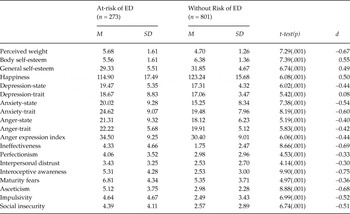
The results of (Student’s) t-test means comparison analysis (see Table 2) show that the WR-ED group scored significantly higher on the variables body self-esteem, general self-esteem, and happiness, and lower scores on the variables perceived weight, depression, anxiety, anger, ineffectiveness, perfectionism, interpersonal distrust, interoceptive awareness, maturity fears, asceticism, impulsivity, and social insecurity. The following variables were found to have a moderate effect size (Cohen’s d): perceived weight, body self-esteem, happiness, state-trait anxiety, ineffectiveness, interoceptive awareness, asceticism, impulsivity, and social insecurity. For the rest of the variables, effect size was small.
Means comparison (Student’s t) and effect size (Cohen’s d) on psychological variables in participants At-risk and without risk of ED

Differences between males and females in the group At-risk of ED
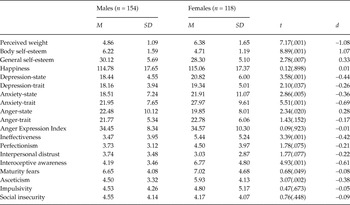
The results of (Student’s) t-test means comparison analysis (see Table 3) indicate males scored significantly higher on body self-esteem, general self-esteem, and anger-state, while females scored significantly higher on perceived weight, state-trait depression, state-trait anxiety, ineffectiveness, interoceptive awareness, and asceticism. This indicates that females in the at-risk group exhibit a higher degree of psychological alteration than males. Effect size was large in the case of perceived weight and body self-esteem, moderate in the case of anxiety-trait and interoceptive awareness, and small for the remaining variables.
Means comparison (Student’s t) and effect size (Cohen’s d) on psychological variables in males and females At-risk of ED

Explanatory variables in ED risk
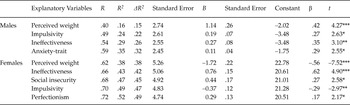
The results of multiple linear regression analyses (step-wise) highlighted the following explanatory variables. In AR-ED males (see Table 4), four variables explained 32% of variance in drive for thinness: perceived weight explained 15% of variance (β = .42), impulsivity 7.6% (β = .27), ineffectiveness 3.8% (β = .35), and anxiety-trait 5.6% (β = –.29). In females, five variables explained 49.8% of variance in drive for thinness: perceived weight explained 38.2% of variance (β = –.56), ineffectiveness 4.5% (β = .62), social insecurity 3.1% (β = .27), impulsivity 2.1% (β = –.29), and perfectionism 1.9% (β = .17). Beta standardized regression coefficients indicate these variables have some explanatory power, and the percentages of explained variance (adjusted coefficients of determination) were of medium magnitude.
Multiple linear regression analysis for explanatory variables in drive for thinness, in males and females At-risk of ED

* p < .05; **p < .01; ***p < .001.
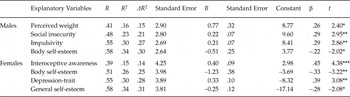
In AR-ED males (see Table 5), four variables explained 30.5% of variance in bulimia: perceived weight explained 15.7% of variance (β = .26), social insecurity 5.6% (β = .29), impulsivity 6% (β = .29), and body self-esteem 3.2% (β = –.22). In AR-ED females, four variables explained 31.2% of variance in bulimia: interoceptive awareness explained 14.5% (β = .45), body self-esteem 10.5% (β = –.33), depression-trait 3.5% (β = .30), and general self-esteem 2.7% (β = –.28). Beta standardized regression coefficients indicate these variables have low explanatory power, and proportions of explained variance had medium-low magnitude.
Multiple linear regression analysis for explanatory variables in bulimia, in males and females At-risk of ED

* p < .05; **p < .01; ***p < .001.
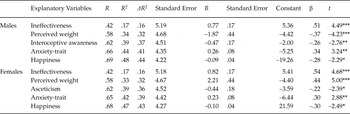
Five variables explained 44.9% of variance in body dissatisfaction in AR-ED males (see Table 6). Ineffectiveness explained 16.6% of variance (β = .51), perceived weight 15.6% (β = –.37), interoceptive awareness 4.8% (β = –.26), anxiety-trait 4.5% (β = .34), and happiness 3.4% (β = –.28). In AR-ED females, five variables explained 43.2% of variance in body dissatisfaction, with ineffectiveness explaining 16.5% of variance (β = .54), perceived weight 15.6% (β = .44), asceticism 4.8% (β = –.22), anxiety-trait 4.5% (β = .30), and happiness 3.4% (β = –.30). Beta standardized regression coefficients indicated these variables have a certain explanatory power, and proportions of explained variance were of medium magnitude.
Multiple linear regression analysis of explanatory variables in body dissatisfaction, in males and females At-risk of ED

* p < .05; **p < .01; ***p < .001.
Discussion
The study’s objectives were to analyze differences between AR-ED and WR-ED groups on several psychological variables, and gender differences within the at-risk group, and to identify explanatory variables in risk of ED.
Regarding the differences between the AR-ED and WR-ED groups, results show that the AR-ED group scored significantly lower on positive variables (self-esteem, happiness) and higher on negative variables (depression, anxiety, anger, ED-related psychological variables) and perceived weight, confirming Hypothesis 1 (moderate effect size: perceived weight, body self-esteem, happiness, anxiety, ineffectiveness, interoceptive awareness, asceticism, impulsivity, social insecurity).
These results are in line with other studies’ findings that general self-esteem, body self-esteem, and happiness are less satisfying emotional states for people with ED or risk of ED (Horndasch et al., Reference Horndasch, Kratz, Holczinger, Hartmut, Hönig, Nöth and Moll2012), or for people whose poor self-concept becomes a source of susceptibility to body dissatisfaction and risk of developing ED (von Lojewski & Abraham, Reference von Lojewski and Abraham2014). The differences in happiness levels observed in this study, favoring the WR-ED group, reiterates Joos et al.’s (Reference Joos, Cabrillac, Hartmann, Wirsching and Zeeck2009) findings in confirming patients with ED experience lower subjective well-being and/or happiness than control groups.
These results with regard to anxiety and depression support García-Villamisar et al.’s (Reference García-Villamisar, Dattilo and Del Pozo2012) findings that in people with ED or AR-ED, depression indexes were higher than in the general population, possibly because depression makes people more susceptible to developing ED.
Differences between AR-ED and WR-ED patients on the variables accompanying the EDI were found in earlier studies, too, particularly ineffectiveness, perfectionism, maturity fears, interoceptive awareness, interpersonal distrust, and impulsivity (Behar, Reference Behar2012; Lundahl et al., Reference Lundahl, Wahlstrom, Christa and Stoltenberg2015; Sehm & Warschburger, Reference Sehm and Warschburger2015). However the present study found differences in all the accompanying variables, suggesting AR-ED participants display tremendous clinical alteration.
Regarding the second hypothesis, about gender differences, females scored significantly higher on perceived weight, state-trait depression, state-trait anxiety, anger-state, ineffectiveness, interoceptive awareness, and asceticism. Males, meanwhile, scored significantly higher on body self-esteem and general self-esteem, so Hypothesis 2 was not confirmed (large effect size: perceived weight, body self-esteem; moderate effect size: anxiety-trait, interoceptive awareness).
In effect, males scored higher on general self-esteem and body self-esteem, confirming the findings of past studies of body image and gender differences (Calzo et al., Reference Calzo, Masyn, Corliss, Scherer, Field and Austin2015; Forsén, Bergsten, & Birgegård, Reference Forsén Mantilla, Bergsten and Birgegård2014). The explanation for that dissatisfaction stems from having internalized the idea that thinness is synonymous with beauty, and females feel greater social pressure and longing to fit that model (Calzo et al., Reference Calzo, Masyn, Corliss, Scherer, Field and Austin2015). Perhaps this explains our results regarding perceived weight, which offer evidence that overestimating body size is a constant in female patients with ED (Behar, Reference Behar, Behary and Figueroa2010). That being said, differences in happiness were not found as a function of gender in AR-ED participants. Perhaps that is because happiness is not always connected to physical-bodily well-being, but rather to a need for social-emotional ties (Zweig, Reference Zweig2015), which females are better able to attain. In terms of the variables accompanying the EDI, these results were not entirely consistent with those of earlier studies (Behar, Reference Behar, Behary and Figueroa2010; Lundahl et al., Reference Lundahl, Wahlstrom, Christa and Stoltenberg2015) in that females only scored higher on ineffectiveness, asceticism, interoceptive awareness, and impulsivity, not on insecurity and perfectionism.
The third hypothesis proposed that in the at-risk group, the explanatory variables implicated in ED risk would be perceived weight, ineffectiveness, impulsivity, perfectionism, maturity fears, anxiety, happiness, and self-esteem. Results partially confirm that hypothesis. Variables explaining ED risk in terms of drive for thinness included perceived weight, ineffectiveness, and impulsivity; in terms of bulimia, body self-esteem; and in terms of body dissatisfaction, ineffectiveness, perceived weight, anxiety-trait, and happiness. Nevertheless, we did not find that perfectionism or maturity fears contributed to explaining risk of ED.
In males, perceived weight was found to explain drive for thinness, bulimia, and body dissatisfaction; and in females, it explained drive for thinness and body dissatisfaction. These results are consistent with other studies’ findings, given that discomfort with perceived weight includes body dissatisfaction, an underlying variable in body image distortion (von Lojewski & Abraham, Reference von Lojewski and Abraham2014). This dissatisfaction differs as a function of the aesthetic body ideals ascribed to each sex – desire for muscular, toned male bodies and hyper-thin female bodies (Forsén et al., Reference Forsén Mantilla, Bergsten and Birgegård2014).
This study confirmed that ineffectiveness, interoceptive awareness, impulsivity, and social insecurity explain ED (Behar, Reference Behar, Behary and Figueroa2010; Zanetti et al., Reference Zanetti, Santonastaso, Sgaravatti, Degortes and Favaro2013). The results contradict other recent findings (Sehm & Warschburger, Reference Sehm and Warschburger2015) that low interoceptive awareness explains bulimia in males. In the present study, low interoceptive awareness explained body dissatisfaction in males, and high interoceptive awareness explained bulimia in females.
Anxiety-trait accounted for variance in drive for thinness in both sexes, and in body dissatisfaction in males. These results support Meng and D’Arcy’s (Reference Meng and D’Arcy2015) findings that anxiety is significantly more common in females; here anxiety was an explanatory variable in risk of ED. Nevertheless, departing from earlier research findings (Loth et al., Reference Loth, MacLehose, Bucchianeri, Crow and Neumark-Sztainer2014), this study found that depression was an explanatory factor in bulimia only in females, and with little stake in explaining total variance (3%). Finally, these results also confirm that low happiness is an explanatory variable in body dissatisfaction for males and females alike, corroborating Joos et al.’s (Reference Joos, Cabrillac, Hartmann, Wirsching and Zeeck2009) findings.
Among this study’s limitations was its non-clinical sample (although EDI scores are used as clinical evidence). With that in mind, results cannot be extrapolated to clinical patients, and the data only allow us to draw conclusions about what variables explained risk of ED. Furthermore, the study’s cross-sectional design prevents us from drawing conclusions about causality/risk.
Nevertheless, this study made certain important contributions with an eye to prevention and designing prevention strategies: (1) It found clear evidence of differences between AR-ED and WR-ED adolescents and youths, the first group scoring low on positive variables, and high on negative – or clinical – variables, confirming a high level of psychopathology in the AR-ED group, and furthermore keeping in mind it was a community (non-clinical) sample; (2) The gender bias typically reported in these disorders was only partially observed here, and we specify on what psychological variables AR-ED females were more susceptible to ED; (3) Results confirmed that perceived weight was the primary explanatory factor – that is, distorted body image implying dissatisfaction is at the core of ED risk; (4) The distortion was larger in females, considering that AR-ED participants perceived themselves as more obese than WR-ED participants, and females in the first group overinflated their weight to exceed that of males, which contradicts anthropometric data according to which males always weigh more than females; (5) Interoceptive awareness operates differently in males and females as an explanatory variable (low interoceptive awareness in males explained body dissatisfaction, and high interoceptive awareness in females predicted bulimia); and (6) Depression was only found to be an explanatory variable for females with bulimia, and it accounted for little variance (3%).
These data reveal an emerging challenge – clinical, educational, and social – that compels professionals to design prevention strategies and intervention programs to address the variables this study found to explain ED risk, in particular perceived weight, so closely linked to body image, ineffectiveness (feelings of worthlessness and failure), anxiety-trait, and impulsivity, which was connected to drive for thinness and bulimia.
Study financed by the Basque Government’s Department of Education, Linguistic Policy, and Culture (IT638–13), and the University of Basque Country Education and Research Unit (UPV/EHU, UFIPSIXXI-11/04).