Introduction
The Institute of Medicine recommends the conduct of advance care planning (ACP) to better align the services received by the individuals with their care goals and preferences (Institute of Medicine, 2014). As a result, stating end-of-life (EOL) preferences has become an important and internationally widespread process in recent years (Mullick et al., Reference Mullick, Martin and Sallnow2013; Sabatino, Reference Sabatino2010). ACP refers to ongoing discussions about shared decision-making in which patients (including residents of long-term care institutions and clients in community settings), their families, and healthcare providers reflect on the patient's goals, values, and beliefs in relation to their current and future medical care (Detering & Silveira, Reference Detering and Silveira2016; Sudore, Lum, et al., Reference Sudore, Lum and You2017). Ideally, this process should document patients’ future health care choices so that this information follows them across different healthcare settings (Hickman et al., Reference Hickman, Hammes and Moss2005).
ACP is a complex intervention that involves multiple stakeholders interacting with each other and with the healthcare system. To implement successfully entails the breaking down of barriers against conversations about death and dying and requires accurate and honest disclosure about prognosis to increase receptivity or openness to receive ACP. The discussion itself needs to be culturally, linguistically, and emotionally tailored to patients and their families. These discussions can occur in different medical and nonmedical settings. Different organizational contexts and disease conditions may give rise to a variety of implementation challenges. The eventual goal of ensuring that “people receive medical care that is consistent with their values, goals and preferences during serious and chronic illness” (Sudore, Lum, et al., Reference Sudore, Lum and You2017), is influenced by all these factors.
When appropriately conducted, ACP may benefit patients (increased autonomy, dignity, peace and intimacy at moment of death), their family (less intense grieving, less likelihood of developing psychiatric conditions), and the healthcare system more generally (decreased resource utilization and costs) (Lum et al., Reference Lum, Sudore and Bekelman2015). Despite these potential benefits, it is often difficult to engage patients and other stakeholders in these highly emotive conversations about life and mortality (Barclay et al., Reference Barclay, Blackhall and Tulsky2007), and there is a lack of clear guidelines and uniformity in its implementation. Depending on the context, the concept and definition of ACP varies, may involve different legal status or require special legal documents (such as advance directives [ADs], living wills, or powers of attorney), and it is not always embedded into routine clinical care (Lovell & Yates, Reference Lovell and Yates2014). All of these elements result in different conclusions regarding the effectiveness of ACP.
Several studies have tried to identify the factors that may act as barriers or facilitators for this process, taking the perspective of healthcare professionals, proxy decision-makers, and patients with various illnesses. These factors vary and may include finding the most appropriate setting and timing for these conversations, levels of diagnosing skills, length of relationships between healthcare professional and patient, discussion strategies, and educational and emotional support for patients, family members, and professionals (De Vleminck et al., Reference De Vleminck, Houttekier and Pardon2013; Jethwa & Onalaja, Reference Jethwa and Onalaja2015; Lord et al., Reference Lord, Livingston and Cooper2015; Lund et al., Reference Lund, Richardson and May2015; van der Steen et al., Reference van der Steen, van Soest-Poortvliet and Hallie-Heierman2014).
Demonstrating the wide variety of research on the topic, studies have focused on particular aspects of ACP, including the use of decision aids (Aslakson et al., Reference Aslakson, Schuster and Reardon2015; Austin et al., Reference Austin, Mohottige and Sudore2015; Butler et al., Reference Butler, Ratner and McCreedy2014), communication strategies (Bernacki et al., Reference Bernacki and Block2014; Parry et al., Reference Parry, Land and Seymour2014; Walczak et al., Reference Walczak, Butow and Bu2016), the impact of different types of ACP and palliative care interventions (Brinkman-Stoppelenburg et al., Reference Brinkman-Stoppelenburg, Rietjens and van der Heide2014; Hall et al., Reference Hall, Kolliakou and Petkova2011; Hickman et al., Reference Hickman, Keevern and Hammes2015; Houben et al., Reference Houben, Spruit and Groenen2014), and most common outcomes to measure ACP (Lorenz et al., Reference Lorenz, Lynn and Dy2006; Luckett et al., Reference Luckett, Sellars and Tieman2014; Mularski et al., Reference Mularski, Dy and Shugarman2007). In fact, a recent study involving a Delphi panel of experts sought to provide an update about the most important outcomes related to ACP (Sudore, Heyland, et al., Reference Sudore, Heyland and Lum2017).
Another area of interest related to ACP has focused on examinations of EOL and palliative care, in which studies have concluded that ACP is an important element for these fields (Auriemma et al., Reference Auriemma, Nguyen and Bronheim2014; Kirolos et al., Reference Kirolos, Tamariz and Schultz2014; Raymond et al., Reference Raymond, Warner and Davies2014; Wang & Chan, Reference Wang and Chan2015). Additionally, the experiences and attitudes of different stakeholders implementing or receiving ACP have been studied (Fosse et al., Reference Fosse, Schaufel and Ruths2014; Johnson et al., Reference Johnson, Butow and Kerridge2015; Ke et al., Reference Ke, Huang and O'Connor2015).
All of these different aspects related to ACP have been analyzed in a wide variety of original studies and systematic reviews (SRs); however, they have been studied in isolation, resulting in fragmented research and overlooked evidence. As highlighted in a recently proposed definition and framework, ACP is a complex intervention comprising several aspects that should be integrated with each other (Sudore, Heyland, et al., Reference Sudore, Heyland and Lum2017; Sudore, Lum, et al., Reference Sudore, Lum and You2017). There is currently no comprehensive document summarizing this growing body of research and comparing it with this recent ACP definition and framework. A systematic narrative overview (Grant & Booth, Reference Grant and Booth2009) will integrate the findings from SRs pertaining to ACP to interpret and broaden its understanding, including all the aspects that influence this process as available in the published literature.
The aim of this overview of SRs is to summarize the current state of research on ACP, bringing together seemingly disparate aspects into a holistic ACP concept and identifying the most important knowledge gaps. We identified populations under study, countries where research has been conducted (to explore cultural influences on ACP), most studied ACP-related topics, research methodologies and quality of the studies, and most reviewed outcome measures. Additionally, we identified research and knowledge gaps to guide future research and funding efforts to improve ACP.
Methods
For this overview, we define ACP as the process involving discussions, usually close to the EOL, whereby patients state their preferences for future treatment (including proxy designation, place of care and of death) were they to become incapacitated (Sudore, Lum, et al., Reference Sudore, Lum and You2017). These discussions may or may not be documented, but it is essential that there is tangible proof that the discussions took place. Methods for this overview were developed based on criteria for conducting overviews of reviews in the Cochrane Handbook of Systematic Reviews of Interventions to ensure methodological rigor and minimize the risk of bias (Becker & Oxman, Reference Becker, Oxman, Higgins and Green2011).
Search strategies
We conducted literature searches between March 2016 and April 2017 through each of the following databases from their inception: MEDLINE, EBM Reviews, and Cochrane Reviews through OVID; CINAHL, Global Health, and PsycINFO through EBSCO; and EMBASE. We developed three search strategies in collaboration with our medical librarian to maximize sensitivity and specificity for each search engine. Two main strings of terms were developed: one pertained to ACP and its related concepts and keywords and the second pertaining to the methodological filter for SRs derived from the guidelines described in the Canadian Agency for Drugs and Technologies’ Database Search Filters and the Health Information Research Unit's Search Strategies (Canadian Agency for Drugs and Technologies in Health, 2016; Health Information Research Unit, 2016). See Appendix A for the search terms used in each database. We also manually searched Google and Google Scholar to ensure the completeness of our overview. Additionally, we searched three gray literature databases: base-search.net, Opengrey.org, and science.gov. References were managed using Endnote X7 (Clarivate Analytics, 2016).
Eligibility criteria
Per our definition, we included reviews with a primary focus on ACP: those that examined ACP or any of its related aspects such as its effectiveness or completion rates as defined by each study, barriers/facilitators, types of ACP tools used, decision aids, communication strategies, and economic impact, among others. We also included reviews that may not focus on ACP but may include ACP as one of the key outcomes or results.
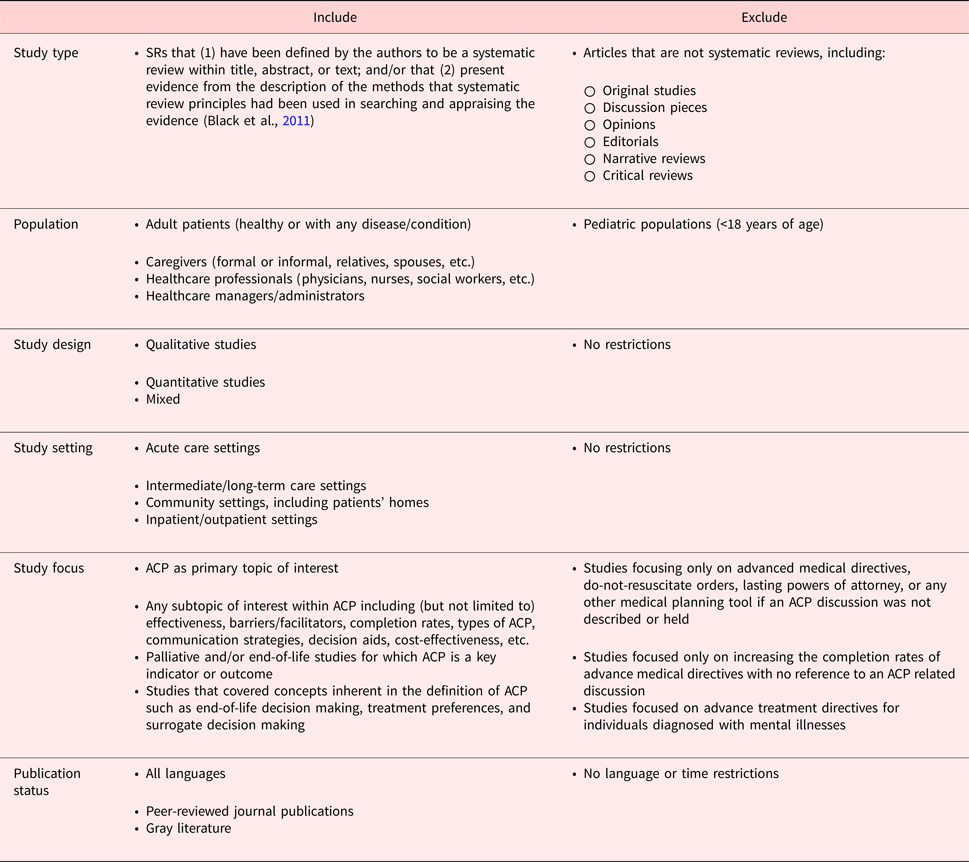
We developed an a priori exclusion and inclusion criteria scheme (Table 1), including SRs that mentioned advance medical directives (AD), do-not-resuscitate, do-not-hospitalize, and lasting power of attorney as well as ACP if they describe that a discussion between patient and medical professional took place in any setting. Further, studies that covered concepts inherent in the definition of ACP such as EOL decision-making, treatment preferences, surrogate decision-making, and so on are included.
Inclusion and exclusion criteria

ACP, advanced care planning; SR, systematic reviews.
To comprehensively cover the ACP literature, there were no restrictions on study designs, populations, settings, or stakeholders involved in the discussions. No language, geographical, or publication date restrictions were applied.
Screening and selection of studies
Two authors (G.J. and W.S.T.) independently screened titles, abstracts, and keywords to identify relevant studies for full-text review. Three authors (G.J., W.S.T., and A.K.V.) independently screened full texts for final inclusion. Discrepancies were resolved through discussion and consensus.
Data extraction and critical appraisal of included studies
We developed a data extraction table that included general information; topic of paper; population, interest, context, outcomes; methodology, results, and conclusions; and future research (Appendix B).
Full data extraction of all included studies was performed by the lead author (G.J.). A second author (A.K.V.) performed data extraction on a random sample of 20% of the included studied; results were compared for consistency. There were minimal discrepancies (10%), which were resolved by discussion and reappraisal. The second author also reviewed the data extraction performed by the lead author for the remaining studies.
We assessed the quality of included SRs to evaluate their methodological rigor and strength of the evidence they provide, using a modified version of the Assessing the Methodological Quality of Systematic Reviews tool, an 11-item checklist widely used to evaluate the methodological quality of mainly quantitative systematic reviews (see Appendix C) (Shea et al., Reference Shea, Grimshaw and Wells2007). We modified this tool as described in Lou et al. (Reference Lou, Carstensen and Jorgensen2017), in which items 9 and 10 were adapted and excluded, respectively, to evaluate SRs that followed a narrative approach, and used qualitative or mixed methodologies.
Our adapted checklist contained 10 items for a maximum score of 10. A review that adequately met all of the 10 criteria was considered to be of the highest quality. The quality rating was as follows: a score (of 10 criteria) rating of 8 to 10 is considered high quality, 4–7 as moderate quality, and 3 or lower as low quality (Bashi et al., Reference Bashi, Karunanithi and Fatehi2017). The quality scores were not used to exclude articles from our overview but to inform about the quality of the research and guide the interpretation of the findings (for details on the quality assessment for each SR, see Appendix C). Similar to the data extraction process, G.J. performed quality assessment on all studies and A.K.V. performed the same process on a random sample of 20% of the studies. There were no discrepancies. The second author also reviewed the quality appraisal performed by the lead author for the remaining articles.
Data analysis, synthesis, and presentation
Data analysis was informed by the Framework Method involving thematic analysis (Gale et al., Reference Gale, Heath and Cameron2013; Mays & Pope, Reference Mays and Pope1995; Ritchie & Lewis, Reference Ritchie and Lewis2003). Two reviewers (G.J. and W.S.T.) performed the familiarization and coding stages with the articles derived from the manual search. This served to identify recurrent themes and main topics of the reviews in the literature and to develop the working analytical framework displayed in the standardized extraction form in Microsoft Excel (Appendix B), which was used to categorize information along predetermined categories. Through reflection and iteration, thematic categories were further refined to derive a final set of codes to interpret the results. The data are presented using a narrative, descriptive approach typically used in cases in which the research question dictates the inclusion of a wide range of research designs, including qualitative and/or quantitative findings (Gilissen et al., Reference Gilissen, Pivodic and Smets2017). Additionally, research gaps were identified from the included studies and thematically organized, ensuring consistency with the rest of the presented results. Given the heterogeneity of the included studies, it was not possible to pool results or use meta-analytical approaches.
This work was based on publicly available literature and did not require ethics approval.
Results
Search results
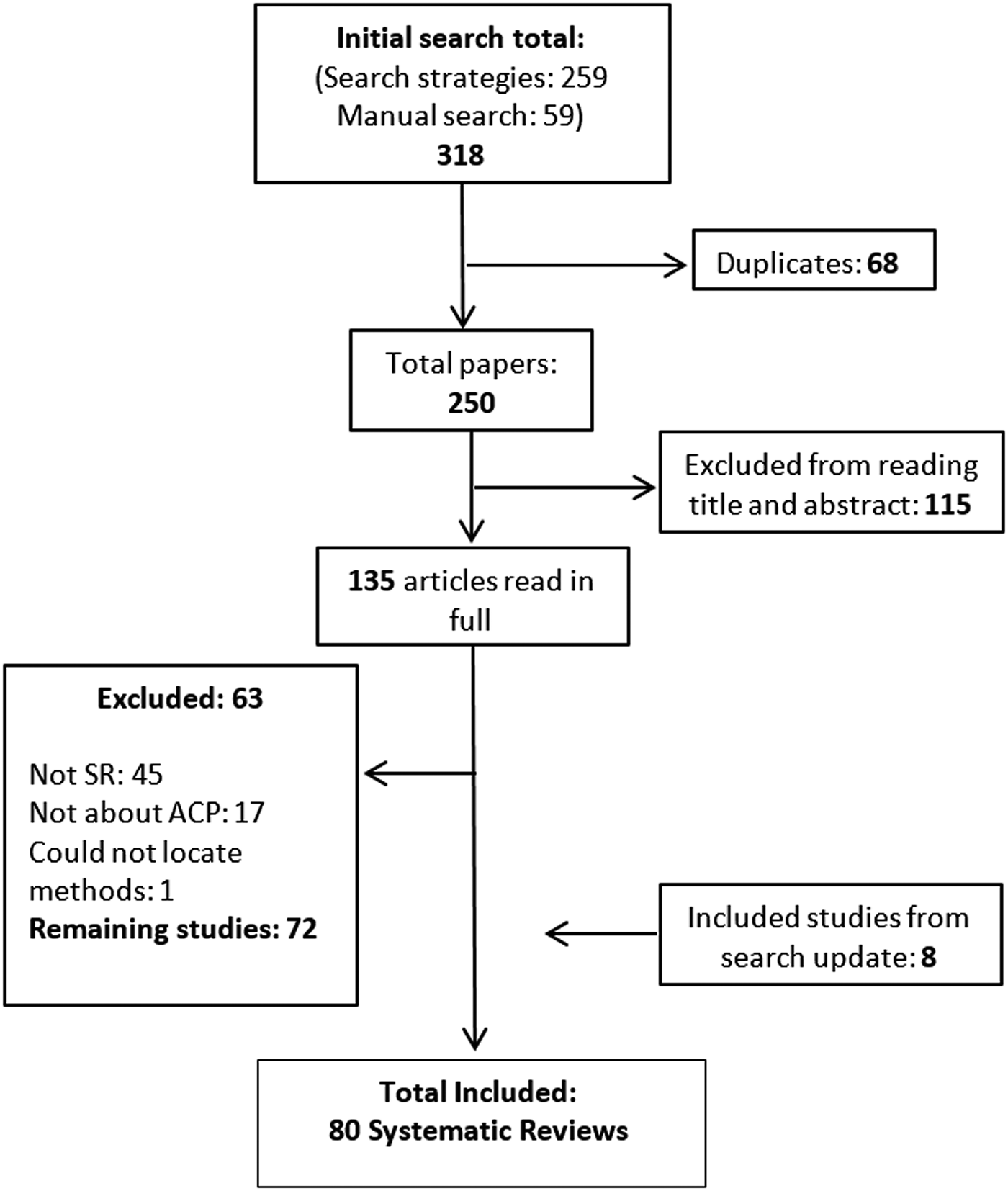
Keyword searches on the electronic databases returned 259 articles; manual searches on Google and Google Scholar resulted in 59 articles. Gray literature searches resulted in no additional articles. After deduplication, 250 papers were subjected to title and abstract screening. After this process, we excluded 115 articles and retrieved the full texts of the 135 remaining articles for full text screening, from which 72 were deemed appropriate for inclusion. The search update resulted in eight additional studies. Final analysis was performed on 80 SRs, which form the basis of this overview. The search results and details can be seen in the PRISMA flowchart in Figure 1 and for the list of excluded studies, please refer to Appendix D.
PRISMA diagram of search results. ACP, advanced care planning; SR, systematic reviews.

Study characteristics
The table in Appendix E lists and provides the characteristics of the 80 included SRs. The number of single studies included in the SRs and therefore covered by our overview is 1,662. From these, 316 studies were included in more than one SR. The majority of these studies were peer-reviewed journal articles, but the SRs also included guidelines or pathways, government organization reports, and book chapters. The most frequently included studies were the article describing the Study to Understand Prognoses and Preferences for Outcomes and Risks of Treatments trial (in 10 SRs) (The SUPPORT Principal Investigators, 1995), an article by Molloy et al. (Reference Molloy, Guyatt and Russo2000) describing the implementation of an advance directive program in nursing homes (in 11 SRs), and an article by Morrison et al. (Reference Morrison, Chichin and Carter2005) explaining the effect of a social work intervention for ACP documentation (in 12 SRs).
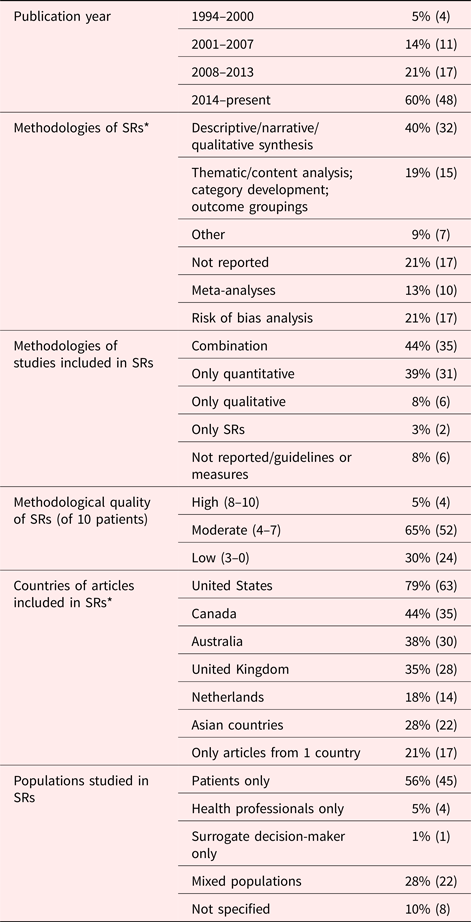
A summary of the characteristics of the SRs included in this study can be found in Table 2. The majority (60%) of the SRs were published from 2014 and onwards. SRs used qualitative methodologies including narrative or descriptive synthesis, or thematic analyses, because of the heterogeneity of their included studies. Ten of the 80 SRs reported meta-analyses, eight of them being performed only in a subset of their total included studies. Seventeen SRs explicitly performed risk of bias analysis, providing different levels of details and overall reporting high or unclear risk of biases.
Summary of SRs’ characteristics

ACP, advanced care planning; SR, systematic reviews.
* Nonexclusive categories.
The large majority of included SRs (95%) were of moderate to low methodological quality. Notably, none of the 80 included SRs satisfied the criterion about indicating the conflict of interest for each of their included studies, and only three provided a list or referenced the excluded studies, which accounted for the lower scores for the vast majority of SRs. Most studies included in the SRs come from high-income, Western countries, and more than half of all the SRs looked at patient populations only.
SRs’ main topics
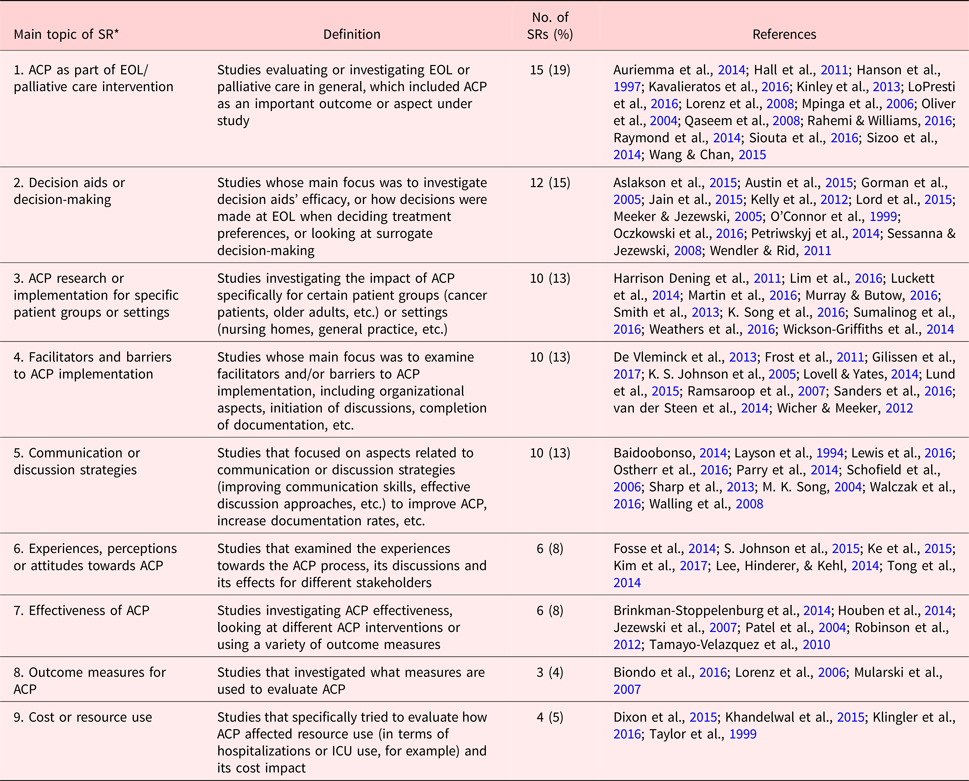
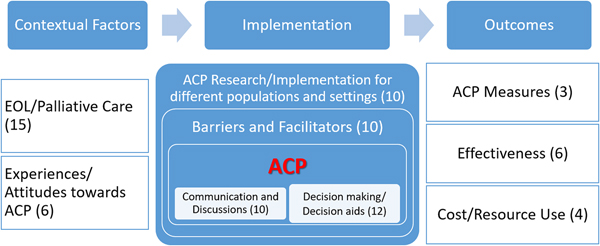
We identified nine main topics, under which the majority of the SRs were classified. These include: ACP as part of EOL or palliative care interventions, care decision making, communication strategies, factors influencing ACP implementation, ACP for specific patient groups, ACP effectiveness, ACP experiences, ACP cost, and ACP outcome measures. Given that a large number of reviews touched upon one or several topics, the primary topic of each review was used for categorization. Detailed elaboration of each main topic with the relevant number of reviews covered are provided in Table 3.
Main topics and number of systematic reviews in each

* Four systematic reviews were classified as having “other” main topics. ACP, advanced care planning; EOL, end of life; ICU, intensive care unit; SR, systematic reviews.
Four reviews were categorized under “others” as their main topics were educational interventions (Chung et al., Reference Chung, Oczkowski and Hanvey2016; Durbin et al., Reference Durbin, Fish and Bachman2010), the evaluation of a specific ACP program, the Provider Orders for Life Sustaining Treatments (Hickman et al., Reference Hickman, Keevern and Hammes2015), and ACP policy impact (Zager & Yancy, Reference Zager and Yancy2011). Figure 2 provides a framework for the role of each topic within the concept of ACP.
SR's main topics (in parentheses, number of SRs per topic). Source: authors’ analysis. *Four systematic reviews were classified as having “other” main topics. ACP, advanced care planning; EOL, end of life; SR, systematic reviews.

Most commonly studied interventions and outcome measures
In line with the most studied topics, the most commonly studied interventions were those aimed at improving EOL or palliative care (Hall et al., Reference Hall, Kolliakou and Petkova2011; Kavalieratos et al., Reference Kavalieratos, Corbelli and Zhang2016; Khandelwal et al., Reference Khandelwal, Kross and Engelberg2015; Lorenz et al., Reference Lorenz, Lynn and Dy2008; Walling et al., Reference Walling, Lorenz and Dy2008; Wickson-Griffiths et al., Reference Wickson-Griffiths, Kaasaleinen and Ploeag2014). Then, several reviews focused on ACP interventions, either comparing different ACP formats (Austin et al., Reference Austin, Mohottige and Sudore2015; Dixon et al., Reference Dixon, Matosevic and Knapp2015; Walczak et al., Reference Walczak, Butow and Bu2016) or looking at whether they affected diverse outcomes (Baidoobonso, Reference Baidoobonso2014; Brinkman-Stoppelenburg et al., Reference Brinkman-Stoppelenburg, Rietjens and van der Heide2014). Also, some studies reviewed specific types of ACP such as the Provider Orders for Life Sustaining Treatments (Hickman et al., Reference Hickman, Keevern and Hammes2015) and the “Let me decide,” “Let me talk,” or other ACP programs (Wickson-Griffiths et al., Reference Wickson-Griffiths, Kaasaleinen and Ploeag2014). Some studies focused on specific aspects within our ACP definition, such as evaluating interventions that focused on ADs (Brinkman-Stoppelenburg et al., Reference Brinkman-Stoppelenburg, Rietjens and van der Heide2014; Houben et al., Reference Houben, Spruit and Groenen2014), and do-not-resuscitate and do-not-hospitalize orders (Brinkman-Stoppelenburg et al., Reference Brinkman-Stoppelenburg, Rietjens and van der Heide2014). Several studies looked at interventions involving decision aids or decision-making (Aslakson et al., Reference Aslakson, Schuster and Reardon2015; Jain et al., Reference Jain, Corriveau and Quinn2015; Sessanna & Jezewski, Reference Sessanna and Jezewski2008; Song et al., Reference Song, Amatya and Voutier2016), communication or discussion strategies (Baidoobonso, Reference Baidoobonso2014; Oczkowski et al., Reference Oczkowski, Chung and Hanvey2016; Walczak et al., Reference Walczak, Butow and Bu2016; Walling et al., Reference Walling, Lorenz and Dy2008), and interventions focused on providing information or education to different stakeholders such as patients, carers, and healthcare providers (Durbin et al., Reference Durbin, Fish and Bachman2010; Hanson et al., Reference Hanson, Tulsky and Danis1997; Jezewski et al., Reference Jezewski, Meeker and Sessanna2007; Patel et al., Reference Patel, Sinuff and Cook2004; Ramsaroop et al., Reference Ramsaroop, Reid and Adelman2007; Tamayo-Velazquez et al., Reference Tamayo-Velazquez, Simon-Lorda and Villegas-Portero2010; Walczak et al., Reference Walczak, Butow and Bu2016).
Examples of outcomes to measure the effectiveness or quality of ACP in the SRs follow.
• Presence of ACP/EOL discussions (with different stakeholders) (Hickman et al., Reference Hickman, Keevern and Hammes2015; Murray & Butow, Reference Murray and Butow2016; Rahemi & Williams, Reference Rahemi and Williams2016; Sanders et al., Reference Sanders, Robinson and Block2016; Smith et al., Reference Smith, Jaffray and Ellis2013; Song et al., Reference Song, Amatya and Voutier2016; Sumalinog et al., Reference Sumalinog, Harrington and Dosani2016; Weathers et al., Reference Weathers, O'Caoimh and Cornally2016).
• Completion outcomes: ACP document completion or documentation of preferences (Baidoobonso, Reference Baidoobonso2014; LoPresti et al., Reference LoPresti, Dement and Gold2016; Sumalinog et al., Reference Sumalinog, Harrington and Dosani2016; Wang & Chan, Reference Wang and Chan2015; Weathers et al., Reference Weathers, O'Caoimh and Cornally2016); AD use or AD completion rates (LoPresti et al., Reference LoPresti, Dement and Gold2016; Ramsaroop et al., Reference Ramsaroop, Reid and Adelman2007; Sanders et al., Reference Sanders, Robinson and Block2016; Sumalinog et al., Reference Sumalinog, Harrington and Dosani2016; Wang & Chan, Reference Wang and Chan2015; Weathers et al., Reference Weathers, O'Caoimh and Cornally2016; Wicher & Meeker, Reference Wicher and Meeker2012).
• Concordance outcomes: concordance between patients’ and families’ wishes (Baidoobonso, Reference Baidoobonso2014; Ke et al., Reference Ke, Huang and O'Connor2015; Martin et al., Reference Martin, Hayes and Gregorevic2016; Meeker & Jezewski, Reference Meeker and Jezewski2005); concordance of preferences with actual treatment (Murray & Butow, Reference Murray and Butow2016).
• Preference outcomes: preferences for or use of life-prolonging measures (Johnson et al., Reference Johnson, Elbert-Avila and Tulsky2005; LoPresti et al., Reference LoPresti, Dement and Gold2016; Martin et al., Reference Martin, Hayes and Gregorevic2016; Ramsaroop et al., Reference Ramsaroop, Reid and Adelman2007; Wicher & Meeker, Reference Wicher and Meeker2012); preferred place of death (Martin et al., Reference Martin, Hayes and Gregorevic2016; Rahemi & Williams, Reference Rahemi and Williams2016).
• Healthcare/resource utilization outcomes: resource use (Weathers et al., Reference Weathers, O'Caoimh and Cornally2016); hospitalization rates (Martin et al., Reference Martin, Hayes and Gregorevic2016; Oliver et al., Reference Oliver, Porock and Zweig2004; Weathers et al., Reference Weathers, O'Caoimh and Cornally2016); number of days spent at the hospital or intensive care unit (ICU) (Baidoobonso, Reference Baidoobonso2014; Dixon et al., Reference Dixon, Matosevic and Knapp2015; Khandelwal et al., Reference Khandelwal, Kross and Engelberg2015); ICU use (Baidoobonso, Reference Baidoobonso2014; Khandelwal et al., Reference Khandelwal, Kross and Engelberg2015); hospice care/use (Baidoobonso, Reference Baidoobonso2014; LoPresti et al., Reference LoPresti, Dement and Gold2016; Rahemi & Williams, Reference Rahemi and Williams2016; Wicher & Meeker, Reference Wicher and Meeker2012); palliative care referrals (Martin et al., Reference Martin, Hayes and Gregorevic2016; Oliver et al., Reference Oliver, Porock and Zweig2004).
• Satisfaction with care outcomes (Murray & Butow, Reference Murray and Butow2016; Weathers et al., Reference Weathers, O'Caoimh and Cornally2016).
Additionally, an SR that reviewed the evidence about patients with chronic kidney disease (Luckett et al., Reference Luckett, Sellars and Tieman2014) found that 110 measures were used, most commonly relating to patient and/or family preferences, attitudes and knowledge, and AD completion rates. Another SR (Biondo et al., Reference Biondo, Lee and Davison2016) found that documentation of patients’ EOL treatment wishes was the most common outcome measure (in 76% of included its studies), followed by the occurrence of ACP/AD/EOL care (in 57% of its studies) and by healthcare resource utilization outcomes (in 39% of its studies). Patient-, family-, or healthcare professional–reported outcomes were less commonly measured (reported by 13%, 4%, and 20% of its studies, respectively). Concordance measures (e.g., dying in place of choice) were reported by 26% of the studies included in this review (Biondo et al., Reference Biondo, Lee and Davison2016).
ACP knowledge and research gaps, as presented in the included SRs
The studied SRs include in their analyses and mention several aspects that are either missing or provide insufficient knowledge regarding ACP.
First, differing legislations between countries and within states of countries, and differing terms used to describe the process and documents, hinder successful ACP processes (Smith et al., Reference Smith, Jaffray and Ellis2013). There is lack of research on promotion and implementation of AD and ACP, especially when taking into account the need to move from a hospital- to a community-based EOL care model (Wang & Chan, Reference Wang and Chan2015).
Patients and caregivers tend to avoid discussions or documentation of EOL care, as they felt these “are connected to death and loss of hope” (Murray & Butow, Reference Murray and Butow2016). Health professionals reported that the rigidity of using structured forms may leave out discussions about important issues that are not included in them, and the presence of various forms causes confusion and challenges when trying to explain them (Hickman et al., Reference Hickman, Keevern and Hammes2015; Ke et al., Reference Ke, Huang and O'Connor2015).
Another gap refers to EOL discussions not occurring as much as they should. A low number of patients with primary malignant brain tumors had EOL discussions regarding treatment preferences, healthcare proxy, palliative care consultation, hospice discussion, and resuscitation wishes; when these discussions took place, many physicians were not aware of their patients’ EOL preferences (Sizoo et al., Reference Sizoo, Pasman and Dirven2014; K. Song et al., Reference Song, Amatya and Voutier2016). Another study points to even lower numbers of discussions being held with frail, older people, even though in most cases they wanted to have them (Sharp, Moran, Kuhn, & Barclay, Reference Sharp, Moran and Kuhn2013). Because healthcare professionals fail to initiate the AD discussion, they lack knowledge regarding what is important for their older patients’ EOL care needs and preferences (Sessanna & Jezewski, Reference Sessanna and Jezewski2008).
The SRs also mention limited evidence about the timeliness and initiation of ACP discussions. For example, for patients with dementia, there is limited and unclear evidence on how to best approach ACP; in motor neuron disease, evidence varies between studies, suggesting discussions should occur earlier and others suggesting they should occur at more advanced stages (Harrison Dening et al., Reference Harrison Dening, Jones and Sampson2011; Murray & Butow, Reference Murray and Butow2016). An important barrier to these conversations is related to prognosis. In many cases, prognoses are inadequately documented and overestimated (Walling et al., Reference Walling, Lorenz and Dy2008), and discussions are hindered because of unclear terminal diagnosis (Sharp et al., Reference Sharp, Moran and Kuhn2013). There is also a lack of information regarding the best setting for these discussions (S. Johnson et al., Reference Johnson, Butow and Kerridge2015).
Other gaps mentioned in the SRs include the variability in terms of the amount of information patients and caregivers want to know (K. S. Johnson et al., Reference Johnson, Elbert-Avila and Tulsky2005). There is a need for enhanced EOL communication and for practical support, especially for family caregivers, who report unavailability from healthcare professionals (Lord et al., Reference Lord, Livingston and Cooper2015). It is also difficult to elucidate what constitutes optimal content (Murray & Butow, Reference Murray and Butow2016); the amount and type of preferences to be included and the level of detail the form should include is not well established and affects the process of decision-making.
There is little research regarding triggers for referral to palliative care services and inadequate evidence of EOL care and ACP in nursing homes (Dixon et al., Reference Dixon, Matosevic and Knapp2015; Taylor et al., Reference Taylor, Heyland and Taylor1999). The SRs also point to a lack of research about ACP for brain tumor patients (K. Song et al., Reference Song, Amatya and Voutier2016), chronic heart failure and chronic obstructive pulmonary disease patients (Siouta et al., Reference Siouta, van Beek and Preston2016), and hemodialysis patients (Lim et al., Reference Lim, Ng and Cheng2016). There is also a need for interventions to reduce disparities among older adults from underrepresented groups given the great diversity of their EOL preferences (Rahemi & Williams, Reference Rahemi and Williams2016).
There are few or no data on other ACP-related important outcomes such as confidence in decision-making, patients’ sense of control and autonomy, actual use of healthcare services (including use of life-sustaining treatments), congruence of EOL treatments with advance care plans, impact on knowledge of ACP, EOL care preferences, satisfaction with healthcare, psychological and emotional effects of EOL discussions, and quality of life and quality of death (Houben et al., Reference Houben, Spruit and Groenen2014; Jain et al., Reference Jain, Corriveau and Quinn2015; M. K. Song, Reference Song2004). Also, there is a lack of high-quality evidence supporting reduced resource use and cost savings (Dixon et al., Reference Dixon, Matosevic and Knapp2015; Taylor et al., Reference Taylor, Heyland and Taylor1999).
Discussion
There is a large body of research on ACP as evidenced by the high number of published SRs about the topic. Our broad conceptualization of ACP allowed us to uncover that the majority of this research (almost three-quarters, according to our findings) comes from studies focusing on the following five main topics: investigations on EOL or palliative care, EOL decision-making or use of decision aids, EOL communication or discussion strategies, barriers and facilitators for ACP, and investigations regarding ACP for specific populations or settings. Additional main topics included experiences or perceptions toward ACP, ACP effectiveness, outcome measures, and ACP cost or resource use.
The largest proportion of ACP-related research has been published since 2014, demonstrating the importance that this process has gained in clinical and EOL care during recent times. The majority of the research has been published in the United States, Canada, and the United Kingdom following the interest and policies enacted in these countries, such as The Patient Self Determination Act of 1991 in the United States and the End of Life Care Strategy for England in 2008, for example. Hence, legislation provides a stimulus for research and accompanying funding as also evident in other research (Kinley et al., Reference Kinley, Froggatt and Bennett2013; Oliver et al., Reference Oliver, Porock and Zweig2004). With greater adoption of ACP outside of North America and Western Europe, greater attention should be paid to contextualizing current evidence for other settings and to initiating research in these countries.
One striking feature revealed by the SRs is the heterogeneity and low quality of included studies. Almost one-half of the SRs had included studies with more than one methodology, and even in the one-third that included only quantitative studies, most were still too heterogeneous to allow pooling results. Additionally, not only were the studies included in the SRs of generally poor methodological quality, but also the SRs themselves were mostly of moderate to low quality.
Comparing the most recurrent ACP outcomes we found in the published SRs against a recent organizing framework of ACP outcomes based on a Delphi panel of ACP experts (Sudore, Heyland, et al., Reference Sudore, Heyland and Lum2017) brings forth interesting results. On the one hand, several important outcomes present in the literature coincide with the opinions of experts (e.g., care received being consistent with goals, holding the discussion about values and care preferences with patient, surrogates and clinicians, the documentation of these preferences). On the other hand, there are also discrepancies. Although experts placed a lot of importance for outcomes regarding ACP documentation being included in the medical records and easily accessible, this outcome is not currently studied in our included SRs. Conversely, in the literature, we found outcomes such as hospitalization and ICU use, healthcare expenditures, hospice care use, and so on, being consistently studied, whereas experts gave overall care utilization outcomes lower ratings of importance. Additional outcomes commonly present in the literature include satisfaction with care and concordance between patients’ and families’ wishes, which were also given a lower ranking by experts, and palliative care referrals, which was not included as measure for successful ACP by experts. A possible explanation for this discrepancy could be that the opinion of experts does not necessarily take into account what is important for other stakeholders, such as patients, family caregivers, or healthcare administrators. As a result, it is important to highlight that the outcomes that ranked lower according the panel of experts does not mean that they are not important outcomes to measure ACP. That these measures have been consistently studied in the literature should be an indication that they may be important outcomes for the other stakeholders mentioned previously and therefore be taken into account as a measure of ACP success and funding allocation.
Most of the published research focuses on discrete, specific events within ACP, as opposed to seeing it as a complex intervention and a holistic program. Because ACP is a continuous, iterative process involving multiple stakeholders and phases, usually across various settings, evaluations or interventions only about specific parts of the process (i.e., EOL decision-making, communication interventions, education and training, completion of documents, and cost evaluations) may not result in improvements or accurate representation of the process as a whole. As shown in other studies, a “whole-system” approach to ACP may provide better insights and improve outcomes for patients, family caregivers, and the health system (Detering et al., Reference Detering, Hancock and Reade2010; Luckett et al., Reference Luckett, Sellars and Tieman2014). Additionally, in many studies, ACP is embedded as part of a larger EOL or palliative care program. In such situations, it is difficult to interpret the results regarding ACP and it is unclear whether the outcomes are driven by ACP or other parts of the program. Greater accuracy and transparency in reporting is warranted.
One of the most important messages coming from the SRs is the need for further research at different levels, both in its comprehensiveness as well as in its quality. The apparent reluctance from the general public to hold ACP conversations is a result of confusing legislation and documentation, combined with a lack of promotion of ACP, especially in the community. There is a clear need to streamline policies and to deploy public awareness campaigns to educate the public on ACP and normalize conversations about death. This should increase ACP receptivity at a societal level. Additionally, there should be enhanced training for health professionals on EOL communication and diagnosing skills so that they can support patients and their families when making decisions and at an emotional level. This should also improve ACP receptivity in addition to facilitating ACP implementation and utilization.
There is clearly a lack of knowledge regarding the best timing, setting, and content for holding optimal ACP discussions. To further improve ACP implementation, research should focus on elucidating when to initiate these conversations and the amount of information patients and their families want to know, especially for different disease groups, because needs and decisions may be different from one patient group to another. Also, research on outcomes such as congruence between ACP and received treatment, satisfaction/emotional/quality of life outcomes, and resource use/cost-saving outcomes should be prioritized to clarify ACP's real impact.
Higher quality and more diverse approaches are needed to explore specific research questions. For example, complex evaluation research (Craig et al., Reference Craig, Dieppe and Macintyre2008), which has the capacity of evaluating interventions containing several interacting components, could be implemented for evaluating ACP effectiveness because ACP is a form of complex intervention. Additionally, future work could require applying implementation science frameworks to address the gaps described previously to improve the implementation of ACP programmes. However, as a result of the current research gaps and low-quality evidence, overarching best practices cannot be provided.
There are some strengths and limitations to this overview. To our knowledge, this is the first study reviewing the state of research regarding ACP as a comprehensive process, without restrictions of populations, settings, and methodologies. Our main strength is the comprehensive ACP definition we adopted, which allowed us to include explicit ACP research, as well as conceptually relevant ACP aspects regardless of the presence of the term “ACP” itself. This should also ameliorate an inevitable systematic review limitation, namely that our search strategy might not have captured all available evidence. Our focus on SRs may have excluded other research that might potentially provide important insights into the conduct of the ACP process. However, we included systematic reviews to have a minimum standard of methodological and scientific quality of included studies.
In conclusion, ACP has gained much importance in EOL care in the past decade, as reflected in the amount of research about this topic. Despite the evident surge in ACP research, there are still many gaps and, given the low quality of the available evidence, it is not yet possible to provide unequivocal best practices that apply to all populations and settings. Research has mostly focused on discrete aspects within ACP (such as the those mentioned previously, namely preference documentation, discussion or communication strategies, decision aids for decision making, surrogate experiences) instead of looking at ACP in a holistic way, in which its different parts rely on one another and include many stakeholders, multiple settings, and different stages. Higher quality and more diverse approaches, such as complex evaluation research, in different countries are needed to explore specific research questions. Only in this way we will be able to develop effective ACP programs based on reliable evidence to improve the quality of palliative and EOL care.
Acknowledgments
The authors thank Caroline Pang, LKC Medicine medical librarian, for her support with the search process and development of strategies.
The work for this overview was supported by a project commissioned by the Agency for Integrated Care and the Ministry of Health of Singapore to evaluate the local Advance Care Planning program (https://livingmatters.sg/).
Supplementary material
The supplementary material for this article can be found at https://doi.org/10.1017/S1478951518000500.
Conflicts of interest
The authors declare no conflict of interest with respect to the research, authorship, and/or publication of this article.