Implications
The present study identifies risk factors associated with exposure to Salmonella, Neospora caninum and Leptospira interrogans serovar hardjo in an extensive, pasture-based, seasonal-calving system of dairy production such as exists in the Republic of Ireland. This study provides important information to underpin herd control programmes for these abortifacient agents, as more farmers are adopting more extensive pasture-based systems and only limited data is currently available on risk factors in such a farming system.
Introduction
An investigation of the temporal trends in bulk milk antibody levels to Salmonella, Neospora caninum (N. caninum) and Leptospira interrogans serovar hardjo (L. hardjo) in Irish dairy herds was completed in 2009 (O’Doherty et al., Reference O’Doherty, Sayers and O’Grady2013). This study documented herd-level seroprevalences of 49%, 19% and 86% for Salmonella, N. caninum and L. hardjo, respectively, with no association found to exist between the prevalence of these pathogens with one another. The clinical manifestations of these infectious agents, which include abortion, poor calf health and mortality, have been shown in international cattle populations to have an adverse effect on the economic performance of dairy herds (Bennett, Reference Bennett1993; Visser et al., Reference Visser, Veling, Dijhuizen and Huirne1997; Chi et al., Reference Chi, VanLeeuwen, Weersink and Keefe2002). Control of these pathogens at farm level is therefore important to dairy farmers.
Previous dairy herd studies have identified herd size, purchase of animals, and calving season as risk factors for Salmonella (Evans and Davies, Reference Evans and Davies1996; Vaessen et al., Reference Vaessen, Veling, Frankena, Graat and Klunder1998; Carrique-Mas et al., Reference Carrique-Mas, Willmington, Papadopoulou, Watson and Davies2010), N. caninum (Björkman, et al., Reference Björkman, Alenius, Emanuelsson and Uggla1996; Ould-Amrouche et al., Reference Ould-Amrouche, Klein, Osdoit, Mohamed, Touratier, Sanaa and Mialot1999; Schäres et al., Reference Schäres, Barwald, Staubach, Ziller, Klos, Schroder, Labohm, Drager, Fasen, Hess and Conraths2004; Dubey et al., Reference Dubey, Schares and Ortega-More2007), and L. hardjo (Leonard et al., Reference Leonard, Mee, Snijders and Mackie2004; Van Schaik et al., Reference Van Schaik, Schukken, Nielen, Dijkhuizen, Barkema and Benedictus2002; Ryan et al., Reference Ryan, Leonard, O’Grady, Doherty and More2012).
Risk factors specific for presence and exposure to Salmonella in dairy herds include geographical region, the prevalence of Salmonella positive herds in the surrounding geographical region, importation of farm manure, concurrent infection with liver fluke, use of calving facilities to house sick animals, and access of birds or rodents to animal feed supplies (Evans and Davies, Reference Evans and Davies1996; Vaessen et al., Reference Vaessen, Veling, Frankena, Graat and Klunder1998; Wedderkoop et al., Reference Wedderkoop, Stroger and Lind2001; Carrique-Mas et al., Reference Carrique-Mas, Willmington, Papadopoulou, Watson and Davies2010).
N. caninum specific risk factors include the presence of farm dogs, access to pond water, the presence of older animals in herds and rearing home-bred replacements (Bartels et al., Reference Bartels, Wouda and Schukken1999; Ould-Amrouche et al., Reference Ould-Amrouche, Klein, Osdoit, Mohamed, Touratier, Sanaa and Mialot1999; Schäres et al., Reference Schäres, Barwald, Staubach, Ziller, Klos, Schroder, Labohm, Drager, Fasen, Hess and Conraths2004; Frössling et al., Reference Frössling, Uggla and Björkman2005). Additional risk factors specific to L. hardjo include geographical region, co-grazing with infected animals, access to contaminated water sources and natural-mating (Leonard et al., Reference Leonard, Mee, Snijders and Mackie2004; Ryan et al., Reference Ryan, Leonard, O’Grady, Doherty and More2012).
Irish dairying is based on an extensive, pasture-based system of livestock production, operating at a stocking rate of, on average, 1.85 livestock units per hectare (LU/ha) (Dillon, Reference Dillon2011). Such systems involve calving cows to coincide with the period of maximum grass growth, that is springtime (Dillon et al., Reference Dillon, Crosse, Stakelum and Flynn1995), with cows being fed grazed grass outdoors for up to 235 days of lactation (Drennan et al., Reference Drennan, Carson and Crosse2005). Few studies have documented pathogen exposure risk factors for such extensive production systems (Leonard et al., Reference Leonard, Mee, Snijders and Mackie2004). In addition, the majority of previous studies examined risk factors for the presence of the actual pathogen (Evans and Davies, Reference Evans and Davies1996; Vaessen et al., Reference Vaessen, Veling, Frankena, Graat and Klunder1998; Bartels et al., Reference Bartels, Wouda and Schukken1999; Carrique-Mas et al., Reference Carrique-Mas, Willmington, Papadopoulou, Watson and Davies2010) with limited studies on identification of risk factors associated with bulk milk seropositivity (Leonard et al., Reference Leonard, Mee, Snijders and Mackie2004; Wedderkoop et al., Reference Wedderkoop, Stroger and Lind2001; Schäres et al., Reference Schäres, Barwald, Staubach, Ziller, Klos, Schroder, Labohm, Drager, Fasen, Hess and Conraths2004). As bulk milk analysis is becoming an important diagnostic tool at farm level for the purposes of herd health planning (McElroy, Reference McElroy2012), identifying risk factors associated with bulk milk seropositivity would prove beneficial. Identification of such risk factors would also assist with promotion of biosecurity implementation (Villarroel et al., Reference Villarroel, Dargatz, Lane, McCluskey and Salman2007) on Irish dairy farms which, at present, is sub-optimal (Sayers et al., Reference Sayers, Sayers, Mee, Bermingham and Dillon2012). The objective of this study therefore was to establish the association between general management and biosecurity-related practices, and bulk milk tank antibody status in unvaccinated herds in order to identify risk factors for exposure to Salmonella, N. caninum and L. hardjo in an extensive grazing production system.
Material and methods
Herd selection
Selection of herds for use in this study has been previously described in detail by O’Doherty et al. (Reference O’Doherty, Sayers and O’Grady2013). Briefly, 312 herds which were members of HerdPlus®, a breeding information decision support tool for farmers co-ordinated by the Irish Cattle Breeding Federation (ICBF), volunteered to participate in the study. Herds were randomly selected within strata of herd size (31 to 65 cows, 66 to 99 cows and >99 cows) and geographical location in Ireland (county; n=26). The number of herds selected per strata was weighted by the number of herds within-stratum in the entire Irish population.
Survey design
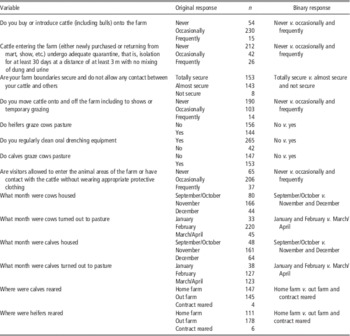
A survey questionnaire comprising 57 questions was compiled from multiple sources including a web-based herd health management tool,Footnote 1 a parasite and grazing management questionnaire (Charlier et al., Reference Charlier, Claerebout, De Muelenaere and Vercruysse2005), and a comprehensive review of literature. Questions broadly related to livestock management, farm visitors, equipment, hygiene and disinfection, and bioexclusion measures such as not purchasing animals, quarantine procedures, access to dogs and to water courses, and wildlife control measures. An additional set of questions was used to obtain data on vaccination protocols employed on each farm for Salmonella and L. hardjo. Of the 57 variables (survey questions), 30 had multiple classes, 27 had binary (yes/no) responses and all were closed-ended. A selection of variables is included in Table 1. The questionnaire was piloted by farm managers on seven Teagasc (Irish Agriculture and Food Development Authority) research farms which led to minor adjustment of the questionnaire. A consultation with researchers at the Animal and Grassland, Research and Innovation Centre, Teagasc, Moorepark also took place to review the final questionnaire before circulation to participating farmers.
Description of selected variables

Survey administration
Survey packs were mailed to each of the 312 study participants in December 2009. Survey packs contained a cover letter, the questionnaire and a self-addressed envelope. A reminder letter was issued to non-respondents in March 2010 followed by a reminder telephone call in May 2010. Surveys were not received from three participants and these herds were removed from further analysis.
Ancillary information
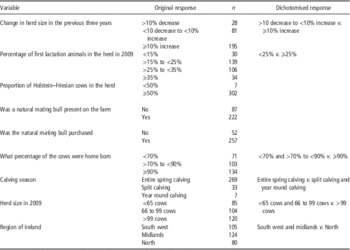
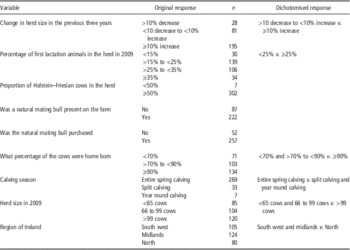
In addition to the self-declared variables collected from the farmer questionnaire, data on a further nine additional risk factors were sourced from the ICBF database. These included the number of dairy cows in 2009, variation in dairy cow numbers between 2006 and 2009, percentage of first lactation animals in the herd in 2009, percentage of home-born dairy cows in the herd in 2009, percentage of Holstein–Friesian animals in the herd in 2009, the presence of a natural-mating bull on the farm, and whether the natural-mating bull was purchased or home-born. The geographic location of each study herd was also considered as a risk factor. Location of study herds was divided into seven geographical regions according to Irish Central Statistics Office (CSO, 2008) survey procedures. These seven regions were subsequently combined into three logical regions based on dairy herd distribution in Ireland. Calving season was also examined as a risk factor for bulk milk seropositivity. Calving season in 2009 was split into three categories; spring-calving (i.e. ⩾85% of the herd calved between January and March), split-calving (i.e.⩽85% of the herd calved between January and March with remaining cows calved between August and December), and herds that did not meet the criteria for inclusion as spring-calving or split-calving were classified as year-round calving. Of the nine additional variables, six had multiple classes and three were binary (Table 2).
Description of the 9 variables derived from ancillary data
Survey validation
The internal consistency of the survey was determined by evaluating the consistency of responses to questions that were repeated throughout the survey using a standardised Chronbach’s coefficient α. Results of the Chronbach’s coefficient α were interpreted using a guide by George and Mallery (Reference George and Mallery2008). A total of three questions were repeated in varying formats. Repeated questions related to importation of slurry from other farms, feeding of feedstuffs to farm animals that had been in contact with other animals (i.e. wildlife), and access of farm animals to watercourses that have passed through other farms.
Herd classification
Bulk milk samples were collected from each study herd at four time points in 2009 (March, June, August and November) and were tested for antibodies to Salmonella, N. caninum and L. hardjo using commercially available ELISA kits. The sensitivity (Se) of the Salmonella, N. caninum and the L. hardjo ELISAs was 63.2%, 99% and 96.4%, respectively. The specificity (Sp) of each ELISA was 99.7%, 96% and 96.7%, respectively. Herds were classified as vaccinated or unvaccinated for Salmonella and L. hardjo based on farmer-declared survey data. There is no vaccine for N. caninum currently licensed in the Republic of Ireland. The ELISA test result and vaccination status of each herd were combined to determine the antibody status (test negative v. test positive) of study herds. ELISA tests, used for detection of antibodies to Salmonella and L. hardjo in the present study, did not differentiate between vaccinated and exposed herds; therefore vaccinated herds were excluded from further analysis. Unvaccinated herds were classified as negative for exposure to the respective pathogen if the herd recorded a negative bulk milk antibody reading at all of the four sampling time points in 2009 (O’Doherty et al., Reference O’Doherty, Sayers and O’Grady2013). Participants were not aware of the disease status of their herds when completing the survey.
Statistical analysis
Univariate logistic regression analysis using PROC GENMOD (SAS Version 9.1, USA) was first used to determine the association between each of the 66 risk factors (i.e. survey results and ancillary herd information) and bulk milk antibody status in unvaccinated herds. In all analyses the likelihood of a positive antibody status was modelled. A binomial error distribution of the data was assumed in all models and a logit link function was used. In the case of Salmonella and N. caninum, independent variables were dichotomised when logical to do so (Tables 1 and 2). Variables with a never, occasionally (i.e. an event that occurs on rare occasions) and frequently (an event that occurs on a regular basis) response profile were dichotomised to no v. yes responses. In addition, variables on housing and turnout of cows and calves were dichotomised to ‘early’ v. ‘late’ housing and ‘early’ v. ‘late’ turnout. Variables regarding heifer and calf-rearing location were dichotomised to ‘reared on the home farm’ (i.e. the farm where all the activities associated with the dairy enterprise take place) or ‘reared on an outside farm’ (i.e. parcel(s) of land located away from the home farm on which animals are grazed and winter feed supplies are harvested) (Table 1). Multiple responses were retained for certain variables, for example calving season and region, as these provided biologically important information. Due to the small number (n=10) of unvaccinated herds that tested negative for exposure to L. hardjo, all independent variables were dichotomised for the purpose of identifying risk factors for L. hardjo.
Where an association (P⩽0.15) between independent and dependent variables in the univariate analyses was identified, that independent variable was subsequently considered for inclusion in a multivariable analysis. All non-significant (P>0.05) variables were removed in a backwards elimination until only significant (P<0.05) variables remained in the model. In a subsequent forward step each of the non-significant variables were re-introduced into the model individually and if associated (P<0.05) with the dependent variable, they were retained in the final model. Variables that exhibited a low number of responses and for which odds ratios (OR) could not be calculated were removed from the analyses. All two-way interactions between significant variables were quantified.
The predicted probability of a positive ELISA result was calculated from the multivariable model using:
 $$P=(1{\plus}e^{{{\minus}(\alpha {\plus}\beta x)}} )^{{{\minus}1}} $$
where α is the intercept of the model, β is the predicted regression coefficient(s), and x is the design matrix for the variables in the model. The OR and their associated 95% confidence intervals (CI) were also calculated using contrast statements.
Results
Survey validation and response rate
A 99% response rate (309 herds) to the delivered questionnaire was achieved. These herds have previously been shown to geographically represent the Irish national dairy farm population (O’Doherty et al., Reference O’Doherty, Sayers and O’Grady2013). The mean number of non-responders to individual questions was five (range zero (i.e. all respondents provided a response to a particular question) to 36 (i.e. 36 respondents did not supply a response to a particular question)). The Chronbach coefficient α analysis yielded values of 0.79, 0.71 and 0.76 for responses to the same question indicating acceptable internal consistency of responses supplied in the survey.
Descriptive data and herd level antibody status
The average herd size of the study population was 101 cows; 27% of herds had <65 cows, 34% had between 65 and 99 cows, and 39% of herds had in excess of 99 cows. Of the study herds, 87% were spring-calving, 11% were split-calving and 2% were year-round calving. One-third of respondents were located in the South West of the Republic of Ireland, 40% were located in the midlands, and 26% were located in the North of the Republic of Ireland. Cattle were not purchased by 18% of herds, with 24% of survey respondents operating a quarantine facility for cattle entering the farm. Of the study population, only 21% reported that visitors to their farm were never allowed to enter the livestock areas without being dressed in appropriate protective clothing and without having their boots disinfected. Three variables on sharing grazing and buildings with cattle from other farms, regularly inspecting farm boundaries, and rapidly disposing of dead animals exhibited a low response rates within categories and OR values could not be calculated for these variables, 99% of respondents reported that their cattle never shared grazing or buildings with cattle from other farms, 1% reported occasional sharing of grazing and buildings with other cattle, with no respondents reporting frequent sharing of grazing and buildings with cattle from other farms. A total of 298 (96%) respondents reported that they regularly inspected farm boundaries. Of the study population only 1% reported that they did not rapidly dispose of dead animals. As reported by O’Doherty et al. (Reference O’Doherty, Sayers and O’Grady2013) 76% (n=235) of the study herds vaccinated for L. hardjo while 49% (n=151) vaccinated for Salmonella. A total of 158 unvaccinated herds were included in the analysis for Salmonella and 74 unvaccinated herds were included in the analysis for L. hardjo. Of the 158 herds that did not vaccinate for Salmonella, 78 (49%) recorded a test positive result (O’Doherty et al., Reference O’Doherty, Sayers and O’Grady2013). Of the 74 herds that did not vaccinate for L. hardjo, 64 (86%) recorded a test positive result (O’Doherty et al., Reference O’Doherty, Sayers and O’Grady2013). A total of 60 herds (19%) recorded a test positive result for N. caninum (O’Doherty et al., Reference O’Doherty, Sayers and O’Grady2013).
Test positive v. test negative N. caninum herds
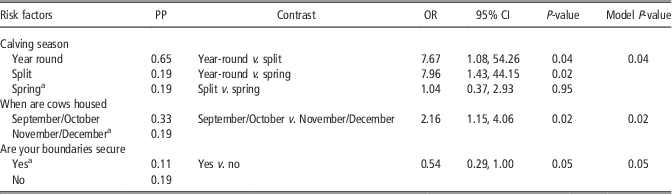
Univariate analyses highlighted several general management and biosecurity-related risk factors associated (P<0.15) with an increased likelihood of being bulk milk test positive to N. caninum. General management factors included earlier housing of cows (P=0.03), year round calving of cows (P=0.01), heifers grazing on cow’s pasture (P=0.005), and grazing different age groups of cattle together (P=0.10). Biosecurity-related factors included the lack of secure farm boundaries (P=0.05), non-provision of adequate quarantine facilities for newly purchased animals (P=0.15), maintenance of clean and secure feed areas (P=0.13), and not testing newly purchased female animals for exposure to N. caninum (P=0.14). A comprehensive description of the associations between these both biosecurity-related and general management factors with N. caninum antibody status from the multivariable model are summarised in Table 3. A greater likelihood of being positive for exposure to N. caninum was observed in herds that practiced year-round calving and in herds that housed cows earlier (Table 3). The multivariable analysis also indicated a greater likelihood of being bulk milk positive to N. caninum in herds where secure farm boundaries were not present (Table 3). No significant two-way interactions were found.
Predicted probabilities (PP), odds ratios (OR) and associated 95% confidence intervals (95% CI) for management practices associated with presence v. absence of antibodies to N. caninum in 309 Irish dairy herds in 2009 in the multivariable analysis

a Referent category for calculation of predicted probabilities.
Test positive v. test negative unvaccinated Salmonella herds
Univariate analyses highlighted biosecurity-related risk factors associated (P<0.15) with an increased likelihood of being test positive to Salmonella. These factors included frequent access to water courses that passed through other farms (P=0.05), herds having greater than three neighbouring farms containing cattle directly bordering the farm (P=0.10), herds that occasionally used agricultural contractors and did not insist that their equipment was clean and disinfected (P=0.15), herds that maintained a clean and secure feed area (P=0.11), and herds that maintained clean housing and yards (P=0.09). General management-related risk factors associated (P<0.15) with an increased likelihood of testing positive to Salmonella in unvaccinated herds included larger herd size (P=0.10), herds that had a >10% reduction in herd size between 2006 and 2009 (P=0.15) and herds that contained <70% home-born animals (P=0.07).
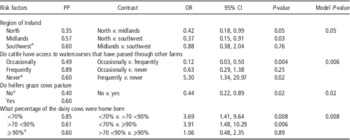
The associations between both general management and biosecurity-related factors with Salmonella antibody status in unvaccinated herds in the multivariable model are summarised in Table 4. A greater likelihood of having a positive bulk milk reading for Salmonella was detected in herds that were located in the southern region of the Republic of Ireland, herds that contained <70% home-born cows, herds that had frequent access to watercourses that passed through other farms, and herds where heifers co-grazed with cows (Table 4). No significant two-way interactions were found.
Predicted probabilities (PP), odds ratios (OR) and associated 95% confidence intervals (95% CI) for management practices associated with presence v. absence of antibodies to Salmonella in 158 unvaccinated Irish dairy herds in 2009 in the multivariable analysis

a Referent category for calculation of predicted probabilities.
Test positive v. test negative unvaccinated L. hardjo herds
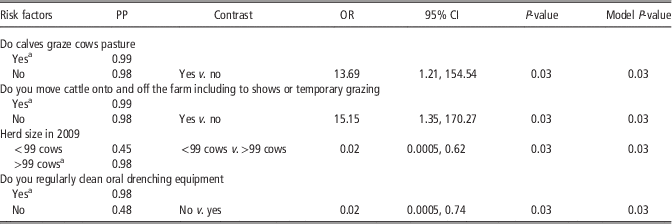
Biosecurity-related risk factors associated (P<0.15) with recording a positive bulk milk reading to L. hardjo in the univariate analysis included movement of cattle onto and off the farm (P=0.02), use agricultural contractors without insisting that their equipment was clean and disinfected (P=0.10), and not minimising the numbers of visitors to the farm (P=0.15). General management-related risk factors associated (P<0.15) with recording a positive bulk milk reading to L. hardjo included greater percentage of first lactation animals (P=0.13), rearing of calves on out farms (P=0.13), housing of calves later in the year (P=0.06), herds with higher numbers of dairy cows in 2009 (P=0.05), and herds that grazed calves on cows pasture (P=0.03). Results from the multivariable model (Table 5) indicate a greater probability of recording a positive bulk milk reading to L. hardjo was detected in herds that moved cattle onto and off the farm and in herds where calves grazed cows pasture. Herds containing higher numbers of cows and herds where oral drenching equipment was regularly cleaned had a higher probability of being antibody positive to L. hardjo. No significant two-way interactions were found.
Predicted probabilities (PP), odds ratios (OR) and associated 95% confidence intervals (95% CI) for management practices associated with presence v. absence of antibodies to Leptospira interrogans serovar hardjo in 74 unvaccinated Irish dairy herds in 2009 in the multivariable analysis

a Referent category for calculation of predicted probabilities.
Discussion
The objective of this study was to determine which farm practices, both general management and biosecurity-related, were risk factors for positive bulk milk results for Salmonella, N. caninum and L. hardjo in unvaccinated Irish dairy herds. As respondents were geographically representative of the national population of dairy farmers (O’Doherty et al., Reference O’Doherty, Sayers and O’Grady2013), and an acceptable measure of survey internal consistency was achieved, this study provides risk information appropriate to pasture-based livestock dairy systems. The results from this study will assist in the design of suitable national control measures to reduce the presence of Salmonella, N. caninum and L. hardjo in Irish dairy herds and similar livestock systems internationally.
N. caninum
This study highlighted a greater likelihood of being bulk milk positive to N. caninum in herds where cows calve throughout the entire year compared to farms operating more compact calving systems. Herds that operate a year-round calving system have an opportunity to ‘recycle’ non-pregnant cows throughout the year to minimise culling rates and extend the lactation of cows (Patton, Reference Patton2012). This makes the opportunity to identify sub-fertile animals more difficult potentially leading to retention of cows that would normally be culled from a spring-calving herd due to poorer fertility performance. As split-calving herds also operate discrete calving-seasons (albeit at two different periods), identification of sub-fertile cows is eased compared with year-round systems which may explain why a split-calving has not been identified as a risk factor. Alternatively year-round calving may result in more prolonged exposure of definitive hosts (i.e. canines) to placentas and afterbirths thereby perpetuating the lifecycle of N. caninum. Prolonged exposure to N. caninum infected material may be integral to its persistence within a herd, as this study also highlighted that herds that were housed earlier for the winter period were twice as likely to record a N. caninum positive bulk milk result. This earlier housing may inadvertently prolong exposure of bovine incidental hosts to occyst contaminated feedstuffs/concentrates while indoors.
An unexpected finding was a greater likelihood (P=0.05) of being positive for exposure to N. caninum on farms with non-secure farm boundaries. Secure farm boundaries play a vital role in preventing disease spread between animals on neighbouring farms. There is no evidence, however, to suggest that direct cow to cow transmission of N. caninum exists (Dubey et al., Reference Dubey, Schares and Ortega-More2007) unlike the more infectious viral diseases such as bovine viral diarrhoea and infectious bovine rhinotracheitis where direct animal contact is a highly efficient method of disease spread (Houe, Reference Houe1999). The presence of non-secure boundaries may be indicative of poor overall farm management which may contribute to increased exposure to N. caninum. However, as N. caninum is a relatively newly identified pathogen which was only described first in 1988 (Dubey et al., Reference Dubey, Schares and Ortega-More2007), the role of an, as yet, undetermined transmission method cannot be ruled out.
In the current study no association (P=0.51) was found between access of dogs and a bulk milk positive reading to N. caninum, which was unexpected. The presence of dogs, a definitive host for N. caninum, has previously been identified as a major risk factor for N. caninum in other populations (Bartels et al., Reference Bartels, Wouda and Schukken1999; Schäres et al., Reference Schäres, Barwald, Staubach, Ziller, Klos, Schroder, Labohm, Drager, Fasen, Hess and Conraths2004). Even though 82% of respondents in the present study reported that dogs had access to cow feeding and calving areas, prolonged exposure of dogs to potentially infected placentas and afterbirths would be limited as the majority of study herds calved cows in spring over a very short period of time. In addition, it should also be noted that a bovine brucellosis national eradication programme has operated in Ireland since 1965 (Hayes et al., Reference Hayes, Ashe, Collins, Power, Kenny, Sheahan, O’Hagan and More2009). Correct disposal of placentas and calving-related materials (e.g. gloves, etc.) was widely promoted as was the role of afterbirths in the spread of infectious disease. This will have contributed to many Irish farmers routinely adopting practices to adequately dispose of these materials thereby preventing infection of farm dogs. Calving of cows indoors is common in spring-calving herds which again may increase the efficiency of placental disposal and minimise exposure of dogs to infected material. Finally, as the majority of cows in spring-calving systems are maintained on pasture, and the level of concentrates in the diet is limited, the potential for exposure of cows to faecal-contaminated feed is limited. Alternatively, even though dogs may have been present on study herds, it is possible that the dogs were not infected with N. caninum. It is possible, nonetheless, that this study may have lacked the statistical power to fully evaluate the role of the dog in the spread of N. caninum on study farms. Further investigation of this finding in extensive dairy system is warranted.
In a pasture-based system, the tight calving season and resultant culling policies would appear to be protective against N. caninum. The relationship between culling policy and herd status for N. caninum deserves further investigation to definitively highlight its usefulness as a routine control method.
Salmonella
Carrique-Mas et al. (Reference Carrique-Mas, Willmington, Papadopoulou, Watson and Davies2010) reported a higher prevalence and incidence of Salmonella in areas of England with greater densities of dairy cattle. The greatest density of dairy cattle occurs in southern regions of the Republic of Ireland (Lesschen et al., Reference Lesschen, van der Berg, Westhoek, Witzke and Oenema2011). It was expected, therefore, that a greater probability of being positive to Salmonella would occur in that region. The results generated did indeed highlight this trend with results from the multivariable model indicating a greater likelihood of being bulk milk positive to Salmonella in the southern region. A recent review of farm biosecurity has highlighted maintenance of a closed herd (not purchasing animals) as an important component of a farm biosecurity plan (Mee et al., Reference Mee, Geraghty, O’Neill and More2012). In the present study, however only 18% of respondents did not introduce newly purchased cattle onto their farms. Similarly, a nationwide study of biosecurity on Irish dairy farms (n=450) found that only 12% of Irish dairy farmers operated a closed herd policy (Sayers et al., Reference Sayers, Sayers, Mee, Bermingham and Dillon2013). In the current study of unvaccinated herds, those that purchased cows that is contained fewer than 70% home-born cows were 3.7 times more likely (Table 4) to record a positive bulk milk result to Salmonella. This is in agreement with Vaessen et al. (Reference Vaessen, Veling, Frankena, Graat and Klunder1998) and Evans and Davies (Reference Evans and Davies1996) who found that introduction of cattle is an important risk factor in the spread of Salmonella. A novel finding of this study showed that in herds where heifers grazed cow’s pasture, they were over twice as likely to be bulk milk positive to Salmonella. As far back as 1975, faecal contamination of pasture was highlighted as an efficient method of transmitting Salmonella (Williams, Reference Williams1975). In predominantly pasture-based dairy systems, therefore, grazing of paddocks by management groups of differing ages (e.g. cows and heifers) may be an important mode of Salmonella transmission. A study on biosecurity and risk management practices on dairy replacement rearing units in the United States by Maunsell and Donovan (Reference Maunsell and Donovan2008) identified the minimisation of direct and indirect contact between different age groups of cattle as a practice to prevent new infections occurring in young stock. Grazing of heifers on cows pasture in such livestock systems should therefore be avoided to prevent new infections occurring in young stock.
Salmonellae spp. have been previously isolated from rivers and streams, and water from a stream contaminated with Salmonella was linked to an outbreak of the disease in cattle in the United Kingdom (Williams, Reference Williams1975). Results from the current study support this finding, with herds that had frequent access to watercourses that passed through other farms being more likely to record a positive bulk milk antibody reading to Salmonella. However, it was also highlighted that those herds with occasional access to such watercourses were less likely to be bulk milk positive than those herds with no access. These results suggest that further investigations are necessary to fully understand the role of watercourses in the transmission of Salmonella in pasture-based systems of dairy production.
L. hardjo
A limitation of the current study was the small number of herds that tested negative for L. hardjo, which reduced the statistical power for detection of significant risk factors for the presence of this pathogen.
Leonard et al. (Reference Leonard, Mee, Snijders and Mackie2004) found a higher prevalence of L. hardjo in larger herds in a study of 347 unvaccinated Irish dairy herds. As contact with urine from infected animals is an efficient method of spread of L. hardjo (Levett, Reference Levett2001). Greater contact between susceptible animals and urine from potentially infected animals is more likely in larger herds. The results from the current study support this finding with larger herds being more likely to record a positive bulk milk result to L. hardjo. Additionally, the probability of having at least one positive animal was higher in larger herds and this combined with the high Se of the diagnostic test, resulted in larger herds recording a positive test result for exposure to L. hardjo.
A study by Van Schaik et al. (Reference Van Schaik, Schukken, Nielen, Dijkhuizen, Barkema and Benedictus2002) showed that direct contact between cattle through animal movement on and off the home farm, for example, allowing cattle to return to the farm when not sold at market, should be avoided to avoid introduction of infectious diseases including L. hardjo. Results from the current study support this finding, with herds where cattle were reintroduced into the herd after returning from marts and shows or from temporary grazing had an increased likelihood of being bulk milk positive to L. hardjo. Cattle that are moved off the farm and returned again can potentially become infected with L. hardjo through contact with other animals or through access to contaminated pastures or water sources. The findings in the present study are also in agreement with Nöremark et al. (Reference Nöremark, Håkansson, Sternberg-Lewerin, Lindberg and Jonsson2011) who reported that markets are potential sources of infectious disease in Sweden. Similar to Salmonella, grazing of contaminated pasture by young stock was a risk factor for herds being bulk milk positive to L. hardjo and again highlights that direct and indirect contact between different age groups of cattle should be minimised to prevent new infections occurring in young-stock. Grazing of calves on cows pasture should therefore be avoided to prevent possible transmission of L. hardjo in dairy herds operating pasture-based systems. An unexpected finding of this study was a greater likelihood of testing positive for antibodies to L. hardjo in herds where oral drenching equipment was regularly cleaned. As cleaning of oral drenching equipment is indicative of good management practice, a lower likelihood of testing positive to L. hardjo on these farms was expected. One possible reason for the greater likelihood of testing positive for exposure to L. hardjo is that the cleaning of oral drenching equipment was carried out in response to the presence of L. hardjo or other infectious diseases in the herd.
The use of bulk milk tank testing in the current study identified similar risk factors to those found in previous studies. The majority of risk factors in previous studies were identified using individual animal testing to define herd status. This study, therefore, highlights the usefulness of bulk milk tank testing as a less expensive approach of classifying herd-level disease status and undertaking risk factor identification. Such studies are often prohibitively expensive where individual animal testing is used as the method of herd classification. In the present study bulk milk tank samples were used to classify herds as negative or positive for exposure to the pathogens under investigation and risk factors associated with exposure were also identified. However, the results of the present study need to be interpreted with caution due to uncertainty in the events before the study occurring, for example, was the risk factor present before introduction of the disease and therefore it cannot be stated for definite that the risk factors identified were the causative factor for the presence of the particular pathogen.
Conclusions
This study provides useful information on general management and biosecurity measures which can be used to reduce the risk of exposure to Salmonella, N. caninum and L. hardjo in herds operating pasture-based livestock systems. Incorporation of these findings into the design of control programmes should facilite more effective disease management and appropriate application of resources. This study highlights an overlap in risk factors between pasture-based production systems and more intensive systems, although factors specific to pasture-based systems have also been identified. This study also highlighted a possible protective effect against N. caninum in compact seasonal pasture-based calving systems.