Sexual victimization experiences encompass various “violent, coercive, and developmentally inappropriate sexual experiences including incest, rape, and other forms of sexual abuse such as fondling and sexual exposure; use of physical force, authority, or age differentials to obtain sexual contact; and verbally coerced sexual contact” (Greene & Navarro, Reference Greene and Navarro1998, p. 590). Individuals who have experienced sexual victimization usually report a high frequency of unwanted and intrusive sexual thoughts (Maltz, Reference Maltz2012). Several studies conducted in women have revealed that those who have experienced sexual abuse usually report a high frequency of sexual fantasies about being forced or being sexually submissive, violent and deviant sexual fantasies, and other unwanted sexual thoughts, such as flashbacks associated with their trauma or reminiscence of their abuse (Briere, Reference Briere1994; Gold, Balzano, & Stamey, Reference Gold, Balzano and Stamey1991; Knight & Sims-Knight, Reference Knight and Sims-Knight2005; Shulman & Home, Reference Shulman and Home2006). However, other authors such as Camuso and Rellini (Reference Camuso and Rellini2010) have found that women who have been sexually abused do not report more violent sexual fantasies compared to those who have never been victimized. Therefore, results are unclear. In men, the few studies that have been conducted have revealed that male survivors of child sexual abuse tend to have fantasies involving forcing someone to have intercourse, being physically forced to have intercourse, participating in an orgy, having sex with a stranger, and having sex with other men, with a higher frequency than non-victims (Bramblett & Darling, Reference Bramblett and Darling1997; Brière, Reference Briere1994).
Most conceptual definitions and measures of sexual cognitions (often referred to as fantasies) assume that they are pleasant, enjoyable, and deliberate (Leitenberg & Henning, Reference Leitenberg and Henning1995). However, a critical aspect to consider in the assessment of sexual thoughts in sexual victims is the affect or the emotions that accompany such cognitions. So far, data on this issue seem somewhat inconsistent. Some studies have shown that sexual victims often experience their sexual thoughts with negative affect, such as feelings of guilt (Knight & Sims-Knight, Reference Knight and Sims-Knight2005). By contrast, other studies have revealed that the sexual fantasies of sexual victims are often not pathological and experienced with positive affect (Gold et al., Reference Gold, Balzano and Stamey1991; Strassberg & Lockerd, Reference Strassberg and Lockerd1998).
In order to clarify the affect of sexual cognitions, it is important to distinguish between those that are experienced as positive and those that are experienced as negative. In order to do so, we used the definition provided by Renaud and Byers (Reference Renaud and Byers1999, Reference Renaud and Byers2001), who distinguished between positive sexual cognitions (PSC) and negative sexual cognitions (NSC). In short, PSC are characterized by positive affect, while NSC are characterized by negative affect, that is, they are not enjoyable. PSC are thoughts that individuals purposely engage in to enhance their sexual feelings or sexual arousal, but they may also include thoughts that appear spontaneously. Whether individuals purposely engage in positive sexual thoughts or such thoughts are experienced spontaneously, PSC are thoughts that are found to be acceptable and pleasant. By contrast, NSC are thoughts that individuals dislike having. They are the types of thoughts that individuals would not expect to have because they are uncharacteristic of their usual thoughts and habits. That is, NSC are thoughts of things individuals would never want to say or do. Therefore, NSC are unacceptable, upsetting, and unpleasant. However, because such thoughts are sexual in content, individuals may be sexually aroused by them despite finding them unacceptable, unpleasant, and upsetting. Both PSC and NSC can be experienced while engaging in masturbation, sexual activity with a partner, and non-sexual activities. In addition, Renaud and Byers (Reference Renaud and Byers2001) found that, compared to negative cognitions, positive cognitions were associated with more positive affect, less negative affect, more frequent subjective general physiological and sexual arousal, and less frequent stomach upsets. They also found that positive sexual cognitions are more deliberate than negative sexual cognitions and result in fewer attempts to control them. The authors developed the Sexual Cognitions Checklist (SCC; Renaud & Byers, Reference Renaud and Byers1999; Reference Renaud, Byers, Fisher, Davis, Yarber and Davis2011), which assesses the frequency and valence of sexual cognitions. The SCC consists of a checklist of 56 sexual cognitions. Forty of the items were taken from the Wilson Sex Fantasy Questionnaire (WSFQ; Wilson, Reference Wilson1988). The remaining 16 items were taken from the Revised Obsessive Intrusions Inventory, Sex Version (ROII-v2; Purdon & Clark, Reference Purdon and Clark1994).
Based on this theoretical framework, Renaud and Byers (Reference Renaud and Byers2005, Reference Renaud and Byers2006) analyzed the relationship between: (1) CSA and AASA; and (2) PSC and NSC according to their content. They only explored sexual cognitions involving submission (e.g., “Being forced to do something sexually”) and dominance (e.g., “Forcing someone to do something sexually”). The authors found that CSA was associated with a higher frequency of cognitions of sexual submission and dominance as being positive rather than negative in both men and women. In addition, AASA was associated with a high frequency of positive and negative cognitions of sexual submission. Renaud and Byers (Reference Renaud and Byers2006) argued that having cognitions of sexual submission with positive affect could be interpreted as an established conditioning between submission and sexual arousal. In this regard, Easton, Coohey, O’Leary, Zhang, and Hua (Reference Easton, Coohey, O’Leary, Zhang and Hua2011) pointed out that awareness of the sexual connotations and implications of sexual victimization is likely to be lower at earlier ages, which probably explains why sexual cognitions are experienced less negatively by CSA victims than by individuals who have experienced AASA.
The types of sexual thoughts that have received most attention in studies involving sexual victims are those revolving around dominance and submission. Considering this, we were interested in exploring not only the frequency of positive and negative sexual cognitions but also the content of such cognitions. In this regard, recent data have shown different relationships between sexual function and sexual cognitions depending on their content, which might be of consideration in sexual victims (Moyano, Byers, & Sierra, Reference Moyano, Byers and Sierra2014). The original version of the SCC developed by Renaud and Byers (Reference Renaud and Byers1999, Reference Renaud, Byers, Fisher, Davis, Yarber and Davis2011) does not distinguish the specific content of sexual cognitions. Therefore, in order to consider both the frequency and the content of positive and negative sexual cognitions, we used the Spanish version of the Sexual Cognitions Checklist (Moyano & Sierra, Reference Moyano and Sierra2012, Reference Moyano and Sierra2013). To validate the SCC in a Spanish sample, a content analysis of the items was conducted. That is, several experts judged the representativeness of the items based on Wilson’s classification of sexual fantasies. This structure was also ratified through Confirmatory Factor Analysis (CFA). Of the original 56 items, 28 items were considered to be adequately clustered into one of the dimensions. The items of the Spanish SCC are clustered into four main subscales: intimate, exploratory, sadomasochistic –which includes both cognitions of sexual dominance and submission–, and impersonal. Intimate cognitions are related to the search for and enjoyment of erotic and sexual interactions with a sexual partner. Exploratory cognitions are related to sexual variety. Sadomasochistic cognitions involve enduring or causing pain during sexual excitation, including both cognitions of sexual dominance and submission –as both types of behavior overlap, they were separated for the objectives of the present study–. Finally, impersonal cognitions refer to fetishes, clothes, films and so on, giving little value to feelings.
Regarding sexual victimization experiences, we considered two main aspects that might impact individuals differently: (a) we distinguished between CSA, AASA, and the co-occurrence of both CSA+AASA, as the latter might trigger a greater negative impact (Walsh, DiLillo, & Scalora, Reference Walsh, DiLillo and Scalora2011); and (b) the severity of abuse, in particular of AASA. Based on Koss and Oros (Reference Koss and Oros1982), we distinguished between: (a) sexual contact, understood as engaging in non-penetrative sex (e.g., kissing, fondling) subsequent to the use of pressure, alcohol or drugs, threats or use of force; (b) sexual coercion, understood as having sexual intercourse subsequent to the use of verbal pressure or use of authority; (c) attempted rape, that is, attempting to have coitus by using alcohol or drugs, threats or use of force; and (d) rape, that is, engaging in coitus by using alcohol or drugs, threats or use of force.
Sexual thoughts are widely used for the treatment of several sexual dysfunctions following cognitive approaches. Therefore, understanding which are the most common contents of the sexual cognitions of both men and women who have experienced sexual abuse and what affect is associated to such cognitions is likely to reveal important information that can help improve their guidance in a therapeutic setting. In this regard, recent therapeutic interventions based on mindfulness have been found to guide patients to become aware of their thoughts/feelings and to observe them just as thoughts, which helps to reduce distress and suffering (Brotto, Seal, & Rellini, Reference Brotto, Seal and Rellini2012; Teasdale et al., Reference Teasdale, Moore, Hayhurst, Pope, Williams and Segal2002).
Therefore, our study had the following objectives:
-
(a) Compare the frequency of positive and negative sexual cognitions and their content: intimate, exploratory, dominance, submission, and impersonal, in men and women who had never experienced sexual abuse and men and women who had had any of the following experiences of sexual abuse: (a) child sexual abuse –i.e., before the age of 13 years Footnote 1 –, CSA; (b) adolescent/adult sexual victimization –i.e., from the age of 13 years–, AASA; and (c) both types of sexual victimization, CSA+AASA.
-
(b) Explore the relationship between the severity of sexual victimization during adolescence/adulthood: sexual contact, sexual coercion, attempted rape, and rape, and the frequency of positive and negative sexual cognitions according to their content: intimate, exploratory, dominance, submission, and impersonal.
We analyzed all these aspects separately in men and women following the recommendations of Peterson, Voller, Polusny, and Murdoch (Reference Peterson, Voller, Polusny and Murdoch2011).
Method
Participants
The sample was composed of 561 Spanish adults (228 men and 333 women) aged between 18 and 50 years old. All participants had been in a heterosexual relationship for at least six months at the time of the study. We established these criteria based on two types of studies: (a) studies using the Wilson Sex Fantasy Questionnaire (WSFQ, Wilson, Reference Wilson1988); in such studies, homosexual men have reported more frequent intimate, exploratory, and impersonal fantasies than heterosexual men (Bhugra, Rahman, & Bhintade, Reference Bhugra, Rahman and Bhintade2006) and homosexual women have reported greater interest in sexual variety and more sadomasochistic behaviors (Nichols, Reference Nichols, Leiblum and Rosen1989). The second type of studies were (b) studies that have suggested that the content of sexual fantasies may be influenced by relationship status (see Hicks & Leitenberg, Reference Hicks and Leitenberg2001; Suschinsky, Lalumière, & Chivers, Reference Suschinsky, Lalumière and Chivers2009). Mean age was 32.6 years (SD = 7.95) in men and 28.7 years (SD = 6.95) in women. Most participants had a high level of education, i.e., university studies (men: 62.7%, women: 70.6%). Regarding religion, 50.4% of men and 45.6% of women reported being Christian (i.e., Catholic), and the remaining participants reported not belonging to any religion. The sample was divided into four subgroups: a) individuals who had experienced sexual victimization only during childhood (CSA; n = 67); b) individuals who had experienced sexual victimization only during adolescence/adulthood (AASA; n = 131); c) individuals who had experienced both types of sexual victimization (CSA+AASA; n = 143); and finally d) individuals who had never experienced sexual victimization (n = 220). There were no significant differences between the four subgroups of sexual victimization experience regarding age, education, or religion in men or women.
Measures
Background questionnaire collecting data on sex, age, nationality, sexual orientation, relationship status and duration, educational level, and religious affiliation.
Spanish version of the Sexual Cognitions Checklist (SSCC; Renaud & Byers, Reference Renaud, Byers, Fisher, Davis, Yarber and Davis2011), developed by Moyano and Sierra (Reference Moyano and Sierra2012).
The SSCC consists of 28 items that are answered on a 7-point Likert scale ranging from 0 (“I’ve never had this thought”) to 6 (“I’ve had –have– this thought frequently during the day”). Respondents are first provided with definitions of positive and negative sexual cognitions. After that, participants are asked to answer the frequency with which they have experienced each sexual cognition “as a positive thought” and “as a negative thought”. This measure groups sexual cognitions into four dimensions, based on Wilson’s classification of sexual fantasies (1988): Intimate (e.g., “Having intercourse with a loved partner”), Exploratory (e.g., “Participating in an orgy”), Sadomasochistic (e.g., “Whipping or spanking someone”), and Impersonal (e.g., “Watching others have sex”). Total frequency scores for PSC and NSC are obtained by adding up the item ratings and range from 0 to 336. For each subscale, scores range between 0 – 54 for intimate, 0 – 48 for exploratory, 0 – 32 for sadomasochistic, and 0 – 24 for impersonal. Higher scores indicate a higher frequency of sexual cognitions. A confirmatory factor analysis (CFA) of the four-dimensional structure yielded better goodness-of-fit indexes in comparison to one-dimensional models. In particular, the RMSEA value was equal to .06 and the GFI and AGFI values were higher than .85. An invariance analysis provided comparisons between men and women across the four-dimensional model. Reliability values were shown to range from .66 to .87. All the dimensions of PSC were associated with positive attitudes toward sexual fantasies and sexual daydreaming. The dimensions of NSC showed negative correlations with positive attitudes toward sexual fantasies and with a subscale of sexual daydreaming. In this study, the following Cronbach’s alpha values were obtained for PSC and NSC respectively: Intimate (α = .89, α = .86), Exploratory (α = .82, α = .81), Sadomasochistic (α = .76, α = .83), and Impersonal (α = .55, α = .68).
Juvenile Victimization Questionnaire (JVQ, Finkelhor, Hamby, Ormrod, & Turner, Reference Finkelhor, Hamby, Ormrod and Turner2005)
We administered the Spanish translation of the sexual victimization subscale (Pereda, Gallardo-Pujol, & Forero, Reference Pereda, Gallardo-Pujol and Forero2008), which consists of six items (e.g., “Durante tu infancia, ¿alguien te obligó a mirar sus partes íntimas utilizando la fuerza o exhibiéndolas por sorpresa?” [“During your childhood, did anyone force you look at their private parts by using force or surprise or by flashing you?”]). However, we only used the scores of the first five items because Item 6 (“Durante tu infancia, ¿alguien hirió tus sentimientos diciendo o escribiendo algo sexual sobre ti o sobre tu cuerpo?” [“During your childhood, did anyone hurt your feelings by saying or writing something sexual about you or your body?”]) had an item-total correlation less than .30 in men and women and a content that differed from that of the remaining items. In this measure, items are answered on a 6-point Likert scale ranging from 0 (Never) to 5 (5 or more times). Higher scores indicate higher frequency of CSA. Finkelhor et al. (Reference Finkelhor, Hamby, Ormrod and Turner2005) reported good validity evidence and test-retest reliability as well as internal consistency. According to the Spanish Criminal Code, CSA was defined as sexual abuse experienced before the age of 13 years. In the present study, overall Cronbach’s alpha was .73.
Sexual Experiences Survey (SES; Koss et al., Reference Koss, Abbey, Campbell, Cook, Norris, Testa and … White2007)
This instrument is composed of 10 items that assess sexual victimization experienced after the age of 14 years. We used the adapted version developed by O’Sullivan, Byers, and Finkelman (Reference O'Sullivan, Byers and Finkelman1998) in which gender is neutralized. Participants are asked the frequency with which they have been sexually victimized. Each item is answered on a 6-point Likert scale, ranging from 0 (Never), 1 (1 time) and so on to 5 (5 or more times). A global score is computed by adding up the frequency for each item. This instrument also considers four subtypes of sexual victimization: sexual contact, sexual coercion, attempted rape, and rape. Cronbach’s alpha values were .82 in men and .75 in women.
Procedure
We conducted an online survey that was circulated on the Internet from May 2012 to February 2013 through several social networks. Once a participant accessed the online survey, he or she was presented with a consent form explaining the objective of the study –exploring sexual victimization experiences in the Spanish population–. Considering that questions about sexual abuse experiences can be upsetting for some individuals, the consent form stated that the questions referred to private aspects of sexuality. It was explained that, if participants felt uncomfortable, they were free to provide no answer or to leave the survey at any moment. If any problem arose during the study, participants were provided the opportunity to contact the main researcher to receive support or psychological counseling, if needed. The form also included a description of the inclusion criteria: being 18 years or older, being Spanish, and having had a heterosexual relationship for at least six months at the time of the study. Anonymity and confidentiality of the data were guaranteed. Time of completion was approximately 30–45 minutes. In order to avoid duplications, IP was controlled. This study was previously approved by the Human Research Ethics Committee of the University of Granada.
Results
Relationship between Sexual Victimization and the Frequency of PSC and NSC
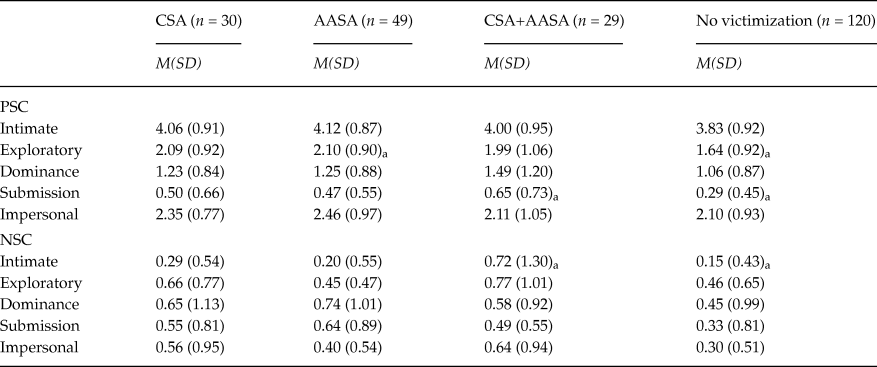
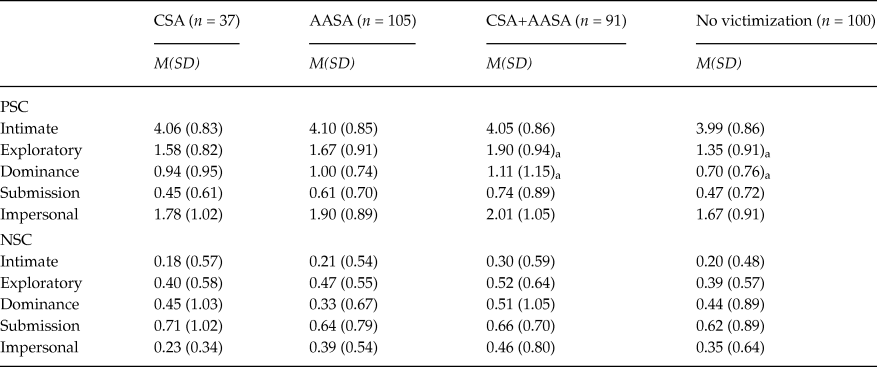
We compared the frequency of each PSC and NSC –intimate, exploratory, dominance, submission, and impersonal– in the sexual victimization groups –CSA, AASA, CSA+AASA– and the non-victimization group by performing separate MANOVAs for men and women. At a multivariate level, we found a significant main effect of the sexual victimization group in men, F(33, 631.18) = 1.81, p = .004, and in women, F(33, 940.53) = 1.51, p = .033. At a univariate level, we found significant differences among the sexual victimization groups in men in exploratory PSC, F(3, 224) = 4.04, p = .008, submission PSC, F(3, 224) = 4.25, p = .006, and intimate NSC, F(3, 224) = 6.36, p = .001, and in women in exploratory PSC, F(3, 329) = 6.01, p = .001, and dominance PSC F(3, 329) = 3.59, p = .014. Descriptive statistics for men and women are shown on Tables 1 and 2, respectively. It should be noted that scores for the frequency of each subscale of PSC and NSC are proportional based on the number of items of each subscale.
Differences in the Frequency of PSC and NSC for each Sexual Victimization Group in Men

Note: Subscripts indicate significant differences in the pair comparisons (p < .05).
Differences in the Frequency of PSC and NSC for each Sexual Victimization Group in Women

Note: Subscripts indicate significant differences in the pair comparisons (p < .05).
Relationship between the Severity of AASV and the Frequency of PSC and NSC
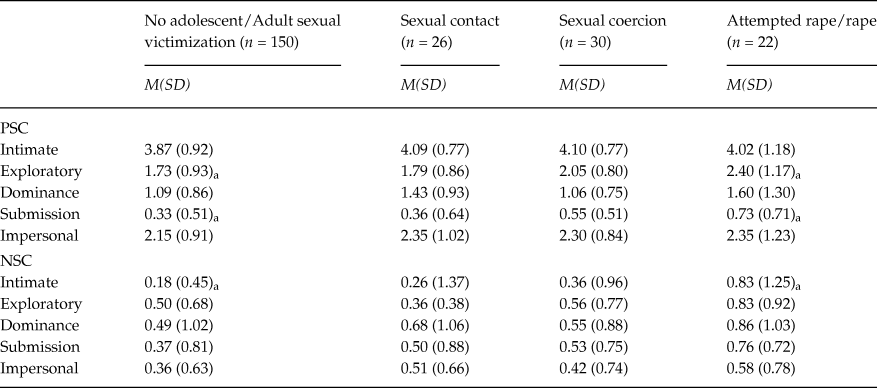
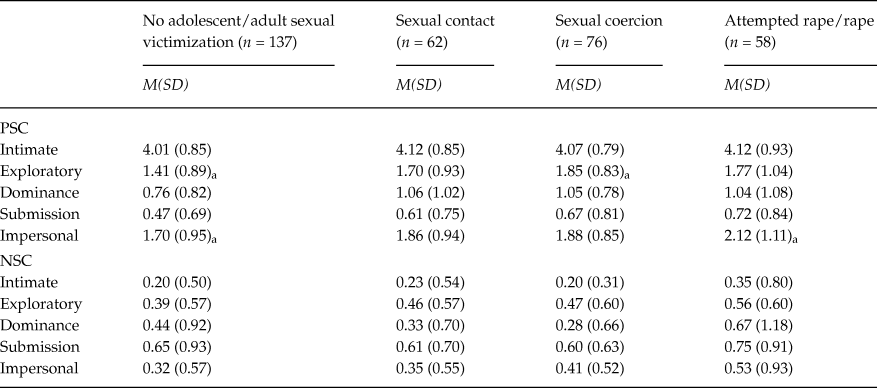
We assessed the relationship between the severity of AASA: sexual contact, sexual coercion, attempted rape, and rape, and the frequency of PSC and NSC: intimate, exploratory, dominance, submission, and impersonal. Considering the very low percentage of individuals in the categories ‘attempted rape’ and ‘rape’, both subtypes were collapsed into one subtype. Next, categories were assigned a code: no sexual victimization = 0, sexual contact = 1, sexual coercion = 2, and attempted rape/rape = 3. We conducted a MANOVA to explore the relationship between the subtypes of AASA and the frequency of PSC and NSC. At a multivariate level, the analysis revealed a significant main effect of the subtype of AASA in men F(30, 631.74) = 2.38, p = .001; at a univariate level, we found significant differences for exploratory PSC, F(3, 224) = 3.72, p = .012, submission PSC, F(3, 224) = 4.20, p = .006, and intimate NSC, F(3, 224) = 7.81, p = .001. In women, the analysis did not reveal any significant effects of AASA subtype, F(30, 939.94) = 1.34, p = .102. However, at a univariate level, significant differences were found for exploratory PSC, F(3, 329) = 4.66, p = .003 and impersonal PSC, F(3, 229) = 2.67, p = .040. Descriptive data for men and women are shown on tables 3 and 4, respectively.
Differences in the Frequency of the Subscales of PSC and NSC according to the Severity of adolescent/adult sexual abuse in Men

Note: Means in the same row with subscripts differ at p < .05 based on pair comparisons.
Differences in the Frequency of the Subscales of PSC and NSC according to the Severity of adolescent/adult sexual abuse in Women

Note: Means in the same row with subscripts differ at p < .05 based on pair comparisons.
Discussion
The aim of this study was to analyze the relationship between sexual victimization experiences of Spanish men and women and the frequency of positive and negative sexual cognitions according to their content. We considered different types of sexual victimization experience (i.e., CSA, AASA, and CSA+AASA) and the severity of the sexual victimization during adolescence/adulthood. Overall, results showed that individuals who had experienced sexual victimization reported a higher frequency of some positive sexual cognitions, particularly when they had experienced CSA+AASA and the severity of the sexual contact during adolescence/adulthood was greater (i.e., attempted rape/rape). However, individuals who had experienced sexual victimization did not appraise their sexual cognitions more negatively than non-victims, except for intimate sexual cognitions with negative affect, which were more frequent in male victims of sexual abuse.
Men who had experienced only AASA reported a higher frequency of exploratory sexual cognitions with positive affect that non-victims. Such frequency was higher when the severity of the sexual abuse was higher (i.e., attempted rape/rape). Exploratory PSC are characterized by an interest in seeking a variety of sexual stimuli. As shown in previous studies, victims of sexual abuse often report unusual patterns of sexual activity. They sometimes have more frequent sexual activity and a higher number of relationships, which sometimes increases the likelihood of exposing themselves to more risky sexual situations (Browne & Finkelhor, Reference Browne and Finkelhor1986; Putnam, Reference Putnam2003; Romano & De Luca, Reference Romano and De Luca2001). In addition, the fact that such men have a higher tendency to search for sexual variety makes them likely to increase their vulnerability to expose themselves to a higher number of sexual interactions and situations in which they are at risk of being victimized.
In our study, men who had experienced CSA+AASA reported a higher frequency of positive cognitions of sexual submission. The frequency of this type of cognitions was higher when the sexual contact was attempted rape or rape. These results are in contrast with traditional gender roles and sexual selection, as cognitions of sexual submission are more often experienced by women, while men tend to have more frequent sexual thoughts in which they play a dominant and active role as a way of showing their own masculinity (Birnbaum, Reference Birnbaum2007; Critelli & Bivona Reference Critelli and Bivona2008; Leitenberg & Henning, Reference Leitenberg and Henning1995; Pawlowski, Atwal, & Dunbar, Reference Pawlowski, Atwal and Dunbar2008). From a cultural viewpoint, Spain is considered a country that upholds traditional gender roles and beliefs (Gutiérrez-Quintanilla, Rojas-García, & Sierra, Reference Gutiérrez-Quintanilla, Rojas-García and Sierra2010), and previous research on sexual cognitions has revealed that men tend to have more cognitions related to dominance contents, while women tend to express more cognitions related to submission contents (Moyano & Sierra, Reference Moyano and Sierra2014). It should be noted that Renaud and Byers (Reference Renaud and Byers2006) obtained similar results in Canada, as they reported that men who had experienced CSA reported more positive cognitions of sexual submission. However, the authors did not consider revictimization sexual experiences during adolescence/adulthood as we did in the present study. This aspect is of interest considering that childhood sexual victimization increased the risk for later revictimization during adolescence/adulthood in men and women (see Basile & Smith, Reference Basile and Smith2011; Parillo, Freeman, & Young, Reference Parillo, Freeman and Young2003; Widom, Czaja, & Dutton, Reference Widom, Czaja and Dutton2008).
We also found differences between men who had experienced CSA+AASA and non-victims: the former reported a higher frequency of intimate NSC than the latter. The fact that men who experienced CSA+AASA reported more intimate cognitions with negative affect might be due to the relationship that has been found between intimacy and emotions of shame and fear in victims of sexual traumas. These individuals tend to assess relationships in terms of dominance and submission, to the detriment of other aspects such as love (Meston, Rellini, & Heiman, Reference Meston, Rellini and Heiman2006). The negative affect associated with intimate sexual cognitions is in line with the findings of previous studies that suggested that male victims of sexual abuse have difficulties establishing satisfactory intimate relationships (Elliott, Mok, & Briere, Reference Elliott, Mok and Briere2004). It should be noted that intimate cognitions encompass not only intimate or romantic sexual interactions with a partner but also explicit sexual behaviors involving the genitals (e.g., giving and receiving oral sex, being naked, sexual intercourse). These types of images may be similar to sexual victimization experiences and therefore more easily remembered and triggered with negative affect (Maltz, Reference Maltz2012). It is important to note that in the present study we did not consider the identity of the perpetrator of sexual abuse, which would be relevant for further interpretation. Our result would be better explained if the sexual abuse was perpetrated by an intimate partner.
In women, compared to non-victims, those who had experienced both CSA+AASA reported more exploratory PSC. In addition, the frequency of such cognitions was higher when the subtype of the victimization was sexual coercion. It should be noted that sexual cognitions and fantasies sometimes tend to be linked to later sexual behavior, especially when they are associated with masturbation and visualization of pornographic material (Bartels & Gannon, Reference Bartels and Gannon2011). Thus, exploratory cognitions (i.e., cognitions that involve group sexual activities) may lead individuals to have more sexual encounters, as has previously been observed in female victims of sexual abuse (Paolucci, Genuis, & Violato, Reference Paolucci, Genuis and Violato2001; Wind & Silvern, Reference Wind and Silvern1992). A number of studies have found that this relationship is stronger when victimization was experienced during both childhood and adolescence/adulthood (Kaltman, Krupnick, Stockton, Hooper, & Green, Reference Kaltman, Krupnick, Stockton, Hooper and Green2005). Women who had experienced CSA+AASA also reported more positive cognitions of sexual dominance. In this case, the severity of the sexual contact was not associated with the frequency of the cognitions. To our knowledge, there is no previous evidence of a relationship between sexual victimization experiences in women and a higher frequency of cognitions of sexual dominance, as few studies have explored sexual cognitions in sexual victims. Yet, indirect evidence suggests that female victims of violence tend to show higher levels of anger and aggressiveness and a higher desire for revenge, and they often have the feeling that they did not fight enough against the perpetrator, which sometimes leads them to perpetrate aggression (Kendra, Bell, & Guimond, Reference Kendra, Bell and Guimond2012; Maneta, Cohen, Schulz, & Waldinger, Reference Maneta, Cohen, Schulz and Waldinger2012). Moreover, several studies suggest that sexual victims report feeling powerless. As a result, their need to feel power and dominance is higher (Finkelhor & Browne, Reference Finkelhor and Browne1985). These findings suggest that female victims might use this type of sexual images as a strategy to cope with the traumatic event. In our study, being a victim of attempted rape or rape was also associated with a higher frequency of cognitions in which impersonal aspects such as objects and materials acquire an erotic value. This may explain the higher interest of victimized individuals for solitary activities rather than dyadic activities (Santos-Iglesias, Calvillo, & Sierra, Reference Santos-Iglesias, Calvillo and Sierra2013).
Several similarities and differences between men and women emerged in the relationship between sexual victimization and sexual cognitions. Both men and women who had being sexually victimized reported a higher frequency of exploratory cognitions with positive affect. This finding seem to indicate that victims of sexual abuse are likely to try to overcome the psychological aftermath by using maladaptive coping strategies, which might be reflected in higher levels of sexual activity and higher interest in sensation seeking through contact with other people (Filipas & Ullman, Reference Filipas and Ullman2006; Messman-Moore, Walsh, & DiLillo, Reference Messman-Moore, Walsh and DiLillo2010). In addition, men and women who had experienced both CSA and AASA reported a higher frequency of positive cognitions of sexual submission and dominance, respectively, which is in contrast with expectations based on traditional gender roles. The data obtained in the present study do not clarify the reasons for this lack of adherence to traditional expectations in men and women. Interestingly, previous research in both Canadian and Spanish community samples has also revealed a lack of coherence between the affect and content of men and women’s sexual cognitions and traditional gender roles. In particular, Renaud and Byers (Reference Renaud and Byers2001) and Moyano and Sierra (Reference Moyano and Sierra2014) have shown that women experience more cognitions involving submission as negative, while men report a higher frequency of dominance NSC, which somehow contradicts some assumptions based on traditional gender roles, probably because individuals feel at risk or worried about acting out their cognitions.
Interestingly, male victims of sexual abuse reported more intimate sexual cognitions with negative affect than female victims of sexual abuse. Previous studies indicate that men who have experienced sexual victimization report more distress than women who have been sexually victimized because they feel that their sense of power, control and masculinity is jeopardized (Peterson et al., Reference Peterson, Voller, Polusny and Murdoch2011). This explanation seems even more relevant if we take into account that, compared to women, men are more often abused by individuals of their same sex (Dube et al., Reference Dube, Anda, Whitfield, Brown, Felitti, Dong and Giles2005). Spain has increasingly developed protective legislation for female victims of abuse (e.g., Ortiz-Barreda, Vives-Cases, & Gil-González, Reference Ortiz-Barreda, Vives-Cases and Gil-González2012). From both a social and legislative perspective, male victims of abuse are likely to feel less supported than female victims. This may contribute to their higher perception of lack of protection, social stigma, or even higher negative feelings such as shame or guilt, which is probably expressed through the negative affect associated to their intimate cognitions.
Our study has several limitations. First, our sample was composed of heterosexual individuals who had been enrolled in a relationship for at least six months and were mostly young and highly educated. Therefore, the generalization of the results to the general population and samples who differ in relationship status, sexual orientation, educational level, and age may be limited. Second, although we considered the period during which individuals experienced sexual victimization or abuse –childhood and/or adolescence/adulthood–, we did not consider the exact time when it occurred. Future studies should consider the time when the victimization occurred or at least the time elapsed between the latest victimization experience and the assessment. This is important because, as some authors such as Frazier (Reference Frazier2003) indicated, some aspects such as the distress associated with the experience of coercion or abuse decrease over time, at least in women. Finally, we did not consider the identity of the perpetrator. This aspect has been found to be associated with the aftermath of abuse experiences (Ullman, Reference Ullman2007).
Nonetheless, our study provides important information about the content and affect of sexual cognitions in a sample of men and women who have experienced sexual abuse. This information may be useful to therapists because sexual thoughts and cognitions are an important part of cognitive approaches in the treatment of sexual dysfunctions. Therefore, understanding the most common contents of sexual cognitions and their affect is likely to contribute to better guiding training in sexual cognitions, which should be focused on the identification and acceptance of negative cognitions and the facilitation of positive affect.
This research was funded through a predoctoral scholarship for the training of university teachers granted by the Spanish Ministerio de Educación to the first author (Reference: AP2008–02503).