The Fontan technique is a palliation for complex congenital cardiopathies with a single functional ventricle. The surgical procedure separates the systemic and pulmonary circulations by directing the venous return directly to the pulmonary artery. This unique circulatory physiology reduces the mixture of venous and arterial blood and avoids volume overload; however, it leads to retrograde venous congestion and low antegrade output due to insufficient preload. The limitation of preload is more prominent during exercise. Reference Diller, Giardini and Dimopoulos1–Reference García-Cuenllas Álvarez, del Campo Bujedo, Oreja Sánchez, Centeno Garrido, Castillo Martín and Sánchez3 The Fontan-associated morbidities are arrhythmia, chronotropic incompetence, heart failure, thromboembolism, cirrhosis, protein losing enteropathy and need for reoperation or transcatheter interventions. Reference Khairy, Fernandes and Mayer4 Longevity after Fontan operation is significantly reduced because of these morbidities and a progressive deterioration in functional status of the patients has been observed late after Fontan palliation. Functional status has important links to mortality and quality of life after Fontan operation. Reference Khairy, Fernandes and Mayer4,Reference Ohuchi, Negishi and Noritake5
CPET allows quantification of functional capacity of patients with Fontan. Several studies have reported lower peak oxygen consumption (VO2) in patients following Fontan palliation. However, there is limited information about the prognostic value of CPET in Fontan population as well as about clinical characteristics that may be predictors of unfavourable outcome and that could be modified to improve the quality of life of these patients. Reference Diller, Giardini and Dimopoulos1–Reference García-Cuenllas Álvarez, del Campo Bujedo, Oreja Sánchez, Centeno Garrido, Castillo Martín and Sánchez3
The purpose of the study was to describe exercise performance results in our sample of patient with Fontan physiology, to analyse the role of CPET parameters in predicting a higher maximum VO2 max and to analyse the role of CPET parameters in predicting an unfavourable outcome.
Materials and methods
A retrospective, unicentric, cross-sectional descriptive study was carried out on patients with a Fontan circulation followed up in Pediatric cardiology and GUCH clinics, who had undergone incremental CPET with cycloergometer between 2010 and 2020.
This study included all Fontan patients who underwent cardiopulmonary exercise test (CPET) with gas exchange monitoring at our centre between 2010 and 2020. Patients unable to cooperate due to psychomotor problems and patients with a height of less than 145 cm were excluded.
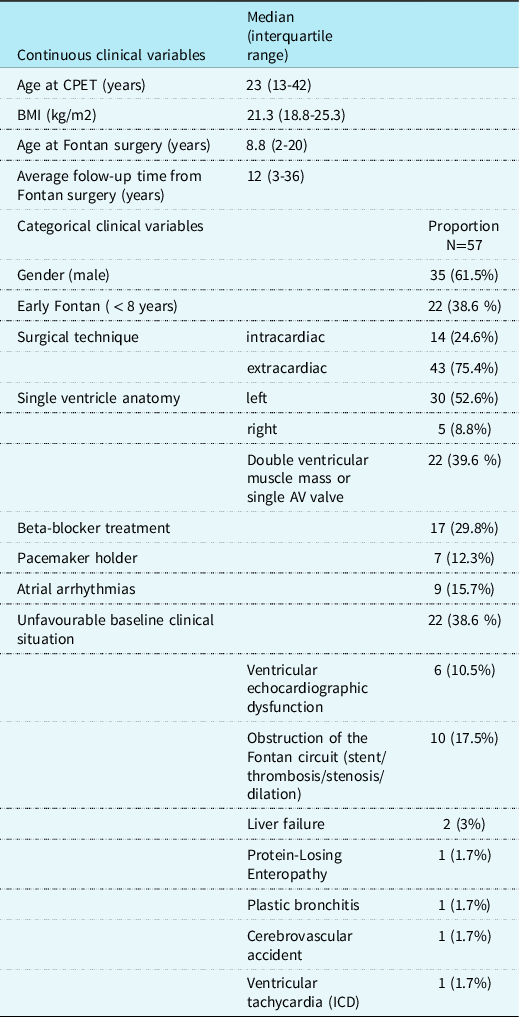
Demographic, anthropometric and clinical characteristics and CPET parameters were collected (Table 1).
Demographic, anthropometric and clinical variables

Abbreviations: CPET (Cardio Pulmonary Exercise Test); BMI (Body Mass Index); ICD (Implantable Cardioverter Desfibrillator).
Cardiopulmonary exercise test
CPET was executed on a computer-controlled sitting bicycle ergometer (JAEGER vyntus CPX) with a breath-by-breath gas exchange analysis. Carbon dioxide elimination, VO2 and minute ventilation were measured with a computerised breath-by-breath analyzer. All patients underwent CPET using a continuously increasing protocol (ramp) of 10–15 W/minute, till exhaustion. Transcutaneous oxygen saturation and 12-lead electrocardiogram were continuously monitored. Blood pressure was determined manually every 3 minutes. It was followed by a 5-minute recovery period. Maximal oxygen uptake was defined as the mean oxygen uptake achieved during the last minute of the highest load performed. The technical details of the measurement of VE/VCO2-slope have been published. Reference Takken, Blank, Hulzebos, van Brussel, Groen and Helders6 The ventilatory anaerobic threshold (VAT) was determined from plots of minute ventilation (VE) versus VO2 or VCO2 versus VO2.
CPET was performed at a temperature of 23 degrees Celsius (73°F) with a relative humidity of 60%, in a spacious room with ventilation and climate control, located in a hospital 7 m above sea level.
All statistical analyses were performed with SPSS. Categorical variables were expressed as number (percentage), and continuous variables were expressed as mean ± standard deviation or median and interquartile range for skewed data.
Linear regression was used to detect correlations between variables and VO2 max. Binary logistic regression was used to assess for predictors of clinical deterioration, defined as functional classes III–IV, need for admission or re-interventions, liver failure or nodules suggesting malignancy, ventricular dysfunction, severe atrioventricular valve failure, obstruction of the Fontan circuit and/or significant arteriovenous, or venous collaterals. Those variables with a statistically significant association in the univariate were included in the multivariate analysis. It was considered significant if p < 0.05 (although it was extended to p < 0.1 for biologically important variables).
Chronotropic insufficiency was defined as heart rate response <85% predicted for age using the equation: peak heart rate = 220 −age.
Results
There were 57 patients who had CPET using bicycle ergometer. Clinical data are summarised in Table 1. The median VO2 max was 23 (18–28) ml/kg/minute and the median oxygen consumption at anaerobic threshold (VO2AT) was 13.6 (11–17) ml/kg/minute, the median CO2 equivalents at anaerobic threshold (VE/VCO2) was 32 (29–35) and the median maximum expected heart rate was 84% (72–88). Chronotropic insufficiency was 38% (22). Significant desaturation to the effort was registered in 29% (15). The profile of the oxygen pulse curve was "flattened" in 58% (33).
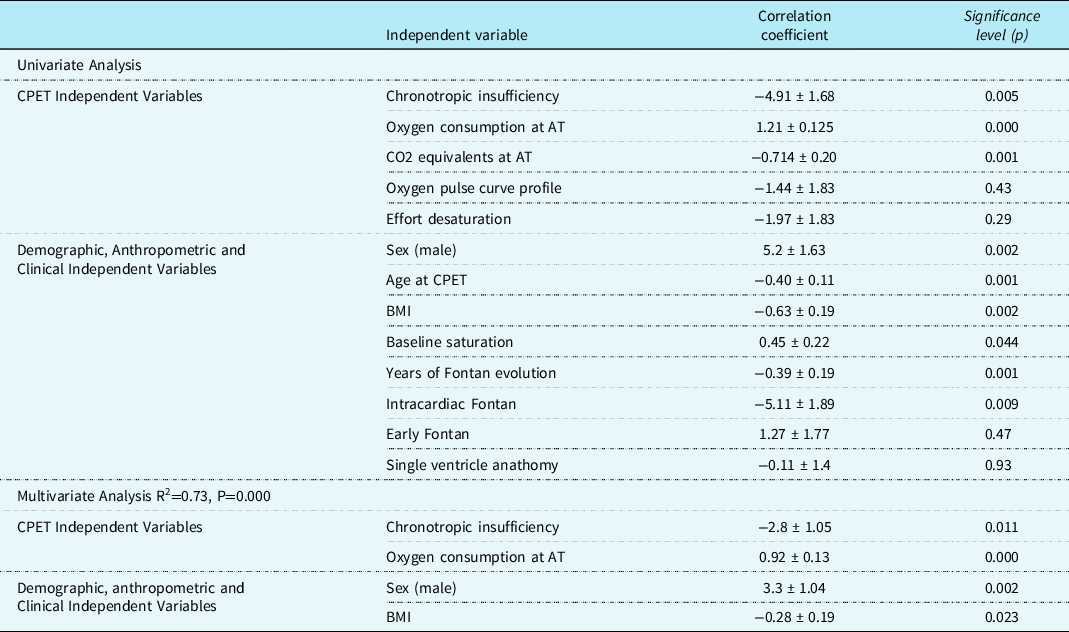
In the univariate analysis, the variables that were significantly related to VO2 max were: age at the time of CPET, sex, BMI, years of Fontan evolution, intracardiac Fontan, VO2AT, VE/VCO2 and chronotropic insufficiency (Table 2).
Dependent variable “Peak oxygen consumption” univariate and multivariate analysis (lineal regresion)

Abbreviations: CPET (Cardio Pulmonary Exercise Test); AT (Anaerobic Threshold); CO2 (Carbon Dioxide); BMI (Body Mass Index).
The incremental profile of the oxygen pulse curve was not associated with VO2 max (p = 0.45), although a strong association between chronotropic insufficiency and VO2 max was detected (p = 0.009), and the expected relationship between incremental oxygen pulse and chronotropic insufficiency was confirmed (p = 0.02).
In multivariate analysis, it was found that chronotropic insufficiency related to the use of beta-blockers or pacemakers did not produce a significant difference in VO2 max in our series.
Age explains the change in VO2 max by decreasing 0.40 ml/kg/minute each year (p = 0.001).
The multiple linear regression model (Table 2) that best fitted the relationship between VO2 max and independent variables (correlation coefficient 0.73) included sex (correlation index 3.35; p = 0.02), BMI (−0.27; p = 0.02), chronotropic failure (−2.79; p = 0.01) and VO2AT (0.92; p < 0.0001).
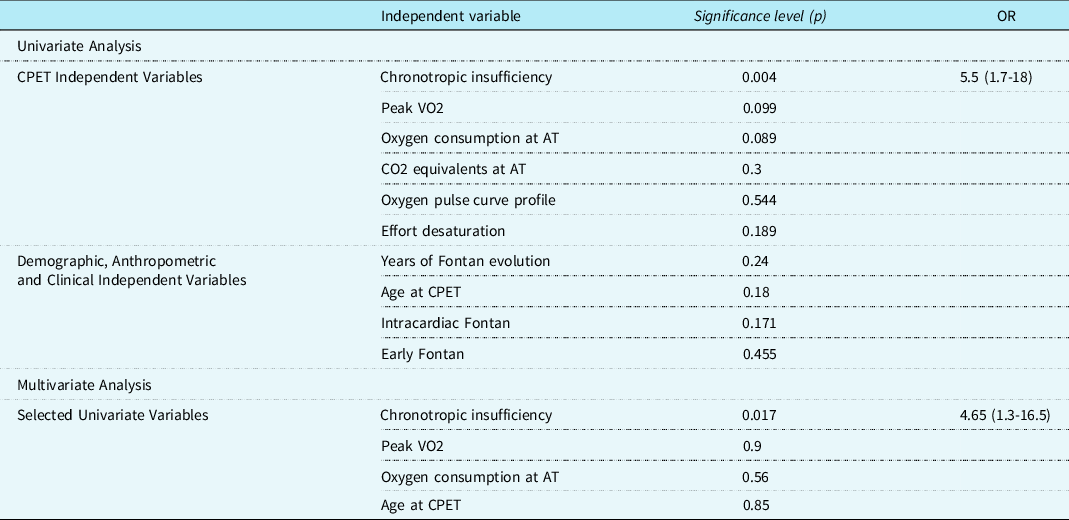
In the univariate analysis of the prognostic CPET variables related to an unfavourable clinical situation (Table 3), significance was obtained with chronotropic insufficiency (p = 0.003). Statistical significance was not obtained with VO2 max (p = 0.099) and VO2AT (p = 0.089), nevertheless, both are physiologically important and show a tendency to significance. In multivariate analysis, chronotropic insufficiency maintains its association with unfavourable clinical situation [p = 0.017, OR = 4.65 (1.3–16.5)].
Dependent variable “final clinical situation” univariate and multivariate analysis

Abbreviations: CPET (Cardio Pulmonary Exercise Test); VO2 (Oxygen Consumption); AT (Anaerobic Threshold); CO2 (Carbon Dioxide).
Discussion
In our series, as in other studies, Reference Kempny, Dimopoulos and Uebing7 patients with Fontan show lower than expected VO2 max and VO2AT. As in the general population, age is a key determinant of VO2 max in patients with Fontan. Although age is a determining factor in the clinical deterioration of these patients, its importance in multivariate models falls when combined with other variables such as chronotropic insufficiency or VO2AT. The universality of the influence of sex (different body composition) on VO2 max is maintained in patients with Fontan, with the VO2 max in men being 5 ml/kg/minute higher than that in women.
The VO2AT is directly related to the VO2 max in patients with Fontan. The physiopathological mechanisms that influence oxygen consumption until the onset of anaerobiosis are possibly the same and are perpetuated at maximum effort. This allows VO2AT to estimate the VO2 max in patients with Fontan.
Chronotropic insufficiency appears in our series as the most important determinant of both VO2 max and clinical deterioration. Chronotropic insufficiency is not uncommon in patients with Fontan (38% in our series), sometimes due to iatrogenic and sometimes due to developmental complications. Reference Poh and d'Udekem8 Heart rate increase allows a cardiac output increase, especially in patients with intrinsic limitation to preload improvement, which occurs in Fontan patients.
Oxygen pulse curve is defined as VO2 divided by heart rate and indicates the capability of oxygen consumption in all body tissues per heartbeat. The assumption that the ascending profile of the oxygen pulse curve could be related to higher maximum oxygen consumption remains unproven in our study because of the effect of chronotropic insufficiency (a lower heart rate increases the oxygen pulse).
Unlike other studies, Reference Ohuchi, Negishi and Noritake5 we have not been able to demonstrate that extracardiac Fontan surgical technique is superior to intracardiac one. This may be due to study limitations: unicentric, small sample, high percentage of extracardiac Fontan 75% and a surgical technique that varied abruptly over time.
In conclusion, in conjunction with the anthropometric parameters universally related to VO2 max (age, sex and BMI), chronotropic insufficiency and VO2AT are the main determinants of functional capacity in patients with Fontan. Furthermore, chronotropic insufficiency is closely related to the worst clinical evolution. Our data would support the intensive treatment of chronotropic insufficiency in order to improve the quality of life and the clinical situation of patients with Fontan.
Acknowledgements
None.
Financial support
This research received no specific grant from any funding agency, commercial or not-for-profit sectors.
Conflicts of interest
None.
Ethical standards
Written informed consent was obtained.