Background
Mechanical circulatory support in the form of extracorporeal membrane oxygenation or ventricular assist device is often the only option for survival in patients with severe cardiorespiratory dysfunction. At Johns Hopkins All Children’s Hospital, we first supported a patient with extracorporeal membrane oxygenation or ventricular assist device using extracorporeal membrane oxygenation on 8 October, 1998 using extracorporeal membrane oxygenation. As our programme gained experience with extracorporeal membrane oxygenation and then with ventricular assist devices, we began offering mechanical circulatory support to patients with characteristics thought to be associated with higher risk.
Although ample literature exists regarding the short-term outcomes of paediatric mechanical circulatory support, limited data exist about the long-term outcomes of such patients. To describe diagnostic characteristics and assess mortality, we reviewed all patients who were supported with extracorporeal membrane oxygenation and/or ventricular assist device at Johns Hopkins All Children’s Hospital from 8 October, 1998 to 25 July, 2016. The purpose of this analysis is to learn about patterns of practice and outcomes for our patients managed with mechanical circulatory support and to gain insight into expected long-term outcomes.
Methods
Support devices
During the early years of our programme, our standard extracorporeal membrane oxygenation circuit included a roller pump (COBE Cardiovascular, Arvada, Colorado, United States of America) with a Silicone membrane oxygenator (AVECOR Cardiovascular Inc., Minneapolis, Minnesota, United States of America). In the late 1990s, we also began using a mechanical cardiopulmonary support circuitReference Ojito, McConaghey, Jacobs and Burke 1 , Reference Jacobs, Ojito, McConaghey, Boden, Chang, Aldousany, Zahn and Burke 2 for extracorporeal membrane oxygenation, consisting of a centrifugal pump, either a Bio-Medicus BP-50 Bio-Pump® Centrifugal Blood Pump or a Bio-Medicus BP-80 Bio-Pump® Centrifugal Blood Pump 80 (Medtronic Inc., Minneapolis, Minnesota, United States of America), with a Minimax, Maxima, or Affinity (Medtronic Inc.) oxygenator. Our original cardiopulmonary support systemReference Ojito, McConaghey, Jacobs and Burke 1 , Reference Jacobs, Ojito, McConaghey, Boden, Chang, Aldousany, Zahn and Burke 2 consisted of a preassembled, completely heparin-coated (Carmeda, Carmeda AB, Upplands Väsby, Sweden) circuit with 0.25-inch arterial and venous tubing, a BP-50 Bio-Medicus centrifugal pump (Medtronic Bio-Medicus, Eden Prairie, Minnesota, United States of America), a Minimax plus membrane oxygenator (Medtronic Cardiopulmonary, Anaheim, California, United States of America), a Bio-Medicus flow probe (Medtronic Bio-Medicus), and a Bio-trend hematocrit/oxygen saturation monitor (Medtronic Cardiopulmonary). In patients weighing more than 30 kg, 3/8-inch arterial and venous tubing, a BP-80 Bio-Medicus cone (Medtronic Bio-Medicus), and a Maxima plus oxygenator (Medtronic Cardiopulmonary) were used. This cardiopulmonary support circuit was our circuit of choice for cardiac extracorporeal membrane oxygenation, because it is heparin coated from tip to tip, which is advantageous in the postoperative settingReference Miyaji, Hannan, Ojito, Jacobs, White and Burke 3 ; meanwhile, we usually used the previously described roller pump circuit for respiratory extracorporeal membrane oxygenation, except in settings of respiratory extracorporeal membrane oxygenation associated with cardiopulmonary resuscitation, in which case we used the cardiopulmonary support circuit. We then began using the Quadrox (Maquet, Rastatt, Germany) oxygenator with our cardiopulmonary support circuit when it became available in the United States of America.
In 2014, we again changed our extracorporeal membrane oxygenation circuit and began using either the Revolution Centrifugal Pump (LivaNova, Mirandola, Italy) for likely shorter-term support scenarios or the CentriMag/PediMag (St. Jude Medical, Inc., St Paul, Minnesota, United States of America) for likely longer-term support scenarios, along with a Quadrox D or Quadrox iD (Maquet) hollow fibre membrane oxygenator.
We have used several ventricular assist devices in the past, including the Berlin Heart and the Abiomed. However, we now primarily use the CentriMag/PediMag (St. Jude Medical, Inc., St Paul, Minnesota, United States of America).
Statistics and database
We performed a retrospective cohort study of all patients who were supported with extracorporeal membrane oxygenation and/or ventricular assist device from our first case (8 October, 1998) through 25 July, 2016. Descriptive analysis of the entire cohort was performed using mean, standard deviation, median, interquartile range, and overall range, as appropriate. The primary outcome of interest was mortality, which was modelled using the Kaplan–Meier method.
The percentage frequency of discharge mortality was calculated overall and within sub-groups. In Tables 1 and 2, survival at 1 and 5 years is a proportion of those who were eligible for the calculation after having ample elapsed time since initiation of mechanical circulatory support. In the figures, the Kaplan–Meier method was used to estimate post-transplant survival probabilities as a function of time since mechanical circulatory support.
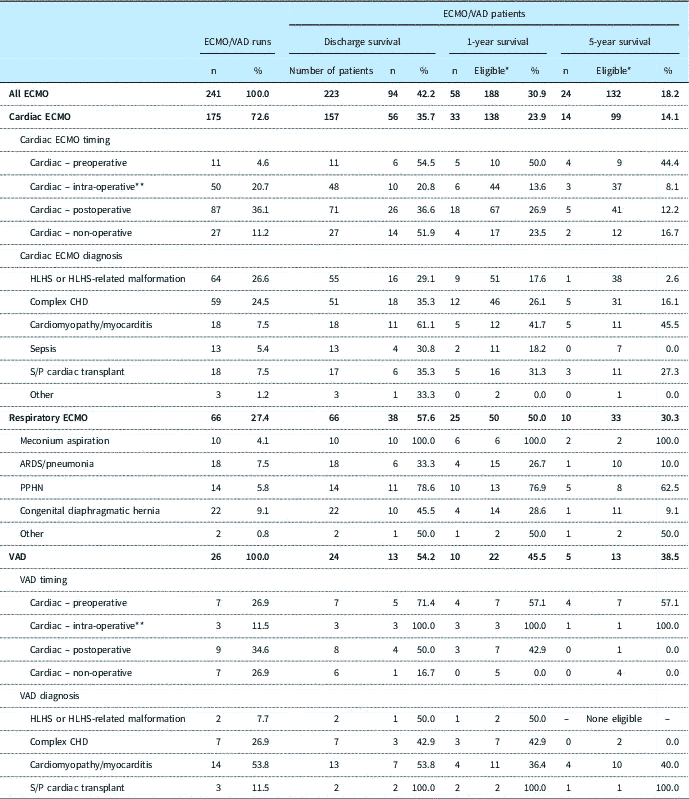
Discharge survival and survival at 1 and 5 years for a variety of cohorts of interest.

ECMO=extracorporeal membrane oxygenation; VAD=ventricular assist device; HLHS=hypoplastic left heart syndrome; ARDS=acute respiratory distress syndrome; PPHN=persistent pulmonary hypertension
* Eligible refers to the number of patients eligible to be included in the denominator of the mortality calculation. In Tables 1 and 2, survival at 1 and 5 years is a proportion of those who were eligible for the calculation after having ample elapsed time since initiation of mechanical circulatory support. In the figures, the Kaplan–Meier method was used to estimate post-transplant survival probabilities as a function of time since mechanical circulatory support.
** Intra-operative ECMO is defined as ECMO initiated in the operating theatre during or immediately after a cardiothoracic operation before leaving the operating theatre. This category includes patients who failed to wean from cardiopulmonary bypass and patients who weaned from cardiopulmonary bypass but could not remain off mechanical support long enough to leave the operating theatre separated from mechanical support.
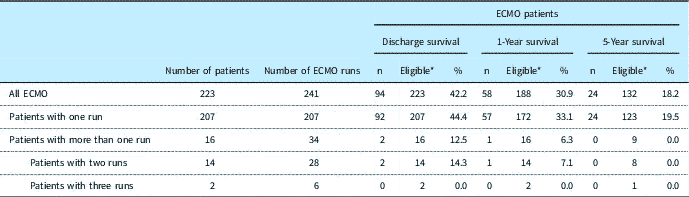
Comparison of patients supported with one extracorporeal membrane oxygenation run with those supported with more than one extracorporeal membrane oxygenation run, and discharge survival and survival at 1 and 5 years.

ECMO=extracorporeal membrane oxygenation
Of note, 92 of 207 (44.4%) patients who were supported with a single ECMO run survived to hospital discharge, whereas only two of 16 (12.5%) survived to discharge after two ECMO runs and none among two (0%) survived after three ECMO runs.
* Eligible refers to the number of patients eligible to be included in the denominator of the mortality calculation. In Tables 1 and 2, survival at 1 and 5 years is a proportion of those who were eligible for the calculation after having ample elapsed time since initiation of mechanical circulatory support. In the figures, the Kaplan–Meier method was used to estimate post-transplant survival probabilities as a function of time since mechanical circulatory support.
A registry and database has been prospectively maintained on all patients and has been used for data collection and analysis, using software certified by the Society of Thoracic Surgeons as a Congenital Heart Surgery Database. The database used is a component of the CardioAccess International Clinical Outcomes Database: Comprehensive Cardiovascular and Thoracic Module, CardioAccess, Inc., St. Petersburg, Florida, and Fort Lauderdale, Florida: http://www.cardioaccess.com. Institutional review board approval and waiver of the need for consent have been obtained (Johns Hopkins All Children’s Hospital Institutional Review Board).
Results
Patient characteristics
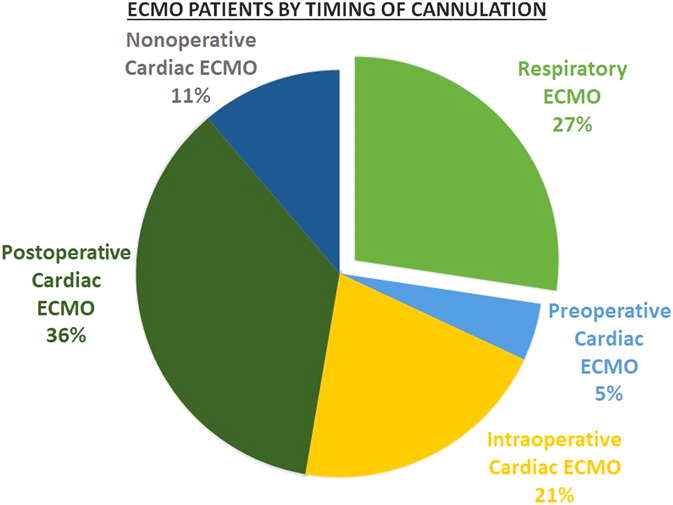
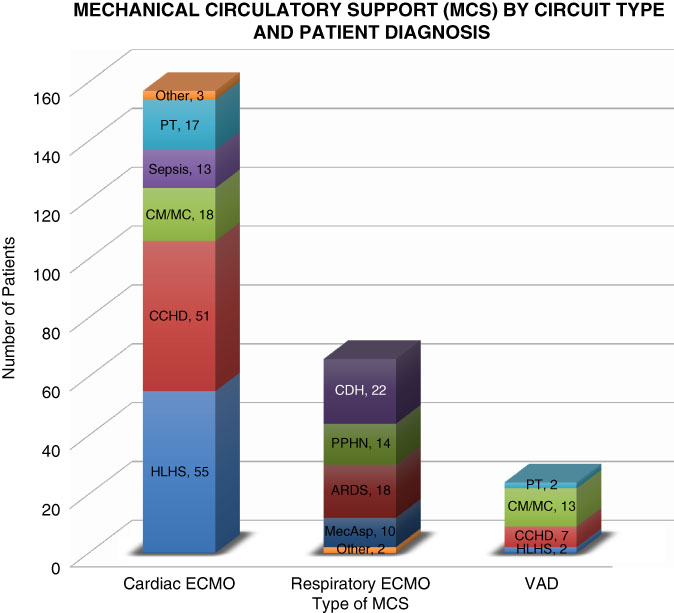
A total of 223 patients underwent 241 extracorporeal membrane oxygenation runs. Median time on extracorporeal membrane oxygenation was 4.0 days, ranging from 0.04 to 55.8 days, with a mean of 6.42±7.0 days. Mean (±SD) age at initiation was 727.4 days (±146.9 days). Indications for extracorporeal membrane oxygenation were stratified into cardiac extracorporeal membrane oxygenation (n=175; 72.6%) or respiratory extracorporeal membrane oxygenation (n=66; 27.4%). The most frequent diagnosis for patients needing cardiac extracorporeal membrane oxygenation was hypoplastic left heart syndrome or hypoplastic left heart syndrome-related malformation (n=55 patients with HLHS who underwent 64 extracorporeal membrane oxygenation runs). For respiratory extracorporeal membrane oxygenation patients, the most frequent diagnosis was congenital diaphragmatic hernia (n=22). Figure 1 documents the indications for extracorporeal membrane oxygenation stratified into cardiac extracorporeal membrane oxygenation (n=175) or respiratory extracorporeal membrane oxygenation (n=66). Cardiac extracorporeal membrane oxygenation patients were further sub-divided according to the timing of cannulation: preoperative (n=11), intra-operative (n=50), postoperative (n=87), or in a non-operative setting (n=27).
Indications for extracorporeal membrane oxygenation (ECMO) and timing of ECMO (for 241 ECMO runs). Figure 1 documents the indications for ECMO stratified into cardiac ECMO (n=175) or respiratory ECMO (n=66). Cardiac ECMO patients were further sub-divided according to the timing of cannulation: preoperative (n=11), intra-operative (n=50), postoperative (n=87), or in a non-operative setting (n=27).

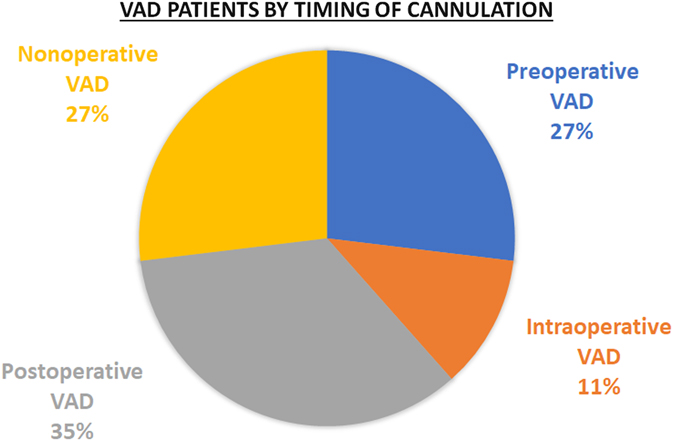
A total of 24 patients underwent 26 ventricular assist device runs. Median time on ventricular assist device was 7 days, ranging from 0 to 75 days, with a mean of 15.3±18.8 days. Mean age at initiation of ventricular assist device was 2530.8±660.2 days (6.93 ±1.81 years). Cardiomyopathy/myocarditis was the most frequent indication for ventricular assist device placement (n=14; 53.8%). In patients with isolated cardiac dysfunction, we have used ventricular assist device both as a bridge to cardiac transplantation and as a bridge to recovery. If a patient is initially supported with extracorporeal membrane oxygenation and their pulmonary function is satisfactory, we will transition to ventricular assist device to allow time for cardiac recovery or to bridge to transplantation. Figure 2 documents the indications for ventricular assist device sub-divided according to timing of cannulation (total n=26): preoperative (n=8), intra-operative (n=3), postoperative (n=9), or in a non-operative setting (n=6). Figure 3 documents all patients stratified by type of mechanical circulatory support and patient diagnosis.
Indications for ventricular assist device (VAD) and timing of VAD (for 26 VAD runs). Figure 2 documents the indications for VAD sub-divided according to the timing of cannulation (total n=26): preoperative (n=7), intra-operative (n=3), postoperative (n=9), or in a non-operative setting (n=7).

Diagnostic categories of patients on extracorporeal membrane oxygenation (ECMO) and ventricular assist device. Figure 3 documents all patients stratified by type of mechanical circulatory support and patient diagnosis. Numbers next to diagnosis indicate number of patients. ARDS=acute respiratory distress syndrome or pneumonia; CCHD=complex CHD; CDH=congenital diaphragmatic hernia; CM/MC=cardiomyopathy/myocarditis; HLHS=hypoplastic left heart syndrome or hypoplastic left heart syndrome-related malformation; MecAsp=meconium aspiration; PPHN=persistent pulmonary hypertension; PT=post-transplant; VAD=ventricular assist device.

Survival analysis
Survival to discharge was 42.2% for extracorporeal membrane oxygenation patients and 54.2% for ventricular assist device patients. Cumulative follow-up time was 116,131 days (317.9 years). Kaplan–Meier 1-year survival was as follows: all patients, 41.0%; extracorporeal membrane oxygenation patients, 41.0%; and ventricular assist device patients, 43.2%. Kaplan–Meier 5-year survival was as follows: all patients, 39.7%; extracorporeal membrane oxygenation patients, 39.7%; and ventricular assist device patients, 43.2%.
Table 1 contains information regarding discharge survival and survival at 1 and 5 years for a variety of cohorts of interest. Table 2 compares patients supported with one extracorporeal membrane oxygenation run with those supported with more than one extracorporeal membrane oxygenation run, and also shows discharge survival and survival at 1 and 5 years. It is noteworthy that 92 patients among the 207 (44.4%) patients who were supported with a single extracorporeal membrane oxygenation run survived until hospital discharge, whereas only 2 out of 16 (12.5%) survived until discharge after two extracorporeal membrane oxygenation runs, and none among the two (0%) survived after three extracorporeal membrane oxygenation runs. Because of sub-optimal outcomes in patients supported with more than one extracorporeal membrane oxygenation run, our programme holds a careful multi-disciplinary discussion about the appropriateness of supporting any patients with a second or third run, realising that such a run is high risk but also may offer the only chance of survival.
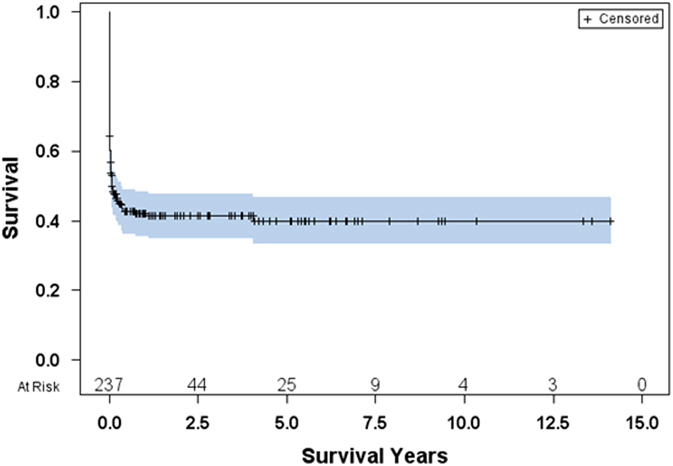
Figure 4 shows overall survival of all extracorporeal membrane oxygenation/ventricular assist device patients (n=237) with a Kaplan–Meier analysis of patient survival from the time of initiation of mechanical circulatory support.
Overall survival of all 237 patients. Figure 4 shows the Kaplan–Meier estimate of overall survival among 237 patients undergoing mechanical circulatory support with extracorporeal membrane oxygenation and/or ventricular assist device, with number of patients at risk documented immediately above the x-axis.

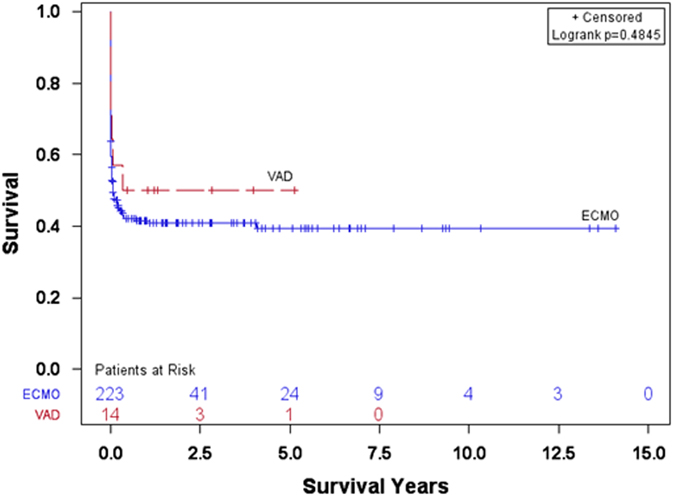
Figure 5 documents the Kaplan–Meier analysis of patient survival stratified by type of support: extracorporeal membrane oxygenation (n=223) and ventricular assist device (n=14).
Survival stratified by type of support. Figure 5 documents the Kaplan–Meier estimate of patient survival stratified by type of support, with number of patients at risk documented immediately above the x-axis: extracorporeal membrane oxygenation (n=223) and ventricular assist device (n=14). Ten of the VAD patients also received ECMO and are displayed only in the ECMO group in Figure 5. ECMO=extracorporeal membrane oxygenation; VAD=ventricular assist device.

Additional patients after the end of this series
In January, 2016, under the leadership of one of the co-authors of this paper (D.W.K.), Johns Hopkins All Children’s Hospital modified our management for the treatment of neonates with congenital diaphragmatic hernia. Between 1 January, 2016 and 30 June, 2017, our programme treated 37 consecutive patients with congenital diaphragmatic hernia, 23 of whom required extracorporeal membrane oxygenation – including 15 left liver-up, one left liver-down, and one left liver-out – in a large omphalocele. One left liver-up patient also had double-outlet right ventricle with mitral atresia and hypoplastic left heart. Six patients had right congenital diaphragmatic hernia. All patients survived, were successfully extubated, and were discharged home on no more than nasal cannula oxygen. These data were recently presented at the 28th Annual Extracorporeal Life Support Organization Conference, Hilton Baltimore, Baltimore, Maryland, in 24–27 September, 2017. Although these data will be the subject of a separate publication, they merit documentation in this manuscript because some of these patients are part of the cohort under consideration in this manuscript and because these patients exemplify how evolving strategies of management can profoundly impact outcomes.
Discussion
Mechanical circulatory support, including both extracorporeal membrane oxygenation and ventricular assist devices, may allow salvage of patients with cardiopulmonary compromise refractory to maximum medical management. This single-institutional, 18-year review documents the different probabilities for survival among various sub-groups of patients who require support with extracorporeal membrane oxygenation and/or ventricular assist device. Our data show that the aetiology of the disease and setting of cannulation may influence survival. Most important, our data provide insights into the expected longer-term survival of patients who survive to hospital discharge after treatment with extracorporeal membrane oxygenation and ventricular assist devices. A potential limitation of our analysis is that a lot has changed over the past 18 years; however, an advantage of our analysis is that we can gain additional insight regarding late survival.
Children who need mechanical circulatory support can be separated into the following four categories:Reference Jacobs, Ojito, McConaghey, Boden, Chang, Aldousany, Zahn and Burke 2 patients before cardiac surgery who cannot be stabilised by conventional means before the operation; patients after cardiac surgery; patients not in need of cardiac surgery whose cardiac or respiratory dysfunction is thought to be reversible with time to allow for cardiac or pulmonary healing while on support; or patients believed to be reasonable candidates for bridging to cardiac transplantation. Overlap can exist between these groups. Nevertheless, mechanical circulatory support may be viewed as a temporising measure that allows time for future intervention or possible recovery.
Mechanical circulatory support carries a significant risk, regardless of the diagnosis of the patient or the indication for support.Reference Jacobs, Ojito, McConaghey, Boden, Chang, Aldousany, Zahn and Burke 2 , Reference Mascio, Austin, Jacobs, Jacobs, Wallace, He and Pasquali 4 – Reference Tanaka, Hirose and Cavarocchi 7 Complications associated with mechanical circulatory support include bleeding, infection, stroke, and others. Our results documented in this manuscript are similar to the results documented in an analysis of nearly 100,000 operations reported to the Society of Thoracic Surgeons Congenital Heart Surgery Database from 2000 to 2010 (for patients aged <18 years).Reference Mascio, Austin, Jacobs, Jacobs, Wallace, He and Pasquali 4 Among 96,596 operations (80 centres), mechanical circulatory support was used in 2.4%. More than half of the mechanical circulatory support patients did not survive to hospital discharge (53.2 versus 2.9% of non-mechanical circulatory support patients; p<0.0001). The mechanical circulatory support patients were younger (13 versus 195 days, p<0.0001) and more often had preoperative risk factors (57.2 versus 32.7%, p<0.0001). The operations with the greatest need for mechanical support included the Norwood procedure (17%) and complex biventricular repairs, such as arterial switch, ventricular septal defect, and arch repair (14%). Mechanical circulatory support-associated mortality was greatest for truncus arteriosus and Ross–Konno operations (both 71%). The hospital-level rates of mechanical circulatory support, adjusted for patient characteristics and case mix, varied by 15-fold across institutions. Both high-and low-volume hospitals had substantial variation in rates of mechanical circulatory support. This analysis of the Society of Thoracic Surgeons Congenital Heart Surgery Database concluded that “Perioperative mechanical circulatory support use varied widely across centres. The mechanical circulatory support rates were greatest overall for the Norwood procedure and complex biventricular repairs. Although mechanical circulatory support can be a life-saving therapy, more than one half of mechanical circulatory support patients will not survive to hospital discharge, with mortality >70% for some operations. Future studies aimed at better understanding the appropriate indications, optimal timing, and management of mechanical circulatory support could help to reduce the variation in mechanical circulatory support use across hospitals and improve outcomes”.Reference Mascio, Austin, Jacobs, Jacobs, Wallace, He and Pasquali 4
Many factors account for the increased risk of mechanical circulatory support in children. Because some children with cardiac failure initially compensate well, the initial presentation of a child requiring mechanical circulatory support is often characterised by severe ventricular dysfunction and significant end organ damage.Reference Wilmot, Lorts and Morales 5 Early identification of a critically ill patient requiring mechanical circulatory support is vital to optimising outcomes.Reference Jacobs, Ojito, McConaghey, Boden, Chang, Aldousany, Zahn and Burke 2 , Reference Wilmot, Lorts and Morales 5 Initiation of mechanical circulatory support before the development of end organ damage is critically important.
Conclusion
Although mechanical circulatory support carries significant risk, extracorporeal membrane oxygenation and/or ventricular assist device may provide the only chance at survival for children with severe cardiopulmonary dysfunction. This single-institutional, 18-year review documents the differential probability of survival for various sub-groups of patients who require support with extracorporeal membrane oxygenation or ventricular assist device. The indication for mechanical circulatory support, underlying diagnosis, the age of the patient, and the setting in which cannulation occurs may all affect survival after extracorporeal membrane oxygenation and ventricular assist device. Future advances in mechanical circulatory support will be facilitated by new and improved support devices and enhanced strategies for caring for the patients on these devices; these advances will be guided by the use of multi-institutional registries that incorporate standardised definitions for all variables including those variables related to perfusion.Reference Shann, Giacomuzzi and Harness 8 – Reference Asante-Korang and Jacobs 10 Future research in the areas of paediatric mechanical circulatory support devices and opportunities for cardiac regenerationReference Jacobs 11 – Reference Boucek, Steele and Jacobs 15 should lead to improved outcomes for children with cardiopulmonary failure. The Kaplan–Meier analyses in this study document that patients treated with mechanical circulatory support who do survive to hospital discharge have an excellent chance of longer-term survival.