

Introduction
The short-lived Chilean representatives of the tribe Chlamydini constitute locally common, but low-diversity components of the Neogene molluscan faunas. Although lacking a modern systematic study and an accurate stratigraphic record, they have been used as biostratigraphic indicators (Herm, Reference Herm1969; Niemeyer et al., Reference Niemeyer, González and Martínez-De Los Ríos1996; Marquardt et al., Reference Marquardt, Blanco, Godoy, Lavenu, Ortlieb, Marchant and Guzmán2000; Ragaini et al., Reference Ragaini, Di Celma and Cantalamessa2008). Apart from the pioneering mentions and subsequent discussions in paleontological literature (Hupé, Reference Hupé and Gay1854; Philippi, Reference Philippi1887; Möricke, Reference Möricke1896; Herm and Paskoff, Reference Herm and Paskoff1967; Beu, Reference Beu1985), these Neogene Chlamydini are still poorly understood. Their systematic analyses are restricted to those performed by Herm (Reference Herm1969) in the context of a general study of the Plio-Pleistocene molluscan faunas of Chile, and to that carried out by Jonkers (Reference Jonkers2003) for the circumpolar Chlamydini. While the former author included them in the genus Chlamys Röding, Reference Röding1798, Jonkers (Reference Jonkers2003) placed them in the Patagonian genus Zygochlamys Ihering, Reference Ihering1907. In light of recent systematic study of the tribe in the Neogene of Patagonia, Santelli and del Río (Reference Santelli and del Río2019) proposed to restrict the genus Chlamys to the Northern Hemisphere and to confine Zygochlamys to the southernmost tip South America. Some Chilean species, such as C. hupeanus (Philippi, Reference Philippi1887), P. remondi Philippi, Reference Philippi1887, C. coquimbensis (Möricke, Reference Möricke1896), C. calderensis (Möricke, Reference Möricke1896), and C. vidali (Philippi, Reference Philippi1887), have been excluded from those genera and are now in need of a comprehensive revision. By the way, in the Argentinean Patagonia, apart from the species included in Zygochlamys Ihering, Reference Ihering1907, Moirechlamys Santelli and del Río, Reference Santelli and del Río2019, Pixiechlamys Santelli and del Río, Reference Santelli and del Río2019, Chokekenia Santelli and del Río, Reference Santelli and del Río2019, Swiftopecten Hertlein, Reference Hertlein1936, Reticulochlamys del Río, Reference del Río2004a, and Jorgechlamys del Río, Reference del Río2004a, there is a new species related to the Chilean C. calderensis n. comb.
Materials and methods
This contribution includes the revision of 156 entire, usually well-preserved specimens from Neogene strata of Patagonia (Argentina) and Chile. The Chilean material described includes the types of the historical collections made by R.A. Philippi in 1887 and G. Steinmann in 1883, and specimens collected by D. Herm in 1965, D. Frassinetti and V. Covacevich in 1993, C. Emparan in 1997, and C. Marquardt in 2001. The Argentinean species was collected by H. Camacho and J. Fernández in 1956.
Stratigraphic occurrence of the studied material
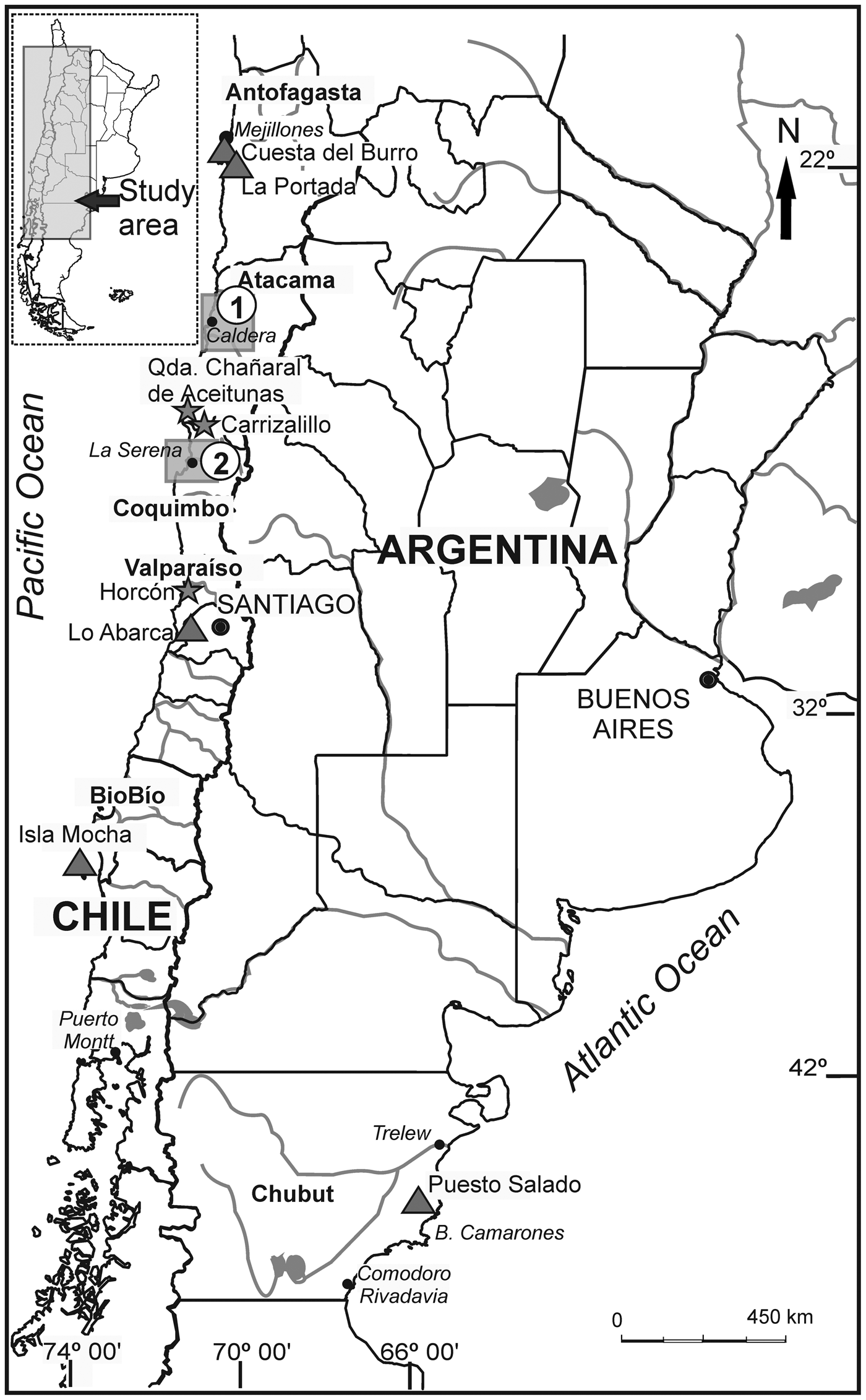
Chilean Chlamydini have been recorded from the Neogene strata exposed from Península Mejillones southwards to Isla Mocha (Fig. 1), in the fossiliferous horizons of the La Portada, Coquimbo, Bahía Inglesa (Fig. 2) and Horcón formations, in “Lo Abarca Beds” included in the Navidad Formation by Encinas et al. (Reference Encinas, Le Roux, Buatois, Nielsen, Finger, Fourtanier and Lavenu2006), and in the “Isla Mocha Beds” (S. Nielsen, personal communication, 2018). As abundantly demonstrated in Chilean geological literature, the age of those units is uncertain. According to modern research, the Bahía Inglesa and Coquimbo formations were assigned to the Miocene–Pliocene (Marchant et al., Reference Marchant, Marquardt, Blanco and Godoy2000; Le Roux et al., Reference Le Roux, Olivares, Nielsen, Smith, Middleton, Fenner and Ishman2006), the La Portada Formation was restricted to the Pliocene (Di Celma et al., Reference Di Celma, Pierantoni and Cantalamessa2014), the Horcón Formation was limited to the late Pliocene (Carrillo-Briceño et al., Reference Carrillo-Briceño, González-Barba, Landaeta and Nielsen2013), and the Navidad Formation at Lo Abarca was considered of late middle Miocene–early late Miocene or Pliocene age (Encinas et al., Reference Encinas, Le Roux, Buatois, Nielsen, Finger, Fourtanier and Lavenu2006). The strata informally known as the “Isla Mocha Beds” and exposed in the northern part of the Isla Mocha are an informal unit correlated with strata stratigraphically placed between the Ranquil and Tubul formations of middle Miocene–Pliocene age (S. Nielsen, personal communication, 2018).
Geographical location of the fossiliferous sites: Squares indicate study areas enlarged in Figure 2: (1) Caldera area, (2) Coquimbo area. Triangles correspond to the sites from which the studied material comes; stars indicate other localities mentioned by Herm (Reference Herm1969) where the studied taxa occur.
Geographical location of the fossiliferous sites in: (1) Caldera area, (2) Coquimbo area. Triangles correspond to the sites from which the studied material comes; stars indicate other localities that were mentioned by Herm (Reference Herm1969) where the studied taxa are found.

More accurate ages for each fossiliferous locality included in the present paper will be provided, whenever possible, when discussing the studied taxa in order to constrain their age.
Fossiliferous localities are displayed in Figure 1 and details of some of these are shown in Figure 2. Stratigraphic and geographic occurrences of the analyzed material are indicated in Supplementary Data 1.
Systematic characters and terminology
Although the pre-radial and initial radial stages are useful for systematic analysis of pectinids (Waller, Reference Waller1993), those sections of shells are unknown in the studied material because they have been abraded or because beaks of shells are missing.
Chlamydinis are characterized by the development of two types of complex ornamentation patterns: folded shells with plicae and interspaces, and non-folded shells sculptured with ribs. In the first type, plicae overlap the interspace on the opposite valve, and plicae and interspaces are sculptured with superimposed ribs that appear at different growth stages. Primary ribs are those appearing on the crests of plicae and on central or on lateral walls of interspaces, and secondary and tertiary ribs are those intercalated between primary ribs and appear at different heights from beaks during ontogeny (Dietotenhosen hupeanus n. comb. Fig. 3; D. remondi n. comb., Fig. 5; Zygochlamys geminata [Sowerby, Reference Sowerby and Darwin1846] [Santelli and del Río, Reference Santelli and del Río2019, fig. 4]; Moirechlamys actinodes [Sowerby, Reference Sowerby and Darwin1846] [Santelli and del Río, Reference Santelli and del Río2019, fig. 10.9]). Moreover, plicae may be also sulcated by shallow, non-bifurcated grooves (D. hupeanus n. gen. Figs. 3, 4.1). In the second type of ornamentation, shells are sculptured with ribs of different thickness, which are also known as primary or first order ribs, and as secondary or tertiary ribs in accordance with their sequence of appearance throughout ontogeny. In most cases those orders coincide with the thickness of ribs (Ckaraosippur calderensis n. gen. [Möricke, Reference Möricke1896], Fig. 6.1–6.11; Ckaraosippur camachoi n. gen. n. sp., Fig. 6.12–6.15; Pixiechlamys quemadensis [Ihering, Reference Ihering1897] [Santelli and del Río, Reference Santelli and del Río2019, fig. 8.8–8.13]).
Dietotenhosen hupeanus (Philippi, Reference Philippi1887) n. comb.: (1) external view of left valve, syntype of Pecten propinquus Hupé, Reference Hupé and Gay1854 MNHN.F.A26549 provided by MNHN online site, from “Coquimbo,” Coquimbo Formation; (2) external view of right valve, holotype of Pecten vidali Phillippi, Reference Philippi1887 SGO.PI 656a, from Mejillones, La Portada Formation; (3) external view of left valve, SGO.PI 5928a, from Quebrada Lagunillas, Coquimbo Formation; (4, 5) left valve, SGO.PI 5928b, from Quebrada Lagunillas, Coquimbo Formation, (4) internal view, (5) external view; (6) external view of left valve, WM 9614 provided by M. Terezow, from Playa Chorillos, Bahía Inglesa Formation; (7) external view of right valve, SGO.PI 5930a, from Quebrada Lagunillas, Coquimbo Formation; (8) right hinge, SNSB-BSPG 1966 IV 163 provided by W. Werner, from Quebrada Honda, Coquimbo Formation; (9) external view of right valve, SGO.PI 5910, from Quebrada Lagunillas, Coquimbo Formation; (10) external view of left valve with grooved plicae, SNSB-BSPG 1966 IV 163 provided by W. Werner, from Quebrada Honda, Coquimbo Formation; (11, 12) left valve, SGO.PI 1244, from Quebrada Honda, Coquimbo Formation, (11) detail of external sculpture with grooved plicae, (12) grooved plicae on ventral margin view. Scale bars are (1–8, 10–12) 10 mm; (9) 20 mm.

(1–3) Dietotenhosen hupeanus (Philippi, Reference Philippi1887) n. comb.: (1, 2) syntype of P. vidali Phillippi, Reference Philippi1887 SGO.PI 656a, from Mejillones, La Portada Formation, (1) detail of shagreen microsculpture on grooved plicae and interspaces on right valve, (2) external view of shagreen microsculpture on right auricle; (3) external view of shagreen microsculpture on left auricle, paratype of Pecten vidali Phillippi, Reference Philippi1887, SGO.PI 656b, from Mejillones, La Portada Formation; (4, 5) Dietotenhosen remondi (Philippi, Reference Philippi1887) n. comb.: (4) detail of shagreen microsculpture and macrosculpture on left valve, SGO.PI 1024b, from Caldera, Bahía Inglesa Formation; (5) detail of right auricles, SGO.PI 1109, from Caldera, Bahía Inglesa Formation. Scale bars are (1) 3 mm; (2–5) 5 mm.

Dietotenhosen remondi (Philippi, Reference Philippi1887) n. comb.: (1, 11) right valve, SGO.PI 222 holotype of Pecten remondi Philippi, Reference Philippi1887, from “Coquimbo,” Coquimbo Formation, (1) external view, (11) plicate ventral margin view; (2) external view of right valve, syntype of P. coquimbensis Möricke, Reference Möricke1896 UNISTRA 52731 provided by K. Janneau, from “Coquimbo,” Coquimbo Formation; (3, 5) right valve, GNS WM 9616 provided by M. Terezow, from Quebrada Herradura, Coquimbo Formation, (3) external view, (5) hinge; (4) external view of left valve, syntype of P. coquimbensis Möricke, Reference Möricke1896 UNISTRA 52732 provided by K. Janneau, from “Coquimbo,” Coquimbo Formation; (6, 10) right valve, SGO.PI 1024a, from Caldera, Bahía Inglesa Formation, (6) external view, (10) detail of antimarginal microsculpture; (7) external view of left valve, SGO.PI 1024b, from Caldera, Bahía Inglesa Formation; (8, 9) left valve, SNSB-BSPG 1966 IV 15 provided by W. Werner, from La Piña, Bahía Inglesa Formation, (8) internal view, (9) external view. Scale bars are (1–10) 10 mm; (11) 5 mm.

(1–11) Ckaraosippur calderensis (Möricke, Reference Möricke1896) n. comb.: (1) external view of right valve, holotype of Pecten calderensis Möricke, Reference Möricke1896 UNISTRA 52730 provided by K. Janneau, from Caldera, Bahía Inglesa Formation; (2) external view of right valve, SGO.PI 5411, from Isla Mocha, “Isla Mocha Beds”; (3, 4) right valve, SGO.PI 4815a, from Lo Abarca, Navidad Formation, (3) external view, (4) internal view; (5) external view of left valve, SGO.PI 4815b, from Lo Abarca, Navidad Formation; (6, 10) left valve, SGO.PI 4815c, from Lo Abarca, Navidad Formation, (6) external view, (10) detail of shagreen microsculpture; (7) external view of right auricle, SGO.PI 4815d, from Lo Abarca, Navidad Formation; (8, 11) left valve, SGO.PI 4815e, from Lo Abarca, Navidad Formation, (8) external view, (11) detail of shagreen microsculpture; (9) external view of left valve, SGO.PI 4815f, from Lo Abarca, Navidad Formation. (12–15) Ckaraosippur camachoi n. gen. n. sp.: (12, 13, 15) left valve, holotype of C. camachoi n. gen. n. sp. CPBA 8604a, from Puesto Salado, Camarones Formation; (12) external view, (13) internal view, (15) plicate ventral margin view; (14) left valve, paratype of C. camachoi n. gen. n. sp. CPBA 8604b, from Puesto Salado, Camarones Formation. Scale bars are (1–9, 12–15) 10 mm; (10) 4 mm; (11) 3 mm.

Shell outline may be prosocline, acline, or opisthocline, according to the slope of the axis of maximum growth. “In an acline shell it is directed towards ventral margin, in an opisthocline shell it is inclined toward the posterior, and in a prosocline shell it is inclined from its distal, lower end to its proximal end, toward the anterior shell” (Carter et al., Reference Carter, Harries, Malchus, Sartori, Anderson, Bieler, Bogan, Coan, Cope, Cragg, Garcia-March, Hylleberg, Kelley, Kleemann, Kriz, McRoberts, Mikkelsen, Pojeta, Skelton, Temkin, Yancey and Zieritz2012, p. 4, 116, 141, respectively). In other words, a prosocline shell has a predominantly posterior shell growth or it is posteriorly elongate, whereas an opisthocline shell is anteriorly elongate.
Repositories and institutional abbreviations
The repositories and their acronyms are as follows: Paleontology collection, Museum national d'Histoire naturelle (MNHN), Paris, France; fossile Wirbellose collection, Bayerische Staatssammlung für Paläontologie und Geologie (SNSB-BSPG), Munich, Germany; Department of Paleontology, Institute of Geological and Nuclear Science (GNS WM), Lower Hutt, New Zealand; Collection de Paléontologie, Université de Strasbourg (UNISTRA), Strasbourg, France; Colección Paleoinvertebrados, Museo de Historia Natural (SGO.Pi), Santiago, Chile; Colección Paleoinvertebrados, Museo Argentino de Ciencias Naturales Bernardino Rivadavia (MACN-Pi), CABA, Argentina and Cátedra de Paleontología de la Universidad de Buenos Aires (CPBA), CABA, Argentina.
Because multiple specimens commonly belong to the same lot numbers, we have informally added “a, b, c, etc.” to some of the collection numbers for the purposes of individual specimen identification in this paper.
Systematic paleontology
Order Pectinida Gray, Reference Gray1854
Superfamily Pectinoidea Rafinesque, Reference Rafinesque1815
Family Pectinidae Rafinesque, Reference Rafinesque1815
Subfamily Chlamydinae Teppner, Reference Teppner and Diener1922
Tribe Chlamydini Teppner, Reference Teppner and Diener1922
Remarks
The tribe Chlamydini Teppner, Reference Teppner and Diener1922 constituted a well-diversified and abundant group in the Paleogene and Neogene rocks of the southernmost tip of South America and has been recently revised by del Río (Reference del Río1995, Reference del Río2004a) and Santelli and del Río (Reference Santelli and del Río2019). In Patagonia (Argentina), it was represented by the broadly distributed genus Swiftopecten Hertlein, Reference Hertlein1936 and by the endemic genera Zygochlamys Ihering, Reference Ihering1907, Reticulochlamys del Río, Reference del Río2004a, Jorgechlamys del Río, Reference del Río2004a, Pixiechlamys Santelli and del Río, Reference Santelli and del Río2019, Chokekenia Santelli and del Río, Reference Santelli and del Río2019, and Moirechlamys Santelli and del Río, Reference Santelli and del Río2019. These genera comprised thirteen species.
Until recently, some Neogene Chlamydini of Chile were considered as members of Zygochlamys, and they are still in need of a comprehensive revision because Santelli and del Río (Reference Santelli and del Río2019) excluded them from this genus. Two new endemic genera are named herein, one to include Chlamys hupeanus (Philippi, Reference Philippi1887), C. vidali (Philippi, Reference Philippi1887), and Pecten remondi Philippi, Reference Philippi1887, and another to include C. calderensis (Möricke, Reference Möricke1896) and a new Argentinean species described below, on the other hand. Those Chilean species belong in the tribe Chlamydini because they have shells with chlamydoid outlines, slightly or strongly asymmetrical auricles, a deep byssal notch with functional ctenolium, equal-sized dorsal and resilial hinge teeth, shagreen microsculpture, prominent antimarginal striae developed in early ontogeny, and lack of internal carinae. They also develop discs densely sculptured with intercalations on both valves and bifurcations or ramifications on the right ones
Dietotenhosen new genus
Type species
Pecten hupeanus Philippi, Reference Philippi1887 (=Pecten vidali Philippi, Reference Philippi1887), La Portada, Bahía Inglesa, Coquimbo and Horcón formations, Chile; Pisco, Huaricangana, Taime, and Hornillos formations, Peru.
Other included species
Dietotenhosen remondi (Philippi, Reference Philippi1887) (=Pecten coquimbensis Möricke, Reference Möricke1896) from Bahía Inglesa, Coquimbo and Horcón formations, Chile.
Diagnosis
Shell as high as long in adults, left valve being strongly more convex than right one. Umbonal angle 99–116°. Byssal notch moderately deep, auricles long and quite symmetrical for the tribe, with free margins of posterior auricle convex or straight. Left valve sculptured with 17–22 plicae, 18–26 plicae on right valve, plicae are rather uniform width and ornamented with 3 or 4 ribs that appear at 40–60 mm from the beaks.
Occurrence
Middle Miocene–early middle Pliocene from northern Peru to central Chile.
Etymology
Dedicated to the German Rock Band “Die Toten Hosen.”
Remarks
Dietotenhosen n. gen. is characterized by a large shell, subcircular or flabelliform in outline, usually opisthocline, highly inequiconvex with left valve nearly twice as convex than the right one, auricles quite symmetric in comparison with other Chlamydini, with free posterior margins convex or straight, and by the development of a moderately deep byssal notch. The valves are sculptured with evenly wide, rectangular or sub-rounded plicae in cross-section, bearing three or four ribs that appear at 40–60 mm from the beaks and with interspaces that are ornamented with a single central primary rib from 10–30 mm height on both valves and with secondary ribs that commence in late ontogeny.
Pecten remondi Philippi, Reference Philippi1887 and P. hupeanus Philippi, Reference Philippi1887 were placed by Herm (Reference Herm1969) in Chlamys sensu stricto Röding, Reference Röding1798, but the presence of inequiconvex and larger shells than in Chlamys s.s., with less-inclined dorsal margins of discs, a wider umbonal angle, more symmetrical auricles with posterior free margin convex or straight, a very shallow byssal sinus, and the development of conspicuous plicae (Figs. 3.12, 5.11) distinguish those taxa from Chlamys s.s. and group them into a new genus. Subsequently, Beu (Reference Beu1985) related D. hupeanus n. comb. and D. vidali with Psychrochlamys patagonica (King, Reference King1832) (Recent, southern South American coasts) and with Moirechlamys actinodes (Sowerby, Reference Sowerby and Darwin1846) (late Miocene, Patagonia). Finally, Jonkers (Reference Jonkers2003) stated that C. remondi and C. hupeana would belong in Zygochlamys Ihering, Reference Ihering1907. However, the representatives of Dietotenhosen n. gen. have outstanding differences with the southern genus Zygochlamys (type species: P. geminatus Sowerby, Reference Sowerby and Darwin1846, late Oligocene–early Miocene, San Julián and Monte León formations) in possessing sub-circular or flabelliform shells with opisthocline discs, wider umbonal angles, a more flattened right valve, auricles markedly more symmetrical, with longer posterior ones having a convex or straight free margin, lower left anterior auricle, and shallower byssal notch and sinus. In addition, Chilean taxa are sculptured with plicae of almost uniform width that are unpaired on the right valve. Ribs on both valves are covered with lower scales, secondary and tertiary ribs on interspaces appear later in ontogeny, and left interspaces are narrower than the plicae (Table 1).
Comparison of South American Chlamydini genera: Ckaraosippur n. gen.; Dietotenhosen n. gen.; Zygochlamys Ihering, Reference Ihering1907; Moirechlamys Santelli and del Río, Reference Santelli and del Río2019; Chokekenia Santelli and del Río, Reference Santelli and del Río2019; Pixiechlamys Santelli and del Río, Reference Santelli and del Río2019; Reticulochlamys del Río, Reference del Río2004a; Jorgechlamys del Río, Reference del Río2004a; Swiftopecten, Hertlein, Reference Hertlein1936; and Chlamys Röding, Reference Röding1798. RV: right valve, LV: left valve; PA: posterior auricles; LAA: left anterior auricles.

Dietotenhosen n. gen. has flabelliform and sub-circular shells like the Patagonian genus Moirechlamys (type species: P. actinodes Sowerby, Reference Sowerby and Darwin1846, late Miocene, Puerto Madryn, Gran Bajo del Gualicho and Barranca Final formations and “Cape Fairweather Beds;” Santelli and del Río, Reference Santelli and del Río2019; figs. 9.2–9.4, 10), but the new genus has more-flattened right valves, more-symmetrical auricles, with a higher right anterior auricle, left anterior and posterior auricles sculptured with fewer ribs and with shallower sinus and byssal notch. Moreover, shells are sculptured with fewer and sub-equally wide plicae (Table 1).
Psychrochlamys Jonkers, Reference Jonkers2003 is differentiated from Dietotenhosen n. gen. by the lack of shagreen microsculpture and the development of coarse commarginal lamellae over the entire surface. In addition, Psychrochlamys has orbicular shells with symmetrical and short auricles, with a shallow byssal notch, and free margin of left anterior auricle sloping posteriorly.
Dietotenhosen hupeanus (Philippi, Reference Philippi1887) new combination
Figures 3, 4.1–4.3
- Reference Hupé and Gay1854
Pecten propinquus Hupé, p. 291, pl. 5, fig. 2, non Münster, Reference Münster1833.
- Reference Philippi1887
Pecten hupeanus Philippi, p. 211, pl. 47, fig. 4, replacement name for Pecten propinquus Hupé, Reference Hupé and Gay1854, non Münster, Reference Münster1833.
- Reference Philippi1887
Pecten vidali Philippi, p. 212, pl. 47, fig. 5.
- Reference Möricke1896
Pecten vidali Philippi; Möricke, p. 578.
- Reference Möricke1896
Pecten hupeanus Philippi; Möricke, p. 578, pl. 13, figs. 2–4.
- Reference Herm and Paskoff1967
Chlamys hupeanus (Philippi); Herm and Paskoff, p. 587, pl. 1.
- Reference Herm and Paskoff1967
Chlamys vidali (Philippi); Herm and Paskoff, p. 587, pl. 1.
- Reference Herm1969
Chlamys vidali (Philippi); Herm p. 103, pl. 1, figs. 1, 2.
- Reference Herm1969
Chlamys hupeanus (Philippi); Herm p. 104, pl. 1, figs. 5, 6.
- Reference Jonkers2003
Zygochlamys hupeana (Philippi); Jonkers, p. 42, pl. 7, fig. 4d–f.
- Reference Jonkers2003
Zygochlamys vidali (Philippi); Jonkers, p. 41, pl. 7, fig. 4a–c.
Type specimens
Syntypes of Pecten propinquus Hupé, Reference Hupé and Gay1854, MNHN.F.A26549, two left valves from “Coquimbo,” Coquimbo Formation. Syntypes of Pecten vidali Phillippi, Reference Philippi1887, SGO.PI 656a, one right valve from Mejillones, paratype of Pecten vidali Phillippi, Reference Philippi1887, SGO.PI 656b, one left valve from Mejillones, Antofagasta region, La Portada Formation.
Diagnosis
Shell flabelliform, thick, right anterior auricle high and entirely sculptured with ribs. Plicae with flat crest unequally sulcated by a shallow groove and covered with ribs from 45 mm to 70 mm; interspaces smooth, up to 20–35 mm, then sculptured with a central primary rib and two secondary ribs from 50 mm to 61 mm height. Some plicae of adult right valves are trisulcate. Shagreen microsculpture present on auricles, grooves on plicae and interspaces from 3 mm or 5 mm height.
Occurrence
Late Miocene–middle Pliocene (as discussed below) from Playa Chorillos, La Piña, Totoral, Caldera (Atacama Region, Bahía Inglesa Formation); “Mejillones,” Cuesta del Burro, (Antofagasta Region, La Portada Formation); Punta Teatinos, La Serena, Quebrada de Tongoy, Quebrada Romeral, Quebrada Lagunillas, Quebrada Honda, (Coquimbo Region, Coquimbo Formation); Horcón (Valparaíso Region, Horcón Formation).
Description
Shell of large size, attaining up to 120 mm in height, thick, flabelliform, higher than long in juvenile, equidimensional or longer than high in adult specimens, slightly opisthocline, posteriorly elongate and antero–dorsal margin more concave than the postero–dorsal one; right valve flat, left one strongly convex. Hinge dorsal margin straight, 49–59% of total disc length. Umbonal angle 99–116°. Auricles almost symmetrical, large, narrow, with the anterior one slightly longer, and with free margins sloping anteriorly; left anterior one with vertical free margin on few specimens; right anterior auricle with dorsal margin slightly projected upwards and free margin straight; byssal notch rounded, short and shallow, functional ctenolium throughout ontogeny, with 5–6 strong teeth; byssal fasciole with convex corrugations towards the umbo; posterior and left anterior auricles with free margin straight or slightly convex, with a shallow byssal sinus. Right anterior auricle sculptured with 6–12 radial ribs, left anterior with 12–16, and posterior auricles with 7–12; ribs on auricles of homogeneous width, ribs on left anterior auricles fine for the tribe, dorsal ribs of right anterior auricle coarser than ventral ribs. Resilifer moderately deep, triangular-isosceles, upright in some specimens and oblique in a few ones. Discs sculptured with wide plicae of sub-equal width, rectangular in cross section, with flat grooved crests, smooth or sculptured with three or four scaly ribs appearing between 45 mm and 70 mm. Ribs covered with low scales ventrally directed. Plicae separated by flat interspaces and sculptured with a middle primary rib that arises between 20 mm and 35 mm shell height on both valves that is flanked by two secondary ribs arising between 50 mm and 60 mm shell height. Right valve sculptured with 20–24 unpaired plicae, sulcated by one groove that commence at 30–40 mm height, in adults, some plicae are trisulcated with grooves that split the plicae in similar widths. Usually the bifurcation on right plicae is incomplete, with the remaining sub-plicae joined throughout ontogeny; few plicae may be entirely and unequally bifurcated or equally trifurcated in late ontogeny; right interspaces twice as narrow as left ones. Left valve with 17–22 simple plicae and interspaces of equal or narrower width; plicae sulcated by grooves that commence between 45 mm and 55 mm height and splitting the plicae unequally, some of them with two grooves. Entire disc surface sculptured with antimarginal ridgelets from beginning of radial stage, developed on plicae and interspaces before the appearance of shagreen microsculpture; commarginal microsculpture of fine lirae restricted to beginning of initial radial stage up to 13 mm height on right valve; shagreen microsculpture developed on interspaces and grooves on plicae from 2.5–5 mm from beaks and extended to ventral margin, and present on entire auricles.
Materials
52 right valves and 63 left valves: MACN-Pi 2479; GNS WM 9614, 9615; SGO.PI 208, 1032a–h, 1034a–f, 1053a, b, 1058a–c, 1071a, b, 1101a–e, 1108a–d, 1113a, b, 1211a–c, 1222a, b, 1244, 1247a, b, 1248a, b, 17525, 17526, 5854a–g, 5860a, b, 5910, 5911a, b, 5915a–e, 5919a–c, 5920, 5928a–c, 5930a–c, 5934a–d, 5943, 5946a, b; SNSB-BSPG 1966 IV 11–13, 155–165, 170–172, 174–182, 186–189, and UNISTRA 52735.
Dimensions (mm)
MNHN.F.A26549 syntype of Pecten propinquus L = 40.2, H = 44.4; SGO.PI 656 holotype of Pecten vidali, an articulated specimen, L = 75.0, H = 75.3; SGO.PI 208 L = 55.8, H = 55.1; SGO.PI 1058, L = 89.0, H = 84.0.
Remarks
This species was originally named as Pecten propinquus by Hupé in Gray, Reference Gray1854 based on two left valves (syntype MNHN.F. A26549, set of two specimens available online, Fig. 3.1) from Coquimbo, whose illustration corresponds to a reconstruction of both valves. However, this name was preoccupied by a crinoid (Pecten propinquus Münster, Reference Münster1833). Subsequently, Philippi (Reference Philippi1887) proposed Pecten hupeanus as a replacement name for P. propinquus, based on a left valve from Coquimbo (SGO.PI 208). Later, Herm (Reference Herm1969) erroneously believed that P. vidali, instead of P. hupeanus, would correspond to the replacement name for P. propinquus, stating that the holotype of P. hupeanus was housed at Museo de Historia Natural (Chile), although this specimen is not part of Hupé’s material. Recently, Griffin and Nielsen (Reference Griffin and Nielsen2008) illustrated the syntype of Pecten propinquus Hupé, stating that the only valid type material of P. hupeanus Philippi, Reference Philippi1887 corresponds to the type material available to Hupé (MNH Gg 2002/91, an old catalogue numbering). Then, the specimen selected by Philippi in 1887 to name P. hupeanus would not be a type specimen (according to the International Commission of Zoological Nomenclature, 1999, Art. 72.7). The syntypes of P. vidali (SGO.PI.656a, b) correspond to the two valves originally mentioned as “upper and lower valves” by Philippi (Reference Philippi1887), who illustrated the right valve (Philippi, Reference Philippi1887, pl. 47, fig. 5).
Dietotenhosen hupeanus n. comb. is the most common species of the Chilean Chlamydini representatives and it is widely distributed from Punta Mejillones southwards to the area of Caleta Horcón. This taxon has been mentioned by Herm (Reference Herm1969) from the La Portada, Cuesta del Burro and Hügel Creek sections, but when he labelled and described the species, he referred it to “Mejillones” sensu lato. Its oldest occurrences are at Playa Chorrillos, a section dated as late Miocene (Bahía Inglesa Formation) (Achurra et al., Reference Achurra, Lacassie, Le Roux, Marquardt, Belmar, Ruiz-del Solar and Ishman2009), and in the area of Bahía Tongoy, where this species is contained in a specific section of the Coquimbo Formation assigned to the latest Miocene–earliest Pliocene (Le Roux et al., Reference Le Roux, Olivares, Nielsen, Smith, Middleton, Fenner and Ishman2006). It extended its stratigraphic range into the early Pliocene, an age proposed by Marchant et al. (Reference Marchant, Marquardt, Blanco and Godoy2000) for exposures at Caldera (Coquimbo Formation). Certainly, D. hupeanus n. comb. is recorded at Cuesta del Burro and in the area “Mejillones” (La Portada Formation, Cuesta del Burro Member) where the exposures were assigned to the early middle Pliocene by Ragaini et al. (Reference Ragaini, Di Celma and Cantalamessa2008). This species was also found in exposures at Horcón (Horcón Formation), referred to the late Pliocene based on the molluscan content by Carrillo-Briceño et al. (Reference Carrillo-Briceño, González-Barba, Landaeta and Nielsen2013), an age herein dismissed due to its circular argument.
Herm (Reference Herm1969) mentioned many other localities where this species comes from Puerto Viejo (Bahía de Copiapó, Caldera) (Bahía Inglesa Formation), Quebrada Chañaral de Azeitunas, Quebrada Culebrón (in Coquimbo), Quebrada Salinita, Quebrada Pachingo (Bahía de Tongoy), (Coquimbo Formation) and Horcón (Horcón Formation). Also, D. hupeanus n. comb. probably is present in Barranquilla (Caldera, Bahía Inglesa Formation), Estero Culebrón (Coquimbo) and Quebrada Salina (Bahía de Tongoy), (Coquimbo Formation), but unfortunately the repository of that material remains unknown.
Chlamys vidali was mentioned in southern Peru at Sud-Sacaco (Sacaco Basin, 100 km southwards, Nazca, Pisco Formation) (Muizon and DeVries, Reference Muizon and DeVries1985), where the isotopic ages of the exposures were referred to the latest Miocene by Ehret et al. (Reference Ehret, Macfadden, Jones, DeVries, Foster and Salas-Gismondi2012). This species was also mentioned for the late Pliocene in southern Peru at cerro Huaricangana (surroundings of Nazca, “Huaricangana Formation;” DeVries, Reference DeVries2017) where it would reach the early Pleistocene at the highest terrace of the hill (T. DeVries, personal communication, 2019) and, for the late Pliocene in northern Peru for the Hornillos Formation (DeVries, Reference DeVries1986, Reference DeVries1988, unpublished). If those relative ages are accepted, the youngest occurrence for this species and genus would expand from latest Miocene to the early Pleistocene. Additional studies are necessary for understanding the migratory routes taken by the studied taxa.
Herm (Reference Herm1969) was the only author who provided a short diagnosis of the species, which has been emended herein. Jonkers (Reference Jonkers2003) assigned C. vidali and C. hupeanus to Zygochlamys, described specimens housed at SNSB-BSPG (among others repositories) and stated that Z. hupeanus would be the youngest species of the genus, and that Z. vidali and Z. hupeanus would have never been sympatric. That author recognized morphologic differences that constitute a matter of degree between both taxa, arguing that: (1) the adults of Z. hupeanus have shells longer than high, whereas in Z. vidali they are higher than long; and (2) Z. hupeanus has more-convex left valves and less-convex right ones, a wider umbonal angle, less-asymmetrical auricles, fewer ctenolium teeth, and more delicate radial sculpture. In his study, D. hupeanus n. comb. and D. vidali n. comb. (both types of them illustrated in Fig. 3.1, 3.2) are considered synonymous because they have shells and auricles of similar shape and size, shells that are large and flabelliform, and auricles that are almost symmetrical and narrow. Moreover, the shell surface of both taxa is entirely covered with shagreen microsculpture (Figs. 3.2, 3.10, 3.11, 4.1), ornamented with an equal number of rectangular and grooved plicae (Figs. 3.10–3.12, 4.1), bearing fine ribs that appear beyond 30 mm from beaks and separated by interspaces that are smooth in much of the shell, but ornamented with a central primary and two secondary ribs in the advanced ontogeny.
It must be highlighted that the collection of D. Herm has been split between two institutions. Part of the material is housed at SNSB-BSPG and the images provided by W. Werner are included herein. Another part, which includes most of the studied specimens of D. hupeanus n. comb., is currently housed at the National Museum of Natural History of Chile, a repository visited by MB.
Dietotenhosen remondi (Philippi, Reference Philippi1887) new combination
Figures 4.4, 4.5, 5
- Reference Philippi1887
Pecten remondi Philippi, p. 211, pl. 45, fig.6.
- Reference Möricke1896
Pecten coquimbensis Möricke, p. 577, pl. 13, figs. 7–10.
- Reference Herm1969
Chlamys coquimbensis (Möricke); Herm, p. 105, pl. 3, figs. 3, 4.
- Reference Jonkers2003
Zygochlamys coquimbensis (Möricke); Jonkers, p. 40, pl. 5, figs. d, e.
Type specimens
Holotype of Pecten remondi Philippi, Reference Philippi1887, SGO.PI 222, a right valve, syntypes of P. coquimbensis Möricke, Reference Möricke1896 UNISTRA 52731, 52732, a right valve and a left valve, all of them from “Coquimbo” (Coquimbo Region), Coquimbo Formation.
Diagnosis
Shell thin and subcircular in outline with a right anterior auricle narrow and dorsally smooth. Plicae rounded and bearing primary and secondary ribs from early ontogeny. Shagreen microsculpture developed on interspaces of the left valve 7–19 mm from beaks, being ventrally replaced by antimarginal ridgelets. Auricles on both valves and right disc sculptured with antimarginal microsculpture.
Occurrence
Middle Miocene–earliest early Pliocene from La Piña, Caldera, quebrada blanca (Atacama Region, Bahía Inglesa Formation); quebrada Herradura, estancia Tangue (bahía de Tongoy), quebrada Honda, punta Teatinos (Coquimbo Region, Coquimbo Formation).
Description
Shell thin, large-sized, attaining up to 116 mm in height, subcircular in outline and slightly higher than long, or equidimensional, acline or slightly opisthocline and posteriorly elongate with postero-dorsal margin of discs straight, antero-dorsal one very concave, and both moderately inclined; left valve much more convex than the right. Hinge dorsal margin straight, 58–63% of total disc length. Umbonal angle 99–101°. Resilifer deep, triangular-isosceles and vertical. Auricles large, anterior ones slightly longer than posterior auricles, auricles with free margins sloping anteriorly, posterior ones with free margin convex, left anterior one markedly convex; right anterior auricle narrow, projected upwards, with dorsal and free margins straight; byssal notch rounded or rectangular, moderately deep and wide, with functional ctenolium throughout ontogeny, with 4–6 strong teeth; byssal fasciole with corrugations convex towards umbo; byssal sinus absent. Right anterior auricle sculptured with six radial ribs, right posterior one with 9–14 ribs, left anterior auricle with 14–16 ribs, left posterior one with 8–10 ribs. Disc sculptured with high, moderately wide, ventrally flattened, rounded radial plicae, top plicae covered with one rib from early ontogeny in both valves and two secondary ribs that appear at 30–55 mm from beaks on plicae flanks, all ribs bearing ventrally directed low scales and small from 4–7 mm. Interspaces narrower than plicae and covered with two orders of ribs, central rib appearing at 3–10 mm and two flanks ribs at 25–40 mm height from beaks. Right valve sculptured with 18–26 plicae and left valve ornamented with 17–21 plicae. Shagreen microsculpture restricted to a band between 7 mm and 19 mm from beaks on left valve. Antimarginal microsculpture on plicae, interspaces, and auricles, well developed on entire surface on right valves, while appearing beyond the shagreen microsculpture on left ones. Commarginal corrugations on right anterior auricle.
Materials
Seven right valves and seven left valves: SGO.PI 1024a, b, 1109, 1100, 17186–17188, GNS WM 9616, SNSB-BSPG 1966 IV 14–15, 167–169, and 183.
Dimensions (mm)
SGO.PI 222 holotype of Pecten remondi, L = 35.2, H = 41.6; SGO.PI 1024b, L = 75.0, H = 80.0; SGO.PI 1024a, L = 80.3, H = 85.2; SGO.PI 1100, L = 70.7, H = 78.4.
Remarks
Dietotenhosen remondi n. comb. is distributed from La Piña southwards to the area of Caleta Horcón. It is recorded in the fossiliferous beds of the Bahía Inglesa Formation exposed at Caldera and quebrada Blanca, considered by Marchant et al. (Reference Marchant, Marquardt, Blanco and Godoy2000) to be late Miocene and middle Miocene–late Miocene, respectively. This species is represented in the area of Bahía Tongoy, where it was found at Quebrada Herradura and estancia Tangue (Coquimbo Formation) deposits that, according to Le Roux et al. (Reference Le Roux, Olivares, Nielsen, Smith, Middleton, Fenner and Ishman2006), should be placed in the latest late Miocene–earliest early Pliocene.
Many other localities, such as Barranquilla, Cerro Lecheros (Bahía Inglesa Formation), Carretera Panamericana km. 480 (area of La Serena), Quebrada Culebrón, Tierras Blancas (surroundings of Coquimbo), Quebrada Pachingo and Quebrada Salina (Bahía Tongoy), (Coquimbo Formation), and Horcón (Horcón Formation) were pointed out by Herm (Reference Herm1969), but the repository of the material from these sites remains unknown.
Philippi (Reference Philippi1887) described Pecten remondi on a small right valve from Coquimbo. Based on one right and one left valve from the same locality, Möricke (Reference Möricke1896) described P. coquimbensis, herein synonymized with P. remondi because both species display the same diagnostic characters: development of subcircular shells, symmetrical auricles, with the right anterior one very low and free margin inclined anteriorly, high and wide byssal notch, free margin of posterior auricles prominently convex, and discs ornamented with antimarginal microsculpture and with rounded, plicae with crests bearing a fine rib from early ontogeny.
Jonkers (Reference Jonkers2003) stated that the type material of P. coquimbensis had been lost. However, it was recently located at UNISTRA and it is herein illustrated (Fig. 5.2, 5.4).
Dietotenhosen remondi n. comb. is included in this new genus because it has equidimensional adult valves, with the right valve very flat, the left one convex, an umbonal angle between 99° and 116°, with slightly asymmetrical auricles, posterior auricles with convex free margin, and an elongated hinge margin. Also, the right valve is sculptured with 18–26 plicae and the left valve with 17–21 plicae, all of them of equal width, bearing up to two orders of ribbing and with secondary ribs appearing at 40–60 mm from the umbo.
Herm (Reference Herm1969) provided a short diagnosis, stating that Chlamys remondi should be synonymized with C. vidali (Philippi, Reference Philippi1887) (=Dietotenhosen hupeanus n. comb.). However, both taxa are different enough to be considered as distinct species. Dietotenhosen remondi n. comb. can be differentiated from D. hupeanus n. comb. In having sub-circular and thinner shells with a remarkably narrower and more anteriorly inclined right anterior auricle, and being ornamented with commarginal corrugations. In D. remondi n. comb., the byssal notch is deeper and wider and the free margins of posterior and left anterior auricles are strongly convex. Also, valves are sculptured with non-grooved, rounded plicae (Fig. 5.1–5.4, 5.6, 5.7, 5.9–5.11), which are narrower on the right valve and hardly ever bifurcated, bearing scaly primary ribs from early ontogeny and secondary ribs covering the flanks of plicae, instead of the equal-width ribs that cover plicae crest in D. hupeanus n. comb. (Fig. 3.2, 3.5–3.7, 3.9, 3.10). In contrast with D. hupeanus n. comb., which has shagreen microsculpture covering both valves, the shagreen microsculpture in D. remondi n. comb. is present only on the left valve and it is replaced by antimarginal ridges beyond the umbonal zone (Fig. 4.4). Moreover, antimarginal microsculpture covers entire auricles in D. remondi n. comb., instead of the shagreen as is the case in D. hupeanus (Table 2).
Comparison of species of Dietotenhosen n. gen: D. hupeanus n. comb. (Philippi, Reference Philippi1887) and D. remondi n. comb. (Philippi, Reference Philippi1887). PA: posterior auricles.

Ckaraosippur new genus
Type species
Pecten calderensis Möricke, Reference Möricke1896, Bahía Inglesa Formation (Atacama Region), “Lo Abarca Beds” (Valparaíso Region, Navidad Formation) and “Isla Mocha Beds” (Biobío Region), Chile.
Other included species
Ckaraosippur camachoi n. gen. n. sp., Camarones Formation (Chubut Province, Argentina).
Diagnosis
Shell subcircular, opisthocline, postero-dorsal margin straight, sculptured with primary, secondary, and tertiary ribs covered with widely spaced scales and separated by very narrow interspaces; left auricles bearing numerous fine ribs.
Occurrence
Earliest middle Miocene–Pliocene from Chile and Patagonia, Argentina.
Etymology
“Stone with ribs” (ckarao = rib, sip'pur = stone) in Kunza, the native Atacamenian dead language, in reference to their shells sculptured with ribs.
Remarks
Ckaraosippur n. gen. is characterized by the presence of subcircular and opisthocline shells with a shallow byssal sinus, umbonal angle between 89° and 97°, a very elongated hinge margin, extended 57–59% of total disc length, left auricles bearing numerous very fine ribs (Fig. 7.2), disc sculptured with numerous single ribs, separated by interspaces ornamented with one to three primary and secondary ribs (Fig. 6). Ribs on disc lateral sides and towards the ventral margin are covered with low and widely spaced scales. Shagreen microsculpture is present at least in the umbonal area of the left valve.
(1) Ckaraosippur calderensis (Möricke, Reference Möricke1896) n. comb.: detail of left auricles, SGO.PI 4815, from Lo Abarca, Navidad Formation; (2–5) Ckaraosippur camachoi n. gen. n. sp.: (2–5) left valve, holotype of C. camachoi n. gen. n. sp. CPBA 8604a, from Puesto Salado, Camarones Formation, (2) detail of left auricles, (3–5) detail of macrosculpture and shagreen microsculpture. Scale bars are (1) 10 mm; (2) 2 mm; and (3–5) 3 mm.

Ckaraosippur n gen. differs from Dietotenhosen n. gen. in having smaller valves that are higher than long, no plicate shells, a narrower umbonal angle, postero-dorsal margin of the disc straight, and left auricles covered with numerous thinner ribs. Also, in Ckaraosippur n. gen. the interspaces are narrower and entirely sculptured with ribs from early growth stage, while in Dietotenhosen n. gen., the interspaces are wider and not completely covered with ribs, having spaces between ribs.
Ckaraosippur n. gen. resembles Chlamys s.s. in not having plicate valves, being instead ornamented with ribs (Fig. 6.15). However, there are some consistent morphological differences to distinguish the two taxa. Discs of Ckaraosippur n. gen. are opisthocline with a straight postero-dorsal margin, left anterior auricle develops a shallower byssal sinus, and it is ornamented with numerous thinner ribs. Also, in Ckaraosippur n. gen., fewer primary ribs on right valve are bifurcated in early ontogeny, whereas in Chlamys s.s., the discs are acline or prosocline with a concave postero-dorsal margin, left anterior auricle develops a deep byssal sinus, and is covered with fewer and coarser ribs. Finally, in Chlamys s.s., ribs on right valves are always bifurcated and bifurcations occur in different growth stages, even in late ontogeny (Table 1).
Ckaraosippur n. gen. has medium-sized shells sculptured with ribs, which distinguish it from any other southern South American Chlamydini having plicate shells, such as those species included in the genera Reticulochamys, Jorgechlamys, Zygoclamys, Moirechlamys, Chockenia, and Dietotenhosen n. gen. (see Table 1). Also, Ckaraosippur n. gen. differs from the Miocene Pixiechlamys in having shells without growth ledges (external and commarginal disruption of shell margin convexity, affecting the entire thickness of the shell; Carter et al., Reference Carter, Harries, Malchus, Sartori, Anderson, Bieler, Bogan, Coan, Cope, Cragg, Garcia-March, Hylleberg, Kelley, Kleemann, Kriz, McRoberts, Mikkelsen, Pojeta, Skelton, Temkin, Yancey and Zieritz2012) and sculptured with ribs that bear few low scales, and auricles with a shallow byssal sinus and larger posterior ones.
Ckaraosippur calderensis (Möricke, Reference Möricke1896) new combination
Figures 6.1–6.11, 7.1
- Reference Möricke1896
Pecten calderensis Möricke, p. 577, pl. 13, fig. 5.
- Reference Herm1969
Chlamys calderensis (Möricke); Herm, p. 101, pl. 3, figs. 1, 2.
Type specimens
Holotype UNISTRA 52730, a right valve from “Caldera” (Atacama Region), Bahía Inglesa Formation.
Diagnosis
Shell densely ornamented with 80–110 ribs, with almost symmetrical auricles, right anterior one narrow and with a very wide and flat dorsal rib.
Occurrence
Middle Miocene–Pliocene s.l. from Caldera (Atacama Region, Bahía Inglesa Formation); “Lo Abarca Beds” (Valparaiso Region, Navidad Formation); and “Isla Mocha Beds” (Biobío Region), Chile.
Description
Shell of moderate size, up to 86 mm in height, subcircular, higher than long, left-convex, opisthocline, posteriorly elongate, antero-dorsal margin concave and postero-dorsal one straight, both very inclined. Hinge dorsal margin straight, 57–59% of total shell length. Umbonal angle 89–96°. Resilifer deep, triangular-isosceles, posteriorly inclined and with a wide ligamentary area. Auricles large, moderately asymmetrical, with free margins sloping anteriorly, those on posterior auricles convex and that on left anterior one markedly concave, right anterior auricle low, dorsal margin of anterior auricle slightly projected upwards, free margin rounded; byssal notch moderately deep and high, rounded in outline, with functional ctenolium with five strong teeth; byssal fasciole with corrugations convex towards umbo; byssal sinus shallow. Right anterior auricle sculptured with six radial ribs, right posterior auricle with eight ribs, left anterior auricle with 19–22 ribs, left posterior auricle with 15 ribs; ribs on anterior auricles thicker than on posterior ones, dorsal rib of right anterior auricle wide and flat, conferring a smooth aspect to dorsal sector of auricle. Exterior surface sculptured with 80–110 rounded ribs, separated by narrower interspaces, bearing one secondary central rib that appears at 3–10 mm height from beaks, flanked by two tertiary ribs that appear at 18–30 mm height; right valve with 26–28 primary ribs, some of them bifurcated and paired, and left one with 24–28 primary ribs. Ribs with low, small, ventrally directed scales, on ribs situated near lateral margins they appear at 5 mm shell height and on ribs on central part of disc at 10 mm shell height. Shagreen microsculpture covering left auricles, proximal sector of right posterior one and interspaces from umbonal zone up to near ventral margin. Antimarginal microsculpture developed on ribs, on interspaces towards the ventral margin in some specimens, and on distal sector of right posterior auricle; thick commarginal corrugations are developed on right anterior auricle.
Materials
Five right valves, one right auricle, and 10 left valves: SGO.PI 1181a, b, 4815a–j, 4907a–c, and 5411.
Dimensions (mm)
SGO.PI 4815e, L = 23.0, H = 26.4; SGO.PI 4815g, L = 24.0, H = 30.8.
Remarks
Pecten calderensis was originally described by Möricke (Reference Möricke1896) from a right valve (Möricke, Reference Möricke1896, pl. 8, fig. 5) collected by G. Steinmann at Caldera. Herm (Reference Herm1969) placed the species in Chlamys, illustrating one left and one right valve from Carrizalillo (Caldera, Bahía Inglesa Formation).
This species is distributed from Caldera southwards to Mocha Island, and is recorded in the Navidad Formation exposed at Lo Abarca, of latest middle Miocene–early late Miocene or Pliocene age (Encinas et al., Reference Encinas, Le Roux, Buatois, Nielsen, Finger, Fourtanier and Lavenu2006), in the early Pliocene at Caldera (Coquimbo Formation) (Marchant et al., Reference Marchant, Marquardt, Blanco and Godoy2000), and in the middle Miocene–Pliocene s.l. strata exposed at “Isla Mocha Beds” (S. Nielsen, personal communication, 2018). Herm (Reference Herm1969) mentioned some other localities where the species could be found, such as bahía Calderilla and Puerto Viejo (bahía Copiapó, Bahía Inglesa Formation); quebrada Carrizalillo, quebrada Chañaral de Aceitunas and quebrada Pachingo (Bahía de Tongoy, Coquimbo Formation), but unfortunately the repository of the corresponding material remains unknown.
Ckaraosippur camachoi new species
Figures 6.12–6.15, 7.2–7.5
Type specimens
Holotype, CPBA 8604a, a left valve, from Puesto Salado (Chubut Province, Camarones Formation). Paratypes, CPBA 8604b–d, two left valves and a fragment of one left valve, from the same locality as the type.
Diagnosis
Left valve ornamented with 38–44 ribs bearing few and very low scales on lateral and ventral margins of the disc.
Occurrence
Earliest middle Miocene from Puesto Salado (Chubut Province, Camarones Formation), Argentina.
Description
Shell of medium size, attaining up to 70 mm in height, subcircular, higher than long, slightly opisthocline, posteriorly elongate. Hinge dorsal margin straight, 54–60% of total disc length, antero-dorsal margin concave and postero-dorsal straight. Umbonal angle 88–95°. Resilifer deep, triangular-isosceles, posteriorly inclined and with a high ligamentary area. Auricles large, moderately asymmetrical, with free margins inclined anteriorly and concave, with shallow byssal sinus. Left anterior auricle sculptured with 21–24 radial ribs, left posterior auricle with 13–14 ribs. Left disc sculptured with 32 primary ribs, increasing by intercalation at 3–6 mm from umbo, attaining a maxim number of 38–44 ribs in late ontogeny. Ribs are rounded and wide, separated by narrower interspaces and bearing scarce and low scales, directed ventrally, near anterior, posterior margin, and ventral valve margins, whereas ribs on central and umbo area of disc are smooth. Scales present on ribs auricles. Interspaces sculptured with a central secondary rib and two tertiary ribs. Antimarginal microsculpture on entire disc surface from initial radial stage; commarginal lirae limited to initial radial stage; shagreen microscultpure developed as a band between 2 mm and 26 mm height on interspaces. Left auricles sculptured with antimarginal and shagreen microsculptures; thick commarginal corrugations on anterior auricle up to 2 mm height from beaks and posterior with shagreen on proximal sector.
Etymology
This species is dedicated to Dr. Horacio Camacho, who collected the studied material and devoted his life to the study of the Patagonian Cenozoic molluscan faunas.
Dimensions (in mm)
Holotype CPBA 8604a L = 55.6 H = 60.1, CPBA 8604b L = 68.0 H = 59.4, CPBA 8604c L = 57.5 H = 64.3.
Remarks
The studied material was collected by H.H. Camacho and J.A. Fernández at Puesto Salado (Cañadón del Salado; Camarones Formation) in strata placed in the NVG Molluscan Assemblage (earliest middle Miocene) (del Río, Reference del Río2004b).
Naming a new pectinid species only based on a right or a left valve is not usually adequate because each valve has its diagnostic characters, but the distinctive ribbing pattern of our left valves permits C. camachoi n. gen. n. sp. to be distinguish from the remaining Cenozoic Chlamydini of Patagonia.
Ckaraosippur camachoi n. gen. n. sp. is placed in Ckaraosippur n. gen. because it has no plicate valves (Fig. 6.15), subcircular and opisthocline shells with a straight postero-dorsal margin and auricles sculptured with numerous fine ribs. Moreover, the ribs are covered with few, widely spaced scales and they are separated by narrower interspaces.
Ckaraosippur camachoi n. gen. n. sp. is distinguished from C. calderensis n. comb. in having smaller size, with more symmetrical auricles, disc ornamented with more numerous primary ribs, but sculptured with fewer ribs in late ontogeny, ribs bearing scales restricted to the margins of discs and shagreen microsculpture limited to the umbonal area (Fig. 7.3–7.5, Table 3).
Comparison of species of Ckaraosippur n. gen.: C. calderensis n. comb. (Möricke, Reference Möricke1896) and C. camachoi n. gen. n. sp.

Conclusions
The tribe Chlamydini from the southeastern Pacific Ocean constitutes a poorly diverse group during Neogene times, when it was represented by Zygochlamys Ihering, Reference Ihering1907, a genus restricted to the Navidad and Guadal formations in Chile (Santelli and del Río, Reference Santelli and del Río2019), and by the genera Dietotenhosen n. gen. and Ckaraosippur n. gen., presently described. This low Chilean diversity is in contrast with the high Chlamydini diversification that occurred in Argentina throughout the Neogene (del Río, Reference del Río1995, Reference del Río2004a; Santelli and del Río, Reference Santelli and del Río2019). Both new taxa are abundant in northern Chile while are not so common in central and southern areas. With their inclusion in the tribe Chlamydini, this tribe increases its generic diversity during the Neogene of Southern South America. The traditional proposals of Herm (Reference Herm1969), Beu (Reference Beu1985), and Jonkers (Reference Jonkers2003) considered that D. hupeanus n. comb., D. remondi n. comb., and C. calderensis n. comb. should be included in Chlamys s.s. Röding, Reference Röding1798 (Pleistocene–Recent genus restricted to North Atlantic and North Pacific oceans [Waller, Reference Waller1993]) or in Zygochlamys. However, the systematic analysis herein performed allow us to reject the previous assignments and to place the southeastern South American species in two new genera: Dietotenhosen and Ckaraosippur.
While commonly represented in Argentina by 13 species during Neogene times, the southwestern South America Chlamydini are restricted to three middle Miocene–early Pleistocene species. These taxa are short-lived when compared with some associated genera, such as the Recent veneroid bivalve Retrotapes del Río, Reference del Río1997 and the volutid gastropod Adelomelon Dall, Reference Dall1906, which also appear in Eocene strata (del Río, Reference del Río1997; del Río and Martínez, Reference del Río and Martínez2006; Nielsen and Frassinetti, Reference Nielsen and Frassinetti2007; Alvarez and del Río, Reference Alvarez and del Río2014).
Contrary to Beu's statement (1985), it has been herein proposed that Dietotenhosen hupeanus (Philippi, Reference Philippi1887) n. comb. (=C. vidali [Philippi, Reference Philippi1887]) is neither related to the extant circumpolar species Psychrochlamys patagonica (King, Reference King1832) and P. delicatula (Hutton, Reference Hutton1873), nor with the Patagonian Miocene Moirechlamys actinodes (Sowerby, Reference Sowerby and Darwin1846). The differences between Dietotenhosen n. gen. and Psychrochlamys Jonkers, Reference Jonkers2003 are reinforced by the recent findings based on molecular phylogenetic analysis carried out by Alejandrino et al. (Reference Alejandrino, Puslednik and Serb2011). That study showed that Psychrochlamys appears to be more related to the subfamilies Pectininae Rafinesque, Reference Rafinesque1815 and Palliolini Korobkov, Reference Korobkov and Orlov1960, and to the tribe Aquipectinini Nordsieck, Reference Nordsieck1969, where the shagreen microsculpture is absent, than to the tribe Chlamydini. In this sense, Psychrochlamys should not be considered a Chlamydini representative, and consequently the tribe Chlamydini would have become extinct in the southernmost tip of South America by the early Pleistocene. Moreover, species nowadays assigned to Psychrochlamys would neither have arisen from the Chilean Neogene C. geminata (Tavera Jerez, Reference Tavera Jerez1979, not Z. geminata [Sowerby, Reference Sowerby and Darwin1846]) nor be related to D. hupeanus n. comb. (=T. vidali) as claimed by Beu (Reference Beu1985) because of the noticeable and numerous morphological differences mentioned above.
According to the present analysis, Dietotenhosen n. gen. and Ckaraosippur n. gen. would be the youngest survivors of the tribe Chlamydini in southern South America, certainly occurring in the middle Pliocene in Chile and probably in the early Pleistocene in Peru.
Acknowledgments
We acknowledge the curators M. Tanuz (CPBA, Facultad de Ciencias Exactas y Naturales, Buenos Aires, Argentina), M. Longobucco (MACN-Pi, Museo Argentino de Ciencias Naturales “Bernardino Rivadavia”, Buenos Aires, Argentina), and D. Rubilar (SGO.PI, Museo Nacional de Historia Natural de Chile, Santiago de Chile) for permitting access to fossil collections, and W. Werner (SNSB-BSPG, Bayerische Staatssammlung für Paläontologie und Geologie, Germany), M. Terezow (GNS WM, Institute of Geological and Nuclear Science, New Zeland), and K. Janneau (UNISTRA, Université de Strasbourg, France) for providing us with excellent photography. The authors are in debt to S. Nielsen (Universidad Austral de Chile, Chile) for facilitating geological information of Isla Mocha.
This paper has been supported by PIP 1649 and PIP 320 (Consejo Nacional de Investigaciones Científicas y Técnicas) and PICT–ANPCyT 57 (Agencia Nacional de Promoción Científica y Técnica) to CDR.
Accessibility of supplemental data
Data available from the Dryad Digital Repository: http://doi.org/10.5061/dryad.8kb68mr.2



