Introduction
Neonatal Abstinence Syndrome (NAS) results from the sudden cut-off from supply of drug that the mother used during pregnancy. NAS is defined as ‘a generalised disorder characterised by signs and symptoms of central nervous system hyperirritability, gastrointestinal dysfunction, respiratory distress and vague autonomic symptoms that include yawning, sneezing, mottling and fever’Reference Kaltenbach, Berghella and Finnegan1 (p. 147). NAS as a result of opioid exposure is typically measured using a Finnegan Withdrawal Scale or modified version of this scaleReference Finnegan and Kandall2 and often requires treatment resulting in long infant hospital stays. Although large case series and smaller randomized controlled trials have observed less severe NAS in buprenorphine- compared with methadone-exposed infantsReference Colombini, Elias and Busuttil3–Reference Lejeune, Simmat-Durand, Gourarier and Aubisson7, there is a lack of strong evidence to suggest which is the most effective pharmacological intervention to reduce NAS for both buprenorphine- and methadone-exposed infants. Importantly, there are no studies that explore the ability of pharmacological interventions to ameliorate NAS symptoms in buprenorphine- and methadone-exposed infants to levels experienced by non-opioid-exposed control infants.
Multiple studies have been undertaken to assess the effectiveness of different pharmacological interventions to control NAS as a result of different maternal opioid exposures. From these studies it is apparent that the use of opioids is effective for the management of opioid-related NAS in opioid-exposed infants, and in particular is superior to that of sedative medications alone.Reference Colombini, Elias and Busuttil3, Reference Ebner, Rohrmeister and Winklbaur4, Reference Jackson, Ting, McKay, Galea and Skeoch8–Reference Langenfeld, Birkenfeld and Herkenrath10 However, interpretation and forthright comparisons of currently available literature to determine the most appropriate opioid replacement therapy for the opioid-exposed infant are confounded by non-standardized methodological approaches.Reference Johnson, Gerada and Greenough11–Reference Winklbaur, Kopf and Ebner15 Most importantly, no research has been undertaken to assess the effectiveness of a pharmacological intervention in the management of NAS by reducing symptoms of withdrawal to comparable symptoms experienced by non-opioid-exposed control infants.
In the context of increasing numbers of buprenorphine maintained women becoming pregnant and choosing to remain on their current therapy throughout pregnancy, the aim of the current study was to assess the use of morphine in treating NAS as a result of buprenorphine or methadone exposure during pregnancy, and its effectiveness in reducing symptomatology of NAS to non-opioid-exposed control infant levels and is the first to report results from a comparative group of non-opioid-exposed control infants.
Methods
Participants
Infants were born to women enrolled in a non-randomized, open label (non-blinded), flexible dosing study assessing the effects of methadone and buprenorphine use during pregnancy between September 2002 and September 2004. Infants formed the following three groups:
• Buprenorphine-exposed infants born to buprenorphine maintained women during pregnancy.
• Methadone-exposed infants born to methadone maintained women during pregnancy.
• Non-opioid-exposed control infants born to non-opioid-dependent women.
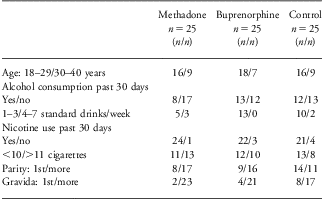
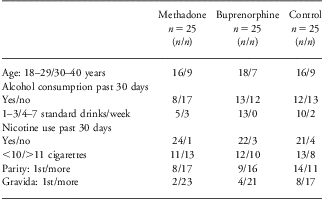
Mothers of infants in the three groups were matched to achieve approximate comparability for the following criteria shown to be important to pregnancy outcome:Reference Crane and Morris16–Reference Merrick, Merrick, Morad and Kandel19 age (between 18–29 or 30–40 years); parity (first born or subsequent child) and gravida (first or subsequent pregnancy); alcohol consumption [yes/no to drinking during pregnancy; if yes, consumption of 1–3 standard drinks/week (1 standard drink = 10 g alcohol) or 4–7 standard drinks/week]; and tobacco smoking (yes/no to smoking tobacco during pregnancy; if yes, smoking 10 or less/day or 11 or more/day).
Opioid maintained women were recruited from a specialist substance use and pregnancy antenatal care clinic at a major teaching maternity and children's hospital in Adelaide South Australia, Australia. Control participants were recruited from standard midwifery antenatal care clinics at the same hospital.
Assessment
In all three maternal groups, substance use was monitored using a self-report questionnaire assessing opioid, cannabis and benzodiazepine use. Where possible, up to three random urine samples were collected during the first and second trimester of pregnancy (dependent on gestational age at enrolment). In all women, three random urine samples were collected during the third trimester of pregnancy. Urine analysis detected additional opioids [including codeine, oxycodone, morphine and heroin (as morphine)], cannabis and benzodiazepines.
NAS was assessed in all three infant groups over a 4-week postnatal follow-up period based on withdrawal score, morphine treatment (opioid-exposed infants only) and length of hospital stay.
Withdrawal score was measured using a Modified Finnegan Withdrawal Scale (MFWS; range: 0–41).Reference Finnegan and Kandall2 The MFWS utilized was an 18-item scale used with permission from the New South Wales Methadone Maintenance Treatment Clinical Practice Guidelines and omitted Moro reflex, sweating and mottling from the original Finnegan Withdrawal Scale.
Control infants do not experience opioid withdrawal, but may exhibit symptoms as part of usual infant behaviour and/or tobacco withdrawal.Reference Godding, Bonnier and Fiasse17 The scale was administered by hospital midwives every 4 h after birth until hospital discharge. If the infant's score reached 8 or greater, the infant was transferred to a Special Care Nursery for scoring to be continued. Following hospital discharge, the MFWS was administered by research staff at home or at organized hospital visits once per week until 4 weeks of age. Infant withdrawal score data was standardized such that the time of each withdrawal score was determined relative to the time of birth.
A standard morphine dosing regimen was used for treatment of NAS that was in accordance with previous studies.Reference Colombini, Elias and Busuttil3, Reference Ebner, Rohrmeister and Winklbaur4, Reference Jackson, Ting, McKay, Galea and Skeoch8, Reference Langenfeld, Birkenfeld and Herkenrath10, Reference Kraft, Dysart and Greenspan20 Administration of oral morphine sulphate (1 mg/ml) was initiated every 4 h when MFWS scores of 8 or greater were observed on three consecutive scoring sessions, when the average of any three consecutive scores was 8 or greater, or if deemed necessary by the treating neonatologist. Doses were as follows: for scores of 8–10: 0.5 mg/kg/day, 11–13: 0.7 mg/kg/day and 14+: 0.9 mg/kg/day. Weaning was as follows: once abstinence is controlled (three consecutive scores of <8), maintain control for 72 h. Weaning was then achieved by decreasing the total daily dose by 10% over 72 h. Among treated infants, once dosage levels were titrated down to 0.2 mg/kg/day, consideration was given to home management of infant medication in consultation with the neonatologist, hospital midwives and social workers, and the mother. For 72 h prior to ceasing all medication, dosing was changed from every 4 h to every 6 h. If infants were discharged on home medication management, they were seen at the hospital's outpatient clinic once per week until weaning was completed. This morphine treatment regimen was used with permission from the New South Wales Methadone Maintenance Treatment Clinical Practice Guidelines. The dose of infant morphine was recorded by the research staff at the weekly home or hospital follow-up visits, along with any missed doses, and doses were checked against the outpatient prescription in the infant's case notes.
Statistics
Power analysis revealed that with α set at 0.01 and power at 90%, 25 participants were needed to detect a 60% difference in the total amount of morphine (mg) required to control NAS.Reference Fischer, Johnson and Eder21 To account for study non-completions, approval was obtained to recruit a maximum of 120 participants (80 opioid maintained and 40 non-opioid-exposed control women). This maximum possible number was based on the average annual number of women who attended the specialist substance use and pregnancy antenatal care clinic at the hospital in years prior to the study. Data were analysed in IBM SPSS Statistics v19® (New York, USA) and GraphPad Prism v5® (GraphPad Software, CA, USA). All data were analysed for normality using Shapiro–Wilk and Kolmogorov–Smirnov normality tests. Normally distributed data between two groups were compared using a two-tailed unpaired t-test and between three groups using a one-way ANOVA with a Sidak post-hoc test. Non-parametric data between two groups were analysed using a Mann–Whitney U-test or Kruskal–Wallis test with Dunn's post-hoc test. A χ 2 test was used to assess differences in frequencies of the occurrence of an event between the three groups and Fischer's exact test for the occurrence of an event between the two treatment groups. Normally distributed data are presented as mean ± s.e.m. and non-parametric data are presented as median (range). P < 0.05 was considered statistically significant.
Ethics
Ethical approval for the study was obtained from the WCH Research Ethics Committee (REC 1330/6/2005). Patient participation in the study was voluntary. All mothers provided written informed consent for both themselves and their subsequent child that was to be assessed following delivery, prior to study commencement. Participants were informed that all information collected as part of the trial would be confidential. Participants were financially remunerated in AUD$50 instalments for their participation over the course of the study with a maximum amount of AUD$250, subject to completion of study requirements.
Results
Participant characteristics
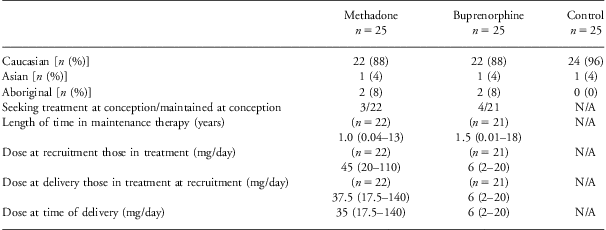
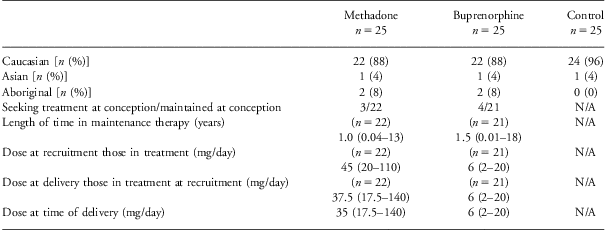
To account for study non-completions, 29, 30 and 26 women were recruited into the methadone, buprenorphine and control groups, respectively, resulting in 25 infants being included in each of the three groups (total n = 75 infants). Major matching comparability criteria of the mothers of these infants are presented in Table 1. Mothers in the three groups were of comparable age, most smoked tobacco, but only a minority consumed more than three alcoholic drinks per week. General participant characteristics are presented in Table 2. The majority of women in all three groups were Caucasian. For women receiving maintenance therapy at the time of recruitment, doses from enrolment to delivery did not significantly change for either treatment group.
Matching criteria of the study population
Characteristics of the study population [median (range)]
Substance use during pregnancy
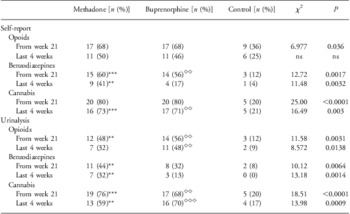
Self-reports of substance use are shown in Table 3 (upper half) from gestational week 21 to delivery and for the 4 weeks prior to delivery. The equivalent rates of positive urines are also shown in Table 3 (lower half). Use of all three substances/substance classes assessed was more common among women on methadone and buprenorphine compared with controls, reflected by both self-report and urinalysis. Substance use between the methadone and buprenorphine groups was not significantly different, with the majority of participants reporting use of additional opioids, benzodiazepines and cannabis.
Additional substance use by maternal study population assessed using self-report and urinalysis

**P < 0.01, ***P < 0.001, Fischer's exact test between methadone and control.
♦♦P < 0.01, ♦♦♦P < 0.001, Fischer's exact test between buprenorphine and control.
ns = χ 2 not significant.
There was no significant difference between treated and untreated methadone- and buprenorphine-exposed infants for maternal benzodiazepine, cannabis and additional opioid use for the whole of pregnancy and 4 weeks prior to delivery. In addition, there was no significant difference between treated methadone- and treated buprenorphine-exposed infants for maternal benzodiazepine [reported all pregnancy: methadone n = 9 (64%), buprenorphine n = 4 (36%); urinalysis all pregnancy: methadone n = 7 (50%), buprenorphine n = 3 (27%); reported 4 weeks prior delivery: methadone n = 6 (46%), buprenorphine n = 2 (20%); urinalysis 4 weeks prior delivery: methadone n = 5 (38%), buprenorphine n = 1 (10%)], cannabis [reported all pregnancy: methadone n = 12 (86%), buprenorphine n = 10 (91%); urinalysis all pregnancy: methadone n = 10 (71%), buprenorphine n = 8 (73%); reported 4 weeks prior delivery: methadone n = 10 (77%), buprenorphine n = 8 (80%); urinalysis 4 weeks prior delivery: methadone n = 9 (69%), buprenorphine n = 7 (70%)] and additional opioids [reported all pregnancy: methadone n = 10 (71%), buprenorphine n = 7 (64%); urinalysis all pregnancy: methadone n = 6 (46%), buprenorphine n = 6 (60%); reported 4 weeks prior delivery: methadone n = 8 (57%), buprenorphine n = 7 (64%); urinalysis 4 weeks prior delivery: methadone n = 4 (31%), buprenorphine n = 6 (60%)] use for the whole of pregnancy and 1 month prior to delivery.
Birth outcomes
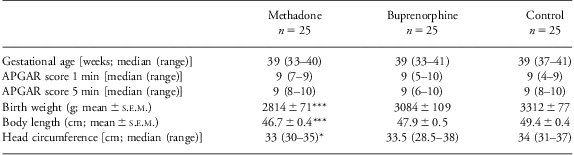
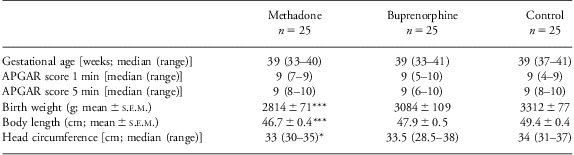
Infant birth outcomes are presented in Table 4. Gestational age at delivery was not significantly different between the three groups, corresponding with no significant difference in the number of infants who were classified as being delivered prematurely (birth of a baby of <37-week gestational age). One methadone-exposed infant was delivered at 33 weeks and two at the beginning of week 36, and one buprenorphine-exposed infant at each of weeks 33 and 35. No control infants were delivered prematurely. APGAR scores were comparable between all three groups at both 1 and 5 min after delivery.
Infant outcomes at birth [median (range)], (mean ± s.e.m.)
*P < 0.05; **P < 0.01; ***P < 0.001 compared with control.
Methadone-exposed infants weighed significantly less (P < 0.001) at birth compared with control infants. Buprenorphine-exposed infants did not differ significantly compared with methadone-exposed or control infants. No infants from the control group were born as low-birth-weight classification (<2500 g) and there was no significant difference in the number born as low-birth-weight classification between the methadone (n = 6) and buprenorphine (n = 2) groups. In accordance with decreased birth weight, body length was significantly shorter (P < 0.001) and head circumference smaller (P < 0.05) for methadone-exposed compared with control infants, with no significant difference in the body length or head circumference of buprenorphine (compared with methadone-exposed or control infants).
NAS
The number of infants in the two maintenance therapy groups requiring pharmacological treatment to control NAS was not significantly different between methadone (n = 15, 60%) and buprenorphine (n = 12, 48%)-exposed infants. In addition to treatment with morphine sulphate, one infant from each of the methadone and buprenorphine groups required treatment with phenobarbitone on one occasion each in the follow-up period due to a reported lack of NAS improvement from morphine treatment alone. The infant from the methadone group was treated on day 2 of life with 20 mg phenobarbitone (maternal urine positive for benzodiazepines in the 4 weeks prior to delivery). The infant from the buprenorphine group was treated on day 28 of life with 9 mg phenobarbitone (maternal urine negative for benzodiazepines in the 4 weeks prior to delivery).
One infant from the buprenorphine group was treated primarily with phenobarbitone as distinct from morphine sulphate. This was on the basis of a request by the mother. A second infant in the methadone group received both morphine sulphate and phenobarbitone for the majority of the 4-week follow-up period due to high-dose benzodiazepine use by the mother during pregnancy. As a result of the differing treatment regimes in these two respective infants the results from these two infants have not been included in the further analyses of NAS, with the exception of information in relation to breastfeeding (BF) and requirement for treatment discussed below.
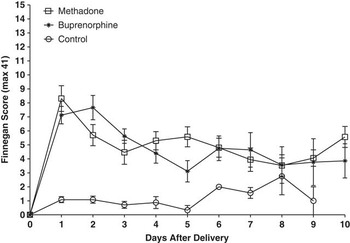
Figure 1 presents the Average Daily Modified Finnegan Score from birth up to 10 days following delivery when the majority of treated infants from each of the buprenorphine (n = 9, 82%) and methadone groups (n = 12, 86%) were still hospitalized. Scores are presented post-morphine treatment initiation.
Average daily Modified Finnegan Scale score of treated infants (mean ± s.e.m.).

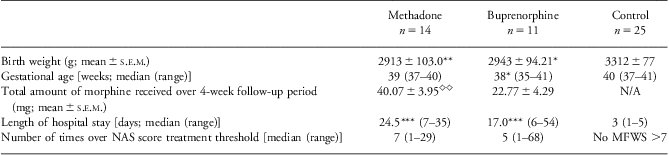
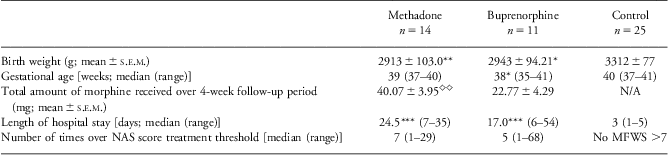
For treated infants, both methadone (P < 0.01) and buprenorphine (P < 0.05)-exposed infants weighed significantly less than control infants. There was no significant difference in birth weight between the two treatment exposure groups. The gestational age at delivery was significantly less (P < 0.05) for buprenorphine-exposed infants compared with controls. There was no significant difference in gestational age between methadone- and buprenorphine-exposed or control infants. One premature infant was treated in the buprenorphine group and none were treated in the methadone group. The total amount of morphine received over the 4-week follow-up period by treated infants was significantly higher (P < 0.01) in the methadone compared with the buprenorphine group. For treated infants, the length of hospital stay was significantly longer for both methadone- and buprenorphine-exposed infants (P < 0.001) compared with controls. There was no significant difference between methadone- and buprenorphine-exposed infants (Table 5).
Treated infant outcomes [median (range)], (mean ± s.e.m.)
NAS, neonatal abstinence syndrome; MFWS, modified Finnegan withdrawal scale.
*P < 0.05; **P < 0.01; ***P < 0.001 compared with control.
♦♦P < 0.01 compared with buprenorphine.
No control infants exceeded the treatment initiation score for the requirement of morphine with three infants achieving a score of 7 on only one occasion each. Following morphine treatment initiation, over the 4-week follow-up period, infants from both the methadone and buprenorphine groups continued to exceed the threshold for morphine treatment requirement. There were significantly (P < 0.01) more methadone (n = 13, 87% of those treated) compared with buprenorphine (n = 5, 42%)-exposed infants who continued to exceed treatment threshold score. There was no significant difference between exposure groups for the number of times infants continued to exceed treatment threshold scores (Table 5).
Following morphine treatment initiation, over the 4-week follow-up period, symptoms that continued in all methadone-exposed infants were high pitched cry, sleeping <2 and 3 h after feeds, mild tremor when disturbed, increased muscle tone, fever (37.3–38.3°C), sneezing and respiratory rate >60 (eight symptoms); for buprenorphine-exposed infants the symptoms were sleeping <3 h after feeds and increased muscle tone (two symptoms). There was no significant difference in the number of symptoms that all infants in each treatment group continued to experience following treatment initiation.
Of those infants treated, 65% (n = 9) of methadone- and 45% (n = 5) of buprenorphine-exposed infants were discharged home on morphine. Thirty-six percent (n = 4) of buprenorphine-exposed infants had been completely weaned from morphine prior to discharge and no methadone-exposed infants had been completely weaned prior to being discharged during the study period.
BF
BF in the first week did not affect the requirement for pharmacological treatment in either methadone-exposed infants [BF treated n = 11 (73%), BF not treated n = 7 (78%); not BF treated n = 4 (27%), not BF not treated n = 2 (22%)] or buprenorphine-exposed infants [BF treated n = 10 (83%), BF not treated n = 11 (85%); not BF treated n = 2 (17%), not BF not treated n = 2 (15%)]. There was no significant difference in the time of treatment initiation or the initial dose of morphine between breastfed and non-breastfed infants for either methadone-exposed infants [time: BF 27.83 (10.67–114.7) h, not BF 35.75 (28.82–53.27) h; dose: BF 0.26 (0.10–0.50) mg, not BF 0.32 (0.26–0.40) mg] or buprenorphine-exposed infants [time: BF 53.52 (6.35–147.0) h, not BF 77.34 (53.75–100.90) h; dose: BF 0.30 (0.24–0.60) mg, not BF 0.25 (0.25–0.25) mg], and the time to pharmacological treatment initiation and the initial dose of morphine was not significantly different between breastfed methadone- or buprenorphine-exposed infants.
Discussion
This prospective non-randomized comparison study is the first to report results from a comparative group of non-opioid-exposed control infants, allowing assessment of the effectiveness of morphine in treating NAS in infants born to mothers maintained on either buprenorphine or methadone, and reducing the severity of symptoms to the levels observed in control infants. It was observed that the routine morphine treatment regimen presented in the current study was not effective in treating NAS and reducing withdrawal symptoms to control infant levels in either methadone- or buprenorphine-exposed infants. In addition, the presented morphine treatment regimen was less effective at controlling NAS in methadone-exposed compared with buprenorphine-exposed infants.
For all infants in each of the three groups, birth outcomes were not significantly different between the groups with the exception of infant size. Methadone exposed, were significantly smaller than control infants, which is consistent with previous research.Reference Blinick, Jerez and Wallach22–Reference Wouldes, Roberts, Pryor, Bagnall and Gunn25 Infant birth weight, head circumference and body length were of similar proportion in each of the three groups, therefore methadone exposed were smaller overall in size than control infants. Maternal smoking and parity were matched at recruitment and multiple pregnancies were an exclusion criterion, therefore minimizing their chances of having a significant impact on infant size outcomes. Race is also unlikely to have impacted infant size, as recalculations of infant size excluding non-Caucasian infants,Reference Wen, Kramer and Usher26–Reference Humphrey and Holzheimer28 (not shown) were unaltered. The current study provides evidence of a direct drug effect of methadone on infant size, as distinct from potential environmental influences.
Results from the current study show that methadone exposure results in a more severe NAS than buprenorphine exposure. Although there was no significant difference in the percentage of infants requiring pharmacological treatment to control NAS, significantly more total morphine over the 4-week follow-up period was required in methadone- compared with buprenorphine-exposed infants in an attempt to control withdrawal. This supports the work of Jones et al.Reference Jones, Kaltenbach and Heil6 and Colombini et al.Reference Colombini, Elias and Busuttil3 who both did not observe differences between treatment groups in the percentage of infants requiring treatment, but who both observed the need for significantly more morphine to control withdrawal in methadone- compared with buprenorphine-exposed infants. Increased NAS severity in methadone- compared with buprenorphine-exposed infants in the current study can also be highlighted by the fact that no methadone, and four buprenorphine-exposed infants were completely weaned from morphine prior to hospital discharge. Differences in the severity of NAS in the current study are likely to be unrelated to additional maternal substance use, gestational age at delivery,Reference Doberczak, Kandall and Wilets29 infant birth weight or size or BF,Reference Blinick, Jerez and Wallach22, Reference Ballard30–Reference Schindler, Eder and Ortner35 as these outcomes were comparable across both groups of treated infants. Interestingly the current study did not observe differences in the length of hospital stay between treated methadone- and buprenorphine-exposed infants as was observed by Jones et al. Reference Jones, Kaltenbach and Heil6
The ineffectiveness of the morphine treatment regimen presented in the current study to control NAS in opioid-exposed infants was first highlighted by the fact that following morphine treatment initiation, both treatment exposure groups continued to exceed MFWS cut-off scores for treatment initiation. Second, according to Finnegan et al. Reference Finnegan and Kandall2 the four most common symptoms experienced as a result of infant narcotic withdrawal are tremors (96%), high pitched cry (95%), sneezing (83%) and increased muscle tone (82%). Out of the eight symptoms that continued to be experienced following morphine treatment initiation over the 4-week follow-up period by the majority of methadone-exposed infants (high pitched cry, sleeping <2 and 3 h after feeds, mild tremor when disturbed, increased muscle tone, fever, sneezing and respiratory rate >60), and the two that continued to be experienced by the majority of buprenorphine-exposed infants (sleeping <3 h after feeds and increased muscle tone), half of these from each group were in the top four symptoms observed by Finnegan et al.Reference Finnegan and Kandall2 as the most common withdrawal symptoms experienced as a result of infant narcotic withdrawal. These two concepts provide evidence that the morphine regimen presented in the current study is not entirely effective in managing NAS as a result of maternal opioid exposure.
Moreover, morphine appeared to be less effective at managing NAS in methadone-exposed infants as significantly more methadone- compared with buprenorphine-exposed infants continued to exceed treatment threshold scores following treatment initiation and while not significantly different, methadone exposed continued to suffer from more of the common symptoms reported as a result of NAS than buprenorphine-exposed infants.
The inability of morphine to return withdrawal symptoms to the level of control infants in either methadone- or buprenorphine-exposed infants can be observed in Fig. 1 over the first 10 days of life. Although average daily scores post-treatment initiation are presented in this figure for each group, and this does not allow the ability to observe the individual instances where opioid-exposed infants continued to exceed treatment thresholds, the average scores provide graphical evidence that the morphine treatment utilized in the current study did not return withdrawal scores to those experienced by control non-opioid-exposed infants.
The inability of the presented morphine treatment regime to manage NAS and return buprenorphine and particularly methadone-exposed infant symptoms to that of control levels is concerning, as the morphine treatment regimen for the current study is if anything more aggressive than morphine treatment regimes utilized in previous studies. The current study utilized 0.09–0.15 mg/kg/dose, whereas Ebner et al.Reference Ebner, Rohrmeister and Winklbaur4 utilized 0.05–0.1 mg/kg/dose, Kraft et al.Reference Kraft, Dysart and Greenspan20 utilized 0.07–0.17 mg/kg/dose and Colombini et al.Reference Colombini, Elias and Busuttil3 utilized 0.03–0.14 mg/kg/dose. The observation that the more aggressive treatment regimen used in the current study was ineffective in its ability to reduce NAS symptoms to those of control infants, could suggest that management of NAS in the past is unlikely to have been as effective as first speculated. This raises a possibility that reduced infant neural development that has been previously observed in methadone-exposed infants,Reference McGlone, Mactier and Hamilton36–Reference Whitham, Spurrier and Sawyer39 may be as a result of inadequately managed NAS and not be as a direct result of methadone exposure through the mother.
Any alterations to NAS treatment that regains symptom control over a reduced period of time and reduces length of infant hospital stay, will only serve to increase mother infant bonding and improve infant outcomes. Several mechanisms could be employed that may increase the effectiveness of the ability of morphine to control NAS in methadone- and buprenorphine-exposed infants and improve infant outcomes. These include revision of the scoring threshold at which treatment should commence to control NAS and/or the use of a loading or bolus dose of morphine. Currently, most NAS treatment protocols commence pharmacological intervention when an average Modified Finnegan Score of 8 or greater is achieved over three consecutive scoring sessions. Lowering the threshold for treatment initiation may result in earlier symptom control prior to symptoms increasing in severity and becoming unmanageable. In the current study if commencement of treatment threshold scores were reduced to three consecutive scores averaging 7 or more, this would have resulted in buprenorphine-exposed infants being treated 27.38 ± 7.80 (5–54) h earlier (in addition to six more infants requiring treatment) and methadone-exposed infants being treated 20.88 ± 5.70 (2–68) h earlier (with also an additional six more infants requiring treatment). The use of a bolus or loading dose of morphine in an attempt to gain control of NAS symptoms earlier, must be weighed up against the potential risk of causing adverse opioid side effects such as respiratory depression.Reference Voepel-Lewis, Marinkovic, Kostrzewa, Tait and Malviya40 Further investigation is therefore required to ascertain more optimal morphine dosing regimens in relation to lowering of treatment initiation thresholds and using bolus or loading doses at the commencement of treatment.
Alternatively, different opioid medications may also be an option to treat NAS as a result of maternal opioid use. Studies have recently begun to investigate the use of buprenorphine itself as a medication to control NAS in opioid-exposed infants.Reference Kraft, Gibson and Dysart9, Reference Kraft, Dysart and Greenspan20 Although these studies did not assess the ability of buprenorphine to reduce withdrawal symptoms to that of non-opioid-exposed controls, these studies did show that when buprenorphine was used to manage NAS in methadone-exposed infants, it was safe and efficacious and had the potential over morphine to reduce the length of infant treatment and hospital stay. In addition, these studies mention that buprenorphine has the ability to have a higher uptitration of dose compared with morphine (due to its increased safety profileReference Jasinski, Pevnick and Griffith41–Reference Ward, Mattick and Hall43), which may allow a quicker attainment of symptom control, thereby potentially negating any risks associated with bolus morphine dosing.
Study limitations include non-randomization of women to treatment, and NAS raters were not blinded to infant drug exposure. Although it cannot be ruled out that non-blinding of the NAS raters could have influenced NAS results, the majority of NAS scoring was undertaken by special care baby unit midwives who, although aware that the infants were undergoing withdrawal from opioids, in the majority of instances did not know which medication the infants had been exposed to during pregnancy.
In conclusion, the morphine regimen utilized in the current study, that is one of the more aggressive regimes utilized worldwide, was not entirely effective in managing NAS and reducing NAS symptoms to those of controls in methadone- and buprenorphine-exposed infants, and appears to be even less effective for methadone. This study highlights the need for more effective NAS treatment regimens as a result of maternal opioid exposure to improve outcomes in opioid-exposed infants and ensure healthy infant and child development.
Acknowledgements
We are grateful to staff and participants of the Drug and Alcohol Services South Australia and to the private prescribers who assisted with the study. We are also grateful to staff and participants from the Women's and Children's Hospital, South Australia, with special mention of Ros Lontis and Louise Goodchild. We would also like to thank Cath Danz, Charlotte Goess, Aaron Farquharson and Kate Morefield for their assistance with sample collection.
This research was supported by an educational grant from Reckitt Benckiser. Andrea Gordon was supported by a Royal Adelaide Hospital Postgraduate Dawes Scholarship and a University of Adelaide scholarship.
Statement of interest
Funding for this study was provided by an educational grant from Reckitt Benckiser. Reckitt Benckiser had no further role in study design; in the collection, analysis and interpretation of data; in the writing of the report; or in the decision to submit the paper for publication. Authors Andrea Gordon, Olga Lopatko and Jason White have previously received reimbursement from Reckitt Benckiser for attending Reckitt Benckiser symposia. Andrea Gordon and Jason White have received a fee for speaking at these symposia.
This trial was registered with the Therapeutic Goods Administration of Australia (Clinical Trial Notification Number: 2002/418).