


Introduction
We will all experience the death of a loved one at some point during our lives. Grief is a normal reaction to such a loss. Most bereaved individuals adjust and are able to re-connect with society and re-engage in pleasurable activities (Bonanno et al., Reference Bonanno, Wortman, Lehman, Tweed, Haring, Sonnega, Carr, Nesse and Arbor2002), even after a major loss (Wortman and Silver, Reference Wortman and Silver1989). However, between 10% (Kersting et al., Reference Kersting, Brahler, Glaesmer and Wagner2011) and 20% (Shear et al., Reference Shear, McLaughlin, Ghesquiere, Gruber, Sampson and Kessler2011) will experience bereavement difficulties that persist rather than diminish over time, with many failing to seek clinical help (Lichtenthal et al., Reference Lichtenthal, Nilsson, Kissane, Breitbart, Kacel, Jones and Prigerson2011) despite significant social impairment and increased risk of suicidality (Latham and Prigerson, Reference Latham and Prigerson2004). Rates of prolonged grief tend to be higher after the death of a child (Meert et al., Reference Meert, Shear, Newth, Harrison, Berger, Zimmerman, Anand, Carcillo, Donaldson, Dean, Willson and Nicholson2011) or violent traumatic death (Currier et al., Reference Currier, Holland and Neimeyer2006).
Many studies have found that bereaved individuals may develop a range of mental health problems, including depression (Zisook et al., Reference Zisook, Shuchter, Sledge, Paulus and Judd1994), anxiety disorders (Jacobs et al., Reference Jacobs, Hansen, Kasl, Ostfeld, Berkman and Kim1990) and post-traumatic stress disorder (PTSD) (Murphy et al., Reference Murphy, Braun, Tillery, Cain, Johnson and Beaton1999; Schut et al., Reference Schut, de Keijser, van den Bout and Dijkhuis1991). Whilst there has been understandable caution against over-pathologizing normal grief responses, there is increasing evidence that prolonged grief is associated with marked functional impairment (Prigerson et al., Reference Prigerson, Bierhals, Kasl, Reynolds, Shear, Day, Beery, Newsom and Jacobs1997), has distinct characteristics from bereavement-related depression and anxiety (Boelen et al., Reference Boelen, van den Bout and de Keijser2003), and has been validated across different cultures, age groups and types of bereavement (Bryant, Reference Bryant2012).
There has been a debate about whether prolonged grief is a distinct diagnostic category (Prigerson et al., Reference Prigerson, Horowitz, Jacobs, Parkes, Aslan, Goodkin and Raphael2009; Strobe et al., Reference Stroebe, Schut and Finkenhauer2001). The authors of the fifth edition of the Diagnostic and Statistical Manual for Mental Disorders (DSM-5; APA, 2013) decided that the evidence was not yet sufficient to merit a formal diagnostic category but agreed that prolonged complex bereavement disorder is a condition for further study. A new diagnostic category of Prolonged Grief Disorder has also been recommended for inclusion in the next edition of the International Statistical Classification of Diseases and Related Health Problems (ICD-11) (WHO, 2012; Maercker et al., Reference Maercker, Brewin, Bryant, Cloitre, Reed, van Ommeren and Saxena2013) (see Table 1).
Diagnostic criteria for DSM-5 persistent complex bereavement-related disorder and proposed ICD-11 prolonged grief disorder
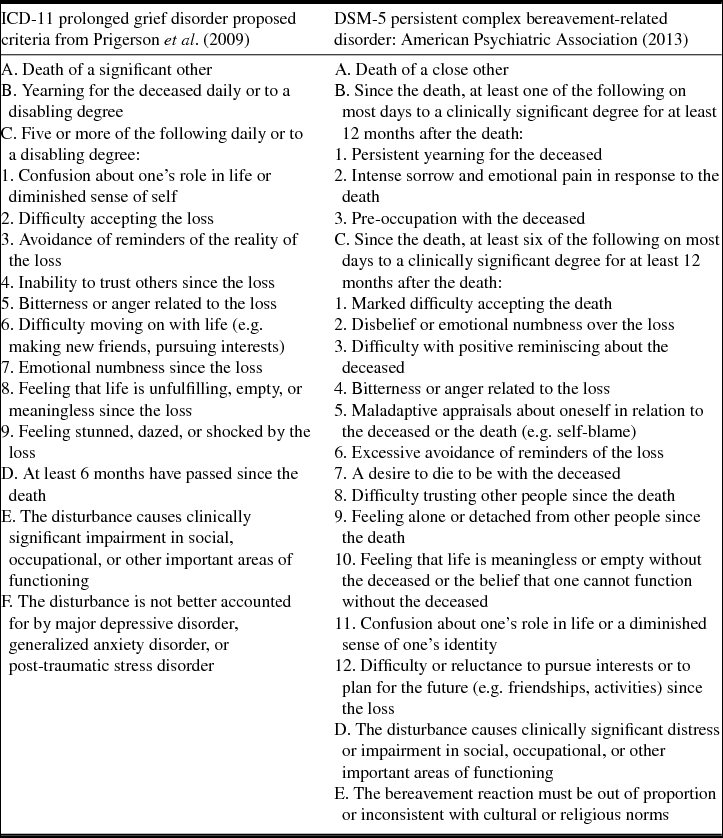
See Jordan and Litz (Reference Jordan and Litz2014).
Defining prolonged and complex grief
The core element of prolonged grief definitions proposed for the DSM-5 and ICD-11 diagnostic systems is a persistent yearning or missing the deceased, or pre-occupation with the circumstance of the death. Additional symptoms include: difficulty accepting the death, feelings of loss of a part of oneself, anger about the loss, guilt or blame regarding the death, or difficulty engaging with new social or other activities due to the loss (Bryant, Reference Bryant2012). The DSM-5 category (Prolonged and Complex Bereavement Disorder, PCBD) proposes a minimum of 12 months duration of symptoms whereas to meet the proposed ICD-11 diagnostic criteria, the symptoms need to persist beyond 6 months after the death. There is ongoing debate about whether abnormal grief should be defined as prolonged (lasting for an extended period of time beyond the acute grief phrase) or complex (a deterioration of the symptoms experienced during acute grief reactions).
Differentiating prolonged/complex grief from depression
Jordan and Litz (Reference Jordan and Litz2014) explain that a key distinction between prolonged grief and depression is how the symptoms in prolonged grief relate to the loss of the deceased. Unlike the pervasive low mood common in depression, the despair and depressed mood associated with prolonged grief is related to separation from the deceased. These authors propose that rumination, widely recognized as an important maintenance factor in depression (Watkins et al., Reference Watkins, Scott, Wingrove, Rimes, Bathurst, Steiner, Kennel-Webb, Moulds and Malliaris2007; Watkins, Reference Watkins2009) seems to have a different orientation in prolonged grief. In depression, a general form of pessimistic rumination is present which may differ from a form of pre-occupation with the deceased that is a feature of prolonged grief disorder. Another difference is the global sense of guilt common in depression. In prolonged grief, guilt tends to relate to self-blame associated with the person's death. The generic loss of interest in depression contrasts with an enduring interest (for the deceased) in prolonged grief. General social withdrawal and avoidance characteristic of depression differs from the avoidance of reminders of the deceased common in PCBD.
Differentiating prolonged and complex grief from PTSD
The common characteristics between PTSD and prolonged complicated grief include: a sense of being stunned or shocked (by the trauma in PTSD and by loss in PCBD), emotional numbing, intrusive thoughts, avoidance of reminders, survivor's guilt, feeling detached from significant others, and intense emotions with significant functional impairments (Rando, Reference Rando1993). Despite these similarities, important differences have been reported between PCBD and PTSD (Shear et al., Reference Shear, Frank, Houck and Reynolds2005; Barnes et al., Reference Barnes, Dickstein, Maguen, Neria and Litz2012). The primary emotions in PTSD are fear, anxiety, anger, guilt or shame whereas in PCBD the primary emotional response is usually yearning, loss or emptiness. Intrusions are common to both disorders but in PTSD intrusive thoughts are associated with the traumatic event and involve a sense of threat, whilst in PCBD, intrusions concern the deceased and involve a sense of loss. In PTSD individuals avoid reminders specifically linked to the traumatic event whereas in PCBD avoidance is limited to those stimuli that serve as reminders of the reality or permanence of the loss. In PTSD, intrusions are triggered by stimuli in the present (such as sounds, colours or smells) that match the past trauma (Ehlers and Clark, Reference Ehlers and Clark2000). In PCBD, however, intrusions are triggered by a wide range of reminders of the deceased rather than being limited to the circumstances of the loved one's death. The hyperarousal and exaggerated reactivity common in PTSD are not typically associated with prolonged grief reactions (Jordan and Litz, Reference Jordan and Litz2014).
CBT approaches to prolonged or complex grief
CBT based models have been developed or modified to treat grief and complex grief reactions. Malkinson and Ellis's (Reference Malkinson, Ellis, Malkinson, Rubin and Witztum2000) Rational Emotive Behaviour Therapy model for grief targets ‘irrational beliefs’, teaching clients to practice more adaptive thinking about their loss and to re-organise their life to maintain bonds with the deceased and improve the ability to function (Malkinson, Reference Malkinson2010).
A number of the components of current cognitive behavioural therapy (CBT)-based prolonged complex grief treatments are derived from other disorder-specific protocols, such as PTSD (Shear et al., Reference Shear, Frank, Houck and Reynolds2005). Imaginal exposure is an established CBT treatment technique for PTSD (Foa and Cahill, Reference Foa, Cahill, Smelser and Bates2001) and has proven to be useful in the treatment of prolonged complex grief when the moment of death is the most distressing experience for the bereaved individual. In prolonged complex grief work with veterans, imaginal exposure has been used to encourage patients to engage with difficult memories to learn that they can tolerate the emotion associated with remembering (Steenkamp et al., Reference Steenkamp, Litz, Gray, Lebowitz, Nash, Conoscenti, Amidson and Lang2011).
Shear and colleagues (Reference Shear, Frank, Houck and Reynolds2005) have designed a manualized complicated grief treatment (CGT) integrating elements of interpersonal psychotherapy for depression and elements of CBT for PTSD. The model incorporates concepts from Stroebe and Schut's (Reference Stroebe and Schut1999) dual processing model and addresses restoration tasks and adjustment to the loss.
Boelan and colleagues (Reference Boelen, van den Hout and van den Bout2006) have developed a CBT-based treatment for complicated grief, which combines exposure therapy and cognitive restructuring components. The Boelan treatment has three core aims: to elaborate and integrate the loss into the individual's autobiographical knowledge base, modify negative global beliefs and misinterpretations of grief reactions, and target anxious and depressive avoidance strategies. Shear's complicated grief treatment and Boelan's CBT-based complicated grief treatment have been demonstrated to be effective in alleviating symptoms in randomized controlled trials (Shear et al., Reference Shear, Frank, Houck and Reynolds2005; Boelan et al., Reference Boelen, de Keijser, van den Hout and van den Bout2007).
In a meta-analysis of randomized controlled trials of psychological therapy for adults with prolonged grief disorder, cognitive behavioural grief-targeted interventions were found to be more effective than control conditions (i.e. supportive or other non-specific therapy, or waitlist conditions) for reducing prolonged grief disorder (PGD) symptoms (Wittouck et al. Reference Wittouck, Van Autreve, De Jaegere, Portzky and van Heeringen2011).
More recently, behavioural activation (BA) has been applied in an open trial for pathological grief (Papa et al., Reference Papa, Rummel, Garrison-Diehn and Sewell2013a,b). The basic premise of this approach is that the death of a significant other undermines an individual's sense of self and their ability to functionally engage in their altered environment. The treatment is derived from the BA protocol for depression (Papa et al., Reference Papa, Rummel, Garrison-Diehn and Sewell2013a).
In recognizing the strengths of CBT-based approaches to prolonged grief we consider in this paper how an established cognitive model for post-traumatic stress (Ehlers and Clark, Reference Ehlers and Clark2000) and trauma-focused cognitive therapy for PTSD (Ehlers et al., Reference Ehlers, Clark, Hackmann, McManus and Fennell2005) has been helpful in treating adults with PCBD. We consider how the cognitive model of persistent PTSD (Ehlers and Clark, Reference Ehlers and Clark2000) may be helpful in categorizing maintaining factors for PCBD (Ehlers, 2006) and the implications for therapy. We draw on clinical examples to illustrate how the model has been applied to a number of cases.
A cognitive approach to complicated grief: lessons from the cognitive model for PTSD
Since complicated grief and PTSD share some similarities, e.g. intrusive memories, avoidance of reminders and emotional numbing, it is possible that there is much to be learned from a cognitive approach to PTSD in the treatment of complicated grief.
Cognitive therapy for persistent PTSD (CT-PTSD) is based on Ehlers and Clark's (Reference Ehlers and Clark2000) cognitive model of PTSD which suggests three core categories of maintaining factors that lead to or maintain a sense of threat in people with PTSD: (1) excessively negative appraisals of the trauma and/or its sequelae, (2) particular characteristics of trauma memories that lead to re-experiencing symptoms, and (3) cognitive strategies and behaviours (such as thought suppression, rumination, safety-seeking behaviours, and avoidance) that are intended to reduce the sense of current threat yet maintain the problem by preventing change in the appraisals or trauma memory, and/or by increasing symptoms. CT-PTSD targets the three factors specified in the Ehlers and Clark (Reference Ehlers and Clark2000) model of persistent PTSD. Key treatment procedures include: (1) an individualized case formulation based on the treatment model, (2) reclaiming your life assignments that involve reclaiming or rebuilding activities and social contacts, (3) elaborating and updating trauma memories, (4) discrimination training with triggers of re-experiencing and (5) reducing unhelpful strategies such as rumination, hypervigilance for threat, thought suppression, and excessive precautions (safety behaviours) with behavioural experiments (Ehlers and Wild, Reference Ehlers, Wild, Schnyder and Cloitre2015).
1. Excessively negative appraisals
In prolonged grief several types of appraisals are common and can be linked to intense yearning to attend to or look after or nurture the deceased person: appraisals of having let down or wronged the deceased and now needing to put things right (such as the patient believing that they should have prevented death or regretting doing or saying things to them before the death); appraisals of permanent damage to the patient (for example, interpreting the loss to mean that their own self or life is less worthy, incomplete or wasted, the patient may also feel that physically a part of them is missing); appraisals that the deceased is still suffering; appraisals of pre-occupation with unfairness of the deceased's lost opportunities in life; and appraisals that other people do not understand or that the patient no longer belongs to a world of others and just belongs to the deceased or has to be with them.) We will expand on some of the most common sets of appraisals.
Appraisals of the death
In PCBD, the bereaved person may have troublesome appraisals about the time or place of their loved one's death, particularly if they were not present. They may imagine details of how the person died, generating lack of certainty around the loss experience. Intrusions of imagined details may lead to the experience of the deceased person still being present or to unhelpful appraisals about the loss, which may maintain distress. The bereaved person may have specific appraisals about gruesome details of the death, which may not reflect the actual details of the death and may become magnified by periods of rumination.
For example, one mother assumed that her young daughter must have suffered for a long time before she died and created a narrative and set of images in her mind that were as distressing as the PTSD intrusions of another family member who actually witnessed the traumatic death of the child. The appraisals, ‘she died in awful pain, she would have called out for me, I should have been there, I can never forgive myself for not being there’ compelled the mother to attend church daily to pray for forgiveness because of her entrenched negative self-beliefs. The church visits triggered her images of the traumatic death and reinforced her shame and guilt appraisals, thus maintaining her grief.
When the bereaved are not present at the time of a traumatic death, information to update negative appraisals about how the deceased died, such as how long the deceased may have suffered, can be accessed from other sources of information. For example, information may be gathered from other people who were present at the scene or from conducting site visits, especially if accompanied by the therapist. Site visits can provide contextual data to update negative appraisals about the death. For example, ‘I now know how he could not have escaped from the gunman because there was only one entrance’ or ‘I can see now that he was more likely to have died instantly because the drop on the bend in the road is so steep’. Other resources, such as coroner's records, pathology reports, memories of inquest hearings, and newspaper reports at the time can be invaluable to help modify exaggerated appraisals about prolonged suffering at the time of death. We have used information from such sources to help clients to reconstruct a more accurate, less distressing narrative of the last moments of the deceased's life. An effective technique to install such new information in the memory more deeply is to incorporate the new information discovered in therapy during imaginal reliving in the same way that the trauma memory is updated in CT-PTSD. This technique has proven to be effective with clients traumatically bereaved by events, such as house fires, road traffic incidents, bombings and shootings.
Appraisals related to responsibility for the death
In PCBD, guilt usually relates to appraisals that the bereaved should have done something to prevent the death of their loved one. One young man's friend was shot dead by paramilitary gunmen who riddled the car with bullets. The patient was in a nearby street but unaware who the victim was at the time. He developed self-punishing negative appraisals, ‘I should have done something to help him’ and ‘he must have suffered awfully because it would have taken ages for him to die’, ‘he must have been frozen in horror as the gunmen approached and died terrified’, ‘how can he rest in peace dying that way?’. Other sources of information were helpful to update the patient's appraisals. From newspaper clippings we discovered that the event occurred at dusk and also his friend's car was stopped at an angle facing the opposite direction from the approaching gunmen. The patient could now accept that it was highly unlikely his friend saw the gunmen approaching at all. Further Socratic dialogue revealed that these groups use the element of surprise as a tactic to get close to their targets, again challenging the patient's appraisals. Another source of help was the pathologist report to the inquest, which explained that the first bullets entered the deceased's brain so he would have died instantly. A discussion followed regarding other likely negative effects of intervention the patient or others could have made, which enabled new appraisals to be formed: ‘my friend would still have died and I or others would have probably been killed also’, ‘others could have been killed if I had caused the gunmen to shoot away from the car towards me’. Updating these appraisals enabled the young man to visit his friend's grave and to say goodbye.
A father who had been out walking with his children believed that his perceived ‘negligence’ had caused his daughter's death when a car collided into his family. His main appraisals linked to guilt were ‘I am responsible, I should have seen the danger coming’. These appraisals were modified by discovering updating information through imaginal re-living and drawing the scene on the whiteboard in great detail. The patient's responsibility belief dropped from 100% to 40% with new information. The therapist then explored possible blocks to assimilating the new information. They revealed that he was frightened to let go of these negative beliefs (appraisals) in case it he would lose his ‘emotional connection’ to his daughter's memory. Further Socratic discussion enabled him to construct an alternative appraisal that ‘to remember her life was as important as remembering how she died’ and he was then able to discuss the relationship that he had shared with his daughter when she was alive. This attentional shift helped the patient to connect with pre-trauma memories and further reduce the strength of the appraisal linked to guilt. His belief rating dropped from 40% to 10%. Even though he still retained a small degree of self-blame for her death, he was able to contextualize the trauma within a lifetime of caring for her and to integrate the traumatic loss with pleasant pre-trauma autobiographical memories.
Another helpful therapeutic technique in this respect is to ask the patient what they did that was helpful. This can help the patients to shift attentional focus away from what they did not do to recall all the help that they did offer. One client lost her husband who died by suicide. Her husband had been very depressed and had been in treatment for depression. The patient had supported her husband for several months with his therapy, his family and his distressing symptoms. He then suddenly took his life. She believed she should have spotted the signs that he was going to take his life and prevented him from doing so. She rated her responsibility belief at 100%. Therapy helped her to focus on all the help she had provided such as taking him to his therapy appointments, supporting visits with his family and comforting him during periods of intense sadness. She was asked to make a list of everything she had done to help her husband. Her list spanned three pages and at the end of the session, she re-rated her belief ‘I should have spotted the signs he was going to take his life and prevented him from doing so’ at 10%.
As indicated earlier, ruminative searching to try to find meaning in relation to traumatic death is common. This process is often linked to negative appraisals of self-blame. One client believed that she was responsible for her daughter's death because she ‘had a feeling that night that there would be an accident’ and was therefore a bad mother because she ‘did not stop her going out in the car’. Careful probing in therapy revealed that the ‘uneasy feeling’ was not a premonition but in fact had been induced by watching a television anti-drinking and driving advertisement of a car crash in the days after the event. Such mistakes are common as a patient selectively retrieves material from a confused memory of the immediate aftermath of traumatic death. Another mother was clear that she had ‘several dreams’ of her daughter being killed on the family farm and had told her husband of these dreams with warnings to be careful with the children. After the accidental death of one of her children on the farm she persecuted herself for failing to act more assertively to prevent the tragedy. Socratic dialogue revealed that she had also experienced happy dreams about the children on the farm over the same period. Psychoeducation about thought–action fusion, a cognitive distortion characteristic of OCD, helped, as did a discussion on the feasibility of preventing all risks at all times. Such work helped to reduce the strength of the client's self-condemnatory appraisals.
Appraisals of life after the loss including appraisals of changed sense of self and other people's responses
In the aftermath of trauma, negative appraisals of initial PTSD symptoms predict the development of chronic, severe PTSD (Ehlers et al., Reference Ehlers, Mayou and Bryant1998; Dunmore et al., Reference Dunmore, Clark and Ehlers1997; Duffy et al., Reference Duffy, McDermott, Percy, Ehlers, Clark, Fitzgerald and Moriarty2015). In PCBD similar negative interpretations of symptoms are common. One bereaved parent who lost two children in separate incidents within a year developed the following negative beliefs about herself, her losses, and her distressed emotional state: ‘This could not happen to a normal parent, I am so different now, I am going mad, I am not the same person that I was and I never will be normal again’. Also, patients may develop problematic appraisals about life without the deceased, such as ‘my life is shattered and will never be worthwhile now’ or ‘what is the point in going on without (the deceased)?’. Some negative appraisals relate to how they believe other people perceive them after traumatic death. A father who lost two children in conflict-related incidents believed, ‘people will think there must be something wrong with me to lose two children’, ‘they will believe that I am being punished for earlier misdeeds’, ‘they will blame me for not taking enough care of my kids’. Consequently, he withdrew from all social activities and led a reclusive lifestyle. He ruminated about his dead children's loss of future activities and his perceived lack of purpose in his life without them. When he ventured out to local shops he avoided conversations because he believed people would inevitably ask about his children and judge him negatively (even 10 years after the event) and that he would fall apart in public. Another mother believed that she had no right to ‘laugh again in public’ because others would see this behaviour as disrespectful to her deceased child's memory. Therapy helped these clients to understand that their perceptions of others’ attitudes towards them were distorted by the appraisals they made of themselves in the aftermath of the death of their children. These clients learned that their memories of the loved ones’ deaths remained vivid because they were linked to distressing, inaccurate meanings. Other people in the community who did not share these interpretations were unlikely to experience frequent intrusive memories of the deaths or even to recall the details of how the children died as time passed by. A discussion on how society and communities adjust to death was helpful to recognize that reduced ‘remembering’ of those who die is a normal adaptive response and not an indication of disrespect or lack of concern for those who die. Finally, behavioural experiments were helpful to gather evidence to update negative appraisals. In one experiment the therapist accompanied a mother on a shopping trip to the local supermarket that she had avoided for eight years. Her predictions were: ‘people will stare at me’, ‘the worst place will be at the payment till where I will be trapped and the cashier will ask me difficult questions about my dead son’, ‘I will break down and make a fool of myself’. During the experiment no one stared, the cashiers were all new staff, different from the ones she had known and no one asked any questions about her dead son. An interesting learning point was that during the experiment she initially kept her head down, avoiding eye contact with other people. The therapist was able to elicit that her attentional focus switched inward at this point to negative thoughts about how ‘odd’ she believed she looked to others. The therapist was able to encourage her to actually observe other people whom she discovered were busy shopping rather than busy focusing on her. Processing the self in a negative manner is a common attentional bias linked to social anxiety disorder yet also relevant to patients with PCBD. They can ‘feel different’ since the death and ‘feel odd’, which can cause them to feel embarrassed, socially awkward and ashamed, causing them to avoid social contact. In therapy, negative self-appraisals can be updated with such behavioural experiments.
2. Characteristics of trauma memories
In PTSD, trauma memories are inadequately integrated with other autobiographical memories and are easily triggered by cues in the environment that match the past trauma. For example, if an individual was hit by a car with bright white headlights, then white office lights could trigger intrusions of their road traffic accident (RTA). Information processing during trauma linked to PTSD presents an important conceptual distinction to prolonged grief disorder where memories of the deceased have formed over long periods of time. Intrusions tend to be triggered by many items, places and activities associated with the deceased rather than by discrete trauma triggers as in PTSD.
Intrusive memories in PCBD may occur in the form of a felt presence of the deceased, which is similar to the concept of ‘affect without recollection’ common to PTSD. Yet, not all items or places associated with the deceased trigger intrusions, therefore one important first step in therapy is to identify those that do. In many cases clients retain lots of memorabilia of the deceased, stimuli that repeatedly activate the memory of the deceased and create a sense of uncertainty about their return. For example, one young client who was beside her best friend when she was killed retained pictures of her deceased friend on several of her bedroom walls. In therapy, she was encouraged to remove these pictures to a photograph album in a drawer which she could choose to open and ‘intentionally remember’ when desired, rather than being constantly reminded of her friend's death.
A mother preserved her deceased son's bedroom in the same state as it was at the time he died, retaining the same bed covers, his clothes in the wardrobe and personal effects in his drawers. No one else was allowed to use the room. She discovered in therapy that these arrangements may be maintaining her grief. With therapist support she packed the clothing and other effects and sent them to an agreed overseas charity. The therapist arranged for the charity to send her follow-up reports about how the clothing was being used to help children in great need. Some personal effects were retained in a box in the attic to be taken out on special occasions such as anniversaries. These steps helped to update the worst meaning of the death, which was that her son and all he represented was gone forever. By donating to charity, she updated the meaning to ‘he lives on through his gifts to children’. Donating clothing to charity also reduced the intrusions of ‘felt presence’ of her son by removing many triggers from her home.
Triggers and stimulus discrimination
Many everyday activities and objects associated with the deceased can trigger intrusions of how the loved one died and may repeatedly bring their absence to mind. Stimulus discrimination training guides the patient to notice triggers for their trauma or loss of memory and to spot all the ways the triggers in the present ‘now’ are different to the past trauma ‘then’ (also called ‘then versus now’ training). The patient is guided to keep their attention in the present, noticing all the differences between the trigger and the past trauma. For example, a mother became very distressed when she saw little girls with blonde hair (similar to the colour of her daughter's hair) and experienced a ‘felt presence’ of her deceased daughter accompanied by an intense yearning to hug her child. In therapy she drew a diagram of this sequence: the trigger (seeing little girls with blonde hair) followed by an intrusion (felt presence of her daughter) which led to her emotional response (intense yearning) and avoidance behaviour (putting her head down) which prevented her from observing differences between the observed child and her own lost child. She would then leave the location quickly. As part of therapy she engaged in behavioural experiments to purposively observe girls her daughter's age and recognize differences to her child. She was encouraged by the therapist to notice features of little girls other than their hair colour, such as ‘how old were they?’, ‘what were they wearing?’, ‘what do they sound like?’. These experiments helped to ‘break the link’ between triggers and the distressing memory of her daughter dying. After these experiments she found it helpful to repeat a phrase to herself, ‘this little girl is not my daughter but another child with blonde hair; my daughter is no longer with us’.
Imagery work
Site visits help to update the patient's memory of how their loved one died. Although a traumatic death cannot be transformed from an unpleasant event into the opposite, the level of distress can be reduced if the memory can be updated to integrate important information such as ‘the deceased is no longer suffering and is no longer in pain’.
One patient reported that it was better to be able to accept that he is ‘no longer lying on this cold concrete floor’ than to think that he was still suffering. Imagery techniques can help to update traumatic death images with an agreed new image of the deceased. For example, the patient may choose to imagine their loved one no longer alone but surrounded by kind, deceased relatives. Importantly, imagery techniques can help the patient to transform the trauma image to an image that represents their most loved quality of their loved one. In this way, imagery techniques can help to update the meaning of the traumatic image. For example, a young man whose daughter died in a paragliding accident frequently imagined what his daughter looked like when she hit the ground. The image he held of her meant that she was still suffering and that he was alone. Therapy helped the patient to run the traumatic image on to include a symbol of his most loved quality of his daughter, which was her positive, upbeat nature. Whenever he experienced an intrusion of her body in the field, he transformed this image to a ray of sunshine, which he had identified as representing her positive nature. The image also helped him to feel that his daughter's positivity was always with him in the way that the sun always shines somewhere in the world.
3. Unhelpful cognitive and behavioural strategies
Some of the most common unhelpful strategies that appear to maintain prolonged grief include rumination, avoidance of reminders, time-consuming rituals that keep focus of attention on loss, social withdrawal or excessive social contact with bereavement networks that maintain focus of attention on loss. We will expand on some of the most common strategies that maintain prolonged complex grief below.
Rumination
Rumination is an unhelpful cycle of thinking, which focuses on abstract questions with no obvious answers, such as ‘why’ and ‘what if. . .?’. Pre-trauma rumination emerges as a predictor of episodes of PTSD (Wild et al., Reference Wild, Smith, Thompson, Béar, Lommen and Ehlers2016) whilst post-trauma rumination predicts chronic PTSD (Duffy et al., Reference Duffy, Bolton, Gillespie, Ehlers and Clark2013; Duffy et al., Reference Duffy, McDermott, Percy, Ehlers, Clark, Fitzgerald and Moriarty2015). Similarly rumination is recognized as a significant maintaining factor in depression (Coffman et al., Reference Coffman, Martell, Dimidjian, Gallop and Hollon2007; Watkins et al., Reference Watkins, Scott, Wingrove, Rimes, Bathurst, Steiner, Kennel-Webb, Moulds and Malliaris2007).
In PTSD, the content of ruminative thinking typically focuses on causes and consequences of the traumatic event (Michael et al., Reference Michael, Halligan, Clark and Ehlers2007). Similarly in complex grief reactions, rumination focuses on the causes and consequences of loss. In PTSD, rumination can trigger intrusive memories, and vice versa (Speckens et al., Reference Speckens, Ehlers, Hackmann, Ruths and Clark2007). Similarly, in prolonged and complex grief reactions rumination can be triggered by intrusions, for example trying to make sense of the ‘felt presence’ of the deceased. Periods of rumination can also generate a ‘felt sense’ that the deceased person is still present. One client interpreted the ‘felt presence’ of her daughter as an indication that she was not at peace and had something important to tell her.
In relation to complex grief, there appears to be an adaptive and a maladaptive ruminative cycle. Adaptive rumination is characterized by reflection aimed at understanding one's emotional state following the loss. Maladaptive rumination is characterized by repetitive thinking about injustice to the self or attempts to compare the loss situation to unrealized alternatives (Eisma et al., Reference Eisma, Schut, Stroebe, Boelen, van den Bout and Stroebe2015). Rumination about injustice was found to be the type most consistently related to poor mental health, a finding that fits with the first author's clinical experiences of working with people traumatically bereaved by acts of terrorist violence and civil conflict. Many embark afterwards on a long campaign for justice often at the expense of their own physical and mental health. We have found it clinically useful to help clients to distinguish between ‘adaptive rumination’ (e.g. problem-solving) and maladaptive rumination (e.g. self-focused cyclical thinking about injustice).
Rumination appears to prevent patients from updating appraisals linked to guilt and instead strengthens appraisals linked to self-blame, such as ‘I should have done more, I should have told my daughter to come straight home’. The ruminative, re-stating of such guilt appraisals may also lead to compensatory behavioural strategies such as visiting the grave several times daily. One patient repeatedly verbalized an appraisal, ‘my wife's death means I have no right to feel joy again’, leading to complete avoidance of activities that would re-connect him with society.
Therapy can help patients to identify triggers for rumination and activities that may replace rumination. One technique, derived from CBT for pathological worry in generalized anxiety disorder (Borkovec et al., Reference Borkovec, Wilkinson, Folensbee and Lerman1983), is to replace rumination with a reserved time slot for ‘intentional remembering’ of the deceased starting daily then reducing in frequency. One patient commenced but instantly stopped attempts to interrupt their rumination because she believed that it would lead to her forgetting her son's memory. An explanation helped her to recognize that the purpose was not to forget about her son but to regain control over her life so that she may remember his complete life.
Cognitive and behavioural avoidance and proximity seeking behaviours
Behavioural experiments are useful to update negative appraisals, update the complicated grief memory and may also be helpful to investigate the effect of particular coping strategies. One parent visited the grave of her child daily for several years, tidying and cleaning and ensuring that the flame remained alight in the small container she had placed on the grave. This behaviour puzzled the therapist because for many people, tombstones and graveyards are a clear reminder of the permanence of death. In probing the behaviour, the patient spoke of the ‘continued presence of her son in her life’. She maintained his bedroom, changed his bed sheets and continued to wash and iron his clothes as if he were still present. When the mother visited the grave, she saw an image of her son as he seemed to her immediately after death when ‘he appeared to be only asleep’. Thus she tended to the grave, keeping it neat and tidy as she did with his bedroom at home. This behaviour seemed to prevent her from updating and integrating the death of her son with other autobiographical memories and, since it was time consuming, prevented her from re-connecting with ‘current life’ activities. In therapy a discussion on how his body would change in a grave helped to update the belief he was sleeping, which enabled her to experiment with reducing the time she spent at his grave. Her beliefs about an afterlife had been shattered by the death but she still believed that he had a spirit and the therapist was able to use imagery work to help her imagine his spirit leaving his body and his body returning to the earth to become part of nature again, which she found comforting.
Patients who find it difficult to accept that the death of their loved one is permanent may avoid situations and other reminders that confront them with this reality. One mother avoided family gatherings where photographs would be taken because there would be a ‘noticeable gap in the picture where her missing son should be standing’. Therapy helped the patient to experiment with attending family gatherings, comparing how isolated she felt before and afterwards. The patient learned that avoiding family events was not going to bring her son back and it only hurt her, causing her to feel more isolated and cut off from people who loved and cared about her.
Further lessons from CT-PTSD for treating PCBD
Reclaiming life activities
In cognitive therapy for PTSD, patients are encouraged to re-engage with former activities to help them reclaim the life they had before their trauma. This element of therapy is called ‘reclaiming your life’ and is equally important in PCBD. Careful consideration is required in setting up reclaiming life activities with other people because individuals suffering from PCBD may experience prolonged expressions of anger and sadness, and may have driven away important sources of emotional support (Bonanno and Keltner, Reference Bonanno and Keltner1997). The phrase ‘reclaim your life’ can be difficult to accept for some patients because many of their previously enjoyed activities may have been shared with the deceased. Such activities may be difficult to resume, the context may have changed significantly and as such cannot be ‘reclaimed’. For example, one mother enjoyed many activities with her child such as attending the mother and toddler group. Such social activities ended with the traumatic death of her child.
A more acceptable phrase may be to ‘rebuild your life’ (in the absence of the deceased), or ‘to re-connect with your life’ (with the wider family, community, society). Activities are planned as behavioural experiments ‘to discover if and how life may still be fulfilling in different ways whilst accepting that this aspect of your life (traumatic bereavement) cannot be reversed’. This is an important aspect of therapy with PCBD because the death can severely interrupt normal routines and social activities for long periods of time. As in chronic PTSD, it can be difficult to access memories of what life used to be like before the death. Behavioural experiments can help to create new beliefs about life continuing to have meaning without the deceased. For example, one parent was linked up with a local voluntary group supporting children with learning disabilities who accepted her support unconditionally and had no knowledge of her traumatic loss. She was able to make a significant contribution to the quality of their lives, which offered her new meaning about the value of her own life.
Therapeutic engagement with prolonged grief
It can be challenging for therapists to listen empathically to distressing accounts of tragic death whilst retaining sufficient emotional distance to be objective. For example, when a parent discussed the tragic loss of her child, one therapist, a parent with a boy of a similar age, found herself tearing up in the session, imagining how she would feel under similar circumstances. One important aspect of supervision in such work is case selection to enable therapists to decide which cases are most suitable to work with, taking into account their own personal circumstances.
Complicated grief seems to disrupt normal patterns of emotional processing (Bonanno, Reference Bonanno2009), which may be challenging for therapists. Individuals with prolonged complex grief reactions experience intense yearning for the deceased and are unable to display facial expressions of positive emotion when recalling conflicted moments (Diminich and Bonanno, Reference Diminich and Bonanno2014). Such features can have profoundly negative effects on interpersonal relationships and may be visible in session. For example, the therapist may find it difficult to detect shifts in affect since non-verbal cues may not accompany experiences of emotion. Many patients may believe it is disrespectful to the deceased to be seen to be experiencing positive emotions. It is necessary to discover and modify such appraisals early in therapy to enable the patient to fully engage in sessions and undertake behavioural experiments. It is also helpful to use therapy to model that it is acceptable for patients experiencing complex grief to express positive emotions such as laughter. The appropriate use of humour can be an effective means to help shift affect and facilitate cognitive change.
Implications for therapy
1. Assessment
The assessment should aim to differentiate between normative and pathological grief and treatment should be offered only to those in the latter category. Trials have found that bereavement interventions for those who are not distressed do no better than waitlist conditions, so clinicians should focus on those who are in need of help. Use a standardized instrument for assessing prolonged complex grief. The Inventory of Complicated Grief measures maladaptive responses to loss (Prigerson et al., Reference Prigerson, Maciejewski, Reynolds, Bierhals, Newsom, Fasiczka, Frank, Doman and Miller1995). More recently, instruments have been developed to assess cognitions that may contribute to complicated grief. We recommend the Grief Cognitions Questionnaire (GCQ; Boelen and Lensvelt-Mulders, Reference Boelen and Lensvelt-Mulders2005) the Typical Beliefs Questionnaire (Skritskaya et al., Reference Skritskaya, Mauro, Olonoff, Qiu, Duncan, Wang, Duan, Lebowitz, Reynolds, Simon, Zisook and Shear2017) and the Grief Cognitions Questionnaire for Children (GCQ-C; Spuij et al., Reference Spuij, Prinzie and Boelen2017). We recommend that therapists develop a preliminary case formulation to include the main elements of the Ehlers and Clark (Reference Ehlers and Clark2000) PTSD model. It is also beneficial to consider relevant cultural and societal norms for mourning and grief (Maercker et al., Reference Maercker, Mohiyeddini, Muller, Xie, Yang, Wang and Muller2009; Klass and Chow Reference Klass, Chow, Neimeyer, Harris, Winokuer and Thornton2011).
2. Memory
Access the worst points, the problematic parts of the memory and the current negative meanings which may relate to the death and to the sequealae. Consider objective information about the death to update meanings that the deceased is present or still suffering and needing care. Site visits may be helpful to gain updating information. A challenge in updating the memory is to find new meanings for life without the deceased. Cognitive re-structuring of negative beliefs about the self and the future without the deceased is necessary.
Create continuity: discuss what the loved one was like. What did the patient and deceased enjoy doing together? What did the deceased bring into their lives? How can the patient create this again? Consider what qualities the deceased brought out in the patient. What activities can the patient engage in to connect to these qualities?
Transform negative imagery to include updated meanings, for example, from an image of the deceased ‘suffering’ to a symbolic representation of the deceased ‘no longer suffering’ and ‘always with me’.
3. Triggers
Identify triggers linked to the death and carry out then versus now discrimination. Reduce excessive reminders of the deceased that trigger intrusions and rumination. Remove memorabilia that preserves uncertainty about the death.
4. Appraisals
Discover the main appraisals linked to the patient's prolonged grief. Use imaginal reliving if appropriate. Update appraisals with cognitive restructuring for different cognitive themes, such as guilt, self-blame and anger. Consult a range of sources for updating information to modify appraisals. Behavioural experiments may also be helpful.
5. Maintaining strategies
Identify the main cognitive and behavioural maintaining strategies. Consider what has changed since the death, what behaviours have stopped and what new behaviours the patient may have started. Use psycho-education to help the patient to discover how these strategies may prevent change in the memory of the death and how they may also trigger intrusions. Encourage the client to replace maintaining strategies with behaviours more likely to facilitate acceptance that the loss is permanent. Collaborate to identify behaviours that help to find meaning and purpose in life without the deceased. Plan re-building life activities that help the patient to reconnect with friends or family.
Attention
Consider focus of attention. Gradually work with the client to shift focus away from loss to what is going on now and on how the client may create continuity in meaning.
Main points
-
• Persistent complex bereavement disorder (PCBD) and prolonged grief disorders (PGD) are new categories that capture symptoms of enduring grief after the death of a loved one.
-
• PCBD and PGD share symptom characteristics with major depression and post-traumatic stress disorder (PTSD), yet prolonged grief has distinct characteristics.
-
• The cognitive model of persistent PTSD (Ehlers and Clark, Reference Ehlers and Clark2000) can be applied to PCBD to categorize maintaining factors and guide treatment.
-
• Two treatment strategies, which are highly relevant for PCBD, and for some presentations of PTSD, are shifting attentional focus away from loss and creating continuity between the past, present and future.
-
• Patients are encouraged to create continuity, often through imagery, from the past to the present by considering how to carry forward the meaning of the loved one in their lives. This may involve transforming painful imagery into a symbolic image that represents the qualities the patient cherished about the deceased.
Ethical statement
The authors assert that all procedures contributing to this work comply with the ethical standards of the relevant national and institutional committees on human experimentation and with the Helsinki Declaration of 1975, as revised in 2008.
Acknowledgements
This work was supported by the Queen's University Belfast Centre for Evidence and Social Innovation and Wellcome Trust (grant 069777 to Anke Ehlers and David M. Clark). We acknowledge the support of the NIHR Oxford Cognitive Health Clinical Research Facility.
Financial support
This research received no specific grant from any funding agency, commercial or not-for-profit sectors.
Declaration of interest
The authors have no conflicts of interest with respect to this publication.
-
(1) To identify similarities and differences between persistent complex bereavement disorder, major depression and post-traumatic stress disorder.
-
(2) To gain a brief overview of the main CBT-based treatments for prolonged and complex grief reactions.
-
(3) To understand how a cognitive model of persistent PTSD (Ehlers and Clark, Reference Ehlers and Clark2000) may be helpful to categorize maintaining factors in PCBD.
-
(4) To consider treatment strategies employed in cognitive therapy for PTSD and how they may be helpful in the treatment of PCBD.



Comments
No Comments have been published for this article.