INTRODUCTION
Soybean [Glycine max (L.) Merrill] has become a major crop in the Brazilian Savannah, associating a favourable rainy season with suitable photoperiod for crop growth. Advances in soil amendment and conservation, cultivar selection for delayed flowering at lower latitude and crop husbandry have been key achievements triggering agricultural sustainable development (Spehar et al. Reference Spehar, Pereira, Souza, Pratap and Kumar2011).
Savannah soybean cultivars carry a delayed flowering trait that allows plants to grow long enough under short-day conditions to permit combine harvesting, thereby allowing expansion of the crop into the tropics (Hartwig & Kiihl Reference Hartwig and Kiihl1979; Kiihl & Garcia Reference Kiihl, Garcia and Pascale1989; Spehar Reference Spehar1995). Inherited by few genes with allelic interactions, hybridizations among selected genotypes have generated early to late maturity types (Destro et al. Reference Destro, Sediyama, Silva, Sediyama and Thiébaut1987; Carpentieri-Pipolo et al. Reference Carpentieri-Pipolo, Almeida, Kiihl and Rosolem2000) which have been fixed into breeding lines that have been evaluated, and are now found in savannah cultivars.
In soybean breeding, parental selection for crosses aims at high yield recombinants while keeping stability-related characters (Spehar & Souza Reference Spehar and Souza2006). After successive selection cycles, undesirable linkages and interactions have been screened out, increasing endogamy in the process (Hiromoto & Vello Reference Hiromoto and Vello1986; St Martin et al. Reference St Martin, Xie, Zhang, Zhang and Song2009). In addition, high yield has been associated with extended flowering and reproduction (Kantolic & Slafer Reference Kantolic and Slafer2001; Cheng et al. Reference Cheng, Wang, Zhang, Wu, Xu, Zhu, Leng, Bai, Guan, Hou, Zhang and Han2011). Under short days, the reproductive phase of soybeans is reduced, with negative impacts on seed yield (Spehar Reference Spehar1995). Cultivar evaluation at different dates has revealed the best sowing period relative to maturity group (Urben Filho & Souza Reference Urben Filho, Souza, Arantes and Souza1993; Marques et al. Reference Marques, Hamawaki, Sediyama, Bueno, Reis, Cruz and Nogueira2011). Even though response limits were defined, yield stability assessment requires extensive evaluation in the savannah to separate genotypic from environmental effects (Spehar et al. Reference Spehar, Pereira, Souza, Pratap and Kumar2011). In adapting soybeans to low latitude, few attempts have been made to explain the differences in photoperiod response at reproduction that could generate less sensitive genotypes.
Soybean trials repeated across locations showed that tropical cultivars can adapt to being grown across a wide range of latitudes, relative to the cultivars grown in temperate zones (Spehar et al. Reference Spehar, Pereira, Souza, Pratap and Kumar2011). However, early maturity cultivars had reduced plant height leading to harvest loss (Spehar Reference Spehar1995). Selection for plant growth from late sowings resulted in early cultivars with a long vegetative phase, at the expense of reducing reproductive period and grain yield (Bonato et al. Reference Bonato, Bertagnolli, Ignaczak, Tragnago and Rubin1998; Spehar et al. Reference Spehar, Pereira, Souza, Pratap and Kumar2011). An approach has been sought by combining plant growth and long reproductive period (Cheng et al. Reference Cheng, Wang, Zhang, Wu, Xu, Zhu, Leng, Bai, Guan, Hou, Zhang and Han2011).
Given the scenario of soybean adaptation to lower latitudes, the current work aimed at evaluating those cultivars best suited to growing in a tropical environment and how duration of different growth phases affected their agronomic performance. Repeated sowing date experiments in different seasons provides the means of generating differences in the length of the growth phases, in support to crop breeding and cultivar acquisition.
MATERIALS AND METHODS
Experimental site, crop and soil management
Experiments were conducted in Planaltina, DF, Brazil (15°39′S, 47°44′W, 1005 m a.s.l.) during three consecutive growing seasons from 2005 to 2008, on a clayey Ferralsol (Oxisol-Haplustox) soil, representative of the savannah soybean-growing area (Soil Survey Staff 2014)). The climate was classified as Aw under the Köppen–Geiger climate classification system (Kottek et al. Reference Kottek, Grieser, Beck, Rudolph and Rubel2006), with two well-defined seasons (rainy and dry), each lasting for c. 6 months.
Before beginning the experiments, soil samples were collected at 0–20 cm depth in the experimental area for chemical analysis. The soil, with pH 5·7, was improved 5 years earlier by application of 4 t/ha dolomite lime 100% calcium carbonate (CaCO3) equivalent. At the same time, the soil also received gypsum to supply sulphur (S) and mobilize calcium in the soil profile and was broadcast fertilized with phosphorus (P) to reach 9 mg/kg. Based on plant requirements, 400 kg/ha of 0–20–20 (nitrogen (N)–phosphorus pentoxide (P2O5)–potassium oxide (K2O)) formulated fertilizer, containing trace elements, was applied in furrows at each sowing (Santos et al. Reference Santos, Neves, Novais, Alvarez and Sediyama2008). To promote biological N-fixation, seed inoculation was carried out before sowing with sterilized peat containing savannah-selected Bradyrhizobium spp strains (Spehar et al. Reference Spehar, Pereira, Souza, Pratap and Kumar2011). During the experiment, plots were sprayed with triazole–strobilurin fungicide mixtures to prevent incidence of soybean rust (Phakopsora pachyrhizi).
Data on rainfall, temperature and day length were collected from a weather station, located 800 m north east from the experimental site, to relate the effect of climate factors on soybean agronomic performance.
Treatments and experimental design
Early maturity BRSOY-1, BRSOY-2 and BRSOY-3, mid-cycle BRSOY-4 and BRSOY-5, and late BRSOY-6, BRSOY-7, BRSOY-8 and BRSOY-9, all of determinate growth habit, were sown on six dates from 20 Oct, at nearest 15-day intervals, using a randomized complete block split-plot design with four replications. Sowing date was the plot and cultivar the sub-plot. Each sub-plot consisted of four rows spaced 0·5 m apart, with 17 seeds/m providing a total plot area of 4·0 m2. The cultivars, from public research institutes and obtained from different crosses by the modified pedigree breeding method, were recommended for the savannah region (Spehar et al. Reference Spehar, Pereira, Souza, Pratap and Kumar2011).
Measurements
For each sub-plot, the following data were collected: (a) duration of the vegetative phase – accumulated degree days from emergence to flowering (DDF); (b) duration of the reproductive phase – accumulated degree days between flowering and maturity (DDM); (c) plant and first pod height, measured from ground level to the top of plant and to the first pod insertion in the stem, respectively, on five random plants; (d) grain yield – by weighing the seeds from the harvest area: seeds were kept at room temperature in dry season savannah, when relative air moisture is low (20–30%). Then they were dried in an oven at 105 °C and moisture content adjusted to 13% in order to standardize comparisons. Degree days for each crop phase were calculated by the formula: DD=Σ[(T max+T min)/2]−T base], where T max=maximum daily temperature; T min=minimum daily temperature; T base=10 °C, which for soybean is taken as the minimum temperature below which there is no effective growth (Zhang et al. Reference Zhang, Wang and Hesket2001). A ratio between DDM and DDF was obtained to compare reproductive length among cultivars across sowing period.
Statistical analysis
Degree days from emergence to first flower and from flowering to maturity, plant and first pod height and grain yield were initially analysed per year, for genotypic response to sowing date, using the statistical model for split-plot (Jones & Nachtsheim Reference Jones and Nachtsheim2009). Considering each crop season as one experiment, a test to assess error mean square homogeneity of variance was performed. Given equal number of replications, a maximum F test was calculated on the ratio F=MS1/MS2, where MS1 is the highest and MS2 is the smallest analysis of variance mean square. When there was no significant difference, joint analysis of variance, involving the three seasons and six sowing dates, resulted in 18 evaluations (year×sowing date). The joint analysis model was given by Y ijl=μ+bi(j)+gi+ej+(ge)ij+ ε(Il)j, where Y ijl=observation relative to genotype i, in block l and environment j (j=1, 2,…18), μ=overall mean, b l(j)=random effect of block l within environment j, g i=genotype fixed effect, i, e j=environment fixed effect, j, (ge) ij fixed effect of i genotype×j environment interaction, ε (il)j=Mean experimental error. Analysis of variance used SAS programme (PROC GLM; SAS Institute 1997). Means were compared by standard error of differences (s.e.d.).
RESULTS
Climatic characteristics and effects on soybean
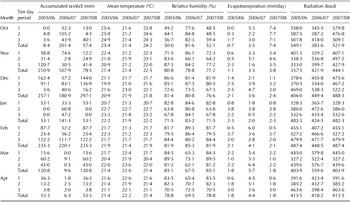
Rainfall in the growing period for each season was 947, 868 and 768 mm for 2005/06, 2006/07 and 2007/08, respectively (Table 1). In the last year, there was a dry spell between January and February, coinciding with the reproductive phase of early sowings. In all cases, the total precipitation was sufficient for soybean growth and reproduction. Mean annual temperature during the experimental period varied between 25·6 and 25·8 °C, with minima of 20·9 and 21·4 °C for soybean vegetative and reproductive phases, respectively. High rainfall was associated with lower temperatures, evapotranspiration and radiation intensity. Average photoperiod reached a maximum of 13·05 h during the soybean vegetative period in late December, declining in the reproductive period. The plants of all cultivars in the later sowings had reduced degree days accumulation from flowering to maturity, at 11·30 h daylight in April, when plants were between growth stages R 7 and R 8 (Fehr & Caviness Reference Fehr and Caviness1977). The vegetative–reproductive relationship among cultivars was retained in late sowing, when yields were reduced, except for some cultivars that were less affected by short days.
Rainfall, mean temperature, relative humidity, evapotranspiration and radiation in the soybean growing period for cropping seasons 2005/06, 2006/07 and 2007/08

Agronomic characters and environment
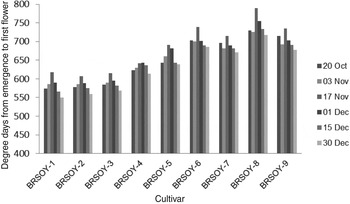
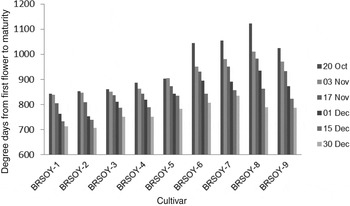
Individual analysis showed each crop season had a unique effect on the different genotypes, although for maturity and grain yield, the cultivar×sowing interaction was highly significant (P<0·05) in all cases. The mean squares of cultivar×sowing for degree days from emergence to first flower (DDF) and from flowering to maturity (DDM), plant height, first pod height and grain yield demonstrated different cultivar response to environmental variations. In the three growing seasons, cultivars interacted significantly (P<0·01) with climate conditions (photoperiod, temperature and moisture avaliability). In general, degree days to first flower were significantly different (P<0·01) across sowing dates and crop seasons (Fig. 1). Degree days to maturity and yield were equally a function of sowing date (Fig. 2, Table 2), while plant growth was less affected by day length variation, with mostly non-significant differences for first pod height.
Accumulated degree days from emergence to first flower (DDF) in nine soybean cultivars of three maturity groups at six sowing dates, mean over three cropping seasons, Planaltina, DF, Brazil.

Accumulated degree days from first flower to maturity (DDM) in nine soybean cultivars of three maturity groups at six sowing dates, mean over three cropping seasons, Planaltina, DF, Brazil.

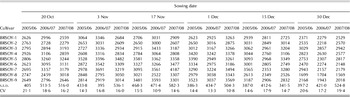
Mean grain yield (kg/ha) for soybean cultivars at six sowing dates and three cropping seasons, Planaltina, DF, Brazil

Degree days from emergence to first flower were high in late October and November sowings but decreased in December, keeping a relationship among genotypes of the different maturity groups (Fig. 1). In general, degree days from flowering to maturity reduced with delayed sowing, negatively affecting yield (Fig. 2, Table 2). Thus, cultivars differed in photoperiod response, with direct impacts on reproductive period and yield. Relatively higher coefficients of variation (CV) for yield revealed less predictable climatic effects, early and late in the crop season.
Sowing date, growth cycle and relationship to grain yield
The overall mean yields, averaged across all sowing dates in the three seasons, were 2904, 2922 and 2966 kg/ha, respectively, indicating little difference between seasons. The comparison of mean performance for season and sowing date showed a different picture. At early sowing there was excess water or dry spell effect, unique to each season, and, at late sowing, lower yield were related to short day effects reducing the duration of the soybean reproductive phase (Table 3, Fig. 2).
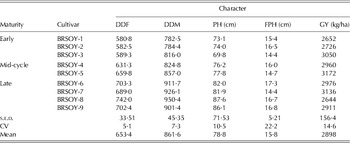
Means for accumulated degree days from emergence to first flower, (DFF), first flower to maturity (DDM), plant height (PH), first pod height (FPH) and grain yield (GY), of nine soybean cultivars evaluated in 18 environments (six sowing dates×three cropping seasons), Planaltina, DF, Brazil

Cultivar performance across environments and stability
The cultivars being evaluated in the current experiment were confirmed as early, mid-cycle and late maturity when tested across locations and seasons prior to their release (Table 3). Irrespective of maturity group, plant and first pod height were sufficient to allow the use of combine harvesters. Accumulated degree days for the reproductive phase were directly related to maturity groups, with mean values of 794·0 and 922·4 between early and late cultivars. However, some cultivars had a comparatively long reproductive phase across the sowing period, such as BRSOY-3, BRSOY-5 and BRSOY-7 (Figs 2 and 3).
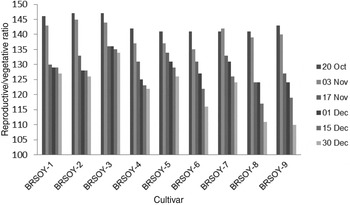
Genotypes performed independently, as verified by significant cultivar×sowing interaction (P<0·05) for grain yield, relating high yield and stability to the longer reproductive period. On average there were significant differences among cultivars (P<0·05): early maturity BRSOY-1 and BRSOY-2 had the lowest yields, although with high DDM : DDF ratio (Fig. 3), while yields of BRSOY-3, the mid-cycle BRSOY-5 and late BRSOY-7 were significantly higher (P<0·01). BRSOY-8 and BRSOY-9, of long reproductive period, had yields similar to early maturing soybeans. These cultivars were more susceptible to dry spells and biotic stresses, with inconsistent performance at late sowing, aggravated by a large reduction in the duration of the reproductive period (Figs 2 and 3).
Ratio between degree days from first flower to maturity and degree days between emergence and flowering (DDM : DDF) in nine soybean cultivars of three maturity groups at six sowing dates, mean over three cropping seasons, Planaltina, DF, Brazil.

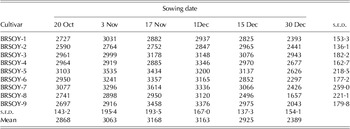
The mean yield over seasons showed that early BRSOY-1, BRSOY-2 and BRSOY-3 had lower ranges between low and high yields, relating in proportionally high DDM : DDF ratio (Table 4, Fig. 3). The high range values for cultivars BRSOY-6, BRSOY-8 and BRSOY-9 reflects the reduction in reproductive period. If the data from late December are not included in the analysis, to exclude the effect of water stress at maturity, a lower range confirmed the large effect of photoperiod on reproduction of late maturity soybean. Cultivar differences in the late sowing period revealed the association between delayed maturity and high yield.
Mean grain yield (kg/ha) of nine soybean cultivars at six sowing dates, averaged across the three cropping seasons at Planaltina, DF, Brazil

DISCUSSION
Rainfall and soybean yield
Rainfall in the soybean growing period was sufficient for water supply in the savannah, as demonstrated previously (Urben Filho & Souza Reference Urben Filho, Souza, Arantes and Souza1993). When distribution is considered, a high concentration of rain in the vegetative to early flowering stages could be a cause of later mineral nutrient deficiency, especially potassium in the reproductive period, which negatively influences yield in early sowing (Spehar et al. Reference Spehar, Pereira, Souza, Pratap and Kumar2011). Additionally, yield reduction could be explained by irregular rain distribution at the beginning of the rainy period (Barros et al. Reference Barros, Peluzio, dos Santos, Brito and de Almeida2003). When dry spells occurred in the reproductive phase for early sowings, they confounded the photoperiod effect. Considering that the savannah rainy period is characterized by fluctuations at the beginning and end of the crop season, yield stability could also be a particular function of drought tolerance at reproduction (Spehar & Souza Reference Spehar and Souza2006). In the absence of moisture stress, yield reduction in the late sowing treatment was caused by photoperiod effect. The limitation imposed by rainfall in the late sowing was independent from delayed maturity within groups.
Sowing dates and day length response
Degree days from flowering to maturity were reduced in the late sowing, explaining most of the yield reduction. At this time, cultivars were responsive to photoperiod, irrespective of maturity groups, as could have been expected based on other studies (Egli Reference Egli and Singh2010). Cultivars in the current evaluation were obtained through hybridization and selection cycles ongoing since the 1970s and 1980s (Spehar et al. Reference Spehar, Pereira, Souza, Pratap and Kumar2011). Incorporation of the long juvenile trait, i.e. a long vegetative period, resulted in delayed flowering with positive impacts on agronomic performance relative to non-adapted photoperiod sensitive cultivars (Kiihl & Garcia Reference Kiihl, Garcia and Pascale1989; Spehar Reference Spehar1995). It explained plant growth in the sowing period for all cultivars, although there were differences in response to photoperiod, especially at the reproductive phase.
As a consequence of a prolonged vegetative period, plants were able to grow long enough under short day conditions so that plants and first pod heights were sufficient to allow mechanized harvesting. Without growth limitation, irrespective of sowing date and crop season, there were statistical differences related to maturity groups (Marques et al. Reference Marques, Hamawaki, Sediyama, Bueno, Reis, Cruz and Nogueira2011). Therefore, the discussion was focused on conditioners of degree days from first flower to maturity period impacting on yield performance. Determinate cultivars used in the current experiment were sensitive to short days after flowering and, although differences were observed among them, there is a need to select for delayed maturity (Cheng et al. Reference Cheng, Wang, Zhang, Wu, Xu, Zhu, Leng, Bai, Guan, Hou, Zhang and Han2011).
Maturity groupings and response to environmental variations
Differences within maturity groups for degree days to first flower and plant height, similar to findings in low altitude savannah, were mostly non-significant (Marques et al. Reference Marques, Hamawaki, Sediyama, Bueno, Reis, Cruz and Nogueira2011). However, the reproductive phase in late sowings affected cultivar performance negatively, as verified with other determinate cultivars (Barros et al. Reference Barros, Peluzio, dos Santos, Brito and de Almeida2003).
It can be stated that delayed flowering is independent and not related to daylength response at the reproductive phase. As the genetics for long reproductive period is not yet completely understood, soybean adaptation to the tropics has been based largely on selection for extended vegetative growth and delayed flowering (Spehar et al. Reference Spehar, Pereira, Souza, Pratap and Kumar2011). Short days caused early maturation in soybeans at late sowing, contrasting with smaller differences in degree days from emergence to first flower within cultivar. Apparently, degree days from flowering to maturity, defining the reproductive period, is a trait of complex genetic inheritance, highly affecting the determinate growth habit of soybean at late sowing (Cheng et al. Reference Cheng, Wang, Zhang, Wu, Xu, Zhu, Leng, Bai, Guan, Hou, Zhang and Han2011). Early to intermediate maturity cultivars were more yield stable than late ones, but in the lengthening days of mid-November, all cultivars reached a maximum value (Urben Filho & Souza Reference Urben Filho, Souza, Arantes and Souza1993; Barros et al. Reference Barros, Peluzio, dos Santos, Brito and de Almeida2003). In general, high yields were related to delayed maturity and the unexpected high performance in mid-December was confounded with the effect of a dry spell at earlier sowing.
Soybean, a short-day plant originating in temperate North Eastern Asia, is adapted to growth in the lower latitude savannah region where the range between longest and shortest day is narrow, as presented in the current paper. However, the reduction in degree days for soybean reproduction in late sowing is similar to that reported at high latitudes (Bruns Reference Bruns2009; Egli Reference Egli and Singh2010; Cheng et al. Reference Cheng, Wang, Zhang, Wu, Xu, Zhu, Leng, Bai, Guan, Hou, Zhang and Han2011). In the tropics, cultivars initiate reproduction according to allele frequency for delayed flowering, defining variations in degree day requirements for the period from emergence to first flower (Destro et al. Reference Destro, Sediyama, Silva, Sediyama and Thiébaut1987; Bonato & Vello Reference Bonato and Vello1999). Late flowering is conditioned by recessive alleles, earliness fitting a partial dominance model, while variations in the duration of the vegetative phase are defined by gene×environment interactions (Carpentieri-Pipolo et al. Reference Carpentieri-Pipolo, Almeida, Kiihl and Rosolem2000). Changes in number of days to first flower, leading to low-latitude soybean adaptation, did not include selection for a long reproductive phase at short days. In tropical cultivars, reduced variation for this character might be related to endogamy (Hiromoto & Vello Reference Hiromoto and Vello1986). Therefore, there is scope for yield improvement in soybean by combining prolonged reproduction (Cheng et al. Reference Cheng, Wang, Zhang, Wu, Xu, Zhu, Leng, Bai, Guan, Hou, Zhang and Han2011) and an indeterminate growth habit (Kantolic & Slafer Reference Kantolic and Slafer2001).
Savannah soybeans and yield stability limits
Breeding soybeans to savannah cultivation has been a recurrent process by incorporating favourable alleles, direct and indirectly related to grain yield (Miranda et al. Reference Miranda, Arias, Prete, Kiihl, Almeida, Toledo and Destro2007). Additionally, during the process, linkage and gene interactions have hindered genetic gain, making expected combinations rather rare events (St Martin et al. Reference St Martin, Xie, Zhang, Zhang and Song2009). The approach has been to select outstanding parents, hybridize them in various combinations of multiple crosses, and select under the modified pedigree method (Kiihl & Garcia Reference Kiihl, Garcia and Pascale1989; Spehar et al. Reference Spehar, Pereira, Souza, Pratap and Kumar2011). As could have been expected, the procedure caused endogamy, with recommended cultivars having common ancestors as sources of seed quality, delayed flowering, resistance to diseases and soil available aluminium (Hiromoto & Vello Reference Hiromoto and Vello1986; Spehar Reference Spehar1995; Spehar & Souza Reference Spehar and Souza2006; Miranda et al. Reference Miranda, Arias, Prete, Kiihl, Almeida, Toledo and Destro2007). Due to probable lack of variation, little gain has been achieved for delayed maturity.
It seems reasonable to enquire whether higher and more stable yields are achievable with new recombinants, in the face of close parentage of soybeans in the savannahs. The definition of stability must consider key factors such as length of reproductive period, measured in the current experiment by degree days from first flower to maturity (Cheng et al. Reference Cheng, Wang, Zhang, Wu, Xu, Zhu, Leng, Bai, Guan, Hou, Zhang and Han2011). Early maturing soybeans suffer less from the effects of erratic droughts and pests, while late ones have longer reproductive phase but are more exposed to such stresses. A balance could be attained with an early to intermediate plant cycle possessing a proportionally long reproductive phase during the sowing period. In addition, growing early soybeans creates opportunities for a second crop profiting from residual moisture which, associated with soil protection, becomes a key sustainability factor in tropical agriculture (Spehar & Trecenti Reference Spehar and Trecenti2011).
All cultivars had foliar area in the range to achieve maximum grain yield (data not presented) (Heiffig et al. Reference Heiffig, Câmara, Marques, Pedroso and Piedade2006; Egli Reference Egli and Singh2010), showing a close relationship with degree days to first flower, even though plant growth varied among dates and growing seasons. Cultivar differential response to the sowings demonstrated the effectiveness of using repeated trials across cropping seasons to assess yield stability (Braccini et al. Reference Braccini, Motta, Scapim, Braccini, Ávila and Meschede2004). In the current experiment, the most yield stable cultivars were BRSOY-3, BRSOY-5 and BRSOY-7, associated with a long reproductive growth period. Irrespective of maturity groups, this trait influences soybean yield stability in a wide variety of sowing periods (Cheng et al. Reference Cheng, Wang, Zhang, Wu, Xu, Zhu, Leng, Bai, Guan, Hou, Zhang and Han2011).
Combinations of sowing dates and growing seasons created environments to evaluate genotypes for yield stability. Sowing dates were more predictable than crop seasons, while the two factors combined allowed identification of the limits for genotypic response. Cultivar performance was explained by the presence of delayed flowering alleles conditioning plant growth, while the plant cycle in late sowing was related to lower variation in degree days to maturity among the cultivars. Understanding the genetic and photoperiod response to reproduction and the introduction of indeterminate growth alleles into cultivars will be useful in selecting for high yield for different sowing dates (Kantolic & Slafer Reference Kantolic and Slafer2001). Broad-base genotype screening in response to early and late sowing could be effective to select for delayed maturity aiming at identifying a soybean ideotype possessing a long reproductive period (Cheng et al. Reference Cheng, Wang, Zhang, Wu, Xu, Zhu, Leng, Bai, Guan, Hou, Zhang and Han2011). It is expected that the current findings should contribute to improved soybean breeding in tropical regions of the world.
This research work was financially supported by the National Research and Development Council (CNPq), Co-ordination for Improvement of High Level Education Personnel (CAPES), University of Brasília (UnB) and the Brazilian Organization for Agricultural Research and Development (Embrapa). Without their partnership it would not have been accomplished.