Introduction
Development of preservation techniques for mouse gametes at room temperature could allow us to store them in a simple and cost-effective manner. Such techniques are important not only in maintaining genetic resources, but also for conducting basic studies such as the mechanism of fertilization without the need for additional animal sacrifice or sample preparation. Previously, we have reported sperm preservation at room temperature using a freeze-drying system; however, these spermatozoa can be stored for only 1 month at room temperature without losing their genetic integrity and reproductive potential (Wakayama & Yanagimachi, Reference Wakayama and Yanagimachi1998). On the other hand, there are several reports that sperm were better preserved at 4 °C instead of at room temperature. Such freeze-dried spermatozoa could be stored for more than 1 year (Ward et al., Reference Ward, Kaneko, Kusakabe, Biggers, Whittingham and Yanagimachi2003). Alternative approaches to simplify the methodology for mouse sperm preservation have been explored because freeze-drying equipment is expensive. It was reported that mouse spermatozoa could be preserved in ethanol or dried under a stream of nitrogen gas at 4 °C. However, the sperm lost their nuclear integrity within 1 day (Tateno et al., Reference Tateno, Wakayama, Ward and Yanagimachi1998) or 3 months (McGinnis et al., Reference McGinnis, Zhu, Lawitts, Bhowmick, Toner and Biggers2005), respectively. We have also demonstrated that mouse spermatozoa could be preserved after storage in a simple high-osmolarity NaCl medium (Van Thuan et al., Reference Van Thuan, Wakayama, Kishigami and Wakayama2005). Such stored sperm could maintain their ability to activate oocytes and to produce high rates of embryo development for up to 2 months at 4 °C. This result was the first demonstration that NaCl has potential as a protective agent for cell preservation without freezing.
All these experiments used spermatozoa that had been dispersed from epididymides to medium, whereas the epididymis is an essential organ for sperm development and storage in vivo. Thus, the epithelial cells of the epididymis secrete proteins to promote sperm maturation (Xu et al., Reference Xu, Ensrud and Hamilton1997; Gatti et al., Reference Gatti, Druart, Syntin, Guerin, Dacheux and Dacheux2000; Martin-DeLeon, Reference Martin-DeLeon2006). The low pH and hyperosmotic pressure within the epididymis allow spermatozoa to survive for several days at body temperature (Acott & Carr, Reference Acott and Carr1984; De Pauw et al., Reference De Pauw, Van Soom, Mintiens, Verberckmoes and de Kruif2003). Recently, some studies on preserving the epididymis at refrigerator temperature (4 °C), to retrieve spermatozoa for in vitro fertilization or artificial insemination, have been carried out in the mouse (Fan et al., Reference Fan, Li, Liu, Meng, Wang, Hou, Zhou and Zhu2008), deer (Hishinuma et al., Reference Hishinuma, Suzuki and Sekine2003; Soler et al., Reference Soler, Perez-Guzman and Garde2003; Martinez-Pastor et al., Reference Martinez-Pastor, Guerra, Kaabi, Diaz, Anel, Herraez, de Paz and Anel2005), pigs (Kikuchi K, Reference Kikuchi, Nagai, Noguchi, Shimada, Takahashi, Hirabayashi, Shino, Ueda and Kaneko1999), dogs (Yu & Leibo, Reference Yu and Leibo2002) and sheep (Kaabi et al., Reference Kaabi, Paz, Alvarez, Anel, Boixo, Rouissi, Herraez and Anel2003). These results suggest that spermatozoa held within the epididymis are more tolerant for preservation at room temperature than are isolated spermatozoa, but, to our knowledge, there is no report on room temperature preservation of sperm in the epididymis.
Yanagimachi et al. reported that the zona pellucida can be preserved for long periods at 4 °C in a concentrated solution of (NH3)2SO4 (Yanagimachi et al., Reference Yanagimachi, Lopata, Odom, Bronson, Mahi and Nicolson1979). Such stored zonae pellucidae maintain their biological and chemical properties. Because this method is simple and cost effective, several laboratories have used it to assess the fertilizing capacity of spermatozoa using salt-stored human (Yanagimachi et al., Reference Yanagimachi, Lopata, Odom, Bronson, Mahi and Nicolson1979), pig (Zhang et al., Reference Zhang, Tang, Shen, Zhou, Wu, Peng, Zhang, Yan and Xia2005) cattle (Chian et al., Reference Chian, Niwa and Okuda1991) and laboratory animals oocytes including the hamster (Yanagimachi et al., Reference Yanagimachi, Lopata, Odom, Bronson, Mahi and Nicolson1979), mouse (Yanagimachi et al., Reference Yanagimachi, Lopata, Odom, Bronson, Mahi and Nicolson1979) and rat (Yanagimachi et al., Reference Yanagimachi, Lopata, Odom, Bronson, Mahi and Nicolson1979). As with the zona pellucida, if spermatozoa could be preserved at room temperature with such a simple method, it could not only save time and money but would also be ethically advantageous by avoiding the excessive use of animals.
Salts and sugars have antimicrobial properties and have been used for many years to store food for long periods at room temperature (Wijnker et al., Reference Wijnker, Koop and Lipman2006). Therefore, in this study, we tried to develop a new method for sperm preservation at room temperature using salt and sugars. Sperm in the cauda epididymidis were stored in NaCl, glucose or raffinose at room temperature for up to 1 year. Glucose and raffinose are used as cryoprotectant agents for freezing spermatozoa, as they protect the cells against various stresses such as osmotic pressure changes (Abe et al., Reference Abe, Lee, Sano, Akiyama, Yanagimoto-Ueta, Asano, Suwa and Suzuki2008; Sztein et al., Reference Sztein, Farley and Mobraaten2000). After preservation, we assessed the functional capacity of the spermatozoa by intracytoplasmic sperm injection (ICSI) into fresh mouse oocytes.
Materials and Methods
Animals
Adult female and male B6D2F1 mice (2–3 months old) and adult female ICR mice (2–6 months old) were purchased from Shizuoka Laboratory Animal Center (Hamamatsu, Japan). All animal experiments conformed to the Guide for the Care and Use of Laboratory Animals and were approved by the Institutional Committee of Laboratory Animal Experimentation of the RIKEN Kobe Institute.
Preservation of the epididymis at room temperature and sperm preparation
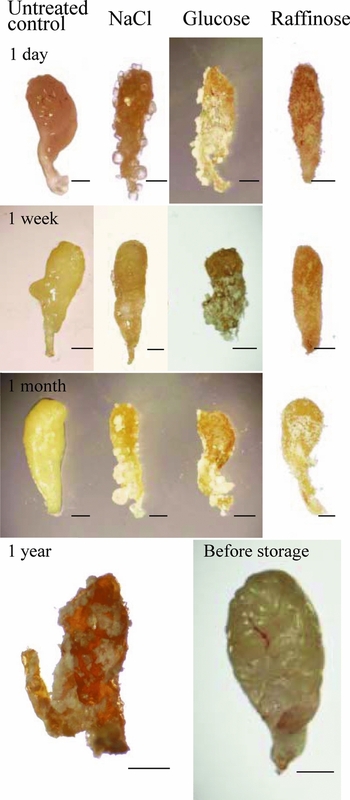
Epididymides were collected from males following euthanasia and then placed directly into 1.5 ml tubes containing salt (NaCl, Wako) or sugars (glucose or raffinose, Wako) for 1 day, 1 week, 1 month, 7 to 8 months or 1 year at room temperature (Fig. 1). Some were kept in tubes without any additives (untreated controls) at room temperature. After preservation, the salt or sugar was removed and each organ was placed in 1 ml of NIM (Ohta et al., Reference Ohta, Sakaide and Wakayama2008) or HEPES-buffered CZB (HEPES-CZB) media at 4 °C for 15 min for rehydration. The sperm were collected by disrupting the epididymis using tweezers and were suspended in NIM or HEPES–CZB medium. Fresh sperm were also collected from mice and incubated in CZB medium at 37 °C under 5% CO2 in air before use.
Epididymides stored in various conditions for 1 day, 1 week, 1 month or 1 year. Scale bar = 1 mm. (See online for the colour version of this figure.)

Water content and viability of stored spermatozoa
The epididymides were weighed just after collection and after storage in salt or sugar for 1 day, 1 week or 1 month. They were weighed after removing all the surrounding salt or sugar. Epididymides stored for 1 month were dried in a desiccator for 44 h to measure the complete dry weight. Sperm viability was examined using a LIVE/DEAD sperm viability kit (Molecular Probes Inc.) according to the manufacturer's protocols. After staining, live and dead sperm were counted. All samples were used for experiments after being weighted so each sample came from a different male.
Gradient preservation and extended rehydration
As an alternative dehydration procedure, epididymides were placed in 5% (w/v) glucose solution and then moved through 10%, 20%, 30%, 40% and >40% glucose (saturated solution) at room temperature for 20 min each. Finally, one treated epididymis was stored in glucose powder and the other was stored in saturated glucose solution at room temperature for 1 day.
As an alternative rehydration procedure, epididymides that had been stored in glucose at room temperature for 1 day were each placed in 1 ml of NIM or HEPES–CZB medium at 4 °C for 15 min, 1–2 h or 22–28 h before examination.
Oocyte collection
Mature B6D2F1 female mice were superovulated by administration of 5 IU equine chorionic gonadotropin (eCG; Teikokuzoki Co.) followed 48 h later by 5 IU human chorionic gonadotropin (hCG; Teikokuzoki Co.). Oocytes were collected from the oviducts about 16 h after the hCG injection. After collection, cumulus cells were dispersed with 0.1% bovine testicular hyaluronidase (Sigma–Aldrich) in droplets of HEPES–CZB medium. After several minutes, the oocytes were transferred to fresh droplets of HEPES–CZB medium and were denuded of almost all cumulus cells by gentle pipetting. Denuded oocytes that had a homogeneous ooplasm were selected and resuspended in new droplets of CZB medium, which had been previously covered with sterile mineral oil. The oocytes were then cultured at 37 °C in a 5% CO2 atmosphere until use (Ono et al., Reference Ono, Mizutani, Li and Wakayama2008).
Sperm head microinjection, embryo culture and production of offspring
One-microlitre aliquots of the sperm suspension were placed in droplets of 10% PVP–HEPES HTF solution (Irvine Scientific) in a micromanipulation chamber. ICSI was performed as described (Kimura & Yanagimachi, Reference Kimura and Yanagimachi1995). Briefly, after washing, the sperm heads were separated from the tail by subjecting the head–tail junction to a few piezo pulses and ICSI was performed at room temperature. After 10 min of recovery at room temperature, the oocytes were cultured in CZB medium for preimplantation development. The injected oocytes in each experimental group were cultured in droplets of CZB media under mineral oil in a plastic dish at 37 °C in a 5% CO2 atmosphere. After 5–6 h of culture, pronuclear formation and oocyte activation were evaluated. The developmental competence of spermatozoa was assessed based on the percentage of sperm-injected oocytes that reached the morula or blastocyst stage after 96 h in vitro.
Fertilized 2-cell embryos were transferred into the oviducts of pseudopregnant ICR females at 0.5 days post coitus. The recipient females were sacrificed on day 18.5 to obtain pups by Caesarean section (Yamagata et al., Reference Yamagata, Suetsugu and Wakayama2009).
Immunofluorescence microscopy
Zygotes generated by ICSI using fresh or stored sperm were fixed in phosphate-buffered saline (PBS) containing 4% paraformaldehyde for 30 min. The fixed zygotes were washed twice in PBS containing 1% (w/v) bovine serum albumin (Nacalai Tesque) (PBS–BSA) for 15 min each and then stored in PBS supplemented with 1% (w/v) BSA and 0.1% (v/v) Triton X-100 (Nacalai Tesque) overnight at 4 °C. All subsequent steps were carried out at room temperature.
Primary antibody incubations were carried out in PBS–BSA for 2 h. Primary antibodies used here were rabbit polyclonal anti-trimethyl-histone H3K9 (H3K9me3, 1:100, Abcam) and mouse monoclonal anti-β-tubulin antibodies (1:100, BD Biosciences). After the zygotes had been washed twice in PBS–BSA for 15 min each, they were incubated for 1 h with conjugated secondary antibodies, Alexa-Fluor-488-labelled chicken anti-rabbit IgG (Molecular Probes Inc.) or Alexa-Fluor-568-labelled goat anti-mouse IgG (Molecular Probes Inc.). After the zygotes had been washed twice in PBS–BSA for 15 min each, the DNA was stained with 4,6-diamidino-2-phenylindole (DAPI) (2 μg/ml; Molecular Probes Inc.). The zygotes were washed and mounted on slides with Vectashield mounting medium (Vector Laboratories Inc.) and observed using a confocal scanning laser microscope (FV1000, Olympus).
Statistical analysis
Outcomes were evaluated using chi-squared tests and a value of p < 0.05 was regarded as statistically significant.
Results
Dehydration of the stored epididymis and viability of spermatozoa
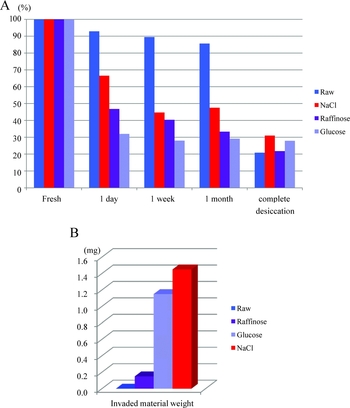
When epididymides were stored in salt or sugar, they became desiccated at different speeds (Figs. 1, 2A). With NaCl storage, about 30% of water was lost within 1 day and then the epididymis gradually became desiccated until it was less than half its original weight at 1 week. There was no further reduction in weight at 1 month. With raffinose, the epididymis had lost half its weight at 1 day and about 10% more by 1 month. When epididymides were stored in glucose, about 70% of the water was lost within 1 day with no further changes. To measure the completely dried weight, epididymides stored for 1 month were placed in a desiccator for 44 h. Glucose had the strongest dehydrating power of the three powders, because the epididymides were almost completely desiccated at 1 day. However, in the other two materials, about 10% of additional water was removed by the desiccator treatment. However, the completely dried epididymides stored in each material showed different final weights compared with intact controls or raffinose-treated organs (Fig. 2B), suggesting that NaCl and glucose both showed a potential to invade the samples.
Weight of the cauda epididymidis stored without additives or in NaCl, glucose or raffinose. (A) Weight change of the stored epididymis after 1 day, 1 week or 1 month, or complete desiccation. (B) Final invaded material weights of epididymides after complete desiccation. (See online for the colour version of this figure.)

Some spermatozoa from control epididymides stored without any additives for 1 day were motile; however all sperm preserved in this way for 1 week were immotile. When epididymides were preserved in salt or sugars, the spermatozoa were not motile even after 1 day of storage. At all stored conditions except for controls, the heads and tails of some spermatozoa had separated and the rate of separated spermatozoa increased as the preservation period was extended. The LIVE/DEAD staining showed that sperm from epididymides stored without any additives and in raffinose for 1 day showed 29.0% and 0.1% viability, respectively, whereas all those stored in NaCl or glucose were dead. At 1 week, no live spermatozoa were observed in epididymides stored without any additives or in raffinose.
The oocyte activation capacity of stored spermatozoa
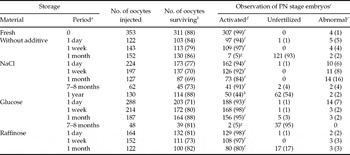
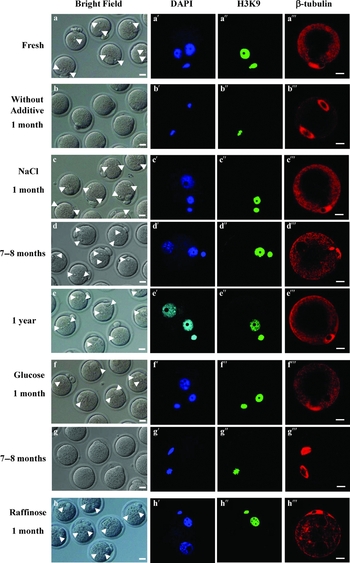
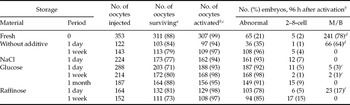
The oocyte activation capacities of spermatozoa from epididymides stored at various times and conditions were examined. When the epididymides were stored without any additives at room temperature for 1 day or 1 week, microinjected sperm heads could activate oocytes at a rate similar to fresh sperm (94% and 97%, respectively, vs 99%, Table 1). However, when they were stored for 1 month, the rate of activated oocytes decreased significantly (5%, Table 1). These oocytes did not form a pronucleus or extrude a second polar body. Figure 3 shows an injected sperm head exhibiting premature chromosome condensation. These chromosomes were synchronized with the oocyte chromosomes at M phase during the first mitotic division, as revealed by staining with DAPI and with specific antibodies for H3K9me3 and β-tubulin (Fig. 3b to b‴). When the epididymides were stored in salt or sugars for 1 day or 1 week, there were no significant differences in the oocyte activation capacity of spermatozoa when compared with the fresh controls, irrespective of storage materials (92–98% vs 99%, Table 1). However, when the epididymides were stored for 1 month, most spermatozoa stored in NaCl, glucose or raffinose retained oocyte activation capacity after ICSI, unlike untreated controls (84%, 95% and 80%, respectively, vs 5%, Table 1). Even after 7 to 8 months, although glucose-stored spermatozoa had largely lost oocyte activation capacity (4%, Table 1), NaCl-stored sperm retained it without any reduction (91%, Table 1). Surprisingly, the oocyte activation rate by sperm from epididymides stored in NaCl for 1 year was 44% with a range of 6–80% (Table 1). Activated oocytes formed male and female pronuclei that appeared normal and extruded a second polar body at 6 h after ICSI (Fig. 3c to f and h). We also examined pronuclear morphology and the methylation status of H3K9me3, β-tubulin and DNA in zygotes by immunofluorescence staining. Most zygotes fertilized with stored spermatozoa did not show any differences from those injected with fresh sperm, although in some activated oocytes the sperm DNA was fragmented or did not decondense (Fig. 3c).
Oocyte activation capacity of spermatozoa after storage in the cauda epididymidis in salt or sugars at room temperature.

aThe experiment was repeated more than three times except for the 7–8-month storage period.
bPercentage based on the number of injected oocytes.
cPercentage based on the number of surviving oocytes.
dTwo-pronuclei (PN) or single-PN embryos.
eThree-PN, no-PN or fragmented embryos.
f–h Values in columns without a common superscript differ significantly (p < 0.001).
Pronuclear stage embryos generated by microinjecting sperm heads from epididymides stored at various conditions. (a–h) Bright field. (a′–h′) Nuclei were stained with DAPI. (a″–h″) Female pronuclei immunostained for H3K9me3. (a‴–h‴) Spindles were visualized by immunostaining for β-tubulin. Oocytes were microinjected with (a) fresh sperm heads, or with sperm heads stored in (b) epididymides for 1 month without additives, (c) in NaCl for 1 month, (d) in NaCl for 7 to 8 months, (e) in NaCl for 1 year, (f) in glucose for 1 month, (g) in glucose for 7 to 8 months, (h) in raffinose for 1 month. Scale bar = 20 μm.

The developmental competence of spermatozoa from stored epididymides
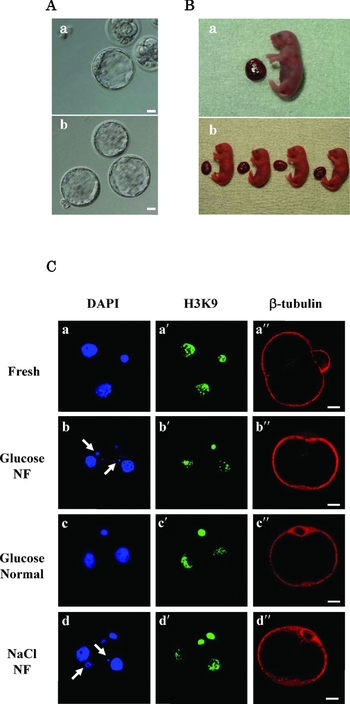
To examine the developmental competence of stored sperm, ICSI-generated zygotes were cultured for 96 h. When epididymides were stored in glucose or raffinose for 1 day at room temperature, only 3% and 17% of embryos developed to the blastocyst stage, respectively (Table 2, Fig. 4A). However, 64% of zygotes produced with sperm from epididymides stored without any additives could develop to the blastocyst stage (Table 2). For NaCl, none of the inseminated oocytes could develop to the blastocyst stage even after 1 day of storage (Table 2). When the epididymides were stored for 1 week, all spermatozoa lost developmental potential except for those in glucose storage (Table 2). However, at 1 month, sperm from glucose-stored epididymides also lost function.
Preimplantation development of mouse oocytes after being injected with sperm heads from the cauda epididymidis stored in salt or sugars at room temperature.

aPercentage based on the number of injected oocytes.
bPercentage based on the number of surviving oocytes.
cTwo-PN or single-PN embryos, excluding 3-PN, no-PN or fragmented embryos.
d–fValues in columns without a common superscript differ significantly (p < 0.001).
M/B, morula/blastocyst stage embryos.
(A) Preimplantation development of mouse oocytes to the expanded blastocyst stage (96 h). Blastocyst stage embryo derived from microinjection of a sperm head from an epididymis stored (a) for 1 day in glucose or (b) for 1 day in raffinose. Scale bar = 20 μm. (B) Offspring from full-term development of mouse oocytes after microinjection with stored epididymal spermatozoa. Offspring derived from spermatozoa from cauda epididymides stored for 1 day at room temperature in (a) glucose and (b) raffinose. (C) 2-cell stage embryos. (a–d) Nuclei were stained with DAPI. (a′–d′) Female-derived chromatin immunostained for H3K9me3. (a″–d″) Immunostaining for β-tubulin of the cytoskeleton. ICSI using (a) fresh sperm heads, or sperm heads from epididymides stored for (b, c) 1 day in glucose or (d) 1 day in NaCl. Scale bar = 20 μm. NF, nuclear fragmentation.

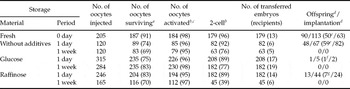
The competence of sperm to support full-term development after being stored in the epididymis in glucose, raffinose or without any additives for 1 day or 1 week was determined by transferring 2-cell stage embryos into surrogate mothers (Table 3). After storage for 1 day, the full-term survival rate was significantly lower for storage in glucose or raffinose than for fresh and untreated control sperm (fresh 50%; untreated 59%; glucose 1%; raffinose 7%; Table 3). Thirteen live offspring were obtained when the oocytes had been injected with spermatozoa from epididymides stored in raffinose for 1 day (Table 3, Fig. 4B). Only one pup was obtained after transferring embryos derived from epididymides stored in glucose (Table 3, Fig. 4B). No live births were obtained with sperm from epididymides stored in raffinose or glucose for 1 week (Table 3).
Results of transfer of embryos developing from oocytes injected with sperm heads from epididymides stored in glucose, raffinose or without additives at room temperature.

aPercentage based on the number of injected oocytes.
bPercentage based on the number of surviving oocytes.
cTwo-PN or single-PN embryos, excluding 3-PN, no-PN or fragmented embryos.
dPercentage based on the number of transferred embryos.
e–gValues in columns without a common superscript differ significantly (p < 0.001).
Chromosome fragmentation at the 2-cell stage among embryos produced from stored spermatozoa
We examined the cause of developmental arrest in embryos injected with sperm stored in epididymides for 1 day by immunofluorescence staining. As described above, zygotes generated by ICSI using fresh sperm or stored sperm showed no significant differences (Fig. 3). By contrast, at the 2-cell stage 100% (NaCl 40/40) or 88% (glucose 36/41) of the embryos showed nuclear fragmentation (fresh controls 7%, 3/43; Fig. 4C).
Varying dehydration or rehydration procedures
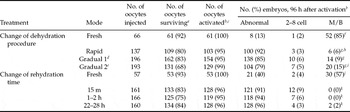
We hypothesized that the rapid dehydration or insufficient rehydration might cause DNA damage in spermatozoa. To reduce the rate of water loss, epididymides were dehydrated gradually using different concentrations of glucose in water. These were then transferred to powdered glucose or glucose solutions to examine the influence of the surrounding environment. As the concentration of glucose solution was increased, the epididymides became dehydrated gradually. The developmental potential of spermatozoa from epididymides stored in glucose solution was better than in powdered glucose (Table 4) but was still less than fresh controls (15% vs 85% embryos produced).
Changing storage and rehydration procedures: preimplantation development of mouse oocytes after being injected with sperm heads from epididymides stored in glucose at room temperature for 1 day.

aPercentage based on the number of injected oocytes.
bPercentage based on the number of surviving oocytes.
cTwo-PN or single-PN embryos, excluding 3-PN, no-PN or fragmented embryos.
dEpididymides were stored in powdered glucose after being dehydrated gradually.
eEpididymides were stored in glucose solution after being dehydrated gradually.
f,g,j,kValues in columns without a common superscript differ significantly (p < 0.001).
h,iValues in columns without a common superscript differ significantly (p < 0.05).
M/B, morula/blastocyst stage embryos.
The rehydration time was also extended to avoid insufficient rehydration and washing. When the rehydration time was lengthened to 28 h, the epididymides became softer and spermatozoa diffused into the solution. Although the rehydration time was extended, there were no significant differences in the developmental potential of spermatozoa compared with the previous methods (Table 4).
Discussion
Cryopreservation is commonly used for the preservation of sperm from many animal species. However, these methods have several drawbacks, including high costs and the difficulties associated with transportation of frozen samples. To overcome these problems, we have tried to develop a new system for sperm preservation that does not rely on freezing. This is the first attempt to report storage of the epididymis in powdered salt or sugars at room temperature.
As shown in Fig. 2, we compared three desiccating agents and found that each showed a different water-absorbing capacity and potential for tissue penetration. For water absorption the rank was glucose > raffinose > NaCl and for tissue invasion potential the rank was NaCl > glucose > raffinose. For example, glucose removed 70% of water content from the epididymis within 1 day, whereas NaCl could only extract 30%. In contrast, NaCl had added nearly one-third weight to the dried epididymides as measured after complete desiccation, whereas raffinose had barely penetrated the tissues at all. We tried to determine the relationship between these characteristics of the preservation agents and the potential for oocyte activation or developmental capacity of preserved spermatozoa.
The results in Table 1 show that sperm from epididymides stored without any additives lost oocyte activation capacity within 1 month. This finding is likely because of degeneration of sperm-born oocyte-acting factors (SOAFs). In contrast, the ability of mouse spermatozoa to activate oocytes was maintained after epididymides had been stored in salt or sugar for 1 month at room temperature (Table 1). Surprisingly, when epididymides were preserved in salt, the oocyte activation potential of spermatozoa was maintained even after 1 year of storage at room temperature. By contrast, when epididymides were preserved in sugar, the activation potential was lost within 8 months. These results suggest that the long-term preservation of SOAFs might be affected by the tissue invasion properties of the desiccant used. Importantly, the pronuclear morphology and methylation status of H3K9me3, β-tubulin and DNA in zygotes showed no differences between zygotes fertilized with stored and fresh spermatozoa (Fig. 3). Thus, the biological activity of mouse SOAFs was completely retained when epididymides were stored at room temperature for 1 year in salt. On average, 44% of oocytes were activated by these sperm. The wide range of 6% to 80% probably resulted from individual mouse differences or preservation conditions.
Yanagimachi et al. reported that the biological and chemical properties of the human zona pellucida could be maintained by storage of oocytes in highly concentrated salt solutions (Yanagimachi et al., Reference Yanagimachi, Lopata, Odom, Bronson, Mahi and Nicolson1979). Unfertile salt-stored human oocytes have been widely used for studying sperm–zona pellucida interactions for predicting the fertilizing ability of sperm from infertile men and for examining gamete binding and penetration between species. On the contrary, here, we show that salt has useful potential for storing proteins or small molecules of spermatozoa and for maintaining their biological and chemical properties at room temperature. The nature of mammalian SOAF has been the subject of intense study. Thus far, strong candidates include phospholipase C zeta (Cox et al., Reference Cox, Larman, Saunders, Hashimoto, Swann and Lai2002; Saunders et al., Reference Saunders, Larman, Parrington, Cox, Royse, Blayney, Swann and Lai2002), truncated c-kit thyrosine kinase (Sette et al., Reference Sette, Bevilacqua, Bianchini, Mangia, Geremia and Rossi1997, Reference Sette, Paronetto, Barchi, Bevilacqua, Geremia and Rossi2002) and the WW domain-binding protein (Wu et al., Reference Wu, Sutovsky, Manandhar, Xu, Katayama, Day, Park, Yi, Xi, Prather and Oko2007). At least part of the SOAF is localized in the perinuclear theca (Kimura et al., Reference Kimura, Yanagimachi, Kuretake, Bortkiewicz, Perry and Yanagimachi1998; Wu et al., Reference Wu, Sutovsky, Manandhar, Xu, Katayama, Day, Park, Yi, Xi, Prather and Oko2007). Thus our approach could provide enough samples to study mammalian SOAFs without using live animals in each experiment, as in Yanagimachi's method for the zona pellucida.
Unlike the oocyte activation potential, the developmental capacities of ICSI-generated embryos were extremely low in vitro and in vivo compared with fresh control even when using sperm stored for only 1 day. The results in Tables 2 and 3 show that of the three desiccants used, raffinose was the best and NaCl was the worst to maintain the developmental capacity of spermatozoa. Raffinose had the lowest tissue penetration capacity and NaCl had the highest tissue invasion potential and lowest dehydration capacity, as described above (Fig. 2). These results suggest that agents with low tissue penetration potential yet giving quick dehydration will cause less damage and enhance sperm preservation.
To examine the effect of dehydration speed and rehydration time, we changed the dehydration and rehydration procedures. When epididymides were dehydrated gradually and then stored in powdered glucose, the developmental potential of sperm was not improved compared with the previous method (Table 4). Thus, the rate of water loss was not related to the damage to sperm DNA. On the other hand, when epididymides were stored in saturated glucose solution after being dehydrated gradually, the developmental potential of spermatozoa was slightly improved (Table 4). This result suggests that storage conditions are important and that it is possible to improve the developmental potential of stored sperm by optimizing the storage conditions.
We also extended the rehydration time to avoid insufficient rehydration. However, the developmental potential of sperm could not be improved (Table 4), indicating that the rehydration time was not related to the damage to sperm DNA. Although NIM, HEPES–CZB medium, PBS and MilliQ water were used as rehydration solutions, there were no significant differences in the oocyte activation ability of spermatozoa or the developmental potential of sperm among those solutions (data not shown), suggesting that the cause of sperm DNA damage was not associated with the kind of rehydration solution.
We examined the cause of developmental arrest by immunofluorescence staining. This approach showed that the embryos produced by stored sperm underwent nuclear fragmentation (Fig. 4C). In addition, fragmented DNA was not stained by H3K9me3 antibody that binds specifically to female chromosomes, in other words, only male DNA formed fragmentation (Fig. 4C). These results indicate that salt or sugar preservation of epididymides did not allow the sperm to retain developmental potential at room temperature because the sperm DNA had been damaged. However, although the developmental capacities of oocytes generated using sperm from salt- or sugar-stored epididymides were significantly lower than untreated controls, we found that the ability of each agent to preserve the sperm differed.
In conclusion, we have developed a method for storing spermatozoa within the cauda epididymidis in powdered salt or sugars at room temperature. Although the developmental potential of stored sperm was lost, as shown by nuclear fragmentation in the resulting embryos, SOAFs were maintained in the sperm from epididymides preserved with powdered NaCl for at least 1 year at room temperature.
Acknowledgements
We thank H. Ohta, K. Yamagata, S. Wakayama, T. Oyanagi, S. Hirauchi and Y. Sakaide for preparing this manuscript. We are grateful to the Laboratory for Animal Resources and Genetic Engineering of RIKEN Kobe Center for housing the mice. Financial support for this research was provided by Grants-in-Aid for Young Scientists B (19780213, to E.M.) and Scientific Research in Priority Areas (15080211, to T.W.) and by the Project for the Realization of Regenerative Medicine (to T.W.).