In the last two decades, historians and art historians have published fascinating studies of the significance of rural landscapes in nation-building. In Hungary, the nation-building project did not come to a rest by the late nineteenth century. Interwar Hungary witnessed a full-blown culture war over the national significance of the rural, with debates taking place across all different forms of national representation including visual art, music, literature and the social sciences. In 1928, following the introduction of sound film in Hungary, cinematic representations were quickly drawn into this highly politicised discussion about national representations. Hungarian feature films, despite their seemingly exclusive concern with the glamorous side of commercial culture and the lifestyles of the urban middle class, became a crucial site of national, and rural, representation. Before turning to the significance of the popular visions of the rural in the films, it will be helpful to sketch briefly the political and intellectual context of debates on ‘the rural’ and ‘the modern’ as they took place in interwar Hungarian public life.
In the interwar years, Hungary witnessed a sudden upsurge of interest in the rural countryside. While clearly national in spirit, the project of ‘discovering the rural’ in search of a new, modern Hungary was not connected to any one political position; the full political spectrum was represented from right wing radicals to conservatives and the left. Sociologists, ethnographers, artists and musicians flocked to villages to study the life and art of peasants. Some were searching for unique national culture, and were convinced that the roots of authentic Hungary were to be found in the countryside. A group of reform-minded intellectuals called the Folk Writers (népi irók) hoped to renew Hungarian artistic and intellectual life by creating a new, modern literature and art based on authentic sources. Others went further in attempts to unearth a new, rural or peasant intelligentsia that would become the foundation of a new national middle class. For example, the Transylvanian Youth insisted that it was in rural Hungary, untainted by cosmopolitan urban modernity, that the ‘essence of the race’ was best preserved.Footnote 1 Most of these groups wished to discover an authentic Hungarian culture that could serve as the basis of a new, organic national modernity.
Liberals, a much smaller group, were also interested in modernising rural Hungary. For them, Budapest, the cosmopolitan capital, redesigned at the turn of the century on a Parisian urban model, represented national greatness and a level of modernisation on a par with the West, while rural Hungary stood for the lingering effects of feudalism, inefficiency and the exploitation of the rural population by the landed nobility. Liberals often pointed out that the romantic idealisation of the rural was a political effort that had little to do with the actual needs and problems of the rural population, who, living in conditions comparable to ‘black Africans of the Congo’Footnote 2 needed urgent infrastructural, financial and cultural modernisation. As the ethnographer Kálmán Szabó noted in 1936, ‘After WWI, economists and politicians began occupying themselves with the problems of peasants and farms (tanya). It was one of them who started applying the label of ‘nation-sustaining element’ to Hungarian peasantry. A lot of older Hungarian peasants used to shake their heads [disapprovingly] at this.’Footnote 3 In Szabó's view, what peasants needed was not to be admired as symbols of the nation but rather policies to extend to them the benefits of modern life.
Liberals generally saw these nationalist movements as dangerous in their idealisation of the rural. They rejected the efforts of nationalist intellectuals who, ambivalent about commercial capitalism, hoped to find a new, more national way of modernising the nation. Pál Ignotus, a liberal Jewish intellectual, expressly excluded the possibility of a new, purely national direction for modernisation, describing the debate about the rural and Hungarian modernisation as raging between conservatives and liberals:
Two directions are at loggerheads here. The first wishes to elevate the fallow and the lords of the fallow above all of Hungary. The other believes the only possible way of improving the sad, desolate, inhumane condition of the rural population is to finally ‘ruin’ it to resemble the sinful Budapest. One camp swears on the fallow, the other on the pavement. Yes, the pavement. There is no third way.Footnote 4
For liberals, the challenge of overcoming Hungary's national backwardness was defined in terms of bringing Hungary's ‘half-feudal’ rural countryside into the modern era.
The rural was not a new symbol of the nation in the interwar years. The link between the rural, meaning at once the rural landscape and traditional rural society, and the national had been crucial to national debates since the mid-nineteenth century. It was generally accepted that rural Hungary stood in contrast with urban Hungary (which for the most part referred to Budapest, the modern cosmopolitan capital); that it represented ‘national’ culture and social strata (there was no agreement on the national status of Budapest); and that it was backward. But there was no agreement on how these elements were connected to each other and what their implications were for modern Hungary. In the political and cultural struggle for the authority to define modern Hungary, the rural became the key for legitimising claims for speaking in the national interest. As a result, Hungary lacked an unambiguous cultural expression of Heimat, a timeless ideal of a strong, harmonious, traditional rural community; there were several, incompatible versions of it.
There were several reasons that this project became particularly urgent in the wake of the First World War. First, Hungary's already fragile national identity was dealt a harsh blow when Hungary lost two-thirds of its former territory and population in the peace treaties. In the wake of the Austro-Hungarian Monarchy's collapse, in 1918 and 1919 Hungary was shaken by a radical and a communist revolution, after which an authoritarian conservative regime gained power. Contemporary critics of all political persuasions believed that the Hungarian peace treaty had been unjust and that in the country's truncated form, Hungarian national culture was under threat of annihilation. By all accounts, Hungary after the First World War was a nation without direction, without a common culture, and without a national leadership to guide it. All agreed that the only solution was national regeneration, and that the rural countryside would play an important role in this.
The idea that Hungary was in need of a modernisation project was not new. Since the early nineteenth century, the project of national modernisation had been imagined in terms of Hungary's backwardness vis-à-vis the West. Liberal aristocratic reformers pushed for national modernisation defined as catching up with the West in economic, cultural and social terms. But by the turn of the century, a new understanding of backwardness gained popularity among conservative nationalists. In the last third of the nineteenth century, the traditional Hungarian landowning nobility began to lose its prominence in the economic and cultural spheres. After the failed nationalist revolution of 1848, the nobility lost free serf labour and tax exemption. Averse to commercial activity and lacking access to capital or credit, many middle-sized landholdings collapsed under the pressures of rapid industrial and commercial modernisation. At the same time, Hungary's largely Jewish industrial and commercial bourgeoisie was beginning to gain prominence in economic, cultural and, to some extent, in political life as well.
Supported by those left behind by modernisation, a conservative nationalist group emerged that preferred to see ‘backwardness’ (the inability to compete in the modern capitalist world) as an authentic Hungarian trait, even a virtue. For them, the image of the impoverished but still glamorous traditional nobility came to stand for the national defiance of ‘foreign’ Jewish or German bourgeois culture. Commercial capitalism, and the modernisation based on it, were rejected as foreign to the Hungarian national character. Before the First World War, Hungary had been part of a multiethnic, multilingual empire in which Jews in particular came to be accepted as citizens with equal rights. After the war, Hungary became a fairly homogeneous nation state; national unity and organic modernity gained new importance and the presence of a large and prominent Jewish population came to be seen as a national problem.
One of the most influential expressions of interwar conservative nationalism was published in 1920 by Gyula Szekfű, the era's leading historian. Three Generations and What Came After was a history of modern Hungary that came to define the thinking of Hungary's conservative middle class for decades. Szekfű found the deeper roots of the nation's problems in Hungary's liberal past that supposedly strayed from the national traditions and values of the Christian nobility. By allowing the rapid influx of Jewish immigrants without requiring from them full ‘spiritual’ assimilation (imagined as something essential, beyond linguistic, national, or even religious assimilation) Hungarian liberals had undermined organic culture by nurturing a ‘Jewish spirit’ that by the early twentieth century dominated Hungary. National backwardness, in this view, was due in part to the oppression of the true national middle class by the stronger Jewish and German bourgeoisie. Rural Hungary was supposed to offer an antidote to the Jewish, commercial capitalist city not only in terms of cultural inspiration but also in terms of a new middle class created out of true Hungarian social strata.Footnote 5
In the cultural realm, scathing critiques of the effeminate, decadent Jewish city were pitted against organic, robust rural society. The writings of the radical public intellectual Dezső Szabó, and particularly the vision of city and country put forth in his first novel, The Swept Away Village, influenced an entire generation of young nationalists. Published in 1919, the Swept Away Village was at once a powerful synthesis of stereotypes and popular thinking about city and village, pushed to the extreme, and a bitter critique targeted more specifically at a group of Budapest liberal intellectuals and reformers. In the novel, Hungarians, both peasants and landowners, belonged to a rural society. Szabó contrasted the simple, healthy Hungarian village with the corrupt and morally bankrupt Jewish-German city, and new hope for regeneration was only to be found in the full-blooded natural culture of the national peasantry. Its hero was a university graduate who at the end of his studies returns to his village. Disappointed in the ideologies of Western civilisation and rejecting success in the modern world, he finds instinctive happiness and authenticity in the village, where his superior intelligence and energy make him a natural leader.Footnote 6
Expressions of the opposition between cosmopolitan, modern Budapest and the authentic national countryside became common, and Budapest was generally seen as Jewish and, as such, never organically national. When the would-be governor Admiral Miklós Horthy entered Budapest as the head of the national army on November 16th 1919, he blamed the 1918 and 1919 revolutions on Budapest's immorality and its rejection of true Hungarian nationalism.
The Hungarian nation loved Budapest, even spoiled it, but recently this city proved to be the nation's ruin. . .. This city renounced the nation's thousand-year history, dragged the Holy Crown and the national colors in the dirt and dressed itself in scarlet rags.Footnote 7
Although Horthy's speech ended with pardoning the city if it will again agree to serve the nation, it made clear that radical liberal, communist or even urban commercial cultures were at odds with authentic Hungarian culture.
In the intensely nationalist, conservative public sphere of interwar Hungary, the possibilities for liberal expression in the political and intellectual realms diminished. Alternative conceptions of a Western, commercial, bourgeois Hungary were pushed to the margins of public life. But in entertainment culture, we find a rather different way of representing the relationships between ‘urban’ and ‘rural’ and ‘backwards’ and ‘modern’.
Films are an interesting source for investigating the popular understanding of the rural, for several reasons. They are an extremely rich source of visual, aural and narrative representations and stereotypes that both reflected and shaped popular thinking about these issues. Films relied on mass audiences; they were designed to be easily understood and to appeal to a diverse population. As a result, films reached a wide range of audiences including women, the working class, the uneducated and those living in provincial towns. In fact, in the first two decades of the twentieth century, films became one of the most important forms of mass culture in Hungary; audiences spent more money annually on movie tickets than on all types of printed materials combined.Footnote 8
Entertainment films suggested a new and radically different way of imagining the place of the rural in Hungarian modernity. They reconfigured the meaning of the rural from the perspective of the urban bourgeoisie. The films’ celebration of the glamorous lifestyles made possible by commercial modernity extended to the countryside as well. In the films, the rural does not stand for authentic, untainted national culture, and it is not in opposition to Budapest. Neither can the rural offer a solution to Hungary's modernisation problems; quite to the contrary, it is urban bourgeois culture that is capable of regenerating the rural countryside.
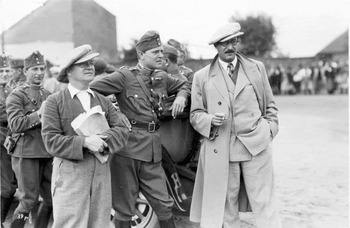
Hungary had a booming silent film industry that expanded even more dramatically during the First World War, and by 1918 became the third largest film producer in the world.Footnote 9 But the post-war influx of foreign films, combined with Hungary's economic crisis and the exodus of some of Hungary's most successful directors brought film production to a complete halt by the mid-1920s. In the new era of sound, film production slowly resumed, based almost entirely on the efforts of small entrepreneurs. Between 1931 and 1938, Hungary produced around 130 feature films. Most of these were romantic comedies, and nearly forty per cent of them were made by two Jewish directors, István Székely and Béla Gaál, who were trained abroad in the 1920s in Vienna and Berlin (Figure 1). In fact, the majority of the most successful Hungarian filmmakers were from Jewish backgrounds. Sons of the assimilated Jewish bourgeoisie, they were a highly educated group of writers trained in Hungary and abroad who maintained close connections with avant-garde artists’ circles in Hungary, the liberal intelligentsia, and the international filmmaking community of Berlin, Vienna and Hollywood. They created an entertainment culture that was heavily reliant on the tradition of urban middle class comedy but aimed at a wide and mixed audience.
Director István Székely on set. (Probably the set of Rákóczi March, 1933)
Székely was the most prolific Hungarian film director of the 1930s. Raised in a liberal, upper-middle class assimilated Jewish family, he was trained in the 1920s in Vienna and Berlin and returned to Hungary only after Hitler's rise to power. He escaped Nazi persecution by fleeing to Hollywood with his wife, actress Irén Ágai, in 1938. Courtesy of the Hungarian National Film Archive photo collection.

Finally, films were recognised by contemporaries, and discussed by the Hungarian government, as extremely influential representations of the nation. Conservative critics believed that Hungary, a country lacking in social and cultural cohesion and with a weak sense of national identity, needed to tap into the propaganda potential of entertainment films. The goal was not so much to broadcast direct political messages as to inspire national culture and feeling, especially among the lower classes and those living in areas along the new Hungarian border. Films were regularly discussed as crucial from a national standpoint both for domestic audiences and as national representation abroad, and critics questioned whether their portrayals of rural and urban Hungary in fact served the nation's best interests.
Unsurprisingly, the radical right did not approve of the way entertainment films portrayed Hungarians, and constantly attacked what they saw as the influence of a ‘commercial Jewish spirit’ in the film industry. According to antisemitic nationalists, Jewish filmmakers lacked a connection to the authentic Hungarian soul and were consequently incapable of producing authentic Hungarian art. Despite the controversy surrounding Hungarian film production, however, before 1938, there were few films, and none that were popularly successful, representing a conservative vision of Hungary. The reason for this was that while interwar Hungarian governments and Hungarian public life were conservative, nationalist and in some ways authoritarian, they were neither hegemonic nor totalitarian. As late as the second half of the 1930s there was no clear agreement on what constituted national culture or how to portray it in film. Even more sorely lacking was an official body capable of enforcing such a vision.Footnote 10 In the absence of a state-funded and -controlled film industry, the government relied on its censorship committee to regulate cinematic representations, with the result that, until 1938, the government had to make do with films produced according to the rules of the commercial capitalist market. This situation came to an end with the 1938 introduction of anti-Semitic legislation, among other things prohibiting individuals of Jewish backgrounds from working in the film industry. By 1940, the Hungarian film industry was almost entirely new: nearly all of the previous decade's directors, producers, writers and production companies were gone, as were the genres, styles and themes of the 1930s.
Contemporary cinemas of East and Central Europe all engaged, in some way or other, with the conflict between traditionalism and modernity, but offered a variety of different interpretations. For young nation states in Central and Eastern Europe, film appeared as an exciting opportunity to popularise a new national cultural vision, and there were attempts by conservatives to foster such representations. The rural landscape was a significant national symbol, and in the films it often came to stand for traditional national culture.Footnote 11 Quite often, however, as was the case in Poland, the Czech Republic and Hungary, artists were able to offer an alternative interpretation of the official nationalist vision through entertainment films.Footnote 12
Hungary's romantic comedy films, most frequently set in Budapest and featuring the adventures of the modern urban middle class, celebrated the pleasures of consumer culture and individual self-determination. On the surface, their representations of rural Hungary seem highly stylised and stereotyped. The countryside appeared primarily as a place where the urban bourgeoisie went for a weekend trip or vacations. The rural scenes contrast sharply with those set in Budapest. While the capital's cityscape and architectural attractions, easily recognisable from postcards or tourist brochures, and the scenes of modern urban life marked it as a well-defined historic place, the countryside was much more generic and symbolic. The goal of filmmakers was not to create an authentic or believable rural setting; exact locations were rarely specified and then often fictitious. Apart from better-known landmarks such as Lake Balaton or the Great Plains of Hortobágy, the regularly appearing rolling fields, farmlands, small towns and old villas could have been anywhere in Hungary: in fact, directors often shot all the ‘rural’ scenes in Hunnia's studio in Budapest.
On the one hand, the films offered nostalgic images of the Hungarian countryside in abundance. Out of the city, the landscape quickly turned into rolling fields of wheat, vineyards, orchards and old estates. Happy peasants sang while working the land, and landlords occasionally galloped by on horses. The only signs of the twentieth century were trains and cars passing by. Such images gave viewers the impression that modernity had largely bypassed the countryside. While cities underwent vast transformations, rural Hungary remained untouched, charming, beautiful and peaceful. Most of these scenes were accompanied by instrumental or vocal renditions of popular ‘gypsy’ folk songs.
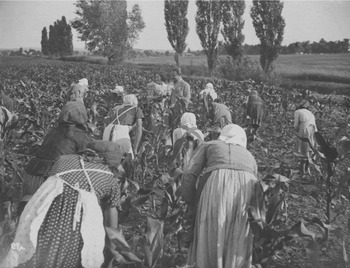
If peasants made an appearance at all, they were domestic employees or farm workers on a rural estate. Without any real function in the narrative, they were backdrops adding local colour through their elaborate folk costumes and their cultural differences from the urban middle class. ‘Village scenes’, occasionally appearing as musical inserts inessential to the narrative, were also common. They depicted peasants engaging in harvesting and customary pastimes, or holding markets, wearing folk costumes, dancing, singing and playing music (Figure 2).
Still from The New Relative (Béla Gaál, Harmónia, 1934)
A middle class young couple look on as traditionally dressed peasant women happily work the land. Zita Perczel as Kitty and Ferenc Delly as Miklós. Courtesy of the Hungarian National Film Archive photo collection.

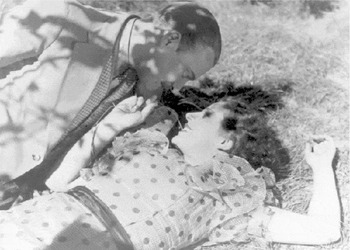
On a visual and aural level, the films’ representations were traditional, even conservative. The films seem to embrace the same elements touted by Sándor Petőfi, Hungary's favorite national poet (a revolutionary who died on the battlefield in 1849) in his 1844 poem The Plains: wheat fields, wells, herds and cowkeepers, fruit trees in the distance and a dilapidated local inn frequented by outlaws express Hungarian particularlity and identity.Footnote 13 They created nostalgic, rarified and visually appealing images of the Hungarian countryside that both domestic and foreign audiences could enjoy. In the films, these scenes are often shown from the perspective of urban or foreign visitors. Directors often discussed scenes presenting the cityscape of Budapest and the Hungarian countryside as exotic and unique as necessary for making films appealing to foreign audiences. Indeed, a New York Times critic reviewed the successful film Three Dragons (Ladislao Vajda, Harmónia, 1936), solely from this angle: ‘scenes in the Hungarian capital and at the [rural] estate are interesting and well photographed’.Footnote 14 In some of the films, this is the extent of the rural presence in the films; it appears as merely an extension of the urban bourgeoisie's space. The new bourgeoisie, with the leisure time for ‘weekends’ and vacations could spend them in style in Hungary. The films seemed to tout the countryside as an ideal vacation spot, underscoring that Hungary, too, offered desirable temporary escapes for those who could afford it (Figure 3).
Still from The New Relative (Béla Gaál, Harmónia, 1934)
The scenic countryside often appears in the films as an ideal setting for romance. After their tour of the family estate, the young couple frolic in the grass. Zita Perczel as Kitty and Ferenc Delly as Miklós. Courtesy of the Hungarian National Film Archive photo collection.

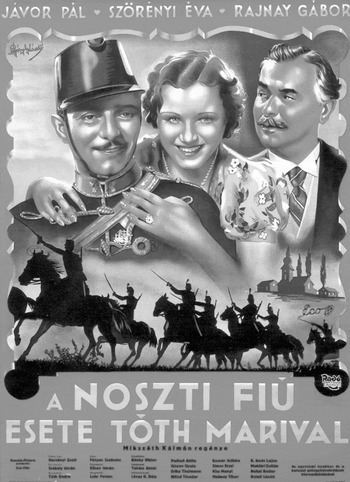
This is the case, for example, in Young Noszty and Mary Tóth (István Székely, Eco Films, 1938) (Figure 4). The film starts off with a Hungarian folk song, the credits are designed with traditional folk motifs, and we see a group of traditionally dressed army officers riding horses through the countryside singing about their romantic exploits. The narrative is based on the eponymous satirical short story (1908) by the popular nineteenth-century novelist Kálmán Mikszáth, in which a family, having made their fortune in America, return to the Hungarian countryside with their modern daughter Mary. The film is a romance between the dashing but old fashioned and gambling-prone lieutenant and the modern cosmopolitan Mary. Almost equally important however is the narrative of Mary's enthusiasm for Hungary and her embracing of rural life. Mary, visiting Hungary for the first time and unused to rural surroundings, feels immediately at home. She attends a folk dance in the village in her maid's traditional peasant clothes to avoid people recognising her, but also to fully enjoy and participate in the dance. She does so and waxes ecstatic over several ‘adorable’ folk music performances by children. Later, she confides in her maid: ‘When I first looked out my window, and instead of skyscrapers I saw this sweet Hungarian landscape, my heart suddenly jumped and I knew I was home.’ Her maid, a peasant girl, is thrilled about the ‘beautiful way’ Mary expresses her feelings and gives her a kiss. What this film and others like it suggest is that one need not be an ‘authentic’ traditional Hungarian to appreciate, love, and serve Hungary. This was an important message at a time when Hungarian nationalism was becoming increasingly exclusionist and began to define national belonging in essentialising and racial terms.
Poster of Young Noszty and Mary Tóth (István Székely, Eco, 1938)
The poster alludes to a several stereotypes of Hungarian identity: cavalry officers with old-fashioned hats and sabres; a small village complete with church steeple and poplar trees; and glamorous gentry gentlemen. The film contrasts the worldviews of Ferenc Noszty, a charming military officer with a gambling problem, his father Pál Noszty, an impoverished landowner, and that of Mary Tóth, a thoroughly modern American woman. (Pál Jávor as Ferenc Noszty, Gábor Rajnay as Pál Noszty and Éva Szörényi as Mary Tóth.) Courtesy of Ernst Galeria Budapest. The poster is included in Film Posters, 1912–1945: The Golden Age of Hungarian Film Posters [A magyar filmplakát aranykora]. (Budapest, Ernst Galeria: 2004).

Films about the countryside were always set on the rural estate of the landowning nobility. In this sense, ‘rural’ referred first and foremost to the lives of the rural nobility; peasants and traditional villages appeared only in a few cases and most importantly in Pal Fejős's two films, The Judgment of Balaton and Spring Shower, and Georg Hoellering's Hortobágy, none of which was very popular with audiences. Rural Hungary was imagined as the nobility's estate and its surroundings, inextricably intertwined with the latter's fortunes. The portrayal of the rural nobility relied to a great extent on popular stereotypes, including that the gentry belonged to a pre-modern class with a culture of its own that was unprepared for the challenges of democracy and capitalism. Gentry traits included pride in their lineage and a refusal to work for a living, which, combined with a penchant for partying, women, cards and horses, resulted in the swift decline of the fortunes and landholdings of the nobility. But the films did not really emphasise the landowning nobility's habits of gambling and drunken revelry; they rather focused on the desire to avoid work and maintain their social status by marrying for money and not love.
If, visually, the films created a familiar and satisfying national landscape, the narrative quickly undermined the bucolic ideal. Next to the idyllic view of the countryside, the films also presented a critical view of traditional rural Hungary and the landowning nobility. The initial reverent image of the countryside, held by outsiders, was soon shattered by ‘reality’. Far from being untouched or unchanged by modernity, rural Hungary appeared to be undergoing profound transformations. The contrast between the rural ideal and modern reality is expressed through the juxtaposition of the film's initial images of the countryside with the subsequent scenes. The seemingly idyllic rural estate, as seen earlier, turns out not to be timeless, harmonious and safe, but rather fraught with problems and ephemeral. The landowning nobility fails to tend to the upkeep of the rural estate and cannot make it prosper. The landowning nobility soon turns out to be destitute, unsuccessful in the modern world and pressed to desperate measures to forestall losing its status completely. For example, Borrowed Castle (Ladislao Vajda, Harmónia, 1937) starts with a secretary typing to dictation the recent history of a noble family which ends with two siblings in a legal battle over ownership of the estate. ‘One party has 7000 acres. . .’ the lawyer dictates, and the scene cuts to a beautiful rural villa surrounded by fecund lands. The next scene shows the other half of the family with no land or estate: a middle-aged scion of the gentry haggles with the pawnbroker over the last remains of his family heritage, a gold ashtray bearing the family's coat of arms, a whale.
In Help, I'm an Heiress (Isván Székely, Globus, 1937) a traditional family is looking to marry their son to the heiress of a nouveau riche count; they discuss the prospect with their lawyer. A few scenes later, we see that in contrast to their outward air of elegance and exclusivity, the home of the traditional nobility turns out to be a dilapidated old castle where they eat hotdogs for dinner. In A Girl Sets Out (István Székely, Művész, 1937) a young son of the rural nobility lives in Budapest and drives a new car, but when parental funds dry up, he tries to make extra cash by paying the butler to dig a tunnel to the family wine cellar and secretly sell some bottles. The films imply not only that there are problems with the solvency of the rural nobility; they also indicate that the measures that the latter have taken do not adequately address their dire situation; hoping to marry someone rich to have more money to waste did not fit with the films’ bourgeois morality. The style of the rural nobility, while charming in its nonchalance and roguishness, also seems foolish and unsustainable, even in the short term.
In other scenes, the films expcitily address the idealised image of a landowning nobility held by the middle class. Although this ideal image is quickly revealed as false, the middle class protagonists (mainly young women) do not despair. Instead they set out to revive or reinvent, according to their own culture, values and expectations. Three Dragons (Ladislao Vajda, Harmónia, 1936), based on a highly successful 1935 play by Sándor Hunyadi, features a middle-aged gentry landowner, Csaholyi, who lives for wasting the last remains of his revenue on women and partying and who as a result has been taken under the guardianship of his sisters. On one of his escapades to Budapest, Csaholyi meets Anna, a beautiful actress who tells him about her childhood as a mechanic's daughter on a rural estate. As a young girl, Anna was captivated by the air of authority and elegance projected by the estate's young landowner, a ‘proud, brash lieutenant.’ She feels nostalgic for the countryside and longs to return there. It later turns out that the young lieutenant was the same Csaholyi himself, although he has few of the virtues Anna had imagined. Anna is not worried; having worked hard as a professional to save money for retirement, she buys her way into the estate as a business partner and becomes a landowner herself. She even marries Csaholyi, but only after instilling in him her own bourgeois work ethic and her love for the countryside.
In A Girl Sets Out, a young landowner wastes his parents’ money on women and entertainment in the city until his parents force him to return to the rural estate. To stave off boredom, he hires a ‘girlfriend’ to accompany him, but fails to realise that he mistakenly hired a respectable working girl. The young woman immediately finds her place on the estate; instead of fulfilling her girlfriend duties, she helps manage the household and the farm, earning the family's respect. After a few weeks, she scolds the young man: ‘You know, I'm a little disappointed in you. [My friend] told me you were the young head of an estate, a landowner. I imagined you as full of energy, full of determination, someone who wakes up at dawn and commands the respect of the entire staff. But it's painful to look at you. Have you done anything in your entire life?’ Having fallen for her, the young man changes his ways for her sake and takes a job as a working man, selling vacuum cleaners. Through hard work and enterprise, the couples’ business takes off. In the film's closing scene, he uses the money he earned through work to purchase his family's bankrupt estate from the bank (Figure 5).
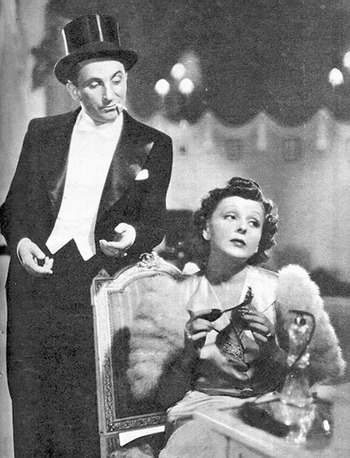
Still from A Girl Sets Out (István Székely, Művész, 1937). As in many other romantic comedies of the decade, in A Girl Sets Out the rural does not always appear as a place of moral purity. It also represents the corrupt and work-averse culture of the rural nobility. In the pictured scene, a scion of the rural nobility who lives elegantly on his inheritance in Budapest complains about his provincial parents to his demi-mondaine friend. (Antal Páger as Brigi, Mária Mezei as Didó) Courtesy of the Hungarian National Film Archive photo collection.

Many films make the redemptive influence of urban bourgeois culture even more explicit. In the aforementioned Three Dragons, a struggling family of conservative landowners is saved by a cosmopolitan actress who falls in love with the lazy, rakish gentry father. Initially wary of the actress whom they consider to be a vamp, with loose morals and a desire to cheat the Csaholyis out of their money, the family is shocked to find out that she is not only a highly successful professional but also an independent respectable woman who has no lovers and out of principle never lets men pay for her. She lives in an impressive villa built on her savings but her real wish is to move to the countryside. In the end, she becomes a business partner in the landowners’ farm. In the last scene, we see her at the farm, dressed in traditional clothes, helping the peasants with bales of hay. Her work ethic and love of the countryside give new life to the estate and inspire her now husband to change his ways and become the hard working and responsible man she wants him to be.
Young Noszty (mentioned earlier) has a very similar if less elaborate story. The Toth family return to the Hungarian countryside with their thoroughly modern American daughter, Mary – an independent working woman. Not only does Mary drive her own car, she also knows how to fix it; she dismisses potential suitors and has no qualms about disguising herself as a peasant girl to have more freedom at a village fair. She shocks locals by becoming active in agriculture as her farm's business manager. She uses her own money to build a model farm and enjoys taking care of the animals herself. The story concludes with Mary seducing the local heartbreaker, another noble scion with a gambling problem. She convinces him to mend his irresponsible ways and adopt a new, bourgeois attitude towards work. Although she does not become like the locals, she is acccepted by them to the point that she is able to effect positive change in traditional Hungarian culture (Figure 6).
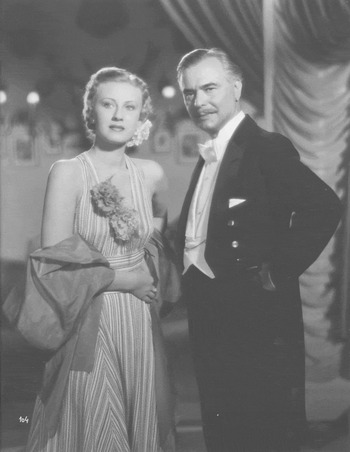
Still from Young Noszty and Mary Tóth (István Székely, Eco, 1938)
In romantic comedies, rural Hungary was often equated with the outmoded culture of the traditional landowning nobility. In this scene, a penniless gentry father seeks to engineer a marriage between his son and the daughter of a wealthy businessman. Éva Szörényi as Mary Tóth and Gábor Rajnay as Pál Noszty. Courtesy of the Hungarian National Film Archive photo collection.

In Help, I'm an Heiress, a young woman inherits her uncle's fortune and estate, and immediately gets a marriage proposal from the attractive son of a neighbouring landowner. Wishing to investigate the young man's reputation herself, she takes a job as a maid at his villa. She begins by helping the family organise their household, and as the son grows increasingly attached to her, she slowly convinces him to change his habits and lifestyle. He gives up his lovers, his expensive foreign vacations and imported toiletries and begins to think about work. With the girl's help, he finds a new purpose in life, gets his finances in order and brings the family's distillery and liquor business back to life.
The films question the assumption that the countryside is ‘pure’ ‘authentic’ and ‘untainted’ by modern culture and is the source out of which modern Hungary can be regenerated. As the above examples already indicate, the rural does not appear in the films as a place of pure morals untainted by the sinful city. Quite the contrary: the rural nobility have to be held back from engaging in self-destructive behaviour. Instead of looking at the countryside as a place of authentic, undisturbed, traditional Hungarian culture, the films show the countryside as connected to and a part of the modern world both culturally and practically; rural Hungary shares in modern urban mass culture through the media (mass press, radio, popular music), and through modern transportation (cars and trains). Although the countryside may seem like a bucolic haven promising freedom to urban visitors, to the young people living there rural Hungary often appears more backward than romantic, its traditionalism limiting their individual freedom. Far from being immune to the charms of modern consumer culture, rural inhabitants are living in the same dream worlds. But compared to the glamour of modern urban life projected in consumer culture, the countryside appears boring, monotonous, and stifling. In the films, rural Hungarians, initially shocked and awed by the fashions and lifestyles of the urban middle class, are quick to imitate and adapt them for themselves.
Many of the films portray urban culture as allowing for individual freedom in the face of tradition. A recurring theme is of young girls from the rural countryside unsatisfied with the opportunities presented to them and desperate to try themselves in the modern world. When they finally do, they succeed in changing their lives for the better. Thanks for Running me Over (Emil Martonffi, Hermes, 1935) features a middle class girl from the countryside who orders musical scores for the latest popular music, fashion magazines and romantic bestsellers from Budapest. She longs to live the lives of her novels’ modern heroines, and dreams of a young man from the city passing through and noticing her. When her horse-drawn carriage is hit by a handsome man in a car, Panni is ecstatic. She invites the man home for coffee, plays him a fashionable tango tune, and, oblivious to his lack of interest, forces an engagement ring on his little finger. After waiting in vain for him to return, broken hearted Panni decides to take the train to Budapest to find the man. Through a misunderstanding, she ends up in a spectacularly modern Bauhaus villa, and within a few days is engaged to its owner.
In The New Relative (Béla Gaál, Harmónia, 1934), Kitty, a liberated American young woman, comes to visit her rural Hungarian family. Kitty lives alone, wears short hair, pants and makeup, smokes seductively and sings and dances to modern tunes on gramophone accompaniment. Although at first her brazen attitudes and clothes alienate her older relatives, soon everyone finds it hard to deny that they enjoy her sense of freedom. They start dancing along with her and even the conservative matron hums Kitty's popular song. The family's strict and traditional attitudes slowly unravel to the great satisfaction of all family members. Kitty gives her cousin a complete modern makeover and newfound self-confidence, resulting in her engagement to a man who never noticed her before. By lightening the mood, Kitty brings happiness to the uptight and stuffy household (Figure 7).
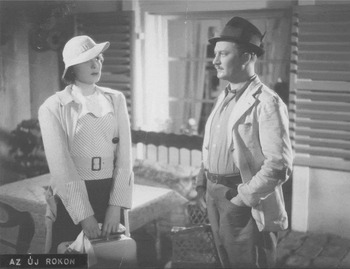
Still from The New Relative (Béla Gaál, Harmónia, 1934)
Kitty, a modern American girl arrives at the farm of her conservative rural relatives in Hungary. Zita Perczel as Kitty and Ferenc Delly as Miklós. Courtesy of the Hungarian National Film Archive photo collection.

Entertainment films discussed some of the same problems concerning national identity and the position of rural Hungary in modernity that preoccupied critics in other spheres of public life in the 1930s. Although the purpose of the films was not to engage in political discussions, they were publicly recognised as representations with a crucial role in nation-building. In contrast to the exclusive, racist nationalism that was gaining ground in public life, however, the films contained a liberal view of Hungary and a few simple messages: these probably did not escape audiences. The first was that one did not need ‘organic’ ties to the soil to feel at home in, or drawn to, rural Hungary, much less to have nostalgia for the rural ideal. In the films it was often outsiders who truly appreciated the rural and who implemented plans to improve or ‘save’ it. Instead of imagining rural Hungary as a traditional, harmonious and closed community, the films saw its boundaries as fluid and permeable.
Second, the films strongly suggested that modern commercial culture was not harmful to rural Hungary, but rather could do much to democratise it and to facilitate its progress. According to the films, it was not urban immorality but rather the rural taste for debauchery, tied to the culture of the rural gentry, that was the biggest obstacle to national progress. As many of the examples mentioned above indicate, films ridiculed conservative rural assumptions about urban immorality and the idea that modern women were dangerous and promiscuous; the fantasy of loose city morals and easy women turns out to be false, fuelled only by the imagination of male gentry drawn to Budapest nightlife and urban entertainment. Instead of presenting the nobility as victims of urban modernity, the films created comedy based on outdated rural attitudes, and suggested that the future of rural Hungary depended on its successful adaptation of bourgeois morality and values.
In conclusion, the films used many of the same traditional elements to represent national identity that were present in other areas of public life. But they created an entirely new, liberal and inclusive way of representing modern Hungary based on commercial representations of urban modernity and on bourgeois values. As late as 1938, before Hungary passed anti-Semitic laws that same year excluding Jewish Hungarians from the nation, such alternative national identities were still prominent in Hungarian popular culture.