Over the course of the 1990s and 2000s, populist candidates achieved electoral victories in many states across Latin America. While there have been a number of comparative studies that explore the logic behind these successes (Doyle Reference Doyle2011; Kenny Reference Kenny2013; Remmer Reference Remmer2011), there has been little attempt to investigate systematically the political and economic outcomes when populists come to power. Rather, empirically what we know about the performance of populists in government tends to come from single-country case studies or small-N comparisons. We know, for instance, that Alberto Fujimori used his personal popularity to completely override democratic institutions in Peru. However, the rule of other populists, such as Néstor Kirchner of Argentina, has produced outcomes closer to that of moderate social democratic governments in the region. As a result, an aggregate picture is difficult to discern. With stable programmatic party–voter alignment still exceptional in the region, populist rule appears likely to be a persistent feature of Latin American politics. Understanding the implications of populist rule is thus an issue of pressing concern.
As Rovira Kaltwasser (Reference Rovira Kaltwasser2012) has argued, populism is a form of politics with ambiguous implications for the functioning of democratic polities. The titles of two recent edited volumes are indicative of the lack of consensus on the issue; one proposes to debate ‘the promise and perils of populism’ (de la Torre Reference De la Torre2015), while the other asks whether populism is a ‘threat or corrective for democracy’ (Mudde and Rovira Kaltwasser Reference Mudde and Rovira Kaltwasser2013). Depending on the cases analysed by individual contributors, quite different interpretations of the implications of populism emerge. Some suggest that populists can enhance participation in the democratic process by mobilizing segments of the population (e.g. the urban poor) who are often neglected by establishment parties (Roberts Reference Roberts2013). Others, in contrast, argue that populism’s anti-institutional posture inevitably leads to the erosion of the rule of law, while any substantive gains to the poor from greater participation are likely to be haphazard and impermanent (Levitsky and Loxton Reference Levitsky and Loxton2013).
This article seeks to provide empirical substance to these debates with new data and a combination of analytical approaches. Building on recent theoretical and case study research, we assess some key political and economic consequences of government by a populist leader, or populist rule, in Latin America. More specifically, we test the effects of populist rule on the legal and institutional constraints on executive power, participation in the democratic process, and redistribution. We discuss the rationale behind the selection of these specific outcomes and the variables we use to measure them below.
This article proceeds in two substantive sections followed by a conclusion. First we elaborate on the concepts of populism and populist rule. We next discuss some potential consequences of populism, justify our choice of dependent variables, and outline in more detail the specific hypotheses we propose to test. Second, we conduct the first comprehensive large-N cross-national test of the consequences of populist rule to date.Footnote 1 Using data on 19 Latin American states from 1982 to 2012, we find that populist governments erode institutional and legal constraints on executive power. However, we do not find evidence that populist rule is associated with improved rates of participation in the democratic process or with greater redistribution than non-populist democratic governments. We further perform instrumental variable estimations and a quasi-experimental analysis to address the potential endogeneity of populism to political and economic conditions.
THEORETICAL CONSIDERATIONS
Populism remains a frustratingly contested concept (Canovan Reference Canovan1999; Jansen 2015; Laclau Reference Laclau2005; Mudde Reference Mudde2004; Roberts Reference Roberts1995, Reference Roberts2007; Weyland Reference Weyland2003). Definitions tend to fall into two types: the ideational and the organizational. As an ideology, populism maintains that ‘politics should be an expression of the volonté générale (general will) of the people’ (Mudde Reference Mudde2004: 543). Populism thus stresses not individual rights but the rights of the people as a corporate body and typically opposes the interests of the people to those of the elite (Crick Reference Crick2005: 626; Mudde Reference Mudde2004: 543; Panizza Reference Panizza2005; Shils Reference Shils1956: 98). The ideational approach to operationalizing and measuring populism has been to focus on the pro-people and anti-elite rhetoric that flows from this ideology (Hawkins Reference Hawkins2009).
While the expression of such public sentiments is a key weapon in the populist toolkit, and necessary to any operationalization of the concept, we find it insufficient as a way to distinguish between populist and non-populist political actors. Problematically, it is unclear when using such an operationalization just how populist a political actor’s rhetoric needs to be to cross the populism threshold. It is also unclear whether the intensity or the frequency of populist rhetoric is of greater importance. For some commentators, the expression of almost any popular sentiment is sufficient to categorize a politician as populist, leading to the inclusion of such mainstream politicians as Britain’s Tony Blair into the populist club (Mair Reference Mair2002).
Consequently, while we acknowledge the role of anti-elite rhetoric in defining populism, we also look to the structural characteristics distinctive to populist movements. Populist movements are characterized by distinctive organizational structures and mobilization strategies that attempt to actualize the notion of popular sovereignty through a direct relationship between leader and supporter (Jansen 2015; Levitsky and Roberts Reference Levitsky and Roberts2011; Roberts Reference Roberts1995; Weyland Reference Weyland2001). We thus adopt Roberts’s (Reference Roberts2007: 5) definition of populism as ‘the top-down political mobilization of mass constituencies by personalistic leaders who challenge elite groups on behalf of an ill-defined pueblo, or “the people”’. This conceptualization combines both the pro-people and anti-elite orientation of populist ideology and the distinctive organizational structure of populist movements. This version of the concept was operationalized and coded by Doyle (Reference Doyle2011) in his empirical analysis of populism in Latin America. We follow and expand on this coding scheme as described in the next section.
We are interested in some of the key political and economic consequences of populist rule. By populist rule, we mean a government controlled by a populist candidate who has been elected to executive office. While the outsider orientation of a populist in power is necessarily moderated from that of a populist campaigner, to varying degrees, populists in power continue to project an image of struggle against the status quo. Note, however, that populist rule is not defined by the actual policies of the government, but by the nature of the campaign mobilization. As a result, we can evaluate empirically the political and economic implications of populist rule.
In so far as the consequences of populist rule have been studied, one of the main outcomes of interest has been the broad notion of democracy itself (Riker Reference Riker1982; Rovira Kaltwasser Reference Rovira Kaltwasser2012). While we find that populist rule is associated with lower values on aggregate estimates of the quality of democracy (Table A22 of the online appendixFootnote 2 ), we argue that these measures are too imprecise to capture populism’s potentially countervailing effects on different dimensions of democracy (Coppedge et al. Reference Coppedge, Alvarez and Maldonado2008). Utilizing Robert Dahl’s disambiguation of democracy into its two main sources of legitimacy, contestation and inclusiveness (Dahl Reference Dahl1971), Rovira Kaltwasser (Reference Rovira Kaltwasser2012) suggests that while populism may be associated with a decline in the former, it promises to enhance the latter. Changes to the freedom and inclusivity of the political process are potentially important outcomes of populist rule, but we argue that they are still too narrowly conceived. The effects of populist rule on the functioning of democratic polities are likely to be felt in ways not captured by these measures.
Given the way in which populist movements are structured and the thin ideology on which such movements draw, we suggest that the effects of populist rule need to be disaggregated into several political and economic dimensions. This approach results in three broad groups of outcomes of interest: legal and institutional constraints on executive power, democratic participation, and redistribution. We elaborate further on the reasons for selecting these outcomes in the rest of this section.
Populism and Constraints on Executive Power
In a minimal sense, democracy is an institutional mechanism for channelling the exercise and alternation of power (Przeworski Reference Przeworski1999; Schumpeter Reference Schumpeter1976). Democracy requires that the government is chosen through a free and fair competitive process, which in turn means that there should be no use of state power to inhibit political opposition to the government (Dahl Reference Dahl1971). Democracy thus implies at least some adherence to institutional and legal mechanisms designed to constrain arbitrary power (Dahl Reference Dahl1982). Without these constraints, there can be no free and fair competition for power (O’Donnell 1993). This freedom from arbitrary domination is essential not just to competitive democracy but to freedom more generally (Ferejohn and Pasquino Reference Ferejohn and Pasquino2003; Hayek Reference Hayek1994: ch. 6). As Pettit (Reference Pettit1997: 5) puts it, ‘Being unfree consists rather in being subject to arbitrary sway: being subject to the potentially capricious will or the potentially idiosyncratic judgment of another.’
It might be argued that the law is often used to preserve and enhance the wealth and power of the elite (Loffredo Reference Loffredo1993); indeed, the delineation of property rights has long been one of the law’s core functions. If true, then adherence to the rule of law would seem to be a retrograde step. This could be especially so in a region as associated with oligarchic domination as Latin America. However, as E.P. Thompson (Reference Thompson1975: 266, 268) famously noted, despite the interests of the dominant classes, the law may ‘acquire a distinct identity, which may, on occasion, inhibit power and afford some protection to the powerless . . . For “the law”, as a logic of equity, must always seek to transcend the inequalities of class power which, instrumentally, it is harnessed to serve.’ The rule of law underpins the principle of ‘one man, one vote’ central to democracy.Footnote 3 In this sense, even in its breach, the rule of law has profound implications for democracy. At the very least, the rule of law provides a common reference point to society so that it can identify when legitimate authority has become domination and in turn resist it (Weingast 1997). Recognition of the equality principle inherent in the law has provided a focal point for civil rights movements across the world, from the suffragette movements in Europe at the beginning of the twentieth century to the anti-Apartheid movement in South Africa at its close.
As Pappas (Reference Pappas2014) argues, populism is democracy shorn of its liberal notions of individualism or minority rights. Populists often explicitly contend that they are not bound by the constitutional and legal order but by the popular will (Urbinati Reference Urbinati1998). Populists on the left argue that the law is used to preserve and enhance the wealth and power of the elite, while those on the right contend that the law is manipulated by outsiders and criminals to the detriment of the people (Conaghan Reference Conaghan2005). The notion that a minority of individuals should be able to prevent the implementation of a policy favoured by a majority is anathema to populism, whether of the left or the right. We therefore hypothesize that populists should be more likely to erode the rule of law than non-populists once in office, whatever their specific ideology.
Furthermore, even if elections are free and fair, this may not be enough to restrain arbitrary power (Donnell 1994). Democratically elected leaders must stay within constitutional constraints on their authority. While these constraints vary from one constitutional system to another, judicial and legislative bodies have typically become crucial to representative democracy in their role of restraining executive power (Manin Reference Manin1997).
Judiciaries must be autonomous from executive interference in the exercise of their functions. Where the executive overreaches its constitutional authority, it is the job of an independent judiciary to correct it. Judicial independence thus performs a key role in democracy (Larkins Reference Larkins1996). Legislative branches vary in their function in parliamentary and presidential systems. In both cases, however, the legislative branch can typically act as a check on executive power by withholding its support in the law making and funding processes (Persson et al. Reference Persson, Roland and Tabellini1997).
Such institutional checks are assurances that the executive does not violate constitutional limits on its power, especially as they relate to the fundamental rights of citizens. We posit that the top-down nature of populist movements in Latin America makes such politicians more likely to evade judicial and legislative constraints on their authority (Germani 1978). Populist leaders typically have limited restraints within their own movements and seek to deploy the legitimacy of majority support against the countervailing legitimacy of republican constraints (Riker Reference Riker1982).
We test the following two hypotheses:
Hypothesis 1: Populist rule is negatively associated with the rule of law.
Hypothesis 2: Populist rule is negatively associated with institutional constraints on executive power.
Populism and Participation
Participation in elections is another potentially significant indicator of popular support for a particular form of government. The relationship between democratic norms per se and voter turnouts is complex. While some evidence exists to say that more positive feelings towards democracy and higher election turnouts are positively correlated, it is difficult to draw causal inferences from this data (Ezrow and Zezonakis 2016). Ultimately, however, there is good reason to believe that voter turnouts are higher when citizens approve of the quality of governance (Miles 2015). In this sense, turnout is an indicator of satisfaction with the performance of a democratic system (Grönlund and Setälä Reference Grönlund and Setälä2004; Topf Reference Topf1995).
As we noted above, populists seek legitimacy in their claim to represent the people (Ochoa Espejo 2015). For radical theorists such as Ernesto Laclau and Chantale Mouffe, populism is more authentically democratic than liberalism, in that it seeks to mobilize the people in a struggle against the structures of power (Laclau Reference Laclau2005; Laclau and Mouffe 2014; Mouffe 2005). Although it is not clear what these claims about mobilizing the people mean in practice, we suggest that it implies that the populist leaders should at the very least be associated with more intensive mobilization of citizens in elections. We might expect this to be especially the case in Latin America. In societies with high levels of inequality, higher electoral turnouts should also push electoral outcomes closer to the median citizen’s preferences, with low turnouts typically favouring better-off voters. Thus, we would expect that populists, especially those on the left, would seek to enhance electoral participation.
A number of scholars, especially of Latin American populism, have argued that populists do indeed mobilize the formerly disenfranchised to participate in politics (Avritzer 2002; Wilpert 2007). For early scholars of populism, mass mobilization was definitive of the phenomenon (Germani 1978). Some qualitative evidence supports this view. Noted populist Hugo Chávez was re-elected on the back of high voter turnouts. Although initially elected in 1998 with a low turnout of the voting-age population (52 per cent) compared with turnouts in the 1980s of over 70 per cent, this figure rose to 76.4 per cent and 82.0 per cent for Chávez’s re-elections in 2006 and 2012 respectively. Of course, even in this case the predictions are not unambiguous. Populist politicians face strong incentives to demobilize their political opponents, so that the aggregate effect on participation may be neutral at best (Hawkins Reference Hawkins2010).
The next set of hypotheses we test therefore concern participation rates in national-level executive and legislative elections:Footnote 4
Hypothesis 3: Elections under populist rule are associated with higher voter turnout.
Hypothesis 4: Elections in which populists are successful are associated with higher voter turnout.
Populism and Redistribution
Even if populism is associated with a decline in legal and institutional restrictions on executive power, this might be justified if it remedies long-standing socioeconomic inequalities. Looking to mobilize the common people against an elite that is usually portrayed in oligarchic terms, it stands to reason that populists should be exercised to redistribute wealth and income to the lower social orders when in power. The redistributive agenda of populists like Hugo Chávez in Venezuela, Evo Morales in Boliva and Néstor Kirchner and Cristina Fernándes de Kircher in Argentina is well known (de la Torre Reference De la Torre2007; Levitsky and Roberts Reference Levitsky and Roberts2011; Remmer Reference Remmer2011). Research in the 1990s on populism similarly associated the phenomenon with high levels of deficit spending on social transfers and other developmental policies (Dornbusch and Edwards Reference Dornbusch and Edwards1991).
However, with the emergence in the 1990s of a class of populists who combined traditional techniques of populist organization and mobilization with neoliberal economic policy, the connection between populism and redistributive social policy has become less clear (Weyland Reference Weyland2003). Nevertheless, excluding such so-called neopopulist governments, we might expect that at least left-wing populist rule would be associated with higher levels of redistribution than that of other governments. Indeed, some recent quantitative research suggests that populist rule of the ‘new left’ may be positively associated with redistribution, although it remains disputed whether the populist or social democratic left have in fact achieved greater gains (Birdsall et al. Reference Birdsall, Lustig and McLeod2011; Cornia Reference Cornia2012; Huber and Stephens Reference Huber and Stephens2012; Montecino Reference Montecino2012).
Hypothesis 5: Populist rule is positively associated with progressive redistribution.
EMPIRICAL ANALYSIS
In this section, we analyse the effect of populist rule on Latin American states in the late twentieth and early twenty-first centuries. As the majority of conceptual, theoretical and empirical research on populism has been directed to understanding the political dynamics of Latin America, focusing here allows us to engage directly with other researchers working on these issues, especially those working with an institutional conceptualization of populism as we are. The unit of analysis is the country-year and the sample covers 19 countries.
The Data
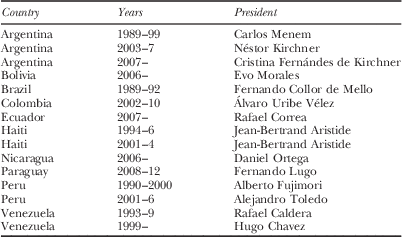
We follow Doyle’s (Reference Doyle2011) classification of populist candidates in his empirical analysis of populism in Latin America. Doyle (Reference Doyle2011) relies on a two-part coding strategy. First, he determined whether individual candidates belong to political organizations coded as personalist by Michael Coppedge (Reference Coppedge2007) and Grigore Pop-Eleches (Reference Pop-Eleches2009). Second, where the leaders of such personalistic parties behave in correspondence with Roberts’s understanding of populist mobilization quoted above, Doyle (Reference Doyle2011) codes them as populist. This two-part strategy distinguishes purely personalist (or patriarchal) parties from populist ones (Roberts Reference Roberts2015). We followed the same strategy to expand Doyle’s (Reference Doyle2011) data set to include more recent years. Episodes of populist rule (that is, populists who were elected to executive office) in the period 1982–2012 are shown in Table 1. The coding of individual leaders of course remains contentious. To make sure that our results are not driven by our coding choice regarding a particular leader, we reproduce our main models while excluding each populist ruler and each country in succession (see Tables A16–A21 of the online appendix).
Democratic Populist Regimes in Latin America, 1982–2012

Next we compare the performance of populist governments with respect to legal and institutional constraints on the executive, democratic participation and redistribution to both non-populist democratic and non-populist authoritarian governments. Democracies/autocracies are identified using the data set of Cheibub et al. (Reference Cheibub, Gandhi and Vreeland2010). Most populist regimes are classified as democratic by Cheibub et al. (Reference Cheibub, Gandhi and Vreeland2010), while a few are classified as authoritarian. Only three of the populist regimes included in the sample are classified as authoritarian by Cheibub et al. (Reference Cheibub, Gandhi and Vreeland2010): Peru after Fujimori’s autogolpe, and the two governments of Aristide in Haiti. Aristide won power in 1991 in elections that were generally recognized to be free and fair, but was overthrown in a coup later that year. Thus, although he was restored to power in 1994, this did not directly follow an election. Aristide won a second term on the basis of the 2000 presidential election, but these elections were marred by irregularities. Cheibub et al. (Reference Cheibub, Gandhi and Vreeland2010) only classify a regime as democratic if there is an alternation in power through elections. Since both governments of Aristide were overthrown by coups before the end of his term, they could not meet that requirement. In Tables A22–A24 of the online appendix we show that our results are unchanged if we exclude these three populist governments. Non-populist autocracies are regimes classified as non-democratic by Cheibub et al. (Reference Cheibub, Gandhi and Vreeland2010) and non-populist by Doyle (Reference Doyle2011). Non-populist democracies are regimes classified as democratic by Cheibub et al. (Reference Cheibub, Gandhi and Vreeland2010) and non-populist by Doyle (Reference Doyle2011).
With the exceptions of the two governments of Aristide in Haiti, all populist rulers included in our sample gained power while the country was democratic. This can be explained by the fact that populists usually gain power through elections. Although, as explained above, Aristide did gain power in 1991 through free and fair elections, the regimes in place before both of Aristide’s terms were authoritarian, according to the classification of Cheibub et al. (Reference Cheibub, Gandhi and Vreeland2010). Results are also unchanged when we exclude each country (including Haiti) in succession (Tables A19–A21 of the online appendix), or if we only drop the two governments of Aristide rather than all observations on Haiti (available upon request). This is important because one may argue that the nature of the previous regime – that is, whether it was democratic or authoritarian – may place different constraints on populist rulers.
Our quantitative analysis is divided into three parts. First, we test whether populist rule is associated with an erosion of legal and institutional constraints on executive power. The first variable of interest is the general rule of law. To measure the rule of law, we use the World Bank Worldwide Governance Indicators variable for the rule of law (Rule of Law), which measures perceptions of the extent to which agents have confidence in and abide by the rules of society – for example, incidence of crime, the effectiveness and predictability of the judiciary and the enforceability of contracts. It is a composite indicator that draws on a wide range of survey-based source material (Kaufmann et al. Reference Kaufmann, Kraay and Mastruzzi2010).Footnote 5
One limitation with this indicator is that since it is based on perceptions of groups, such as businessmen, it may reflect changes in the attitudes of these groups towards the incumbent, especially when he/she is left-leaning, rather than real changes in the rule of law. Although we acknowledge that this is a clear limitation, we believe that this indicator still provides valuable information. In fact, our results are robust when we use related measures on executive constraints and the independence of the judiciary that do not share this problem. Moreover, our results indicate that right-wing populism also reduces the rule of law, even though in this case the business community may be biased in favour of the incumbent (see Table A11 of the online appendix).
The next variable of interest is constraints on executive power. As with the rule of law, there is no perfectly objective measure to capture the operation of constraints in practice. Here we employ Polity IV’s Constraints on the Executive. The higher the level of this indicator, the more the decision-making powers of chief executives are restrained, typically by legislators.
The third variable we use aims to capture the relationship between the executive and the judiciary. To measure the freedom of the judiciary from political interference, we use Independence of the Judiciary, which is taken from Cingranelli and Richards (Reference Cingranelli and Richards2010). This measure estimates the extent of political interference with the operation of the courts.Footnote 6
The second set of tests concern the relationship between populism and participation. Our unit of analysis is the election for executive and legislative office at the national level. We examine both elections in which populist candidates were successful and any subsequent elections that occurred while a populist was in power. If executive election turnouts capture the popularity of a populist candidate, legislative election turnouts should provide a more general indicator of satisfaction with the prevailing system of government. Following the approach of Altman and Pérez-Linán (Reference Altman and Pérez-Linán2002), we take the percentage turnout of voting-age population in first-round elections from the Institute for Democracy and Electoral Assistance (2014) as our main indicator of participation. Results are unchanged if we instead use the percentage turnout of registered voters (available upon request).
One important limitation of using turnout is that it only captures one of many aspects of participation. Populism could fuel other forms of political participation – for example, by mobilizing previously neglected segments of society through rallies, etc. We do not claim that turnout proxies for these other forms of participation. Instead, we argue that turnout is one of many important aspects of participation and that it enables us to capture, albeit imperfectly, whether populism enhances the overall level of participation in the society – not only participation among their main constituencies.
The final outcome of interest is redistribution. Our main indicator of redistribution is an estimate of the reduction in inequality brought about by government policy. To construct this indicator, we take advantage of a Gini coefficients data set recently made available by Solt (Reference Solt2009 [2013]). Solt (Reference Solt2009 [2013]) provides indicators of market inequality (pre-tax and transfer inequality) and net inequality (post-tax and transfer inequality). We measure redistribution as the proportion change between the pre- and post-tax/transfer Gini coefficients of a country during a given year:
 $${\rm Redistribution}_{{i,t}} ={{Gini_{{market_{{i,t}} }} {\minus}Gini_{{net_{{i,t}} }} } \over {Gini_{{market_{{i,t}} }} }}$$
where Gini market is the market Gini coefficient (pre-tax and transfer inequality) and Gini net the net Gini coefficient (post-tax and transfer inequality) of country i in year t.
Higher values indicate higher levels of (progressive) redistribution. A negative value implies that the post-tax/transfer Gini coefficient of a country is higher than its pre-tax/transfer Gini coefficient, meaning that redistribution is regressive. Contrary to authors relying on other measures, such as public spending or the tax rate, this indicator clearly distinguishes between progressive and regressive redistribution. Other authors have also relied on the difference between pre- and post-tax/transfer inequality to measure redistribution, albeit not to study populism (e.g. Kenworthy and Pontusson Reference Kenworthy and Pontusson2005).
Contrary to recent authors such as Montecino (Reference Montecino2012), we do not use change in the Gini coefficients over time because affecting the Gini coefficient of a country takes a long period of time, making it difficult to estimate the effect of the current regime on inequality. Moreover, the overall Gini coefficient can be affected by a multitude of factors other than the regime, whereas the difference between the market and net Gini coefficients of a country is exclusively driven by taxes and transfers. In addition, because the 2000s saw a general reduction in inequality across the region that has been attributed to a variety of forces, including a positive global economic environment (López-Calva and Lustig Reference López-Calva and Lustig2010), we need to determine the extent to which any reduction in socioeconomic inequality was attributable to populist rule per se (see the debates in Blofield Reference Blofield2011; Cornia Reference Cornia2014).
Although less reliable, as a robustness check, we also examine measures of redistribution based on fiscal policy. We utilize measures of Health Spending (% GDP) and Education Spending (% GDP) from the World Bank’s World Development Indicators (World Bank 2013). However, it should be noted that in already highly unequal societies, the main beneficiaries of such expenditure are often found among those of higher socioeconomic status (Segura-Ubiergo Reference Segura-Ubiergo2007). Moreover, public expenditure may be used inefficiently and often fails to reach the poor (Ross Reference Ross2006). We include analysis of these variables in Section 2 of the online appendix (Tables A32–A33).
The analysis also includes the following control variables: GDP per capita logged, GDP per capita growth rates (World Bank 2013), and ethnic fractionization (Alesina et al. Reference Alesina, Devleeschauwer, Easterly, Kurlat and Wacziarg2003). Since some populists took power amid civil wars (e.g. Fujimori), we also include a control variable for whether there is an ongoing civil war (Peace Research Institute Oslo). Models on participation control for whether a state has compulsory voting (Institute for Democracy and Electoral Assistance 2014) and only cover elections held in non-populist democracies and populist regimes (i.e. non-populist autocracies are excluded). In models on institutional constraints on the executive and on redistribution, we include a dummy variable for non-populist autocracies. Therefore, the coefficients on Populism capture differences between populist regimes and non-populist democracies. In order to account for the possibility that more unequal countries redistribute more (see Meltzer and Richard Reference Meltzer and Richard1981), all models on redistribution control for the pre-tax/transfer Gini coefficient (Solt Reference Solt2009 [2013]). Results with additional controls for oil production (Ross Reference Ross2013) and inflation (World Bank 2013) are presented in Tables A5–A7 of the online appendix.
All of our models include lagged dependent variables (LDVs). Therefore, our models estimate the effect of populism on the change in the dependent variable. This is important given that populism may be more likely to emerge in countries that already have a weak rule of law, for example.Footnote 7 Given the importance of focusing on changes in the dependent variables, Tables A2–A4 of the online appendix redo all models with country and decade fixed effects. Results are unaltered. Finally, we also show that the results are robust when the dependent variable is the difference in the variable of interest between the current and previous year (see Tables A26–A28 of the online appendix).
Table A1 of the online appendix provides summary statistics for all variables used in the analysis.
Analysis and Results
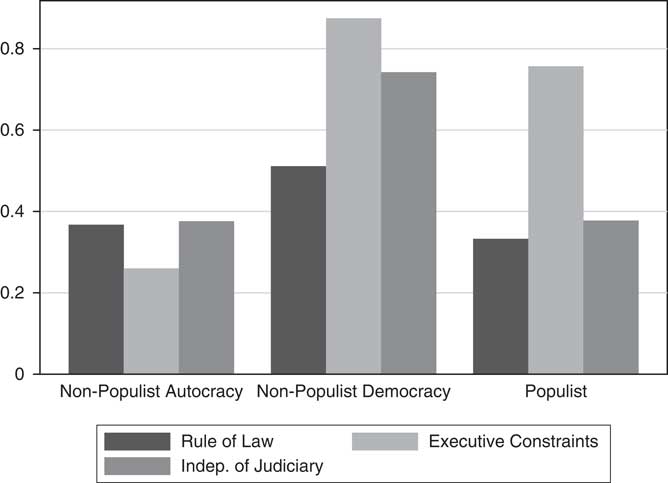
We first examine the effect of populism on the different indicators of institutional and legal constraints on executive authority (H1 and H2). For comparability, all indicators are normalized between 0 and 1, where 1 indicates the highest performance with the given right (e.g. in the case of Constraints on the Executive, it means that Polity IV assigns the highest level of executive constraint score). As illustrated in Figure 1, populist governments receive substantially lower scores for each of the three indicators.
Institutional and Legal Constraints on Executive Authority under Non-Populist Autocracy, Non-Populist Democracy and Populism Note: Populist regimes are identified using Doyle’s (Reference Doyle2011) classification. Democracies/autocracies are identified using the data set of Cheibub et al. (Reference Cheibub, Gandhi and Vreeland2010). Most populist regimes are classified as democratic by Cheibub et al. (Reference Cheibub, Gandhi and Vreeland2010) (e.g. Venezuela under Chavez) while a few are classified as authoritarian (e.g. Peru after Fujimori’s autogolpe). Non-populist autocracies (non-populist democracies) are regimes classified as non-democratic (democratic) by Cheibub et al. (Reference Cheibub, Gandhi and Vreeland2010) and non-populist by Doyle (Reference Doyle2011).

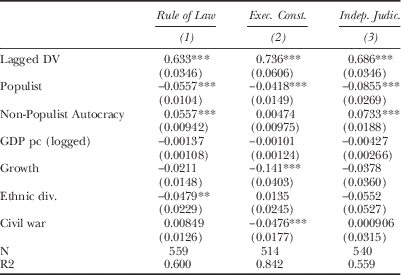
Table 2 reports the effect of populism on institutional and legal constraints on executive authority along with robust standard errors.Footnote 8 Populism is associated with a decrease in the Rule of Law, Executive Constraints and Judicial Independence, and the relationships are statistically significant at the 1 per cent level.
Effect of Populism on Institutional and Legal Constraints on Executive Authority

Note: OLS estimations. Robust standard errors in parentheses. ***p<0.01; **p<0.05; *p<0.1.
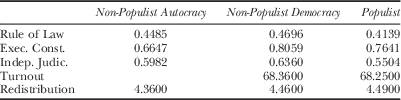
Table 3 reports predicted values associated with the estimations. All variables other than Populism and Non-Populist Autocracy are kept at their mean or median. We then calculate the predicted value of each dependent variable under populism, non-populist democracy and non-populist autocracy. Crucially, since we control for the lag of the dependent variable, regimes reported in Table 3 begin at the same value on the dependent variable. For example, Table 3 shows that while a populist regime that begins the year with a Rule of Law value at the mean of the distribution will finish the year with a value of 0.4139; the same country – with the same initial Rule of Law value – would have finished the year with a value of 0.4696 if it were a non-populist democracy. Populism thus leads to a decrease in the Rule of Law value of 0.056 points every year compared with a non-populist democracy. A period of populist rule lasting, say, four years, would thus result in a decrease in the Rule of Law of 0.224 (on a 0 to 1 scale), which is larger than its standard deviation (0.15).

In terms of the possible confounding variables, we find that income per capita is positively correlated with the rule of law and with judicial independence but not with executive constraints. Negative economic growth is not associated with any deterioration in performance on these indicators. We do, however, find that ethnic fragmentation is associated with lower performance on rule of law, while the presence of an ongoing civil conflict is associated with a decline in executive constraints.
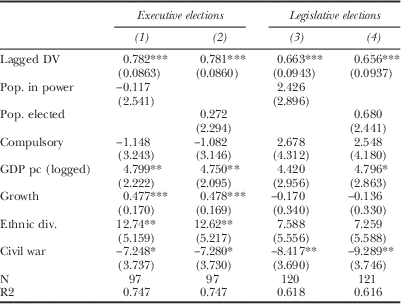
The next outcome of interest is participation. The average turnout for executive elections in populist regimes is 66.61 per cent. This is slightly higher than in non-populist democracies (65.81 per cent), although the difference is not statistically significant. Table 4 reports the effect of populism on turnout in executive and legislative elections. Elections held in non-populist autocracies are omitted from the sample. Therefore, the estimates compare turnout under populist and non-populist democracy.
Effect of Populism on Electoral Turnout

Note: OLS estimations. Turnout in first-round elections. Elections held in non-populist autocracies are omitted. Robust standard errors in parentheses. ***p<0.01; **p<0.05; *p<0.1.
Columns 1 (executive elections) and 3 (legislative elections) test whether elections that were held while a populist party was in power have higher turnouts than those held in non-populist democracies (H3). Note that the election may or may not have been ultimately won by a populist party. These models enable us to account for the possibility that populist parties are only able to widely mobilize the masses when they have access to state resources.
Columns 2 (executive elections) and 4 (legislative elections) instead look at elections that were won by a populist party (H4). In these cases, a populist party may have been in power at the time of that election but need not have been. In all instances, populism is found to have no significant effect on turnout. The magnitude of the effect is once again illustrated in Table 3 (which is based on Model 1 of Table 4). It shows that turnout in executive elections is predicted to be 68.36 and 68.25 per cent under non-populist democracy and when a populist holds office, respectively.
A possible explanation for this non-finding is that only some types of populists encourage participation. For example, one may believe that left-leaning populists, such as Chávez, are more likely to increase participation than right-leaning populists like Collor de Mello or Menem. Therefore, using information on the ideology of political parties from the Database of Political Institutions (DPI) (Beck et al. Reference Beck, Clarke, Groff, Keefer and Walsh2001), we have classified all populist regimes as leftists, rightists or centrists. Table A12 of the online appendix shows that left populists are not associated with higher levels of participation relative to non-populist democracies.
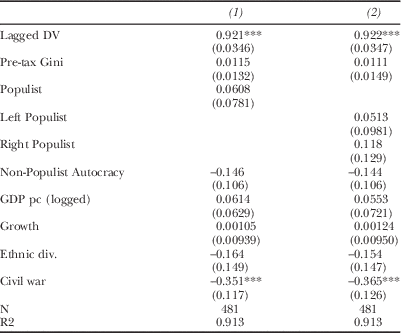
Finally, Table 5 tests the effect of populism on redistribution (H5). Remember that our measure of redistribution captures the change in the level of inequality before and after tax and transfer. Model 1 suggests that, contrary to our expectations, populist governments do not redistribute more than non-populist democracies. These results contradict the findings of some (e.g. Montecino Reference Montecino2012) but not all (e.g. McLeod and Lustig Reference McLeod and Lustig2011) previous authors. Table 3 shows that the predicted redistribution level is virtually the same under populist and non-populist democracy (4.49 vs. 4.46 per cent).
Effect of Populism on Redistribution

Note: OLS estimations. Robust standard errors in parentheses. ***p<0.01; **p<0.05; *p<0.1.
This finding could be driven by right-wing populist governments, like the one of Fujimori. Therefore, in column 2, we distinguish between left and right populist governments. The findings show that left populists do not redistribute more than non-populist democracies. In Section 2 of the online appendix, we redo the analysis using education and health spending (% GDP) rather than the difference between pre- and post-tax/transfer Gini coefficients. Results again suggest that populists do not redistribute more than non-populist democracies.
Robustness Checks
It may be that states in which populists are elected are already experiencing the kind of deterioration in political stability that would be associated with lower outcomes on the rule of law, executive constraints and judicial independence indices on which we rely. That is, it may be a decline in the rule of law, etc., that encourages people to abandon conventional parties and elect a populist outsider in the first place (Tanaka Reference Tanaka1998). The same is true for participation and redistribution. Populist parties may also be more likely to emerge when the population is disillusioned with a democracy and thus unlikely to participate, or when the regime fails to redistribute towards the poor. However, the fact that our models include lagged dependent variables and results are robust to the inclusion of country fixed effects (Tables A2–A4 of the online appendix) somewhat alleviates this concern.
We perform two additional sets of analyses aimed at addressing the issue of endogeneity. First, we run instrumental variable (IV) estimations using the presence of autonomously elected institutions at the subnational level (Autonomy) as an instrumental variable for populist rule. We base our use of this instrument on the claim that decentralization weakens established parties in clientelistic democracies (but not programmatic ones) by breaking up the patronage networks that link national parties and voters (Kenny Reference Kenny2013). This in turn creates the opportunity for populist appeals directly to the people (outside established machine politics). Kenny (Reference Kenny2013) finds that electoral decentralization is a robust predictor of the victory of a populist candidate for executive office at the national level, controlling for a variety of other institutional, social and economic variables, including federalism and fiscal decentralization, thus addressing an important potential source of endogeneity (Crook and Manor Reference Crook and Manor1998; Goldfrank Reference Goldfrank2011; cf. Treisman Reference Treisman2007).
There is no conclusive way to establish whether the IV meets the exclusion restriction. However, there are empirical grounds to argue that it does. First, there is no statistically significant association between executive constraints, political rights, civil liberties, or violent conflict and populist electoral support (Kenny Reference Kenny2016). The same is true of GDP growth. GDP growth is positively associated with the election of populist candidates (Remmer Reference Remmer2011). To the extent that economic crises might be associated with a decline in the rule of law, these findings also run against the likelihood of us finding a negative relationship between populist rule and the rule of law. Second, decentralization is positively associated with the Rule of Law and with development more generally. That is, the better the rule of law and the more developed a nation, the more likely it is to decentralize. This finding also mitigates the possibility that decentralization is endogenous to a decline in the rule of law. Third, to further address the endogeneity issue, Kenny (Reference Kenny2013, Reference Kenny2016) employs an IV strategy in which decentralization is instrumented for using country area, population and contiguity (replicating the strategy of Brancati Reference Brancati2009). Instrumented decentralization is a similarly robust predictor of populist success in Latin America, controlling for a wide range of identity, institutional and economic alternatives (Kenny Reference Kenny2016). In short, whatever may be driving populism and decentralization, it does not appear to be the state of the economy or of the rule of law.
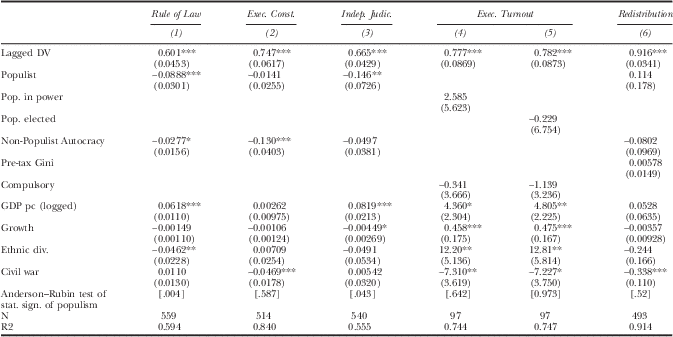
The main measurement of subnational authority used in the regression analyses comes from the Institutions and Elections Project (IAEP) (Regan and Clark Reference Regan and Clark2010), which has been updated by Kenny (Reference Kenny2013). We use Kenny’s binary coding of whether or not subnational representatives are appointed, elected, or otherwise chosen autonomously from the central government. Based on a combination of primary and secondary sources, we then extended the data set to include additional years (up to 2012). First stage regressions, presented in Table A34 of the online appendix, show that Autonomy is not a weak instrument of populism. We follow the method proposed by Wooldridge (Reference Wooldridge2002: 623–5) to deal with regressions in which the first stage is non-linear and the second is linear. We use a probit model to first estimate the effect of Autonomy on the likelihood that a populist party takes power. We then use the predicted values as instruments (not regressors) in the second stage (see Section 3 of the online appendix for more detail).
Results are reported in Table 6. Our main results are unchanged. Populism does not enhance participation or redistribution. Moreover, populists perform significantly worse than non-populist democracies in terms of rule of law and judicial independence. The only findings that change with the use of the instrumental variable are those for Executive Constraints. The effects are in the predicted direction but are not statistically significant.
Instrumental Variable Analysis of the Effect of Populism

Note: Two-stage probit least square estimations. See Section 3 of the online appendix for more information on the estimation procedure, and Table A34 for the first stage regressions. Anderson–Rubin test of statistical significance reports a test of the effect of populism on turnout that is robust to weak instruments. Robust standard errors in parentheses. ***p<0.01; **p<0.05; *p<0.1.
Even though first stage regressions suggest that Autonomy is not a weak instrument for populism, Table 6 also reports Anderson–Rubin tests of the statistical significance of populism, which is robust to the use of weak instruments. Anderson–Rubin tests suggest that populism is not associated with higher levels of participation or redistribution, and that it erodes the rule of law and the independence of the judiciary.
As with most instruments, this one is not perfect. There may still be something unique about the political and social circumstances in which populists get elected that makes them more prone to problems with the rule of law, participation and redistribution. Therefore, we also adopt a second strategy to address the issue of endogeneity in the institutional constraints and redistribution models.Footnote 9 Here we exploit a kind of ‘quasi-experiment’ to overcome this problem (Dunning Reference Dunning2012). Because populism is operationalized according to the structure of leaders’ parties and the way in which they conducted their electoral campaigns, we can see if there is a statistically significant difference in our outcomes between those states in which populists got elected and those in which they almost got elected. If a potentially declining rule of law situation or a failure to redistribute explained populist support, we should see no significant difference between these subsets of cases.
We look at all cases in which populist campaigners obtained over 20 per cent of the first-round vote and compare the rule of law, legislative and judicial constraints on the executive, and redistribution in those cases where they come to power to those cases where they do not. Although not a perfect discontinuity, 20 per cent in a first round presidential election in Latin America represents a substantial level of popularity. In a few cases, populist candidates obtained a plurality in the first round, only to lose in a run-off election. We therefore test our hypotheses concerning populist rule by comparing populist governments only to those governments that narrowly beat a populist candidate in the preceding election.
Table A15 of the online appendix assesses whether the conditions prior to the elections were similar in democracies in which populist parties were elected (treatment group) and those in which populist parties were almost elected (control group). Results suggest that the initial conditions were similar for the treatment and control groups, except for constraints on the executive indicator. They had similar rule of law and redistribution levels and similar values on the control variables. In fact, if anything, countries in which populist parties barely failed to gain office are found to be poorer and more ethnically diverse – two conditions found to be harmful to institutional constraints – than those in which they succeeded. Therefore, initial conditions cannot explain why countries in which populist parties were elected did worse than those in which they almost got elected.
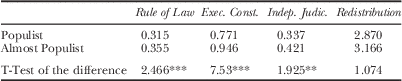
Table 7 presents the results of a difference of means test for all indicators between states under populist government and those governments that just beat a populist opponent. For the rule of law, executive constraints and the independence of the judiciary, populist governments perform lower than those in which populists were almost elected, even though, as shown in Table A15, they come to power under similar conditions. The results are statistically significant. We believe this strongly supports the theoretical claim that there is something about populist government per se that harms institutional constraints, not simply some underlying socioeconomic or security conditions that makes the election of a populist and the erosion of the rule of law simultaneously more likely. Although populist governments redistribute less than those in which populist parties were almost elected, the difference is not significant.
T-Tests of the Difference between Populist Regimes and those in which Populist Parties Were Almost Elected

Note: Almost Populist governments are defined as democracies in which a populist party has received at least 20 per cent of the vote. ***p<0.01; **p<0.05; *p<0.1.
CONCLUSION
This article has provided a first cut at systematically evaluating a range of political and economic effects of populist rule. Our analysis reveals that populist rule has had largely negative effects on the legal and institutional constraints on executive power in Latin America. The encroaching arbitrariness of authority under populist rule confirms the suspicions of liberal theorists. However, given that the rule of law is almost by necessity associated with the maintenance of the status quo, this relationship makes a great deal of sense.
In contrast to expectations, however, populist rule in Latin America is not associated with improvements in some other potentially important substantive outcomes. In general, populist governments fail to enhance participation, at least in terms of electoral turnout. Furthermore, populist governments, even those on the left, do not redistribute more than non-populist democracies. These findings are robust to a thorough range of specifications. In this section we interpret the results above.
Why does the theorized positive correlation between populism and participation fail to show up? We argue that the data reflect the fact that populists can win by both demobilizing their opponents as well as mobilizing their supporters. For example, in the Venezuelan case, while participation among the poor and socially excluded increased through local institutions like the communal councils and the missiones, opponents of the regime were actively demobilized (Ciccariello-Maher Reference Ciccariello-Maher2013; Hawkins Reference Hawkins2010; Trivino Salazar Reference Trivino Salazar2013). The street protests against the government of Chávez’s successor, Nicolás Maduro, in 2014 and 2015, and the continued repression of regime opponents, were symptoms of this institutional closure. In short, under Chávez, as under other populists, participation was thus incentivized in a highly selective way in order to advance partisan interests. We see these countervailing dynamics replicated across the spectrum of populist governments in the region with the result that no unambiguous relationship between populism and participation can be easily discerned. It is important to note that these results do not imply that populists do not mobilize members of the society that have been previously neglected. Instead, they suggest that populism does not enhance turnout among all groups.
One of the most surprising results concerns the lack of redistribution even among left-leaning populists. In cases like Venezuela, where Chávez consistently based his appeal on promises of economic progress for the country’s marginalized communities, this presents a particular puzzle. While those on the radical left have tended to be critical of the pro-business policies of more moderate left governments like that of Lula in Brazil, it does appear that the latter have brought about as much post-tax redistribution as the more radical alternatives. In part, this may be due to the depressing effect of left populist government on the business environment vis-à-vis non-populist left alternatives (Weisbrot Reference Weisbrot2011). This is not to say that the policy packages of Lula’s Brazil or Bachelet’s Chile represent an optimal strategy for poverty and inequality reduction. Neither government challenged the basic liberal economic rules of the game set out in the 1990s, with the result that many on the left view them with scepticism (Panizza Reference Panizza2009). However, the growth of experimental participatory institutions introduced by the state at the local level as well as local projects of resistance and reclamation that began from below in Brazil and elsewhere in Latin America suggest that it may be possible to bring about substantive progress in ways that do not lead to the excessive concentration of power in the executive (Wolford Reference Wolford2010).
We should note that while we see a deterioration in the legal and institutional constraints on executive power under populist rule, this should not be taken to imply that ‘pre-populist’ regimes were liberal bastions of the rule of law. The government massacre of protesters and rioters in Venezuela in 1989, known as the Caracazao, was just one of the most egregious of many such violations by non-populist democratic regimes (Ciccariello-Maher Reference Ciccariello-Maher2013). Nevertheless, although couching its appeal in popular terms, populist rule does not on average make the democratic environment any more open. In fact, the opposite is true.
A final caveat is in order before concluding. Our results and arguments may not travel well to populist regimes outside Latin America, since populism varies considerably across regions. Therefore, it is possible that the implications of populism are different, say, in Europe or Asia. The study of the political and economic consequences of populism in other regions is a promising field for future research.
SUPPLEMENTARY MATERIAL
To view the supplementary material for this article, please visit http://dx.doi.org/doi:10.1017/gov.2016.25.