Introduction
Cancer is the second largest global cause of death, leading to one death out of six patients worldwide (Ferlay et al., Reference Ferlay, Soerjomataram and Dikshit2015). However, this can lead to a misconception that cancer is always an unpreventable and fatal disease that leads to death, pain, suffering, loss of control and independence, helplessness, and isolation (Daher, Reference Daher2012). This misconception and the resulting stigma impact not only cancer patients themselves (Fujisawa and Hagiwara, Reference Fujisawa and Hagiwara2007) but also the general public, who have a potential risk of cancer. Past studies have demonstrated that the general population hesitates to have cancer screenings or treatment due to cancer stigma, which leads to a delay in cancer detection and care (Carter-Harris et al., Reference Carter-Harris, Hermann and Schreiber2014; Meacham et al., Reference Meacham, Orem and Nakigudde2016). Reducing the stigma associated with cancer is a national and international goal.
Goffman conceptualized stigma as an individual being disqualified from full social acceptance (Goffman, Reference Hair, Babin and Anderson1963). He stated that stigma is subject to the social context, which means that a specific trait may be negatively evaluated in one situation but may be evaluated differently in different situations (Goffman, Reference Hair, Babin and Anderson1963). Cancer stigma has been reported worldwide (Liu et al., Reference Koo and Li2015; Shim et al., Reference Shim, Shin and Kim2016; Suwankhong and Liamputtong, Reference Suwankhong and Liamputtong2016; Tang et al., Reference Tang, Mayer and Chou2016), and the prevalence of cancer stigma among cancer patients has been reported to be between 52% and 58% (Peters-Golden, Reference Peters-Golden1982; Cho et al., Reference Cho, Smith and Choi2013). Although cancer stigma has not been widely examined in Japan, a few studies suggest that it does exist in Japanese society (Tsuchiya et al., Reference Vrinten, Gallagher and Waller2012; Fujisawa et al., Reference Fujisawa, Umezawa and Fujimori2014).
To challenge cancer stigma, the Japan Cancer Control Act promotes cancer education among school students and has been running a series of campaigns to educate the general public (Mlhw.go.jp, 2018). However, an unexpected adverse effect of cancer education has been reported. Yako-Suketomo et al. (Reference Yako-Suketomo, Katanoda and Kawamura2019) demonstrated that children who received cancer education tend to develop a stereotyped view of cancer patients, seeing them as pitiable, sickly, thin, and pale. Some children have also come to view cancer patients as heavy drinkers and heavy smokers. These results indicate that the knowledge that potential causes of cancer can be related to daily habits — such as smoking and diet — and that cancer is avoidable by vaccine and routine checkups has increased the stigma against cancer patients.
To evaluate the public's attitude toward cancer and to address the stigma issue, a reliable measurement tool is necessary. A few instruments are available to measure cancer-related stigma (Cataldo et al., Reference Cataldo, Slaughter and Jahan2011; Kissane et al., Reference Kissane, Patel and Baser2013; Stump et al., Reference Stump, LaPergola and Cross2016); however, these scales are designed to assess perceived stigma among cancer patients themselves. To the best of our knowledge, the Cancer Stigma Scale (CASS) is the only measure of which the psychometric properties have been validated that assesses the general public's attitude toward cancer (Marlow and Wardle, Reference Marlow and Wardle2014). Cancer stigma is considered to be multidimensional, consisting of the following components: peril, course, concealability, disruptiveness, and esthetics. Additionally, behavioral characteristics and attitudes toward discrimination are also considered to be included in cancer stigma. The CASS was originally developed and validated in the UK (Marlow and Wardle, Reference Marlow and Wardle2014). The Chinese version of CASS — with a similar structure to the original — was developed and an analysis of its psychometric properties demonstrated adequate internal consistency, reliability, and indices of model fit (Ye et al., Reference Ye, Liu and Lu2019). CASS has been applied in two studies, identifying that lung cancer patients were more stigmatized than patients with other types of cancer (Marlow et al., Reference Marlow, Waller and Wardle2015) and examining the correlation between cancer stigma and cancer screening behaviors (Vrinten et al., Reference Tsuchiya, Horn and Ingham2019). For these reasons, we considered that CASS may be a suitable tool to measure cancer-related stigma in the general Japanese population.
This study, therefore, aims to translate the CASS into Japanese (J-CASS) and validate its psychometric properties in the general Japanese population. We hypothesize that the J-CASS has appropriate psychometric properties and can be applicable in Japan.
Methods
Translation process
After obtaining approval for the translation of CASS from the original author, the scale was translated from English to Japanese by a first translator following the process of translation and adaptation of instruments published by the World Health Organization (2020). A bilingual expert panel was convened to identify and modify inadequate expressions and concepts of the translation. The discrepancies between the forward translation and the original version were also discussed. Back translation was conducted independently by a second translator without any knowledge of the original scale. The discrepancies between the forward and back translations were discussed by the expert panel, and the back translation of the scale was approved by the original author. All translators were health care providers fluent in both English and Japanese, knowledgeable concerning English-speaking cultures, and familiar with the terminology of psychology. The expert panel included specialists in health and education with experience in instrument development and translation.
Participants and setting
We targeted the general population in Japan aged 20–69 able to read Japanese. To assure anonymity and thereby avoid social desirability bias, participants were recruited via an online market research agency (MyVoice Communications, Inc.) that has more than one million registered Japanese users. We estimated that 250 (the total number of J-CASS items multiplied by 10) is an acceptable sample size to evaluate the reliability and validity of the measure (Hair et al., Reference Goffman2014). After removing answers with missing data, we received 450 responses. A total of 3,317 potential respondents who were randomly selected were informed about the study. We set quotas based on the original CASS development to ensure equal distribution concerning gender and age (20–34 and 35–69 years old) (Marlow and Wardle, Reference Marlow and Wardle2014). The potential respondents were asked to provide electronic informed consent prior to the survey. It was explained that participation is free from any coercion. To examine the test–retest reliability, we asked the respondents to participate in a second survey two weeks after the first. Each participant was reimbursed with 20 points (to the value of 20 Japanese Yen) that can be exchanged for gifts. The study was approved by the ethical committee of the Japan Women's College of Physical Education (Application number: 2017-32).
Measurements
The CASS is a multidimensional measure used to evaluate a person's negative attitude toward cancer that has been shown to have good reliability and validity (Marlow and Wardle, Reference Marlow and Wardle2014). The scale consists of 25 items and six factors: Awkwardness (i.e., I would feel comfortable around someone with cancer), Severity (i.e., Once you've had cancer, you can never be “normal” again), Avoidance (i.e., I would try to avoid a person with cancer), Policy Opposition (i.e., More government funding should be spent on the care and treatment of cancer patients), Personal Responsibility (i.e., A person with cancer is to blame for their condition), and Financial Discrimination (i.e., It is acceptable for banks to refuse to approve loans for people with cancer). Each item is evaluated on a 6-point Likert scale (1: Strongly disagree to 6: Strongly agree) with an additional option of “not sure,” which is converted to missing data.
The following items were used for evaluating the validity of J-CASS.
Demographics and socioeconomic status
The participants’ age, gender, marital status, education history, employment status, and income were recorded.
Cancer experience
We asked whether the participants themselves, their close family, or their friends had ever been diagnosed with cancer (yes/no answer).
Social desirability
We used the short-form Marlow–Crowne Social Desirability Scale to measure participants’ perception of socially desirable behavior (Crowne and Marlowe, Reference Crowne and Marlowe1960; Kitamura and Suzuki, Reference Kitamura and Suzuki1986). This 13-item scale with yes/no responses is the shorter version of the original 33-item Marlow–Crowne Social Desirability Scale (Reynolds, Reference Reynolds1982). A higher score indicated that the respondent tends to behave in a socially desirable way.
Data analysis
Similar to the procedure in the original CASS development process, returned surveys of which more than 20% of the 25 CASS items were answered with “not sure” (converted to missing data) were eliminated from the analysis. The median scores of the items were imputed for the missing data (“not sure” responses). The homogeneity of the sample was assessed by comparing the characteristics of the participants who were included and excluded by using a t-test and Fisher's exact test.
As stigma is subject to cultural context, we conducted factor analyses to examine the structure of the scale, instead of merely applying the factor structure of the original scale. We used a promax rotation to examine the factor structure and to estimate the factor loading. An eigenvalue of greater than one was set as the criteria to identify the most suitable number of factors. Items with factor loadings of <0.4 were eliminated. Next, a confirmatory factor analysis was conducted to assess the model fitness using the following criteria: Root Mean Square Error of Approximation (RMSEA) < 0.08, Goodness-of-Fit Index (GFI), Adjusted Goodness-of-Fit Index (AGFI), Normed Fit Index (NFI) ≥ 0.80, Comparative Fit Index (CFI), Tucker–Lewis Index (TLI) > 0.90, and χ 2/df < 5.0 (Ishiyaku et al., Reference Ishida2017). The subscale scores of the J-CASS was compared with that of Marlow's CASS by using the t-test. The correlations between the factors were assessed, and the internal reliability of each factor was assessed by Cronbach's alpha. The Cronbach's alpha is considered satisfactory if the value exceeds 0.70. To examine the test–retest reliability, internal correlation coefficients (ICCs) between the initial and second surveys were calculated. An ICC value between 0.5 and 0.75 and between 0.75 and 0.9 are, respectively, indicative of moderate and good reliability (Koo and Li, Reference Liu, Yang and Narsavage2016).
The concurrent validity of the scale was assessed by t-test and ANOVA, with the hypotheses that males, younger respondents (20–34 vs. 35–54 vs. 55+), and those with lower social desirability scores (0–5 vs. 6–13) would have higher J-CASS scores, whereas respondents who are more familiar with cancer (i.e., those who have been diagnosed with cancer, or those who have a close friend or family member who has been diagnosed with cancer) would have lower J-CASS scores. These hypotheses match those in the original CASS development (Marlow and Wardle, Reference Marlow and Wardle2014). All data analyses were conducted using SPSS version 24 for Windows. The significance levels were set at p < 0.05 (two-sided).
Results
Participants’ characteristics
A total of 450 participants completed the initial survey (response rate: 13.6%). Of these, 300 participants completed the second survey (response rate: 67%). In the initial survey, no participants left any J-CASS items blank, but approximately 30% of the participants selected “not sure” for more than 20% of the items. These responses were excluded from the data analysis. Therefore, 319 participants were included in the final analysis, of which 171 participants — who completed both surveys with less than 20% “not sure” items — were included in the test–retest analysis.
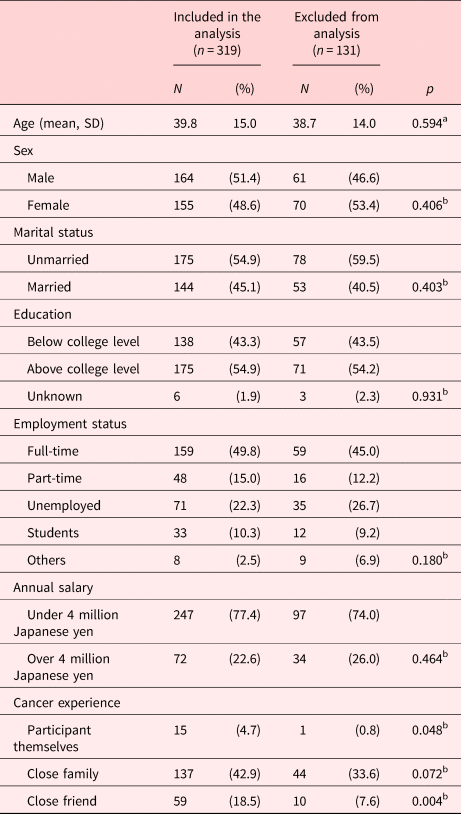
The characteristics of the participants are shown in Table 1. The mean age of the initial 319 respondents was 39.8 (±15.0). Approximately half of the participants were male, married, and earned relatively high annual salaries (more than four million Japanese Yen). Fifteen participants (5%) had been diagnosed with cancer, 43% of the participants had close family who had been diagnosed with cancer, and 19% had a close friend who had been diagnosed with cancer. The Fisher's exact tests showed that the participants who were included in the analyses were more likely to have been diagnosed with cancer themselves (Odds Ratio [OR] = 6.4, p < 0.05) and were more likely to have a close friend who had been diagnosed with cancer (OR = 2.7, p < 0.01) than the participants who were excluded from the analyses.
Demographics (N = 450)

a Mann–Whitney U test.
b Fisher's exact test.
Explanatory factor analysis
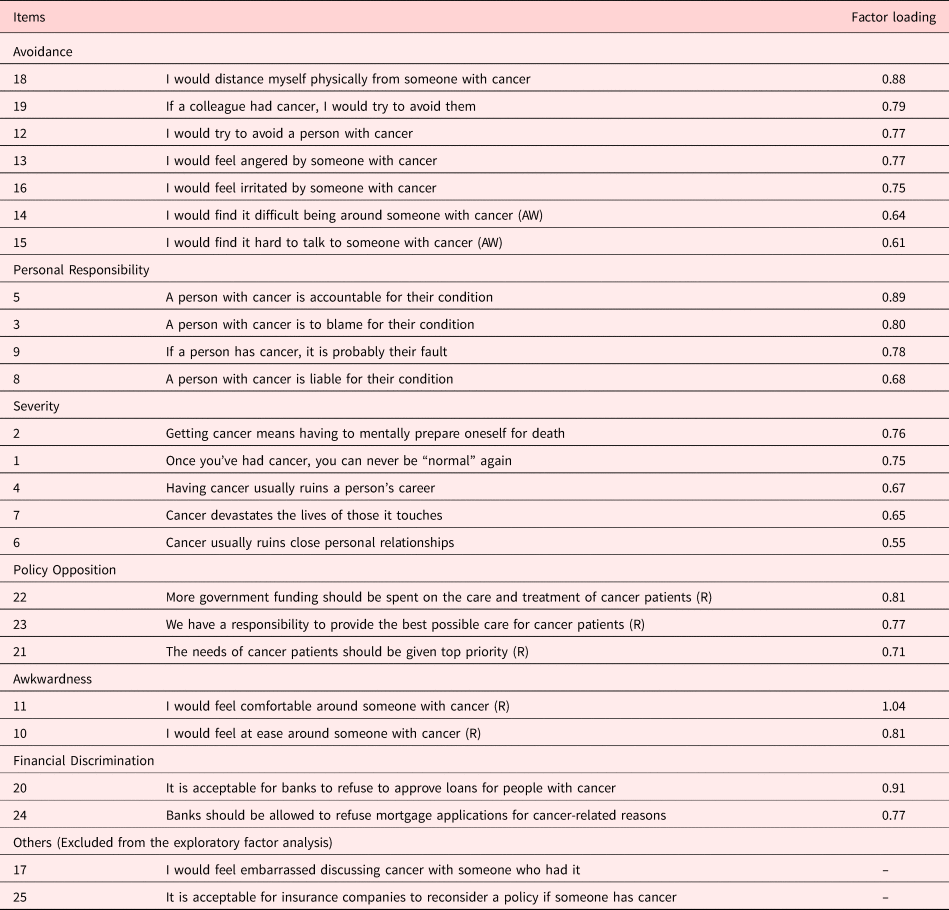
All 25 items of the J-CASS were entered into an explanatory factor analysis with a promax rotation (Table 2). After eliminating items 17 (“I would feel embarrassed discussing cancer with someone who had it”) and 25 (“It is acceptable for insurance companies to reconsider a policy if someone has cancer”) due to their low factor loadings (<0.4), the eigenvalue suggested a six-factor solution, which explained 70% of the variance. The Kaiser-Meyer-Olkin value was 0.81 and Bartlett's test of sphericity value was significant (p < 0.001). The number of items in each factor was the same as that of the original CASS in the factors Personal Responsibility, Severity, and Policy Opposition, while those in Avoidance (seven items), Awkwardness (two items), and Financial Discrimination (two items) were different from the original CASS.
Exploratory factor analysis of J-CASS

(R) Items were reversed; (AW) Items are included in the Awkwardness factor in the original CASS.
Confirmatory factor analysis
A six-factor confirmatory factor analysis model suggested a poor model fit: RMSEA = 0.10, GFI = 0.81, AGFI = 0.76, CFI = 0.82, TLI = 0.79, NFI = 0.79, and χ 2/df = 5.41. Therefore, the model was adjusted based on the modification indices. When the correlations between items 13 and 16 and between items 14 and 15 were added, the model of fit improved remarkably, exceeding the proposed criteria: RMSEA = 0.07, GFI = 0.86, AGFI = 0.82, CFI = 0.91, TLI = 0.90, NFI = 0.87, and χ 2/df = 2.67.
Mean and inter-factor correlation
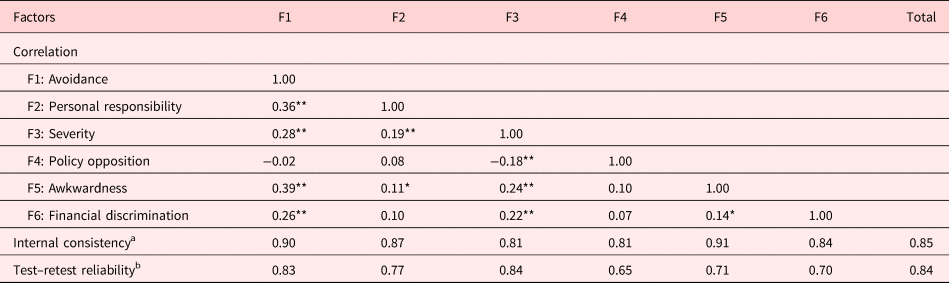
The mean score of the J-CASS total score and subtotal scores were significantly higher than those of Marlow's original study (t = 2.60–19.27, p < 0.01) [20]. There were significant correlations between each factor, ranging from r = 0.11 to r = 0.39 (Table 3). An exception is Policy Opposition, which was only correlated with Severity and not with other factors. Moreover, Financial Discrimination and Personal Responsibility were not significantly correlated with each other.
Correlation, internal consistency, and test–retest reliability of each factor

a Cronbach's alpha.
b Internal correlation coefficient.
* p < 0.05.
** p < 0.01.
Internal consistency and test–retest reliability
The internal consistency was satisfactory for the total scale and for each factor (Cronbach's alpha = 0.81–0.91; Table 3). The ICC value was 0.84 for the total score and between 0.65 and 0.84 for each factor, which indicated moderate to good test–retest reliability.
Concurrent validity
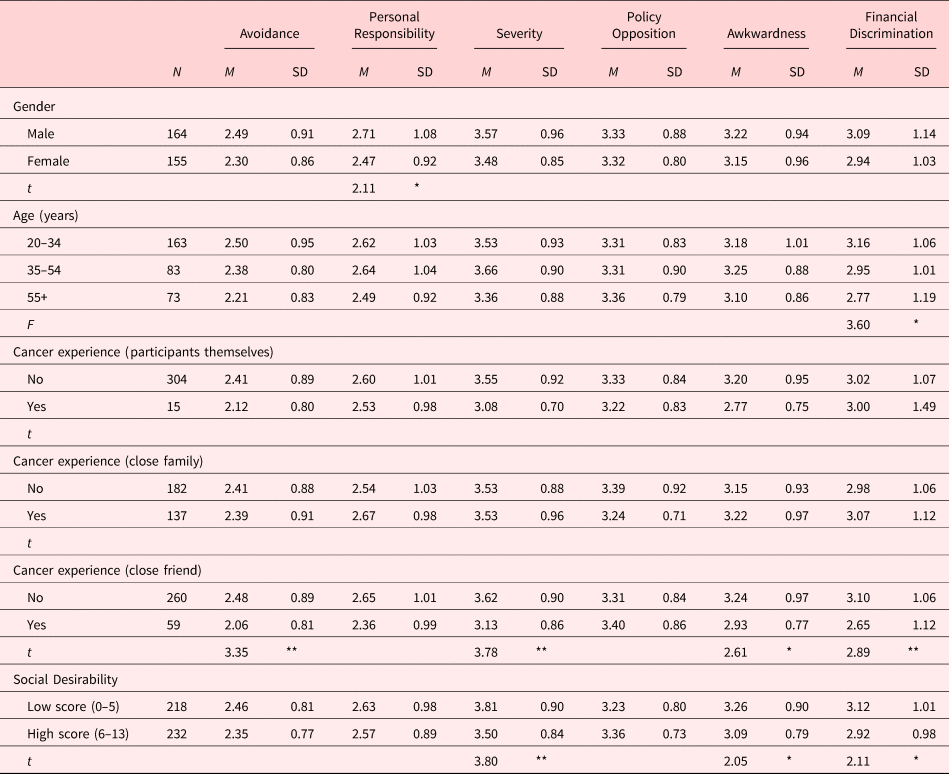
To test our hypotheses, the differences in the mean scores of each factor were examined according to gender, age, cancer experience, and social desirability (Table 4). Male respondents scored significantly higher for Personal Responsibility than female participants. Younger respondents scored higher for Financial Discrimination. Participants whose close friends have been diagnosed with cancer had lower scores for Avoidance, Severity, Awkwardness, and Financial Discrimination. Higher social desirability was associated with lower scores for Severity, Awkwardness, and Financial Discrimination. Participants’ personal experience of cancer had no significant correlation with any of the factors.
Concurrent validity of J-CASS (N = 319)

N, Number of respondents.
* p < 0.05.
** p < 0.01.
Discussion
In this study, the CASS was translated into Japanese and tested on a sample of the general Japanese population. The J-CASS consisted of six factors and proved to have adequate internal consistency and moderate to good test–retest reliability. As we hypothesized, the J-CASS score was significantly associated with age, gender, cancer experience, and social desirability, supporting the scale's construct validity. To the best of authors’ knowledge, the J-CASS is the only validated scale that evaluates cancer stigma in the general Japanese population.
For cross-cultural adaption, translation and back translation were done while remaining true to the meaning of the original items. No specific adjustments were necessary for cultural adaptation and the back translation was approved by the original author. The analysis demonstrated that J-CASS has a similar construct to the original CASS in the number of factors and items in each factor. However, the two scales have certain minor differences. J-CASS did not fit the original model and two items were removed from the scale. In particular, in J-CASS, Awkwardness showed a different factor structure compared with that of the original CASS. Two items of Awkwardness were included in Avoidance and one item was removed due to insufficient factor loading. Considering that there is a moderate inter-factor correlation between Awkwardness and Avoidance — in both J-CASS and the original CASS (Marlow and Wardle, Reference Marlow and Wardle2014) — Awkwardness and Avoidance are similar in their concept and some of the included items can be interchangeable. For example, the item “I would find it hard to talk to someone with cancer” is included in Awkwardness in the original scale but in Avoidance in the J-CASS. We assumed that these items are interchangeable in meaning depending on whether participants focus on the emotional aspect or behavioral aspect.
Each subscale of the J-CASS was associated with social-demographic variables and social desirability, the same as the original CASS development. However, cancer experiences held by the participants themselves were not associated with stigma. This result indicates that cancer experience does not result in patients having either a positive or negative attitude toward cancer. Another finding is that, although those who have a close friend with cancer felt a higher level of stigma, those who have a close family with cancer did not. This fact indicates that emotional attachment has more impact on stigma than does a biological relationship.
Despite slight differences in the factor structures, the J-CASS scores in this study were significantly higher than that of the original CASS study across all factors. There are a few possible interpretations of this finding. First, it may reflect the difference in cancer stigma between the UK and Japan as a whole. Second, it may be due to a difference in the participants’ characteristics. Despite the two studies adopting a similar methodology and the basic characteristics of the participants (mean age and gender proportion) being alike, differences in their characteristics are possible. This aspect needs to be addressed in future studies.
In the current study, approximately 30% of the respondents were excluded from the analysis, as they selected “not sure” for more than 20% of the questions. This differs from Marlow's original study, where only 6% of the participants were excluded due to missing data (Marlow and Wardle, Reference Marlow and Wardle2014). When comparing participants included in the data analysis and those excluded, those who did not have experience of a cancer diagnosis or close friends or family diagnosed with cancer were more likely to select “not sure.” We assume that the respondents’ unfamiliarity with cancer may be a reason for the large proportion of “not sure” responses. To minimize “not sure” responses, the scale may need to clarify the meaning of the “not sure” response. A past study that scrutinized potential intention of “not sure” responses among Japanese respondents demonstrated that a “not sure” response represents a variety of respondents’ intentions, ranging from an incapability to make a decision due to lack of information, indifference to the topic, self-repression, or an unpleasant feeling when answering the questions (Ishida, Reference Ishiyaku, Kasim and Harir2016). Further studies need to be conducted to clarify the meaning of the “not sure” response and to refine J-CASS question items.
Clinical implications
There are many potential clinical implications concerning J-CASS. First, correlations between cancer stigma and some key clinical variables — such as cancer screening uptakes, psychological status, social support, and quality of life — could be explored based on J-CASS. Second, comparing cancer stigma in the general public with stigma in cancer patients may provide information on how we can support cancer patients with a high level of perceived stigma. Third, J-CASS can be used as an indicator of the effectiveness of cancer education programs. Further studies to demonstrate the usefulness of J-CASS is warranted.
Study limitations
This study has several limitations. First, as mentioned above, approximately 30% of the respondents were excluded from the analysis due to their high number of “not sure” responses. The significant differences in demographics between the participants who were included and excluded in the analysis imply the presence of substantial selection bias. Second, the study participants were limited to internet users who were registered as internet monitors in a single agency. These participants may not necessarily represent the entire general Japanese population (Hunter, Reference Hunter2012). Moreover, the low response rate infers potential sampling bias. Third, even though the survey was conducted online to maintain anonymity, social desirability bias among the respondents may be unavoidable. Last, the scale was forward and back translated by a single translator, which may cause a potential bias, but the final translation was carefully reviewed by the expert panel.
Conclusions
This study successfully translated CASS into Japanese and demonstrated its appropriate psychometric properties. This is the first attempt to examine the psychometric properties of CASS among the general Japanese population. Minor differences between the original CASS and J-CASS were demonstrated, which warrants further investigation of the differences in cancer-related stigma in different cultural backgrounds.
Funding
This study was supported by the National Cancer Center Research and Development Fund (28-A-23).