Introduction
Lesbian, gay, and bisexual (LGB) individuals are at a significantly higher risk of developing depression and anxiety than heterosexual individuals (Plöderl & Tremblay, Reference Plöderl and Tremblay2015). Specifically, the risk over 12 months or a lifetime is 1.5–2.6 times higher (King et al. Reference King, Semlyen, Tai, Killaspy, Osborn, Popelyuk and Nazareth2008). As approximately 3.5% of the population is LGB (Gates, Reference Gates2011), this constitutes a significant public health burden. Identifying the origins (biological and/or environmental) of these disparities and their underlying mechanisms may help in developing strategies to reduce them. The most commonly cited cause of sexual orientation disparities in depression and anxiety is minority stress (Meyer, Reference Meyer2003). This proposes that group-specific social stressors stemming from anti-LGB stigma, including prejudice events, expectations of rejection, concealment, and self-stigma, cascade into psychopathology. Hatzenbuehler (Reference Hatzenbuehler2009) extended this approach, suggesting that such minority stressors contribute to the development of general psychological processes known to be associated with psychopathology, such as rumination, which in turn increases the risk of depression and anxiety. Research has found that LGB individuals have higher levels of rumination than heterosexual individuals and that this variable mediates the relationship between LGB stigma-related stressors and distress, corroborating this (Hatzenbuehler et al. Reference Hatzenbuehler, McLaughlin and Nolen-Hoeksema2008; Hatzenbuehler et al. Reference Hatzenbuehler, Nolen-Hoeksema and Dovidio2009b; Liao et al. Reference Liao, Kashubeck-West, Weng and Deitz2015).
However, depression and anxiety are influenced by both genetic and environmental factors (Polderman et al. Reference Polderman, Benyamin, De Leeuw, Sullivan, Van Bochoven, Visscher and Posthuma2015). Research also suggests that genetic factors are important in the development of sexual orientation (Bailey et al. Reference Bailey, Vasey, Diamond, Breedlove, Vilain and Epprecht2016). Thus, the association between sexual orientation and psychological distress could be due to common genetic causes, rather than environmental factors such as minority stressors. Twin studies can tease out these effects. For example, in a classical discordant twin design, monozygotic (MZ or ‘identical’) twins discordant for a particular trait are recruited and differences between the twins are examined. If significant differences are found, these are taken as support for non-shared environmental influences, because the twins share the same genotype (thus minimizing differences due to genetic factors). Maternal influences, common (family/upbringing) environment, age, sex, and cohort effects are also controlled for.
Twin studies in this area are inconsistent, however. One Swedish twin study found that adjusting for perceived discrimination and hate crime victimization reduced the association between non-heterosexuality (defined as same-sex sexual experiences) and rates of common mental health disorders. However, the association was reduced substantially by a further control for familial factors using co-twin comparisons (Frisell et al. Reference Frisell, Lichtenstein, Rahman and Långström2010). Nevertheless, this study was unable to separate the familial influences into their genetic and environmental constituents. A second study in the Australian Twin Registry reported a genetic correlation (an estimate of additive genetic influences that is shared between a pair of heritable traits) between same-sex sexual attraction and neuroticism and psychoticism, but no environmental correlation (Zietsch et al. Reference Zietsch, Verweij, Bailey, Wright and Martin2011). In another study, Zietsch et al. (Reference Zietsch, Verweij, Heath, Madden, Martin, Nelson and Lynskey2012) reported that genetic factors accounted for 60% of the correlation between depression scores and same-sex attraction, but that adverse family experiences, childhood sexual abuse, and other non-shared environmental factors also contributed to that correlation. One study on 103 male twin pairs discordant for having male sexual partners reported elevated suicidality in the sexual minority co-twins, even after adjustment for substance use and depression (Herrell et al. Reference Herrell, Goldberg, True, Ramakrishnan, Lyons, Eisen and Tsuang1999). This difference was not moderated by zygosity (whether MZ or dizygotic [DZ or ‘non-identical’]), suggesting that genetics could not explain this finding. However, a final study on 38 male MZ pairs discordant for sexual orientation found that heterosexual twins had greater psychological distress scores on the Symptom Checklist-90-Revised than their gay co-twins (Sánchez et al. Reference Sánchez, Bocklandt and Vilain2013).
These studies are limited by their use of single-item measures of sexual orientation or sexual behavior-only measures (rather than levels of sexual attractions), use of a small range of minority stressors (often simply one or two indicators of victimization), no standardized measures of minority stress factors, and non-standard mental health outcomes (or proxy markers such as personality traits). A related issue is the sexual orientation of the heterosexual co-twins. One assumption in the existing genetically informative research is that minority stress effects are subsumed with non-shared environmental effects because the heterosexual co-twin cannot be subject to such stressors. However, it may be possible that otherwise heterosexual-identified co-twins of LGB individuals have small degrees of same-sex attractions or behaviors, despite not fully expressing a complete LGB phenotype, by virtue of sharing a genetic predisposition toward same-sex sexuality (Bailey et al. Reference Bailey, Vasey, Diamond, Breedlove, Vilain and Epprecht2016). If this is the case, then this may subject them to some minority stressors, albeit perhaps at lower levels. For example, this may result in some self-stigma that affects the individual's risk for mental health problems, or direct prejudice events if they behave in ways that reflect this attraction. This is particularly pertinent given that heterosexual individuals with some same-sex sexuality report higher levels of psychological distress and minority stressors than exclusively heterosexual individuals (Vrangalova & Savin-Williams, Reference Vrangalova and Savin-Williams2014). Additionally, such individuals may be more gender non-conforming, a developmental trait robustly associated with adult sexual orientation and even low levels of same-sex attractions and behavior (Dunne et al. Reference Dunne, Bailey, Kirk and Martin2000; Bailey et al. Reference Bailey, Vasey, Diamond, Breedlove, Vilain and Epprecht2016). This may increase the exposure of heterosexual individuals with small degrees of same-sex attractions/behavior to stigma because gender non-conformity acts as a behavioral ‘marker’ of current or future sexual minority status. Gender non-conformity is also associated with mental health outcomes in both LGB and heterosexual individuals (Roberts et al. Reference Roberts, Rosario, Slopen, Calzo and Austin2013). Finally, even if the heterosexual twin experienced no same–same attractions or gender non-conformity, it is possible that they experience victimization relating to the minority sexual orientation of their twin, for example, due to people assuming that they are also non-heterosexual. Prior studies have been unable to explore this possibility due to their limited minority stress and sexual orientation measures.
The present study investigated non-shared environmental influences as causal explanations for disparities in psychological distress and rumination between heterosexual and LGB individuals. A classical discordant MZ twin design, where one twin identified as heterosexual and the other as LGB, was employed. Furthermore, a range of minority stressors was investigated as potential explanations of such effects. Finally, the relationship between minority stressors and negative psychological outcomes in MZ heterosexual co-twins of LGB individuals was explored to test whether such individuals can be assumed to be unaffected by minority stressors. To our knowledge, this is the largest discordant MZ twin sample to study these questions.
In line with previous research in non-twin samples, it was hypothesized that LGB twins would display higher levels of psychological distress, rumination, minority stressors, and recalled childhood gender non-conformity (CGN), and lower levels of well-being than their heterosexual MZ co-twins. Drawing on minority stress approaches, it was also hypothesized that differences between twins in rumination and psychological distress scores would be positively associated with the differences in minority stressors, and CGN scores. To investigate whether minority stressors were also associated with heterosexual twins’ psychological outcomes, associations were investigated between distress, rumination, and minority stressors for these participants separately.
Methods
Procedure
Participants were recruited via targeted online and print advertisements and referrals from colleagues. Twin pairs were invited to participate if they were MZ, raised together, aged 16 or older and one identified as LGB and the other as heterosexual. Participants received no compensation.
Measures
Questionnaires covered demographic variables, sexual orientation, zygosity, CGN, prejudice events, concealment, expectations of rejection, self-stigma, rumination, and psychological distress.
Sexual orientation
Participants indicated their sexual identity using a multiple-choice question. Participants also indicated the proportion of males and females they experience sexual attraction, romantic attachments, and romantic infatuations for on seven-point scales ranging from 0, ‘Always male’, to 6, ‘Always female’, with an eighth option of X, ‘Little or no (sexual attraction)’. Finally, participants indicated on two eight-point scales ranging from ‘0 (none)’ to ‘over 50’ the numbers of male and female sex partners they had during their lifetime. Ratings were converted to seven-point summary scores in line with other sexual orientation measures.
Zygosity
Zygosity was determined using an English language version of a Norwegian zygosity questionnaire (Torgersen, Reference Torgersen1979). Participants answered three items about their childhood similarity on separate three-, three- and four-point scales. Scores from both twins were pooled and totaled, forming a single score ranging from 6 to 20. Lower scores indicated higher childhood similarity, and thus higher likelihood of being MZ. Validation research using blood typing has found that twins scoring 12 or lower have a 96.8% of being MZ, twins scoring 14 or higher have a 4.2% chance of being MZ and twins scoring 13 have a 50.0% chance of being MZ (Torgersen, Reference Torgersen1979). Thus, a cut-off of 12 or less was chosen for classification as MZ, ensuring participants have an extremely similar chance of being MZ as they would if screened using a biological test. Using questionnaires for this purpose is common in twin registries worldwide due to this high criterion validity (Strachan et al. Reference Strachan, Hunt, Afari, Duncan, Noonan, Schur, Watson, Goldberg and Buchwald2013).
Childhood gender non-conformity
CGN was measured using a recalled CGN scale (Hassan & Rahman, Reference Hassan and Rahman2007). Participants indicated their levels of CGN from as early as they can remember to 12 years old on 10 items rated on five-point scales. An example item is ‘As a child, I enjoyed playing rough physical sports such as football (soccer), hockey or rugby’. Scores are reversed for female participants. Recalled CGN measures display excellent internal consistency and validity for both men and women (Zucker et al. Reference Zucker, Mitchell, Bradley, Tkachuk, Cantor and Allin2006; Hassan & Rahman, Reference Hassan and Rahman2007).
Prejudice events
Heterosexist Harassment, Rejection, and Discrimination Scale
General prejudice events were measured using a version of the Heterosexist Harassment, Rejection, and Discrimination Scale, modified to include all transgender non-heterosexual individuals (LGBT+ individuals; Szymanski, Reference Szymanski2006). Participants rated how frequently they had experienced 14 events in the past year because they are LGBT+ or were perceived to be on a six-point scale ranging from 1, ‘The event has NEVER happened to you’, to 6, ‘The event happened ALMOST ALL OF THE TIME (more than 70% of the time)’. An example item is ‘How many times were you denied a raise, a promotion, tenure, a good assignment, a job, or another such thing at work that you deserved because you are LGBT+ or were perceived to be LGBT+?’ Versions of this scale display good validity and internal reliability for LGB men and women (Szymanski, Reference Szymanski2006, Reference Szymanski2009).
Victimization
Lifetime victimization was measured using an instrument adapted from D'Augelli (Reference D'Augelli, Omoto and Kurtzman2006) to include all LGBT+ individuals. Participants rated how often they had experienced each of seven forms of victimization because they are LGBT+ or were perceived as such on a four-point scale ranging from 0, ‘Never’, to 3, ‘Three or more times’. Example items include ‘Verbal Abuse’, and ‘Assaults (Being Punched, Kicked or Beaten)’. Versions of this scale have shown good validity and internal reliability (D'Augelli, Reference D'Augelli, Omoto and Kurtzman2006; Lehavot & Simoni, Reference Lehavot and Simoni2011).
Microaggressions
Microaggressions (low-level prejudice events) were assessed using the Sexual Minority Microaggressions Scale (Timmins et al. Reference Timmins, Rimes and Rahman2017). Participants indicated how often in the past year they had experienced nine different microaggressions on a five-point scale, ranging from 1, ‘Never’, to 5, ‘All of the time’. Example items include ‘People finding you fascinating or exotic because you are LGBT+ or they perceive you to be LGBT+’ and ‘People accusing you of being defensive or sensitive when talking about your gender identity or sexual orientation’. This scale has good validity and internal reliability for LGB men and women (Timmins et al. Reference Timmins, Rimes and Rahman2017).
Concealment
Active concealment
Active concealment of sexual minority status was assessed using the Gender and Sexual Minority Presentation Management Inventory (Timmins et al. Reference Timmins, Rimes and Rahman2017). Participants indicated how often they engage in five different strategies in order not to appear to be LGBT+ on a five-point scale, ranging from 1, ‘Never’, to 5, ‘All of the time’. Example items are ‘I try to act more masculine or feminine’ and ‘I check myself to see if anything gives me away’. This scale has displayed good validity and internal reliability (Timmins et al. Reference Timmins, Rimes and Rahman2017).
Outness
Outness was assessed using an adaptation from Meyer et al. (Reference Meyer, Rossano, Ellis and Bradford2002). Participants indicated the proportion of people that they were ‘out to’ about their sexual orientation in five different social groups on a four-point scale ranging from 1, ‘out to none’, to 4, ‘out to all’. Example items include ‘Family’ and ‘Healthcare Professionals’. A version of this scale displayed good reliability and good validity in LGB individuals (Frost & Meyer, Reference Frost and Meyer2009).
Expectations of rejection
Acceptance concerns
Concerns about potential stigma were measured using a version of the Acceptance Concerns subscale of the Lesbian, Gay, and Bisexual Identity Scale (Mohr & Kendra, Reference Mohr and Kendra2011), modified to be inclusive of all LGBT+ individuals. Participants rated on a six-point scale ranging from 1, ‘Disagree Strongly’, to 6, ‘Agree Strongly’, three statements about concerns over potentially being stigmatized for being LGBT+ or perceived as such. Example items include ‘I often wonder whether others judge me because I'm LGBT+ or because they think I am’ and ‘I can't feel comfortable knowing that others judge me because I'm LGBT+ or because they think I am’. This scale has good reliability and construct validity with LGB individuals (Mohr & Kendra, Reference Mohr and Kendra2011).
Vigilance
Vigilance for others’ suspicions of own LGBT+ status and likely reactions were measured using the Vigilance for Others' Suspicions Scale (Timmins et al. Reference Timmins, Rimes and Rahman2017). Participants indicated on a five-point scale ranging from 1, ‘Never’, to 5, ‘All of the time’, how often they display three different forms of vigilance. Example items include ‘I pay close attention to whether people suspect me of being LGBT+’ and ‘I am quick to notice changes in how someone is treating me if they have reason to suspect me of being LGBT+’. This scale has displayed good validity and internal reliability for LGB individuals (Timmins et al. Reference Timmins, Rimes and Rahman2017).
Self-stigma
Sexual orientation self-stigma was assessed using a version of the Revised Internalized Homophobia Scale (Herek et al. Reference Herek, Gillis and Cogan2009), modified to be applicable regardless of gender identity and sexual orientation. Participants rated on a five-point scale ranging from 1, ‘Strongly Disagree’, to 5, ‘Strongly Agree’, five statements about self-stigma. Example items include ‘I would like to get professional help in order to change my sexual orientation from what it is to something else’ and ‘I feel that being of my sexual orientation is a personal shortcoming for me’. This measure has good internal reliability and construct validity with LGB individuals (Herek et al. Reference Herek, Gillis and Cogan2009).
Rumination
Rumination was assessed using a version of the brooding subscale of the Ruminative Responses Scale (Treynor et al. Reference Treynor, Gonzalez and Nolen-Hoeksema2003), modified to refer to distress broadly, rather than just negative mood. Participants indicated on a four-point scale ranging from 1, ‘Almost never’, to 4, ‘Almost always’, how often they experience five different cognitions when they feel down, sad, or distressed. Example items include ‘Think about a recent situation, wishing it had gone better’ and ‘Think “Why do I always react this way?”’ This measure has displayed good internal reliability in LGB individuals and is also associated with both concurrent and long-term depression in the general population (Treynor et al. Reference Treynor, Gonzalez and Nolen-Hoeksema2003; Hatzenbuehler et al. Reference Hatzenbuehler, Dovidio, Nolen-Hoeksema and Phills2009a, Reference Hatzenbuehler, Nolen-Hoeksema and Dovidiob).
Well-being
General well-being was assessed using the UK Office for National Statistics Well-Being measure (ONS-WB Self et al. Reference Self, Thomas and Randall2012). Participants rated four aspects of their well-being on an 11-point scale ranging from 0, ‘not at all’, to 10, ‘completely’. This scale has displayed good validity and internal reliability for LGB men and women (Timmins et al. Reference Timmins, Rimes and Rahman2017).
Psychological distress
Psychological distress was measured using the Patient Health Questionnaire Anxiety and Depression Scale (PHQ-ADS; Kroenke et al. Reference Kroenke, Wu, Yu, Bair, Kean, Stump and Monahan2016). Participants indicated on a four-point scale ranging from 0, ‘Not at all’, to 3, ‘Nearly every day’, how often they experienced 16 different symptoms of depression and anxiety over the previous 2 weeks. Scale scores range from 0 to 48. Higher scores indicate more symptoms of psychological distress. Example items include ‘Feeling nervous, anxious or on edge’ and ‘Feeling down, depressed or hopeless’. This measure has demonstrated good to excellent reliability and strong construct validity (Kroenke et al. Reference Kroenke, Wu, Yu, Bair, Kean, Stump and Monahan2016). The scale includes a nine-item depression subscale, range = 0–27, and seven-item anxiety subscale, range = 0–21.
Data preparation
Missing data on individual items ranged from 0.0% to 3.1%. Individuals’ scores for scales with missing items were calculated by substituting the mean of their remaining items, but only if 80.0% or more were complete. This ensured data were retained where possible without substantially affecting internal reliability. Pairwise deletion was used for remaining missing data. No adjustments to the α levels were made in the following tests to correct for familywise error, as the small sample size meant that this would inflate the Type II error rate to an unacceptable level (Nakagawa, Reference Nakagawa2004). Instead, we limited the number of tests performed to ensure a minimal Type I error rate.
Results
Sample
Forty-eight twin pairs fully completed the study measures. Each twin pair reported demographics unique within the sample, indicating that there were no duplicate responses. Seven pairs were excluded for scoring 13 or higher on the zygosity questionnaire. Another pair was excluded as both twins reported a sexual minority identity. Finally, two pairs were excluded due to one twin being transgender and the other not. This left 38 twin pairs.
Of the 38 pairs, eight were recruited through social media, three were recruited through the mailing list of TwinsUK, a UK twin registry, 15 were recruited through magazine advertisements, two were recruited through a university mailing list and 10 were recruited through referrals from colleagues undertaking an unrelated study. Participants had a mean age of 29.2 (range = 19–50). Seven pairs were both resident in the United States, 21 pairs were resident in the United Kingdom, two pairs were resident in Canada and the rest of the sample reported living in various other countries. Thirty-six pairs identified as ethnically white, one black, and one multi-racial. Thirteen heterosexual individuals and 11 LGB individuals were above the cut-off for clinical depression on the PHQ-ADS. Furthermore, 11 heterosexual individuals and 12 LGB individuals were above its cut-off for clinical anxiety. Twenty-five pairs were sisters and 13 were brothers. Regarding sexual identity, 33 of the LGB twins were lesbian/gay and five were bisexual. In total, only 21 heterosexual twins reported exclusive opposite-sex sexual attractions, romantic infatuations, romantic attachments, and no same-sex partners. Descriptives for study measures are presented in Table 1.
Descriptive statistics in heterosexual and LGB twins

PHQ-ADS, Patient Health Questionnaire Anxiety and Depression Scale; ONS-Wellbeing, UK Office for National Statistics Well-Being Scale.
a Excludes one participant who reported ‘Little or no sexual attraction’.
b Excludes two participants who reported ‘Little or no romantic infatuations’.
c Excludes two participants who reported ‘Little or no romantic infatuations’.
d Excludes three participants who reported no sexual partners.
Comparisons between heterosexual and sexual minority twins
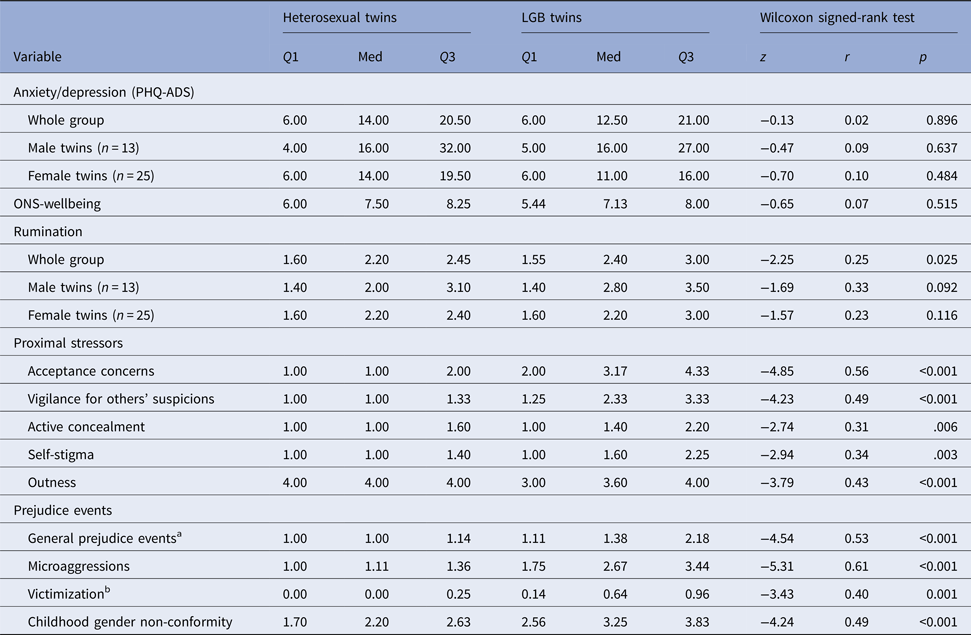
Multiple variables were significantly non-normally distributed, so non-parametric statistical tests were employed. Results of Wilcoxon signed-rank tests comparing psychological characteristics and minority stress experiences of heterosexual and LGB twins are presented in Table 2. LGB twins had significantly higher scores than their heterosexual co-twins for rumination, acceptance concerns, vigilance, active concealment, self-stigma, microaggressions, general prejudice events, victimization, and CGN, and lower scores for outness. No significant differences were found for psychological distress or well-being. Group comparisons were repeated for distress and rumination in the groups split by gender, as women tend to display higher levels of both than men (Girgus & Yang, Reference Girgus and Yang2015). However, no significant sexual orientation differences were found for either sex when investigated separately.
Results of Wilcoxon signed-rank tests comparing heterosexual and LGB twins with quartiles (N = 38 pairs)

PHQ-ADS, Patient Health Questionnaire Anxiety and Depression Scale; ONS-Wellbeing, UK Office for National Statistics Well-Being Scale.
Med, median; Q1, first quartile; Q3, third quartile.
a n = 37 pairs due to missing data.
b n = 36 pairs due to missing data.
Correlations between twin differences in distress, rumination, and minority stressors
It had been predicted that differences between the cohort pairs in distress, well-being, and rumination would be associated with differences in minority stressors. However, given no significant group differences were found for the PHQ-ADS or ONS-Wellbeing measures, only difference scores for rumination were calculated and treated as an outcome variable in the difference score correlations. Spearman correlation coefficients were calculated to examine the association between rumination differences scores and differences scores for acceptance concerns, self-stigma, microaggressions, general prejudice events, victimization, and CGN (Table 3). Significant positive associations were found between rumination and both acceptance concerns and self-stigma.
Spearman correlations for rumination twin difference scores, psychological distress and rumination in heterosexual twins, and psychological distress and rumination in LGB twins

PHQ-ADS, Patient Health Questionnaire Anxiety and Depression Scale.
PHQ-ADS difference scores not calculated as non-significant differences were found between LGB and heterosexual twins on this variable.
Significant correlations are bolded.
a Based on 37 pairs due to missing data.
b Based on 36 pairs due to missing data.
Correlations between distress, rumination, and minority stressors within each sexual orientation group
Spearman correlation coefficients were calculated for the associations between distress, rumination, minority stressors, and CGN split by sexual orientation (Table 3). For heterosexual individuals, a significant positive correlation was found between rumination and distress, and between rumination and self-stigma. For LGB individuals, significant positive correlations were found between rumination and each of acceptance concerns, self-stigma, and microaggressions. Furthermore, significant correlations were found between distress and each of rumination, acceptance concerns, self-stigma, microaggressions, and general prejudice events. All other associations were non-significant.
Analyses for twin pairs with exclusively heterosexual participants
All above analyses were rerun with the 21 pairs in which the heterosexual twin reported exclusive opposite-sex sexual attractions, romantic infatuations, romantic attachments, and no same-sex sexual partners. Results can be seen in online Supplementary Tables S1–S2. Notably, for exclusively heterosexual individuals, there was a significant, positive correlation between microaggressions and rumination.
Discussion
This is the first study to test relationships between a broad range of minority stressors, psychological distress, and rumination in a rare sample of MZ twins discordant for sexual minority status. There was partial support for our hypotheses. Firstly, LGB individuals had higher levels of rumination than their heterosexual co-twins, consistent with previous work in non-twin samples (Hatzenbuehler et al. Reference Hatzenbuehler, McLaughlin and Nolen-Hoeksema2008). This supports a causal effect of non-shared environmental, rather than genetic, factors (because the twins share the same genotype). LGB individuals also exhibited significantly higher levels of minority stressors and CGN than their heterosexual co-twins, consistent with growing work indicating that LGB individuals experience elevated stigma-related stressors (Hatzenbuehler, Reference Hatzenbuehler2009; Hatzenbuehler et al. Reference Hatzenbuehler, Nolen-Hoeksema and Dovidio2009b; Liao et al. Reference Liao, Kashubeck-West, Weng and Deitz2015). As predicted, differences in rumination between twin pairs were associated with differences in acceptance concerns and self-stigma, although the associations were not significant for microaggressions, prejudice events, victimization, or CGN. This hints that one source of the non-shared environmental influence may involve minority stressors.
These results extend previous findings by showing that at least some minority stressors are associated with rumination in the heterosexual MZ co-twins of LGB individuals. Specifically, self-stigma was associated with rumination in the full sample of heterosexual twins and microaggressions were positively associated with rumination in the exclusively heterosexual group. It is also possible that the non-significant associations were due to a floor effect, as the means and variances for the heterosexual twins were low for the minority stressors. As rumination is a risk factor for psychological distress, these data imply that minority stressors may also have some relevance for the mental well-being of the MZ heterosexual co-twins of LGB individuals (Treynor et al. Reference Treynor, Gonzalez and Nolen-Hoeksema2003). Notably, the significant relationship between microaggressions and rumination in the exclusively heterosexual twins suggests that this stressor may affect these individuals, even though they experience no same-sex attractions or sexual behavior. Thus, future studies using large samples of twins should endeavor to include measures of distress, multiple minority stressors, particularly self-stigma and microaggressions, and multidimensional sexual orientation.
LGB individuals did not have higher levels of psychological distress or lower well-being, in contrast to our predictions and previous research conducted in non-twin samples (Plöderl & Tremblay, Reference Plöderl and Tremblay2015; cf. Sánchez et al. Reference Sánchez, Bocklandt and Vilain2013 in a study of MZ male twins discordant for sexual orientation). As genetics and the shared environment were controlled for, this would imply there was no effect of the non-shared environment, which is inconsistent with minority stress as an explanation for disparities in distress between heterosexual and LGB individuals (Meyer, Reference Meyer2003). However, a previous study using a larger sample of both MZ and DZ twins found that LGB individuals had higher levels of depression than heterosexual individuals and that environmental factors accounted for 40% of this association (Zietsch et al. Reference Zietsch, Verweij, Heath, Madden, Martin, Nelson and Lynskey2012). That previous study may have been more likely to detect a group difference than the present study due to using a larger sample size and measuring depression over the lifetime, rather than distress over the previous 2 weeks as in the current study, or over the past 7 days as in Sánchez et al. (Reference Sánchez, Bocklandt and Vilain2013). Indeed, as rumination is strongly associated with future risk of psychological distress, the LGB individuals in this study could be argued to have higher distress vulnerability than heterosexual individuals, despite exhibiting similar levels of depressive or anxious symptomatology over the past fortnight (Treynor et al. Reference Treynor, Gonzalez and Nolen-Hoeksema2003). This sexual orientation difference was not significant for either men or women when the groups were split by sexual orientation. However, this is likely due to small numbers in these sub-samples. Finally, it is possible that the heterosexual twins in both studies had higher levels of distress due to minority stress factors, as suggested by the associations between rumination and minority stressors found in the current study's heterosexual twins. Thus, the current body of work should not be seen as evidence against Meyer's (Reference Meyer2003) minority stress theory, per se.
This study has several limitations. Firstly, the design precluded testing the direction of associations between specific non-shared environmental factors (e.g. levels of minority stressors) and distress or rumination. It is possible that rumination results in greater reporting of minority stressors, rather than stigma experiences causing more rumination. The design also meant we were unable to quantify more complex direct and indirect pathways (e.g. using path analysis to test mediation and moderation) from the four minority stress factors through to rumination and then to distress. Secondly, our sample was predominantly white and Western. Thirdly, participants were self-selected, which may have over-represented twins with similar traits and experiences or high levels of mental health problems. This latter point is corroborated by the rates of depression and anxiety being several times higher in both groups than would be expected (King et al. Reference King, Semlyen, Tai, Killaspy, Osborn, Popelyuk and Nazareth2008; Löwe et al. Reference Löwe, Decker, Müller, Brähler, Schellberg, Herzog and Herzberg2008; Kocalevent et al. Reference Kocalevent, Hinz and Brähler2013). Our sample size was small. This is unsurprising. MZ twinning occurs in approximately 0.3% of live births and sexual minority status discordance may occur in as a few as 4.0% of MZ twin pairs, so participants who meet our inclusion criteria were rare (Kendler et al. Reference Kendler, Thornton, Gilman and Kessler2000; Hall, Reference Hall2003). This makes our sample unique, but with the limitation that, due to the small sample, wide confidence intervals were observed for most correlations, many non-significant correlations had p values close to significance and not all questions of interest could be investigated. However, our study was bolstered by the use of multidimensional measures of sexual orientation, which allowed for exclusively heterosexual twins to be examined separately, unlike in previous studies. We also used multiple minority stress measures, allowing a greater range of previously neglected association to be tested. Nonetheless, future studies should examine sexual orientation (e.g. comparing lesbian/gay with bisexual individuals) and gender subgroups separately, given that sexual orientation may have a different biological basis in these groups (Bailey et al. Reference Bailey, Vasey, Diamond, Breedlove, Vilain and Epprecht2016). While we have argued that minority stressors are likely explanations for the non-shared environmental effects on rumination identified here, we cannot exclude other non-social factors such as prenatal hormonal influences. Finally, as adjusting for familywise error was not feasible, there is a higher chance that some of the significant findings were false positives. These points require further study.
In conclusion, these findings support non-shared environmental factors as a causal explanation for higher levels of rumination in LGB individuals relative to heterosexual individuals. This may include the influence of certain minority stressors on rumination in LGB individuals. Finally, this study suggests that rumination may be associated with minority stressors in the heterosexual MZ co-twins of LGB individuals.
Supplementary material
The supplementary material for this article can be found at https://doi.org/10.1017/S003329171700321X.
Financial support
This research received no specific grant from any funding agency, commercial or not-for-profit sectors.
Conflict of interest
None.