Elites in authoritarian regimes use political institutions to structure political order. But these institutions are fundamentally vulnerable to strategic manipulation by the elites. This is the central dilemma confronting the new literature on institutions in authoritarian regimes. This ‘institutional turn’ in comparative authoritarianism is a consequence of comparativists’ renewed efforts to make general statements about the ways in which authoritarian regimes vary. Much current research draws attention to the role of formal political institutions – in particular, dominant parties that oversee national legislatures – in undergirding authoritarian rule. Unlike previous studies of authoritarian institutions, which argued that institutions ultimately undermined elites’ hold on power,Footnote 1 the new literature on authoritarian institutions argues that elites purposefully create institutions that consolidate their hold on political power to foster durable authoritarian rule.
Despite the rapid advance of this literature, nagging problems remain. If party institutions under authoritarian rule are vulnerable to manipulation because political actors believe that institutional manipulation can shape political outcomes in their favor, then it is also true that factors that explain the origins of (and changes in) dominant parties also directly affect those political outcomes. This theoretical observation has important methodological consequences for how scholars should study authoritarian institutions. I summarize these with a causal diagram in Figure 1.
From institutional origins to political outcomes

To study the effects of institutions under authoritarianism on authoritarian political outcomes (Path B), regardless of the causal mechanisms invoked, researchers need an account of both the processes through which political institutions form and change (Path A), on the one hand, and the consequences of those processes for the outcomes that institutions are thought to explain, on the other (Path C). Stated otherwise, research designs must be able to distinguish the joint determination of institutions and outcomes from the causal effect of institutions on outcomes. Absent a research design that can do this, it is impossible to distinguish the effects of institutions on outcomes from the effects of structural variables or elite preferences that shape both. No contemporary scholar of authoritarian institutions believes that these effects can be treated as if they are randomly assigned, and some recent work on political institutions under authoritarianism takes this problem into account by modeling how non-democratic regimes choose their institutional configurations. But even such careful attempts to account for the origins of institutions face conceptual and empirical difficulties.
This article highlights these issues in three prominent books: Barbara Geddes's path-breaking analysis of factionalism and regime survival in party-based versus military and personalistic regimes,Footnote 2 Jason Brownlee's Authoritarianism in an Age of Democratization Footnote 3 and Jennifer Gandhi's Political Institutions Under Dictatorship.Footnote 4 These works are chosen from among the growing literature of institutions in authoritarian regimes for three reasons. First, they are widely (and correctly) viewed to define the ‘state of the art’ in the new institutional turn in comparative authoritarianism. Secondly, they are all explicitly comparative.Footnote 5 And thirdly, they each conclude that institutions matter for authoritarian regimes, but they offer a diverse variety of theoretical and methodological approaches – including both in-depth case analyses and cross-national statistical tests and developing testable hypotheses through informal historical-structural arguments, simple game theoretic heuristics and formal theoretical models. The conceptual challenges identified in this article apply equally to each work, regardless of the theoretical approach or methodological preferences of the author.
The critique of institutions as epiphenomenal on more fundamental political, social and/or economic relations follows from two critical perspectives on political institutions, one based on rationalist theories of institutional design and the other based on a social conflict theory of political economy. These approaches rest on very different epistemological foundations, yet share skepticism that institutions can be treated as exogenous causes of political outcomes. Unlike the classic historical institutionalist response to these two critical institutionalisms – which catalogues how institutions can ‘lock in’ political elites to make choices that they would not have otherwise chosen – in contemporary work, authoritarian institutions do exactly what their creators want them to do, and leaders adjust institutional forms when doing so is in their interest. Both ‘rationalist’ and ‘critical’ critiques of institutions are ignored in the important works on authoritarian institutions reviewed here. This article makes special reference to the Malaysian case – which has figured prominently in recent scholarship – to illustrate my argument's conceptual and empirical challenges to the existing literature. Where appropriate, I also engage with the broader literature on parties and elections in non-democratic countries.Footnote 6
This article's conclusion is not that authoritarian institutions cannot have causal effects on political outcomes. Rather, my argument holds that the existing empirical research has not demonstrated the causal effects of authoritarian institutions, despite its use of sophisticated qualitative and quantitative research designs, because (1) it has yet to address the thorny theoretical issues inherent to the study of institutions under authoritarianism and (2) its research designs cannot distinguish between institutions as causes (represented by Path B in Figure 1) and institutions as epiphenomena (represented by Paths A and C in Figure 1). The central message for future research is that the effects of authoritarian institutions cannot be studied separately from the concrete problems of redistribution, policy making and regime maintenance that motivate regime behavior. I highlight new directions for doing so in the article's conclusion.
Authoritarian Institutions and Institutional Theories
Contemporary research on authoritarian institutions conceives of these institutions as constraints. Parties and legislatures perform two central functions: they contain factional conflict among ruling elites and mobilize broad popular support for incumbent regimes.Footnote 7 In the former, parties and legislatures prevent periodic squabbles among ruling elites from degenerating into regime crises by providing widely accepted mechanisms for resolving intraparty disputes and managing leadership succession.Footnote 8 In the latter, parties constrain ruling elites’ choices by binding them to their citizens through networks of patronage and targeted public goods provision.Footnote 9 This approach incentivizes voters to support dominant parties at election time, but also forces party elites to invest in maintaining the existing system.
These views comport nicely with the theoretical approach to institutions as constraints articulated by Douglass North,Footnote 10 as well as historical institutionalist approaches to comparative politics.Footnote 11 In each, institutions are important because they prevent individuals, factions, classes or other actors from acting in ways that undermine or destabilize the political status quo, providing a functionalist logic for why institutions exist and enabling scholars to make causal claims about how variations in political institutions will shape political outcomes. Yet contending institutional theories raise questions about how to think about the relationship between institutions and the political contexts in which they are found.
The Riker Objection
Institutions, like other social phenomena, are socially constructed. An alternative approach to institutions draws on the insights of Riker to conceive of them as the equilibria that emerge from the strategic behavior of individuals.Footnote 12 Therefore when scholars claim to be studying an institution, they are examining the equilibrium of a game among strategic actors that has the properties of being stable, durable and robust to certain perturbations.Footnote 13 By implication, it is misleading to consider institutions as exogenous constraints on individual behavior, for they are by definition endogenous to both the interests of the individuals whose behavior they appear to constrain and the environment in which these individuals interact. Institutional rules are subject to strategic manipulation, as are the substantive outcomes that institutions supposedly shape.
Shepsle terms this the ‘Riker objection’.Footnote 14 Its strongest form implies that institutions cannot be causes of anything, for they are merely epiphenomenal on individual preferences and the broader strategic environment: ‘Institutions are constraints except when decisive coalitions decide they are not.’Footnote 15 This implication has led scholars to propose different strategies for rescuing the exogeneity of institutions for the purpose of studying their effects. Shepsle's proposal, which focused on committee structures within legislatures as constraints on voting in a multidimensional policy space, was to distinguish between procedural and policy coalitions.Footnote 16 Policy coalitions are ‘normal’ politics, in which legislators vote on substantive bills under broad agreement about the institutional rules that govern legislative behavior. Procedural coalitions form to vote on the institutional rules themselves. Legislators’ worries about co-operation and enforcement prevent procedural coalitions from forming very often, because all potential such coalitions recognize that they are vulnerable to later manipulation by future procedural coalitions. For a majority of legislative behavior, then, rules can be taken as exogenous and behavior analyzed as if institutions were indeed hard constraints.
This may or may not be a plausible response to the Riker objection in democratic legislatures, but it raises a key concern for non-democratic regimes: every theory of why authoritarian institutions exist proposes that they exist in order to shape the rules of the game. Gandhi describes legislatures and parties as allowing dictators to ‘control bargaining’ and help reveal the preferences of various factions on whose support the regime relies.Footnote 17 Geddes asserts that single-party regimes expand political rights during times of crisis in order to secure their hold on power.Footnote 18 Brownlee argues that elites create ruling parties in order to ‘co-opt or suppress elite rivals’.Footnote 19 Authoritarian institutions are consequential because elites can use them to cement or protect their hold on power.
Here, then, is the conundrum: for a theory of institutions as constraints to survive the Riker objection, the individuals whose behavior institutions constrain must fear the manipulation of institutional rules, and therefore not manipulate them. But theories of authoritarian institutions hold that institutions exist because powerful political actors use them to manipulate, manage or otherwise control political competition – there are no policy coalitions under authoritarian regimes that are distinct from procedural coalitions. The Rikerian perspective would predict that if authoritarian institutions do what existing theories predict they will do, then institutions should be least likely to constrain behavior in these settings. The presence of dominant parties, the nature of institutional rules, forms of legislative competition and other aspects of authoritarian institutions will reflect the distribution of power in authoritarian regimes rather than exogenously shape it.
Malaysia's parliamentary history can illustrate how an institutions-as-equilibria perspective operates in practice and why it is important. From Malayan independence in 1957 until the 2008 election, the ruling United Malays National Organisation (UMNO) was the largest party in a multiparty coalition government that occupied at least two-thirds of the seats in the Dewan Rakyat, Malaysia's lower house. Two-thirds is critical because this is the legal threshold required to amend the Malaysian constitution (and thereby to enact any legislation). By design, then, Malaysia's most important political institution does not constrain legislative policy making. Laws change in response to periodic challenges to the existing political order, such as leadership disputes and economic crises. As of 2005, the Malaysian constitution had been amended more than 600 times.Footnote 20
When the opposition denied the ruling coalition its supermajority after the 1969 general elections, political elites’ responses revealed their power to manipulate institutions. Using the pretext of ethnic riots in Kuala Lumpur, the executive declared a state of emergency and shuttered parliament, only to reopen it in 1971 after reshuffling the party's leadership and absorbing an important opposition party into the new Barisan Nasional coalition.Footnote 21 Faced with institutional constraints on their political power, the elites very publicly and very deliberately destroyed these constraints. What re-emerged after 1971 was a different equilibrium outcome: a national legislature dominated by a coalition of parties that was in turn dominated by UMNO.
Institutions and Critical Political Economy
A similar conclusion about the epiphenomenality of institutions emerges from a different origin in various critical approaches to comparative political economy.Footnote 22 The most prominent exemplar of this viewpoint is associated with what has been called the ‘Murdoch school’ of political economy.Footnote 23 This perspective understands politics as driven by social conflict among actors seeking to protect their economic and political interests, an understanding that scholars in this tradition label ‘social conflict theory’.Footnote 24 While the approach is not explicitly Marxist in orientation, it shares intellectual origins with various Marxian studies of the capitalist state.Footnote 25
This perspective holds that the building blocks for political analysis are not institutions, but rather contestation and socio-economic change. Addressing the literature on hybrid regimes, Jayasuriya and Rodan note ‘the problematic assumption that…[political] institutions are external to – even if influenced by – broader power structures’.Footnote 26 The central object of institutional analysis must be how political institutions articulate elite domination and reproduce existing political orders. Capitalist development generates social and economic changes that powerful actors with privileged access to economic and political resources manage by modifying existing political institutions, which structures subsequent social and economic change.Footnote 27 The implication is that institutions do not have independent causal effects on politics, for they do not persist unless the more basic social relations that produce them also persist. Even dramatic and unanticipated institutional changes, such as democratization, are unlikely themselves to upset existing socio-economic orders. Absent a shock to a society's social structure, elites are likely to harness new political institutions in order to adjust their earlier strategies of domination and accumulation.
The evolution of UMNO, Malaysia's ruling party, illustrates how the party has evolved to reflect the changing underlying socio-economic reality of post-independence Malaysia. UMNO was founded as a moderately conservative ethnic party whose leadership was drawn from the country's traditional aristocracy and sought to preserve Malay rights in an independent Malaya.Footnote 28 The 1969 emergency was a consequence of popular dissatisfaction among UMNO's constituents about their relatively backward economic position vis-à-vis the country's visible non-Malay minority groups (particularly Chinese Malaysians). Elites responded by transforming the UMNO and enacting policies that would cement its role as Malaysia's key political and economic organization. The resulting policies – termed the New Economic Policy – fed the growth of a Malay entrepreneurial class whose business fortunes depended on political connections. UMNO as a party developed its own corporate investments. Prime Minister Mahathir Mohamad (1981–2003) then transformed UMNO in a way that effectively entrenched his authority over the party's machinery and corporate interests – along the way, he even managed to have the party declared illegal in order to sideline a troublesome rival faction (he immediately formed a new party with a nearly identical name that excluded his rivals).
In this way, UMNO has persisted as an institution since 1957. But its membership, structure and function have changed as a direct consequence of Malaysian development. Critical political economy approaches direct attention away from formal institutions and towards the social, economic and political conflicts that produce them, making it necessary to embed the study of formal political institutions within a broader analysis of these conflicts.Footnote 29
While critiques of institutional analysis from social conflict theory have gone largely unnoticed among mainstream institutional scholars, historical institutionalists have responded to the Riker objection by proposing alternatives to the institutions-as-equilibria perspective.Footnote 30 Using metaphors of ‘path dependence’ and ‘increasing returns’, these perspectives hold that the crafters of institutions create them in ways that fulfill their own interests, but over time institutions become ‘sticky’, thereby constraining political actors even when their interests change. What distinguishes the classic historical institutionalist response to the Riker objection from the new literature on authoritarian institutions is that for the former, political actors are constrained from doing what they want to do by the institutions they previously created. This fact alone demonstrates institutions’ causal effects on political outcomes. Bunce, for example, argues that the political institutions that communist elites created to sustain communism eventually facilitated its demise – which from the leaders’ perspective, was an unanticipated and unintended consequence.Footnote 31 In contemporary authoritarianism research, though, institutions do exactly what their creators want them to do, and leaders adjust institutional forms when doing so is in their interest. Because the new literature holds that institutions are created to solve concrete political problems, and that successfully do this, scholars have not sought evidence that history has ‘locked in’ the crafters of institutions to a trajectory that they would not have otherwise chosen. This leaves their analyses vulnerable to the institutional critiques outlined here.
Parties, Legislatures and Political Outcomes
Within the new institutionalist literature on comparative authoritarianism, the most widely studied political outcome is regime survival. This line of study follows the path-breaking work of Barbara Geddes, who argued that insufficient attention to variation across authoritarian regimes hindered our ability to understand why, when and how democratization takes place.Footnote 32 Her Paradigms and Sand Castles introduces important methodological tools for comparative researchers, but most substantive interest in the book has focused on her study of authoritarian institutions in the second chapter. Here Geddes outlines the logics of rule under single-party, military and personalist dictatorships and provides the first global dataset on authoritarian regime types. Geddes’ dataset is a foundational contribution to the study of comparative authoritarianism, which has been widely employed by scholars of authoritarianism,Footnote 33 but few have engaged the theories of authoritarian rule that she proposes.
Factionalism and Regime Typologies
For Geddes, factionalism is common to all authoritarian regimes, and the operational differences across regime types are factions’ preferences for co-operation versus defection, which are conditional on others’ behavior. These differences are illustrated using simple game-theoretic heuristics that generate predictions about the conditions under which factions will co-operate to produce regime durability.
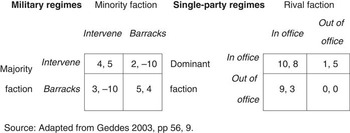
Military regimes have both majority and minority factions, which differ depending on whether they succeed if they unilaterally attempt a coup (the majority faction does, the minority faction does not) and by their preferences for a coup (the majority prefers not to launch a coup, the minority prefers to launch one). This is a co-ordination game: both factions prefer to either remain in the barracks together or launch a coup together, the minority because it will be unsuccessful if it attempts a coup alone, the majority because it is less likely to keep power post-coup without the minority's support.
The corporate identity of military officers explains their preference for co-operation. Officers value the military as an institution, and understand that both failed coups and divided military governments will harm it. Puzzlingly, Geddes then concludes that ‘because officers see their interests in terms similar to a battle-of-the-sexes [co-ordination] game, military regimes break down more readily than do other types of authoritarianism in response to internal splits’.Footnote 34 This prediction does not follow from the existence of a co-ordination game, for the mere existence of multiple equilibria has no bearing on the stability of any single equilibrium. It is also unclear what Geddes means by an ‘internal split’. If it is a change in the relative preference orderings of the factions, then a co-ordination game is no longer the appropriate heuristic through which to think about the factions’ preferences, so the mechanism linking splits to authoritarian breakdown has yet to be specified. If it means an event that increases the absolute (but not relative) differences in the preferences, then this would not upset the existing equilibrium. Either way, more theoretical work is required to produce the prediction that military regimes are more likely to break down after internal splits because they play a co-ordination game.
Single-party regimes (which are interchangeable with ‘dominant party’ regimes in this review) have ‘dominant’ and ‘rival’ factions. Geddes adopts a nonstandard representation of this factionalism game. Instead of strategies forming the dimensions of the factions’ choices, she uses the outcomes. This approach muddles the discussion of the strategies that factions use to stay in office with the outcomes they hope to achieve by staying in office. A better approach, adopted here, would be to label these strategies ‘co-operate’ and ‘defect’, distinguish these from the outcomes that follow from them (both stay in office, one stays in office or neither stays in office) and then link payoffs to these outcomes. This method helps clarify the subsequent discussion.
For Geddes, both factions in single-party regimes prefer to co-operate in order to reap the benefits they receive from holding office. The rival faction prefers to co-operate even if the dominant faction defects (throws it out of office) because the rival faction nevertheless derives programmatic benefits from the dominant faction's policies even if the rival faction is excluded from the perquisites of office. The dominant faction prefers to co-operate (keep the rival faction in office) rather than defect because when the rival is out of office it attempts to challenge the dominant faction. The best-response equilibrium in this game is therefore that both factions co-operate and remain in office.
This stylized representation of factionalism and regime survival under single-party rule – the causal mechanism underlying Geddes’ interpretation of Path B in Figure 1 – rests on several questionable features of the factionalism game. One is that the relevant domain of conflict between factions is over being in office versus not being in office. Most factional conflict in single-party authoritarian regimes is between various factions within the party seeking to become the dominant faction, or the dominant faction attempting to forestall its replacement by an insurgent rival within the party. That is, the relevant outcomes for the dominant and rival factions are not restricted to ‘in office’ or ‘out of office’ but rather are ‘in office as dominant/majority faction’, ‘in office as rival/minority faction’ and ‘out of office’.
If factions jockey for position within ruling parties, then the strategies they may pursue become very complex. The payoffs for various strategies are difficult to describe in generic terms. It is possible, for instance, that members of the dominant faction will force an insurgent rival faction out of office because the costs of fighting the minority from within the party are higher than the costs of fighting it as part of the opposition (net of the benefits of not having to share the spoils of office with the rival). Geddes assumes that rival factions never try to unseat the dominant faction, and that they only choose whether to be the minority or out of office entirely. However, if the rival faction has ambitions of becoming the dominant faction, then its strategic choices depend on both its payoffs from remaining a rival faction and its expected outcome as a member of the opposition. The Malaysian case provides two examples of these dynamics in the past thirty years. When Mahathir had UMNO declared illegal in 1988, it was to exclude a rival faction led by Tengku Razaleigh Hamzah from reaping the rewards of UMNO membership. Razaleigh and his followers then formed a new party, Semangat ‘46, which co-operated with two existing opposition parties. Just a decade later, during the Asian financial crisis of 1998, Mahathir ousted his deputy Anwar Ibrahim from UMNO; Anwar responded by forming a new opposition party, the People's Justice Party (PKR), which co-operated with the opposition during the 1999 general election.
These examples point to a second non-obvious feature of the single-party game: the set of players is restricted to those within the ruling party. Many single-party authoritarian regimes tolerate organized oppositions of some sort, and all authoritarian regimes have non-elites who can act strategically in response to the dominant party's behavior. In Malaysia, all internal factional struggles within UMNO play out vis-à-vis not just the factions within UMNO and the Barisan Nasional, but among various potential opposition parties as well. These have always included an Islamist opposition party (PAS) that can attract votes from UMNO's Malay base and a social democratic party (DAP) that campaigns on a platform of social and economic justice, which in principle could attract Malay votes too. Since 1999 it has also included Anwar's multiethnic reformist party (PKR), itself formed from a rival UMNO faction. While there is almost no co-operation or party switching between UMNO factions and the DAP, party switching between UMNO and PAS or PKR is more common.
To understand how these outside options affect Geddes’ claims about the benefits of remaining in office for rival factions that oppose the dominant faction – which underlie her claim that ‘the best outcome for everyone is for both the majority faction and the rival faction to hold office’Footnote 35 – focus on the payoffs in Figure 2. Geddes argues that the rival faction prefers to co-operate even when the dominant party defects, because if the rival faction defects it obtains neither the perquisites of office nor the programmatic benefits of having the ruling party make policy. This, however, is not the relevant comparison for the rival faction. Instead, the rival faction compares the benefits of co-operation if the dominant party defects to the programmatic benefits it might extract by co-operating with the various available opposition partners. Semangat ‘46 members allied with the DAP and PAS to win office and gain the programmatic benefits they lost when they went from being a rival UMNO faction to an opposition party. PKR did the same in 1999, and since the opposition's unexpected success in 2008 it has resumed this strategy. It is unlikely that from the perspective of rival factions, the expected utility of such opposition coalitions is universally lower than the expected utility of remaining a rival faction within the ruling party. That, however, must be true if co-operation is generically the rival faction's best response to defection by the dominant faction. Given what we know about the logic of intraparty conflict in actual single-party regimes, it is not true that the dominant strategy of all factions within single-party regimes is to co-operate with one another.
Factions in military and single-party regimes

A more general concern is the relationship between factions’ preferences (which defines variation across authoritarian regimes) and the types of regimes that Geddes studies. Do different kinds of authoritarian regimes emerge as a consequence of elites’ preferences, or do these regimes impose preference orderings on elites? If authoritarian institutions are the ‘causal primitives’, then it is straightforward to think about the exogenous causal effects of institutions on elite behavior, and hence on political outcomes. In military regimes, junta leaders perceive regime maintenance as a co-ordination game. Elites in party-based regimes think about their interests differently, which gives them a universal preference for co-operation over defection. This approach would not create problems for studies of the effect of authoritarian institutions on subsequent political outcomes if the research design can also account for any systematic factors that might have explained the origins of institutions.
But treating institutions as the causal primitives creates problems when Geddes operationalizes the three regime types – in particular her decision to code most of the world's regimes as ‘hybrid’ regimes (her designated ‘military/single-party regimes’ and ‘personalist/single-party regimes’ accounted for 30 per cent of surviving regimes in 2000; ‘triple hybrids’ account for another 40 per cent).Footnote 36 If single-party and military regimes produce different preference orderings that lead to different political equilibria, then it is theoretically incoherent to expect hybrid regimes to create two different preference orderings and associated equilibria simultaneously. Moreover, in at least one case, Geddes uses the outcomes that she wishes to predict to guide her coding decisions: in distinguishing between military and personal regimes, she codes a regime as ‘military’ when intraelite relations are collegial, and ‘personalist’ when they are not.Footnote 37 This approach might be defensible if the structure of intraelite relations were the causal primitive, but not if the nature of intraelite relations is the product of authoritarian institutions.
For these reasons, making institutions the causal primitives is problematic. However if preference orderings among factions are true causal primitives, then it is hard to imagine institutions having exogenous causal influences on political outcomes. Even if we observe a correlation between regime type and a particular dependent variable such as regime durability, the causal story associated with that correlation requires further elaboration. For example, if single-party authoritarian regimes tend to survive longer, as Geddes finds, this is because elites prefer co-operation to defection under all circumstances and have created or sustained a dominant party (Paths A and C in Figure 1). Approached in this way, Geddes’ institutional typologies are best understood as capturing the observable implications of different preference orderings.
In Geddes's account, military socialization gives junta leaders a set of preferences that shapes the regimes they create, making elite preferences the causal primitives. By contrast, it seems that single-party regimes imbue elites with a set of preference orderings, meaning that institutions are the casual primitives. The existence of hybrid regimes further confuses matters – are institutions or elite preferences the causal primitives when junta leaders like Nasser create mass parties? These conceptual challenges make it difficult to interpret Geddes’ theoretical claims or the statistical results they purport to explain.
Elite Consensus and the Origins of Dominant Parties
Like Geddes, Brownlee argues that authoritarian regimes’ institutional features determine their durability: regimes headed by mass parties tend to survive longer than regimes without them. Unlike Geddes, however, in Authoritarianism in an Age of Democratization, Brownlee specifies the conditions under which authoritarian regimes can form the sorts of dominant parties that lead to durable rule. The key is elite consensus. When elites solve the problems that can lead to factionalism and infighting at the moment of regime consolidation, they create ruling parties that facilitate durable authoritarian rule. Without elite consensus, no such parties emerge – elites may form parties, but they are hollow, weak and not particularly useful for consolidating or extending elites’ hold on power. This analytical move broadens the causal account to include the origins of dominant parties that explain authoritarian durability (Path A in Figure 1) and allows him to distinguish these parties from the fragile party-like organizations that dictators such as Ferdinand Marcos create.Footnote 38
While the theoretical claims in Authoritarianism in an Age of Democratization are similar to those made by Geddes, Brownlee frames his main target as the literature on limited elections and regime survival, in particular Huntington's claim that ‘liberalized authoritarianism is not a stable equilibrium; the half way house does not stand’.Footnote 39 Using Geddes’ dataset (augmented with additional coding of monarchical regimes, which Geddes excludes) and employing a different statistical model (Geddes estimates Weibull regressions, whereas Brownlee estimates binary logistic regressions using cubic time polynomials to account for duration dependence), Brownlee finds no relationship between holding limited elections and authoritarian regime survival. However, Geddes’ conclusions hold: party-based regimes survive longer than other authoritarian regime types, regardless of whether they hold elections.
Brownlee's central contribution is not his rejection of the argument that authoritarian elections lead to unstable politics; it is his broadening of Geddes’ theoretical account of ruling parties and regime survival. Brownlee presents case studies of foundational moments and regime trajectories under authoritarian rule in Egypt, Malaysia, the Philippines and Iran. He recognizes that authoritarian institutions are political creations, constructed by ruling elites when they ‘decisively resolve their core conflicts’Footnote 40 for the purpose of cementing their rule. But once created, ruling parties become constraints, binding elites and other members of the ruling coalition to the existing structure of power and authority and transcending petty factionalism and intraelite squabbles. At the same time, institutions only do this when they remain strong and independent; ruling parties create durable authoritarian rule ‘unless institutions weaken’Footnote 41 and elites destroy them, which happens because ‘elites behave opportunistically in response to the political context that surrounds them’. For Brownlee, ruling parties therefore have a curious feature: they are both endogenous and exogenous. They are endogenous at their moment of creation, but they subsequently become exogenous once they are institutionalized unless elites weaken them through manipulation, rendering them endogenous once again.
This tension (between institutions as constraints versus institutions as objects of political conflict) is common to all studies of political institutions and is at the heart of the Riker objection; it is precisely why the social conflict approach de-emphasizes ruling parties in favor of social and economic contestation. The basic claim of historical institutionalism is that endogenous institutions can become exogenous. But Brownlee cannot resort to a historical institutionalist defense without either substantially refining his theory or collecting different evidence than he has presented, because his account holds that ruling parties help manage elite conflicts, but also that the resolution of elite conflicts causes ruling parties to emerge. Moreover, ruling parties enhance regime durability because they prevent elites from defecting, but elites who have resolved intraelite conflicts and eliminated any credible opposition are certainly less likely to face the sort of elite defection that Brownlee believes undermines durable authoritarian rule. In a statistical sense, in this system of causal relations (outlined in Figure 3, a modified version of Figure 1), the pathway from ruling parties to durable regimes is unidentified.
Factional conflict, ruling parties and regime durability

One strategy for overcoming this indeterminacy is to find exogenous variation in institutions across a broad sample of regimes that does not arise from elite consensus, and to use this to investigate the effects of institutions on regime survival. But Brownlee offers no account of the existence of ‘durable’ ruling parties aside from the resolution of elite conflict. As a theoretical matter, it is entirely possible that the resolution of elite conflicts explains all cases of ruling parties that can bind elites to ruling coalitions (although Gandhi would disagree; see below). And Brownlee's evidence does nothing to refute this hypothesis in his four cases.
However these case studies cannot then demonstrate Brownlee's more ambitious point: that the causal sequence runs strictly from the resolution of elite conflicts to ruling parties to durable regimes, rather than from the resolution of elite conflicts directly to regime durability (or from something else to regime durability). Rather, the case studies are narrative accounts of the covariation between the foundational moments that lead elites to resolve their conflicts (or not), the creation of ruling parties that bind the former and the fragility of regimes without strong ruling parties.Footnote 42 The problem is that covariation between independent and dependent variables among the four regimes is compatible with several different arguments.
First consider several alternative explanations for regime durability. One is that authoritarian regimes in Muslim-majority countries survive longer than those in non-Muslim countries, a simple theoryFootnote 43 that alone would actually explain more variation across the four cases than Brownlee's account because it explains the survival of the Islamic Republic of Iran. Another alternative explanation is that when elites latch themselves to powerful international patrons and plunder the economy (Egypt and the Philippines), they can only retain power as long as that international patron is willing to support them (Egypt prior to 2011, Philippines prior to 1986), while regimes that eschew such patrons (Malaysia and Iran) survive regardless of the international pressures they face. Cases should be selected to help rule out such alternative explanations, or to highlight what alternative explanations cannot be ruled out, meaning that they must be addressed using within-case methods. Brownlee's historical case studies give proper names to ruling parties (NDP and UMNO) and the elites whom they bind (Mubarak and Mahathir). Although they provide historical detail, these case studies give us little analytical leverage over the causal role of political institutions beyond what we find in the statistical analysis.
Even ignoring these alternative explanations, however, the case studies must illustrate that causal pathways run from elite conflict to ruling parties, and from there to regime durability, rather than along a set of different causal pathways. To reiterate, it is theoretically possible that institutions increase regime durability by shaping the behavior of the rulers who created and sustain them. As Brownlee notes, this is the historical institutionalist's notion of path dependence.Footnote 44 The challenge is to distinguish this argument from alternative theories that make observationally equivalent claims about the correlation between ruling parties and regime survival given elite consensus, such as the critical institutionalist perspective that elite consensus causes regime survival, and that ruling parties are merely epiphenomenal on elite consensus (Paths A and C in Figure 1). One way to approach this problem would be to specify the observable implications of the path dependence argument to see if they explain features of authoritarian politics that the other approaches cannot.
In the case of Malaysia, Brownlee treats the resolution of factional disputes (Mahathir-Razaleigh and Mahathir-Anwar) as evidence that supports his account. But these are two cases of a phenomenon that is at odds with his argument that ‘ruling parties generate and maintain a cohesive leadership cadre’.Footnote 45 The Malaysia case represents precisely the opposite: both Razaleigh and Anwar proved to be anything but pliable elites with ‘a sense…that their immediate and long-term interests are best served by remaining within the party organization’ in a system in which ‘individual pursuits can be the root of continued allegiance’.Footnote 46 Here is Brownlee's description of the consequences of elite factionalism in cases unlike Malaysia:
If rulers dismantle the party to insulate their closest confederates, fears of exclusion proliferate. Distance breeds distrust. No mechanisms exist to mediate interfactional conflict, and debates escalate into battles for political life or death. The lack of a party to regulate elite interaction heightens the allure of working from the outside. Previous defenders of the system campaign for reform rather than waste away in a hierarchy that offers no opportunity for success. Defectors expose internal conflicts to public view and may participate in a counteralliance of long-time activists and recently estranged regimists. As intraelite rivalry feeds into interfactional competition, the regime becomes susceptible to previously suppressed opponents.Footnote 47
It is hard to imagine a more vivid description of Razaleigh's or Anwar's battles with Mahathir, but these are conditions in which regimes are vulnerable to collapse, according to Brownlee, not ones in which the ruling party has become a fortress. The evidence from Malaysia's recent political history is simply inconsistent with Brownlee's theory of ruling parties and regime durability. Instead, a very different causal story appears to be at play, in which a strong leader maintains elite coalitions that are sufficient to ward off challengers. Ruling party institutionalization is interesting, but not because ruling parties increase regime durability.
The general challenge with Brownlee's theoretical claims is that they are difficult to distinguish empirically from their competitors. Qualitative evidence must have a close dialogue between the theory's predictions and the case histories. If ruling parties manage and contain factionalism, then (at the very least) the factionalism that we observe within such parties must be different in some observable way from the factionalism in regimes without coherent ruling parties. This sort of evidence would support Brownlee's theoretical claims, but it would require sustained attention to what factionalism should look like in the two different institutional settings. It is problematic that Malaysia's experience is precisely the opposite of what Brownlee predicts it should be. Still, even if factionalism were observably different in Malaysia (and Egypt) than in the Philippines and Iran, we would also require evidence that this variation in factionalism is the result of having a ruling party. Given that ethnic relations, colonial legacies, economic trajectories and other facets of Malaysian politics differ from that of the Philippines and Iran, such an argument would require a very careful theoretical and empirical treatment to establish that in the Malaysian case, the existence of UMNO (rather than something else) explains the nature of Malaysian factionalism.
The key strengths of Authoritarianism in an Age of Democratization are its ambitious theoretical argument and its familiarity with country cases. Yet these point to basic problems in the qualitative research design that undermine both the internal and external validity of the causal story that Brownlee advances. Choosing cases that ensure covariation between independent and dependent variables is only the first step. And for reasons that are internal to Brownlee's own argument, there are reasons to suspect that Brownlee's qualitative evidence has actually demonstrated the irrelevance of ruling parties rather than their causal effects.
Selecting Institutions
Institutional selection is at the heart of Jennifer Gandhi's Political Institutions under Dictatorship. Like Brownlee, Gandhi insists that an account of the political consequences of authoritarian institutions must begin with an account of their origins, and she provides both a theory of authoritarian institutions and a theory of how they subsequently affect regime survival and other political outcomes. But unlike Brownlee and Geddes, Gandhi approaches ruling parties as arenas through which to solicit broader co-operation from members of society, so the causal mechanisms linking institutions to outcomes (Path B in Figure 1) in her account differ starkly. Managing elite conflict is important, but societal co-operation is critical because potential elite defectors look for support among the opposition.Footnote 48 The task for dictators is to manage this potential opposition from society in order to forestall elite defections and popular revolutions. The tools at their disposal are repression and co-optation (‘division’ is not considered), and Gandhi argues that the latter is facilitated through broadly inclusive political institutions.
Gandhi begins with a model in which a dictator and his citizens have differing ideal points along a unidimensional policy space. Oppositions can challenge the dictator by announcing a policy that is consistent with the preferences of the median citizen. Dictators can make policy concessions to the citizenry to induce co-operation, but not all dictators have to, because dictators and citizens care about rents in addition to policies. Dictators in ‘enclave’ economies have easy access to rents, but in other economies dictators need to co-operate with at least part of the citizenry to produce rents. Policy concessions increase co-operation. So dictators without access to easily obtainable rents make limited policy concessions to obtain the co-operation needed to generate them.
The dictator worries that the opposition will mount a challenge to the regime. The likelihood of a challenge depends on two exogenous parameters: the probability that the opposition will succeed if it launches a rebellion, and the punishment the dictator will impose if the rebellion fails. When the threat from the opposition is low and the dictator's punishment is high, policy concessions are an increasing function of the need for co-operation. When the threat from the opposition is higher, the dictator offers still more policy concessions, as well as a share of rents. When the threat from the opposition is high but the dictator's punishment for attempting a rebellion is light the dictator offers concessions but the opposition rebels anyway.
The key assumption for Gandhi is not in her theoretical model; it is that concessions require an institutional framework.Footnote 49 This assumption allows her to relate the comparative statics of her model to predictions about variation in political institutions across dictatorships: under conditions in which the theoretical model predicts policy concessions (‘when the dictator needs more co-operation, when polarization between the dictator and the opposition is lower, when the opposition is more likely to succeed in overturning the dictator and when the loss the opposition would suffer were it to fail is small’Footnote 50 ) dictators will institutionalize their rule.
In contrast to both Geddes and Brownlee, Gandhi argues that the most consequential way to think about variation in authoritarian institutions is not by capturing their ‘type’ (a nominal variable comprised of single-party, military, personalist and various hybrids) but rather by observing the existence of one or more legislative parties (an ordinal variable that is orthogonal to type). This subtle distinction shifts Gandhi's analysis from Geddes’ typological approach to a variable-centered approach.Footnote 51 Neither conception of how regimes vary is obviously superior, but they are consequential for studying the effects of institutions. For Gandhi, a military regime that wants to offer concessions can do so by allowing legislative parties. For Geddes and those employing her data, the existence of one or more legislative parties requires expert judgment as to whether this is sufficient to code the regime as a single-party regime.
Gandhi's predictions about the circumstances under which authoritarian institutions emerge (Path A in Figure 1) are very different than Brownlee's. Brownlee argues that dominant parties emerge when elites resolve their factional differences; Gandhi holds that institutions result from negotiations between a dictator and an opposition and in response to credible threats of revolt. Nonetheless, ‘what institutions do’ is very similar in both accounts (the mechanisms underlying Path B in Figure 1). For Gandhi, legislatures allow ‘controlled bargaining’Footnote 52 among elites, although they also have the benefits of being closed to public scrutiny and providing an arena in which various claimants can strike deals.Footnote 53
Are legislative parties the best tool to perform these functions?Footnote 54 In Malaysia, ruling elites regularly bypass formal institutions when faced with an exogenous increase in their need to ensure co-operation. Facing a challenge to its power in 1969, the regime shuttered parliament and created a National Operations Council (NOC) that brought in members of the state's security forces as well as various political and economic elites. We know little about the internal functioning of the NOC, but its purpose was precisely that ascribed to legislative parties (closed door negotiations, controlled bargaining, information gathering, etc.). In late 1997, facing a growing economic crisis and foreseeing the need to solicit broad societal participation during a period of difficult adjustment, Mahathir singlehandedly created the National Economic Action Council (NEAC), an extraconstitutional body tasked with taking all necessary steps to ensure economic recovery and social stability. All accounts of the NEAC's operations confirm that it also performed the various functions that Gandhi and others imply are best accomplished by legislative parties. We also know that far from being simply a technocratic or administrative body, the NEAC was a political creation meant to sideline Anwar Ibrahim from policy making.
These observations notwithstanding, Gandhi's account, uniquely among the works reviewed here, provides a falsifiable account of the origins of authoritarian institutions that can be tested using observables.Footnote 55 But while the main theoretical work in Gandhi's account explains the origins of institutions, most of the empirical work links institutions to policies, economic growth and regime survival. Having a model of the origins of institutions does not absolve her from dealing with the potential epiphenomenality of institutions when linking institutions to outcomes, and Gandhi is aware of this, but close inspection of her research design reveals that these methods probably have not done so.
Gandhi's methods are, at base, frameworks for studying Path B in Figure 1 while accepting that Paths A and C are plausibly also at work. The workhorse statistical model in her account is a Heckman-style two-stage selection model. The easiest way to illustrate the method is through her study of authoritarian institutions and economic growth. The first-stage model predicts authoritarian institutions (INSTITUTIONS) using a set of explanatory variables (Z) drawn from her theory:
 $$INSTITUTIONS\, = \,\delta ^{\prime}{\bf {{{\bf Z}}}}\, + \,u$$
This produces for each observation an estimate of the degree of non-random selection as proxied through the inverse Mills ratio (λ):
 $$\lambda \, = \,\frac{{\phi (\delta ^{\prime}{\bf {{{\bf Z}}}})}}{{\rPhi (\delta ^{\prime}{\bf {{{\bf Z}}}})}}.$$
The second stage uses this estimate of non-random selection as an independent variable in a regression of economic growth on a standard set of its determinants (X), which is estimated across each of j subsamples defined by the j different values of INSTITUTIONS:
 $$GROWT{{H}_j}\, = \,\beta ^{\prime}{{{\bf {{X}}}}_j}\, + \,{{\theta }_j}^{\prime}{{\lambda }_j}\, + \,{{{\epsilon}}_j}.$$
Using a series of assumptions to which I return below, this produces unbiased estimates of βj
and θj
. One can then calculate predicted growth rates
 $$$({{\widehat{{GROWTH}}}_j})$$$
for all observations in the sample. The average across all observations of
 $$${{\widehat{{GROWTH}}}_{j\, = \,{\rm{0}}}}$$$
, then, is an estimate of predicted economic growth if all countries had institutions j = 0. Comparing this average to the estimates obtained by predicting growth under j = 1 and j = 2 estimates the effects of institutions on economic growth.
The first substantive assumption of any Heckman-style selection model is that at least one variable in the selection equation has no unmodeled relationship with the outcome in the main equation.Footnote 56 That is, at least one element in Z is conditionally independent of εj .Footnote 57 If this exclusion restriction fails, then estimates of β and θ are biased to an unknown degree and in an unknown direction. Gandhi does not discuss this assumption; instead, the elements Z in the selection equation are drawn from earlier chapters on the origins of institutions, and the elements X are motivated separately. By assumption, the elements of Z and X do not overlap, with the exception of Military Dictator, and the model is identified based on the exclusion of the other elements of Z from the growth equation.
Gandhi's findings therefore depend critically on whether or not the same variables that determine institutions also affect economic growth. We therefore return to the problem identified in Figure 1: the joint determination of institutions and outcomes, distinguishing Path B from the combination of Paths A and C. As I have emphasized, it is not enough to account for the origins of institutions; one must still have a research design that can distinguish the origins of institutions from the origins of economic growth, either statistically or conceptually. And there are reasons to be skeptical that each of the variables that she believes affects institutions – the excluded elements of Z that do not appear in the growth equation – can be treated as exogenous to economic growth. Among her proxies for the need for co-operation, Lee argues that Civilian Dictators experience higher economic growth.Footnote 58 Gandhi herself believes that Military Dictators are plausible determinants of economic growth, and she therefore correctly includes them in the growth equation.Footnote 59 Sachs and Warner argue that Resources directly affect economic growth.Footnote 60 There is abundant evidence linking policy polarization to economic growth through both Ethnic Polarization Footnote 61 and Income Inequality.Footnote 62 The proxies for opposition strength are more plausibly excludable, in particular the measure of global democracy (Other Democracies) and the number of political parties in the previous regime (Inherited Parties). But Leadership Changes and Purges are both likely measures of political instability, which Alesina et al. believe directly affects economic growth.Footnote 63 Even Other Democracies and Inherited Parties may shape economic growth if they are actually proxies for something like global economic opennessFootnote 64 and institutional legacies of the investment environment.
Gandhi's first identifying assumption is that at least one of these variables does not belong in the growth equation. But even if there is an excludable element in Z, if one of the other excluded elements in Z is erroneously excluded from X, the resulting ‘exclusion bias’ renders the estimates of the effects of institutions on economic growth inconsistent even if the exclusion restriction is met for a different element in Z.Footnote 65 An intuitive example illustrates the substantive problems that arise if this assumption is violated. If countries with abundant natural resources are less likely to have institutionalized authoritarian regimes (as per Gandhi's argument), and if such countries suffer from worse economic performance (as argued by Sachs and Warner), then omitting Resources from the growth equation will overestimate the effect of institutions on economic growth even if there is an excludable instrument among the other elements of Z. The selection-corrected model of economic growth will produce misleading inferences about institutions unless all joint determinants of institutions and growth appear in both equations.
In the case of regime survival, Gandhi acknowledges that if institutions matter in the ways that her arguments claim, there should be no correlation between institutions and regime survival. Regimes that are vulnerable should create institutions, and those that are not vulnerable will not. For Brownlee, a coherent ruling party always increases regime durability; for Gandhi, only vulnerable regimes create ruling parties. The existence of an institution fully captures the need for regime-bolstering co-operation that having that institution can remedy, so authoritarian regimes with and without institutions should be equally likely to break down.
This is a weak test of Gandhi's argument. A stronger test would start with the recognition that her theory of institutions is itself a theory of regime survival. If her argument is correct, then without conditioning on institutions, her proxies for the abstract variables that explain institutions should be correlated with regime survival. Then, adding her measure of institutions – the intervening variable in her causal account – should yield a significant coefficient on that variable while decreasing the explanatory power of the other variables in the model. This approach would comprise much stronger evidence that institutions matter in the way that her argument specifies. Altogether, Gandhi's results demonstrate that even careful attempts to account for the origins of institutions require important substantive assumptions about whether the factors that shape institutions also affect the outcomes they might explain.
A Future for Authoritarian Institutions
The central problem for institutional analysis is how to reconcile the fact that institutions are political creations with the observation that they correlate very well with outcomes that matter to political scientists. Authoritarian regimes are secretive, and they are loathe to explain their inner workings to political scientists. For students of comparative authoritarianism, institutions are attractive because they are relatively easy to identify, making sophisticated cross-national studies feasible. When scholars have theories about how institutions shape authoritarian rule that make predictions about observable outcomes – how long regimes last, how fast their economies grow, if they go to war and so forth – they should test whatever propositions can be tested.
However, this article has argued that the new institutionalist literature on comparative authoritarianism has failed to address basic theoretical and empirical challenges that emerge when scholars wish to make causal claims about the effects of authoritarian institutions on political outcomes. The two critical institutionalisms outlined above remind us that because institutions are political creations, analysts must distinguish between institutions as causes and institutions as epiphenomena. These perspectives are simply absent from the books reviewed here.Footnote 66 The problem is that critical institutionalisms raise basic theoretical questions that have consequences for conceptualization (as in Geddes) and empirical testing (either through comparative case studies, as in Brownlee, or in cross-national statistical studies, as in Gandhi). And even though recent work by Acemoglu et al. and Svolik provides a theoretical toolkit for endogenizing many of the features of authoritarian institutions to struggles among factions and elites,Footnote 67 the empirical challenge remains: assessing the downstream effects of institutions.
The future for empirical studies of authoritarian institutions is to devote more attention to these challenges. Students of authoritarianism more broadly will profit from systematically examining the non-institutional features of authoritarian rule. All of this will require detailed knowledge of individual regimes and careful attention to the logic of inference.
Sophisticated studies of politics within authoritarian institutions are still rare, although there are a number of good studies that more plausibly link institutions to regime survival in important cases.Footnote 68 Malesky and Schuler provide one excellent example of how a very careful study of one country's authoritarian political system can illustrate some of the foundations of broader theoretical claims.Footnote 69 Their effort relies on impressive data collection and a deep understanding of the inner workings of Vietnam's national legislature. It is, of course, difficult to generalize any conclusions beyond this single case, but internal validity should be privileged over external validity when it is difficult to defend the assumptions about measurement validity and data generating processes that are necessary for making externally valid inferences.
In order to test claims about the effects of authoritarian institutions, moreover, scholars must pay closer attention to research design. This requires sensitivity to how institutions form and change, the consequences of these changes for subsequent political outcomes (including the unexpected and unanticipated effects of authoritarian institutionsFootnote 70 ) and competing mechanisms that could also produce these outcomes. It also requires empirical strategies that produce defensible causal claims, even if they are limited in their generality. These are research designs that select cases in order to ensure covariation between institutions and outcomes, but that can also rule out joint determination, selection and endogeneity when capturing the origins of institutions and the outcomes they purport to explain. ‘Increasing the n’ can only establish external validity if confounding variables are measurable and the design is sound.
Malesky et al. provide one example of how careful paired comparisons can show how the nature of decision-making institutions within one-party communist regimes explains different levels of income inequality in China and Vietnam.Footnote 71 Case selection allows them to rule out alternative explanations for income inequality, and the plausibly exogenous pattern of the deaths of Vietnamese elites explains why the structure of decision making in Vietnam differs from that in China. At this stage in our knowledge of authoritarian institutions, a study that shows rigorously that a ruling party affects political outcomes in one country and its absence explains different outcomes in another – and can ensure that institutions (rather than their causes or some other factor) are doing the explanatory work – is preferable to a study that can elicit a conditional correlation between ruling parties and some outcome across all dictatorships.
Quantitative cross-national research should not be abandoned, of course, but cross-national tests need defensible research designs that directly confront the theoretical challenges presented by the two critical institutionalisms. This means more attention to both theory and statistical identification. The global pattern of democracy is a good candidate for being an instrument of authoritarian institutions in Gandhi's empirical model of economic growth, but this assumption must be defended explicitly (and exclusion bias must be eliminated). Where statistical identification is not possible, institutional scholars must entertain alternative explanations for the cross-national patterns they uncover. Scholars will also profit from producing cross-national datasets on elite interests, factional behavior, and social or class coalitions that support authoritarian regimes, each of which provides an alternative (but perhaps complementary) window into the dynamics of authoritarian politics.Footnote 72
Finally, the institutional turn in comparative authoritarianism risks privileging research on ‘surface’ politics at the expense of ‘deep’ politics. Scholars may miss the true politics of authoritarianism if they focus on readily observable institutional structures. This has two consequences. The first is superficiality: scholars will find that institutions correlate with important political outcomes, but will mistakenly believe that institutions (rather than the factors that shape them) are doing the explanatory work. One need not adopt the language of critical institutionalism to challenge the causal role of institutions. Both Slater and Smith provide historical perspectives on the origins of authoritarian regimes in which fundamental variables – such as fiscal constraints, elite contestation and social conflict – supersede the causal importance of political institutions for explaining contemporary political trajectories.Footnote 73
The second consequence is narrowness. Few theories can link authoritarian institutions to anything beyond regime survival and general public policies. But authoritarian regimes do many things besides grow/stagnate and survive/collapse. They decide to murder their subjects or not; to favor certain ethnic groups or not; to integrate with the global economy in various ways; to mobilize, ignore or ‘reeducate’ their citizens; to respond to domestic challenges with repression, concessions or both; to insulate their bureaucracies from executive interference or not; to delegate various ruling functions to security forces, mercenaries or criminal syndicates, or subnational political units; and to structure economies in various ways that might support their rule. Authoritarian institutions will tell us little about these outcomes, and if we are to explain variation in these factors across regimes and over time, close attention to other variables will be necessary.