1 Introduction
Flow-induced motion (FIM) of rigid and flexible bodies is a fundamentally complex phenomenon that has received considerable attention due to its ubiquitous applications. Flow-induced oscillation (FIO) and flow-induced pitching (FIP) are two particular cases within the FIM set, where vortices shed from the structure may play a major role on modulating the motions. A canonic case of FIO is the unsteady lift induced by the von Kármán vortices on two-dimensional (2D) cylinders (Sarpkaya Reference Sarpkaya2004; Williamson & Govardhan Reference Williamson and Govardhan2004; Wu, Ge & Hong Reference Wu, Ge and Hong2012). Those structures with rectangular cross-section exhibit more complex patterns across angles of attack. Sen & Mittal (Reference Sen and Mittal2011) and Zhao (Reference Zhao2015) numerically investigated the oscillation of 2D rectangular cylinders under low Reynolds numbers
 $(Re\sim 200)$
, and showed that the thickness ratio significantly influences the vortex shedding. Recent experimental studies conducted by Nemes et al. (Reference Nemes, Zhao, Jacono and Sheridan2012) and Zhao et al. (Reference Zhao, Leontini, Jacono and Sheridan2014) showed the sensitivity of angle of attack on the FIO of a square cylinder.
The FIP motions are triggered by the net torque from the unbalanced surface pressure distribution. This phenomenon is common in flat plates, airfoils and rectangular prisms. Early studies by Theodorsen (Reference Theodorsen1935) and Von Kármán (Reference Von Kármán1938) described the small-amplitude pitching motions using potential flow theory. Recently, Baik et al. (Reference Baik, Bernal, Granlund and Ol2012) and Jantzen et al. (Reference Jantzen, Taira, Granlund and Ol2014) pointed out that the reduced frequency
 $k=\unicode[STIX]{x03C0}f_{p}c/U$
, with
 $c$
,
 $f_{p}$
and
 $U$
denoting the chord length of plate, pitching frequency and incoming flow velocity, is key to describing the pitching motion. A recent experimental study by Jin et al. (Reference Jin, Ji, Liu and Chamorro2016b
) with flat plates showed a linear relation between pitching frequency and wind speed for various thickness ratios.
Although substantial effort has been placed on characterizing FIM on 2D structures, that on three-dimensional (3D) bluff bodies has received comparatively much less attention. Complex motions with simultaneous FIO and FIP are common in these cases, where the Strouhal number
 $St$
exhibits variability due to the local aspect ratio facing the flow (Fail, Lawford & Eyre Reference Fail, Lawford and Eyre1957). Of particular interest in engineering is the case involving slung loads; those structures usually exhibit highly coupled pitching and pendulum-like oscillations. Raz et al. (Reference Raz, Rosen, Carmeli, Lusardi, Cicolani and Robinson2008) conducted wind tunnel and flight tests with a rectangular slugged container and analysed the stability of the dynamics with passive vertical fins. Greenwell (Reference Greenwell2014) measured the rotation of low-aspect-ratio rectangular prisms and reported ‘lock in’ and hysteresis phenomena. Raz et al. (Reference Raz, Rosen, Cicolani and Lusardi2014) investigated the dynamics of slug cargoes from an helicopter and focused on the influence of helicopter motion and centre of gravity offset. Cicolani et al. (Reference Cicolani, Ivler, Ott, Raz and Rosen2015) used slow pitching motion as a mechanism to suppress the pendulum-like oscillation of slung loads. Using a numerical approach, Prosser & Smith (Reference Prosser and Smith2016) explored the 3D aerodynamics of prismatic bodies and circular cylinders, and pointed out that shear layer reattachment dominates the mean forces and moments of the bluff bodies. Prosser & Smith (Reference Prosser and Smith2015) proposed a physical-based, reduced-order aerodynamics model for predicting the motions of bluff bodies.
In spite of these efforts, systematic characterization and quantitative description of FIM in rectangular slung loads under complex flows are relatively scarce. Understanding the fluid–structure feedback is key to allowing insights for robust dynamic control. Nakamura & Ohya (Reference Nakamura and Ohya1984), Tamura & Miyagi (Reference Tamura and Miyagi1999) and Irwin (Reference Irwin2008) pointed out that the turbulence intensity
 $I_{u}$
of the incoming flow has a dominant role in the vortex shedding and velocity fluctuations in the wake of bluff bodies. In this work, we aim to provide quantitative description of FIM in 3D rectangular slung loads under flows with very low and high free-stream turbulence. A systematic experimental investigation was conducted with various combinations of flows and body geometry to uncover the dynamics of the motion. The experimental set-up is described in § 2, the results and analysis are provided in § 3, and a discussion and summary are presented in § 4.
2 Experimental set-up
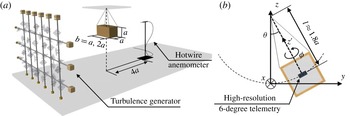
The oscillation and pitching of two rectangular slung prisms were characterized and quantified under various flows and turbulence levels. The prisms were placed in the free-stream region of the Talbot Laboratory wind tunnel of the University of Illinois at Urbana-Champaign. The Eiffel-type wind tunnel has a test section 0.914 m wide, 0.45 m high and 6.1 m long. See Adrian, Meinhart & Tomkins (Reference Adrian, Meinhart and Tomkins2000) for additional details of the facility.
A cubic prism and a rectangular box-like prism (empty inside) were made with acrylic blocks and balsa material as outer casing. The prisms were
 $b=$
75 mm and 150 mm long, and shared the same thickness and height
 $a=75~\text{mm}$
. These dimensions led to a negligible blockage ratio (
 ${\leqslant}3\,\%$
). Both prisms were suspended horizontally near the beginning of the test section by four thin
 $200~\unicode[STIX]{x03BC}\text{m}$
plastic lines with a single joint fixed at the ceiling such that the distance of the centre of mass to the pivotal point is
 $l\approx 1.8a\approx 137.5~\text{mm}$
(figure 1
a). The motion of the prisms was described in terms of an absolute coordinate system (
 $x,y,z$
) fixed at the wind tunnel, and a relative coordinate system (
 $x^{\prime },y^{\prime },z^{\prime }$
) with origin coincident with the centre of mass of the prisms (figure 1
b). The weights of the prisms were
 $m=201.3~\text{g}$
and 302.5 g, which resulted in moment of inertia
 $I$
about the
 $z^{\prime }$
axis of
 $1.73\times 10^{-4}~\text{kg}~\text{m}^{-2}$
and
 $6.84\times 10^{-4}~\text{kg}~\text{m}^{-2}$
. The acrylic blocks were carefully distributed inside the outer casing of the prisms, preserving the centre of mass and geometry. Also, the mass ratio
 $m^{\ast }=m/(ba^{2}\unicode[STIX]{x1D70C}_{a})>200$
(Govardhan & Williamson Reference Govardhan and Williamson2000), where
 $\unicode[STIX]{x1D70C}_{a}$
is the air density, and the non-dimensional moment of inertia
 $I^{\ast }=32I/(\unicode[STIX]{x03C0}\unicode[STIX]{x1D70C}_{a}b^{4}a)>100$
(Smith Reference Smith1971) for the two prisms. This indicates that the dynamics of the prisms is essentially independent of the inertia. The dynamics of the prisms was characterized at various flow velocities ranging from
 $U=1.6~\text{m}~\text{s}^{-1}$
to
 $6.6~\text{m}~\text{s}^{-1}$
or Reynolds numbers
 $Re=Ub/\unicode[STIX]{x1D708}\in (0.8,6.6)\times 10^{4}$
, where
 $\unicode[STIX]{x1D708}$
is the kinematic viscosity of the air. For each flow velocity, the turbulence level
 $I_{u}=\unicode[STIX]{x1D70E}_{u}/U$
was set to very low (
 $I_{u}\approx 0.05\,\%$
) and high intensity (
 $I_{u}=9.3\,\%$
). Here
 $\unicode[STIX]{x1D70E}_{u}$
denotes the standard deviation of the streamwise velocity fluctuations. An active turbulence generator (TG) was used to induce the high
 $I_{u}$
, whereas the very low
 $I_{u}$
was obtained without the TG. Specific details of the geometry and setting of the TG are provided in Jin et al. (Reference Jin, Liu, Aggarwal, Singh and Chamorro2016c
).
(a) Schematic of the experimental set-up; (b) front view with the coordinate systems.

The instantaneous motion of the prisms was tracked with a small, low-weight wireless accelerometer embedded at the centre of mass of the prisms at a sampling frequency
 $f=256~\text{Hz}$
for periods longer than 360 s, where the last 120 s were used to avoid initial transient disturbances. Although minor, the effect of the mass and moment of inertia of the accelerometer was accounted for in the prism assembly. This telemetry system was equipped with a combination of 3-axis gyroscope and 3-axis accelerometer of 16 bits and 12 bits, which directly recorded instantaneous angular velocities and linear accelerations with uncertainties of
 $0.07^{\circ }~\text{s}^{-1}$
and
 $0.02~\text{m}~\text{s}^{-2}$
. Complementary measurements of the flow in the wake of the prisms were obtained with a hotwire anemometer located
 $4a$
downwind of the centre of the slung prisms set with no flow (figure 1
a). The probe is made of
 $5~\unicode[STIX]{x03BC}\text{m}$
tungsten wire and operated at a sampling frequency
 $f=20~\text{kHz}$
for a period of 120 s, where the calibration was conducted against a pitot tube. Through the calibration and experiment, the temperature was kept within
 $\pm 0.5\,^{\circ }\text{C}$
to avoid errors due to thermal drift of the voltage signal. Before each measurement, the static position of the prisms was set with the square and rectangular sides facing the flow, with no detectable motion indicated by the telemetry.
3 Results
In this section we summarize and discuss the dynamics of the slung rectangular prisms as a function of the Reynolds number, turbulence levels and aspect ratio. Insight from the velocity fluctuations in the prism wake is also included to aid the analysis.
3.1 Dynamics of the cubic prism
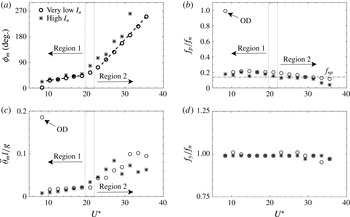
In general, the motion of the prism is dominated by two distinctive patterns, namely pitching about the
 $z^{\prime }$
axis and pendulum-like oscillation in the
 $y{-}z$
plane across the
 $Re$
and
 $I_{u}$
indicated in § 2. The amplitude of the pitching
 $\unicode[STIX]{x1D719}_{m}$
as a function of the non-dimensional incoming flow velocity
 $U^{\ast }=U/(lf_{n})$
is shown in figure 2(a) for the very low and high
 $I_{u}$
flows. Here,
 $f_{n}=(1/2\unicode[STIX]{x03C0})\sqrt{g/l}$
is the natural frequency of the pendulum-like oscillation under small amplitude, and
 $g$
is the acceleration due to gravity. The values of
 $\unicode[STIX]{x1D719}_{m}$
exhibit a monotonic increase with
 $U^{\ast }$
and a very regular trend under very low turbulence. Two distinctive regions can be defined in terms of the amplitude growth rate
 $\unicode[STIX]{x2202}\unicode[STIX]{x1D719}_{m}/\unicode[STIX]{x2202}U^{\ast }=k$
, with
 $k$
a characteristic constant. In region 1 (
 $U^{\ast }\lesssim 19{-}20$
),
 $k\approx 2$
; whereas in region 2 (
 $U^{\ast }\geqslant 22{-}23$
), the growth rate of the pitching is much larger and still linear with
 $k=15$
for the very low turbulence flow. Although exhibiting fluctuations, this is roughly the case for high
 $I_{u}$
. Zaki & Gad-El-Hak (Reference Zaki and Gad-El-Hak1994) experimentally investigated the flow passing a free-to-rotate square cylinder under various
 $Re$
, and defined a critical pitching amplitude
 $\unicode[STIX]{x1D719}_{cr}=45^{\circ }$
that characterizes the transition between small and large rotations. Here, a similar
 $\unicode[STIX]{x1D719}_{cr}$
is obtained at the end of region 1. The corresponding dominant pitching frequencies
 $f_{p}$
normalized by
 $f_{n}$
are shown in figure 2(b). Approximately constant
 $f_{p}/f_{n}\approx 0.2$
characterizes region 1, whereas a very mild decrease occurs in region 2. It is noted that this frequency range is close to the natural pitching frequency generated from the suspension lines (
 $f_{np}$
) measured under small pitching amplitude. Within region 1, the flow provides additional torque that contributes to move the prism back to the equilibrium position and leads to
 $f_{p}>f_{np}$
. Due to the symmetry of the prism, however, the wind force can decrease the overall restoring torque for
 $\unicode[STIX]{x1D719}_{m}>45^{\circ }$
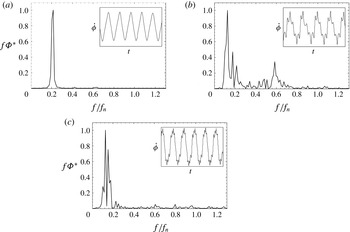
in region 2. Inspection of the spectral content of the pitching velocity
 $\dot{\unicode[STIX]{x1D719}}$
 $(=\unicode[STIX]{x2202}\unicode[STIX]{x1D719}/\unicode[STIX]{x2202}t)$
reveals that high-order harmonics are generated in region 2 in the very low and high
 $I_{u}$
flows. This is shown in figure 3 with the compensated spectrum of
 $\dot{\unicode[STIX]{x1D719}}$
normalized by its maximum,
 $f\unicode[STIX]{x1D6F7}^{\ast }(=f\unicode[STIX]{x1D6F7}_{\dot{\unicode[STIX]{x1D719}}}/[f\unicode[STIX]{x1D6F7}_{\dot{\unicode[STIX]{x1D719}}}]_{max})$
, for selected cases. It reveals secondary motions, which are linked to the periodicity of the angle-dependent moment
 $M_{\unicode[STIX]{x1D719}}=A\sin 4\unicode[STIX]{x1D719}$
of the prism. Here,
 $A>0$
is a constant and
 $\unicode[STIX]{x1D719}$
is the angle of attack (Tatsuno et al.
Reference Tatsuno, Takayama, Amamoto and Ishi-i1990; Zaki & Gad-El-Hak Reference Zaki and Gad-El-Hak1994). Zaki & Gad-El-Hak (Reference Zaki and Gad-El-Hak1994) pointed out that sustained autorotation of a square cylinder occurs for
 $Re\geqslant 4.7\times 10^{3}$
. Here, large-amplitude rotation with
 $\unicode[STIX]{x1D719}_{m}\geqslant 360^{\circ }$
was observed for
 $U^{\ast }\geqslant 36$
(
 $Re\approx 3.2\times 10^{4}$
); the suspension lines provide an additional restoring moment that suppresses the onset of prism autorotation.
Dynamics of the cubic prism. (a) Pitching amplitude
 $\unicode[STIX]{x1D719}_{m}$
; (b) dominant pitching frequency
 $f_{p}/f_{n}$
; (c) amplitude of pendulum-like oscillation
 $\ddot{\unicode[STIX]{x1D703}}_{m}l/g$
; (d) dominant frequency of oscillation
 $f_{y}/f_{n}$
.

Compensated spectra of the angular velocity
 $f\unicode[STIX]{x1D6F7}^{\ast }=f\unicode[STIX]{x1D6F7}_{\dot{\unicode[STIX]{x1D719}}}/[\unicode[STIX]{x1D6F7}_{\dot{\unicode[STIX]{x1D719}}}]_{max}$
of the cubic prism under low turbulence. (a)
 $U^{\ast }=16.7$
; (b)
 $U^{\ast }=25$
; (c)
 $U^{\ast }=33.4$
. Inset shows sample time series of
 $\dot{\unicode[STIX]{x1D719}}$
.

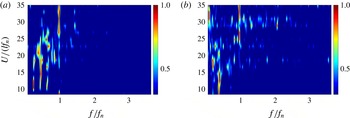
Velocity spectra
 $\unicode[STIX]{x1D6F7}_{u}$
in the wake of the cubic prism. (a) Very low and (b) high
 $I_{u}$
flow.

It is worth pointing that
 $f_{p}\rightarrow f_{n}$
under very low turbulence and low
 $U^{\ast }$
(
 ${\approx}8$
). In this particular condition, the dynamics of the prism is fully dominated by the pendulum-like oscillation (hereon OD). This interesting phenomenon is also inferred from the negligible pitching amplitude in figure 2(a) and, indirectly, from the amplitude of the angle acceleration of the oscillation
 $\ddot{\unicode[STIX]{x1D703}}_{m}$
in figure 2(c). Later, we will show that the OD involves synchronization between the vortex shedding and the body oscillations in the rectangular prism. Similar to the
 $\unicode[STIX]{x1D719}_{m}-U^{\ast }$
relationship,
 $\ddot{\unicode[STIX]{x1D703}}_{m}$
exhibits distinctive behaviour in regions 1 and 2, with faster growth with
 $U^{\ast }$
in the region 2. However, it appears to plateau at a
 $U^{\ast }$
level that depends on
 $I_{u}$
. The corresponding oscillation frequencies
 $f_{y}$
are illustrated in figure 2(d), which are locked in
 $f_{n}$
for all the cases. This suggests that the pendulum-like oscillation of the slung prism is not governed by a Strouhal vortex shedding relation.
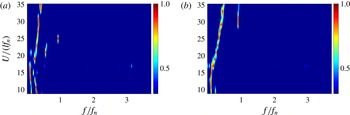
Complementary measurements in the wake of the prism indicate a strong linkage between the velocity fluctuations and prism motion. The corresponding 2D spectra for various
 $U^{\ast }$
are illustrated in figure 4. It shows that, regardless of the turbulence, the flow carries the effects of the pitching frequency and harmonics within region 1 (except the OD case), while the pendulum-like oscillation becomes more distinctive in region 2. As expected, the spectrum of the high
 $I_{u}$
case shows enhanced energy distributed across
 $f/f_{n}$
. This is an indirect footprint of the irregular
 $\unicode[STIX]{x1D719}_{m}(t)$
and
 $\ddot{\unicode[STIX]{x1D703}}_{m}(t)$
as shown in figure 2(a,c). The dominant frequencies in region 2 around
 $U^{\ast }\in [19{-}27]$
reflect secondary velocity fluctuations of the prism pitching. While higher-order harmonics are triggered with increasing
 $U^{\ast }$
(figure 3
c), their comparatively small amplitude results in a reduced footprint in the spectra of figure 4.
3.2 Dynamics of the rectangular prism
We now explore the pitching and pendulum-like oscillation of the rectangular prism under very low and high turbulence. Due to the higher aspect ratio, the dynamics of the prism is expected to be strongly coupled with the angle of attack. As such, the prism motions are characterized with the large face aligned and perpendicular to the flow.
3.2.1 Rectangular side facing the flow
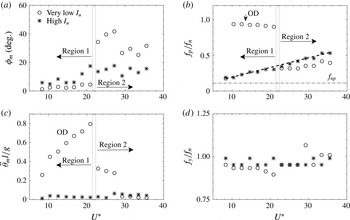
Similar to the other prism, figure 5(a) shows the distribution of
 $\unicode[STIX]{x1D719}_{m}$
under the same flow conditions. A sharp jump occurs in the vicinity of
 $U^{\ast }=22\pm 1$
under very low turbulence flow, which defines the limits of regions 1 and 2. Within region 1 and very low turbulence, the prism motion is characterized by low
 $\unicode[STIX]{x1D719}_{m}$
and high
 $\ddot{\unicode[STIX]{x1D703}}_{m}$
(figure 5
a,c). This suggests that the OD phenomenon governs the motion of the rectangular prism. In contrast, a sharp decline of
 $\ddot{\unicode[STIX]{x1D703}}_{m}$
and OD motion characterize region 2. The distribution of the oscillation amplitude is very similar to that defining the ‘upper’ to ‘lower’ branch transition in vortex induced vibrations (VIV) of slender cylinders (Khalak & Williamson Reference Khalak and Williamson1999; Flemming & Williamson Reference Flemming and Williamson2005). The vortex shedding frequencies
 $f_{s}$
, based on
 $b$
and the Strouhal number
 $St=0.161$
measured with the static prism, are
 $f_{s}/f_{n}\in [1.26,2.95]$
within the OD region. This is analogous to the synchronization region of both circular and square cylinders during VIV (Govardhan & Williamson Reference Govardhan and Williamson2000; Zhao et al.
Reference Zhao, Leontini, Jacono and Sheridan2014). Further, Zhao et al. (Reference Zhao, Leontini, Jacono and Sheridan2014) pointed that within the ‘upper’ branch in the case of a square cylinder, the frequency of the oscillation and force due to vortex shedding synchronizes, and only
 $f_{y}$
(and harmonics) stands out in the frequency domain; this phenomenon is observed in figures 5(d) and 7(a) in region 1. It is worth noting that the increase of
 $\ddot{\unicode[STIX]{x1D703}}_{m}$
in region 1 under very low turbulence results in a slight departure of
 $f_{y}$
from
 $f_{n}$
, which is due to the large-amplitude oscillations, where
 $f_{n}=(1/2\unicode[STIX]{x03C0})\sqrt{g/l}$
needs to be revisited. Also, the negligible pitching results in
 $f_{p}$
modulated by
 $f_{y}$
, as shown in the cubic prism. The suppression of the oscillation by pitching in region 2 is also reflected by the lower
 $f_{p}$
, and
 $f_{y}$
is comparatively closer to
 $f_{n}$
, where the small-angle assumption for oscillation holds.
Dynamics of the rectangular prism with the large side facing the flow. (a) Pitching amplitude
 $\unicode[STIX]{x1D719}_{m}$
; (b) dominant pitching frequency
 $f_{p}/f_{n}$
; (c) amplitude of pendulum-like oscillation
 $\ddot{\unicode[STIX]{x1D703}}_{m}l/g$
; (d) dominant frequency of oscillation
 $f_{y}/f_{n}$
.

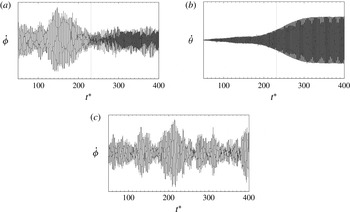
Investigation into the initiation of the OD phenomenon shows that the time necessary to reach steady oscillation under OD in the cubic and rectangular prisms is orders of magnitude larger than that defined by the integral time scale of the turbulence, or that defined by the mean flow and the scale of the set-up in the very low turbulence case. This is illustrated in figure 6(a,b) with sample time series
 $t^{\ast }=tf_{n}$
of the dynamics of the rectangular prism under
 $U^{\ast }=16.7$
and very low turbulence; a distinctive transition of the dynamics occurs at
 $t^{\ast }\approx 230$
(figure 6
a). Before this time, the prism exhibited large-amplitude and low-frequency pitching regardless of the turbulence levels (figure 6
c). A fast increase of the pendulum-like oscillation occurs after the transition, resulting in pitching weakening, with its frequency modulated by the high-amplitude oscillation (figures 6
a,b and 5
b). A similar transition occurring in the synchronization of FIV of a circular cylinder was recently reported by Mittal (Reference Mittal2016), suggesting that the initial condition and nonlinear effects play a significant role in determining the transition time.
Time series of the motion of the rectangular prism with the large side facing the flow at
 $U^{\ast }=16.7$
. (a)
 $\dot{\unicode[STIX]{x1D719}}(t)$
under low turbulence flow; (b)
 $\dot{\unicode[STIX]{x1D703}}(t)$
under very low
 $I_{u}$
; (c)
 $\dot{\unicode[STIX]{x1D719}}(t)$
under high
 $I_{u}$
.

Velocity spectra
 $\unicode[STIX]{x1D6F7}_{u}$
in the wake of the rectangular prism with the large side facing the flow. (a) Very low and (b) high
 $I_{u}$
flow.

In general, distinctive behaviour was observed under high
 $I_{u}$
. Similar to the cubic prism,
 $\unicode[STIX]{x1D719}_{m}$
exhibits an increase with
 $U^{\ast }$
, whereas no net growth occurs in region 2. The OD motion also becomes negligible under high
 $I_{u}$
. This motion is a result of desynchronization between the fluid force and oscillation. The velocity fluctuations containing a wide spectrum of turbulent scales in the high
 $I_{u}$
case might induce disturbances in the fluid–structure feedback and, consequently, suppress the synchronization based on the definition in Zhao et al. (Reference Zhao, Leontini, Jacono and Sheridan2014). It is worth pointing that
 $f_{p}$
increases nearly linearly with
 $U$
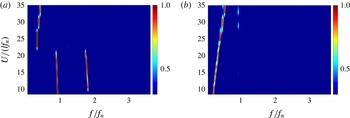
, as shown in figure 5(b), which is also highlighted in the spectra of wake fluctuations in figure 7(b). The growth rate of
 $f_{p}$
,
 $k=\unicode[STIX]{x0394}f_{p}b/\unicode[STIX]{x0394}U\approx 0.014$
is much smaller than the corresponding Strouhal number of rectangular cylinders (Knisely Reference Knisely1990). A similar linear increase of the pitching frequency was reported by Jin et al. (Reference Jin, Ji, Liu and Chamorro2016b
) for a flat plate, suggesting that the prism pitching can be approximated by a differential equation of the form:
 $$\begin{eqnarray}\displaystyle I\ddot{\unicode[STIX]{x1D719}}+\unicode[STIX]{x1D6FD}\dot{\unicode[STIX]{x1D719}}+K\unicode[STIX]{x1D719}+M_{w}=0, & & \displaystyle\end{eqnarray}$$
where
 $\unicode[STIX]{x1D6FD}$
accounts for the damping of the system,
 $K$
represents the restoring torque provided by the suspension lines and
 $M_{w}$
embodies all the torques generated from wind-induced forces, including angle-dependent moment
 $M_{\unicode[STIX]{x1D719}}$
and vortex-shedding-induced moment
 $M_{v}$
, among others. As a first-order estimation, we ignore the influence of damping and
 $M_{v}$
, then (3.1) is simplified as:
 $$\begin{eqnarray}\displaystyle I\ddot{\unicode[STIX]{x1D719}}+K\unicode[STIX]{x1D719}+M_{\unicode[STIX]{x1D719}}=0. & & \displaystyle\end{eqnarray}$$
Similar to the case of the 2D flat plate, both numerical (Prosser & Smith Reference Prosser and Smith2016) and experimental (Rosen, Cecutta & Yaffe Reference Rosen, Cecutta and Yaffe1999) investigations show that, with small
 $\unicode[STIX]{x1D719}$
, the moment coefficient
 $C_{m}=M_{\unicode[STIX]{x1D719}}/(\unicode[STIX]{x1D70C}_{a}U^{2}bS)/2\approx \unicode[STIX]{x1D6FE}\unicode[STIX]{x1D719}$
, where
 $S$
is the characteristic area and
 $\unicode[STIX]{x1D6FE}$
is a geometry-dependent constant. Therefore, the frequency of pitching can be expressed as:
 $$\begin{eqnarray}\displaystyle f_{p}=\frac{1}{2\unicode[STIX]{x03C0}}\sqrt{\left(\frac{1}{2}\unicode[STIX]{x1D70C}U^{2}bS\unicode[STIX]{x1D6FE}+K\right)/I}. & & \displaystyle\end{eqnarray}$$
This suggests that under very low
 $U$
, the pitching frequency converges to the natural frequency determined by the suspension lines (
 $f_{np}$
). When
 $U$
increases, the influence of the suspension lines gradually become minor, which leads to
 $f_{p}\approx 1/2\unicode[STIX]{x03C0}\sqrt{(1/2)\unicode[STIX]{x1D70C}U^{2}bS\unicode[STIX]{x1D6FE}/I}\propto U$
as observed in figure 5(b). It is worth pointing that for the very low turbulence flow within region 2, where the OD phenomenon ends, the increase of
 $f_{p}$
with
 $U^{\ast }$
is also close to a linear relationship, but at a lower rate. This highlights the influence of turbulence on the aerodynamics of 3D structures as it does for 2D bodies (e.g. Tamura & Miyagi Reference Tamura and Miyagi1999).
Dynamics of the rectangular prism with the square side facing the flow. (a) Pitching amplitude
 $\unicode[STIX]{x1D719}_{m}$
; (b) dominant pitching frequency
 $f_{p}/f_{n}$
; (c) amplitude of pendulum-like oscillation
 $\ddot{\unicode[STIX]{x1D703}}_{m}l/g$
; (d) dominant frequency of oscillation
 $f_{y}/f_{n}$
.

3.2.2 Square side facing the flow
Similar to § 3.2.1,
 $\unicode[STIX]{x1D719}_{m}$
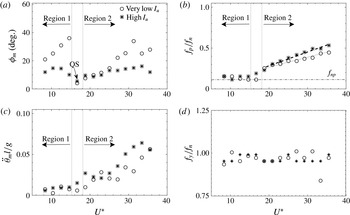
exhibits distinctive behaviour in the two regions defined by a sudden change, as shown in figure 8(a). Within region 1,
 $\unicode[STIX]{x1D719}_{m}$
increases with
 $U^{\ast }$
under very low turbulence flow, whereas the changes are milder for high
 $I_{u}$
. At
 $U^{\ast }\approx$
16.5,
 $\unicode[STIX]{x1D719}_{m}$
reaches a minimum regardless of the turbulence levels, which represents a quasi-static state (hereon QS) where the pendulum-like oscillation is small (figure 8
c). In this particular condition, the equilibrium position of the prism is inclined with respect to the initial one (no flow).
Equation (3.1) indicates that the pitching of the prism is influenced by the wind force as well as the restoring moment from the suspension lines. Within region 1 and at low
 $U^{\ast }$
, the pitching is modulated by the suspension lines, where the equilibrium position is that of its static state. However, similar to the 2D counterpart (Onoue et al.
Reference Onoue, Song, Strom and Breuer2015), the angle-dependent moment
 $M_{\unicode[STIX]{x1D719}}$
tends to keep the large side facing the flow, and the moments generated from the suspension lines and
 $M_{\unicode[STIX]{x1D719}}$
reach the quasi-static balance at the QS condition. At sufficiently large
 $U^{\ast }$
, the wind force dominates the dynamics of the prism, leading to an equilibrium pitching with the rectangular side facing the flow. In this condition, the dynamics of the prism is very analogous to that described in § 3.2.1 when the influence of OD phenomenon vanishes. This is evidenced by the increase of
 $\unicode[STIX]{x1D719}_{m}$
and
 $\ddot{\unicode[STIX]{x1D703}}_{m}$
with
 $U^{\ast }$
, as well as by the linear
 $f_{p}-U^{\ast }$
relation despite the turbulence levels (figure 8
b). Also note that
 $f_{y}$
is ‘locked in’ (
 $f_{n}$
) over the span of
 $U^{\ast }$
(figure 8
d).
Inspection of the spectral content of the velocity fluctuation in the prism wake, for the very low and high
 $I_{u}$
cases, reveals that the dominant pitching frequency and harmonics induce the most energetic structures (figure 9). The dynamics of the prism exhibits higher-amplitude pendulum-like oscillations and smaller pitching under high
 $U$
and
 $I_{u}$
, which is reflected by the distinctive
 $f_{y}$
signature in the wake (figure 9
b). A similar phenomenon is also observed in figure 7 when the rectangular side of the prism faced (at
 $t=0$
) the flow. It is worth pointing that figure 9(a) also shows a weak frequency component at
 $f/f_{n}\sim 3.2$
when the prism is in the QS state. This corresponds to periodic vortex shedding from the edge of the prism following the Strouhal relationship, which further verifies the quasi-static state of the prism under this specific case. It is noted that compared to the angle-dependent moment
 $M_{\unicode[STIX]{x1D719}}$
, the effect of the vortex-shedding-induced moment
 $M_{v}$
is not distinctive in most of the cases except in the QS state, where the corresponding Strouhal vortex shedding frequency can be observed in the wake. This is different from the flow passing a free-to-rotate square cylinder (Zaki & Gad-El-Hak Reference Zaki and Gad-El-Hak1994), where the vortex shedding frequency associated with the fixed cylinder plays a significant role in modulating the rotation. Here, the pendulum-like oscillation with its frequency ‘locked in’
 $f_{n}$
affects the periodic vortex shedding defined by
 $St$
, where the restoring moments from the suspension lines lead to additional disturbance.
It is worth noting that the oscillation frequency
 $f_{y}$
is close to
 $f_{n}$
regardless of the geometry of the prisms and flow condition. As discussed, for cases within the OD region, a ‘lock in’ phenomenon similar to that of VIV can result in frequency synchronization. Under desynchronization, the dynamics of the prisms is expected to be governed by an external multiscale flow-induced force due to the variation of
 $St$
as a function of pitching angle, the effective velocity and the coupling of pitching and oscillations; where turbulence will add more complexity. As a first-order approximation, the oscillation of the prisms can be expressed as follows
 $$\begin{eqnarray}\displaystyle ml\frac{\text{d}^{2}\unicode[STIX]{x1D703}}{\text{d}t^{2}}=F_{w}-mg\sin \unicode[STIX]{x1D703}-C\frac{\text{d}\unicode[STIX]{x1D703}}{\text{d}t}, & & \displaystyle\end{eqnarray}$$
where
 $F_{w}$
represents the force from wind and
 $C$
is the damping coefficient. The application of the Fourier transform
 ${\mathcal{F}}(\unicode[STIX]{x1D703})$
considering
 $\sin \unicode[STIX]{x1D703}\approx \unicode[STIX]{x1D703}$
for small pitching amplitude under desynchronization allows one to determine the dominant frequencies. Then, equation (3.4) can be rearranged as:
 $$\begin{eqnarray}\displaystyle {\mathcal{F}}(\unicode[STIX]{x1D703})=\frac{1}{ml}\frac{{\mathcal{F}}(F_{w})}{g/l-(2\unicode[STIX]{x03C0}f)^{2}+2\unicode[STIX]{x03C0}\text{i}fC/(ml)}, & & \displaystyle\end{eqnarray}$$
with
 $g/l=(2\unicode[STIX]{x03C0}f_{n})^{2}$
,
 $$\begin{eqnarray}\displaystyle {\mathcal{F}}(\unicode[STIX]{x1D703})=\frac{1}{ml}\frac{{\mathcal{F}}(F_{w})}{(2\unicode[STIX]{x03C0}f_{n})^{2}-(2\unicode[STIX]{x03C0}f)^{2}+2\unicode[STIX]{x03C0}\text{i}fC/(ml)}. & & \displaystyle\end{eqnarray}$$
Considering that
 $F_{w}$
involves a range of frequencies, the one that is close to
 $f_{n}$
can stand out, where the magnitude of the denominator in (3.6) becomes minimum (
 $f\rightarrow f_{n}$
). A similar phenomenon is observed in the oscillation of flexible structures under turbulence (Hobeck & Inman Reference Hobeck and Inman2014), and recently discussed in Jin, Ji & Chamorro (Reference Jin, Ji and Chamorro2016a
).
Velocity spectra
 $\unicode[STIX]{x1D6F7}_{u}$
in the wake of the rectangular prism with the square side facing the flow. (a) Very low and (b) high
 $I_{u}$
flow.

4 Summary and discussion
The dynamics of rectangular slung prisms was systematically studied under two aspect ratios
 $a/b$
, turbulence levels
 $I_{u}$
, and various
 $Re$
. Pendulum-like oscillation perpendicular to the incoming flow and pitching about the vertical axis of symmetry of the prims are the most distinctive patterns. For the cubic prism, sufficiently high
 $U^{\ast }$
triggers secondary pitching velocity fluctuations and a more rapid increase of pitching and oscillation amplitude regardless of turbulence levels. In general, the dynamics of the rectangular prism exhibits more complex motion due to the sensitivity to the angle of attack. With the large side facing the flow, the prism motion is dominated by large-amplitude oscillation under very low turbulence and low
 $U^{\ast }$
. Turbulence breaks the synchronization between vortex shedding and oscillation of the prism, and the pitching frequency shows a linear relation with
 $U^{\ast }$
. With the square side facing the flow, the restoring moment from the suspension lines contributes to maintain the equilibrium position of pitching coincident with its initial orientation for comparatively low
 $U^{\ast }$
. This moment is gradually balanced by the wind force with increasing
 $U^{\ast }$
, leading to a quasi-static state that eventually results in the rectangular side facing the flow under both very low and high turbulence. For all the tests, the dominant oscillation frequency was ‘locked’ close to the natural frequency of the pendulum-like oscillations.
It is shown that both the aspect ratio and the incoming flow velocity play a significant role in the dynamics of prisms. Prisms with larger
 $b/a$
ratio are expected to behave similar to the rectangular case discussed in this work, whereas
 $M_{w}$
(3.1) can be even more dominant compared to the restoring force from the suspension lines. Recent work by Jin et al. (Reference Jin, Ji, Liu and Chamorro2016b
) showed that for large
 $b/a$
(i.e. approaching to flat plates), the dynamics of the 2D prisms can be approximated to flat-plate theory under small pitching angles. Future work will focus on other factors including, but not limited to, the mass ratio, the length of suspension lines, asymmetry of the mass distribution inside a prism and complementary flow visualization.
Acknowledgements
This work was supported by the Department of Mechanical Science and Engineering, University of Illinois at Urbana-Champaign, as part of the start-up package of L.P.C. The authors are grateful for the help of undergraduate student S. Ji.