Whether second language (L2) learning is implicit or explicit in nature is a question that has driven a large body of research in the field of second language acquisition (SLA). Addressing this issue is essential to our understanding of core questions in the field such as whether first language (L1) and L2 acquisition are fundamentally similar or different (Bley-Vroman, Reference Bley-Vroman, Gass and Schachter1989, Reference Bley-Vroman2009) and whether (and what type of) L2 instruction affects development (Norris & Ortega, Reference Norris and Ortega2000; Spada & Tomita, Reference Spada and Tomita2010). Over the years, multiple methods have been developed that attempt to investigate the learner’s mind to shed light on these questions. However, only recently have researchers been able to utilize methods that allow for a more direct look into the brain. Indeed, a growing body of neuroimaging research has examined the neurophysiological bases of L2 learning as mediated by age of acquisition, proficiency, and linguistic form (for reviews see Abutalebi, Reference Abutalebi2008; De Diego-Balaguer & Rodriguez-Fornells, Reference De Diego-Balaguer and Rodriguez-Fornells2010; Indefrey, Reference Indefrey2006; Kotz, Reference Kotz2009; Stowe & Sabourin, Reference Stowe and Sabourin2005; Tolentino & Tokowicz, Reference Tolentino and Tokowicz2011). Somewhat surprisingly, however, no neuroimaging study has taken up the implicit-explicit issue, which is a central question of SLA, even as other neural approaches appear to be able to make unique contributions to these questions (e.g., Batterink & Neville, Reference Batterink and Neville2013; Bowden, Steinhauer, Sanz, & Ullman, Reference Bowden, Steinhauer, Sanz and Ullman2013; Morgan-Short, Sanz, Steinhauer, & Ullman, Reference Morgan-Short, Sanz, Steinhauer and Ullman2010; Morgan-Short, Steinhauer, Sanz, & Ullman, Reference Morgan-Short, Finger, Grey and Ullman2012).
Among the implicit-explicit issues to which neuroimaging can contribute are (a) what the nature of L2 is (i.e., whether L2 learning, processing, and knowledge can be implicit) and (b) how implicit and explicit contexts may mediate the neural representation of L2 (i.e., whether learners rely on particular neural circuits when learning under implicit or explicit contexts). The current study takes an initial step toward addressing the second issue by employing a longitudinal design to examine the neural representation of L2 syntax when learners are exposed to a L2 under an implicit context (i.e., a context in which no grammatical information or direction to search for rules is provided; DeKeyser, Reference DeKeyser, Doughty and Long2003; Norris & Ortega, Reference Norris and Ortega2000; Spada & Tomita, Reference Spada and Tomita2010). In the agenda to elucidate implicit-explicit issues of L2s through neuroimaging approaches, this is a starting point that also addresses empirical and methodological gaps in the body of research on the neural representation of L2 and informs L2 neurocognitive theoretical approaches. In the review of literature that follows, we provide brief overviews of theoretical perspectives and empirical findings related to the neural circuits that underlie L2, focusing on information relevant to implicit-explicit issues in SLA and on the gaps that remain to be addressed.
BACKGROUND
Neurocognitive Theories of L2 Grammar
All prominent neurocognitive models of L2 grammar (Abutalebi, Reference Abutalebi2008; Green, Reference Green, Hout, Hulk, Kuiken and Towell2003; Paradis, Reference Paradis2004, Reference Paradis2009; Perani & Abutalebi, Reference Perani and Abutalebi2005; Ullman, Reference Ullman2001, Reference Ullman2004, Reference Ullman and Sanz2005, Reference Ullman, VanPatten and Williams2014) embrace a dynamic view of development in their claims that the neural representation of L2 grammar changes over time with increasing proficiency and exposure to the L2. However, different classes of models make differing predictions about how L2 representation changes over time. One class of neurocognitive models posits that both L1 and L2 rely on neural circuits that subserve the declarative and procedural memory systems, which are responsible for the learning and consolidation of (a) idiosyncratic information (e.g., knowledge of facts and events) and (b) motor and cognitive skills and habits (e.g., knowing how to ride a bike and play chess), respectively (Paradis, Reference Paradis2004, Reference Paradis2009; Ullman, Reference Ullman2001, Reference Ullman2004, Reference Ullman and Sanz2005, Reference Ullman, VanPatten and Williams2014). According to these models, at early stages of L2 development, one should expect greater involvement of the neural structures that underlie declarative memory (e.g., temporal lobe structures and Brodmann’s areas [BAs] 45 and 47; Ullman, Reference Ullman, VanPatten and Williams2014), but at later stages of L2 development, when learners have had ample exposure to the L2 and have achieved high levels of proficiency, one should expect increasing involvement of the neural structures that underlie procedural memory (e.g., the inferior frontal gyrus [IFG] and basal ganglia; Ullman, Reference Ullman, VanPatten and Williams2014). Another class of models posits that the same neural circuits that underlie L1 syntax should also underlie L2 syntax at early and late stages of L2 (e.g., the left IFG and superior temporal gyrus [STG]; Abutalebi, Reference Abutalebi2008). However, they also posit that, at early stages, the use of L2 grammar is more effortful and, thus, (a) may require a higher level and extent of neural activation and (b) may also recruit neural circuits associated with language control, which refers to the idea that competition between languages will be resolved by inhibiting an active, nontarget language (Abutalebi, Reference Abutalebi2008; Green, Reference Green1998) and is expected to rely on the anterior cingulate cortex, the caudate nucleus, the prefrontal cortex (such as BA 9 and BA 46), and the left inferior parietal lobe (Abutalebi, Reference Abutalebi2008; Abutalebi & Green, Reference Abutalebi and Green2007).
With regard to whether the context of exposure (e.g., immersionlike, implicit exposure or classroomlike, explicit exposure) mediates the neural representation of L2, declarative-procedural models suggest that different contexts can affect how the memory systems are recruited (Paradis, Reference Paradis2004; Ullman, Reference Ullman, VanPatten and Williams2014) and specifically claim that “explicit language instruction . . . may increase language acquisition in declarative memory” whereas “exposure to L2 without explicit instruction . . . might enhance grammar acquisition in procedural memory” (Ullman, Reference Ullman, VanPatten and Williams2014, p. 7). Ullman and colleagues have also shown that neural processing, as assessed by electrophysiology, can be differentially affected by different contexts of exposure (Morgan-Short et al., Reference Morgan-Short, Sanz, Steinhauer and Ullman2010; Morgan-Short, Steinhauer, et al., Reference Morgan-Short, Finger, Grey and Ullman2012). Models that posit a role for cognitive control in early stages of L2 development have not made specific predictions for the role of context, but it seems reasonable that these models may also be able to incorporate a mediating role for this factor. For example, one possible prediction could be that more implicit contexts bring about increased reliance on control mechanisms, as learners focus attention on the incoming L2 input to parse and integrate the input without interference from the L1. This may differ from more explicit contexts, in which the task of parsing and integrating stimuli without L1 interference could be less effortful because potentially supportive metalinguistic information is provided before learners interact with the L2 input. To more fully incorporate a role for the context of exposure into L2 neurocognitive models, evidence of the neural networks specifically recruited when L2 acquisition occurs under implicit or explicit contexts is needed. Given that previous empirical research on the neural circuits that underlie L2 for natural language has not isolated contexts of exposure, the current study aims to uniquely address this need by using an artificial language paradigm through which the type of exposure to the L2 can be controlled to reveal the neural circuits of L2 syntax under implicit contexts, thus providing data that is expected to be relevant to all classes of neurocognitive theories.
Empirical Evidence of the Representation of L2 Grammar
An increasing number of brain imaging studies have been conducted to elucidate the neural representation of L2 (for reviews, see Abutalebi, Reference Abutalebi2008; De Diego-Balaguer & Rodriguez-Fornells, Reference De Diego-Balaguer and Rodriguez-Fornells2010; Grey, Tagarelli, Turkeltaub, & Ullman, Reference Grey, Tagarelli, Turkeltaub and Ullman2013; Indefrey, Reference Indefrey2006; Kotz, Reference Kotz2009; Stowe & Sabourin, Reference Stowe and Sabourin2005; Tagarelli, Grey, Ullman, & Turkeltaub, Reference Tagarelli, Grey, Ullman and Turkeltaub2012; Tolentino & Tokowicz, Reference Tolentino and Tokowicz2011; Ullman, Tagarelli, Grey, & Turkeltaub, Reference Ullman, Tagarelli, Grey and Turkeltaub2014). In large part, these reviews conclude that L1 and L2 rely on a remarkably similar set of neural circuits, although for L2 grammar, learners may (also) rely on different neural circuits. For example, a recent meta-analysis found that L2 grammar activates neocortical regions that are active for L1 grammar, such as BA 44 and BA 6 (Grey et al., Reference Grey, Tagarelli, Turkeltaub and Ullman2013; Tagarelli et al., Reference Tagarelli, Grey, Ullman and Turkeltaub2012; Ullman et al., Reference Ullman, Tagarelli, Grey and Turkeltaub2014) but that L2 grammar additionally shows more bilateral activation as well as activation in the basal ganglia and posterior parietal regions. Similarly, a systematic review of L2 neuroimaging research found that “L2 seems to be acquired through the same neural structures responsible for L1 acquisition” (Abutalebi, Reference Abutalebi2008, p. 466) but that left prefrontal areas may also be activated for L2 grammar, at least at lower levels of L2 proficiency. Thus, both reviews conclude that the neural circuits that underlie L1 also underlie L2 but that L2 may additionally rely on neural circuits that are not active in L1.
Note, however, that these conclusions are very general and differ in terms of which additional neural circuits purportedly underlie L2. One important methodological issue that contributes to the limit of our conclusions is that the paradigms used in neuroimaging research vary greatly. It is problematic that conclusions are drawn across studies that employ different modes and tasks (e.g., aural or written sentence comprehension, oral sentence production, or aural or written grammaticality judgment) and that vary in whether they make within- or across-subject comparisons (e.g., comparing the processing of a speaker’s L1, e.g., L1 English, to the same speaker’s L2, e.g., L2 Spanish, vs. comparing the processing evidenced by L1 speakers of a particular language, e.g., L1 Spanish, with that evidenced by L2 speakers of the same language, e.g., L2 Spanish). Such differences among studies can make it difficult to arrive at robust conclusions about the neural representation of L2.
Perhaps more problematic is the issue of differing baseline conditions, which are used as control conditions that allow us to isolate neural activation related to a particular construct of interest. The issue of selecting appropriate baseline conditions is a critical methodological consideration in all functional magnetic resonance imaging (fMRI) studies (Huettel, Song, & McCarthy, Reference Huettel, Song and McCarthy2004) and impacts the interpretability of fMRI data in cognitive neuroscience in general. In studies of language processing, baselines should be used to subtract away linguistic, cognitive, and sensorimotor processes that are not experimentally informative before within- or between-subject analyses are conducted. For example, in some studies, activation during L2 reading comprehension may be isolated by subtracting away brain activity while at rest. In this case, neural activation when a participant listens to a L2 sentence is compared to neural activation when a participant is not presented with any stimuli and is asked to rest. In other studies, activation during L2 reading comprehension may be isolated by subtracting away brain activity during L1 reading comprehension. The difficulty in making generalizations across studies using these two methods for isolating activation lies in the fact that the activation for L2 reading comprehension minus rest would reflect all the activity that goes into reading a sentence and responding to a comprehension prompt, including viewing the words, lexical-semantic processing, grammatical processing, making a decision in response to a comprehension question, and pressing a button to indicate that decision. In contrast, activation for L2 reading comprehension minus L1 reading comprehension would result only in activation that reflects the difference of these two linguistic processes (because making a decision in response to a comprehension question and pressing a button to indicate that decision would be common to both conditions, those processes would be subtracted away and would not be represented in the data). Thus, the results of two studies that purportedly examine the same question could differ vastly due to the design of the study, even if the mode and task were similar.
Even given this type of problem, meta-analyses and reviews of the neural representation of L2 have found some consistency in results related to L2 processing in general, but if one is to isolate the neural circuits tied to grammatical processing (or syntactic processing, the specific aspect of language of interest in the current study), then the stimuli used for experimental and baseline conditions should vary only per their syntactic properties and should otherwise be matched for all other processes (e.g., phonological, lexical-semantic material and decision-making and response processes), so that these processes can be subtracted out of the data that are subsequently analyzed. As such, the neural activations evidenced in the study would be specific to syntactic processing. Our examination of the literature identified only one study that isolated L2 syntax in this manner.Footnote 1 Luke, Lui, Wai, Wan, and Tan (Reference Luke, Liu, Wai, Wan and Tan2002) accomplished this through a within-subject comparison of the neural activation associated with a syntactic judgment task to the neural activation associated with a font-based judgment task based on the same stimuli sentences. Under this approach, only experimental processes were represented in the results, and individual differences among learners were controlled through the within-subject design. Results from this study showed that L1 Chinese-L2 English speakers, who had an average of 10 years of formal training in English in school settings and who rated themselves fairly highly for English fluency, largely relied on L1 circuits—including the left and right IFG (BA 44 and BA 45 specifically)—to process L2 syntax but also recruited additional areas for L2 syntax (e.g., the bilateral parahippocampal gyrus).
A second issue apparent in previous neuroimaging literature is that information about the context of learning is not clearly reported in most neuroimaging studies of L2, and, to the authors’ knowledge, it has also not been isolated or controlled as a factor of interest. Indeed, it is likely that most learners who have been tested have been exposed to both implicit and explicit types of exposure (i.e., they have experienced both immersion and classroom learning, respectively), making it impossible to isolate the role of context in the neural representation of L2. However, a recent study that examined L2 learning in a laboratory setting and that trained learners under an implicit context (i.e., no grammatical rule explanation or direction to search for rules) provides initial evidence regarding the development of the L2 neural representation under implicit contexts (Tagarelli, Reference Tagarelli2014; Tagarelli et al., Reference Tagarelli, Jiang, Shattuck, Laka, Newport and Ullman2014). Note that this study also isolated grammatical processing by comparing neural activation to matched grammatical and ungrammatical stimuli, thus isolating the circuits involved in processing ungrammatical syntactic stimuli. Although whole-brain analyses did not reveal any significant neural activation on a judgment task, region of interest (ROI) analyses revealed significant group- and individual-level of activation. Over all learners, activation in bilateral BA 47 and deactivation in BA 6 were evidenced at an early stage of development, and right BA 47 and left BA 44 were activated at a later stage of development. At the individual level, analyses based on learners’ performance on the judgment task revealed statistically trending, but moderately sized, positive relationships between performance and BA 47 activation at an early stage of development as well as between performance and IFG structures (BA 45 and BA 6) and the left putamen at a later stage of development.
The results from these two studies that have isolated L2 syntactic processing (Luke et al., Reference Luke, Liu, Wai, Wan and Tan2002; Tagarelli, Reference Tagarelli2014; Tagarelli et al., Reference Tagarelli, Jiang, Shattuck, Laka, Newport and Ullman2014) are consistent with conclusions from previous, more general meta-analyses that L2 syntax can rely on similar neural circuits as L1 syntax (e.g., BA 44 and BA 45). Furthermore, the results also suggest the involvement of circuits associated with the declarative and procedural memory systems (e.g., parahippocampal activation, evidenced in Luke et al., Reference Luke, Liu, Wai, Wan and Tan2002, and left putamen activation, evidenced in Tagarelli, Reference Tagarelli2014). Thus, we have preliminary evidence about the L2 neural representation of syntax as it develops over time under implicit contexts, but the picture is far from complete: Luke et al.’s participants had a significant amount of exposure to their L2 under more explicit contexts (i.e., 10 years of formal exposure) and were only tested at one point along the developmental trajectory, and Tagarelli and colleagues’ participants did not show clear whole-brain, group-level results for the judgment task administered at either early or late stages of development.
To address these study-specific limitations as well as gaps and methodological concerns in the L2 neuroimaging literature more generally, the current study examines how the neural representation of L2 syntax develops under implicit contexts by (a) exposing learners to an artificial L2 under an implicit context that does not provide grammatical explanation or direction to search for rules, (b) assessing L2 development at early and late stages of development, and (c) examining the neural circuits that underlie these stages of development through a L2 judgment task that isolates syntactic processing by using a baseline condition matched to the experimental condition on all aspects of linguistic, cognitive, and sensorimotor processing apart from syntactic processing. Given the significant brain-behavior correlational results from Tagarelli and colleagues (Tagarelli, Reference Tagarelli2014; Tagarelli et al., Reference Tagarelli, Jiang, Shattuck, Laka, Newport and Ullman2014), we also carry out both group- and individual-level analyses. For the brain-behavior correlations, we extend Tagarelli and colleague’s examination of associations between performance on L2 tasks and neural circuits to also include examination of associations between performance on cognitive tasks and neural circuits. This extension will help us to gain a more complete understanding of how domain-general cognition supports the development of the neural representation of L2 under implicit contexts. Here we specifically consider declarative and procedural memory, which have previously been shown to account for L2 syntactic development at different stages of learning under implicit contexts, with declarative memory ability predicting development of L2 syntax at early stages of learning and procedural memory ability predicting development of L2 syntax at later stages of learning (Morgan-Short, Faretta-Stutenberg, Brill-Schuetz, Carpenter, & Wong, Reference Morgan-Short, Faretta-Stutenberg, Brill-Schuetz, Carpenter and Wong2014).
Motivation for the Study
The current study takes an initial step in addressing the implicit-explicit issues of L2 acquisition that are central to our understanding of L2 but that have largely been ignored by previous neurocognitive theories as well as by neuroimaging research. More specifically, we address the question of how implicit and explicit contexts may mediate the neural representation of L2 (i.e., whether learners rely on a particular neural network when learning under implicit or explicit contexts). Given that this is an initial step in a larger research agenda, we begin by addressing the development of the neural representation of L2 syntax under implicit contexts. Although the study is largely motivated by the field of SLA, it is informed by cognitive neuroscience and, indeed, addresses the gaps and limitations of previous L2 neurocognitive theory and research. Our research design isolates (a) the type of exposure (i.e., implicit exposure) and (b) the measurement of the neural activity associated with syntactic processing, which allows us to uniquely address the following research questions:
1a. When exposed to a L2 under an implicit context, what neural circuits underlie L2 syntax at early stages of development?
1b. Do the neural circuits underlying L2 syntax at early stages of development vary across learners who exhibit different levels of performance on linguistic and cognitive tasks?
2a. When exposed to a L2 under an implicit context, what neural circuits underlie L2 syntax at late stages of development?
2b. Do the neural circuits underlying L2 syntax at late stages of development vary across learners who exhibit different levels of performance on linguistic and cognitive tasks?
METHODS
The study comprised seven experimental test sessions: (a) a cognitive test session (Session 1), which included specific measures of declarative and procedural memory as well as a measure of overall intelligence; (b) four language training and practice sessions (Sessions 2, 4, 5, and 6), which consisted of exposure to and practice with an artificial L2 in a meaningful context; and (c) two assessment sessions (Sessions 3 and 7), during which fMRI data were acquired while participants completed judgment tasks in which they indicated the acceptability of grammatical and ungrammatical sentences from the artificial language. Each element of the study is described subsequently with reference to Morgan-Short et al. (Reference Morgan-Short, Faretta-Stutenberg, Brill-Schuetz, Carpenter and Wong2014), which provided a behavioral report of this study, for additional details when needed.
Participants
The 13 participants (six female) included in the analysis were right-handed, healthy adults between the ages of 18 and 25 (M = 21.77, SD = 2.24 years) and were either currently enrolled in college or held a bachelor’s degree in a non-language-related field. All participants spoke only English as a native language and had limited exposure to Romance languages. On average, participants spoke a total of 1.23 nonnative languages (SD = 0.60; Spanish, French, German, and/or Polish), had received an average of 3.15 years of total formal L2 instruction (SD = 2.05), and were first exposed to a language other than English at 14.25 years of age (SD = 2.18). Seven additional participants began the study but were excluded from analysis due to failing to complete all seven study sessions (n = 3), inattention (falling asleep) during the final language assessment (n = 1), malfunctioning of experimental equipment (n = 1), or IQ scores below 95 (n = 2), which was established based on the finding from Carpenter (Reference Carpenter2008) that no learner with an IQ under 95 was able to reach even a low level of proficiency in the artificial language Brocanto2, the target artificial language used in the current study.
Materials and Procedures
Cognitive Tests
During the cognitive test session (Session 1), participants’ declarative and procedural memory learning ability was assessed. For each type of memory, two separate cognitive measures that have been used in previous research on declarative and procedural memory were employed, and a composite score was calculated so as to better capture the task-independent ability to learn with that particular memory system. A description of each measure is provided below.
Measures of declarative memory learning ability
Following previous research (Carpenter, Reference Carpenter2008), participants completed verbal and nonverbal measures of declarative learning ability. The Modern Language Aptitude Test, Part V (MLAT-V; Carroll & Sapon, Reference Carroll and Sapon1959), was used as a verbal measure of declarative learning. Following the standard MLAT-V procedure, the researchers directed participants to memorize 24 word association pairs that consisted of pseudo-Kurdish words and their English translation equivalents. After studying and practicing the word pairs within a specified time limit (see Morgan-Short et al., Reference Morgan-Short, Faretta-Stutenberg, Brill-Schuetz, Carpenter and Wong2014, for details), participants completed a 24-item, timed multiple-choice test (4 min) on which they chose the English equivalent for each pseudo-Kurdish word. Scores for this measure are based on the number of correct responses selected on the multiple-choice test.
The nonverbal measure of declarative learning ability was the Continuous Visual Memory Task (CVMT; Trahan & Larrabee, Reference Trahan and Larrabee1988), a test of visual declarative memory. Participants viewed a series of complex, abstract designs presented in a random order on a computer screen and then indicated whether each design was novel (“new,” n = 7) or had appeared previously (“old,” n = 63; for details, see Morgan-Short et al., Reference Morgan-Short, Faretta-Stutenberg, Brill-Schuetz, Carpenter and Wong2014). Participants’ responses were used to calculate a CVMT d' score.
Measures of procedural learning ability
Participants also completed two independent measures of procedural learning ability. The first measure of procedural memory was a computerized version of the Tower of London (TOL) task (Kaller, Rahm, Köstering, & Unterrainer, Reference Kaller, Rahm, Köstering and Unterrainer2011; Kaller, Unterrainer, & Stahl, Reference Kaller, Unterrainer and Stahl2012; Unterrainer, Rahm, Leonhart, Ruff, & Halsband, Reference Unterrainer, Rahm, Leonhart, Ruff and Halsband2003). In this task, participants clicked and dragged ball-like shapes on pegs, or towers, from an initial configuration to a goal configuration. Participants completed a practice trial followed by sets of four 3-, 4-, 5-, and 6-move trials. The measure of learning for the TOL task was reaction time based on participants’ initial think time—that is, the time between the presentation of a trial and the first move made by the participant on that trial (see Morgan-Short et al., Reference Morgan-Short, Faretta-Stutenberg, Brill-Schuetz, Carpenter and Wong2014, for further details).
The second measure of procedural learning ability was a dual-task version of the Weather Prediction Task (WPT; Foerde, Knowlton, & Poldrack, Reference Foerde, Knowlton and Poldrack2006) also used in Carpenter (Reference Carpenter2008; Carpenter, Morgan-Short, & Ullman, Reference Carpenter, Morgan-Short and Ullman2009). The WPT is an implicit, probability-based task on which participants predict the weather (sunshine or rain) based on patterns of one to four geometrical tarot cards presented on the computer. Each combination of cards represents a different probability for sunshine or rain. Each trial was presented for 3 s, and participants indicated their predictions, sunshine or rain, on the keyboard. After the participant’s response, the correct answer was displayed on the screen. For the concurrent dual task, one to three tones, which were either high (1,000 Hz) or low (500 Hz), were pseudorandomly presented, and participants were instructed to count the number of high tones that occurred during each block (again, see Morgan-Short et al., Reference Morgan-Short, Faretta-Stutenberg, Brill-Schuetz, Carpenter and Wong2014, for further details). Following Carpenter (Reference Carpenter2008; Carpenter et al., Reference Carpenter, Morgan-Short and Ullman2009), the WPT scoring used for analysis was based on participants’ accuracy on the final block.
Artificial Language
In the training and practice sessions (Sessions 2, 4, 5, and 6) and in the linguistic assessment sessions (Sessions 3 and 7), participants engaged with an artificial language, Brocanto2 (Morgan-Short, Reference Morgan-Short2007; Morgan-Short, Finger, Grey, & Ullman, Reference Morgan-Short, Finger, Grey and Ullman2012; Morgan-Short et al., Reference Morgan-Short, Sanz, Steinhauer and Ullman2010; Morgan-Short, Steinhauer, et al., Reference Morgan-Short, Finger, Grey and Ullman2012), which had been modified from Brocanto (Friederici, Steinhauer, & Pfeifer, Reference Friederici, Steinhauer and Pfeifer2002). Brocanto2 is an artificial language with a productive structure that is consistent with natural languages yet allows (a) learners to reach relatively high levels of proficiency in a brief period of time and (b) researchers to maintain strict control over factors such as type and amount of exposure to the L2 and the (dis)similarity between the L2 and the learners’ native language. Previous research with Brocanto and Brocanto2 has shown that learners reach high levels of proficiency in relatively short amounts of time and show brain activity characteristic of natural language processing in event-related potential and fMRI studies (Friederici et al., Reference Friederici, Steinhauer and Pfeifer2002; Morgan-Short et al., Reference Morgan-Short, Sanz, Steinhauer and Ullman2010; Morgan-Short, Steinhauer, et al., Reference Morgan-Short, Finger, Grey and Ullman2012; Opitz & Friederici, Reference Opitz and Friederici2003). See Morgan-Short, Steinhauer, et al. (Reference Morgan-Short, Finger, Grey and Ullman2012) for a detailed discussion regarding the motivation and validity of using an artificial-language research paradigm.
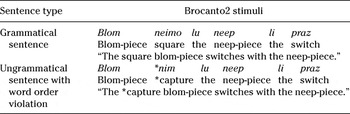
As previously described (Morgan-Short et al., Reference Morgan-Short, Faretta-Stutenberg, Brill-Schuetz, Carpenter and Wong2014; Morgan-Short, Steinhauer, et al., Reference Morgan-Short, Finger, Grey and Ullman2012), the grammar of Brocanto2 is dissimilar to English to avoid the possibility of L1 transfer but follows the rules of English phonotactics to reduce difficulty in phonological learning, which is not of interest to the current study. Brocanto2 has 13 lexical items, which are only presented auditorily during the study: four nouns (pleck, neep, blom, and vode), two adjectives (troise/o and neime/o), one article (li/u), four verbs (klin, nim, yab, and praz), and two adverbs (noyka and zayma). Unlike English, each noun in Brocanto2 has a formal grammatical gender designation, either masculine or feminine. Also unlike English, adjectives and articles, which both appear postnominally, are morphologically marked to agree with the grammatical gender of the noun. Brocanto2 employs a fixed subject-object-verb word order, which differs from the subject-verb-object word order found in English. Adverbs, when used, appear at the end of the sentence, immediately following the verb. All Brocanto2 words were recorded in isolation rather than as part of a phrase or sentence and were always presented auditorily one by one such that prosodic information at the phrasal or sentential level was not available, which further eliminated confounding grammatical and phonological learning and prevented prosody cues from being available for distinguishing between grammatical and ungrammatical stimuli used for the assessment task (see the Linguistic Assessment section). See Table 1 for an example of a Brocanto2 sentence.
An example of grammatical and ungrammatical Brocanto2 sentences

* Note. = violation.
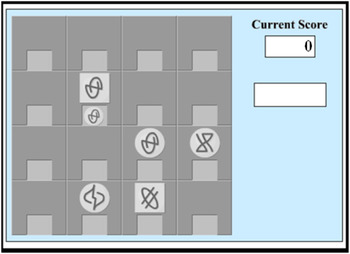
Each Brocanto2 sentence describes a move on a computer-based board game, which provides a communicative context for the artificial language (Friederici et al., Reference Friederici, Steinhauer and Pfeifer2002; Morgan-Short, Finger, et al., Reference Morgan-Short, Finger, Grey and Ullman2012; Morgan-Short et al., Reference Morgan-Short, Sanz, Steinhauer and Ullman2010; Morgan-Short, Steinhauer, et al., Reference Morgan-Short, Finger, Grey and Ullman2012; see Figure 1 for an example of a game board configuration). Four game tokens are represented by distinct symbols, which correspond to the four nouns in Brocanto2. Each token is presented within a circle or a square background (described using the adjectives). Players can move, swap, capture, and release tokens (with each of these actions corresponding to a Brocanto2 verb), either horizontally or vertically (corresponding to Brocanto2 adverbs). Importantly, the rules of the game and the rules of the artificial language are completely independent of each other. To ensure that learning the game was not confounded with learning the language, all participants were trained to play the game before they engaged in learning the language.
An example of the game board configuration.

Language Training and Practice
In each training and practice session (Sessions 2, 4, 5, and 6), participants were required to demonstrate mastery of all Brocanto2 lexical items before proceeding with full language training and practice (see Morgan-Short et al., Reference Morgan-Short, Faretta-Stutenberg, Brill-Schuetz, Carpenter and Wong2014, for a full description of vocabulary training as well as for familiarization with the computer-based game provided in Session 2). Learners were informed that they would receive training on an artificial language and were asked to listen carefully to the information that was given. The full language training, which lasted approximately 13.5 min, occurred under an implicit condition in which no explicit grammar rules or explanations regarding any aspect of the language were provided. Instead, learners were exposed to 129 auditorily presented meaningful phrases and sentences of the language. As each phrase or sentence was presented, participants also viewed the corresponding game token or move. This implicit training condition was designed to approximate learning a language under a natural (immersion) setting in which learners are exposed to phrases and sentences but do not generally receive grammatical explanation about the language (Morgan-Short et al., Reference Morgan-Short, Sanz, Steinhauer and Ullman2010; Morgan-Short, Steinhauer, et al., Reference Morgan-Short, Finger, Grey and Ullman2012).
After language training, learners practiced using the artificial language in the context of the computer-based game. Learners were informed that they would use the artificial language to play the computer-based game. Practice consisted of 72 modules (20 stimuli per module) of comprehension and production practice. During comprehension modules, participants heard sentences in the language and were instructed to make the move on the game board that corresponded to the statement they heard. During production modules, participants saw a move and were instructed to describe it by using a Brocanto2 sentence—that is, to state the move out loud. For both comprehension and production practice, participants received feedback on whether their response was correct (e.g., whether they made the correct move or produced a fully grammatical sentence). No additional information or opportunities to modify the response were provided. None of the sentences presented in practice were presented during language training. Participants completed 12 practice modules during Session 2 and 20 practice modules in each of the subsequent training and practice sessions, Sessions 4, 5, and 6. Responses were recorded and accuracy was calculated for each participant for each practice module.
Linguistic Assessment
After the initial and final training and practice sessions (e.g., Sessions 2 and 6), participants completed linguistic assessment sessions (Sessions 3 and 7) during which brain imaging data was also acquired using a rapid-presentation event-related design (see the MRI Acquisition section). Linguistic development was assessed using a computer-administered grammaticality judgment task (GJT) that assessed syntactic knowledge. Participants judged the acceptability of 120 novel Brocanto2 sentences consisting of 60 grammatical and 60 ungrammatical sentences. The ungrammatical sentences, each derived from a grammatical sentence, contained a syntactic word-order violation that had been created by replacing a word from one of the five word categories (e.g., a noun) with a word from a different category (e.g., an adjective, article, verb, or adverb). Violations never occurred on the first word of the sentence and were distributed among each word category equally. The stimuli were divided into two experimental blocks, with ungrammatical and their matched grammatical sentences occurring in different blocks, and were pseudorandomly intermixed so that there were never more than three consecutive grammatical or ungrammatical sentences.
A block of control (baseline) stimuli followed each experimental block. The stimuli presented in the control block were developed so as to isolate syntactic processing in the final analyses through a design in which the control, baseline condition matched the experimental, syntactic condition with regard to other linguistic processes as well as cognitive and sensorimotor processes. The control stimuli were derived from the 60 grammatical sentences used for the experimental stimuli. Half of these grammatical sentences were presented exactly as in the experimental block, and half of these grammatical sentences were presented with the loudness of one word intensified at +8 dB throughout. Thus, the control stimuli were exactly the same as the grammatical sentences presented in the experimental block, which were also the sentences from which the ungrammatical sentences had been created. The intensified words in the control stimuli were the same words that had been replaced to create grammatical violations in the experimental stimuli. Thus, the position of the violation and the intensified words in the stimuli were also matched between the two conditions.Footnote 2 The order of presentation of the experimental and control stimuli was balanced such that stimuli presented in the first experimental block were presented in the second control block and vice versa. Within the control blocks, the 30 grammatical sentences and the 30 sentences with an intensified word were pseudorandomly intermixed so that there were never more than three consecutive grammatical or intensified sentences, which paralleled the pseudorandomization of stimuli within the experimental block.
During the administration of the experimental and control tasks, participants were instructed to make a judgment related to the stimuli. For the GJT, participants were instructed to judge the acceptability of each sentence using buttons on a response box, and, for the control task, participants were instructed to judge the loudness of each sentence. Stimuli presentation began with a fixation cross “+” that was displayed for 500 ms prior to sentence presentation and remained on the screen for the duration of the sentence. Sentence stimuli were presented auditorily at a rate of 800 ms per word. A prompt asking for a judgment (either “Good?” or “Loud?”) appeared for 2,000 ms after the final word of each sentence, during which time participants provided a response. Immediately after the participant’s response, the fixation cross appeared on the screen for a variable (jitter) duration of 0, 2, 4, 6, 8, or 10 s, which corresponded to 0, 1, 2, 3, 4, and 5 repetition times (TRs), respectively, before next the trial began. The durations of the jitters (i.e., the varying intervals between trials) and the event duration (20 s) for each trial were determined by the schedule optimization tool Optseq2 (Dale, Reference Dale1999), which allows overlapping hemodynamic responses, a consequence of the rapid-presentation event-related design, to be estimated by deconvolution. Accuracy on the GJT was recorded behaviorally, and d' scores, which account for potential response bias, were also calculated for each participant as the indicator of his or her performance in distinguishing grammatical versus ungrammatical sentences.
Participants were provided with the directions for the experimental and control tasks and practiced making acceptability and loudness judgments outside of the MRI scanner. For each judgment task, participants completed one practice block composed of 20 novel sentences that were created in the same manner as the stimuli in the experimental and control blocks. After receiving the directions and completing the judgment practice, participants were moved to the scanner for MRI acquisition.
MRI Acquisition
Magnetic resonance images were acquired at the Center for Advanced MRI (now the Center for Translational Imaging) in the Department of Radiology at Northwestern University using a Siemens 3T TIM Trio MR scanner from Siemens Medical Solutions. For each participant, a high-resolution, T1-weighted, three-dimensional anatomical volume was acquired axially (magnetization-prepared rapid gradient echo; TR = 2,300 ms; echo time [TE] = 3.36 ms; flip angle [FA] = 9 degrees; inversion time [TI] = 900 ms, matrix size = 256 × 256, field of view [FOV] = 256 mm, slice thickness = 1 mm) and was used in conjunction with the functional activation maps to localize the anatomic regions involved. T2*-weighted functional images were acquired axially using a susceptibility-weighted echo planar imaging pulse sequence while subjects performed the judgment tasks (TR = 2 s, TE = 20 ms, FA = 90 degrees, FOV = 220 mm, in-plane resolution = 3.4 mm × 3.43 mm; 38 slices with a slice thickness of 3 mm with zero gap were acquired in an interleaved measurement). Experimental materials were delivered via headphones that were custom-made for MRI environments.
fMRI Data Analysis
Preprocessing
The functional data were analyzed using AFNI (Cox, Reference Cox1996). The functional images were corrected for slice-timing differences and motion. Each participant’s anatomical image was coregistered to the functional image. The functional images were spatially normalized to a standard stereotaxic template (TT-N27) in Talairach space and were resampled in 3-mmFootnote 3 voxels. Spatial smoothing with a 6-mm full width at half-maximum Gaussian kernel was performed. Each participant’s data signal was scaled before it was entered into the subject-level analyses.
Whole-brain analysis
We performed subject- and group-level statistics using a general linear model. Our 2 (Task: syntactic and control) × 2 (Scan: GJT1 and GJT2) design resulted in four conditions, including the two task conditions (the syntactic [experimental] task and the control [baseline] task) at early and late stages of language training. In the subject-level model, each participant’s hemodynamic responses induced by each condition were modeled with the 1-parameter gamma variate basis function provided by AFNI (3ddeconvole program), with the onset of the basis function time-aligned with the onset of the critical word in the deconvolution analysis. Six motion parameters were included as covariates of noninterest in the model. Beta coefficients for each condition were used for group-level analyses. In the group-level model, the beta coefficients from each participant were entered into a 2 (Task: syntactic and control) × 2 (Scan: GJT1 and GJT2) ANOVA provided by AFNI (3dANOVA3 program). Monte Carlo simulation as implemented by the AlphaSim program in AFNI was used for performing multiple comparisons of our whole-brain data (familywise p = .05). The corrected threshold was set at p < .005 for a single voxel with a cluster size greater than 36 voxels (972 mm3). Significant Task × Scan interaction effects were explored further by extracting the beta coefficient for each condition from the whole significant cluster and applying ANOVA and simple effects analysis.
Brain-behavior analyses
Before conducting brain-behavior analyses, we calculated standardized composite scores to better capture declarative and procedural memory learning ability across the independent cognitive tasks (see the calculation details in Morgan-Short et al., Reference Morgan-Short, Faretta-Stutenberg, Brill-Schuetz, Carpenter and Wong2014). To explore the brain regions in which task activations correlated with behavioral measures, we performed a whole-brain Pearson correlation between brain activation (beta coefficient for the syntax condition) and behavioral measures (d' scores for the GJT and composite scores for declarative and procedural memory learning ability). The corrected threshold was set at p < .005 with a cluster size greater than 36 voxels (972 mm3) by using the AlphaSim test implemented in AFNI.
Summary of the General Procedure
Participants were scheduled for seven experimental sessions over a 2-week period with one to three nights between each session. During Session 1, the cognitive assessment session, participants first provided informed consent, filled out background questionnaires, and completed a randomized battery of cognitive tests that included an IQ assessment (the Kaufman Brief Intelligence Test; Kaufman & Kaufman, Reference Kaufman and Kaufman2004) and the declarative and procedural learning tasks described previously. This session lasted approximately 3 hr, and the order of the cognitive tests was counterbalanced across participants. The remaining sessions were devoted to language training and practice (Sessions 2, 4, 5, and 6; the average duration per session was 2.6 hr) and behavioral and fMRI assessment (Sessions 3 and 7; the average duration per session was 1 hr), as described previously. Participants were compensated for time spent completing the study at a rate of $10 per hour for behavioral tasks and $25 per hour for fMRI data acquisition. They also received a $45 bonus for completing the study.
RESULTS
Behavioral Results
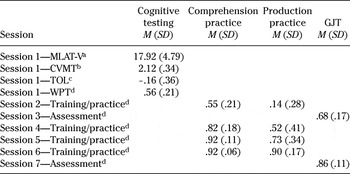
Participants in the current study showed successful L2 development over time on practice and assessment tasks (see Table 2). For the practice task, learners showed above-chance performance on comprehension practice for Session 2 (training and practice) and showed increasing comprehension and production accuracy with each additional training and practice session. For the assessment task, learners evidenced development of Brocanto2 syntax at the first GJT that varied widely among learners (accuracy: M = .68, SD = .17, range = .49–.99; d': M = 1.23, SD = 1.38, range = −0.07–4.52) and showed increased and less variable performance at the second GJT (accuracy: M = .86, SD = .11, range = .64–.98; d': M = 2.61, SD = 1.11, range = 0.86–4.21). Overall, behavioral results demonstrated that participants successfully learned the artificial language.
Behavioral performance on the cognitive and second language measures

Note. MLAT-V = Modern Language Aptitude Test, Part V; CVMT = Continuous Visual Memory Test; TOL = Tower of London task; WPT = Weather Prediction Test; and GJT = grammaticality judgment task.
a The number of items correct out of 24.
b Unit of measurement = d'.
c Unit of measurement = the change in initial think time in milliseconds.
d Accuracy score.
fMRI Results
We conducted two sets of analyses on the fMRI data. First, to address Research Questions 1a and 2a (When exposed to a L2 under an implicit context, what neural circuits underlie L2 syntax at early and late stages of development?), we conducted a voxelwise mixed-effects ANOVA to reveal any changes over time for the experimental, syntactic task (over both grammatical and ungrammatical stimuli) compared to the control, baseline task (over both intensified and nonintensified stimuli). Second, to address Research Questions 1b and 2b (Do the neural circuits underlying L2 syntax at early and late stages of development vary across learners who exhibit different levels of performance on linguistic and cognitive tasks?), we conducted correlations between behavioral data and neural activation on the experimental, syntactic task to shed light on how L2 performance and individual cognitive measures were related to the recruitment of neural circuits.
Voxelwise ANOVA
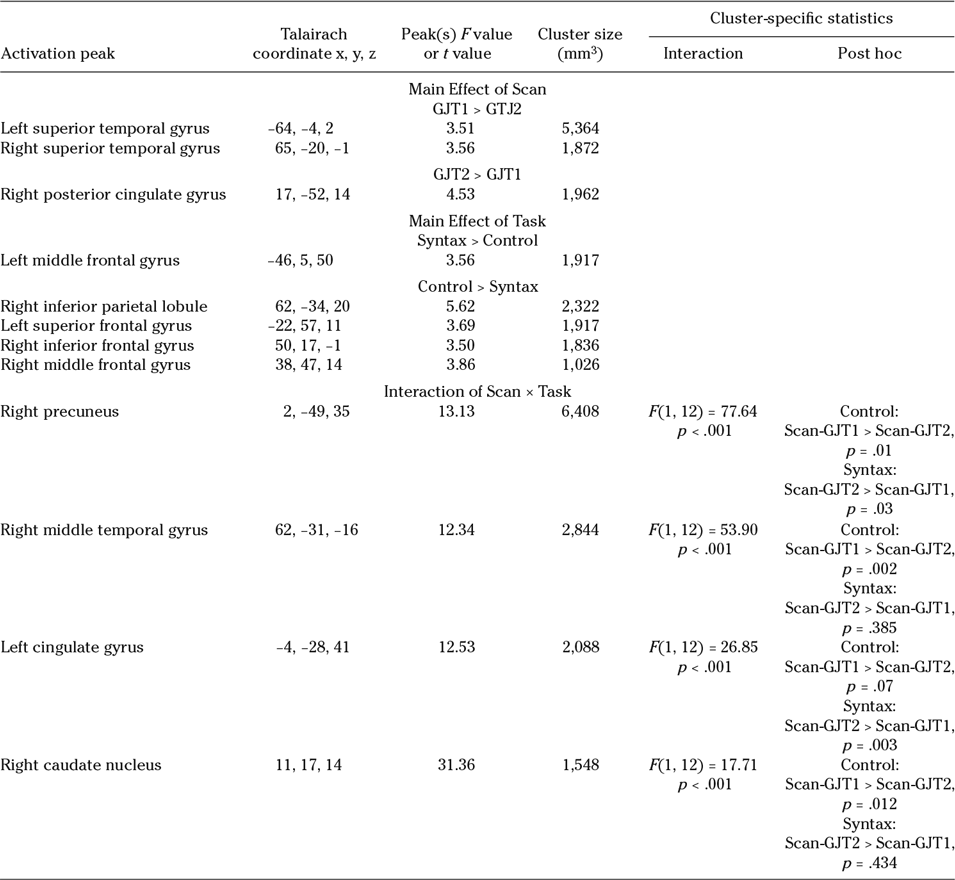
In examining the neural circuits that underlie L2 syntax at early and late stages of development, the ANOVA analysis revealed significant main effects of scan and task as well as a significant Scan × Task interaction (see Table 3 for statistics). The main effect of scan indicated that learners activated (a) the left and right STG to a greater extent for GJT1 compared to GJT2 and (b) the right posterior cingulate gyrus to a greater extent for GJT2 as compared to GJT1. The main effect of task indicated that learners activated (a) an area in the left hemisphere (the left middle frontal gyrus, including area BA 6) to a greater extent for the syntactic task compared to the control task and (b) the left superior frontal gyrus and several right hemisphere structures (the right inferior parietal lobe–BA 42, right IFG–BA 47, and right middle frontal gyrus) to a greater extent for the control task compared to the syntactic task. The interactions between scan and task indicated that activation levels (a) decreased over time (from GJT1 to GJT2) for the control task, specifically in the right precuneus, right middle temporal gyrus, and right caudate nucleus, but (b) increased over time (from GJT1 to GJT2) for the syntactic task, specifically in the right precuneus and the left cingulate gyrus (see Table 3 for follow-up ANOVA and simple effects statistics).
Results from the general linear model voxelwise Scan × Task ANOVA
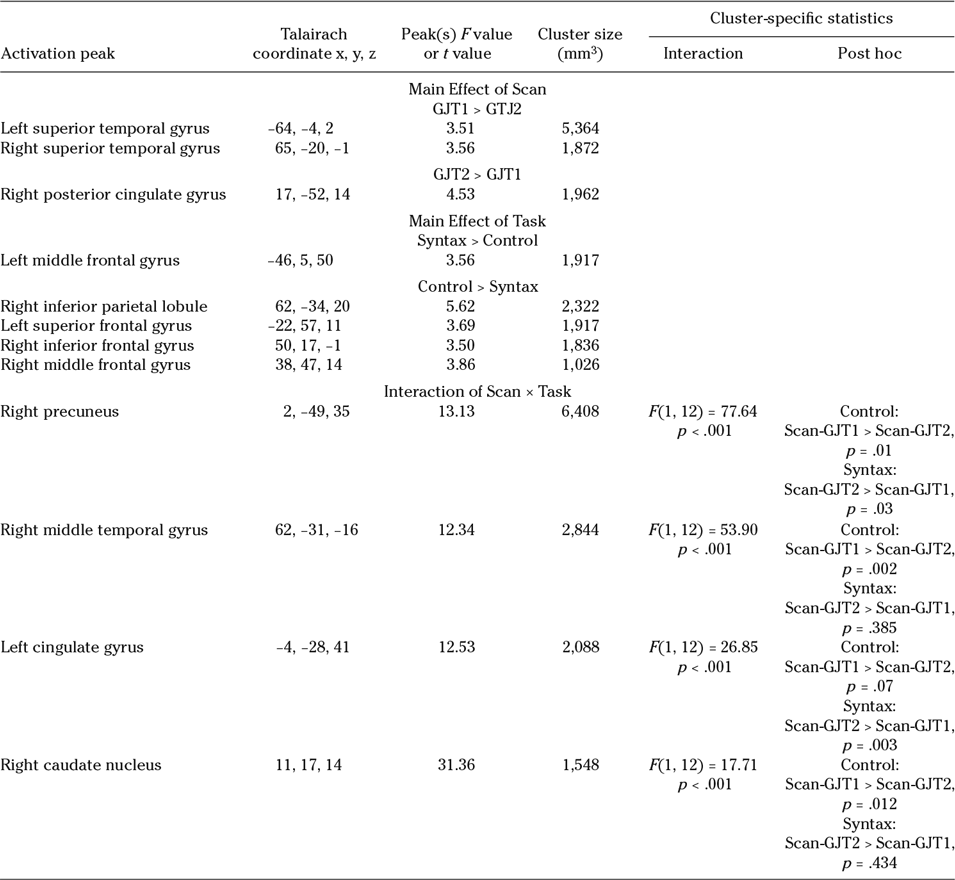
Note. The significance threshold was a voxelwise p value of < .005 with a cluster size greater than 972 mm3 (corrected p < .05 based on a Monte Carlo simulation). GJT1 = first grammaticality judgment task; GJT2 = second grammaticality judgment task.
Although the findings from this group-level analysis are significant and meaningful in and of themselves (and they are discussed further in the Discussion section), the planned analyses to explore individual differences in neural activation are expected to further reveal meaningful information given that learners evidenced a range of scores on the judgment tasks for each scan, particularly for the first scan.
Behavioral-Neural Relationships
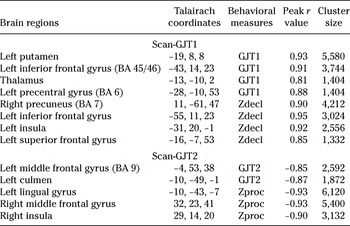
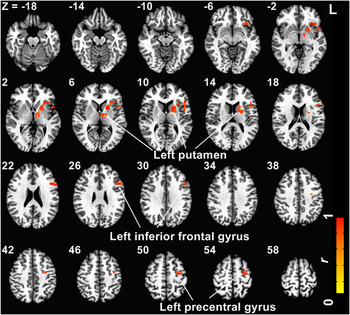
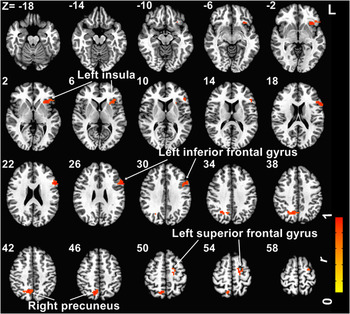
In examining the relationship between neural activation during the syntactic judgment task with behavioral performance on this task and neural activation during the syntactic judgment task with performance on the cognitive tasks, as reflected by the declarative and procedural memory composite scores, several significant relationships were found (see Table 4; see also Table 2 for descriptive statistics for tests of declarative and procedural memory ability). For GJT1, behavioral-neural correlational analyses revealed several positive correlations with linguistic and cognitive measures. First, the results yielded a positive correlation between performance on the GJT1 and brain activity in the left putamen, the left IFG, the precentral gyrus (BA 6), and the thalamus (see Figure 2). Second, the analyses showed positive correlations between the declarative composite score and neural activity in the left IFG, the left superior frontal gyrus, the left insula, and the right precuneus (see Figure 3). No relationship was found between neural activity during the first scan and the procedural composite score.
Clusters for which syntactic task activation significantly correlated with behavioral measures

Note. The significance threshold was a voxelwise p value of < .005 with a cluster size greater than 972 mm3 (corrected p < .05 based on a Monte Carlo simulation). BA = Brodmann’s area; GJT1 = first grammaticality judgment task; GJT2 = second grammaticality judgment task; Zdecl = standardized composite score for declarative memory; Zproc = standardized composite score for procedural memory.
Regions showing significant correlation between the pretraining syntactic task activation and task performance on GJT1. The significance threshold was a voxelwise p value of < .005 with a cluster size greater than 972 mm3 (corrected p < .05 based on a Monte Carlo simulation). Results are overlaid on the TT-N27 template. Images are displayed in radiological convention (i.e., axial and coronal images with the participant’s left side displayed on the right of the image). See Table 4 for coordinates. L = left hemisphere.

Regions showing significant correlation between the pretraining syntactic task activation and the declarative memory composite score. The significance threshold was a voxelwise p value of < .005 with a cluster size greater than 972 mm3 (corrected p < .05 based on a Monte Carlo simulation). Results are overlaid on the TT-N27 template. Images are displayed in radiological convention (i.e., axial and coronal images with the participant’s left side displayed on the right of the image). See Table 4 for coordinates. L = left hemisphere.

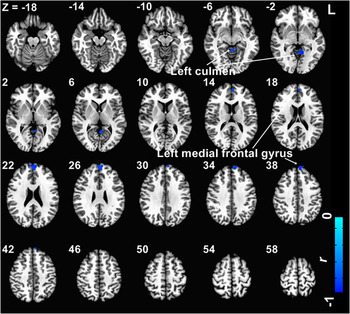
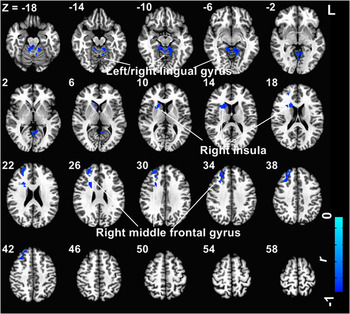
For GJT2, behavioral-neural correlational analyses revealed negative relationships between neural activity and behavioral performance. Performance on the GJT2 showed negative correlations with activity in the left middle frontal gyrus and the left culmen (see Figure 4). In addition, the procedural composite score correlated negatively with activation in the right middle frontal gyrus, the insula, and the lingual gyrus (see Figure 5). No relationship was found between neural activity on the second scan and the declarative composite score.
Regions showing significant correlation between the posttraining syntactic task activation and task performance on GJT2. The significance threshold was a voxelwise p value of < .005 with a cluster size greater than 972 mm3 (corrected p < .05 based on a Monte Carlo simulation). Results are overlaid on the TT-N27 template. Images are displayed in radiological convention (i.e., axial and coronal images with the participant’s left side displayed on the right of the image). See Table 4 for coordinates. L = left hemisphere.

Regions showing significant correlation between the posttraining syntactic task activation and the procedural memory composite score. The significance threshold was a voxelwise p value of < .005 with a cluster size greater than 972 mm3 (corrected p < .05 based on a Monte Carlo simulation). Results are overlaid on the TT-N27 template. Images are displayed in radiological convention (i.e., axial and coronal images with the participant’s left side displayed on the right of the image). See Table 4 for coordinates. L = left hemisphere.

DISCUSSION
The current study examined the development of the neural representation of L2 syntax under an implicit context at both early and late stages of development. The implicit context utilized here exposed learners to an artificial L2 without providing any grammatical explanation or direction to search for grammar rules.Footnote 3 Rather, participants received meaningful exposure to the L2 and used it for comprehension and production purposes in the context of making moves on a computer-based game board. Through behavioral and neural assessments administered at early and late stages of learning, the study provides evidence about (a) what neural circuits support L2 syntax under an implicit context at different stages of development and (b) whether the neural circuits vary across individuals. The study is able to uniquely address these questions due to its design that controls the context of exposure and that isolates the neural circuits tied to syntactic processing through the use of matched experimental and control conditions. In the following sections, we discuss the group- and individual-level results and briefly consider the implications that this set of results has for extant neurocognitive theories of L2.
L2 Syntactic Processing on the Group Level
The whole-brain, group-level analysis in the current study isolated the neural circuits involved in L2 syntax uniquely in that the control, baseline condition presented the same sentence stimuli and cognitive and sensorimotor tasks as in the experimental, syntactic judgment condition, with the only difference being the manipulation of grammaticality in the experimental condition and the manipulation of loudness in the control condition. The analysis revealed a main effect of task, indicating that, compared to the control task, the experimental, syntactic task relied more on the left middle frontal gyrus, including BA 6, and less on the left superior frontal gyrus, right IFG (BA 47), right middle temporal gyrus, and right inferior parietal lobe. This finding suggests that, when judging syntactic stimuli, learners’ neural response was more left-lateralized and less dependent on circuits associated with general cognition (e.g., the superior frontal gyrus, which has been associated with working memory [du Boisgueheneuc et al., Reference du Boisgueheneuc, Levy, Volle, Seassau, Duffau, Kinkingnehun and Dubois2006] and task switching [Cutini et al., Reference Cutini, Scatturin, Menon, Bisiacchi, Gamberini, Zorzi and Dell’Acqua2008]), as might be expected for a linguistic compared to a nonlinguistic task. This is consistent with the interpretation that although language was processed in both the experimental and control tasks, the syntactic task did not recruit areas of general control to the same extent as the control task but did recruit a neural area, left BA 6, that is expected to be involved in L2 grammar, at least at high stages of proficiency and experience (Ullman, Reference Ullman, VanPatten and Williams2014).
In comparing these results with previous studies that have focused specifically on isolating grammar through matching baseline conditions, we did not find converging results with Tagarelli and colleagues (Tagarelli, Reference Tagarelli2014; Tagarelli et al., Reference Tagarelli, Jiang, Shattuck, Laka, Newport and Ullman2014), who found activation in bilateral BA 47 and deactivation in BA 6 at an early stage of development as well as activation in right BA 47 and left BA 44 at a later stage of development. This difference between studies may be explained by the fact that the results from Tagarelli and colleagues were only evidenced in ROI analyses, which we did not motivate or carry out in the current study. With regard to Luke et al.’s (Reference Luke, Liu, Wai, Wan and Tan2002) whole-brain analysis, we found converging results in that both studies showed involvement of the left middle frontal gyrus for L2 grammar. In addition, we found that the areas of activation that were stronger for our control task (i.e., the right IFG and right inferior parietal lobe) were also activated in Luke et al. (Reference Luke, Liu, Wai, Wan and Tan2002), suggesting that our learners were indeed processing the control task stimuli as linguistic stimuli. This strengthens our claim that neural circuits with greater activation for the experimental task as compared to the control, baseline task are expected to reflect L2 syntax specifically, rather than general aspects of L2 sentence processing.
The current whole-brain, group-level analysis also revealed a main effect for scan (GJT1 and GJT2), indicating that, over both the experimental and control tasks, learners relied less on the bilateral STG over time. These decreased levels of neural activation may indicate that learners became more efficient at processing the linguistic aspects of the stimuli presented in both the syntactic and control tasks. The analysis over both tasks also revealed that learners came to rely more on the right posterior cingulate gyrus, which might indicate that learners increasingly engaged circuits associated with attention (i.e., the posterior cingulate gyrus; Hahn, Ross, & Stein, Reference Hahn, Ross and Stein2007; Leech & Sharp, Reference Leech and Sharp2014) to a greater degree when completing the judgment tasks at later stages compared to early stages. Finally, the current analysis revealed interactions between scan and task that indicated that (a) activation at the second scan compared to the first scan for the control task tended to decrease over multiple neural circuits, which again may be generally indicative of more efficient processing of Brocanto2 sentences over time, and (b) activation for the syntactic task tended to increase over time over two areas (i.e., the right precuneus and the left cingulate gyrus), which supports the previous suggestion that learners may be more actively processing Brocanto2 syntax with attention over time (Leech & Sharp, Reference Leech and Sharp2014). None of these circuits have been evidenced in previous studies that isolate L2 grammar and may have been revealed in the current study because of the matched nature of the experimental and control tasks, which allowed us to explore the neural circuits specifically recruited for L2 syntax.
Overall, results from the whole-brain ANOVA suggest that, over time, learners required fewer resources to process the Brocanto2 sentences in general (as evidenced by less STG activation at later compared to earlier stages of development over both the experimental and control tasks as well as by decreased levels of activation in multiple neural circuits for the control task). However, as a group, learners appeared to increasingly rely on areas of attention and of control both overall (as evidenced by more posterior cingulate gyrus activation over both the syntactic and control tasks) and for processing L2 syntax (as evidenced by increased levels of posterior cingulate and precuneus activation for the syntactic task at the second scan). Finally, learners appeared to show a more left-lateralized response pattern to the syntactic processing, as left BA 6 was activated to a greater extent for the syntactic task as compared to the control task.
L2 Syntactic Processing on the Individual Level
The whole-brain, individual-level analysis of neural activation during the experimental, syntactic task revealed several interesting findings that both complemented and extended the results from the group-level analysis. Neural activation measured during the syntactic judgment task at an early stage of development (GJT1) showed positive relationships between performance on the judgment task and activation in several brain areas: Better performance on the syntactic judgment task was associated with higher levels of activation in the left putamen, the left IFG, the precentral gyrus (BA 6), and the thalamus (see Figure 1). This pattern of results suggests that those individuals who evidenced the highest performance at the early stages of development relied more heavily on brain areas that have been associated both with grammar and with procedural memory (e.g., the left IFG and BA 6, and the basal ganglia and thalamus structures; Ullman, Reference Ullman2001, Reference Ullman2004, Reference Ullman, VanPatten and Williams2014). Interestingly, although activity in the neural circuits involved in procedural memory was positively related to performance on the judgment task, activity in these circuits (or any neural circuits) was not related to performance on the behavioral procedural memory tasks administered to assess procedural memory ability. In other words, procedural memory ability was not related to activation in the neural circuits that were recruited for the syntactic judgment task at the early stage of development. In contrast, neural activity during the syntactic judgment task showed positive associations with declarative memory ability: There was evidence of positive correlations between greater declarative memory ability and activity in the left IFG, the left STG, the left insula, and the right precuneus (see Figure 2), which suggests that learners with stronger declarative memory recruited brain areas associated with some aspects of declarative memory (i.e., the insula and precuneus) as well as a brain area typically associated with L1 grammar (i.e., the left IFG).
What could account for the seemingly contradictory results that neural activity in circuits associated with grammar and procedural memory are related to performance on the syntactic judgment task but that declarative memory and not procedural memory is positively associated with neural activation during the same syntactic judgment task? One possible explanation could be that learners with stronger declarative memory are able to quickly shift from a declarative stage of processing to a procedural stage of processing. Recall that all learners received implicit training and had completed six comprehension and six production practice modules before the first assessment, which might have been enough exposure and practice for good learners to quickly move to a procedural stage of processing. If such an explanation were true, then we might expect that learners with stronger declarative memory would perform better at very early stages of practice and that better performance at early stages of practice would enable learners to shift from relying on declarative memory neural structures to relying on procedural memory structures by the first GJT scan. Thus, we would predict associations between declarative memory and scores at initial stages of practice as well as between scores at initial stages of practice and the recruitment of procedural memory neural structures during the GJT1 scan. Post hoc analyses confirmed both of these predictions. There was a medium-to-large positive association between declarative memory scores and performance on the first two practice modules (r = .72, p = .006) and a medium positive association between performance on the first two practice modules and activity in the left IFG during the first scan (for BA 44: r = .57, p = .043; for BA 45: r = .56, p = .046). Therefore, it appears that learners who have strong declarative memory are able to “get” the language at the earliest stages of learning and are able to quickly engage grammatical-procedural neural circuits when making syntactic judgments.
Given the association between neural circuits associated with L1 grammar and procedural memory at early stages of development, one might also expect robust positive associations between performance on the syntactic task and such circuits during syntactic judgment at a later stage of development when all learners have achieved relatively high proficiency levels (95% accuracy for comprehension practice). However, the results do not support this expectation. In fact, performance on the syntactic judgment task at the second assessment (GJT2) was negatively associated with neural activity in the left culmen and the left middle frontal gyrus (see Figure 3), suggesting that learners who evidenced lower performance at later stages of development relied more heavily on these areas, which are associated with sustaining attention and working memory (Filbey, Russell, Morris, Murray, & McDonald, Reference Filbey, Russell, Morris, Murray and McDonald2008; Lawrence, Ross, Hoffmann, Garavan, & Stein, Reference Lawrence, Ross, Hoffmann, Garavan and Stein2003; Ranganath, Johnson, & D’Esposito, Reference Ranganath, Johnson and D’Esposito2003). There was also a negative association between performance on the procedural memory tasks and neural activity in the right middle frontal gyrus, the insula, and the lingual gyrus (see Figure 4), which suggests that learners who have poorer procedural memory ability have more difficulty with the final syntactic judgment task, as indicated by poorer scores on GJT2 and more effortful neural processing (as indicated by higher levels of neural activation). This set of findings suggests that learners who had more difficulty making correct syntactic judgments and who performed more poorly on the behavioral procedural memory tasks evidenced increased neural engagement when making syntactic judgments at later stages of development.
To summarize, the individual-based neural-behavioral correlational analysis showed (a) positive associations at early stages of development among brain activity during syntactic judgment, declarative memory strength, and performance on the judgment task and (b) negative associations at later stages of development among brain activity during syntactic judgment, procedural memory strength, and performance on the judgment task. These results are somewhat consistent with previous research (Tagarelli, Reference Tagarelli2014; Tagarelli et al., Reference Tagarelli, Jiang, Shattuck, Laka, Newport and Ullman2014) in that, for both studies, positive relationships were found between performance on a judgment task and activation in IFG structures, including BA 6, and the left putamen. Note, however, that these relationships were found at early stages of development for the current study and at later stages of development for Tagarelli and colleagues’ study (for which there were moderately sized trending effects in the ROI analysis).
With regard to cognitive ability and neural activation, the associations reported in the current study are, to the authors’ knowledge, the first results related to how individual, domain-general cognitive abilities are associated with the neural representation of L2 syntax. Both declarative and procedural memory appeared to play a role, with better declarative memory ability being associated with increased neural activation in circuits tied to grammar and procedural memory at early stages of development and with poorer procedural memory being associated with increased neural activation in areas not tied to grammar or procedural memory at later stages of development. These findings are largely consistent with the relationships between declarative and procedural memory and L2 development evidenced in the previously reported full behavioral analysis (Morgan-Short et al., Reference Morgan-Short, Faretta-Stutenberg, Brill-Schuetz, Carpenter and Wong2014), which also revealed a role for declarative memory at early stages of development and for procedural memory at later stages of development. The only difference between the behavioral and neural results is that, at the later stage of development, the relationship between procedural memory and behavioral development is positive, whereas the relationship between procedural memory and neural activity is negative. Although at first glance this may appear contradictory, careful consideration of the negative relationship reveals that it is not inconsistent with previous results, given that the relationship indicates that learners with poorer procedural memory show increased, possibly more effortful, levels of neural recruitment, whereas learners with better procedural memory show decreased, possibly more efficient, levels of neural recruitment. This might be expected of learners who perform better on the judgment task, which is indicated by the positive relationship between procedural memory and better performance at later stages of development (Morgan-Short et al., Reference Morgan-Short, Faretta-Stutenberg, Brill-Schuetz, Carpenter and Wong2014).
Considering the results of the group- and individual-level analyses as a whole, it appears that, as a group, learners in the current study relied on areas tied to L1 grammar (e.g., BA 6) when making syntactic judgments at both early and late stages of development but engaged areas of attention and control more over time for the syntactic task (e.g., the precuneus and cingulate gyrus). This group-level analysis can be better understood by considering the individual-level analyses that showed that the learners who evidenced the most development early on relied on circuits tied to L1 grammar and to procedural memory (e.g., the left IFG and basal ganglia), whereas learners who were less successful at later stages of development relied on circuits that may be tied to extralinguistic processing (e.g., the left middle frontal gyrus). Thus, the results suggest that, when learning under an implicit context, some learners are able to quickly rely on grammar and procedural memory neural circuits, whereas other learners are not able to rely on these areas (given the amount of training and practice provided by the current study) but increasingly use extralinguistic areas to process grammar.
Although the current study was not designed to distinguish among theories, the findings have possible implications for different neurocognitive perspectives of L2. First, the results suggest that there may be multiple ways in which a L2 is represented neurally, so L2 neurocognitive theories may need to account for variability in the neurocognitive representation of L2: Some learners may come to depend primarily on areas associated with L2 grammar and procedural memory, whereas other learners may rely on other areas, including neural circuits tied to control mechanisms, to support their development of L2. Interestingly, the findings that support this conclusion show relationships at particular stages of development that may not be predicted by the respective theoretical perspectives: Good learners appeared to recruit circuits tied to L1 grammar and to procedural memory at early stages of learning, which differs from the prediction made by declarative-procedural perspectives—that such a relationship would be evidenced at later stages. Also, both group- and individual-level analyses indicated that learners relied on neural circuits associated with control at later stages of development, whereas theoretical perspectives that predict a role for cognitive mechanisms posit that these mechanisms would be recruited to a greater extent at early stages of development. In addition to considering how individual differences in cognitive ability may be integrated into the neurocognitive perspective of L2, theories should also fully develop predictions regarding the context of exposure. Ullman (Reference Ullman, VanPatten and Williams2014) states that more implicit, immersionlike contexts may lead to greater reliance on procedural memory, which may explain why good learners in the current study, which provided an implicit training context, were able to recruit neural circuits tied to L1 grammar and procedural memory at early stages of development. For perspectives that predict a role for control mechanisms, the results suggest that poorer learners did rely on neural circuits tied to attention and control but only after a significant amount of exposure to the L2. Both of these patterns of findings may be expected to change when learners are exposed to a L2 under more explicit contexts. Overall, however, the results of the current study provide evidence that is, at least partially, consistent with both theoretical perspectives suggesting that both theories may be capturing valid elements of the neural representation of L2 and that the theories may be mutually informative to each other. It is interesting to note that the results of the current study are also consistent with a nonneural-based theory of L2 acquisition that claims that aspects of L2 are initially represented as declarative knowledge that becomes proceduralized and later automatized with practice. This theory predicts that learners who are able to quickly form declarative knowledge will be able to proceduralize their knowledge earlier (DeKeyser, Reference DeKeyser, VanPatten and Williams2007). This claim seems supported by the fact that learners from the current study who had high declarative memory ability showed greater engagement of neural circuits tied to procedural memory when making syntactic judgments even at an early stage of learning.
CONCLUSIONS
As pointed out in the introduction, neuroimaging research has the potential to contribute to at least two central questions related to implicit-explicit issues in L2 acquisition: (a) what the nature of L2 is and (b) how implicit and explicit contexts may mediate the neural representation of L2. The current study has taken an initial step toward elucidating the second issue, but further work is necessary to compare whether a different pattern of findings would result from explicit contexts of exposure. Perhaps even more central to our understanding of L2 is the first issue—that is, the nature of L2. Ideally, one could gather evidence of the neural circuits underlying L2 and make conclusions about the implicit or explicit nature of L2. However, although much is known about neural circuits and the cognitive processes supported by these circuits, it remains difficult to make clear claims about whether such evidence reflects explicit or implicit learning, processing, or knowledge (Morgan-Short, Faretta-Stutenberg, & Bartlett-Hsu, Reference Morgan-Short, Faretta-Stutenberg, Bartlett-Hsu and Rebuschatin press). Neural measures can rarely be tied uniquely to explicit or implicit learning, processing, or knowledge. Nevertheless, this approach should not be abandoned because, as we come to know more about the brain and neural processing, we can better interpret brain-based results with regard to L2 development generally and with regard to questions about the explicit or implicit nature of different aspects of L2. As we approach the point at which neural measures can be more directly associated with particular processes, we should capitalize on neural methods in conjunction with behavioral methods to examine not only how factors such as age of acquisition, proficiency, and L1-L2 similarity affect the neural representation of L2 but also how neural circuits are mediated by other factors that are known to play significant roles in L2 acquisition (e.g., implicit-explicit issues, motivation, etc.). Furthermore, it is particularly important to consider how multiple factors work in conjunction (e.g., how individual differences play out in explicit as opposed to implicit learning contexts) to lead to successful L2 development. With a basic understanding of how multiple factors work to bring about L2 development and L1-like representation of L2, researchers may then consider how the conditions or input provided to learners can be manipulated so that they are also able to attain high levels of success in the L2 and arrive at L1-like neural representations, which would be expected to be the most stable representation for L2 use and retention. Finally, we should also continue to refine research designs to better reveal the neural circuits involved in specific aspects of language by isolating such aspects through the use of more consistent and methodologically sound control, baseline conditions. Taking this approach to elucidate the development of the neural representation of L2 syntax under implicit contexts of exposure, the current study demonstrated that some learners are able to quickly rely on neural circuits associated with L1 grammar and procedural memory, whereas other learners increasingly use extralinguistic neural circuits related to control mechanisms to process syntax. Thus, there may be multiple ways in which L2 is represented neurally, at least when learned under implicit contexts.