INTRODUCTION
One of the major goals of studies on sandy beach ecology over the last decades has been to examine community and population responses to variations in the physical characteristics of beaches (Defeo & McLachlan, Reference Defeo and McLachlan2005 and references therein). Several patterns have been established for community descriptors, such as species richness, abundance and biomass, according to exposure gradients and morphodynamic states (McLachlan, Reference McLachlan, McLachlan and Erasmus1983; Defeo & McLachlan, Reference Defeo and McLachlan2005, Reference Defeo and McLachlan2011, Reference Defeo and McLachlan2013; McLachlan & Dorvlo, Reference McLachlan and Dorvlo2005). In this regard, species richness, abundance and biomass of the intertidal macrofauna increase from reflective to dissipative conditions (Defeo & McLachlan, Reference Defeo and McLachlan2005, Reference Defeo and McLachlan2011, Reference Defeo and McLachlan2013).
At species level, recurrent patterns have recently been observed in several life-history traits, according to beach morphodynamic state (Defeo & McLachlan, Reference Defeo and McLachlan2005; Celentano et al., Reference Celentano, Gutiérrez and Defeo2010). The habitat harshness hypothesis (HHH) (Defeo et al., Reference Defeo, Gómez and Lercari2001; Defeo & Martínez, Reference Defeo and Martínez2003) postulates that the harsh environment on reflective beaches forces intertidal organisms to divert more energy towards maintenance, resulting in lower abundance, fecundity, growth, and survival rates than on dissipative beaches. On the other hand, supralittoral amphipods follow the opposite pattern (Defeo & Gómez, Reference Defeo and Gómez2005) according to the hypothesis of habitat safety (HHS).
Conversely, few attempts have been made to assess ecological patterns in production for sandy beach macrofauna species (Petracco et al., Reference Petracco, Cardoso and Turra2013). A negative latitudinal effect on the P/B ratio was observed for bivalve populations and for the cirolanid Excirolana armata (Dana, 1853) (Cardoso & Veloso, Reference Cardoso and Veloso2003; Herrmann et al., Reference Herrmann, Carstensen, Fisher, Laudien, Penchaszadeh and Arntz2009; Petracco et al., Reference Petracco, Cardoso, Turra and Corbisier2012c, Reference Petracco, Cardoso and Turra2013). On the other hand, higher production of filter feeders was observed on exposed beaches, mainly with dissipative/intermediate conditions, than on sheltered beaches (Petracco et al., Reference Petracco, Cardoso and Turra2013). In addition, higher P/B ratios for the supralittoral amphipods on beaches with more dissipative conditions (Petracco et al., Reference Petracco, Cardoso and Turra2013) are in agreement with the habitat safety hypothesis (HSH), according to which these forms show higher mortality on dissipative beaches than on reflective beaches (Defeo & Gómez, Reference Defeo and Gómez2005).
Crabs of the genus Emerita dwell in the harsher swash zone of sandy beaches across the world. The mole crab Emerita brasiliensis Schmitt, 1935, particularly, is frequently found in the intertidal zone of reflective and dissipative beaches along the Atlantic coast of South America, from Rio de Janeiro (Brazil) to Montevideo (Uruguay) (Defeo & Cardoso, Reference Defeo and Cardoso2002). This filter feeder frequently has high values of biomass and production and is thus an important component in the energy flow through sandy beaches (Gianuca, Reference Gianuca1985; Petracco et al., Reference Petracco, Veloso and Cardoso2003, Reference Petracco, Cardoso, Corbisier and Turra2012a, Reference Petracco, Cardoso and Turra2013; Veloso et al., Reference Veloso, Cardoso and Petracco2003). The presence of E. brasiliensis on sandy beaches with contrasting morphodynamic states allows for the assessment of differences in life history of this crab according to different physical characteristics of beaches.
Important variations in abundance, size structure, reproductive traits, growth and mortality of E. brasiliensis have been observed from reflective to dissipative conditions (Defeo et al., Reference Defeo, Gómez and Lercari2001; Defeo & Cardoso, Reference Defeo and Cardoso2004; Defeo & McLachlan, Reference Defeo and McLachlan2005; Celentano & Defeo, Reference Celentano and Defeo2006; Celentano et al., Reference Celentano, Gutiérrez and Defeo2010). As production and P/B ratio are strongly related to several of these population parameters, such as abundance, size structure, mean body mass, growth, mortality and lifespan, as well as to environmental characteristics (Robertson, Reference Robertson1979; Benke, Reference Benke1993; Cusson & Bourget, Reference Cusson and Bourget2005; Huryn & Benke, Reference Huryn, Benke, Hildrew, Raffaelli and Edmonds-Brown2007), they should also be influenced by beach morphodynamics. Therefore, this study aimed to assess trends in the production and P/B ratio of E. brasiliensis populations according to variations in physical characteristics related to beach morphodynamic states (e.g. grain size and beach slope) and to other population parameters commonly related to production and P/B ratio, such as abundance, mean body mass and growth rate.
MATERIALS AND METHODS
A literature review on population production of Emerita brasiliensis was performed to conduct a meta-analysis about the effects of physical characteristics of beaches on secondary production and P/B ratio of this species. In addition to studies related to E. brasiliensis production (Gianuca, Reference Gianuca1985; Petracco et al., Reference Petracco, Veloso and Cardoso2003; Veloso & Sallorenzo, Reference Veloso and Sallorenzo2010), several other studies were used to collect data on population parameters related to production and P/B ratio, and also data regarding the environmental characteristics of beaches (e.g. Veloso & Cardoso, Reference Veloso and Cardoso1999; Cardoso et al., Reference Cardoso, Veloso and Caetano2003; Veloso et al., Reference Veloso, Cardoso and Petracco2003). Physical factors related to morphodynamic state (dissipative, intermediate or reflective; sensu Short, Reference Short1996), such as Dean's parameter, mean grain size, beach width and beach-face slope, were recorded from each study, since they explain the variations in the structure and dynamics of E. brasiliensis (Defeo & Cardoso, Reference Defeo and Cardoso2002; McLachlan & Dorvlo, Reference McLachlan and Dorvlo2005; Celentano et al., Reference Celentano, Gutiérrez and Defeo2010).
Density, mean body mass, lifespan and curvature parameter (K) of the von Bertalanffy growth function (VBGF) were recorded as biotic variables, in addition to production, P/B ratio and mean biomass. Since the best way to estimate the production of macrobenthos is using classical methods based on time series measurement of population densities and body mass (cohort-based and size-based methods: Cusson & Bourget, Reference Cusson and Bourget2005), only estimates of production and P/B ratios of E. brasiliensis obtained with these approaches were included in the dataset. As the mass-specific growth rate method (MSGRM) is preferred to the size-frequency method (SFM) (Brey, Reference Brey2001) in studies that used both methods (Petracco et al., Reference Petracco, Veloso and Cardoso2003), production data estimated with the former were included in the dataset. Instantaneous mortality rate was not included in the dataset because this population parameter was not available for some populations. Since population parameters were estimated separately for males and females in some studies, both values were used to obtain the overall population estimate. Furthermore, when two annual population parameters (production, P/B, among others) were estimated for the same population (Petracco et al., Reference Petracco, Veloso and Cardoso2003), a single annual value of each parameter was included in the dataset. After gathering and treating data, relationships of production and P/B ratio with physical factors, such as grain size, beach slope, Dean's parameter, and beach width, were assessed by the simple relationships. We used simple relationships for this purpose as multiple regression and/or generalized models are less suitable for the analysis of small samples (Hair et al., Reference Hair, Black, Babin, Anderson and Tatham2006; Zuur et al., Reference Zuur, Ieno, Walker, Saveliev and Smith2009). The relationships were modelled by linear and non-linear fitting based on the coefficient of determination (r 2) (e.g. Defeo & Gómez, Reference Defeo and Gómez2005; Defeo & McLachlan, Reference Defeo and McLachlan2013). All statistical analyses used a 5% significance level (Zar, Reference Zar1999).
RESULTS
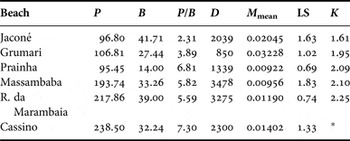
Among the six datasets available on production of E. brasiliensis, five are from beaches located in south-eastern Brazil (Jaconé, Grumari, Prainha, Massamba and Restinga da Marambaia), i.e. subtropical regions, while one is located in southern Brazil (Cassino), i.e. a temperate region (Table 1). Regarding morphodynamic state, most of the beaches are reflective (Jaconé, Grumari and Prainha), two are intermediate (Massambaba and R. da Marambaia), and one is dissipative (Cassino). Dean's parameters ranged from 0.73 (Jaconé) to 6.50 (Cassino). Sediment composition of beaches ranged from very fine (0.13 mm: Cassino), mean (0.43–0.45 mm: Massambaba and Prainha), to coarse sands (0.87 mm: Jaconé), thus covering a considerable range of grain size variation. The slope face was very gentle on Cassino, a dissipative beach (3.00%), increasing sharply towards reflective beaches (9.25–10.75%), while beach width ranged from 38 (Jaconé) to 76 m (R. da Marambaia) (Table 1).
Physical attributes of the exposed sandy beaches Jaconé, Grumari, Prainha, Massambaba, R. da Marambaia (south-eastern Brazil), and Cassino (southern Brazil). Jaconé and Massambaba: data from Veloso & Sallorenzo (Reference Veloso and Sallorenzo2010); Grumari and R. da Marambaia: data from Cardoso et al. (Reference Cardoso, Veloso and Caetano2003); Prainha: data from Petracco et al. (Reference Petracco, Veloso and Cardoso2003) and Veloso et al. (Reference Veloso, Cardoso and Petracco2003); Cassino: data from Gianuca (Reference Gianuca1985).

Production, mean biomass, P/B ratio and the other population parameters are shown in Table 2. Emerita brasiliensis production ranged from ~100 g AFDM m−2 y−1 on the three reflective beaches, to ~ 200 g AFDM m−2 y−1 on the intermediate/dissipative beaches. Similarly, P/B ratios also varied sharply between populations, with estimates ranging from 2.31 to 7.30 y −1. Higher densities occurred on intermediate beaches (Massambaba and R. da Marambaia >3000 ind m−2), and lower density occurred on one reflective beach (Grumari: 850 ind m−2). The shortest and longest lifespans were estimated on a reflective beach (Prainha: 0.69 years) and on an intermediate beach (Massambaba: 1.83 years), respectively. Emerita brasiliensis had the lowest and highest curvature parameters on a reflective beach (Jaconé: K = 1.61 y−1) and on an intermediate beach (R. da Marambaia: 2.25 y−1), respectively.
Biological attributes of Emerita brasiliensis populations of the beaches Jaconé, Grumari, Prainha, Massambaba, R. da Marambaia (south-eastern Brasil), and Cassino (southern Brazil). Production (P: g AFDM m−2 y−1), mean biomass (B: g AFDMm−2), P/B ratio (y−1), mean density (D: ind m−2), mean body mass (M mean: g AFDM), lifespan (LS: years), and curvature parameter of the von Bertalanffy growth function (K: y−1). Jaconé and Massambaba: data from Veloso & Sallorenzo (Reference Veloso and Sallorenzo2010); Grumari and R. da Marambaia: data from Cardoso et al. (Reference Cardoso, Veloso and Caetano2003); Prainha: data from Petracco et al. (Reference Petracco, Veloso and Cardoso2003) and Veloso et al. (Reference Veloso, Cardoso and Petracco2003); Cassino: data from Gianuca (Reference Gianuca1985).

* Data not available.
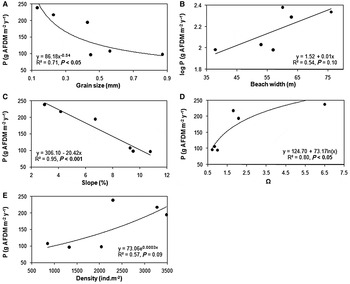
Emerita brasiliensis production was related to either environmental traits or population parameters. Production was negatively related to mean grain size and slope, and positively related to Dean's parameter and beach width (the latter marginally significant) (Figure 1A–D); i.e. higher production estimates occurred on wider dissipative beaches with finer grains and gentler slopes. Production was also marginally and positively related to population density (Figure 1E).
Significant (P values in bold) and marginally significant relationships between annual production (P) and (A) grain size, (B) beach width, (C) beach slope, (D) Dean's parameter and (E) density.

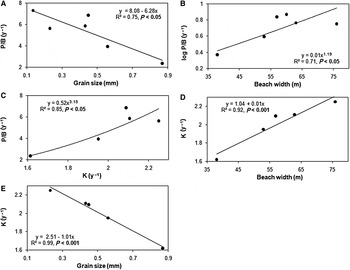
As with production, P/B ratio was related to both environmental and biological features. The relationship between P/B and mean grain size was negative, whereas P/B ratio increased as beach width increased (Figure 2A, B). P/B ratio was not related to the other environmental variables considered in this study. Regarding independent biological variables, P/B ratio was not related to mean body mass or lifespan. On the other hand, the curvature parameter of the von Bertalanffy growth function (K) was positively related to P/B ratio of E. brasiliensis (Figure 2C). Similarly, K values were related negatively to grain size and positively to beach width (Figure 2D, E).
Significant relationships between annual P/B ratio and (A) grain size, (B) beach width, (C) curvature parameter of the von Bertalanffy growth function (K), and between K and (D) beach width and (E) grain size. Note: the K value for the population from Cassino beach is not available.

DISCUSSION
Although the dataset available on production and P/B ratios of the mole crab Emerita brasiliensis is limited, some trends were identified for these two important population parameters. The production of E. brasiliensis was related to both environmental (grain size and beach slope) and biotic factors (density). Higher production on wider beaches with finer grains and gentler slopes indicates that this decapod attains higher production in more intermediate/dissipative conditions. This result agrees with the ‘habitat harshness hypothesis’ (HHH: Defeo et al., Reference Defeo, Gómez and Lercari2001; Defeo & Martínez, Reference Defeo and Martínez2003), which postulates that intertidal species such as E. brasiliensis drive more energy to their maintenance in the harsher conditions of reflective beaches, resulting in lower abundance and growth rate than on dissipative beaches (Celentano & Defeo, Reference Celentano and Defeo2006; Celentano et al., Reference Celentano, Gutiérrez and Defeo2010). In this context, the positive effects of less severe intermediate/dissipative conditions (wider beaches with finer grains) on density and growth rates (K) contribute to the higher production of E. brasiliensis on these beach types.
In addition to the more benign swash climate on intermediate/dissipative beaches, the higher density and production of the filter feeder E. brasiliensis also derives from high food availability due to the presence of a wide surf zone rich in phytoplankton (McLachlan, Reference McLachlan1980; Celentano et al., Reference Celentano, Gutiérrez and Defeo2010). Therefore, the very high density values, and mainly production values of E. brasiliensis on the dissipative Cassino beach (Table 2) were attributed to the very high food availability provided by surf zone diatoms (Gianuca, Reference Gianuca1985). Although R. da Marambaia and Massambaba were classified as intermediate beaches, the high E. brasiliensis production on these beaches suggests that they also provide a good level of food availability for this filter feeder. This assumption is reinforced by the idea that production indicates the intensity of resources used by a population (Benke, Reference Benke, Hauer and Lamberti1996). In fact, E. brasiliensis has high production even on reflective beaches, with values well above the mean global estimate for sandy beach macrofauna and for molluscs and crustaceans that inhabit these environments (Petracco et al., Reference Petracco, Cardoso and Turra2013). High production of the mole crab results both from high mass-specific growth rate deriving from the high curvature parameter K (>1.6 y−1), and high biomass (B) (Veloso & Cardoso, Reference Veloso and Cardoso1999; Petracco et al., Reference Petracco, Veloso and Cardoso2003, Reference Petracco, Cardoso, Corbisier and Turra2012a; Veloso & Sallorenzo, Reference Veloso and Sallorenzo2010), although these population parameters are often negatively correlated (Huryn & Wallace, Reference Huryn and Wallace2000).
Similarly, P/B ratio was related to both environmental and biological variables. With reference to environmental variables, P/B ratio followed a pattern similar to production, with higher values on beaches with dissipative characteristics, i.e. beaches with finer grains and larger width. These higher P/B values can be attributed to higher values of curvature parameter (K) on intermediate/dissipative beaches. Higher values of K obtained for intertidal forms under dissipative physical characteristics (Table 2) are consistent with the habitat harshness hypothesis (HHH) although no clear response has been observed for the growth rate of males of E. brasiliensis (Defeo et al., Reference Defeo, Gómez and Lercari2001; Cardoso et al., Reference Cardoso, Veloso and Caetano2003; Celentano & Defeo, Reference Celentano and Defeo2006). Considering that P/B ratio is an important variable, which summarizes the dynamic relationship between growth rate, biomass and production (Huryn & Benke, Reference Huryn, Benke, Hildrew, Raffaelli and Edmonds-Brown2007), the higher the value of K for a population, the higher the P/B of this population tends to be.
The P/B ratio is also strongly related to the size structure of a population (Benke & Huryn, Reference Benke, Huryn, Hauer and Lamberti2006). Emerita brasiliensis populations from dissipative beaches (source habitats: Celentano et al., Reference Celentano, Gutiérrez and Defeo2010) generally have polymodal length-frequency distribution (LFD). On the other hand, on reflective beaches (sink habitats: Celentano et al., Reference Celentano, Gutiérrez and Defeo2010), LFDs are generally irregular with scarcity of older individuals and megalopae due to higher mortality and scarcity of recruitment in these beach types (Celentano & Defeo, Reference Celentano and Defeo2006; Celentano et al., Reference Celentano, Gutiérrez and Defeo2010). Although E. brasiliensis populations on intermediate/dissipative beaches show LFDs with individuals of larger size classes, these populations often have a large percentage of newly recruited individuals, increasing their P/B ratio (e.g. R. da Marambaia: see figure 3 in Cardoso et al., Reference Cardoso, Veloso and Caetano2003). On the other hand, populations of reflective beaches may show varied LFDs, either with low percentage of recruits, and consequently, lower values of P/B ratio (Table 2) (e.g. Grumari: see figure 3 in Cardoso et al., Reference Cardoso, Veloso and Caetano2003), or with high percentage of this population component, and consequently, high P/B ratio (Prainha: see figures 3 & 4 in Petracco et al., Reference Petracco, Veloso and Cardoso2003).
Higher K values and generally higher proportions of smaller individuals can satisfactorily explain the higher P/B ratio of E. brasiliensis in intermediate/dissipative conditions. However, considering that the higher P/B ratio for the supralittoral amphipods in dissipative conditions was explained by Petracco et al. (Reference Petracco, Cardoso and Turra2013) based on the higher mortality on dissipative beaches (habitat safety hypothesis (HSH): Defeo & Gómez, Reference Defeo and Gómez2005) and on the similarity between P/B ratio and mortality rate (Z) (Allen, Reference Allen1971), higher P/B ratios and mortality rates on reflective beaches are also expected based on HHH for intertidal forms such as E. brasiliensis. The absence of mortality estimates for some E. brasiliensis populations of the dataset prevents simultaneous comparisons between Z and P/B ratio responses to physical characteristics. Therefore, further studies are required on the effects of physical characteristics on P/B ratios of intertidal and supralittoral forms based on HHH and HSH (Defeo et al., Reference Defeo, Gómez and Lercari2001; Defeo & Martínez, Reference Defeo and Martínez2003; Defeo & Gómez, Reference Defeo and Gómez2005) to corroborate the pattern of this important population parameter.
The high motility of E. brasiliensis, which enables its survival in the harsher swash zone of exposed beaches with different morphodynamic states, is a characteristic that is also frequently related to high P/B ratio (Cusson & Bourget, Reference Cusson and Bourget2005). Consequently, unlike the general negative relationship between P/B and mean body mass, E. brasiliensis shows higher P/B ratios than most species with lower mean body mass, such as isopods and polychaetes (Petracco et al., Reference Petracco, Cardoso, Corbisier and Turra2012a, Reference Petracco, Cardoso and Turra2013). The absence of a relation between P/B ratio and lifespan in this study is unexpected, since the variable lifespan is usually the most frequently related to P/B ratio (Cusson & Bourget, Reference Cusson and Bourget2005; Petracco et al., Reference Petracco, Cardoso and Turra2013). This result seems to be due to different criteria used to estimate this variable. In fact, some lifespan estimates on subtropical beaches (>1.5 years: Jaconé and Massambaba) contrasted with others obtained in a similar latitude and morphodynamic state (0.7–1.0 years: Table 2), and were unexpectedly longer than the ones estimated on Uruguayan beaches (>1.0 years: Defeo et al., Reference Defeo, Gómez and Lercari2001). Furthermore, the limited number of estimates in the dataset used here is also responsible for the lack of relationship of P/B ratio with lifespan and mean body mass.
One of the major goals in the study of secondary production has been the development and validation of empirical models to estimate secondary production without the need for expensive and time-consuming sampling programmes (Brey, Reference Brey2001; Cusson & Bourget, Reference Cusson and Bourget2005; Petracco et al., Reference Petracco, Cardoso, Corbisier and Turra2012b; Beukema & Dekker, Reference Beukema and Dekker2013). Therefore, some relationships between production and P/B ratio and both biological and physical variables indicate that the development of a ‘short-cut’ approach to estimate E. brasiliensis production is a promising prospect. However, a high number of production estimates throughout the geographic range of occurrence of this species, mainly between latitudes of 20 and 30°S and on beaches with different physical characteristics, is required for the elaboration of a reliable empirical model to estimate the production of the mole crab.
In summary, despite the limited number of E. brasiliensis production estimates available, some general production and P/B ratio macroscale trends were observed. The results obtained showed that populations on beaches with intermediate/dissipative characteristics (wider beaches width finer grains and gentler slopes) have higher production than those with reflective characteristics (narrower beaches with medium-coarse grains and steeper slopes). Similarly, P/B ratio increases from reflective to intermediate/dissipative beaches due to higher K values and relative frequency of newly settled recruits in the latter.
ACKNOWLEDGEMENTS
We thank our colleagues who provided information from their studies and thus contributed to the development of this study. Thanks are also due to Dr Omar Defeo, and an anonymous reviewer for their critical reading and valuable suggestions on the final manuscript. This paper is part of the Postdoctoral degree by M.P. at Instituto Oceanográfico da Universidade de São Paulo (IOUSP).
FINANCIAL SUPPORT
This study was supported by National Council for Scientific and Technological Development-Brazil (CNPq: Process no. 163181/2011-0). M. Petracco thanks ‘Fundação de Amparo e Desenvolvimento da Pesquisa (FADESP) e Pró-Reitoria de Pesquisa e Pós-Graduação (PROPESP)/UFPA’ for providing the financial support to the English revision.