Introduction
The success of biological control depends on the selection of the correct biological control agent, such as a parasitoid, production of the agent, natural conditions and the methods employed (Greathead & Waage, Reference Greathead and Waage1983). Temperature, humidity and photoperiod are important factors in the production of biological control agents under laboratory conditions (Liying, Reference Liying1986). However, the suitability of its host, and its type, size, stage, age, number and the presence of superparasitism or hyperparasitism are other important factors in the success of mass production of a biological control agent (Salt, Reference Salt1938; Arthur & Wylie, Reference Arthur and Wylie1959; Vinson & Ivantsch, Reference Vinson and Ivantsch1980; Gülel, Reference Gülel1982, Reference Gülel1987; Harvey et al., Reference Harvey, Harvey and Thompson1993, Reference Harvey, Bezemer, Elzinga and Strand2004; Heinz, Reference Heinz1998; Sagarra & Vincent, Reference Sagarra and Vincent1999; Harbison et al., Reference Harbison, Legaspi, Fabritius, Saldana, Legaspi and Enkegaard2001; King, Reference King2002; Martinez-Martinez & Bernal, Reference Martinez-Martinez and Bernal2002; Uçkan & Gülel, Reference Uçkan and Gülel2002; Ueno, Reference Ueno2004; Gonzalez et al., Reference Gonzalez, Matthews and Matthews2005).
The relationship between the host and parasitoid is fundamental to biological control. The female parasitoid has the most important role in this relationship. Thus, the sex ratio of parasitoid offspring is also important for biological control (Hamilton, Reference Hamilton1967; King, Reference King1987). The host has a major effect on the sex ratio of hymenopteran parasitoid offspring (Kopyl, Reference Kopyl1983; King et al., Reference King, Crowe and Skinner1995; Heinz, Reference Heinz1998; Sagarra & Vincent, Reference Sagarra and Vincent1999; King, Reference King2002; Uçkan & Gülel, Reference Uçkan and Gülel2002; Ueno, Reference Ueno2005). The host not only affects development of the parasitoid but also affects its behaviour and physiology in the adult stage (Gülel, Reference Gülel1982; Mehrnejad, Reference Mehrnejad2003).
Dibrachys boarmiae (Walker, 1863) (Hymenoptera: Pteromalidae) is a small, black wasp, approximately 1.5–2.2 mm in length. It is a gregarious, idiobiont ectoparasitoid of some harmful lepidopteran cocoon-spinning prepupae and pupae. Females of D. boarmiae, which has a female-biased sex ratio, search for and locate their hosts and then lay eggs inside the cocoon, externally on the integument of the larva or pupa. The emerging wasp larvae feed as ectoparasitoids, pupating near the body of the host after approximately 13–14 days. Adult males emerge before females. Mating takes place soon after adult emergence and males mate with more than one female. Because this species has a haplo(diplo)id sex determination, unmated females produce only males, while mated females produce both males and females. Gülel (Reference Gülel1982) reported D. boarmiae as a potential biological control agent because of its specific advantages in mass production and behaviour. Although there have been many studies about the host requirements for different parasitoids, the literature concerning D. boarmiae is limited (Gülel, Reference Gülel1988a, Reference Gülel1991). The current study, therefore, investigated the effects of host species, stage and size on the clutch size and sex ratio of D. boarmiae offspring by using three host species, the greater wax moth Galleria mellonella (Linnaeus, 1758), small wax moth Achroia grisella (Fabricius, 1794), and the early stage solitary larval endoparasitoid, Apanteles galleriae (Wilkinson, 1932).
Materials and methods
Host cultures
Successive stock cultures of G. mellonella were established from adult G. mellonella obtained from a resident laboratory culture. Five pairs of 3–5 day old G. mellonella adults from the culture were placed in a 5-l jar, which was sealed with a mesh cloth tied around its neck. Prepupae and pupae from this culture were used in the experiments. Sterile honey wax was used as G. mellonella food and was supplied ad libitum. A. grisella were also produced via the method explained for G. mellonella. The third host, Ap. galleriae, is an endoparasitoid of G. mellonella and A. grisella early stage instars. Five pairs of 3–5 day old Ap. galleriae adults (five males, five females) were placed in five separate 0.5-l jars, each containing early instars of G. mellonella (obtained from two females) and sealed around the neck. Sterile honey wax was also used as the food in these 0.5-l jars. All host stock cultures were maintained under laboratory conditions at 25±2°C and 70±5% relative humidity. A specific photoperiod regime was not employed during the studies.
Parasitoid culture
The parasitoid rears well in G. mellonella (Gülel, Reference Gülel1982). Dibrachys boarmiae adults were produced from G. mellonella that were originally sourced from infected beeswax received from beekeepers. To obtain G. mellonella prepupae, late stage larvae from stock cultures were placed in jars filled with shredded paper and then sealed. The five jars were maintained at 25±2°C and 70±5% relative humidity. One or two prepupae from these jars were placed in each of ten, 10-ml laboratory test tubes, together with two female and one male D. boarmiae and 3–5 g of adult parasitoid food containing 25% honey and 75% honey wax. These ten tubes were maintained under the prescribed laboratory conditions to produce the parasitoid stock cultures. Ten days later, adult male and female parasitoids and parasitoid food were removed from the tubes. Five days after that, the host or hosts in each tube were removed, the ends of the coccoons were removed with scissors, and the parasitoid pupae were returned to the same tube. Thus, newly emerged adult parasitoids did not come into contact with the host G. mellonella prior to the experiment.
The effect of host species and stage on clutch size and sex ratio of the parasitoid
Fifteen female D. boarmiae from 0–3 days of age and ten male D. boarmiae from 3–5 days of age were placed in the same container for one day. The fifteen mated females were then divided into three groups of five. Each mated female in the first group was placed separately with a G. mellonella prepupa and 3–5 g of parasitoid food in a 10-ml laboratory test tube. The five mated females in the second and third groups were placed with an A. grisella and Ap. galleriae prepupa, respectively. After ten days, adult parasitoids and parasitoid food were removed from all tubes. Twenty days later, the total number and sexes of adult parasitoids obtained from each group were calculated. All of these experiments were repeated with pupae to determine the effect of host stage on clutch size and sex ratio of the parasitoid. Statistical comparisons among host species were done separately for each host stage.
The effect of host size on clutch size and sex ratio of the parasitoid
In determining the effects of host size, the prepupae and pupae of only G. mellonella and A. grisella were used. Three different weight classes were established for each host species on the basis of fresh weight; 0.11–0.13 g, 0.14–0.16 g and 0.17–0.19 g of the prepupae and pupae of G. mellonella. For prepupae and pupae of A. grisella, the three groups weighed; 0.02–0.03 g, 0.03–0.04 g and 0.04–0.05 g. Each weight group consisted of a host, parasitoid food and a female parasitoid in each of five different 10-ml test tubes, as described above. Statistical analyses were done seperately for each host stage of each host species.
Statistical analysis
Clutch size data were analyzed using generalized linear models with Poisson distribution and identity link functions. Significant main effects and interactions were identified with the simplified model. Comparisons between clutch sizes were by independent samples t-test. The sex ratio data (proportion of males) were analyzed using the binominal errors and logit link function. Differences between sex ratios were analysed with Mann-Whitney U and Kolmogorov-Smirnov (K-S) test. All analyses were completed with the statistical package SPSS v.15.0 for Windows with significance set at the 5% level.
Results
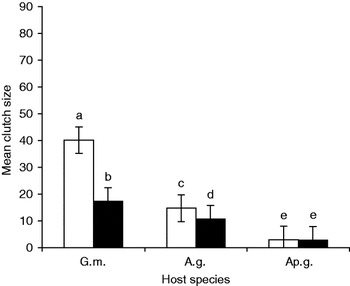
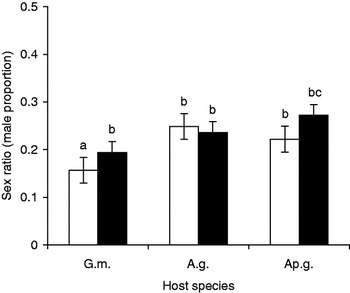
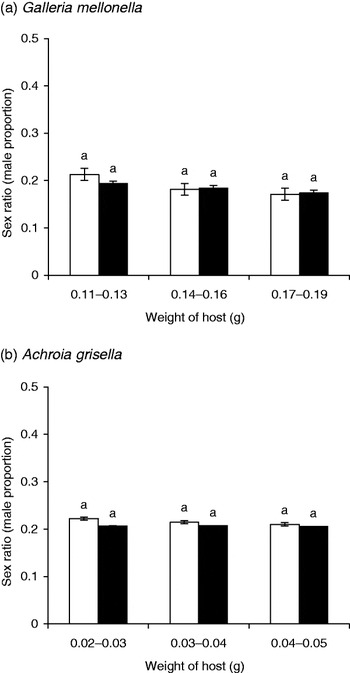
Sex ratios were female biased for both the prepupae and pupae of all three host species (tables 1 and 2, fig. 3). For prepupae, the sex ratio was greater for G. mellonella than for the other two host species (between G. mellonella and A. grisella; Mann-Whitney U=55.000, P=0.016; between G. mellonella and A. galleriae; Kolmogorov-Smirnov Z=1.643, P=0.009) (table 1). In contrast, there was less significant difference in sex ratio among host species for pupae (between G. mellonella and A. grisella; Mann-Whitney U=82.500, P=0.217; between G. mellonella and A. galleriae; Mann-Whitney U=46.000, P=0.005; between A. grisella and A. galleriae; Mann-Whitney U=55.500, P=0.016 (table 2). There was no significant interaction between host species and host stage (χ2=0.018, P=0.991) for sex ratio of parasitoid offspring (tables 1 and 2). For all three hosts, there was no significant difference between the sex ratios of D. boarmiae from the pupae and prepupae (for G. mellonella, between prepupae and pupae; Mann-Whitney U=43.000, P=0.003; for A. galleriae, between prepupae and pupae; Mann-Whitney U=112.000, P=1.000; for A. galleriae, between prepupae and pupae; Mann-Whitney U=86.500, P=0.285 (tables 1 and 2, fig. 1), and the sex ratio of offspring was not affected by the stage and weight of the host species (χ2<0.0001, P=0.985; tables 3 and 4, figs 3 and 4).
Effects of host species and stages on clutch size (mean±SE) of parasitoid, Dibrachys boarmiae. G.m., Galleria mellonella; A.g., Achoria grisella; Ap.g., Apanteles galleriae. Error bars represent standard errors of means and the different letter on error bars indicate significant differences (independent samples t-test, P<0.05) (□, prepupa; ▪, pupa).

The effect of host species on clutch size (mean±SE) and sex ratio (proportion of male) of Dibrachys boarmiae.

* , Each represents three repeats of five individuals (n=15).
** , The differences between the values in the same columm followed by the same letter are not statistically significant (using Mann-Whitney U test or Kolmogorov-Smirnov (K-S) test at P>0.05).
*** , The differences between the values in the same columm followed by the same letter are not statistically significant (using Tukey HSD test at P>0.05).
The effect of host stage on clutch size (mean±SE) and sex ratio (proportion of male) of Dibrachys boarmiae.

* , Each represents three repeats of five individuals (n=15).
** , The differences between the values in the same columm followed by the same letter are not statistically significant (using Mann-Whitney U test or Kolmogorov-Smirnov (K-S) test at P>0.05).
*** , The differences between the values in the same columm followed by the same letter are not statistically significant (using Tukey HSD test at P>0.05).
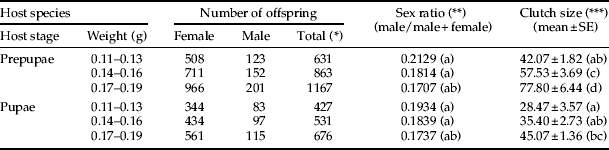
The effect of stage and size of host, Galleria mellonella, on clutch size (mean±SE) and sex ratio (proportion of male) of Dibrachys boarmiae.

* , Each represents three repeats of five individuals (n=15).
** , The differences between the values in the same columm followed by the same letter are not statistically significant (using Mann-Whitney U test or Kolmogorov-Smirnov (K-S) test at P>0.05).
*** , The differences between the values in the same columm followed by the same letter are not statistically significant (using Tukey HSD test at P>0.05).
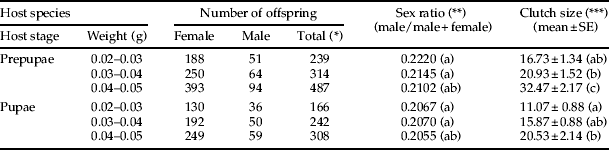
The effect of stage and size of host, Achroia grisella, on clutch size (mean±SE) and sex ratio (proportion of male) of Dibrachys boarmiae.

* , Each represents three repeats of five individuals (n=15).
** , The differences between the values in the same columm followed by the same letter are not statistically significant (using Mann-Whitney U test or Kolmogorov-Smirnov (K-S) test at P>0.05).
*** , The differences between the values in the same columm followed by the same letter are not statistically significant (using Tukey HSD test at P>0.05).
Differences among host species in clutch size per female were significant (tukey HSD, F=209,061, df=44, P<0.0001) (table 1). We found a significant interaction between host species and host stage (χ2=267.117, P<0.0001) in clutch size per female (tables 1 and 2). Clutch sizes per female were significantly lower for the pupal stages than for the prepupal stage for G. mellonella (independent sample t-test; t=9.936, df=28, 2tP<0.0001) and A. grisella (independent sample t-test; t=2.884, df=28, 2tP=0.007) (tables 1 and 2, fig. 1). While there was a significant interaction between prepupal and pupal stages of G. mellonella (χ2=38.29, P<0.001), there was no significant interaction between prepupal and pupal stages of A. grisella (χ2=4.261, P=0.39) in clutch size per female (tables 1 and 2). However, the difference between the prepupal and pupal stages for both A. galleriae was not significant (independent sample t-test; t=0.493, df=28, 2tP<2.884) (tables 1 and 2, fig. 1).
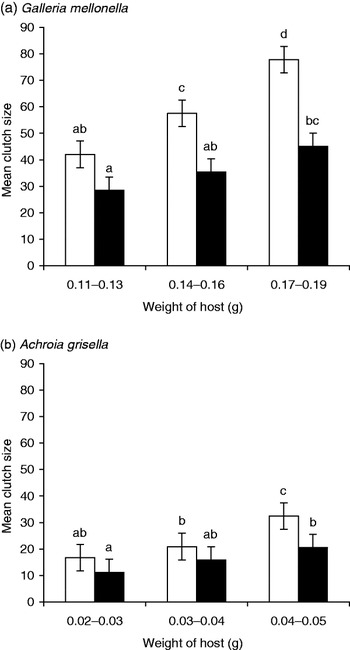
Generally, as the host weight increased within a host stage, the clutch size increased (tables 3 and 4). There was no significant interaction between host species and host stage (χ2=2.832, P=0.092) in clutch size (tables 3 and 4). For each host species, the clutch size from the prepupae of both hosts was significantly greater than from the pupae for given host weight class (tables 3 and 4, fig. 2). We found significant interactions between host species (G. mellonella and A. grisella; χ2=649.832, P<0.0001) and host stages (prepupa and pupa; χ2=64.707, P<0.0001) in clutch size (tables 3 and 4). We also found significant interactions between host stage and host weight (χ2=2.400, P<0.0001) in clutch size (tables 3 and 4).
Effects of host species ((a) Galleria mellonella and (b) Achroia grisella) and size on clutch size (mean±SE) of parasitoid, Dibrachys boarmiae. Error bars represent standard errors of means and the different letter on error bars indicate significant differences (independent samples t-test, P<0.05) (□, prepupa; ▪, pupa).

Discussion
Dibrachys boarmiae generally attacks the prepupae and young pupae of cocoon-spinning host species (Gülel Reference Gülel1982; Uçkan & Gülel, Reference Uçkan and Gülel2002; Mehrnejad, Reference Mehrnejad2003; Sarikaya & Gülel, Reference Sarikaya and Gülel2004). Mehrnejad (Reference Mehrnejad2003) stated that the cocoon of the host is a critical factor in the host selection of the parasitoid. In studies, G. mellonella (Gülel, Reference Gülel1982, Reference Gülel1987, Reference Gülel1988a, b, 1989, 1991; Uçkan & Gülel, Reference Uçkan and Gülel2002; Mehrnejad, Reference Mehrnejad2003; Sarikaya & Gülel, Reference Sarikaya and Gülel2004), A. grisella (Gülel, Reference Gülel1982; Sarikaya & Gülel, Reference Sarikaya and Gülel2004), three Yponomeuta sp. (Gülel, Reference Gülel1982), Kermania pistaciella (Mehrnejad, Reference Mehrnejad2003) and Sitotroga cerealella (Mehrnejad, Reference Mehrnejad2003) have been used as hosts for D. boarmiae. To elicit new information, the present study also used Ap. galleriae as a host. It is an endoparasitoid which D. boarmiae hyperparasitises in the prepupal or pupal stage (Uçkan & Gülel, Reference Uçkan and Gülel2002). During earlier experiments, the authors tested different host species, such as the house fly, Musca domestica, which do not spin a cocoon. When its prepupae and pupae were offered to the parasitoid, it examined and paralyzed them but did not lay eggs on them. In the following days, neither parasitoids nor adult host flies emerged (A. Sarikaya, personal observation).
In hymenopteran parasitoids, the clutch size and sex ratio in the offspring obtained from big host species or from smaller hosts with weak defence is generally higher (Doutt, Reference Doutt1959; Gross, Reference Gross1993; Godfray, Reference Godfray1994; Quicke, Reference Quicke1997). Clutch sizes produced per female for the three host species utilised in this study varied (table 1). These differences in the clutch size of host species are similar to those determined in other Hymenoptera (Doutt, Reference Doutt1959; Vinson & Ivantsch, Reference Vinson and Ivantsch1980; Godfray, Reference Godfray1994; Quicke, Reference Quicke1997).
Given that females produce more offspring from larger hosts, it is not surprising that D. boarmiae females prefer larger hosts (Gülel, Reference Gülel1982), as do the majority of hymenopteran parasitoids (Doutt, Reference Doutt1959; Godfray, Reference Godfray1994; Quicke, Reference Quicke1997). There are differences in the chemical composition of different hosts. This leads to a difference in the food quality available to the preadult parasitoid larvae developing on or in them. For hymenopteran parasitoids, the host and its size affect both the speed of preadult development and body size in the adult (Doutt, Reference Doutt1959; Gülel, Reference Gülel1982; Godfray, Reference Godfray1994; Quicke, Reference Quicke1997). For these reasons, the differences found in our study may be explained by host effects. In holometabolous insects, the chemical composition of individuals changes slightly when transforming from one stage into a completely different one, such as from larva to prepupa or from prepupa to pupa. This change in chemical composition facilitates the change from one stage to another and contributes to the maintenance of holometabolic development. Therefore, the differences between the proportion of males to females in the offspring obtained from the different stages of the same host species, such as from prepupae and pupae (tables 1 and 2, fig. 1), may be occurring because the nutritional status of the prepupae and pupae are different. The differences in clutch size per female of the three host species in the current study, therefore, may be attributable to the hosts supplying different levels of nutrition in terms of both quality and quantity.
Mehrnejad (Reference Mehrnejad2003) found in a study conducted with D. boarmiae that the (female:male) ratio in the offspring of the parasitoid reared on G. mellonella was 11.5:1. This was in contrast to the ratio of 4:1 reported by Gülel (Reference Gülel1982). In the current study, the authors found the same sex ratio to be 4:1, thus corroborating Gülel's (Reference Gülel1982) findings. As stated by Mehrnejad (Reference Mehrnejad2003), the difference between findings may be due to the differences in experimental conditions or parasitoid strain.
In the current study, the different host species, stages and sizes did not cause much difference in sex ratio. This result supports those of previous studies conducted with D. boarmiae (Gülel, Reference Gülel1982; Mehrnejad, Reference Mehrnejad2003; Sarikaya & Gülel, Reference Sarikaya and Gülel2004). It was surprising that few significant differences existed between the sex ratios in the parasitoid offspring obtained from different host species or from different stages of the same one (tables 1 and 2, fig. 1), because it is generally accepted that in hymenopteran parasitoids, females generally lay fewer fertilized eggs in unsuitable or small host species (Doutt, Reference Doutt1959; Gross, Reference Gross1993; Godfray, Reference Godfray1994; Quicke, Reference Quicke1997). The current study demonstrated, through the differences in clutch size (tables 1 and 2, fig. 1) that D. boarmiae lays different numbers of eggs on the prepupa and pupa. The similarity between the sex ratio in the offspring obtained from prepupae and pupae of different host species may be explained by D. boarmiae females laying a similar number of eggs in the prepupae and pupae of the host species, regardless of size (tables 3 and 4, figs 3 and 4). In hymenopteran parasitoids which can parasitise, the different stages of the same host, the clutch size per female obtained from each stage may be different (Doutt, Reference Doutt1959; Godfray, Reference Godfray1994; Quicke, Reference Quicke1997; Mehrnejad, Reference Mehrnejad2003). In the current study, results for two of the three host species, namely G. mellonella and A. grisella, corroborated the results of those studies. Generally, the number of offspring obtained from pupae is smaller than from prepupae. That was also true for G. mellonella and A. grisella in the present study (tables 1 and 2, fig. 1), and may stem from D. boarmiae laying fewer eggs on pupae, as noted by Gülel (Reference Gülel1982) and corroborated by the current study.
Effects of host species (G.m., Galleria mellonella; A.g., Achoria grisella; Ap.g., Apanteles galleriae) and host stages (prepupa and pupa) on sex ratio (proportion of male) of parasitoid, Dibrachys boarmiae. Error bars represent standard errors of means and the different letter on error bars indicate significant differences (Mann-Whitney U test or Kolmogorov-Smirnov (K-S) test, P<0.05) (□, prepupa; ▪, pupa).

Effects of host species ((a) Galleria mellonella and (b) Achroia grisella) and host size (weight) on sex ratio (proportion of male) of parasitoid, Dibrachys boarmiae. Error bars represent standard errors of means and the different letter on error bars indicate significant differences (Mann-Whitney U test or Kolmogorov-Smirnov (K-S) test, P<0.05) (□, prepupa; ▪, pupa).

In this study, the increase in clutch size of D. boarmiae with increased host weight within a species and also from small to large host species is consistent with other studies (Doutt, Reference Doutt1959; Godfray, Reference Godfray1994; Quicke, Reference Quicke1997; Sarikaya & Gülel, Reference Sarikaya and Gülel2004).
In studying the effects of host weight on the clutch size and sex ratio of offspring, it was demonstrated that less available food causes less offspring per female (tables 3 and 4, figs 2 and 4). This result corroborates results from studies of superparasitism in other hymenopteran parasitoids. As there is a decrease in food supply per larvae in superparasitism, some larvae die before they are fully developed. As a result, clutch size per female obtained from a host also decreases (Gülel, Reference Gülel1987; van Alphen & Visser, Reference van Alphen and Visser1990; Harvey et al., Reference Harvey, Harvey and Thompson1993). However, a study of superparasitism was not part of the experimental design in the current study. Its design allowed for the possibility of superparasitism because this occurs under natural conditions, and excluding the possibility of superparasitism would have biased the sex ratio of the offspring. The amount of food per larvae was altered by modifying the weight of the host. It is possible that, in some cases, clutch size per female decreased because of larval deaths due to insufficiency of food. In the current study, a change in host size led to a significant change in clutch size but not to a significant difference in the sex ratio of offspring obtained (tables 3 and 4, figs 2 and 4).
Female-biased D. boarmiae develops quickly, can parasitise different host species and different stages of the same species and can reproduce continuously during the whole year, allowing adult parasitoids to rapidly multiply, which means that it has the characteristics of a useful biological control agent (Gülel, Reference Gülel1982, Reference Gülel1987, Reference Gülel1988a,Reference Gülelb, Reference Gülel1989, Reference Gülel1991; Uçkan & Gülel, Reference Uçkan and Gülel2002; Mehrnejad, Reference Mehrnejad2003; Sarikaya & Gülel, Reference Sarikaya and Gülel2004). According to the findings of this study, D. boarmiae is a good candidate for use as a biological control agent against G. mellonella and A. grisella, which are economically important parasites of beehives (Gülel, Reference Gülel1982; Sarikaya & Gülel, Reference Sarikaya and Gülel2004). In addition, although the value of D. boarmiae as a biological control agent is reduced by the fact that in G. mellonella it is a hyperparasitoid on early stage larvae of the endoparasitoid Ap. galleriae, it is clearly useful in clarifying host species-parasitoid relationships (Gülel, Reference Gülel1982; Uçkan & Gülel, Reference Uçkan and Gülel2002).
If D. boarmiae is to be used as a biological control agent, the following recommendations are relevant: (i) the largest possible hosts should be used when mass producing the parasitoid in the laboratory (Gülel, Reference Gülel1982; Sarikaya & Gülel, Reference Sarikaya and Gülel2004); (ii) the prepupae of the host should be utilised (Gülel, Reference Gülel1982; Mehrnejad, Reference Mehrnejad2003; Sarikaya & Gülel, Reference Sarikaya and Gülel2004); (iii) the ambient temperature should not exceed 32.5°C during both mass production and release (Mehrnejad, Reference Mehrnejad2003); (iv) cocoon-spinning species should be targetted (Mehrnejad, Reference Mehrnejad2003); (v) the effect of its hyperparasitic behaviour should be factored in (Uçkan & Gülel, Reference Uçkan and Gülel2002); and (vi) adult parasitoids more than ten days old should not be released as 90% of their eggs are laid in the first ten days of their lives (Mehrnejad, Reference Mehrnejad2003).
Acknowledgement
The authors thank Gregory T. Sullivan of OYDEM, Ondokuz Mayis University in Samsun, Turkey for editing an earlier version of this manuscript and anonymous referees for their extremely helpful comments on the manuscript.