Introduction
Across nations, policy and advocacy initiatives are increasingly based upon the premise that social relationships play a vital role in helping people to live well with dementia. Although dementia can have profound negative effects on relationships (Evans and Lee, Reference Evans and Lee2014), emerging research has demonstrated how positive family relationships (Ablitt et al., Reference Ablitt, Jones and Muers2009; La Fontaine and Oyebode, Reference La Fontaine and Oyebode2014), friendships (e.g. Harris, Reference Harris2012, Reference Harris2013), peer support groups, and relationships (Beard and Fox, Reference Beard and Fox2008; Hochgraeber et al., Reference Hochgraeber, Riesner and Schoppmann2013) can all be sustained in spite of dementia. Better cognitive functioning has also been noted when people with dementia are engaged with larger social networks (Bennett et al., Reference Bennett, Schneider, Tang, Arnold and Wilson2006). Thus, people living with dementia inevitably do so within a social world; the subjective experience of the condition is shaped by multi-level social contexts and the quality of social relationships is interwoven with the preservation of identity (La Fontaine and Oyebode, Reference La Fontaine and Oyebode2014) and well-being (Ablitt et al., Reference Ablitt, Jones and Muers2009).
Accounts of selfhood in dementia depict an interplay between the ways in which individuals are socially positioned and the way they view themselves. For example, Sabat (Reference Sabat2001) suggests that in living with dementia, identity is shaped by (i) the individual's view of themselves and the impact of dementia; (ii) the reactions and positions directed toward them by others; and (iii) the way in which the individual reacts to the responses of others. Well-being in dementia is maintained and promoted by positive, person-centered interactions that meet key psychological needs, such as attachment, comfort, and inclusion (Kitwood, Reference Kitwood1997). Negative responses and attitudes toward the person can be internalized and thus influence the ability to maintain a valued sense of self (MacRae, Reference MacRae2011; Earnshaw and Quinn, Reference Earnshaw and Quinn2012). Sabat (Reference Sabat2001, Reference Sabat and Harris2002) suggests that malignant positioning occurs when a person's behavior is understood in terms of negative qualities, stereotypes, and labels. Internalization of negative stereotypes by older people has a discernible negative impact, including reduced performance on cognitive tests (Levy, Reference Levy1996). When negative stereotypes are implicit within the relationships between others and people with dementia, these may inadvertently erode valued social roles and contribute to disability over and above that attributable to cognitive impairment.
The psychosocial approach represented in the work of Kitwood (Reference Kitwood1997) and Sabat (Reference Sabat2001) emphasizes how people with dementia can actively perceive and respond to the quality of their social relationships and how this is likely to influence their well-being. More broadly, a person's subjective and psychological well-being is inherently linked with the way in which they appraise their social environment and their ability to function within it. From a positive psychology perspective, Keyes (Reference Keyes1998) refers to this as “social well-being,” defined as the presence of positive beliefs about one's social environment (including community and society) as well as the perceived quality of one's relationship to it, in terms of feeling valued and accepted. It can be argued that social well-being is likely to be associated with aspects of social health, defined by Huber et al. (Reference Huber, Knottnerus, Green, van der Horst, Jadad, Kromhout and Schnabel2011) as the extent to which people are able to meet social obligations, participate and self-manage independently by using personal and social assets, despite limitations posed by illness. As such, the way that people living with dementia appraise and respond to interactions within their social world is potentially an important determinant of their social health and well-being. However, little is currently known about how these connections operate in terms of people's subjective lived experiences. Improving our understanding of the determinants of social health in dementia would facilitate the development and enhancement of practices and interventions in dementia care (Vernooij-Dassen and Jeon, Reference Vernooij-Dassen and Jeon2016).
There are existing systematic reviews in dementia that highlight experiences of stigma, isolation, and limitation by others, as well as the importance of social interaction (see, for example, Steeman et al., Reference Steeman, Casterlé, Dierckx, Godderis and Grypdonck2006; de Boer et al., Reference De Boer, Hertogh, Dröes, Riphagen, Jonker and Eefsting2007). However, these reviews have focused mostly on intrapersonal experiences and social processes have on the whole been assigned secondary importance, positioned as a supplemental part of the “impact” (de Boer et al., Reference De Boer, Hertogh, Dröes, Riphagen, Jonker and Eefsting2007, pp. 1026) or the “transitional process” (Steeman et al., Reference Steeman, Casterlé, Dierckx, Godderis and Grypdonck2006, pp. 730) of living with dementia. Studies exploring lived experiences of social processes in dementia have grown over the past decade. However, these have yet to be drawn together systematically to understand how people with dementia perceive and experience the views and responses of other people toward them and the influence that this has on aspects of self-hood and well-being in living with dementia.
This review therefore aimed to synthesize existing qualitative literature pertaining to how people with dementia subjectively experience their everyday, informal social relationships.
Methods
Search strategy
A systematic search of the literature was conducted using the electronic databases PsycINFO, MEDLINE, and CINAHL-Complete. Further data was sought through contact with relevant authors, scanning the reference lists of included papers, and hand-searching of key journals. The electronic search was completed in May 2016. A broad search strategy was designed to identify as many relevant studies as possible. This utilized a range of search terms derived from previous literature reviews relating to dementia (Steeman et al., Reference Steeman, Casterlé, Dierckx, Godderis and Grypdonck2006; de Boer et al., Reference De Boer, Hertogh, Dröes, Riphagen, Jonker and Eefsting2007; Wolverson et al., Reference Wolverson, Clarke and Moniz-Cook2016) as well as perceived responses to other mental and physical health conditions (Jacoby et al., Reference Jacoby, Snape and Baker2005; Ross and Goldner, Reference Ross and Goldner2009; Brohan et al., Reference Brohan, Slade, Clement and Thornicroft2010; Schomerus et al., Reference Schomerus2012). Limiters were applied to restrict the search to journal articles that were written in English and published in peer-reviewed journals after 1989, as the voices of participants with dementia were typically missing until this point (Lyman, Reference Lyman1989).
Search terms were related to: (i) dementia (dementia or Alzheimer's), (ii) social experiences/responses (social, societal, interaction, relationship, attitude, stigma, prejudice, discrimination, perception, perceive, stereotype, reaction, view, or public), and (iii) qualitative approaches: (qualitative, subjective, experience, or personal). Truncation of search terms was used where appropriate to capture a greater breadth of data.
Inclusion and exclusion strategies
Papers were initially excluded if they clearly did not pertain to lived experiences in dementia. Remaining papers were examined and included if they met all of the following criteria:
1. Aims: The study aimed to explore the social experiences of people with dementia, as evidenced by research aims, questions, or interview schedules. Papers were retained if these referred broadly to social factors or experiences, to social relationships (e.g. friendship or family relationships), or to more specific social processes (e.g. collective identity and stigma).
2. Methodology
(a) The study was clearly empirical as evidenced via a clear statement of analytic procedure.
(b) The study employed a qualitative approach, to capture participants’ subjective experiences.
3. Participants: The majority, or all, of the study's findings represented the perspectives of people with dementia, as evidenced by direct quotes. If studies included some participants who did not have dementia (e.g. spouses, or individuals with mild cognitive impairment), these were clearly differentiated in order to exclude them from data analysis or were checked to ensure that these participants represented less than 10% of the sample.
4. Findings: The study presented sufficient findings relating to the review questions.
5. Rigor: The study was published in a peer-reviewed journal.
6. Language: The study was written in English.
Papers were excluded if:
1. The study focused solely upon shared experiences of couplehood within the context of dementia, since this has been explored in a recent meta-synthesis (see Wadham et al., Reference Wadham, Simpson, Rust and Murray2016).
2. The study focused upon the relationships between people with dementia and health and social care professionals, since this review focused on the everyday, informal social experiences.
3. The study focused upon circumscribed events or experiences (such as receiving a diagnosis of dementia or the experience of mealtimes for people with dementia) rather than investigating broader, ongoing lived experiences.
Quality assessment
For this review, inclusion and exclusion criteria were set to ensure that priority was given to the likely relevance of papers in adding to current understandings of the concepts under review (see Dixon-Woods et al., Reference Dixon-Woods2006, for a rationale). All papers selected were therefore included in the methodological quality assessment. This was conducted using the National Institute for Health and Care Excellence methodology checklist for qualitative studies (NICE, 2012, Appendix H, pp. 2–12). Methodological quality was assessed by the first author with a subset (22% of papers) additionally checked by a peer researcher (MC). Initial ratings agreed on 77% of occasions and differences of opinion were then discussed thoroughly until a consensus decision was reached.
Data synthesis
Findings were synthesized using critical interpretative synthesis (Dixon-Woods et al., Reference Dixon-Woods2006) – an adaptation of meta-ethnography which also borrows techniques from grounded theory (see Barnett-Page and Thomas, Reference Barnett-Page and Thomas2009). Within this method, qualitative data is analyzed across a body of literature to identify common themes that are then integrated to produce a synthesizing argument. This refers to a new framework of concepts and connections that is in line with key questions underpinning the review and also captures the full range of data across the body of research. This is an iterative process involving a constant comparison of new themes or newly synthesized concepts against original findings. In this way, aspects of a concept that may appear across several papers can be reinterpreted and understood in terms of a new synthesized concept. Underpinning the synthesis is an ongoing critique of methodology and of the assumptions and discourses that may have shaped authors’ interpretations of their original findings.
This method was chosen as it allowed us to go beyond the theory and assumptions of a given study and consider each study's findings in relation to the context in which it was conducted. This, in turn, allowed us to prioritize the relevance of each paper toward our research question, in order to gain a fuller understanding of the social experiences of people with dementia. Throughout the process, the development of synthesized concepts was checked, double-checked and revised by drawing upon the expertise of clinicians working within the dementia field.
Results
Identification and classification of relevant studies
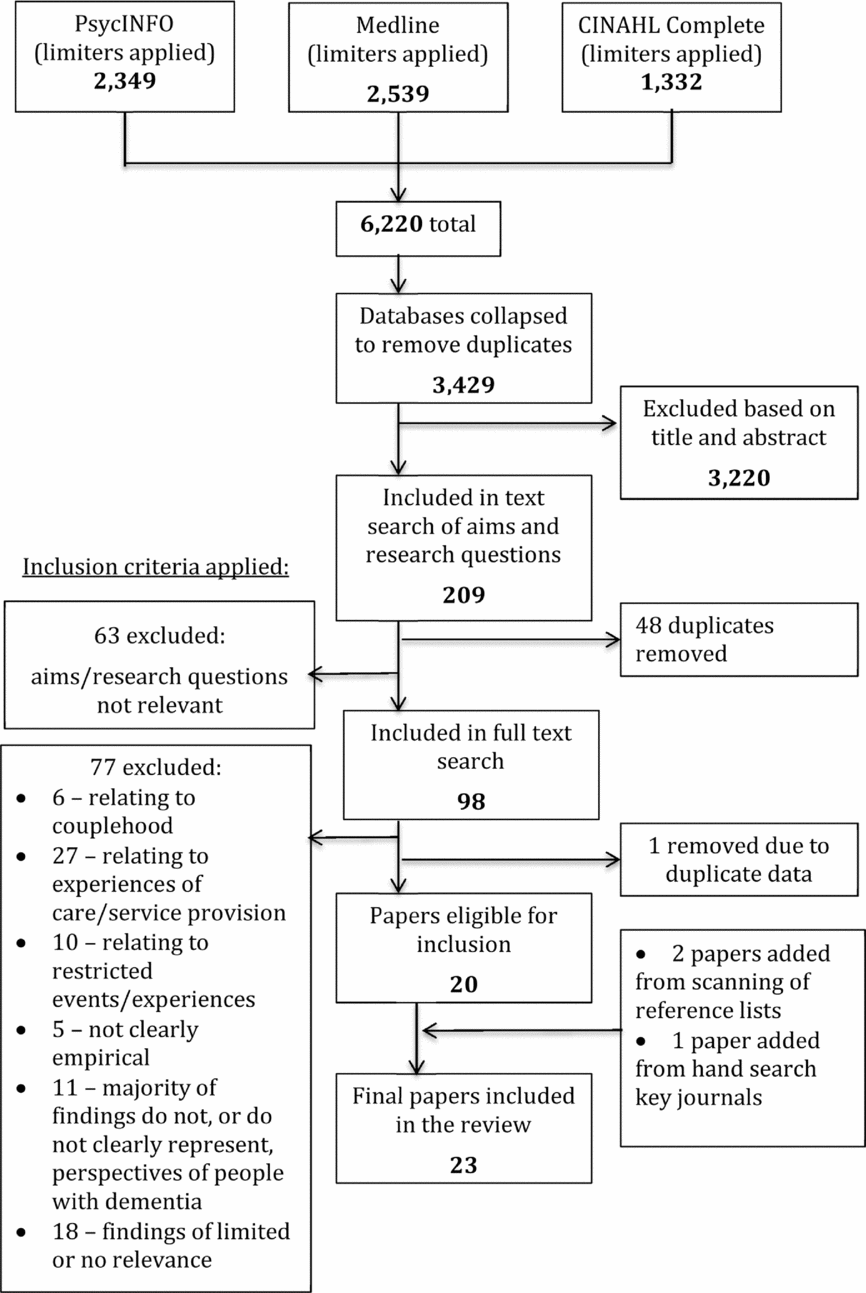
From the electronic database search, 20 papers met inclusion criteria, whereas 3 papers were added by hand searching key journals and scanning reference lists, resulting in a final collection of 23 papers (see Figure 1).
Flowchart depicting the paper selection process.

Characteristics of included studies
The majority of samples were drawn from the United Kingdom (7) and the USA (8), with others from Canada (3), Sweden (2) Norway (1), New Zealand (1), and China (1). Most studies focused upon the experience of Alzheimer's type dementia; however, type of dementia was not reported in seven studies, and in five studies (Harris, Reference Harris2004; Beard and Fox, Reference Beard and Fox2008; Örulv, Reference Örulv2012; Powers et al., Reference Powers, Dawson, Krestar, Yarry and Judge2016; Tranvåg et al., Reference Tranvåg, Petersen and Nåden2015), 26 out of 195 participants were reported to have mild cognitive impairment. The total number of participants with dementia or mild cognitive impairment (n = 26) was 401, but sample sizes varied widely, from one single case study (O'Connor et al., Reference O'Connor, Phinney and Hulko2010), to 114 participants (Powers et al., Reference Powers, Dawson, Krestar, Yarry and Judge2016). Age range also varied widely, from 35 to 95 years (lowest mean age reported = 56 years; and highest mean age = 81.8 years). For the purposes of this review, the perceptions and experiences of people living with dementia were systematically and selectively extracted from studies in which they were presented alongside those of carers, families or friends (Harris and Sterin, Reference Harris and Sterin1999; O'Connor et al., Reference O'Connor, Phinney and Hulko2010; Harris, Reference Harris2013; O'Sullivan et al., Reference O'Sullivan, Hocking and Spence2014).
Studies mostly used semi-structured interviews or focus groups, but some included observational data (Beard, Reference Beard2004; O'Connor et al., Reference O'Connor, Phinney and Hulko2010; Örulv, Reference Örulv2012; Bartlett, Reference Bartlett2014a, Reference Bartlett2014b), data from health and social care records (O'Connor et al., Reference O'Connor, Phinney and Hulko2010), diary entries, and photographs (Bartlett, Reference Bartlett2014a, Reference Bartlett2014b). Analytic approaches included phenomenological (N = 6), grounded theory (N = 6), content (N = 4), thematic (N = 3), discursive (N = 2), hermeneutic (N = 2), and narrative (N = 1), or were described more generally in terms of an inductive approach (N = 1). Four studies drew on more than one analytic framework.
Two studies aimed to investigate how people with dementia perceive and experience the responses of others toward them (Langdon et al., Reference Langdon, Eagle and Warner2007; MacRae, Reference MacRae2011). One of these (MacRae, Reference MacRae2011) aimed to understand the impact of these responses upon the experience of dementia, and other studies similarly aimed to investigate how the experience of dementia is perceived to be affected by: interactions in the social environment (Harris and Sterin, Reference Harris and Sterin1999), people's friendships (Harris, Reference Harris2012) social attitudes or oppression (Katsuno, Reference Katsuno2005; Bartlett, Reference Bartlett2014b; O'Sullivan et al., Reference O'Sullivan, Hocking and Spence2014), and socio-cultural factors (Mok et al., Reference Mok, Lai, Wong and Wan2007; O'Connor et al., Reference O'Connor, Phinney and Hulko2010). Three studies aimed to explore social experiences and social processes within self-help and support groups (Beard and Fox, Reference Beard and Fox2008; Clare et al., Reference Clare, Rowlands and Quin2008; Örulv, Reference Örulv2012) and two studies aimed to examine certain qualities within the relationships between people with dementia and their social circle (Harris, Reference Harris2013; Tranvåg et al., Reference Tranvåg, Petersen and Nåden2015). Three studies aimed to broadly explore the experience of young-onset dementia, including social dimensions (Harris, Reference Harris2004; Pipon-Young et al., Reference Pipon-Young, Lee, Jones and Guss2012; Clemerson et al., Reference Clemerson, Walsh and Isaac2014). In the remaining five studies, information relevant to the review questions arose from research findings relating to the illness experience, (Powers et al., Reference Powers, Dawson, Krestar, Yarry and Judge2016), identity (Beard, Reference Beard2004; Caddell and Clare, Reference Caddell and Clare2011; Hedman et al., Reference Hedman, Hansebo, Ternestedt, Hellström and Norberg2012), motivation for activism (Bartlett, Reference Bartlett2014a), and awareness and coping (MacQuarrie, Reference MacQuarrie2005). For example, in MacQuarrie's (Reference MacQuarrie2005) study on awareness and coping within dementia, a theme depicting objectification by others emerged.
For a full summary of the included studies and their key characteristics, please refer to Table S1, available as supplementary material attached to the electronic version of this paper at www.journals.cambridge.org/10.1017/S1041610216002374.
Methodological quality
Overall scores for methodological quality using the NICE checklist for qualitative studies (NICE, 2012, Appendix H, pp. 2–12) for each of the included papers can be found in Table S2.
Although reflexivity is considered a key component of qualitative research (Finlay, Reference Finlay2002), there was limited evidence of reflexivity across all included studies. In two studies, interpretative themes appeared to be influenced by a priori research questions (MacRae, Reference MacRae2011; Powers et al., Reference Powers, Dawson, Krestar, Yarry and Judge2016). In several studies, researchers did not refer to discrepant results within their findings, giving the unlikely impression that all participants shared similar perspectives. However, these concerns did not significantly undermine the validity of conclusions drawn, as all papers had grounded their results within extracts of original data.
Synthesis of findings
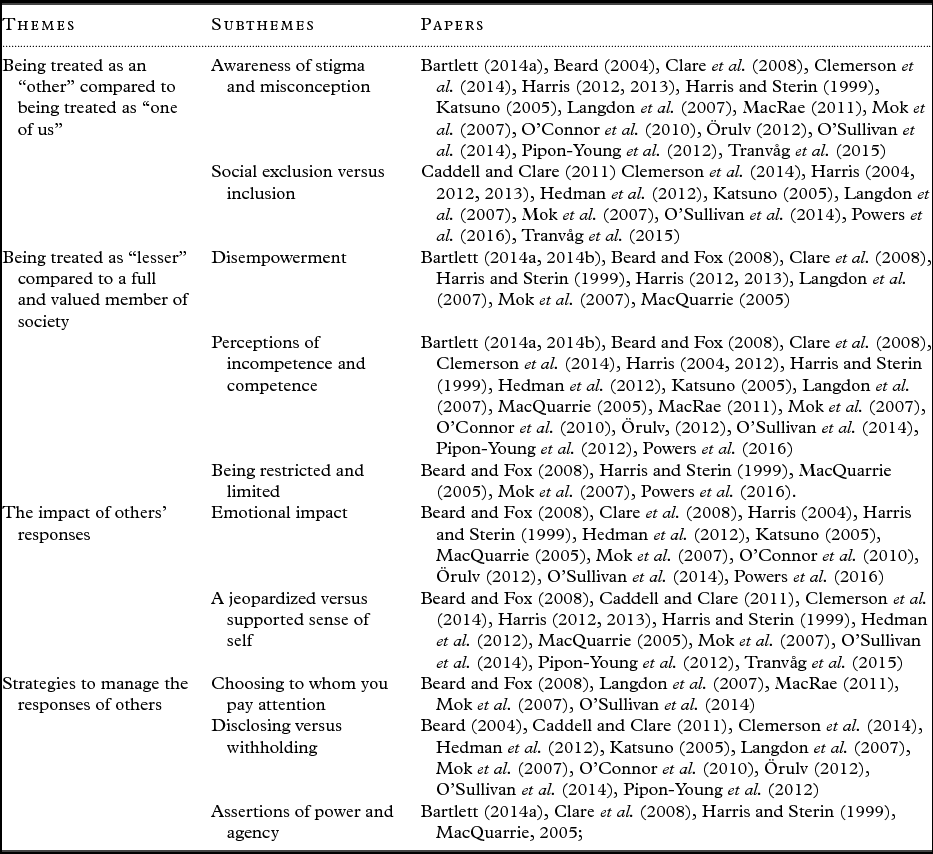
The synthesis resulted in 4 themes and 10 subthemes, as displayed in Table 1, which also shows the papers contributing to each subtheme.
Themes and subthemes derived from the synthesis of findings

Theme: being treated as an “other” compared to being treated as “one of us”
Across several studies, a number of findings converged on the notion that people with dementia perceived that they are treated differently from other people. Two dominant themes arising from these findings related to the potential to be outcast from, and relegated in, society. A tension appeared to exist between a sense of inclusion versus a sense of being seen as an “other.”
Subtheme: awareness of stigma and misconception
Across studies, people showed awareness of the stigma surrounding dementia and expressed concerns about its potential effects in terms of depersonalization and marginalization. Stigma was understood to be an “experience” (Katsuno, Reference Katsuno2005, pp. 205) that was “felt” (Harris, Reference Harris2013, pp. 154) or perceived (MacRae, Reference MacRae2011) by people with dementia due to their condition;
It's got this stigma to it
Taken from the theme: The pervasiveness of stigma (O'Sullivan et al., Reference O'Sullivan, Hocking and Spence2014, pp. 488)
Stigma was experienced on an interpersonal level, affecting the development of friendships, for example, but also on a broader level, as represented by the subtheme; “societal level: felt stigma” (Harris, Reference Harris2013, pp. 154).
Awareness of stigma did not always translate into concern over how others might treat people with dementia (MacRae, Reference MacRae2011). However, people perceived that society holds various expectations, stereotypes, and misconceptions about people with dementia. This could lead to interactional tensions when others did not perceive them to act like or look like somebody with dementia (Beard, Reference Beard2004; O'Connor et al., Reference O'Connor, Phinney and Hulko2010; Bartlett, Reference Bartlett2014b). Örulv (Reference Örulv2012) interpreted this as a double-barreled experience of stigmatization, where stigma was apparent when people with dementia conformed to stereotypes, but also apparent when they flouted these stereotypes;
Participant 1: “they say, ‘Yeah, but I can't understand that there's something wrong with you’, they say, ‘You know, you take part in the conversation like the rest of us’”.
. . .Participant 2: “. . .you should just sit there”.
. . .Participant 1: “And just dribble or something”.
Taken from the theme: In-between trivialization and dismissal – facing double stigmatization (Örulv, Reference Örulv2012, pp. 31)
People perceived that others viewed people with dementia as stupid (O'Connor et al., Reference O'Connor, Phinney and Hulko2010; Clemerson et al., Reference Clemerson, Walsh and Isaac2014; O'Sullivan et al., Reference O'Sullivan, Hocking and Spence2014), mentally ill (Mok et al., Reference Mok, Lai, Wong and Wan2007), crazy (Harris, Reference Harris2012; Harris, Reference Harris2013; O'Sullivan et al., Reference O'Sullivan, Hocking and Spence2014), or no longer part of society (O'Sullivan et al., Reference O'Sullivan, Hocking and Spence2014), and discussed how others did or did not treat them like they were “normal” (Harris, Reference Harris2012, pp. 310; Langdon et al., Reference Langdon, Eagle and Warner2007, pp. 993; Pipon-Young et al., Reference Pipon-Young, Lee, Jones and Guss2012, pp. 606; Tranvåg et al., Reference Tranvåg, Petersen and Nåden2015, pp. 583). The included studies therefore suggested that people with dementia were aware of the stigma and assumptions held by others about dementia and how these can impact upon the way in which others responded to them. People living with dementia perceived that these assumptions were likely driven by a lack of understanding and education (Katsuno, Reference Katsuno2005; Langdon et al., Reference Langdon, Eagle and Warner2007; O'Connor et al., Reference O'Connor, Phinney and Hulko2010; Pipon-Young et al., Reference Pipon-Young, Lee, Jones and Guss2012).
Subtheme: social exclusion versus inclusion
Social exclusion was described across several studies. In two studies, people living with dementia perceived that they were ignored by other people (Katsuno, Reference Katsuno2005; Mok et al., Reference Mok, Lai, Wong and Wan2007), whereas in other studies, they reported that friends and family had reduced or ended contact with them since they had been living with dementia (Harris, Reference Harris2004; Katsuno, Reference Katsuno2005; Langdon et al., Reference Langdon, Eagle and Warner2007; Mok et al., Reference Mok, Lai, Wong and Wan2007; Hedman et al., Reference Hedman, Hansebo, Ternestedt, Hellström and Norberg2012; Harris, Reference Harris2013; O'Sullivan et al., Reference O'Sullivan, Hocking and Spence2014; Clemerson et al., Reference Clemerson, Walsh and Isaac2014; Powers et al., Reference Powers, Dawson, Krestar, Yarry and Judge2016);
she never came to the house or anything. Ah well, excuses . . . I didn't have your new address. They all don't check it . . . all these friends that I'm talking about. There's a telephone book.
Taken from the theme: Loss of friendship (Katsuno, Reference Katsuno2005, pp. 207)
The cessation of social contact by others was framed by Katsuno (Reference Katsuno2005, pp. 206) as a “loss of friendship” and by Langdon et al. (Reference Langdon, Eagle and Warner2007, pp. 996) as a “loss of social status and role,” reflecting the dominant discourse of loss within the dementia literature. In Harris (Reference Harris2013, pp. 152), descriptions of the withdrawal of friends were captured within the theme “Impact of the disease,” giving an impression that social exclusion is sometimes framed as an inevitable consequence of the disease process.
However, several studies highlighted that people with dementia also perceived that many friends and family had stood by them (Caddell and Clare, Reference Caddell and Clare2011; MacRae, Reference MacRae2011; Harris, Reference Harris2012, Reference Harris2013; Powers et al., Reference Powers, Dawson, Krestar, Yarry and Judge2016), had become more supportive, or were now even closer than before (MacRae, Reference MacRae2011; Harris, Reference Harris2013; Powers et al., Reference Powers, Dawson, Krestar, Yarry and Judge2016);
Friends that I've had for 20, 30, 40 years are still my friends but we talk more. Reach out more often.
Taken from the theme: Nature of commitment (Harris, Reference Harris2013, pp. 152)
In three studies, people with dementia described feeling unconditionally accepted by their inner circles of friends or families (Langdon et al., Reference Langdon, Eagle and Warner2007; Bartlett, Reference Bartlett2014a; Reference Bartlett2014b), although some viewed acceptance as a position of privilege and not the norm for a person living with dementia (Bartlett, Reference Bartlett2014a). People with dementia described the value of love, friendship, and inclusion (Caddell and Clare, Reference Caddell and Clare2011; Tranvåg et al., Reference Tranvåg, Petersen and Nåden2015), and the themes generated by these studies highlighted the “importance of relationships” (Harris, Reference Harris2012, pp. 309) and the “significance of others and positive interactions” (MacRae, Reference MacRae2011, pp. 451) to people living with dementia. Studies of friendship highlighted that people with dementia did not always feel ostracized. Many maintained inclusive and reciprocal relationships with friends (Harris, Reference Harris2012).
Theme: being treated as lesser compared to a full and valued member of society
In some studies, people described feeling that they were appreciated as “A valuable contributing member of society” (Clare et al., Reference Clare, Rowlands and Quin2008, pp. 19) for the contributions they made through dementia-related activism (Clare et al., Reference Clare, Rowlands and Quin2008; Bartlett, Reference Bartlett2014a). Others highlighted that their dignity was preserved when they were “Feeling appreciated and acknowledged. . .” for their contributions within their family network (Tranvåg et al., Reference Tranvåg, Petersen and Nåden2015, pp. 582). In other studies, people with dementia described experiences of being treated as lesser than other people. Again, a tension between these poles (valued and empowered versus devalued and dismissed) seemed to characterize this overarching theme.
Subtheme: disempowerment
Across several studies, people with dementia perceived that their status in society had been reduced. People described feeling that they had been “socially demoted” (Beard and Fox, Reference Beard and Fox2008, pp. 1517) and were now treated like second-class citizens (Bartlett, Reference Bartlett2014a). They felt that they no longer had equal power within their relationships (Harris and Sterin, Reference Harris and Sterin1999), were looked down upon (Mok et al., Reference Mok, Lai, Wong and Wan2007), and lacked dignity and respect from others (Clare et al., Reference Clare, Rowlands and Quin2008; Bartlett, Reference Bartlett2014a). This change in social status was reported by two studies within a theme of loss (Langdon et al., Reference Langdon, Eagle and Warner2007; Mok et al., Reference Mok, Lai, Wong and Wan2007), whilst MacQuarrie (Reference MacQuarrie2005, pp. 431) made reference to a more dynamic process;
So I'd like to be asked by the Handi Dart [community transport] drivers how well am I on my feet (rather than) have this 200 pounder pick me up like a bag of potatoes and help me in! That's not help!’
Taken from the theme: Dialectical tension between agency and objectification (MacQuarrie, Reference MacQuarrie2005, pp. 432)
In a study of activism, Bartlett (Reference Bartlett2014a) found that perceived social relegation motivated some to take action to improve the position of people with dementia in society. Some people felt able to use their identity as a dementia ‘patient’ to regain power (Bartlett, Reference Bartlett2014a). However, even then, the responses of others could maintain a relegated position;
I feel like others that we are ‘wheeled out’ when needed
Taken from the theme: “A high price to pay” (for activism) (Bartlett, Reference Bartlett2014b, pp. 1300)
Subtheme: perceptions of incompetence and competence
Some studies found that people with dementia had positive experiences in relation to support received from others (Harris and Sterin, Reference Harris and Sterin1999; Langdon et al., Reference Langdon, Eagle and Warner2007; MacQuarrie, Reference MacQuarrie2005; MacRae, Reference MacRae2011; Clemerson et al., Reference Clemerson, Walsh and Isaac2014). However, a number of studies also highlighted that people with dementia perceived that they were treated by others as if they were no longer cognitively or functionally capable (Harris and Sterin, Reference Harris and Sterin1999; Katsuno, Reference Katsuno2005; Langdon et al., Reference Langdon, Eagle and Warner2007; Beard and Fox, Reference Beard and Fox2008; O'Sullivan et al., Reference O'Sullivan, Hocking and Spence2014; Bartlett, Reference Bartlett2014a; Clemerson et al., Reference Clemerson, Walsh and Isaac2014; Powers et al., Reference Powers, Dawson, Krestar, Yarry and Judge2016). Some findings indicated that people with dementia experienced others as patronizing (O'Sullivan et al., Reference O'Sullivan, Hocking and Spence2014; Clemerson et al., Reference Clemerson, Walsh and Isaac2014), felt that others did too much for them (Harris and Sterin, Reference Harris and Sterin1999; O'Sullivan et al., Reference O'Sullivan, Hocking and Spence2014), or checked unnecessarily as to whether they felt able to fulfill a task (Hedman et al., Reference Hedman, Hansebo, Ternestedt, Hellström and Norberg2012; O'Sullivan et al., Reference O'Sullivan, Hocking and Spence2014);
People are so kind to you. They say ‘Are you alright? Now are you sure about this or can I help you with that? Let me do it’. This is the attitude. They wouldn't say that if it was you.
Taken from the theme: The impact of patronizing attitudes (O'Sullivan et al., Reference O'Sullivan, Hocking and Spence2014, pp. 489)
A further aspect was that several studies found people with dementia perceived that their views were no longer sought or listened to. Others no longer asked them for advice, did not consult them in decision-making (Beard and Fox, Reference Beard and Fox2008; Powers et al., Reference Powers, Dawson, Krestar, Yarry and Judge2016), or distrusted what they said (Mok et al., Reference Mok, Lai, Wong and Wan2007; Beard and Fox, Reference Beard and Fox2008). Some were left feeling that others did not care what they thought (Örulv, Reference Örulv2012; Powers et al., Reference Powers, Dawson, Krestar, Yarry and Judge2016), or no longer even perceived them to have feelings and needs (Clare et al., Reference Clare, Rowlands and Quin2008);
The things that I say seem to be a lot more subject to question than they used to be. It's as if I can't possibly know anything anymore
Taken from the theme: Strategies of management – Interactional tensions (Beard and Fox, Reference Beard and Fox2008, pp. 1516)
In a contrasting set of findings, people with dementia experienced a trivialization of the difficulties associated with their condition, as if others did not even believe that they had dementia (Harris, Reference Harris2004; Clare et al., Reference Clare, Rowlands and Quin2008; O'Connor et al., Reference O'Connor, Phinney and Hulko2010; Örulv, Reference Örulv2012; Pipon-Young et al., Reference Pipon-Young, Lee, Jones and Guss2012; Bartlett, Reference Bartlett2014b).
They're treating it as if it's a once-in-awhilers!. . . Yeah you have once-in-awhilers yeah, you screw up but it's only once in a while. Whereas for me it's an everyday occurrence!
Taken from the theme: Being taken seriously – “it's not sometimers, it's ALLTIMERS!” (O'Connor et al., Reference O'Connor, Phinney and Hulko2010, pp. 35)
Two studies incorporated these findings within themes depicting the experience of “Dementia Land”, which others could not understand (Clare et al., Reference Clare, Rowlands and Quin2008, pp.16), and the “back stage” effects of dementia (Bartlett, Reference Bartlett2014b, pp. 1297), which went unseen by others. Other studies incorporated them within themes highlighting “others’ reactions to dementia”, which included not wanting to believe the diagnosis (Pipon-Young et al., Reference Pipon-Young, Lee, Jones and Guss2012, pp. 605), and in the themes of “in between trivialization and dismissal” (Örulv, Reference Örulv2012, pp. 29) and “being taken seriously” (O'Connor et al., Reference O'Connor, Phinney and Hulko2010, pp. 35), where participants’ experiences of trivialization were understood to occur when their presentation deviated from the stereotypes that others associated with dementia. These findings contrasted with those of Harris (Reference Harris2012), where friends were seen to recognize the strengths of people with dementia whilst still acknowledging their difficulties;
I'm still active and I'm in a golf league and I get worse and worse every year and the girls in the league won't let me quit. They say I am a role model
Taken from the theme: Recognition of strengths and understanding of limitations (Harris, Reference Harris2012, pp. 312)
Subtheme: being restricted and limited
Across several studies, people with dementia perceived that others imposed unnecessary restrictions and limitations upon them. Some studies found that people with dementia perceived that others limited their activities (Mok et al., Reference Mok, Lai, Wong and Wan2007) or told them what they could or could not do without giving them a chance to prove themselves, thus undermining autonomy and self-concept (Harris and Sterin, Reference Harris and Sterin1999; MacQuarrie, Reference MacQuarrie2005). Other studies highlighted that people with dementia felt restricted when they perceived that they had to do what others wanted instead of what they wanted (Beard and Fox, Reference Beard and Fox2008; Powers et al., Reference Powers, Dawson, Krestar, Yarry and Judge2016), when they were over-protected (Mok et al., Reference Mok, Lai, Wong and Wan2007; MacQuarrie, Reference MacQuarrie2005), kept indoors (MacQuarrie, Reference MacQuarrie2005), or followed and observed by others (MacQuarrie, Reference MacQuarrie2005; Beard and Fox, Reference Beard and Fox2008);
I'm told I can't do this and I can't do that, and they don't know if you can or you can't, because they don't give you a chance to try. . .I feel like a prisoner in my own home.
Taken from the theme: Emotional reactions linked to efforts to maintain sense of self (Harris and Sterin, Reference Harris and Sterin1999, pp. 246)
Theme: the impact of others’ responses
Studies reported on a range of effects that others’ responses were perceived to have on the emotional and psychological well-being of people with dementia.
Subtheme: emotional impact
Several studies described participants’ feelings of frustration, anger, and resentment at the ways in which others responded to them (Harris and Sterin, Reference Harris and Sterin1999; Katsuno, Reference Katsuno2005; MacQuarrie, Reference MacQuarrie2005; Beard and Fox, Reference Beard and Fox2008; O'Connor et al., Reference O'Connor, Phinney and Hulko2010; Hedman et al., Reference Hedman, Hansebo, Ternestedt, Hellström and Norberg2012; Örulv, Reference Örulv2012; O'Sullivan et al., Reference O'Sullivan, Hocking and Spence2014). One study found that others’ responses made people fearful of dementia itself (Katsuno, Reference Katsuno2005). Feelings of pain and sadness were described (Harris and Sterin, Reference Harris and Sterin1999; Harris, Reference Harris2004; Katsuno, Reference Katsuno2005; Mok et al., Reference Mok, Lai, Wong and Wan2007; Beard and Fox, Reference Beard and Fox2008), in addition to loneliness in response to social exclusion (Clare et al., Reference Clare, Rowlands and Quin2008; Powers et al., Reference Powers, Dawson, Krestar, Yarry and Judge2016);
When I was first diagnosed. . .they all said ‘Oh, what can I do?’ I just asked them to remain being my friend; I don't know why they left. It hurts so badly.
Taken from the theme: Extreme social isolation (Harris, Reference Harris2004, pp. 29)
Contrastingly, positive emotions were described by people with dementia when they felt accepted, respected, and loved by those around them (Harris, Reference Harris2013; Tranvåg et al., Reference Tranvåg, Petersen and Nåden2015);
My wife. . . not just the fact that she helps me prepare my meals. . . there's so much more than that . . . it's the depth of dignity, joy and love. . . which means so much
Taken from the theme: Experiencing love and confirmation (Tranvåg et al., Reference Tranvåg, Petersen and Nåden2015, pp. 582).
Subtheme: a jeopardized versus supported sense of self
Several studies described how the identity of people with dementia was threatened by the responses of others. In some studies, the responses of others were seen to threaten people's sense of self as competent (Beard and Fox, Reference Beard and Fox2008), or worthy (Mok et al., Reference Mok, Lai, Wong and Wan2007). In other studies, people with dementia described how the responses of others challenged their self-esteem (Harris and Sterin, Reference Harris and Sterin1999), self-confidence (O'Sullivan et al., Reference O'Sullivan, Hocking and Spence2014) and person-hood;
I'm told I can't do this and can't do that and it puts me on a negative feedback. . .of a situation where I am no longer a human being.
Taken from the theme: Impact of the social psychological milieu on self-concept (Harris and Sterin, Reference Harris and Sterin1999, pp. 254)
The potentially adverse influence of others upon identity was incorporated within themes depicting “threat to self” as a consequence of dementia (Clemerson et al., Reference Clemerson, Walsh and Isaac2014, pp. 458) and “identity change” alongside “interactional tensions” as two “consequences of diagnosis” (Beard and Fox, Reference Beard and Fox2008, pp. 1512). Hedman et al., (Reference Hedman, Hansebo, Ternestedt, Hellström and Norberg2012) highlighted that people's social identities could be threatened when others undermined their ability to perform previous roles.
Across the studies, it was also evident that positive responses from others could support a valued sense of self. Being accepted in the context of valued and reciprocal friendships could make people with dementia feel that they were still themselves and still important (Pipon-Young et al., Reference Pipon-Young, Lee, Jones and Guss2012; Harris, Reference Harris2013). Friends and family were also perceived to be supportive (Caddell and Clare, Reference Caddell and Clare2011) in helping to maintain activities (MacQuarrie, Reference MacQuarrie2005; Harris, Reference Harris2012; Tranvåg et al., Reference Tranvåg, Petersen and Nåden2015), support their values (Harris, Reference Harris2012), and foster resilience;
Having somebody ring you and share their problems with you. A friend of mine did that yesterday and that was really good you know because it's like she's forgotten [Penny has dementia], and I'm still Penny.
Taken from the theme: Resilience (Pipon-Young et al., Reference Pipon-Young, Lee, Jones and Guss2012, pp. 608)
Theme: strategies to manage the responses of others
In two studies (Beard and Fox, Reference Beard and Fox2008; Orulv, Reference Örulv2012) the responses of others were perceived to be an additional problem that people with dementia had to deal with on top of any difficulties associated with dementia itself;
I think the disease itself is enough problem but the constrictions that they [family members, doctors, etc.] place around you. . .
Taken from the theme: Resisting Relegation (Beard and Fox, Reference Beard and Fox2008, pp. 1514)
The theme “Being part of a bigger picture” was used to capture this understanding that people's everyday difficulties were tied to their social environment and the behavior of others (Örulv, Reference Örulv2012, pp. 32). “Strategies of management” were therefore required in “Handling relationships” (Beard and Fox, Reference Beard and Fox2008, pp. 1516). Other studies similarly reported that people with dementia needed to develop ways of negotiating the social environment; themes incorporating terms such as “managing” (Langdon et al., Reference Langdon, Eagle and Warner2007, pp. 994) “coping” (Mok et al., Reference Mok, Lai, Wong and Wan2007, pp. 597), and “(re)gaining respect” (Bartlett, Reference Bartlett2014a, pp. 633) were all used to describe ways of handling the responses of others.
Subtheme: disclosing versus withholding
A number of studies found that people with dementia made decisions about disclosing their diagnosis, summed up by the theme “To tell or not to tell” (Beard, Reference Beard2004, pp. 422). Some found that those who experienced or expected negative responses from others managed this threat by concealing their diagnosis and trying to cover up any difficulties. Some studies reported these findings within themes emphasizing the active use of management strategies by people with dementia (Langdon et al., Reference Langdon, Eagle and Warner2007, pp. 994 – “Managing disclosure”; Pipon-Young et al., Reference Pipon-Young, Lee, Jones and Guss2012, pp. 606 – “Saving face”). In other studies, findings relating to withholding and covering up were incorporated within more passive themes pertaining to: “stigma” (Katsuno, Reference Katsuno2005, pp. 205; Örulv, Reference Örulv2012, pp. 29; O'Sullivan et al., Reference O'Sullivan, Hocking and Spence2014, pp. 487), “Losing status” (Mok et al., Reference Mok, Lai, Wong and Wan2007, pp. 595), and “threat to self” (Clemerson et al., Reference Clemerson, Walsh and Isaac2014, pp. 458).
I'm trying to guard that. . .the reputation, you know. . .don't want to be looked down on . . .
Taken from the theme: Experience of stigma and devaluation (Katsuno, Reference Katsuno2005, pp. 206)
Contrastingly, studies found that some people with dementia actively chose to disclose their diagnosis to others. This could be a way of “saving face” (Pipon-Young et al., Reference Pipon-Young, Lee, Jones and Guss2012, pp. 606) by legitimizing symptoms and eliciting understanding and kindness (Beard, Reference Beard2004), rather than risk others making negative assumptions (O'Connor et al., Reference O'Connor, Phinney and Hulko2010; Hedman et al., Reference Hedman, Hansebo, Ternestedt, Hellström and Norberg2012). It could also be a way of challenging stigma (Örulv, Reference Örulv2012), or ensuring that one's difficulties were “being taken seriously” (O'Connor et al., Reference O'Connor, Phinney and Hulko2010, pp. 35);
And I don't want people to think I'm dumb or something. So it's easier if I explain it.
Taken from the theme: Being taken seriously - “it's not sometimers, it's ALLTIMERS!” (O'Connor et al., Reference O'Connor, Phinney and Hulko2010, pp. 35).
People with dementia shifted between the two strategies of withholding and disclosing depending upon the ‘others’ in question. This was highlighted in the theme “Managing levels of disclosure in the private and public worlds” (Langdon et al., Reference Langdon, Eagle and Warner2007, pp. 994). Some were more likely to disclose to close family or friends (Harris, Reference Harris2012) than to people in the public domain (Langdon et al., Reference Langdon, Eagle and Warner2007; O'Sullivan et al., Reference O'Sullivan, Hocking and Spence2014). The theme “You feel your way there” (Hedman et al., Reference Hedman, Hansebo, Ternestedt, Hellström and Norberg2012, pp. 726) highlighted the complexity of the decision-making process that people go through in choosing to whom to disclose that they are living with dementia.
Subtheme: choosing to whom you pay attention
In several studies, people with dementia were described as acutely “sensitive” and “vigilant” in attending to the responses of others toward them (Beard and Fox, Reference Beard and Fox2008, pp. 1516; Langdon et al., Reference Langdon, Eagle and Warner2007, pp. 994; Mok et al., Reference Mok, Lai, Wong and Wan2007, pp. 596; O'Sullivan et al., Reference O'Sullivan, Hocking and Spence2014, pp. 487). However, one study found that some people with dementia protected themselves by judging the negative opinions of others to be insignificant and focused instead upon those who responded normally or positively to them (MacRae, Reference MacRae2011);
Oh, I have no doubt at all but what they probably think, oh poor Ernie Roberts, he's got a hell of a bad memory now. That's up to them. [So you don't let that bother you?] No, there's no point to it.
Theme: Concern about others’ treatment of them (MacRae, Reference MacRae2011, pp. 450)
Subtheme: assertions of power and agency
Harris and Sterin (Reference Harris and Sterin1999) and MacQuarrie (Reference MacQuarrie2005) found that people with dementia at times employed strategies to assert their agency in the face of restrictions and limitation. Sometimes this meant being clear to others about what level of support was acceptable, and sometimes it meant going against the restrictions put down by others. Themes reflected the importance of autonomy (Harris and Sterin, Reference Harris and Sterin1999) and the tension between this and objectification by others;
I stand up for myself more. Like when (spouse) says something about ‘We'll do it another time. We don't need them right now’. . . I'd end up down at the store buying what I want anyway.
Taken from the theme: Dialectical tension between agency and objectification (MacQuarrie, Reference MacQuarrie2005, pp. 433)
Studies described how people with dementia worked hard to be “a valuable contributing member of society” (Clare et al., Reference Clare, Rowlands and Quin2008, pp. 19) and to “(re)gain” respect and power (Bartlett, Reference Bartlett2014a, pp. 633). Some asked that others did not limit them but worked with them (Clare et al., Reference Clare, Rowlands and Quin2008), whereas others used their identities as a “patient” to stand up to others (Bartlett, Reference Bartlett2014a). The need for some people to balance their “autonomy” against the “importance of comfort and security” (Harris and Sterin, Reference Harris and Sterin1999, pp. 250–251), gained from the care received from others, was a further aspect of experiences captured by this theme.
Discussion
This is the first review, to our knowledge, to build upon previous reviews of the lived experience of dementia from a decade ago (Steeman et al., Reference Steeman, Casterlé, Dierckx, Godderis and Grypdonck2006; de Boer et al., Reference De Boer, Hertogh, Dröes, Riphagen, Jonker and Eefsting2007), by examining in detail the subjective social experiences of people with dementia. The findings of the current review challenge the notion of an inevitable link between a diagnosis of dementia and ‘social pathology’ (which includes acquired impairments in social behavior, affecting an individual's ability to engage in social opportunities; Vernooij-Dassen and Jeon, Reference Vernooij-Dassen and Jeon2016). The findings demonstrate that some of the losses that people with dementia experience result directly from the responses of others, rather than dementia itself. Furthermore, people with dementia make active attempts to maintain their sense of identity and emotional well-being when this is threatened by the perceived negative responses of others.
Social pathology – or the malignant social environment?
Our findings represent a contrasting perspective to the notion of social pathology, described in the landmark introduction to the concept of social health in dementia (Vernooij-Dassen and Jeon, Reference Vernooij-Dassen and Jeon2016). Some of our findings concur with previous reviews describing negative social interactions surrounding people with dementia (Steeman et al., Reference Steeman, Casterlé, Dierckx, Godderis and Grypdonck2006; de Boer et al., Reference De Boer, Hertogh, Dröes, Riphagen, Jonker and Eefsting2007). However, experiences of isolation, feelings of loneliness and inadequacy, losses in self-esteem have all tended to be framed as a direct consequence of the disabilities caused by dementia (Steeman et al., Reference Steeman, Casterlé, Dierckx, Godderis and Grypdonck2006; de Boer et al., Reference De Boer, Hertogh, Dröes, Riphagen, Jonker and Eefsting2007). The constructs and language used by a number of studies in the present review appeared to similarly convey an assumed link between dementia and the experience of losses or threats to self (Harris and Sterin, Reference Harris and Sterin1999; Katsuno, Reference Katsuno2005; Langdon et al., Reference Langdon, Eagle and Warner2007, Mok et al., Reference Mok, Lai, Wong and Wan2007; Harris, Reference Harris2013; Clemerson et al., Reference Clemerson, Walsh and Isaac2014).
In contrast, the current review's findings, based on critical interpretive synthesis, demonstrate how people with dementia perceive some losses as resulting directly from the responses of others, rather than dementia itself. In particular, perceived losses in relationships, roles, status, and value were key elements in overarching themes relating to experiences of being outcast and relegated within social interactions. Such experiences impacted negatively upon the emotional and psychological well-being of people with dementia, including their ability to conserve a valued sense of self. Our findings resonate with psychosocial models of dementia (Kitwood, Reference Kitwood1997; Sabat Reference Sabat2001, Reference Sabat and Harris2002) in depicting a social environment that can be experienced as malignant (Kitwood, Reference Kitwood1990) in its processes of stigmatization, labeling, disempowerment, exclusion, and patronizing responses. The findings also highlight the awareness that people with dementia can have when they are being negatively positioned by others (Sabat, Reference Sabat2001, Reference Sabat and Harris2002), particularly when they are treated as an “other” and a “lesser” being as a consequence of having dementia. A process of “othering” is described by Mitchell et al. (Reference Mitchell, Dupuis and Kontos2013) in terms of societal and media-based discourses and images that lead to suffering being imposed upon people with dementia. Our data lend support to this notion, but additionally demonstrate that people with dementia can actively experience a process of othering across varied social contexts, from close interpersonal relationships through to interactions with community and society as a whole.
Social health and social well-being
In the present review there are examples and synthesized themes where people with dementia describe social interactions in which they feel accepted and valued (see, for example, Harris, Reference Harris2012, Reference Harris2013; Tranvåg et al., Reference Tranvåg, Petersen and Nåden2015; Table 1). Such examples embody the concept of social health (Vernooij-Dassen et al., Reference Vernooij-Dassen, Leatherman and Rikkert2011; Vernooij-Dassen and Jeon, Reference Vernooij-Dassen and Jeon2016), where people with dementia value making contributions and supporting their friends (see, for example, Clare et al., Reference Clare, Rowlands and Quin2008; Pipon-Young et al., Reference Pipon-Young, Lee, Jones and Guss2012; Harris, Reference Harris2013; Table 1, Theme: being treated as lesser compared to a full and valued member of society). Such reciprocal social interactions have the potential to sustain a sense of self and well-being. Keyes (Reference Keyes1998) suggests that subjective well-being is connected with the experience of being positively included and of value to a community and to society. In dementia, this experience is likely to require society to move beyond the processes of stigma and “othering” outlined in the current review, by learning to include and value unique and varied aspects of personhood. Certain aspects of social well-being that were outlined by Keyes (Reference Keyes1998), such as the presence of positive beliefs and experiences associated with relationships, community, and society have potential as an important marker for social health in dementia.
Interpersonal and intrapersonal perspectives
Our review was weighted toward understanding the interpersonal aspects of social experiences for people with dementia but we did not overlook the interplay between this and the ways in which individuals understood and managed the responses. Key models of awareness in dementia suggest that people adopt active strategies to maintain or adjust their sense of identity in line with cognitive and functional changes (Clare, Reference Clare2003). Consistent with this notion, we note how people with dementia react to the perceived negative responses of others with active self-protective strategies to conserve a valued sense of identity and emotional well-being. Examples included managing the ways in which they shared or concealed their condition around other people, by attending more closely to those who responded positively to them, or by asserting themselves in the face of restrictions put in place by others (see, for example, MacQuarrie, Reference MacQuarrie2005; MacRae, Reference MacRae2011; Pipon-Young et al., Reference Pipon-Young, Lee, Jones and Guss2012; Table 1, Theme: strategies to manage the responses of others). People with dementia therefore retain an active capacity to perceive and interpret social responses toward them and can remain aware of how negative images and discourses associated with the condition influence the views and responses of others toward them. This suggests that the social health and well-being of people living with dementia can be determined by an interplay between a person's continued attempts to find meaning in their social interactions and the interpersonal and social responses and attitudes that they encounter. The views and attitudes of others and the discourses used about dementia may also influence how, and to whom, individuals express awareness of their impairments.
The literature we examined was somewhat divided as to the extent to which the individual's experience of dementia was assumed to impact upon their social interactions versus the extent to which social interactions were assumed to impact upon their experience of dementia. It was clear across studies that people living with dementia had idiosyncratic experiences of social relationships, potentially indicative of both of these directions of effect. This may also reflect individual differences in the way in which individuals perceive, experience, and manage others’ responses toward them. For example, people who have internalized a perception of dementia as shameful may be more likely to perceive others’ responses as stigmatizing. Alternatively, variation in assumed links between dementia and social experiences may reflect differences in methodology, theoretical approach and the context of a given study. Research into positive experiences, traits, and virtues (Seligman and Csikszentmihalyi, Reference Seligman and Csikszentmihalyi2000) might yield a different set of findings compared to studies that explore losses and deficits in dementia. For example, interviews exploring experiences of friendship may elicit discussion around positive reactions from other people (Harris, Reference Harris2012, Reference Harris2013), whereas participants receiving input from a mental health unit (Langdon et al., Reference Langdon, Eagle and Warner2007) might be surrounded by less supportive “others” than those recruited from support groups. It is also equally possible that different responses encountered by people with dementia reflect differences in the types of relationships that they are engaged in. MacRae (Reference MacRae2011) suggested that ultimately, the responses of the individual and responses of others toward dementia are likely to interact.
Limitations of the review
As the majority of studies were conducted in the United Kingdom, North America, Canada, and Scandinavia, it is unlikely that the findings of this review will extend to the experiences of people with dementia across all cultures. Nevertheless, it is noteworthy that many of the experiences present in included studies were shared by Chinese participants interviewed by Mok et al. (Reference Mok, Lai, Wong and Wan2007).
Although severity of dementia was not always made explicit, the in-depth interview methods used by the majority of studies meant that samples were more likely to have included people with mild-moderate dementia. The majority of participants were also defined as having Alzheimer's type dementia. Based upon the current review, it is not possible to draw conclusions about the extent to which the perceived responses of others toward people with dementia may be affected by factors such as subtype and severity. It should also be noted that the studies selected had recruited participants from across a wide age range. It is noteworthy that a number of experiences were shared across the age range (for example, the isolation described by older adult participants was also described by participants with young-onset dementia (Harris, Reference Harris2004; Clemerson et al., Reference Clemerson, Walsh and Isaac2014). However, this review is unable to draw conclusions about the potential effects of age upon the social experiences of people with dementia, for example, how these might be influenced by social attitudes toward aging.
The inclusion and exclusion criteria for this review were selected in order to capture papers of relevance to the review question, and to allow for an in-depth synthesis of this body of literature. However, the literature reviewed inevitably does not capture the full breadth of social experiences for people living with dementia, which remain an important focus for systematic reviews in future. Participants across the included studies discussed their experiences of varied types of relationships, such as friendships, relationships with spouses, children, and acquaintances. There were also a number of instances in which participants commented more generally upon their interactions with “others” or “people,” without specifying to whom they referred. This review is therefore unable to draw out potential distinctions between experiences of different forms of social relationship for people with dementia.
The critical interpretative synthesis methodology adopted for the present review meant that the relevance of papers to the review question was prioritized over their methodological limitations (Dixon-Woods et al., Reference Dixon-Woods2006), and none of the selected papers were therefore excluded on the basis of quality. This was considered acceptable since our exploratory review set out to fully understand the social “lived” experiences of people with dementia. Whilst each theme was supported by several studies deemed to be of good methodological quality, it remains possible that variations in the methodology and quality of the included studies constrain the validity and reliability of the themes derived from the synthesis.
Implications for research and practice
This review highlights the complexities and nuances of social experiences across people living with dementia. For example, people with dementia may face difficulties not just when they are treated as incompetent, but conversely, when they are seen as competent to the extent that their difficulties are dismissed or trivialized. Future research should explore the full range and complexity of these social experiences for people living with dementia, as the dialectical nature of subjective experience means that no social environment is likely to be perceived to be fully positive or fully negative.
The social experiences described within this review emphasize the potential importance of ensuring that clinical assessments and psychosocial interventions take into account not just person- and disease-related factors, but also dialectical processes within the person's interpersonal relationships and surrounding social context (Moniz-Cook, Reference Moniz-Cook, Laidlaw and Knight2008). Of particular note in this review's findings was the dynamic interplay between the responses of others and the active processes of meaning-making and management by people living with dementia. Person-centered care therefore need not necessarily be one-directional, but can include, for example, social encounters in which the contributions of people with dementia to their personal relationships (Kitwood, Reference Kitwood1997; Vernooij-Dassen and Moniz-Cook, Reference Vernooij-Dassen and Moniz-Cook2016) and wider society are both recognized and reinforced.
Further research is required to investigate connections between subjective and social well-being in dementia. Within this, consideration is needed as to how we might best understand, operationalize, and measure social health as a key aspect of the lived experience of dementia. One possibility here is to perhaps draw upon Keyes’ (Reference Keyes1998) conceptualization of social well-being, which emphasizes how experiencing one's social environment as inclusive, accepting, valuing and rewarding, critically influences well-being at a subjective level. The concept of social well-being can perhaps be seen in operation within current policy driven initiatives such as the growth of “dementia friendly communities” (Department of Health, 2015). The findings of our systematic review and synthesis have implications for extending the remit of these initiatives, toward allowing people with dementia the reciprocal contribution that they value within their communities and wider society.
Conclusion
Studies of intrapersonal experiences such as loss and diminishing identity have previously been understood as a direct result of dementia. Our synthesis of the interpersonal experiences of people with dementia in their social contexts notes a fundamentally relational dimension. This reflects a dynamic interplay between the perceived responses of others and the active efforts of individuals, as they interact with and navigate within their social encounters. Perceived negative responses from others mean that people with dementia not only have to adjust to changes in abilities and expectations but they must also actively manage those social interactions that might ostracize and relegate them. The dynamic relational aspect that we note may contribute to emerging concepts and definitions of social health in dementia. Careful consideration is needed of the particular kinds of social experiences and contexts that best enable to people with dementia to continue to “live well” within their communities.
Conflict of interest
None.
Description of authors’ roles
K. M. Patterson designed the study, carried out the data collection and analysis, and wrote the paper; C. Clarke and E. L. Wolverson assisted in the formulation of the search strategy, supervised the data collection and analysis, and assisted in preparing the paper; and E. D. Moniz-Cook contributed to drafts and writing the final paper.
Acknowledgments
The authors would like to thank M. Campion for her assistance with quality assessment.
Supplementary material
To view supplementary material for this article, please visit http://doi.org/10.1017/S1041610216002374