Borderline personality disorder (BPD) is a severe form of psychopathology characterized by a pervasive pattern of cognitive, emotional, and behavioral dysregulation (American Psychiatric Association, 1994). Although BPD is a heterogeneous disorder, aggression consistently emerges as a key feature (Goodman & New, Reference Goodman and New2000; Skodol, Seiver, et al., Reference Skodol, Gunderson, McGlashan, Dyck, Stout and Bender2002). Despite the prominent role of aggressive behavior in conceptualizations of borderline pathology, a number of limitations exist. First, findings have been based largely upon cross-sectional investigations, precluding conclusions regarding the temporal ordering of aggression and borderline pathology. Second, research in this area has focused almost exclusively on physical forms of aggression typical of males, with little attention to relational forms of aggression that are more salient to females. Third, few studies have made the distinction between reactive (i.e., impulsive/dysregulated) and proactive (i.e., premeditated/controlled) functions of aggressive behavior, despite theoretical reason to expect unique associations. Fourth, while there has been increasing empirical attention to biological factors involved in the etiology of BPD, there remains a paucity of research pertaining to how individual differences in stress physiology may exacerbate risk for aggressive conduct among youth with borderline pathology.
The current study aimed to address the aforementioned limitations by examining differential, prospective associations between borderline pathology and forms and functions of aggression in middle childhood. In addition, we tested gender and physiological reactivity as moderators of these associations. Consistent with a developmental psychopathology approach (Cicchetti & Toth, Reference Cicchetti and Toth2009; Sroufe & Rutter, Reference Sroufe and Rutter1984), we adopted a dimensional assessment of borderline personality features (BPFs), as opposed to the categorical diagnosis of BPD (Crick, Murray-Close, & Woods, Reference Crick, Murray-Close and Woods2005; Crick, Woods, Murray-Close, & Han, Reference Crick, Woods, Murray-Close, Han, Freeman and Reinecke2007). BPFs refer to stable cognitive, affective, and behavioral tendencies that reflect failure to negotiate stage-salient developmental tasks (Crick et al., Reference Crick, Murray-Close and Woods2005). BPFs are not markers of psychopathology but rather indicators of being on a probabilistic developmental pathway that may eventuate in BPD (Crick et al., Reference Crick, Murray-Close and Woods2005). It is believed that studying the full range of borderline features best informs etiological models of BPD, as well as the development of early intervention efforts aimed at targeting personality pathology before maladaptive patterns become canalized (Crick et al., Reference Crick, Murray-Close and Woods2005, Reference Crick, Woods, Murray-Close, Han, Freeman and Reinecke2007).
BPFs Promote Aggressive Behavior
Researchers typically conceptualize aggression as an outcome of borderline pathology (Gardner, Archer, & Jackson, Reference Gardner, Archer and Jackson2012; Skodol, Seiver, et al., Reference Skodol, Gunderson, McGlashan, Dyck, Stout and Bender2002); however, the hypothesis that BPD precedes aggression has rarely been empirically tested. Core features of BPD, including affective instability, impulsivity, anger, abandonment fears, and stormy relationships, may promote the enactment of aggressive behavior. Aspects of affective instability, such as emotional sensitivity and deficient modulation of intense emotional reactions, may interfere with the ability to inhibit aggressive behavioral responses to perceived provocation (Linehan, Reference Linehan1993). Furthermore, other core features of BPD, including impulsivity and anger, may also lead to aggressive behavior (Hubbard et al., Reference Hubbard, Smithmyer, Ramsden, Parker, Flanagan and Dearing2002; Schwartz, Reference Schwartz2000). Abandonment fears and relationship instability may result in interpersonal conflict that incites the enactment of aggressive behavior (Gardner et al., Reference Gardner, Archer and Jackson2012). Overall, aggression may function as a mechanism for managing intense negative emotions evoked by perceived threats to valued relationships or as a strategy to manipulate and control relationship partners.
Despite significant theoretical work suggesting that borderline features promote the development of aggressive behavior patterns, empirical research that identifies borderline pathology as a risk factor for aggression is very limited. The majority of studies in this area are cross-sectional in nature. Furthermore, the few extant longitudinal studies have methodological limitations that diminish their ability to establish direction of effects. For example, although Stepp, Smith, Morse, Hallquist, and Pilkonis (Reference Stepp, Smith, Morse, Hallquist and Pilkonis2012) found that BPFs predicted physical aggression 2 years later, they did not control for aggression at baseline, precluding examinations of whether BPFs preceded aggressive conduct. Examining the alternative direction of effects, Underwood, Beron, and Rosen (Reference Underwood, Beron and Rosen2011) showed that developmental trajectories of aggressive behavior predicted BPFs at age 14. However, initial levels of BPFs were not assessed; therefore, it is not clear whether aggression preceded increases in BPFs over time. In a study by Crick et al. (Reference Crick, Murray-Close and Woods2005), increases in aggression were associated with time-dependent increases in BPFs over the course of 1 year; however, the statistical approach employed in this study did not allow inferences regarding direction of effects (see also Stepp, Pilkonis, Hipwell, Loeber, & Stouthamer-Loeber, Reference Stepp, Pilkonis, Hipwell, Loeber and Stouthamer-Loeber2010).
Thus, the first goal of the present study was to use cross-lagged structural equation modeling in order to examine whether BPFs longitudinally predict aggressive behavior. This approach allowed for the investigation of longitudinal, bidirectional effects, while controlling for within-time covariances between constructs and the stability of constructs across time. It is important that this data analytic approach afforded the opportunity to rule out the alternative possibility that aggressive behaviors serve as a risk factor for the development of BPFs.
Forms of Aggression
The conclusion that aggression is a core feature of BPD is based largely upon research examining forms of aggression typical of males, such as physical aggression, defined as behaviors that target the victim's physical well-being (e.g., hitting, kicking, or punching; Crick & Grotpeter, Reference Crick and Grotpeter1995). The association between borderline pathology and physical aggression is well established, and it has been demonstrated using various methodologies, including self- and other report, experimental laboratory assessments, and genetically informed designs (see Goodman & New, Reference Goodman and New2000; Skodol, Seiver, et al., Reference Skodol, Gunderson, McGlashan, Dyck, Stout and Bender2002; Trull, Stepp, & Durrett, Reference Trull, Stepp and Durrett2003). Despite robust findings with respect to physical aggression, relatively little is known about the relationship between borderline pathology and relational aggression, defined as behaviors aimed at damaging and manipulating relationships as a means to harm others (e.g., threats to withdraw friendship, gossip, or exclusion; Crick & Grotpeter, Reference Crick and Grotpeter1995). Evidence indicates that boys are more likely to engage in physically aggressive behaviors than are girls; in contrast, girls are as (or more) likely than their male counterparts to display relationally aggressive conduct (Card, Stucky, Sawalani, & Little, Reference Card, Stucky, Sawalani and Little2008). Because women account for nearly 75% of BPD diagnoses (American Psychiatric Association, 1994), it is critical to include aggressive behaviors that are relatively characteristic of women, such as relational aggression, in studies of the association between BPD and aggression.
Relationally aggressive children exhibit a number of characteristics that parallel features of BPD, including preoccupation with relational concerns and intense, stormy, and enmeshed relationships (Geiger & Crick, Reference Geiger, Crick, Ingram and Price2001). For instance, relationally aggressive children exhibit heightened sensitivity to relational events, including hypervigilance and distress in response to interpersonal stressors (Crick, Grotpeter, & Bigbee, Reference Crick, Grotpeter and Bigbee2002; Mathieson et al., Reference Mathieson, Murray-Close, Crick, Woods, Zimmer-Gembeck and Geiger2011). With respect to their dyadic relationships, relationally aggressive children desire friendship exclusivity and report high levels of intimacy, jealousy, conflict, and relational aggression within their friendships (Cillessen, Jiang, West, & Laszkowski, Reference Cillessen, Jiang, West and Laszkowski2005; Grotpeter & Crick, Reference Grotpeter and Crick1996; Murray-Close, Ostrov, & Crick, Reference Murray-Close, Ostrov and Crick2007; Rose, Swenson, & Carlson, Reference Rose, Swenson and Carlson2004). These relational qualities are often hypothesized to serve as risk factors for the development of relational aggression; for instance, sensitive information elicited in the context of intimate exchange may be used as ammunition against friends when angry or threatened (Grotpeter & Crick, Reference Grotpeter and Crick1996; Murray-Close et al., Reference Murray-Close, Ostrov and Crick2007). Thus, several of the core features of BPD (i.e., preoccupation with relational concerns, cognitive and emotional sensitivity to relational stressors, and intense, stormy, and enmeshed relationships) have been identified as potential risk factors for the development of relational aggression.
Consistent with theoretical suggestions of a link between borderline pathology and relational aggression, initial concurrent and longitudinal investigations show that relational aggression is related to BPFs in middle childhood (Crick et al., Reference Crick, Murray-Close and Woods2005; Rogosch & Cicchetti, Reference Rogosch and Cicchetti2005; Stepp et al., Reference Stepp, Pilkonis, Hipwell, Loeber and Stouthamer-Loeber2010), adolescence (Underwood et al., Reference Underwood, Beron and Rosen2011), and adulthood (Ostrov & Houston, Reference Ostrov and Houston2008; Werner & Crick, Reference Werner and Crick1999). Furthermore, two studies have shown that relational aggression accounts for unique variance in BPFs, above and beyond the effect of physical aggression. In the first of such investigations, Crick et al. (Reference Crick, Murray-Close and Woods2005) demonstrated that increases in relational aggression during middle childhood predicted time-dependent increases in BPFs across 1 year, even after controlling for physical aggression. Physical aggression, by contrast, did not predict BPFs once relational aggression was taken into account. Extending these findings to adults, research by Ostrov and Houston (Reference Ostrov and Houston2008) indicated that relational aggression was concurrently associated with heightened levels of BPFs. Again, physical aggression did not significantly account for unique variance in BPFs. These findings provide initial evidence that relational aggression may be more closely linked to BPFs than physical forms of aggression. Thus, the second goal of the present study was to examine longitudinal associations between BPFs and both physical and relational forms of aggression.
Functions of Aggression
The association between aggression and borderline pathology may be further qualified by whether the aggressive behavior is proactive or reactive in function. According to the frustration-aggression hypothesis, reactive aggression is motivated by frustration or failure to attain anticipated gratification (Dollard, Doob, Miller, Mowrer, & Sears, Reference Dollard, Doob, Miller, Mowrer and Sears1939). Furthermore, frustration only potentiates aggressive responding when the precipitating aversive event induces negative affect (Berkowitz, Reference Berkowitz1989). Thus, reactive aggression is defined as an angry, retaliatory response to perceived threat or provocation (Little, Jones, Henrich, & Hawley, Reference Little, Jones, Henrich and Hawley2003). Reactive physical and relational aggression have been associated with observational and physiological indicators of anger (Hubbard et al., Reference Hubbard, Smithmyer, Ramsden, Parker, Flanagan and Dearing2002; Marsee & Frick, Reference Marsee and Frick2007; Ostrov, Murray-Close, Godleski, & Hart, Reference Ostrov, Murray-Close, Godleski and Hart2013), as well as the inability to regulate emotional arousal (Ostrov et al., Reference Ostrov, Murray-Close, Godleski and Hart2013; Vitaro, Brendgen, & Tremblay, Reference Vitaro, Brendgen and Tremblay2002). As a result, this subtype of aggression is often described as impulsive and dysregulated (Little et al., Reference Little, Jones, Henrich and Hawley2003). Proactive aggression, by contrast, has its theoretical origins in Bandura's (Reference Bandura1973) social cognitive learning theory and is motivated by high self-efficacy and favorable outcome expectations for aggression. Research indicates that proactive aggression has distinct cognitive, emotional, and physiological correlates (Little et al., Reference Little, Jones, Henrich and Hawley2003). Children who engage in high levels of proactive aggression report positive outcome expectancies for aggression and confidence in their ability to enact an aggressive response (Crick & Dodge Reference Crick and Dodge1996; Dodge, Lochman, Harnish, Bates, & Pettit, Reference Dodge, Lochman, Harnish, Bates and Pettit1997; Marsee & Frick, Reference Marsee and Frick2007; Schwartz et al. Reference Schwartz, Dodge, Coie, Hubbard, Cillessen and Lemerise1998; Smithmyer, Hubbard, & Simons, Reference Smithmyer, Hubbard and Simons2000). Furthermore, proactive aggression is associated with blunted physiological reactivity (i.e., skin conductance and heart rate acceleration; Hubbard et al. Reference Hubbard, Smithmyer, Ramsden, Parker, Flanagan and Dearing2002), which is believed to underlie nonemotional and goal-directed expressions of aggression (Murray-Close, Reference Murray-Close2013b). Thus, proactive aggression is thought to reflect relatively unemotional, controlled, and deliberate aggressive actions aimed at attaining a desired goal (Little et al., Reference Little, Jones, Henrich and Hawley2003).
Given these distinctions, there is reason to believe that reactive and proactive aggression would be differentially related to borderline pathology. Reactive aggression, in particular, is consistent with the experience of intense and inappropriate anger, affective instability, impulsivity, and sensitivity to interpersonal threats characteristic of BPD. For instance, individuals with borderline pathology may engage in reactive aggression in response to perceived threat to valued relationships. In a cross-sectional study, Gardner et al. (Reference Gardner, Archer and Jackson2012) showed that reactive, but not proactive, physical aggression was positively associated with borderline features among adolescents and adults. Nonetheless, certain aspects of borderline pathology are consistent with proactive aggression; for instance, individuals with borderline pathology may use proactive aggression in order to manipulate their relationship partners and to achieve interpersonal goals. Ostrov and Houston (Reference Ostrov and Houston2008) demonstrated that both reactive and proactive functions of relational aggression were uniquely associated with heightened levels of BPFs among adults. Given the limited research in this area, the third goal of the present study was to explore the unique associations between BPFs and proactive and reactive functions of aggression.
Gender Differences
The associations between BPFs and aggressive behaviors may differ for boys and girls. Ostrov and Godleski's (Reference Ostrov and Godleski2010) gender-linked model of aggressive behavior posits that children engage in aggression that is consistent with their gender schemas. For example, when girls are aggressive, they are more likely to engage in relational aggression than physical aggression, and when boys are aggressive, they are more likely to engage in physical aggression than relational aggression. Moreover, this model suggests that risk factors may result in gender-specific manifestations of aggressive behaviors. Thus, as a result of gender schemas, heightened levels of BPFs may be most strongly associated with relationally aggressive strategies among girls and with physically aggressive strategies among boys. This model highlights the possibility that nonsignificant associations between physical aggression and BPFs, once relational aggression is controlled (e.g., Crick et al., Reference Crick, Murray-Close and Woods2005), may be partly attributable to gender differences in the manifestation of aggressive behavior. In other words, BPFs may only be related to physical aggression among boys given their heightened involvement in such conduct. Thus, in the present study, we examined whether the longitudinal associations between BPFs and aggression differ for boys and girls.
The Role of Physiological Reactivity to Interpersonal Stress
According to Linehan's (Reference Linehan1993) biosocial theory, BPD results from a biological vulnerability to emotion dysregulation, characterized by intense, easily triggered emotional reactions. Despite the role that biological factors are expected to play in the development of BPD, few studies have included psychophysiological indicators of emotional reactivity, relying instead on subjective self-ratings. Nevertheless, researchers examining the association between psychophysiological indices and borderline pathology have focused on the sympathetic nervous system (SNS), which supports the fight or flight response and the mobilization of defensive behaviors (Herpertz, Kunert, Schwenger, & Sass, Reference Herpertz, Kunert, Schwenger and Sass1999; Kuo & Linehan, Reference Kuo and Linehan2009; Limberg, Barnow, Freyberger, & Hamm, Reference Limberg, Barnow, Freyberger and Hamm2011; Schmahl et al., Reference Schmahl, Elzinga, Ebner, Simms, Sanislow and Vermetten2004). These studies have measured heart rate and blood pressure reactivity, which are influenced by the SNS and the parasympathetic nervous system, and skin conductance response, which is considered to be a relatively pure indicator of SNS arousal (see Dawson, Schell, & Filion, Reference Dawson, Schell, Filion, Cacioppo, Tassinary and Berntson2007). For example, research by Limberg et al. (Reference Limberg, Barnow, Freyberger and Hamm2011) showed that adult BPD patients experienced increased heart rate reactivity and a trend toward heightened skin conductance reactivity in response to abandonment and rejection scripts, compared to healthy controls. Similarly, in a study by Schmahl et al. (Reference Schmahl, Elzinga, Ebner, Simms, Sanislow and Vermetten2004), BPD and skin conductance reactivity to personalized abandonment narratives were associated at a trend level. Blood pressure reactivity, however, was not associated with BPD. Striving for a more ecologically valid assessment of physiological reactivity, Ebner-Priemer et al. (Reference Ebner-Priemer, Shaw-Welch, Grossman, Reisch, Linehan and Bohus2007) used an ambulatory assessment of heart rate during a 24-hr period of typical daily activity. Compared to healthy controls, nonmedicated adult BPD patients exhibited higher increases in heart rate not directly resulting from physical or metabolic activity (Ebner-Priemer et al., Reference Ebner-Priemer, Shaw-Welch, Grossman, Reisch, Linehan and Bohus2007). However, other studies have failed to demonstrate physiological hyperreactivity among adults with BPD (Herpertz et al., Reference Herpertz, Kunert, Schwenger and Sass1999; Kuo & Linehan, Reference Kuo and Linehan2009).
Conflicting results regarding physiological profiles associated with BPD may be in part due to differences in methods used to induce physiological responses. Exposure to standardized unpleasant, neutral, and pleasant images (e.g., International Affective Picture System) typically fails to elicit differences in physiological reactivity between BPD patients and healthy controls (Herpertz et al., Reference Herpertz, Kunert, Schwenger and Sass1999; Limberg et al., Reference Limberg, Barnow, Freyberger and Hamm2011). In contrast, disorder-specific stimuli related to scenarios involving rejection and abandonment have been successful in evoking heightened levels of physiological reactivity in BPD patients, relative to healthy controls (Limberg et al., Reference Limberg, Barnow, Freyberger and Hamm2011; Schmahl et al., Reference Schmahl, Elzinga, Ebner, Simms, Sanislow and Vermetten2004). This pattern of findings highlights the need to examine reactivity to stressors that are interpersonally focused, which was the approach taken in the present study. As opposed to using standardized emotional stimuli, physiological reactivity was measured as children recounted personal experiences of relational provocation (e.g., exclusion, being the target of gossip, or having a friend play with someone else), which are expected to be particularly salient for children with borderline pathology. Consistent with previous research with adult BPD patients (Herpertz et al., Reference Herpertz, Kunert, Schwenger and Sass1999; Kuo & Linehan, Reference Kuo and Linehan2009; Limberg et al., Reference Limberg, Barnow, Freyberger and Hamm2011; Schmahl et al., Reference Schmahl, Elzinga, Ebner, Simms, Sanislow and Vermetten2004), skin conductance reactivity was included as an indicator of emotional reactivity. Although less common in research in this area, the present study also assessed indices of blood pressure reactivity, because these tend to be related to anger and hostility (Hubbard et al., Reference Hubbard, Smithmyer, Ramsden, Parker, Flanagan and Dearing2002), both of which are central aspects of borderline pathology.
Given the multifaceted nature of borderline pathology and mixed findings regarding associations between BPFs and physiological reactivity, it is possible that there are individual differences in physiological reactions to peer stress among youth with BPFs. These differences, in turn, may have important implications for youths' risk for aggressive behaviors. Emerging theory and research suggests that physiological reactivity to stress may provide important insights into children's aggressive behavior patterns (Murray-Close, Reference Murray-Close2013a; Scarpa & Raine, Reference Scarpa and Raine1997). Some evidence indicates that aggressive youth exhibit heightened skin conductance and blood pressure reactivity (e.g., Bollmer, Harris, & Milich, Reference Bollmer, Harris and Milich2006; Schneider, Nicolotti, & Delamater, Reference Schneider, Nicolotti and Delamater2002), whereas others have reported blunted physiological reactivity among aggressive youth (Harden, Pihl, Vitaro, & Gendreau, Reference Harden, Pihl, Vitaro and Gendreau1995; Herpertz et al., Reference Herpertz, Mueller, Wenning, Qunaibi, Lichterfeld and Herpertz-Dahlmann2003). Conflicting findings regarding the association between physiological reactivity to stress and aggression may depend in part on functions of aggressive behavior. More specifically, given the role of dysregulated negative affect in reactive aggression, exaggerated physiological arousal following stress is believed to activate reactive, but not proactive, aggression (Murray-Close, Reference Murray-Close2013b). In contrast, given the relatively “cold-blooded” nature of proactive aggression, blunted physiological reactivity is hypothesized to promote proactive functions of aggression (Murray-Close, Reference Murray-Close2013b).
Consistent with these suggestions, Pitts (Reference Pitts, Adrian, Brennan, Farrington and Mednick1997) showed that reactively physically aggressive school-aged children demonstrated higher heart rate reactivity in response to a challenging task, compared to children high on both reactive and proactive physical aggression as well as nonaggressive controls. In another study of second-grade children, skin conductance reactivity to a provocative task was positively associated with reactive, but not proactive, physical aggression (Hubbard et al., Reference Hubbard, Smithmyer, Ramsden, Parker, Flanagan and Dearing2002). Demonstrating that heightened physiological reactivity is associated with reactive relational aggression, Murray-Close and Rellini (Reference Murray-Close and Rellini2012) showed that diastolic blood pressure reactivity to relational stress predicted reactive relational aggression, but not proactive relational aggression, among women with a history of sexual abuse. In this study, blunted physiological reactivity to stress was associated with proactive functions of relational aggression (Murray-Close & Rellini, Reference Murray-Close and Rellini2012).
Taken together, these findings suggest that children with heightened levels of BPFs who also experience intense emotional reactions to interpersonal stress, as indexed by heightened physiological responses, may engage in reactive aggression as a result of their overwhelming negative affect. Thus, a fourth goal of the present study was to examine interactions between BPFs and physiological reactivity in the prediction of aggressive behavior patterns. We expected that high levels of BPFs, coupled with heightened physiological reactivity to interpersonal stress, would confer the greatest risk for reactively aggressive behavior.
The Current Study
In sum, the primary aim of the current study was to test whether BPFs longitudinally predict forms and functions of aggression in middle childhood. Four subtypes of aggression were examined: reactive relational aggression, proactive relational aggression, reactive physical aggression, and proactive physical aggression. Informed by a developmental psychopathology framework, we adopted a multiple levels of analysis approach that incorporated biological factors, psychological factors, and their interplay (Cicchetti & Toth, Reference Cicchetti and Toth2009). The following hypotheses were tested:
-
1. BPFs would be positively associated with increases in aggression, particularly relational forms of aggression, over time.
-
2. BPFs would predict increases in reactive, but not proactive, functions of aggression over time.
-
3. Gender would moderate the association between BPFs and aggression, such that BPFs would be positively associated with relational aggression among girls and with physical aggression among boys.
-
4. Physiological reactivity to interpersonal stress would moderate associations between BPFs and aggression, particularly reactive aggression. We expected that these associations would be strongest among children who demonstrate heightened physiological reactivity to relational stress.
Method
Participants
One hundred ninety-six children (105 girls), recruited from a large Midwestern city, participated in this short-term longitudinal study. Participants were assessed at two time points, 1 year apart. Age of the participants at Time 1 (T1) ranged from 8.53 to 12.44 years (M = 10.11 years, SD = 0.64). Participants were recruited through visits to local schools (8.2% of the sample) and through a university participant pool (91.8%). A group of research assistants visited schools to explain the purposes and procedures of the study and distributed the consent forms to students. These students were asked to bring the consent forms home to their parents and then return the forms to their teachers at schools. Another group of research assistants called the families from a university participant pool and invited eligible families to participate. Families with a child in fourth to sixth grade were invited to participate. To be eligible to participate, children could not have developmental delays that would interfere with study protocol and families had to live within a 2-hr drive from the university laboratory. Fourteen percent of the families contacted were excluded because they lived too far away from the university's laboratory where the assessments were conducted. Another three families were excluded because of parent-reported developmental delays. The racial makeup of the sample was 91% Caucasian, 3% Asian, 2% African American, and 4% other racial groups. Five percent of participants reported that they were Hispanic in ethnicity. Distribution for parental education levels was 2.6% high school or GED graduate, 27.2% 2-year college or associate's degree, 46.2% bachelor's or 4-year college degree, and 24% postgraduate degree. Distribution of the marital status of the parents was 94.4% married, 1.5% divorced, 2.1% single, and 2% living with a partner. Median yearly household income was $80,001 or more (64.4%); 16.8% of participating families had incomes from $60,001 to $80,000; 13.6% had incomes from $40,001 to $60,000, and 5.2% had incomes from $10,001 to $40,000.
Parents of all children gave written informed consent for their child to participate in the study, and children gave written assent to participate. The procedures and purposes of the study were approved by the institutional review board at the first author's university. Participants were invited into the lab, where they completed a 2-hr session, including an individually administered interview about their stressful peer experiences (1 hr) and a series of questionnaires (30 min) including self-reports of BPFs. In fewer than 20% of cases, researchers visited participants in their homes to complete the assessment protocol. In the stress interview, physiological arousal during several stressful conditions was assessed. For the purposes of the present study, only T1 reactivity to relational stressors was included in analyses. Teachers of the participants completed measures assessing reactive and proactive functions of relational aggression and physical aggression. This assessment and self-reports of BPFs were repeated at Time 2 (T2). Of the 196 participants enrolled at T1, 118 (60.2%) continued their participation in the study at T2. Participants who dropped out of the study did not differ from those who remained in the study in terms of age, gender, race, or study variables at T1 (i.e., physiological reactivity measures, reactive and proactive relational and physical aggression, BPFs; ts = 0.53–1.17, ps = .243–.596; χ2 = 1.65–4.84, ps = .346–.685). For their participation, students received a $5 Target gift card and a small toy. Parents were compensated for mileage with a gas station gift card and were given an additional $50 for participation. Teachers were compensated $10 for completing measures for each participating child.
Assessment of subtypes of aggression
Teachers completed the Children's Social Behavior Scale—Teacher Report II, which was adapted from the measure used by Gentile, Mathieson, and Crick (Reference Gentile, Mathieson and Crick2011) that distinguishes between both forms and functions of aggression. There were four subscales in this measure: reactive relational aggression (four items; e.g., “When angered or provoked by another kid, this child reacts by ignoring the kid or by giving the kid the ‘silent treatment’”), proactive relational aggression (three items; e.g., “This child tries to control peers by threatening to exclude them from important activities [e.g., games, future birthday parties] unless the peers do what the child says”), reactive physical aggression (three items; e.g., “When angered or provoked by other another kid, this child reacts with physical fighting”), and proactive physical aggression (three items; e.g., “This child tries to control peers by threatening to beat them up unless the peers do what the child says”). Items were rated on a 5-point scale from 1 (never) to 5 (almost always). Mean scores across subscale items were used in the analyses. The Cronbach α values for the four subscales at both time points ranged from 0.73 to 0.86, demonstrating acceptable reliability of this measure in the present sample.
Assessment of BPFs
Participants completed the Borderline Personality Features Scale for Children (BPFS-C; Crick et al., Reference Crick, Murray-Close and Woods2005). The BPFS-C was modified from the borderline scale of the Personality Assessment Inventory (Morey, Reference Morey1991), which is a reliable and valid tool used to assess BPFs among adults. Subscales were adapted to reflect age-appropriate manifestations of borderline personality pathology. The BPFS-C has 24 items rated on a 5-point scale from 1 (not at all true) to 5 (always true). Sample items include “My feelings are very strong. For instance, when I get mad, I get really, really mad. When I get happy, I get really, really happy” and “I get upset when my parents or friends leave town for a few days.” Mean scores across all items were used in the analyses. Favorable psychometric properties have been demonstrated for the BPFS-C, including good internal consistency across 12 months (Crick et al., Reference Crick, Murray-Close and Woods2005), construct validity (Crick et al., Reference Crick, Murray-Close and Woods2005), criterion validity (Chang, Sharp, & Ha, Reference Chang, Sharp and Ha2011), and moderate concordance with other reporters (i.e., parents; Chang et al., Reference Chang, Sharp and Ha2011; Sharp, Mosko, Chang, & Ha, Reference Sharp, Mosko, Chang and Ha2011). In the present sample, Cronbach α was 0.81 at T1 and 0.87 at T2, indicating good reliability for this measure.
Assessment of physiological activity
Children's physiological reactivity (i.e., systolic and diastolic blood pressure and skin conductance level) was assessed during a semistructured interview, the Social Competence Interview (SCI), adapted from a procedure developed by Ewart and Kolodner (Reference Ewart and Kolodner1991, Reference Ewart and Kolodner1993). The SCI was adapted to allow for assessment of reactivity to relational and instrumental conflicts. The SCI interview consisted of two parts, Interview A and Interview B (counterbalanced in order across participants). In Interview A, the child was given a deck of five cards, each of which described a category of instrumental peer provocation situations (e.g., “another kid knocks you down”). During Interview B, children selected a problem from five cards describing relational provocations (e.g., “another kid ignores you or doesn't talk to you”). For each interview, the child was asked to choose the situation that has caused him/her the most stress and to reconstruct the event using standard imagery techniques, following the procedures developed by Ewart and Kolodner. Only assessment of reactivity to relational conflicts at T1 was included in this study owing to its interpersonal focus and hypothesized relevance to borderline pathology.
Systolic and diastolic blood pressures were recorded with an Accutorr Plus (Datascope) monitor. Skin conductance level (expressed in microsiemens) was assessed with two Ag/AgCl skin conductance electrodes attached to the distal phalanges of the first and second fingers of the child's nondominant hand with double-sided adhesive collars to limit gel to a 1-cm diameter circle. Physiological indices were collected using James Long Company hardware and software. A 16-channel James Long Company A/D converter was used to digitize the signals. An initial 5-min accommodation period preceded the interview protocol. During this time, the interviewer attached the blood pressure cuff to the participant's arm on the dominant side and attached the skin conductance leads to the nondominant hand. Then the interviewer took two test blood pressure readings in order to familiarize the child with the recording procedure. Finally, the participant engaged in a 1-min silent accommodation period prior to the first baseline measurement. Each interview session consisted of an initial 6-min resting baseline (i.e., sit quietly without talking), followed by one of the interviews (A or B) that lasted approximately 12 min, and then a second 6-min recovery period. Previous research with a different sample has successfully used this protocol to investigate the association between physiological reactivity to relational stress and relational aggression (Murray-Close & Crick, Reference Murray-Close and Crick2007). Blood pressure was recorded at 2-min intervals throughout the entire 24-min procedure. Skin conductance levels were assessed continuously. Physiological changes between initial baseline readings and the interview period were used to index systolic blood pressure reactivity (SBPR), diastolic blood pressure reactivity (DBPR), and skin conductance reactivity (SCLR) to relational stressors.
Results
Descriptive analysis
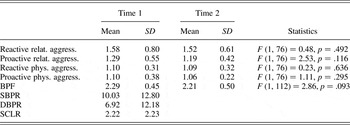
We conducted repeated-measures analysis of variance to examine differences in aggressive behaviors and BPFs between two time points. In these analyses, aggressive behaviors and BPFs were the dependent variables; time was the within-subject variable. No significant differences in these variables across time were found. Means and standard deviations for all the study variables are presented in Table 1.
Descriptive statistics of study variables across time

Note: BPF, Borderline personality features; SBPR, systolic blood pressure reactivity; DBPR, diastolic blood pressure reactivity; SCLR, skin conductance level reactivity.
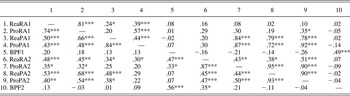
We also tested bivariate correlations to examine concurrent and longitudinal associations among BPFs and different forms and functions of aggression. Table 2 presents these correlations by gender. For boys, BPFs were not correlated with any aggression subtypes within time or across time. For girls, BPFs at T1 were significantly correlated with reactive and proactive relational aggression at T2 (r = .33–.47); BPFs at T2 were correlated with reactive relational aggression at T2 (r = .35). For both boys and girls, several significant correlations emerged among different subtypes of aggression within time, including medium to high correlations between reactive and proactive relational aggression (r = .43–.81) and medium to high correlations between reactive and proactive physical aggression (r = .44–.93). In terms of stability of the constructs, for boys, reactive and proactive physical aggression were highly stable over 1 year (r = .79 and .92, respectively). For girls, all of the subtypes of aggression were stable over 1 year (r = .33–.48), with the exception of proactive physical aggression (r = .22, p = .148). BPFs were fairly stable for both boys and girls over 1 year (r = .49 and .56, respectively).
Correlations among borderline personality features and subtypes of aggression by gender

Note: Correlations for boys are above the diagonal; correlations for girls are below the diagonal. ReaRA1, Reactive relational aggression at Time 1; ProRA1, proactive relational aggression at Time 1; ReaPA1, reactive physical aggression at Time 1; ProPA1, proactive physical aggression at Time 1; BPF1, borderline personality features at Time 1; ReaRA2, reactive relational aggression at Time 2; ProRA2, proactive relational aggression at Time 2; ReaPA2, reactive physical aggression at Time 2; ProPA2, proactive physical aggression at Time 2; BPF2, borderline personality features at Time 2.
*p < .05. **p < .01. ***p < .001.
Data analysis plan
We conducted path analyses using Mplus version 6 to address our study hypotheses. Given that some study variables, especially proactive and reactive physical aggression at both time points, exhibited substantial departures from normality (i.e., skewness range = 3.39–6.44), a robust weighted least squares estimator was used to accommodate nonnormally distributed variables (see chap. 15 in Muthén & Muthén, Reference Muthén and Muthén1998–2010). Maximum likelihood estimation procedures were used to accommodate missing data.
A series of path analyses was conducted to examine the longitudinal associations between BPFs and aggression within and across time. Two cross-lagged models were tested: one with BPFs, reactive relational aggression, and proactive relational aggression at both time points (Figure 1) and the other with BPFs, reactive physical aggression, and proactive physical aggression at both time points (Figure 2). All the paths (dashed or solid) illustrated in the model were tested, which included stability paths of the constructs, within-time covariances between constructs at both time points, and the cross-lagged paths between T1 constructs and T2 constructs (e.g., T1 BPFs to T2 aggression and T1 aggression to T2 BPFs).
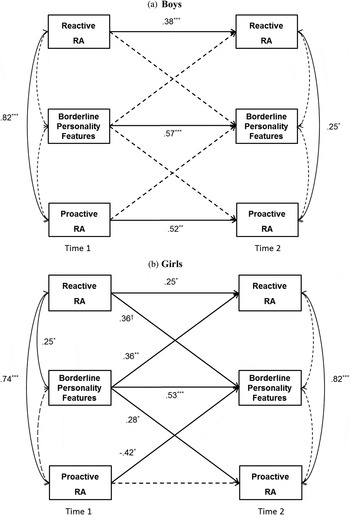
Cross-lagged model (with standardized estimates) of borderline personality features and reactive and proactive relational aggression (RA) for (a) boys and (b) girls. Significant paths are shown in solid lines; nonsignificant paths are shown in dashed lines. The residual covariance between proactive RA at Time 1 and reactive RA at Time 2 was estimated based on modification indices but is not shown. †p = .063, *p < .05, **p < .01, ***p < .001.

Cross-lagged model (with standardized estimates) of borderline personality features and reactive and proactive physical aggression (PA) for (a) boys and (b) girls. Significant paths are shown with solid lines, and nonsignificant paths are shown with dashed lines. †p < .065, *p < .05, ***p < .001.

To examine whether physiological reactivity (i.e., SBPR, DBPR, and SCLR, respectively) interacted with T1 BPFs to predict T2 reactive and proactive aggression, we again conducted path analyses separately for relational aggression and physical aggression. In one model, we tested main effects of T1 physiological reactivity and T1 BPFs, and the interactive effect of BPFs and physiological reactivity, in the prediction of T2 reactive and proactive relational aggression. In the other model, we tested main effects of T1 physiological reactivity and T1 BPFs, and the interactive effect of BPFs and physiological reactivity, in the prediction of T2 reactive and proactive physical aggression. In both models, we controlled for the stability of aggression by including T1 measures of T2 aggression outcomes (i.e., reactive and proactive aggression) in the models as covariates (e.g., T1 reactive aggression to T2 reactive aggression and T1 proactive aggression to T2 proactive aggression).Footnote 1 Within-time correlations between variables at each time point were also estimated. Separate analyses were run for each index of physiological reactivity (i.e., SBPR, DBPR, and SCLR). Continuous variables were mean centered prior to analyses. Significant interactions between BPFs and physiological reactivity were probed using simple slope analyses at low (–1 SD) and high (+1 SD) levels of physiological reactivity (Aiken & West, Reference Aiken and West1991).
We also tested whether the pathways in the models varied by gender by conducting multigroup analysis in Mplus. The chi-square, root mean square error of approximation (RMSEA), and comparative fit index (CFI) were used to evaluate model fit (Hu & Bentler, Reference Hu and Bentler1999). In general, a nonsignificant chi-square, a cutoff value of 0.06 or lower for RMSEA, and a cutoff value of 0.95 or higher for the CFI suggest good fit with the observed data, although lower thresholds are generally adopted for acceptable fit (e.g., CFI = 0.90; see Hu & Bentler, Reference Hu and Bentler1999). We present standardized estimates to facilitate interpretation of the results.
BPFs and reactive and proactive relational aggression
The first model examined the associations between BPFs and reactive and proactive relational aggression within and across time. We tested our hypothesized model with the overall sample. The model fit was good, χ2 = 0.00, df = 1, p = .969, CFI = 1.00, RMSEA = 0.00 (0.00, 0.00). We then ran multigroup analysis to examine gender moderation on the paths. An unconstrained model in which all the paths were set to be freely estimated across gender was compared to a fully constrained model in which all the paths were constrained to be equivalent across gender using a chi-square difference test for nonnormally distributed data (Satorra & Bentler, Reference Satorra and Bentler2001). The difference in model fit between the unconstrained model and the fully constrained model was significant, Δχ2 (14) = 30.36, p = .007,Footnote 2 suggesting that the paths in the model varied by gender. We then tested several additional models and compared them to the unconstrained model to locate which paths differed by gender. Constraining within-time covariances between constructs to be equal across gender resulted in a significant decrease in model fit, Δχ2 (7) = 19.02, p = .008, suggesting that within-time covariances varied by gender. Constraining stability paths to be equal across gender did not worsen the model fit, Δχ2 (3) = 0.13, p = .988, indicating that stability of constructs did not differ between boys and girls. Constraining cross-lagged paths, however, resulted in a significant reduction in model fit, Δχ2 (4) = 14.73, p = .005, which suggested that cross-lagged paths varied between boys and girls. As a result, our final model constrained stability paths to be equal across gender but freed within-time covariances and cross-lagged paths to vary by gender. This final model exhibited acceptable model fit, χ2 (5) = 7.94, p = .160, CFI = 0.98, and RMSEA = 0.08 (0.00, 0.17).
Figure 1a and 1b present results of this final model for boys and girls, respectively. No significant cross-lagged paths were found for boys. In contrast, all the cross-lagged paths were significant or marginally significant for girls. Specifically, T1 BPFs positively predicted T2 reactive and proactive relational aggression. It is interesting that evidence emerged for the alternative direction of effects as well; specifically, T1 reactive relational aggression positively predicted T2 BPFs (although at a trend level, p = .063), and T1 proactive relational aggression negatively predicted T2 BPFs for girls. Concurrently, for both boys and girls, reactive and proactive relational aggression were highly correlated with each other at T1; moreover, even after controlling for the relation between these two constructs at the previous time point, the residuals of reactive and proactive relational aggression were still significantly correlated with each other 1 year later. At T1, reactive relational aggression was positively correlated with BPFs for girls only. Reactive relational aggression and BPFs were stable for boys and girls, and proactive relational aggression was stable for boys over 1 year.
BPFs and reactive and proactive physical aggression
The second model examined the associations between BPFs and reactive and proactive physical aggression within and across time. Model fit for the overall sample was acceptable, χ2 (2) = 6.57, p = .037, CFI = 0.96, RMSEA = 0.11 (0.02, 0.21). Multigroup analysis comparing the unconstrained and fully constrained models indicated that the paths in the model varied by gender, Δχ2 (13) = 224.53, p < .001. Constraining within-time covariances, Δχ2 (6) = 1.84, p = .933, and constraining cross-lagged paths, Δχ2 (4) = 9.31, p = .057, to be equal across gender did not worsen model fit. However, constraining stability paths to be equal across gender resulted in a significant reduction in model fit, Δχ2 (3) = 196.44, p < .001.Footnote 3 As a result, our final model constrained within-time covariances and cross-lagged paths to be equal across gender but freed stability paths to vary by gender. This final model exhibited excellent model fit, χ2 (14) = 12.32, p = .565, CFI = 1.00, and RMSEA = 0.00 (0.00, 0.09).
Figure 2a and 2b present results of this final model for boys and girls, respectively. For boys, T1 BPFs were marginally associated with lower T2 proactive physical aggression (p = .061). For girls, T1 BPFs significantly predicted lower T2 proactive physical aggression (p < .05) and marginally predicted lower T2 reactive physical aggression (p = .064). At T1, for both boys and girls, reactive and proactive physical aggression were highly correlated with each other; the residuals of reactive and proactive physical aggression continued to be highly correlated with each other 1 year later. For both genders, BPFs were fairly stable over the 1-year period. Reactive and proactive physical aggression were highly stable among boys but not among girls.
BPFs and physiological reactivity predicting reactive and proactive relational aggression
SBPR
To assess whether SBPR moderated the association between BPFs and relational aggression, we first tested our hypothesized model with the overall sample; model fit was χ2 (0) = 0.00, p = .00, CFI = 1.00, RMSEA = 0.00 (0.00, 0.00). To examine gender moderation, we conducted multigroup analyses in which we compared an unconstrained model (i.e., all the paths were set to be freely estimated across gender) to a fully constrained model (i.e., all the paths were set to be equivalent across gender). Constraining the paths to be equivalent across gender resulted in a significant reduction in fit, Δχ 2 (14) = 55.84, p < .001, suggesting that the paths in the model varied by gender. We then tested several additional models and compared them to the unconstrained model to locate which paths differed by gender. Constraining within-time covariances between constructs, Δχ2 (4) = 22.32, p < .001, and constraining directional paths (i.e., T1 SBPR, BPFs, and SBPR × BPFs to T2 reactive and proactive relational aggression), Δχ2 (6) = 18.19, p = .006, to be equal across gender resulted in a significant decrease in model fit. Constraining stability in aggression measures from T1 to T2 to be equal across gender did not worsen the model fit, Δχ2 (4) = 5.56, p = .235. Therefore, our final model constrained stability paths to be equal across gender and freed the rest to vary by gender. This final model exhibited acceptable model fit, χ2 (4) = 5.56, p = .235, CFI = 0.99, and RMSEA = 0.07 (0.00, 0.20).
Table 3 presents standardized estimates for the directional paths of interest (i.e., SBPR, BPFs, and SBPR × BPFs → reactive and proactive relational aggression) by gender. Results indicated a significant interaction of SBPR × BPFs in predicting both reactive and proactive relational aggression for girls only. Simple slope analysis showed that among girls, T1 BPFs predicted increases in T2 reactive relational aggression, above and beyond T1 reactive relational aggression, for those with high SBPR (B = 2.03, p < .001) but not for those with low SBPR (B = –0.20, p = .485). Similarly, T1 BPFs predicted increases in T2 proactive relational aggression, after controlling for T1 proactive relational aggression, for those with high SBPR (B = 1.20, p = .003) but not for those with low SBPR (B = –0.07, p = .787). No significant main effects or interactions were found for boys.
Borderline personality features and physiological reactivity in the prediction of reactive and proactive relational aggression

Note: SBPR, Systolic blood pressure reactivity; BPF, borderline personality features; DBPR, diastolic blood pressure reactivity; SCLR, skin conductance level reactivity.
*p < .05. **p < .01. ***p < .001.
DBPR
Following the same procedures, we tested our hypothesized model involving DBPR first with the overall sample; model fit was χ2 (0) = 0.00, p = .00, CFI = 1.00, RMSEA = 0.00 (0.00, 0.00). Multigroup analysis indicated that constraining paths to be equal across gender resulted in a significant decrease in model fit compared to the unconstrained model, Δχ2 (14) = 32.47, p = .003. We then tested several additional models to locate which paths differed by gender and found that within-time correlations, Δχ2 (4) = 15.19, p = .004, but not directional paths, Δχ2 (6) = 8.18, p = .223, or stability paths, Δχ2 (4) = 2.51, p = .643, varied by gender. Therefore, our final model freed within-time correlations to vary by gender but constrained directional paths and stability paths to be equal across gender. This final model exhibited good model fit, χ2 (10) = 11.34, p = .332, CFI = 0.99, and RMSEA = 0.04 (0.00, 0.13).
Directional paths (i.e., DBPR, BPFs, and DBPR × BPFs → reactive and proactive relational aggression) are presented in Table 3. The interaction of DBPR × BPFs was not significant. However, there was a significant main effect of DBPR in predicting reactive relational aggression for both genders. Lower DBPR at T1 was associated with increases in reactive relational aggression at T2 for both boys and girls.
SCLR
Model fit for the overall sample was χ2 (0) = 0.00, p = .00, CFI = 1.00, RMSEA = 0.00, (0.00, 0.00). Multigroup analysis indicated that constraining paths to be equivalent across gender resulted in a significant decrease in model fit when compared to the unconstrained model, Δχ2 (14) = 48.04, p < .001. Results from several additional models indicated that within-time correlations, Δχ2 (4) = 21.79, p < .001, and directional paths, Δχ2 (6) = 14.43, p = .025, but not stability paths, Δχ2 (4) = 2.30, p = .680, differed by gender. Therefore, our final model constrained stability paths to be equal across gender and freed the rest to vary by gender. This final model exhibited excellent model fit, χ2 (4) = 2.30, p = .680, CFI = 1.00, and RMSEA = 0.00 (0.00, 0.13).
Directional paths (i.e., SCLR, BPFs, and SCLR × BPFs → reactive and proactive relational aggression) are presented in Table 3. The interaction of SCLR × BPFs was not significant, although there was a significant main effect of SCLR in predicting proactive relational aggression for boys only. Specifically, heightened SCLR at T1 predicted increases in proactive relational aggression at T2 for boys only.
BPFs and physiological reactivity predicting reactive and proactive physical aggression
SBPR
The model examining whether SBPR moderated the association between BPFs and physical aggression with the overall sample exhibited acceptable model fit, χ2 (2) = 4.95, p = .084, CFI = 0.95, RMSEA = 0.097 (0.00, 0.21). Multigroup analysis indicated that constraining the paths to be equivalent across gender resulted in a significant reduction in model fit, as compared to the unconstrained model, Δχ2 (12) = 93.44, p < .001. Results from several additional models showed that stability paths, Δχ2 (4) = 21.79, p < .001, but not within-time correlations, Δχ2 (4) = 5.41, p = .248, or directional paths, Δχ2 (6) = 5.61, p = .468, varied by gender. Therefore, our final model freed stability paths to vary by gender and constrained the rest of the paths to be equal across gender. This final model exhibited excellent model fit, χ2 (14) = 15.21, p = .364, CFI = 1.00, and RMSEA = 0.03 (0.00, 0.12).
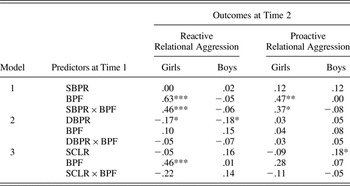
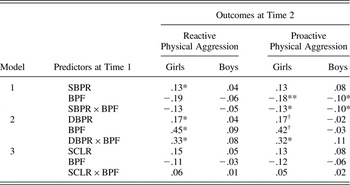
Table 4 presents standardized estimates for the directional paths of interest (i.e., SBPR, BPFs, and SBPR × BPFs → reactive and proactive physical aggression) by gender. Results indicated a significant interaction of SBPR × BPFs in predicting proactive physical aggression for both boys and girls. However, simple slope analysis showed that, among boys, T1 BPFs did not significantly predict T2 proactive physical aggression for those with high SBPR (B = 0.02, p = .874) or low SBPR (B = 0.00, p = .988). Similarly, among girls, T1 BPFs did not significantly predict T2 proactive physical aggression for those with high SBPR (B = 0.09, p = .497) or low SBPR (B = –0.01, p = .865). In addition, there was a significant main effect of SBPR in predicting reactive physical aggression for girls. That is, heightened SBPR at T1 predicted increases in T2 reactive physical aggression for girls.
Borderline personality features and physiological reactivity to a relational stressor in the prediction of reactive and proactive physical aggression

Note: SBPR, Systolic blood pressure reactivity; BPF, borderline personality features; DBPR, diastolic blood pressure reactivity; SCLR, skin conductance level reactivity.
†p < .06. *p < .05. **p < .01.
DBPR
Model fit for the baseline model with the overall sample was χ2 (2) = 4.79, p = .091, CFI = 0.96, RMSEA = 0.09 (0.00, 0.21). Fully constraining paths in the model to be equivalent across gender resulted in a significant decrease in model fit compared to the unconstrained model, Δχ2 (12) = 79.32, p < .001. Results from several additional models showed that directional paths, Δχ2 (6) = 18.66, p = .005, and stability paths, Δχ2 (2) = 239.84, p < .001, but not within-time correlations, Δχ 2 (4) = 1.43, p = .838, varied by gender. Therefore, our final model constrained the within-time correlations to be equal across gender but freed the directional paths and stability paths to vary by gender. This final model exhibited excellent model fit, χ2 (8) = 3.28, p = .916, CFI = 1.00, and RMSEA = 0.00 (0.00, 0.05).
Directional paths (i.e., DBPR, BPFs, and DBPR × BPFs → reactive and proactive physical aggression) are presented in Table 4. The interaction of DBPR × BPFs was significant in predicting both reactive and proactive physical aggression for girls but not for boys. However, simple slope analysis showed that among girls, T1 BPFs did not significantly predict increases in T2 reactive physical aggression for those with high DBPR (B = 5.03, p = .324) or low DBPR (B = –0.93, p = .781). Similarly, T1 BPFs did not predict increases in T2 proactive physical aggression for those with high DBPR (B = 0.08, p = .352) or low DBPR (B = –0.01, p = .831). Nonetheless, main effects of DBPR suggested that among girls, heightened DBPR at T1 was associated with increases in T2 reactive physical aggression and proactive physical aggression (although at a trend level, p = .059; see Table 4).
SCLR
Model fit for the baseline model with the overall sample was χ2 (2) = 4.87, p = .088, CFI = 0.95, RMSEA = 0.096 (0.00, 0.21). Constraining paths to be equivalent across gender resulted in a significant decrease in model fit compared to a fully unconstrainted model, Δχ2 (12) = 75.23, p < .001. Results from several additional models showed that only stability paths differed by gender, Δχ2 (2) = 70.43, p < .001; therefore, our final model freed these paths to vary across gender and constrained the rest to be equal across gender. This final model exhibited good model fit, χ2 (14) = 18.48, p = .186, CFI = 0.98, and RMSEA = 0.06 (0.00, 0.14).
Directional paths (i.e., SCLR, BPFs, and SCLR × BPFs → reactive and proactive physical aggression) are presented in Table 4. No significant main effects or interactions were significant in predicting reactive or proactive physical aggression at T2.
Discussion
Researchers have typically conceptualized aggression as an outcome of BPD; however, few have empirically tested the hypothesis that borderline pathology precedes aggressive behavior. Furthermore, extant work has been dominated by a focus on physical forms of aggression, to the neglect of relational aggression, and has often failed to consider functions of aggressive behavior. The present study aimed to address these limitations by examining prospective associations between BPFs and aggression (i.e., reactive relational aggression, proactive relational aggression, reactive physical aggression, and proactive physical aggression) over a 1-year period during middle childhood. Physiological reactivity (i.e., DBPR, SBPR, and SCLR) and gender were tested as potential moderators. Findings indicated that borderline pathology prospectively predicted relationally aggressive behavior among girls, particularly in the context of heightened physiological reactivity.
Consistent with study hypotheses, BPFs predicted increases in reactive relational aggression over time for girls only. Moreover, BPFs were related to reactive relational aggression only among girls who evinced heightened physiological reactivity (i.e., SBPR) to a relational stressor. Our findings are consistent with previous research showing that borderline pathology is concurrently associated with reactive aggression (Gardner et al., Reference Gardner, Archer and Jackson2012), particularly reactive relational aggression (Ostrov & Houston, Reference Ostrov and Houston2008), even after controlling for proactive functions. Furthermore, these results support the conceptual overlap between borderline pathology and reactive relational aggression. Researchers have noted a number of parallels between BPFs and relational aggression, including enmeshed relationships, manipulative behaviors, and cognitive and emotional sensitivity to interpersonal events (e.g., Crick et al., Reference Crick, Murray-Close and Woods2005). Results from the present study suggest that borderline features, such as affective instability, intense and inappropriate anger, and impulsivity, may predispose emotionally dysregulated girls with BPFs to engage in retaliatory, impulsive functions of relational aggression.
Results also showed that girls with high levels of BPFs experienced increases in proactive functions of relational aggression over time. Moreover, the association between BPFs and proactive relational aggression only emerged in the context of heightened SBPR. Although the controlled and calculating nature of proactive aggression seems to be inconsistent with some aspects of BPD (e.g., cognitive, affective, and behavioral instability), the enmeshed and stormy interpersonal relationships typical of borderline pathology may promote such conduct, especially in the form of relational aggression. Some characteristics of BPD appear to overlap with proactive aggression. Consistent with the goal-directed quality of proactive aggression, research in adult populations indicates that the use of manipulation to achieve desired goals reflects a commonly observed feature of BPD (Mandal & Kocur, Reference Mandal and Kocur2013). For girls with BPFs in the present study, it is possible that proactive functions of relational aggression may be employed to manipulate relational partners, particularly among those who are highly reactive to interpersonal threats.
Although unexpected, our finding that BPFs predicted both reactive and proactive functions of relational aggression supports previous research in adult populations indicating that these two subtypes of aggression are uniquely associated with borderline pathology (Ostrov & Houston, Reference Ostrov and Houston2008). Furthermore, this pattern of results is consistent with research indicating that reactive and proactive relational aggression tend to co-occur (Crapanzano, Frick, & Terranova, Reference Crapanzano, Frick and Terranova2010). In a study of fourth- through seventh-grade children conducted by Crapanzano et al. (Reference Crapanzano, Frick and Terranova2010), cluster analyses revealed two groups of relationally aggressive girls: a reactive only group and a combined reactive and proactive group. Findings from the present study suggest that girls with heightened levels of BPFs who experience intense emotional reactions to interpersonal stress may be part of a distinct subgroup of aggressive children that engages in both reactive and proactive relational aggression.
Children with heightened levels of BPFs did not appear to be at risk for increasing levels of physical aggression. Girls with elevated BPF scores experienced a decline in proactive physical aggression over 1 year. In addition, two marginally significant pathways emerged, indicating that BPFs negatively predicted proactive physical aggression among boys and reactive physical aggression among girls. Results are consistent with previous research indicating that physical aggression does not account for unique variance in borderline pathology after controlling for relational aggression (Crick et al., Reference Crick, Murray-Close and Woods2005; Ostrov & Houston, Reference Ostrov and Houston2008). Furthermore, decreasing trajectories of physical aggression in the current study may reflect an increasing preference for relationally aggressive strategies among girls with heightened levels of BPFs. Because physical aggression becomes increasingly nonnormative with development (Broidy et al., Reference Broidy, Nagin, Tremblay, Bates, Brame and Dodge2003), relational aggression may gradually become the primary strategy among youth with BPFs.
Although results from the present study largely support the hypothesis that BPFs promote aggression, findings also emerged for the alternative direction of effects. It is interesting that proactive relational aggression predicted a decline in BPFs over time among girls. Findings are consistent with recent research indicating that proactive relational aggression predicts improvements in emotion regulation during early childhood (Ostrov et al., Reference Ostrov, Murray-Close, Godleski and Hart2013). It is possible that engaging in calculated, goal-directed aggression may serve as an opportunity to practice emotion regulation skills, acting as a buffer against the development of psychopathology characterized by affective instability (Ostrov et al., Reference Ostrov, Murray-Close, Godleski and Hart2013). Furthermore, research shows that relational aggression may be used in a skillful way to achieve desirable social outcomes, including high status in the peer group (Cillessen & Mayeux, Reference Cillessen and Mayeux2004; Prinstein & Cillessen, Reference Prinstein and Cillessen2003; Rose, Swenson, & Waller, 2005). These findings have been particularly robust for girls (Cillessen & Mayeux, Reference Cillessen, Jiang, West and Laszkowski2005; Rose, Swenson, et al., 2005). Perhaps girls who use proactive relational aggression in a highly controlled way are emotionally regulated and well adjusted in their interpersonal relationships, decreasing the risk for the development of borderline pathology.
In addition, reactive relational aggression predicted increases in BPFs among girls, but only at a trend level. This finding supports previous suggestions that stable tendencies for impulsivity may be manifested as relational aggression during middle childhood and may promote the development of BPFs (Crick et al., Reference Crick, Murray-Close and Woods2005). However, negative behaviors such as reactive relational aggression may place youth on a negative developmental trajectory toward borderline pathology, above and beyond associations with impulsivity, because it leads to problems such as hostile worldviews, enmeshed relationships, and poor emotion regulation skills (Crick et al., Reference Crick, Woods, Murray-Close, Han, Freeman and Reinecke2007; Ostrov et al., Reference Ostrov, Murray-Close, Godleski and Hart2013). It will be important for future research to examine the potential mechanisms linking relational aggression to future borderline pathology, including impulsivity and relationship dysfunction.
Finally, results from the present study provided partial support for our gender moderation hypothesis. Consistent with a gender-informed model of aggression (Ostrov & Godleski, Reference Ostrov and Godleski2010), findings suggest that when girls with BPFs become angered, they may be more likely than their male counterparts to select relationally aggressive strategies. In contrast, the hypothesis that BPFs would be most strongly related to increases in physical forms of aggression among boys was not supported. Boys with higher levels of BPFs showed a decrease in proactive physical aggression over time; however, this association only approached conventional levels of statistical significance and, thus, should be interpreted with caution. It should be noted that boys showed considerable stability in proactive and reactive physical aggression, perhaps limiting the opportunity to predict changes in physical aggression over time. High stability may be partially attributable to the short-term longitudinal design of the present study. It will be important for future research to investigate the link between aggression and borderline pathology over longer periods of time and to assess other developmentally salient behaviors characteristic of boys with BPFs (e.g., substance use and delinquency).
Taken together, results from the present study show that BPFs promote an increasing trajectory of relationally aggressive behavior among girls who demonstrate heightened physiological reactivity to interpersonal stress. These findings are consistent with extant theory and empirical research that indicates that heightened physiological reactivity energizes aggressive behavior (Murray-Close, Reference Murray-Close2013a). Furthermore, the present study contributes to the literature indicating that affective instability is a core feature of BPD that drives associated maladaptive behaviors (Linehan, Reference Linehan1993). Although research in adult samples has provided inconclusive support for physiological hyperreactivity as an indicator of emotional reactivity in BPD patients, the most robust findings appear to come from studies that utilize disorder-specific stressors to evoke stress (e.g., abandonment and rejection scripts; Limberg et al., Reference Limberg, Barnow, Freyberger and Hamm2011; Schmahl et al., Reference Schmahl, Elzinga, Ebner, Simms, Sanislow and Vermetten2004). The present study suggests that relational peer provocation may be particularly salient for girls with BPFs. Findings highlight the utility of assessments with an interpersonal focus in research examining borderline pathology.
Limitations and future directions
Although the current study provides new information about the development of BPFs and aggression in middle childhood, a number of limitations should be addressed in future research. Physiological reactivity was assessed while participants recalled a recent peer victimization experience. Although this is considered a strength of the present study owing to the ecological validity of this approach, future research should examine how children with BPFs react to interpersonal stress in real time. Experimental paradigms designed to evoke aggression, combined with assessment of physiological reactivity, may afford direct observation of behavioral and physiological reactivity in response to stress. Research with adult BPD patients has used the point subtraction aggression paradigm (Cherek & Dougherty, Reference Cherek and Dougherty1997), which provokes subjects by having money indirectly taken from them by a fictitious opponent during a money acquisition task. The point subtraction aggression paradigm has been shown to discriminate between adults with BPD and healthy controls (Dougherty, Bjork, Huckabee, Moeller, & Swann, Reference Dougherty, Bjork, Huckabee, Moeller and Swann1999; McCloskey et al., Reference McCloskey, New, Siever, Goodman, Koenigsberg and Flory2009; New et al., Reference New, Hazlett, Newmark, Zhang, Triebwasser and Meyerson2009). However, standardized interpersonal stressors (e.g., Cyberball; Williams, Cheung, & Choi, Reference Williams, Cheung and Choi2000) may be effective in evoking physiological hyperreactivity in youth with BPFs. Because interpersonal relationship problems characteristic of borderline pathology often involve close friends and other valued relationship partners (Skodol, Gunderson, et al., Reference Skodol, Siever, Livesley, Gunderson, Pfohl and Widiger2002), personalized adaptations of such stressors (e.g., stress occurring in close interpersonal contexts) may be particularly effective in evoking physiological reactivity in youth with BPFs.
In addition, it is important to note that the adapted version of the SCI used in the present investigation required children to reconstruct both an instrumental stressor and a relational stressor. Due to the salience of interpersonal stress for individuals with borderline pathology, only reactivity to the relational stressor was included in the analyses reported here. Although it is possible that there may have been carryover effects in physiological arousal from the instrumental stressor, the order in which participants described a relational versus an instrumental stressor was counterbalanced and, thus, should not have systematically affected study findings.
Finally, it is important to address the high correlations observed between functions of aggression in the present study. Although this is consistent with previous research (Card & Little, Reference Card and Little2006), our correlation between reactive and proactive physical aggression among girls was particularly high. Given the infrequency of physical aggression among girls, it may be the case that girls who engage in physical aggression are likely to use both functions.
Overall, the findings from the present study demonstrate that BPFs promote the development of relationally aggressive behavior among girls who exhibit heightened physiological reactivity to interpersonal stress. Girls with BPFs appear to engage in relationally aggressive behavior in response to interpersonal threat when they are also emotionally dysregulated, as evidenced by an exaggerated physiological stress response to relational provocation. It is possible that these girls use aggression as a strategy to cope with the overwhelming experience of intense negative affect associated with stressful peer interactions. Interventions that target emotion regulation skills and promote adaptive coping strategies may reduce risk for an increasing developmental trajectory of relational aggression and associated functional impairment among girls with BPFs.