INTRODUCTION
Attention deficit hyperactivity disorder (ADHD) is a childhood-onset, neurodevelopmental condition characterized by developmentally inappropriate inattention, motor over-activity and impulsiveness (Taylor et al. Reference Taylor, Sandberg, Thorley and Giles1991). For an individual to meet DSM-IV criteria for ADHD or ICD-10 criteria for hyperkinetic disorder, these symptoms need to cause impairment and be exhibited in different settings, for example at home and at school or work. The DSM-IV system also allows for subtyping of ADHD into predominantly inattentive type, hyperactive-impulsive type, and a combined type that is most similar to the ICD-10 concept of hyperkinetic disorder (Barkley, Reference Barkley1998). ADHD affects between 2% and 5% of children (Faraone et al. Reference Faraone, Sergeant, Gillberg and Biederman2003) and it is now recognized that ADHD can persist into adolescence and adult life, although it is not yet clear how diagnostic criteria are best adjusted for the developmental phase (Faraone et al. Reference Faraone, Spencer, Montano and Biederman2004). In a recent study in the USA, the estimated prevalence rate of current adult ADHD was 4·4% (Kessler et al. Reference Kessler, Adler, Barkley, Biederman, Conners, Demler, Faraone, Greenhill, Howes, Secnik, Spencer, Ustun, Walters and Zaslavsky2006).
The aetiology of ADHD, as for other psychiatric disorders, is complex (Thapar et al. Reference Thapar, Langley, O'Donovan and Owen2006). Genetic, prenatal and later environmental influences all appear to increase susceptibility to ADHD and are also likely to modify its course and outcome.
Evidence of a genetic contribution to ADHD
It is now well established that ADHD runs in families and is strongly genetically influenced. This evidence comes from family, twin and adoption studies (Thapar et al. Reference Thapar, Holmes, Poulton and Harrington1999; Faraone et al. Reference Faraone, Perlis, Doyle, Smoller, Goralnick, Holmgren and Sklar2005).
Studies comparing the families of clinic-referred children with ADHD to relatives of referred children with other disorders and normal controls have found increased rates of ADHD in all closely related family members of affected probands including siblings (Faraone et al. Reference Faraone, Biederman, Keenan and Tsuang1991; Biederman et al. Reference Biederman, Faraone, Keenan, Benjamin, Krifcher, Moore, Sprich-Buckminster, Ugaglia, Jellinek and Steingard1992) and parents (Biederman et al. Reference Biederman, Faraone, Keenan and Tsuang1991, Reference Biederman, Faraone, Keenan, Benjamin, Krifcher, Moore, Sprich-Buckminster, Ugaglia, Jellinek and Steingard1992). Family studies have also found that half-siblings of ADHD children reared together with an ADHD proband have a significantly lower risk of developing the disorder than full siblings of the proband (Goodman & Stevenson, Reference Goodman and Stevenson1989), indicating that familial clustering is unlikely to result exclusively from the family environment. Overall, the relative risk of ADHD in first-degree relatives of probands with the disorder is between 4·0 and 5·4 (Faraone et al. Reference Faraone, Biederman and Monuteaux2000).
Adoption study findings are consistent with genetic factors contributing to the familiality of ADHD (Cantwell, Reference Cantwell1975; Cunningham et al. Reference Cunningham, Cadoret, Loftus and Edwards1975; Alberts-Corush et al. Reference Alberts-Corush, Firestone and Goodman1986; Sprich et al. Reference Sprich, Biederman, Crawford, Mundy and Faraone2000). All published studies show that adopted children with ADHD are more similar to their biological parents on ADHD measures than to their adoptive parents. Although clearly indicating a genetic contribution to ADHD, adoption studies have been criticized for limitations such as small sample sizes and the fact that interviewers are generally not blind to psychiatric or adoptive status (McMahon, Reference McMahon1980).
Twin studies have also consistently found a large, significant contribution of genetic factors to variation in ADHD (Thapar et al. Reference Thapar, Holmes, Poulton and Harrington1999; Faraone et al. Reference Faraone, Perlis, Doyle, Smoller, Goralnick, Holmgren and Sklar2005). The twin studies have differed from those based just on families, biological and adoptive, in that they mostly have been population-based, questionnaire studies and are therefore more representative of the general population. The results indicate high heritability of ADHD, with between 60% and 91% of the variance in ADHD scores in the general population being explained by genetic factors (Thapar et al. Reference Thapar, Holmes, Poulton and Harrington1999). ADHD is similarly heritable when conceptualized categorically (Goodman & Stevenson, Reference Goodman and Stevenson1989; Sherman et al. Reference Sherman, McGue and Iacono1997; Thapar et al. Reference Thapar, Harrington, Ross and McGuffin2000; Price et al. Reference Price, Simonoff, Waldman, Asherson and Plomin2001).
Genetic contribution to ADHD subtypes, persistence and co-morbidity
Family and twin study designs have also been used to examine questions other than whether genetic factors influence ADHD. First, there is the issue of whether different ADHD subtypes show a distinct genetic architecture. Findings on the extent to which DSM-IV inattentive and hyperactive-impulsive subtypes are influenced by a different or shared set of genetic factors are, however, mixed (Sherman et al. Reference Sherman, McGue and Iacono1997; Hudziak et al. Reference Hudziak, Heath, Madden, Reich, Bucholz, Slutske, Bierut, Neuman and Todd1998; Faraone et al. Reference Faraone, Biederman and Monuteaux2000; Smalley et al. Reference Smalley, McGough, Del'Homme, NewDelman, Gordon, Kim, Liu and McCracken2000; Todd et al. Reference Todd, Rasmussen, Neuman, Reich, Hudziak, Bucholz, Madden and Heath2001; Rasmussen et al. Reference Rasmussen, Neuman, Heath, Levy, Hay and Todd2004; Larsson et al. Reference Larsson, Lichtenstein and Larsson2006). Family studies of clinical samples have found that the subtypes tend to breed true, whereas population-based twin studies have shown a shared genetic contribution to different subtype dimensions (Thapar et al. Reference Thapar, Langley, O'Donovan and Owen2006). As an alternative to the DSM-IV method of subtyping, a number of studies have also used latent class analysis to identify statistically derived latent subtypes of the disorder. These studies find significant genetic contributions to latent (or underlying) ADHD constructs (Neuman et al. Reference Neuman, Heath, Reich, Bucholz, Madden, Sun, Todd and Hudziak2001; Todd et al. Reference Todd, Sitdhiraksa, Reich, Ji, Joyner, Heath and Neuman2002) that have been used by some of these research groups in subsequent molecular genetic studies.
Second, the developmental course of ADHD has been examined. Cross-sectional family studies suggest that the relative risk of ADHD may be higher in relatives of first-degree relatives of those with persistent ADHD (λr=17·2–19·7; λr is a measure of risk for ADHD in relatives) than those with childhood ADHD (λr=4–5·4) (Faraone et al. Reference Faraone, Biederman and Monuteaux2000). Longitudinal twin study findings have additionally shown that it is genetic influences that are the main contributor to stability of ADHD symptoms over time (Nadder et al. Reference Nadder, Rutter, Silberg, Maes and Eaves2002; Larsson et al. Reference Larsson, Larsson and Lichtenstein2004; Rietveld et al. Reference Rietveld, Hudziak, Bartels, van Beijsterveldt and Boomsma2004; Kuntsi et al. Reference Kuntsi, Rijsdijk, Ronald, Asherson and Plomin2005; Price et al. Reference Price, Simonoff, Asherson, Curran, Kuntsi, Waldman and Plomin2005).
Finally, ADHD commonly co-occurs with other disorders, especially conduct disorder. Twin studies have been consistent in showing that the co-occurrence of ADHD and conduct disorder symptoms is accounted for by shared genetic factors (Silberg et al. Reference Silberg, Rutter, Meyer, Maes, Hewitt, Simonoff, Pickles, Loeber and Eaves1996; Thapar et al. Reference Thapar, Harrington and McGuffin2001). There is also evidence from family (Faraone et al. Reference Faraone, Biederman and Monuteaux2000; Smalley et al. Reference Smalley, McGough, Del'Homme, NewDelman, Gordon, Kim, Liu and McCracken2000) and twin studies (Thapar et al. Reference Thapar, Harrington and McGuffin2001) that ADHD accompanied by conduct disorder problems is more strongly familial (λr=4·8–9·5) than ADHD alone (Faraone et al. Reference Faraone, Biederman and Monuteaux2000) and indexes higher genetic loading.
In summary, there is evidence from different sources showing that ADHD is genetically influenced. Family and twin studies also suggest that genetic factors play an important role in ADHD persistence and contribute to the co-occurrence of conduct disorder.
Molecular genetic studies
The process of identifying susceptibility genes for complex disorders has, until recently, either involved searching the whole genome using linkage strategies or more targeted candidate gene association approaches (Faraone et al. Reference Faraone, Perlis, Doyle, Smoller, Goralnick, Holmgren and Sklar2005). Most recently, whole genome association (WGA) studies based on several hundreds of thousands of genetic markers have become feasible. At the time of writing, WGA studies of ADHD are under way, but none have yet been published. Thus, to date, genetic findings implicating specific susceptibility genes for ADHD have all been the fruit of functional candidate gene studies.
Linkage study findings for ADHD
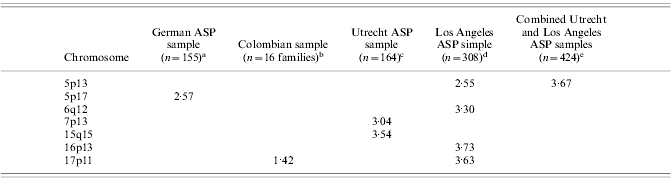
So far, findings from four whole-genome linkage studies have been published (see Table 1). Three are affected sib pair (ASP) linkage studies from the USA (Fisher et al. Reference Fisher, Francks, McCracken, McGough, Marlow, MacPhie, Newbury, Crawford, Palmer, Woodward, Del'Homme, Cantwell, Nelson, Monaco and Smalley2002; Smalley et al. Reference Smalley, Kustanovich, Minassian, Stone, Ogdie, McGough, McCracken, MacPhie, Francks, Fisher, Cantor, Monaco and Nelson2002; Ogdie et al. Reference Ogdie, Macphie, Minassian, Yang, Fisher, Francks, Cantor, McCracken, McGough, Nelson, Monaco and Smalley2003, Reference Ogdie, Fisher, Yang, Ishii, Francks, Loo, Cantor, McCracken, McGough, Smalley and Nelson2004, Reference Ogdie, Bakker, Fisher, Francks, Yang, Cantor, Loo, van der Meulen, Pearson, Buitelaar, Monaco, Nelson, Sinke and Smalley2006), the Netherlands (Bakker et al. Reference Bakker, van der Meulen, Buitelaar, Sandkuijl, Pauls, Monsuur, van't Slot, Minderaa, Gunning, Pearson and Sinke2003) and Germany (Heiser et al. Reference Heiser, Dempfle, Friedel, Konrad, Hinney, Kiefl, Walitza, Bettecken, Saar, Linder, Warnke, Herpertz-Dahlmann, Schafer, Remschmidt and Hebebrand2006) and the other study is based on multiplex families from Colombia (Arcos-Burgos et al. Reference Arcos-Burgos, Castellanos, Pineda, Lopera, Palacio, Palacio, Rapoport, Berg, Bailey-Wilson and Muenke2004) (see Table 1). In the Dutch study (Bakker et al. Reference Bakker, van der Meulen, Buitelaar, Sandkuijl, Pauls, Monsuur, van't Slot, Minderaa, Gunning, Pearson and Sinke2003), which included 164 ASPs, there was suggestive evidence of linkage (the finding did not reach statistical significance but the signal was large enough that we would expect it to be picked up by chance only once per genome scan) on chromosomes 7p and 15q [maximum Multipoint LOD (logarithm of the odds) Scores (MLSs)=3·04 and 3·54]. In the USA (UCLA) study of 270 ASPs (Ogdie et al. Reference Ogdie, Fisher, Yang, Ishii, Francks, Loo, Cantor, McCracken, McGough, Smalley and Nelson2004), significant linkage was found on chromosome 16p13 (MLS=3·73) and suggestive linkage on 17p11 (MLS=2·98). One region, 5p13, showed modest evidence of linkage (LOD score >1) in both studies, with an MLS of 1·43 in the Dutch sample and 1·77 in the US sample. Linkage analysis of the joint UCLA and Dutch (Ogdie et al. Reference Ogdie, Bakker, Fisher, Francks, Yang, Cantor, Loo, van der Meulen, Pearson, Buitelaar, Monaco, Nelson, Sinke and Smalley2006) sample yielded significant evidence for linkage at 5p13 (MLS=3·67, p=0·01). The authors, however, found that this signal came mainly from the UCLA families and also found evidence for distinct genetic backgrounds for each sample, possibly indicating ethnic or sample collection differences. The robustness of these findings therefore requires further investigation.
Significant and suggestive findings from whole-genome linkage studies into ADHD
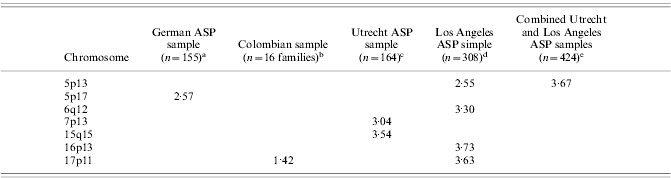
ADHD, Attention deficit hyperactivity disorder; ASP, affected sib pair.
b Arcos-Burgos et al. Reference Arcos-Burgos, Castellanos, Pineda, Lopera, Palacio, Palacio, Rapoport, Berg, Bailey-Wilson and Muenke2004.
c Bakker et al. Reference Bakker, van der Meulen, Buitelaar, Sandkuijl, Pauls, Monsuur, van't Slot, Minderaa, Gunning, Pearson and Sinke2003
Fine mapping studies are in progress, as are results from other linkage studies across the world. The most recently reported fine mapping results of positional candidate regions using 308 ASPs from UCLA supported significant evidence of linkage (Ogdie et al. Reference Ogdie, Fisher, Yang, Ishii, Francks, Loo, Cantor, McCracken, McGough, Smalley and Nelson2004) in the previously identified candidate linkage regions on 17p11 and 16p13. These analyses also highlighted suggestive evidence of linkage in a new region on 6q12, as well as on chromosome 5p13. The study from Colombia differs in that it was based on 16 multigenerational and extended pedigrees (Arcos-Burgos et al. Reference Arcos-Burgos, Castellanos, Pineda, Lopera, Palacio, Palacio, Rapoport, Berg, Bailey-Wilson and Muenke2004). Although linkage analysis on the combined set of families showed peaks (MLS >1) on chromosomes 5q33.3, 11q22 and 17p11, these did not achieve conventional levels of statistical significance (α=0·10). Fine mapping linkage analysis of all families together yielded significant linkage at chromosomes 4q13.2, 5q33.3, 11q22 and 17p11. The only region of overlap with previous studies was 17p11. In summary, to date there have been few published linkage studies of ADHD and results are at an early stage.
Functional candidate gene association studies
Functional candidate gene studies based on guesses about pathophysiology have not been very successful in complex diseases as a whole, possibly because the hypotheses of causation are not correct. They have, however, been remarkably successful for ADHD, where selection of functional candidate genes has been informed by findings from a variety of sources, including those from animal, pharmacological and imaging studies. These studies have particularly pointed to the likely involvement of dopaminergic pathways in ADHD, although clearly other neurotransmitter systems are also likely to be involved, as are biological mechanisms not based simply on neurotransmitters. First, for ADHD there is well-established evidence of an immediate and in most cases robust response to stimulant medication. These pharmacological agents, notably methylphenidate, appear to exert therapeutic effects in ADHD by increasing the functional availability of extracellular dopamine (Volkow & Swanson, Reference Volkow and Swanson2003) through inhibition of the dopamine transporter (DAT1, encoded by the gene SLC6A3), which is responsible for reuptake of dopamine from the synaptic cleft into presynaptic terminals (Castellanos, Reference Castellanos2001). Second, neuro-imaging studies of ADHD suggest changes in structure and function of brain regions rich in dopaminergic innervation (Spencer et al. Reference Spencer, Biederman, Madras, Faraone, Dougherty, Bonab and Fischman2005). Several studies have also shown increased DAT1 binding in ADHD (Dougherty et al. Reference Dougherty, Bonab, Spencer, Rauch, Madras and Fischman1999; Dresel et al. Reference Dresel, Krause, Krause, LaFougere, Brinkbaumer, Kung, Hahn and Tatsch2000), although others have found lower DAT1 binding (van Dyck et al. Reference van Dyck, Quinlan, Cretella, Staley, Malison, Baldwin, Seibyl and Innis2002; Jucaite et al. Reference Jucaite, Fernell, Halldin, Forssberg and Farde2005). Third, findings from animal studies have also implicated involvement of the dopaminergic system (Thapar et al. Reference Thapar, O'Donovan and Owen2005b) and informed functional candidate gene studies of ADHD.
In summary, there has been evidence to support investigation of dopaminergic genes in ADHD. In this review, we focus on those genes for which association findings have been found to be significant in meta-analyses or pooled analyses or which are supported by at least two independent datasets. Detailed description of all candidate gene association findings in ADHD are provided elsewhere (Faraone et al. Reference Faraone, Perlis, Doyle, Smoller, Goralnick, Holmgren and Sklar2005).
Association findings for ADHD
The dopamine D4 receptor gene (DRD4)
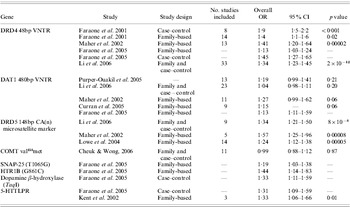
Many studies have targeted the DRD4 gene, which encodes the dopamine DRD4 receptor, and focused on a variable number tandem repeat (VNTR) polymorphism in which alleles differ by the number of repeats of a 48-bp sequence. The known size range varies from 2 repeats (2R) to 11 (11R). The allele containing 7 repeat units has now been extensively and convincingly implicated in ADHD, with at least four sets of published pooled or meta-analyses showing significant evidence for association (see Table 2). Reported odds ratios (ORs) from these studies have ranged from 1·13 [95% confidence interval (CI) 1·03–1·24] to 1·9 (95% CI 1·5–2·2). Although this finding is now strong and the variant is in a coding region (exon 3), how this variant influences disease risk at a mechanistic level is unclear (D'Souza & Craig, Reference D'Souza and Craig2006).
Findings of pooled or meta-analyses studies of candidate gene findings for ADHD

ADHD, Attention deficit hyperactivity disorder; OR, odds ratio; CI, confidence interval; —, data not given.
The dopamine D5 receptor gene (DRD5)
A meta-analysis of five studies (Maher et al. Reference Maher, Marazita, Ferrell and Vanyukov2002) and a larger international joint analysis of almost 2000 probands and 3000 of their parents from 14 research groups (Lowe et al. Reference Lowe, Kirley, Hawi, Sham, Wickham, Kratochvil, Smith, Lee, Levy, Kent, Middle, Rohde, Roman, Tahir, Yazgan, Asherson, Mill, Thapar, Payton, Todd, Stephens, Ebstein, Manor, Barr, Wigg, Sinke, Buitelaar, Smalley, Nelson, Biederman, Faraone and Gill2004) have shown significant association between ADHD and a repeat polymorphism in the DRD5 gene. The associated polymorphism is based upon the number of copies of a two base repetitive sequence (a dinucleotide repeat), with the associated allele conferring a reported OR of 1·24 (95% CI 1·12–1·38, p=0·00005). A subsequent meta-analysis has also shown significant association with this variant (see Table 2) (Li et al. Reference Li, Sham, Owen and He2006). The associated polymorphism is, however, located 18·5 kb away from the protein encoding region of the gene and has no known function. Whether this polymorphism per se causes some alteration in the function of DRD5, for example by influencing its abundance, or whether this association is indirect (that is the associated allele tends to be co-inherited with another polymorphism elsewhere in the gene, with the latter being functional) is unknown. Nevertheless, the evidence implicating DRD5 in ADHD is now fairly robust.
The dopamine transporter gene (SLC6A3)
SLC6A3 (also known as DAT1) encodes the dopamine transporter (DAT1). Most published association studies of ADHD have focused on a VNTR in the 3′-UTR of the gene, a region of the gene that, while transcribed into mRNA, is not translated into protein. Data bearing on the question of whether or not this variant is functional are equivocal (D'Souza & Craig, Reference D'Souza and Craig2006), as is the evidence for association. Indeed, five sets of published pooled and meta-analyses have yielded different findings. The first two sets of analyses (Maher et al. Reference Maher, Marazita, Ferrell and Vanyukov2002; Curran et al. Reference Curran, Purcell, Craig, Asherson and Sham2005), based on nine and 11 studies respectively (664 and 824 informative transmissions), showed evidence of heterogeneity across samples but only trends for association (OR 1·16, p=0·063 and OR 1·27, p=0·06). A more recent analysis based on an extended dataset found a small but significant association (OR 1·13, 95% CI 1·03–1·24) (Faraone et al. Reference Faraone, Perlis, Doyle, Smoller, Goralnick, Holmgren and Sklar2005). However, the two most recent pooled analyses (Table 2) have found no evidence for association (Purper-Ouakil et al. Reference Purper-Ouakil, Wohl, Mouren, Verpillat, Ades and Gorwood2005; Li et al. Reference Li, Sham, Owen and He2006). Finally, in the largest study to date, the International Multi-centre ADHD Gene (IMAGE) study, there was no evidence of association with the VNTR in the DAT1 3′-UTR (Brookes et al. Reference Brookes, Mill, Guindalini, Curran, Xu, Knight, Chen, Huang, Sentha, Taylor, Chen, Breen and Asherson2006). It has been suggested that the lack of candidate gene association findings may be accounted for by site heterogeneity (Brookes et al. Reference Brookes, Mill, Guindalini, Curran, Xu, Knight, Chen, Huang, Sentha, Taylor, Chen, Breen and Asherson2006). Thus, while possibly a priori the most compelling candidate gene, the evidence so far does not favour a role for DAT1 as a primary aetiological factor in ADHD. It should be stressed that even if it is not genetically associated, this does not refute the hypothesis of altered DAT1 function in ADHD as an important mediator in the pathophysiological cascade.
The synaptosomal associated protein (SNAP-25) gene
Interest in this gene has come from animal research. The coloboma mouse mutant, which has a chromosomal deletion containing SNAP-25, shows marked motor hyperactivity that is alleviated by stimulant medication (d-amphetamine but not methylphenidate). The hyperactivity is also ameliorated in coloboma mice modified to express SNAP-25 (Hess et al. Reference Hess, Collins and Wilson1996). However, the relationship between SNAP-25 and hyperactivity is not straightforward. SNAP-25-only knock-out mice (i.e. mice with no SNAP-25 but with the additional genes in the coloboma deletion retained) are not hyperactive (Washbourne et al. Reference Washbourne, Thompson, Carta, Costa, Mathews, Lopez-Bendito, Molnar, Becher, Valenzuela, Partridge and Wilson2002). These observations suggest that in the coloboma mice, low SNAP-25 is necessary but not sufficient for the phenotype, and that deletion of another gene is likely to be contributory. In humans, evidence for association between SNAP-25 and ADHD is still not fully convincing, as groups have studied different markers (Barr et al. Reference Barr, Feng, Wigg, Bloom, Roberts, Malone, Schachar, Tannock and Kennedy2000; Brophy et al. Reference Brophy, Hawi, Kirley, Fitzgerald and Gill2002; Mill et al. Reference Mill, Curran, Kent, Gould, Huckett, Richards, Taylor and Asherson2002; Kustanovich et al. Reference Kustanovich, Merriman, McGough, McCracken, Smalley and Nelson2003) and detailed studies are only beginning to emerge (Mill et al. Reference Mill, Richards, Knight, Curran, Taylor and Asherson2004).
The serotonin transporter gene (SLC6A4)
Interest in the serotonergic system has again come from animal studies as well as some pharmacological studies. Although other variants have also been studied, independent replicated association findings have been reported for a functional variant in SLC6A4, the serotonin transporter gene. This is a 44-bp insertion/deletion polymorphism (usually referred to as 5-HTTLPR) in the promoter region of the gene. There are long and short allelic variants, with the short form being associated with lower transporter expression (Lesch et al. Reference Lesch, Bengel, Heils, Sabol, Greenberg, Petri, Benjamin, Muller, Hamer and Murphy1996), as well as reduced serotonin uptake in platelets (Greenberg et al. Reference Greenberg, Tolliver, Huang, Li, Bengel and Murphy1999). Pooled analysis (Kent et al. Reference Kent, Doerry, Hardy, Parmar, Gingell, Hawi, Kirley, Lowe, Fitzgerald, Gill and Craddock2002) of data from three published studies (Manor et al. Reference Manor, Eisenberg, Tyano, Sever, Cohen, Ebstein and Kotler2001; Seeger et al. Reference Seeger, Schloss and Schmidt2001; Kent et al. Reference Kent, Doerry, Hardy, Parmar, Gingell, Hawi, Kirley, Lowe, Fitzgerald, Gill and Craddock2002) showed an increased frequency of the long, higher-expression allele in children with ADHD and over-representation of the long/long genotype (OR 1·33, 95% CI 0·11–1·66, p=0·01) (Kent et al. Reference Kent, Doerry, Hardy, Parmar, Gingell, Hawi, Kirley, Lowe, Fitzgerald, Gill and Craddock2002) (see Table 2). This finding has since been replicated in two case–control studies (Zoroglu et al. Reference Zoroglu, Erdal, Alasehirli, Erdal, Sivasli, Tutkun, Savas and Herken2002; Beitchman et al. Reference Beitchman, Davidge, Kennedy, Atkinson, Lee, Shapiro and Douglas2003) and two population-based studies that have examined subclinical symptoms related to ADHD (Retz et al. Reference Retz, Thome, Blocher, Baader and Rosler2002; Curran et al. Reference Curran, Purcell, Craig, Asherson and Sham2005). Studies across a variety of ethnic populations have, however, failed to find evidence of association (Langley et al. Reference Langley, Payton, Hamshere, Pay, Lawson, Turic, Ollier, Worthington, Owen, O'Donovan and Thapar2003; Kim et al. Reference Kim, Badner, Cheon, Kim, Yoo, Kim, Cook, , Leventhal and Kim2005; Xu et al. Reference Xu, Mill, Chen, Brookes, Taylor and Asherson2005; Banerjee et al. Reference Banerjee, Sinha, Chatterjee, Gangopadhyay, Singh and Nandagopal2006; Heiser et al. Reference Heiser, Dempfle, Friedel, Konrad, Hinney, Kiefl, Walitza, Bettecken, Saar, Linder, Warnke, Herpertz-Dahlmann, Schafer, Remschmidt and Hebebrand2006). A pooled analysis of case–control studies found significant association between the variant and ADHD (Faraone et al. Reference Faraone, Perlis, Doyle, Smoller, Goralnick, Holmgren and Sklar2005) (see Table 2), although as this did not include family-based studies or the most recent findings, perhaps this association requires further investigation.
Gene–phenotype links and intermediate phenotypes in molecular genetic studies of ADHD
ADHD, in common with other complex disorders, is generally considered to be both clinically and aetiologically heterogeneous. In other words it can show marked variation in clinical manifestation and this could reflect different risk factors operating through a variety of risk mechanisms. This has fuelled interest in a number of related molecular genetic research areas.
First, there has been research on whether different ways of categorically defining the ADHD phenotype (e.g. ADHD plus conduct disorder, ADHD subtypes) might index underlying aetiological heterogeneity (see Thapar et al. Reference Thapar, Langley, O'Donovan and Owen2006 for a recent review). Second, there have been attempts to identify susceptibility genes for ADHD defined as a clinically quantitative trait, using population quantitative trait loci (QTL) genetic studies, rather than as a diagnostic category (Curran et al. Reference Curran, Purcell, Craig, Asherson and Sham2005). Third, there is increasing interest in whether genetic variants that influence ADHD susceptibility also influence its clinical variability, including the developmental course (Thapar et al. Reference Thapar, Langley, Asherson and Gill2007). Fourth, in line with genetics research across psychiatry, there has been increasing focus on potential intermediate phenotypes that lie on the pathway from risk factor to disorder (Doyle et al. Reference Doyle, Willcutt, Seidman, Biederman, Chouinard, Silva and Faraone2005). Some researchers believe that identifying susceptibility genes for such intermediate phenotypes may prove more fruitful than focusing on psychiatric disorder. This type of research may also shed light on the mechanisms that mediate the link between specific risk factors and disorder. In the context of ADHD, this has mostly concerned neurocognitive intermediate phenotypes (Castellanos & Tannock, Reference Castellanos and Tannock2002), notably impairments in executive function, response inhibition and working memory. More recent attention has turned to imaging genomics (Meyer-Lindenberg & Weinberger, Reference Meyer-Lindenberg and Weinberger2006), the goal of which is to determine how variations in brain structure or function might mediate the effects of genes on clinical disorder. However, imaging genetics is still in its infancy, at least with respect to ADHD, and very little is known about the links between genes, brain structure/function and the disorder, although some promising imaging intermediate phenotypes have been reported (Durston et al. Reference Durston, Fossella, Casey, Hulshoff Pol, Galvan, Schnack, Steenhuis, Minderaa, Buitelaar, Kahn and van Engeland2005; see Seidman et al. Reference Seidman, Valera and Makris2005 for a recent review). We next focus on findings of links between replicated gene variants and specific phenotypic aspects of ADHD.
Dimensional measures of ADHD
The strength of evidence from twin studies that ADHD is heritable has mainly been based on dimensional measures of ADHD, but despite this, the associations between DRD4, DAT1, DRD5 and SNAP-25 and ADHD appear to be weaker when dimensional phenotypes are used rather than the clinical category (Mill et al. Reference Mill, Xu, Ronald, Curran, Price, Knight, Craig, Sham, Plomin and Asherson2005). Although it is not yet clear whether this has arisen because there have been few molecular genetic studies based on quantitative measures of ADHD, the results to date suggest that, at least for these gene variants, the DSM-IV clinical phenotype of ADHD, despite its problems, has been most useful. However, this is not to say that it is the optimal phenotype definition for all purposes.
ADHD subtypes
To date, findings of links between specific gene variants and different ADHD subtypes have not been robust. Although not replicated, the first large, international pooled analysis of the DRD5 variant showed association with a specific clinical phenotype, in that there was evidence of stronger association with the inattentive type of ADHD (Lowe et al. Reference Lowe, Kirley, Hawi, Sham, Wickham, Kratochvil, Smith, Lee, Levy, Kent, Middle, Rohde, Roman, Tahir, Yazgan, Asherson, Mill, Thapar, Payton, Todd, Stephens, Ebstein, Manor, Barr, Wigg, Sinke, Buitelaar, Smalley, Nelson, Biederman, Faraone and Gill2004). This finding, however, requires replication before conclusions can be drawn.
Developmental course of ADHD
Although twin studies have suggested that genetic factors account for continuity of ADHD symptoms over time, there have been very few longitudinal molecular genetic studies of ADHD. The evidence so far suggests that the DRD4 7-repeat allele appears to influence the course of ADHD, with two longitudinal studies (El-Faddagh et al. Reference El-Faddagh, Laucht, Maras, Vohringer and Schmidt2004; Langley et al. Reference Langley, Fowler, Owen, O'Donovan and Thapar2006) showing evidence of association with ADHD persistence over time but one published study failing to replicate this finding (Barkley et al. Reference Barkley, Smith, Fischer and Navia2006). Finally, in the large Dunedin cohort sample, among those with ADHD, DRD4 and DAT1 gene variants not only predicted poor adult prognosis but were also associated with intellectual functioning indexed by IQ test scores (Mill et al. Reference Mill, Caspi, Williams, Craig, Taylor, Polo-Tomas, Berridge, Poulton and Moffitt2006).
Co-morbid conduct disorder
There have been a number of studies testing for association between a specific gene variant in catechol-O-methyltransferase (COMT) and conduct disorder symptoms in ADHD. COMT is an enzyme that metabolizes catecholamines and is involved the primary mechanism for dopamine clearance in the prefrontal cortex (PFC), which is relatively devoid of DAT1. There has been considerable interest in a polymorphism (val158met) in COMT that encodes a valine (val) to methionine (met) amino acid change. In brain, COMT with the val allele is around 40% more active than COMT with the met allele (Chen et al. Reference Chen, Lipska, Halim, Ma, Matsumoto, Melhem, Kolachana, Hyde, Herman, Apud, Egan, Kleinman and Weinberger2004). Possession of the val allele is also associated with increased PFC dopamine clearance and worse performance on neurocognitive tasks assessing PFC function (Diamond et al. Reference Diamond, Briand, Fossella and Gehlbach2004; Meyer-Lindenberg et al. Reference Meyer-Lindenberg, Kohn, Kolachana, Kippenhan, McInerney-Leo, Nussbaum, Weinberger and Berman2005), which might implicate this variant in the development of ADHD. However, meta-analysis provides no support for an association between val158met and ADHD (Cheuk & Wong, Reference Cheuk and Wong2006).
Conversely, there is evidence that possession of the val allele is associated with conduct disorder symptoms/antisocial behaviour in ADHD (Thapar et al. Reference Thapar, Langley, Fowler, Rice, Turic, Whittinger, Aggleton, Van den Bree, Owen and O'Donovan2005a). This finding has since been replicated in two independent population-based samples from the UK and New Zealand (Caspi et al. Reference Caspi, Langley, Craig, Milne, Moffitt, O'Donovan, Owen, Polo Tomas, Poulton, Rutter, Taylor, Williams and Thaparin press) but not in a Canadian sample (Joober & Sengupta, Reference Joober and Sengupta2006). This finding is of interest in that it illustrates that some risk factors (here a functional COMT variant) may have modifying effects on the ADHD phenotype (here antisocial behaviour) but not increase risk for the disorder itself, at least with effect sizes of a magnitude that can be detected in sample sizes available to date.
Cognitive phenotype
Although there has been much interest in neurocognitive measures in ADHD, there are no consistently replicated genetic findings. There have been some reports suggesting that the DRD4 VNTR influences measures of cognitive functioning in ADHD (Swanson et al. Reference Swanson, Oosterlaan, Murias, Schuck, Flodman, Spence, Wasdell, Ding, Chi, Smith, Mann, Carlson, Kennedy, Sergeant, Leung, Zhang, Sadeh, Chen, Whalen, Babb, Moyzis and Posner2000; Langley et al. Reference Langley, Marshall, van den Bree, Thomas, Owen, O'Donovan and Thapar2004; Bellgrove et al. Reference Bellgrove, Hawi, Lowe, Kirley, Robertson and Gill2005; Mill et al. Reference Mill, Caspi, Williams, Craig, Taylor, Polo-Tomas, Berridge, Poulton and Moffitt2006) but, to date, different research groups have used different measures. Some have found that those possessing the DRD4 7-repeat allele perform more poorly on measures of accuracy, impulsiveness and general cognitive ability (Langley et al. Reference Langley, Marshall, van den Bree, Thomas, Owen, O'Donovan and Thapar2004; Mill et al. Reference Mill, Caspi, Williams, Craig, Taylor, Polo-Tomas, Berridge, Poulton and Moffitt2006), whereas others find that those carrying the non-risk alleles have more cognitive deficits (Swanson et al. Reference Swanson, Oosterlaan, Murias, Schuck, Flodman, Spence, Wasdell, Ding, Chi, Smith, Mann, Carlson, Kennedy, Sergeant, Leung, Zhang, Sadeh, Chen, Whalen, Babb, Moyzis and Posner2000; Bellgrove et al. Reference Bellgrove, Hawi, Lowe, Kirley, Robertson and Gill2005). Thus findings here have been mixed with no consistent patterns yet emerging.
Gene–environment interaction
The aetiology of ADHD, like all complex disorders, is not entirely explained by genes; environmental factors also contribute. Not all individuals exposed to environmental risk factors develop disorder; that is, individuals differ in their response to specific environmental factors. Equally, for complex diseases, not all individuals carrying susceptibility gene variants will develop the disorder unless they are exposed to environmental risk factors. This phenomenon of gene–environment interaction is now being increasingly recognized as an important contributor to complex diseases and behaviour and may contribute to non-replication across molecular genetic studies (Moffitt et al. Reference Moffitt, Caspi and Rutter2005; Rutter et al. Reference Rutter, Moffitt and Caspi2006).
Studies of gene–environment interaction in ADHD are at an early stage so there is, as yet, no large body of replication data from which to draw robust conclusions. The following reports should therefore be taken as indicative of the direction of investigation, rather than confirmed findings. In one association study of a non-clinical US sample, the DAT1 148-bp allelic variant was shown to be associated with hyperactive-impulsive symptom scores only in those who were exposed to maternal smoking in pregnancy (Kahn et al. Reference Kahn, Khoury, Nichols and Lanphear2003). Subsequently, another study also found evidence of interaction between prenatal smoking exposure and DRD4 and DAT1 gene variants in increasing the risk of DSM-IV ADHD, although in this study the interaction was with a different allele of the DAT1 variant (Neuman et al. Reference Neuman, Lobos, Reich, Henderson, Sun and Todd2006). However, these findings have not been replicated in a clinically referred sample (Langley et al. Reference Langley, Turic, Rice, Holmans, Van den Bree, Craddock, Kent, Owen, O'Donovan and Thaparin press). In a recent study of ADHD, there was evidence that those carrying a previously unstudied haplotype combination of markers in the DAT1 gene were more sensitive to prenatal exposure to alcohol (Brookes et al. Reference Brookes, Mill, Guindalini, Curran, Xu, Knight, Chen, Huang, Sentha, Taylor, Chen, Breen and Asherson2006). There have also been two studies investigating interaction between the DRD4 7-repeat allele and the season of birth (Seeger et al. Reference Seeger, Schloss, Schmidt, Ruter-Jungfleisch and Henn2004; K. Brookes et al. unpublished observations). However, results from these studies differed from each other. Finally, in a study from our own group, there was evidence to suggest that those with ADHD possessing the COMT val/val genotype were more sensitive to the adverse effects of a lower birthweight and those exposed to both risk factors showed higher conduct disorder symptoms (Thapar et al. Reference Thapar, Langley, Fowler, Rice, Turic, Whittinger, Aggleton, Van den Bree, Owen and O'Donovan2005a).
Pharmacogenetics represents a type of gene–environment interaction that may eventually impact on clinical practice. Pharmacogenetic studies aim to identify genetic variants that influence clinical response to medication. Although there have a few studies investigating gene variants in children with ADHD that predict clinical response to ADHD (McGough, Reference McGough2005), such studies are at an early stage and robust findings have yet to emerge.
Conclusions
Genetics research on ADHD is progressing very rapidly at an international level. Family, twin and adoption study findings have been highly consistent in showing a strong genetic influence on ADHD. These studies also suggest that genetic influences contribute to the overlap between ADHD and conduct disorder and to ADHD persistence.
A number of robustly replicated molecular genetic findings have withstood analyses by means of pooled and meta-analyses. To date, all of the associated gene variants have been of small effect and in the future there will be increasing interest in examining the risk effects of multiple genes (gene–gene interaction) and interaction with environmental risk factors.
Larger-scale genetic studies based on much bigger sample sizes achieved through international collaboration are likely to result in the identification of further ADHD susceptibility genes. Investigation of gene–clinical phenotype links is important and replicated findings so far suggest that examining these relationships will be fruitful. As in all epidemiology, identifying an associated factor is just the starting point for investigating whether it has a causal risk effect. The real challenge, but also the excitement, lies in identifying causal pathways and mechanisms. Success in these areas will enable the identification of biological targets and pathways for new medications as well as inform appropriate methods of risk reduction and treatment through environmental means.
ACKNOWLEDGEMENTS
Our ADHD research and K.L. are supported by the Wellcome Trust.
DECLARATION OF INTEREST
None.