The development of financial services in colonial India (1858–1947) presents the historian with several paradoxes. Between 1870 and 1930, a manifold increase in the volume of credit enabled growth in cultivation and India’s emergence as a major exporter of agricultural commodities in the world. The process began in the middle of the nineteenth century with the rising export of food grains and cotton and construction of irrigation canals and railways, and it lasted until the Great Depression. The financial needs of merchants and producers were met by the indigenous “informal” sector—that is, family firms engaged in banking and moneylending. Despite the growth of their business, indigenous bankers rarely invested money in modern industry like the cotton textile mills. With the exception of a few textile firms of Ahmedabad, industry tended to be financed by mercantile profits, public shareholding, and public deposits. And despite the growth of indigenous banking, the rates of aggregate savings and investment remained exceedingly low in the early twentieth century. Footnote 1 Indigenous bankers met the needs of agriculture but diversified little and had little noticeable effect on the savings habit.
This article is an attempt to explain these successes and failures of banking in India in the era of globalization. The success is easily explained. The long-established commercial networks in South Asia had nurtured large banking firms. The biggest of these firms were based in the trading cities, especially the port cities. They had a diversified portfolio and routinely dealt with other bankers and merchants. A key feature of their operation was the extensive use of negotiable instruments, especially a group of instruments collectively known as hundi. The common meaning of hundi at that time was a banker’s draft or promissory note, though sometimes merchants’ bills of exchange were also called hundi. Hundi was partially covered by an important piece of British Indian legislation, the Negotiable Instruments Act (1881). Footnote 2 More than legislation, the reputation of the acceptors as banking houses, and the customary law and conventions that they followed, ensured that the hundis they issued were discounted by the corporate banks, the largest of which were partially European owned and based in the port cities. The discounting of hundis, therefore, made for an area of convergence and cooperation between modern and traditional banking firms. In other words, their inherited institutional strengths and colonial legal intervention together helped these bankers expand their business.
The business of agricultural lending in the villages and small towns involved a very different institutional setup and different sets of actors from those described above. Even the large banking firms had some exposure to agriculture, but they rarely dealt with the peasants and local grain merchants directly. Those who mainly dealt with the peasants needed to adapt to a specific geographical condition. The conduct of agriculture under tropical monsoon conditions was marked by extreme seasonal fluctuations in the pace of economic activity. The monsoon concentrated rainfall into a two-to-three-month span in an otherwise hot and arid region, thus squeezing the sowing season, when peasants needed credit, and the harvest season, when the trade needed credit, into short time spans, sometimes as short as two to three weeks. In the busy season, bankers needed to expand credit a lot and very quickly. Local banking adapted to the unpredictable fluctuations in demand in a variety of ways. They usually dealt in the most liquid of assets, such as cash and gold, made unsecured loans, relied on their personal knowledge of the clients, insisted on short-term loans, and avoided deposit banking which would add a nonseasonal liability. The rest of the year was the slack season when circulation of money in the countryside was greatly reduced in extent.
The “failure” of the financial market was due to the facts that the seasonality-induced institutional features limited financial intermediation in the economy at large and that seasonal fluctuations in interest rates persisted. Footnote 3 The persistence of huge interyear fluctuations in interest rates was a sign that the banking business failed to increase credit sufficiently in the busy season without running into unsustainable default and failed to deploy surplus funds profitably in the depressed months. Footnote 4 Poor legislation reinforced these syndromes. Lenders in agricultural credit did not usually transact by means of negotiable instruments. The acceptors of hundi were too remote and unknown to the merchants, moneylenders, and peasants engaged in local trade. Legislation on negotiable instrument was piecemeal in that it did not extend to local moneylending and to the contractual documents that were potentially usable in agricultural transactions. A string of provincial laws restricting land mortgage posed obstacles to the use of the mortgage document as a negotiable instrument. There were other hurdles to legislation. The diverse profile of the actors, many of whom were merchants and bankers of small resources, and immense variation in local conventions would have made designing a proper legal framework for bills a frustrating enterprise. Therefore, the financial system was poorly equipped to spread credit between seasons and types of borrowers.
These arguments about the pattern and quality of financial market development lead to two larger points about the evolution of the institutions of capitalism in colonial India and the implications of that process for economic growth. Economic and business histories offer contradictory accounts of how institutions of capitalism evolved in India. One view that we can identify with the historiography of society in colonial India, including the history of business communities, suggests that the key institutions were mainly endogenous—caste norms and community networks, for example. Footnote 5 Another view that we can identify with the “new institutional economic history” suggests that the key institutions were exogenous—for example, colonial legislation inspired by the western juridical tradition. Footnote 6 This article offers a revision to these perspectives by suggesting that geography impinged on the working of both indigenous tradition and colonial law. Secondly, because the financial system entailed limited capacity for intermediation, it had limited capacity to support industrialization. The tropical monsoon climate made for an economic system that went from boom to bust every six months, year after year. Banking was geared to meeting the peak credit demand but by the use of means that forced bankers to keep capital idle in the depressed months, starving nonagricultural businesses of money even when money was idle.
The rest of this article shows how this financial system functioned. It is divided into five main sections. The next section locates the study in a chronological narrative of rural credit. While the chronological narrative supplies a reason for an investigation into the organization of the market, the main intent of the article is a static one: to understand how a structural-geographical condition shaped the organization. The subsequent sections concentrate on this issue. The sections deal with interest rates, seasonality, financial institutions, and implications of money market organization for savings and investment, with data that mainly come from the 1920s. The concluding section reflects on the relevance of the study for a comparative history of capitalism.
The History of Rural Credit in Colonial India
At the heart of the narrative of financial market development in colonial India is the story of commercialization of agriculture. There was agricultural trade in the region before, but the scale increased between 1870 and 1930. For example, the volume of grain and cotton exports increased threefold in this time span. Like regimes before, the British colonial state depended heavily on taxes collected from land. The fiscal imperative and growing demand in Britain for food and industrial raw material made the Indian government take interest in agriculture. The two most important areas of state intervention were construction of irrigation canals in northern India (ca.1850–1938) and the creation of absolute private property in land (1793–1820). From around 1870, the railways started to reduce trade costs significantly along routes connecting the agricultural interior with the ports. Cultivated area about doubled from 1870 to 1930.
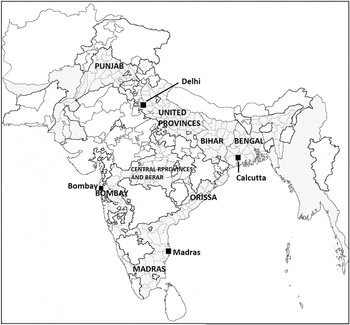
As far as one can measure, between 1870 and 1930, the volume of credit linked to agricultural trades increased by 2–300 percent in real terms. Who supplied this money? The more organized end of the money market consisted of indigenous banking firms owned by families that had been doing this business for generations. Many were earlier based in towns situated on the overland and along river trade routes, such as Benares, Mathura, Delhi, or Jaipur. In the eighteenth and nineteenth century a number of these families relocated to the port cities of Bombay, Calcutta, and Madras (see Figure 1 for major place names). These firms rarely funded peasants but dealt with other bankers, big merchants, townsmen, and sometimes industrial firms. The local money market that funded the grain merchants and the peasants consisted of a more diverse set of actors, including traditional banking families as well as a number of people who were new to the credit business or did it on the side. Indian banking firms were variously known as shroffs, sahukars, mahajans, and pedhis.
British Indian provinces (shaded), states, and main cities. Source: author.

Corporate or joint-stock banking began in the early nineteenth century but experienced rapid growth only in the twentieth century. Corporate banks consisted of a number of constituents, including the exchange banks, licensed to deal in foreign currency transactions, the partially government-owned Presidency Banks, the Indian corporate banks, and a group of small quasibanks like cooperative credit societies, loan offices, and land mortgage banks. The Presidency Banks were the Bank of Bengal (1806), Bank of Bombay (1840), and the Bank of Madras (1843). These functioned partly as the government’s banker and were amalgamated to form the Imperial Bank in 1921. These banks and private joint-stock banks handled domestic trade and remittance. Like the Indian bankers, few of these banks directly lent agricultural credit. But they did deal with the Indian bankers, mainly by accepting bills issued by the latter.
Economic history scholarship tells us little about how this network functioned. The core theme in the historiography of rural credit is not financial institution, but property right in land. In the standard narrative, absolute ownership right made land an attractive collateral. Market shocks, revenue burden, or poverty induced peasants to borrow too much. Where land belonged to substantial landlords, tenant farmers fell into debt dependency upon the landlords. Much of this scholarship, influenced by Marxist-Leninist class analysis, has explored how the indebted peasant became an example of “dislocations wrought by colonial rule.” Footnote 7 The evidence for a debt-driven impoverishment is controversial, but that debate is not relevant here.
Business history has paid more attention to how the network functioned. From this literature, we can derive two useful propositions. First, indigenous bankers and indigenous negotiable instruments (hundi) met the busy-season demand for money. Footnote 8 Secondly, the money market was segmented, among other reasons, because all lenders applied selection of clients based on personal information. These segmentation rules were informal in that they were not recognized in law. For example, the indigenous bankers charged lower rates for transactions among members of their own caste or community. The European bankers of Calcutta similarly were more lax with European clients. Footnote 9 Beyond anecdotes, we do not know enough about why specialization emerged in the credit business.
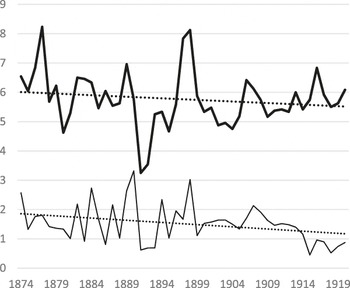
One obvious difference between metropolitan and local banking was in respect of laws regulating negotiable instruments. The fact that the bank rate (interest rate in interbank transactions, see Figure 2) did not rise even as credit demand rose in the course of commercialization suggests that metropolitan banking was sufficiently flexible as an institution. In other words, the negotiability of the bills in circulation in this sphere improved in the long run. Negotiability improved owing to some positive changes. To some extent, the big banking firms shared information and clientele. In the second half of the nineteenth century, the colonial government enacted a number of laws relating to contract and contractual procedure. These included the Negotiable Instruments Act (1881). Thereafter, a few disputes on hundis came to the courts. The hundi remained a poorly regulated instrument even after legislation. The judges often had difficulty understanding what it was and had to call in experts. The Act may well have only been an attempt to collect a transaction tax. Footnote 10 Nevertheless, its very presence made the hundi more transparent and standardized in form.
Bank rate, Bank of Bengal, average over the years (top) and standard deviation of monthly values (bottom). Source: Reserve Bank of India, Banking and Monetary Statistics of India. Bombay: Reserve Bank of India, 1954.

If law aided institutional development among metropolitan bankers, it had an opposite effect in local banking. Land mortgage loans came to be regulated by a number of provincial laws designed to stop indebted peasants from losing their land. The two most famous interventions were the Deccan Agriculturists Relief Act (1879) and the Punjab Land Alienation Act (1900). How serious the problem of land alienation was cannot be ascertained. The rate of land transfer tended to be low even without the laws. After the Indian Mutiny (1857), officers were often unduly nervous about the prospect of peasant unrest. Whether as an effect of these laws or simply because of convenience, a great deal of seasonal trade loans was unsecured.
Even if legislation remained ambiguous in effect, the government became increasingly interested in local moneylending. One outcome of this growing interest was the Banking Enquiry Commission (1929–1930), instituted as a fact finding mission to aid the grant of full monetary autonomy to India in 1935. The evidence collected during the Banking Enquiry contains thick descriptions of money markets, with a level of detail unavailable in any inquiry report before or since, and it covered all of India. The Banking Enquiry represented the first and the only systematic attempt to collect evidence from a large number of actors engaged in the rural money market. This resource has been used little in Indian financial history scholarship, even though alternative sources on Indian informal credit are scarce. Private archives of indigenous bankers are practically unheard of.
This article makes use mainly of these interviews. The interviews are especially useful to the article, not only for the institutional details they contain, but also because a great deal of the descriptions relates to seasonality. These descriptions help us reconstruct important features of the narrative history of rural credit as well as the organization of the money market. To illustrate how narrative history is helped, let us make the plausible assumption that the process of commercialization and enlargement of the volume of credit made the effect of seasonality-induced risks greater than before. Confirming that assumption, one of the earliest systematic histories of Indian banking did not even mention the words “season” and “rain,” whereas the Banking Enquiry evidences in the 1920s were preoccupied with seasonality. Footnote 11 To illustrate how this resource sheds light on organization, the interviews tell us when the system successfully dealt with the risk and when it failed to adapt to it. No other source on financial history is as detailed as this one to shed light on the link between geography and institutions in the financial market.
The purpose for which this resource is used is to seek explanations for two stylized facts about interest rates.
Interest Rates: Trend and Variation
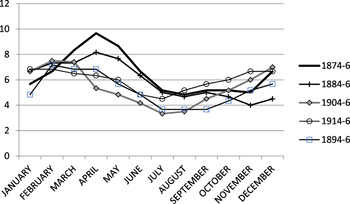
In agricultural credit operations, three main types of transaction can be distinguished: banker-to-banker, banker-to-trader, and trader-to-peasant transactions. Good time-series data are available for banker-to-banker transactions alone. In the long run, the average nominal and real interest rates in interbank transactions either fell or remained stable. The Banking Enquiry team examined the old account books of one Gujarati firm, Lakshmidas Madhavji of Karachi and Porbandar, and discovered that the interest rate on intershroff loans was more or less fixed at 6 percent per year from 1795 to 1930. Footnote 12 This was also one of the lowest rates in the indigenous money market. Footnote 13 In the more organized segment of the money market that transacted with the newly established corporate banks, a similar trend reappeared. This is evident in data compiled on the “bazaar rates” (discount rates on the best quality bills of exchange) and in the trend in bank rate shown in Figure 2. Footnote 14 The prime banker-to-banker rate was the bank rate charged by the Imperial Bank. The Imperial Bank, it has been mentioned, formed of a merger of three Presidency Banks, of which the largest was the Bank of Bengal. In order to make long-run comparisons possible, this article uses the rate charged by the Bank of Bengal (Figures 2 and 3), which again shows a long-term fall, if a marginal fall. Footnote 15
Bank rate, Bank of Bengal, seasonal variation. Source: Reserve Bank of India, Banking and Monetary Statistics of India. Bombay: Reserve Bank of India, 1954.

The second stylized fact can be established from the bank rate data. There were big fluctuations between seasons (Figures 2 and 3). The real interest rate fluctuation was higher than that in money rates because the price of food grain fell during harvest when money rates were high and increased in the rains when money rates were low. The amplitude may have fallen somewhat in the long run, but the ground to infer that is not sufficient.
Whereas the announced bazaar rate and the bank rate applied to banker-to-banker transactions, the rates at which merchants would borrow money from the banker and the peasant would borrow from the merchant were higher than this rate and varied enormously among clients and regions. We do not have systematic data on these other interest rates—only some snapshots. In North India, the common rate charged by bankers for loans made out to local traders was 9 percent. Between bankers the rate started from 4.5 percent. Footnote 16 The Marwari bankers of Bengal operated in a similar way. They had low rates for intracommunity borrowing, and 9–15 percent for trade borrowing. Among the Multanis of South India, the lending rate of interest was 9–13 percent. Intracommunity loans carried a rate of 6 percent.
The highest interest rates, and seemingly the highest seasonal variation, were reported in the sphere of trader-peasant transactions. Early nineteenth century accounts suggest that rates in trader-peasant loans were higher than those in the late nineteenth century, falling from as high as 50–100 percent to 12–24. Footnote 17 But even if the average did fall—and the evidence is slight on this—there was still a huge difference between the banker-to-banker loan rate and the trader-to-peasant loan rate. The average rate for trader-peasant loans in central India “varies from 18 to 75 per cent, the most common rate being 24 per cent.” Footnote 18 Similar rates appear from Bengal. The common rate in Bihar was two percent per month. The significance of 18 or 24 is obvious. These numbers allowed the debtor and the creditor to calculate the amount of debt outstanding by monthly rather than annual accounting. In turn, monthly accounting was so prevalent because the vast majority of the loans were of three to six months in duration and were given by individuals who were not always professional bankers and therefore relied on the simplest accounting rules. In the retail money market, interest rates on short-term loans were so high that everybody with any money to spare joined the credit business. Itinerant traders, factory owners, shopkeepers, lawyers, and teachers, all did loan business on the side during the peak season.
Trader-peasant loan rates varied locally. In arid areas, in land-locked areas, in areas that produced one subsistence grain for local consumption, and where transport cost was high, interest rates between peasants and bankers tended to be higher than elsewhere. The possible explanation is that in such areas bankers received less accommodation from metropolitan banking because of low volumes. For evidence, we know that the rate of interest fell in the well-connected coastal Gujarat and rose in the dry tracts of Gujarat. In Bombay, seasonal demand for loans was less in the dry tracts, according to the district officers but rose in the cotton cultivation zone of Khandesh, where laborers needed to be engaged on a yearly contract, and in the irrigated areas where sugarcane and betel were grown. Footnote 19
All of these rates also varied seasonally. A large amount of cash reserves of banks was converted into trade credit during the peak season, the winter months. To protect its reserves, the Imperial Bank (and the Presidency Banks before 1920) increased its bank rate. During the main harvest season, January–March, demand for money was at its peak, and loan rates between traders and peasants could be as high as 50–100 percent, though rates were a more moderate 12–24 percent among known clients. By April, the market started cooling. In the rainy season, June–August, the rates crashed and money markets disintegrated as movements of capital between small and large centres reduced.
Why was the intrayear variation in interest rate so great in India? In order to answer this question, we need to take a closer look at what seasonality meant for the economy at large.
Seasonality
With the arrival of the first rains in June from the southwest monsoon, the land All over India was ploughed and sown with the monsoon (kharif) crops, which were rice, millets, maize, groundnut (in South India), and cotton. These were usually only “wet” crops, which were harvested between August and December. Between October and December, the winter crops (rabi)—wheat, barley, and pulses—were sown; these were harvested March–April. The peak harvest season occurred in December and March, when the largest number of crops came in to the markets. The winter crops were usually irrigated, while also making use of the northeast monsoon or reverse monsoon that brought some moisture to most parts of India. The second monsoon was especially strong in eastern coastal South India, but not strong enough for extensive cultivation of the more valuable winter crops. The major benefit of the northeast monsoon was the ability to produce a wider variety of locally consumed grains, such as coarse rice. Two cash crops had a slightly different cycle. Sugarcane was a year-round crop planted in January and harvested next December. Jute was sown in February and harvested in July. Both these crops required special conditions: sugarcane needed heavy irrigation, and jute required standing water upon low lands. These, therefore, were planted in small areas. Sugarcane harvest contributed to market activity in winter. But the effect of the jute harvest was confined locally.
No region in India in 1920 produced the full basket of kharif and rabi crops. All regions grew a basket of monsoon crops. Regions receiving canal and well water, such as Punjab, western Gangetic, coastal Andhra, and a few narrow river valleys, also grew a number of winter crops. The rest of India grew winter crops relying mainly on the return monsoon and, therefore, on a smaller scale than the kharif. Most regions left a large part of the cultivable land fallow during summer.
The busiest credit season started toward the end of October and ended in March. During these months the harvest of the monsoon crops and the sowing of the winter crops overlapped. A smaller busy season also occurred in June and July when the monsoon plowing required large numbers of laborers to be hired. Peasants needed to borrow money in June to meet revenue demand and to hire workers. In most parts of India the cash and food reserves of the peasants ran low from April to June and were only partially relieved by the rabi harvest in April. In the jute growing districts of Bengal, April was the time when laborers were needed for weeding jute, and peasants would borrow money to pay the laborers. These loans were to be repaid in July when the jute harvest came in to the market. Almost everywhere, peasants growing rice needed to borrow in June and July to hire extra hands for the sowing. These loans were to be repaid in December and January. Footnote 20 Merchants needed to borrow money to supply advances to the peasants. The June peak in the money market, however, was a much weaker one compared with what was to come after October. From October to November, many peasants repaid their loans. But demand for money to finance commodity trade almost exploded.
It was not only commodity trade that peaked in winter. Because many types of small industry processed agricultural material, industrial operation had a seasonal cycle. Grain mills, leather tanning, oil presses, cotton gins, tile and brick making, and jaggery, or raw sugar production, worked for a few months in winter. Fishing was a “seasonal industry, for during the rains when the rivers are in flood and the lakes and jhils are overflowing, fishing becomes impossible.” Footnote 21 In the dry areas where fodder was scarce, the livestock market moved seasonally. Cattle were sold off to breeders and herders at the end of the sowing season. These herders took cattle nearer forest areas for grazing. They were repurchased before the next sowing season. The practice was reported in Madras and North India. Footnote 22 Transfrontier trade with Tibet, Afghanistan, and Central Asia peaked in winter. Frontier communities like the Bhotiyas and the Tibetan traders, who were suppliers of wool to the plains, remained in the mountains with their herds, spun wool, and cultivated land during summer. They descended to the plains to trade in the fairs that occurred in December and January. The woollen mills at Kanpur purchased wool from them. Therefore, the mills’ own production cycle was bound by the season. If overland trade was activated in winter, so was coastal trade because coastal shipping routes became safer to ply in winter.
The labor market also became more active from November to February. In the western Gangetic plains, migrant agricultural laborer gangs were hired for the rabi sowing, carpenters and blacksmiths hired workers to produce tools and consumer durables that were sold in fairs, and forest contractors hired sawyers in October to cut trees in the Himalayan foothills and supply timber to the railways. Footnote 23 The timber contractors, therefore, needed to borrow in winter.
The supply of labor also had a seasonal rhythm. The mill worker in Bombay and Calcutta went home to north India during the sowing season in June and the harvest in winter—a pattern of circulation the mill managers then and American sociologists later explained as a lack of commitment. In fact, many of these workers owned land and had taken loans from traders to finance cultivation back home. They were committed to these traders as well as to their employers. In the off season, likewise, there were reverse movements of people out of the interior into the towns. “Most of the tenants in their off season go to the neighbouring industrial towns. Some of the estates in the Unao district border Cawnpore [a factory town] and they get across the Ganges and obtain employment in the mills. Similarly Sandila labourers go to Lucknow and get employment there.” Footnote 24 Since these industries worked in winter, it is safe to assume that “off season” here meant the end of the winter agricultural season. And since these movements were driven by lack of demand at places of origin, one would expect the circular migration to depress the off-season wage.
Consumption of nearly everything varied according to season. The demand for craft goods peaked in winter. After the harvest, many marriages took place. The busy season for a craft, therefore, started from a month or two before winter. Footnote 25 The demand for cotton textiles was more uniform seasonally than the demand for silk or woollen cloth. But the cotton weavers faced idleness in the monsoon months because both local sales and open-air processing of yarn slowed down in July and August. For the rural poor, the basket of food articles changed completely between winter and monsoon, and the winter one was bigger and more varied. Footnote 26
Retail sales done in the slack season involved an explicit or implicit credit element. The accounts were settled in winter. A lot of retail sale of cloth in rural Bengal was done by traveling merchants, who visited their clients in September and returned after harvest in December to collect money. The price they charged was higher than the price of these goods in the town market. Some of them also made cash loans of a three-month duration. Footnote 27 In this way, private consumption accentuated the seasonal fluctuation of the circulation of money.
Basic infrastructure was a seasonal variable. Transport systems in the zones not served by coastal shipping or a railway line broke down during the monsoon and were revived in winter. In Bombay “the unmetalled roads are often mere cart tracks useless for traffic in the rainy season, especially in Gujerat.” Footnote 28 “[I]n the rainy season there is a wide expanse of water and nothing else” in the Haryana plains. Footnote 29 One witness stated that in the rainy season, the difference in the price of rice was 10–20 percent between his village and the nearest railway station only two miles away. Footnote 30 One would expect that the loan rates would also show a similar disposition. Interestingly, the high seasonality of communication may have acted as a reason for the local administration not to invest much money in road building. “[T]he seasonal nature of the traffic … will hinder the development of motor transport in the rural areas.” Footnote 31 The pressure upon the provincial governments for road building and faster transportation was not very strong because the peak season for transportation occurred in winter when seasonal roads worked fine.
Not surprisingly, then, the money market moved through extreme tightness and extreme idleness. Footnote 32 “Complaints regarding the tightness of the money market in the mofussil during the busy season have been general,” and, equally, “inactivity [in the credit market] is greatest in May and early June.” Footnote 33 Why did such seasonal variation persist? What were the consequences of the persistence? In order to answer these questions, it is necessary to begin with a description of the business of banking.
Banking
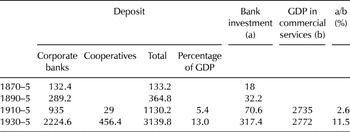
The top players in the money market were the indigenous banking firms based in the metropolitan cities (Bombay, Calcutta, Madras, and Delhi). They were among the major clients of the corporate banks. For example, in Bengal, hundis issued by the Calcutta bankers were discounted by the Imperial Bank, and in the slack season, some of the idle money moved into Calcutta or Dhaka for deposit in joint-stock banks, which offered a current account, or for investment in treasury bills. Footnote 34 The joint-stock banks funded a small (if rising) proportion of the trade directly (see Table 1) but, more often, they funded the bankers. Footnote 35 The indigenous bankers withdrew large sums of money from the Imperial Bank, other corporate banks, and the call money market by issuing hundis. In some cases, silver rupee was procured from the banks. Some of them had branches in the commodity trading hubs or knew the local bankers. In turn, the local bankers raised money by issuing hundis whenever they could, and sent the bills back to the metropolis or sold these to each other. They then loaned this money to traders and landlords who financed cultivation, or they funded smaller moneylenders and transport operators. They also did business with traders’ agents, planters, warehouse owners, and, rarely, small industries.
Growth of banks and bank finance of trade 1870–1934

Notes: Source of banking data is the same as in Figures 2 and 3. Source of GDP data: Sivasubramonian, National Income. Bank investment is the investment of Presidency Banks until 1920 and the “advances” made by the Imperial Bank thereafter. The data is incomplete. All values in Rs. million. The investment figures are for the first year of each quinquennium.
Their transactions with the Imperial Bank and with each other involved relatively low rates of interest (like the bank rate), extensive use of bills, better personal contacts and goodwill, and easier flow of information. In Calcutta and Bombay, for example, large settlements of indigenous bankers and a concentration of corporate banking made bankers’ bills circulate more easily than in the provincial towns. The money markets in these cities were not identical. Banks in Bombay served Indian clients more easily than did the European-owned banks in Calcutta. The difference in this respect had more to do with the structure of indigenous banking than with the policies of the Imperial Bank. There were several community-based clusters that competed for the same business in Bombay—the Multani (Shikarpur), Marwari, and Gujarati being the leading ones. In Bombay, and to a smaller extent in Madras, several communities had an intracommunity call money market. The internal market was so active that the call money rates often went below the bank rate. The call money market was noticeably weaker in Calcutta, even among the Marwari bankers. With the hundi business more developed there, interest or discount rates on trade loans were lower in Bombay than in Bengal.
The three segments—banker-banker, banker-merchant, and merchant-peasant—overlapped to some extent. But they were also fundamentally distinct, which we know by studying the negotiable instruments in each case. Banker-to-banker loans were mainly conducted by means of the hundi. There were three types of hundi: payable on sight (darshani), payable after a period specified in the hundi (muddati, mitidar), and payable after a flexible period according to cash flow. The third type prevailed among the Chettiar bankers of South India and was known as the nadappu. The legal system found it impossible to classify the nadappu and was quite uncertain about the other types. Footnote 36 Still, the market reputation of the issuers was usually secure so that these instruments circulated widely.
The bankers usually belonged in specific castes and communities, the prominent among these being the Multani and the Marwari, the Bengali Saha, Nattukottai Chettiar, Kallidaikurichi Brahmins in South India, the Jains and Gujaratis in Bombay, and, occasionally, Rohilla Afghans, though the main business of the last-mentioned was consumption credit. The small group of income taxpayers in the 1920s consisted of a few of these bankers. In South India, the town banking business was dominated by the Chettiars, the Multanis, the Marwaris, and the Kallidaikurichi Brahmins. The Chettiar community business was located in Burma until 1930, but there were considerable transactions in Madras as well. Footnote 37 In 1930, their involvement with agricultural trade or financing cultivation was minimal, as much of the business of the Madras firms concentrated on remittance of money through hundis issued by them to and from Malaya, Burma, and Madras. By contrast, the small community of Multani bankers was sometimes engaged in financing agricultural trade by acting as the intermediary between the merchant and the joint-stock bank. Footnote 38 They did not, however, lend directly to the peasants or on stock in trade. In busy season, they borrowed from their principals in Shikarpur as well as from the Imperial Bank.
These bankers never financed peasants but financed each other and bigger clients, such as landlords, warehouse owners, merchants with personal reputation, agents of outstation trading firms, tea estates, and traders buying jute, tobacco, and chilli crops where these cash crops were grown. Footnote 39 They discounted bills of exchange and issued remittance instruments like commercial papers when they were branches of Bombay or Calcutta firms, or had close links with the latter. They financed merchant-transporters who could furnish bills of lading from the railway company. Some of these firms were of a size comparable with that of the corporate banks. About six big indigenous banking firms in Calcutta together did as much business as the state-run Imperial Bank. Footnote 40
The biggest indigenous banking firms had dealings with the Imperial Bank. But the relationship between the two actors—corporate and family firms—was not always cozy. The bankers’ complaints about corporate banks were twofold in nature: that the big banks did not give loans or refused acceptance of hundi, or that the big banks encroached on their business. In parts of Bombay, the Imperial Bank and other joint-stock banks took over some of the hundi business from the indigenous bankers. They competed on discount rates. Footnote 41 The indigenous bankers still financed overland trade, but the corporate banks gave the local merchants and agents more options. In the same region, the Deccan Agriculturists Relief Act restrained moneylending, and the new class of merchant-creditors, like owners of ginning factories that took up the business of agricultural finance, preferred to deal with the corporate banks. Footnote 42 In Madras, bankers complained that the Imperial Bank stole their clients. “Whenever we go to them [managers of Imperial Bank] for discounting our bills, they learn the name of the parties themselves and directly approach them and offer them a lower rate of interest.” Footnote 43
In Calcutta, some Marwaris complained that the corporate banks did not give enough loans. In the assessment of one Marwari banker, the banks’ reluctance to lend stemmed from racial prejudice. “The European business community in Calcutta looks upon Indian firms with distrust … [the European banker’s] decision is influenced by what he hears at the clubs from other members.” Footnote 44 The view that prejudiced discrimination influenced the operation of the corporate banks is endorsed in the analysis of a banking history as well. Footnote 45 Racial prejudice may well have been present in Calcutta. But complaints on this account were not common at all. The sulky remarks cited above overlooked the fact that all bankers lent only to people they knew personally. By withholding money from firms whose accounting practices they did not understand, the European managers of the Imperial Bank did not do anything that the Marwaris did not do to their potential clients. Besides, as we have seen, there was quite a different explanation for indigenous bankers to feel resentful toward the Imperial Bank. The Imperial Bank was sometimes a threat to the Indian bankers because it bypassed them and lent directly to Indian merchants.
The merchants who took loans from the bankers were a motley group. Their profile changed from place to place and crop to crop. Among the larger merchant firms, the use of regular accounts and bills was not unknown. In Bengal, during the jute harvest season, travelling merchants (bepari, faria) under contract from a middleman, baling firm, or warehouse-owner (aratdar) went into the jute market, met the moneylenders who had financed the peasants, and bought goods. Their principals were financed by the professional bankers or corporate banks. Footnote 46 The loans that these principals took could be in the form of a direct cash advance. “In Dacca some banking firms make direct cash advances on personal credit to the tradesmen either for purchasing imported goods for distribution and sale or for gathering local produces for export.” Footnote 47 More commonly, the merchant would sign a promissory note or cash a hundi with the banker. Among the banking firms of Bengal, there was a further distinction between the Marwari and the Bengali, the distinction being that the former was often the branch of a Calcutta firm, and the Bengalis were locals. In the big jute market of Tangail, the Bengali Sahas, the Marwaris, the Imperial Bank, and other joint-stock banks all financed merchants. The Marwari buyers were agents of Marwari bankers of Calcutta. Footnote 48
As in Bengal, the bankers located in the market towns of Western India financed internal trade and had outstation, even overseas, branches. They financed commodity trade overland and small industrial firms. Footnote 49 The usual practice was that in the harvest season, the merchant or trading agent would buy goods by borrowing from a local banker who had ties with a metropolitan banker. For example, in the cotton export trade in coastal Gujarat a local agent would ship the cotton by railway to the principal merchant in Bombay. The Bombay firm would ask, through a chithi, or hand note, a local banker to pay the agent. On delivering the railway receipt to the European export firm—say, Ralli Brothers—the Bombay firm received a draft, which was sent to the local banker. Footnote 50 In Central India, export merchants in cotton, like the Ralli Brothers or Japanese trading firms, operated in the way export merchants operated elsewhere. They opened agency in the trading town during the busy season and financed their purchases by obtaining money from bankers, corporate banks, and the firms’ head offices. Footnote 51
Trading firms like the Ralli would, of course, make use of bankers’ bills. But in the majority of banker-to-trader transaction, bills were rarely used. Most loans were unsecured and taken or given on the basis of a hand note. These hand notes were not known to have been traded. Of course, the extent of the dependence of merchants upon bankers would vary between regions. One indicative figure comes from Delhi, where, in the busy season 75 percent of trade capital was provided by the traders’ own money, which would include unsecured loans, and 25 percent was raised with darshani hundis. Footnote 52 But Delhi was a big city. Once we step out of banker-to-banker transactions in metropolitan cities, hundi became rare. Numerous statements in the Banking Enquiry showed this: “Very little part is played by negotiable instruments in the internal trade”; “the use of hundi is gradually dying out”; “the discounting of hundis plays only a small part as compared with the use of cash”; “hundis are very rare” or “very rare in the rural parts”; “very few know what a hundi is.” Footnote 53 In the remoter areas of Central Provinces, “For internal trade of the province very little use is made of hundi cheques, etc., because only a few big bankers in cities deal in them.” Footnote 54 In the uplands and forested tracts, merchants did not even have a fixed location. In the landlocked Central Provinces, the grain merchants were mobile transporters. Their caravan operations required taking out loans. These loans were known as khep or trip. Footnote 55 There was no chance that in the distant markets that they covered the trade bill or the hand note would be accepted or that their own hand note would have much marketable value.
In trader-to-peasant loans, land mortgage was sometimes used, though not nearly as much as may be expected. “One remarkable fact is that the sowkars do not insist on mortgage or any other security.” Footnote 56 The transaction cost in the shape of time and money to settle a lawsuit was generally high. Where this statement came from (Central Provinces), land was not usually valuable because of poor transport connection or poor soil quality. Even when land was valuable and loans were secured, taking possession of mortgaged assets was not easy. Land mortgage deals were covered in several provinces by laws preventing land transfer. The case of the Punjab Land Acquisition Act (1894), which completely outlawed land mortgage with nonlandlords, is an example. The Act had the effect of turning all trader-peasant loans into landlord-peasant loans. Footnote 57 By confining the mortgage market in this way, provincial jurisdiction would ensure that mortgage deeds were not tradable instruments.
Most loans were unsecured loans and were exposed to default risk. As one bank officer of Bengal reported, “it may be safely assumed that 50 per cent of such loans … becomes ultimately irrecoverable.” Footnote 58 Even if the percentage is an exaggeration, the risk was no doubt high. The bankers, therefore, charged more interest when lending to nonbanker clients. And all lenders, even those who accepted hundi, tried to mitigate risk with personal knowledge of the client. No one lent to any borrower whose circumstaces were not fully known. In response to the question of how bankers secured trust, a Marwari witness of Bengal replied, “[T]hey know the people they are dealing with.” Footnote 59 In western India, too, “a remarkable feature of the indigenous banking system is the banker’s close personal touch with the customer. He knows the history of the family of his borrower and the details concerning his business and financial position.” Footnote 60 In big deals, a certain degree of transparency was maintained. “Indigenous bankers deal principally with men of business or the educated … They regularly supply their clients with copies of their accounts. Our evidence proves past doubt that, whatever may be said of some moneylenders, the indigenous bankers’ code of honesty is very high.” Footnote 61 The Chettiar bankers lent money only “relying on their estimate of their clients’ worth and reputation among their banking community.” Footnote 62 The rate of interest also depended on such knowledge. “The rate of interest varies with the status and the property of the borrower,” or in another statement from the same region, “The rate of interest on unsecured loan depends on the character of the borrower.” Footnote 63
Community ties surely served to ensure transparency and acted as a channel of information flow. For one Marwari, dealing with another Marwari might mean a discount in interest rate in banker-to-banker borrowings. But such “social capital” is apt to be taken too seriously. The social ties between the big-city and the small-town bankers were not necessarily close, even when both were Marwari or Multani. Not all Marwari firms were linked in principal-agent relationships—in fact, few were. The local bankers treated their counterparts as business associates more than as elders or relatives. Between bankers, merchants, and peasants, there was no question of sharing social capital. They belonged in different worlds.
We are now closer to answering the question that this paper started from: How do we define and explain the success and failure of the financial system? The money market succeeded in expanding credit volume in the long run, thanks to the institutional strengths of the banker-to-banker market. The key point of strength was the hundi. In principle, a rise in trade volumes should see an expansion in the volume of bills, particularly usance bills, which should expand supply of money to trade. With the bills retiring three to six months later, the circulation of money should even out between seasons. This is more or less what happened in overseas trade between India and Britain with the government-backed Council Bill system. To some extent, the same thing happened with banker-banker lending. Corporate banks and large banking firms issued bills. The long-run fall in interest rate suggests that bills did circulate more widely over time and that the banking business grew in pace with trade.
But that was the long-run trend. Between seasons, credit supply remained uneven. The sharp rise in the seasonal interest rates showed that the bills failed to circulate below the banker-to-banker level, leading contemporary critics of Indian banking to complain of “inelasticity” of the supply of money in response to trade demand. Footnote 64 Interest rates differed between segments because bills were more or less confined to the banker-banker layer. Hundi was rarely used between merchants and bankers. Reputation failed to secure transactions on easy terms when these transactions crossed the borders of community, personal knowledge of clients, and familiar trades.
A key question then is why hundi was not traded more widely. The hundi was a small and derived instrument. Its acceptance derived, as in every other partially legislated customary instrument, from personal knowledge and personal security. The reach of that knowledge was limited. Hundis were discounted either by a member of the same community that issued it or by the Imperial Bank on the guarantee of a local shroff. The Bank could convert these into cash by selling them to the Paper Currency Department. But because its own clients were fussy, the Bank was selective in its choice of hundi, and because of brokerage, its commission was high. Still, discounting hundi was less of a problem in Calcutta or Bombay because of the density both of corporate banks and community firms. In the largest trading towns in the interior—say, Patna, Benares or Kanpur (Cawnpore)—hundi had a good chance of being accepted by the Imperial Bank or other large corporate banks, or it could be sent to Bombay or Calcutta to be cashed in. But in the smaller towns located in the agricultural tracts, hundi was not a useful instrument.
There were many obstacles to the wider usage of hundi. The law was at best ambiguous. “There is no legal definition of a hundi. It is governed by the custom and usages of the various localities, and only where no specific custom exists does it come under the term ‘bill of exchange’ within the meaning of the Negotiable Instruments Act.” Footnote 65 As court cases showed, contract enforcement was often dependent upon the meaning of the hundi in particular contexts. Footnote 66 They were cashable only in the town mentioned on the document. Few bankers entertained a hundi without personal knowledge of the drawee. “No hundis from strangers” were allowed by the Kallidaikurichi Brahmin bankers. Footnote 67 The same thing was said of the Marwaris and the Chettiars. Cooperative banks were not permitted to discount hundi. Footnote 68 Few corporate banks discounted hundis with the Imperial Bank, deterred by the charges of the latter. Witnesses including bankers complained that the hundi was not secure enough because it was not regulated enough by law. Footnote 69 In short, it was not a good candidate for a bill market unless, as some bankers suggested to the Central Banking Enquiry Committee, “legislation [were] passed standardizing the essential features of the hundi.” Footnote 70
Given the facts that the bill was not a perfect instrument and that it was poorly marketable, banking firms needed to make many of their transactions in liquid cash. The strategy of the indigenous bankers was to attain flexibility to expand and contract commodity market financing, which, in the absence of a bill market of sufficient depth, required them to keep a large part of their wealth in cash. “During the busy season when demand for cash is great, bankers keep as high a cash balance as possible.” Footnote 71 There was a high premium on liquidity. The Presidency Banks carried relatively large cash reserves, several times their investment, and the cash balances would have been deployed in short loans and bill discounting when needed. The ability to tap cash and jewelery was a source of strength for the Marwari entrepreneurs of Calcutta. The Marwaris regularly lent on gold. Even as the hoarding of gold was falling out of fashion among the general public, among the Saha merchant bankers, gold hoarding continued. Footnote 72 In common with bankers elsewhere, the Chettiars kept an enormously large proportion of their wealth in cash; in one estimate, ₹800–900 million in cash, as against ₹150–200 million in property and other tangible wealth for the community as a whole. Footnote 73 In the 1920s, there was an ongoing decline in usance or muddati hundi. Footnote 74 Darshani or sight hundis were more liquid (that is, carried less commission) and accepted more readily. The changeover also meant that the hundis were losing their role as bills and becoming more of a demand draft, gaining liquidity but losing the capacity to act as a credit multiplier.
Indigenous banking, therefore, was a limitedly capable agent. Could corporate banking offer a better system?
Corporate Banking
The Banking Enquiry witnesses often looked back to a historical change. Around 1870, indigenous bankers lent money to local merchants and warehouse owners, who in turn financed peasants. “Formerly the whole of the internal trade of the province was financed by them.” Footnote 75 The indigenous bankers did not have enough resources of their own to fund the excess demand for money. But almost all of them had liquid stores of wealth, could access parent firms, belonged in the same community as the local bankers, and thus could take advantage of relatively low rates. A middle layer of the banking business consisted of bankers who mediated between the big traders and the metropolitan or corporate bankers. This layer had become partially corporatized by 1930. The 1913 Company Act distinguished banks from other companies, which acted as an impetus to the change. The War had also led to accumulation of profits that were converted into banking capital. In the major market towns that dealt in cash crops, service workers and landlords who had no prior ties with banking, set up “loan offices” and cooperative societies. Some of these organizations arose from community and caste-bound lending operations and continued to operate among people who were not only known to each other professionally, but also belonged in the same caste (the Nadar Bank of Tuticorin cited earlier being one example). These organizations did the same type of credit business as did the indigenous bankers but differed from the latter in that they usually received deposits. In fact, these deposits sometimes came from the indigenous bankers. Footnote 76 This layer of small corporate firms gave the indigenous bankers some competition but was constrained by the fact that bill rediscounting did not function to their advantage. They were too small and too local to be well known. They had difficulty raising money to meet sudden shortfalls. Furthermore, if the corporate form reduced liability and helped raise funds, it also brought in new risks.
The small banks that were frequently formed of locally accumulated wealth suffered from a high mortality. Bank mortality remains a poorly understood phenomenon in Indian history. Along with lax regulation and insider lending, there was another factor, an overexpansion in deposits just before a run. Footnote 77 My interpretation of the high mortality is that there was a fundamental disparity between the asset and liability of these banks imparted by exposure to agriculture and agricultural seasonality. Deposit expansion accentuated the disparity to a dangerous level. In a good agricultural year, the Bengal loan offices were solvent; in a bad year, they faced the problem that their interest obligation on the deposits did not vary in time with the returns of loans made out. The outflow was not a seasonal one; the inflow was seasonal.
Because the short-term money market sucked in resources, it became expensive to attract long-term deposit. This imparted a seasonal modulation on the deposits with the corporate banks. Deposit volumes rose in busy season and fell in the slack season. “No one who has any practical experience can conceive how the [banking] companies strive and scramble to secure deposits.” Footnote 78 Midlevel banks had to offer dangerously high returns to depositors. Furthermore, whereas an individual indigenous banker had a lender of last resort in Bombay or Calcutta, the corporate bank working in the countryside often operated on its own—and in too small a scale to draw on its own reserves. When they were heavily committed to one activity—say, tea or jute—and that activity faced a cash shortage, the banks suffered a cash shortage. Footnote 79 Corporate banks, cooperatives, land mortgage banks, and loan offices were prone to corruption as well. In an exceptionally tight money market, the clerk of the cooperative bank would charge the market rate to the bank’s clients on the side while writing the regulated lower rate on the books, or ask for presents from them before approving a loan. Footnote 80
What did the government do to mitigate these problems? Despite the presence of the government-owned Imperial Bank and its predecessors, the Presidency Banks, corporate banking was not a product of government intervention. These banks had limited exposure to agriculture. “The part played by Government in agricultural finance in normal times is practically nil.” Footnote 81 In North India, the government advanced some money as a long-term agricultural loan, called taqavi. But its scale was limited, and it suffered from other distortions. Peasants, for example, routinely took taqavi to settle their debts with private bankers. Officials and experts cautioned repeatedly that the government could not become efficient bankers because “collection of interest and principal from the agriculturists entails troubles … a large staff has to be maintained. Recourse to law courts will be frequent and consequent law expenses will be heavy.” Footnote 82 The government did play a role in regulating interest rates. In every province the governments introduced a legal ceiling on interest rate and restrictions on land transfers. For example, the Usurious Loans Act regulated the interest rate in Bengal. According to nearly all witnesses, the Act exerted only a notional influence, since very few cases were ever filed with reference to the Act. Still, new corporate lenders such as the cooperative banks and loan offices were bound by the regulation to moderate their interest demand. The judiciary also interfered in the money market. The standard interest rate in Bengal for secured loans was 12 percent, and unsecured loans, 24 percent. These were not the prevailing rates, nor fixed by law, but the rates that the district judges were willing to accept as the standard. That is, if the real rate charged were higher, the judge could apply discretion and bring it down to these floors. Such cases, however, were rare.
If corporate banks muddled through the deposit business, most indigenous bankers were reluctant to engage in it. Again, my reading is that seasonality was responsible. Whereas the assets were highly seasonal, the obligation to pay interest was a nonseasonal one. Of course, banking communities differed in this respect. One of the distinctive features of Chettiar bankers was said to be their deposit business. They accepted public deposits, allowed checks to be drawn, and offered better interest rates than joint-stock banks. Footnote 83 But this part of their work was in decline after they shifted a large part of the capital to Burma. The bigger of the Bombay banking firms accepted deposits, though they did not allow checks. Footnote 84 This deposit business was not very large, and outside Bombay it did not flourish. According to the testimony of a Surat banker, the public preferred the corporate banks for deposit because the latter published their accounts. Footnote 85 Even when deposits were accepted, the bankers maintained strict selection of the clients. “Indigenous bankers receive deposits generally from those people who are closely related or on most intimate terms with them.” Footnote 86 This selection was surely necessary to avoid a run on the bank, say, in winter when a large withdrawal of deposit would be most inconvenient to deal with.
Because the inflow was in cash and seasonal, the largest volume of investment was formed of short-term loans, as the next section will illustrate.
Investment
Most trader-to-peasant loans were three months or shorter in duration and taken in the slack season to be repaid in the harvest season. In turn, the credit market for long-term loans was conspicuously undeveloped. Loans of more than one year in duration were hard to find. For any term longer than one season, the lender insisted on a mortgage. A report prepared by the Indian Chamber of Commerce, a body consisting mainly of traders, estimated that of the total outstanding debt of Bengal of ₹930 million (1930), ₹440 million was secured by a mortgage, ₹180 million was unsecured, and ₹310 million was seasonal and unsecured. Footnote 87 A district officer further clarified that nonseasonal loans rarely exceeded one year. Footnote 88 Very short loans that were contracted and repaid within a few months consisted of half of the stock of debt in agricultural regions around Delhi. Footnote 89
One historian of Indian banking, S.K. Muranjan, made a comparison of the short-term rate and long-term rate of interest. The analysis suggested a reason why lending short term was so attractive. He showed that the short-term rate exceeded the long-term rate in India, whereas in the large money markets of the world, the opposite was usually the case. Footnote 90 Muranjan’s was a dubious exercise because the rates chosen for comparison (the bank rate and the yield on long-maturity government stock) related to what I call the banker-to-banker market. Instruments in use in that market were not representative of those in the other money markets. Still, the comparison has useful lessons. In the countries compared with India, money supply into the short-term asset market was more elastic than it was in India. In India, by contrast, the bank rate was too dependent on the cash reserves of banks, and relatedly, on the very high seasonal peak. Only rarely (as in 1891–1892, 1916–1918), a sudden rise in cash reserves led to the fall in the short rate. A more decisive change occurred in the mid-1930s when the short rate crashed due to an agricultural depression and widespread liquidation of private holdings of gold and silver.
If money rushed into the interior during the busy season, between April and August, bankers “sat yawning behind their desks” and found it difficult to profitably invest idle money. Footnote 91 In North India, “money advanced to traders is active only during the busy seasons and lies idle for about five months.” Footnote 92 And in the South, “it is becoming more and more apparent that during certain seasons of the year large amounts of capital get concentrated in the hands of the provincial bank and it is found that there is no profitable method of investment.” One investment option was government securities, but these were losing value in the 1920s. Footnote 93 The Chettiar bankers transferred funds in the slack season to Rangoon, Malaya, and the Straits. Footnote 94 For small corporate banks that lent only to specific trades in which caste members had trading interest, there was no banking in the rainy season. “Only during busy season we do moneylending business. There is no business for other months.” Footnote 95 In North India, there was an interbank market in hundi during the slack season. Those bankers who anticipated more business in the peak season would buy up hundis from others at a lower rate than in the busy season. Footnote 96 Also, hundis could be bought at par from bankers engaged in seasonal operations by merchants, such as cloth merchants, whose business was year-round. Footnote 97 But these were not very common forms of employment of surplus money.
“There is at present complete divorce between banks and industry.” Footnote 98 This is something of a puzzle, for surely long-term loans backed by a good mortgage faced no legal hurdles as they did with agricultural land and received the backing of contract law. Moreover, bank deposit, while it varied with season, did increase in the long run. That is, there was a secular rise in the seasonally nonsensitive component of bank liability. The number of account holders increased in the joint-stock banks. In principle it was possible to protect long-term loans with long-term deposits. In reality, banks found it hard not to mix up the short and long components, financed seasonal trade with deposit, and took on undue risks upon themselves during bad trading seasons. A contemporary writer speculated that the indigenous bankers preferred to invest long-term in land. However, if the data on Chettiar investment is representative, the scale of land investment was not all that large. Footnote 99
If banks did not finance industry, who did? Big companies of Calcutta floated shares and used their own reserves to fund investment. They also borrowed from the Imperial Bank and other Calcutta joint-stock banks to finance working capital. Big companies of Bombay and Ahmedabad were more successful in attracting deposits from indigenous bankers. Footnote 100 Some of the newly established cotton mills in the interior relied on this mode of financing. The reliance on deposits of bankers, however, carried risks of a run on the company when commodity trade demand was large. On the other hand, small firms borrowed from friends and relations to finance investment and borrowed from buyers to finance working capital.
It was the midlevel firm with need of substantial loan that was starved of funds. Two examples will illustrate the problem. In Assam, tea estates were mainly owned by European companies. In the Dooars region of Bengal, however, estates of small size were owned by Bengali professionals. Both the European estates and the Bengali estates sold tea in the Calcutta auctions, but the latter found it impossible to be financed by the Calcutta banks. The Imperial Bank funded the European planters, subject to guarantees issued by the tea brokers, who were also European firms. These brokers—Figgis, Cresswell, Carrit-Moran, and J. Thomas being the main players—refused to guarantee the Bengali ventures. In the Banking Enquiry evidences, the refusal was seen as an effect of collusion. There was possibly another reason for the refusal. The brokers’ main business was certifying the quality of tea, which was crucial to selling tea in the London auctions, and the Bengali estates were known to produce a poorer and unbrandable quality of tea. In any case, these estates borrowed money from Marwari bankers at 12–21 percent. Footnote 101
A second example comes from the interview of a Bengali entrepreneur Surendra Mohan Bose. I pick this example because Bose did not come from a business community, and yet he left a business legacy. He was the proprietor, with his brothers, of Bengal Waterproof, Bangeshwari Cotton Mills, a tea estate, and a soap factory. Bose was imprisoned around World War I for anti-Briitsh activities, educated himself in California, and returned to become an entrepreneur. In every way acceptable as a potential client of a corporate bank, Bose had to face “great difficulty in financing purchase of raw materials.” Footnote 102 He often had to borrow from the Marwai bankers at 15–18 percent and pay high rates of commission on bills discounted at banks. The managing agents of another successful industrial firm, Calcutta Chemicals, reported that persuading a bank, in this case an Indian-owned bank, to open a trading account to a midlevel industrial firm was an almost impossible task. The banks accepted the request more readily when the firm had the government as its main client, but not otherwise. Footnote 103
Why did the midlevel firms find it so hard to get cheaper money? Or, to ask the question differently, why did the bankers prefer to keep their money idle for four to six months a year instead of lending long-term? An answer to the question is that their personal knowledge network included commodity traders and not industrialists. Besides, indigenous bankers were said to be nervous about parting with their cash balances. “Bankers feel the burden of great financial anxiety when they begin to tie up their resources in the slack season.” Footnote 104 “It is not possible to utilise these funds in lending and borrowing … as the money is required” to fund seasonal demand. The joint stock banks worked in the same way. The Imperial Bank was said to be willing to fund industry, but its rate for industry increased well above the bank rate if the loan was made in the busy season. Footnote 105 Financing plans of manufacturing firms, thus, needed to mind at least three things not directly linked to technical efficiency: the quality of the agricultural season, the cost of loans, and the risk of a sudden demand for repayment.
Conclusion: Three Lessons for Comparative History
The paper shows that a sound banking system and the wider use of negotiable instruments made it possible for credit supply to grow in step with commercialization of agriculture. Even as the long-run problem was tackled, the money market continued to experience extreme seasonal fluctuations. Liquid instruments like cash or gold were preferred to bills to achieve flexibility in seasonal transactions. In principle, the government could do more to improve the negotiability of instruments like hand notes and land mortgages among grain traders and peasants. But these remained limited in circulation because of weak legislation and adverse regulation like antimoneylender laws.
The story outlined above leads me to advance three propositions of potential significance for comparative history. First, geography influenced the process of financial modernization. The general point that geography, in particular the tropical monsoon, shaped the prospect of economic development is a familiar one in global economic history. Footnote 106 So far the literature exploring the link lacks coherence and has little relevance for a study of either financial development or agricultural development. This is an important gap because agriculture was directly influenced by climate and was the largest livelihood in India. The paper meets that gap by showing how seasonality might shape the level of financial intermediation in the countryside.
A second and related proposition is that, having to deal with seasonality made indigenous banking firms unsuitable agents to fund industrialization. Because liquidity was so important, bankers and merchants preferred to keep their capital idle in the slack season. Some of them were also reluctant to accept public deposit, which was a nonseasonal liability. These conditions explain why the system was poorly equipped to make profitable use of slack season surplus, to make better use of household savings, or to extend credit to industrial enterprise. There was, in other words, a trade-off between agricultural use of capital and industrial use of capital. Seasonality was the key to that trade-off.
The third proposition concerns the role of the state, specifically, commercial legislation. Legislation was constrained by political factors, which slowed institutional development. The scholarship on negotiable instruments in other regions of the world has shown that courts had an important function in achieving “clarity and uniformity” of commercial law, in freeing commercial papers from the influence of “localism,” and in making the interest of trade rather than the profile of the litigant the center of jurisdiction. Footnote 107 These actions were never an easy matter because local conventions could represent a strong political force as well as the convenience of path dependence. British Indian legislation needed to do much more to break these local conventions and standardize negotiable instruments. Some contemporary bankers also wanted intervention, and the decision to conduct a large-scale banking enquiry in 1929–1930 was in part an effort to understand local conventions. The state, however, did far less than it needed to. Designing an instrument that would be liquid enough to meet seasonal fluctuations could not have been an easy matter in any case. More than that, the state was torn between two contradictory pulls, to help commercial institutions develop and to slow, even stifle, institutional development in order to avoid the peasant losing land. The conservative drive stemmed partly from the fact that the bankers did not form a unified lobby. More fundamentally, it stemmed from a propeasant and antimoneylender political ideology shared by a large number of British Indian administrators, an ideology that carried over into independent India.
Soon enough, political shift was to rule out any reformist agenda altogether. The discourse on what could be done to make private moneylending efficient disappeared after independence in 1947. The independent state, which started with a fierce antimoneylender ideology, took steps to practically outlaw indigenous banking and closely regulate agricultural trade to the extent that supporting institutions of private trade was not seriously discussed thereafter.