Introduction
The ultimate purpose of health, fertility and family planning surveys is to provide high-quality data for the formulation of policies and programmes. Information about people's attitudes and expectations concerning fertility and contraceptive use is routinely collected to estimate the demand for contraceptive services. Longitudinal studies of the same respondents at different intervals can be used to estimate the ‘unmet need’ for family planning (Westoff & Bankole, Reference Westoff and Bankole1995; Casterline & Sinding, Reference Casterline and Sinding2000) and to indicate whether contraceptive use patterns correspond to previously stated expectations. Longitudinal studies are particularly valuable for assessing family planning programmes and for planning and targeting new interventions.
Compared with the plethora of cross-sectional studies of fertility and family planning, longitudinal studies of the same respondents regarding their desired fertility and reproductive outcomes are relatively few (Islam & Bairagi, Reference Islam and Bairagi2003; Kodzi et al., Reference Kodzi, Casterline and Aglobitse2010), especially those investigating the reasons for differences between fertility intentions and actual family size (Ibisomi et al., Reference Ibisomi, Gyimah, Muindi and Adjei2011). From the longitudinal studies that exist, the evidence concerning whether intentions are reliable predictors of attained fertility is mixed. Morgan (Reference Morgan2001), based on a review of available literature, argued that fertility intentions were generally unreliable forecasters of individual behaviour. Later, however, he and others found considerable congruence between intentions and outcomes, especially at the aggregate level (Bongaarts, Reference Bongaarts2002; Quesnel-Vallée & Morgan, Reference Quesnel-Vallée and Morgan2003; Hagewan & Morgan, Reference Hagewan and Morgan2005; Morgan & Rackin, Reference Morgan and Rackin2010). Inconsistencies between fertility desires and actual family size have been attributed to background factors such as age, age at first birth, education, wealth, rural–urban residence, number of children borne in the interim and their survival status (Freedman et al., Reference Freedman, Hermalin and Chang1975; Hermalin et al., Reference Hermalin, Freedman, Sun and Chang1979; Nair & Chow, Reference Nair and Chow1980; Foreit & Suh, Reference Foreit and Suh1980; Ibisomi et al., Reference Ibisomi, Gyimah, Muindi and Adjei2011), as well as women's decision-making power to use contraception or to stop childbearing, and spousal agreement on family size (Quesnel-Vallée & Morgan, Reference Quesnel-Vallée and Morgan2003; Morgan & Rackin, Reference Morgan and Rackin2010; Kodzi et al., Reference Kodzi, Casterline and Aglobitse2010). In South and South-East Asia, son preference has been found to be a key determinant of consistency between fertility intentions and outcomes (Hermalin et al., Reference Hermalin, Freedman, Sun and Chang1979; Foreit & Suh, Reference Foreit and Suh1980; Vlassoff, Reference Vlassoff1990; De Silva, Reference De Silva1991; Islam & Bairagi, Reference Islam and Bairagi2003; Roy et al., Reference Roy, Sinha, Koenig, Mohanty and Patel2008).
In India, with one of the oldest family planning programmes in the world, three series of National Family Health Surveys (NFHS-1, 2 and 3) have been conducted. Several question modules on fertility preferences, contraceptive use and family size were included. Interestingly, despite India's sustained focus on family planning, only one study appears to have used the NFHS data to determine the degree to which fertility intentions have translated into family size outcomes (Roy et al., Reference Roy, Sinha, Koenig, Mohanty and Patel2008). The NFHS-2 data (1998) from women interviewed in Maharashtra, Tamil Nadu and Bihar were compared with data from the same women in 2002, with a focus on the congruence of fertility desires over time. Apart from the latter analysis, one other study in India compared fertility intentions and outcomes for a cohort of rural women over a 12-year period (Vlassoff, Reference Vlassoff1990). The findings of the two studies were consistent, despite the much larger sample and geographical area of the NFHS study: in both, women who had attained their desired number of sons met their fertility targets much more closely than those who had not.
A limitation of most longitudinal studies of fertility intentions and subsequent behaviour is their short time frame, with the result that many respondents were still in their childbearing phase at the time of follow-up. In the Roy et al. (Reference Roy, Sinha, Koenig, Mohanty and Patel2008) study, for example, respondents were 15–39 years old in the re-survey, and the period between interviews was only four years. Consequently, there was still scope for women to deviate from their stated goals. In the Vlassoff (Reference Vlassoff1990) study, a sufficiently large period had elapsed for most women to have had all the children they wanted, thus providing a closer approximation of the coherence between fertility desires and completed family size. The question remained, however, as to whether, and by how much, subsequent generations would continue to reduce their fertility, especially those who had more girls than boys. The present paper provides an answer to this question, and further contributes to research on the predictability of stated intentions for reproductive outcomes. A cohort or ‘subgroup’ of women from the same area referred to above was interviewed in 1987 and again, 20 years later, in 2007–2008. Although the number of respondents traced over the period is small, the study provides information of a more in-depth nature on sex preference, fertility and contraceptive behaviour than previous studies in India. For example, it follows up on specific intentions regarding the number of children desired, as opposed to simply ‘more’ and ‘no more’, the indicators used in most other studies. Also, unlike the majority of other studies, it presents information on sex preferences, allowing for comparison of previous desires and actual fertility by sex. The continuity of the researcher and the research approach, a desirable characteristic for improving the reliability of observations in longitudinal research (Hocking, Reference Hocking1999), is a further contribution of this analysis. Finally, as will be discussed in more detail later, the study community is located in western Maharashtra, an area known for its progressive reproductive health policies, making it an interesting case study with relevance to other parts of India.
The setting
Socioeconomic context
The village is located in Satara District, an agriculturally progressive area in western Maharashtra. Considerable development occurred over the period 1987–2007. (The study took place over 5 months, from October, 2007 to March, 2008. However, for the sake of simplicity, the survey is referred to as having been conducted in 2007.) The most important economic change was the transformation of agriculture from subsistence dry-land farming (mainly sorghum) to a variety of cash crops, including sugar cane, vegetables, fruit and flowers. This transformation was due mainly to the diversion of two canals from an upstream dam, completed in 1987, and to the installation of lift irrigation by individual farmers, facilitated by growth in the availability of electricity. The large majority of household heads were still employed in agriculture in 2007, but more of them also had a secondary, non-agricultural occupation.
The average size of landholdings per household was smaller in 2007 than in 1987 as a result of land division among male descendants (sons and grandsons) over the interim. Although daughters have the legal right to inherit land in India, girls traditionally sign over these rights to male family members at the time of marriage. Whereas girls marry into their husbands' families, boys are expected to remain with their parents and provide for them in their old age. Households with more than five acres fell from 12% to 9%, while those with less than 2.5 acres increased from 47% to 63%. The percentage of landless households also rose slightly, from 20% to 23%. Despite the decline in average landholdings per household, land parcels had become more valuable and productive due to irrigation.
As in Maharashtra as a whole, educational levels of the village population expanded impressively, especially among females. For example, 79% of married village women aged 15–49 were literate, compared with 71% for Maharashtra (IIPS & Macro International, 2008). The mean number of years of education for married village women aged 15–24 rose from 5.8 in 1987 to 8.7 in 2007. However, very few married women (1% in 1987 and 7% in 2007) were active in the labour force. Qualitative findings revealed that female education, rather than preparing girls for employment, was valued mainly for its role in improving their marriage prospects and equipping them for the management of domestic affairs. Age at marriage increased from an average of 16.8 for women aged 15–24 in 1987 to 17.8 in 2007, just below the legal age at marriage for females in India (18 years).
From this brief description it is evident that, despite considerable economic progress in the community, males remained dominant as principal earners, sources of security for their parents and the main inheritors of property, including from their wives upon marriage. This was strongly confirmed by observation of village practices and by the comments of respondents. For example, while the giving of dowry was officially illegal in India, large gifts of gold and other goods were demanded by the grooms' families when negotiating marriages. The question of the importance of sons in determining choices about family size thus remains pertinent within the rural Indian context.
Access to health and family planning services
The overall health situation, in terms of both services and outcomes, improved greatly between 1987 and 2007. A primary health care centre (PHC), located within one kilometre of the village, was upgraded from a small sub-centre to a full centre in 1989, serving 20 villages. Women used the PHC services mainly for family planning, deliveries and vaccinations. The crude birth rate in Satara District was 16.7, and family planning was widely adopted. However, the PHC's focus on family planning had not changed in 30 years and incentives were still used to motivate health workers to promote low fertility ideals. According to the NFHS-3 data for rural Maharashtra, this goal was closely approximated with an average of 2.3 live births for women aged 15–49 in 2005–06 (IIPS & Macro International, 2008).
Female sterilization was still the most prominent family planning method promoted by the PHC (although a return visit to the area in 2010 revealed that the focus is beginning to shift to male methods, and several male sterilization camps had been held that year in Satara District). Abortion, ostensibly for medical reasons, was also practised in the PHC and a separate room, dedicated to medical termination of pregnancy, had been added to the facility.
Data and Methods
In the study community, 494 married women aged 15–49, representing 99% of all eligible women in the village, were interviewed in 2007. Of these, a subgroup of 71 respondents who had been interviewed 20 years earlier was identified. In both 1987 and 2007, this group was part of a reproductive health study of all married women aged 15–49 in the community. Many women from the 1987 group were no longer eligible for the 2007 study because they were no longer menstruating (a criterion for inclusion in the larger study), or because they were widowed or no longer living in the community.
In both 1987 and 2007, information on socioeconomic and cultural factors, fertility and contraception was collected. The same basic questionnaire was used in the two studies, although some of the cultural indicators were updated to reflect changing societal norms. For example, some questions, such as approval for antenatal care or modern deliveries, were dropped after 1987 because these practices had become commonplace in the community. The questionnaires were pre-tested in October 2007, through interviews with eighteen married women in two rural communities located about 70 km from the study village.
The fertility-related questions comprised a complete fertility history, including live births and living children (sons and daughters), as well as fetal losses (including abortions) and infant and child deaths. The questions concerning desired numbers of children focused on ‘desired’, rather than ‘ideal’, because the earlier study found that rural women had considerable difficulty distinguishing between these concepts. In fact, Roy et al. (Reference Roy, Sinha, Koenig, Mohanty and Patel2008), who examined differences between ideal and desired numbers of children in relation to fertility outcomes, found that the desired number of children was a more accurate indicator than ideal number for predicting actual fertility. Respondents were asked how many children they would like to have, and of these, how many girls and how many boys. Another question focused on how many daughters the woman would be prepared to have in attempting to have a son: ‘Suppose you had only daughters and no sons. How many children would you have in order to try to get a son?’
A question module on contraceptive use was also included, and detailed questions were asked about methods used, length of time employed, source, satisfaction with the methods and if stopped, why. In addition, several questions were asked about sex determination, with respect to whether it was practised in the area, whether women knew others who had taken the test and whether respondents themselves had taken it.
The married women's questionnaires were administered by two female research assistants from outside the study area, both of whom had masters degrees in social work. They were from rural areas, located several kilometres away from the study village, lending greater objectivity and confidentiality to the interviews than would have been the case had the assistants been known to the respondents. Complete privacy was insisted upon, and when this was not feasible in the respondent's household, arrangements were made for her to be interviewed in a private setting elsewhere. The author and research assistants lived in the village continuously throughout the study, and the author supervised the data collection through daily monitoring and unscheduled spot checks. Data were double-entered and inconsistencies checked and corrected. The data were analysed using SPSS.
Ethical clearance for the study was obtained from the Research Ethics Board, University of Ottawa.
Results
Desired and actual fertility (1987–2007)
Table 1 provides information on average actual and desired fertility of the subgroup in 1987 and 2007. Whereas in 1987, living females slightly outnumbered living males, by 2007, the reverse was true. Average actual fertility in 2007 was lower than average desired fertility in 1987. The difference is mainly due to fewer living sons than desired (an average of 0.5 children), whereas for females, actual and desired numbers are similar. The average numbers of desired children, boys and girls, in 2007 are for the minority of women who said they wanted more children and had not been sterilized. The lower average desired numbers for these women probably reflect their expectation of smaller completed family size because of sub-fertility or other reasons.
Average numbers of living and desired children (sons and daughters) for subgroup, 1987 and 2007

a Because only women who had not completed their fertility (said they wanted more children and had not been sterilized) were asked about their desired number, the number of respondents in the ‘desired children’ column is smaller than for living children in 2007.
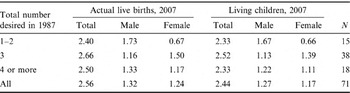
In Table 2 data are provided on average live births and living children in 2007 by desired number of children in 1987. For those wanting two or fewer children, fertility intentions were exceeded somewhat, with almost three times the number of sons as daughters. Respondents wanting more than two children had lower average fertility than their intentions. This was especially true for those wanting four or more children. Overall, there were more sons than daughters among most categories of live births and living children. Child mortality for women wanting 1–2 children was a little higher among males than females, perhaps partly explaining why their total desired number was exceeded. For the subgroup as a whole, mortality was distributed evenly between both sexes.
Average numbers of live births and living children (sons and daughters) for subgroup in 2007, by desired number of children in 1987

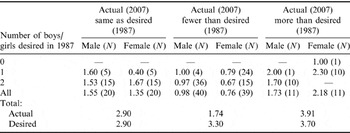
In order to compare numbers of living sons and daughters in 2007 with desired numbers two decades earlier, the subgroup is broken into three groups (Table 3): those who had exactly achieved their total desired number of children (28%), those who had fewer than desired (56%) and those who had more than desired (16%). The large majority of respondents (84%) achieved fewer than, or exactly the total number, of children intended.
Average numbers of living sons and daughters in 2007, by numbers desired in 1987, for subgroup respondents who had achieved, had fewer than, and had exceeded desired number in 2007

Those who attained their total desired number of children (first column) came closest to meeting their desired sex distribution. The actual and desired numbers of male children are 1.55 and 1.77, respectively (Tables 3 and 1), and the numbers of actual and desired female children are 1.35 and 1.24. In the case of girls, the average number of actual children is a little higher than desired, whereas for boys it is a little lower.
The largest group of women shown in Table 3, i.e. those who had fewer children than desired (second column), had considerably fewer children of both sexes than wanted: only 0.98 boys and 0.76 girls, on average. For those who had more children than intended (third column), the total average number of boys (1.73) was similar to the subgroup's overall desired number in 1987 (1.77), whereas the average number of girls was considerably more (2.18 compared with 1.24). Evidently, these women exceeded their desired family size in order to obtain their desired number of sons, not because they wanted more daughters.
Overall, child mortality was low in the group of re-interviewed women, but it was slightly higher among women who had exactly achieved or fell short of their desired number: 0.10 and 0.18 deaths on average, respectively (data not shown). None of the eleven women in the ‘excess fertility’ group had experienced a child death.
Family planning performance, 2007
In Table 4, the average number of living children for the subgroup is shown by sterilization use in 2007. The large majority of these women (83%) had been sterilized, and all had opted for the female operation. Although sterilization was the predominant method of birth control, other methods were used more frequently than previously. Twenty women had used other methods for child spacing, including the IUD, contraceptive pills and condoms, and five of them had employed a combination of methods. The average parity of sterilized women in 2007 was 2.69 children, with a higher average number of sons than daughters. The fertility of unsterilized women was much lower: an average of 1.17 living children, with fewer sons than daughters.
Average numbers of living children (sons and daughters) by sterilization for subgroup, 2007

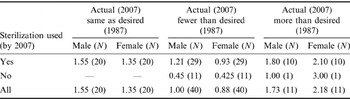
Table 5 shows the average numbers of living children (sons and daughters) by sterilization use for those who, in 2007, had achieved, had fewer than, or exceeded their desired family size. Sterilization use was straightforwardly related to whether respondents had borne their desired number of children. Of those women who had the same number of children as intended, 100% had been sterilized; among those with more children than desired, all but one woman had been sterilized; whereas among those who had fewer children than desired, 70% had been sterilized.
Average numbers of living children (sons and daughters) by sterilization for subgroup respondents who had achieved, had fewer than, and had exceeded desired number in 2007

Table 5 also shows that, overall, those closest to achieving their average desired number, i.e. 1.77 sons and 1.24 daughters (Table 1), had been sterilized after reaching or approaching their desired number of sons. Only those who met their ideals exactly approximated the group ideal of 1.24 girls. In all groups, those who had been sterilized had a much higher average number of sons than those who had not. Interestingly, in the ‘actual fewer than desired’ category, women stopped childbearing with lower average numbers of both sons (1.21) and daughters (0.93) than desired. In the ‘more than desired’ category, sterilized women had considerably more female children than desired, whereas the average number of males (1.80) was close to the overall average desired number of the subgroup in 1987. When the birth orders of this group were checked, girls exceeded boys among the early parity children, indicating that couples probably continued childbearing in hopes of having a son. A typical comment of the latter group was, ‘We wanted two children. But we had two daughters. So today we have three children – one boy and two girls.’
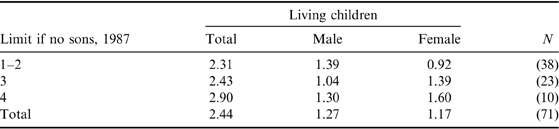
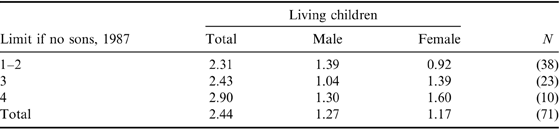
As mentioned previously, in 1987 respondents who had not yet attained their desired number of children and who had not been sterilized were asked how many daughters they would be prepared to have in order to have a son. Table 6 compares these answers with their number of living children (sons and daughters) in 2007. The 1987 responses were fairly consistent with 2007 outcomes, in that there is gradual increase in actual numbers of children by those who stated higher limits. Those who stated a maximum of 1–2 children had an average of 2.31 children, higher than their anticipated limit (1.39 sons and 0.92 daughters). In all other groups, women had fewer children than their stated limit.
Average numbers of living children (sons and daughters) for subgroup respondents in 2007 by stated limit they would go to in order to have a son in 1987
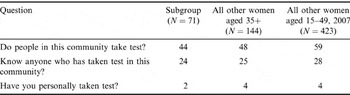
In Table 7, the answers of the subgroup regarding sex determination testing are compared with those of others of the same age group (35+) and all women aged 15–49 in the village in 2007. Despite the fact that these tests were illegal, about half the women in all groups stated that it was practised by women in the community, and about one quarter said that they had known someone who had taken the test. Less than 5% of the women admitted to having personally undergone testing for sex determination purposes. However, five of the subgroup, or 7% of respondents, said they had had an abortion. When probed about this, several said that they had been advised by health staff to have an abortion after undergoing ultrasonography (ostensibly for health reasons), and learning that the fetus was female.
Percentage of respondents, including subgroup, women aged 35+ and all women aged 15–49 answering ‘yes’ to sex determination questions, 2007

The above results are remarkably similar to those of the previous longitudinal study over the 1975–1987 period (Vlassoff, Reference Vlassoff1990), despite representing different generations of women, and a gap of 20 years. In both groups, actual fertility levels were lower than desired family size, with a preponderance of male offspring. Sterilization was by far the most popular family planning method in both periods, and used by those who came closest to meeting the overall cohorts' desired numbers of sons and daughters. The average number of living children for women who had been sterilized was higher for the 1975–1987 group: 3.18 (1.83 sons and 1.35 daughters), compared with 2.69 living children (1.42 sons and 1.27 daughters) in the 1987–2007 subgroup. Many women in the 2007 cohort commented on the importance of smaller families, given current economic circumstances. Several respondents voiced the following opinion, ‘One child is enough in today's world so that you can raise him properly and give him a good education.’ Boys outnumbered girls among those who met or fell short of their desired fertility at the time of sterilization in both periods, whereas among those who exceeded their desired number, girls outnumbered boys in both the sterilized and unsterilized categories.
Discussion
This study is unique in tracing a cohort of rural Indian women over two decades, representing the entire reproductive life span of most of the respondents, given that having children at later ages is considered socially undesirable in India. In addition, it allows for the comparison the findings of this longitudinal assessment with those of an earlier longitudinal study in the same community. The results of both are highly consistent.
An important finding with policy and programme implications is the steady decline in family size over time. Actual fertility among the re-interviewed respondents was lower, for the most part, than would have been anticipated, based on their stated desired fertility in 1987. Lower fertility was accompanied by high levels of family planning uptake, indicating the growing acceptance of smaller family size goals, combined with successful government efforts to make contraception available. Qualitative findings confirmed that people's consciousness of economic pressures, including lack of employment opportunities, declining land availability and the costs entailed in educating and raising children, had caused couples to stop childbearing at fewer children than previously intended. While the relative influence of economic considerations and official government interventions in determining outcomes was not quantitatively assessed, it was clear that the family planning opportunities in the area went hand in hand with a desire to limit family size.
Another positive finding from a policy and programme standpoint is that overall desired numbers of children have clearly declined. The total average desired number is now fewer than two children. Even more significant is the decline in the desired number of sons, currently just over one, on average.
The findings of the 1975–1987 and 1987–2007 longitudinal analyses indicate that desired numbers of children are good indicators of maximum completed fertility, because in both years, only a small percentage of women (those who had more daughters than sons) exceeded their total desired number of children, and a large percentage of women had considerably fewer children than desired. The consistency of this observation over both study periods indicates that desired fertility is a fairly close proxy of completed fertility in the Indian context.
In the study area, the number of couples using contraception for child spacing was increasing, another indicator of the success of official family planning efforts. Nonetheless, sterilization, as opposed to spacing methods, remained the most popular form of birth control, and most village couples still preferred to complete their families and then adopt a terminal method. Qualitative information from the respondents indicated that, even when couples wished to postpone and/or space their births, considerable pressure from family elders, especially mothers-in-law, led them to produce children as soon as possible. Women reported that this was an important deterrent to postponing and spacing births. Thus, interventions to encourage the delay and spacing of births are necessary. In this regard, a promising new scheme, called the ‘Honeymoon Package’, consisting of monetary incentives for couples who postpone their first birth by 2–3 years, was introduced as a pilot project in Satara District in April, 2007.
Despite positive socioeconomic and demographic changes in the study area, sons remain the critical determinant of completed family size, and although fewer sons are desired now than previously, at least one son is considered essential before terminating childbearing. The imbalance between sons and daughters evident in the data can be explained, at least to some extent, by the availability of sex determination tests and abortion in the area. While couples are now content with only one son, and most prefer to have one daughter as well, our findings indicate that most will not stop childbearing until they have at least one male child, whereas this is not the case with females. The argument made over two decades ago remains true today:
… it is unlikely that this situation will change without a radical transformation of traditional values and norms. Even with the removal of economic insecurity, the centrality of sons remains rooted in cultural practices such as residence, inheritance, and religious obligations.
(Vlassoff, Reference Vlassoff1990)The heavy reliance on female sterilization also needs to be redressed, especially given that modern male methods are considerably easier to perform and undergo than female alternatives. Since the completion of this study, efforts to promote sterilization among men through male-only sterilization camps have begun in Satara District.
Given the low level of fertility achieved in the study area and in Maharashtra more widely, declines in fertility of the magnitude previously experienced can no longer be expected. It is therefore time for a shift in Indian policies away from the heavy concentration on family planning to broader social, economic and demographic targets. For example, efforts to promote the spacing of children, and hence lengthen the span of generations, will require heightened efforts to address son preference and improve the status of girls and women. We have seen the impressive success achieved by India's family planning programme. If similar, broad-based, emphasis could be placed on improving the position of women in India, a positive impact could be anticipated, not only in the area of fertility decline but also in women's contribution to overall economic development, especially in rural areas.
Acknowledgments
The author wishes to thank the Swiss Tropical and Public Health Institute, University of Basel, Switzerland, for its financial and technical support to this project, and the Agharkar Research Institute, India, for its institutional and logistical assistance. The help of Ms Sangita Mohite and Ms Chhaya Sawant, research assistants, was greatly appreciated, as was the constant cooperation and participation of the village people in this study. Finally, the author is grateful to the anonymous reviewer for the insightful comments made on the original manuscript.