1. HISTORY
[M]ake UPIC available to the world’s entire population. (Xenakis Reference Xenakis1981)
As early as the 1950s, Iannis Xenakis had the intuition to develop a machine that enabled one to break free from the constraints of traditional music notation while simplifying the exploration of this new way of composing. In his mind, this tool should facilitate, for example, the graphic and sound transcriptions of the glissandi in his breakout work Metastaseis from 1954. The prototype of a machine hybridising drawing, sound synthesis and music was born only in 1977 in the research centre founded by Xenakis (CEMAMu): the UPIC (Unité Polyagogique Informatique of CEMAMu). The ‘agogic’ suffix evokes all parameters specific to the expressiveness of music notation; by appending this to the prefix ‘poly’, Iannis Xenakis opened up the field of the compositional process by making drawing the main vector of music composition (graphically incorporating musical structure, sound, dynamics, envelopes, etc.).
Different versions of the UPIC evolved at the CEMAMu, adapting the system to new technological capabilities, up to the creation of the UPIX solution (UPIC software) for Windows dating from 2001, which no longer depended on the specialised equipment manufactured by the CEMAMu. (Bourotte and Delhaye Reference Bourotte and Delhaye2013: 134)
2. DEVELOPING UPISKETCH
When the Centre Iannis Xenakis (CIX, formerly Les Ateliers UPIC/CCMIX, the structure created by Xenakis in 1985 for the promotion of the UPIC worldwide) was established at the University of Rouen (2010), one of the projects we had was to continue the development of the UPIC/UPIX in a way close to Xenakis’s original idea. Documents from our own archives, previously un-inventoried, provided testimony from Xenakis himself about potential future developments.
Meanwhile, the CIX had the opportunity to collaborate with the European University of Cyprus (EUC) in a Creative Europe Programme: Interfaces. The stated general goal of this programme, coordinated by the Onassis Cultural Centre in Athens, is ‘new models and practices for audience development in Europe’. Furthermore, as outlined in the network’s specific objectives, this project ‘aims to inspire more people of all ages and demographics to experience contemporary music and sound art and learn to incorporate the European musical legacy in newly found idioms and contexts’.Footnote 1 The specific activity under which we were an affiliate partner with the EUC is ‘Urban Music Boxes and Troubadours’. We agreed on the goal for the CIX to develop an UPIC-inspired application for mobile devices that would then be implemented by the EUC in various manners: integrated into multimedia terminals available in the streets of Nicosia and other cities and venues throughout Cyprus and hosting several workshops with young children having little or no previous musical experience. The application we developed, UPISketch,Footnote 2 provides the opportunity to draw music, hopefully in a more intuitive way than the original UPIC, thereby fulfilling the project’s general goal of bringing ‘new music to new audiences.’ Throughout the history of UPIC, this goal was always a major concern. Many of the developments that occurred between different UPIC versions were motivated by the desire to propagate the system: when microcomputers came on the market, more hardware ‘UPIC boxes’ were built enabling the system to be more readily available. Later, in 2001, the software version could run on any PC with Windows. Today we hope that UPISketch will push this a step further by:
making it available online;
providing a simpler user interface;
enlarging the compatibility to various platforms (iOS, OSX, Windows).
2.1. Some of UPIC’s specific features
It may be interesting to note why UPIC is still considered a valid pedagogical reference, over 40 years after its inception. We are in the field of music composition. Through drawing, the relationship between the imagination and sound becomes obvious – it is rendered visible. There are two points that remain essential to us: UPIC must be simple to use, and it must not restrict creative possibilities. We want to break out of the paradigms of classical music, such as those found in standard music sequencing software. The playful aspect of the visuals allows the user to create new musical forms, which s/he would not have dared consider when using more classical means. As Xenakis stated already in Reference Xenakis1979, ‘The pedagogical interest is obvious: with UPIC, music becomes a game for children. They draw. They hear. They have everything at their fingertips. They can correct things immediately. They are not forced to learn instruments. They can imagine timbres. And above all, they can immediately devote themselves to composition’ (Xenakis Reference Xenakis1979). And the same holds true today as our first UPISketch workshops have shown (see section 3.2).
2.1.1. UPIC as a tool for music composition
UPIC’s purpose is not only to produce sounds, but also to help arrange sounds together; in a word, compose music. Even if not mandatory, users should, ideally, have some idea beforehand about what they want to do, because they are expected to be a composer, whether a first-timer or a professional musician.
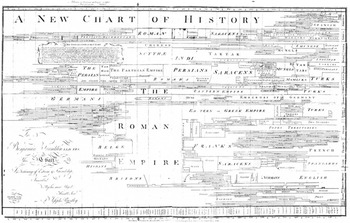
UPIC provides a workspace in which time is transferred to a spatial dimension, so that we can visually control when, and hence where, events will occur on the page. As evident as this statement may seem, many electroacoustic music tools work differently, or do not consider the timeline paradigm and/or facilitating the creation of graphic scores as major goals (IanniX, Max/MSP, PureData, SuperCollider, etc.). For that purpose, we need to generate some sort of notation. In a general manner, we shall call ‘music notation’ any technique that uses a medium for inscribing musical ideas that can later be reinterpreted by the eye. Such a system enables us to deal with more complex structures. It is worth reiterating a very special characteristic: with this system, time becomes spatial, so we can literally see it. This is no less than one of the basics of experimental physics, which evolved over centuries before becoming a general practice. In their book Cartographies of Time: A History of the Timeline, Rosenberg and Grafton explain this well: ‘It took longer than might have been expected for chronologers to progress from creating tables that contained information … to charts that expressed information graphically’ (Rosenberg and Grafton Reference Rosenberg and Grafton2013: 71). Joseph Priestley is then cited as the author in 1765 of A New Chart of History, being ‘possibly the most influential timeline of the eighteenth century’ (Figure 1): ‘After Priestley, most readers simply assumed the analogy between historical time and graphic space. The issue was no longer how to justify the analogy but how to implement it’ (Rosenberg and Grafton Reference Rosenberg and Grafton2013: 126)
A New Chart of History, Joseph Priestley. London: Engraved and published for J. Johnson, 1769. http://mikelove.files.wordpress.com/2008/03/priestley_chart_of_history.jpg (accessed 13 February 2019).

Using this paradigm, the first DAWs (Digital Audio Workstation – what Curtis Roads calls ‘graphical sound editing and mixing programs’ (Roads Reference Roads2004: 184)) in the 1990s provided us with a graphical way of assembling sounds, much easier than with the analogue tape recorders that preceded them. Then we could, with programs such as ProTools, not only assemble sounds, but also draw curves in order to describe the evolution of parameters of the effects. These would greatly (albeit partly) address the visual approach to electroacoustic composition. So, specifically, what kind of system do we want to use?
2.1.2. UPIC’s main user input is drawing
Drawing has the advantage of being a universal human practice. It involves multiple natural abilities: sight, touch and, in our case, hearing. As has been well demonstrated by Mario Duarte, who could not count on any technology in remote areas of Mexico, teaching ‘electroacoustic’ music was made possible by the use of drawing (Duarte Reference Duarte2018). In our case, let us assume the following: if we admit a little bias, the first obvious parameter for composing will be pitch. Let us emphasise the proper use of the word ‘pitch’: the general meaning, which will be ours, is related to frequency, as being the rate of the vibrations of a sound. Notes, in opposition, should be seen as a reduced set of the infinite continuum of the frequencies. Given that, the way pitch/frequency is represented is a sensitive question. Drawing is our path to avoid resorting to standard Western music notation, which requires a real engagement from the learner. As strange as it may sound, the link between drawing and scientific representation seems more straightforward than between solfege and music.
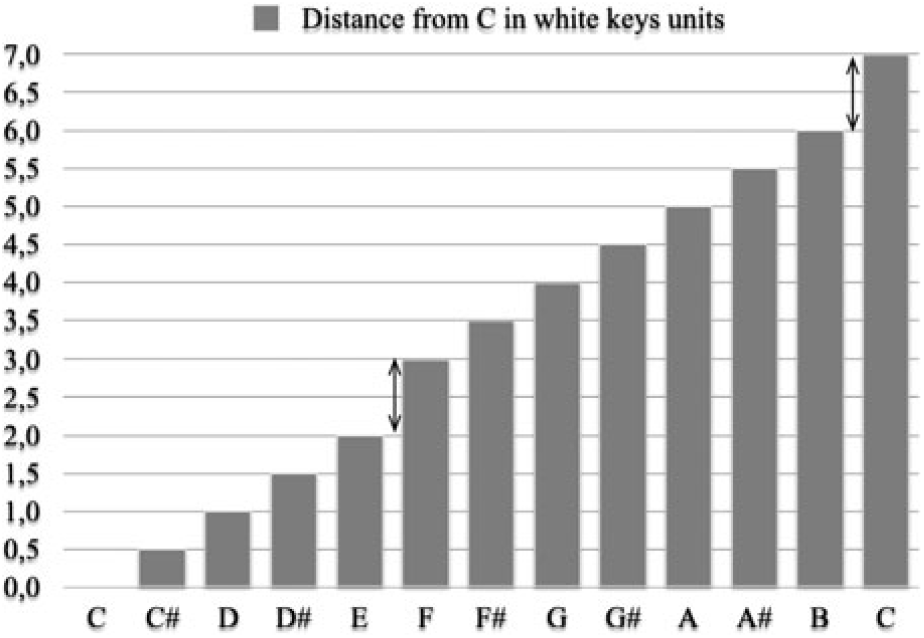
In the domain of organology, many instruments show a biased template: Figure 2 shows the piano.
Distance in white keys units versus heard pitch, author’s table.

The example above tells how much our cultural background can shape the way we practice music.
Isomorphism (in Gestalt psychology) between a physical value and its representation seems a good starting point for being able to invert the analysis process into a creative process. Once we have made the step from reality to mind representation, we can also make it from mind to reality. As shown above, the graphic representation of a piano keyboard is not isomorphic. A proper physical representation would be preferable to a cultural construction, because it is more universal and easier to share.
Solfege is a highly developed symbolic system, but the non-linearity between viewed height and pitch is flagrant when you approach it with a scientific background. The intuitive isomorphism that would allow a child to easily infer pitch from the position of a point in space is lacking. The UPIC at least restores the neutral, scientific paradigm for pitch representation. It is a great tool for exploration: trying things out with no preconceived ideas on how to assemble pitches together.
2.1.3. UPIC as an instrument
Starting from the real-time version, one could play meta-scores with the UPIC (i.e. scores that describe how the predefined UPIC pages should be played). While UPISketch does not implement meta-scores yet, the resynthesis is now in real-time, allowing the playhead to be moved and hearing the result at a given position. Therefore, the sounding is not necessarily related to the duration of the drawn gestures, but more to the user’s actual navigation on the page.
2.1.4. UPIC as a tool without predefined templates, without aesthetic bias (blank page)
The idea of blank page is important in Xenakis’s thought: ‘creation must start from nothingness’ (Xenakis Reference Xenakis1996 cited by Harley Reference Harley2004: 10). It would be interesting to establish a scale of aesthetic biases in the tools we use in music, from zero (completely specific) to one (universal). Even if such a scale has not been created, the simple evocation of it is enough to express the following: we may have zero as the ideal, but we know it is unattainable. For example, we have to make a decision on the direction of time. Higher frequencies are also usually represented higher. Having this in mind, we care, notwithstanding, about reducing our cultural footprint on the proposed tool. For example, showing a grid for pitch landmarks raises the question of which pitches we should show. This has been addressed, in the first version of UPISketch, by letting the user choose different divisions of the octave. This is far from being neutral, obviously, and we hope to gain more universality with the next versions.
We also need to do more research and implement controls that are more related to physics, such as ‘granularity’ or ‘harmonicity’, but as mentioned before, the UPIC does not use symbolic notation, and we would like to maintain this line of thought, allowing the mind to deal directly with curves representing physical values (even if we are not against the idea of incorporating standard and non-standard notation systems). With UPISketch today, we use existing sounds, so we have not addressed the topic of microsound composition – yet. But we hope, by integrating the use of probabilities, to allow for various quantitative controls over the sound, considering them as a flow of individual grains. More about the future of UPISketch is discussed in the conclusion.
2.2. Using UPISketch
Some of what UPISketch inherited from the UPIC has been described above. We shall now describe the basic use of UPISketch, from the same perspective, and offer more details of its development.
2.2.1. The basic use case
Unlike the UPIX 2001 software version, with UPISketch, from the very beginning of a session we are placed in front of a page on which two clicks are enough to get into sound creation: one click for selecting a source sound, one to draw a shape in the page. Already then, a whole compositional process can begin. It can be quickly enhanced, though, by learning a few features concerning navigation in the page and manipulation of the drawn gestures. This further knowledge is accessible via an embedded help page, including demo videos. The menu that accesses all the commands is represented in graphic icons. The left part of the menu can be switched between two kinds of tools. One is for select, pan/zoom, draw, delete, undo, redo, reset view; the other is for open project, save project, library, export sound, settings, help, info. The right part of the menu is fixed and consists of simple playing controls. Like in UPIC and in any DAW, hitting play in UPISketch will play the page from the position given by the playbar, which can be moved to any desired starting point.
We reiterate that whether UPISketch is being used as a sketchbook or as a sound composition tool per se, as long as users imagine some musical structure beforehand, and have an inner ear, they can easily realise their ideas without needing any background in music theory.
2.2.2. Some notes on UPISketch developments
A UPISketch page is an open space. Here, though, the computer has an advantage over working on paper: it does not rely on carriage return and page turns. And by zooming we can easily alternate between an overall vision and minute details. Zooming on the touchscreen version is straightforward, since it uses the same interaction principles as any widely used map application. For the desktop version, if the user lacks a mousewheel, this double touch is emulated by hitting the Control key and dragging the mouse towards the right for magnifying or towards the left for unzooming.
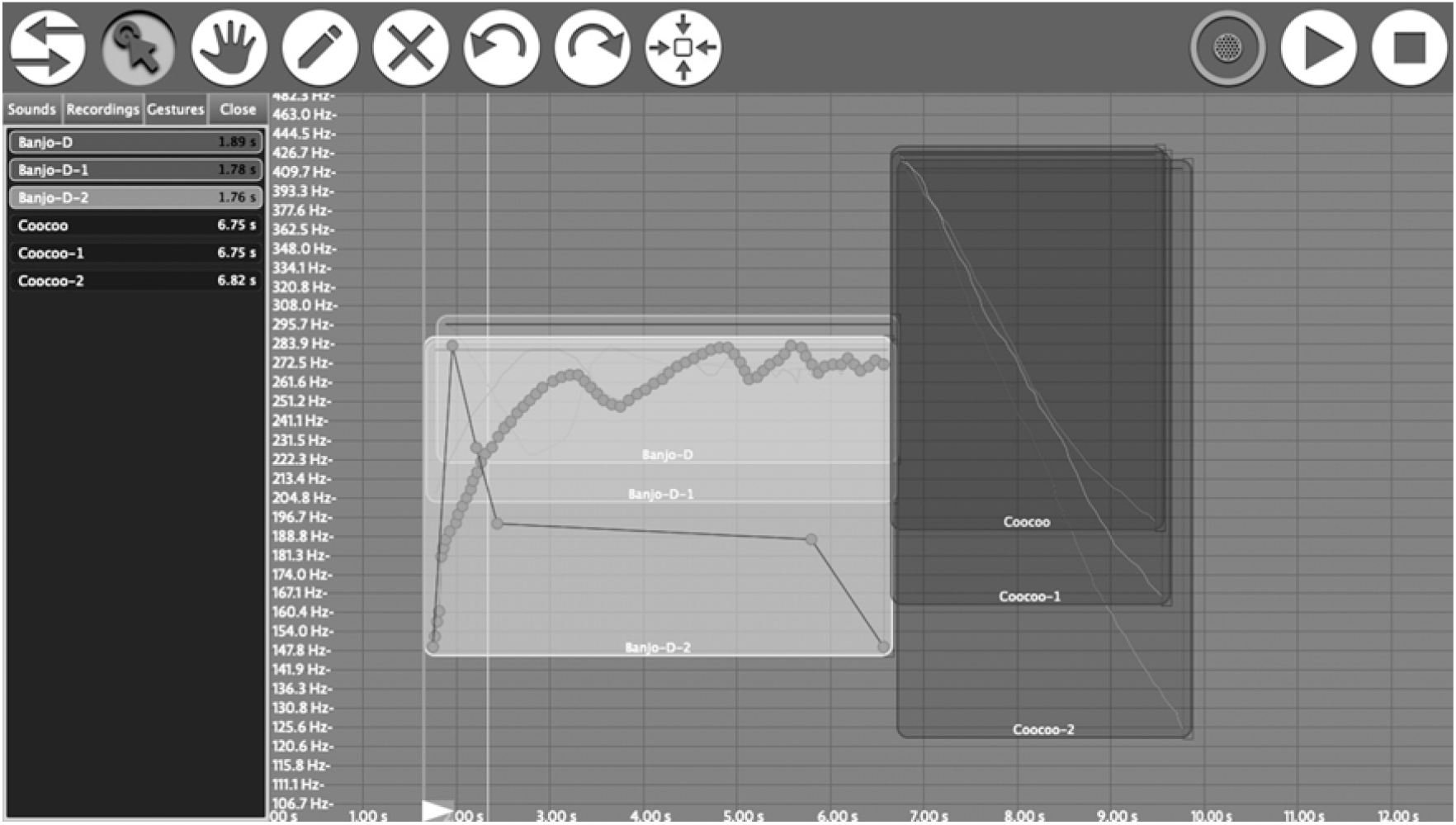
For UPISketch2 (Figure 3), released in May 2019, we have taken into account the principal remarks of the participants of the 2018 Leicester workshop (more on this in part 3.3). The additional features are therefore:
possibility of replacing a sound source with another;
copy/paste operations;
grouping of gestures;
editable pitch and amplitude curves;
gesture list;
undo/redo improved;
improved pitch analysis;
real-time monitoring of the sound.
UPISketch Version 2 screenshot, with its pitch landmarks displayed as frequencies.

Real-time monitoring of the sound will be done by placing the playhead at a position (eventually fixed) in the page. This is a new way of interacting with the score, and we may note that this feature happened to be, previously, one major update of the UPIC system itself.
Also, a fact that will certainly significantly broaden the number of potential users: the new version is compatible with iOS, OSX and Windows.
3. PEDAGOGY AND THE UPIC
Although Xenakis clearly imagined the UPIC first and foremost as a compositional tool that corresponded to his own experience as a talented draughtsman/architect and his personal sound universe often comprising continuous gestures, he was quick to recognise its appeal from a pedagogic perspective. Seeing the goals outlined in the Interfaces programme we decided to concentrate our first efforts with UPISketch on this aspect of demystifying music composition for the general public, in particular but not exclusively, for children.
3.1. Having fun with a tool
In his 1982 preface to the journal Les Cahiers de l’ARM (Atelier Régional de Musique – the same organisation directed at the time by Alain Després, who was to become the first director of Les Ateliers UPIC in 1985), dedicated entirely to the UPIC, Xenakis declared, ‘It is therefore within the perspective of a battle, a crusade against musical illiteracy, that these series of [UPIC] demonstrations take place in cities and towns throughout France and abroad’ (Xenakis and Després Reference Xenakis and Després1982: 3). Furthermore, he made it clear, in the same article that ‘music composition can be done by everyone’. From a pedagogic point of view, one of the best ‘weapons’ of this ‘crusade’ was to render making music not only intuitive, but also actually fun, tripping up the notion that learning how to make music not only has to be tedious but also arduous, with mandatory training in theory and solfeggio. Aiming that ‘weapon’ at a maximum number of people, with a certain preference for targeting young audiences, was clearly one of the main goals behind the decision to create Les Ateliers UPIC, a mission that continues to this day, under the various appellations of the structure, including the CCMIX (Centre de Création Musicale Iannis Xenakis, between 2000 and 2009) and today, the Centre Iannis Xenakis. Footnote 3 The first premise is not only can the act of composition be demystified from early on, but it can also give kids access to sounds, which they can custom-make, that have little or no relationship to the nursery rhymes they grow up with or what they hear on the radio or in their parents’ homes. Testimony from Després about the first UPIC workshops bears witness to this new approach: ‘After quickly explaining how the machine works and letting users do some experiments, we asked the young children to imagine either a story, an atmosphere, a sound landscape, or even a simple musical construction, for the more experienced’ (Després Reference Després, Brümmer and Kanach2019).
The feedback from these first UPIC workshops, documented in the same Cahiers de l’ARM issue (and cited throughout our previous OS publication (Bourotte and Delhaye Reference Bourotte and Delhaye2013)) served as a guide for our own implementation of UPISketch, both from the angle of its conception and from the manner we choose to present it to a brand-new generation of young, inexperienced youths. We strongly support the fact, especially when it comes to a software tool, that if using it is a pleasurable, fun experience, then it is a good place to start from in the domain of education. (We detail our approach to running our UPISketch workshops in section 3.2).
The public announcement of UPISketch being available (for free) on the Apple Store was made on the Centre Iannis Xenakis’s Facebook page on 2 September 2018. Our page has nearly 7,000 followers and seemed the most cost-efficient way to reach a captive public. Very rapidly, we ‘reached’ over 3,500 people and registered over 500 interactions. Following the same procedure for our launch of Version 2 on 8 May 2019, over 5,500 were ‘reached’ with nearly 1,000 interactions. We were then thrilled when reviews, for example, on the rather highly visible KVR audio forum, appeared, stating: ‘Fun tool, like the original was as well’ (by original, the author is referring to the UPIC).Footnote 4 Or, on the German website ‘gearnews’, comments such as ‘a really interesting app … Actually a funny idea, but also very interesting. This makes for a lot of liveliness … Sound designers will be happy here!’Footnote 5 Elsewhere, on the ‘audiobus forum’, we could not hold back our collective smile when we read from one user: ‘I started playing with it and got that holy shit, Batman, feeling but this is me saying that.’Footnote 6 Or, when we attained a five-star rating on iOSnoops’s website!Footnote 7
Even in non-directed settings, for example, the Urban Music Boxes installed in various locations throughout Cyprus, when asked by us for user feedback (because we were generally not present) our colleagues from the EUC had this to say: ‘No complaints, only compliments’!Footnote 8 Unfortunately, at the time of this writing, we do not have any further information about this aspect of the project, except that Urban Music Boxes have been installed at the EUC, the Pancyprian Gymnasium Museum, the venue where we held our first workshops at the Bank of Cyprus Cultural Foundation, the Cyprus Museum and the Shoe Factory – all in Nicosia, and also in Limassol during the SMC2018 conference at the Rialto Theatre. The EUC, as the Interfaces network partner, will be documenting these actions over the next few months.
3.2. ‘Let’s draw music’: the workshops
The first implementation of UPISketch took place in April 2018 in Nicosia (Cyprus) in the form of several workshops with children from various backgrounds, ranging from 6 to 10 years old. Ten iPads were provided, already loaded with the UPISketch application, and the travelling exhibition curated by the CIX, ‘Iannis Xenakis and the UPIC’,Footnote 9 was hung in a large space provided by the Bank of Cyprus Cultural Foundation (BOCCF). The event was, of course, free of charge and over three mornings six groups, each with around 20 school children, attended 90-minute sessions. The CIX was represented by the co-authors of this article, the EUC by Potheini Vaiouli, as well as Demetra Englezou (photographer/videographer from the EUC) and her assistant, and the BOCCF by Elena Efthyvoulou (Communications and Events Officer). Each class was accompanied by one or two teachers from the children’s respective classes.
Initially, we had requested that each session be limited to ten students, to guarantee each having sole access to the app, but popular demand was such that we had to pair-off the children with two per iPad, obliging them to share the device (or work collectively) at the same time. We also initially requested that the age range be limited to 8 to 12 years old, but the six sessions quickly filled up with younger subjects. These considerations rather radically changed the scope of our own observations, especially because, due to needing to pair-up, it became difficult, if not impossible, to witness each child’s independent reaction to and interaction with the app. It was, however, extremely interesting to see how the children interacted among themselves while sharing a single device, which, surprisingly, went remarkably smoothly and with congeniality.
The 90-minute sessions were basically structured in five parts:
1. Introduction (circa 15 minutes)
When the children entered, they first were introduced to the hung exhibition (in English) and either Potheini or Elena walked each group through it, explaining, in Greek, who Xenakis is, always directly interacting with the kids, asking them questions (who plays an instrument, who has heard of Xenakis, etc.) and describing how drawing was a compositional tool for Xenakis, even when writing for instruments; then, his interest in computers for making music; and finally, how he combined the two by inventing the UPIC. Towards the end of this introduction, we played excerpts of Xenakis’s Mycènes Alpha, following the graphic score represented on one of the panels of the exhibition.
2. Teaching the app (circa 8 minutes)
Then, Rodolphe sat on the floor, with the children huddled around in a circle and explained the basic functions of UPISketch (with simultaneous translation by our Greek colleagues) and explained how to ‘draw music’ using the app. Even the youngest attendees, at 6 years old, were not intimidated by the iPads but rather were drawn to them like magnets – fearless and impatient to try the app with their own hands.
3. Familiarisation (circa 25 minutes)
Then, the children divided up into small group around several tables, with three or four pairs per table. We gave them about 30 minutes to get acquainted with the app, and we were all on call to troubleshoot or answer any questions that arose. These children, then and there, experienced their very first exposure to composing music by drawing.
4. Composing a piece (circa 30 minutes)
We then gave them the task of composing a short piece that they would co-sign with their partners and left them free to devise their own and first ‘real’ compositions. Of course, the adults were still on stand-by for any trouble shooting.
5. Saving and sharing (circa 10 minutes)
The last minutes of each session were spent saving and labelling all their sound files and listening, as a group, to each pairs’ ‘composition’. A very short slide-show (with a soundtrack composed in one of the sessions by 8-year-old Katerina Bargilly) documents this whole process. Footnote 10
In the context of the Pharos Contemporary Music Festival, also in Nicosia, in summer 2019, we hosted an open workshop that was well attended by children, young adults (some music students who made the journey from Limassol) and mature adults of a very mixed nature: some visual artists, intrigued (and ultimately seduced by the concept), as well as a general adult public. Footnote 11 Of particular interest were some first attempts by some of the teenaged music students who tried their hand at creating music in a more ‘metal’ idiom. We are impatiently awaiting full documentation of such events from the EUC.
3.3. Presenting UPISketch to the scientific community
The CIX participated in the 2018 SMC conference, which coincidentally also took place in Cyprus, in Limassol in July 2018. There, Rodolphe Bourotte prepared and presented a ‘Poster Session’ on UPISketch.Footnote 12
A couple of months later, in September 2018, CIX’s proposal to present a UPISketch talk and workshop at the De Montfort University’s conference ‘Bringing New Music to New Audiences’, also organised in the context of Interfaces, was enacted, and that represented, for us, a first real-time trial with colleagues and peers, trying out our app before our very eyes and ears. Furthermore, although a workshop with school children was initially planned, due to logistics, this was finally not possible. So, instead, we presented a hands-on workshop for the contributors and public attending the conference. This was a first for us in terms of workshopping the app with just adults and peers. Again, the explanation process was rapid-fire fast, and everyone set out to work (or shall we say play) with it. Again, testimony to UPISketch’s success at demystifying the compositional process was gathered:
I tried UPIC for the first time during a workshop held by the CIX (Sharon Kanach and Rodolphe Bourotte) in September 2018. I was very positively surprised by the ease of its use. It felt as if the sound was alive and malleable; it gives an even clearer view of the form of the piece than with score notation, while at the same time guides and frees the user’s imagination. I was totally absorbed by the process of music making, and, not being a composer, very proud of my tiny piece at the end! (Lorenda Ramou, pianist, musicologist, project manager at Stegi Onassis) Footnote 13
Meanwhile, some other interesting feedback came from people who were involved with UPIC at the time of its creation (version UPIC-A). One of them, François-Bernard Mâche, was a lecturer at the ZKM conference ‘Graphic Interfaces for Notation’, held on 28 and 29 September 2019. After the presentation we made of UPISketch, his main concern was the existence of a library of default sounds.
The following statement by him, from more than 25 years ago which exposes an important philosophical point of view, is a probable explanation of the reaction he had:
Les Ateliers UPIC have a very original place amongst the research centres in computer music. This originality is due in part to the machine they promote [UPIC], which, unlike what can be found in shops, has no other limitation than that of the user’s imagination. No prefabricated programs or ‘factory sounds’ here: anything is possible, and everything is left to be done. (Mâche, Reference Mâche1993: 1; translated by the authors)
Afterwards, in Karlsruhe, we had a private discussion and he came to grasp a more positive view of the project. The sound library, in effect, must be seen simply as a proposition, while it is up to the user to decide if s/he wants to add his/her own sounds. However, because the first version for tablets had a clear pedagogical goal, we choose to deactivate the recording option, because we observed it could easily deviate the young user from the initial objective of composing by drawing.
Another first-time user who expressed certain reservations was none other than the developer of UPIC-A in 1977, Guy Médigue:
[F]or the moment I have limited my tests to ranges using ‘Classical Instruments’. So, I built and listened to the DO range (from C3 to C4) with just about all your instruments.
First conclusion: the results are quite variable. With instruments like ‘Sax’ ‘Flute’ ‘BassClar’ for example, they are quite accurate (the sounds aren’t very beautiful, but that’s another matter). With many other instruments (Bassoon, BlockFI…), the result is often ‘unpredictable’ as you yourself say in the User’s Manual, specifying that the sounds you record must have a well-defined pitch. Footnote 14
Indeed, we had to carefully choose our source sounds, but even then, some were not processed satisfactorily by the analysis algorithm at the time. The accuracy has been improved since.
3.4. UPISketch in the classroom
Victoria Simon, a recent PhD graduate from McGill in Communications Studies, who has dedicated a significant portion of her research on UPIC Footnote 15 and is currently a visiting assistant professor at Pitzer College (Los Angeles) in their Media Studies programme, makes UPISketch an integral part of her ‘Intro to Digital Sound Production’ class and, in her ‘Sound Theory, Sound Practice’ course assigns her students an ‘individual comprehensive project’ using UPISketch in which they have to ‘design an extensive audio project which demonstrates proficiency’. Footnote 16
Testimony from Yin Yu, a multi-disciplinary designer with a background in electronic engineering and architectural design and currently a PhD student at UCSB’s MAT-lab sums it up nicely too:
The UPISketch is really fun. I was surprised at what I heard after sketching a couple lines. I am thinking of bringing it to my class to let the students to try since half of them don’t have a music background. UPISketch seems a great tool for them to get to know more about music and how to compose! I desperately hope this app will have a Windows version since our lab computers are Windows based. I also hope I can add sound files into the ‘Factory Sounds’ if that is possible … Honestly, I am really into it. Very simple and easy to use. Footnote 17
Other colleagues in both Europe and North America are beginning to integrate UPISketch in their curricula, across several disciplines and we are eager to gather more feedback and implement further improvements based on their experiences.
4. CONCLUSION
We can state that the general reception was positive over diverse audiences, but we need to conduct more workshops in order to collect more evaluation data. We intend to partner with experts from other areas such as psychology and sociology in order to analyse such data with competence. Such results could potentially impact future iterations of UPISketch. We also noticed that sometimes there is a tendency to use the app more as a graphic tool, mostly by younger children (less than nine years old), but for the older children and certainly young and mature adults, we witnessed their real pleasure in experimenting and gaining awareness of their compositional capabilities.
What we can ascertain is that by introducing the act of composing music to random yet willing participants, demystifying music making through the simple act of drawing and making it fun, all while valorising such creation through Xenakis’s example has already contributed to at least generating new potential audiences for new music, however modestly in these very early stages. Previously undiscovered new vocations may also be provoked. In all cases, without exception, no one said ‘I can’t do this’; all participants left feeling newly enabled. There was, admittedly, a significant number of people asking, ‘Can we make normal music with it?’ This is a something we would like to address when adding pitch and time sieves functionalities, which will be at least a solution for implementing rhythmical and melodic patterns albeit not a simple path to conventional music.
In the next version, UPISketch will enter the realm of a real control over the parameters of granular synthesis. This iteration will try to allow a more open sound world, less patterned to the models of the sound sources. It will introduce probabilities in an intuitive way, as ever, by drawing. This idea, that Xenakis could well have formulated (but to our knowledge did not do so publicly), serves nevertheless the Xenakian project of integrating probabilities in a sound composition tool assisted by drawing.