Introduction
In the recent years, it has become apparent that adipose-derived stem cells (ASCs) have regenerative properties which include pro-angiogenic features (Ref. Reference Rasmussen1), multilineage differentiation capacity (Ref. Reference Lund2), immunosuppression of activated immune cells (Ref. Reference Melief3) and the ability to home to injured areas (Refs Reference Baek, Kang and Ra4, Reference Smith5). As a result, there is currently a dramatic surge in the interest in using ASCs for a variety of clinical beneficial applications such as bone/cartilage repair, amelioration of ischaemic disease, wound healing and soft tissue reconstruction. Nevertheless, the progress on the route to become a mainstay treatment modality appears painstakingly slow. A recent review of the 87 clinical trials on ASCs registered on www.clinicaltrials.gov highlighted the fact that most studies so far have been case-reports or small-scale phase I/II studies, and that many of the larger phase III studies are still underway and the results are yet to be reported (Ref. Reference Lim, Ong and Sugii6). In the vast majority of these studies, the therapeutic product is actually a fat tissue stromal vascular fraction (SVF), which is not enriched for ASCs, but rather consists of several cell types, including endothelial progenitor cells, T regulatory cells and mesenchymal stem cells (Ref. Reference Rodriguez7). The choice of using SVF rather than more homogeneous ASCs, which have been selected by plastic-adherence and expansion, could be explained by the fact that SVF prepared directly in the operating theatre obviates the need for treating the cells as a medicinal product and thus alleviates a significant administrative, regulatory and logistic burden. However, as isolated and expanded ASCs are less immunogenic, and it is possible to boost the therapeutic doses by several orders of magnitude, expanded ASCs are suggested to be a better choice than the freshly isolated SVF (Refs Reference Pikuła8, Reference Garcia-Olmo9).
The therapeutic appeal of ASCs is further underscored by the results from the numerous case-reports, small clinical trials and animal experiments, where the ASCs appear highly safe irrespective of different formulations, such as fresh or expanded, or different origin, such as autologous or allogeneic (Ref. Reference Lim, Ong and Sugii6). Nevertheless, the optimism engendered by early studies needs to be curbed until conclusive evidence is obtained from large-scale double-blinded phase III investigations. If these confirm the preliminary promising observations, and the issue of initial high costs is remedied along with improvements in the production, the path is paved for implementing the ASC-based therapies as a standard treatment option.
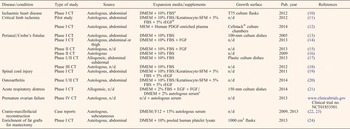
In many case reports or small clinical trials performed so far, the final procedures for isolating and expanding ASCs have typically evolved from the locally implemented protocols for in vitro studies that have been adjusted to comply with good manufacturing practice (GMP)-guidelines and national legislation. Thus, recent advances in understanding of for instance media composition on cell expansion are not reflected in the choice of methods used in the clinical trials (Table 1). This hinders direct comparison of the results and in turn slows the pace, by which phase III studies are initiated and ultimately standard treatment protocols can be implemented. Thus the current challenge is to harmonise procedures for the procurement of the therapeutic-grade ASCs to such an extent that the combined information stemming from numerous phase I/II studies can be harnessed, and utilised in the design and execution of phase III studies.
Registered trials using expanded ASCs with information on the expansion conditions

CT, clinical trial; DMEM, Dulbecco's minimum essential medium; FBS, fetal bovine serum; FGF, fibroblast growth factor; MEM, minimum essential medium; n/d, not described; Pub., publication; Ref., reference; rEGF, recombinant endothelial growth factor; SFM, serum free medium; VEGF, vascular endothelial growth factor.
a After 1 passage and prior to injection, cells were differentiated for 1 week in media containing 2% FBS + VEGF.
b After 24 h in DMEM-based media, further culturing was carried out using Keratinocyte-SFM-based media.
c Cells were expanded in FBS-supplemented media, but cultured in autologous serum-supplemented DMEM for 24–48 h prior to injection.
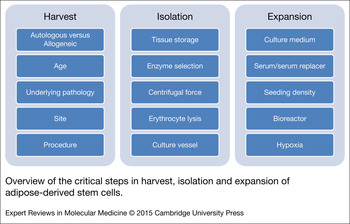
The objective of this review is to identify best practices for isolation and expansion of ASCs for clinical use, and to identify areas where evidence for making recommendations is still incomplete. This review follows up on many of the questions that were raised in the thorough review by Wilson et al. on the clinical perspectives of ASCs (Ref. Reference Wilson, Butler and Seifalian25). The steps in the pipeline to procure clinically relevant quantities of ASCs that will be dealt with in detail include the selection of donors, isolation of the SVF from lipoaspirate, expansion and putative preconditioning of ASCs (Fig. 1). Discussion of cost-effectiveness of the different methods presented is beyond the scope of this paper.
Overview of the critical steps in harvest, isolation and expansion of ASCs. The process of obtaining clinically relevant numbers of multipotent ASCs can be divided into three stages comprising harvest of adipose tissue, isolation of the stem cells, and finally expansion until sufficient quantities have been achieved. For each of the stages are outlined relevant parameters, that should be considered to achieve optimal results.

Harvest of adipose tissue
Selection of donors
There is considerable interest in identifying the optimal source of ASCs in terms of histocompatibility, age or personal characteristics, such as BMI or an underlying condition. As for the importance of a syngeneic setting, it has been speculated that the use of autologous cells could reduce the risk of immune rejection (Ref. Reference Ra26). However, allogeneic ASCs have been found effective in prevention of graft-versus-host disease and autoimmune diseases (Ref. Reference Voswinkel27), and there is indirect evidence to indicate that allogeneic mesenchymal stem cells compare with autologous with respect to their immunomodulatory properties and ability to evade and/or suppress immune responses (Ref. Reference De Miguel28). The jury is still out as to the selective advantage of using either autologous or allogeneic ASCs, and more research is needed to resolve this issue, such as the head-to-head comparison for treatment of perianal fistulas (Ref. Reference Lim, Ong and Sugii6). The ramification of such knowledge may be far reaching, since vindication of the allogeneic approach would provide for a highly attractive off-the-shelf product. In addition to being readily available, it would most likely be economically attractive, as cells from a single donor or a single batch from multiple donors may be used to treat several patients.
Since at this juncture, the use of allogeneic ASCs is limited, a pivotal question now appears as to what extent the stem cells from elderly or chronically ill are suitable for clinical use. Several studies have addressed this issue, but they have not been able to provide a definite answer. For the most part, it has been reported that donor age and BMI have little or no effect on the yield or proliferation of ASCs (Refs Reference Mojallal29, Reference Schipper30, Reference De Barros31). Nevertheless, it cannot be ruled out that age plays a role, since the cells from younger donors in some studies were found to give rise to larger cell yield and have a slightly higher proliferative capacity, and ageing was associated with suppression of proangiogenic properties both in vitro and in vivo (Refs Reference Van Harmelen, Röhrig and Hauner32, Reference Gu33). In addition to effects of ageing, also diabetes appears to affect the properties of ASCs. Specifically, the ASCs from diabetic patients were shown to have a lower proliferative rate and clonogenic capacity (Refs Reference Gu33, Reference Lee11), and also decreased proangiogenic potential (Refs Reference De Barros31, Reference Gu33). Although some of previously mentioned studies suggest that incubating ASCs from diabetic patients in low oxygen tensions may restore their proangiogenic properties (Refs Reference De Barros31, Reference Gu33), the apparently compromised regenerative power is a real challenge in developing the autologous cellular therapies in this setting, especially in elderly patients.
Site of origin
The main determinants for the selection of the anatomical region of where to obtain the fat are the ease of access and the properties of the acquired tissue. When comparing the subcutaneous fat in abdominal area with that from either flanks, hips or thighs, results are conflicting. The majority of studies show that abdominal fat produces a better yield (Refs Reference Aguena34, Reference Jurgens35, Reference Padoin36), and the harvested ASCs are more resistant to apoptosis (Ref. Reference Aguena34). However, since one study shows better yield from hip (Ref. Reference Fraser37), there might be inter-individual variations. When assessing the multilineage potential of ASCs from either abdomen or hip/thigh, one study found that there was no difference in the propensity to differentiate into the osteogenic and adipogenic lineages (Ref. Reference Jurgens35). In addition to subcutaneous fat, intra-abdominal fat represents an alternative source of ASCs. However, when compared with ASCs from subcutaneous fat, it appears that ASCs from intra-abdominal fat proliferate at a lower rate, display less adipogenic potential and in some cases also less osteogenic differentiation (Refs Reference Van Harmelen, Röhrig and Hauner32, Reference Aksu38).
From the practical point of view, the procedure for harvesting abdominal adipose tissue provides relatively most comfort for the patient, who can rest in a supine position during the procedure, and the surgeon does not have to take possible issues of asymmetry into account. Subcutaneous abdominal fat thus appears as an ideal source of ASCs suitable for clinical use.
Liposuction versus tissue resection
The actual harvest of the adipose tissue may be accomplished basically by a liposuction or tissue resection. No difference between liposuctioned and resected tissue was found with respect to cell yield (Ref. Reference Buschmann39). The tumescent liposuction is the method broadly used in cosmetic/aesthetic surgery, and can be carried out with slight modifications. As for the types of tumescent solution, it has been shown that the lidocaine/adrenaline infusion does not affect the growth and differentiation characteristics of ASCs (Ref. Reference Muscari40); however, both procaine and, to a lesser degree, lidocaine appear to affect the miRNA expression pattern (Ref. Reference Sung41). Whether the effect on miRNAs may have any bearing on the future clinical use of ASCs is still not clear, nevertheless, based on these results the use of lidocaine over procaine is recommended. As for the surgical procedure, both the manual and pump-assisted liposuction provide comparable results (Refs Reference Aguena34, Reference Fraser37), but the use of ultrasound to aid tissue dissociation was associated with impairment of the proliferative capacity of the resulting ASCs (Ref. Reference Oedayrajsingh-Varma42). Although some studies have shown that using a wide-bore aspiration and injection cannulas is beneficial for adipocyte viability (Refs Reference Erdim43, Reference Ozsoy, Kul and Bilir44), studies show that ASCs from adipose tissue harvested by a microcannula showed increased viability, adherence rate and migration with no effect on the yield when compared with ASCs from tissue harvested by a wider cannula (Refs Reference Alharbi45, Reference Trivisonno46). As for the surgical tissue resection, this approach, although being more cumbersome, appears valid as well, since it delivers a competitive cell yield, and the ASCs seem to have a slightly higher osteo- and chondrogenic differentiation propensity than ASCs obtained by a liposuction (Ref. Reference Schreml47). In conclusion, based on the fact that the tumescent liposuction is less invasive than dissection, this would be the method of choice to procure the adipose tissue.
Isolation of stem cells
Tissue storage prior to isolation
Since the lipoaspiration and the downstream processing to isolate ASCs are usually carried out at two different places, such as at the hospital and GMP certified laboratory facilities, respectively, there is inevitably a lag period, during which the samples need to be stored. Despite a possibility that ASC yield may drop within few hours after the lipoaspiration (Ref. Reference Matsumoto48), the available data, as well as our own experience (unpublished results), appear to lend sufficient evidence to conclude that the 24 h storage at room temperature (17–23°C) does not adversely affect the isolation of stem cells and the ASCs retain their differentiation potential (Refs Reference Carvalho49, Reference Eom50). In comparison, we have observed that storage at 4°C appears to have an adverse effect of viability of ASCs. This observation is confirmed by others (Ref. Reference Wang51). Thus, where the adipose tissue needs to be transported for processing at distant locations, we recommend shipping at room temperature.
Enzymatic treatment, centrifugation and erythrocyte lysis
The basic paradigm for isolation of ASCs has been outlined more than a decade ago by Zuk et al. (Ref. Reference Zuk52), and since then many laboratories have adopted it with own modifications. The procedure essentially entails two phases. First, the preparation of the SVF, which is composed of the mesenchymal stem cells, erythrocytes, leukocytes, immature adipocytes, and endothelial cells (Ref. Reference Riordan53), and, second, the selection phase, where the cells are allowed to adhere and proliferate and form the ASC culture. Several steps are involved along the way, and they include initial washing to remove most of the erythrocytes, treatment with proteases, removal of tissue debris and mature adipocytes, lysis of residual erythrocytes, and finally plating of the single-cell suspension. Different aspects of the individual steps are discussed in more detail in the following paragraphs.
As mentioned above, the adipose tissue is commonly processed to isolate the ASCs using proteolytic digestion of the SVF, although, it is possible to attempt ASC outgrowth using explant cultures of the resected morsels of fat or use non-enzymatic approaches which should be less invasive, but substantially less effective in regards of cell yield (Refs Reference Priya54, Reference Shah55). Comparisons of crude collagenases, and highly purified proteases did not yield any outstanding candidate as no difference in yield, proliferation, surface markers nor differentiation potential was detected (Refs Reference Pilgaard56, Reference Carvalho57). Thus it is perceived that most GMP-approved collagenases would work well, and could be selected based on price and availability. After enzymatic dissociation, the tissue remnants are removed by a successive filtration using two different meshes, 100 and 60 μm, respectively, to prevent the clogging. When handling larger volumes of digest, the use of a vacuum-assisted rather than a simple gravity-driven filtering may be considered to aid the process. The stem cells in the resulting cell suspension may be conveniently concentrated using differential centrifugation, which is a preferred method to more gentle but less effective washing and decanting (Refs Reference Condé-Green, de Amorim and Pitanguy58, Reference Condé-Green59). After centrifugation the mature adipocytes will float and the pellet will be composed of the cells defining the SVF. Nevertheless, one need to bear in mind, that extensive g-force may impart damage to cells that can result in the reduced viability and self-renewing capacity. In particular, it has been found that forces in excess of 3000 g have a potential to significantly impair the ASCs but using up to 1200 g is within the safety zone, having no impact on structural integrity (Ref. Reference Kurita60). After the centrifugation, the nucleated cells of interest are still contaminated with a large amount of erythrocytes. The erythrocytes do not represent a serious challenge, as they will eventually be removed during medium changes. Nevertheless, it is plausible that they may interfere to some extent with ASC adherence and proliferation, and the CFU potential (Refs Reference Baer61, Reference Horn, Bork and Wagner62). In our laboratory, we have observed that lysis of the erythrocytes prior to plating, using either ammonium chloride or distilled water, makes the immediate microscopic assessment of cultures more straightforward. However, in the absence of lysis, the erythrocytes are removed with the first changes of media, at which point, we do not observe any differences in comparison with cultures having erythrocytes lysed (unpublished data).
Selection through plastic adherence
In the final phase, the ASCs are isolated based on their capability to adhere to a plastic surface (Refs Reference Schipper30, Reference Zuk63), which for the practical reasons usually is the tissue culture-treated polystyrene (TCP) of the culture vessels (Ref. Reference Escobedo-Lucea64). Since the behaviour of a particular cell type, such as attachment, growth and the biological responses, can be greatly influenced by specific surface properties, including wettability, electric charge, chemistry, topography and stiffness (Ref. Reference Koller65), non-TCP surfaces or coating have been assayed to augment the proliferation and maintenance of mesenchymal stem cells (Refs Reference Koller65, Reference Foldberg66, Reference Ho67). Nevertheless, these investigations concluded in accordance, that it is the standard TCP that provides for optimum growth substrate. In cases where the maximum harvest is desired, the reseeding of the supernatant fraction after the first 24 h can be attempted, possibly boosting the yield by more than 50% (Ref. Reference Buschmann39).
Isolation of SVF in automated closed systems
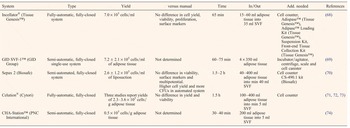
To minimise risk of contamination and operator variability, efforts have been put into developing fully- or semi-automated, and fully or partially closed systems for isolation of ASCs (Table 2). Fully automated systems are an attractive option, as they allow for isolation of SVF and immediate transfer of cells to the patient within the operating theatre, without the need to follow the rigorous regulations associated with more-than-minimally manipulated cell products (Refs Reference Giancola, Bonfini and Iacone75, Reference Hourd76). However, the cell yield is limited due to limitations on the volume of liposuctioned tissue, and further expansion is often desired. Comparison of different automated systems to each other and to manual procedures, revealed that most of the systems are as efficient or better than the classical isolation procedure; however, the automated systems are expensive ranging from approximately $500–2000 in disposables per isolation (Ref. Reference Aronowitz and Ellenhorn74).
Automated systems for isolation of SVF on the market

SVF, stromal vascular fraction; add., additionally; min, minutes; h, hours.
Expansion of the ASCs
Optimal population doublings
To achieve cell numbers sufficient for clinical application, the ASCs most often need to be expanded. Pikuła et al. (Ref. Reference Pikuła77) even suggested that the in vitro expanded ASCs are a better choice for clinical application than freshly isolated SVF. However, extended passaging is invariably associated with increased costs and risk of contamination, and, moreover, the in vitro conditions may potentially have an adverse effect on the population characteristics, such as the growth rate and tri-lineage differentiation (Refs Reference Lindroos78, Reference Wan Safwani79). We have also been shown that the process of trypsinisation enhances the pro-angiogenic properties of the ASCs, which may impact their regenerative properties (Ref. Reference Rasmussen80). Although it is generally accepted that the cells during the ex vivo growth undergo selection and some level of physiological deregulation, which is proportional to the culture period, many biologically significant properties may remain stable or even become enhanced, as was shown, for example, for the immunophenotype (Ref. Reference Yoshimura81) and the T-cell-mediated immunosuppression (Ref. Reference McIntosh82), respectively. At present, there is no generally accepted consensus as to the maximal number of population doublings which the ASCs should be subject to, to reach the therapeutic dose. However, it does appear that mesenchymal stem cells from adipose tissue can undergo more population doublings before senescence than mesenchymal stem cells from bone marrow (Ref. Reference Dmitrieva83). Also some reports have demonstrated the ASCs and other mesenchymal stem cell populations are relatively resistant to transformation even after extended passaging (Refs Reference Tarte84, Reference Lange85, Reference Schellenberg86). In conclusion, there is no doubt that the plastic adherence and expansion result in a more homogeneous cell population with a minimal mixture of hematopoietic cells (Ref. Reference Bourin87).
Selection of culture medium
For culturing of ASCs, both the Dulbecco's minimum essential medium (DMEM) and the alpha minimum essential medium (α-MEM) complete with 10% fetal bovine serum (FBS) and glucose at a physiologic concentration (100 mg/dl; 5.6 mm) have been widely used as a standard medium, although the α-MEM may actually be the preferred variant (Ref. Reference Lund2). However, the addition of different supplements, such as insulin, all-trans retinoic acid, endothelial growth factor (EGF), and basic fibroblast growth factor have been shown to augment metabolism, transcriptional activity, immunophenotypical profile and differentiation (Ref. Reference Baer61). Apart from the biochemicals, glucose should be given additional consideration, since it has been indicated to be able to impact differentiation (Ref. Reference Cramer88) and in the case of hypoxic growth conditions, it is necessary to support increased demands on glycolysis (Ref. Reference Mischen89).
Use of serum or serum replacers during culture
With the advances in understanding of ASC basic biology, the focus shifts more and more on the clinical use, and as a result, the issues related to safety, efficacy, reproducibility and quality are poised to assume centre stage. In this context, issues regarding inconsistency and immunogenicity of the bovine serum have been cited as a major obstacle on the way to clinical translation (Ref. Reference Heiskanen90). In response, a variety of defined serum-free (SF) or xeno-free (XF) solutions have been developed and commercialised, unfortunately, many of the earlier versions were not able to deliver on the expected performance in terms of growth rate or maintenance of multipotency (Refs Reference Lund2, Reference Parker91). Recently, Life Technologies marketed a highly promising StemPro® line of products, including StemPro MSC SFM XenoFree medium and StemPro LipoMAX Defined XenoFree Lipid Supplement and CELLstart supplements, to provide enhanced proliferation, and differentiation capacity (Refs Reference Escobedo-Lucea64, Reference Koller65), and also the MesenCult-XF® media from Stemcell Technologies appears promising (Ref. Reference Al-Saqi92). Another approach to avoid the use of bovine serum relies on supplementing the media with human serum-derived products, such as the thrombin-activated platelet-rich plasma, AB serum, or the platelet lysate. All of these have been shown to be at least as suitable as the bovine serum for the expansion of high-quality ASCs without compromising proliferation or differentiation potential (Refs Reference Atashi93, Reference Bieback94, Reference Trojahn Kølle95). There is a caveat however, in the use of autologous serum, as it has been shown that age of the donor affects the properties of serum in terms of supporting stem cell differentiation (Ref. Reference Abdallah96).
Seeding density
On a classical two-dimensional growth surface, the seeding density is an important variable to be taken into consideration. Previously, high densities were used for functional studies (Ref. Reference Yang97), whereas low densities were used for long-term proliferation studies, and found to promote cell division (Refs Reference Rasmussen1, Reference Escobedo-Lucea64, Reference Fink98).
Bioreactors
For large-scale production of ASCs, the use microcarriers in stirred bioreactors has been proposed (Ref. Reference Schirmaier99), and also hollow-fibre technology shows promise for the GMP-compliant expansion of mesenchymal stem cells (Ref. Reference Rojewski100). For the time being, data from trials using automatically expanded ASCs are scarce, and it is still too early to conclude on the role of bioreactors. Should allogeneic ASCs become the treatment modality of choice, the need for automated systems will be greater and will probably drive innovation in the area (Ref. Reference Martin, Smith and Wendt101).
Hypoxia
The last factor to be dealt with when optimising the ASC expansion, in addition to already mentioned growth surface and media, is the gaseous environment. Routinely, the cell cultures are maintained in an atmosphere of 20% oxygen and 5% carbon dioxide; however, it has been confirmed that lowering the oxygen concentration to values from 1 to 5% has a beneficial effect on the ASC growth rate as well as maintenance of stemness (Refs Reference Rasmussen1, Reference Yang97, Reference Valorani102, Reference Weijers103). We have previously shown that reductions in the oxygen availability affects chondrogenic and adipogenic differentiation of ASCs and even influences their electrophysiological properties (Refs Reference Lund2, Reference Fink104, Reference Prasad105).The values around 1% probably represent an oxygen borderline zone and further dramatic lowering, as has been, for example, shown for 0.1% (Ref. Reference Mischen89), may seriously impair cell proliferation. From the point of final clinical application, it is of interest that the secretion of the proangiogenic factor VEGF appears to increase in inverse proportion to oxygen (Ref. Reference Thangarajah106) and 1% oxygen has a potential to upregulate other angiogenic factors and stimulate angiogenesis in vitro (Ref. Reference Rubina107). One should though be aware that these regulatory responses are controlled on a temporal basis, and need to be carefully timed in order to be still present in the therapeutic bolus. In addition to the effect on the cells from a representative donor population, the hypoxia is able to reverse the deficient angiogenic capacity in the cells from aged or diabetic individuals (Refs Reference De Barros31, Reference Gu33). Based on the available evidence, there is a good reason to believe a judicious use of hypoxic growth conditions will become a standard part of GMP protocols on ASC expansion (Ref. Reference Zachar108).
Characterisation prior to clinical use
Historically, mesenchymal stem cells, including ASCs, have been defined according to their ability to adhere to plastic, trilineage differentiation potential, and presence or absence of a defined set of surface markers (Ref. Reference Dominici109). Recently a set of minimal criteria defining ASCs specifically has been proposed by the International Federation for Adipose Therapeutics and Science (IFATS) and the International Society for Cellular Therapy (ISCT) (Ref. Reference Bourin87). These criteria include capacity for self-renewal, viability, tri-lineage differentiation and the following surface marker profile: +CD13, CD29, CD44, CD90, CD105 (>80%), – CD14, CD31, CD45, CD144, CD235a (<2%) in addition to application-specific potency assays to control functionality.
The European Medicines Agency (EMA), recommends that prior to clinical use, the identity of stem cells should be defined by their self-renewal capacity and the expression of specific markers (Ref. 110). In addition, it is recommended that potency tests relevant to the treatment are carried out, and these assays should be at least semi-quantitative and be correlated with the intended therapeutic effect. Such assays may include both functional tests and marker-based assays and could include measurement of secretion profiles, cell interactions, migration capacity, differentiation capacity, etc. (Ref. 110). Interestingly, however, there are no requirements by the EMA to perform multipotency assays, unless warranted by the clinical application.
We are not aware of any assay currently used to predict clinical potency of the ASCs, yet we expect that such assays will be developed and validated concurrently with the completion of clinical trials.
Summary
-
• It is still not clear, for which clinical applications allogeneic or autologous cells are most optimal. However, there is growing evidence that allogeneic cells may be as effective as autologous due to their immunosuppressive properties and ability to evade the immune recognition. It appears that ASCs from ageing and ailing donors may have diminished proliferative and proangiogenic properties, yet these may be to some extent restored by hypoxic exposure.
-
• For harvest of adipose tissue, tumescent liposuction of subcutaneous abdominal adipose tissue appears optimal, and the tissue may be stored for up to 24 h at room temperature without a detrimental effect on the cell product.
-
• For the dissociation of the tissue, collagenase treatment is the method of choice.
-
• During the isolation procedure, centrifugal forces should not exceed 1200 g.
-
• Erythrocyte lysis has little impact on the cell yield and quality.
-
• Selection by plastic adherence is optimal on standard TCP surfaces.
-
• For xeno-free expansion, StemPro media or α-MEM supplemented with human serum-derived products such as platelet lysate, AB serum or thrombin-activated platelet-rich plasma have proven optimal in terms of supporting proliferation and maintenance of multipotency.
-
• Cell culture under hypoxic conditions promotes proliferation, maintenance of stemness and may reverse effects caused by ageing or diabetic background.
-
• Hollow fibres and microcarriers are paving way towards large-scale expansion but at present too early to conclude on their significance.
Acknowledgements
This work was supported by the Obel Family Foundation (TF grant number 20114-18036) and Lily Benthine Lund's Foundation (SR grant number 5652).
Conflict of interest
SB and MV are regular employees of ThermoFisher Scientific and have not received any financial gains. They hold some stocks of ThermoFisher Scientific as employees of ThermoFisher Scientific. SR, VZ, CPP and TF declare that they have no competing interests. The authors alone are responsible for the content and writing of the manuscript.