


Introduction
Social phobia is characterized by a disabling fear of social situations that may bring upon embarrassment or humiliation. Exposure to feared social situations is typically either avoided or endured by the person with great anxiety. In sleep research, social anxiety (through the use of a speech threat) has been used as a tool to create an acute state of insomnia for investigating the impact of pre-sleep arousal on subsequent sleep and sleep perception (e.g. Tang and Harvey, Reference Tang and Harvey2004b). Interestingly, despite this established link between social anxiety and acute insomnia, the association between social phobia and more chronic forms of insomnia has only received minimal research/clinical attention.
There is some initial evidence showing that the diagnosis of social phobia is linked to the presence of extended insomnia (Degonda and Angst, Reference Degonda and Angst1993). Although not everyone with social anxiety has trouble sleeping, persistent complaints of insomnia are frequently noted amongst social phobics presenting for treatment in anxiety disorders clinic. Compared to sex-matched and age-comparable healthy control subjects, patients diagnosed with generalized social phobia report poorer sleep quality, longer sleep latency, more frequent sleep disturbance, and more severe daytime dysfunction than the healthy controls (Stein, Kroft and Walker, Reference Stein, Kroft and Walker1993). There appears to be a positive correlation between the level of social anxiety and insomnia severity, although such relationship is partially mediated by depressive symptoms (Buckner, Bernert, Cromer, Joiner and Schmidt, Reference Buckner, Bernert, Cromer, Joiner and Schmidt2008). It is unclear how exactly the conditions interact and if they aggravate each other, but previous large-scale epidemiological studies have shown that insomnia appears mostly at the same time or after the occurrence of an anxiety disorder (Ohayon and Roth, Reference Ohayon and Roth2003) and that untreated insomnia increases the risk of developing anxiety disorders by 2–5 times within an 11-year interval (Necklemann, Mykletun and Dahl, Reference Neckelmann, Mykletun and Dahl2007).
Historically, sleep disturbances co-occurring with another psychological disorder are conceptualized as “secondary insomnia”, with the psychological condition regarded as the primary problem and insomnia as a symptom that will resolve when the primary problem is treated. An unfortunate legacy of this conceptualization is that the insomnia and its associated problems are mostly overlooked in treatment. Recently, there has been a growing body of research showing that standard cognitive behaviour therapy for primary insomnia (CBT-I) can be fruitfully applied to treat insomnia co-occurring with depression, posttraumatic stress disorder, cancer, chronic pain, HIV and alcoholism (Smith, Huang and Manber, Reference Smith, Huang and Manber2005). Yet, the utility of CBT-I in social phobia has remained largely unexplored. The aim of this clinical report, therefore, is to illustrate the possibility of tackling insomnia comorbid with a moderately complex case of social phobia using an abbreviated version of CBT-I.
Case presentation
This case concerned a 32-year old artist, who was referred for assessment and treatment of social phobia. Lee (a pseudonym) reported feeling extremely nervous every time he encountered social situations. He constantly worried about making mistakes and used alcohol to help him socialize. Lee's social anxiety made it difficult for him to leave his house. He felt that his career was severely hampered by his social anxiety, as being a selling artist these days involved travelling, networking and business negotiation.
Lee reported having trouble getting to sleep on most nights. He also reported problems waking up too early and not being able to get back to sleep. In terms of his mood, Lee had an ongoing problem of depression. He was previously prescribed antidepressants by his GP and seen by a counsellor for his low mood, but he found neither of these treatments helpful. Lee felt that his mood would improve if he was treated for his social anxiety. He also felt that he would not be able to benefit from the social phobia treatment until his disrupted sleep pattern settled. Lee was therefore offered a sleep assessment, followed by a brief course of CBT-I, whilst he was waiting for the social phobia treatment.
Assessment of insomnia
Lee's sleep disturbances were assessed using the Duke Structured Interview Schedule for the Diagnoses of DSM-IV-TR and International Classification of Sleep Disorder, Second Edition (ICSD-2) (Edinger et al., unpublished). In addition, Lee was asked to keep a sleep diary for 1 week and to complete a pack of questionnaires that assessed his sleep quality, insomnia-related thoughts and responses, daytime functioning and general psychological characteristics. Specifically, the pack included the Insomnia Severity Index (ISI; Bastien, Vallieres and Morin, Reference Bastien, Vallières and Morin2001), Anxiety and Preoccupation about Sleep Questionnaire (APSQ; Tang and Harvey, Reference Tang and Harvey2004a), Dysfunctional Beliefs and Attitudes about Sleep Questionnaire (DBAS-16; Morin, Vallieres and Ivers, Reference Morin, Vallières and Ivers2007), Insomnia Interference Scale (IIS; Tang, unpublished), and Hospital Anxiety and Depression Scale (HAD; Zigmond and Snaith, Reference Zigmond and Snaith1983). Details of these questionnaires are provided in the extended version of this report.
Assessment outcome and case formulation
Lee revealed that, although he had always been a “light sleeper”, his recent trouble in sleeping was aggravated by his social anxiety and low mood. He regarded his insomnia as equally interfering as other problems, because he often found himself unable to concentrate or function as well as he hoped. His average IIS score was 7 (out of a possible 10) suggesting that his insomnia was severely affecting his daytime functioning.
Lee reported problems sleeping five nights a week, and he was most bothered by his inability to go to sleep (taking on average 2 hours to fall asleep) and the lengthy awakenings (of approximately an hour duration in total). His sleep was generally short (about 4 hours), and often of poor quality (not feeling refreshed upon waking). Lee scored 25 on the ISI, indicating severe clinical insomnia. He met the DSM-IV-TR criteria for insomnia related to another mental disorder and the ICSD-2 criteria for “psychophysiologic insomnia” and “inadequate sleep hygiene”. Lee's scores on the HAD anxiety and depression subscales were 18 and 13, respectively, both of which were above the clinical cut-offs (≥8). Whilst his trouble sleeping was exacerbated by his social anxiety and depression, the insomnia was not exclusively associated with his mood change and his sleep problems were judged to be sufficiently severe to warrant independent clinical attention.
Lee's scores on the APSQ (53) and the DBAS (4.81) were high, comparable to those obtained by primary insomnia patients in previous research. It was conceivable that Lee's insomnia was partly maintained by his sleep-related worries. He strongly endorsed questionnaire items such as “I worry that I won't cope tomorrow if I don't sleep well”, “I get overwhelmed by my thoughts at night and often feel I have no control over this racing mind”. These thoughts were likely to create additional arousal and made it even harder for him to fall asleep. Such cognitive reactions (excessive worries), together with his behavioural (extending time in bed, painting in the bedroom when unable to sleep) and emotional (frustration, anxiety, irritation) responses to his not sleeping, were considered to be the factors perpetuating his insomnia.
Insomnia treatment
A total of five one-hour sessions were offered to Lee, individually on a weekly basis, plus a booster session one week after the treatment ended. The treatment comprised several behavioural and cognitive interventions recommended by the American Academy of Sleep Medicine. These included sleep psychoeducation, sleep restriction, stimulus control and cognitive restructuring. The treatment focused not only on helping Lee establish a stable sleep-wake schedule but also on addressing his concerns about the impact of insomnia on his mood and daytime performance. Details of the treatment content can be found in Table 1 of the extended version of this report.
Given the short and intensive nature of the treatment, homework was assigned weekly to ensure that learning during the session was consolidated. Throughout the treatment, Lee was asked to keep a daily sleep diary. The information gathered was used to guide the pace of the sleep restriction therapy. To evaluate treatment outcomes, Lee was also asked to complete (i) a week of sleep diary before and after treatment and at ~9 month follow-up; (ii) the ISI, APSQ and IIS in each weekly session; (iii) a long questionnaire (including the ISI, APSQ, ISS, DBAS-16 and HAD) a week before and after treatment and at follow-up.
For clinical and logistical reasons, Lee's social phobia treatment commenced soon after the termination of his insomnia treatment, which had denied a clear-cut follow-up opportunity. The follow-up questionnaire was sent to Lee after his completion of his social phobia treatment. Cautions should be applied when interpreting these outcomes as they represented the combined effect of both treatments. For the reader's information, the social phobia treatment Lee received was cognitive-oriented (Clark, Reference Clark, Crozier and Alden2001). It focused on reversing the maintaining processes specified in the Clark and Wells (Reference Clark, Wells, Heimberg, Liebowitz, Hope and Schneier1995) social phobia model (e.g. self-focused attention, negative self-processing, safety-seeking behaviours) and none of which was specifically linked to sleep.
Results
Sleep parameters
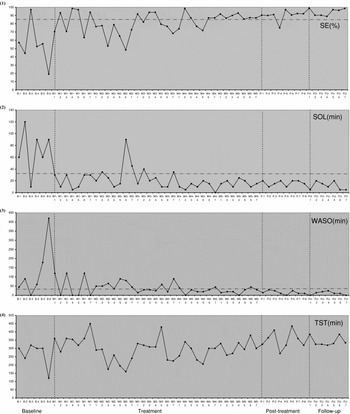
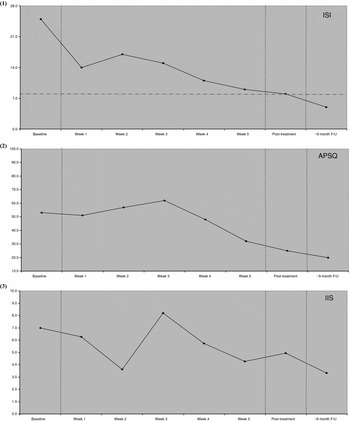
A consistent trend of improvement was observed in Lee's sleep diary data and self-report questionnaire. Figure 1 depicts the day-by-day changes in Lee's sleep pattern, as measured by his sleep-diary data, over the course of treatment. Figure 2 depicts the week-by-week changes in Lee's sleep quality (ISI), sleep-related anxiety (APSQ) and insomnia-related interference (IIS) over the course of treatment.
The daily changes in sleep diary outcome variables over the course of the treatment. Outcome variables presented here include: (1) sleep efficiency (SE;%, cut-off for normal sleep = 85% or above, as indicated by the dotted horizontal line), (2) sleep onset latency (SOL; min, cut-off for normal SOL = 30min or below, as indicated by the dotted horizontal line), (3) the total duration of wake after sleep onset (WASO; min, cut-offs for normal WASO = 30min or below, as indicated by the dotted horizontal line) and (4) total sleep time (TST; min)

The weekly changes in sleep questionnaire measures over the course of the treatment. Measures presented here include: (1) Insomnia Severity Index (ISI; range: 0–28; cut-off for “no clinically significant insomnia” = 7 or below, as indicated by the dotted horizontal line), (2) the Anxiety and Preoccupation About Sleep Questionnaire score (APSQ; range: 10–100) and (3) the Insomnia Interference Scale score (IIS; range: 0–10).

Sleep efficiency (SE). The SE increased from a mere 49.7% at baseline to 91.6% at post-treatment, constituting an 84% improvement in efficiency. This improvement was maintained at follow-up, with Lee obtaining an average SE of 94.7%. Both the post-treatment and follow-up SEs exceeded the conventional threshold for efficient sleep, which is typically set at ≥85%.
Sleep Onset Latency (SOL). The average SOL dropped 77%, from 71.6 minutes at baseline to 16.3 minutes at post-treatment, which then continued to drop another 30% to 11.4 minutes at follow-up. Both the post-treatment and follow-up SOLs were well within the 30-minute cut-off commonly used to distinguish normal from delayed sleep onset.
Wake After Sleep Onset (WASO). The number of WASO dropped 48%, from 2.5 at baseline to 1.3 at post-treatment, whilst the duration of WASO dropped 88%, from 132.5 minutes at baseline to 15.6 minutes at post-treatment. At follow-up, both the number and duration of WASO maintained their improvements; the average number of WASO was 1 whilst the average duration of WASO was 11.4 minutes. Both the post-treatment and follow-up WASO durations were well within the 30-minute cut-off commonly used to distinguish normal from prolonged mid-night awakenings.
Total Sleep Time (TST). The TST increased 32%, from 4.42 hours at baseline to 5.84 hours at post-treatment. Such gain was maintained at follow-up, with Lee obtaining an average TST of 5.73 hours at ~9 months after treatment.
ISI. The ISI score dropped 68%, from 25 (indicating severe clinical insomnia) at baseline to 8 (indicating subthreshold insomnia) at post-treatment. The ISI score then continued to drop another 38% to 3 (indicating no clinically significant insomnia) at follow-up.
Insomnia-related processes
APSQ. The APSQ score dropped 53%, from 53 at baseline to 25 at post-treatment, which then continued to drop another 20% to 20 at follow-up.
DBAS-16. The DBAS-16 score dropped 40%, from 4.8 at baseline to 2.9 at post-treatment, which then continued to drop another 57% to 1.3 at follow-up.
General functioning
IIS. The IIS score dropped 30%, from 7 at baseline to 4.9 at post-treatment, which then continued to drop another 32% to 3.3 at follow-up.
HAD. The HAD-anxiety score dropped 28%, from 18 at baseline to 13 at post-treatment, which then continued to drop another 23% to 10 at follow-up. The pattern of change was slightly different for the HAD-depression score, which only dropped by 1 point (8% reduction) from 13 at baseline to 12 at post-treatment. A bigger improvement was, however, observed at ~9 month when the score dropped 67% to 4, below the clinical cut-off (8).
Discussion
The current report is the first study to demonstrate that insomnia symptoms associated with social phobia, depression and alcohol misuse can be effectively treated using a brief 5-session CBT-I. Overall, Lee's response to the treatment was encouraging. Considerable reduction in insomnia symptoms were observed after treatment; the ISI, SOL, WASO duration and SE demonstrated improvements at a level that met dual criteria for clinical significance (criterion 1: a 50% reduction of symptoms; criterion 2: conventional cut-offs; ISI<15; SOL or WASO<30 minutes; SE ≥85%). The only exception was TST; the gain in this parameter did not reach clinical significance even though it was extended by ~1.5 hours following treatment. This might be explained by the principle of the sleep restriction therapy that aimed to consolidate rather than to lengthen sleep, and possibly by a ceiling effect on how much sleep Lee's body could actually obtain.
Sleep of chronic insomniacs is marked by extensive day-to-day variability (Vaillieres, Ivers, Bastien, Beaulieu-Bonneau and Morin, Reference Vallieres, Ivers, Bastien, Beaulieu-Bonneau and Morin2005). CBT-I involves the use of treatment strategies that aim to help the patient establish a regular sleep-wake schedule (e.g. stimulus control and sleep restriction), and these are typically associated with a reduction of such variability in sleep and thus improved the quality of sleep (Edinger, Wohlgemuth, Radtke, Marsh and Quillian, Reference Edinger, Wohlgemuth, Radtke, Marsh and Quillian2001). Consistently, a visual inspection of Figure 1 indicates that Lee's sleep measures (SE, SOL, WASO and TST) were marked with greater variability at baseline and beginning of treatment than at post-treatment and follow-up. This shrinkage in variability can be interpreted as another indicator of treatment success.
Corresponding improvements were observed in the levels of sleep-related anxiety and dysfunctional beliefs about sleep. These are cognitive processes hypothesized to be perpetuating Lee's insomnia and were actively targeted in the current treatment. Some improvements were noted in Lee's general anxiety, but only minimal change was observed in his depression rating. Moreover, a post-hoc examination of Lee's notes indicated that the insomnia treatment did not change his score on the Liebowitz Social Anxiety Scale (Liebowitz, Reference Liebowitz1987). It appears that improvements in sleep do not necessarily bring about an immediate anxiolytic or mood-enhancing effect as one may hypothesize based on the close link between sleep, anxiety and depression. Although these findings are consistent with those of a previous study in which the success of CBT-I was not accompanied by similar mood improvement in a mixed group of secondary insomnia patients (Lichstein, Wilson and Johnson, Reference Lichstein, Wilson and Johnson2000), they stand in contrast with those from another study in which the addition of CBT-I to an antidepressant enhanced treatment outcome for both conditions (Manber et al., Reference Manber, Edinger, Gress, San Pedro-Salcedo, Kuo and Kalista2008). The lack of improvement in mood may be explained by the focus of the treatment being on sleep (rather than anxiety or mood) and its relatively short duration. Further investigation is required to delineate the often-assumed reciprocal interaction between insomnia and anxiety and depression. More information about the interplay between social phobia and insomnia and the shared vulnerability between the two conditions should inform the adaptation of CBT-I for use in patients with comorbid anxiety disorders.
Maintenance of the improvements in sleep quality, insomnia-related psychological processes and general level of daytime functioning was excellent at ~9 month follow-up. In fact, all of the sleep-related variables further improved from post-treatment to ~9 month after treatment. These continual improvements probably are a result of the combined effectiveness of the CBT-I and the subsequent cognitive therapy for social phobia Lee received (Clark, Reference Clark, Crozier and Alden2001). It is interesting to note that there was a sharp reduction in HAD depression scores from post-treatment to follow-up, but not anytime before. This appears to suggest that a newly rectified sleep pattern may not be sufficient to bring about immediate improvements in mood. The introduction of additional treatment that specifically targets social anxiety and low mood may be necessary to alleviate these symptoms.
Case study has played an influential role in the development of clinical research and is a widely endorsed approach to explore new phenomena and treatment strategies (Kazdin, Reference Kazdin and Kazdin2003). Whilst it has many advantages as a preliminary research methodology (e.g. being clinically relevant and time-efficient), replications of the findings in larger samples of social phobics with comorbid insomnia are required to establish the generalizability of the results and it would be important for future research to evaluate the treatment effect against an active control treatment. It was a pragmatic decision to treat Lee's insomnia ahead of his social phobia treatment. Further research is needed to identify the most effective treatment sequence for people with concomitant anxiety and sleep issues and to examine if the gains in sleep can be maintained in the absence of the subsequent social phobia treatment. Within the confines of the limitations discussed, the current case report highlights the potential to successfully (and economically) treat insomnia comorbid with social anxiety. More systematic research is now called for to investigate the clinical benefits of incorporating a brief CBT-I into existing treatments for social phobia.
Acknowledgements
Nicole Tang is funded by a Post Doctoral Award from the National Institute of Health Research (Department of Health), United Kingdom. The author would like to thank Drs Jennifer Wild and Rachel Handley for facilitating the treatment and Dr Claire Goodchild and Professor David Clark for reading an earlier draft of the manuscript.




Comments
No Comments have been published for this article.