


INTRODUCTION
Radiocarbon (14C) dating of bulk sediments has long been used as a method of last resort in the absence of reliable charcoal, wood, or other plant macrofossils for dating (Zhou et al. Reference Zhou, Zhou and Head1990; Muhs et al. Reference Muhs, Ager, Bettis, McGeehin, Been, Beget, Pavich, Stafford and Stevens2003). Accurate dating of sediments is complicated due to their low levels carbon content and sediments are naturally heterogeneous mixtures of multiple organic fractions, each with potentially different 14C activity (Walker et al. Reference Walker, Davidson, Lange and Wren2007). Soils have traditionally been dated as either bulk sediments or as individual sedimentary fractions. Humin is the material used for radiocarbon dating because it is commonly thought to minimize the contribution of younger organic carbon (Head Reference Head, Ambrose and Mummery1987). It was reported that humic acids had younger 14C ages relative to other sedimentary fractions (Wang et al. Reference Wang, Hackley, Panno, Coleman, Liu and Brown2003), but this is not always the case (Walker et al. Reference Walker, Davidson, Lange and Wren2007). Pollen has also been extracted from soil and sediments for radiocarbon dating (Brown et al. Reference Brown, Farwell, Grootes and Schmidt1992; Regnell Reference Regnell1992; Zhou et al. Reference Zhou, Donahue and Jull1997). However, the techniques require larger sample sizes. Widespread fossil shells were preserved in Quaternary loess-paleosol sequences, but the limestone effect influences the reliability of 14C age (Zhou et al. Reference Zhou, Donahue and Jull1997; Pigati et al. Reference Pigati, Rech and Nekola2010, Reference Pigati, McGeehin, Muhs and Bettis2013; Ujvari et al. Reference Ujvari, Molnar and Pall-Gergely2016, Reference Ujvari, Stevens, Molnar, Demeny, Lambert, Varga, Jull, Pall-Gergely, Buylaert and Kovacs2017), due to limitations of extractive technique, the biospheroid (Moine et al. Reference Moine, Antoine, Hatte, Landais, Mathieu, Prud’homme and Rousseau2017) and compound specific 14C dating (Haggi et al. Reference Haggi, Zech, McIntyre, Zech and Eglinton2014) are not popular, though they were considered as reliable material.
Recently, several studies have used combustion techniques to date organic matter of sediments (McGeehin et al. Reference McGeehin, Burr, Jull, Reines, Gosse, Davis, Muhs and Southon2001; Wang et al. Reference Wang, Hackley, Panno, Coleman, Liu and Brown2003; Rosenheim et al. Reference Rosenheim, Day, Domack, Schrum, Benthien and Hayes2008; Cheng et al. Reference Cheng, Zhou, Wang, Lu and Du2013). McGeehin et al. (Reference McGeehin, Burr, Jull, Reines, Gosse, Davis, Muhs and Southon2001) used a stepped-combustion method to minimize the contribution of clay-bound carbon, as its presence can significantly reduce the accuracy of sediment age determination, with the oldest 14C ages seen in samples with the highest clay content (Scharpenseel and Becker-Heidmann Reference Scharpenseel and Becker-Heidmann1992).
Organic matter in loess is a naturally heterogeneous mixture of multiple fractions, such as fulvic acid, humic acid, and humin (Dodson and Zhou Reference Dodson and Zhou2000; Turney et al. Reference Turney, Coope, Harkness, Lowe and Walker2000). After loess and paleosol are deposited, soluble organic matter and fine particle OM from overlying younger layers are able to migrate downward via many means, such as bioturbation, permeation, root decomposition. Therefore, loess and paleosol deposits can be regarded as semi-closed systems. These organic compounds are not removed by the usual acid-base-acid (ABA) sample pretreatment method (Head Reference Head, Ambrose and Mummery1987), and dates from fulvic and humic acids, and/or humin may produce inconsistent 14C results (Abbott and Stafford 196l; Perrin et al. Reference Perrin, Willis and Hodge1964; Scharpenseel and Schiffmann Reference Scharpenseel and Schiffmann1977; Giletblein et al. Reference Giletblein, Marien and Evin1980; Head Reference Head, Ambrose and Mummery1987; Beckerheidmann et al. Reference Beckerheidmann, Liu and Scharpenseel1988; Martin and Johnson Reference Martin and Johnson1995; Paul et al. Reference Paul, Follett, Leavitt, Halvorson, Peterson and Lyon1997; Huang et al. Reference Huang, Li, Bryant, Bol and Eglinton1999; Muhs et al. Reference Muhs, Aleinikoff, Stafford, Kihl, Been, Mahan and Cowherd1999). Song et al. (Reference Song, Lai, Li, Chen and Wang2015) indicated that optically stimulated luminescence (OSL) and 14C ages of humin agreed well for ages younger than ca. 25 cal ka BP. However, beyond 30 cal ka BP, there is no consistent increase in AMS 14C age with depth, while OSL ages continue to increase. These differences confirm the observation that the accelerator mass spectrometry (AMS) 14C ages obtained using conventional ABA pretreatment from loess deposits in Central Asia are severely underestimated and may be due to 2%–4% modern carbon contamination.
Hence, there is a need for further development of stepped-combustion pretreatment methods that can remove modern carbon contamination caused by leaching from overlying layers.
SITE LOCATION
Donglongshan
The Donglongshan section (33°26′01″N, 110°47′39″E, elevation 600 m a.s.l) is in the upper Danjiang River area of the Qinling Mountains, central China (Figure 1). This area lies on the boundary between the warm temperate and subtropical zones. The mean annual temperature is ~12.9°C and mean annual precipitation ~750 mm. The annual number of frost-free days is 206. The climate is influenced mainly by the East Asian summer and winter monsoons. The natural vegetation is dominated by mixture of deciduous broadleaved and coniferous forests. According to our geological investigations in this area over the years, exposures of loess-paleosol sequences are common on the second and third terraces of the Danjiang River. These sediment sequences are usually ~2 m thick and composed of two distinct lithic units: the loess–paleosol sequences are composed of the Holocene brownish paleosol S0 (35–95 cm), and at depth of 1–35 cm contain abundant remains of human activity, such as colored potsherds and charcoal, the lower one comprises loess-like sediments (95–270 cm). Ten samples were obtained at depths of 60, 80, 95, 105, 125, 160, 180, 225, and 270 cm, one charcoal fragment was found at 35 cm and used for 14C dating.
Locations of Weinan section and Donglongshan section, Shaanxi, China.

Weinan
The Weinan section (34°25′38.8″N, 109°34′37.4″E, elevation 660 m a.s.l.) is in the central part of a “Yuan” dimensions are 160 km2 (stable loess tableland) at the southeastern margin of the CLP (Figure 1). The “Yuan” is ~8 km from west to east and ~20 km south to north, with the Qinling Mountains in the south (Figure 1). Currently, the mean annual temperature and precipitation at this site are 13.6°C and 645 mm, respectively, and the climate is influenced mainly by the East Asian summer and winter monsoons. The loess–paleosol sequences are composed of the Holocene brownish paleosol S0 (30–110 cm), Last Glacial yellowish typical loess L1–1 (110–250 cm) and L1–3 (780–1035 cm), and weakly developed paleosol L1–2 (250–780 cm).The studied section is ~14 m thick (Kang et al. Reference Kang, Wang and Lu2013) and the upper 4.5 m is the focus of this study. Four samples from depths of 70, 180, 420, and 560 cm were selected for 14C dating.
METHODS
14C Sample Pretreatment
Before chemical pretreatment, any modern root was removed by wet separation. The sediment samples and the charcoal were given ABA pretreatment including 1M HCl (2 hr, 60°C), 0.1M NaOH (overnight, 60°C), and 1M HCl (2 hr, 60°C). After the initial 1M HCl treatment, a portion of each bulk organic carbon sample was rinsed repeatedly with deionized water until neutrality. A second portion was treated with 0.1M NaOH and 1M HCl. The residual (humin) fraction was rinsed repeatedly with deionized water until neutrality. The samples were then dried in an electric oven at 60°C.
Using conventional combustion, bulk organic carbon, humin fraction, and charcoal were oxidized to obtain CO2. For conventional combustion, a subsample of the charcoal (~5 mg) along with CuO was placed in a quartz tube and evacuated using a high vacuum system. When the vacuum level reached 1 × 10⁻⁵ Torr, the sample tube was isolated from the vacuum line. The sample was combusted using a natural gas jet burner for about 20 mins and the resulting gas passed through several cleaning elements to purify it. The pure CO2 was then collected using liquid nitrogen and reduced to graphite for AMS dating.
TOC underwent stepped combustion at 400°C and 900°C to ensure thorough liberation of CO2 from the different components. Samples (500 mg) were placed in a 9-mm quartz tube, vacuum evacuated to 1 × 10⁻⁵ Torr, and combusted in 0.3 atmosphere of ultra-pure O2 at 400°C. After isolating the low temperature fraction (LT fraction), the remaining sample material was pumped under high vacuum, recharged with 0.3 atmosphere ultra-pure O2, and heated to 900°C. Finally, the high temperature fraction (HT fraction) can be obtained.
For the AMS analysis, the CO2 was reduced to graphite using Zn/Fe catalytic reduction (Slota et al. Reference Slota, Jull, Linick and Toolin1987; Jull Reference Jull and Elias2007). The AMS measurements were performed using the 3MV tandem accelerator at the Xi’an AMS Centre, Xi’an, China (Zhou et al. Reference Zhou, Zhao, Lu, Lin, Wu, Peng, Zhao and Huang2006) and the 3MV NEC AMS machine operating at 2.5 MV at the Arizona AMS Facility. The CO2 samples from Donglongshan were measured for δ13C using an isotope ratio mass spectrometer at the Arizona AMS Facility.
All the OSL ages originate from the work of Kang et al. (Reference Kang, Wang and Lu2013). The OSL age gradually increases from ~10.1 to ~45.5 ka (with errors of ~±5% at 1σ) with increasing depth (Kang et al. Reference Kang, Wang and Lu2013).
RESULTS AND DISCUSSION
The 14C dates of the low-temperature and high-temperature fractions (Zhu et al. Reference Zhu, Cheng, Yu, Yu, Kang, Yang, Jull, Lange and Zhou2010) are given in Table 1, The δ13C values of the HT and LT fractions obtained in the present study as shown in the Table 2. All 14C dates of the low-temperature are younger than high-temperature fractions, and δ13C values of the HT are less negative than LT, resulting from change of carbon source instead of fractionation.
14C ages of LT and HT fractions from Donglongshan section. All14C data were calibrated using Calib 7.0.2.

* Median probability.
** Charcoal.
δ13C results of LT and HT fractions from Donglongshan section.*

* The accuracy of δ13C is 0.1‰
Given the large carbon isotopic differences between C3 and C4 plants, the isotopic composition of soil organic matter can be readily used to differentiate input from C3 and C4 plants. Liu et al. (Reference Liu, Huang, An, Clemens, Li, Prell and Ning2005) suggested that C4 abundance increases from the last glacial to the Holocene in response to greater monsoon activity and that the C4 expression is suppressed in the cold and drier intervals in the Chinese Loess Plateau. As the Loess Plateau is influenced by the East Asian monsoon, the formation and development of loess and paleosol are closely correlated with monsoon intensity. A richer δ13C value indicates the influence of the summer monsoon and thus a warm and humid climate with high precipitation, which can contribute to C4 biomass increase. Conversely, a depleted δ13C value signifies weakening of the summer monsoon and a relatively dry and cold climate.
In this sense, the δ13C value of organic carbon in soil can be used as a proxy indicator of the intensity of the summer monsoon in Asia (Lin and Liu Reference Lin and Liu1992). For ease of visual comparison, it was necessary to build an age frame using HT age data. The Bacon package (Blaauw and Christen Reference Blaauw and Christen2011) from R software was used to build age-depth model as shown in Figure 2. The δ13C variations of the LT and HT fractions generally resemble the changing trends of the δ18O in stalagmites that reflects monsoon intensity (Wang et al. Reference Wang, Cheng, Edwards, An, Wu, Shen and Dorale2001; Yuan et al. Reference Yuan, Cheng, Edwards, Dykoski, Kelly, Zhang, Qing, Lin, Wang and Wu2004; Dykoski et al. Reference Dykoski, Edwards, Cheng, Yuan, Cai, Zhang, Lin, Qing, An and Revenaugh2005; Cheng et al. Reference Cheng, Edwards, Broecker, Denton, Kong, Wang, Zhang and Wang2009, Reference Cheng, Edwards, Sinha, Spotl, Yi, Chen, Kelly, Kathayat, Wang and Li2016). However, the δ13C variation of the HT fraction appears to respond much more sensitively to climate change, and 14C age of the HT fraction are consistent with age of climatic event documented by stalagmites in Dongge and Hulu Caves, such as YD, B/A, H1 illustrated in the Figure 3.
Bacon age model from the Donglongshan Section based on HT 14C age.

Correlation between δ13C-depth curves for the HT and LT fractions and the δ18O curve for the past 30 ka based on data from Dongge, and Hulu Caves (Wang et al. Reference Wang, Cheng, Edwards, An, Wu, Shen and Dorale2001; Yuan et al. Reference Yuan, Cheng, Edwards, Dykoski, Kelly, Zhang, Qing, Lin, Wang and Wu2004; Dykoski et al. Reference Dykoski, Edwards, Cheng, Yuan, Cai, Zhang, Lin, Qing, An and Revenaugh2005; Cheng et al. Reference Cheng, Edwards, Broecker, Denton, Kong, Wang, Zhang and Wang2009, Reference Cheng, Edwards, Sinha, Spotl, Yi, Chen, Kelly, Kathayat, Wang and Li2016). a: δ13C curve for the LT fraction; b: δ13C curve for the HT fraction; and c: δ18O curve for the stalagmites.

The δ13C curves of the LT and HT fractions from this region over the past 30 ka were obtained. It is noteworthy, that the curve of the LT fraction fails to indicate some significant climatic events, such as the YD, B/A, and H1, while these events are clearly recorded by the curve of the HT fraction. This may be the younger carbon material transported from the overlying soil has smoothed many important climatic signals. After removing the younger material LT fraction, original signal of palaeovegetation was kept in the HT fraction, which was less influenced by leaching. This further confirms that the HT fraction can not only provide more reliable age information, but also records more details of δ13C variation and associated climate events. It is reasonable to infer that reasonable ages can be acquired from the HT fraction.
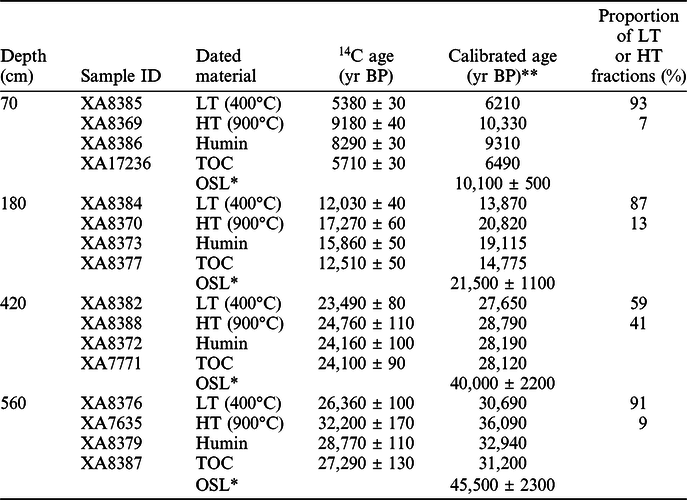
We focus on whether the HT fraction can provide reasonable ages for other loess profiles and for the older layer. The 14C ages of different fractions in the Weinan section are shown in Table 3 (Cheng et al. Reference Cheng, Burr, Zhou, Chen, Hou, Du, Fu and Lu2020) and Figure 4.
Radiocarbon and OSL ages for all sediment fractions from four sample depths in Weinan section. All14C data are calibrated using Calib 7.0.2.

* All OSL ages with errors of ~±5% at 1 σ are cited from Kang et al. (Reference Kang, Wang and Lu2013).
** Median probability.
Comparison of 14C and OSL ages of samples from four different depths in the Weinan section.

The 14C age of each fraction of the samples gradually increases as the sampling depth increases from 70 to 560 cm (Figure 3). A comparison of the 14C ages of different fractions reveals that for a given sample or at a certain depth the HT fraction shows the oldest 14C age, followed by the humin fraction, while the youngest 14C age came from the LT. The 14C ages of various fractions from 420 cm are all around 24,000 yr. BP, while the 14C ages of the samples from other depths vary widely between fractions. The five fractions can be ranked in descending order of 14C age as follows: HT > humin > TOC > LT. The present study suggests that, on average, the 14C age from the humin fraction is ~1600 years younger than that from the HT fraction. At 70 and 180 cm, the HT fractionʼs 14C ages are consistent with the OSL ages within 1σ. However, at depths of 420 and 560 cm, the HT fractionʼs 14C ages are about ~10,300 years younger than the OSL ages on average, and the 14C ages of the humin fraction are ~13,000 years younger than the OSL ages on average.
It is known that the OSL clock starts ticking as soon as the sediment is isolated from sunlight (Aitken Reference Aitken and Aitken1998), perhaps 1–2 cm depth, However, when the loess is at the 1–2 cm depth, carbon may exchange until it is buried to perhaps 1 m depth or more, thus we assume that radiocarbon ages are younger than OSL dates. When the average sedimentation rate is 100 yr/cm in the loess plateau (Zhou et al. Reference Zhou, An and Head1994), at the depth of 10 cm, OSL age is around 1000 yr, 14C age of organic matter is ~1000 years younger than OSL age. If the exchange of carbon is continuous, the difference between the 14C ages of organic carbon and the OSL ages widens with depth, as be shown by the results in the Weinan section. Thus, the question remains: is there reliable 14C dating material in the sediment?
Clay minerals play an important role in the storage and migration of organic matter. As clay minerals form in soils near the surface, some carbon can be incorporated into the clay minerals as they form. There are two forms of retained carbon in clay minerals. 1): Carbon is incorporated into the crystal lattice of a clay mineral, which is less susceptible to contamination/exchange/ bio-decomposition, as has been suggested by studies (Kleber et al. Reference Kleber, Mikutta, Torn and Jahn2005; Eusterhues et al. Reference Eusterhues, Rumpel and Kogel-Knabner2007). 2): There are binding sites e.g. hydroxyl ions, interlayers of swelling clays, or on the edge of non-swelling clays in the clay minerals, which could accommodate organic carbon and exchange carbon (Theng et al. Reference Theng, Churchman and Newman1986; Schulten et al. Reference Schulten, Leinweber and Theng1996; Chorover et al. Reference Chorover, Amistdadi and Chadwick2004; Skiba et al. Reference Skiba, Szczerba, Skiba, Bish and Grybos2011). Wang et al. (Reference Wang, Burr, Wang, Lin and Nguyen2016) found that the lattice-bound carbon can be released when the clay is completely oxidized at the high temperature, and binding sites of carbon can be emitted by low temperature. Hence, the radiocarbon age of the high temperature fraction dates to the time that the clay mineral formed (a maximum age) and low temperature fraction can be associated with relatively recent carbon exchange.
According to our 14C study on organic carbon in dust in Xi’an city, the distribution of 14C ages is around 3000 BP years, that is to say, after dust deposition, the 14C age of organic carbon in the sediment should be relatively old. However, why are 14C ages of organic matter in the loess plateau area relatively young? In the Donglongshan section, on average, 87% of the carbon recovered was in the low temperature fractions, while the high temperature fractions averaged 13%. In the Weinan section, the low-temperature and high-temperature component averaged 82% and 18%, respectively. It can be found that the carbon content of the low-temperature fraction was much higher than that of the high-temperature fraction in the section with intense leaching. Our study also shows that the ages of HT and OSL were consistent. However, in the arid area with weak pedogenesis, 14C ages of the HT fractions are much higher than those of the LT fractions, and HT fractions in the sediments are significantly older than OSL ages, thus the organic carbon in the sediments retained a large amount of old carbon in the source area (private communication). We inferred that the organic carbon in the dust deposited in loess plateau area may be replaced or exchanged, and then bio-decomposed, thus the remaining amount was also very small. In a sense, the influence of old carbon on 14C age of organic carbon in the sediment was very small in the loess plateau area.
Contamination by younger carbon becomes more evident as the age of the loess increases. Wang et al. (Reference Wang, Zhao, Dong, Zhou, Liu and Zhang2014) found that the 14C age of bulk OC from 10 ka to 35 ka, however, at the same interval, the OSL age ranged from 12 to 60 ka. This suggests that the loess profile has been undergoing continuous carbon exchange with its surroundings and the DOC and fine particle OM have constantly delivered younger carbon from the overlying layers to the lower layers. Deeper loess and paleosols have lower organic matter contents, thus the influence of younger carbon leached from the overlying layers increases, 2% contamination of modern carbon in a 15-ka-old sample may lead to only a minor age underestimation, whereas the same contamination for a 60-ka-old sample would yield an age estimate of only ~30 ka (Pigati et al. Reference Pigati, Quade, Wilson, Jull and Lifton2007). The longer the sedimentary cycle, the more stably bonded the organic matters brought down by DOC and the clay minerals, which were inseparable from the reliable components, deeply being mixed with each other. Therefore, it is very difficult to obtain reliable 14C ages using wet chemical pretreatment e.g. ABA. Though, HT pretreatment method (400–900ºC) fails to produce reasonable 14C in the deeper loess layer, itʼs promising to obtain reliable fraction by higher temperature interval e.g. 500–900ºC or 600–900ºC.
CONCLUSIONS
In the loess-paleosol sequence, 14C dates of the low-temperature (room temperature–400ºC) were younger than high-temperature (400–900ºC) fractions, indicating more contribution of younger carbon transported from overlying layers to LT fraction, which has smoothed many important climatic signals. After removing the contamination from the LT fraction, the δ13C variation of the HT fraction appears to respond much more sensitively to climate change, and 14C ages of the HT fraction are consistent with age of climatic event documented by stalagmites in Dongge and Hulu Caves, suggesting that HT fraction can produce relatively reasonable 14C ages. However, it is very difficult to obtain reliable 14C ages from older layer. Deeper loess and paleosols have lower organic matter contents, thus the influence of younger carbon transported from the overlying layers increases. Future research is expected to focus on the extent to which the organic carbon transported from overlying layers affects the 14C age of older layers. Our preliminary HT δ13C data from the Donglongshan loess profile indicate changes in monsoon climate regimes and gives a potential approach to reveal how monsoonal climate changes the regional plant ecosystem elsewhere in the Chinese Loess Plateau. More research is needed to verify if HT δ13C can be widely applied to trace abrupt climate change and study monsoon evolution in other areas.
ACKNOWLEDGMENTS
The authors would like to express sincere thanks to the staff of the Xi’an AMS Center, CAS Key Technology Talent Program and the Belt&Road Center for Earth Environment Studies for their support. This work was jointly supported by grants from the National Natural Science Foundation of China [NSFC41730108], Chinese Academy of Sciences [QYZDY-SSW-DQC001 and ZDBS-SSW-DQC001], National Research Program for Key Issues in Air Pollution Control (DQGG0105-02) and State Key Laboratory of Loess and Quaternary Geology.