Introduction
Red rice is often cited as one of the 10 most troublesome weeds in cultivated rice fields in the southern United States (Avila et al. Reference Avila, Senseman, McCauley, Chandler and O’Barr2005; Craigmiles Reference Craigmiles1978; Khodayari et al. Reference Khodayari, Smith and Black1987; Webster Reference Webster2000). Barnyardgrass is another troublesome rice weed that can reduce rice yield by as much as 80% (Smith Reference Smith1965). Production rice fields usually have multiple weed species present, including broadleaf weeds, grasses, and sedges (Cyperus spp.).
Historically, before imidazolinone-resistant rice (Clearfield® rice, BASF, Research Triangle Park, NC 27709) became available, herbicide programs in rice targeted barnyardgrass with initial weed management programs because of the lack of herbicides available for red rice control (Smith Reference Smith1965; Smith and Hill Reference Smith and Hill1990). However, with the release of imidazolinone-resistant rice in 2002, producers had the option of effectively controlling red rice while producing a rice crop. Imazethapyr (Newpath® herbicide, BASF) was the first herbicide selected for use in imidazolinone-resistant rice in the United States, and imazamox (Beyond® herbicide, BASF) was added 2 yr later to help manage late-season control of red rice that emerged late in the growing season or was not controlled with earlier applications of imazethapyr. Herbicides in the imidazolinone herbicide family inhibit acetohydroxy acid synthase or acetolactate synthase (ALS; EC 2.2.1.6) (Stidham and Singh Reference Stidham and Singh1991), providing a major advance in weed management technology for producers and the control of red rice (Webster and Masson Reference Webster and Masson2001). However, 100% control of red rice was rarely achieved in rice production fields (Webster and Masson Reference Webster and Masson2001).
Imazethapyr has PRE and/or POST activity on many grass and broadleaf weed species. Imazethapyr applied at 70 and 140 g ai ha−1 to rice at the 2- to 3-leaf stage controlled red rice greater than 90% (Webster and Masson Reference Webster and Masson2001), and imazethapyr at 70, 105, or 140 g ha−1 applied PRE followed by 70 g ha−1 POST controlled barnyardgrass 88% to 96% (Pellerin et al. Reference Pellerin, Webster, Zhang and Blouin2004). This new technology allowed producers to finally manage red rice and barnyardgrass while producing a rice crop rice.
Rice production generally provides an excellent environment for hemp sesbania (Lorenzi and Jeffery Reference Lorenzi and Jeffery1987). However, imazethapyr has little to no activity on hemp sesbania when used in conjunction with imidazolinone-resistant rice production, requiring the use of other herbicides (Webster and Masson Reference Webster and Masson2001; Zhang et al. Reference Zhang, Webster and Selim2001). Several other weeds, including Amazon sprangletop [Leptochloa panicoides (J. Presl) A. S. Hitchc.] and bearded sprangletop [Leptochloa fusca (L.) Kunth var. fascicularis (Lam.) N. Snow], have proliferated in the imidazolinone-resistant rice production system due to lack of control or suppression with only imazethapyr and imazamox. Propanil and propanil-based products are often an option for the management of Leptochloa spp. and hemp sesbania in Louisiana rice production (Pellerin et al. Reference Pellerin, Webster, Zhang and Blouin2004; Webster Reference Webster2017).
Propanil was commercialized in the early 1960s and became the primary herbicide for controlling barnyardgrass (Shaner Reference Shaner2014). For many years, the weed control program for rice in the southern United States focused on propanil, and propanil has long been used to control annual grass and broadleaf weeds in U.S. rice production (Carlson et al. Reference Carlson, Webster, Salassi, Hensley and Blouin2011; Fish et al. Reference Fish, Webster, Blouin and Bond2015, Reference Fish, Webster, Blouin and Bond2016; Pellerin et al. Reference Pellerin, Webster, Zhang and Blouin2004; Smith Reference Smith1961, Reference Smith1965). By the early 1990s, 98% of the rice acreage was treated with at least one application of propanil (Carey et al. Reference Carey, Hoagland and Talbert1995). However, many cases of propanil-resistant barnyardgrass have been confirmed in the Midsouth rice-producing states (Baltazar and Smith Reference Baltazar and Smith1994; Carey et al. Reference Carey, Hoagland and Talbert1995); those resistant barnyardgrass biotypes may require 2.5 to 20 times the commercial use rate of propanil for control.
Research has demonstrated that herbicide mixtures may be beneficial in improving efficacy and broadening the weed-control spectrum in imidazolinone-resistant rice (Carlson et al. Reference Carlson, Webster, Salassi, Hensley and Blouin2011; Fish et al. Reference Fish, Webster, Blouin and Bond2015, Reference Fish, Webster, Blouin and Bond2016; Pellerin et al. Reference Pellerin, Webster, Zhang and Blouin2004). The use of herbicide mixtures is favorable to producers because of increased weed control and reduced application costs. Fish et al. (Reference Fish, Webster, Blouin and Bond2015, Reference Fish, Webster, Blouin and Bond2016) reported many benefits with the co-application of herbicides with multiple sites of action in an imidazolinone-resistant rice production system. Co-application benefits include a broadened spectrum of weed control; economical application in a single spray solution versus the need for multiple applications to avoid antagonism; and the management, delay, or prevention of herbicide-resistant weed development. More importantly, high weed populations early in the growing season require timely herbicide applications to prevent yield loss (Webster et al. Reference Webster, Carlson, Salassi, Hensley and Blouin2012).
Colby’s method is a statistical linear model commonly used to determine a synergistic, antagonistic, or neutral response among herbicide mixtures by examining the herbicides applied alone and calculating an expected response when they are combined (Colby Reference Colby1967). This model was used by Lanclos et al. (Reference Lanclos, Webster and Zhang2002) to determine antagonistic effects of various rice herbicides mixed with glufosinate in glufosinate-resistant rice. Blouin et al. (Reference Blouin, Webster and Zhang2004) suggest that if the expected response is defined as a multiplicative, nonlinear function of the means for the herbicides when applied alone, then standard linear model methodology for tests of hypotheses does not apply directly; thus, the Blouin et al. (Reference Blouin, Webster and Zhang2004) nonlinear mixed model is more sensitive than Colby’s linear model in detecting significant differences in herbicide response. Zhang et al. (Reference Zhang, Webster, Blouin and Leon2005) employed the Blouin et al. (Reference Blouin, Webster and Zhang2004) nonlinear model to determine antagonistic effects of fenoxaprop mixed with propanil plus molinate or bentazon. Blouin et al. (Reference Blouin, Webster and Bond2010) further modified the nonlinear model into the augmented mixed model, which proved to be more versatile than the Blouin et al. (Reference Blouin, Webster and Zhang2004) nonlinear mixed model.
The objective of this research was to evaluate the interaction of an imazethapyr mixture with various rates of propanil for control of red rice, barnyardgrass, and hemp sesbania in rice production and the potential to use this mixture to better manage troublesome weeds in rice production. Blouin’s modified Colby’s is used to determine whether a synergistic, antagonistic, or a neutral response occurs with each mixture (Blouin et al. Reference Blouin, Webster and Zhang2004, Reference Blouin, Webster and Bond2010).
Materials and Methods
A study was conducted at three locations: (1) the Louisiana State University Agricultural Center’s H. Rouse Caffey Rice Research Station (RRS) near Crowley, LA, in the 2011 and 2012 crop seasons on a Crowley silt loam soil with pH 6.4 and 1.4% organic matter (OM); (2) the Louisiana State University Agricultural Center’s Northeast Research Station (NERS) near St Joseph, LA, in the 2012 crop season on a Sharkey clay with pH 6.1 and 2.1% OM; and (3) the Louisiana State University Agricultural Center’s Macon Ridge Research Station (MRRS) near Winnsboro, LA, in the 2012 crop season on a Gigger silt loam with pH 5.8 and 1.3% OM. Long-grain ‘CL 161’ imidazolinone-resistant rice was planted in 2011 and ‘CL 111’ imidazolinone-resistant rice was planted in 2012 at the RRS, NERS, and MRRS. ‘CL-161’ and ‘CL-111’ are similar in yield potential, but there is a slightly earlier maturity date with ‘CL-111’ compared with ‘CL-161’ (S Linscombe, Louisiana State University Agricultural Center Rice Breeder, personal communication).
Treatments were arranged as a two-factor factorial in a randomized complete block with four replications. Factor A was imazethapyr applied at 0 or 70 g ai ha−1, and factor B was propanil (RiceShot® herbicide label, RiceCo LLC, Memphis, TN 38137) applied at 0, 1,120, 2,240, 3,360, and 4,480 g ha−1.
Herbicide applications at all locations were made with a CO2-pressurized backpack sprayer calibrated to deliver 140 L ha−1 solution at 190 kPa. The spray boom consisted of five flat-fan 110015 nozzles (AirMix® Venturi Nozzle, Flat Fan, Greenleaf Technologies, Covington, LA 70434) with a 38-cm spacing. Crop oil concentrate (COC) at 1% vv (Agri-Dex® adjuvant label, Helena Chemical Company, Collierville, TN 38017) was added to imazethapyr when applied alone; however, no COC was added to any mixture that contained propanil. The propanil formulation used in this research was an EC formulation and required no adjuvant when mixed with imazethapyr. The initial treatment containing herbicide mixtures was applied on 1- to 3-leaf rice. In compliance with the imidazolinone-resistant rice stewardship program, the entire area at each location received a second application of imazethapyr at 70 g ha−1 applied alone 14 d later to rice in the 4- to 5-leaf stage.
Data obtained from the studies included visual evaluation of weed control and injury based on chlorosis and necrosis of foliage and reduced plant height on a scale of 0% to 100%, where 0 = no injury or control and 100 = plant death. Rice plant height was recorded from the ground to the tip of the extended panicle immediately before harvest (unpublished data), and rough rice yield was obtained for the primary crop with a small plot combine harvesting the center four rows of each plot (3.9 m2 of harvested area). Grain yield was adjusted to 12% moisture.
Treatments were applied at the RRS in 2011 on 2- to 8-cm red rice at the 1- to 3-leaf stage; 1- to 8-cm barnyardgrass at the 1- to 4-leaf stage; 1- to 8-cm hemp sesbania at the 1- to 4-leaf stage; and in 2012 on 5- to 10-cm red rice at the 2- to 3-leaf stage; 5- to 10-cm barnyardgrass at the 2- to 3-leaf; and 1- to 6-cm hemp sesbania at the 1- to 4-leaf stage. In 2012, applications at the NERS were made on 1- to 8-cm barnyardgrass at the 2- to 6-leaf stage, and applications at the MRRS were made on 3- to 5-cm barnyardgrass at the 2- to 4-leaf stage. Natural populations of each weed existed at each location, and densities of red rice and barnyardgrass were 20 to 40 plants m−2 for each species. Visual weed control observations were made at the RRS at 7, 14, 21, 35, and 49 d after treatment application (DAT); at the NERS at 14, 28, and 49 DAT; and at the MRRS at 28 and 49 DAT.
Interactions for control data were analyzed under the guidelines described in detail by Blouin et al. (Reference Blouin, Webster and Bond2010), and rough rice-yield data were analyzed with the use of the MIXED procedure in SAS (SAS Institute 2008). The fixed effects for the model were the treatment mixtures from the two rates of imazethapyr in combination with the five rates of propanil. The random effects for the model were location by year and replications within location by year, and treatment by replication interactions. The formulation of the model was detailed by Blouin et al. (Reference Blouin, Webster and Bond2011). The dependent variables in separate analyses were red rice control, barnyardgrass control, hemp sesbania control, and rough rice yield. The analysis for control employed repeated measures. The analysis for yield used Fisher’s protected LSD to compare treatment means. Normality of plot effects over all DAT values was checked with the use of the UNIVARIATE procedure in SAS (SAS Institute 2011). Significant normality problems were not observed.
Results and Discussion
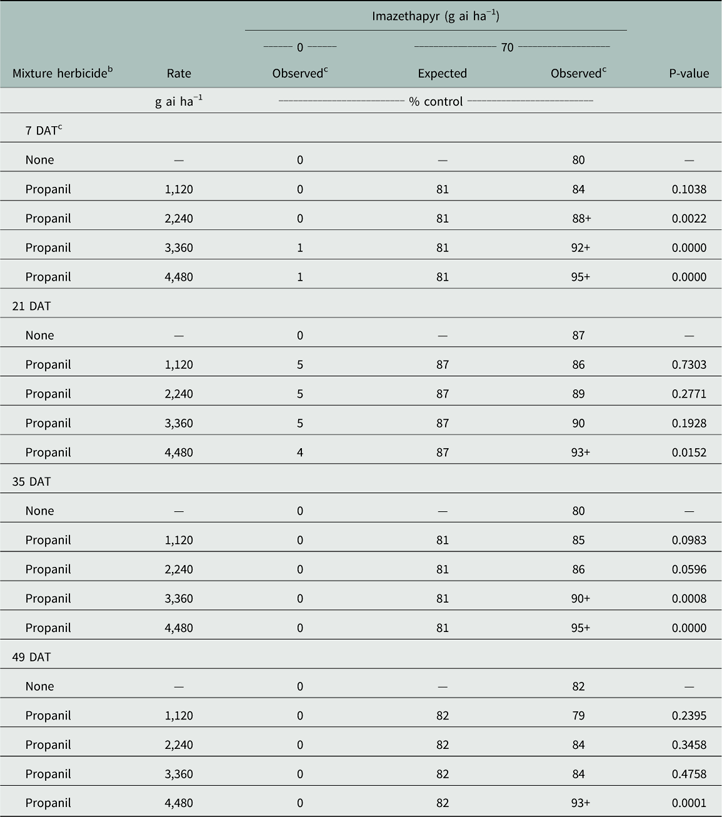
A synergistic response was observed at 7 DAT for red rice with imazethapyr applied at 70 g ha−1 mixed with propanil at 2,240, 3,360, and 4,480 g ha−1, with increasing control from an expected value of 81% to an observed control of 88% to 95% (Table 1). The mixture of imazethapyr plus propanil at 4,480 g ha−1 applied to red rice continued to be synergistic at each evaluation date. This is similar to synergism observed with a mixture of imazamox plus propanil reported by Fish et al. (Reference Fish, Webster, Blouin and Bond2016). No antagonism was observed for red rice treated with any mixture across all evaluation dates. The neutral and synergistic interactions indicated no negative impact on red rice control compared with imazethapyr applied alone. A mixture with these two herbicides with different sites of action, imazethapyr plus propanil, can improve the overall weed-control spectrum (Carlson et al. Reference Carlson, Webster, Salassi, Hensley and Blouin2011). Carlson et al. (Reference Carlson, Webster, Salassi, Hensley and Blouin2011) reported an increase of red rice control with an imazethapyr plus propanil mixture, and Fish et al. (Reference Fish, Webster, Blouin and Bond2015) reported synergism with imazethapyr plus a prepackage mixture of propanil plus thiobencarb.
Red rice control with imazethapyr and propanil mixtures in the 2011 and 2012 crop seasons at the Louisiana State University Agricultural Center’s H. Rouse Caffey Rice Research Station near Crowley, LA.

a Evaluation date and respective herbicide mixture.
b Observed means followed by a plus (+) or a minus (−) are significantly different from Blouin’s modified Colby’s expected responses at the 5% level, indicating a synergistic or an antagonistic response. No (+) or (−) indicates a neutral response.
c Abbreviation: DAT, days after treatment application.
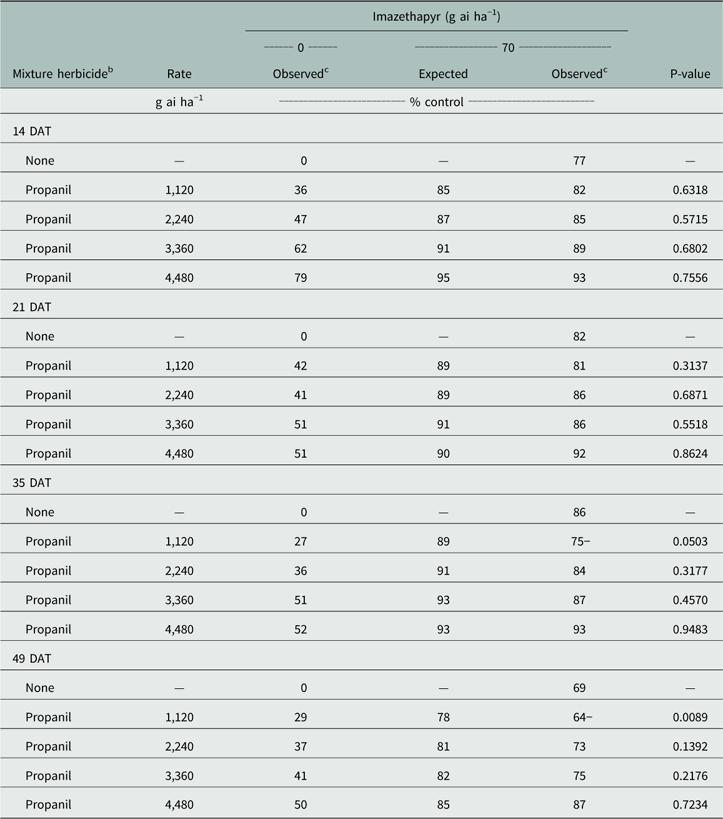
Antagonism occurred for barnyardgrass control with imazethapyr applied at 70 g ha−1 plus the lowest rate of propanil evaluated, 1,120 g ha−1, at 35 and 49 DAT; however, a neutral response was observed for barnyardgrass control for all other mixtures evaluated (Table 2). No synergistic response occurred for barnyardgrass control, but there appears to be no negative impact of this mixture when propanil was applied at 2,240 to 4,480 g ha−1. Propanil- or ALS-resistant barnyardgrass populations have been found in Louisiana; however, these populations are isolated and do not appear to be cross-resistant. If resistance is present, other weed management options may need to be employed; however, if cross-resistance is not present, this mixture may be an option for management of a single site-of-action resistance. A mixture of imazethapyr plus propanil can be a viable option in a rice weed management program and can help delay the development of herbicide-resistant barnyardgrass. This mixture can also be helpful in preventing barnyardgrass resistance in areas where propanil- or ALS-resistant barnyardgrass is not present. Previous research in Louisiana has reported synergism with imazamox or imazethapyr when mixed with propanil-based herbicides (Fish et al. Reference Fish, Webster, Blouin and Bond2015, Reference Fish, Webster, Blouin and Bond2016). However, research in Brazil has shown antagonism with a four-way mixture of imazapyr, imazapic, and propanil plus thiobencarb for barnyardgrass control (Matzenbacher et al. Reference Matzenbacher, Kalsing, Dalazen, Markus and Merotto2015).
Barnyardgrass control with imazethapyr and propanil mixtures in the 2011 crop season at the RRS and 2012 crop season at the RRS, NERS, and MRRS.Footnote a

a Abbreviations: RRS, Louisiana State University Agricultural Center’s H. Rouse Caffey Rice Research Station near Crowley, LA; NERS, Louisiana State University Agricultural Center’s Northeast Research Station near St Joseph, LA; MRRS, Louisiana State University Agricultural Center’s Macon Ridge Research Station near Winnsboro, LA; DAT, days after treatment application.
b Evaluation date and respective herbicide mixture.
c Observed means followed by a plus (+) or a minus (−) are significantly different from Blouin’s modified Colby’s expected responses at the 5% level, indicating a synergistic or an antagonistic response. No (+) or (−) indicates a neutral response.
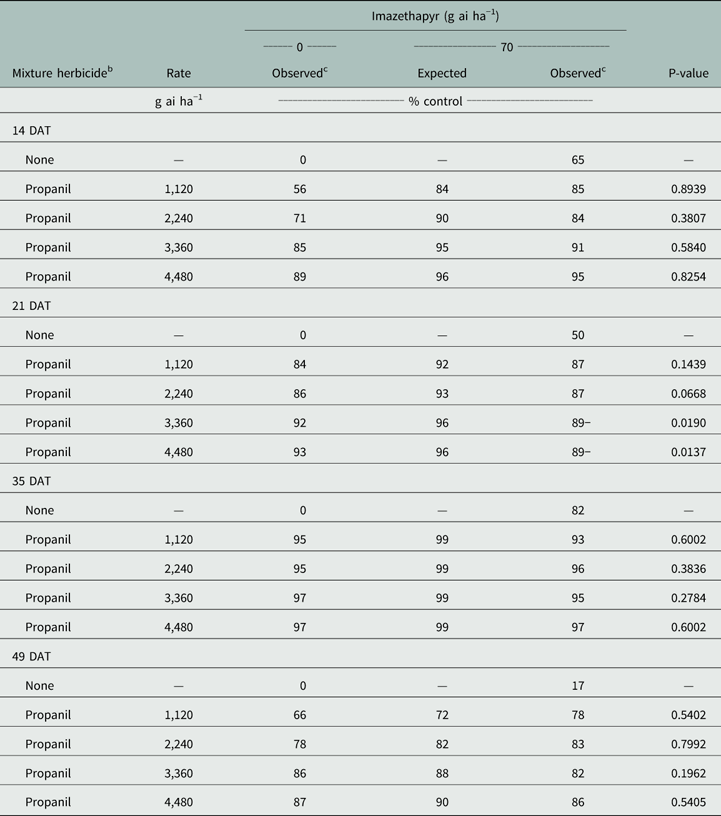
For hemp sesbania control, antagonism occurred at 21 DAT with imazethapyr applied at 70 g ha−1 plus propanil at 3,360 and 4,480 g ha−1, with decreasing control from an expected value of 96% to 89% observed control (Table 3). However, at 35 and 49 DAT, a neutral interaction occurred, which indicated no negative impact with the herbicide mixture for hemp sesbania control. Control of hemp sesbania in rice is essential to prevent yield loss (Camargo et al. Reference Camargo, Senseman, McCauley and Guice2012), and applying imazethapyr mixed with herbicides with activity on broadleaf weeds can be used to broaden the weed spectrum in an imidazolinone-resistant rice production system (Carlson 2011).
Hemp sesbania control with imazethapyr and propanil mixtures in 2011 crop season at the RRS and 2012 crop season at the RRS, NERS, and MRRS.Footnote a

a Abbreviations: RRS, Louisiana State University Agricultural Center’s H. Rouse Caffey Rice Research Station near Crowley, LA; NERS, Louisiana State University Agricultural Center’s Northeast Research Station near St Joseph, LA; MRRS, Louisiana State University Agricultural Center’s Macon Ridge Research Station near Winnsboro, LA; DAT, days after treatment application.
b Evaluation date and respective herbicide mixture.
c Observed means followed by a plus (+) or a minus (−) are significantly different from Blouin’s modified Colby’s expected responses at the 5% level, indicating a synergistic or an antagonistic response. No (+) or (−) indicates a neutral response.
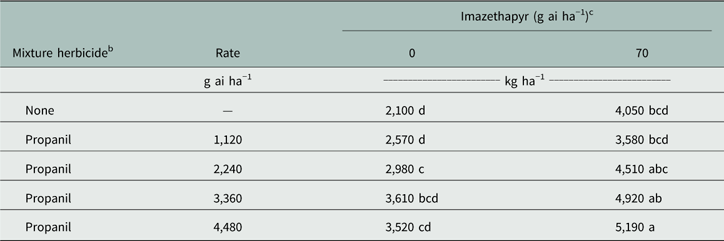
An increase in rice yield was observed with an imazethapyr plus propanil at 4,480 g ha−1 mixture compared with a single application of imazethapyr or propanil at any rate evaluated (Table 4). No antagonistic response was observed at 7, 14, 21, and 49 DAT for any weed evaluated treated with an imazethapyr plus propanil at 4,480 g ha−1 mixture. The lack of a negative antagonistic response indicates this herbicide can be used to increase the weed-control spectrum, which can effectively increase rough rice yield through reduced competition. It is important that weed control measures be applied early in the rice-growing season, and producers should be aggressive with herbicide programs by applying imazethapyr plus additional herbicides for broad-spectrum weed management (Webster Reference Webster2014).
Rough rice yields of rice treated with imazethapyr mixed with propanil at the RRS in the 2011 and 2012 crop seasons.Footnote a

a Abbreviation: RRS, Louisiana State University Agricultural Center’s H. Rouse Caffey Rice Research Station near Crowley, LA.
b Respective herbicide mixtures.
c Means followed by a common letter are not significantly different at P = 0.05 using PROC MIXED in SAS.
Based on weed management and the synergistic or neutral responses observed for red rice (Table 1), barnyardgrass (Table 2), and hemp sesbania (Table 3) control, the high rate of imazethapyr plus propanil mixtures may help prevent or delay red rice outcrossing with imidazolinone-resistant rice and may help delay herbicide-resistance development in barnyardgrass and hemp sesbania. It is recommended that multiple site-of-action herbicide mixtures be part of a best management practices program for resistance management and prevention (Norsworthy et al. Reference Norsworthy, Ward, Shaw, Llewellyn, Nichols, Webster, Bradley, Frisvold, Powles, Burgos, Witt and Barrett2012).
Acknowledgments
Published with the approval of the director of the Louisiana Agricultural Experiment Station and the Louisiana State University Agricultural Center, Baton Rouge, LA 70803, under manuscript number 2017-306-30788. The authors would like to thank Steve Linscombe and the staff of the Louisiana State University Agricultural Center Rice Research Station. The Louisiana Rice Research Board provided partial funding for this project.