Introduction
Snapmelon [Cucumis melo L. var. momordica (Roxb.) Duthie et Fuller] is native to India, where it is commonly known as ‘phut’ or ‘phoont’ which means to split. Its fruits invariably crack at maturity and the flesh tastes mealy. Immature fruits are cooked or pickled and the mature, low sugared flesh (4–5% total soluble solids, TSS) is eaten raw. Snapmelon is cultivated in many parts of India and in the two Japanese islands (Hachijo and Fukue; Fujishita, Reference Fujishita2004), where it was used as food during the two world wars.
Snapmelon is an excellent source of disease and insect resistance. In February 1929, California melon breeders received a shipment of snapmelon seed collected from the Kathiawar region of Gujarat province in India, from Mr D.N. Mehta (a graduate student of Dr J.T. Rosa); Second Economic Botanist, Nagpur, Central Provinces, India (Swarup, Reference Swarup, Kallo and Singh2000; Kathleen R. Reitsma, pers. commun.). From this snapmelon germplasm, US breeders isolated powdery mildew [Podosphaera xanthii (Castagne) Brawn and Shishkoff]-resistant collections designated Calif. # 525 and PI 79 376 (Pryor et al., Reference Pryor, Whitaker and Davis1946; Whitaker and Davis, Reference Whitaker and Davis1962). Calif. # 525 was shared with Dr I.C. Jagger and used in the development of ‘PMR 45’, first powdery mildew-resistant melon cultivar released in California. Line PI 79 376 was used in the development of ‘PMR 5’ in response to the appearance of P. xanthii race 2 (Whitaker and Davis, Reference Whitaker and Davis1962). The present-day varieties of muskmelon resistant to race 2 of P. xanthii and to Golovinomyces cichoracearum owe their origin to this genetic stock. Subsequently, more Indian snapmelon accessions PI 124111, PI 124112, PI 134192 and PI 414723 provided resistance to various diseases and pests such as downy mildew [Pseudoperonospora cubensis (Berk et Curtis) Rostovzer], fusarium wilt (Fusarium oxysporum Schltdl. fsp.melonis Snyder and Hansen), zucchini yellow mosaic virus, papaya ringspot virus, cucurbit aphid-borne yellow virus and Aphis gossypii Glover (Thomas et al., Reference Thomas, Cohen, McCreight, Jourdin and Cohen1998; Pitrat et al., Reference Pitrat, Hanelt and Hammer2000).
Indian snapmelon accessions have also been used for creating mapping populations in various laboratories in Europe and the US (Baudracco-Arnas and Pitrat, Reference Baudracco-Arnas and Pitrat1996; Wang et al., Reference Wang, Thomas and Dean1997) and to substantiate taxonomic relationships with other horticultural groups of C. melo (Silberstein et al., Reference Silberstein, Kovalski, Huang, Anagnostou, Jahn and Perl-Treves1999; Stepansky et al., Reference Stepansky, Kovalski and Perl-Treves1999a, Reference Stepansky, Kovalski, Schaffer and Perl-Trevesb; Akashi et al., Reference Akashi, Fukuda, Wako, Masuda and Kato2002; Monforte et al., Reference Monforte, Garcia-Mas and Arus2003).
The first comprehensive analysis of genetic variation in this taxon was performed recently (Dhillon et al., Reference Dhillon, Ranjana, Singh, Eduardo, Monforte, Pitrat, Dhillon and Singh2007), using snapmelon accessions collected from the north-western plains of India. Global genebanks preserve Indian snapmelon accessions originating from the north of India (Rajasthan, Punjab, UP; McCreight et al., Reference McCreight, Staub, Koppar and Srivastava1993; Staub and McCreight, Reference Staub and McCreight2004), but not from eastern India that remains inaccessible to collectors due to the unstable political situation in the region. McCreight et al. (Reference McCreight, Staub, López-Sesé and Sang-Min2004) suggested that the genetic variation in melon germplasm of north and central India might be an indication of the genetic diversity present in eastern India. They recommended that additional collections of melon germplasm should be made in eastern India with the expectation that genetic diversity not present in the existing world collections of melon would be found. A similar genetic picture of Indian melon germplasm has been suggested by Akashi et al. (Reference Akashi, Fukuda, Wako, Masuda and Kato2002).
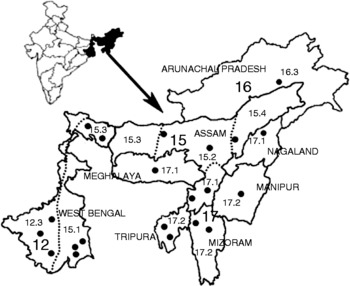
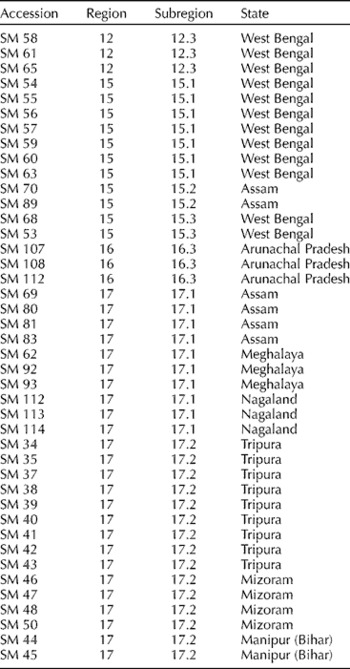
We have collected snapmelon landraces from four agro-ecological regions of eastern India representing eight agro-ecological subregions (Supplementary Table S1, available online only at http://journals.cambridge.org; Fig. 1) spread over eight states (West Bengal, Meghalaya, Assam, Arunachal Pradesh, Nagaland, Manipur, Mizoram and Tripura). Information on the genetic variation in snapmelon germplasm of eastern India is lacking in the literature. We employed morphological and cucumber mosaic virus (CMV)-resistance data, biochemical traits and simple sequence repeat (SSR) markers to assess the genetic diversity. The variation detected in Eastern Indian snapmelon landraces was compared with reference accessions of melon of diverse origin (S.E. Asia, S. Asia, W. Asia, Europe and other geographical parts of India). The present study should lead to an increase in the horticultural utilization of this kind of snapmelon germplasm by melon conservationists, breeders and growers, and make historical baseline data available for future melon explorations in this part of the world.
Distribution of snapmelon accessions as per agro-ecological regions.

Materials and methods
Germplasm
Forty-two landraces of snapmelon (Table 1) were collected from the eight states in eastern India, namely West Bengal, Meghalaya, Assam, Arunachal Pradesh, Nagaland, Manipur, Mizoram and Tripura, representing four agro-ecological regions (Sehgal et al., Reference Sehgal, Mandal, Mandal and Vadivelu1992) and eight agro-ecological subregions (Ghosh, Reference Ghosh1991; Fig. 1). Accessions belonging to a broad range of melon horticultural types (Monforte et al., Reference Monforte, Garcia-Mas and Arus2003, Reference Monforte, Eduardo, Abad and Arús2005) and Indian melon accessions from northern and southern India (agrestis, acidulus) were also included in the study as reference populations (Supplementary Table S2, available online only at http://journals.cambridge.org). Original germplasm maintained through sibbing was used for molecular studies, and the evaluation of disease resistance and single plant selections from the S3 generation of each accession was used for other assessments.
Details of snapmelon accessions collected from four agro-ecological regions of eastern India covering eight subregions

Morphological evaluation
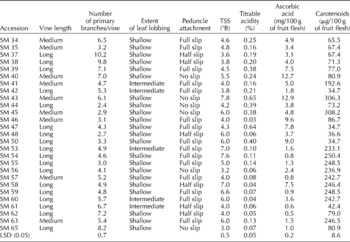
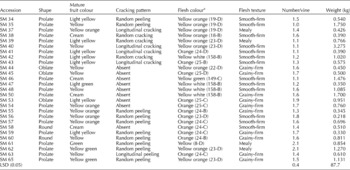
Twenty-seven landraces of snapmelon (Tables 2 and 3) were evaluated for morphological traits and productivity in 2007 at the Punjab Agricultural University, Ludhiana, India. Accessions were initially sown in compost and seedlings at the three-leaf stage were transplanted to the field. Three replications containing ten plants of each accession were arranged in a randomized complete block design such that row spacing was 3.0 m and within row spacing was 0.45 m. Plants were furrow irrigated and fertilized and protected from pathogens and pests as necessary with approved chemical control measures. Five central plants of each accession in each replication were chosen for sampling. The following traits were recorded: (1) vine length at first fruit maturity, (2) number of primary branches/vine, (3) extent of leaf lobbing, (4) peduncle attachment, (6) fruit shape, (7) mature fruit colour, (8) fruit-cracking pattern, (9) mature fruit flesh colour, (10) fruit flesh texture, (11) marketable fruit number/vine and (12) marketable fruit weight. Extent of leaf lobbing was visually determined as described by Whitaker and Davis (Reference Whitaker and Davis1962).
Plant habit traits and biochemical composition of fruit of snapmelon accessions

TSS, total soluble solids; °B, brix; LSD, least significant difference.
Fruit traits of snapmelon accessions

a Royal Horticultural Society's Colour Chart was used for fruit flesh colour identification.
LSD, least significant difference.
Biochemical analysis
Twenty seven landraces of snapmelon (Table 2) were evaluated for biochemical traits. Five mature fruits of each accession in each replication were harvested at the fruit maturity stage for biochemical assays. TSS (expressed as brix, °B) in fruit juice were examined using a hand refractometer. Ascorbic acid was bioassayed as described by Bajaj and Kaur (Reference Bajaj and Kaur1981). Titrable acidity was measured by titration of a fruit juice sample with 0.05 N NaOH, using phenolphthalein as indicator. Total carotenoids were estimated by the method described by Thomas and Joshi (Reference Thomas and Joshi1977).
Screening for cucumber mosaic virus (CMV) resistance
The assessment for resistance to CMV was carried out as described in Dhillon et al. (Reference Dhillon, Ranjana, Singh, Eduardo, Monforte, Pitrat, Dhillon and Singh2007). Screening for CMV resistance was done under natural epiphytotic conditions in the field during the rainy season (August–September) in 2007. The test plots were surrounded by plants of Luffa aegyptica Mill., which became completely infected with CMV during the month of September.
DNA extraction
DNA from ten plants per accession was extracted from young leaf tissue, using the method described by Doyle and Doyle (Reference Doyle and Doyle1990), with modifications suggested by Garcia-Mas et al. (Reference Garcia-Mas, Oliver, Gomez-Paniagua and DeVicente2000), and bulked for subsequent analysis.
SSR markers and genetic variability analysis
All the accessions shown in Table 1 together with accessions listed in Supplementary Table S2, available online only at http://journals.cambridge.org (reference genotypes) were used for SSR analysis. The 16 SSR markers used in this study (ECM50, ECM51, ECM61, ECM65, ECM70, ECM80, ECM85, ECM109, ECM124, ECM125, ECM129, ECM130, ECM133, ECM134, ECM178 and ECM182) were developed by Fernandez-Silva et al. (Reference Fernandez-Silva, Eduardo, Blanca, Esteras, Picó, Nuez, Arús, Garcia-Mas and Monforte2008). Polymerase chain reaction (PCRs) were performed in a final volume of 15 μl with 1X Taq buffer [10 mM Tris–HCl, 50 mM KCl, 0.001% gelatine, (pH 8.3)], 1.5–3.5 mM MgCl2, 166 μM dNTPs, 2 pmol of each forward and reverse primers, 0.66 pmol of IRD700- or IRD800-labelled oligonucleotide complimentary to the 20-mer M13 sequence that was added to the forward primer (Fernandez-Silva et al., Reference Fernandez-Silva, Eduardo, Blanca, Esteras, Picó, Nuez, Arús, Garcia-Mas and Monforte2008), 2 U Taq DNA polymerase and 15 ng of genomic DNA. The cycling conditions were: an initial cycle at 94°C for 1 min, followed by 35 cycles at 94°C for 30 s and 72°C for 1 min, and a final cycle at 72°C for 5 min. Electrophoresis was performed using LI-COR IR2 sequencer (Li-Cor, Inc., Lincoln, NE, USA), using 25 cm plates with 6% acrylamide, 1X TBE (90 mM Tris–borate, 2 mM EDTA, pH 8.0 and 7.5 M urea) and electrophoresis was performed at 1500 V, 35 mA and 31 W at 50°C until the PCR products were visible.
Due to the bulking of samples during DNA extraction, the observation of two or more SSR alleles in a single genotype could have resulted from the presence of several heterozygous plants, or homozygous plants, for the alternative alleles or a combination of both. Experimental conditions during the PCR amplification did not permit quantification of the frequency of an SSR allele in the sample based on the band intensity. Therefore, all the detected alleles were assumed to have a frequency of 1/n (n = number of alleles). Microsatellite allele sizes were estimated comparing their migration with the IRD-700 or -800, 50–350 bp size standard (Li-Cor, Inc.). The number of alleles, allele frequencies, polymorphism information content (PIC), Nei et al. (Reference Nei, Tajima and Tateno1983) genetic distances and neighbour-joining (NJ) tree were calculated with Powermarker (Liu and Muse, Reference Liu and Muse2005), and the NJ tree was plotted with MEGA 3.0 (Tamura et al., Reference Tamura, Dudley, Nei and Kumar2007). Factor correspondence analysis (FCA) was performed with NTSYSpc 2.11W.
Results
Morphological comparisons and field observations
A detailed description of the snapmelon accessions used in the present study is provided in Tables 2 and 3. All the accessions were monoecious. Long (>150 cm) and medium (100–150 cm) vines were observed in 66.6 and 33% of the accessions, respectively (Table 2). The majority (81.5%) of the accessions had shallow leaf lobbing, the remainder had intermediate lobbing. The number of primary branches/vine ranged from 2.4 to 10.2. The greatest number of primary branches was observed in accessions with long vines (SM 37 and SM 38). There was no association between the number of fruits/vine and the number of primary branches/vine (r P < 0.05 = 0.08). About 55% of accessions had full-slip peduncle abscission, and an equal number (22.2%) showed half slip or no slip mode of abscission. Three types of fruit shape were identified in the germplasm viz. round, prolate and oblate (Table 3). The majority of the accessions belonged to prolate (22) category; the categories oblate and round were represented by three and two accessions, respectively. The majority of accessions (51%) had light yellow to yellow mature fruit and only one accession had green fruit. Likewise, the majority (77%) of the accessions had yellow orange to orange fruit flesh. There was no association between mature fruit colour and flesh colour. Snapmelons are generally known for mealy flesh texture. Three kind of flesh textures namely mealy, smooth-firm and grainy-firm were tasted in these accessions. Fruits cracking on maturity are a characteristic of snapmelons. We observed clear genetic polymorphism for the pattern of fruit cracking, which was either longitudinal or random starting in the middle of the fruit. Fruit cracking was absent in one third of the accessions. In a few cases, instead of fruit cracking, only skin peeling (again either longitudinal or random) occurred. The average number of fruit/vine ranged between 1.0 and 2.1. The average fruit weight ranged between 0.218 and 3.275 kg. Furthermore, during collection of germplasm in the farmers' fields, variability in snapmelon landraces was also observed for maturity, rind thickness, seed cavity size, flesh thickness and fruit skin lustre. Skin lustre was prominent in one accession (SM 76).
Biochemical comparison
The TSS, titrable acidity, ascorbic acid and carotenoid values of the 27 snapmelon accessions are shown in Table 2. Their total sugars ranged between 3.0 and 7.8 °B. Ascorbic acid and titrable acidity of mature fruits ranged between 0.5 and 12.9 mg/100 g of flesh weight and 0.03–0.65%, respectively. Accessions SM 43 and SM 40 contained significantly (P < 0.05) more ascorbic acid than other accessions (12.9 and 12.7 mg/100 g of fruit flesh weight, respectively). Accessions SM 43 (0.65%) and SM 47 (0.64%) were significantly (P < 0.05) more acidic than the other landraces. The carotenoids in the accessions ranged between 34.7 and 308.2 μg/100 g of fruit flesh weight. There was a positive association between orange fruit flesh colour and higher carotenoid content.
Evaluation for CMV resistance
Three accessions from Assam (SM 72, SM 73 and SM 82) and one from West Bengal (SM 67) were resistant to CMV. The rest of the accessions was susceptible to the virus.
Characterization of SSR loci
A total of 141 alleles were found across the full set of melon accessions. The average number of alleles per SSR locus was 8.8 (range 4–15). The average PIC value, a reflection of allele diversity and frequency, was 0.64 (0.43–0.80). The average observed heterozygosity for the accessions of eastern India was 0.24, whereas it was 0.21 for the reference populations. Forty-three alleles (30.4%) were exclusively in the melon accessions of eastern India and the reference population had thirty-two (22.6%) unique alleles.
Genetic structure of the snapmelon collection of eastern India
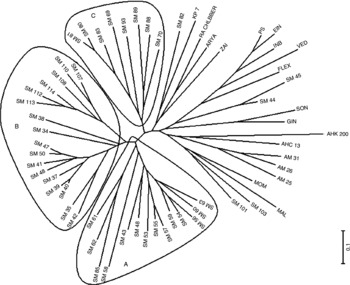
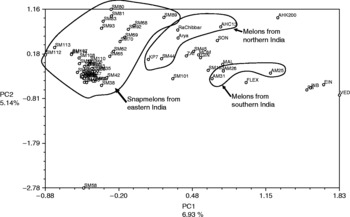
Figure 2 depicts the NJ tree for the range of genotypes examined based on the variability of 16 SSR loci. All the snapmelon accessions from the eastern states of India except SM 92 were well separated from the reference genotypes, both international accessions and melon landraces of northern, southern and central India (AHC 13, AHK 200, Ra Chibber, Arya, KP 7, AM 25, AM 26, AM 31, SM 101 and SM 103). The snapmelon accessions from the eastern states of India were clustered in three major groups. The distribution of accessions fits very well with their geographical origin. For example, accessions SM 63, SM 60, SM 56, SM 54, SM 59, SM 57 and SM 55 belonging to subregion 15.1 of West Bengal grouped together in cluster A. Similarly, accessions SM 42, SM 35, SM 40, SM 39, SM 37, SM 48, SM 41, SM 34 and SM 38 originating in subregion 17.2 of Tripura grouped together in cluster B. Accessions SM 70, SM 89, SM 69, SM 83, SM 80 and SM 81 belonging to subregion 15.2 and 17.1 of Assam bunched together in cluster C. Three accessions originating in subregion 16.3 of Arunachal Pradesh (SM 107, SM 108 and SM 112) clustered together in one of the subclusters of major cluster B. This major cluster had also one subcluster containing accessions of Nagaland origin (subregion 17.1). The FCA plot (Fig. 3) is consistent in numerous aspects with the NJ tree. The genetic distances between melon accessions obtained for FCA showed a clear genetic differentiation between snapmelon accessions from eastern India and melon accessions from northern, southern and central India, similar to the separation of clusters identified by the NJ tree. For example, the separation of AHK 200, AHC 13, Ra Chibber, KP 7, Arya, SM 101, SM 103, AM 25, AM 26, AM 31 and other reference populations from various parts of the world from the rest of the snapmelon genotypes of eastern India in the FCA plot is quite compatible with the relationships depicted in the NJ tree.
NJ tree for the set of 42 snapmelon accessions along with other reference genotypes.

Depiction of genetic relationships among snapmelon accessions of diverse origin using FCA as estimated by 16 SSR loci.

Discussion
The widely used description of snapmelon is that it is an Indian melon, which has fruit with low sugar content and a mealy texture and which cracks at maturity. Our survey of morphological characteristics of eastern-Indian snapmelon landraces revealed considerable diversity in plant habit, fruit traits, biochemical value and resistance to CMV. Different fruit shapes (3), fruit colours (6), fruit flesh colour (4) and flesh texture (3) exist in snapmelons. Genotype-specific patterns of fruit splitting and skin peeling are apparent in the germplasm. Even absence of fruit cracking at maturity was noticed in eight landraces. Local farmers informed us that they had consciously practised selection for this trait because the non-dehiscent mature snapmelon fruits were preferred by the modern consumer, for hygienic reasons. All the three types of peduncle abscission typical of modern cultivars of sweet melon are available in snapmelons. Similar patterns of variability in snapmelon landraces, originating from north-western plains of India, were observed by Dhillon et al. (Reference Dhillon, Ranjana, Singh, Eduardo, Monforte, Pitrat, Dhillon and Singh2007). It seems that a plentiful snapmelon variability is present in India. Snapmelon landraces of eastern India are generally quite low in ascorbic acid (ranging from 0.5 to 12.9 mg/100 g of fruit flesh) compared with the accessions belonging to the north-western plains of India (ranging from 1.6 to 34.1 mg/100 g of fruit flesh; Dhillon et al., Reference Dhillon, Ranjana, Singh, Eduardo, Monforte, Pitrat, Dhillon and Singh2007). Carotenoid content is also an important fruit quality trait because sufficient intake of carotenoids prevents diseases associated with vitamin A deficiency in humans (Goldman, Reference Goldman2003). In many places in eastern India, consumers prefer orange- or yellow–orange-coloured fruit flesh, which is associated with higher carotenoid concentration. We were informed during germplasm collection expeditions that local farmers had deliberately developed orange fruit flesh landraces rich in carotenoid content (288.9 and 306.3 μg/100 g of fruit flesh). The combination of high acidity and sugar content in melon flesh has been selected by breeders in order to improve the flavour of sweet melons, which have low acidity (0.12–0.2%). In the current snapmelon germplasm, landraces with high acidity (0.65%) have been found, although most of them have a low sugar content. In a survey of 56 genotypes of C. melo representing broad spectrum of varieties in this species, the combination of high sugar and high acid genotype was found to be non-existent (Stepansky et al., Reference Stepansky, Kovalski, Schaffer and Perl-Treves1999b). Burger et al. (Reference Burger, Saár, Distelfield, Katzir, Yeselson, Shen and Schaffer2003) found that sugar content and acidity were not genetically linked and developed melon lines with both high sugar and high acidity. Interestingly, we have collected two landraces of snapmelon from Assam (SM 76) and Tripura (SM 43), which have high sugars (9.4 and 7.8% TSS) as well as high acidity (0.77 and 0.65%). Local farmers told us that they had deliberately developed these orange fruit-fleshed landraces with better flavour and which were also rich in carotenoids (288.9 and 306.3 μg/100 g of fruit flesh). The experimental combinations were created by farmer–breeders in response to their ‘customers’ demands. These findings support the conclusion of Burger et al. (Reference Burger, Saár, Distelfield, Katzir, Yeselson, Shen and Schaffer2003) that the combination of high sugar and high acidity is possible within melon fruit. Acidity may be caused by the accumulation of different organic acids, such as malic or citric acids. The elucidation of which organic acid (or combination of organic acids) is causing the high acidity of the above accessions would help in the development of new melon cultivars with high sugars and high acids and different flavour characteristics.
We have also identified three landraces from Assam (SM 72, SM 73 and SM 82) and one from West Bengal (SM 67), which are resistant to CMV. Previously, snapmelon accessions resistant to CMV were reported only from northern regions of India (More, Reference More2002; Dhillon et al., Reference Dhillon, Ranjana, Singh, Eduardo, Monforte, Pitrat, Dhillon and Singh2007). Until recently, CMV resistance has been described as oligogenic recessive and strain specific (Dogimont et al., Reference Dogimont, Leconte, Perin, Thabuis, Lecoq and Pitrat2000). However, Essafi et al. (Reference Essafi, Juan, Diaz, Moriones, Monforte, Garcia-Mas and Martin-Hernandez2008) reported that a single gene is responsible for resistance to CMV strains P9 and P104.82 found in the accession PI 161375, although this gene did not confer resistance to strains M6 and TL. These two reports suggest that resistance to a broad spectrum of CMV strains may need the combination of different resistance sources. The resistant accessions found in the current report may contribute to this broad spectrum resistance.
Several conclusions can be drawn from the results of SSR analysis. First, they support the agro-ecological subregion separation of snapmelon germplasm from the eastern Indian states from the worldwide reference populations. This compliments the findings of Dhillon et al. (Reference Dhillon, Ranjana, Singh, Eduardo, Monforte, Pitrat, Dhillon and Singh2007) who observed regional differentiation at the molecular level in snapmelon landraces of north Indian origin. A second conclusion is that snapmelon germplasm from the eastern states of India has considerable genetic diversity. A third conclusion is that the snapmelon landraces of eastern India are genetically distinct from the melon accessions of northern, southern and central India and also from the reference genotypes from the other parts of the world. It is important that additional accessions from this geographically and ecologically varied region of India are collected to ensure the preservation of existing genetic variability. The position of the snapmelon accessions of eastern India in both the NJ dendrogram and FCA plot suggests that this germplasm is lateral to the other melon accessions. McCreight et al. (Reference McCreight, Staub, López-Sesé and Sang-Min2004) also determined that melon germplasm from eastern India might contain allelic diversity not presently available in the melon germplasm collections held in various global genebanks. Dhillon et al. (Reference Dhillon, Ranjana, Singh, Eduardo, Monforte, Pitrat, Dhillon and Singh2007) observed that a collection of snapmelon landraces from north India had a central position in a similar FCA plot, suggesting that the collection could represent a centre of origin from which oriental and occidental melon germplasm was developed and this concept has been supported by Luan et al. (Reference Luan, Delannay and Staub2008). In the present study, the FCA plot has also north Indian melons (Ra Chibber, AHC 13, KP 7, SM 44, SM 45 and MOM) occupying a somewhat central position. Accessions SM 44 and SM 45 though collected from Manipur were originally brought from Bihar, an eastern State of India, by farmers. However, the lateral position of the current snapmelon collection of eastern India suggests that this germplasm has had a minimal role in the generation of oriental and occidental germplasm. It therefore represents a large gene pool of genetic diversity that has not been yet exploited by oriental/occidental traditional farmers or modern melon breeders and may represent a repository of unique genetic variability. The preservation of this unique germplasm is clearly a necessity for future melon breeding programmes.
Acknowledgements
N.P.S.D. was supported by a fellowship for sabbatical stays from the Spanish Ministerio de Ciencia e Innovacion (MCINN). The work was funded by Grant AGL2006-12 780-C02-01/AGR (MCINN). We are thankful to Mr Krishanu De and Dr Umesh Thapa for providing help during germplasm collection work and Fuensanta Garcia for technical support. We are grateful to Professor G.J. Jellis for useful comments.