Empirical research on self-injurious behavior (SIB; e.g., cutting, burning, self-hitting) has increased dramatically over the past 2 decades (see Yates, Reference Yates2004, for review). The description of SIB and its parameters has been a central focus of investigation (e.g., Favazza, Reference Favazza1987/1996; Luiselli, Matson, & Singh, Reference Luiselli, Matson and Singh1992; Simeon & Hollander, Reference Simeon and Hollander2001; Simpson, Reference Simpson1975). However, extant research on SIB is limited by the predominant application of cross-sectional and retrospective research designs in clinical settings with primarily female samples. Moreover, most research on SIB has been atheoretical and nondevelopmental. This investigation extends the current literature by providing a rare look at the phenomenology and developmental psychopathology of SIB in a community sample that has been followed since birth.
SIB is a matter of urgent concern, given increasing rates in both clinical and community populations (Boyce, Oakley-Browne, & Hatcher, Reference Boyce, Oakley-Browne and Hatcher2001; Gratz, Conrad, & Roemer, Reference Gratz, Conrad and Roemer2002; Ross & Heath, Reference Ross and Heath2002; Walsh & Rosen, Reference Walsh and Rosen1988). Forces underlying rising rates of SIB remain to be determined; however, peer influences and contagion effects through face to face interactions, virtual relationships on the Internet, and media depictions of SIB are frequently cited mechanisms of transmission (Berman & Walley, Reference Berman and Walley2003; Whitlock, Powers, & Eckenrode, Reference Whitlock, Powers and Eckenrode2006). Yet the actual prevalence of SIB remains difficult to ascertain because of definitional variation across studies (Favazza, Reference Favazza and Jacobs1999; Putnam & Stein, Reference Putnam and Stein1985; Simeon & Favazza, Reference Simeon, Favazza, Simeon and Hollander2001; Simeon & Hollander, Reference Simeon and Hollander2001). Building on previous definitions of SIB (Favazza, Reference Favazza1998), this study examined self-inflicted, direct, socially unacceptable destruction or alteration of body tissue that occurs in the absence of conscious suicidal intent or pervasive developmental disorder. This definition of SIB is consistent with those of Favazza and others (e.g., Menninger, Reference Menninger1938; Pattison & Kahan, Reference Pattison and Kahan1983; Ross & McKay, Reference Ross and McKay1979), which differentiate SIB from suicidality, psychotic self-mutilation, stereotypies associated with organic or developmental disorders, and indirect methods of harm such as self-starvation, self-poisoning, substance abuse, refusal of medical treatment, or excessive risk taking. The central aims of the present study were (a) to describe the phenomenology of SIB in a low-income, mixed-gender community sample; (b) to test the role of child sexual abuse, child physical abuse, and child physical neglect in the etiology of SIB; and (c) to evaluate whether dissociation and somatization explain expected relations between maltreatment and SIB.
Aim I: Phenomenology
The first aim of this study was to explore multiple facets of SIB, including its prevalence and sociodemographic distribution, developmental timing, and methods and motivations for injury, in this low-income, mixed-gender community sample. As defined here, Yates (Reference Yates2004) has estimated that 10–15% of the general population has a lifetime history of SIB, with 5–10% of individuals engaging in repeated episodes. However, the literature on the prevalence and phenomenology of SIB across different gender, ethnic, and economic groups is variable. Although some studies suggest that women are 1.5–3 times more likely to self-injure than men (Boudewyn & Huser Liem, Reference Boudewyn and Huser Liem1995; Clery, Reference Clery and Boswell2000; Favazza, Reference Favazza and Jacobs1999; Shea & Shea, Reference Shea and Shea1991; Turp, Reference Turp1999), recent data from various samples reveal less pronounced gender differences (Briere & Gil, Reference Briere and Gil1998; Callias & Carpenter, Reference Callias and Carpenter1994; Garrison et al., Reference Garrison, Addy, McKeown, Cuffe, Jackson and Waller1993; Gratz et al., Reference Gratz, Conrad and Roemer2002; Tyler, Whitbeck, Hoyt, & Johnson, Reference Tyler, Whitbeck, Hoyt and Johnson2003). Similarly, although a few studies report higher rates of SIB among Caucasian individuals (Jones, Reference Jones1986; Ross & Heath, Reference Ross and Heath2002; Shea & Shea, Reference Shea and Shea1991; Turell & Armsworth, Reference Turell and Armsworth2000), others reveal significant levels of SIB in minority samples (Babiker & Arnold, Reference Babiker and Arnold1997; Lipschitz et al., Reference Lipschitz, Winegar, Nicolaou, Hartnick, Wolfson and Sowthwick1999; Marshall & Yazdani, Reference Marshall and Yazdani1999). As with other kinds of self-destructive behavior (e.g., substance use, sensation seeking; Lipsitt & Mitnick, Reference Lipsitt and Mitnick1991; Noshpitz, Reference Noshpitz1994), self-injurious episodes typically have their onset in adolescence (e.g., 12–14) and recur to varying degrees for a period of years before diminishing in middle adulthood.
In addition to sociodemographic patterning, researchers have begun to explore the qualitative features of SIB, including methods of injury and reported reasons for injuring. Although individuals tend to adopt a preferred mode of self-injury, many employ several methods over time (Briere & Gil, Reference Briere and Gil1998). In most studies, cutting is the most frequently endorsed method of injury (Babiker & Arnold, Reference Babiker and Arnold1997; Favazza & Conteiro, Reference Favazza and Conteiro1988; Paul, Schroeter, Dahme, & Nutzinger, Reference Paul, Schroeter, Dahme and Nutzinger2002; Shearer, Reference Shearer1994), yet several investigations have found needle sticking, self-hitting, and other forms of SIB to be more common than cutting (Baral, Kora, Yuksel, & Sezgin, Reference Baral, Kora, Yuksel and Sezgin1998; Gratz et al., Reference Gratz, Conrad and Roemer2002; Paul et al., Reference Paul, Schroeter, Dahme and Nutzinger2002).
Similarly, preliminary data suggest that people endorse a wide range of reasons for engaging in SIB (Simeon & Favazza, Reference Simeon, Favazza, Simeon and Hollander2001; Suyemoto, Reference Suyemoto1998). Interpersonal motivations characterize SIB that serves a communicative function and aims to regulate one or more features of the interpersonal environment (e.g., to make someone angry, to impress someone, to avoid hurting someone, to respond to peer pressure/influence). Intrapersonal motivations are involved when SIB is used to modify internal states of arousal or regulate intrapsychic distress (e.g., to stop feeling angry, to control emotional pain, to alleviate depression or stress). The current study tested the hypothesis that interpersonal motivations characterize intermittent, impulsive SIB, whereas intrapersonal motivations typify recurrent, severe SIB (Yates, Reference Yates2004). In this view, whether motivated by interpersonal or intrapersonal factors, SIB serves a regulatory function. Beyond descriptive analyses, however, this study also addressed the need for greater understanding of why SIB may take on such regulatory functions.
Aim II: Etiology
Relative to the descriptive literature on SIB, less is known about developmental pathways toward self-injurious outcomes. Retrospective findings from both clinical and community samples strongly implicate the role of child maltreatment in the etiology of SIB. Up to 79% of self-injurers report a childhood history of abuse or neglect (Favazza & Conteiro, Reference Favazza and Conteiro1989; Gratz et al., Reference Gratz, Conrad and Roemer2002; Low, Jones, MacLeod, Power, & Duggan, Reference Low, Jones, MacLeod, Power and Duggan2000; van der Kolk, Perry, & Herman, Reference van der Kolk, Perry and Herman1991; Wiederman, Sansone, & Sansone, Reference Wiederman, Sansone and Sansone1999). Retrospective relations between child sexual abuse and SIB are widely observed and almost entirely replicated in the published literature (e.g., Boudewyn & Huser Liem, Reference Boudewyn and Huser Liem1995; Briere & Zaidi, Reference Briere and Zaidi1989; Crowe & Bunclark, Reference Crowe and Bunclark2000; Darche, Reference Darche1990; Romans, Martin, Anderson, Herbison, & Mullen, Reference Romans, Martin, Anderson, Herbison and Mullen1995; Zlotnick, Shea, & Pearlstein, Reference Zlotnick, Shea and Pearlstein1996; see Zweig-Frank, Paris, & Guzder, Reference Zweig-Frank, Paris and Guzder1994b, for exception). Relative to sexual abuse, fewer studies have examined the role of child physical abuse in the etiology of SIB, although most data support this relation (e.g., Bryer, Nelson, Miller, & Krol, Reference Bryer, Nelson, Miller and Krol1987; Carroll, Schaffer, Spensley, & Abramowitz, Reference Carroll, Schaffer, Spensley and Abramowitz1980; Green, Reference Green1978; van der Kolk et al., 1991; Wiederman et al., Reference Wiederman, Sansone and Sansone1999, see Boudewyn & Huser Liem, Reference Boudewyn and Huser Liem1995, for exception). Of the few studies that have examined the role of child neglect in SIB, some have found significant relations (e.g., Dubo, Zanarini, Lewis, & Williams, Reference Dubo, Zanarini, Lewis and Williams1997; Lipschitz et al., Reference Lipschitz, Winegar, Nicolaou, Hartnick, Wolfson and Sowthwick1999; van der Kolk et al., 1991), but others have not (Wiederman et al., Reference Wiederman, Sansone and Sansone1999; Zweig-Frank, Paris, & Guzder, Reference Zweig-Frank, Paris and Guzder1994a, Reference Zweig-Frank, Paris and Guzder1994b). Finally, there remains a possibility that observed relations between child maltreatment and pathological outcomes such as SIB may reflect the influence of the broadly chaotic and high-risk environments that tend to be associated with maltreatment rather than maltreatment per se (Nash, Hulsely, Sexton, Harralson, & Lambert, Reference Nash, Hulsely, Sexton, Harralson and Lambert1993). The second aim of this study was to examine the contributions of prospectively identified child sexual abuse, physical abuse, and physical neglect to the prediction of SIB. Moreover, drawing on this unique longitudinal data, we examined these relations in consideration of the multirisk contexts within which maltreating families are often embedded.
Aim III: Process
The third aim of this study was to employ a developmental psychopathology perspective (Sroufe & Rutter, Reference Sroufe and Rutter1984) to guide the specification and examination of developmental pathways and mechanisms by which child maltreatment may contribute to SIB. In a recent application of a developmental psychopathology framework to understanding SIB, Yates (Reference Yates2004) identified multiple pathways by which maltreatment may instantiate vulnerabilities in basic adaptive capacities, vulnerabilities that, in turn, necessitate the application of compensatory (mal)adaptive strategies, such as self-injury, to negotiate age-salient developmental issues. These capacities include an underlying view of relationships as reliable and rewarding (i.e., motivational path), a complementary view of the self as worthy of care (i.e., attitudinal path), a capacity to integrate experience across multiple levels of thinking and feeling (i.e., integrative path, formerly termed instrumental), the ability to modulate emotion and arousal (i.e., emotional path), and the formation of reciprocal and empathic relationships (i.e., relational path). Although recognizing that there is structural heterogeneity among pathways toward self-injurious outcomes, the present investigation sought to evaluate the hypotheses underlying the integrative pathway.
Drawing on broader theories of self and emotional development (Bowlby, Reference Bowlby1969/1982; Cicchetti & Beeghly, Reference Cicchetti and Beeghly1990; Cicchetti & Izard, Reference Cicchetti and Izard1995; Emde, Reference Emde, Call, Galenson and Tyson1984; Gunnar & Sroufe, Reference Gunnar and Sroufe1991; Harter, Reference Harter1999; Schore, Reference Schore1994; Sroufe, Reference Sroufe1995; Stern, Reference Stern1985), the integrative pathway holds that adverse experiences in the caregiving environment undermine the child's emerging capacities to integrate affect and cognition, to symbolize experience through language, and to reflect on the emotional experiences of the self and of others. In turn, this model predicts that deficits in integrative, symbolic, and reflective functioning render the child vulnerable to splitting affect from cognition (i.e., dissociation) and symbolizing affect via the body rather than the mind (i.e., somatization). This study tested the hypothesis that child maltreatment fosters pathological elaborations of dissociative and somatic processes that render the individual vulnerable to SIB as an alternative strategy for processing and symbolizing experience.
Affect, maltreatment, and the developing self
Beginning with repeated affective exchanges in the infant–caregiver relationship, emotion is a central mechanism of self-development and of self-pathology (Bradley, Reference Bradley2000; Demos, Reference Demos and Goldberg1987; Emde, Reference Emde, Call, Galenson and Tyson1984; Jung, Reference Jung1954; Krystal, Reference Krystal1988; Sroufe, Reference Sroufe1995; Stern, Reference Stern1985). In the context of empathic and responsive caregiving, the child comes to believe that affect can be modulated with assistance from important others and that arousal will not precipitate disintegration. Predictable patterns of affect regulation form the core of a coherent affective self that allows for the recognition of consistencies in self and feeling states across time and context, as well as commonalities between one's own “affective core” and the affective experience of others (i.e., empathy; Emde, Reference Emde, Call, Galenson and Tyson1984; Sroufe, Reference Sroufe, Sameroff and Emde1989). In contrast, child maltreatment undermines the affective core of self-continuity by thwarting the adaptive integration of affect with cognition, the symbolic processing of affectively laden experience, and the capacity to reflect on the affective experience of the self and of others.
The typically developing child progresses toward increasing integrative, symbolic, and reflective capacities that engender flexible and successful encounters with age-salient developmental issues (Sroufe, Reference Sroufe, Cicchetti and Beeghly1990; Stern, Reference Stern1985). These processes enable the conversion of affective experience into language, rendering it “knowable” to the self and to others in relation to the self (Klein, Reference Klein1976). Over time, words become containers for affects, which allows emotion to move from the body to the mind where it can be regulated (i.e., desomatized; Krystal, Reference Krystal1974). Failure to organize experience linguistically and relationally leaves it to be symbolized on a somatosensory level through sensation and behavior (van der Kolk & van der Hart, Reference van der Kolk and van der Hart1989).
Mounting evidence suggests that insensitive caregiving and maltreatment undermine the child's developing capacities for integration, symbolization, and reflection (Allessandri, Reference Allessandri1991; Fonagy, Gergely, Jurist, & Target, Reference Fonagy, Gergely, Jurist and Target2002; Rosenberg, Reference Rosenberg1984). For example, maltreated children demonstrate marked deficits in their abilities to metabolize affective experience through language. Maltreated toddlers have shorter mean length utterances, engage in less verbal dialogue, and use less descriptive speech than their nonmaltreated peers (Coster, Gersten, Beeghly, & Cicchetti, Reference Coster, Gersten, Beeghly and Cicchetti1989). Moreover, maltreated children produce fewer utterances about physiological state (e.g., hunger, thirst) and negative affect (e.g., anger, bad feelings) than do nonmaltreated children, suggesting that there may be specific deficits in the linguistic representation of self-states as a function of maltreatment (Cicchetti & Beeghly, Reference Cicchetti, Beeghly, Cicchetti and Beeghly1987). Similarly, children with histories of insensitive or harsh caregiving evidence deficits in their ability to process and reflect upon affectively generated information (e.g., emotion recognition and expression; Allen & Tarnowski, Reference Allen and Tarnowski1989; Camras, Sachs-Alter, & Ribordy, Reference Camras, Sachs-Alter, Ribordy, Lewis and Sullivan1996). Ill equipped to process emotional experience through thinking and shared knowing in relationship, the traumatized child may turn to the bodily domain to process experience through action. In support of this assertion, deficits or distortions in affective processing have been connected with violence and aggression broadly (Fonagy & Target, Reference Fonagy and Target1995), and with SIB in particular (Doctors, Reference Doctors1981; Simpson, Reference Simpson and Farberow1980; van der Kolk et al., Reference van der Kolk, Pelcovitz, Roth, Mandel, McFarlane and Herman1996).
In sum, a history of sensitive caregiving forms the foundation for adaptive integrative, symbolic, and reflective capacities that enable the child to self-regulate fluctuating states of affect and arousal. In the case of maltreatment, however, a deviation occurs such that increasingly sophisticated defensive processing of affect develops rather than increasingly complex symbolic processing. Over time, SIB may emerge as an action- and bodily-based response to affect in lieu of adaptive integrative, symbolic, and reflective capacities. Rendered unable to know what is felt or to feel what is known, the maltreated child may solidify normative capacities to split affect from cognition into an enduring pattern of dissociative coping (Carlson, Yates, & Sroufe, in press; Fischer & Ayoub, Reference Fischer, Ayoub, Cicchetti and Toth1994). Similarly, unable to use shared symbols (e.g., language) to help bring affect out of the body and into the mind, these individuals may symbolize experience on a somatosensory level through pathological somatization (Rodin, de Groot, & Spivak, Reference Rodin, de Groot, Spivak, Bremner and Marmar1998; van der Kolk et al., Reference van der Kolk, Pelcovitz, Roth, Mandel, McFarlane and Herman1996). This study tested the hypothesis that child maltreatment may cause normative defensive processes, such as dissociation and somatization, to crystallize into pathology that, in turn, renders the individual vulnerable to body-based regulatory strategies such as SIB. In this view, the act of injury enables the body to become “the narrator of what words cannot say; of sensation for which there is no lexicon; of feelings they cannot bear in their conscious mind; of action language rather than verbalization” (Krueger, Reference Krueger2002, p. xi).
Dissociation and somatization
In dissociation, there is an alteration in the accessibility of memory and knowledge, the integration of behavior, and one's sense of self (Putnam, Reference Putnam, Cicchetti and Toth1994). Retrospective data (Chu & Dill, Reference Chu and Dill1990; Draijer & Langeland, Reference Draijer and Langeland1999; Mulder, Beautrais, Joyce, & Fergusson, Reference Mulder, Beautrais, Joyce and Fergusson1998) and preliminary prospective findings (Ogawa, Sroufe, Weinfield, Carlson, & Egeland, Reference Ogawa, Sroufe, Weinfield, Carlson and Egeland1997) support associations between child maltreatment and dissociation. Although there is consistent evidence of strong relations between dissociation and child sexual abuse, and, to a lesser degree, child physical abuse, observed relations between neglect and dissociation are less consistent (Macfie, Cicchetti, & Toth, Reference Macfie, Cicchetti and Toth2001; Merckelbach & Muris, Reference Merckelbach and Muris2001). There is a well-established association between SIB and pathological dissociation (Saxe, Chawla, & van der Kolk, Reference Saxe, Chawla and van der Kolk2002; Shearer, Reference Shearer1994; Zlotnick, Mattia, & Zimmerman, Reference Zlotnick, Mattia and Zimmerman1999). People who self-injure exhibit more dissociative symptoms than noninjurers (Low et al., Reference Low, Jones, MacLeod, Power and Duggan2000; Zlotnick et al., Reference Zlotnick, Shea and Pearlstein1996; Zweig-Frank et al., Reference Zweig-Frank, Paris and Guzder1994b), and preliminary data suggest that dissociative symptom levels predict SIB (Brodsky, Cliotre, & Dulit, Reference Brodsky, Cliotre and Dulit1995). Recently, researchers have suggested that dissociation may explain observed relations between child maltreatment, particularly sexual abuse, and SIB (Briere & Gil, Reference Briere and Gil1998; Kisiel & Lyons, Reference Kisiel and Lyons2001).
In somatization, the self is experienced in primarily physical terms and distress is expressed via somatic symptoms, bodily preoccupation, and/or illness-related worry (Barsky & Klerman, Reference Barsky and Klerman1983; Rodin, Reference Rodin1991). Somatization has been linked with a history of trauma, particularly body-based traumas such as sexual or physical abuse (Briere & Runtz, Reference Briere and Runtz1988; Farley & Keaney, Reference Farley and Keaney1997; Sansone, Wiederman, & Sansone, Reference Sansone, Wiederman and Sansone2001). Although somatization has received far less attention than dissociation in the literature on SIB, preliminary findings support the association between somatization and SIB (Sansone, Gaither, & Barclay, Reference Sansone, Gaither and Barclay2002; Simeon et al., Reference Simeon, Stanley, Frances, Mann, Winchel and Stanley1992). This study tested the hypothesis that SIB functions as a compensatory regulatory strategy that is necessitated by trauma-induced deficits in affective integration, symbolization, and reflection as indicated by dissociation and somatization.
Summary
Together, the three overarching aims of this study, to describe the phenomenology, etiology. and developmental psychopathology of SIB in a community sample, contribute to the literature on SIB in many ways. First, the data offer a rare look at the descriptive psychopathology of SIB in a low-income, mixed-gender community sample that has been followed from birth. Second, the analyses evaluated hypothesized relations between prospectively identified child maltreatment and SIB. Third, these relations were examined while considering the possible role of risk factors that have been associated with SIB and/or child maltreatment, including child cognitive ability, maternal socioeconomic status (SES), maternal life stress, family disruption, and maternal report of partner violence in the home (Appel & Holden, Reference Appel and Holden1998; Milner, Reference Milner, Trickett and Schellenbach1998; Oliver & Petty, Reference Oliver and Petty2002; Wekerle & Wolfe, Reference Wekerle, Wolfe, Mash and Barkley2003). Fourth and finally, this research illustrates the application of a developmental psychopathology framework to test whether pathological dissociative and somatic processes explain expected pathways between child maltreatment and SIB.
Method
Participants
Participants were drawn from the Minnesota Longitudinal Study of Parents and Children (MLSPC), a 26-year study of development and adaptation in a poverty sample of young mothers (M = 20.5 years, SD = 3.74) and their first-born children (see Egeland, Reference Egeland, Starr and Wolfe1991, for complete sample data). The original sample of primiparous mothers (N = 267) was recruited between 1975 and 1977 from the Minneapolis Public Health Clinic where they were receiving prenatal care. The families were identified as at risk for parenting problems because of poverty (100%), single motherhood (62%), and low maternal educational attainment (40% had not completed high school).
Sixty-one percent (N = 164; 81 females, 83 males) of the original sample completed interviews at age 26 for this study. This sample was 68.3% Caucasian, 10.4% African American, 3.6% Latino, Asian, or Native American, and 17.7% multiracial. Attrition analyses did not reveal differences between the current participants and those not included in these analyses with respect to demographic variables, except participants at age 26 were more likely to be Caucasian (68.3%) in comparison to the original sample (44.7%); χ2 (1) = 4.51, p < .05. Although there were no significant differences between the samples with respect to rates of child physical abuse or physical neglect, rates of child sexual abuse were significantly higher among the retained sample; χ2 (1) = 4.62, p < .05. However, this difference is likely an artifact of the disproportionate amount of attrition that occurred in the first several months of the study, when rates of child sexual abuse were negligible. Of the original 267 participants, 190 remained in the study as of the 18-month assessment (i.e., 75% of the attrition occurred in these early months).
Measures
Self-Injurious Behavior Questionnaire (SIBQ)
SIB was assessed at age 26 using the SIBQ, a semistructured interview about body-based SIBs (Yates & Carlson, Reference Yates and Carlson2003). The interview began with questions about culturally contextualized body modifications (e.g., piercing, tattooing), other related behaviors (e.g., risk taking, accident proneness), and whether participants had friends who engaged in SIB. Following these initial questions, all participants were asked if they had ever hurt themselves intentionally without meaning to kill themselves, by doing things like cutting, burning, or hitting themselves. If the reported incident(s) fell within the current definition of SIB, the participant was asked a series of questions to assess lifetime history of SIB and its parameters. Frequency of SIB was indicated categorically ranging across 1–2 times, 3–5 times, 6–10 times, and more than 10 times. Questions regarding methods of injury and ages of onset and offset were open ended (e.g., “what have you done to hurt yourself?”).
Reported motivations for SIB were coded as interpersonal (e.g., to show someone how much I was hurting), intrapersonal (e.g., to punish myself), or substance related (e.g., because I was high) based on participants' spontaneous responses to the query, “Why do you think you (insert form(s) of SIB)?” Participants provided as many responses to this query as they wanted, such that a single participant could report motivations in more than one category. Following this open-ended query, participants were provided with a comprehensive list of motivations for injuring and were asked to indicate which motivations ever applied to a SIB event for them, and to identify the top three reasons they engaged in SIB. Findings regarding spontaneously reported motivations and endorsed motivations for injuring are presented separately.
Consistent with the extant research on SIB, these analyses employed a categorical SIB classification consisting of three groups: noninjurers reported no history of SIB; intermittent injurers reported one to two incidents of SIB; recurrent injurers reported three or more SIB events. Participants who reported ambiguous SIB events (n = 9; e.g., punching a window without the intent to injure oneself) were not included in these analyses to ensure that the study captured the phenomenology of clear SIB events. Thus, the final sample for these analyses consisted of 155 participants (80 females, 75 males).
Studies with inpatient, clinical samples have employed similar categorical definitions of SIB based on frequency cutoffs, such as 5 or more incidents (Dulit, Fyer, Leon, Brodsky, & Frances, Reference Dulit, Fyer, Leon, Brodsky and Frances1994), or 10 or more incidents (Brodsky et al., Reference Brodsky, Cliotre and Dulit1995). Given the nonclinical nature of this sample and the categorical nature of our frequency data, a cutoff of three clear incidents was selected. This cutoff is more conservative than recent community based studies, which have distinguished groups of injurers based on one versus more than one SIB events (Cyr, McDuff, Wright, Theriault, & Cinq-Mars, Reference Cyr, McDuff, Wright, Theriault and Cinq-Mars2005; Whitlock, Eckenrode, & Silverman, Reference Whitlock, Eckenrode and Silverman2006), but is less stringent than clinical studies. Given prior findings that individuals endorsing more than one incident of SIB evidence significantly higher levels of psychological distress and impairment in community settings (Cyr et al., Reference Cyr, McDuff, Wright, Theriault and Cinq-Mars2005; Whitlock, Eckenrode, et al., Reference Whitlock, Eckenrode and Silverman2006), the current distinction between intermittent and recurrent injuring constitutes both a conservative and clinically meaningful criterion. Nevertheless, identifying meaningful cutoff points across frequencies of SIB events remains a challenge for this area of research.
Child maltreatment
Sample participants have been classified into maltreatment groups at several points in time (Egeland, Reference Egeland, Cicchetti and Toth1997; Shaffer, Huston, & Egeland, Reference Shaffer, Huston and Egeland2008). As described below, the current analyses were based on maltreatment ratings across childhood from birth through age 17.5 based on two maltreatment classifications, an early childhood rating from birth to age 5 and a later childhood rating from age 5 to 17. Child sexual abuse, physical abuse, and physical neglect were coded dichotomously (present/absent) for each participant on the basis of information from several sources, including direct observations, caregiver interviews, reviews of child protection and medical records when possible, and teacher interviews. The final maltreatment groups include children identified as maltreated at any point across the childhood years.
Child sexual abuse consisted of genital contact between the child and a person who was at least 5 years older than the child was (all perpetrators were in their teenage years or older). Physical abuse included parental acts that resulted in physical damage to the child (e.g., bruises, cuts, burns). Physical neglect was defined as incompetent and irresponsible management of the child's day-to-day care, inadequate nutritional or health care, and dangerous home environments because of insufficient supervision by a caregiver.
During the early childhood years (birth to 5 years), a team of Project staff conferenced and classified children into one or more maltreatment categories. Despite the subjectivity of this case conference approach, there was nearly perfect agreement among staff members regarding maltreatment classification. Moreover, team identifications were uniformly supported by available information about involvement with child protective services. Thirty-seven participants experienced one or more forms of maltreatment in early childhood. All cases of child sexual abuse (n = 10) and child physical abuse (n = 25) had been referred to child protection or were under the care of child protection at some point during the rating period. Children who were classified as neglected (n = 17) had been or were currently under the care of either a public health nurse or child protection.
During later childhood (5–17 years), available information from observations, interviews, and, when possible, records, was reviewed again, and 56 participants were identified as having experienced one or more maltreatment types. Each case was rated separately for sexual abuse (n = 28), physical abuse (n = 27), and neglect (n = 20). To establish reliability, 10% of these cases were coded by an independent rater and kappa coefficients were calculated (sexual abuse κ = .85, physical abuse κ = .81, physical neglect κ = .89). Participants were included in these later ratings if maltreatment was reported at any point during the assessments between 5 and 17 years of age. However, some of the maltreatment coded during later childhood may have occurred prior to age 5 (e.g., when an early childhood maltreatment experience was reported during a later assessment). Therefore, the present data could not be used to assess chronicity of maltreatment, because the overlap between early and later maltreatment ratings (n = 28) may reflect chronic maltreatment or the double coding of early maltreatment. Similarly, because each type of maltreatment was coded individually for each participant, comorbidity was present across the maltreatment groups with 38.7% of the total maltreatment sample experiencing more than one type of maltreatment.
Of the 155 participants in these analyses, 62 (44.6%; 33 females, 29 males) experienced one or more forms of maltreatment at some point across childhood (data were available during both rating periods for 140 of the participants; data on child physical abuse and physical neglect were missing for one participant during early childhood). Thirty participants (21.4%; 19 females, 11 males) experienced child sexual abuse, 35 (25.2%; 16 females, 19 males) experienced child physical abuse, and 27 (19.4%; 14 females, 13 males) experienced physical neglect.
Associated risk factors
Child cognitive ability
The Wechlser Intelligence Scale for Children—Revised (WISC-R; Wechsler, Reference Wechsler1974) was administered to each participant in third grade to assess cognitive ability. The WISC-R demonstrates high test–retest (r = .95) and split-half (r = .96) reliabilities for the entire scale with populations of children age 6–16 years (Wechsler, Reference Wechsler1974). The vocabulary, similarities, and block design subtests were administered as an abbreviated version of the entire scale. These subscales adhere to established criteria for research use (Salvia & Ysseldyke, Reference Salvia and Ysseldyke1985), correlate highly with full-scale IQ scores, and have adequate reliability and validity (Sattler, Reference Sattler1988). Prorated IQ scores were derived with Sattler's (1988) formula for use in these analyses.
SES
Household SES was assessed in Grades 1, 2, and 3 as the mean of z scores from multiple sources of information. At all three time points, caregiver's occupational status was classified using the revised Duncan Socioeconomic Index (Duncan, Reference Duncan and Reiss1961; Stevens & Featherman, Reference Stevens and Featherman1981) and mother's level of education was obtained. In Grade 3, a maternal report of household income was collected in addition to the other two measures. SES indices based on z-score means were transformed into t scores to produce positively scaled distributions for these variables at each time point. The t scores from Grades 1, 2, and 3 were averaged to form the composite index of SES in these analyses.
Stressful life events
Maternal life stress was assessed using a modified version of the 40-item Life Events Inventory (Cochrane & Robertson, Reference Cochrane and Robertson1973) with items added and deleted to increase its relevance for the MLSPC sample (Egeland & Deinard, Reference Egeland and Deinard1975). The resultant 39-item Life Events Scale (LES) was designed to assess the amount of social and economic stress experienced by the family. Life stress data were collected during each of eight semistructured maternal interviews in early childhood (12–64 months). The interviewer asked whether each event (e.g., job loss, death of family member) had occurred since the preceding assessment. Positive responses were probed further to enable independent, trained coders to rate the severity of each stressor on a 3-point scale reflecting the extent to which the event was disruptive to the family's functioning (Pianta & Egeland, Reference Pianta and Egeland1990). Across all items, the mean interrater agreement was .86. At each time point, a total weighted life stress score was computed by summing the number of items checked on the scale, with the weights assigned according to the severity of each stressor. The composite life stress score was calculated by averaging across standardized z scores at each time point.
Family disruption
The family disruption scale captures the level of stability or disruption in the composition of family membership based on the number of the mother's romantic partners, the number of the mother's partners living in the home, the number of moves in and out of the home by the mother's partners, and the number of moves made by the mother and the child that were instigated by changes in the mother's romantic relationships (Pierce, Reference Pierce2000). Information for this scale was obtained from interviewer notes and mothers' interviews over the course of the study. The 5-point scale ranged from 1 (stable one- or two-parent home; e.g., one man was in the home or the mother was not involved in any romantic relationships during the measurement period) to 5 (extremely disrupted home; e.g., mother was involved with multiple partners or numerous moves in and out of the home occurred during the measurement period). Interrater reliability was assessed for 33 cases rated independently by two coders (κ = .61). Intraclass correlation for the early childhood family disruption composite was .77. For these analyses, family disruption ratings were averaged across the early childhood (12–64 months) assessments.
Partner violence
The degree of mother-reported male to female partner violence in the home was rated using an 8-point scale that was developed to reflect the frequency and severity of physical violence directed toward the mother by her partner(s) in the home (Yates, Dodds, Sroufe, & Egeland, Reference Yates, Dodds, Sroufe and Egeland2003). Partner violence ratings were based on information from face to face interviews with the mother and on items pertaining to physically violent behavior between adults in the child's home taken from the LES. The partner violence ratings were made by trained coders after a comprehensive review of all the interview and life stress data in a given time period. Because mothers were the primary informants, the partner violence ratings reflect male to female partner violence only. Interrater reliability was calculated at each time point based on 50 ratings that were completed by two graduate research assistants (r = .93–.99). For these analyses, partner violence ratings were averaged across the early childhood (12–64 months) assessments.
Discretization and Somatization
The Kiddie Schedule of Affective Disorders and Schizophrenia (K-SADS) is a semistructured diagnostic interview that assesses current and past levels of psychopathology (Puig-Antich & Chamgers, Reference Puig-Antich and Chamgers1978). Interviews were administered when the participants were 17.5 years old. They were scored by trained clinical interviewers based on criteria specified in the Diagnostic and Statistical Manual of Mental Disorders, Third Edition—Revised (DSM-III-R; Ambrosini, Metz, Prabucki, & Lee, Reference Ambrosini, Metz, Prabucki and Lee1989; American Psychiatric Association, 1987). The current analyses employed KSADS ratings of present and past dissociative and somatic symptoms. The dissociation symptom summary score was computed by summing across 13 past and present dissociative symptoms (e.g., referring to self in third person, watching self from the outside, feeling numb, α = .67). The somatization symptom summary score was computed by summing across 14 past and present somatic symptoms (e.g., chest pains, dizzy spells, headaches, nausea; α = .77).
Data preparation
All data were examined for nonnormality (i.e., skewness > 2, kurtosis > 7; see Curran, West, & Finch, Reference Curran, West and Finch1996). Examination of the distribution of dissociation revealed one outlier whose score was 5.84 standard deviations above the sample mean. This participant's symptom score was replaced with a value just above the highest value of the other participants to maintain rank order while preventing its undue influence on analyses. A natural logarithm was used to transform the partner violence (skew = 2.28 and kurtosis = 6.18 before transformation, skew = 1.32 and kurtosis = .81 after transformation) and dissociation scores (skew = 2.48 and kurtosis = 8.02 before transformation, skew = 1.88 and kurtosis = 3.43 after transformation) to render parametric statistics valid.
Results
Descriptive analyses
Phenomenology
Prevalence and sociodemographics
Of the 155 participants in the current analyses, 26 (16.8%) endorsed at least one clear incident of SIB. Thirteen participants (8.4%; 6 females, 7 males) reported intermittent SIB (i.e., one to two events) and 13 (8.4%; 8 females, 5 males) reported recurrent SIB (i.e., three or more events). There were no significant differences across the three groups with respect to gender, race, educational attainment, employment status, relationship status, or parenthood.
The mean age of SIB onset was 14.0 years (SD = 4.0, range = 4–23 years), with 26.9% of injurers reporting onset of SIB prior to age 13. Average duration between age of onset and offset was 5.3 years (SD = 5.5, range = 0–21 years). Recurrent SIB cases reported younger ages of onset (M = 12.4 years, SD = 3.2) than intermittent SIB cases (M = 15.5 years, SD = 4.3); t (24) = 2.12, p < .05. Recurrent SIB cases also reported longer durations of SIB (M = 8.8 years, SD = 5.0) than intermittent SIB cases (M = 1.8 years, SD = 3.3); t (29) = 4.19, p < .001. There were no gender differences in the age of onset or average duration of reported SIB.
The likelihood of having friends who self-injure varied across SIB groups; χ2 (2) = 13.39, p < .001. Both intermittent (53.8%) and recurrent injurers (61.5%) were more likely to have friends who self-injure than were noninjurers (22.5%); χ2 (1) = 6.14 and 9.35, respectively, both p < .01. However, intermittent and recurrent injurers endorsed having friends who injure with similar frequency. There were no gender differences in the likelihood of having friends who self-injure.
Methods and motivations
There were no significant differences in method of injury across SIB groups. Both groups of injurers engaged in hitting (46.2% of intermittent group, 69.2% of recurrent group), cutting (38.5% of intermittent group, 69.2% of recurrent group), and burning (23.1% of intermittent group, 30.8% of recurrent group). Additional methods of injury (e.g., self-strangulation without intending to die, drinking harmful chemicals) were endorsed by 30.8% of recurrent injurers, but all recurrent SIB cases also endorsed hitting, cutting, and/or burning; 53.8% of recurrent injurers endorsed more than one form of SIB. Across groups, self-hitting and cutting were reported with similar frequency (57.7 and 53.9%, respectively) and more often than burning (26.9%). There were no gender differences in reported methods of SIB. Across both SIB groups, 88.5% of SIB cases reported injuries ranging from bleeding to breaking bones. More than half (58.3%) of the recurrent cases reported injuries severe enough to necessitate outpatient medical attention. There were no differences between males and females in the likelihood or severity of sustained injuries.
Participants reported intrapersonal motivations for SIB, such as “to get away or escape bad feelings” or “to punish yourself,” more often than interpersonal motivations, such as “to shock, impress, or get back at others.” Recurrent injurers were significantly more likely than intermittent injurers to endorse intrapersonal motivations (92.3 vs. 50.0%); χ 2 (1) = 5.54, p < .05. In contrast, there was a trend for intermittent injurers to endorse interpersonal motivations more often than recurrent injurers (58.3 vs. 23.1%). Across both SIB groups, substance related explanations for SIB were rare (7.7%). There were no significant gender differences in reported motivations for SIB.
Etiology
Bivariate relations
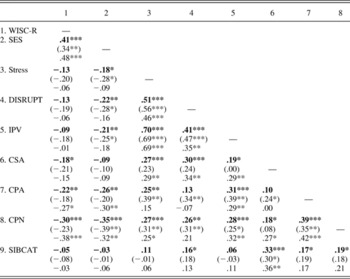
As shown in Table 1, zero-order correlations confirmed expected relations between the associated risk factors of child cognitive ability, SES, maternal life stress, familial disruption, intimate partner violence, and child maltreatment. Comorbidity among different forms of maltreatment was indicated by significant relations among maltreatment subtypes. Although child maltreatment types were positively correlated with SIB, only family disruption emerged as a significant correlate of SIB.
Zero-order correlations among associated risk factors, maltreatment types, and SIB for the total sample (N = 136–155), males (n = 62–75), and females (n = 73–80)

Note: Total sample correlations are in bold, male correlations are in parentheses, and female correlations are in normal font. WISC-R, child cognitive ability; SES, socioeconomic status; Stress, maternal life stress; DISRUPT, paternal disruption; IPV, intimate partner violence; CSA, child sexual abuse; CPA, child physical abuse; CPN, child physical neglect; SIBCAT, SIB category.
*p < .05. **p < .01. ***p < .001.
When examined by gender, meaningful differences in the pattern of relations between variables were evident. Among males, there was not a significant relation between exposure to intimate partner violence and child sexual abuse, yet this relation was robust among females, r (77) = .29, p < .05. However, there was a significant relation between child sexual abuse and child physical abuse for males, r (63) = .24, p < .05, but no such relation was evident for females. In contrast, there was no significant relation between child sexual abuse and physical neglect for males, yet this emerged as a significant relation for females, r (76) = .27, p < .05. Although relations between the predictor variables and SIB were similar for males and females, the observed gender differences in the interrelations among predictors warranted the control of gender in subsequent multivariate analyses.
Multivariate analyses
Striking differences were apparent in the frequency of child maltreatment experiences across the different SIB groups (see Table 2). Child sexual abuse and physical neglect appeared more frequently in the developmental histories of recurrent injurers, whereas a history of child physical abuse appeared to be overrepresented among intermittent injurers. A multivariate multinomial logistic regression analysis further clarified the etiological contribution of child maltreatment experiences to self-injurious outcomes (see Table 2). This method allowed for the evaluation of the unique contribution made by each independent variable beyond that of the other independent variables, such that each predictor was evaluated as if it entered the regression equation last. This analysis adjusted simultaneously for gender, associated risk factors (i.e., child cognitive ability, SES, maternal life stress, paternal disruption, and intimate partner violence), and other abuse types in predicting SIB category membership (i.e., no SIB vs. intermittent or recurrent SIB).
Summary of child maltreatment across, and as predictive of SIB, group membership

Note: Multivariate multinomial logistic regression analysis adjusted simultaneously for gender, associated risk factors (i.e., child cognitive ability, socioeconomic status, maternal life stress, paternal disruption, and intimate partner violence), and other abuse types. Maltreatment predictors coded 1 for present and 0 for absent. χ2 (18) = 29.37, p < .05; pseudo R 2 = .28 (Nagelkerke, Reference Nagelkerke1991).
a95% confidence interval.
*p < .05. **p < .01.
A test of the full model against a constant only model was statistically reliable for SIB; χ2 (18) = 29.37, p < .05. Neither gender nor the associated risk factors of child cognitive ability, SES, maternal life stress, familial disruption, or intimate partner violence in the home made significant contributions to the prediction of SIB group membership (not shown). Controlling for covariation among the predictors, a history of child sexual abuse increased the likelihood of recurrent self-injury by nearly 10-fold (adjusted odds ratio [OR] = 9.65, 95% confidence interval [CI] = 2.35–39.65), but was not predictive of intermittent SIB. Child physical abuse was not predictive of recurrent SIB, but was associated with a more than 7-fold increase in the odds of intermittent SIB (OR = 7.35, 95% CI = 1.65–32.83). Although physical neglect appeared more common in the developmental histories of recurrent injurers (46.2%) relative to intermittent (16.7%) and noninjurers (16.7%), it did not predict SIB group membership when its covariation with the other predictors was controlled.
Process
Process-level analyses examined dissociation and somatization as putative mediators of observed relations between child maltreatment and SIB. Levels of dissociation and somatization were elevated among SIB cases, with significantly higher levels among recurrent injurers (see Table 3). With respect to child maltreatment and these processes, however, only child sexual abuse was associated with significantly higher levels of dissociation in adolescence, t (144) = −2.16, p < .05. None of the maltreatment groups evidenced significant elevations in somatization.
One-way ANOVAs comparing mean dissociation and somatization symptom scores across SIB groups

***p < .001.
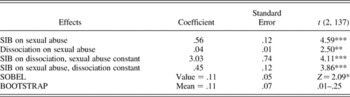
Mediation was evaluated following the causal steps of Baron and Kenny (Reference Baron and Kenny1986), and using Preacher and Hayes' (Reference Preacher and Hayes2004) bootstrap method to estimate the size of the indirect effect (for discussion, see Mallinckrodt, Abraham, Wei, & Russell, Reference Mallinckrodt, Abraham, Wei and Russell2006; Shrout & Bolger, Reference Shrout and Bolger2002). Based on the criteria set forth by Baron and Kenny (Reference Baron and Kenny1986) for testing mediation, only dissociation emerged as a possible mediator of the observed relation between child sexual abuse and recurrent SIB. As shown in Table 4, (a) child sexual abuse predicted recurrent SIB, t (2, 125) = 4.59, p < .001; (b) child sexual abuse predicted dissociation, t (2, 125) = 2.50, p < .02; (c) dissociation predicted recurrent SIB when child sexual abuse was held constant, t (2, 125) = 4.11, p < .001; and (d) the predictive strength of child sexual abuse to recurrent SIB decreased when dissociation was held constant, t (2, 125) = 3.86, p < .001. The Sobel Test (MacKinnon, Warsi, & Dwyer, Reference MacKinnon, Warsi and Dwyer1995) revealed a significant mediating effect of dissociation on the relation between sexual abuse and recurrent SIB (z = 2.09, p < .05). Based on 1,000 random samples from the original data, the significance of this reduction was further supported by the 95% CI for the size of the indirect effect derived from the bootstrapped estimates (.01–.25). However, comparison of the coefficients and significance levels for the direct effect of child sexual abuse on recurrent SIB and that for the indirect effect of child sexual abuse on recurrent SIB through dissociation revealed only partial mediation.
Dissociation mediating the relation between child sexual abuse and recurrent SIB
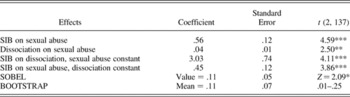
*p < .05. **p < .01. ***p < .001.
Discussion
SIB emerged as a prominent and heterogeneous phenomenon in this low-income, mixed-gender, community sample. Although researchers have conceptualized SIB as a homogeneous phenomenon that is either present or absent, recent clinical (e.g., Brodsky et al., Reference Brodsky, Cliotre and Dulit1995; Dulit et al., Reference Dulit, Fyer, Leon, Brodsky and Frances1994; Low, Terry, Duggan, MacLeod, & Power, Reference Low, Terry, Duggan, MacLeod and Power1997; Zlotnick et al., Reference Zlotnick, Mattia and Zimmerman1999) and community (e.g., Cyr et al., Reference Cyr, McDuff, Wright, Theriault and Cinq-Mars2005; Whitlock, Eckenrode, et al., 2006) studies have examined the phenomenology of SIB as a function of its frequency and severity. The present findings extend this work to reveal meaningful heterogeneity in SIB with respect to its form, function, etiology, and the developmental processes that underlie it.
Nearly 17% of the participants in this study reported at least one clear episode of SIB, with 8.4% reporting three or more episodes. These prevalence rates replicate and extend findings from college and high school samples (Gratz et al., Reference Gratz, Conrad and Roemer2002; Ross & Heath, Reference Ross and Heath2002; Whitlock, Eckenrode, et al., 2006) to a broader, low-income, community sample. Moreover, consistent with prior work in clinical settings (Dubo et al., Reference Dubo, Zanarini, Lewis and Williams1997; Nixon, Cloutier, & Aggarwal, Reference Nixon, Cloutier and Aggarwal2002), the present findings suggest distinct developmental pathways between groups of injurers. In contrast to intermittent injurers, who typically began injuring around 15–16 years of age and stopped before age 18, recurrent injurers typically began injuring around age 12–13 and continued to engage in SIB for a period of 8–9 years. Future research should examine whether SIB that is limited to the adolescent period involves different developmental antecedents and processes (e.g., peer influence, family conflict) than SIB that begins prior to adolescence and/or that extends into adulthood (e.g., maltreatment, affect dysregulation).
Consistent with recent investigations of SIB, participants in this study endorsed intrapersonal motivations for SIB, such as rising tension or dysphoria, more often than interpersonal motivations, such as manipulation or attention seeking (Nixon et al., Reference Nixon, Cloutier and Aggarwal2002; Nock & Prinstein, Reference Nock and Prinstein2004). Although it is important to recognize that these spontaneous explanations for injuring may represent post hoc behavioral (mis)attributions (Reid & Henry, Reference Reid and Henry2001), the motivations (or rationales) reported by persons who self-injure do appear meaningful. Recurrent injurers were more likely to identify intrapersonal motivations for SIB than were intermittent injurers, who tended to report interpersonal motivations. These findings suggest that recurrent SIB subserves intrapersonal regulatory functions (e.g., to quell intrapsychic distress), whereas intermittent SIB may serve interpersonal regulatory functions (e.g., to communicate distress). Despite additional levels of differentiation in motivational processes that could not be examined here because of the small sample (e.g., body vs. affect based), this intra- versus interpersonal functional understanding of SIB has important treatment implications, which are discussed later.
The present study did not reveal meaningful gender differences in rates, methods, or functions of SIB. Although these data are consistent with recent findings from nonclinical samples (Gratz et al., Reference Gratz, Conrad and Roemer2002; Tyler et al., Reference Tyler, Whitbeck, Hoyt and Johnson2003), the limited sample size in this study may have obscured potential gender differences. Thus, there is a need for ongoing research to further examine and clarify the interactions among gender, etiology, and process in SIB.
Amid rising rates of SIB, scholars have hypothesized that social contagion effects and peer influences may be important explanatory mechanisms (Berman & Walley, Reference Berman and Walley2003; Fennig, Carlson, & Fennig, Reference Fennig, Carlson and Fennig1995; Whitlock, Powers, et al., 2006). As expected, participants who engaged in SIB were more likely than noninjurers to report having friends who self-injure. However, recurrent injurers were not more likely to do so than were intermittent injurers. These results support Suyemoto's (1998) assertion that SIB may emerge out of modeling or vicarious learning experiences, but it is probably maintained by reinforcement contingencies, such as tension release. Additional research is needed to identify factors that influence whether or not individuals who experiment with SIB will progress to recurrent SIB. In this regard, biological levels of analysis may be especially informative. For example, evidence points to the role of the endogenous opiate system, which is also involved in early attachment relationships (Panksepp, Siviy, & Normansell, Reference Panksepp, Siviy, Normansell, Reite and Field1985), as a probable maintenance mechanism in SIB (Symons, Reference Symons, Schroeder, Oster-Granite and Thompson2002).
In addition to important phenomenological findings, this study offers the first prospective evidence of relations between child maltreatment and SIB in any setting. Moreover, preliminary analyses tested process-level hypotheses connecting child maltreatment to self-injurious outcomes via dissociative and somatic mechanisms. As expected, there were robust relations between child maltreatment and SIB (van der Kolk et al., 1991; Wiederman et al., Reference Wiederman, Sansone and Sansone1999). Although qualified by the presence of comorbidity among different maltreatment subtypes in this sample, our findings suggest that, when controlling for child physical abuse and neglect, child sexual abuse contributes to recurrent SIB, whereas child physical abuse increases the likelihood of intermittent SIB. At the multivariate level, physical neglect was not associated with SIB group membership. The comorbidity between neglect and abuse may account for the present finding, and inevitably complicates efforts to understand if and how different kinds of maltreatment may contribute to SIB. Nevertheless, these findings are noteworthy given that gender, associated risk factors, and other forms of maltreatment were controlled in these analyses.
This study suggests that there is something unique about child maltreatment, beyond its association with other risk factors, that contributes to SIB. Moreover, the findings partially support the predicted model of SIB as a compensatory regulatory strategy in the aftermath of traumatic experience. Pronounced tendencies to split affect from cognition (i.e., dissociation) and to express affect through the body (i.e., somatization) were related to recurrent SIB, and dissociation emerged as a significant partial mediator of the specific relation between child sexual abuse and recurrent SIB. This study adds to the growing body of literature connecting dissociative processes with SIB (Chu, Reference Chu1991; Low et al., Reference Low, Jones, MacLeod, Power and Duggan2000; Zlotnick et al., Reference Zlotnick, Shea and Pearlstein1996), and supports preliminary evidence that somatization may be an important, but as yet understudied, process in SIB (Sansone et al., Reference Sansone, Wiederman and Sansone2001; Simeon et al., Reference Simeon, Stanley, Frances, Mann, Winchel and Stanley1992). Beyond examining the role of somatization and dissociation in self-injurious pathways, however, additional work is needed to understand how and why these processes may contribute to SIB. For example, these processes might interfere with effortful control and reflection such that responses become more reactive and affect driven. Similarly, SIB may relate to dissociation because it induces dissociation (i.e., to distract from painful feelings) and/or because it regrounds the person from a dissociative episode. This study encourages additional and more refined analyses of this nature using larger and varied samples.
Strengths and limitations
This study extends prior findings from clinical settings and captive normative samples to a low-income, mixed-gender, community sample. Moreover, these data were collected prospectively using multiple methods and informants. Whether in clinical or community settings, prior studies of SIB have relied on cross-sectional, retrospective research designs, typically using single informants to report on both independent and dependent measures, which introduces potential confounds related to retrospective bias (Henry, Moffitt, Caspi, Langley, & Silva, Reference Henry, Moffitt, Caspi, Langley and Silva1994) and shared method variance (Sternberg, Lamb, & Dawud-Noursi, Reference Sternberg, Lamb, Dawud-Noursi, Holden, Geffner and Jouriles1998). Finally, the study's emphasis on developmental processes and pathways moves this research beyond the level of description to examine specific transactions that may lead to self-injurious outcomes.
Despite the contributions of this study to the neophyte literature on SIB, many of the features that confer strength to the findings also introduce potential limitations and confounds to their interpretation. In contrast to the powerful numbers of large-scale epidemiologic samples (e.g., Klonsky, Oltmanns, & Turkheimer, Reference Klonsky, Oltmanns and Turkheimer2003), this study provides a unique and in-depth look at the qualitative and developmental features of SIB in a small group of injurers who have been followed from birth through young adulthood. By necessity, this study represents a trade-off between the breadth of large-scale samples and the depth of small-scale longitudinal designs. The sample size in this study limited the complexity of the current analyses, particularly the capacity to examine gender differences and interactive processes fully. Similarly, the examination of SIB in community settings necessitates the adoption of a lower criterion for recurrent SIB than has been employed in clinical samples, which may have implications for the generalizability of community findings to clinical milieus. Nonetheless, the current sample is larger than many cross-sectional studies of SIB in the literature, and the criterion for recurrent SIB was similar or more conservative than those used in recent community studies (Cyr et al., Reference Cyr, McDuff, Wright, Theriault and Cinq-Mars2005; Whitlock, Eckenrode, et al., 2006).
Beyond the unique features of the current sample and study design, methodological limitations in this study are typical of broader research on psychopathology. For example, issues of classification, definition, and comorbidity remain prominent concerns in studies of child maltreatment, despite efforts to create standard definitional guidelines (Barnett, Manly, & Cicchetti, Reference Barnett, Manly, Cicchetti, Cicchetti and Toth1993). As was typical of early studies on maltreatment (Mash & Wolfe, Reference Mash and Wolfe1991), the MLSPC did not obtain consistent data pertaining to qualitative features of child maltreatment (e.g., age of occurrence, frequency, relationship of perpetrator, severity) that are important for fully understanding relations between maltreatment and psychopathological outcomes (Cole & Putnam, Reference Cole and Putnam1992; Trickett, Noll, Reiffman, & Putnam, Reference Trickett, Noll, Reiffman and Putnam2001), including SIB (Romans et al., Reference Romans, Martin, Anderson, Herbison and Mullen1995; Santa Mina & Gallop, Reference Santa Mina and Gallop1998). Moreover, the current sample size did not permit the specification of distinct maltreatment subgroups such that the present findings may be less robust because of comorbidity across different maltreatment subtypes. Finally, evidence also suggests that other forms of trauma (e.g., loss or illness), which were not considered in this study, may influence pathways toward and away from SIB (van der Kolk et al., 1991).
Along similar lines, reliable methods for assessing psychopathology are needed, particularly in the area of SIB. This research employed a measure of SIB with unknown psychometric properties that may have influenced the present findings (for discussion, see Schwartz, Reference Schwartz1999). However, the majority of research on SIB to date has employed study-specific questionnaires with similarly unknown psychometrics (e.g., Dulit et al., Reference Dulit, Fyer, Leon, Brodsky and Frances1994; Favazza & Conteiro, Reference Favazza and Conteiro1988; Gratz, Reference Gratz2001; Ross & Heath, Reference Ross and Heath2002; Sansone, Wiederman, & Sansone, Reference Sansone, Wiederman and Sansone1998; van der Kolk et al., 1991). Moreover, the SIBQ obtained more comprehensive information than most measures, which typically ask only about methods and frequencies of SIB. The dearth of empirically valid measures of SIB remains a prominent limitation of the research in this area.
Implications
This study provides compelling evidence for the etiological contribution of child maltreatment to SIB. Although the current findings suggest that dissociation and somatization contribute to SIB, SIB is multidetermined and there is a need for additional research to examine processes that may account for relations among maltreatment, dissociation, somatization, and SIB. Additional explanatory variables have been suggested in the literature, including negative representations of self and others (Low et al., Reference Low, Jones, MacLeod, Power and Duggan2000; Yates, Tracy, & Luthar, Reference Yates, Tracy and Luthar2008), emotion dysregulation (Cicchetti, Ganiban, & Barnett, Reference Cicchetti, Ganiban, Barnett, Garber and Dodge1991; Rodin et al., Reference Rodin, de Groot, Spivak, Bremner and Marmar1998), impulsiveness (Herpertz, Sass, & Favazza, Reference Herpertz, Sass and Favazza1997; Zlotnick et al., Reference Zlotnick, Shea and Pearlstein1996), and, as discussed previously, biological systems (Schroeder, Oster-Granite, & Thompson, Reference Schroeder, Oster-Granite and Thompson2002). Moreover, the present findings point to the possibility that there is meaningful heterogeneity within the broad class of SIB. These data suggest that child physical abuse may be uniquely related to intermittent injury, whereas child sexual abuse contributes to recurrent injuring. Future research should identify the specific processes underlying these potentially distinct pathways. For example, disruptions in impulse control may be related to intermittent injuring in the wake of child physical abuse, whereas disintegrations between affect and cognition may be especially salient in the relation between child sexual abuse and recurrent injuring. Process-level investigations of SIB will inform the development and implementation of prevention and intervention efforts.
There is a need for models that account for increased risk of SIB specifically, rather than for psychopathology broadly. For example, the present findings suggest that dissociation and somatization are important processes for understanding SIB, but there is a need to examine whether these processes are unique to SIB or merely markers of elevated global psychopathology. Similarly, future research must attend to pathways towards SIB, as well as those that carry individuals away from SIB in the aftermath of adversity. For example, 70% of recurrent injurers in this study had a documented history of child sexual abuse, but it is equally important that 67% of participants with a history of sexual abuse did not progress toward SIB. Future research must identify processes that promote resistance to, or desistance from, pathological pathways toward SIB.
The developmental psychopathology perspective that guides this research highlights the developmental significance of SIB as a compensatory regulatory strategy in the aftermath of early relational adversity, which has important implications for clinical practice and intervention. In this view, SIB is understood as a maladaptive means to reach an adaptive end, rather than as a manipulative “gesture.” A developmental perspective may help clinicians and clients to become more comfortable with, and open to, strength-based treatment approaches. A strength-based approach to treatment recognizes that persons who self-injure have many core resources to effectively process affect and arousal. For example, self-injurers clearly register arousal on some level and that arousal motivates a behavioral response that effectively, albeit maladaptively, mitigates distress. Strength-based approaches to treatment should capitalize on these latent resources (e.g., by helping to facilitate more conscious awareness of arousal and behavioral responses to it), while fostering the development of new skills to process overwhelming affect or arousal (e.g., through relationships and linguistic symbolization). Consistent with the growing emphasis on competence promotion in clinical practice (Masterpasqua, Reference Masterpasqua1989; Yates & Masten, Reference Yates, Masten, Linley and Joseph2004), this study suggests that effective treatments should focus on skill development and resource promotion so that SIB is no longer needed for interpersonal and/or intrapersonal regulation.
When working with self-injuring clients, an overarching goal of treatment must be the restoration of adaptive affective processing skills so that cognition can be integrated with affect, and experience can be symbolized rather than acted out through behavior and the body. However, given the heterogeneity of SIB revealed in this study, interventions must also address the specific compensatory functions of SIB for the particular individual (Linehan, Reference Linehan1993; Nock & Prinstein, Reference Nock and Prinstein2004). Clients who engage in intermittent SIB for communicative purposes and interpersonal regulation may benefit from problem-focused treatment that emphasizes anger management, problem solving, and interpersonal skill development. In contrast, clients who engage in recurrent SIB that functions to enable intrapersonal regulation may be most responsive to treatment that fosters the symbolic expression and modulation of overwhelming affect (e.g., via language, writing, play, or art).
At a conceptual level, this study illustrates how the application of a developmental psychopathology framework to the study of disorder and adaptation justifies an emphasis on the function and meaning of (mal)adaptation, in addition to its form. This approach encourages an understanding of psychopathology, in this case SIB, as an outgrowth of successive developmental deviations, rather than as a reflection of fixation or regression (Fischer et al., Reference Fischer, Ayoub, Singh, Noam, Maraganore and Raya1997; Sroufe, Reference Sroufe1997). Thus, this research has implications for primary prevention efforts that aim to ameliorate the deleterious consequences of trauma exposure in childhood (or beyond). For example, interventions that foster interpersonal skills and emotion understanding in early development may reduce the risk of children entering onto pathways toward SIB. At a secondary level, these findings point to the critical importance of theoretically informed and empirically supported interventions for maltreated children, particularly efforts to help child victims express their experiences through symbol (e.g., play, art) and language. Of course, these interventions must exist in the context of broader efforts to prevent child maltreatment and foster positive parenting practices.
Finally, a developmental understanding of psychopathology recognizes that the science and practice of psychology are reciprocally informing (Cicchetti & Hinshaw, Reference Cicchetti and Hinshaw2002; Masten, Reference Masten and Cicchetti1989; Rutter & Sroufe, Reference Rutter and Sroufe2000; Sameroff, Reference Sameroff, Mussen and Kessen1983). Theory-driven practice will improve not only the quality of service provision to persons who self-injure, but it will also advance our understanding of how theoretical models of development and change operate in the real world. Thus, the present study has implications for clinical practice with persons who self-injure just as clinical practice will, in turn, have implications for future scholarly research on SIB.