Introduction
This article examines the provision of housing related support (HRS) for older Gypsies and Travellers, reflecting on how flexible, outreach-led models of good practice had begun to emerge, provided through Supporting People (SP) funding. It reports on a study conducted in spring 2010 (Hodges, Reference Hodges2010), which drew on a combination of secondary analysis of Gypsy and Traveller Accommodation Needs Assessments (GTANA) and interviews with SP professionals and Gypsy/Traveller service users. It concludes that the loss of such provision in a situation of retrenchment and localism will potentially worsen social exclusion and poor health for this minority group. Alternatively, strategic decisions to continue specialist SP services could help counter some of the further disadvantages likely to accrue to Gypsies and Travellers as power is devolved to an often hostile local level and other services are withdrawn.
Older Gypsies and Travellers, exclusion and well-being
Highly restrictive planning policy and a hostile sedentarist culture have meant Gypsies and Travellers continue to experience chronic shortages of safe, secure accommodation (Greenfields, Reference Greenfields2008a). The dearth of provision is widely recognised as the focal cause of social exclusion and disadvantage experienced by Gypsies and Travellers (Parry et al., Reference Parry, Van Cleemput, Peters, Moore, Walters, Thomas and Cooper2004; McQuillan and Van Doorslaer, Reference McQuillan and Van Doorslaer2007; Cemlyn et al., Reference Cemlyn, Greenfields, Burnett, Matthews and Whitwell2009). Advocates for the rights of Gypsies and Travellers express the fear that Coalition government policy, including the Localism Act, will increase the difficulty of achieving increased site provision, key to achieving social inclusion and improved community relations (Ryder et al., Reference Ryder, Acton, Alexander, Cemlyn, Van Cleemput, Greenfields, Richardson and Smith2011). Devolving power to local level has the potential to threaten the rights and wellbeing of all minority groups, as the will of the local majority may reflect prejudice and oppression, with limited intervention by central or regional democratic institutions to counteract inequalities (Kisby, Reference Kisby2010; Parvin, Reference Parvin2009). For Gypsies and Travellers, whose own community organisations are vital for promoting their interests in a hostile local context, but are also frequently underdeveloped at local level and threatened further by budget cuts (Ryder, Reference Ryder2011), localism and the Big Society is expected to lead to increased exclusion rather than inclusion (Ryder et al., Reference Ryder, Acton, Alexander, Cemlyn, Van Cleemput, Greenfields, Richardson and Smith2011). Discrimination, racism and unequal provision further shape the poor health outcomes amongst Gypsies and Travellers (Parry et al., Reference Parry, Van Cleemput, Peters, Moore, Walters, Thomas and Cooper2004; Van Cleemput et al., Reference Van Cleemput, Parry, Thomas, Peters and Cooper2007; Jesper et al., Reference Jesper, Griffiths and Smith2008; Richardson and Ryder, Reference Richardson, Ryder, Trehan and Sigona2008; Greenfields and Smith, Reference Greenfields and Smith2010; Greenfields and Smith Reference Greenfields and Smith2011). Poor health is understood to translate into significantly shorter than average life expectancy rates among Gypsy and Traveller communities, meaning fewer individuals survive into old age (Crawley, Reference Crawley2004). Surviving older people can be expected to experience increased rates of ill-health and disability as a cumulative effect of disadvantage and exclusion experienced over their life course (Walker, Reference Walker and Johnson2005; Pantazis et al., Reference Pantazis, Gordon and Levitas2006; Cemlyn et al., Reference Cemlyn, Greenfields, Burnett, Matthews and Whitwell2009).
Against these wider determinants of health inequality, the literature shows that support and care provided by younger family members to older relatives contributes to their wellbeing and is a source of pride for older people, as a demonstration of cultural values of reciprocity and respect for seniority (Robert, Reference Robert, Cornwell and Buchanan2005; Clark and Greenfields, Reference Clark and Greenfields2006; Johnson and Willers, Reference Johnson and Willers2007; McQuillan and Van Doorslaer, Reference McQuillan and Van Doorslaer2007; Jesper et al., Reference Jesper, Griffiths and Smith2008). However, as has been found amongst other minority ethnic communities (Blakemore and Boneham, Reference Blakemore and Boneham1994; Katbanma et al., Reference Katbamna, Ahmad, Bhakta, Baker and Parker2004; Strudwick and Morris, Reference Strudwick and Morris2010), extended family support is not available to all, whether through unwillingness or inability. Just as immigration restrictions and patterns affect care-giving amongst other minority ethnic communities (Ahmad and Walker, Reference Ahmad and Walker1997; Milne and Chyssanthopoulou, Reference Milne and Chryssantholpoulou2005), site availability restrictions and patterns of nomadism and settling can affect people's ability to provide or receive support (Cemlyn et al., Reference Cemlyn, Greenfields, Burnett, Matthews and Whitwell2009). Assumptions that it is a small group affected (Grewal et al., Reference Grewal, Nazroo, Bajekal, Blane and Lewis2004), or that Gypsies and Travellers ‘look after their own’ (Katbamna et al., Reference Katbamna, Ahmad, Bhakta, Baker and Parker2004; Van Cleemput et al., Reference Van Cleemput, Thomas, Parry, Peters, Moore and Cooper2004; Begum, Reference Begum2006), risk perpetuating older Gypsies’ and Travellers’ unequal access to external services to support their wellbeing. In chorus with demands for culturally competent services for other ageing BME communities (Owens and Randhawa, Reference Owens and Randhawa2004; Manthorpe et al., Reference Manthorpe, Iliffe, Moriarty, Cornes, Clough, Bright, Rapaport and OPRSI2009), there is a need for services which are responsive to the needs of older Gypsies and Travellers.
Supporting People services, personalisation and joint working
The Supporting People programme was designed to provide broadly housing-related support in order to promote independence and wellbeing of individuals who are vulnerable or disadvantaged, with Gypsies and Travellers recognised as a client group (Department for Communities and Local Government, 2007). However, as with other public services, serious retrenchment is occurring. Orr et al. (Reference Orr, Shapps and Harwin2011) suggest that national level cuts of 12 per cent over a four-year period are modest by comparison to other cuts. This figure disguises the redistribution of SP funding in the Formula Grant for Local Authorities, with some local authorities gaining significantly increased SP allocations and others losing up to 60 per cent. Furthermore, some local authorities have reallocated significant proportions of their SP funding to other services, resulting in cuts of up to 67 per cent to SP services (National Housing Federation, 2011: 6).
The SP programme approach fits within a wider policy agenda of personalisation, with its proclaimed emphasis on tailored, flexible, joined-up support and greater choice and control by service users (Boxall et al., Reference Boxall, Dowson and Beresford2009; Duffy, Reference Duffy2010). ‘Personalisation’ is a politicised term employed in a range of ways. Duffy (Reference Duffy2010) differentiates rhetorical usage, directed towards promoting service reform; policy usage, referring to government initiatives; and technological usage, referring to various practices including direct payments, individual budgets and self-directed support.
Critiques have been levelled at these different usages of personalisation. Its rhetorical usage has been criticised as serving political (Burton, Reference Burton2010) or professional and managerial ends (Lloyd, Reference Lloyd2010) with limited relevance to making a difference for service users (Burton, Reference Burton2010; Duffy, Reference Duffy2010; Lymbery, Reference Lymbery2010). Further critiques have focused on its market-based approach, its lack of attention to structural inequalities and a lack of resources to achieve proclaimed outcomes (Lymbery, Reference Lymbery2010). A significant criticism is that personalisation initiatives have laid too much emphasis on achieving service user independence via ‘self directed support’ as a desired outcome, rather than emphasizing the achievement of provision tailored to individual needs (Lloyd, Reference Lloyd2010). Lloyd employs an ‘ethics of care’ lens to argue that interdependence may be a more realistic desired outcome than independence, on the basis that ‘vulnerability and dependency are inherent in the human condition, meaning that we all have a need for care’ (Lloyd, Reference Lloyd2010: 198). From this perspective, there is a need for greater sharing of responsibility for care, achievable through the redirection of resources towards addressing the dependencies arising out of the frailty and ill-health of older people. This requires the directing of support towards family carers as well as providing decent working conditions for paid workers. This is pertinent to providing support for the family-based care often provided or sought by Gypsies and Travellers.
Joint working arrangements have long been recognised as contributing to successful community-based provision of services (O'Malley and Croucher, Reference O'Malley and Croucher2005). The relevance of joint working to services for Gypsies and Travellers has been demonstrated through the work of specialist education and occasional specialist health and social work services, with the Traveller Education Services (TES) having often played a key role until the recent cuts to the TES network (Cemlyn, Reference Cemlyn2000; Foster and Cemlyn, forthcoming). However, provision for Gypsies and Travellers is more often characterised by fragmented inter-departmental relationships. Moreover, joint working between housing and health care services has proved challenging at both managerial and operational levels (Allen, Reference Allen2005; Cameron et al., Reference Cameron, Macdonald, Turner and Lloyd2007). Pooled budgets are considered to contribute to effective joint working, whereas a hostile political climate and financial uncertainty impede this (Cameron and Lart, Reference Cameron and Lart2003). Efficient governance arrangements, relationships of trust and frequent, regular communication between agencies are identified as factors associated with effective joint working (Cameron and Lart, Reference Cameron and Lart2003; Cameron et al., Reference Cameron, Macdonald, Turner and Lloyd2007).
The study included attention as to how personalisation approaches and joint working practices contribute to the delivery of SP-funded housing support services to older Gypsies and Travellers.
The study methodology
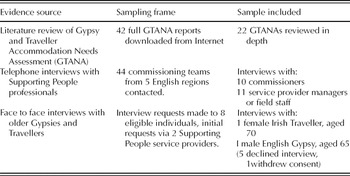
The purpose of the study was to add to understanding of the support needs of older Gypsies and Travellers relating to their accommodation situation, and the factors associated with SP services’ effectiveness in responding to these needs. The study comprised a desk review of GTANAs, semi-structured telephone interviews with SP professionals and face-to-face in-depth interviews with older Gypsy and Traveller service users – see Table 1.
Summary of data sample

The twenty-two GTANAs reviewed in depth were purposively selected (Alasuutari et al., Reference Alasuutari and Brannen2009) as including age demography data, information on the accommodation, support and service needs of older people and information on existing corresponding provision. Evidence was charted on numbers of older people, old age as a factor in changing accommodation needs, age-related factors influencing use of services, types of HRS needs and older people's experiences of accommodation-related support.
The semi-structured telephone interviews with ten SP commissioners and eleven providers of SP-funded services to Gypsies and Travellers explored evolving service models, the nature of services provided, respondents’ own understanding of older Gypsies’ and Travellers’ support needs and views on the effects of cuts and the ending of ring-fencing.
Out of eight individual older Gypsy and Traveller service users identified and initially approached by their support providers, just two successful face-to-face interviews were achieved. Ellen,Footnote 1 an Irish Traveller in her seventies, lived alone on an authorised site. John, an English Gypsy in his late sixties, lived in a council house with his wife and grown-up children. In the interviews, they expressed their views on their current living situation and recounted their experiences of health and housing-related support services. Reticence amongst Gypsy and Traveller community members to engage with outsider-led research, reflecting the barriers to engagement and lack of trust in sedentary institutions more generally (Cemlyn et al., Reference Cemlyn, Greenfields, Burnett, Matthews and Whitwell2009; Ryder, Reference Ryder2011), combined with the researcher's own lack of previous experience working directly with these communities contributed to this study's limited success in engaging with a larger number of older Gypsies and Travellers. Time constraints, family crisis and poor health were reasons given by individuals for declining to be interviewed, whilst one person interviewed withdrew consent the following day, without offering an explanation.
Anonymised transcripts of all interviews were coded, charted and summarised prior to interpretative analysis. A second phase of analysis compared GTANA evidence and interview evidence by theme, with attention to correspondences and contradictions between these different evidence types (Ritchie and Lewis, Reference Ritchie and Lewis2005; Brewer and Hunter, Reference Brewer and Hunter2006).
Study findings
Older Gypsies’ and Travellers’ accommodation situations and related support needs
The study sought evidence relating old age and experiences of ageing with accommodation needs and related support needs. Secondary analysis of GTANAs identified respondents’ subjective sense of ageing as a frequently given reason for changing accommodation situations, likely to be associated with support needs. In ten of the twenty-two sample GTANAs, survey respondents identified age/too old and getting older as reasons for ceasing to travel (Brown et al., Reference Brown, Hunt and Niner2007a; Brown et al., Reference Brown, Hunt, Steele and Niner2007b; Greenfields et al., Reference Greenfields, Home, Cemlyn, Bloxsom and Lishman2007; Northern Housing Consortium et al., 2007; Brown et al., Reference Brown, Hunt and Condie2008a; Brown et al., Reference Brown, Hunt and Condie2008b; Brown et al., Reference Brown, Hunt, Condie and Niner2008c; Fordham Research Group, 2008b; Niner and Sankey, Reference Niner and Sankey2008; Brown et al., Reference Brown, Hunt, Condie and Niner2009a; Brown et al., Reference Brown, Hunt and Niner2009b). In six of the GTANAs sampled, old age or getting older were given as reasons for moves into bricks and mortar (David Couttie Associates, 2006; David Couttie Associates, 2007; Greenfields et al., Reference Greenfields, Home, Cemlyn, Bloxsom and Lishman2007; Fordham Research Group, 2008a; Powell et al., Reference Powell, Casey, Reeve, Brown, Condie, Hunt and Niner2008; Brown et al., Reference Brown, Hunt and Niner2009b).
The West of England GTANA stated that people aged over sixty, two thirds of whom were women, comprised the second largest group who reported no longer travelling, after those living on local authority sites or in social housing (Greenfields et al., Reference Greenfields, Home, Cemlyn, Bloxsom and Lishman2007: 103). The London-wide GTANA reported that 30 per cent of authorised site residents, and 13 per cent of housed residents gave age/too old as a reason for no longer travelling (Fordham Research Group, 2008b). Amongst authorised site residents in London, age/too old was the second most frequently given reason after lack of transit sites/stopping places, with health/support needs as the third most frequently given reason (Fordham Research Group, 2008b). Individual GTANAs identified disability amongst older household members as giving rise to needs for additional accommodation provision (Brown et al., Reference Brown, Hunt and Niner2009b), for care and support (Northern Housing Consortium et al., 2007) and for adaptations (David Couttie Associates, 2006: 106).
In interviews, SP professionals identified households with older members as amongst those affected by shortages of safe and secure accommodation, including roadside dwellers unable to find legal sites to settle on and housed residents experiencing racist harassment or facing eviction.
John emphasised his desire in old age to move back onto a site out of council housing, based on an aversion to bricks and mortar and a desire for cultural belonging:
My wife is not very well, and she were born in a Gypsy caravan, I were born in a Gypsy caravan, and now, as years goes on, we've started missing it, we feel like we want to go home, now we've just got a few years to go. We're getting to that age, we're not young anymore. So we feels now like we want to make a break, and live the rest part of our life where we come from.
Amongst those living on authorised sites, SP interviewees identified poor site management and maintenance as endangering older residents; for example, where non-accessible bathroom facilities posed risks to the safety of elderly residents with restricted mobility. Furthermore, SP professionals recounted cases of frail elderly Gypsies and Travellers with low incomes living in poor-quality and inappropriate accommodation, unable to afford general upkeep costs or the costs of repairs; for example, to leaky skylights or electrical faults. In the Doncaster GTANA, older people predominated amongst the 15 per cent of survey respondents reporting problems maintaining their homes (Northern Housing Consortium et al., 2007). Demand amongst older people for adaptations, such as accessible showers or baths, grab rails and custom-made steps or slopes up to trailers, was widely identified by SP professionals.
Many older people living on site, including those living alone, require regular, low-level support:
So it's fairly much about what you'd expect to get in sheltered housing, it's reassurance, calling in on a daily basis . . . they've got some particularly elderly ladies on that site for that ‘Are you OK?’ type of support. (SP13)
The Cambridge sub-region GTANA reported that 70 per cent of respondents aged over seventy-five years of age were living alone (Home and Greenfields, Reference Home and Greenfields2006), indicating that such needs may be widespread.
More acute needs were indicated by SP professionals as arising amongst older people with mental health problems, including anxiety, depression or dementia, raising dilemmas concerning safeguarding, culturally appropriate provision and communication difficulties:
One client is a woman living in a vardo with her adult son . . . she has the beginnings of dementia and gets confused. She says she is OK but clearly struggles and has had a few falls. (SP17)
Not all the SP interviewees identified older people as having distinct or more acute needs than other adult Gypsies and Travellers. Widely shared problems of limited literacy among Gypsy and Traveller communities have been identified in a number of studies, including most recently by Ryder and Greenfields (Reference Ryder and Greenfields2010), although a study by Dawson (Reference Dawson2004) indicated that literacy difficulties are likely to be more severe among older generations of Gypsies and Travellers. A variety of support needs, including help with filling in forms and making benefits claims, finding new accommodation, accessing services and for advocacy, were identified as general to Gypsy and Traveller households. But interviewees identified several instances where the vulnerability or poor health status of an older person increased the acuteness of their need, or where the specific nature of needs was tied to age status, for example help applying for pension entitlements.
Institutional and cultural barriers to supporting well-being
This study reported barriers to effective support for the wellbeing of older Gypsies and Travellers. Nationally, there is limited data currently available regarding age demography for Gypsies and Travellers, which makes it hard to understand the scale of demand for services. Whilst nine GTANAs were excluded from this study because they did not present any age disaggregated data, those which were included varied in how they presented age data. Analysis of available data in GTANAs revealed widely varying proportions of respondents within older age brackets. The Cambridge sub-regional GTANA found that people aged sixty-five and over comprised 17.4 per cent of English Gypsy respondents but just 3.7 per cent of Irish Traveller respondents across the sub-region (Home and Greenfields, Reference Home and Greenfields2006), while in South Yorkshire, people aged sixty-five and over were estimated to comprise just 5.6 per cent of the sub-regional Gypsy and Traveller population (Northern Housing Consortium et al., 2007). Below average life expectancy rates in Gypsy and Traveller communities may factor in the low number of older respondents identified in many areas (Crawley, Reference Crawley2004; Commission for Racial Equality, 2006), while the greater numbers of older respondents in some areas may reflect the better access to services enjoyed by those living permanently on authorised sites (Cemlyn et al., Reference Cemlyn, Greenfields, Burnett, Matthews and Whitwell2009).
The SP interviews indicated widespread professional uncertainty regarding numbers of older people amongst their client groups, particularly within bricks and mortar accommodation, reflecting previous findings (Lovatt, Reference Lovatt2006). Interviewees observed that older people with possible support needs could be hidden from professional view within large extended family groups typical on sites, whilst unwillingness to self-identify amongst those living in bricks and mortar impedes professionals attempting to identify needs, also recognised by Lovatt (Reference Lovatt2006). Such uncertainty regarding their numbers presents an ongoing barrier to planning appropriate support to older Gypsies and Travellers.
SP professionals reported a number of barriers to uptake of support services by older Gypsies and Travellers, closely reflecting findings in the health and social care sectors, including under-engagement with statutory services by Gypsies and Travellers (Parry et al., Reference Parry, Van Cleemput, Peters, Moore, Walters, Thomas and Cooper2004; Jesper et al., Reference Jesper, Griffiths and Smith2008; Davidson et al., Reference Davidson, McLaughlin and Drummond2009), limited awareness amongst the communities regarding the nature of HRS services (McQuillan and Van Doorslaer, Reference McQuillan and Van Doorslaer2007; Cullen et al., Reference Cullen, Hayes and Hughes2008), low levels of literacy (Parry et al., Reference Parry, Van Cleemput, Peters, Moore, Walters, Thomas and Cooper2004), and mutual mistrust between Gypsies and Travellers and neighbouring sedentary or ‘settled’ communities (Parry et al., Reference Parry, Van Cleemput, Peters, Moore, Walters, Thomas and Cooper2004; Jesper et al., Reference Jesper, Griffiths and Smith2008). Several SP interviewees felt that attitudinal barriers, particularly mistrust, can delay uptake of services by older Gypsies and Travellers:
Um, older Travellers can be . . . a bit mistrustful of the settled population and authority so they may be more reluctant to access services that's open to them. (SP15)
Prejudicial attitudes amongst statutory provider personnel (McQuillan and Van Doorslaer, Reference McQuillan and Van Doorslaer2007; Cemlyn et al., Reference Cemlyn, Greenfields, Burnett, Matthews and Whitwell2009) can impede their access to services, as can rules and eligibility criteria which fit poorly with Gypsies’ and Travellers’ situations:
So there's lots of problems trying to access things that people in conventional housing can access. They're kind of turned away really because they don't fit into the boxes that they need to be ticking. (SP16)
Professionals expressed a spectrum of views regarding the balance of cultural and institutional factors influencing opportunities to support older Gypsies’ and Traveller's wellbeing and independent living. One provider foresaw cultural preferences regarding the location of sleeping quarters and toilet facilities as a critical limitation on the future feasibility of supporting frail elderly individuals to continue living on site (SP4), whereas the commissioner and provider for another SP service expressed frustration at another agency's refusal to provide appropriate adaptations for an elderly client living by the roadside due to her nomadic lifestyle (SP19, SP21).
Several interviewees identified poor inter-agency working as a problem, with most of them ascribing blame to other agencies being reluctant to work with Gypsies and Travellers or to co-operate with SP providers, one remarking that ‘only SP seems to initiate joint working, not the other way around’ (SP20).
Strengths and challenges of SP support provided to older Gypsies and Travellers
The interviews with SP professionals addressed a mix of both site-specific services and floating support services provided to individuals in different accommodation situations. For some existing services provided by site managers, SP was welcomed as an additional source of monies for the ongoing people-side of their site manager role, including activities such as reading letters and calling in on more vulnerable individuals. However, such arrangements may result in inappropriate use of SP funding, where site manager responsibilities, such as collecting rents and enforcement of site rules, conflict with the trust relationships required between support worker and client.
Other site-based services had used SP monies to enhance the support provided to residents or had been restructured as floating support models. New and restructured floating support services funded by SP monies enabled services to reach housed and/or roadside-dwelling households. One local authority commissioned separate site-specific and specialist floating support services to serve Gypsy and Travellers in different accommodation situations (SP6, SP19).
Enthusiastic adopters of floating support reported that through their adoption of a pro-active outreach approach, they had been successful in making contact with previously under-served groups, enabling them to respond to acute unmet needs amongst roadside dwellers and, similarly, to provide support to counteract the high rates of tenancy failure amongst housed Gypsies and Travellers (SP6).
Familiarity and relationships of trust between providers and Gypsies and Travellers were identified as crucial to the success of services, established and sustained by maintenance of confidentiality, respect, continuity of service, pro-activeness and time spent engaging with clients. One provider reported a case where the trust relationship between an elderly widow and her SP support worker enabled the client to successfully adapt to a switch in her health care from a ten-year period of having the same carer to a health care team alternating on a six-weekly basis. After the client initially rejected the new arrangement, her support worker accompanied the new carers on their visits until she felt more at ease, avoiding the possible need for her to move into residential care (SP9).
Several support services which judged they had developed good relationships with the communities they served reported reaching new clients via word of mouth recommendations, capitalising on cultural preferences for reliance on friends and families for signposting (Hunt and Brown, Reference Hunt and Brown2008). Employment of Gypsies and Travellers as support workers, as adopted by a handful of SP services, was judged an effective means of accelerating or deepening relationships of trust and familiarity (Greenfields, Reference Greenfields2008b).
Support workers’ roles in making connections and liaising between clients and other services were considered important by providers to achieving wellbeing outcomes for service users. A notable example was where support personnel had made a successful cross-referral to mental health and social care teams for an elderly client, resulting in her receiving a more comprehensive package of support benefitting her quality of life (SP22).
Tailoring of support to individuals and flexibility in the duration of support were additional characteristics identified as enhancing the quality of services. The adoption of time-based commissioning models, rather than client-numbers-based models, may increase the flexibility of support providers to allocate their support effectively in accordance with the fluctuating and varied support needs of their clients (SP8).
A further dimension of flexibility concerned successful joint working across administrative boundaries. In one example, the services of two neighbouring authorities had co-operated at strategic and grassroots level to enable families to enjoy continuity of support even as they pursued their nomadic lifestyle, routinely crossing local authority borders (SP18, SP17).
A significant area of activity for support workers involved advocacy, and making practical arrangements to improve site conditions and arrange for adaptations to caravans, in order that older Gypsies and Travellers could continue living on site and achieve a better quality of life (Lovatt, Reference Lovatt2006; Davidson et al., Reference Davidson, McLaughlin and Drummond2009). Such improvements entailed considerable work liaising with health professionals, arranging appointments, negotiating design, accessing grants and overseeing installation. The benefits for clients were identified by professionals in terms of preventing or delaying forced moves into bricks and mortar or residential care by individuals with declining health or infirmity, enabling them to sustain their culturally traditional lifestyles. As a service user, Ellen expressed appreciation of the benefits of rails and bathroom adaptations in her trailer for her daily living. But although she stated, ‘I couldn't live in a house, I've got to live in a trailer’, she did not clearly make a link between the adaptations she'd received and her continued living in a trailer. She did though, express anger that further promised adaptations had been delayed, recounting how she'd suffered a dangerous fall outside her trailer:
I went down, wind took me and there was nothing to get hold of whatever, and it was raining and blustery and I lay out there for three quarters of an hour in the wet and I couldn't move, and still they haven't done anything and I was promised that last Christmas.
Although she lives apart from her family, Ellen keeps in regular contact with her adult children and had been able to call on her daughter to stay and help after she had an operation.
SP interviewees readily acknowledged the significance of family-provided support and care amongst Gypsies and Travellers, although they expressed differing views regarding the quality of and preference for family-provided care. Some professionals judged family-provided care positively, as enabling older people to remain on site, retaining familiarity and cultural connections. For others, the tendency of families to take in older members to look after them was viewed as not necessarily the preferred choice of the older people concerned (SP13, SP21). Nevertheless, there was evident professional recognition of complementarities between family-provided and external support towards enabling older family members to sustain their quality of life:
we do lots of things that help them in their day-to-day life, but also in their day-to-day living their family will be around, helping with keeping the place clean and washing and cooking and whatever . . . by default a lot of the stuff that we offer is stuff that the family can't offer because the family has the same issues accessing services and reading, writing, dealing with the settled community as the older people do, so we try to fill an important gap. (SP15)
Professionals interviewed expressed dilemmas about how best to deliver care and support which balances the cultural preferences of individual older people, their care needs and the expectations and capacities of their families. One commissioner related a particularly sensitive case review where available options considered by professionals were inadequate to address the needs of an older roadside Traveller:
She was very old and frail and oxygen dependent. She wanted to stay with her family but due to ill-feeling they didn't want her. She refused to go into hospital or residential care so remained by the roadside in a caravan. At a case review, it was judged that in her circumstances a personal health budget would have limited benefit. (SP19)
The commissioner indicated that this case was unusual in terms of the severity of the woman's needs, but reflected the increasingly common situation of older Travellers who are isolated from their extended families.
Views on the potential impact of cuts and the ending of ring-fencing
Interviewees were acutely conscious of how the (then) forthcoming cuts and potential redirecting of SP monies to other services threatened continued funding of SP services to Gypsies and Travellers. Some professionals identified their Gypsy and Traveller client group as particularly vulnerable to cuts as an unpopular group with few vocal advocates. Others took the view that, as a disadvantaged group already receiving very limited funding, services for Gypsies and Travellers might be less vulnerable to cuts and possibly even benefit from narrower targeting of services on the basis of need. Evidence gathering and activities to influence decision-makers regarding the value of existing services were seen as important to protect funding for services – exemplified by initiatives to bring service users to council members meetings to report the benefits of services received.
Discussion
The study's findings on how SP specialist services have addressed the needs of older Gypsies and Travellers provide a basis for reflecting on the outlook for future work to support the wellbeing of Gypsies and Travellers. This must be considered within the context of public spending cuts, changes to planning policy and the localism agenda.
Accommodation shortages remain as the overarching threat to the social inclusion and wellbeing of Gypsies and Travellers, with some of the most acute support needs of older Gypsies and Travellers relating to shortages of or very poor-quality provision. The implementation of the Localism Act has led to regional planning targets for Gypsy sites being abolished and planning reverting to local authority level. ‘Light touch’ planning policy replaces specific guidance about conducting Gypsy Traveller Accommodation Assessments (Department for Communities and Local Government, 2011). Devolution of power to neighbourhood level in planning potentially threatens delivery of new sites, since opposition tends to be most concentrated at local level (Ryder et al., Reference Ryder, Acton, Alexander, Cemlyn, Van Cleemput, Greenfields, Richardson and Smith2011). While the Localism Act supports greater community involvement in local place-shaping decision-making processes, a lack of Gypsy/Traveller community groups may limit the extent to which these communities will be represented (Ryder, Reference Ryder2011; Ryder et al., Reference Ryder, Acton, Alexander, Cemlyn, Van Cleemput, Greenfields, Richardson and Smith2011). SP services may have a potentially facilitative role to play in reducing some of these risks to Gypsies’ and Travellers’ effective engagement in local planning, through advocacy and building links between Traveller and sedentary communities.
The professional scope of SP providers to respond flexibly and to tailor support to the individual needs of Gypsies and Travellers gives rise to forms of provision that reflect principles embodied in other specialist services, in education, health or social care (Cemlyn, Reference Cemlyn2008; Van Cleemput, Reference Van Cleemput2008; Foster and Walker, Reference Foster and Walker2009; Cemlyn and Greenfields, Reference Cemlyn and Greenfields2010). These identify outreach work, cultural recognition and sensitivity, flexibility of provision, partnership across administrative boundaries, advocacy, a commitment to promote equality, and strategies to support the involvement of community members in provision (Cemlyn et al., Reference Cemlyn, Greenfields, Burnett, Matthews and Whitwell2009). While in some cases, it may be that such principles already informed existing site manager services, there are indications that SP funding has enabled the commissioning of new or restructured services designed to respond more flexibly and reach a wider range of needs.
The findings also highlight how new SP providers have promoted the wellbeing of older Gypsies and Travellers by identifying their unmet needs and connecting them with and working jointly with social care and health services. The adoption of such roles by specialist SP providers is likely to be of increased importance in the face of cutbacks to other trusted outreach services, such as Gypsy and Traveller Liaison Officers and Traveller Education Services (Ryder et al., Reference Ryder, Acton, Alexander, Cemlyn, Van Cleemput, Greenfields, Richardson and Smith2011). However, even where SP services are safeguarded, cuts to other services and funding pots are likely to hamper their ability to refer clients on appropriately.
One under-developed but potentially significant role for SP specialist providers concerns a role in facilitating uptake of personal budgets by older Gypsies and Travellers. Individual budgets, for example, may enable frail elderly people to pay for family-provided care. However, in addition to barriers to equitable use of personalised funding (Ali, Reference Ali2009; Royal Geographical Society, 2011), the undervaluing of family-provided care by professionals may lead them to avoid promoting these personalisation ‘technologies’ to eligible Gypsies and Travellers.
Conclusion
There are limited data relating to the needs of older Gypsies and Travellers. This article has sought to address some of this gap by bringing together a secondary analysis of purposively selected GTANAs, with findings from interviews with SP professionals and older Gypsies and Travellers. The findings point to the potential of specialist services to improve the living conditions and social support for older Gypsies and Travellers as well as their engagement with other local services and with decision makers, contributing to their wellbeing and social inclusion. However, the broader context of retrenchment of services and devolution of contentious planning decisions to an often hostile local political level pose a threat to the continued development of these positive aspects of SP provision, unless a priority focus is maintained on the needs of this highly excluded group.