



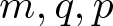






1. Introduction
In this paper, we consider Liouville-type theorems of positive weak solutions of the following elliptic equation
 \begin{equation}
-\Delta_m u+u^q(\log u)^p=0
\end{equation}
and elliptic inequality
 \begin{equation}
-\Delta_m u\geqslant u^q(\log u)^p,
\end{equation}
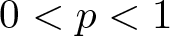
where  $N\geqslant1$,
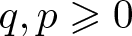 $q,p\geqslant0$, and
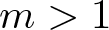
 $\Delta_mu=\text{div}(|\nabla u|^{m-2}\nabla u)$ is the
 $m$-Laplacian operator with
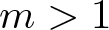 $m \gt 1$,
 $\log u$ is a nonnegative function, that is,
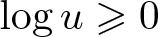 $\log u\geqslant0$, or equivalently,
 $u\geqslant1$.
Logarithmic nonlinearity has significant applications in PDE models. Bialynicki-Birula and Mycielski [Reference Bialynicki-Birula and Mycielski6] firstly proposed the classical Schr $\mathrm{\ddot{o}}$dinger-type equation with nonlinearity
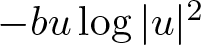 $-bu\log|u|^2$ as a model of nonlinear wave mechanics, and then briefly described the properties of this equation in [Reference Bialynicki-Birula and Mycielski7]; the logarithmic nonlinearity is consistent with the born interpretation of the wavefunction. Barrow and Parsons [Reference Barrow and Parsons2] examined inflationary universe models driven by scalar fields with the logarithmic potential of the form
 $V(u)=V_0u^q(\log u)^p$. By identifying regions of logarithmic potential where inflation may occur, they obtained analytic expressions for the evolution of the field and the metric. Moreover, the logarithmic nonlinearity could also be applied to other PDE models, such as the minimal supersymmetric standard model [Reference Enqvist and McDonald18] and the quantum mechanics [Reference Zloshchastiev33].
During the past several decades, an abundance of works regarding existence and asymptotic behavior of solutions to the equation with logarithmic nonlinearity have emerged in many literatures. Results include the cases of the fractional Schr $\mathrm{\ddot{o}}$dinger equations [Reference Guo and Peng24], semilinear Schr
 $\mathrm{\ddot{o}}$dinger equations [Reference Wang and Zhang31], degenerate elliptic equations [Reference Chen, Liao and Zhang14], parabolic equations [Reference Liu, Yin and Luo26], pseudo parabolic equations [Reference Chen and Tian15], stochastic differential equations [Reference Bonder and Groisman9], and Choquard equations [Reference Deng, Shi and Yang17]. Recently, Ghergu, Kim and Shahgholian [Reference Ghergu, Kim and Shahgholian21] focused on the semilinear elliptic equation
 \begin{equation}-\Delta u=u^q\vert\log u{\vert^p\;}\text{on}\;B_1\setminus\{0\},\end{equation}
where 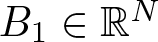 $B_1\in\mathbb{R}^N$ with
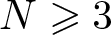 $N\geqslant3$,
 $\frac{N}{N-2} \lt q \lt \frac{N+2}{N-2}$ and
 $-\infty \lt p \lt \infty$. They obtained that nonnegative solution
 $u\in C^2(B_1\setminus\{0\})$ of (1.3) either has a removable singularity at the origin or it behaves like
 \begin{equation*}
u(x)=A(1+o(1))|x|^{-\frac 2{q-1}}\Big(\log\frac 1{|x|}\Big)^{-\frac{p}{q-1}} \text{as}\ x \to 0,
\end{equation*}
where  $A=[(\frac 2{q-1})^{1-p}(N-2-\frac {2}{q-2})]^{\frac 1{q-1}}$. They extended the classical argument in [Reference Caffarelli, Gidas and Spruck10, Reference Gidas and Spruck22], which focused on the equation
 $\Delta u+g(u)=0$ where
 $g(u)$ satisfies some technical conditions, to the logarithmic nonlinearity.
In the present paper, we mainly concern the gradient estimates and Liouville-type theorems associated with the equation (1.1).
For the case without logarithmic nonlinearity, i.e., the case  $q\geqslant0, p=0$, some scholars focus on studying the classical Lane-Emden equation
 \begin{equation}
-\Delta_mu=u^q.
\end{equation}
For the weak solutions of (1.4), Serrin and Zou [Reference Serrin and Zou29, Theorem II] proved the nonnegativity of nontrivial solutions on the entire  $\mathbb{R}^N$, and a Liouville-type theorem which asserts that every solution is constant on the entire
 $\mathbb{R}^N$. These two results are valid for the case where
 $m \lt m^*=\frac{N(m-1)+m}{N-m}$ (Sobolev exponent), and this restriction regrading
 $m$ is sharp. For the weak supersolutions of (1.4), Bidaut-V
 $\mathrm{\acute{e}}$ron and Pohozaev [Reference Bialynicki-Birula and Mycielski8, Theorems 3.2(ii) and 3.3(iii)] established the nonnegative of nontrivial solutions on an exterior domain, provided
 $q\in(1,m_*)$ when
 $N \gt m$, or
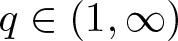 $q\in(1,\infty)$ when
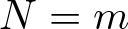 $N=m$, where
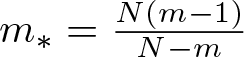 $m_*=\frac{N(m-1)}{N-m}$ (Serrin exponent). Serrin and Zou [Reference Serrin and Zou29, Theorem I
 $^{\prime}$] extended the above result on an exterior domain to the case
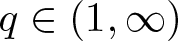 $q\in(1,\infty)$ when
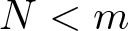 $N \lt m$. Moreover, Serrin and Zou [Reference Serrin and Zou29, Theorem II(d)] obtained that the differential inequality
 $-\Delta_mu\geqslant u^q$ has only the trivial solution
 $u\equiv0$ on the entire
 $\mathbb{R}^N$, provided
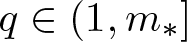 $q\in(1,m_*]$ when
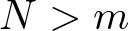 $N \gt m$.
For the case with logarithmic nonlinearity, i.e., the case  $q\geqslant0, p\geqslant0$, we refer to [Reference Chen and Chen16, Reference Ma27, Reference Peng, Wang and Wei28, Reference Wang and Wang30, Reference Yang32]. Ma [Reference Ma27] focused on the case
 $q=1,p=1$, and established local gradient estimates of positive solutions to the equation
 \begin{equation*}
\Delta u+au\log u=0\ \text{on}\ M,
\end{equation*}
where  $a \lt 0$,
 $(M,g)$ is a complete non-compact Riemannian manifold of
 $\mathrm{dim}(M)\geqslant3$. Yang [Reference Yang32] considered more general equation
 \begin{equation}
\Delta u+au\log u+bu=0\ \text{on}\ M,
\end{equation}
where  $a$ and
 $b$ are two real numbers. He improved the local gradient estimates in [Reference Ma27] and extended them to the case where
 $a \gt 0$ and
 $M$ could be of any dimension; these estimates are also applicable to the corresponding parabolic equation. Chen and Chen [Reference Chen and Chen16] improved and extended the results in [Reference Ma27] to the case
 $a \gt 0$, and got a bound for the positive solution to (1.5). Peng, Wang and Wei [Reference Peng, Wang and Wei28] studied the case
 $q=1,p\geqslant0$ on Riemannian manifold, and obtained the gradient estimates of the positive solutions to the elliptic equation
 \begin{equation*}
\Delta u+au(\log u)^p+bu=0,
\end{equation*}
where  $a\neq0$,
 $b$ are two constants and
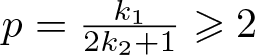 $p=\frac{k_1}{2k_2+1}\geqslant2$, here
 $k_1$ and
 $k_2$ are two positive integers. Wang and Wang [Reference Wang and Wang30] generalized the constant coefficients of (1.5) to functions, and considered the following equation on a smooth complete Riemannian
 $N$-manifold
 $(M^N,g)(N\geqslant3)$:
 \begin{equation*}
\Delta u+a(x)u\log u+b(x)u=0.
\end{equation*}
They obtained the  $C^0$ estimates, gradient estimates, the global properties and local Liouville-type theorems of solutions.
In the present paper, we consider the Liouville-type theorems for positive weak solutions to (1.1) and (1.2) with  $q\geqslant0,p\geqslant0$. Our main results are stated as follows.
Theorem 1.1 Let 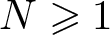 $N\geqslant1$,
 $1 \lt m \lt 2$,
 $m-1 \lt q \lt 1$,
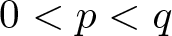 $0 \lt p \lt q$. Assume that
 $u$ is a positive weak solution of the following equation with absorption term:
 \begin{equation}-\Delta_mu+u^q(\log u)^p=0\;\mathrm{in}\;\mathbb{R}^N,\end{equation}
and  $\log u$ is a nonnegative function. Then
 $u\equiv 1$.
Remark 1.1. The case  $q=1,p=1$ is considered to be a critical case. If the nonlinearity grows much faster than
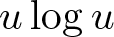 $u\log u$ as
 $u\to\infty$, then blow-up can occur, see [Reference Bonder and Groisman9] for more details. The non-negativity of
 $\log u$ and the restriction
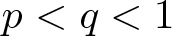 $p \lt q \lt 1$ in Theorem 1.1 arise from the utilization of the Young’s inequality. The restriction
 $1 \lt m \lt 2$ is crucial for guaranteeing the existence of the exponent
 $q$.
The following theorems provide Liouville-type theorems for positive weak solutions of (1.6) in the cases  $q \gt 1$ and
 $q=1$.
Theorem 1.2 Let 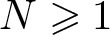 $N\geqslant1$,
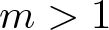 $m \gt 1$,
 $q \gt 1$,
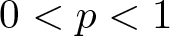 $0 \lt p \lt 1$. Assume that
 $u$ is a positive weak solution of (1.6), and
 $\log u$ is a nonnegative function. Then
 $u\equiv 1$.
Theorem 1.3 Let 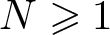 $N\geqslant1$,
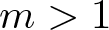 $m \gt 1$,
 $q=1$,
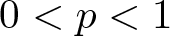 $0 \lt p \lt 1$. Assume that
 $u$ is a positive bounded weak solution of (1.6), and
 $\log u$ is a nonnegative function. Then
 $u\equiv 1$.
Remark 1.2. In Theorems 1.1–1.3, we consider the case where  $q \gt p$. It is an open problem whether or not Liouville-type theorem remains true for the case
 $q\leqslant p$.
The following result provides a Liouville-type theorem for positive weak supersolutions.
Theorem 1.4 Assume 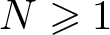 $N\geqslant1$,
 $m \gt N$,
 $q\geqslant0$,
 $p\geqslant0$. Let
 $u$ be a positive solution of the inequality
 \begin{equation}-\Delta_mu\geqslant u^q(\log u{)^p\;}\mathrm{in}\;\mathbb{R}^N,\end{equation}
and  $\log u$ is a nonnegative function. Then
 $u\equiv 1$.
Remark 1.3.  $\mathrm{(i)}$ Given that
 $\log u\geqslant0$, it follows that
 $-\Delta_mu\geqslant0$. Serrin and Zou [Reference Serrin and Zou29] proved Theorem 1.4 by utilizing the weak comparison principle and the proof method by contradiction. We present here a new proof of this result. Our proof relies on transformation of inequality and the selection of suitable cut-off functions.
 $\mathrm{(ii)}$ The proof method in this paper can also be applied to investigate the inequality (1.7) on
 $(M,g)$, which is an
 $N$-dimensional complete noncompact Riemannian manifold with nonnegative Ricci curvature. In fact, due to
 $\mathrm{Ric}(M)\geqslant0$, the estimate (3.3) is valid by applying standard volume comparison theorem.
This paper is the initial work to explore Liouville-type theorems for positive weak solutions and supersolutions of quasilinear equation involving logarithmic term on the entire  $\mathbb{R}^N$. Other studies related to this equation focus on either the asymptotic behaviour of nonnegative singular solutions (see [Reference Ghergu, Kim and Shahgholian21]) or gradient estimates and Liouville-type theorems for positive solutions on Riemann manifolds in the semilinear case (see [Reference Chen and Chen16, Reference Ma27, Reference Peng, Wang and Wei28, Reference Wang and Wang30, Reference Yang32]).
Due to the appearance of the logarithmic term  $(\log u)^p (p\geqslant0)$, we adopt the following techniques in proving Liouville-type theorems.
First, ODE analysis shows that any solution of the equation involving logarithmic term necessarily contains such a term. Given that the existing gradient estimates are in an exponential form, they require refinement. By constructing an auxiliary function with a logarithmic term and applying the comparison principle, we can derive a more precise gradient estimate, as detailed in Lemma 2.1.
Second, our proof relies on the utilization of appropriate cut-off functions. By choosing a general cut-off function with free parameter in its first derivative, we could impose restrictions on this parameter. This enables us to obtain wider ranges of the exponents 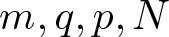 $m,q,p,N$, as details in the proofs of Theorem 1.4.
The paper is organized as follows. In Section 2, we present Theorems 1.1-1.3. In Section 3, we prove Theorem 1.4.
2. The proof of Theorems 1.1-1.3
This section is devoted to proving Liouville-type theorems of weak solutions to (1.6). Our proof is based on Bernstein-type gradient estimates, which could be referred to the series of works [Reference Attouchi and Souplet1, Reference Barrow and Parsons5, Reference Chang, Hu and Zhang11–Reference Chang, Ju and Zhang13, Reference Filippucci, Pucci and Souplet19, Reference Filippucci, Sun and Zheng20, Reference Guo and Zhang23, Reference Lions25]. The following result gives an Osserman-type property of an elliptic equation with absorption.
Lemma 2.1. Let  $\Omega$ be a domain of
 $\mathbb R^N$. Let
 $k \gt 1$ and
 $R \gt 0$. Assume
 $u$ is continuous,
 $z$ is continuous and nonnegative on
 $\overline{B_R}(x_0)$ and
 $C^1$ on the set
 $S=\left\{x\in B_R(x_0):z(x) \gt 0\right\}$, and
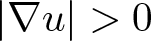 $|\nabla u| \gt 0$ on
 $S$. For some real number
 $d$ and positive constant
 $\overline{C}$, if
 $z$ satisfies
 \begin{equation}
-\Delta z-(m-2)\frac{\langle D^2z\nabla u, \nabla u\rangle}{|\nabla u|^2}+\overline{C}z^{k}-d\frac{|\nabla z|^2}{z}\leqslant0,
\end{equation}
on each connected component of  $S$. Then for any ball
 $\overline{B_R}(x_0)\subset\Omega$, there holds
 \begin{equation}
z(x_0)\leqslant C_{N,k,d}R^{-\frac{2}{k-1}} \Big[ [\log (R^2)]^{-\frac{2}{k-1}} + [\log (R^2)]^{-\frac{1}{k-1}} + 1 \Big].
\end{equation}
Remark 2.1.  $\mathrm{(i)}$ Denote the operator
 $\mathcal{A}$ by
 \begin{equation*}
\begin{aligned}
z\rightarrow\mathcal{A}z\triangleq&-\Delta z-(m-2)\frac{\langle D^2z\nabla u,\nabla u\rangle}{|\nabla u|^2}\\
=&-\sum_{i,j=1}^{N}\left(\delta_{ij}+(m-2)\frac{u_iu_j}{|\nabla u|^2}\right)z_{ij}=-\sum_{i,j=1}^{N}a_{ij}z_{ij},
\end{aligned}
\end{equation*}
where  $\delta_{ij}=1$ if
 $i=j$,
 $\delta_{ij}=0$ if
 $i\neq j$,
 $u_i=\frac{\partial u}{\partial x_i}$,
 $u_{ij}=\frac{\partial^2u}{\partial x_i\partial x_j}$ and
 $a_{ij}$ depend on
 $\nabla u$,
 \begin{equation*}
\mathrm{\min}\{1,m-1\}|\xi|^2\leqslant\sum_{i,j=1}^{N}a_{ij}\xi_{i}\xi_{j}\leqslant\mathrm{\max}\{1,m-1\}|\xi|^2
\end{equation*}
for all  $\xi=(\xi_1,...\xi_N)\in\mathbb R^N$. Consequently,
 $\mathcal{A}$ is uniformly elliptic if
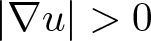 $|\nabla u| \gt 0$.
 $\mathrm{(ii)}$ For the differential inequality (2.1), Bidaut-V
 $\mathrm{\acute{e}}$ron, García-Huidobro, and V
 $\mathrm{\acute{e}}$ron [Reference Barrow and Parsons3, Proposition 2.1] established the estimate in the form of
 \begin{equation}
z(x_0)\leqslant C_{N,k,d}R^{-\frac 2{k-1}}.
\end{equation}
In this paper, the logarithmic term 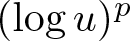 $(\log u)^p$ is a crucial term, we have obtained a more accurate description on
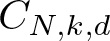 $C_{N,k,d}$ in (2.3), as detailed in (2.2).
Proof of Lemma 2.1
We can assume that 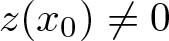 $z(x_0)\neq 0$. We consider a ball
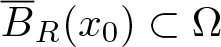 $\overline{B}_R(x_0)\subset\Omega$ and set
 $r=|x-x_0|$ such that
 $R^2-r^2 \gt 1$, i.e.,
 $\log(R^2-r^2) \gt 0$. Let
 $w$ be the function by
 \begin{equation*}
w(x)=\lambda(R^2-r^2)^{-\frac{2}{k-1}}[\log(R^2-r^2)]^{-\gamma},
\end{equation*}
where  $\lambda,\gamma \gt 0$. A simple calculation implies that
 \begin{eqnarray*}
w_{x_i} &=&\frac{4\lambda}{k-1} (R^2-r^2)^{-\frac{2}{k-1}-1}[\log(R^2-r^2)]^{-\gamma}x_i\\
&& + 2\lambda\gamma (R^2-r^2)^{-\frac{2}{k-1}-1}[\log(R^2-r^2)]^{-\gamma-1}x_i\\
& = & (R^2-r^2)^{-\frac{2}{k-1}-1}[\log(R^2-r^2)]^{-\gamma-1} x_i
\Big[\frac{4\lambda}{k-1}\log(R^2-r^2) + 2\lambda\gamma\Big]
\end{eqnarray*}
and
 \begin{eqnarray*}
w_{x_ix_j}
&= & (R^2-r^2)^{-\frac{2}{k-1}-2}[\log(R^2-r^2)]^{-\gamma-2}\\
&& \cdot\Big\{
\frac{8\lambda(k+1)}{(k-1)^2} [\log(R^2-r^2)]^2 x_ix_j
+ \frac{8\lambda\gamma}{k-1} \log(R^2-r^2) x_ix_j \\
&& + \frac{4\lambda}{k-1} (R^2-r^2)[\log(R^2-r^2)]^2\delta_{ij}
+ \frac{4\lambda\gamma(k+1)}{k-1} \log(R^2-r^2) x_ix_j\\
&& + 4\lambda\gamma(\gamma+1) x_ix_j
+ 2\lambda\gamma (R^2-r^2)\log(R^2-r^2)\delta_{ij} \Big\},\\
\end{eqnarray*}
where 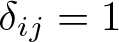 $\delta_{ij}=1$ if
 $i=j$ and
 $\delta_{ij}=0$ if
 $i\neq j$. It follows that
 \begin{eqnarray*}
\mathcal{A}(w) & = & -\sum_{i,j=1}^{N}a_{ij}w_{x_ix_j} \\
&\geqslant & - \mathrm{\max}\{1,m-1\}(R^2-r^2)^{-\frac{2}{k-1}-2}[\log(R^2-r^2)]^{-\gamma-2}\\
&& \cdot\Big\{
\frac{8\lambda(k+1)}{(k-1)^2} [\log(R^2-r^2)]^2r^2
+ \frac{8\lambda\gamma}{k-1} \log(R^2-r^2) r^2 \\
&& + \frac{4\lambda N}{k-1} (R^2-r^2)[\log(R^2-r^2)]^2
+ \frac{4\lambda\gamma(k+1)}{k-1} \log(R^2-r^2) r^2\\
&& + 4\lambda\gamma(\gamma+1) r^2
+ 2N\lambda\gamma (R^2-r^2)\log(R^2-r^2) \Big\}
\end{eqnarray*}
and
 \begin{eqnarray*}
|\nabla w|^2 &= & (R^2-r^2)^{-\frac{4}{k-1}-2}[\log(R^2-r^2)]^{-2\gamma-2} \\
&& \cdot \Big[\frac{16\lambda^2}{(k-1)^2}[\log(R^2-r^2)]^2 + 4\lambda^2\gamma^2
+ \frac{16\lambda^2\gamma}{k-1}\log(R^2-r^2)\Big]r^2.
\end{eqnarray*}
Then
 \begin{eqnarray*}
\frac{|\nabla w|^2}{w} &= & (R^2-r^2)^{-\frac{2}{k-1}-2}[\log(R^2-r^2)]^{-\gamma-2} \\
&& \cdot \Big[\frac{16\lambda}{(k-1)^2}[\log(R^2-r^2)]^2 + 4\lambda\gamma^2
+ \frac{16\lambda\gamma}{k-1}\log(R^2-r^2)\Big]r^2,\\
w^k &=& \lambda^k(R^2-r^2)^{-\frac{2}{k-1}-2}[\log(R^2-r^2)]^{-\gamma k}.
\end{eqnarray*}
We now substitute these estimates into the following estimate
 \begin{equation*}
\begin{aligned}
\mathcal{L}w = & \mathcal{A}(w) + \overline{C} w^k -d \frac{|\nabla w|^2}{w}\\
\geqslant & \lambda (R^2-r^2)^{-\frac{2}{k-1}-2}[\log(R^2-r^2)]^{-\gamma k} \\
& \cdot \Big\{\overline{C}\lambda^{k-1} - [\log(R^2-r^2)]^{-\gamma-2+\gamma k}\Big[ C_1[\log(R^2-r^2)]^2r^2 + C_2 [\log(R^2-r^2)]r^2\\
& + C_3 (R^2-r^2)[\log(R^2-r^2)]^2 + C_4r^2 + C_5 (R^2-r^2)\log(R^2-r^2)\Big] \Big\}\\
\geqslant & \lambda (R^2-r^2)^{-\frac{2}{k-1}-2}[\log(R^2-r^2)]^{-\gamma k} \\
& \cdot \left\{\overline{C}\lambda^{k-1} - [\log(R^2-r^2)]^{-\gamma-2+\gamma k}\Big[C_6[\log(R^2)]^2 + C_7\log(R^2) + C_4 \Big] R^2 \right\}\\
\triangleq & \lambda (R^2-r^2)^{-\frac{2}{k-1}-2}[\log(R^2-r^2)]^{-\gamma k}[\overline{C}\lambda^{k-1} -T(R)],
\end{aligned}
\end{equation*}
where
 \begin{equation*}
C_1 = \frac{8(k+1)}{(k-1)^2} + \frac{16d}{(k-1)^2}, \
C_2 = \frac{8\gamma}{k-1} + \frac{4\gamma(k+1)}{k-1} + \frac{16\gamma d}{k-1}, \
C_3 = \frac{4N}{k-1},
\end{equation*}
 \begin{equation*}
C_4=4\gamma(\gamma+1)+4\gamma^2d,\ C_5= 2N\gamma,\ C_6= C_1+C_3,\ C_7=C_2+C_5.
\end{equation*}
It is clear that 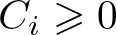 $C_i\geqslant0$ for
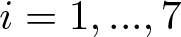 $i=1,...,7$. Thus
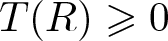 $T(R)\geqslant0$. We choose
 $\lambda$ such that
 \begin{equation*}
\lambda\geqslant \Big(\frac{T(R)}{\overline{C}}\Big)^{\frac 1{k-1}}
\end{equation*}
and deduce that  $\mathcal{L}w \geqslant 0$. We take for
 $S_1$ be a connected component of
 $\{x\in B_R(x_0):z(x) \gt w(x)\}$, thus
 $z(x) \gt 0$ in
 $S_1$ and
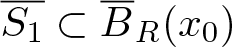 $\overline{S_1}\subset\overline{B}_R(x_0)$. If
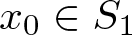 $x_0\in S_1$ is such that
 $z(x_0)-w(x_0)=\max\{z(x)-w(x):x\in S_1\} \gt 0$, then
 $\nabla z(x_0)=\nabla w(x_0)$ and
 $\mathcal{A}(z-w)(x_0)\geqslant0$. Therefore
 \begin{equation*}
0\geqslant\mathcal{L}(z-w)(x_0)=\mathcal{A}(z-w)(x_0)+a(x)(z^k-w^k)(x_0)+d\Big(\frac{|\nabla w|^2}{w} - \frac{|\nabla z|^2}{z}\Big).
\end{equation*}
Since the last term is positive, it is a contradiction. Then  $z\leqslant w$ in
 $B_R(x_0)$. In particular,
 \begin{equation}
\begin{aligned}
z(x_0)\leqslant & w(x_0)\\
= & \overline{C}^{-\frac 1{k-1}}[R\log(R^2)]^{-\frac{2}{k-1}}\Big[C_6[\log(R^2)]^2 + C_7\log(R^2) + C_4 \Big]^{\frac{1}{k-1}}\\
\leqslant & C_8 [R\log(R^2)]^{-\frac{2}{k-1}} \Big[ [\log (R^2)]^{\frac{2}{k-1}} + [\log (R^2)]^{\frac{1}{k-1}} + 1 \Big]\\
\leqslant & C_8 R^{-\frac{2}{k-1}} \Big[ [\log (R^2)]^{-\frac{2}{k-1}} + [\log (R^2)]^{-\frac{1}{k-1}} + 1 \Big],
\end{aligned}
\end{equation}
where  $C_8=C_8(m,p,q,N) \gt 0$. The proof is complete.
Next, we give a general Bernstein-type estimate for positive weak solutions of (1.6).
Lemma 2.2. Let  $u$ be any
 $C^1$ positive solution of (1.6) in a domain
 $\Omega$, with
 $m \gt 1$,
 $q\geqslant0$, and
 $p\geqslant0$. Let
 $G=\{x\in\Omega:|\nabla u(x)|\neq 0\}$. Let
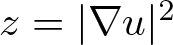 $z=|\nabla u|^2$. Then
 $z$ satisfies
 \begin{equation}
\begin{aligned}
& \Delta z + (m-2) \frac{\langle D^2z\nabla u,\nabla u\rangle}{z}\\
\geqslant & \frac 1{2N} u^{2q}(\log u)^{2p} z^{2-m}
+ 2qu^{q-1}(\log u)^p z^{\frac{4-m}2}
+ 2pu^{q-1}(\log u)^{p-1} z^{\frac{4-m}2}
-d \frac{|\nabla z|^2}{z},
\end{aligned}
\end{equation}
where
 \begin{equation*}
d=\frac{(m-2)^2}{2N} + \frac{3|m-2|}2 + \frac{N(m-2)^2}2.
\end{equation*}
Proof. We assume 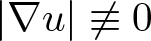 $|\nabla u| \not\equiv0$, and consider the region where
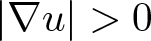 $|\nabla u| \gt 0$. Applying the regularity result in the region
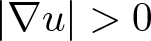 $|\nabla u| \gt 0$ where the equation (1.6) is nondegenerate, we obtain that
 $u\in C^{\infty}$. We rewrite (1.6) in the form
 \begin{equation}
-\Delta u - (m-2)\frac{\langle D^2u\nabla u,\nabla u\rangle}{|\nabla u|^2} + u^q(\log u)^p|\nabla u|^{2-m} =0.
\end{equation}
By using the Bochner formula
 \begin{equation*}
\frac12\Delta\left(|\nabla u|^2\right)=|D^2u|^2+\langle\nabla(\Delta u), \nabla u\rangle,\ \ \mathrm{where}\ |D^2u|^2=\sum_{i,j}(u_{ij})^2
\end{equation*}
combined with Cauchy-Schwarz inequality
 \begin{equation*}
|D^2u|^2\geqslant\frac{1}{N}(\Delta u)^2,
\end{equation*}
we arrive at
 \begin{equation}
\frac12\Delta\left(|\nabla u|^2\right)\geqslant\frac{1}{N}(\Delta u)^2+\langle\nabla(\Delta u), \nabla u\rangle.
\end{equation}
Denoting
 \begin{equation*}z=|\nabla u|^2,\end{equation*}
we have  $\nabla z=2D^2u \nabla u.$ It follows from (2.6) that
 \begin{equation}
\Delta u = -\frac{m-2}2\frac{\langle \nabla z,\nabla u\rangle}{z} + u^q(\log u)^p z^{\frac{2-m}2}.
\end{equation}
Direct computations imply that
 \begin{equation}
\begin{aligned}
& \left\langle\nabla\left(\frac{\langle\nabla z,\nabla u\rangle}{z}\right),\nabla u\right\rangle\\
=&\frac{\langle\nabla\langle\nabla z,\nabla u\rangle,\nabla u\rangle}{z}+\langle\nabla z,\nabla u\rangle\left\langle\nabla\left(\frac{1}{z}\right),\nabla u\right\rangle\\
=&\frac{\langle D^2z\nabla u,\nabla u\rangle+\langle D^2u\nabla z,\nabla u\rangle}{z}-\frac{\langle\nabla z,\nabla u\rangle}{z^2}\langle\nabla z,\nabla u\rangle\\
=&\frac{\langle D^2z\nabla u,\nabla u\rangle}{z}+\frac{|\nabla z|^2}{2z}-\frac{\langle\nabla z,\nabla u\rangle^2}{z^2}
\end{aligned}
\end{equation}
and
 \begin{equation}
\begin{aligned} &\left\langle\nabla\left(u^q(\log u)^p z^{\frac{2-m}2}\right), \nabla u\right\rangle\\
= & \langle\nabla(u^q), \nabla u\rangle (\log u)^p z^{\frac{2-m}2}
+ \langle\nabla (\log u)^p, \nabla u\rangle u^q z^{\frac{2-m}2}
+ \langle \nabla (z^{\frac{2-m}2}), \nabla u\rangle u^q(\log u)^p\\
= & qu^{q-1}(\log u)^p z^{\frac{4-m}2}
+ pu^{q-1}(\log u)^{p-1} z^{\frac{4-m}2}
+ \frac{2-m}2 u^q(\log u)^p z^{-\frac m2}\langle\nabla z,\nabla u\rangle.
\end{aligned}
\end{equation}
Substituting the expressions in (2.8)-(2.10) into the following estimate, we derive
 \begin{equation}
\begin{aligned}
& \langle\nabla(\Delta u), \nabla u\rangle \\
= & - \frac{m-2}2 \frac{\langle D^2z\nabla u,\nabla u\rangle}{z}
- \frac{m-2}4 \frac{|\nabla z|^2}{z}\\
& + \frac{m-2}2 \frac{\langle\nabla z,\nabla u\rangle^2}{z^2}
+ qu^{q-1}(\log u)^p z^{\frac{4-m}2}\\
& + pu^{q-1}(\log u)^{p-1} z^{\frac{4-m}2}
+ \frac{2-m}2 u^q(\log u)^p z^{-\frac m2}\langle\nabla z,\nabla u\rangle.
\end{aligned}
\end{equation}
Based on the inequality
 \begin{equation*}
(-A+B)^2 \geqslant \frac 12 B^2 - A^2, \mathrm{where}\ A,B\in\mathbb{R},
\end{equation*}
we deduce from (2.8) that
 \begin{equation}
(\Delta u)^2 \geqslant \frac 12 u^{2q}(\log u)^{2p} z^{2-m}
-\frac{(m-2)^2}4\frac{\langle \nabla z,\nabla u\rangle^2}{z^2}.
\end{equation}
Substituting (2.11)–(2.12) into (2.7), we obtain
 \begin{equation}
\begin{aligned}
& \Delta z + (m-2) \frac{\langle D^2z\nabla u,\nabla u\rangle}{z}\\
\geqslant & \frac 1N u^{2q}(\log u)^{2p} z^{2-m}
- \frac{(m-2)^2}{2N}\frac{\langle \nabla z,\nabla u\rangle^2}{z^2}\\
& - \frac{m-2}2 \frac{|\nabla z|^2}{z}
+ (m-2) \frac{\langle\nabla z,\nabla u\rangle^2}{z^2}\\
& + 2qu^{q-1}(\log u)^p z^{\frac{4-m}2}
+ 2pu^{q-1}(\log u)^{p-1} z^{\frac{4-m}2} \\
& + (2-m) u^q(\log u)^p z^{-\frac m2}\langle\nabla z,\nabla u\rangle.
\end{aligned}
\end{equation}
Note that the second and the fourth terms on the right-hand side of (2.13) are estimated by the third term:
 \begin{equation}
\left|\frac{\langle\nabla z, \nabla u\rangle^2}{z^2}\right|
\leqslant \frac{|\nabla z|^2|\nabla u|^2}{z^2}=\frac{|\nabla z|^2}{z};
\end{equation}
the last term on the right-hand side of (2.13) is estimated by the first and the third terms from the Young’s inequality:
 \begin{equation}
\begin{aligned}
|(2-m)u^q(\log u)^p z^{-\frac m2}\langle\nabla z,\nabla u\rangle|
\leqslant & |2-m| u^q(\log u)^p z^{\frac{1-m}2}|\nabla z|\\
\leqslant & \frac 1{2N} [u^q(\log u)^p z^{\frac{2-m}2}]^2 + \frac N2 [|2-m| z^{-\frac 12}|\nabla z|]^2 \\
= & \frac 1{2N} u^{2q}(\log u)^{2p} z^{2-m}+ \frac {N(2-m)^2}{2} \frac{|\nabla z|^2}{z}.
\end{aligned}
\end{equation}
2.1. The case  $m-1 \lt q \lt 1$

Lemma 2.3. Let  $N\geqslant1$,
 $1 \lt m \lt 2$,
 $m-1 \lt q \lt 1$,
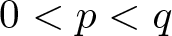 $0 \lt p \lt q$. Assume that
 $u$ is a
 $C^1$ positive solution of (1.6) in a domain
 $\Omega\subset\mathbb R^N$, and
 $\log u$ is a nonnegative function. Then there exists a positive constant
 $C=C(m,p,q,N)$ such that
 \begin{equation}
|\nabla u|\leqslant C (d(x))^{-\frac{q+1}{q-m+1}}\Big[ [\log(d(x))^2]^{-\frac{q+1}{q-m+1}} + [\log(d(x))^2]^{-\frac{q+1}{2(q-m+1)}} + 1 \Big],
\end{equation}
where  $d(x)=\mathrm{dist}(x,\partial\Omega).$
Proof. We set 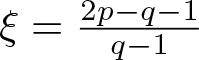 $\xi=\frac{2p-q-1}{q-1}$. Using
 $p \lt q \lt 1$, we have
 \begin{equation*}
\xi-1=\frac{2p-q-1}{q-1}-1=\frac{2(p-q)}{q-1} \gt 0.
\end{equation*}
The first and second terms on the right-hand side of (2.5) are estimated by the term  $C_9u^{\frac{\xi(q-1)+q+1}{\xi}}(\log u)^{\frac{p\xi+p}{\xi}} z^{\frac{(4-m)\xi-m}{2\xi}}$ from the Young’s inequality:
 \begin{equation}
\begin{aligned}
& C_9u^{\frac{\xi(q-1)+q+1}{\xi}}(\log u)^{\frac{p\xi+p}{\xi}} z^{\frac{(4-m)\xi-m}{2\xi}}\\
\leqslant & \varepsilon\Big[u^{\frac{2q}{\xi}} (\log u)^{\frac{2p}{\xi}} z^{\frac{2-m}{\xi}}\Big]^{\xi}
+ C_{10}(\varepsilon) \Big[ C_9u^{\frac{\xi(q-1)+q+1}{\xi}-\frac{2q}{\xi}} (\log u)^{\frac{p\xi+p}{\xi}-\frac{2p}{\xi}} z^{\frac{(4-m)\xi-m}{2\xi}-\frac{2-m}{\xi}} \Big]^{\frac{\xi}{\xi-1}} \\
= & \frac 1{2N} u^{2q}(\log u)^{2p} z^{2-m}
+ 2qu^{q-1}(\log u)^p z^{\frac{4-m}2},
\end{aligned}
\end{equation}
where we choose 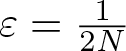 $\varepsilon=\frac{1}{2N}$ and
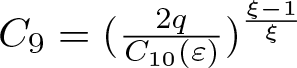 $C_{9}=(\frac{2q}{C_{10}(\varepsilon)})^{\frac{\xi-1}{\xi}}$ with
 $C_{10}(\varepsilon)=(\frac{\xi}{2N})^{-\frac 1{\xi-1}}(\frac{\xi}{\xi-1})^{-1}$. Combining (2.5) and (2.17), we have
 \begin{equation}
\begin{aligned}
& \Delta z + (m-2) \frac{\langle D^2z\nabla u,\nabla u\rangle}{z}\\
\geqslant & C_{9}u^{\frac{\xi(q-1)+q+1}{\xi}}(\log u)^{\frac{p\xi+p}{\xi}} z^{\frac{(4-m)\xi-m}{2\xi}}
+ 2pu^{q-1}(\log u)^{p-1} z^{\frac{4-m}2}
-d \frac{|\nabla z|^2}{z}.
\end{aligned}
\end{equation}
We set  $w=\frac{q+1}{q+1-2p}$. Since
 $q+1-2p=(q-p)+(1-p) \gt 0$, we get
 \begin{equation*}
w-1=\frac{q+1}{q+1-2p}-1=\frac{2p}{q+1-2p} \gt 0.
\end{equation*}
The first and second terms on the right-hand side of (2.18) are estimated by the term  $C_{11}z^{\frac{2q+2-m}{q+1}}$ from the Young’s inequality:
 \begin{equation}
\begin{aligned}
& C_{11}z^{\frac{2q+2-m}{q+1}}\\
\leqslant & \delta\Big[u^{\frac{\xi(q-1)+q+1}{\xi w}}(\log u)^{\frac{p\xi+p}{\xi w}} z^{\frac{(4-m)\xi-m}{2\xi w}}]^{w}\\
&+ C_{12}(\delta) \Big[C_{11} u^{-\frac{\xi(q-1)+q+1}{\xi w}}(\log u)^{-\frac{p\xi+p}{\xi w}} z^{\frac{2q+2-m}{q+1}-\frac{(4-m)\xi-m}{2\xi w}} \Big]^{\frac{w}{w-1}} \\
= & C_{9}u^{\frac{\xi(q-1)+q+1}{\xi}}(\log u)^{\frac{p\xi+p}{\xi}} z^{\frac{(4-m)\xi-m}{2\xi}}
+ 2pu^{q-1}(\log u)^{p-1} z^{\frac{4-m}2},
\end{aligned}
\end{equation}
where we choose  $\delta=C_{9}$ and
 $C_{11}=(\frac{2p}{C_{12}(\delta)})^{\frac{w-1}{w}}$ with
 $C_{12}(\delta)=(C_{9}w)^{-\frac 1{w-1}}(\frac{w}{w-1})^{-1}$. It follows from (2.18)–(2.19) that
 \begin{equation*}
\Delta z + (m-2) \frac{\langle D^2z\nabla u,\nabla u\rangle}{z} \geqslant
C_{11} z^{\frac{2q+2-m}{q+1}} -d \frac{|\nabla z|^2}{z},
\end{equation*}
where
 \begin{equation*}
\frac{2q+2-m}{q+1}-1=\frac{q-m+1}{q+1} \gt 0.
\end{equation*}
2.2. The case
$q \gt 1$

Lemma 2.4. Let 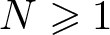 $N\geqslant1$,
 $m \gt 1$,
 $q \gt 1$,
 $0 \lt p \lt 1$. Assume that
 $u$ is a
 $C^1$ positive solution of (1.6) in a domain
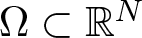 $\Omega\subset\mathbb R^N$, and
 $\log u$ is a nonnegative function. Then there exists a positive constant
 $C=C(m,p,q,N)$ such that
 \begin{equation}
|\nabla u|\leqslant C (d(x))^{-\frac{2}{2-m}}\Big[ [\log(d(x))^2]^{-\frac{2}{2-m}} + [\log(d(x))^2]^{-\frac{1}{2-m}} + 1 \Big],
\end{equation}
where  $d(x)=\mathrm{dist}(x,\partial\Omega).$
Proof. Assume that  $u$ is a positive solution of (1.6). Set
 \begin{equation*}
z=|\nabla u|^2.
\end{equation*}
It follows from (2.5) that
 \begin{equation}
\Delta z + (m-2) \frac{\langle D^2z\nabla u,\nabla u\rangle}{z}
\geqslant 2pu^{q-1}(\log u)^{p-1} z^{\frac{4-m}2}
-d \frac{|\nabla z|^2}{z}.
\end{equation}
We define  $f(u)\triangleq 2pu^{q-1}(\log u)^{p-1}$, then
 \begin{equation*}
f'(u)=2pu^{q-2}(\log u)^{p-2}[(q-1)\log u+p-1].
\end{equation*}
It is clear that 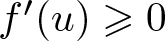 $f'(u)\geqslant0$ for
 $\log u\geqslant \frac{1-p}{q-1}$, i.e.,
 $u\geqslant e^{\frac{1-p}{q-1}}$ and
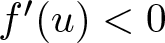 $f'(u) \lt 0$ for
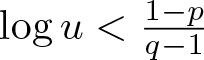 $\log u \lt \frac{1-p}{q-1}$, i.e.,
 $u \lt e^{\frac{1-p}{q-1}}$. Thus
 \begin{equation}
f(u)\geqslant f\Big(e^{\frac{1-p}{q-1}}\Big)=2pe^{1-p}\Big(\frac{1-p}{q-1}\Big)^{p-1}\triangleq C_{13} \gt 0.
\end{equation}
Combining (2.21) and (2.22), we obtain
 \begin{equation*}
\Delta z + (m-2) \frac{\langle D^2z\nabla u,\nabla u\rangle}{z}
\geqslant C_{13} z^{\frac{4-m}2}
-d \frac{|\nabla z|^2}{z},
\end{equation*}
where 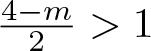 $\frac{4-m}2 \gt 1$. Letting
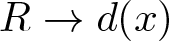
 $R\to d(x)$, we obtain (2.20) by Lemma 2.1.
2.3. The case
$q=1$

Lemma 2.5. Let  $N\geqslant1$,
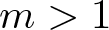 $m \gt 1$,
 $q=1$,
 $0 \lt p \lt 1$. Assume that
 $u$ is a
 $C^1$ positive bounded solution of (1.6) in a domain
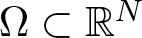 $\Omega\subset\mathbb R^N$, and
 $\log u$ is a nonnegative function. Then there exists a positive constant
 $C=C(m,p,q,N)$ such that (2.20) holds.
Proof. Assume that  $u$ is a positive bounded solution of (1.6). Set
 \begin{equation*}
z=|\nabla u|^2.
\end{equation*}
Using (2.21), we have
 \begin{equation*}
\Delta z + (m-2) \frac{\langle D^2z\nabla u,\nabla u\rangle}{z}
\geqslant 2p(\log u)^{p-1} z^{\frac{4-m}2}
-d \frac{|\nabla z|^2}{z}.
\end{equation*}
We define  $g(u)\triangleq 2p(\log u)^{p-1}$, then
 $g(u)$ is decreasing with respect to
 $u$. Thus if
 $1\leqslant u\leqslant C^*$, we obtain
 \begin{equation*}
g(u)\geqslant g(C^*)=2p(\log C^*)^{p-1}\triangleq C_{14} \gt 0.
\end{equation*}
Thus
 \begin{equation*}
\Delta z + (m-2) \frac{\langle D^2z\nabla u,\nabla u\rangle}{z}
\geqslant C_{14} z^{\frac{4-m}{2}}
-d \frac{|\nabla z|^2}{z},
\end{equation*}
where 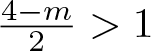 $\frac{4-m}2 \gt 1$. We let
 $R\to d(x)$ and then obtain (2.20) by applying Lemma 2.1.
Proof of Theorems 1.1–1.3
When 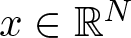 $x\in\mathbb{R}^N$,
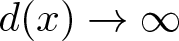
 $d(x)$ which appears in Lemmas 2.3–2.5 can be chosen arbitrarily large. Lemmas 2.3–2.5 imply that
 $\left|\nabla u \right|\to0$ as
 $d(x)\to\infty$. In other words,
 $u$ is a constant.
3. The proof of Theorem 1.4
This section is devoted to proving a Liouville-type theorem of positive weak solutions to (1.7). The proof could be referred to the series works [Reference Barrow and Parsons4, Theorem 2.1] and [Reference Chang, Hu and Zhang11, Theorem 1.2]. The method is different from that in [Reference Serrin and Zou29, Theorem II(a)].
Proof of Theorem 1.4
Assume that  $u$ is a positive solution of (1.7). Set
 \begin{equation*}
u=e^v.
\end{equation*}
It follows from 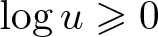 $\log u\geqslant0$, i.e.,
 $u\geqslant1$ that
 $v\geqslant0$. Thus
 \begin{equation}
-\Delta_m v\geqslant (m-1)|\nabla v|^m + e^{(q-m+1)v}v^p \geqslant (m-1)|\nabla v|^m.
\end{equation}
We select a cut-off function 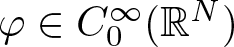 $\varphi\in C^{\infty}_0(\mathbb{R}^N)$ with the properties:
 \begin{equation*}\mathrm{supp}\varphi\subset B_1(0),\;\;\;\varphi\equiv1\;\mathrm{on}\;B_{1/2}(0),\;\vert\nabla\varphi\vert\leqslant C\varphi^{1/2},\;\text{and }0\leqslant\varphi\leqslant1.\end{equation*}
Since  $m \gt N$, there exists a parameter
 $k$ such that
 $0 \lt k \lt 2(1-\frac Nm)$. Here we fix
 $k$ and set
 $R \gt 0$. We take
 $\xi(x)=R^{k}\varphi\left(\frac{x}{R}\right)$, which satisfies
 \begin{equation}
\xi= \left\{\begin{array}{ll} 0 &\text{in } {\mathbb R}^N\setminus B_{R}(0), \\ R^k & \text{in } B_{R/2}(0), \end{array}\right. 0\leqslant \xi\leqslant R^k,
|\nabla\xi|=\frac{|\nabla\varphi|}{R^{1-k}}
\leqslant\frac{C\xi^{\frac12}}{R^{1-\frac k2}}.
\end{equation}
By multiplying (3.1) with  $\xi^{\frac m2}$ and then integrating by parts, while applying the Young’s inequality, we arrive at
 \begin{equation*}
\begin{aligned}
\int_{B_R}\xi^{\frac{m}2}|\nabla v|^m
&\leqslant C\left|\int_{B_R}|\nabla v|^{m-2}\nabla v\cdot\nabla\left(\xi^{\frac{m}2}\right)\right|\\
&\leqslant C\left|\int_{B_R}|\nabla v|^{m-1}\xi^{\frac{m}2-1}|\nabla\xi|\right|\\
&\leqslant\frac12\int_{B_R}(\xi^{\frac{m-1}2} |\nabla v|^{m-1})^{\frac{m}{m-1}} + C\int_{B_R}(\xi^{-\frac 12}|\nabla\xi|)^m\\
& =\frac 12\int_{B_R}\xi^{\frac{m}2}|\nabla v|^m
+C\int_{B_R}\frac{|\nabla\xi|^m}{\xi^{\frac m2}},
\end{aligned}
\end{equation*}
where  $C \gt 0$. By using (3.2), we have
 \begin{equation}
\int_{B_R}\xi^{\frac{m}2}|\nabla v|^m
\leqslant 2C\int_{B_R}\frac{|\nabla\xi|^m}{\xi^{\frac m2}} \leqslant C'R^{N-(1-\frac k2)m}.
\end{equation}
Since the exponent 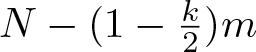 $N-(1-\frac k2)m$ is negative, we let
 $R\to\infty$ and then this implies the conclusion.
Acknowledgements
The authors are grateful to the referees for their significant suggestions, and the authors appreciate the help of the editor. Chang was partially supported by the National Natural Science Foundation of China (No. 12401265), Natural Science Basic Research Program of Shaanxi Province (No. 2024JC-YBQN-0014) and the Research Startup Foundation for Talent Introduction of Xi’an University of Science and Technology (No. 2050123041); Zhang was partially supported by the National Natural Science Foundation of China (No. 12271423) and the Shaanxi Fundamental Science Research Project for Mathematics and Physics (No. 23JSY026).





