Evidence for cross-linguistic paths that particular source constructions follow in grammaticalization (as in Bybee, Perkins, & Pagliuca, Reference Bybee, Perkins and Pagliuca1994) invites further discussion of the microprocesses that motivate this change. Among the grammaticalization paths advanced is the tendency of perfects to evolve into perfectives, a path observed in various Romance languages (Squartini & Bertinetto, Reference Squartini and Bertinetto1995, Reference Squartini, Bertinetto and Dahl2000), among other languages of the world (Bybee et al., Reference Bybee, Perkins and Pagliuca1994:53). Perfects typically mark an event as having occurred prior to the moment of speech without pinpointing the specific time of its occurrence. Presumably, the speaker perceives this event as being relevant to the current moment of speech or connected in some way to the present. The Present Perfect (PP) in Spanish, a compound form consisting of a present tense form of haber ‘to have’ and a past participle, has traditionally been viewed in this manner.Footnote 1 In contrast, the Spanish Preterit is used to encode perfective events, or events viewed as completed prior to and detached from the moment of speech. In example (1), the Spanish PP encodes an atelic (viewed as incomplete or continuing) situation holding true in the past and continuing in the present as made explicit by the adverbial siempre ‘always’; example (2) shows the Preterit encoding a telic (viewed as complete or temporally bounded), perfective event supported by pocos días ha ‘a few days ago’. In both examples, and in those to follow, the verb of concern appears in bold in both the original Spanish and the idiomatic English gloss.
(1) … me ha gustado siempre tanto la caza.
‘… I have always liked hunting so much.’
(19th, MDR)Footnote 2(2) … y en una (carta) que recibí pocos días ha, me dijo cómo su madre trataba de casarla…
‘… and in one (letter) that I received a few days ago, she told me how her mother was trying to marry her off …’
(19th, MDR)However, several contemporary varieties of Peninsular Spanish exhibit innovative use of the PP, as the PP assumes more and more the perfective value of the Preterit, changing its focus from that of situating an event as prior and relevant to the moment of speech to that of reporting the past event for its own sake (Bybee et al., Reference Bybee, Perkins and Pagliuca1994:86; Schwenter, Reference Schwenter1994b). Examples (3) and (4) demonstrate this grammaticalized perfective PP. In (3), the PP and Preterit are both used to encode an event that took place earlier the same day, as indicated by the broader discourse context. In (4), the PP is used to narrate a series of perfective events in a more remote past, the day before the moment of speech.
(3) ¿Qué has hecho del tordo? ¿Le diste de comer?
Sí, señora. Más ha comido que un avestruz. Ahí le puse en la ventana del pasillo.
‘What have you done with the thrush? Did you feed him?
Yes, ma'am. He has eaten more than an ostrich. I put him in the window in the hallway.’
(19th, FDM)(4) He venido tan a tiempo, y tan de priesa, que he podido recoger la edición toda completa;
y el librero y yo, esta noche sin que ninguno lo sepa, hemos hecho que en las llamas por siempre desaparezca.
‘I have come so quickly, that I have been able to retrieve the entire edition/run; and the bookseller and I, this evening without anyone knowing about it, have made sure that it disappears forever in flames.’
(19th, CAR)This study traces the evolution of the Peninsular Spanish PP employing a diachronic, variationist perspective to compare the contexts of use for the Preterit and the PP in dramatic texts from three centuries—15th, 17th, and 19th. A brief description of that corpus is first given. Then, given that the changing functions of the PP lie at the heart of this study, research focused on how different PP functions are believed to emerge in grammaticalization is presented before discussion of the current findings.
CORPUS SELECTION
To measure the PP's extension to new contexts, it must first be established in what linguistic contexts the PP and the Preterit were used early on. Usage from the late 15th century was selected as a baseline, as several studies describe the evolution of the PP construction through the 15th century (Company Company, 1980; García Martín, Reference Martín and María.2001; Thibault, Reference Thibault2000) and earlier dramatic texts are not available. Beginning with this 15th century data, relative frequencies of the PP and Preterit and their contexts of use were compared with those from later centuries, in this case, texts from Spain's Siglo de Oro ‘Golden Age’ of the early to mid-17th century (1600–1650) and texts from the early to mid-19th century (1800–1850).
The desire for the corpus to reflect as closely as possible what happens between speakers in interaction led to the decision to select the data from dramatic texts. Dramatic texts rely chiefly on the interaction between the actors on stage, and their success or failure depends largely upon their ability to present authentic and engaging representations of life. Previous studies, including Poplack (Reference Poplack2006) and Poplack and Malvar (Reference Poplack and Malvar2007), have found that results with data from dramatic texts closely resemble those from actual speech. The audience of a dramatic text comes to the play with no prior knowledge of the characters' lives. The information they must know in order to piece together the plot and character relationships must be presented on stage primarily via the actors' lines. This characteristic of dramatic texts is of importance to this study as it supports a wealth of language use in the very contexts of interest when studying developing perfectives. The PP and Preterit are used to describe past events of varying nature, including those termed “hot news” (unexpected perfective events generally of recent occurrence), hodiernal (occurring the day of speech), and prehodiernal (before the day of speech). Because the characters need to supply details of their past histories (prehodiernal and continuing or persistent situations), talk about recent events to which the audience was not privy (often hodiernal), and report events that just happened offstage (often hot news), dramatic texts supply ample evidence of these various past temporal reference contexts.
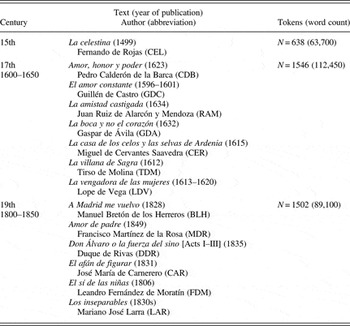
The dramatic texts selected include works by the best-known authors of their time, as well as lesser-known authors, whose work reached a smaller audience. Except for the smaller 15th-century corpus, an effort was made to include the work of at least six playwrights from each century. Both were done in an effort to represent as fully as possible PP and Preterit use in each time period. For each century, an exhaustive extraction was made of all PP and Preterit tokens, permitting the calculation of the relative frequency of the PP to the Preterit.Footnote 3Table 1 displays a list of the texts included in each century's data, the playwrights' names, (approximate) year of publication, the author/text code employed when presenting examples throughout this paper, and the approximate word count and the number of tokens reserved for variable rule analysis after accomplishing relative frequency counts. Because the temporal nature of events is believed to be a key factor in use of the PP, the coding of the data for this study would have been impossible without a thorough understanding of each drama's plot and the timeline of said events.
Corpus by century

GRAMMATICALIZING PERFECTS
Much research on perfect grammaticalization has emphasized the role of current relevance (and its subsequent weakening) as paving the way to perfectivity (see Bybee et al., Reference Bybee, Perkins and Pagliuca1994:63–87; Harris, Reference Harris, Harris and Vincent1982:49–50; Schwenter Reference Schwenter1994b; Squartini & Bertinetto, Reference Squartini and Bertinetto1995, Reference Squartini, Bertinetto and Dahl2000). This proposed grammaticalization path consists of four stages, all of which were evident in the data used for this study (as the examples will illustrate).
In Stage I, the PP functions as a resultative, expressing present states, not the perfective events that brought about the state, as seen in (5) where the focus is the emotional condition in which the king has left the character, not the actual act of disturbing her that precipitated the state. In a similar fashion, in (6) the focus is on the character's aged appearance, not the events that caused the aging process itself.
(5) ¡Rey mío!, turbado me has!
‘My king!, you have disturbed me.’
(15th, CEL)(6) Vieja te has parado.
‘You have gotten old.’
(15th, CEL)Much work has examined resultative use to determine how it leads to further grammaticalization. Detges (Reference Detges, Eksell and Vinther2006:51), drawing upon Jacob's (1996) work, distinguishes a type of resultative (which he calls Resultative B) that he believes aids in the reinterpretation of the resultative as a “current relevance” perfect (Stage III): resultatives in which the subject of the PP clause is also the responsible author/experiencer of the past event. Certain classes of verbs lend themselves to this interpretation of a resultative, including verbs of cognition, perception, and communication (cf. Carey, Reference Carey, Stein and Wright1995; Jacob, Reference Jacob1996), as in (7), where Areusa's past experience of seeing Melibea is responsible for her current knowledge about her.
(7) Elicia: Mas creo que soy tan hermosa como vuestra Melibea.
Areusa: Pues no la has tu visto como yo, hermana mía.
‘Elicia: I believe that I am as beautiful as your Melibea.
Areusa: Well, you have not seen her as I have, my sister.’
(15th, CEL)Detges (Reference Detges, Eksell and Vinther2006) discussed how this use also includes certain achievement verbs, including verbs of physical violence, in which the subject acts as the agent and is directly responsible for the resultant state. He further stated that this resultative construction has pragmatic value as it is used to refer to “states of affairs, which, for some reason, are considered particularly noteworthy” (Detges, Reference Detges, Eksell and Vinther2006:58). By linking this responsible author element to the resultant state, the connection between the past event and the state is strongly present and could lead to inference that the event itself is the focus.
In Stage II, the PP is used in durative or iterative situations that began in the past and continue into the present (i.e., ongoing, atelic). In such cases, the time of occurrence of the event is often difficult to pinpoint or not particularly relevant. There is some debate as to whether Stage II is part of the resultative → perfective grammaticalization path, and if it is a stage through which all languages must pass on their way to developing a perfective from a perfect. Squartini and Bertinetto (Reference Squartini and Bertinetto1995:231–232) discussed diachronic studies on Portuguese that seem to contradict the proposed unidirectionality of the path.Footnote 4 The focus of this anomalous behavior, also cited as having occurred in Old French, revolves around the use of the PP with accomplishment or achievement verbs (i.e., telic) in purely perfective situations while nontelic values (i.e., Stage II) had not yet developed. Similar observations concerning the data in this study will be discussed. A central focus of this study was to track the emergence of this continuative perfect function in an attempt to characterize its role in PP grammaticalization.
In Stage III of the grammaticalization path, the PP extends to past events considered relevant to the present, but which are not specified to occur at a particular past reference point. In (8), the PP encodes a perfective event that may be interpreted as currently relevant due to its relationship to the current situation.
(8) ¿De qué basura han sacado esa mujer que a cantar viene?
‘From what trash pile have they gotten this woman who is singing?’
(17th, TDM)The event is clearly perfective. The woman is no longer in the trash pile (as she is singing for an audience). However, her “recent removal” from the trash may be considered relevant as it underscores the quality of her current singing.
In later phases of Stage III, bleaching of current relevance by overuse advances and an association with the perfective past strengthens. The PP begins to show less sensitivity to temporal distance and to cooccur with definite past adverbials, as in (9), where el mes pasado ‘last month’ accompanies the PP.
(9) Le he vistoel mes pasado en Barcelona, y he oído contar los dos últimos
desafíos que ha tenido. …
‘I have seen him last month in Barcelona, and I have heard tell of the last two challenges that he has had. …’
(19th, DDR)The “current” relevance in these cases is perhaps overshadowed by the obvious perfective nature of the event. With continued use, the PP extends to more remote past times, eventually functioning as a true perfective (Stage IV). In such cases, the Preterit may completely disappear or be restricted to particular registers or genres. However, one would assume that this process is quite gradual, and intermediate steps between Stage III and IV have been hypothesized as well.
HOT NEWS PERFECTS, TEMPORAL DISTANCE, AND PERFECT GRAMMATICALIZATION
Schwenter (Reference Schwenter1994a) argued that several PP functions do not belong conclusively to Stage III or IV, but rather serve as transition steps from the experiential or continuative perfect in Stage II to the perfective perfect of Stage IV. He distinguished hot news perfects and suggested that they may lead to the development of hodiernal/prehodiernal uses that in turn lead to an increased generalization of the PP to all perfective contexts.
Hot news perfects typically introduce a new topic into the discourse by mentioning a recent event of interest. This use of the PP is pragmatically motivated as it does not connect the event with the present, but focuses the listener's (and the audience's) attention on the significance and recency of the event itself, as in (10). In some cases, as in the example presented here, a resultative interpretation is also possible.
(10) Ya Estela hermosa se ha declarado.
‘Lovely Estela has already declared herself (gotten engaged).’
(17th, CDB)In these cases, the lack of true current relevance (as these perfects function to introduce a new topic) erodes that aspect of the PP's meaning and strengthens its association with perfectivity by seemingly simply reporting a past event. If hot news perfects do indeed serve as a transition to more remote past contexts, then their use would presuppose that other Stage III functions (such as current relevance), as well as Stage II functions, are already established. This study examines when the hot news function developed, and if the development of Stage II functions preceded or succeeded the use of hot news perfects.
Dahl (Reference Dahl1985) found that with the erosion of current relevance speakers begin to employ a more objective and concrete method for distinguishing past events: the time at which the event occurred. Cross-linguistically, the hodiernal/prehodiernal distinction is the most common remoteness distinction (in terms of objective time). Various studies have concluded that the Peninsular Spanish PP is increasingly used for hodiernal events, whereas the Preterit is relegated to prehodiernal events (Schwenter, Reference Schwenter1994a, Reference Schwenter1994b; Schwenter & Torres Cacoullos, Reference Schwenter and Torres Cacoullos2008; Serrano, Reference Serrano1994, Reference Serrano1996). However, interestingly, Schwenter and Torres Cacoullos (Reference Schwenter and Torres Cacoullos2008) also found that the PP is favored in nonspecified temporal reference contexts (both perfective “indeterminate” and imperfective “irrelevant” contexts). Based on 20th-century conversational data, their results reinforce that the PP has retained its traditional perfect functions, even as its new perfective functions have developed. Schwenter and Torres Cacoullos (Reference Schwenter and Torres Cacoullos2008) posited that the PP is becoming the default past perfective as it appears more frequently than the Preterit in the least-specified perfective (i.e., temporally indeterminate) contexts. Therefore, it will expand into additional perfective contexts not by extending itself gradually from hodiernal to more remote times, but by appropriating more and more perfective contexts that are temporally nonspecific or indeterminate.
This body of scholarship has focused on the innovative perfective PP in contemporary use (see also Burgo, Reference Burgo2008; Howe, Reference Howe2006; Kempas, Reference Kempas2006, Reference Kempas2008). Several key questions remain: Approximately when did the Peninsular PP move from one discernible stage (or function) in its grammaticalization path to the next? What contexts of use were first vulnerable to change and then favored further grammaticalization of the PP? What factors influenced these changes? The comparative variationist methodology (as described in Poplack & Tagliamonte, Reference Poplack and Tagliamonte2001:88–102; Tagliamonte, Reference Tagliamonte2006:245–253) employed in this study allows for a careful examination of how PP extension occurred and the grammaticalization path the form may have followed. In so doing, this study focuses not on current relevance, which can be difficult for the analyst to ascertain (see Howe, Reference Howe2006; Schwenter & Torres Cacoullos, Reference Schwenter and Torres Cacoullos2008; Van Herk, Reference Van Herk2003), but rather the more readily operationalized construct of temporal reference.
ACCOUNTING FOR CHANGING CONSTRAINTS
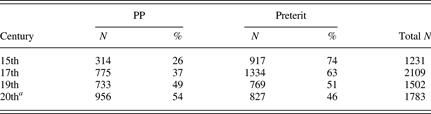
Variationist methodology in syntactic studies generally examines only those discourse contexts where differences in meaning are neutralized (Sankoff, Reference Sankoff and Newmeyer1988). In this case, that might restrict the dataset to those contexts describing the recent perfective past. However, this would not allow for an in-depth understanding of the other functions the PP performs (which may also form part of the perfective grammaticalization path) nor would it permit extrapolation of how those functions developed over time. Schwenter and Torres Cacoullos (Reference Schwenter and Torres Cacoullos2008:10–12) proposed defining more broadly the variable envelope for grammaticalizing variants, suggesting that all functions of a grammaticalizing form should be included in the analysis as they reflect polysemous meanings that lie within the scope of the grammaticalization path, provided that the alternative variant shows overlapping uses (cf. Poplack & Tagliamonte, Reference Poplack and Tagliamonte2001). By circumscribing the variable context broadly (i.e., past temporal reference) and examining all uses of both the PP and Preterit (as did Schwenter & Torres Cacoullos, Reference Schwenter and Torres Cacoullos2008), the factors conditioning the use of both can be teased apart and then compared across centuries. Therefore, all occurrences of the PP and Preterit were extracted for study. Table 2 displays the frequency of the PP relative to the Preterit in each century.
Relative frequencies by century
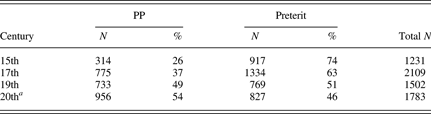
aThe 20th-century frequencies are from Torres and Cacoullos (2008:13).
In the 15th century, the PP is relatively infrequent (26%) compared with the Preterit (74%). As it was just around this time that the modern haber + participle had become the preferred perfect form, defeating its ser competitor (Company Company, 1980:29), this result is expected. The following centuries show a steady increase in frequency, until, in the 19th century, the PP (49%) is used at a comparable rate to the Preterit (51%), suggesting great extension to new contexts of use. These 19th-century frequencies parallel those of Schwenter and Torres Cacoullos's 20th-century spoken data (2008).
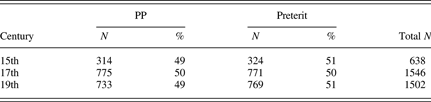
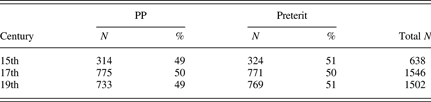
After registering the higher frequency of Preterit forms, tokens were randomly selected so that Preterit representation in the 15th- and 17th-century corpora was roughly equivalent to that of the PP. This permitted inclusion of more PP tokens for a given total N coded.Footnote 5 To exemplify this random sampling procedure, in Tirso de Molina's La villana de la Sagra (The Village-Girl of Sagra), there were 90 PP tokens (26%) compared with 255 Preterit tokens (74%). Given that Preterit tokens outnumbered PP tokens roughly 3 to 1, every third token of the Preterit was retained for further analysis, while all 90 of the PP tokens were preserved. Although the sampling method for the 15th and 17th centuries resulted in an artificial relative frequency in the corpus coded for the quantitative analysis, this even distribution allowed for more ready comparison of the two variants when examining measures of phonetic reduction, fossilization of syntax, and distribution of adverbial use (Copple, Reference Copple2009). The random selection of Preterit tokens provided examples of usage from the entire text, thus avoiding a skewing of results that could possibly occur if only a small portion of the text were used in the extraction of the Preterit tokens. This resulted in three datasets, totaling 3686 tokens of the two forms. Table 3 displays the representation of each form in each century for the variable rule analysis. The tokens were coded for various factors, including temporal distance, lexical aspect or Aktionsart (Vendler, Reference Vendler and Vendler1967), semantic class of the verb, cooccurrence with adverb ya ‘already’, polarity, clause type, sentence mode, grammatical person, and subject expression. Temporal reference classification is discussed in detail as this approach represents a departure from much previous work.
Representation of forms in corpus
TEMPORAL REFERENCE
Schwenter and Torres Cacoullos (Reference Schwenter and Torres Cacoullos2008) identified five temporal reference contexts that concern two features of an event: whether a time of occurrence can be specified (or discerned from the larger context), and if specifiable, the chronological distance of the event from the moment of speech. In this way, no attempt at assessing current relevance must be made. Their classification system includes three temporal reference contexts where time is specified—hodiernal, hesternal (“yesterday”), and prehesternal (“before yesterday”)—and two where time is not specified—indeterminate and irrelevant. In this study, this approach was adopted, with an additional specified context, very recent past. The rationale for this decision, as well as more detailed explanations and examples for each temporal reference context follow.
Very recent temporal reference
The least remote of the specified temporal reference contexts, very recent events, occurs “right before” the moment of speech. These situations resemble Comrie's perfects of recent past (1976:60). However, for these tokens, no stretching of recency (as Comrie describes) is permitted; all of these events occurred within 25 lines of the reporting of their occurrence onstage (most generally, just before or within the same short scene). Very recent tokens were fairly frequent in the dramatic data as characters announce the impending entrances and exits of other characters and themselves as in (11); describe events that take place offstage, shown in (12) and (13); share reactions or assessments of onstage events with the audience as in (14) and (15); and even allow them to announce their own deaths in dramatic fashion as in (16).
(11) Al fin vine a dar contigo.
‘At last I came to deal with you.’
(17th, LDV)(12) Gente suena por allá: tres hombres, si no me engaño, se han parado.
‘There are sounds of people over there: three men, if I'm not mistaken, have stopped.’
(17th, GDC)(13) ¿Pues aués oydo lo que con aquella mi señora he passado?
‘Well, have you heard what I have experienced while with m'lady?’
(15th, CEL)(14) Loco don Lüis se ha vuelto.
‘Don Luis has gone crazy.’
(17th, TDM)(15) El alma me ha tornado.
‘He has returned my soul to me.’
(15th, CEL)(16) ¡Ay que me has muerto traidor!
‘Oh, you have killed me, traitor!’
(17th, TDM)Appearing in both the Preterit and PP, this class is sometimes accompanied by adverbials, such as ahora ‘now’ or hace poco ‘just a little bit ago’, that reinforce their proximity to the moment of speech.
This class is abundant in every century's data (ranging from 15% to 30% of the PP and Preterit tokens in each century). Although comparable data from conversation or other genres is not available, this perhaps high frequency of use in the present corpus may be a function of the dramatic genre and the need to ensure that the audience is aware of what is happening. Very recent tokens are not generally isolated as a separate temporal reference context, but instead may have been considered hodiernal tokens in previous research, thereby obscuring their role in PP grammaticalization (although see Rodríguez Louro, Reference Rodríguez Louro2009). Indeed, the patterning of the very recent tokens was quite different from that of the hodiernal tokens, and, as shown, they played a different role in the plot development in the dramas than the hodiernal tokens did, so they are analyzed separately here.
Hodiernal temporal reference
Actions occurring the same day as (but more than 25 lines before) the moment of speech were coded as hodiernal. These events were occasionally temporally specified with an adverb, such as hoy ‘today’ in (17), but also included events that were known to have occurred the same day, due to knowledge of the drama's plot or remarks made by the characters, in the absence of a cooccurring adverbial.
(17) Hoy al Conde he obligado a que a la corte vaya.
‘I have obligated the Count to go to court today.’
(17th, CDB)In (17), the cooccurring adverb hoy might permit coding as either hodiernal or very recent past. It was identified as hodiernal in this case, as approximately 100 lines of dialogue separate the king's conversation with the count and his reporting of the event. Knowledge of the plot also aided in identifying hodiernal events (and separating them from very recent events). In (18), Luis had left his home earlier in the evening to play cards (and in a separate scene had had time to kill someone after the card game went badly) when this statement is made.
(18) Idos con Dios, que ha gran rato que don Luis de aquí ha salido …
‘Go with God, don Luis has left here a long time (while) ago …’
(17th, TDM)Prehodiernal temporal reference
Actions known to have occurred before the day of speech were coded as prehodiernal. Because of the nature of a drama (where often the action takes place in one or two separate days depending on how the acts are divided), it was difficult to establish hesternal temporal distance as one often does not have a clear idea of exactly how much time has elapsed between one act and the next. Generally, the only way to distinguish hesternal events from prehesternal was through the use of an adverb. The fact that Schwenter and Torres Cacoullos (Reference Schwenter and Torres Cacoullos2008:24) found no significant difference in the relative frequency of the PP in these two contexts in contemporary data eased concerns about distinguishing these two temporal distance contexts. Because of these considerations, events that were hesternal, as in (19), and prehesternal, as in (20), were combined here as prehodiernal.
(19) Y yo he visto ayer, a la salida de Triana, al negro con los caballos.
‘And I have seen yesterday, at the Triana exit, the black man with the horses.’
(19th, DDR)(20) … salimos el verano pasado de Madrid …
‘… we left Madrid last summer …’
(19th, FDM)Irrelevant temporal reference
In irrelevant temporal reference, one may not be able to resolve when an event took place even if queried, but neither is it of particular importance, that is, the “when” is simply not germane. Durative or iterative situations, as in (21) and (22), are typical of the irrelevant temporal reference contexts.
(21) Me he criado con él cual si fuese mi hermano.
‘I have [been] raised with him as if he were my brother.’
(19th, MDR)(22) Escribió varios romances … ¿y qué sé yo cuántas cosas?
‘He wrote various romantic ballads … who knows how many things?’
(19th, BLH)Indeterminate temporal reference
In the indeterminate cases, the precise time of the perfective action is not specified in the utterance, nor is it discernible from the larger discourse context. In contrast to the irrelevant contexts, an interlocutor could query cuándo (when) to determine the specific time of occurrence, as in (23) and (24), where the time of departure and the date of betrothal are not mentioned, but could be easily discovered.
(23) … que ha dejado su pueblo a todo trance.
‘… that he has left his town resolved.’
(19th, MDR)(24) Mi padre a Policiano ha prometido mi mano.
‘My father has promised my hand to Policiano.’
(17th, RAM)As noted earlier, these indeterminate cases are of interest, as Schwenter and Torres Cacoullos (Reference Schwenter and Torres Cacoullos2008:31) proposed that they are the locus of extension of the perfective PP.
FACTORS RELATED TO RESULTATIVE MEANING
The data were also coded for factors that might reflect ties to the PP's resultative origins. These included semantic qualities of the main verb from two different perspectives (Aktionsart and semantic class) and subject expression. A verb's lexical aspect considers its inherent relationship with time (Vendler, Reference Vendler and Vendler1967:97), whereas its semantic class places it with verbs that express similar types of actions or states. Previous studies have found both of these semantic qualities to play a role in the grammaticalization of perfects (see Carey Reference Carey, Stein and Wright1995, Reference Carey and Goldberg1996; Detges, Reference Detges, Eksell and Vinther2006; Schwenter & Torres Cacoullos, Reference Schwenter and Torres Cacoullos2008, among others).
Vendler's (1967) categorization of verbs according to their inherent aspectual quality is based on three oppositions: dynamism (stative vs. dynamic), telicity (atelic or telic), and punctuality (durative vs. punctual) (see also Comrie, Reference Comrie1976:41–51). To code for lexical aspect, all verbs in infinitive form and, in the case of transitive verbs, their accompanying object phrases were examined. Object phrases were included so as to distinguish verbs that function as both activities (e.g., leer ‘to read’) and accomplishments (e.g., leer una carta ‘to read a letter’). Compound verbs (e.g., hacer reir ‘to make laugh’) were also included. Verbs were listed in infinitive form to avoid any bias that the realized forms (PP or Preterit) might contribute to the meaning of the verb phrase. De Miguel (Reference De Miguel, Bosque and Demonte1999) and Cortés-Torres (Reference Cortés-Torres2005) offered insight on applying Vendler's (1967) categories to Spanish verbs.
Additionally, each verb was coded for semantic class based on previous studies on resultative PP use in Old English, French, and Spanish. Carey (Reference Carey, Stein and Wright1995:87) found that the majority of resultative PP usage in Old English occurred with mental state, communication, and perception verbs (cf. Van Herk, Reference Van Herk2003). She hypothesized that initial use of the PP with mental state verbs conventionalizes the resultative function (Carey, Reference Carey and Goldberg1996:37), whereas later use of perception and communication verbs widens the focus from the resultant state to the event and then to the discourse itself (introducing current relevance), allowing the construction to expand to other event verbs (Carey, Reference Carey, Stein and Wright1995:88). As discussed, Detges (Reference Detges, Eksell and Vinther2006) distinguished Resultative B constructions, wherein the subject is understood to be the “responsible author” of the event that brought about the resultant state. Detges provided examples from Old French and Old Spanish of the responsible author Resultative B construction being used with verbs of physical violence, hacer ‘to do/make’, and motion verbs as verbs that follow this tendency.Footnote 6 Lastly, Hernández (Reference Hernández2004:36) described resultative PPs in contemporary Salvadoran data that “suggest a complete ‘transformation’ from a previously perceived or known physical or mental state or condition to another form or shape of the same entity.” This was interpreted to include mental state and perception verbs, as well as verbs expressing other psychological changes of state (e.g., enojarse ‘to become angry’) and verbs dealing with the exchange or change of possession of a physical object (as they would incorporate both the idea of a motion verb as well as a change of state). Because of this previous body of work on PP resultatives, all of these groups appear as factors in the semantic class coding so that influence of the PP's resultative origins may be traced.
Additionally, subject expression (lexical, pronominal, or nonexpressed) was included as it was hypothesized that expressed subjects might serve as a means to track the responsible author element associated with the resultative PP. Because these resultatives highlight the responsible agent or experiencer responsible for the current state, subject expression (either lexical or pronominal) should favor the PP as an expressed subject could only strengthen this highlighting effect.Footnote 7
CHANGING CONSTRAINTS
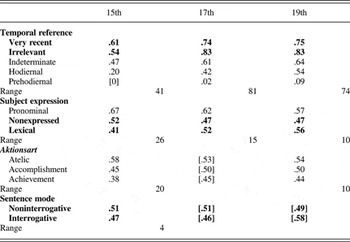
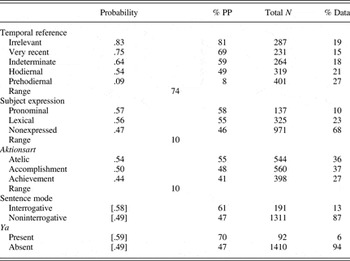
To determine which of these factors influenced selection of the PP and the magnitude of those effects, each century's data were submitted to variable rule analysis using Goldvarb X for Windows (Sankoff, Tagliamonte, & Smith, Reference Sankoff, Tagliamonte and Smith2005). Because of their overlapping character, independent analyses were conducted with each semantic class as separate factors, resultative-compatible semantic classes grouped together, and Aktionsart. In each century, semantic class (in either configuration) was not selected as significant, but Aktionsart was. In Table 4, the variable rule analysis results for each century are presented together to show changes over time in constraint hierarchies (in bold) as well as in the direction of effect for particular factors. Note that nonsignificant factor groups are presented in brackets for each century for comparison across time. Complete results for each century are presented in the Appendix.
Constraint hierarchies for favoring of the PP in the 15th, 17th, and 19th centuries

Temporal reference and subject expression were selected as significant in each century, with Aktionsart selected in both the 15th and 19th centuries. Of these groups, temporal reference exhibits the most dramatic change as, although it was the first group selected in each century, its effect strengthens over time. The magnitude of effect increases from 1.5 times that of the next factor group, subject expression, in the 15th century, to 7 times that of subject expression and Aktionsart in the 19th century (though the increase is affected by the inclusion of prehodiernal contexts in the 17th- and 19th-century analyses).Footnote 8 Additionally, the hierarchy within the factor group changed as very recent temporal reference gave way to irrelevant temporal reference as the most favorable context for the PP in the 17th century. The continued emergence of the PP in perfective contexts is signified by increasing favoring first in indeterminate contexts, in the 17th century, and then in hodiernal contexts, in the 19th century, as they shift to favor selection of the PP. These changes evidence the increasing and varied roles that the PP incurred as it grammaticalized over time.
While subject expression experiences a shift between nonexpressed and lexical subjects, the constraint hierarchy remains consistent for Aktionsart. As mentioned, the magnitude of effect for these two factor groups greatly diminishes over time. Aspectual constraints in the 15th century reflect the hybrid-aspectual nature of the PP as it evolves from its resultative roots—its use with telic verbs in forming such constructions (note the only slight disfavoring of accomplishment verbs) and its already established compatability with atelic values. The PP is generally viewed as aspectual in nature, so it is perhaps surprising that this aspectual effect is already weak in comparison to that of temporal reference (one-half its range). Aktionsart constraints continue to weaken over time as the PP increasingly assumes a temporal value.
Sentence mode, selected in the 15th century as a weak effect, shows a reversal in the direction of effect for interrogatives in the 19th century as they favor the PP (although this group was not selected in the multivariate analysis). Schwenter and Torres Cacoullos (Reference Schwenter and Torres Cacoullos2008:21) found that yes/no questions, being less temporally anchored, favored selection of the PP. This finer distinction in question type was not made in the coding of the data of this study, but it might help in tracing when and how interrogatives began to favor use of the PP.
A closer examination of the two factor groups selected in each century, temporal reference, and subject expression, reveals additional insight about the grammaticalization process the PP experienced and its connections to the PP's resultative origins.
TEMPORAL REFERENCE AND RESULTATIVE ROOTS
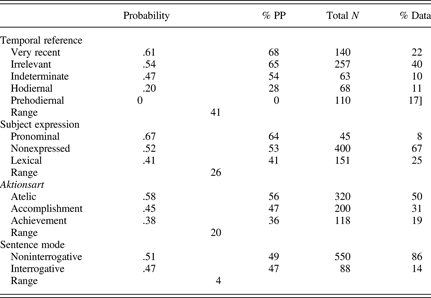
In the 15th century, temporal reference was selected as the factor group making the strongest contribution to the selection of the PP. This is mostly because use of the PP is favored in very recent contexts (and it is strongly disfavored in hodiernal), as its use in irrelevant contexts is only slightly favored. It can be said then that, in the 15th century, the PP was not functioning as a perfective in any true sense of the word, yet it had not strongly assumed its “continuative” perfect role either. The constraint hierarchy from more to less favorable contexts, irrelevant (.54) > indeterminate (.47) > hodiernal (.20), does underline that the PP was emerging in irrelevant temporal reference contexts at a faster rate than in indeterminate and hodiernal functions. It would stand to reason that the PP would appear in nonspecified temporal reference contexts, irrelevant and indeterminate, before specified temporal reference (and hodiernal and prehodiernal contexts were strongly disfavored).
The three most favorable 15th-century temporal reference contexts will now be discussed along with the factor of semantic class. Although not selected in the multivariate analysis, clear ties to its resultative origin are apparent in the PP's patterns of use with particular semantic classes. In this discussion, semantic classes associated with resultative readings are grouped together (called “resultative-compatible”) and contrasted with the “other” verbs (i.e., no resultative association).
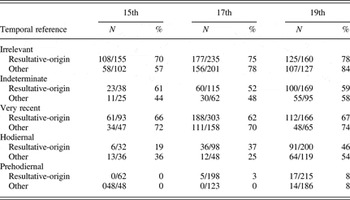
The strong favoring effect of very recent temporal reference is believed to be a reflection of the resultative origin of the PP, as many of the very recent tokens (66%, n = 93/140) are verbs from the semantic classes associated with resultative PP usage (i.e., perception, mental states, change of physical or emotional state, communication, motion, physical violence) (Carey, Reference Carey, Stein and Wright1995, Reference Carey and Goldberg1996; Detges, Reference Detges, Eksell and Vinther2006; Hernández, Reference Hernández2004). These verb classes represent approximately 60% of the overall corpus, so they do occur disproportionately in very recent contexts in the 15th century. It is important to note that these classes appear encoded in the PP in very recent contexts at a lower rate (66%) than do the other verb classes (72%), as shown in Table 5. The opposite is true for the irrelevant and indeterminate tokens. The resultative-compatible classes exhibit higher PP rates than the other verbs do.Footnote 9
Neutralization of resultative-compatible semantic class effects (rates of PP)

The very recent tokens, regardless of semantic class, tend to be of a telic nature (64%, n = 90/140), and so highlight events that have just occurred. It has been posited that speakers use new forms with pragmatic intent, as in Haspelmath's (Reference Haspelmath1999:1043) “maxim of extravagance”: Speakers resort to innovation in order to attract more attention to what they are saying. In so doing, forms are used in new contexts and grammaticalization may result. The frequent occurrence of the PP in very recent contexts may be interpreted as fulfilling the pragmatic need to keep the audience “clued in” about events offstage or characters' emotional states. In this way, many of these instantiations are quite similar to hot news PPs, as they generally announce information that the audience might not have inferred or otherwise known (or that the author did not want to leave up to chance). Example (25) shows a hot news perfect from contemporary Peninsular data (Schwenter, Reference Schwenter1994b:81), and (26) and (27) show 15th-century very recent tokens that communicate news of a similar nature to the contemporary hot news example.
(25) El español ha ganado.
‘The Spaniard has won.’
(26) Fue topado de los alguaziles noturnos e sin le conocer le han acometido.
‘He was caught by the night guard and without recognizing him they have arrested him.’
(15th, CEL)(27) ¡Helo todo perdido!
‘I have lost everything!’
(15th, CEL)In each of these examples, the events communicate news that the audience might not have otherwise known, but which would be essential to their understanding the plot.
Offering further support for the hot news interpretation of some very recent tokens is the fact that one-third of the interrogative clauses (32%, n = 28/87) appear in very recent contexts as characters use them to open up discussions about recent events. Here, (28) allows one character to bring up a new topic of conversation (relating events that have recently happened to him), whereas (29) and (30) show characters requesting information about recent events of other characters.
(28) ¿Pues aués oydo lo que con aquella mi señora he passado?
‘Well, have you heard what I have experienced while with m'lady?’
(15th, CEL)(29) ¿Qué es lo que mi hija ha sentido?
‘What is it that my daughter has felt/experienced?’
(15th, CEL)(30) ¿Cómo venís a tal hora, que ya amanesce? ¿Qué haués hecho? ¿Qué os ha passado?
‘Why are you here at this hour as it's barely dawn? What have you done? What has happened to you?’
(15th, CEL)Following the very recent contexts as favorable to the PP are the irrelevant temporal reference contexts. In the 15th century, 65% of the irrelevant temporal reference tokens were encoded in the PP. This rate in irrelevant contexts reflects that the PP was still developing these functions, as this rate does not compare to contemporary findings (96% in Schwenter & Torres Cacoullos, Reference Schwenter and Torres Cacoullos2008:21). The patterns of usage with the aforementioned resultative-compatible semantic classes in irrelevant contexts may shed light on how the PP spread to these contexts. The resultative-compatible classes form 60% (n = 155/257) of the irrelevant tokens, a representation that is proportional to their distribution in the corpus; however, the PP rate of occurrence is higher than average (70%). When the rate of PP occurrence in these resultative-compatible semantic classes was compared with that of the remaining classes (57%), the distribution was significant (p = .036, chi-square = 4.417). Carey (Reference Carey and Goldberg1996:38) posited that the use of these types of classes (specifically, she addressed perception and communication verbs) in iterative contexts helps establish event salience by its repeated nature, reinforcing the up-to-the-moment temporal sense of the perfect and shifting the “locus of relevance from the subject to the discourse content.” Additionally, the fact that these classes are so plentiful (they are 60% of the data) may aid in extension simply due to their association with the PP and their frequent use.
The third temporal reference context favoring the PP, the indeterminate perfective contexts, also exhibits clear semantic class effects. Use of these classes held at 60%, their distribution in the corpus, but once again, rates of PP use (61%) were higher than those of the other verb classes (44%). This indeterminate PP use (as well as the hot news use in very recent contexts) may explain the discrepancy noted previously in studies on Portuguese and Old French of telic (both accomplishment and achievement) verbs appearing in perfective situations, whereas nontelic values (i.e., irrelevant temporal reference) had not developed.
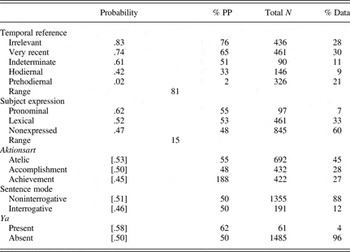
By the 17th century, the magnitude of effect for temporal reference had grown to five times that of the next factor group, subject expression, with ranges of 81 and 15, respectively. This is mostly owed to the strengthening of the PP in irrelevant contexts and its almost categorical disfavoring in prehodiernal contexts (omitted from the 15th century because there were no PP occurrences). The semantic class effect previously observed in the 15th century in irrelevant contexts has disappeared as the PP had generalized to all classes, and this same effect in indeterminate contexts was greatly reduced. This led to a shift in the constraint hierarchy between the 15th and 17th centuries, as the irrelevant contexts surpassed the very recent contexts as those most favoring (with a factor weight of .83 compared with .74). Indeterminate contexts began to favor the PP, and hodiernal shifted toward the PP, although these “today” contexts did not yet favor its occurrence.
In the 19th century, the previous contexts that favored the PP in the 17th century—irrelevant, very recent, and indeterminate—are joined by the hodiernal contexts. In effect, the PP is now favored in imperfective and nonremote temporally specified perfective contexts, thus representing the hybrid nature it exhibits today. The prehodiernal contexts are the only temporal reference contexts not favoring selection of the PP. This result parallels those of contemporary usage (Schwenter & Torres Cacoullos, Reference Schwenter and Torres Cacoullos2008:21).
SUBJECT EXPRESSION AND RESULTATIVE ROOTS
Subject expression was selected as the second most influential factor group in each century. In the 15th century, pronominal expression most favors the PP whereas lexical expression overwhelmingly disfavors it. This somewhat contradictory result is unexpected as one would assume that both pronominal and lexical expression would favor the PP if indeed a responsible author resultative effect can be measured (for Detges's Resultative B constructions [2006]). To determine if such an effect exists, 15th-century rates of PP with pronominal, lexical, and nonexpressed subjects were compared in the resultative-compatible classes in those temporal reference contexts where selection of the PP was possible (i.e., all but prehodiernal). When the prehodiernal contexts (where the PP does not occur) were removed, rates of the PP with pronominal and lexical subjects cooccurring with resultative-compatible verbs were higher than those for expressed subjects with “other” verbs or for nonexpressed subjects (Copple, Reference Copple2009). In this case, then, the disfavoring of lexical subjects in the 15th-century variable rule analysis is deceptive. This result is partially assumed to occur because 24% of the lexical subjects occurred in prehodiernal contexts (which were categorically Preterit). In those temporal reference contexts where the PP was possible, rates of PP with lexical subjects with resultative-compatible verbs exceed 60%, whereas the lexical subjects with other verbs' PP rate is 31%. In particular, lexical subject expression favors the PP in very recent contexts (64%), highlighting the evolving hot news function of the resultative construction as lexical subjects were used to report happenings to other characters.
As the PP grammaticalized further from its resultative roots, this subject expression effect was expected to diminish (although traces could easily be retained), and this is the case. By the 17th century, an overall weakening of this subject expression effect is apparent, although lexical subjects now slightly favor the PP in the multivariate analysis. Higher rates of the PP are found with pronominal and lexical subjects in cooccurrence with resultative-compatible semantic classes only in the most variable PP-Preterit contexts—indeterminate and hodiernal (Copple, Reference Copple2009). This suggests a lingering association of the responsible author effect observed in the 15th century in the least established PP contexts and the possible role of this construction as a vehicle for extension of the PP to new contexts. By the 19th century, these effects had largely disappeared.
DISTRIBUTION OF THE PP ACROSS TEMPORAL REFERENCE CONTEXTS
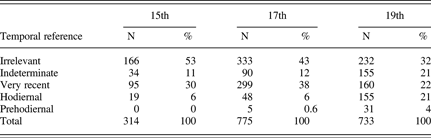
To further this analysis of the PP's advancing grammaticalization, the distribution of the PP across the different temporal reference contexts was examined for each century (see Table 6). Several shifts in distributional patterns provide supporting evidence of how the PP grammaticalized between the 15th and 19th centuries. In the 15th century, PP use was concentrated in very recent (30%) and irrelevant (53%) contexts. These figures are possibly a bit inflated because of the dramatic conventions of the time apparent in La Celestina,Footnote 10 yet this cannot mask the fact that there were certain contexts in which the PP was rarely compatible: indeterminate, hodiernal, and prehodiernal. The small representation in indeterminate contexts hints at the possibility of future development, but it is evident that the PP had not developed a perfective function at this time beyond recent past.
The PP distribution across temporal reference contexts in 15th, 17th, and 19th centuries
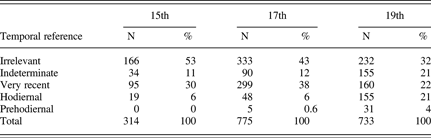
In the 17th century, little change in distribution occurred except for a decrease in the proportion of irrelevant contexts and an increase in very recent contexts. It is not coincidental that this is when the nueva comedia ‘new comedy’, introduced by Lope de Vega and adopted by many of his contemporaries, changed the dramatic format (Chandler & Schwartz, Reference Chandler and Schwartz1991:49; Dixon, Reference Dixon and Gie2004:251–264). Plots became more complicated and unexpected, quick resolutions the norm; hence, it is not surprising that hot news perfects were in high demand, nor that the type of philosophical statements found in La Celestina (mainly in irrelevant contexts) would diminish in number in order to move the different plotlines along (Chandler & Schwartz, Reference Chandler and Schwartz1991:116).
In the 19th century, the proportion of PP occurrences in irrelevant contexts continued to decrease, as did that of very recent contexts, as PP use in perfective contexts came to the fore. Perfective contexts encoding some amount of temporal remoteness (i.e., hodiernal, indeterminate, and prehodiernal) accounted for 46% of PP occurrences. This clearly represents the transition of the PP from a perfect to a perfect/perfective.
CONCLUSIONS
What then does the grammaticalization path of the Peninsular Spanish PP look like? The lingering effects of the resultative function as reflected in semantic class distributions suggest a route to perfectivity.
The very recent contexts were the most strongly favoring of the PP in the 15th century, and it is hypothesized that this “recent past perfect” emerged first from the resultative meaning. Very recent contexts were the only temporal reference context in which the rate of resultative-compatible PP was lower than that for the other verb classes (66% vs. 72%). This suggests that the resultative function, highly frequent in these contexts, was well on its way to becoming the more generalized means of reporting a recent event in the 15th century, hot news perfects as an initial foray into the expression of pure perfectivity. This hot news function most likely first emerged several centuries previously. Studies of older texts could test this idea.
Detges (Reference Detges, Eksell and Vinther2006:68) proposed that “contrary to Harris' (1982) model, perfects [in stage] II with temporal persistence and perfects III with current relevance are not successive diachronic stages, but only two distinct temporal values that can evolve simultaneously out of resultative B constructions.” The elevated relative frequency of the PP with responsible author resultative verbs would seem to have occurred rather simultaneously in irrelevant and indeterminate contexts in accordance with this proposal, and those resultative-compatible verbs appear to have led extension to those contexts. However, it should be stressed that it may not be simply the semantics of the resultative-compatible verb classes per se, but rather the association of particular verb types in these classes with the PP that played a role in the generalization of the PP. That is, there may be retention not just of meaning, but of distribution patterns in grammaticalization (Torres Cacoullos, Reference Torres Cacoullos2001).
It has also been hypothesized that perfects develop as the resultative function is extended to experiential and iterative contexts, reinforcing event salience (cf. Carey, Reference Carey and Goldberg1996). This does appear to be the case as the resultative-compatible verbs exhibit higher rates of PP use than other verbs in irrelevant temporal reference contexts in the 15th century, but between the 15th and 17th centuries, the rate of PP use rose in the other classes such that rates of other PP surpass the resultative-compatible PP, signaling a generalization of the PP's function(s) in irrelevant temporal reference. It is in the 17th-century data, then, that the PP truly establishes itself as a continuative perfect—it dominates the irrelevant temporal reference context relative to the Preterit (76% to 24%) and is used extensively in all semantic verb classes.
The indeterminate contexts exhibit a similar pattern, albeit at a slower rate (most likely caused by their covert perfective nature). In so doing, they reveal possible intermediate steps in the PP's extension to new contexts. The indeterminate contexts already reflected a fairly strong PP presence in the 15th century, but this was rooted in the use of the resultative-compatible classes in those temporally nonspecified contexts. However, the resultative's compatibility with telicity may have aided the PP's initial extension in indeterminate contexts to the other (nonresultative) semantic classes. Telic verbs in the other class have a PP rate of 60% (n = 6/10), whereas atelic verbs are much lower at 27% (n = 4/15). In theory, the PP construction, already strongly associated with telicity via its resultative function, extended to telic other verbs before generalizing to atelic other verbs because of the compatible perfective nature of indeterminate contexts. The data here are very limited, so these statements must remain speculatory. However, the proposed path for extension would be as follows:
• Early on in its development, the PP makes its initial forays into new contexts through the resultative-compatible semantic classes with which it is most associated.
• Over time, the constraints of resultative-compatible semantic classes lessen and the PP generalizes to other semantic classes (extending first to those members of the class that are aspectually compatible with the temporal reference contextFootnote 11).
• As semantic class effects are neutralized (i.e., all semantic classes exhibiting comparable rate of PP expression), the overall relative frequency of the PP with respect to the Preterit in a particular temporal reference context rises.
These findings outline a path for the PP's evolution to perfective (see Figure 1) that recasts the grammaticalization path discussed previously in terms of temporal reference.
Proposed grammaticalization path of Peninsular PP.

This path is based on the order in which the functions developed and their rates of occurrence in the corpora. It should be stressed that these temporal reference functions evolved in a simultaneous, yet staggered manner. The development of each function on the proposed path overlaps with and aids in the development or solidification of other functions. The resultative function, operative well before the 15th century, had already generalized to a hot news function in the 15th century. This hot news function was followed by the simultaneous encroachment of the PP's cooccurrence with resultative-compatible verbs in irrelevant and indeterminate contexts. The irrelevant PP developed much more quickly than the indeterminate PP, underlining that the durative and iterative functions of irrelevant contexts are more compatible with the PP's aspectual nature than the perfective, nonspecified indeterminate contexts.
Nonspecified temporal reference (irrelevant and indeterminate contexts) is believed here to be an important contributor to PP extension to temporally specified perfective contexts. The PP expanded from hot news to indeterminate and irrelevant contexts because the more event-salient reading of hot news was compatible with this extension. Importantly, irrelevant temporal reference contexts were compatible with both the durative qualities of a resultant state and the resultative's connection with the present. Repeated use of the PP in durative/iterative contexts has been posited to aid in supporting the shift from present state to the events that produced it (Carey, Reference Carey and Goldberg1996:39) and this is believed to hold true for the irrelevant PP usage here. The PP in indeterminate contexts, although more slow to develop, did increase and most likely led to increased hodiernal use in the 19th century and the highly frequent use observed today, as those indeterminate contexts reinforce the growing association of the PP with perfectivity. Theoretically, extension to prehodiernal contexts could have occurred more quickly (as it did in French and other Romance languages), but there are few indications that support this extension in this data (a shift from 0% to 8% PP use over 350 years). It is posited that for the prehodiernal PP to develop fully, indeterminate and hodiernal use would have to increase greatly, thereby strengthening a general sense of perfectivity with the PP, and also its use in temporally specific contexts.
These findings offer a new perspective on how the perfective Peninsular Spanish PP emerged, and, by extension, the possible behavior of perfects in Romance languages, thus adding to the growing body of work about grammaticalization processes in general. These findings also suggest additional avenues of research. The semantic class findings here merit more careful exploration as the operationalization of the resultative-compatible verb classes was rather broadly done (e.g., all communication verbs included, not just telic communication verbs). Finer distinctions might yield more information about the PP's extension into indeterminate and irrelevant contexts, as well as how generalization to other semantic classes occurred. Study of the two medieval perfect forms (with haber and ser auxiliaries) from a variationist perspective might explain how the PP came to assume some of the resultative contexts it commanded in the 15th century data here (e.g., its use with intransitive movement verbs) and its grammaticalization from resultative to hot news perfect.
APPENDIX
Factors contributing to the selection of PP over Preterit in the 15th century
Total N=314/638, p = 0.000
Log likelihood –339.346, Chi-square/cell = 1.2865
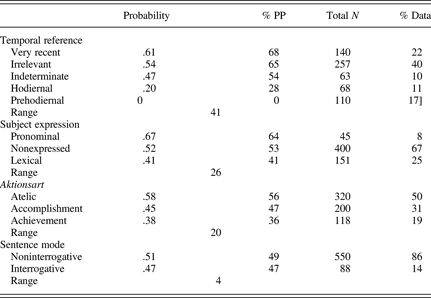
Note: All groups included selected as significant.
Factors contributing to the selection of PP over Preterit in the 17th century
Total N=775/1546, p = .013
Log likelihood –773.838, Chi-square/cell = .9524

Note: Not selected: Aktionsart, sentence mode, and ya.
Factors contributing to the selection of PP over Preterit in the 19th century
Total N=733/1502, p = .037
Log likelihood –783.439, Chi-square/cell = 1.1433

Note: Not selected: sentence mode and ya.