



Depression is not an inherent part of normal ageing, despite the common losses experienced in old age. Geriatric depression generally occurs after the age of 65 years, with a female preponderance and higher rates in hospital and residential care settings compared with community settings. Reference Mojtabai and Olfson1 In community settings, approximately 5% of adults aged 65 years and older meet the criteria for major depression, while rates of subsyndromal depression are estimated to be 8–16%. Reference Blazer2 The presence of subsyndromal depressive symptoms inflates these rates, and failing to capture these symptoms can negatively impact prognostication. Furthermore, geriatric depression is often compounded by medical multimorbidity and cognitive impairment, which may signal depressive pseudodementia, prodromal dementia or true comorbidities. These factors contribute to higher mortality due to complications, suicide and vulnerability to accidental events. Reference Naguy and Al-Khadhari3
The association between depression and outcomes in survivors of out-of-hospital cardiac arrest (OHCA) has previously been investigated. Reference Coppler, Brown, Moschenross, Gopalan, Presciutti and Doshi4–Reference Piegza, Jaszke, Scislo, Pudlo, Badura-Brzoza and Piegza7 However, fewer studies have explored the relationship between depression and OHCA occurrence itself, particularly in the geriatric population. Penninx et al found that the prevalence of depression among coronary heart disease (CHD) patients is exceptionally high, ranging from 15 to 30%, compared with 10% in the general population. Reference Penninx8 Empana et al indicated that clinical depression might be associated with a higher OHCA risk, independently of established CHD risk factors, and that this risk is correlated with the severity of depression. Reference Empana, Jouven, Lemaitre, Sotoodehnia, Rea and Raghunathan9 Additionally, suicide-related OHCA – estimated at 4.3–5.4 per 100000 person-years – is a distinct subset of OHCAs that result from intentional self-harm, such as drug overdose or hanging. Unlike most OHCAs, which arise from acute medical conditions, these events may be preventable through timely psychiatric assessment and intervention. Recent registry-based studies have further indicated a rising trend in suicide-related OHCA over the past decade, with consistently poor survival outcomes due to delayed recognition and the often irreversible nature of the underlying injury. Reference Lee, Ro, Park, Jeong, Song and Shin10
The association between OHCA and depression remains unclear in the geriatric population with depression, who often present with multiple medical comorbidities. This population warrants particular attention in OHCA research because they are especially vulnerable to autonomic dysregulation, adverse events related to polypharmacy and delayed recognition of clinical deterioration. Moreover, depression in older adults is frequently under-recognized and undertreated, leading to poor control of cardiovascular risk factors and an increased risk of sudden cardiac death. Reference Penninx8 This study utilises population-wide health registry data to identify risk factors for OHCA events, and to develop and validate a prediction model for OHCA among geriatric patients with depression.
Method
Study setting, ethnicity statement and data source
This retrospective, population-based cohort study employed a dynamic, repeated-measurement approach. In this repeated-measure design, each patient contributed multiple ‘observation dates’, beginning 90 days after the index date of depression medication prescription. Follow-ups were constructed at 30-day intervals. On each observation date, updated patient information was collected to estimate OHCA risk within 7, 30 and 90 days. Enrolment commenced on 1 January 2011, marked by the first out-patient visit where depression medication was prescribed. Each observation date was treated as an independent point for assessment of outcome probability. The study was approved by the National Taiwan University Hospital Hsin-Chu Branch (approval no. 110-152-E) and the National Health Research Institutes (NHRI; approval no. EC1101217-E).
Data were sourced from Taiwan’s Health and Welfare Data Science Centre (HWDC) under the Ministry of Health and Welfare. The HWDC provides anonymised data with stringent security protocols, eliminating the need for patient consent. The National Health Insurance (NHI) research database within the HWDC was examined. Taiwan’s NHI system, established in 1995, had covered 99% of the population by 2004. Reference Lin, Warren-Gash, Smeeth and Chen11 This database includes comprehensive demographic and clinical data, coded according to ICD-9 or ICD-10, and records of healthcare utilisation, medical expenditures and socioeconomic information. Reference Liao, Ko, Chen and Hsiao12–Reference Hsieh, Su, Shao, Sung, Lin and Kao Yang14
Geriatric depression: inclusion and exclusion
In Taiwan’s NHI system, out-patient visits usually involve medical prescriptions lasting at least 7 days for a specific illness. Between January 2011 and December 2020, depression cases were identified by combining diagnostic codes with medication prescriptions. Depression was classified using ICD-9 codes 296, 296.2, 300.4 and 311 and ICD-10 codes F32.x, F33.x and F34.1. The NHI’s auditing system, which monitors fraudulent activities and ensures data reliability, was also used. Additionally, to identify depression medications, we evaluated the number of out-patient visits per patient in the previous year that involved a prescription for at least 7 days, as per NHI standards. A participant with more than two such visits in a year was considered to have a need for depression medication.
The inclusion criteria for the study were patients aged over 65 years, those diagnosed with depression using diagnostic codes and those prescribed depression medications. A total of 28 drugs, categorised into five classifications, including benzodiazepines, antidepressants and miscellaneous, were considered (Supplementary Table 1 available at https://doi.org/10.1192/bjp.2025.10427). The exclusion criteria included patients who started treatment after 24 December 2020 and those who died within 7 days of their initial entry. The 7-day buffer was applied to ensure that individuals survived sufficiently long to contribute valid observation periods, and to minimise potential reverse causality, wherein imminent death might bias the association between depression treatment patterns and OHCA risk.
Variables
Variables included age, gender, pre-existing comorbidities, urgent medical needs, haemodialysis status, medication possession ratio (MPR), medication changes, psychotherapy and month of observation.
Pre-existing comorbidities, identified annually from comprehensive NHI prescription data, included diabetes mellitus, hypertension, chronic kidney disease, peptic ulcer disease, heart disease, cerebrovascular disease, hyperlipidaemia, chronic obstructive pulmonary disease, liver cirrhosis and arterial embolism and thrombosis. Haemodialysis was defined as ongoing treatment for over 3 months before the observation date.
Healthcare utilisation was tracked by recording both intensive care unit (ICU) visits in the year preceding the observation date and visits to out-patient clinics, emergency departments and hospital wards within 30 days before the observation date. Psychotherapy, defined as formal counselling sessions with a psychiatrist, was also tracked within the 3 months before the observation date.
Medication-related variables included MPR, calculated as the proportion of days covered by antidepressant prescriptions within each 30-day observation period (range 0–1), Reference Benner, Glynn, Mogun, Neumann, Weinstein and Avorn15 and recent antidepressant medication changes within the preceding 3 months.
Outcome, model development and validation
The primary outcome measured was the incidence of OHCA events at 3 time points: the 7th, 30th and 90th days after the observation date. OHCA events were identified using ICD codes and triage level 1 status in the emergency department. Reference Murray, Bullard and Grafstein16 Specifically, ICD-9 codes 427.4, 427.5, 798 and 798.1 and ICD-10 codes I46, I46.2, I46.8, I46.9, I49.0, I49.01 and R99 were used. During Taiwan’s transition from ICD-9 to ICD-10 in 2015–2016, some emergency departments adopted R99 as a temporary diagnostic code for cardiac arrest; these codes are frequently employed as proxies for OHCA in administrative databases. Because the data-set lacked information on post-event survival, our models were developed to estimate the probability of an OHCA occurrence independent of patient survival outcomes.
To predict and provide real-time OHCA probabilities, data from 2011 to 2018 were used for model development. Approximately 80% of the yearly data were allocated to the training set, while the remaining 20% were used for internal validation to assess performance and reproducibility. Additionally, considering the impact of the COVID-19 pandemic, data from 2019 (pre-pandemic) and 2020 (during the pandemic) were used as testing sets for temporal (external) validation. Reference Binuya, Engelhardt, Schats, Schmidt and Steyerberg17
Statistical analysis
Two independent analysts managed the data-set and conducted statistical analyses using SAS version 9.4 for Windows (SAS Institute Inc., Cary, North Carolina, USA; see https://www.sas.com) and R version 4.4 for Windows (R Core Team, Vienna, Austria; see https://www.r-project.org). A two-sided P-value < 0.05 was considered statistically significant. Student’s t-test and the chi-square test were used to compare continuous and discrete variables, respectively. Multivariate logistic regression analysis examined the association between predictors and OHCA events, with results reported as adjusted odds ratios and 95% confidence intervals. A nomogram graphically represented each predictor’s impact on OHCA probability using a simplified scoring system.
The model’s predictive accuracy was evaluated using the area under the receiver operating characteristic curve (AUROC) across the training, validation and testing data-sets. The Hanley–McNeil test was used to compare ROC curves (validation versus 2019 testing, validation versus 2020 testing and 2019 versus 2020 testing). A calibration plot compared predicted and observed OHCA risks.
Overall model performance was assessed using metrics from the confusion matrix, including sensitivity, specificity, accuracy, positive predictive value, negative predictive value, positive likelihood ratio (PLR), negative likelihood ratio (NLR) and diagnostic odds ratio (DOR).
Results
Participants: training and testing cohorts
Figure 1 illustrates the inclusion process of participants throughout the study period from 2011 to 2020. Initially, 465 414 patients with depression were identified; of these, 107 214 (23.0%) were derived from the geriatric population. Due to missing data on either gender or inability to determine the initial observation or outcome date, 3192 (3.0%) patients were excluded. This left 104 022 eligible patients, who were then followed longitudinally; among this cohort, 2479 (2.4%) had experienced OHCA.
Patient enrolment flow: this figure illustrates the patient screening and enrolment process. Initially, patients were screened and those meeting specified exclusion criteria were removed from the study. The remaining cohort underwent long-term longitudinal follow-up, during which out-of-hospital cardiac arrest (OHCA) incidents were identified using ICD-9 or ICD-10 diagnostic codes. ED, emergency department.

Table 1 demonstrates the baseline characteristics in the training and testing data-sets. The training cohort comprised 88 294 patients with a mean age of 75.6 years, of whom approximately 36% were male. The testing cohort for 2019 included 8231 patients with an average age of 75.7 years, while the 2020 testing cohort comprised 7526 patients with a mean age of 75.4 years. Overall, the training and testing cohorts demonstrated comparable baseline characteristics, with no statistically significant differences in regard to age, frequency of emergency department visits or history of prior hospitalisation.
Comparison of characteristics in training and testing data-sets

ED, emergency department; ICU, intensive care unit. Data are presented as numbers (percentages).
a. comparison between training and testing data-sets in 2019.
b. comparison between training and testing data-sets in 2020.
c. comparison between testing data-sets in 2019 and 2020.
Predictors of OHCA in geriatric patients with depression
This study developed three predictive models for the incidence of OHCA at intervals of 7, 30 and 90 days following each observation date; the associations and their statistical significance are detailed in Supplementary Table 2. The 7-day OHCA model identified key predictors, including older age, male gender, previous utilisation of medical resources (such as ICU admissions, emergency department visits and hospitalisations), pre-existing comorbidities (heart disease, cerebrovascular diseases and hyperlipidaemia) and medication changes. The 30-day OHCA model highlighted the same key predictors as the 7-day model, with additional factors including haemodialysis treatment, diabetes mellitus, chronic kidney disease and psychotherapy. Furthermore, the month of observation was a significant predictor, with observations from May to July showing a lower OHCA risk compared with January. Similarly, the 90-day OHCA model’s significant predictors largely mirrored those of the 30-day model, and the months from February to July were associated with reduced OHCA occurrence risk.
Figure 2(a–c) presents the nomograms for the three prediction models, illustrating the influence of significant predictors on OHCA incidence. Each predictor is represented by a line segment, with a scale indicating the range of values for that variable. Points ranging from 0 to 100 were assigned to each predictor based on its value. These points were then summed to determine the total score, which ranged from 0 to 350. By drawing a vertical line from the total score to baseline, the corresponding predictive probability of OHCA after 7 (Fig. 2(a)), 30 (Fig. 2(b)) and 90 days (Fig. 2(c)) post-observation date could be obtained.
Nomograms for out-of-hospital cardiac arrest (OHCA) in geriatric patients with depression: (a) 7-day, (b) 30-day, (c) 90-day. These nomograms estimate an individual’s OHCA risk by plotting values on each variable axis. A vertical line from each value to the top points scale determines the points assigned to that variable. Total points are summed and projected vertically from the total points scale to the bottom axis, providing a personalised OHCA risk assessment for geriatric patients with depression. ICU, intensive care unit; OPD, out-patient department; ED, emergency department; COPD, chronic obstructive pulmonary disease.

Prediction performance of the proposed models
In the training data-set, AUROC values ranged from 0.719 to 0.727. In the validation data-set, AUROC values for the 7-, 30- and 90-day models were 0.731, 0.742 and 0.729, respectively. For the 2019 testing data-set (Fig. 3(a)), corresponding AUROC values were 0.707 (95% CI: 0.707–0.707), 0.730 (95% CI: 0.730–0.721) and 0.734 (95% CI: 0.731–0.736), respectively. In the 2020 testing data-set (3b), the corresponding AUROC values were 0.771 (95% CI: 0.771–0.771), 0.757 (95% CI: 0.757–0.758) and 0.745 (95% CI: 0.743–0.747), respectively.
Receiver operating characteristic (ROC) curve for out-of-hospital cardiac arrest (OHCA) prediction: (a) 2019 testing data-set, (b) 2020 testing data-set. Each panel displays ROC curves for three time points – 7 days (dark blue line), 30 days (light blue line) and 90 days (grey line) – along with the area under the curve (AUC) and corresponding 95% confidence intervals.

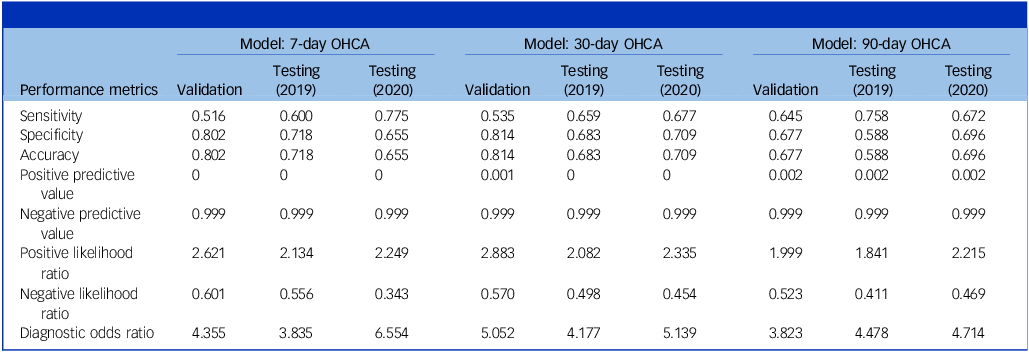
Table 2 summarises the overall prediction performance of the models derived from the confusion matrix, including both the validation data-set and the two testing data-sets. For short-term OHCA prediction, the 7-day OHCA model’s performance metrics in the 2019 testing data-set were as follows: sensitivity, 0.600; specificity, 0.718; accuracy, 0.718; PLR, 2.13; NLR, 0.56; and DOR, 3.84. In the 2020 testing data-set, corresponding metrics were 0.775, 0.655, 0.655, 2.25, 0.34 and 6.55, respectively.
Performance of models in validation and testing data-sets

OHCA, out-of-hospital cardiac arrest.
For long-term OHCA prediction, the 90-day OHCA model’s performance metrics in the 2019 testing data-set were sensitivity, 0.758; specificity, 0.588; accuracy, 0.588; PLR, 1.84; NLR, 0.41; and DOR, 4.48. In the 2020 testing data-set, the corresponding metrics were 0.672, 0.696, 0.696, 2.22, 0.47 and 4.71, respectively.
Calibration
Supplementary Figs 1 and 2 illustrate the calibration plot for prediction of 7-, 30- and 90-day OHCA in the 2019 and 2020 testing data-sets. The dotted 45° line represents perfect calibration, where the predicted probabilities align exactly with the observed probabilities. Given the low incidence rate of OHCA in the studied population, the predicted and observed probabilities ranged from 0 to 0.004. The ten dots, each accompanied by confidence intervals, represent deciles of the population divided according to predicted probability. In the 2020 data-set, the model’s performance for OHCA prediction showed slight overestimation, as evidenced by the blue line generally appearing below the dotted line.
Discussion
Model performance in prediction of short- and long-term OHCA
In this study, geriatric patients with depression presented with various OHCA risks and associated predictors across different time points. Our modelling framework was designed to reflect real-world clinical reassessment intervals and to facilitate the development of periodic, actionable risk alerts for OHCA. Among the revealed causes, there were individual health factors, recent medical resource needs, seasonal factors and potentially unquantifiable personal behaviour factors. These factors were intricately interwoven, leading to a certain degree of limitation in the accuracy of models predicting OHCA in older patients with depression, whether it be within 7, 30 or 90 days. Overall, our model demonstrated greater stability in predicting long-term OHCA (90 days) compared with short-term predictions of 7 or 30 days. Additionally, the model’s accuracy has improved post- compared with pre-COVID-19 outbreak. This improvement may be attributed to the COVID-19 pandemic, which restricted most behaviours and implemented isolation policies, Reference Xu, Sun and Fu18 thereby reducing the complexity of individual health and social factors in the target population and enhancing predictive accuracy.
Although the absolute incidence of OHCA in this cohort was relatively low, the potential consequences of missed high-risk cases – often resulting in irreversible collapse or death – highlight the critical importance of timely identification. When evaluated through a quality-adjusted, life-year-based framework, targeted, low-cost interventions (e.g. medication review, proactive psychiatric follow-up) for high-risk individuals may still constitute a cost-effective and ethically sound allocation of clinical resources in geriatric care.
Medical needs may serve as a warning sign
Frequent utilisation of medical resources within a short period was a significant indicator for OHCA occurrence, regardless of whether it pertains to short-term (7 days) or long-term (30, 90 days) OHCA events. As early as 2019, Shuvy et al’s study found that >25% of patients with OHCA sought emergency medical assistance within 90 days, Reference Shuvy, Koh, Qiu, Brooks, Chan and Cheskes19 with the proportion of emergency visits and hospitalisations increasing as the time of the OHCA event approached. Our study, utilising a large national population database, reached the same conclusion. In predicting short-term OHCA we found that, among older individuals with depression, ICU admissions within 1 year, emergency visits, hospitalisations and out-patient medical use were significantly associated with OHCA occurrence within 7 days. In the 30- and 90-day models, ICU admissions, emergency visits and hospitalisations remained significant factors. These medical needs may be due to either psychiatric or medical conditions. Frequent utilisation of medical resources before OHCA occurrence suggested the presence of acute health issues requiring attention, and indicated that these patients were at risk of sudden death. Reference Zylyftari, Moller, Wissenberg, Folke, Barcella and Moller20 These risk signs may be used for early prevention.
Pre-existing conditions remain a contributory factor to OHCA occurrence
Patient-specific health factors remain the primary predictors of OHCA occurrence. In our predictive model, age remained the most significant and contributing risk factor for OHCA probability in the geriatric depression population, similar to other common cardiovascular diseases. Among pre-existing comorbidities, the primary impact was on OHCA occurrence within 30 and 90 days, with these conditions being less significant in the 7-day predictive model. This may be because most pre-existing conditions are chronic diseases that require a prolonged period to alter physiological states and cause sudden death. Besides common conditions such as diabetes, cardiovascular and cerebrovascular diseases, chronic kidney disease combined with dialysis treatment was a significant factor for 30- and 90-day OHCA in the geriatric depression population. This finding aligned with the medical needs conclusion, Reference Shuvy, Koh, Qiu, Brooks, Chan and Cheskes19,Reference Zylyftari, Moller, Wissenberg, Folke, Barcella and Moller20 because these patients frequently visited hospitals for dialysis, and blood infection risk post-dialysis led to an increasing mortality rate over the years. Reference Sarnak and Jaber21
Switches in antidepressants also increased the likelihood of OHCA within 7 and 30 days but not within 90 days. Medication switches may indicate worsening depression, necessitating medication adjustments. The lack of impact on 90-day OHCA probability may be due to physiological adaptation and better control of depression over time. Additionally, regular psychiatric counselling could reduce OHCA risk within 30 days; however, this effect was not significant in the two other periods. This factor probably should be considered alongside the patient’s mobility and medication adherence. Specifically, older depressed patients who could visit the hospital for counselling (psychotherapy group) were at lower risk compared with bedridden patients who frequently changed medications.
Suicide-related OHCA
The term ‘suicide-related OHCA’ was mentioned to acknowledge a subset of cardiac arrests triggered by intentional self-harm (e.g. overdose or hanging), which has been increasingly recognised in national registry data. However, our data-set did not allow differentiation between suicide-related and medically induced OHCA. As such, while we included the former in the broader conceptual framework of depression-associated risk, the majority of OHCA events in our analysis were probably of medical origin.
Month of the year potentially associated with OHCA
Winter is a season during which older individuals with depression are more prone to experiencing OHCA; Reference Muller, Dyson, Bernard and Smith22 this may be related to both physiological and depressive disorders. During winter, the incidence of sudden cardiovascular death among the geriatric population increases due to lower temperatures. Reference Baker-Blocker23 Additionally, studies indicate that winter may trigger or exacerbate depressive episodes. Reference Zhang, Folarin, Sun, Cummins, Ranjan and Rashid24 These findings align with our study, showing a significant increase in OHCA risk from October to December compared with January in the 90-day predictive model.
Study limitations
The current study has certain limitations. First, suicide always poses a risk for the worsening of depression, Reference Orsolini, Latini, Pompili, Serafini, Volpe and Vellante25 even among the geriatric population. Because suicide is a deliberate act, our study, which utilised an extensive database, failed to ascertain whether OHCA incidents were due to suicidal factors. This could be one of the reasons for the model’s limited accuracy. Second, other psychiatric disorders – such as anxiety, schizophrenia, substance use disorders and insomnia – may contribute to OHCA vulnerability in older adults. However, due to diagnostic overlap, non-specific medication indications and coding limitations inherent in claims data, we were unable to separately assess the impact of these conditions. Third, although we defined our target population as older adults (≥65 years) with depression, we were unable to distinguish between late-onset depression and depression that began earlier in life and persisted into old age. This distinction may be clinically meaningful, because the duration and subtype of depression (e.g. chronic versus new-onset) may differentially affect physiological vulnerability, comorbidity profiles and the risk of OHCA. Fourth, key lifestyle and behavioural factors such as smoking, obesity, physical activity and substance use were not available in the NHIR Database, because this claims-based registry was originally designed for administrative and reimbursement purposes and does not capture variables unrelated to insurance claims. These unmeasured confounders may influence both depression severity and the risk of OHCA. Future studies incorporating clinical data or survey-based assessments are warranted to address this limitation. Fifth, due to the limitations of the claims-based data-set, we were unable to obtain clinical scores or structured psychiatric assessments to evaluate depression severity. Although we identified antidepressant use and recent medication changes, we could not quantify cumulative treatment duration or dose–response relationships. Last, we could not determine the proportion of psychiatric consultations where medication was collected by family members on behalf of the patient. This could have led to information bias, because physicians were unable to assess patients directly during consultations.
Clinical implications
In addition to age, acute medical needs, pre-existing comorbidities, psychiatric medication adjustments and seasonal variation were identified as significant predictors of both short- and long-term OHCA risk among older patients with depression. In clinical practice, frequent emergency department visits or repeated changes in antidepressant regimens may serve as early warning signs of impending physiological or psychiatric deterioration. These findings highlight the importance of proactive monitoring and multidisciplinary intervention to reduce the risk of OHCA in this vulnerable population.
Supplementary material
The supplementary material is available online at https://doi.org/10.1192/bjp.2025.10427
Data availability
The data that support the findings of this study are available on request from the corresponding author. The data are not publicly available due to restrictions.
Acknowledgements
We thank Editage (www.editage.com.tw) for English-language editing.
Author contributions
C.-W.S.: conceptualisation, funding acquisition, investigation, methodology, writing (original draft preparation, review and editing). C.-C.C.: investigation, validation, writing (review and editing). Y.-T.C.: data curation, formal analysis, software. C.-Y.F.: investigation, validation, visualisation. E.P.-C.H.: conceptualisation, methodology.
Funding
This work was supported by the National Taiwan University Hospital Hsin-Chu Branch and the NHRI (grant nos NHRI-111-H01 and NHRI-112-H04).
Declaration of interest
None.






eLetters
No eLetters have been published for this article.