INTRODUCTION
Closing-in (CI) is the tendency to reproduce drawings in the space close to the model or to directly draw on the model in copying tasks (Mayer Gross, Reference Mayer Gross1935). In recent years, CI has been extensively studied particularly in individuals with different forms of dementia (Trojano & Gainotti, Reference Trojano and Gainotti2016); CI has been observed in Alzheimer’s disease (AD; De Lucia, Grossi, Fasanaro, Carpi, & Trojano, Reference De Lucia, Grossi, Fasanaro, Carpi and Trojano2013; Grossi, Orsini, & De Michele, Reference Grossi, Orsini and De Michele1978; Grossi, De Lucia, & Trojano, Reference Grossi, De Lucia and Trojano2015; Lee et al., Reference Lee, Chin, Kang, Kim, Park and Na2004), vascular dementia (De Lucia, Grossi, & Trojano, Reference De Lucia, Grossi and Trojano2014), and fronto-temporal dementia (Grossi, De Lucia, Milan, & Trojano, Reference Grossi, De Lucia, Milan and Trojano2015) and, more recently, in Parkinson’s disease with associated dementia (De Lucia, Grossi, Mauro, & Trojano, Reference De Lucia, Grossi, Mauro and Trojano2015; Poletti et al., Reference Poletti, Lucetti, Del Dotto, Borelli, Baldacci, Logi and Bonuccelli2012). Moreover, the phenomenon has been reported in individuals with neurodegenerative disorders without clinically relevant associated dementia (De Lucia et al., Reference De Lucia, Grossi, Mauro and Trojano2015), and in focal brain-damaged individuals (De Lucia, Grossi, & Trojano, Reference De Lucia, Grossi and Trojano2016; Gainotti, Reference Gainotti1972).
In all these neurological conditions, CI in copying tasks were due to frontal dysfunctions, confirming the idea that CI might represent a neuropsychological marker for frontal/executive dysfunctions (De Lucia et al., Reference De Lucia, Grossi, Fasanaro, Carpi and Trojano2013). Indeed, visuo-constructional tasks involve several mental processes monitored by frontal/executive abilities. Figure copying entails visual attention, visuo-spatial analysis, and planning abilities, and requires continuous attentional switches from the model to the drawing hand (Gasparini et al., Reference Gasparini, Masciarelli, Vanacore, Ottaviani, Salati, Talarico and Bruno2008). Impairments of frontal/executive functions might release a “default” attraction of the moving hand toward the focus of visual attention (the stimulus to be copied). Some authors, indeed, observed that the attraction of attention and action toward the model is boosted when participants’ attentional resources are divided between two concurrent cognitive activities (Ambron, McIntosh, Allaria, & Della Sala, Reference Ambron, McIntosh, Allaria and Della Sala2009; De Lucia et al., Reference De Lucia, Grossi and Trojano2014; McIntosh, Ambron, & Della Sala, Reference McIntosh, Ambron and Della Sala2008).
Of interest, it has been recently observed that mild-to-moderate AD patients showing CI, and in particular those who overlap their copy onto the model (adherent-type of CI), manifested more severe loss of independence in the ability to carry out basic and instrumental activities of daily living with respect to patients with dementia not showing CI (De Lucia, Grossi, & Trojano, Reference De Lucia, Grossi and Trojano2017). This finding suggested that CI in copying tasks could serve as an indirect index of a basic impairment of attention-action control in daily living activities. Walking is perhaps the most common and automatized activity of daily living, and yet requires cognitive control abilities whenever ecological conditions call for a concurrent secondary task, as in walking and avoiding hurdles or walking carrying a glass at home. All these common situations are considered rather unproblematic, but can constitute a risk for falling when attentional capacities are limited (Ruffieux, Keller, Lauber, & Taube, Reference Ruffieux, Keller, Lauber and Taube2015; Wollesen, Voelcker-Rehage, Regenbrecht, & Mattes, Reference Wollesen, Voelcker-Rehage, Regenbrecht and Mattes2016).
On this basis, the aim of the present study was to directly assess whether CI could manifest during walking. We hypothesized that, if CI results from a failure to inhibit automatic responses toward distractors, then veering of walking trajectories toward irrelevant objects should be significantly larger among individuals who exhibit CI, compared to individuals not showing CI. To test this prediction, we devised a simple walking task to be performed in presence of visual distractors.
METHOD
Participants
Participants for the present study were recruited from a continuous series of outpatients attending the Geriatric Center “Frullone” in Naples. In analogy with previous studies on CI (e.g., Ambron et al., Reference Ambron, McIntosh, Allaria and Della Sala2009; De Lucia et al., Reference De Lucia, Grossi, Fasanaro, Carpi and Trojano2013), we excluded patients with severe dementia. To qualify for the present study, participants had to meet the following inclusion criteria: (i) clinical diagnosis of probable AD according to the NINCDS-ADRDA diagnostic criteria (McKhann et al., Reference McKhann, Drachman, Folstein, Katzman, Price and Stadlan1984); (ii) mild to moderate level of AD severity, as characterized by a score ranging 0.5 to 2 points on the Clinical Dementia Rating scale (CDR; Hughes, Berg, Danziger, Coben, & Martin, Reference Hughes, Berg, Danziger, Coben and Martin1982), and by a raw score ranging 10 to 23 on the Italian version of Mini Mental State Examination (Measso et al., Reference Measso, Cavarzeran, Zappala, Lebowitz, Crook, Pirozzolo and Grigoletto1993); (iii) formal education of at least 2 years; (iv) lack of concomitant severe organ insufficiency or neoplastic disease; (v) lack of walking difficulties as characterized by a raw score ranging 15 to 20 on the Assessment of Walking Skills (AWS) test (Della Sala, Spinnler, & Venneri, Reference Della Sala, Spinnler and Venneri2004), see below.
Fifty AD patients (36 females) with age ranging 53 to 76 years, and education ranging 5 to 17, met the above selection criteria.
We also enrolled a group of 20 healthy adults, age- and education-matched with the AD sample [9 female; age range: 55–71 years; education range: 5–17 years; Mini-Mental State Examination (MMSE) range: 26–30; Clinical Dementia Rating (CDR) scale: 0], with no previous history of neurological or psychiatric diseases, and without walking difficulties.
When necessary, participants were assessed while wearing their own glasses to ensure normal or corrected to normal visual acuity. No participants had clinically relevant visual field defects.
All participants gave their written informed consent to participate to the study. This study was conducted in accordance with the Ethical standards of Helsinki Declaration.
Preliminary Assessment of Walking Skills
Before entering the study, all participants underwent a preliminary evaluation of walking skills to avoid any abnormalities potentially interfering with performance on the walking task. To this aim, we used a dedicated task included in the AWS test (Della Sala et al., Reference Della Sala, Spinnler and Venneri2004). The task requires participants to immediately imitate motor actions demonstrated and verbally described by the examiner (i.e., “walk with right hand on stomach and left hand on back,” or “walk with your hands behind the nape of your neck”). Two examiners are present during the task, one demonstrating the items and the other observing and recording participants’ performance. The task includes 20 items (plus two practice trials). Each response is scored 1 point when accurate or 0 when it includes: (i) crossing of the legs while attempting to walk; (ii) inability to keep an upright stance; (iii) association with parasitic arm or trunk movements or bizarre leg movements; (iv) impaired balance; (v) lack of dexterity. The total score ranges 0 to 20 points.
Neuropsychological Assessment
In addition to the MMSE and CDR, all participants underwent several tests assessing frontal-executive abilities, visuo-spatial and visuo-constructional skills, and anterograde memory; two standard questionnaires assessed functional independence.
Frontal-executive abilities were evaluated by means of Frontal Assessment Battery (FAB; Appollonio et al., Reference Appollonio, Leone, Isella, Piamarta, Consoli, Villa and Nichelli2005), phonological verbal fluency test (Carlesimo, Caltagirone, & Gainotti, Reference Carlesimo, Caltagirone and Gainotti1996), Stroop color-word test (Caffarra, Vezzadini, Dieci, Zonato, & Venneri, Reference Caffarra, Vezzadini, Dieci, Zonato and Venneri2002a), attentional matrices (Spinnler, & Tognoni, Reference Spinnler and Tognoni1987), and Trail Making Test (TMT; Giovagnoli et al., Reference Giovagnoli, Del Pesce, Mascheroni, Simoncelli, Laiacona and Capitani1996). The FAB consists of verbal and non-verbal subtests and provides a global measure of frontal control abilities; the phonological verbal fluency test requires participants to produce in one minute as many words beginning with the letter “F”, “A”, and “S” as they can, and provides a measures of cognitive flexibility. The Stroop test consists of three sections requiring to name colors (naming task), to read words (reading task), and to inhibit reading of color-words and name the ink color in which each word is printed (interference task), and provides a measures of executive monitoring and inhibition of irrelevant responses. The attentional matrices consist of three matrices of digits on which participants are required to cancel target-digits ignoring distractor-digits, and provide a measure of visual attention. The TMT consists of two parts in which participants have to draw lines connecting numbers in ascending order (part A), and to connect numbers and letters in ascending order alternating the two series (i.e., 1-A-2-B-3-C; part B), and provides a measure of sustained and selective attention.
Visuo-spatial abilities were evaluated by means of the Corsi span forward (Spinnler & Tognoni, Reference Spinnler and Tognoni1987), and the Clock drawing test (Mondini, Mapelli, Vestri, & Bisiacchi, Reference Mondini, Mapelli, Vestri and Bisiacchi2003). Corsi span requires patients to reproduce block-tapping sequences of increasing length, and provides an index of working memory for visuo-spatial information. The Clock drawing task requires participants to complete a shape of a clock by putting in all the numbers and setting the hands for 2 and 45, and provides a measure of visuo-spatial skills, semantic knowledge, planning, and constructional abilities.
Visuo-constructional abilities were assessed by the immediate reproduction of Rey Complex Figure (Caffarra, Vezzadini, Dieci, Zonato, & Venneri, Reference Caffarra, Vezzadini, Dieci, Zonato and Venneri2002b), and by the figures copying task (Spinnler & Tognoni, Reference Spinnler and Tognoni1987). The two tasks require participants to copy an abstract complex model or seven arrays of black-and-white geometrical drawings (see below).
Anterograde memory was assessed in the verbal domain by immediate and delayed recall of a series of 15 words (Carlesimo et al., Reference Carlesimo, Caltagirone and Gainotti1996) that provide two measures: immediate recall (range, 0–75) and delayed recall (range, 0–15). Anterograde memory in the visuo-spatial domain was assessed by delayed reproduction of the Rey Complex Figure (Caffarra et al., Reference Caffarra, Vezzadini, Dieci, Zonato and Venneri2002b).
In all participants we also assessed daily living functioning by the Italian informant-based versions of the questionnaires for basic activities of daily living (BADLs; Katz, Downs, Cash, & Grotz, Reference Katz, Downs, Cash and Grotz1970), and instrumental activities of daily living (IADLs; Lawton & Brody, Reference Lawton and Brody1969). These questionnaires explore patients’ functional level expressed as the number of activities performed autonomously by the participants.
Assessment of Closing-in in Copying of Geometrical Figures
To detect CI, we used Spinnler and Tognoni’s copying test (1987) mentioned above. In this task, participants were shown with seven stimulus-sheets each including black-and-white geometrical figures (e.g., square, diamond, cube, triangle) centrally printed in the upper half of an A4 sheet of paper. Participants were explicitly required to reproduce the model in the lower half of the same sheet, centrally aligned with respect to participants’ body midline.
For each graphic reproduction, we recorded presence and type of CI. Two types of CI were identified: adherent-CI, occurring when at least one element of the copy overlapped to at least one element of the model (i.e., a side of a square), and near-CI, occurring when any point of the copy was within 10 mm from the lower side of the model (De Lucia, Grossi, Fasanaro, Carpi, & Trojano, Reference De Lucia, Grossi, Fasanaro, Carpi and Trojano2013). Number of near-CI, adherent-CI, and total CI was computed for each individual, independently from the accuracy score computed after Spinnler and Tognoni (Reference Spinnler and Tognoni1987).
Assessment of CI in a Walking Task
In a second session, performed 1 day later, the tendency to veer toward a salient visual stimulus was assessed in a walking task. The task was run in a dedicated space of the daily center “Frullone,” a large rectangular empty room with white walls and light gray floor, and with one window in the upper half of the two longest sidewalls.
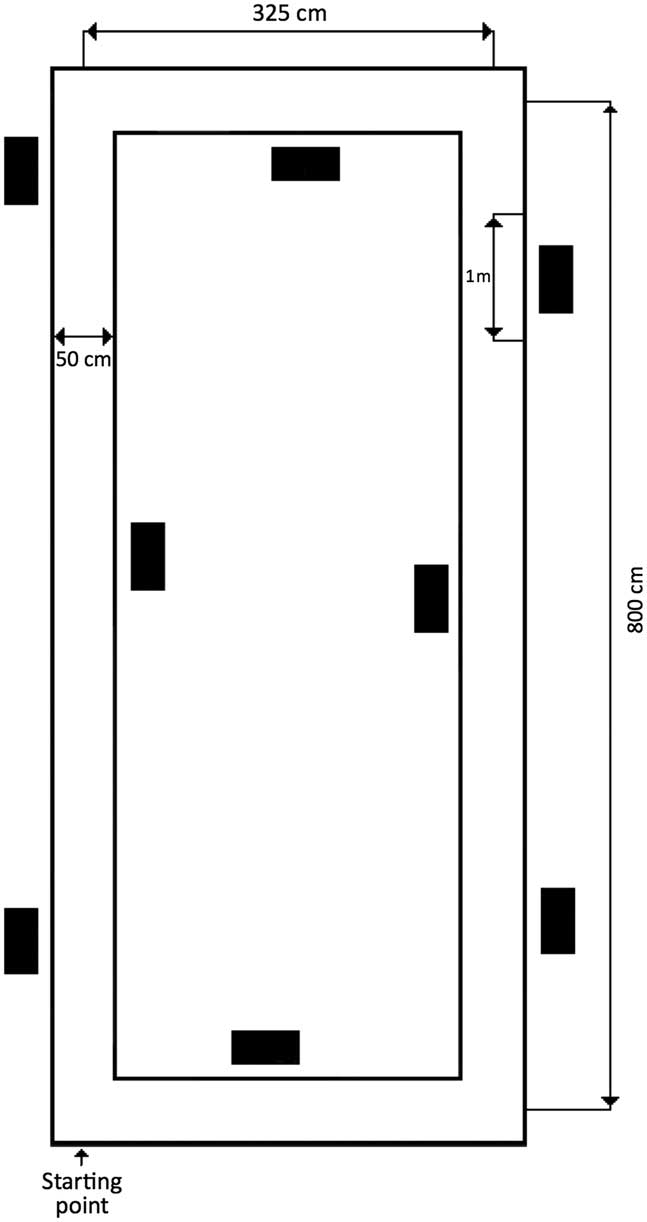
In the center of the room a walking path (800 cm long, and 325 cm wide) was marked by two parallel black lines (made by 10-cm-wide thin rubber adhesive tape) placed 50 cm from each other. On the four sides of the path, eight visual distractor-items were placed randomly (30 cm from the path; see Figure 1). The distractor-item consisted of rectangular red light cardboard boxes, 140 cm high, and 50 cm wide (the boxes were not anchored on the ground for safety reason).
The figure shows a representative example of the walking path used to assess closing-in in an ecological task. Participants were required to walk in the center of the path. The black rectangles depicted on each side of the path represent the red boxes used as distractor-items.

Participants were explicitly required to walk at their own pace in the center of the path paying attention not to step on the parallel black lines; no explicit mention was made about the red boxes, and no time restriction was given. One examiner shadowed the participants (without providing any further instruction or cue) along the whole path to supervise task completion and avoid risk of falling.
On each trial, we recorded the number of relevant veering errors (defined as steps on the borders of the path placed in the area of each red box, or bumps into one box) in correspondence of the 8 red boxes. Number of total errors ranged 0 to 16, as all participants completed two trials, one in clockwise and one in anticlockwise direction.
Statistical Analyses
On the basis of presence of CI in the copying test, we divided participants into three groups: healthy adults (HA), AD individuals not showing CI errors (AD group), and AD individuals showing at least one type (near or adherent) of CI error (AD-CI group). Then, we ran a multivariate analysis of variance (MANOVA), to compare demographic data, neuropsychological scores and scores on daily living functioning scales in the three groups (HA, AD, and AD-CI). Post hoc analyses were performed by means of the Bonferroni-corrected post hoc comparisons, according to which the observed p-value is corrected by multiplying it by the number of comparisons; the corrected p-value is then evaluated against the conventional significance level of p<.05. In the present study, all significant tests had p<.05 after adjustment.
Number of participants showing veering errors in the walking task was compared between AD and AD-CI groups by chi-square analysis. Moreover, we compared AD-CI participants showing CI errors in copying of geometrical figures and veering errors in the walking task and AD-CI participants showing CI errors only in copying of geometrical figures by means of a second MANOVA with demographic data, neuropsychological scores and functional independence as the dependent variables. Post hoc analyses were performed by means of Bonferroni-corrected post hoc comparisons, setting the level of significance at p<.05.
All data analysis has been performed by Statistical Package for Social Science (SPSS, ver. 19.0; IBM, Armonk, NY).
RESULTS
No HAs produced CI in copying of geometrical figures test (HA group). Among AD individuals, 16/50 participants did not show CI (AD group), 34/50 (68%) participants produced 97 CI errors out of a total of 350 copies (AD-CI group). Among AD individuals showing CI, 4 produced near-CI in isolation, 19 produced adherent-CI in isolation, and 11 individuals exhibited both near-CI and adherent-CI.
Results from the first MANOVA analysis showed a main effect of the group (Wilks’ λ=.013; p<.001; η2 p=.88). AD-CI group individuals achieved significantly lower scores on frontal/executive abilities, and on daily living functioning than AD individuals. Moreover, both AD and AD-CI individuals scored significantly poorer than HAs on all the neuropsychological measures consistently with the clinical diagnosis (see Table 1).
Means (SDs) of demographic data, general cognitive functioning, overall dementia severity, and neuropsychological test scores in healthy adults without CI (HN), Alzheimer’s disease individuals without CI (AD), and Alzheimer’s disease individuals with CI (AD-CI). Summary statistics of the AD vs AD-CI comparisons are also reported (p-value and partial eta squared).

Note. Summary statistics of the comparisons between the two groups are also reported (p-value and partial eta squared).
*Different from HA at corrected-p<.05.
**Different from HA at corrected-p<.005.
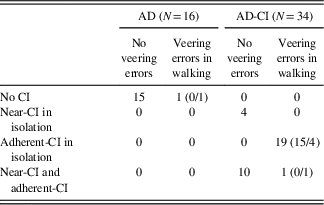
In the walking task, no HA individuals veered their walking trajectory toward the distractors. Among AD group, veering errors were evident in 1/16 individual not showing CI in copying of figures, producing a total number of four errors. Most AD-CI individuals (20/34; 58.8%) also showed at least one veering error in the walking task, producing a total number of 174 errors. The difference in percentage of patients showing veering errors between the two AD groups (AD vs. AD-CI) was significant (chi-square=6.138; df=1; p=.02). All patients showing veering errors in the walking test also showed adherent-CI in the copying test (see Table 2).
Number of AD individuals showing veering errors in walking and/or CI in copying (the number of participants showing bumps into boxes/steps on the path errors is shown in parentheses)

Note. AD=AD individuals not showing CI; AD-CI=AD individuals showing CI. No healthy individual produced CI or veering errors.
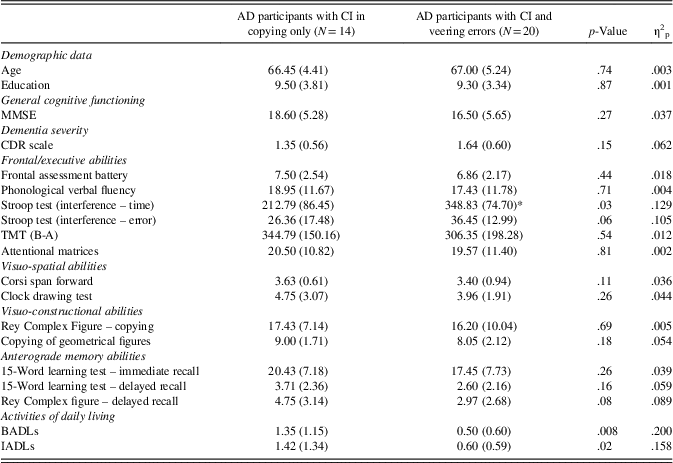
Results from the second MANOVA showed no significant general effect (Wilks’ λ=.32; p=.21; η2 p=.67), but the analysis of the individual effects revealed that AD-CI participants who showed CI and veering errors had a significantly poorer performance on the Stroop-color word test, in terms of interference-time, and lower level of independence on both BADLs and IADLs questionnaires with respect to AD-CI individuals who showed CI in copying only (see Table 3).
Means (SDs) of demographic data, general cognitive functioning, dementia severity, and neuropsychological test scores in Alzheimer’s disease individuals showing closing-in (CI) in graphic task only, and Alzheimer’s disease individuals with CI in graphic task and veering of walking trajectory errors in the walking task.

DISCUSSION
In the present study, we explored the relationship between CI in a graphic copying task and the tendency to show comparable errors in an ecological task such as walking. We observed that most AD patients (58.8%) producing graphic CI also tended to veer their walking trajectory toward irrelevant visual distractors. Of interest, the strongest association was found between veering of walking trajectory and the adherent type of CI. Patients with graphic CI and veering errors in walking also manifested a more severe defect in tests requiring attention-executive monitoring and inhibition of responses toward irrelevant stimuli with respect to the remaining AD patients of the present sample. Thus, defective inhibition of automatically cued actions would release the tendency to veer walking trajectories.
Usually, frontal-attention processes carry out a high-level control during walking for monitoring all the environmental variables. When frontal/executive abilities are defective, visual distractors can trigger a tendency to veer toward them. Ambron, McIntosh, and Della Sala (Reference Ambron, McIntosh and Della Sala2012), described a similar effect in pre-school age, as they found that children showing CI can manifest a stronger tendency to deviate their drawing productions toward visual distractors compared to children without CI. Of interest, these authors also observed that the tendency to veer toward the distractor was most evident in children producing adherent-CI compared to those showing near-CI only. Therefore, the present findings would reinforce the idea that CI in copying tasks and the tendency to approach toward visual distractors would arise from a failure of the frontal/executive control processes involved in the inhibition of actions automatically triggered by external cues (De Lucia et al., Reference De Lucia, Grossi, Fasanaro, Carpi and Trojano2013; Kwak, Reference Kwak2004; Trojano & Gainotti, Reference Trojano and Gainotti2016).
The present results, demonstrating that graphic CI is often associated with specific errors in walking, support the value of graphic CI in predicting loss of independence in basic and instrumental activities of daily living (De Lucia et al., Reference De Lucia, Grossi and Trojano2017). In this respect, adherent-CI seems to be directly related to impairments of abilities to monitor and inhibit attraction toward salient visual stimuli (De Lucia et al., Reference De Lucia, Grossi, Fasanaro, Carpi and Trojano2013; McIntosh et al., Reference McIntosh, Ambron and Della Sala2008).
Attention skills are usually required to walk in daily living. Elderly individuals with reduced attention capabilities may fail in monitoring and planning their visual attention and action, and collide with objects (Vermeulen, Neyens, van Rossum, Spreeuwenberg, de Witte, Reference Vermeulen, Neyens, van Rossum, Spreeuwenberg and de Witte2011). Indeed, it has been observed that changes in executive functions, in particular initiation of action, self-awareness, planning, and inhibition of dominant responses and external distractors, can modify walking patterns even in healthy elderly individuals (Yogev-Seligmann, Hausdorff, & Giladi, Reference Yogev-Seligmann, Hausdorff and Giladi2008).
In everyday life, walking across a street is a voluntary motor action that uses frontal-executive cognitive system. Presence of distractors could represent a conflicting condition, since it would require to focus visual attention on the target and to inhibit the automatic action to veer toward it. CI in graphic tasks could help in predicting the potentially dangerous tendency to collide with distractors in walking.
The same reasonment applies to driving, which require frontal-executive functions, in particular selective attention, and judgement abilities (Carter et al., Reference Carter, Monaghan, O’Brien, Teodorczuk, Mosimann and Taylor2015). Indeed, in a retrospective study on CI in AD, Ambron et al. (Reference Ambron, McIntosh, Allaria and Della Sala2009) envisaged that CI could manifest as a tendency to veer toward attention-requiring stimuli during driving. Automobile driving requires performing several competing tasks, including search and recognition of roadside targets and traffic signs, while simultaneously monitoring traffic with attention to avoid roadway hazards. A decline of frontal-executive functions would increase the rate of traffic accidents, especially in drivers with AD (Uc, Rizzo, Anderson, Shi, & Dawson, Reference Uc, Rizzo, Anderson, Shi and Dawson2005). Indeed, it has been observed that drivers affected by AD showed more driving errors that normal individuals, and this phenomenon was related to severity level of AD (Martyr & Clare, Reference Martyr and Clare2012). Therefore, CI could serve as a marker of propensity to collide with salient visual cues during walking and driving. Moreover, this tendency to collide with stimuli could be modulated by higher frontal/attention load thus individuals showing more severe forms of CI could have high likelihood to collide with visual cues since their lower frontal control.
The two main limitations of the present study refer to the relatively small sample of AD patients, and to the fact that we only assessed walking as an instance of common daily living activities. Further studies should thus address generalization of the present findings, but we can conclude here that CI in AD patients can serve as an easy to detect and useful marker to identify subjects at a high risk for accidents in daily living.
Acknowledgments
We are grateful to the staff of the Geriatric Center “Frullone” in Naples (Italy) for assistance in recruiting patients. We are also grateful to all participants (and their caregivers) involved in this study. The authors have no conflict of interest to disclose. The study has not received any external financial support.