INTRODUCTION
Regrettably, there is a general paucity of studies on sub-clinical disease in wild bird populations and as a result, disease ecology is not well understood (Bunbury et al. Reference Bunbury, Jones, Greenwood and Bell2008). In the UK, the protozoan parasite Trichomonas gallinae is currently causing widespread declines in finch (Fringillidae) populations (Robinson et al. Reference Robinson, Lawson, Toms, Peck, Kirkwood, Chantry, Clatworthy, Evans, Hughes, Hutchinson, John, Pennycott, Perkins, Rowley, Simpson, Tyler and Cunningham2010). Typically, the main hosts of the avian Trichomonas parasite are the Columbidae (Sansano-Maestre et al. Reference Sansano-Maestre, Garijo-Toledao and Gómez-Muñoz2009), including the endangered Mauritius Pink Pigeon Columba mayeri, where it can be a major factor in nestling mortality (Bunbury et al. Reference Bunbury, Jones, Greenwood and Bell2007), limiting population growth (Bunbury et al. Reference Bunbury, Jones, Greenwood and Bell2008). Currently in the UK, the status of T. gallinae infection in wild dove and pigeon populations is unknown but infection via garden feeders has been associated with a 35% decline in Greenfinch Cardualis chloris populations within a 12-month period (Robinson et al. Reference Robinson, Lawson, Toms, Peck, Kirkwood, Chantry, Clatworthy, Evans, Hughes, Hutchinson, John, Pennycott, Perkins, Rowley, Simpson, Tyler and Cunningham2010), and finch trichomonosis is currently spreading across Europe (Lawson et al. Reference Lawson, Robinson, Neimanis, Handeland, Isomursu, Agren, Hamnes, Tyler, Chantry, Hughes, Pennycott, Simpson, John, Peck, Toms, Bennett, Kirkwood and Cunningham2011a). In the UK, two species of Columbidae, Collared Doves Streptopelia decaocto and Woodpigeons Columba palumbus, commonly host the T. gallinae parasite (as diagnosed through necropsy and microscopic or microbiological confirmation; Veterinary Laboratories Agency, 2009) and also feed in gardens alongside finches. Recent findings from Lawson et al. (Reference Lawson, Cunningham, Chantrey, Hughes, John, Bunbury, Bell and Tyler2011b) identified the same strain of trichomonosis in Woodpigeons as in Greenfinches. However these samples were obtained from only two Woodpigeons that had died as a result of the infection in 2002. As yet there has been no subsequent evidence to suggest (either in samples from living or deceased birds) that there is a reservoir of finch trichomonosis within UK columbiform species. Stock Doves Columba oenas and Turtle Doves Streptopelia turtur are less likely to feed in garden habitats and to our knowledge there have been only 12 reported suggestive cases of T. gallinae infection in Stock Doves between 2002 and 2009, all diagnosed through examination of clinical histories rather than molecular or microscopic confirmation of parasite identity (Veterinary Laboratories Agency, 2009) and no reported cases in Turtle Doves within the UK. Indeed, the migratory habits of Turtle Doves may lead to a reduced exposure to Trichomonas, as finch trichomonosis is strongly seasonal, with the highest rates between September and February (Robinson et al. Reference Robinson, Lawson, Toms, Peck, Kirkwood, Chantry, Clatworthy, Evans, Hughes, Hutchinson, John, Pennycott, Perkins, Rowley, Simpson, Tyler and Cunningham2010) when Turtle Doves are migrating or on wintering grounds.
Trichomonas gallinae, the protozoan causative agent of avian trichomonosis, replicates by binary fission, resulting in the formation of lesions, primarily in the gullet and respiratory tract, which can lead to death by starvation or suffocation (Stabler, Reference Stabler1954; Sansano-Maestre et al. Reference Sansano-Maestre, Garijo-Toledao and Gómez-Muñoz2009; Robinson et al. Reference Robinson, Lawson, Toms, Peck, Kirkwood, Chantry, Clatworthy, Evans, Hughes, Hutchinson, John, Pennycott, Perkins, Rowley, Simpson, Tyler and Cunningham2010). The parasite itself has no intermediate host but can be transmitted both horizontally at shared food and water sources, and in Columbidae vertically through pigeon crop milk which is fed to young nestlings (Villanúa et al. Reference Villanúa, Höfle, Pérez-Rodríguez and Gortázar2006; Bunbury et al. Reference Bunbury, Jones, Greenwood and Bell2007). It shows large genetic variation, with more than 15 different strains belonging to three clades known to infect avian species. Susceptibility and virulence varies between different strains and as a result <1% of pigeons infected by the Trichomonas parasite display clinical signs (Sansano-Maestre et al. Reference Sansano-Maestre, Garijo-Toledao and Gómez-Muñoz2009). However, sub-clinical infection can still lead to reduced survival (Bunbury et al. Reference Bunbury, Jones, Greenwood and Bell2008) and prior infection to non-virulent isolates can also confer protection again virulent isolates (Stabler, Reference Stabler1948). This highlights a need for surveillance of wild bird populations that does not rely simply on estimating prevalence by visual observation of morbidity or mortality.
Here, we aimed first to establish whether or not T. gallinae is present in wild populations of Turtle Doves, Collared Doves, Woodpigeons and Stock Doves from farmland sites across East Anglia, where Turtle Dove populations remain at comparatively high densities. To our knowledge, this is the first study to investigate the presence of the parasite in dove and pigeon populations in the UK. Second, we sequenced a subset of positive samples to establish whether or not T. gallinae strains infecting Columbidae sub-clinically are the same as those causing finch mortality, and to advance understanding of the diversity of T. gallinae in UK Columbidae.
MATERIALS AND METHODS
Oral swabs were collected from Columbidae at 12 farmland sites across Cambridgeshire (one site near each of Cambourne: 52°21′N, 0°06′W; Chrishall: 52°03′N, 0°10′E; Witcham: 52°39′N, 0°15′E; and Over: 52°31′N, 0°01′E), Essex (one site near each of Tolleshunt D'Arcy: 51°77′N, 0°79′E; Aldham: 51°89′N, 0°78′E; Marks Tey: 51°88′N, 0°79′E; and Silver End: 51°85′N, 0°62′E), Norfolk (two sites near Hilgay: 52°56′N, 0°39′E) and Suffolk (2 sites near Stowmarket: 52°19′N, 0°99′E): we restricted sampling to these areas as Turtle Dove numbers are declining rapidly in the UK and populations are now largely restricted to south-east England (e.g. Dunn and Morris, Reference Dunn and Morris2012). Adult birds were caught at temporary bait sites using whoosh nets and large-mesh mist nets (Redfern and Clark, Reference Redfern and Clark2001) between June and August 2011; nestlings were temporarily removed from closely monitored nests, located by searching suitable habitat in areas known to contain Columbidae. Birds were ringed on the leg using numbered British Trust for Ornithology metal rings, aged where possible by reference to standard texts (Baker, Reference Baker1993) and weighed using a digital balance (Satrue, Taiwan, ± 0·1 g). The oral cavity, throat and crop were swabbed using a sterile viscose swab, which was then inoculated in an individual InPouch TF culture kit (Biomed Diagnostics, Oregon). The pouches were sealed to avoid cross-contamination, and incubated at 37 °C for at least 72 h. Previous studies have indicated that 72 h is sufficient time to allow detection of all T. gallinae infections, with no further infections being detected within a further 4 days (Cover et al. Reference Cover, Harmon and Thomas1994; Boal et al. Reference Boal, Mannan and Hudelson1998; Bunbury et al. Reference Bunbury, Bell, Jones, Greenwood and Hunter2005). Accordingly, we took 72 h as a cut-off, after which subsequent analysis was carried out.
Parasites were isolated within a fume cupboard, using standard laboratory procedures to avoid cross-contamination and following the protocol of Riley et al. (Reference Riley, Roberts, Takayama and Kreiger1992), modified as follows. In brief, 75–100 μL of the culture was centrifuged at 900 g for 5 min at 4 °C. The resulting pellet was washed twice in 500 μL of sterile phosphate-buffered saline (PBS) by centrifugation and then re-suspended in 200 μL of PBS. DNA was extracted from the isolated pellets using a DNeasy blood and tissue kit (Qiagen, Hilden, Germany) according to the manufacturer's instructions (Robinson et al. Reference Robinson, Lawson, Toms, Peck, Kirkwood, Chantry, Clatworthy, Evans, Hughes, Hutchinson, John, Pennycott, Perkins, Rowley, Simpson, Tyler and Cunningham2010).
Primers TFR1 [f] and TFR2 [r] were used to target the ITS1/5.8S/ITS2 ribosomal region of the T. gallinae protozoan, with an expected product length of 400 bp (Robinson et al. Reference Robinson, Lawson, Toms, Peck, Kirkwood, Chantry, Clatworthy, Evans, Hughes, Hutchinson, John, Pennycott, Perkins, Rowley, Simpson, Tyler and Cunningham2010). A positive control sample was obtained from a Woodpigeon that had visible clinical signs of trichomonosis. A negative control with molecular grade water in place of DNA was also used in each PCR to confirm absence of contamination.
Each PCR reaction consisted of: ∼50 ng template DNA; 0·6 μ m forward and reverse primers; 1·5 mm MgCl2; 0·4 mm dNTPs; 0·5 Units Go Taq Hot Start Polymerase (Promega, Madison, WI) and 5X PCR buffer made up to a total volume of 50 μL with molecular grade water. PCR thermal cycling was conducted as follows: 5 min denaturation at 94 °C, then 36 cycles of 1 min at 94 °C, 30 s at 65 °C and 1 min at 72 °C, followed by 5 min at 72 °C for final elongation (Riley et al. Reference Riley, Roberts, Takayama and Kreiger1992). PCR protocols were all carried out on a Gene Amp 9700 PCR system (Applied Biosystems, Foster City, CA). The PCR products were electrophoresed through a 0·8% agarose gel in 0·5×TBE buffer, stained with ethidium bromide and visualized by UV light. All samples from the first PCR were screened again to confirm the presence or absence of parasites. PCR products were purified using Wizard SV Gel and PCR Clean-Up System (Promega, Madison, WI) and sequenced by GATC Biotech (London, UK) or Source BioScience (Nottingham, UK).
The ITS1/5.8S/ITS2 ribosomal region of rDNA is a reliable species marker for Trichomonas spp., providing evidence of evolutionary pathways (Gaspar Da Silva et al. Reference Gaspar Da Silva, Barton, Bunbury, Lunness, Bell and Tyler2007). This region of rDNA is highly conserved with a low rate of mutation (Grabensteiner et al. Reference Grabensteiner, Bilic, Kolbe and Hess2010) therefore any sequences that were not identical to existing strains were considered to be a new strain. Forward and reverse sequences for each PCR product were trimmed and manually aligned, and assessed for sequencing errors in BioEdit (Hall, Reference Hall2005). The closest matching sequence to the consensus sequence for each PCR product was determined using the NCBI-BLAST database (Altschul et al. Reference Altschul, Madden, Schäffer, Zhang, Zhang, Miller and Lipman1997). To construct a phylogenetic tree, GenBank was searched using the term ‘Trichomonas ITS1’, and all sequences isolated from wild birds (n = 33) were aligned with the four unique sequences from this study, along with representative sequences of Trichomonas tenax, Trichomonas vaginalis, Trichomonas canistome and Tetratrichomonas gallinarum. The outgroup for this alignment was Trichomonas foetus isolate clone 9 (GenBank accession number DQ243911; Sansano-Maestre et al. Reference Sansano-Maestre, Garijo-Toledao and Gómez-Muñoz2009). ClustalW (Thompson et al. Reference Thompson, Higgins and Gibson1994) was used to create a full alignment of the selected sequences, following which any duplicate sequences were removed so that only unique sequences remained (n = 22). The neighbour joining method was used to create a phylogenetic tree in MEGA 5.1, with genetic distance measured by the maximum composite likelihood (Tamura et al. Reference Tamura, Peterson, Peterson, Stecher, Nei and Kumar2011). Branch reliability was analysed using a bootstrap of 1000 replicates. To check the reliability of the phylogenetic tree created using the neighbour joining method, we also constructed a phylogenetic tree using the minimum evolution method, with genetic distance measured using maximum parsimony and branch reliability calculated using a bootstrap of 1000 replicates.
Ecological factors associated with Trichomonas infection were examined using a binomial General Linear Model (GLM) with infection status (positive or negative) as the response variable. We used the ‘dredge’ function in the ‘MuMIn’ (Bartón, Reference Bartón2012) package in R (R Core Development Team, 2012) to fit models to all possible first-level combinations of three explanatory variables we considered likely to influence Trichomonas infection: species, age and gamebird feeder status (whether or not the farm at each site provided supplementary grain for gamebirds year-round). Models were ranked using the second-order Akaike's Information Criteria (AICc), which measures the goodness-of-fit of a model whilst taking into account the number of variables within each model, and penalizing models for the addition of variables. Thus, AICc selects models to maximize the goodness-of-fit whilst retaining the minimum number of explanatory variables (Burnham and Anderson, Reference Burnham and Anderson2002).
RESULTS
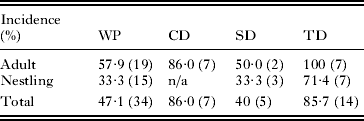
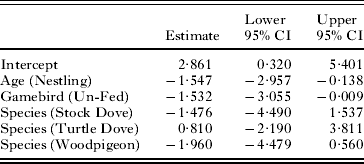
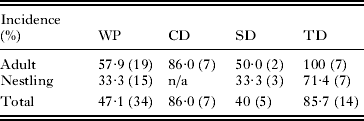
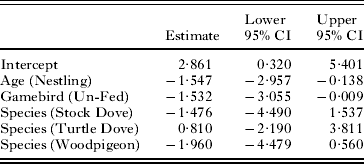
Sixty samples were collected from 14 Turtle Doves, 5 Stock Doves, 7 Collared Doves and 34 Woodpigeons. Thirty-six samples (60%) tested positive for Trichomonas infection (Table 1). One top model fitted the data better than all others to predict Trichomonas infection status, when considering a cut off ΔAIC<2 (Burnham and Anderson, Reference Burnham and Anderson2002): the next best model had a ΔAIC of 2·14. The top model contained all three predicator variables (Table 2). Confidence intervals for age and gamebird feeder status did not overlap zero, indicating strong support for the importance of these two variables in influencing Trichomonas infection status (Table 2). Adults were more likely to be infected than nestlings (adults 71·4% infected, n = 35; nestlings 44% infected, n = 25; Table 2), and birds sampled at sites providing food for gamebirds were more likely to be infected than those sampled at sites with no such supplementary feeding (65% infected, n = 40, 6 sites and 50% infected, n = 20, 6 sites, respectively; Table 2). Incidence of infection differed between species, although significant differences as denoted by non-overlapping confidence intervals were found between only Turtle Dove (85·7% infected, n = 14) and Woodpigeon (47·1% infected, n = 34).
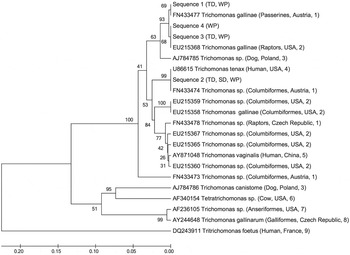
Phylogenetic analysis using the neighbour joining method and ITS1/5.8s rRNA/ITS2 sequences of Trichomonas spp. found within this study in comparison to those published in GenBank. Sequences are labelled by GenBank accession number and Trichomonas species/strain. Information in parentheses indicates the species or family from which the strain was isolated along with geographic location (where available) and a numerical citation. Genetic distance is by maximum composite likelihood and branch reliability is shown as a percentage. Sequences obtained from this study are shown as, ‘Sequence X’. 0·05 scale bar: substitutions (corrected) per bp. Species abbreviations are as in the legend to Table 1. Citations are as follows: 1: Grabensteiner et al. (Reference Grabensteiner, Bilic, Kolbe and Hess2010); 2: Gerhold et al. (Reference Gerhold, Yabsley, Smith, Ostergaard, Mannan, Cann and Fischer2008); 3: Cielecka et al. (Reference Cielecka, Borsuk, Grytner-Ziecina and Turkowicz2000); 4: Felleisen (Reference Felleisen1997); 5: Xiao et al. (Reference Xiao, Xie, Fang, Gao, Zhu, Song, Zhong and Lun2006); 6: Walker et al. (Reference Walker, Hayes, Sawyer, Nordhausen, van Hoosear and BonDurant2003); 7: Crespo et al. (Reference Crespo, Walker, Nordhausen, Sawyer and Manalac2001); 8: Kutisova et al. (Reference Kutisova, Kulda, Cepicka, Flegr, Koudela, Teras and Tachezy2005); 9: Duboucher et al. (Reference Duboucher, Caby, Dufernez, Chabé, Gantois, Delgado-Viscogliosi, Billy, Barré, Torabi, Capron, Pierce, Dei-Cas and Viscogliosi2006).

Incidence and numbers of birds found to be carrying Trichomonas in each species, shown within two age categories. Numbers in the table show per cent infected along with total sample size within each species and age group. WP = Woodpigeon; CD = Collared Dove; SD = Stock Dove; TD = Turtle Dove
Model estimates from the top model examining ecological factors predicting Trichomonas infection. Estimates and 95% CIs for factors are for the factor stated compared with a reference factor (Age: Adult; Gamebird: Fed; Species: Collared Dove)
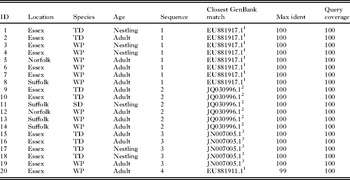
Twenty PCR products were sequenced from 11 Woodpigeons, nine Turtle Doves and one Stock Dove, yielding four unique sequences (Table 3). Both phylogenetic trees agreed on branch order, and bootstrap estimates for branch reliability concurred to within 4% (mean±1 s.e. of the difference: 1·00 ± 0·31%). We present the neighbour joining tree in Fig. 1 and the minimum evolution tree in Appendix 1. Sequence 1 was isolated from eight individuals, both Woodpigeons and Turtle Doves, from sites in Essex, Suffolk and Norfolk and was identical to T. gallinae isolate R2505 (GenBank accession number EU881917.1; Sansano-Maestre et al. Reference Sansano-Maestre, Garijo-Toledao and Gómez-Muñoz2009). Phylogenetic analysis showed Sequence 1 to be identical to T. gallinae strains C, D and E (Lawson et al. Reference Lawson, Cunningham, Chantrey, Hughes, John, Bunbury, Bell and Tyler2011b), all isolated from Columbidae in the USA, Spain and Austria, and raptors in Spain and the USA (Felleisen, Reference Felleisen1997; Gerhold et al. Reference Gerhold, Yabsley, Smith, Ostergaard, Mannan, Cann and Fischer2008; Sansano-Maestre et al. Reference Sansano-Maestre, Garijo-Toledao and Gómez-Muñoz2009; Grabensteiner et al. Reference Grabensteiner, Bilic, Kolbe and Hess2010), and to fall within the same clade as one strain isolated from passerines (a presumably captive Canary Serinus canaria domestica in Austria; Fig. 1; Grabensteiner et al. Reference Grabensteiner, Bilic, Kolbe and Hess2010). Sequence 2 was isolated from six individuals: three Woodpigeons, two Turtle Doves and one Stock Dove, from sites in Essex, Suffolk and Norfolk. This sequence did not match any existing T. gallinae strains, but had 100% query coverage and 100% max identity to Trichomonas sp. AP-2012 isolates EMD-TG2667, EMD-TG2651, PCD-TG2901 and BSD-TG2671 (GenBank accession numbers JQ030996.1, JQ030995.1, JQ0309941 and JQ030993.1; A. Peters and S. Raidal, unpublished data). Sequence 2 falls within the T. tenax clade (Fig. 1) along with one sequence isolated from humans in the USA (Felleisen, Reference Felleisen1997), and one sequence isolated from Columbidae in Austria (Grabensteiner et al. Reference Grabensteiner, Bilic, Kolbe and Hess2010).
Details of sequenced Trichomonas samples providing the sequence number from this study, closest GenBank match to each sample (detailing maximum identity and query coverage), along with the location and age of bird. Species abbreviations are as in the legend to Table 1. Superscript number following GenBank sequences indicates citation for that sequence, where 1: Sansano-Maestre et al. (Reference Sansano-Maestre, Garijo-Toledao and Gómez-Muñoz2009); 2: Peters and Raidal, unpublished data; and 3: Reinmann et al. (Reference Reinmann, Müller, Kuhnert, Campero, Leitsch, Hess, Henning, Fort, Müller, Gottstein and Frey2012)

Sequence 3 was isolated from four Turtle Doves and one Woodpigeon at three sites in Essex, and had 100% query coverage and 100% max identity to T. gallinae strain Vienna 5895-C1/06, isolated from a (presumably captive) psittaciforme in Austria (GenBank accession number JN007005.1; Reinmann et al. Reference Reinmann, Müller, Kuhnert, Campero, Leitsch, Hess, Henning, Fort, Müller, Gottstein and Frey2012). Sequence 3 was also identical to T. gallinae isolates XT770-05 and XT710-05, isolated from Greenfinches C. chloris and Chaffinches Fringilla coelebs during the finch trichomonosis epizootic (Robinson et al. Reference Robinson, Lawson, Toms, Peck, Kirkwood, Chantry, Clatworthy, Evans, Hughes, Hutchinson, John, Pennycott, Perkins, Rowley, Simpson, Tyler and Cunningham2010), along with sequences isolated from Columbidae in Mauritius, Europe and the USA (Kleina et al. Reference Kleina, Bettim-Bandinelli, Bonatto, Benchimol and Bogo2004; Gaspar Da Silva et al. Reference Gaspar Da Silva, Barton, Bunbury, Lunness, Bell and Tyler2007; Gerhold et al. Reference Gerhold, Yabsley, Smith, Ostergaard, Mannan, Cann and Fischer2008; Sansano-Maestre et al. Reference Sansano-Maestre, Garijo-Toledao and Gómez-Muñoz2009; Grabensteiner et al. Reference Grabensteiner, Bilic, Kolbe and Hess2010), raptors in Europe (Sansano-Maestre et al. Reference Sansano-Maestre, Garijo-Toledao and Gómez-Muñoz2009), and passerines and corvids in the USA (Anderson et al. Reference Anderson, Grahn, Van Hoosear and BonDurant2009), all classified as T. gallinae strain A (Lawson et al. Reference Lawson, Cunningham, Chantrey, Hughes, John, Bunbury, Bell and Tyler2011b). Sequence 4 was isolated from the only bird screened that showed any clinical signs of disease, a Woodpigeon sampled at a site in Essex, with a large caseous yellow lesion in the oral cavity consistent with trichomonosis. This sequence had 100% query coverage and 99% max identity to T. gallinae isolate P1807 (GenBank accession number EU881911.1; Sansano-Maestre et al. Reference Sansano-Maestre, Garijo-Toledao and Gómez-Muñoz2009), with two separate base deletions. Sequences 3 and 4 both fell within the same clade as T. gallinae strain B (Lawson et al. Reference Lawson, Cunningham, Chantrey, Hughes, John, Bunbury, Bell and Tyler2011b), isolated from raptors in the USA (Gerhold et al. Reference Gerhold, Yabsley, Smith, Ostergaard, Mannan, Cann and Fischer2008).
DISCUSSION
We found the T. gallinae parasite to be present in all four columbiform species examined, confirming the first cases in Turtle Doves in the UK, with incidence at 86%. Whilst our sample size is relatively small, samples were obtained from a wide geographical area within the current UK range of the Turtle Dove, suggesting that high levels of infection may be widespread. As we used molecular methods rather than microscopy to confirm infection, our approach seems unlikely to report false negatives; however, it is possible that we may have underestimated true infection rates.
The overall incidence of Trichomonas infection falls within the middle to top half of the range found by other studies: 5·6% in Mourning Doves Zenaida macroura to 92% in Rock Pigeons Columba livia (Villanúa et al. Reference Villanúa, Höfle, Pérez-Rodríguez and Gortázar2006; Sansano-Maestre et al. Reference Sansano-Maestre, Garijo-Toledao and Gómez-Muñoz2009). Woodpigeons and Stock Doves had much lower incidences of infection than Turtle Doves and Collared Doves, which both showed higher prevalence than found in previous studies of these species elsewhere (50% in Turtle Doves in Spain: Muñoz, Reference Muñoz1995; 10% for Collared Doves in Iraq: Al-Bakry, Reference Al-Bakry2009). Despite this difference, the incidence in Woodpigeons in our study was 22% higher than in mainland Europe (Villanúa et al. Reference Villanúa, Höfle, Pérez-Rodríguez and Gortázar2006). This may be an indicator of a general increase in disease incidence or due to geographical or seasonal variation. Trichomonas in Columbidae tends to be more prevalent during the breeding season when temperatures are warmer and rainfall lower (Bunbury et al. Reference Bunbury, Jones, Greenwood and Bell2007), partially due to increased stress and bird–bird contact at nesting sites (Sansano-Maestre et al. Reference Sansano-Maestre, Garijo-Toledao and Gómez-Muñoz2009). In contrast, finch trichomonosis shows highest morbidity and mortality during the winter, although levels of sub-clinical infection within this period are unknown (Robinson et al. Reference Robinson, Lawson, Toms, Peck, Kirkwood, Chantry, Clatworthy, Evans, Hughes, Hutchinson, John, Pennycott, Perkins, Rowley, Simpson, Tyler and Cunningham2010).
We found higher incidences of Trichomonas infection on farms where supplementary food was supplied for gamebirds than on farms with no supplementary food. This supports the suggestion that such food sources may attract high densities of birds, promoting opportunities for disease transmission and dissemination (e.g. Höfle et al. Reference Höfle, Gortazar, Ortíz, Knispel and Kaleta2004; Lawson et al. Reference Lawson, Robinson, Colville, Peck, Chantrey, Pennycott, Simpson, Toms and Cunningham2012). Although introduced gamebirds such as Pheasants Phasianus colchicus and Red-Legged Partridges Alectoris rufa are subject to Trichomonas parasites (e.g. Pennycott, Reference Pennycott1998), these species tend to be infected with Trichomonas gallinarum rather than T. gallinae. Trichomonas gallinarum and T. gallinae are found within different clades which suggests that strains may be unlikely to cross between Columbidae and galliformes at gamebird feeders. Birds in our study were primarily caught in close proximity to farmyards, which, like garden feeders, may attract sick birds, especially where supplementary food (such as that for gamebirds) is provided over extended periods. Our sample may therefore have been biased towards sick birds with restricted movement. However, all adult Turtle Doves were radio-tagged (as part of another study) and displayed normal movement patterns, suggesting no increase in morbidity in this species.
We found four strains of Trichomonas in UK Columbidae. Apart from one strain isolated from only one Woodpigeon, all strains were found in both Turtle Doves and Woodpigeons, with one also found in a Stock Dove, suggesting that none are species-specific, although the examination of additional genes would provide additional corroboration of this. Sequences 1 and 2 were isolated from three counties of East Anglia, at sites up to 115 km apart, suggesting these two strains are widespread. Sequences 3 and 4 were isolated only from sites in Essex, and may therefore be more localized, although further work is required to confirm this. Sequence 1 fell within the same clade as T. gallinae sequences from Columbidae and raptors in Europe and the USA (Felleisen, Reference Felleisen1997; Gerhold et al. Reference Gerhold, Yabsley, Smith, Ostergaard, Mannan, Cann and Fischer2008; Sansano-Maestre et al. Reference Sansano-Maestre, Garijo-Toledao and Gómez-Muñoz2009; Grabensteiner et al. Reference Grabensteiner, Bilic, Kolbe and Hess2010), and fell in the same clade as one strain isolated from a (presumably) captive Canary in Austria (Grabensteiner et al. Reference Grabensteiner, Bilic, Kolbe and Hess2010). This suggests this clade contains generalist and widespread avian parasites, supported by the wide geographic spread of this strain within our study sites. Interestingly, Sequence 1 is identical to a strain isolated from Collared Doves in their introduced range in the USA (Gerhold et al. Reference Gerhold, Yabsley, Smith, Ostergaard, Mannan, Cann and Fischer2008) suggesting that the apparently widespread nature of this strain might be linked to the spread of this invasive columbiform. Whilst the majority of UK Columbidae do not undertake long-distance migration, the exception is the Turtle Dove, which is a trans-Saharan migrant, providing an additional mechanism by which Trichomonas parasites could be dispersed over large distances.
Sequence 2 is of particular interest, as phylogenetically it clusters not with T. gallinae, but within the T. tenax clade, usually a parasite of humans (Cielecka et al. Reference Cielecka, Borsuk, Grytner-Ziecina and Turkowicz2000). Grabensteiner et al. (Reference Grabensteiner, Bilic, Kolbe and Hess2010) found a ‘T. tenax-like’ isolate in a Racing Pigeon C. livia from Austria, and more recently, a sequence identical to our Sequence 2 was found in Common Emerald Doves Chalcophaps indica, Zebra Doves Geopelia striata and Bar-Shouldered Doves Geopelia humeralis in Australasia (A. Peters and S. Raidal, unpublished data). Thus, the finding of this strain in UK Columbidae is not unprecedented, although this suggests that this strain may be extremely widespread geographically. The Collared Dove is a relatively recent addition to UK avifauna (first reported breeding in 1955), spreading from India through a natural range expansion and it is plausible that this species may have brought Trichomonas strains with it, especially as it is known to carry Trichomonas parasites in its introduced range in North America (Stimmelmayr et al. Reference Stimmelmayr, Stefani, Thrall, Landers, Revan, Miller, Beckstead and Gerhold2012), along with its native range (e.g. Romagosa and Labisky, Reference Romagosa and Labisky2000; Al-Bakry, Reference Al-Bakry2009). However, further analysis of strains across the range of this species would be required to confirm this. The pathogenicity of this novel strain is unknown (and it may be a pathogenic strain sampled prior to lesion development): controlled infections would be required to assess this as prior infection with a non-virulent strain can lead to sub-clinical infection by a virulent strain that would otherwise cause clinical signs, confounding correlative observations (Stabler, Reference Stabler1948).
The only bird within our study with macroscopic lesions in the oral cavity at the time of sampling, was a Woodpigeon that later died as a result of infection. Although the clinical signs were consistent with trichomonosis (a large caseous yellow lesion was visible in the oral cavity), no post-mortem was carried out so the cause of death could not be confirmed, and other lesion-forming diseases could not be excluded. This bird was infected by Sequence 4, which falls within the same clade as T. gallinae genotype, a strain similar to that responsible for the finch trichomonosis epizootic in the UK (Lawson et al. Reference Lawson, Cunningham, Chantrey, Hughes, John, Bunbury, Bell and Tyler2011b). Sansano-Maestre et al. (Reference Sansano-Maestre, Garijo-Toledao and Gómez-Muñoz2009) found that only birds carrying this genotype had visible clinical signs (referred to as genotype B in this paper), so this outcome runs in accordance with previous findings. A Turtle Dove nestling with clinical signs of trichomonosis (regurgitated seed and saliva around the beak and a fetid smell, although no visible oral lesions), was found during September 2011: its sibling showed no clinical signs and both were depredated prior to fledging. This nestling was infected by Sequence 3, which falls within the same clade as Sequence 4. Sequence 3 is identical at the ITS1/5.8S/ITS2 ribosomal region to that isolated from Greenfinches C. chloris and Chaffinches F. coelebs during the UK finch trichomonosis epizootic (Robinson et al. Reference Robinson, Lawson, Toms, Peck, Kirkwood, Chantry, Clatworthy, Evans, Hughes, Hutchinson, John, Pennycott, Perkins, Rowley, Simpson, Tyler and Cunningham2010). It would be beneficial for further work to examine other functional genes such as the iron hydrogenase gene, to determine whether this strain is in fact the same as the epizootic strain (Robinson et al. Reference Robinson, Lawson, Toms, Peck, Kirkwood, Chantry, Clatworthy, Evans, Hughes, Hutchinson, John, Pennycott, Perkins, Rowley, Simpson, Tyler and Cunningham2010; Lawson et al. Reference Lawson, Cunningham, Chantrey, Hughes, John, Bunbury, Bell and Tyler2011b). If so, then this would lend support to the suggestion that the finch trichomonosis epizootic was a result of parasite spillover from Columbidae to new host species at shared feeding stations (Robinson et al. Reference Robinson, Lawson, Toms, Peck, Kirkwood, Chantry, Clatworthy, Evans, Hughes, Hutchinson, John, Pennycott, Perkins, Rowley, Simpson, Tyler and Cunningham2010; Lawson et al. Reference Lawson, Robinson, Colville, Peck, Chantrey, Pennycott, Simpson, Toms and Cunningham2012). Given that this nestling showed clinical signs of trichomonosis, further work should also investigate the potential implications of Trichomonas infection for this rapidly declining dove.
In the UK, Turtle Doves are a species of particular conservation concern as the population has declined by 80% between 1995 and 2010 (Risely et al. Reference Risely, Massimino, Johnston, Newson, Eaton, Musgrove, Noble, Procter and Baillie2012). During this period of population decline Turtle Doves have halved their number of nesting attempts per pair, thought to be a result of food stress (Browne and Aebischer, Reference Browne and Aebischer2003). Compared with other UK Columbidae (that feed on a variety of weed seeds, buds, shoots and occasionally invertebrates) Turtle Doves are ecologically unique: firstly in that they rely solely on seed food throughout the year; and secondly in that they are migratory. Increased agricultural efficiency has reduced the availability of arable weeds and consequently the seeds upon which this species relies (Murton et al. Reference Murton, Westwood and Isaacson1964). This in turn has driven a dietary switch from weed seeds to cereals, oilseeds and an increased reliance on anthropogenic food sources such as grain tailings in farmyards (Browne and Aebischer, Reference Browne and Aebischer2003), which is likely to increase the density of foraging birds and thus increase the transmission of Trichomonas parasites. Increased food stress can decrease immune function (Lindström et al. Reference Lindström, Hawley, Davis and Wikelski2005), inducing chronic stress in birds (Clinchy et al. Reference Clinchy, Zanette, Boonstra, Wingfield and Smith2004) and can subsequently increase levels of parasitaemia for blood parasite infections (Appleby et al. Reference Appleby, Anwar and Petty1999). Whether the same mechanism applies to Trichomonas infection is speculative and requires further investigation. Migratory stress has also been postulated to increase susceptibility to Trichomonas infection (Villanúa et al. Reference Villanúa, Höfle, Pérez-Rodríguez and Gortázar2006) and thus may also contribute to the high levels of infection found in this species.
In summary, we have provided the first evidence as to the status of Trichomonas infection within Columbidae in the UK. We found a high incidence in both Turtle Doves and Collared Doves, although our sample size is relatively small. Despite this, we found a high diversity in parasite strains, with four unique sequences falling within three different phylogenetic clades: two of T. gallinae and one of a T. tenax-like strain, which appears to be geographically widespread. We found a higher incidence of infection at farms providing food for gamebirds, suggesting that supplementary feeding may increase disease transmission in farmland environments (although transmission from gamebirds to Columbidae appears unlikely), as well as at garden feeders postulated to lead to transmission of finch trichomonosis. One of the sequences isolated from Turtle Doves and Woodpigeons is identical at the ITS/5.8S/ITS2 ribosomal region to that responsible for the finch epizootic, although sequencing at other genes is needed in order to confirm whether this is the same strain. Overall, this work highlights the need to extend our knowledge of the diversity and ecological implications of Trichomonas parasites to develop effective management strategies for vulnerable host species.
ACKNOWLEDGEMENTS
We thank three anonymous reviewers whose comments greatly improved an earlier draft of the manuscript.
FINANCIAL SUPPORT
This work was part-funded by the RSPB as part of the Turtle Dove monitoring project. Catching and ringing was carried out under a British Trust for Ornithology licence held by JCD and sampling for parasites was carried out under licence from the Home Office.
Phylogenetic analysis using the minimum evolution method and ITS1/5.8s rRNA/ITS2 sequences of Trichomonas spp. found within this study in comparison to those published in GenBank. Sequences are labelled by GenBank accession number and Trichomonas species/strain. Information in parentheses indicates the species or family from which the strain was isolated along with geographic location (where available) and a numerical citation. Genetic distance is by maximum composite likelihood and branch reliability is shown as a percentage. Sequences obtained from this study are shown as ‘Sequence X’. 0·05 scale bar: substitutions (corrected) per bp. Species abbreviations are as in the legend to Table 1. Citations are as in the legend to Fig. 1.