Introduction
The scientific literature generally reports that cognitive abilities such as vocabulary or/and general knowledge improve up until at least the age of 60 years, while others, which require manipulation or reasoning about familiar or abstract material, undergo a linear decline (i.e. Salthouse, Reference Salthouse2010). Chronological age has traditionally been used as a predictor of cognitive status. However, as aging involves the accumulation of biological and environmental influences, use of complementary markers to track cognitive change is recommended (MacDonald et al., Reference MacDonald, DeCarlo and Dixon2011). It is also important to take into account the great inter-individual variability among older people and that some variables increase or decrease the variation in cognitive performance. For example, Pereiro-Rozas et al. (Reference Pereiro-Rozas, Juncos-Rabadán, Facal and Pérez-Fernández2014) found that cognitive performance varied more widely in old participants with a low level of education than in those with high level of education. Different sociodemographic (e.g. socioeconomic status, work complexity), lifestyle (e.g. leisure activities, physical activity, dietary habits), psychological (e.g. depression, positive will to live), biological (e.g. medication intake, hypertension, overweight), and environmental factors (e.g. exposure to toxic agents) explain a large proportion of the variation in cognitive performance in older people (Facal et al., Reference Facal, Juncos-Rabadan, Pereiro and Lojo-Seoane2014).
Some studies have investigated the influence of each these variables on cognitive performance, while others have attempted to identify intricate relationships between these variables and cognitive performance, thus considering aging as a complex phenomenon. Following this approach, Yaffe et al. (Reference Yaffe2009) used data from the “Dynamics of Health, Aging and Body Composition Study (Health ABC)” to study the proportion of older people who maintained their cognitive status and to identify which factors could predict cognitive ability over seven years. They found that 30% of the participants between 70 and 79 years old at baseline maintained their cognitive ability, while 53% displayed a minor decline and 16% a major decline. Participants who were more likely to maintain their cognitive ability included those with high school education, who worked or volunteered, were not taking care of a spouse or children, were receiving sufficient social support, were living with someone at baseline, rated their health as good, drank more than one alcoholic drink per day, engaged in moderate to vigorous weekly exercise, did not smoke at baseline, had lower body mass index (BMI), and those without hypertension, diabetes, and stroke. Adam et al. (Reference Adam, Bonsang, Grotz and Perelman2013) measured the impact of professional and non-professional activity (leisure and physical activity) on cognitive functioning, taking into account the influence of age, educational level, and socioeconomic status. They found that both types of activity had positive impacts on cognitive ability. Indeed, the negative effect on cognitive performance of not carrying out any professional activity was alleviated by involvement in other types of activity, particularly attending learning and training courses. This study emphasizes the relative importance of some predictors of cognitive ability (in this case, professional activities) in the context of other variables or predictors (in this case, non-professional activities) that can mitigate or increase the predicted power of the former.
Although previous studies have published detailed normative data describing the cognitive aging process in a wide Spanish sample (Peña-Casanova et al., Reference Peña-Casanova2009), no studies have been carried out in a Spanish sample studying cognitive performance in middle-aged and older adults taking into account different predictors in order to explain inter-individual age-related differences. The specific objective of the study was to analyze data from the “Longitudinal Study Aging in Spain (ELES)” project to investigate the influence of socioeconomic, emotional, and physical execution variables on cognitive performance in four age groups of participants: 50–59, 60–69, 70–79, and 80+ years.
The reason for looking for relationships between cognition and independent variables over decades has been to be able to study specific predictors of cognitive performance in different ages, beyond a more general age effect. The choice of predictors was theoretically driven. In example, Haan et al. (Reference Haan, Al-Hazzouri and Aiello2011) found that those with more advantaged objective socioeconomic status experienced fewer declines in cognitive ability and short-term verbal memory performance. Demakakos et al. (Reference Demakakos, Nazroo, Breeze and Marmot2008) showed the role of subjective economic status in the relation between objective economic status and health using logistic and linear regression analyses of cross-sectional data from the “English Longitudinal Study of Aging (ELSA)” study. Charles and Carstensen's review (Reference Charles and Carstensen2010) stressed the role of well-being and emotional distress in cognitive capacity. Exercise and physical performance has been frequently related to cognitive performance. In example, Middleton et al. (Reference Middleton, Mitnitski, Fallah, Kirkland and Rockwood2008) showed, applying parametric Markov chain models to longitudinal data from the “Canadian Study of Health and Aging,” that frequent exercisers had more frequently stable or improved cognition over five years than low/no exercisers. In a sample of older adults aged 85+ years at baseline, Taekema et al. (Reference Taekema, Gussekloo, Maier, Westendorp and de Craen2010) observed that lower baseline handgrip strength predicted an accelerated decline in cognitive status. Accordingly, we have tried to identify relationships between variables from different areas and cognitive performance (Yaffe et al., Reference Yaffe2009; Yu et al., Reference Yu, Ryan, Schaie, Willis and Kolanowski2009). This study included predictors from different areas (socioeconomic, physical execution, and emotional), mixing some predictors that have been widely studied and have consistently demonstrated their predictive value for cognitive functioning (e.g. educational level, occupational complexity, or physical activity) (Karlamangla et al., Reference Karlamangla, Miller-Martinez, Aneshensel, Seeman, Wight and Chodosh2009; Vemuri et al., Reference Vemuri2014) and others that have been less well studied (e.g. emotional variables such as the will to live or satisfaction with aging) and not previously studied together with other variables. Following this rationale, the hypotheses were (1) the different variables studied will have a role in the prediction of cognition in the different age groups, since they have demonstrated their predictive value when they have been studied isolated. Specifically, it is expected that a higher score for the independent variables will predict higher cognitive performance, except in Body Mass Index (BMI) where a higher score is expected to predict a lower cognitive performance; (2) those variables from the socioeconomic area will have the higher predictive value in the different age groups; (3) certain changes in the pattern of predictive variables will be found between age groups.
Method
Participants
The participants of this cross-sectional study belong to the Pilot Study of the “Longitudinal Study of Aging in Spain (ELES)” carried out in 2011. ELES (www.proyectoeles.es) is an interdisciplinary panel study created to track the elderly Spanish population born before 1960 with the main aim of analyzing evolutionary processes of non-institutionalized people aged 50 years and older by using a multidisciplinary approach. The ELES project considers five dimensions: (1) demographics and background; (2) psychosocial area; (3) health; (4) economy; (5) family and social environment.
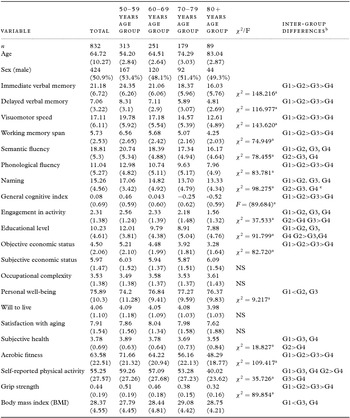
The pilot study included a total of 1,531 participants. However, after application of the following exclusion criteria, we finally selected 832 participants: (i) diagnosis of illness related to memory, Parkinson's disease, or depression; (ii) score under 24 (18 for the illiterate) in the Spanish version of the Mini-Mental State Examination (Lobo et al., Reference Lobo1999); and (iii) to have missing data in any of the studied cognitive variables. The characteristics of participants and differences between groups are included in Table 1 for the entire sample and broken down into four different age subgroups: 50–59, 60–69, 70–79, and 80+ years old.
Mean values and standard deviations (in parentheses) of the demographic, cognitive, socioeconomic, emotional, and physical execution measures for the total sample and for each age group

a p < 0.0001.
b G1 = 50–59 years age group; G2 = 60–69 years age group; G3= 70–79 years age group; G4 = 80+ years age group.
Measures
In addition to demographic characteristics including age and sex, we considered different cognitive, socioeconomic, emotional, and physical execution variables.
Seven cognitive tasks were administered in the ELES project to measure cognitive variables. The Auditory Verbal Learning Test (Rey, Reference Rey1964) was used to assess immediate and delayed verbal memory. The letter cancellation task adapted from the ELSA study (Huppert et al., Reference Huppert, Gardener, McWilliams, Banks, Breeze, Lessof and Nazroo2006) was used to assess visuomotor speed. The backward digit sub-scale of the Wechsler Adult Intelligence Scale – WAIS (Wechsler, Reference Wechsler1999) was administered to measure working memory span. Semantic fluency (animals) and phonological fluency (words starting with the letter “S”) (Benton et al., Reference Benton, Hamsher, Rey and Sivan1994) were used to assess language, considering as final scores the total number of different animals and the number of words starting with the letter “S” named. Twenty items of The Boston Naming Test (Goodglass and Kaplan, Reference Goodglass and Kaplan1996) were used to evaluate naming ability. The final score was the correct number of items named, with the maximum score in this test being 20. In order to obtain only one measure for the cognitive variable, we performed a factorial analysis in which the seven previous cognitive measures were included in the same factor and the factorial value was considered as a general cognitive index (González et al., Reference González, Facal, Juncos-Rabadán and Yanguas2015). Following the criteria of previous longitudinal studies (Huppert et al., Reference Huppert, Gardener, McWilliams, Banks, Breeze, Lessof and Nazroo2006), the cognitive measures have been selected following four basic criteria: (1) they must measure cognitive processes relevant in the daily life; (2) they are sensible to the aging process; (3) they must be easy to administer and feasible and achievable for the participants; (4) they must be, as far as possible, also administered in other longitudinal studies, so the results can be compared (harmonization). Different longitudinal studies such as Health and Retirement Study (HRS), the ELSA, the Surveys of Health, Ageing, and Retirement in Europe (SHARE), and The Irish Longitudinal Study on Aging (TILDA) use similar tasks and approaches in the characterization of the cognitive performance (Crimmins et al., Reference Crimmins, Kim, Langa and Weir2011). While other studies, such as NEURONORMA (Peña-Casanova et al. Reference Peña-Casanova2009), evaluate the cognitive function with an extensive neuropsychological battery, this study is focused on the cognitive processes more likely to decline due to the aging process and the role of different predictors of the cognitive performance with a bigger sample.
The independent measures selected in this study have been selected following a similar rationale to that of the cognitive measures. These measures have been previously used in other longitudinal studies (HRS, ELSA, SHARE, etc.) (Baltes and Mayer, Reference Baltes and Mayer2001; Demakakos et al., Reference Demakakos, Nazroo, Breeze and Marmot2008; Singh-Manoux et al., Reference Singh-Manoux, Marmot, Glymour, Sabia, Kivimäki and Dugravot2011; Adam et al., Reference Adam, Bonsang, Grotz and Perelman2013; Pinto and Neri, Reference Pinto and Neri2013), and they have been adapted to the Spanish cultural context when needed. Five socioeconomic variables were considered in the study: (1) participation in activities, which was measured as the frequency (number of days per month) of engagement in cultural activities, learning activities, social activities, and travel. The score reflecting participation in activities was the mean value of the four types of activities calculated according to the following: (i) less than once a year; (ii) less than once a month; (iii) once a month; (iv) two to three days a month; (v) four days a month; (vi) 5 to 29 days a month; (vii) daily; (2) participants were also asked about their educational level. The level achieved was transformed into a score by taking into account the number of years needed to complete each study cycle; (3) participants were asked how much money all members of the house spent for their different needs (food, household, transport, etc.), to measure economic status. A score expressing objective economic status was calculated; (4) subjective economic status was measured as satisfaction with the household income, ranging from 0 (very poor) to 10 (very rich); (5) occupational complexity was measured using the protocol of the NEST-DD (Network the Efficiency and standardization of Dementia Diagnosis) project (Garibotto et al., Reference Garibotto2008) which classifies people as follows: unemployed; unskilled workers; housewife; qualified workers; technical workers, teachers, liberal professions, managers; and professors and high-level executives.
The following measures of emotional variables were included in the study: (1) the personal well-being index (PWI), developed by the International Well-being Group (IWG, 2006), which measures personal satisfaction with different domains of life ranging from 0 to 100; (2) will to live, measured by questions specifically created for this study, and asking whether the benefits of living outweigh/compensate misfortunes in life. The scores ranged from 1 (hardly ever) to 5 (almost always); (3) participants were asked to rate their satisfaction with aging with scores ranging from 0 (the worst possible way) to 10 (the best possible way); (4) participants were also asked to rate subjective health with scores ranging from 1 (very bad) to 5 (very good).
Finally, the following physical execution variables were considered: (1) the Two-Minute Step (TMS), in which the participant was asked to march on the spot by lifting their knees to the level corresponding to midway between the knee cap and the top of the hip bone (marked on a nearby wall). The total score was the total number of times the right knee reaches this level in two minutes; (2) BMI (kg/m2) was calculated directly from height and weight measurements; (3) grip strength was measured with a dynamometer, which the respondents were asked to squeeze as hard as possible with their dominant hand. The participants underwent two trials and the average value from both trials was considered the final measure; (4) self-reported physical activity was measured by two questions about the duration and intensity of physically demanding activities carried out regularly (from the Yale Physical Activity Survey: DiPietro et al., Reference Dipietro, Caspersen, Ostfeld and Nadel1993).
Procedure
The sample comprised non-institutionalized people over 50 years old living in Spain. Cluster sampling procedure was used to select the participants. The stratification variables were the municipality, census section, household, members of the household, gender, and age. The households were selected at random from the database of households with a telephone. The information collection process included different sequential stages and it was carried out either by telephone or in face to face visits between the interviewer and the participant at the participant's home.
The Ethics Committee of the Spanish National Research Council (CSIC) approved the study protocol and the study was performed in accordance with the ethical standards established in the 1964 Declaration of Helsinki. All participants provided written informed consent before each stage of the evaluation.
Statistical analyses
Prior to carrying out the statistical analyses, missing values of independent variables were estimated for both the total sample and the different age groups (Sterne et al., Reference Sterne2009). Four of the variables had a high percentage of missing values: objective economic status, occupational complexity, satisfaction with aging, and aerobic fitness. Due to the large spectrum of response of the variables, we used the regression method to estimate the missing values.
Comparisons of the mean values of variables for the different age groups were conducted by non-parametric testing, as the variables were not normally distributed (Kruskal–Wallis test, and U Mann–Whitney test for two-group comparisons).
Separated regression analysis was conducted for each age group, including one group of variables (socioeconomic, physical execution, and emotional variables) in each separate analysis as independent variables, and the general cognitive index as the dependent variable. Accordingly, different sets of variables were selected for each age group from those significant predictors in the separated socioeconomic, emotional, and physical analysis. Then the enter method was used to carry out multiple linear regressions for each age group including simultaneously socioeconomic, physical execution, and emotional variables. The order of the variables introduced using the enter method in each age group was selected according to the literature review, entering the variables expected to have a higher predictive value first and then the ones with a lower expected predictive value.
Results
Age-related differences in the cognitive measures were observed, with the highest scores being obtained by the 50–59 years age group, followed by the 60–69 years age group and the 70–79 years age group, while the 80+ years age group obtained the lowest scores. Only semantic fluency and naming did not differ significantly between 70–79 years age group and the 80+ years age group. A similar pattern was found in the predictor variables. Differences between age groups were found in almost all of the predictor variables, with the exception of subjective economic status, occupational complexity, will to live and satisfaction with aging. In general, the results indicate differences between the 50–59 years age group and the other three groups, especially the 70–79 and 80+ years age groups (see Table 1).
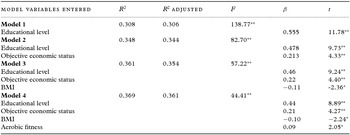
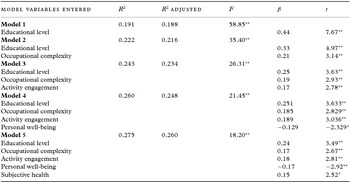
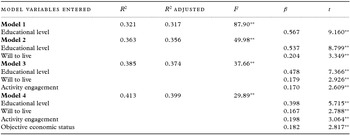
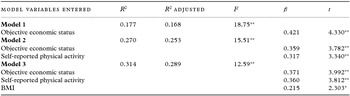
Separated regression analysis for each age group including each group of variables of independent predictors showed (i) for the 50–59 years age group, educational level (β = 0.44, t = 7.75, p < 0.001) and objective economic status (β = 0.20, t = 3.97, p < 0.001) were selected as significant predictors in the regression analysis conducted for socioeconomic measures (R 2 adjusted = 0.37, F = 34.76, p < 0.001); aerobic fitness (β = 0.18, t = 3.07, p < 0.01) and BMI (β = −0.19, t = −3.26, p < 0.01) were selected as physical execution variables (R 2 adjusted = 0.71, F = 6.63, p < 0.001), and no emotional variables were selected since the regression model for these group of variables was not significant (R 2 adjusted = 0.01, F = 2.14 p = 0.08); (ii) for the 60–69 years age group, three measures – activity engagement (β = 0.16, t = 2.46, p = 0.015), educational level (β = 0.21, t = 2.76, p = 0.006), and occupational complexity (β = 0.18, t = 2.69, p = 0.008) – were selected as significant predictors in the regression analysis from the socioeconomic variables (R 2 adjusted = 0.24, F = 16.48, p < 0.001); personal well-being (β = −0.17, t = −2.45, p = 0.015) and subjective health (β = 0.20, t = 2.89, p = 0.004) were selected as the emotional measures (R 2 adjusted = 0.48, F = 4.09, p = 0.003) and the regression model for the physical execution variables was not significant (R 2 adjusted = 0.17, F = 2.03, p = 0.09), so no variables from this group were included; (iii) for the 70–79 years age group, activity engagement (β = 0.28, t = 3.43, p < 0.001), objective economic status (β = 0.18, t = 2.70, p = 0.008), and educational level (β = 0.33, t = 4.31, p < 0.001) were selected as significant predictors in the regression analysis carried out with the socioeconomic variables (R 2 adjusted = 0.39, F = 22.53, p < 0.001); from the emotional measures, only will to live (β = 0.26, t = 3.39, p = <0.001) was selected as significant predictor (R 2 adjusted = 0.10, F = 5.80, p < 0.001), while none of the variables from the physical execution field were selected as predictors in the regression analysis (R 2 adjusted = 0.11, F = 6.82, p = 0.07); (iv) for the 80+ years age group, the objective economic status (β = 0.31, t = 2.64, p = 0.01) was selected in the regression analysis from the model with socioeconomic measures (R 2 adjusted = 0.22, F = 5.74, p < 0.001); self-reported physical activity (β = 0.28, t = 2.43, p = 0.017) and BMI (β = 0.21, t = 2.07, p = 0.04) were the variables selected as predictors from the physical execution measures (R 2 adjusted = 0.19, F = 5.88, p < 0.001), and no variables were selected from the emotional measures (R 2 adjusted = 0.11, F = 3.77, p = 0.06). Then joint multiple linear analysis of significant socioeconomic, emotional, and physical execution predictors of cognitive function in each age group showed that (i) for the youngest group (50–59 years), cognitive performance was best explained by Model 4 that included the two socioeconomic (educational level and objective economic status) and the two physical (BMI and aerobic fitness) variables selected in the previous step that jointing explained 36% of the variance (Table 2). The educational level explained 30.6% of the variance, objective economic status added 3.6%, BMI added another 1%, and finally aerobic fitness added 0.7%; (ii) for the 60–69 years group, cognitive performance was best explained by Model 5 that included the three socioeconomic (educational level, occupational complexity, activity engagement) and the two affective (personal well-being subjective health) variables selected (Table 3) that jointly explained 26% of the variance. The first variable entered was educational level and explained 18.8% of the variance, then occupational complexity added 2.8%, activity engagement added 1.8%, personal well-being added 1.4%, and finally subjective health added 1.2%; (iii) for the 70–79 years group, cognitive performance was best explained by Model 4 that included the three socioeconomic (educational level, activity engagement, objective economic status) and the affective (will to live) variable selected that jointly explained 40% of the variance (Table 4). Educational level was the first variable entered and it explained 31.7% of the variance, will to live added 3.9%, activity engagement added 1.8%, and finally objective economic status added another 2.5% of the explained variance; (iv) for the oldest group, cognitive performance was best explained by Model 3 that included one socioeconomic (objective economic status) and two physical (self-reported physical activity, BMI) variables selected that jointly explained 29% of the variance (Table 5). Objective economic status explained 16.8% of the variance, self-reported physical activity added 8.5% and BMI 3.6%.
Multiple regression analysis for the 50–59 years old group with the socioeconomic, emotional, and physical execution variables as independent variables or predictors, and general cognitive index as dependent variable

Note: **p < 0.01.
*p < 0.05.
Multiple regression analysis for the 60–69 years old group with the socioeconomic, emotional, and physical execution variables as independent variables or predictors, and general cognitive index as dependent variable

Note: **p < 0.01.
*p < 0.05.
Multiple regression analysis for the 70–79 years old group with the socioeconomic, emotional, and physical execution variables as independent variables or predictors, and general cognitive index as dependent variable

Note: **p < 0.01.
*p < 0.05.
Multiple regression analysis for the +80 years old group with the socioeconomic, emotional, and physical execution variables as independent variables or predictors, and general cognitive index as dependent variable

Note: **p < 0.01.
*p < 0.05.
Discussion
In the present study, we investigated the extent to which different socioeconomic, emotional, and physical execution variables influence cognitive function in four different age groups of people. We found that educational level was the most important predictor for all except the 80+ years age group. The importance of educational level as predictor of cognitive performance is consistent with previous findings on cognitive reserve (Lojo-Seoane et al., Reference Lojo-Seoane, Facal, Guardia-Olmos and Juncos-Rabadán2014). Stern (Reference Stern2009) defined cognitive reserve as a hypothetical construct that refers to the ability of the brain to actively cope with pathological damage through the effective recruitment of brain networks or by implementing alternative strategies to solve cognitive demands. Years of education is one of the best known proxies of cognitive reserve. According to Vemuri (Reference Vemuri2014), educational level has a strong predictive value as it exerts an effect throughout the lifespan while the other variables, e.g. activity engagement, have a limited effect over time. However, in the present study, educational level did not account for cognitive performance in the oldest group. This could be explained by the fact that most of the over 80-year-old participants only completed primary school, which is common in this age group in Spain because of socioeconomic circumstances related to the Spanish civil war and post-war period. Educational level, therefore, lost its predictive value in the oldest group. Gottesman et al. (Reference Gottesman2014) found that educational level can predict cognitive performance in older people at a certain moment but that this variable does not predict changes in cognitive ability. Thus, although educational level can differentiate poor and good cognitive performance in younger adults, education level will not mitigate deterioration in cognitive ability at a specific point. Nonetheless, it is important to take into account that most Spanish people over 80+ years do not have more than elementary education level.
Objective economic status predicts cognitive performance in the 50–59, 70–79, and 80+ years age groups. This variable and education are closely related throughout the lifespan (Rabbitt et al., Reference Rabbitt2004). As educational level is closely related to occupational complexity and to economic status achieved in adulthood (Haan et al., Reference Haan, Al-Hazzouri and Aiello2011), this may explain why objective economic status does not appear to be predictor of cognitive performance in the 60–69 years age group, but occupational complexity does predicts cognitive performance in this group.
Engagement in activity predicted cognitive performance in the 60–69 and 70–79 years age groups. It is possible that this variable does not appear in the youngest group because most people between 50 and 59 years old are still working and thus they have less time for leisure activities than retired people. On the other hand, people over 80 years old may spend less time performing this type of activity due to physical limitations (Bielak et al., Reference Bielak, Hughes, Small and Dixon2007).
Two emotional variables were included in the models: personal well-being in the 60–69 years age group, and will to live in the 70–79 years age group. As reported by Gerstorf et al. (Reference Gerstorf, Ram, Röcke, Lindenberger and Smith2008), emotional variables, such as satisfaction with life, remain stable as age increases, and only decline as the participant perceives that death is close, a common perception in very old people. In our sample, the more important role of emotional predictors in the 60–69 and 70–79 years age groups could be explained by the relative stability of socioeconomic factors after retirement and the better health of participants than in the oldest group, allowing a more important role for affective, subjective factors in cognitive performance in these age groups (Charles and Carstensen, Reference Charles and Carstensen2010). Although Allerhand et al. (Reference Allerhand, Gale and Deary2014) found that high levels of well-being in a sample between 50 and 90 years old were associated with better cognitive function, we found the opposite result in the 50–59 years age group as personal well-being was negatively associated with cognitive performance. The different findings may be due to different moderating covariables playing a role only in this age group. It is also important to note a cohort effect in some variables, e.g. the youngest groups have a higher level of education than the oldest groups as a result of their socioeconomic circumstances. This cohort effect has not been studied in relation to emotional variables and it is not clear whether the younger generations will have better or poorer emotional health due to when they were born. Regarding subjective health, which was only just included in the 60–69 years age model, previous studies have also found an association between a poor perception of health and poor cognitive performance (i.e. Lyu et al., Reference Lyu, Lee and Dugan2014).
Regarding the physical predictors, BMI was included in the model in the youngest and the oldest groups, but in different directions. Thus, in the youngest group, lower BMI indicated better cognitive performance, while in the oldest group higher BMI indicated better cognitive performance. Fried et al. (Reference Fried2001) operationalized the fragility concept by using five criteria, one of which was involuntary weight loss. Hence, very old people who have lost weight and are frail also show poorer cognitive performance (Driscoll et al., Reference Driscoll2011), whereas in the youngest group, being overweight was negatively related to physical and cognitive health (Benito-León et al., Reference Benito-Leon, Mitchell, Hernandez-Gallego and Bermejo-Pareja2013). Other related variables (aerobic fitness and self-reported physical activity) also appear, like BMI, in the extreme groups. In this respect, physical activity in old adults is more closely related to good health status (Middleton et al., Reference Middleton, Mitnitski, Fallah, Kirkland and Rockwood2008).
Finally, some variables, that we hypothesized would partly explain cognitive performance, were not included as significant predictors in the regression models. The predictive power of variables such as subjective economic status, satisfaction with aging, and grip strength has been demonstrated in previous studies (Demakakos et al. Reference Demakakos, Nazroo, Breeze and Marmot2008; Taekema et al., Reference Taekema, Gussekloo, Maier, Westendorp and de Craen2010). However, it is possible that these variables lose their predictive power when they are studied in the context of the other socioeconomic, emotional, and psychical variables, respectively, analyzed in this study by age group.
Except the first hypothesis, since not all independent variables have a role in the prediction of cognition, the other two hypotheses are confirmed in this study. Regarding the direction of the relationship, there was a direct relationship between the variables so a higher score for the independent variables was found to be associated with a higher score for the cognitive variables. As hypothesized, there was a negative relationship between BMI and cognition but only in the youngest group, while in the oldest group BMI also appears as a predictor of cognition but with a direct relationship. As previously said, and according to the literature, an unexpected negative relationship was found between personal well-being and cognition in the 60–69 years old group. According to the data found, the socioeconomic variables are the ones with the higher predictive value and, as previously described, the same pattern of predictive variables is not found in the different age groups. As these results have been found in a regression model where the dependent variable was the cognitive performance, it can be concluded that the independent variables have an effect on cognition. In this context, variables such as objective economic status and aerobic fitness in the 50–59 years age group, activity engagement, and personal well-being in the 60–69 years group, will to live in the 70–79 years group or BMI in the 80+ years group, may add a relatively small amount of variance explained to the analysis presented, but our analysis approach has allowed us to take into account their potential contributions to the cognitive aging process, not only theoretically but also from an applied perspective.
To our knowledge, this is pioneering research in the Spanish context, considering different variables with a potential role in the cognitive aging process in a country with a high proportion of people over 50 years old. On the other hand, we considered important to divide the total sample into four different age groups to study the roles of the different factors at different ages. Thanks to this segmentation of the sample, we observed variations in predictors between the different age groups. Socioeconomic and physical execution variables were the best predictors in the youngest and the oldest group, educational level was not included in the 80+ years model, and the physical execution variables lose some power in the 60–69 and 70–79 years age groups and the emotional variables appear as predictors.
One of the strengths of this study is the large size of the sample (n = 832) and its representativeness of Spanish older people. The second strength is the number and type (socioeconomic, emotional, and physical execution) of independent variables included. In this respect, this study extends previous findings, as variables not traditionally studied (e.g. personal well-being and subjective health) were included with other commonly studied variables (e.g. educational level and occupational complexity). In this regard, this study complements previous studies, such as the NEURONORMA project, which published an extensive set of data centered in the normative study of different neuropsychological tests (Peña-Casanova et al., Reference Peña-Casanova2009), whereas the study presented here is a shorter and not as comprehensive a cognitive assessment, but uses a bigger sample size and analyzes a bigger set of potential predictors of the cognitive performance. However, this study also has an important limitation as the transversal design of the study makes it impossible to establish causal relationships between variables. In this sense, the NEURONORMA study has recently researched about cognitive change in elderly Spanish adults after one year (Sánchez-Benavides et al., Reference Sánchez-Benavides2016). More longitudinal studies of cognitive aging and, in general, of the aging process, should be conducted in the older Spanish population.
As it has been mentioned before, the study findings have some practical implications. Some of these variables can be more easily modified than others, and it may therefore be worth designing different intervention programs for the different stages of the aging process with the aim of changing the status of these variables and, hence, improving cognitive performance.
Conflict of interest
None.
Description of authors' roles
Mari Feli González was responsible for objectives, hypothesis, and statistical analysis, and wrote the paper. David Facal helped in the definition and measurement of the cognitive and independent variables, and collaborate in writing the paper. Onésimo Juncos collaborated in the statistical analysis and reviewed the final version of the paper. Javier Yanguas, as main researcher of the ELES study, designed the ELES questionnaire and reviewed the final version of the paper.
Acknowledgments
The authors wish to express their gratitude to the various professionals involved in this project, especially Dr Elena Urdaneta and Dr Ángel Rodríguez. The ELES Pilot Study was funded by “SAIOTEK 2009” Program of the Basque Government, by “Acciones complementarias 2009” Program of the Science and Innovation Spanish Ministry and by “Fundación Obra Social” of Caja Madrid. This work was financially supported by the Galician Government: Consellería de Cultura, Educación e Ordenación Universitaria; axudas para a consolidación e Estruturación de unidades de investigación competitivas do Sistema universitario de Galicia (GPC2014/047), with FEDER funds.