The excavations of the Moon Pyramid Project at Teotihuacan have revealed not only a series of earlier versions of the pyramid, largely enclosed within the latest version (Building 7) that we see today, but also a series of remarkable offerings (Sugiyama and Cabrera Castro Reference Sugiyama and Castro2007; Sugiyama and López Luján Reference Sugiyama and Luján2007; Sugiyama et al. Reference Sugiyama, Castro and Luján2004). These have been designated Burials 2–6, in good part because of the presence of human remains in each of them. It seems, however, that most of the humans entered the offerings as sacrifices; only Burial 5 remains ambiguous in this respect. Burial 1, the first to be encountered by the project, was the post–Teotihuacan interment of a neonate intruded into earlier deposits as a true burial, albeit without offerings or a mortuary structure.
The preservation of the skeletal material was invariably poor because of the chemical properties of the soils and because the fill lying over several of the burials contained large stones. Inadequate preservation and the frequent fragmentation and warping of the bones made reconstruction difficult or impossible. This hindered observation of a number of features, particularly artificial cranial modification, metric dimensions, and perimortem trauma.
Nevertheless, we were able to recover basic data for the majority of individuals. Our success was due in part to the fact that most of the skeletons were excavated by individuals (usually Pereira) trained as physical anthropologists. Observations made in the course of the excavation sometimes proved to be our most reliable, or even sole, source of information on some aspects of the burials.
Sex identification was based on a wide variety of criteria, with those of the pelvis taking precedence (Bruzek Reference Bruzek1991; Bruzek et al. Reference Bruzek, Castaex and Majó1996; Buikstra and Ubelaker Reference Buikstra and Ubelaker1994; Ferembach et al. Reference Ferembach, Schwidetzky and Stloukal1979; Phenice Reference Phenice1969). Age assessment relied primarily on changes in the pubic symphysis (Suchey and Katz Reference Suchey, Katz and Kathleen1998), changes of the auricular surface of the ilium (Lovejoy et al. Reference Lovejoy, Meindl, Pryzbeck and Mensforth1985), epiphyseal fusion (Buikstra and Ubelaker Reference Buikstra and Ubelaker1994; McKern and Stewart Reference McKern and Stewart1957), dental development (Trodden Reference Trodden1982), and the closure of the cranial sutures (Meindl and Lovejoy Reference Meindl and Lovejoy1985). The most difficult assessments of both age and sex involved Burial 4, where we were forced to rely on cranial data in the absence of the postcranial skeletons.
BURIAL 2
The offering complex designated Burial 2 was created at the start of construction of Building 4, probably sometime around a.d. 250 (Sugiyama and López Luján Reference Sugiyama and Luján2007). It was located on the pyramid's north–south midline, at its base. A complete adult male (individual 2), age 40–50 years by the auricular surface and pubic symphysis, was resting against the east wall of the rough, unroofed chamber that contained the offerings (Spence and To Reference Spence and To2000). He had been wearing five beads, a pendant and two ear ornaments of greenstone; one ear ornament was still in place by his left temporal bone. The body was oriented to the west, the legs extending to the west and the back against the chamber wall (Sugiyama and López Luján Reference Sugiyama and Luján2007:Figure 2). The arms were pulled behind the back, crossing at the wrists. Although no remnants of ligature were recovered, their position leaves little doubt that individual 2's hands had been tied behind his back. The legs, although extended in front of the body, were slightly flexed, elevating the knees above the chamber floor and slightly separating the ankles and feet. These data suggest that individual 2 was possibly still alive when placed in the chamber.
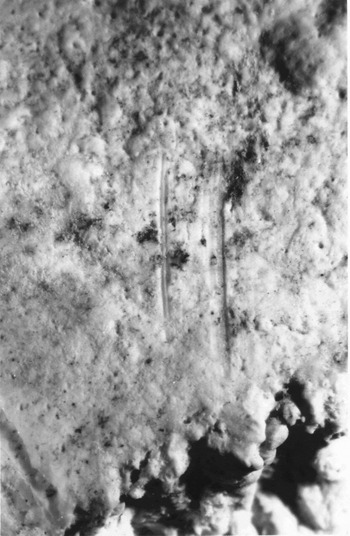
There is no evidence of trauma to suggest a rapid and forceful death for individual 2. The only indication of perimortem trauma is a short gouge on the anterior right parietal bone (Figure 1). The abrasion is slightly posterior to the coronal suture and about 2 cm lateral to the sagittal suture, and it is oriented diagonally forward to the right. It is 1.5 mm wide and 4.9 mm long. Striations in the track suggest a chert or obsidian object. The gouge is deeper and broader posteriorly, attenuating somewhat anteriorly, indicating that the object impacted the head at the posterior point and moved forward, glancing off the bone. Such a blow is unlikely to have caused death, but there is no evidence of healing. There were no stones in the nearby chamber fill of a form and weight to cause such an abrasion, so it was probably the result of a blow from a weapon delivered at or shortly before the time of death. Individual 2 may have suffered it in combat at the time of his capture. However, his bone isotope values suggest that he may have been living in or near Teotihuacan for the later years of his life, raising the question of whether he was taken during warfare or simply selected from the local population, as was the case with many of the Feathered Serpent Pyramid sacrifices (White et al. Reference White, Spence, Longstaffe, Stuart-Williams and Law2002, Reference White, Price and Longstaffe2007). Alternatively, the blow may have been delivered in the course of the sacrifice, perhaps to provoke a flow of blood as part of the ritual. This is plausible in view of another feature of the Burial 2 offering complex. In each of several clusters of material, a bifacially worked obsidian knife had been placed to point vertically to the top of the head of a nearby obsidian human figurine. Saburo Sugiyama and Leonardo López Luján (Reference Sugiyama and Luján2007) interpret these as tableaux of human sacrifice (Sugiyama et al. Reference Sugiyama, Castro and Luján2004:21, Figure 32).
Cut on Individual 2's right parietal. Scanning electron microscope photograph by Alan Noon.

Beyond this perimortem injury, individual 2 has some history of prior trauma. There are compression fractures of the ninth thoracic through second lumbar vertebrae. Since there is no evidence of an infection, the fractures may have had a traumatic origin, such as a fall. Also, there are deposits of new bone on the volar surfaces of the proximal phalanges of the left second and third fingers. The degree of integration points to a traumatic event from two weeks to three months before death (see Walker et al. Reference Walker, Cook and Lambert1997). The left fibula has a large, irregular calcification from the posterior surface of the proximal diaphysis consistent with myositis ossificans. A radiograph shows a breach of the cortex at this point but no evidence of a full fracture. One likely explanation is sharp force trauma suffered some months or years before death.
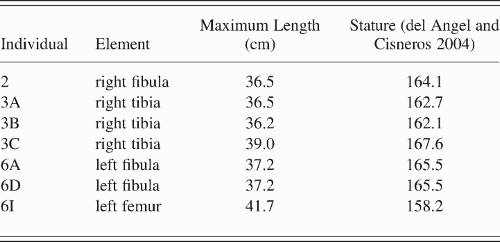
The right fibula of individual 2 is 36.5 cm in length (Table 1), indicating a stature of 164.1 cm, following the formula recommended by Andres del Angel and Hector Cisneros (Reference del Angel and Cisneros2004). The cranium has fronto-occipital (tabular oblique variety) modification. There is no dental decoration. Although tabular oblique modification occurs in Teotihuacan, the tabular erect type is more characteristic of the city (Cid and Torres Reference Cid, Torres, Manzanilla and Serrano1999:321–329; González and Salas Reference González, Salas, Manzanilla and Serrano1999:238–239; Serrano et al. Reference Serrano, Vázquez, de la Calle and Serrano2003:108–109). Some morphological features also set individual 2 apart from the majority of Teotihuacanos (Spence and To Reference Spence and To2000), supporting the foreign origin indicated by the oxygen-isotope values of his teeth (White et al. Reference White, Price and Longstaffe2007). Most notable among these is the presence of a mandibular torus, a feature absent in a sample of 16 individuals from the west part of the city (Cid and Torres Reference Cid, Torres, Manzanilla and Serrano1999:Table 8) and present in only one of 75 individuals from the city center (Spence Reference Spence, Sempowski and Spence1994:Tables 60, 63). Individual A of Moon Pyramid Burial 5, who according to the oxygen-isotope values was not from Teotihuacan (White et al. Reference White, Price and Longstaffe2007), also has a mandibular torus. There are four cases in a sample of 107 sacrificed people from the Feathered Serpent Pyramid, most of whom were not born in Teotihuacan (White et al. Reference White, Spence, Longstaffe, Stuart-Williams and Law2002).
Stature estimates

The greenstone ornaments suggest a person of high rank. There is no dental hypoplasia, indicating a childhood free of any serious or prolonged health stress. There are, however, two Harris lines on the fibula.
A second individual is represented in Burial 2 by a partial adult occipital bone leaning against a Tlaloc vase in the southwestern corner of the chamber, part of one of the peripheral complexes in the feature. It consists of the upper half of the occipital squama, its lateral borders being the left and right lambdoidal sutures with lambda at the apex. The inferior border is a transverse fracture through the bone, apparently done by percussion while the bone was still green, judging by the “peeling” of the cortical surface at one point along the fracture edge (see White Reference White1992:140–143). There are several scraping and cutting marks on the occipital. The majority are aligned sagittaly along the midline of the occipital, but there are also clusters of cuts moving diagonally down toward the midline from each lambdoidal suture. Apparently, the flesh had been stripped from the head before its deposition in the chamber, and probably before the blow that halved the occipital bone.
BURIAL 3
Burial 3 was placed in a pit on the north–south axis of the pyramid. It included four human skeletons as well as animal remains and a variety of other goods. It was created during the construction of Building 5, sometime around a.d. 300 (Sugiyama and Cabrera Castro Reference Sugiyama and Castro2007). There is an important distinction between the Burial 2 and Burial 3 offering complexes. In Burial 2, the human was not the central component of the offering. Individual 2 was at one side of the chamber, which he shared with a number of complete animals, birds, and snakes, as well as two more centrally placed greenstone figurines. Some of the animals were more prominently located than individual 2. In Burial 3, there were four complete humans centrally located in the feature, and the animals were represented by crania rather than complete bodies.
Three of the individuals in Burial 3 (individuals A–C) were resting in the extended position, on their backs, with their heads to the east and feet to the west (Pereira Reference Pereira2000; Sugiyama and López Luján Reference Sugiyama and Luján2007:Figure 4). The fourth, individual 3D, was at the north end of the pit and was also arranged with the head to the east. However, individual 3D was in a tightly flexed position, lying on the left side (and so facing south, toward the other three) and bowed forward, the legs drawn up tightly in front of the torso and flexed at the knees. This position, a contrast to the extended position of the other three, seems to have been a deliberate choice on the part of those arranging the sacrifice. The location of other items in that part of the tomb indicates that individual 3D had been placed in that position rather than assuming it.
All four individuals had their arms crossed behind their backs, indicating that they had been bound like individual 2. However, unlike individual 2, their lower legs were close together, suggesting that they, too, had been tied. Traces of fiber were found by the wrists of individual 3D and the ankles or feet of individuals 3A, 3B, and 3D.
The sequence of their deposition in the pit was evident from a number of overlapping skeletal elements (Pereira Reference Pereira2000). Individual 3C had been placed first, and was nearest the center of the feature. Then individual 3B was placed to his left (south), followed by individual 3A further to the south. The placement of individual 3D in the pit, to the right (north) of individual 3C, followed the placement of 3C but could have been earlier than, contemporaneous with, or later than the placement of individuals 3A and 3B. Unfortunately, large stones in the fill caused considerable damage to the skeletons. Evidence of minor trauma, such as the cranial gouge of individual 2, could not be assessed, and the question of cranial shaping could be addressed only for individual 3C.
Individual 3A was a male, to judge by pelvic criteria. Epiphyseal fusion and dental eruption indicate an age of 20–24 years (Spence Reference Spence2001). Decoration of the maxillary teeth takes a rather curious form. The left canine has a circular hollow for an inlay on the buccal face of the crown, modification E1 in Javier Romero's (Reference Romero1986) system. However, there was no inlay present in the tooth, and none was recovered in the feature. Also, none of the other teeth, including the right canine, had been modified. The right lateral incisor is very reduced in size while the left is normal. The asymmetrical pattern of modification and the failure to find the missing inlay suggest that individual 3A was taken for sacrifice before the operation had been completed. An alternative but less likely explanation is that the procedure was abandoned because of the reduced size of the right lateral incisor; presumably, asymmetry of this size would not have escaped notice that long.
Hypoplasia lines on the canines and second molars indicate three periods of stress in individual 3A's childhood. These can be converted to general ages with the formulae presented by Lori Wright (Reference Wright1997:Table 1), based on a Maya sample. The episodes of ill health occurred at approximately three and six years of age (Spence Reference Spence2001).
Pelvic characteristics indicate that individual 3B was male. The absence of fusion in several elements (e.g., distal ulna and radius) and the fusion still in progress in other epiphyses (e.g., vertebral rings, iliac crest) suggest an age of 18–20 years. There is no evidence of dental decoration, although of the anterior maxillary teeth only the left central incisor is observable in this respect. An extensive set of hypoplasia lines, visible in several teeth, indicate approximately 10 episodes of stress during childhood.
Both pelvic criteria and general skeletal robusticity leave little doubt that individual 3C was male. The auricular surface indicates an age of 40–44 years (Lovejoy et al. Reference Lovejoy, Meindl, Pryzbeck and Mensforth1985). There is no dental decoration. In this case, the cranium was complete enough to identify the presence of plano-occipital modification of the tabular oblique variety, with the flattening more pronounced on the occipital than on the frontal bone. There is no hypoplasia, suggesting a relatively stress-free childhood.
Individual 3D, by far the youngest person in Burial 3, was too young for a reliable sex identification. The components of the innominate had not yet joined. The extensive lack of fusion of long bone epiphyses and the stage of dental development (the second molar root apices have not yet closed) indicate an age of 13–15 years (Brothwell Reference Brothwell1981; Trodden Reference Trodden1982; Ubelaker Reference Ubelaker1989). Poor preservation precludes observation of cranial modification. There is no dental decoration. Hypoplasia lines indicate some eight stress episodes between three and five years of age. Traces of red pigment were observed on part of the calvarium.
A considerable amount of variability in non-metric skeletal and dental traits and the variation in hypoplasia incidences suggest that these four individuals originally came from different backgrounds (Spence Reference Spence2001; see White et al. Reference White, Price and Longstaffe2007). As with individual 2, individuals 3A–C may have had relatively high status. Only individual 3D lacked associated finery.
Of the four, individual 3C was apparently the principal figure. He had been placed first in the pit, was closest to its center, was the oldest of the four, and was notably taller than the others (Table 1). His shell collar and pendants link him to the soldier sacrifices of the Feathered Serpent Pyramid, although the soldiers had no ear ornaments (Sugiyama Reference Sugiyama2005). Individual 3D, in contrast, stands apart from the others by virtue of extreme youth, the flexed position, the application of red pigment to the cranium, and the lack of finery. It seems that individual 3D may have been considered a category of person distinct from that of the other three.
BURIAL 4
Like Burials 2 and 3, Burial 4 was at the pyramid base and on its north–south central axis. It was deposited there early in the construction of Building 6. However, unlike the previous two offering complexes, Burial 4 had no feature constructed to contain it; only heads were present; and there were no ornaments, offerings, or other associated materials. Stones in the overlying fill and the chemical qualities of the soil caused considerable damage to the bones.
There were 17 heads, identified as individuals 4A–Q (Sugiyama and López Luján Reference Sugiyama and Luján2007:Figure 5). An eighteenth individual was apparently represented by a single atlas vertebra, in addition to those recovered from individuals 4A–Q, resting upright between individuals 4L and 4M. There appear to be two clusters represented in the deposit, the northerly including individuals 4E–K and the southerly consisting of individuals 4A–D and 4M–Q. Cranium 4L is situated somewhat ambiguously between the clusters, but when the extra atlas vertebra is taken into consideration, individual 4L seems to be more a part of the southern cluster. However, the reality of these clusters is questionable (see later). The heads of the southerly cluster are strung out in a north–south pattern, placing the most northerly (individual 4L) only 5 cm from the nearest head in the northern cluster (individual 4I). The seven heads of the northern cluster were resting in a rough circle, a pattern that may actually have been due to the presence of a couple of large stones in their center.
The heads had been placed on the fill prior to the decomposition of the soft tissue. The mandibles were all well articulated with the crania and the atlas vertebrae all still present. The hyoid bone was recovered with individuals 4A–D, 4G, 4I, 4L, and 4P. The axis—or, at least, the dens process—was present in individuals 4A, 4C–D, 4F–J, 4L–O, and 4Q. The third cervical vertebra was recovered from individuals 4C–D, 4O, and 4Q, and the fourth from individual 4D (Pereira Reference Pereira2001).
Despite the damage sustained by the bones in the burial environment, cut marks could be seen on several elements. The mandibles of individuals 4H, 4K, 4L, and 4M have cuts on the posterior borders of the rami, probably a result of decapitation efforts initiated from the rear. In addition, the mandibles of individuals 4F, 4I, 4K, and 4L display cuts on the inferior part of the body, apparently from cuts that started at the front and moved upward and posteriorly. Cuts are also present on the inferior part of the occipital squama of individual 4E; the atlas vertebrae of individuals 4E, 4K, 4L, and 4N; the axis vertebrae of individuals 4G and 4I; and the third cervical of individual 4C. Some of these cuts were made by a relatively fine stone tool, perhaps an obsidian blade, while others were probably from a bifacially worked tool. The goal was certainly to sever the head from the body, but it is unlikely that this decapitation was the actual cause of death.
One hyoid (individual 4B) shows an oblique fracture of the unfused right greater horn that, judging by the discoloration of the fracture surface (equal to that of the bone surface rather than lighter), is ancient. It may have been the result of strangulation, though none of the other hyoids recovered in Burial 4 had perimortem fractures. It is possible that the fracture observed in individual 4B was a result of the postmortem manipulation of the head during decapitation.
In five cases (individuals 4A, 4F, 4H, 4L, and 4N), the dens process of the axis vertebra, or the dens and the superior part of the body, was separated from the rest of the vertebral body, which was absent in all but one of these cases. There is some cortical “peeling” (White Reference White1992:140–143) at the line of separation in individual 4N's axis, suggesting that it occurred while the bone was still green. This sort of separation is similar to the “hangman's fracture,” which occurs in high-speed automobile collisions and in judicial hangings where the “long drop” is used (Shkrum et al. Reference Shkrum, Green and Nowak1989; Spence et al. Reference Spence, Michael, Alison and Regan1999). Although neither of these seems a likely mode of sacrifice in ancient Teotihuacan, other causes can create the same effect. A possibility is decapitation that was initiated by first immobilizing the head and then striking the back of the neck with a heavy blow. Then, after the execution, the head would have been severed from the body.
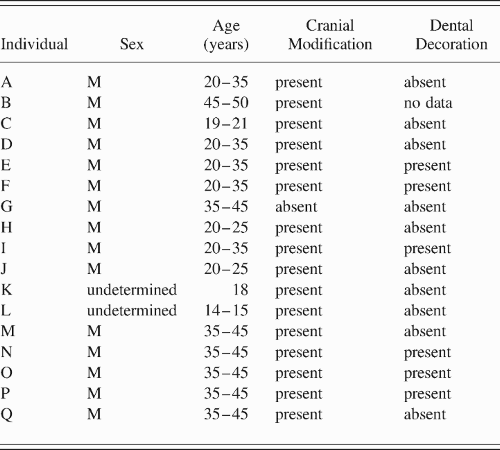
Sex identification, in the absence of most of the postcranial skeleton, necessarily relies on the characteristics of the cranium and mandible (Brothwell Reference Brothwell1981; Ferembach et al. Reference Ferembach, Schwidetzky and Stloukal1979). By these criteria, most of the individuals of Burial 4 were male (Table 2). In two cases (K and L), sex could not be determined. This, however, may be due to their youth; they are the two youngest individuals in Burial 4.
Burial 4 characteristics

Note: M = male.
A considerable age range is included in Burial 4, but most are in the young or middle-age categories (Table 2). The principal criteria include sutural fusion (Meindl and Lovejoy Reference Meindl and Lovejoy1985:Table 3), the development and eruption of the third molars, and the union of the secondary epiphyses of the cervical vertebrae. None of these are perfect methods. Sutural fusion, for example, is affected by cranial modification (White Reference White and Christine1996) and so must be applied with caution in this particular burial, where cranial modification is almost universal. Nevertheless, the age categories used here are broad enough to capture most variation and still allow useful age distinctions.
Despite the fragmentation and postmortem warping, it could be determined that all of the Burial 4 crania except individual 4G had been modified to some degree (Table 2). In five cases (individuals 4A–C, 4E, and 4M), the category of modification was tabular oblique; in four cases (individuals 4K, 4L, 4N, and 4Q), it was tabular erect; and in seven cases, it was unidentifiable. Two crania (individuals 4A and 4K) showed the bilobate variant, with a depressed band running along the sagittal suture. This heterogeneity in cranial modification is what might be expected in a group of individuals of disparate origins (see White et al. Reference White, Price and Longstaffe2007).
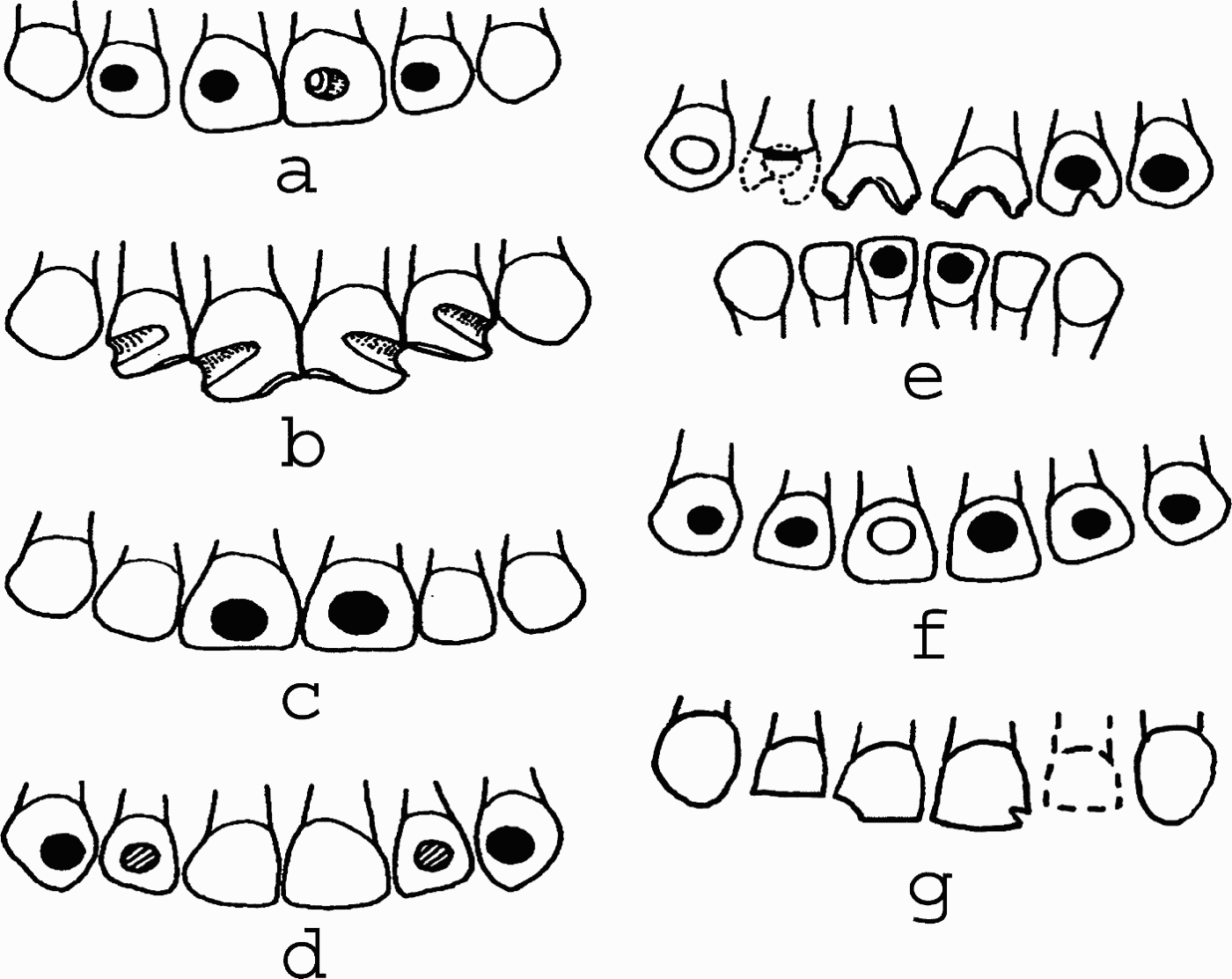
Six of the 17 heads have dental decoration and 10 do not, while in one case (individual 4B) the teeth are too poorly preserved to determine the presence or absence of decoration (Table 2). Of the six with decoration, five involved only the maxillary teeth, and one (individual 4O) also has decoration of the mandibular incisors. A brief description of each follows. The patterns are illustrated in Figure 2.
Dental decoration of individuals in burials 4 and 5. (a) 4E; (b) 4F; (c) 4I; (d) 4N; (e) 4O; (f) 4P; (g) 5C. Solid circle = pyrite inlay; circle with diagonal lines = greenstone/jadeite inlay. Figure by Grégory Pereira.

Individual 4E has inlays (type E1 of Romero Reference Romero1986) in all four maxillary incisors (Figure 2a). Three of the inlays are circular, flat, and of pyrite. Surprisingly, the left central incisor has a small cylindrical jadeite bead lodged in the aperture, an apparently unique variant of type E1.
All four maxillary incisors of individual 4F have been altered by filing (Figure 2b). Each has a broad groove running diagonally halfway across the labial face from the distal corner of the crown. The mesial corners of the central incisors have been removed to create a central groove, making them examples of Romero's (Reference Romero1986) type F2. The incisal edges of the lateral incisors have been filed to make them straight but oblique, rising mesially. This type of decoration has not been included in Romero's system. The only other place in Teotihuacan where type F2 appears is among the sacrifices of the Feathered Serpent Pyramid, most of whom were foreign-born (Serrano et al. Reference Serrano, Pimienta and Gallardo1997; White et al. Reference White, Spence, Longstaffe, Stuart-Williams and Law2002).
Individual 4I has E1 decoration of the maxillary central incisors. The inlays are circular, flat, and of pyrite (Figure 2c).
The central incisors of individual 4N are unaltered, but the lateral incisors and canines have E1 decoration. The inlays of the lateral incisors are of greenstone, while those of the canines are of pyrite. All have convex faces (Figure 2d).
Individual 4O has extensive decoration (Figure 2e). The mandibular central incisors have inlays of flat pyrite disks. The maxillary central incisor crowns have no inlays, but each has a deep central notch in its incisal edge and oblique filing of the mesial and distal corners—Romero's type F11. The left lateral incisor also has a notch in its incisal edge, though without the mesial and lateral filing. It does, however, have a flat disk of pyrite inlaid in its labial face, making it a combination of Romero's types A1 and E1. This particular type is not included in Romero's typology but would probably fall into his category G (Romero Reference Romero1986). The crown of the right lateral incisor had been damaged by a fracture, and the flat pyrite disk is jammed on its side into the exposed pulp chamber, perhaps in a deliberate attempt to seal it. Presumably, it had originally displayed the same decoration as its antimere. The maxillary canines have E1 decoration. The inlay in the left canine is a convex-faced disk of pyrite, while the inlay for the right canine is missing.
Finally, individual 4P has all his maxillary incisors and canines decorated in E1 style (Figure 2f). The inlays are flat pyrite disks, although that of the right central incisor is missing.
Red pigment was noted on the cranium, primarily on the frontal and parietal bones, of every individual in Burial 4 except 4A. This extensive use of pigment is in contrast to previous burials, where the only occurrences were on a parietal bone of individual 3D, the youth in the flexed position in Burial 3, and on the frontal bone of individual 6A.
Although the distribution of the crania suggests two possible groupings, they do not show any consistent distinctions in non-metric traits, cranial modification, or dental decoration. In general, the bone oxygen-isotope values suggest that, rather than being placed as two large clusters, the heads were deposited in several groups of two or three each, their association based on their area of residence in the years before death. This is what might be expected if these were captives taken in a variety of military engagements (White et al. Reference White, Price and Longstaffe2007).
BURIAL 5
Burials 4 and 5 were contemporaneous, dating to about a.d. 350, and were both associated with the initial construction of Building 6. However, while Burial 4 is at the base of the pyramid, Burial 5 was placed in a pit on the midline in the upper platform of Building 5 immediately before it was covered by Building 6. It contained three complete human skeletons, as well as pumas, rattlesnakes, an eagle, and a variety of exotic goods (Sugiyama and López Luján Reference Sugiyama and Luján2007:Figure 7). The distribution of human skeletal elements show that the three corpses had decomposed and collapsed in a largely open environment, one that was shortly afterward filled with large stones and soil entering from above (Pereira Reference Pereira2003).
All three bodies were seated in the lotus (tailor) position, with their hands together in front of them and resting above their feet (Pereira Reference Pereira2003). This is rare in Teotihuacan burials, where the usual position is vertical flexed. It occurs often in pictorial presentations of the Maya elite (Pereira et al. Reference Pereira, Spence and White2004), but it is much less common in Classic-period Maya burials. The main exception is in Kaminaljuyu Mounds A and B, where it is the most frequent position among the principal occupants of the tombs (Kidder et al. Reference Kidder, Jennings and Shook1946).
The three had been placed facing to the west, with individual 5A slightly west of the pit center; individual 5B immediately to the south of 5A; and individual 5C a little farther apart, to the northeast of 5A (Sugiyama and López Luján Reference Sugiyama and Luján2007). However, just to the east of individual 5A—and so in the center of the pit—was a greenstone figurine associated with ornaments much like those worn by 5A and 5B. It may be that this figurine represents a fourth individual who was equivalent in rank to the others (Sugiyama and López Luján Reference Sugiyama and Luján2007; Sugiyama et al. Reference Sugiyama, Castro and Luján2004:28).
Individual 5A had been placed in the feature before 5B, but the slight separation of individual 5C does not allow us to place him in the sequence. Clearly, all three had been deposited in the feature at roughly the same time. It seems unlikely that three eminent personages all suffered death simultaneously through natural causes, so at least two of them, and perhaps all three, may have been sacrificed (Pereira Reference Pereira2003; see also the discussion in Sugiyama and López Luján Reference Sugiyama and Luján2007). In contrast to the sacrifices in Burials 2 and 3 and to those of the Feathered Serpent Pyramid, those in Burial 5 did not have their hands tied behind their backs. However, their hands were together in front of them, crossing one above the other at the level of the distal radii and ulnae, carpals, or metacarpals. This positioning suggests that they may have had their hands bound in front of them. While the hands of individuals 5A and 5B rested with the palms down, the right hand of 5C was palm up. It is interesting to note that the greenstone figurine, representing a possible fourth individual, is also in the lotus position but with the hands resting apart on the thighs.
The ornaments associated with individuals 5A and 5B are rich and very similar, but there are still some subtle differences between the two (Pereira Reference Pereira2003). Individual 5C is also richly attired, though with somewhat different items and materials. He also had a wood baton resting along his right forearm (Pereira Reference Pereira2003). This might explain the palm-up position of his right hand. Red pigment had been liberally applied to the corpses of individuals 5A and 5B. It was concentrated primarily on their faces and limbs but was absent from their torsos. Apparently, this was done after they had been placed in the lotus position. However, the only red pigment on individual 5C was a small spot on the right ilium. It had been accidentally transferred there from an element of the attire that rested on the ilium; none had been deliberately applied directly to the body.
Pelvic criteria indicate that all three skeletons are male. Age was determined largely on the basis of auricular surface morphology, supplemented in some cases by pubic symphysis and sternal rib morphology (Loth and İşcan Reference Loth, İşcan and İşcan1989; Suchey and Katz Reference Suchey, Katz and Kathleen1998). Individual 5A was 50–70 years old, while 5B was 40–50, and 5C was 40–45. Although the estimated age ranges of 5B and 5C overlap to some degree, dental wear and auricular surface morphology suggest that individual 5C was probably somewhat younger than 5B (Pereira Reference Pereira2003).
Despite the poor condition of the remains, it was possible to determine that individuals 5A and 5B lacked cranial modification and dental decoration. Unfortunately, individual 5C was too poorly preserved to evaluate the possibility of cranial modification. There is, however, decoration of the maxillary incisors (Figure 2 g). The central incisors follow Romero's (Reference Romero1986:Figure 1) type B5, with small notches filed in the distal corners of their incisal edges. The right lateral incisor displays Romero's A4 type of decoration, the incisal edge filed evenly across to raise it to the level of the top of the notch in the adjacent central incisor. Although the left lateral incisor was not recovered, it is assumed that it was similar to its antimere.
Individual 5A has only a single line of hypoplasia, while 5B has none. Individual 5C, however, has several. Five or six stress episodes are indicated between the ages of two and five.
Individual 5C stands apart from 5A and 5B in several respects: his slightly younger age, his attire, his somewhat separate location in the pit, the wood baton he held, his dental decoration, the absence of deliberately applied pigment, and his history of childhood health stress. It is not entirely clear which of these differences should be assigned significance and which merely represent minor variations, or whether individual 5C's social position or political rank was higher or lower than those of 5A and 5B. However, some of the contextual data suggest that individual 5A may have been superior to the other two, and individual 5C the most inferior of the three (Sugiyama and López Luján Reference Sugiyama and Luján2007). Despite these differences, our overall impression is that individual 5C was not a fundamentally distinct category of person—that is, whatever gap in status existed between individual 5C and the other two was one of degree rather than of kind. The real gap in status is between these three and the contemporaneous individuals of Burial 4.
BURIAL 6
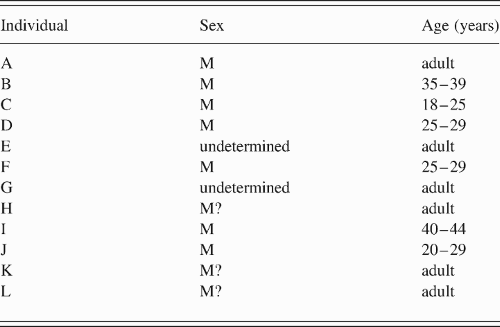
Burial 6 is contemporaneous with Burial 3, dating to the start of construction of Building 5 about a.d. 300 (Sugiyama and Cabrera Castro Reference Sugiyama and Luján2007). The twelve individuals in the burial all had their hands bound behind their backs (Sugiyama and López Luján Reference Sugiyama and Luján2007:Figures 10–11). Two (individuals 6A–B) were complete skeletons, buried in elaborate regalia. The other ten (individuals 6C–L) were without finery, had been decapitated, and were unceremoniously piled together (Pereira and Chávez Reference Pereira, Chávez, Sugiyama and López Luján2006; Pereira et al. Reference Pereira, Bustos, Chávez, Alfaro and Nuñez2005). All of the Burial 6 individuals whose sex could be identified were male, although the identifications of individuals 6H, 6K, and 6L are based solely on the size and robustness of their long bones (Table 3). Individuals 6E and 6G were too poorly preserved to attempt a sex identification. Six individuals could be assigned only to a broad “adult” age category, and the more precise age assignments of the others were generally based on a single criterion, usually auricular surface morphology (Lovejoy et al. Reference Lovejoy, Meindl, Pryzbeck and Mensforth1985).
Burial 6 characteristics

Note: M = male.
Individuals 6A and 6B were differentiated from the rest by their spatial separation from the others, their more formal positioning, their regalia, and the fact that they had not been decapitated. Individual 6A is an adult male, somewhat older than 6B, judging by dental wear. He has rather marked fronto-occipital modification of the tabular oblique variety. Dental decoration is absent. There are spots of red pigment on the frontal bone.
Individual 6B, also male, was about 35–39 years old at death, judging by the morphology of the auricular surface (Lovejoy et al. Reference Lovejoy, Meindl, Pryzbeck and Mensforth1985). There was no cranial modification and no trace of red pigment on the bones. However, individual 6B does display elaborate dental decoration. The mandibular left incisors and canine have wide V-shaped notches in their incisal margins, Romero's (Reference Romero1986) type A1. On the right side, the canine is similarly notched; the lateral incisor is missing; and the medial incisor has not been altered. We are at a loss to explain this asymmetry in decoration. However, even though the asymmetry is focused on the medial incisors, it would not have been visible to the casual observer.
An unanticipated byproduct of this extensive alteration was the introduction of caries and the formation of abscesses. The caries occur at the base of the notch in all four of the recovered notched teeth and have led to apical abscesses opening bucally beneath the right canine, the right medial and lateral incisors (which share a common abscess pocket), the left medial and lateral incisors (also with a shared pocket), and the left canine and first premolar (a shared pocket). The loss of the right lateral incisor was probably antemortem, a result of this infection. Furthermore, the distal border of the notch in the left medial incisor had broken off antemortem, with some subsequent rounding and smoothing of the fracture surface.
On the maxilla, the medial incisors also have A1 alteration, although in this case the notches have broader, more rounded bases. The lateral incisors and canines all have convex-faced greenstone inlays. In the canines, these have been offset mesially on the buccal surface of the tooth to maintain a balance with the missing (filed away) distal corner of the crown. The lateral incisors are thus of Romero's (Reference Romero1986) type E1; the canines, his type G2. In contrast to the mandible, there are no caries or abscesses on the maxilla.
The right coronoid process of an additional adult mandible, from someone other than individuals 6A or 6B, was recovered from the vicinity of individual 6B. It is a small piece of bone, only 23 m × 13 mm, so its placement here may not have been deliberate, in contrast to the occipital bone in the Burial 2 chamber and the extra atlas in Burial 4. The extensive “onion skin” layering of new bone on the coronoid process indicates an infection that apparently was still active at the time of death. The poor condition of the fragment does not allow us to say precisely how it was separated from the rest of the ramus. It is possible that the separation was a result of a blow (Galloway Reference Galloway1999:Figures 3–7, A-4) that took place in combat some time before death, with subsequent infection of the area. If this was the case, the question remains of how the fragment came to rest here. One possible explanation comes to mind. Maxilla pendants cut and shaped from the faces of defeated enemies adorned some of the sacrificed soldiers of the Feathered Serpent Pyramid (Spence et al. Reference Spence, Michael, Christine, Fred and Law2004), and shell imitations of human maxillae were worn by many more of them, as well as by Moon Pyramid victims 3C and 6B himself (Sugiyama Reference Sugiyama2005; Sugiyama and López Luján Reference Sugiyama and Luján2007). A real maxilla pendant was also found in the fill of structure 44:N4E1 of the Moon Plaza, suggesting their use in contexts other than the Feathered Serpent Pyramid. Perhaps, then, similar pendants were cut from the faces of individuals 6C–L after their decapitation, and the right coronoid process of one of these victims, separated either by cutting or by earlier trauma, was discarded with the associated soft tissue during the process.
Individuals 6C–L were young to middle-age males, at least in those cases where age and sex identification proved possible (Table 3). Although a variety of antemortem injuries and infections were noted, there is also one case of perimortem trauma. The left humerus of individual 6D has a 10 mm long unhealed defect across the medial side of the posterior surface, just above the distal metaphysis. It is 6 mm deep, with a width of 2 mm. Its dimensions, the presence of radiating fracture lines, and the absence of internal striae show that the defect resulted from a blow from an edged weapon rather than from perimortem or postmortem cutting. It probably would not have caused 6D's death, but it may indicate some conflict shortly before or at the time of death.
FILL MATERIAL
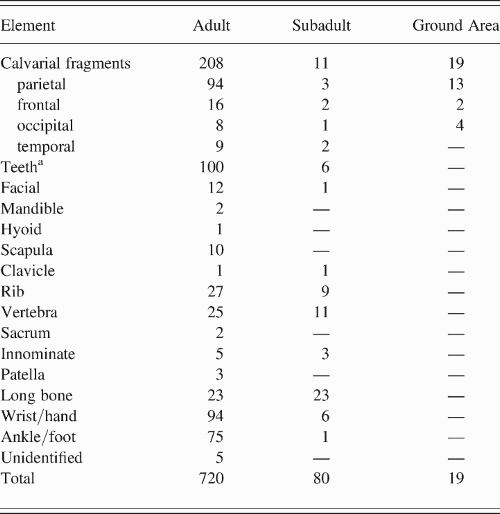
In the course of the excavations in and near the Moon Pyramid, 800 isolated and fragmented human skeletal and dental items were recovered from construction fill (Table 4). The majority of these are probably displaced remnants of Teotihuacan burials that had been accidentally disturbed and incorporated in the fill during the construction of the various versions of the pyramid. Rebecca Storey (Reference Storey1992:131, 134–136) has noted a similar phenomenon in the Tlajinga 33 apartment compound.
Human skeletal fragments from the fill

aPermanent teeth, if fully developed, are treated here as adult; deciduous teeth are subadult.
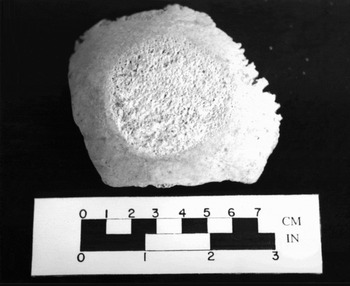
However, the number of calvarial pieces is surprisingly high at nearly half the total number of skeletal elements. This bias suggests that other factors may have been at work. Several of the calvarial fragments (Table 4; Figure 3) have flattened circular areas of grinding on the external surface of the bone. These range from 28 mm to 64 mm in diameter, with a mean of 48.9 mm. At least 11 different adults, including both males and females, are represented. The grinding flattens the surface of the bone, sometimes reaching through to the internal table and, in a few cases, even perforating it. This treatment is most common on the parietal bone, although it also occurs on the frontal and occipital. Sometimes there are two ground areas on the same bone, occasionally intersecting each other at an angle. Because of the fragmentation, it is difficult to estimate the frequency of this treatment, but of those parietal fragments complete enough to determine its presence or absence, nearly half display it.
Cranial fragment with ground area. Figure by Alec Miller.

Similarly treated cranial elements were found dispersed in the area of the La Ventilla 1992–1994 excavations (Abigail Meza Peñaloza, personal communication 2005). Another occurrence of this treatment in Teotihuacan is in a Great Compound deposit reported by J. Rodolfo Cid and Arturo Romano (Reference Cid and Romano1997). Five parietal and frontal fragments with ground areas, representing at least three adults, were found with some fragmented fine ceramics. This feature is reminiscent of the “Problematic Deposits” of Tikal, extensive deposits in pits of disarticulated human bones, fragmented ceramic vessels, stone artifacts, faunal remains, and other materials, usually including numerous luxury and ceremonial goods (Iglesias Reference Iglesias and Braswell2003). Some of the human cranial fragments have ground areas identical to those of the Moon Pyramid and Great Compound (Iglesias Reference Iglesias and Braswell2003:185; Laporte and Fialko Reference Laporte, Fialko, Clancy and Harrison1990:62, Figure 3.24). The consensus is that these cranial pieces had been used to abrade or polish other materials (Cid and Romano Reference Cid and Romano1997:141; Iglesias Reference Iglesias and Braswell2003:185; Laporte and Fialko Reference Laporte, Fialko, Clancy and Harrison1990:62). Juan Pedro Laporte and Vilma Fialko add that they were probably taken from sacrificial victims. Another possibility is that the calvaria were being prepared for use as receptacles, with the ground areas serving as flattened bases. This seems unlikely, since some of those from the Moon Pyramid were actually perforated by the grinding and some had two ground areas intersecting at an angle.
The ground pieces in the Moon Pyramid are not clustered; they are scattered widely through the fill. Moreover, they are not associated with other items, luxury or otherwise. They are not, then, parts of larger ceremonial deposits—at least, not as found. Oxygen-isotope values from four of them indicate that two are foreigners and two may have been from the Teotihuacan area (White et al. Reference White, Price and Longstaffe2007). There are two possible explanations for their presence. One is that they were indeed taken from sacrificed people, used in some sort of ritual that led to the creation of the ground areas (either by directly grinding the bone or by using it to grind some other material), then deliberately scattered through the fill. The heads missing from Burial 6 can be seen to add some weight to this explanation, but it would still be necessary to explain what had happened to the mandibles, facial elements, and cervical vertebrae also missing from Burial 6. The numbers of these recovered from the fill are very small compared with the calvarial elements. The earlier Burial 4 evidence suggests that we are more likely to find the missing heads deposited together elsewhere in the pyramid. An alternative explanation is that these ground elements were originally parts of ceremonial deposits such as the one in the Great Compound but were unwittingly disturbed, gathered up, and incorporated into the pyramid by workers collecting fill for the construction. Further analyses—in particular, a more detailed study of their distribution in the fill—may help to resolve the issue.
CONCLUSIONS
Although each of the prior versions of the Moon Pyramid was a distinct structure in its own right, together they may represent a single, evolving institution. All of the sacrificial victims for whom sex identification was possible were male. Ages ranged from the early teens (3D) to late middle–old age.
The earliest human sacrifice, individual 2, was placed against one wall of the chamber, while other elements of the offering complex were more prominently displayed (Sugiyama and López Luján Reference Sugiyama and Luján2007). In subsequent burials, the human victims played more central roles in the offerings and showed some internal differentiation. There seem to have been two main categories, one consisting of decapitated victims with no associated finery (Burials 4, 6C–L) and the other of complete skeletons with finery and with some evidence of internal distinctions (Burials 3, 5, 6A–B). Individual 3D, for example, is clearly differentiated from 3A–C by being much younger, having a flexed burial position, and lacking finery, although it is difficult to say whether this reflects an age distinction or some more enduring status. There are also differences in age, placement, and finery among 3A–C, 5A–C, and 6A–B. In fact, age seems to have been correlated with status among all of the Moon Pyramid burials, as it was in the Feathered Serpent Pyramid (Serrano et al. Reference Serrano, Pimienta and Gallardo1991). Not only was the youngest Burial 3 individual (3D) the least important person in the sacrifice, but the principal victim (3C) was the oldest. In Burial 5, the youngest individual (5C) was differentiated from the other two in location and attire, although the nature of these distinctions is not entirely clear and the age differences are not great.
Of the two main categories, it would seem logical to identify the decapitated victims as lower in status, perhaps most comparable to the individuals whose maxillae formed the pendants worn by some Feathered Serpent Pyramid victims (Spence et al. Reference Spence, Michael, Christine, Fred and Law2004). Although there is some overlap, the decapitated victims on the whole are younger than the others. However, this is not to say that they form a homogeneous category of low status. The treatment that these victims received from the Teotihuacanos may have obliterated some important status distinctions that would have been recognized in their homelands. Although they were perhaps not of the same elevated status as the other victims, the residential relocations indicated by their oxygen-isotope values and the elaborate nature of some of their dental decoration suggest that they were more than simple rural farmers.
There is also the question of “symbolic” sacrifices. In some of the burials, there were bones or objects that may have been intended to symbolize the presence of additional individuals. In Burial 2, an incomplete occipital bone was associated with a Tlaloc vase. The obsidian human figurines of Burial 2 may also have represented sacrificial victims (Sugiyama and López Luján Reference Sugiyama and Luján2007). The additional atlas vertebra of Burial 4 suggests the inclusion of an eighteenth person there. In Burial 5, the greenstone figurine may symbolize a fourth elite individual. The extra mandibular piece in Burial 6, however, is better explained as the result of the manufacture of a maxilla pendant from the face of one of the 10 decapitated victims.
The topic of human sacrifice in Teotihuacan has been explored by a number of investigators (e.g., Cabrera Castro Reference Cabrera Castro, Manzanilla and Serrano1999:523–533; Gómez Reference Gómez and Cardós1990; González and Salas Reference González and Salas2001). Most conclude that some version of it was practiced even in domestic contexts such as the apartment compounds, though some have noted that these interpretations are often problematic (Gómez Reference Gómez and Cardós1990:148–149, 152; Spence and Gamboa Reference Spence, Gamboa, Manzanilla and Serrano1999:178–179, 187–189). A wide variety of situations can be confused with human sacrifice: the recovery and burial of kin killed in combat or sacrificed by enemy groups; overlooked remains in graves that were exhumed; skeletal elements from graves that were accidentally disturbed; ancestral relics included in the burials of their descendants or placed as dedication or termination offerings in propitious locations; people who died while far away; trophies taken in war; executed criminals; and normal burial practices, such as the interment of infants in or near altars (Spence and Gamboa Reference Spence, Gamboa, Manzanilla and Serrano1999:188–189). To distinguish among all these possibilities, the burial context, associated materials, and bones themselves—the location and function of cut marks, evidence of trauma, missing elements—must be carefully examined. Among the Aztecs, as in many early states, human sacrifice was the prerogative of the state (Berdan Reference Berdan1982). Any suggestion of it in domestic contexts, then, requires detailed and critical examination. Very few of the examples advanced to date in Teotihuacan are convincing (but see Manzanilla Reference Manzanilla2006:29, 32, Figure 9, for a possible case).
Given state control over human sacrifice, more credible evidence of the practice would be expected in public contexts. Indeed, the most striking examples in Teotihuacan are from the great public structures in the center of the city (Sugiyama Reference Sugiyama2005). Cases may also be found in some of the more peripheral temples, most of which were apparently linked to the central zone, perhaps as outlying administrative centers (Cowgill et al. Reference Cowgill, Altschul, Sload and Harold1984).
A variety of sacrificial patterns have been identified in the central zone, each perhaps tailored to the nature and function of the institution with which it was associated. The Pyramid of the Sun, not yet well known in this respect, had subadult sacrifices at the corners, although one adult male was associated with a later addition (Sempowski Reference Sempowski, Sempowski and Spence1994:46–47; Spence Reference Spence, Sempowski and Spence1994:350–351). The Feathered Serpent and Moon Pyramid victims, however, were all teenagers or adults. But there are differences between and within these two structures. Sugiyama (Reference Sugiyama2005:235–236; Sugiyama and López Luján Reference Sugiyama and Luján2007) suggests that the Feathered Serpent Pyramid celebrates the inauguration of a Teotihuacan ruler while the Moon Pyramid is linked to a deity or supernatural force. This may explain the contrast in the treatment of the young adult males at each site. Those at the Feathered Serpent Pyramid wore elaborate military regalia, were carefully placed in rows around the structure, and have bone oxygen-isotope values indicating long-term residence in the region before their sacrifice. (Sugiyama Reference Sugiyama2005; White et al. Reference White, Spence, Longstaffe, Stuart-Williams and Law2002). They appear to have been Teotihuacan soldiers protecting their ruler. In contrast, the young men of Moon Pyramid Burials 4 and 6 were without regalia or offerings, had been decapitated, and were deposited casually, even contemptuously. Their bone oxygen-isotope values indicate that they were never residents of the Teotihuacan region (White et al. Reference White, Price and Longstaffe2007). They were probably captured enemies who were deprived of any symbols of their identities and killed in what might be identified as simply executions, were it not for the undeniably sacred nature of the context. Their perceived function may have been nourishment rather than protection. The other Moon Pyramid victims—those who were not decapitated—display a great deal of variety and may be more comparable to the victims in the central and corner burials of the Feathered Serpent Pyramid (see Sugiyama Reference Sugiyama2005).
Acknowledgments
We particularly thank Saburo Sugiyama and Rubén Cabrera Castro for the opportunity to work with the Moon Pyramid Project and for their help throughout it. The Instituto Nacional de Antropología e Historia of Mexico granted permission to export samples to Canada for isotopic analysis. We are also grateful to Christine D. White and Fred Longstaffe of the University of Western Ontario for the isotopic analysis; to Dori Rainey for statistical analysis of Burial 4; and to Lori Wright for telling us about the ground cranial elements at Tikal. Our work was funded by an Alumni Research Award of the Faculty of Social Science, University of Western Ontario, and by UMR 8096 “Archéologie des Amériques,” Centre National de la Recherche Scientifique, as well as by the numerous grants that supported the Moon Pyramid Project. Finally, we wish to acknowledge the patience and skill of a number of people who assisted in the excavation of the bones: Martha Alfaro Castro, Diana Bustos Ríos, Ximena Chávez, Jorge Martínez Herrera, Luis Nuñez Enríquez, Teresa Rodrigues, Laura Roldán, Juan Alberto Román Berelleza, and Denise To.